




Abstract
There are increasing external pressures on 21st-century universities to be engines of economic recovery and growth. In this rapidly altering landscape, how university senior leaders articulate the purpose of university education and the contribution of academic developers to fulfil these education purposes is a matter of empirical interest. Senior leaders and academic developers have particular responsibilities since they impact educational quality at an institutional level. Senior leaders are responsible for orienting their institutions, giving direction to colleagues in the process, while their implicit leadership theories animate effort and interactions. Academic developers are employed to provide educational programmes for academics to develop their pedagogical competence, and are increasingly deployed by university leaders to implement new quality assurance systems. Such responsibilities strongly suggest agency and relative autonomy to forge new alliances and collaborative networks where these did not previously exist; they are simultaneously required to be leaders and followers. Consequently, the portfolios of academic developers have expanded exponentially, strategically walking a tightrope between the potentially coercive message of strategic missions and the relative autonomy of academic staff, brokering new horizons of university education in a collegial, collaborative and horizontal manner. The paper captures the dynamics of leading education in four universities: the brokering responsibilities of academic developers.
Keywords
Introduction
Teaching and learning, a core mission of universities, has gained increased attention in the European Higher Education Area (EHEA) since the initiation of the Bologna process in 1998. External stakeholders have articulated more explicit requirements of 21st-century universities to develop programmes that are more transparent and aligned with transnational common standards for higher education such as those defined in the European Qualification Framework, while being more cognisant also of the graduate employment market (Deem, 2001, 2008; Karseth and Solbrekke, 2016). Public universities are increasingly expected to become more student-centred and entrepreneurial, and to collaborate more closely with employers in the public and private sectors, sometimes through public–private partnerships, and to render research into commercial enterprises (Barnett, 2016: p. 397; Stensaker, Bilbow, et al., 2017).
While the first decade of the Bologna process paid particular attention to structural reforms of programmes, the second decade is increasingly concerned with how universities may transform their pedagogies and teaching approaches within restructured programmes (Paris Communiqué, 2018). At a moment when Europe is facing important societal challenges, including unemployment, social inequality, migration-related issues, and an increase in political polarisation, radicalisation and violent extremism, politicians expect higher education to play a decisive role in providing solutions to these challenges (Gaebel et al., 2018). In this rapidly changing and febrile landscape, politicians expect public universities to offer students and other learners opportunities for lifelong personal development, to enhance their prospects of employment and to encourage their active citizenship in democratic societies.
In asserting such expectations for higher education, politicians have intruded more radically into universities’ pedagogies by means of reporting mechanisms For example, the Norwegian White Paper on quality culture in higher education (Norway, Ministry of Education and Research, 2016–2017: 1) states: ‘the Government will provide more of the tools and guidelines required to raise the quality in higher education’, arguably an erosion of institutional autonomy. The White Paper continues that ‘educational quality must be the responsibility of the academic environment as a whole, including the academic leadership’. Such statements indicate that politicians expect university leaders to engage more systematically with the improvement and transformation of teaching and learning (Robson & Wihlborg, 2019; Stensaker, Van der Vart, et al. (2017); Wallace et al., 2011).
The most recent Trend report on European higher education (Gaebel et al., 2018) 1 indicates that the quality of teaching and educational leadership is high on the agenda of many universities and is thus a matter of importance for leaders as well as ADs, those hired to transform teaching, and to support teachers and leaders in pedagogical matters. More than 85% of the institutions have developed teaching and learning centres, 50% have established formal requirements regarding teaching experience, and 77% provide academic development courses of which 37% are compulsory. There is increasing recognition of the relationship between university leaders’ priorities and the possibilities for transforming and developing education (Gaebel et al., 2018: 6–9), as well as strengthening educational leadership in most universities (Stensaker, Van der Vart, et al. 2017).
Against this backdrop, how university leaders talk about the mission of higher education (Barnett, 1990), and how they expect ADs in particular to fulfil these educational purposes, is a major interest and focus. While the quality of university education is a relational phenomenon, complex and unpredictable, and contingent on the contributions of – and interplay among – students, academic and administrative staff, we have chosen to interrogate how university leaders see the roles and responsibilities of ADs. ADs are receiving more attention, have grown in numbers in most universities and are increasingly called upon by university leaders to implement teaching reforms, provide university pedagogical courses and to be consultants for educational leadership at different levels (Stensaker, Van der Vart, et al. 2017; Sugrue et al., 2017). Thus, how university leaders talk about ADs’ roles and responsibilities within their organisation is a matter of empirical significance, not only for university leaders and ADs, but extends also to understandings of what counts as educational quality both at an institutional level and in teaching practices.
University leaders are responsible for orienting their institutions to fulfil the general mission of university education, and their enactment of leadership provides direction to colleagues as to how orientations are to be accomplished (Sutphen et al., 2018). They orchestrate the creation of strategic plans and allocate resources to strategic priorities, with consequent implications for both structures and cultures of the working and learning environments. How they talk about and undertake these responsibilities are indicative of their implicit leadership theories (ILTs). From a distributed leadership perspective (Spillane, 2006), one espoused by many universities (Youngs, 2017), how university leaders envisage and talk about the roles and responsibilities of ADs will inevitably influence ADs’ leadership agency to fulfil their responsibilities to contribute to the mission of university education. How ADs’ ‘read’ these leadership and orientation scripts shapes how they live out the mission of higher education in practice when providing courses in educational leadership and university teaching (Fremstad et al., 2019; Grunefeld et al., 2017; Stensaker, Van der Vart, et al., 2017). In contemporary universities, as the portfolios of ADs have expanded exponentially, they walk a tightrope between the prescriptive and potentially coercive messages of strategic missions and the relative autonomy of academic staff. They navigate along two axes of influence – vertical,
taking cues from ‘the top’, and horizontal, in a more collegial and collaborative manner with academic and administrative colleagues while continuously brokering power relations and the relative autonomy it is possible to negotiate within this dynamic force field of competing and sometimes conflicting interests and priorities. To understand the dynamic interplay between institutional leaders’ articulated visions for their universities and their accounts of the possible contributions of ADs to promote their organisational purposes, data are provided by interviews with four university leaders in four Scandinavian universities, part of a larger study on formation and competence building of academic developers. 2 Though mindful of the limited data set and the geographical location of the four institutions, we are confident nevertheless, particularly in light of the Trend report data cited above, that the analysis and discussion will yield insights and understandings with significance for leaders and ADs in other settings. Towards this end, the research questions are:
How do university leaders describe the university mission in contemporary society?
How do they describe the roles and responsibilities of ADs in contributing to the realisation of this mission?
The paper is in five parts. First, we provide a brief summary of dominant university ‘orientations’. Additional elements of our analytical approach are ILTs as well as the ‘brokering’ role increasingly expected of ADs. Second, we describe the abductive insider and outsider approach used in data gathering and analysis. Third, we combine very brief institutional descriptions of the universities included in our analysis with ‘portraits’ of the SLs and their responses to our research questions. Fourth, these portraits are discussed critically, beginning with the orientations implied, the leadership intimated, and the roles and responsibilities of ADs articulated within such orientations and ILTs. Fifth, the paper concludes that the brokering role of ADs, as they exercise their responsibilities, is shaped considerably by context, and in particular the mission of the university as articulated by SLs and how, within that, the agency of ADs is further influenced by the ILTs of their respective institutional leaders. Such contextualised understandings are necessary to enable ADs to develop leadership brokering capacities that embrace their own and others’ ILTs, in ways that empower them to move beyond the assertion that ‘context matters’.
Analytical approach
The analytical approach deployed here has emerged abductively (Alvesson and Sköldberg, 2000) through our engagement with both theory and data. As indicated above, this study, part of an ongoing international project, has enabled us to develop theoretical concepts that have been particularly useful for analyses of university leaders’ interview data. The concept ‘university orientation’ inspired by Barnett (2011) and Sutphen et al. (2018) has enabled us to gain insight into how mission statements, as expressed in interviews with university leaders, and subsequently analysed by us, provide evidence of a dialectic relationship between leaders’ perspectives and their university orientations. Emerging from this analysis also was the existence of university leaders’ ‘implicit leadership theories’ (Eden and Leviatan, 1975) that, in turn, have implications for the roles and responsibilities of ADs, and how they are positioned as well as the manner in which they act as ‘brokers’ (Brew and Cahir, 2014) in their respective organisations. These concepts are briefly elaborated on immediately below.
University orientations
Although often opaque and written by committees of SLs, strategic plans are nonetheless public documents describing the purposes a university has defined for itself, ideals, general goals, and lightly described strategies. Previous analysis of such plans in a variety of universities enabled us to identify four prominent orientations: traditional, scientific, entrepreneurial and bureaucratic (Sutphen et al., 2018). Institutions do not conform to a pure type. Rather, orientation boundaries are porous, enabling universities to project multiple orientations simultaneously – appealing to as well as appeasing different stakeholders. Nevertheless, institutions give priority to some orientations more than others. Figure 1 provides a summary statement regarding the dominant characteristics of four orientations and their underpinning values commitments.
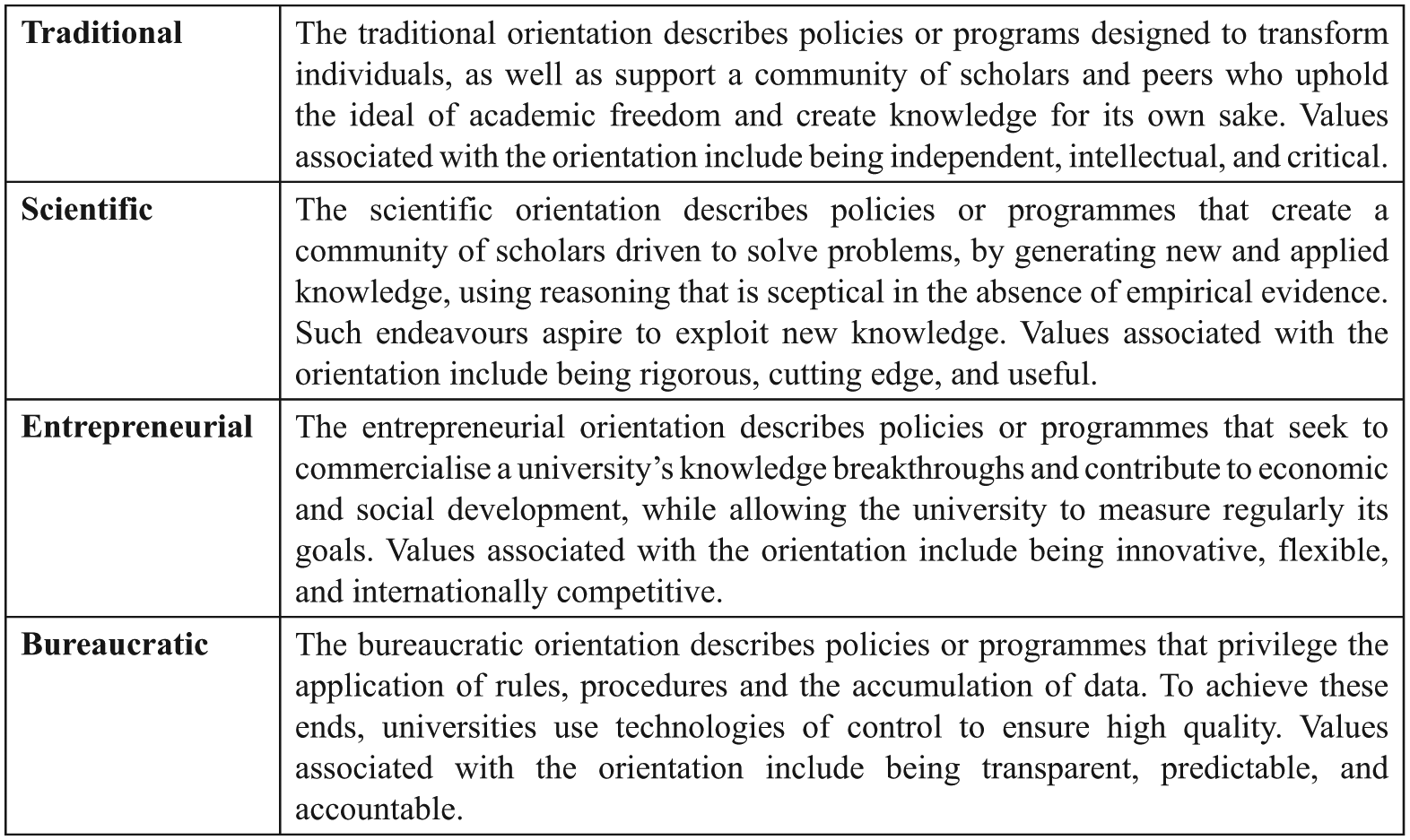
Four university orientations: Characteristics and underpinning values.
While these are not exhaustive, they provide a useful lens through which to interrogate SLs’ responses to our first research question.
Implicit leadership theories
Since Eden and Leviatan (1975) introduced the concept of ‘implicit leadership theories’, more recent work has sought to advance it from a variety of perspectives. Henkel (2002: 40) concluded that ‘[t]here is as yet little systematic training for academic leadership. There are no “scripts” for these roles, and the burden is largely on the individual to define and find their “texts” for themselves’ (40). Such influences enable Bennis and Nanus (1985: 21) to assert that ‘leadership is like the Abominable Snowman, whose footprints are everywhere but who is nowhere to be seen’ (quoted in Bolden et al., 2008: 358); influences that are described as ‘lay images of leadership, which are individually and socially determined’ (Schyns et al., 2011: 397) while ILTs also ‘develop early . . . children already have [them]’ while ‘they remain relatively stable when the context changes’ (Schyns et al., 2011: 399). Birnbaum (1989: 130) concluded, based on analysis of interviews with 32 SLs in colleges and universities, that ‘[c]ollege and university presidents in general define leadership as a process of influence directed towards the achievement of goals’ (italics in original). The extent to which ILTs may be perceived as effective or otherwise may be determined by how ‘followers’ perceive the observed ILTs of a leader; more likely to be perceived as ‘effective’ if the ADs’ own ILTs resonate with those of the leader. As part of the abductive approach, ILTs emerged as being significant.
The brokering role
Research indicates that in ‘research intensive’ universities, academics are increasingly expected to ‘account’ for quality teaching, as well as being ‘research productive’, and ADs are progressively being called upon to be ‘brokers’ (Brew and Cahir, 2014). Such responsibilities strongly suggest agency and relative autonomy to forge new alliances and collaborative networks, to reach out and create common ground and mutual interest where these did not previously exist. Consequently, ADs are increasingly expected to have a broad perspective on the university landscape, to ‘approach new initiatives with an element of detachment’, and while they will continue to be knowledgeable about teaching and learning, their leadership remit will also extend to challenging the ‘underlying assumptions about the role of the higher education teacher . . . and the role and function of universities and how these relate to broader societal trends’ (Brew and Cahir, 2014: 350). ADs’ work, however, varies enormously from one institutional context to another, and these contextual disparities have been absent to a significant extent from international publications on ADs’ roles and responsibilities (Sugrue et al., 2017).
Methodology
The four interview transcripts analysed here are part of a much larger data set generated in the formation research project indicated above. We agreed to interview the most appropriate senior leader (Vice-Chancellor or Pro Vice-Chancellor for Learning and Teaching) in each university, and the insider in each made the necessary arrangement. The interview schedule was constructed with reference to literature on ADs’ work, and experiences of ADs as ‘insiders’ in each setting, as well as appropriate attention to the objectives of the study. The interviews were led by an ‘outsider’, a researcher member of the research team, but with the presence and participation of an institutional insider. In this manner, if there were issues of language, or contextual factors overlooked by the outsider or about which he was unaware, the insider interjected in the process as a means of gaining a more complete response to questions. This insider–outsider approach had been deployed to good effect previously by research team members (Solbrekke and Sugrue, 2014).
Interviews lasting between 55 and 90 minutes were completed in the offices of the leaders in the spring of 2016 and were recorded and subsequently transcribed. The outsider interviewer analysed each transcript working abductively, writing interpretative text in parallel to the transcript (Alvesson and Skolberg, 2000). These texts were shared with each insider, applying hermeneutic readings to arrive at agreed interpretations in light of the whole interview.
Inductively, we identified how the four leaders articulated their institutional mission and talked about the roles and responsibilities of ADs to contribute to this. Moving between the analytical approach and the data in an iterative manner, several deliberations on our interpretations enabled us to identify leaders’ ITLs and the orientations of their universities, getting inside the interplay between these elements. While the four universities are named below, the interviewees are represented using pseudonyms. Each has read the text and granted permission for the data as utilised here.
University leaders’ talk about institutional missions and ADs’ contributions
While this section prioritises understanding data in context, capturing the interplay between university leaders’ explicit statements on their university’s mission and ADs’ contribution, a ‘portrait’ of the individual (consistent with ethical commitments) and the institution is provided (Lawrence-Lightfoot and Davis, 1997). The subsequent section provides a more meta-level analysis where findings are discussed in a comparative manner across the four universities.
Uppsala University
Bjorn has been employed by the university since 1995 and was appointed professor before subsequently assuming his current role. Uppsala is the Nordic region’s oldest university – founded in 1477, ranked among the top 100 universities worldwide. Bjorn states: ‘I think we are the most research intensive’ and, part elaboration, part justification, he indicates that ‘traditionally two-thirds of what we do is research and PhD training’. Consequently, ‘research comes first and then comes teaching’. It is not surprising, therefore, that traditional and scientific orientations are institutional commitments worn with pride and distinction. Against this historical legacy and institutional positioning, he recognises that ‘it is a leadership challenge’ to ‘remind ourselves that we are actually a research and teaching university’. His perspective is tilted towards traditional and scientific orientations, yet during the past two decades, as external pressure for academic staff to acquire basic pedagogical competence has intensified, he recognises that teaching ‘is truly extremely important for a university’, but ‘the role has been kind of gradually struggling to establish itself, I think one has to say’. Though a ‘research and teaching university’, commitment to its orientations elicits a cautious, incremental approach to raising the status of teaching. Such ILTs are circumscribed by tradition and position more than oriented towards transformation of teaching: restrained incrementalism.
Bjorn puts the contribution of ADs in perspective when he asserts: ‘I don’t think even the concept of academic developers or academic development is well established here.’ While indicating ‘I don’t know the institutional history fully’, he claims that up to ‘20 years’ ago, those who did this work were perceived as ‘pedagogic department drop outs’ and, over time, as their numbers grew, they became ‘a separate unit’; they do not have ‘academic positions . . . they are not hired as lecturers or professors, they have like administrative positions’. Nevertheless, he asserts that ‘this unit has meant a lot to increasing that level of professionality . . . in the university teachers’, and ‘a new generation of university teachers’, while being obliged to engage in their early career with pedagogy, continue to ‘work with their teaching formats in a very much more active way than . . . a generation earlier’. However, when efforts have been made to insist that promotion to being ‘a good professor’ includes adequate attention to pedagogical development, ‘that has been contested at every stage when it was introduced’.
ADs have created ‘a network of teachers’ across faculties and they work with these ‘elite teachers’ to embed pedagogical expertise in their disciplinary contexts, though Bjorn is less certain that members of this ‘elite’ ‘are systematically used as mentors . . . but . . . the idea is that they should have such a role’. He asserts that ADs ‘do a really good job’ and that ‘they have a strong position in the university’. More recently, their work has been complicated or compromised by external demands for ‘quality assurance and quality enhancement’, a system that has ‘been quite rigid’; thus the necessity to ‘strike a balance’ while recognising that ‘what quality means . . . is a tricky issue’. Notwithstanding his positive assertions about the contribution of ADs, he states: ‘this concept of academic development . . . I am not sure if that had developed so far in this university’ or indeed ‘in Sweden generally’. He considers that perhaps ‘it is a profession’ and that it is ‘quite weakly institutionalised in this country’. Institutional history and national context circumscribe ILTs, thus sending a strong ‘lead’ to those with responsibility for academic development. ILTs, in such circumstances, are something of an institutional ‘devil’s bargain’ - whereby ADs’ contributions may gain the respect of peers by doing good work while challenging institutional history in the process may be circumscribed, thus limiting the agency of ADs in pursuit of pedagogical goals, and institutional transformation.
University of Oslo
Sara has been at the university for some decades, a professor prior to occupying her current responsibility. The university, Norway’s oldest, established in 1811, has been continuously associated with nation building while more recently it has asserted its global commitment to inter-disciplinarity and to knowledge generation, an endeavour without borders that necessitates collaboration with a strong moral commitment to improving the lot of all global citizens (see https://www.uio.no/english/about/strategy/).
Sara appeals to a traditional orientation when she indicates that ‘a part of its past has always been to build a nation’ but, in a global world, such commitments have become borderless ‘global challenges’ while the university is committed to ‘finding solutions to all’, although not to the detriment of commitment to ‘build a nation’ but rather to ‘maintain, to take part in society’. Such an articulation of the role of the university may be regarded as including elements of all four orientations, but she adds that ‘global commitment is like a moral commitment’, also implying ‘the freedom to research, the freedom to pick your own team or your own research and the freedom to choose your own base to publish’; thus ‘classical freedom is also a big part of the ideal of the university’. This traditional perspective is combined with commitment to a scientific orientation since there have been political efforts to ‘pressure [influence] the results from research’, and to circumscribe research endeavour through leverage as to ‘how research money in Norway is organised’; thus a sense of traditional autonomy being encroached upon by a more entrepreneurial orientation. Consequently, though not against the ‘commercialisation’ of research, she asserts that ‘the business part should not be our main goal’. She intimates that recent external efforts through funding mechanisms that seek to ‘make an agreement on how the university should develop’ need to be treated with scepticism if not entirely resisted. The ILTs embedded in these assertions seek to uphold aspects of the traditional university, while being resistant to the external demands that erode academic freedom and a focus on scientific research, mindful of moral commitment, while being sceptical if not entirely resistant to entrepreneurial impositions, a delicate balancing of competing considerations, consistent with social democratic principles and values espoused in Norway; a nuanced defence of traditional academic freedom.
Sara indicates that the ‘main courses in university educational teaching that . . . all in permanent position have been obliged to take’ were no longer perceived as ‘enough’. Rather, faculties themselves wanted ‘to develop their education, they wanted more help’. In 2011, the university increased the time for ADs’ consultancy work from 100 to ‘300 hours for each faculty’. This is consistent with a general trend, ‘the shift from not only focusing on the individual teacher to also focusing on faculties and teaching, developing teaching on the faculties’. The policy turn indicates greater emphasis on the relational responsibility that faculty leaders (deans) have for teaching quality. Sara states that this development has been very positively received: ‘the faculties are very happy with the arrangement’. Due to this more recent initiative, the unit personnel are ‘better known around the university’, and, arising from this increased visibility, their reputation ‘really has increased . . . because people are saying yeah [expressing delight]’ and ‘they have now called them and asked’ for professional support, while ‘some five or six years ago they didn’t because we didn’t have this arrangement’.
This more visible consultancy role brings challenges but Sara indicates that it is built on a number of foundational pillars. Foremost among them is that unit personnel are appointed to ‘scientific positions’ with responsibility for ‘research and teaching’ and this arises from the university’s commitment ‘to be strong in research’. Sara’s view is that ‘you get a better understanding if you meet people with research-based teaching’. Additionally, ‘it is important for the credibility for the people meeting with our researchers’. But it is more than that: ‘the university needs the knowledge’ while other faculties who solicit support from the academic development (AD) unit ‘trust that the help is based in research’. ADs, however, also need to have the capacity to ‘translate your own knowledge . . . into something relevant at the different faculties’. Consequently, they need to ‘have knowledge about the university’ as well as having the capacity to ‘translate’ their knowledge into relevant expertise; a judicious combination of political nous and brokering capacity while collaborating (horizontally) with peers. This more expansive leadership role ADs are now obliged to play indicates that ‘of course they are change agents’ to facilitate ‘faculties that want to look at their practices’ and ‘assist in changing to make people enthusiastic about teaching’ as people respond positively to being ‘inspired’. In a more visible and ‘high stakes’ environment, ADs’ ‘credibility’ cannot afford to have a gap between ‘what you are doing and what you are saying’. Rather, they need to embody leadership and collaborative followership; agents in a brokering process that is a work in progress, with attendant ambiguities and challenges.
University of Tromsø
Vanessa’s commitment to leading education at Tromsø is to increase the status of teaching to be on a par with research and stems, in part, from her background in education. Established in 1970, ‘The Arctic University of Norway is the northernmost university of the world’, while this ‘location on the edge of the Arctic implies a mission’ that enables staff and students alike to ‘explore global issues from a close-up perspective’ (see http://www.topuniversities.com/universities/university-troms%C3%B8-arctic-university-norway/undergrad).
Vanessa indicates that Tromsø ‘is known for a university who thinks in a different way’, evidently entrepreneurial, whereby ‘programmes . . . have a lot of connection with the society’ through ‘practice or internship’ while also being the ‘first university’ (in collaboration with Oslo) nationally to have been granted ‘the centre for excellence in education’. Her ILT, more explicit than in other contexts, is focused on raising the status of teaching so that ‘education and research . . . meet together’, while promoting an ‘excellence teacher’ programme that will be incentivised by ‘more wages’ and sabbatical leave on pedagogical rather than disciplinary grounds. This leadership strategy, while also endeavouring to work closely with industry to create opportunities that can retain graduates, thus arresting migration southwards and to larger cities, seems avowedly entrepreneurial in orientation. The ILT seeks internally to raise the status of teaching, while being connected and networked for teaching and research purposes externally; entrepreneurial and practice oriented rather than competing directly with already established ‘research intensive’ universities. Tromsø has used its deans as a means of raising the status of teaching, an important institution-wide strategic leadership approach to delivering this initiative. Thus, Vanessa states: ‘we have deans [promote teaching] and they are wise deans for education at each faculty’. These deans meet regularly, ‘with me as leader’; she expressed enthusiasm too for the harnessing of technology, ‘a game-based learning’ approach that ‘students love’. In this regard, she indicates a substantial annual budget to fund a limited number of competitively funded collaborative research projects that seek to include technologies as integral to pedagogy, while ‘every project must have in mind the students and the students’ possibility to learn better’. Here, the advancement of teaching appears as an initiative driven by senior management –
a top-down, vertical approach orchestrated by the deans; suggestive of an ILT that exercises positional power incentivised by funding that promotes teaching and research.
Consistent with evidence from the other institutions, there is a strong emphasis on developing a ‘teaching team’; growing recognition that it is increasingly impossible for individual ADs to have competencies in several areas, because ‘some are really good at the digital and some are really good in supervising’ and ‘we can’t be good in everything’ but ‘when we work in a team’ much more is possible. The particular contribution of ADs in this context remains understated since the overriding initiative institutionally is a concerted effort to raise the status of teaching to be on a par with research. By contrast, the actual contribution of ADs remains somewhat opaque, though they do have research and teaching responsibilities. What is clear, and consistent with evidence from other institutions, is that there is a more collective responsibility for teaching quality, the cultivation of a team approach that confirms an emerging orthodoxy in other universities. This orthodoxy highlights the increasing visibility of ADs institutionally as they are obliged to engage more ‘teams’ and with whole faculties rather than being confined exclusively to provision of basic pedagogical courses only. Their capacity to lead and their competencies to fulfil this more complex brokering role, as well as having additional potential to impact institutionally while being positioned more pivotally in the organisations power structures, also bring with them a visibility and exposure to critical scrutiny. This orientation and its attendant ILTs seems characterised by a competitive entrepreneurialism to raise the status of teaching more in tune with an ‘accountability logic’ rather than a ‘professional responsibility’ logic (Solbrekke and Englund, 2011).
Örebro University
At the time of interview, Professor Ken was coming towards the end of his senior leadership term of office. The university, established in 1999, indicates its ‘desire . . . for students and staff to feel part of Örebro University with a sense of pride and satisfaction . . . [and] to be a prominent broad-based university with the courage to review and the ability to evolve’ (see https://www.oru.se/english/about-us/vision-and-strategies/).
The dynamic of being a ‘new’ university has had a particular hue at Örebro during Ken’s stewardship. He is quite adamant that the university has ‘two roles . . . being a very active societal part but . . . a very strong role by being autonomous . . . to create good educational programmes, good courses . . . They don’t have to create jobs.’ He is competitive, and though sceptical regarding league tables he has nevertheless led the university through its second ‘research evaluation’ in a concerted effort to build ‘research infrastructure’ so that academic staff may ‘fit in the university jacket [conform to university research norms]’, and thus compete with more established institutions where he has worked previously, while insisting that ‘we are just as good’. His perspective is avowedly entrepreneurial with a selective approach to traditional and scientific orientations to advance the university’s ranking. He echoes remarks by Sara in Oslo that being alert to external encroachment on traditional autonomy necessitates holding ‘a dual perspective’ and thus being able ‘to defend the autonomous part all the time’, and, since in Sweden (as in Norway) university income comes from the government and not from student fees, encroachment of the paymaster must be resisted since the government has ‘very little experience about what the university is in depth’. His ILT emerges as being proactive, leading from the front, while he asserts that ‘I trust everyone until they show me that I should not do it’, suggesting a conditional trust, a ‘contingent’ leadership (Furu, 2012) that may be no more than an assertion that ‘trust . . . is . . . essentially confidence, and . . . perhaps nothing stronger than acquiescence’ (Hardin, 2008: 69). As a ‘new’ university, growing at a phenomenal rate, the ILT dynamic is an upward expansionist trajectory, to make a mark and appropriate elements of the other orientations to further the more entrepreneurial ambitions of the university; challenging the established orthodoxy that: ‘the old universities . . . are sort of sacred things’, adding: ‘I don’t think so.’
Ken’s primary reason for creating the teaching and learning unit (in 2013) was to establish ‘a place where you could discuss pedagogic development . . . where you could meet . . . to discuss that’. Hot on the heels of this initiative came ‘quality assurance . . . internally and . . . externally’, the latter as a direct consequence of the national agency for higher education. Thus, from the outset, the focus of programmes ‘was very much into . . . quality assurance’. What emerges is a description that fits comfortably within an ‘accountability logic’ rather than a ‘professional responsibility’ logic (Solbrekke and Englund, 2011), whereby if a discipline was identified as ‘failing’, in such circumstances, Ken indicated that he would take ‘the initiative to call everybody involved’ and the head of the unit would be responsible for ‘supporting it’, whatever was deemed the appropriate remediation.
Integral to the leadership strategy is the appointment of deans in the first instance, and, since Örebro ‘is such a young university, people were not trained in leadership, they were extremely untrained in leadership, extremely’, thus there has been considerable investment in ‘trying to find people’ while endeavouring to ‘give a lot of power to the deans . . . and also the heads of schools’. These observations suggest that in a young university, a more assertive leadership is a necessity, while seeking simultaneously to wean other leaders from a consequent deference and possible dependency. Nevertheless, there is recognition too that trust is central; that Ken puts a lot of trust in the head of unit, and seeks to invest similar trust in the deans and others ‘since they can do it better than I’. This is evidence, perhaps, that a more distributed approach to leadership requires trust and capacity building in appropriate measure, while leading from the front may become an impediment to such organisational undertakings. Nevertheless, he recognises that ‘you should trust your fellow co-worker, and you should not interfere when there is a reason not to’. Consistent with elsewhere, there is more emphasis on ‘specially qualified teachers’ while here too these individuals ‘get a salary raise’, but ‘since teaching is bigger than research here’, collaboration across faculties from the unit at the centre is becoming here, as elsewhere, a new and emerging orthodoxy in academic development, no longer an individual option but a collective responsibility.
Institutional orientations, leaders’ ILTs and ADs’ brokering contributions: ‘Talk back’
What may be garnered from the evidence presented above when leaders talk about university missions and the contributions made to these by ADs? Deem (2008: 21) concluded her penetrating analysis of the production and reproduction of 21st-century universities with the statement: ‘not all universities are the same and . . . not all have or need have the same world-conquering ambitions’, a view reinforced by the evidence provided above. Clearly, context matters: institutional history, structures and positioning, including geographical location, while SLs matter too – how they articulate the role of the university, and ‘their’ university in particular, imbued with their untutored ILTs. Even if the latter are difficult to access, they nevertheless are manifest in subtle ways, yet have considerable shaping influence on the contributions of ADs; the extent to which their work is enabled and circumscribed.
In Uppsala, the university with the greatest longevity, Bjorn is comfortable rather than complacent in asserting its traditional and scientific orientations, and since ADs do not occupy academic positions within the university, yet do good work, their competence and contribution derive from a reliance on research conducted by ADs elsewhere. Being circumscribed in this way by a particular cocktail of tradition, science and institutional structures, pedagogical reform rather than transformation is justified further since questions are raised as to whether academic development (AD) exists as a ‘discipline’ and, at any rate, is poorly developed nationally. Sticking to its traditions and attendant ILTs is a calculation intended to retain its current international ranking, since such determinations pay little attention to the quality of teaching, and Bjorn perceives newly minted policy to be rather rigid and restrictive in that regard. Arguably, in such circumstances, ADs are expected and enabled to do ‘good work’ but without research it is less likely to be challenging to the status quo, and less transformative of institutional culture, its ILTs and power relations. These dynamics provide evidence of leadership ecologies ‘where everything is interconnected and leading involves stewardship and the privileging of relationships’, such that incremental change is perceived as appropriate rather than something more radical (Davies and Jones, 2014: 368).
Though Oslo too is traditional and scientific in its orientations, ADs have been present as academic staff for more than 50 years; thus they have established claims to status and expertise. Scepticism was expressed regarding increasing external pressures by policymakers and politicians that erode autonomy, a perspective shared with Uppsala, but there is clearer articulation of traditional mission transformation into a borderless social commitment to tackle global challenges. While there is additional common ground with Uppsala in being sceptical and resistant to external prescription, there is a greater sense that ADs, along with academic colleagues, should retain traditional freedoms to pursue their own research agendas, with the additional advantage that being research active confers credibility when engaging with colleagues and the core challenge is to imaginatively ‘translate’ such knowledge across disciplinary boundaries, not merely service a pedagogical need. While ADs in Uppsala provide a valued service to colleagues, in Oslo there is a greater sense of being a member of the academic community with the privileges and responsibilities that accrue: autonomy, status, promotional opportunities and the status attached to securing research funding in a more competitive landscape. Here also, increasing consultancy work at cross-faculty level is more institutionalised than in Uppsala, and thus the expertise of ADs is more visible, distributed and appreciated with more potential to transform. The chemistry in the ecology between macro and micro politics creates considerably different water for ADs to swim in – ‘a field of struggles for power among the holders of different forms of power’ (Bourdieu & Wacquant, 1992: 76; italics in original).
By contrast, in the more recently established universities (Tromsø and Orebo) the dominant orientation is more obviously entrepreneurial, while appropriating selectively elements of the others. Though both established their respective teaching and learning units in 2013, in case of the latter it was entirely new, while in the former it was a reconfiguration of pre-existing entities and personnel. Entrepreneurial orientation in both institutions appears implicitly to include a more directive leadership, more top-down, apparently less concerned with collegial and more collaborative decision-making, and thus also potentially more coercive. Geography too plays a part but in very different ways. In Orebro, the leader’s ambition is to challenge established institutions nationally in terms of research, while the unique location of Tromsø is its selling point, connecting more overtly to the external environment and community in a more practical and applied sense. There are opportunity costs in both institutions. In Tromsø, the roles and responsibilities of ADs are subsumed or submerged within a recently developed policy to raise the status of teaching, placing considerable additional demands on their teaching commitments to the relative detriment of their research, while in Orebro, despite significant trust in the unit’s work, the external demand for quality, imbued with an entrepreneurial hue, cultivates a deficit view of quality teaching rather than a more concerted capacity-building approach. In both institutions also, there is a determined effort to build and deploy leadership capacity through the network of deans, and, while this may distribute leadership responsibilities, depending on how such powers are enacted they may colour the cultural waters in more coercive rather than collegial and collaborative ways.
All four institutions, in so far as personnel and organisational structures and positioning allow, are more committed than before to a ‘team’ approach, a pooling of expertise, particularly necessary in fulfilling consultancy responsibilities. Collectively, these insights move beyond the assertion that ‘context matters’ to indicating and illustrating that the meshing of micro and macro engagements matters in a dynamic manner that also moves beyond assertions about the enactment of distributed leadership. These insights call for more attention to the ecology of how such roles and responsibilities are embedded in everyday routines, not yet adequately addressed and without which it is more difficult to understand and appreciate the actual and potential contributions of ADs (Hempsall, 2014).
For the most part, responses to the questions concerning the role of the 21st-century university were provided through the prism of individual institutional location – my university, and my part in leadership of it rather than ‘the’ university. Commitments implicit in articulated orientations are harnessed to resist external policy encroachments, or to move towards such initiatives to enhance entrepreneurial credentials, a complex cocktail of embrace and resistance, the timbre of which varies and to which ADs need to be highly attuned, reading the (implicit) leadership score before determining the possible notes they sound when engaging with colleagues and leaders alike. ILTs emerge in this paper as the chameleon within orientations, the unarticulated energy and direction that those in senior leadership positions invest in bringing orientations to fruition. There is evidence that they exist, and that they shape the actions of their ‘owners’ while positional authority inevitably means that they shape the actions of others also, particularly ADs who have precise responsibilities for pedagogical leadership and transformation. Further research is necessary on this dynamic ecology, and how it is possible to cultivate more ‘foresight’ – anticipating possible futures (Michel, 2016); a continuous search for ‘legitimate compromise’ in contexts of competing and potentially conflicting interests (May, 1996). Such brokering, the pursuit of legitimate compromises, requires sophisticated diplomatic interpersonal expertise intertwined with university pedagogical competence, simultaneously deploying ‘political nous’, thus building educational leadership capacity, among ADs in the first instance (Stensaker, Van der Vart, et al. 2017; Sugrue et al., 2017). Perhaps such evidence is a timely reminder also of the necessity, to engage simultaneously with ‘the university as an institution and the university as an idea’ (Barnett, 2018: 184; italics in original).
The evidence presented above also suggests that the role of broker is becoming an integral element of ADs’ ‘professional responsibility’ (Solbrekke and Englund, 2011). Consequently, ADs are positioned as brokering leaders who not only ‘translate’ their knowledge of teaching, learning and leading, but depending on their status and institutional positioning they may also engage in a form of transformative resistance whereby their engagements with colleagues are imbued with their value commitments that may or may not resonate with institutional priorities. Thus, when leaders’ perceived contributions of ADs are considered through the lens of orientations, their ‘interconnectedness’ becomes more apparent. Orientations serve a useful purpose in surfacing crucial threads in this tapestry of responsibilities, while they reveal also, with assistance from ILTs, that such interconnectedness operates on a horizontal as well as a vertical organisational axis, requiring sophisticated reading of the landscape.
While ILTs were in evidence, more as a subterranean influence rather than being overtly articulated, their influence in terms of how orientations are communicated and promoted emerges with significance. More immediately evident is the complex cocktail that is created by a combination of institutional culture and the personal disposition of the leader as the fruits of such cocktails become manifest in their ILTs. In this regard, agency and structure are brought into high relief – time, place and person metamorphose into a leadership attitude, action or tactic. Their presence and influence was most apparent in the new universities where growing the organisation in a variety of ways appears to legitimate leading from the front, in a more top-down, directive manner. In both Örebro and Tromsø, building and using leadership through appointing deans and using them as a means of promulgating ‘the institutional mission’ is apparent: ‘leadership through’ rather than ‘leadership with’ (Blase, 1998; Blase and Anderson, 1995), that sits uncomfortably with distributed perspectives, arguably more conducive to building trust. While power dynamics are never far from the centre of engagements, it is most likely that ‘soft power’ is more conducive to building trust in peer-to-peer (horizontal) relationships, while the exercise of ‘hard power’ (vertically) is considerably less likely to build trust, though it may build loyalty: adherents rather than critics. As Nye (2008: 96) attests: ‘leaders [and in this instance ADs also] must not only understand the political culture of a group but they must also assess how it relates to networks and the distribution of hard and soft power resources’. How orientations are permeated by ILTs, the energy and commitment invested in the latter become an important means for ADs and others to deliberate on their own professional responsibilities regarding institutional orientations and pedagogical transformations.
A bureaucratic orientation also emerges from our analysis with chameleon-like qualities. While all organisations need bureaucratic structures, the manner in which the institutional edifice - a combination of orientations and ILTs, - becomes an implicit dimension of the bureaucratic scaffolding has important consequences for a university’s ecology. It appears, therefore, that as organisations grow (evident both in Tromsø and Orebro), there is a need to create and expand the skeletal structure to ‘scaffold’ the growing institutional fabric, while in older organisations such structures may be a ready-made mechanism for reform or an impediment to it. Similarly, it may be suggested that external demands for accountability or quality assurance under various guises may become part of the bureaucratic fabric, and thus also the basis for resistance or compliance, cultivating an accountability rather than a professional responsibility logic. As a further refinement of our description of a bureaucratic orientation, it needs to be understood as something more interwoven into the fabric of daily life, its rules, routines and procedures, while these too need to be accessible for critique and change. In this complex set of interwoven relationships there is greater responsibility to read the landscape, and, in the process, ‘reveal the tensions and issues that pervade higher education institutions, rather than uncritically gloss over them’ (Youngs, 2017: 144). Such an emerging agenda may suggest that an evolving element of the role and responsibility of ADs is to hold SLs to account for both orientations and ILTs, while an additional element of this research and responsibility agenda is to connect orientations, ILTs and professional values, beliefs and commitments as part of a more broadly based approach to interrogate institutional ecology.
Conclusions
While institutions vary considerably in terms of tensions between teaching and research, and their espoused orientation(s), as well as the status and positioning of ADs, it is very evident, nevertheless, that their role is now more onerous and visible (Sugrue et al., 2017). What the foregoing analysis adds to this understanding is that collaborative, team-based consultative partnerships across the entire institution have rapidly become a new orthodoxy. ADs, while not universally cast in pivotal positions, nevertheless rely almost exclusively on soft power in the exercise of their responsibilities. On this more exposed institutional promontory, they broker with institutional orientations and leaders’ ILTs, while simultaneously brokering with peers in disparate disciplines – an epistemic and emotional roller coaster that, at once, exposes them on a horizontal and vertical axis of deliberative professional compromises, ‘honest brokers’ creating new horizons of leadership and pedagogy as they seek collaboratively to fabricate the future of the university (Sugrue and Solbrekke, 2011).
In doing so, ADs are increasingly called upon to build trust horizontally, in a collegial and thus more conducive manner with peers across the organisation, and they are simultaneously being obliged to trust in the policy trajectories and institutional visions articulated by their leaders, a force field with considerable potential to ‘compromise’ value commitments. Here too, the integrity agency and leadership capacities of ADs will be severely tested on the often unforgiving anvil of practice. What emerges is that institutional leadership, and its enactment, has multiple moving parts, and is always a work in progress, one in which ADs are increasingly being summoned to play a more prominent part: a challenge to their positioning and professionalism, as leaders, followers and increasingly as brokers – tiptoeing through power relations, both vertical and horizontal.
ADs’ primary challenge and responsibility is to build their own and others’ capacities to continue to address and to remain open to questioning the articulated orientations of their institutions while building sustainable places and spaces for teaching, learning and leading education. Being ‘advocates’ (Honan et al., 2013) leaves them more visible and vulnerable, and potentially in conflict with institutional leaders, requiring intimate knowledge of organisational culture and possession of political nous (Sugrue et al., 2017). As brokers, they have the potential to make a distinct contribution by focusing some of their research efforts on who SLs are in our universities: why and for what purposes they sign up to serve; how the dynamics of leadership, its connectedness and trust-building play out along power lines that operate vertically and horizontally across the university landscape, thus illuminating the ‘grid’ of interconnected patterns of leadership and academic development.
Footnotes
Declaration of conflicting interest
The authors declare that there is no conflict of interest.
Funding
The author(s) disclosed receipt of the following financial support for the research, authorship, and/or publication of this article: Financial support from the Norwegian Research Council is gratefully acknowledged [grant number 247645].
