




Abstract
In comparison to a vast literature on Soviet education little is known about Ukrainian pedagogical sciences apart from a mounting critique about the issues of academic dishonesty and plagiarism, which relates to all higher education disciplines, the absence of an empirical tradition in education research, a poor record of publication in peer-reviewed journals, and the dominance of a positivist approach, which seeks to discover ‘laws’ rather than reach ‘understanding’. This paper offers a thematic analysis of four ‘Pedagogy’ textbooks – three textbooks for under-graduate studies and one textbook for post-graduate study. The textbook analysis demonstrates that Ukrainian pedagogical sciences as a research tradition is deeply rooted in its own conceptual apparatus with no apparent relation to the current debates about teaching and learning in a wider Europe. The key proposition of the paper is that Ukrainian pedagogical sciences represent a mixture of Herbatianism and dialectical materialism, with more recent developments that emphasise ‘acme’ or ‘perfectionism’ that could be compared to debates on virtue ethics in education. Alongside these narratives the discourse of ‘Kozak pedagogy’ contributes to the nation-building narrative in education. The paper calls for a review of the content of ‘pedagogy’ textbooks currently used in higher education institutions in Ukraine and envisages that the newly established Ukrainian Educational Research Association can provide a platform for this important undertaking.
Introduction
There is a dearth of international studies on Ukrainian higher education (HE) with the exception of a few country reports (e.g. British Council, 2015; International Renaissance Foundation, 2015; Organisation for Economic Co-operation and Development, 2017; World Bank, 2003) and a handful of publications in international peer-reviewed journals (Filiatreau, 2011; Koshmanova and Ravchyna, 2008; Kovtun and Stick, 2009; Kushnir, 2016; Oleksiyenko, 2016; Shaw, 2013). The topics addressed in these studies include the questions of education reform and policy (Filiatreau, 2011; Kovtun and Stick, 2009; Kushnir, 2016; Shaw, 2013), initial teacher education (Koshmanova and Ravchyna, 2008) and the question of academic integrity (Osipian, 2009, 2010). These studies advance a proposition that attempts at reforming education in Ukraine are driven by a hybrid neo-liberal and post-communist rationality (Fimyar, 2010), which explains a number of failed reforms (Kuzio, 2012; Shaw, 2013). Looking at the level of policy-making in secondary level education, Fimyar explains these drivers as simultaneous attempts to ‘“recapture Ukraine’s past’’ and build a “spiritually and culturally rich’’ nation, while at the same time, “catch up with developed ‘“Europe’’’ and thereby build a “modern and technologically advanced’’ market economy’ (Fimyar, 2010: 85). Inevitably, the two distinct political projects envisaged by the successive ministers are prone to create tensions and incoherencies at the level of policy and practice. Tracing the implementation of the Bologna Process reforms, Kushnir (2016) observed similar tendencies, whereby change in policy rhetoric did not translate into changes in institutional practices.
Other alarming issues deeply embedded in Ukrainian HE, widely reported in international reports and national media, are widespread practices of academic dishonesty and plagiarism (Organisation for Economic Co-operation and Development, 2017; Osipian, 2010; Parkhomenko, 2016; Surzhyk 2016, 2017). The latest Organisation for Economic Co-operation and Development report, which looks at systemic integrity violation in education in Ukraine suggests that in HE ‘plagirism in some form is practised by 93% of students’ (Organisation for Economic Co-operation and Development, 2017: 147), and ‘on average, no less than 50% of dissertations do not meet minimum standards of academic quality, or are plagiarised, or both’ (Institute for Education Development, 2015 cited in Organisation for Economic Co-operation and Development, 2017: 147). While the adoption of the Law about Higher Education of Ukraine (2014) and attendant policy documents (Ministry of Education and Science of Ukraine, 2018) is aimed at tackling the issue by delegating the responsibility for detecting plagiarism to the Attestation Board of the Ministry of Education and Science, the National Quality Assurance Agency for HE, and the Academic Councils of Higher Education Institutions (Organisation for Economic Co-operation and Development, 2017: 145), the factors contributing to the prevalence of academic dishonesty and plagiarism remain. Among these are limitations in legislation, institutional capacity, lack of ethical norms, assessment procedures prone to dishonesty, lack of detection capacity and impunity for acts of academic dishonesty (Organisation for Economic Co-operation and Development, 2017: 149–152).
Persisting Soviet-era practices of separating HE teaching and research, exacerbated by decades of inadequate funding, also negatively impact the quality of education research in Ukraine. During the Soviet era, universities were not seen as centres of research, and research was a remit of the Academy of Pedagogical Sciences. This practice has continued in modern-day Ukraine. For example, in the field of education research, the task of conducting pedagogical research is designated to the National Academy of Pedagogical Sciences of Ukraine (NAPSU) and its affiliated research institutes. The Law about Higher Education of Ukraine (2014) attempted to modify some aspects of this practice by stipulating the ideas of ‘academic freedom’ and ‘autonomy’ (article 1, clause 1.3). However, the separation of research and teaching is retained in the practices of the NAPSU. For example, it is stipulated that the Academy can have an intake of master’s students; however, it will only be responsible for the research part of the degree, while it will have to cooperate with higher education institutions (HEIs), which will provide the taught component of the degree (article 5, clause 5).
Another important characteristic of Ukrainian pedagogical research is a long-standing tradition of distinguishing between ‘fundamental’ and ‘applied’ research – a distinction that will be explored in greater detail in this paper. The NAPSU website is currently listing 51 fundamental research projects (National Academy of Pedagogical Sciences of Ukraine, 2019a) and 46 applied research projects (National Academy of Pedagogical Sciences of Ukraine, 2019b) undertaken by different institutes of NAPSU between 2017 and 2020. The examples of ‘fundamental’ research projects include:
(1) ‘Trends in the development of school education in the EU [European Union], the USA and China’ (Project No 1; Institute of Pedagogy; 2018–2020);
(2) ‘Discursive techniques of identity formation [Ukrainian self-construction of personality]’ (Project No. 12; G.S. Kostiuk Institute of Psychology; 2017–2019);
(3) ‘Trends in the development of adult education in developed countries’
(Project No. 21; Institute of Pedagogy and Adult Education; 2017–2019);
(4) ‘Teaching technologies for adult learners in formal and non-formal education’ (Project No 23; Institute of Pedagogy and Adult Education; 2017–2019); and
(5) ‘Strategies and methods of creative personality development’ (Project No 49; Institute of Gifted Child; 2018–2020) (National Academy of Pedagogical Sciences of Ukraine, 2019a).
The examples of ‘applied’ research projects include:
(1) ‘Didactic-methodological support of competency-oriented teaching in primary school’ (Project No 1; Institute of Pedagogy; 2017–2019);
(2) ‘Methodology of competency-oriented teaching of the Ukrainian Language to lyceum students according to the level of the [educational] standard’ (Project No 5; Institute of Pedagogy; 2018–2020);
(3) ‘Organisational and pedagogical principles of designing education environment in a gymnasium’ (Project No 14; Institute of Pedagogy; 2019–2021);
(4) ‘Psychological factors of deviant behaviour of minors in the conditions of social transformations’ (Project No 18; G.S. Kostiuk Institute of Psychology; 2019–2021); and
(5) ‘Modernisation of organisation of educational process in the establishments of extracurricular education (Project No 25; Institute of Problems of Upbringing; 2018-2020)’ (National Academy of Pedagogical Sciences of Ukraine, 2019b).
The above examples of research projects share several important characteristics. They all have a tendency to a high level of generalisation and unspecified methodological approaches. They tend to focus on ‘principles’ or ‘trends’, which are reflective of dialectical materialism as a ‘form of logic which considers the world as absolute and relative, as having definable patterns and determinacy’ (Popkewitz and Tabachnik, 1981: 9). The main criticism of dialogical materialism often mentioned in the literature is its attempt to equate the social world with the natural world.
Back in 1971 Rosen raised a critique of methodological weaknesses of ‘largely descriptive work of Soviet research’ which contains ‘little more than demonstration or pilot studies’ and ‘scant accumulation of experimental data’ (Rosen, 1971: 56 cited in Popkewitz and Tabachnik, 1981: 15). However, Popkewitz and Tabachnick (1981) described Rosen’s critique as an attempt to reduce all science to the canons of the positivism of American social science. For them, the ‘Soviet experimental approach is similar to the classic experiment in science, such as those done by Galileo. The purpose of such experimentation is to study the qualitative effects or relationships suggested by some novel theoretical analysis’ (Popkewitz and Tabachnick, 1981: 16). In the same contribution, they explain that ‘the favoured methodological approach in Soviet educational research appears to the “natural” or “formative” experiment [which] relies principally on observation and participation in regular classroom settings [whereby] precise controls are not imposed before or during the experiment’ (Popkewitz and Tabachnick, 1981: 32).
As an attempt to introduce new approaches and methodologies to education, the Ukrainian Educational Research Association (UERA) was established in 2015. The UERA’s founders envisaged that the organisation would be built on the values of democratic governance, ethical research, peer-reviewing, evidence-based pedagogy, collaboration, capacity-building and inter-disciplinarity (Ukrainian Educational Research Association, 2016). The UERA’s website currently features bustling activity for its members, promoting education research and capacity-building opportunities, many of which are supported by European Union funding, including the Jean Monnet and Erasmus+ Programmes. One of the most significant undertakings by the UERA current leadership is the ‘Ukrainian Teachers and Teaching Climate’ report based on the representative national survey, which uses Teaching and Learning International Survey methodology (Ukrainian Educational Research Association, 2018).
The link between the state of development of discipline and textbooks, which teach the discipline, is pointedly explained in Nisbet’s (2002) discussion about early textbooks in education research. Nisbet argues for a better acknowledgement of the role of textbooks in ‘the creation of a new discipline, in marking its boundaries and shaping its content, and also in legitimating new extensions’ in subsequent development of discipline (Nisbet, 2002: 38). He further explains, that: When an academic discipline is well established, the influence of the textbook is mainly through recognised courses of instruction for students: the book defines the topics which come within the scope of the discipline and indicates appropriate procedures for investigation. It consolidates and confirms existing perceptions, whereas at an early stage in the emergence of a new discipline, the textbook has a more formative role, acting as a guide to researchers venturing into these unexplored areas and so shaping the boundaries and content of the new discipline. At a later stage, a new textbook may give a new direction to the discipline. (Nisbet, 2002: 38)
This paper uses thematic analysis of four ‘pedagogy’ textbooks (Fitsula, 2009; Paschenko and Krasnoshtan, 2014; Sysoyeva and Krystopchuk, 2013; Volkova, 2012) to understand the state of the art of Ukrainian pedagogy and its relation to other education traditions in Europe. The key proposition of the paper is that Ukrainian pedagogical sciences represent a mixture of Herbartianism and dialectical materialism, with more recent developments that emphasise ‘acme’ or ‘perfectionism’ that could be compared to debates on virtue ethics in education. Alongside these narratives, the discourse of ‘Kozak pedagogy’ is also prominent. The paper concludes with a call for a review of the content of ‘pedagogy’ textbooks currently used in HEIs in Ukraine, and envisages that the newly established UERA will provide a platform for this important undertaking.
Practice, science, art and craft of pedagogy
‘Pedagogy’ is a contested term, unevenly received in pedagogical discourses in the English-speaking world and continental Europe (see Alexander, 2008; Best, 1988; Watkins and Mortimore, 1999). While in continental Europe pedagogy is regarded as a well-established academic discipline, in the English-speaking world, pedagogy, which has received attendant criticisms about being a poorly defined and ill-conceived term, became historically neglected (Simon, 1981; Watkins and Mortimore, 1999). Instead, in Britain and the US, discourses of curriculum have become more prominent, which is reflective of the history of devolved responsibilities for curriculum construction in that part of the world (Alexander, 2008). As a result, in Britain and the US, pedagogy was made ‘subsidiary to curriculum’ (Alexander, 2008: 47).
The term ‘pedagogy’ has a long history. It stems from a Greek word meaning ‘attendant leading a boy to school’ (Watkins and Mortimore, 1999: 1). In other accounts, ‘pedagogue’ is translated as a ‘slave who ushers the children forward until they are ready for their private tutor’ (Best, 1988: 157). ‘Pedagogy’ dates back to 1571 in the Oxford English Dictionary. In modern day usage it stands for: (1) ‘A place of instruction; a school, a college; a university’; (2) ‘Instruction, discipline, training; a system of introductory training; a means of guidance’; and (3) ‘The art, occupation, or practice of teaching. Also: the theory or principles of education; a method of teaching based on such a theory’ (Oxford English Dictionary, 2019).
The primary concern of this paper is the meaning of pedagogy as academic discipline. In mainland Europe, pedagogy as academic discipline has a very broad meaning. It encompasses discourses of ‘health and bodily fitness, social and moral welfare, ethics and aesthetics, as well as [. . .] the institutional forms that serve to facilitate societies and individual’s pedagogical aims’ (Marton and Booth, 1997: 178 cited in Watkins and Mortimore, 1999: 2). To further illustrate this point, Alexander uses an example of curriculum structure of a pedagogy degree at a Russian pedagogical university, which includes courses on ‘general culture’ (e.g. philosophy, ethics, history, economics, literature, art and politics); as well as foundations of psychology, physiology, child development, child law, and preparation for subject teaching, or didaktika and metodika, which links all the elements of teaching together (Alexander, 2008: 46).
In its current usage in Ukraine, pedagogy as academic discipline is referred to as ‘pedagogical sciences’, as, for example, in the Academy of Pedagogical Sciences, while initial teacher educators receive their degrees in the ‘pedagogy and methodology of teaching’ of a particular subject. This tendency of pedagogy as academic discipline to unite under its banner a wide array of theories and discourses makes it open to criticisms, one of which is, arguably, the lack of rigour in its conceptual apparatus and methodological approaches.
The major disagreement among educators and researchers who attempted to provide a definition of pedagogy is whether pedagogy represents ‘science’ or ‘art’. For some, there were enough grounds to argue that pedagogy cannot be further removed from being a ‘science’, as it is ‘nothing more than intuition, affect, a compilation of interpersonal relations’ (Best, 1988: 161). Historically, pedagogy is associated with the ‘science of teaching’, which stems from the works of Pestalozzi and Kant. However, it is Johann Friedrich Herbart who is considered the founder of the tradition of ‘pedagogy as science’. Herbart practised his work in Germany, but became influential in the US due to the translation of his seminal book Allgemeine Pädagogik (1806), meaning ‘General Pedagogics’, which, according to Hamilton (1999), was inadequately translated as the ‘Science of Education’.
Herbart viewed the ultimate goal of his philosophy as finding ‘the foundation of true psychological knowledge’ (Herbart, 1896 [2012]: 21). The link between pedagogy and psychology is important here. It is discussed in more detail in Best’s contribution, where the case of France is used to illustrate metamorphoses of the term ‘pedagogy’ (Best, 1988: 158–159). In the 1950s and 1960s, France witnessed the birth of a new science – ‘psycho-pedagogy’ – which was subsequently replaced by ‘pedagogical sciences’ in the early 1970s. This was considered to be a better alternative for an ill-conceived, newly coined ‘psycho-pedagogy’, which, according to the many criticisms coming from the circles of French philosophers at the time, rested on a shaky foundation and could not provide ‘adequate explanation of educational phenomena’ (Best, 1988: 159). In Ukraine now, and in the Soviet Union previously, the legacy of the merger of the terms is still evident in the widely used term ‘psychological–pedagogical’ (as in ‘psychological–pedagogical approaches’, ‘psychological–pedagogical characteristics’, etc.), which preface all things related to education and continue to operate in pedagogical discourses in Ukraine without facing any significant challenges or objections from the educational community.
An important contribution, which cemented the Herbartian view of pedagogy as ‘science’, was Herbart’s approach to instruction, which he advocated should unfold in a series of stages: The first Herbartian stage (clearness) entailed the analysis of previous notions and the addition of new matter; the second stage (association) focused on the collation, comparing and contrasting similar phenomena; the third stage (system) was directed towards the establishment of generalised notions; and, at the final stage (method), practical applications were drawn from the results of the earlier stages. (Hamilton, 1999: 144)
Apart from his contribution to theory of instruction, Herbart put forward a number of other concepts that were considered groundbreaking at the time. For example, in an attempt to move beyond a dual view of the teacher’s task as one of either ‘instruction’ or ‘education’, Herbart put forward the notion of erziehenden Unterrichts – educating instruction (Biesta and Miedema, 2002: 173). Other concepts, which were part of Herbart’s theory, and which were later revived by his followers, 1 are those of ‘interest’, ‘moral training’ and didactics (Hamilton, 1999: 144).
However, it is Herbart’s epistemological position, which was premised on ‘metaphysics and mathematics, besides self-observation, experience and experiments’ (Herbart, 1896 [2012]: 21), that contributed to the subsequent demise of his theories. De Garmo (1896) further illustrates Herbart’s belief in metaphysics as a basis for psychology and Herbart’s assumption around moral judgements and ethics, which contributed to his view of pedagogy as ‘science’. Herbart’s ideas were met with criticism in scholarly circles, especially with the appearance of new pedagogical theories, such as those of John Dewey (Hayward and Thomas, 1903). Despite the criticism, Herbart’s ideas were revived later, but with a much lower momentum than they had had before (Hamilton, 1999) and, as this paper will demonstrate, they continue to shape pedagogical thinking in Ukraine.
To address the shortcomings of the overemphasis on ‘science’ in earlier iterations of the term ‘pedagogy’, the term ‘pedagogics’, which stands for ‘science, art and principles of pedagogy’, was introduced in academic and practitioner discourse in the late 18th century. While in linguistic terms, ‘pedagogy’ is used almost on a par with ‘pedagogics’ (Oxford English Dictionary, 2019), in academic circles ‘pedagogy’ is a more accepted term. Best (1988) traces another metamorphosis of the term ‘pedagogy’, when the term ‘didactics’ was first coined in Germany and soon afterwards adopted in France in part as the attempt to address continuing criticisms of pedagogy as an academic discipline. According to Best, ‘didactics’ was coined to denote ‘our understanding of the relationship between the content that is taught, those who are taught and the teacher’ (Best, 1988: 161). As a result of this split between pedagogy and didactics, ‘general pedagogy’ has become the philosophy, the sociology and the social psychology of education, whereas ‘specialised’ or ‘subject’ pedagogy has become didactics (Best, 1988: 161).
According to Hamilton (1999), the European discourse of didactics is similar to the Anglo-American discourse of pedagogy. He explains that ‘in both of its classical and Enlightenment senses, pedagogy denoted the process of upbringing and the influences that might shape this human activity’ (Hamilton, 1999: 136). He further explains that since the 16th and 17th centuries, the terms pedagogy and didactics have been circulating in conjunction. He illustrates this by referring to the Oxford English Dictionary issued in the 1970s where one of the definitions of pedagogy is the ‘art or science of teaching’, and one of the definitions of didactics is the ‘science or art of teaching’ (Hamilton, 1999: 137). This similarity between the concepts was mirrored in their definitions provided a decade later. Simon defines pedagogy as the ‘science of teaching embodying both curriculum and methodology’ (Simon, 1981: 125), and Gundem (1998) defines didactics as ‘a science and theory about teaching and learning in all circumstances and in all forms’ (Gundem, 1998: 6).
Drawing on McDonald (1992) and Marland (1993), Watkins and Mortimore (1999) move the debate around the definition of pedagogy forward by proposing an alternative way of thinking about pedagogy, which is as neither science nor art, but as a ‘craft’. It is in this sense that Eisner views teaching as improvisatory for ‘the ends it [teaching] achieves are often created in process’ with a multiplicity of everchanging and unpredictable circumstances in which teaching takes place (Eisner 1979: 153 cited in Alexander, 2008: 51). Similarly, Brown and McIntyre view experienced teachers’ work as grounded in ‘a craft knowledge of ideas, routines and conditions, which they map empirically in respect of pupils, time, content, the material environment and teachers themselves’ (Brown and McIntyre, 1993 cited in Alexander, 2008: 50).
The most recent contribution to the discussion of pedagogy, which revived the interest in this term in English-speaking countries and beyond, is the work by Alexander, who views pedagogy as both the act and discourse (Alexander, 2000: 540). He defines pedagogy as ‘the act of teaching and body of knowledge, argument and evidence in which it is embedded and by which particular classroom practices are justified’ (Alexander, 2008: 46). By attending to both meanings of the term pedagogy, Alexander brings out attention to ‘the bigger picture’, whereby pedagogy ‘connects the apparently self-contained act of teaching with culture and mechanisms of social control’ (Alexander, 2000: 540).
In the analysis that follows, we will demonstrate that the discussion about the definition of the term ‘pedagogy’ is largely absent in the four textbooks under analysis. What analysis demonstrates is the continuing legacy of Herbartian views of pedagogy, reinforced with dialectical materialism, alongside discourses of ‘Kozak pedagogy’, which are mobilised as nation-building narrative in education.
Methodological approach
This paper offers a thematic analysis of four ‘pedagogy’ textbooks – three textbooks for undergraduate studies (Fitsula, 2009; Pashcheko and Krasnoshtan, 2014; Volkova, 2012) and one textbook for postgraduate study (Sysoyeva and Krystopchuk, 2013). Our decision to use textbook analysis was guided by Nisbet’s proposition that ‘the textbook may be both a reflection of current development [in disciplines], and one of the influences on subsequent development’ (Nisbet, 2002: 38). Musteață viewed textbook analysis as ‘an integral part of the reform and development of educational systems’ (Musteață, 2011: 3). O’Keeffe’s (2013) approach to textbook analysis is based on four key elements: content; structure; expectation; and language. The US National Science Resources Center assessment criteria (Swanepoel, 2010: 135) included pedagogical appropriateness, content, and presentation and format. Open and axial coding (Blaikie, 2010) were used to extract categories of the texts we analysed and establish relationships among them.
The decision to use textbooks for analysis was also influenced by existing studies, which used textbook analysis to explore the construction of national identities and political landscapes in post-Soviet contexts (e.g. Silova, 2006; Silova et al., 2014; Williams, 2014). Silova et al. (2014) focus on the role of ‘spatial socialization’ of their young readers in Armenia, Latvia and Ukraine (Silova et al., 2014: 103). Building on Newman and Paasi’s (1998) theoretical framework, Silova et al. consider educational texts as embodying (and embedded in) plural ‘pedagogies’ of space as expressions of the national ‘sociospatial consciousness’ (Silova et al., 2014).
We have selected the three textbooks for undergraduate studies based on the recommendation by a group of initial teacher educators currently working in two HEIs in Ukraine, who attended capacity-building training in the UK. They described these textbooks as ‘classic’ textbooks in initial teacher education, which are approved and recommended by the Ministry of Education and Science of Ukraine 2 , and are used as key resources in preparation for state examinations. We searched for an additional textbook for postgraduate studies online, in the hope of seeing an alternative approach to content and presentation of key pedagogical ideas in Ukraine. In each textbook we have analysed several chapters, which explain the structure and objectives of pedagogy as science and methodology, and methods of pedagogical research. The analysis starts by unpacking definitions of pedagogy, its sub-fields and links with other disciplines. The objectives of Ukrainian pedagogical science are analysed next, followed by an analysis of the typology of pedagogical research (fundamental, applied and implementation), and key methodological approaches and methods.
Data display: ‘the state of the art’ of Ukrainian pedagogical sciences
Little is known about the developments of Ukrainian pedagogical sciences after the collapse of the Soviet Union. This paper addresses this question through a textbook analysis of key pedagogy textbooks currently used as principal resources in undergraduate and postgraduate teaching degrees in initial teacher education in Ukraine. The textbooks were written by experienced Ukrainian scholars, who obtained their Candidate of Sciences degree in 1968 (Volkova and Sysoyeva) and 1986 (Krystopchuk). The textbooks were selected for publication as a result of a national competition, and were approved by the Ministry of Education and Science and recommended as teaching resources in initial teacher education. The textbooks are key resources in preparation for state examinations.
Looking at the synopses 3 of the four textbooks (see Figure 1), a few similarities between the textbooks can be observed. First, the introductory chapters offer information about the general principles and theories of pedagogy and tendencies of student personality development. Second, synopses place a lot of importance on developing teaching skills and attitudes, and skills of ‘self-assessment’ and ‘self-analysis’ (Pashchenko and Krasnoshtan, 2014). What is also evident is the breadth with which the discussion is presented – ‘from the times of Kievan Rus to the present’ (Fitsula, 2009) or ‘the formation of world and domestic pedagogical sciences and practice from the ancient times to the present’ (Volkova, 2012). The emphasis is placed on learning about the process of education reform, school education and ‘innovative national education’. Sysoyeva and Krystopchuk’s (2014) textbook is different in its focus, as it aims to provide methodological preparation for master’s-level students to undertake pedagogical research.
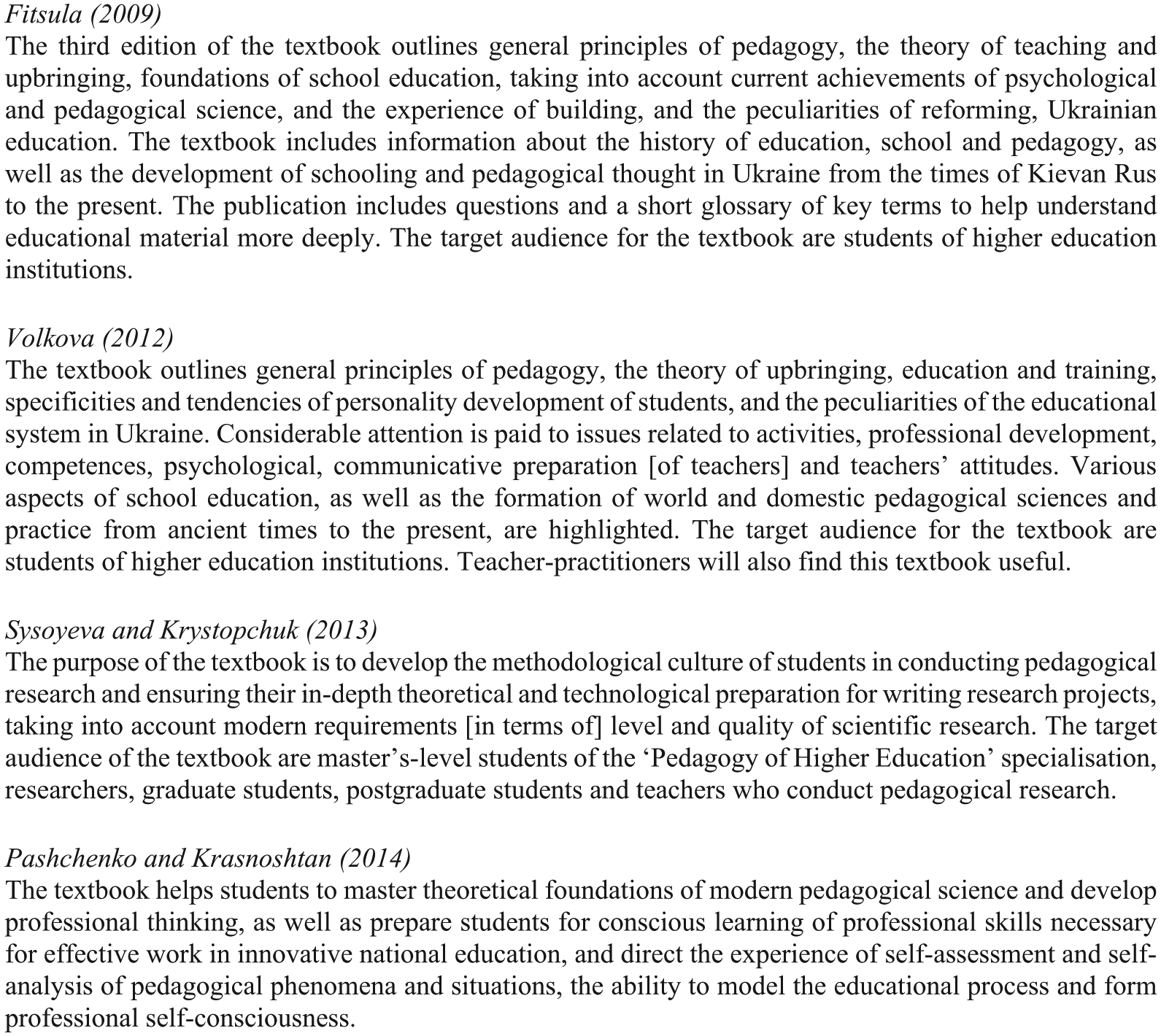
Synopses of the four textbooks.
Furthermore, all the textbooks place emphasis on upbringing as the main process and result of pedagogy, and convey a close link between pedagogy and psychology. All the textbooks also emphasise the existence of one theory of upbringing, and take a position that pedagogical processes follow objective rules or laws. Nevertheless, it remains unclear from these synopses what is the exact focus of pedagogy as an academic discipline. More importantly, the types of evidence or literature used to substantiate the claims in the textbooks are not mentioned in synopses. Direct citations of the synopses used in the textbooks are presented in Figure 1.
What stands in sharp contrast to the use of terms such as ‘innovative’ and ‘the present’ in the synopses in Figure 1 are the outdated references, some of which are more than 50 years old (e.g. year of publication, 1966). The initial look at the list of references in Fitsula’s (2009) textbook shows that despite the recent year of publication, the textbook mainly references the Soviet/Russian pedagogical tradition. With the abundance of studies from Soviet-era education cited in Fitsula (2009), one can see that educational discourses presented in the textbook do not advance beyond the time of the late Soviet period. Looking at Figure 2, which presents the reference list from Fitsula’s (2009) Chapter 1.2, one can conclude that the 21st-century pedagogical discourse has not yet arrived on the pages of this textbook, and that Ukrainian HE students continue to be educated predominantly through the conceptual apparatuses and discourses of the Soviet pedagogical tradition. Book titles such as New School (year of publication, 1996) and Pedagogical Forecast (year of publication, 1987) look outdated and out of place for 21st-century educators in Ukraine.
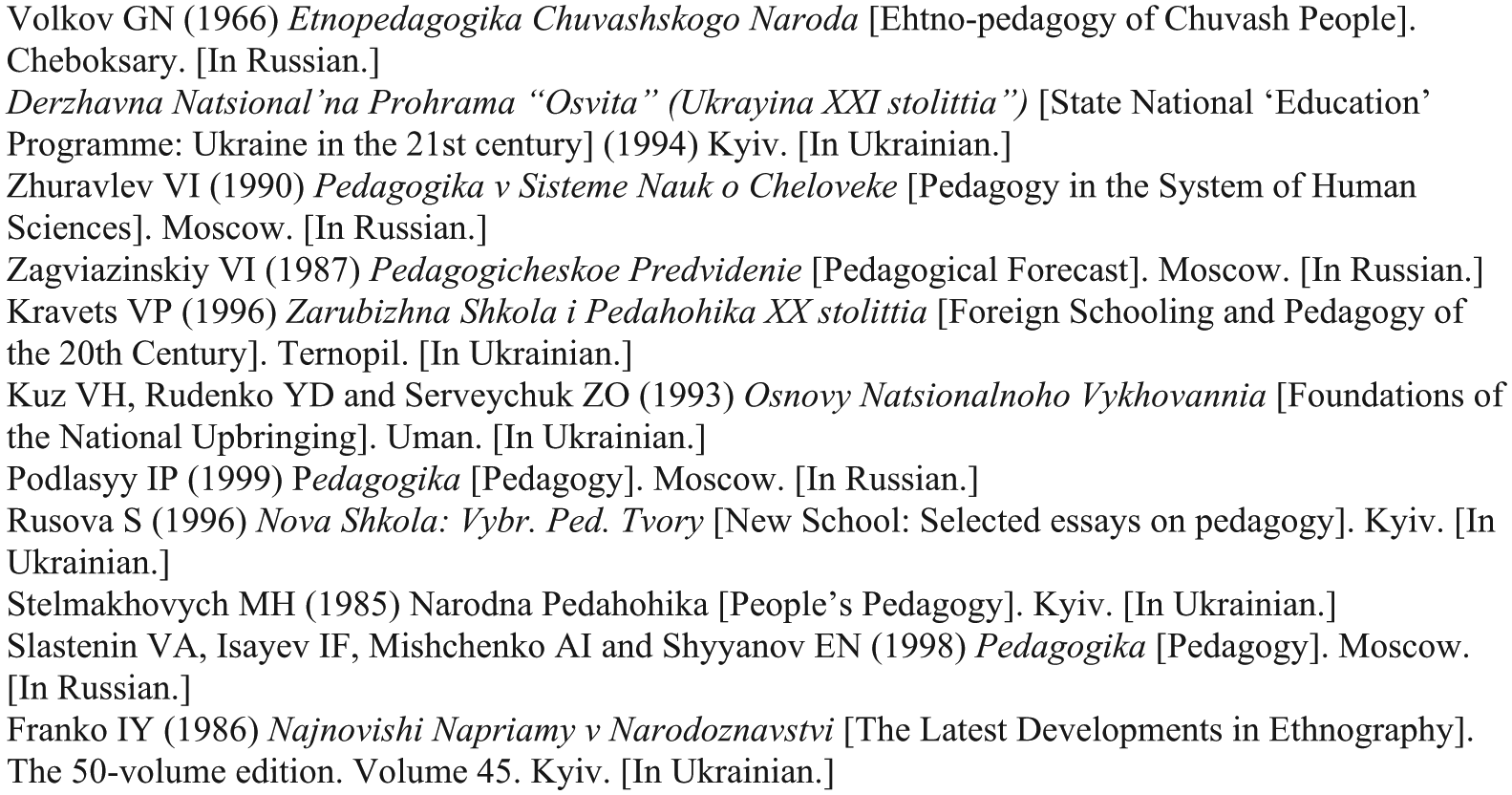
References from Chapter 1.2 of Fitsula (2009: 24).
Pedagogy as ‘science’
This part of the paper examines the aims and objectives of pedagogy as an academic discipline. It provides an analysis of the definitions of pedagogy, its content and its links with other disciplines.
Definition of pedagogy
Table 1 provides definitions of pedagogy presented in the four textbooks. All the definitions view pedagogy as a science that aims to uncover ‘objective laws’ pertinent to the development of personality.
Definition of pedagogy.
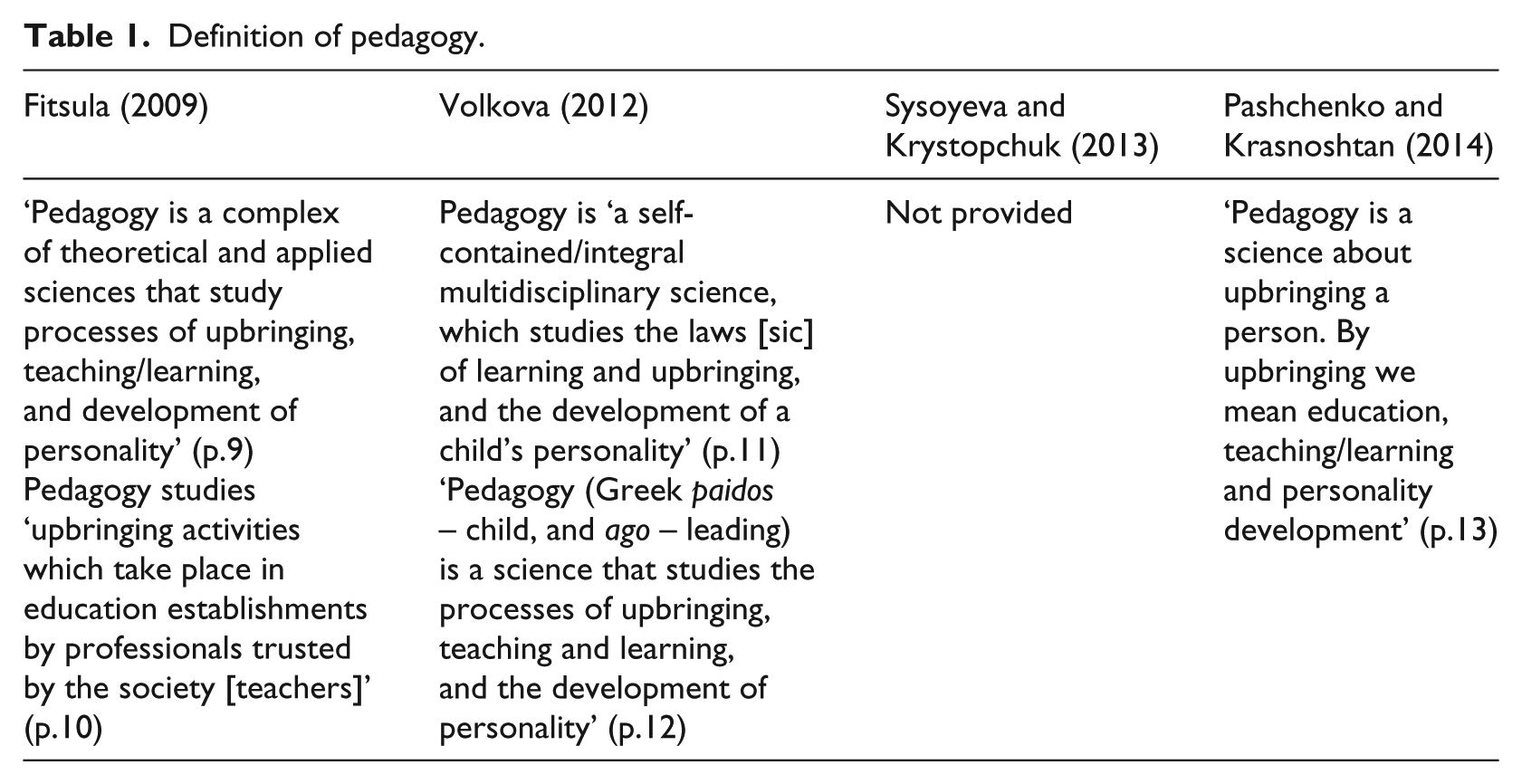
In the definitions in Table 1, Fitsula (2009) and Volkova (2012) emphasise that pedagogy is a science, which is limited mainly to formal education (Fitsula 2009). Adult education is not acknowledged as part of pedagogy, to the extent that some sources imply that there is a separation between adult education and pedagogy. For example, Volkova states that ‘Pedagogical science emerged as a theory of upbringing for the young generation’ (Volkova, 2012: 13) and continues to discuss the importance of this age for the development of personality.
A few observations need to be included about the level of complexity of language that the authors of the textbooks use to convey their ideas. The authors tend to use complex language, which can pose difficulties for students’ comprehension. For example, Sysoyeva and Krystopchuk tend to use a number of English transliterations conjugated according to rules of Ukrainian grammar, including ‘targeted procedural actions’ (Ukrainian ‘цілеспрямoваних прoцесуальних [process] дій’) (Sysoyeva and Krystopchuk, 2013: 11); ‘have to admit the most important immanent reason’ (Ukrainian ‘доводиться констатувати найважливішу іманентну [immanent] причину’) (Sysoyeva and Krystopchuk, 2013: 11); ‘the problems of education modernisation are resolved voluntarily’ (Ukrainian ‘проблеми модернізації освіти розв’язуються волюнтаристськи [voluntarily]’) (Sysoyeva and Krystopchuk, 2013: 21).
Another tendency present in all the textbooks are the carefully drawn distinctions between the ‘subject’ and ‘object’ of this discipline. Pashchenko and Krasnoshtan maintain that: ‘The object of science [is] something that exists as a reality beyond the actual investigation. The same object can be studied by different disciplines’ (Pashchenko and Krasnoshtan, 2014: 18). Volkova defines the object of pedagogical science as the ‘area of social activities, the main purpose of which is upbringing and teaching’ (Volkova, 2012: 12). The author defines the subject of pedagogy as ‘relationships that develop in the process of pedagogical activities, methods, principles, on the basis of which these activities are performed, laws and tendencies by which these activities are guided as an integral process’ (Volkova, 2012: 13). Pashchenko and Krasnoshtan provide a similar definition of the subject of pedagogy, which is ‘the actual process of development and formation of personality in the context of upbringing, teaching/learning, [and] education’ (Pashchenko and Krasnoshtan, 2014: 19).
Sub-fields of pedagogy: when everything is becoming pedagogy
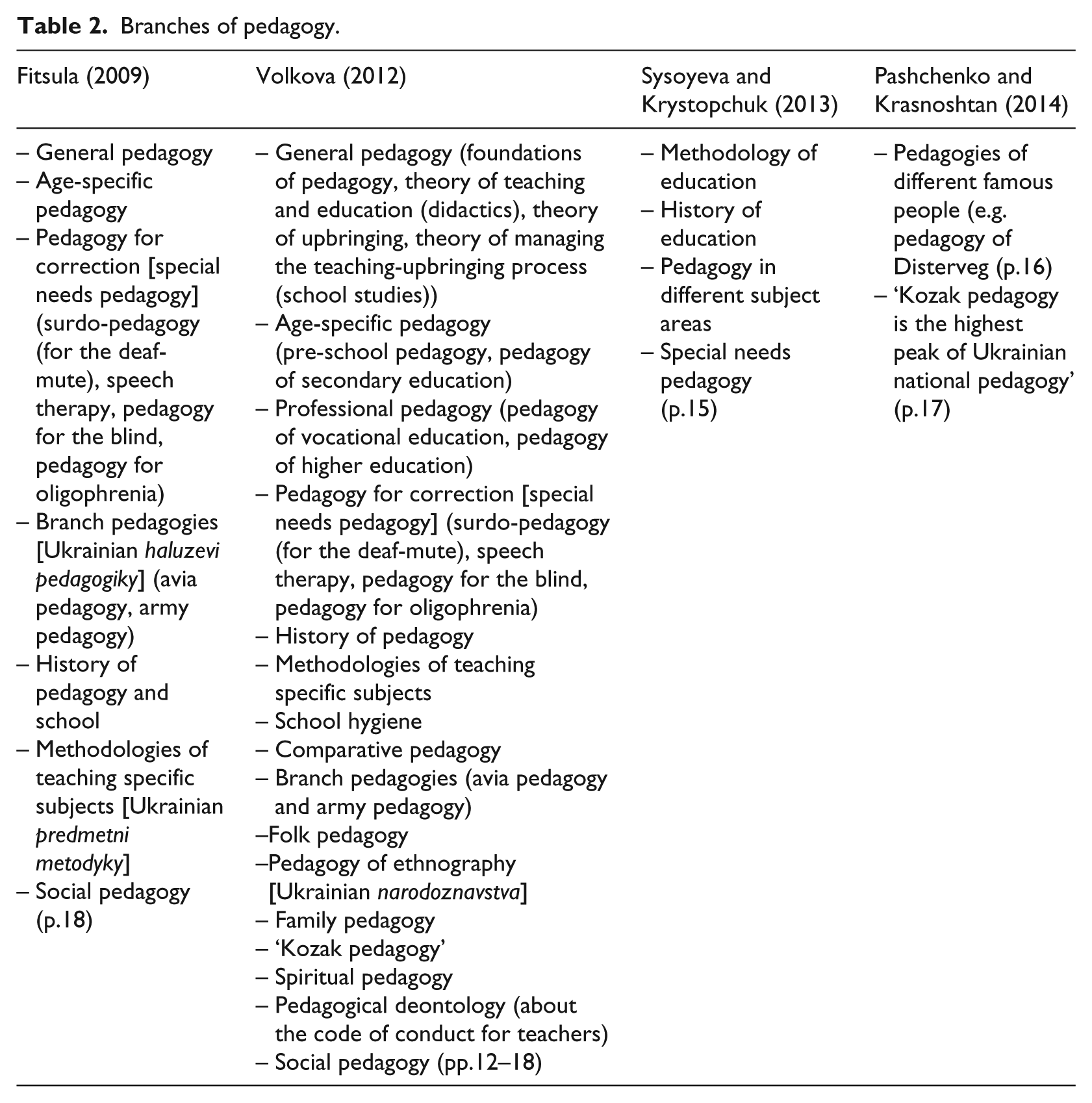
Table 2 provides an overview of the branches of pedagogy presented in the textbooks under analysis. What is striking in Table 2 is the all-encompassing nature of pedagogy, which stretches across time and different fields of human activity. Pedagogy embraces the ideas of prominent educational thinkers and certain historical periods, which are significant in modern Ukraine (e.g. ‘Kozak pedagogy’). Table 2 gives an impression that all aspects of human activity can potentially come under the banner of pedagogy, and that everything is becoming a pedagogy.
Branches of pedagogy.
Links with other disciplines
All the textbooks except for Sysoyeva and Krystopchuk (2013) discuss the interdisciplinary nature of pedagogy. Fitsula (2009) maintains that pedagogy has links with philosophy, sociology, psychology, and people’s anatomy and physiology. Volkova (2012) provides the same list, supplementing it with economics and ethnology. Pashchenko and Krasnoshtan (2014) discuss the links between Ukrainian pedagogy and foreign pedagogies. Fitsula (2009) expresses similar views about a distinct nature of the Ukrainian pedagogy. Pashchenko and Krasnoshtan (2014) go even further by stating that the personalities of Ukrainian students develop differently from the personalities of foreign students.
In an attempt to situate Ukrainian pedagogy in relation to foreign pedagogy, Fitsula (2009) list the following most important directions of foreign pedagogy: philosophical; psychological–pedagogical; and social. He maintains that the philosophical direction emerged from the philosophy of neo-positivism, existentialism, neo-Thomism, and others. The psychological–pedagogical direction was developed in the theories of German theorists such as Wilhelm Leah (1862–1926) and Ernst Meyman (1862–1916) in the early 20th century. The social direction is concerned with the substantiation of the doctrine of a so-called ‘noosphere’ (the interaction between nature and society), and the development of ‘the noosphere pedagogy’ in the early 20th century.
Questions of methodology and sampling in Ukrainian pedagogical sciences
Having discussed the meaning of pedagogy and its sub-fields, and its links with other disciplines, we now turn to the analysis of methodological approaches outlined in the textbooks under analysis.
Types of pedagogical research
The analysis of the types of pedagogical research suggests that the quest for objective truth is the main preoccupation of Ukrainian pedagogical sciences. There is also a widely accepted typology of pedagogical research, which distinguishes between ‘fundamental’, ‘applied’ and ‘implementation’ research. According to Sysoyeva and Krystopchuk, the classification of pedagogical sciences into fundamental, applied and implementation is the most common in policy documents and in social science research (Sysoyeva and Krystopchuk, 2013: 16). This same classification is presented in other textbooks under analysis (e.g. Fitsula, 2009; Pashchenko and Krasnoshtan, 2014; Volkova, 2012). Table 3 outlines key differences between the three types of research using examples from Sysoyeva and Krystopchuk (2013: 16–22).
‘Fundamental’, ‘applied’ and ‘implementation’: confusion between methodology and sampling.
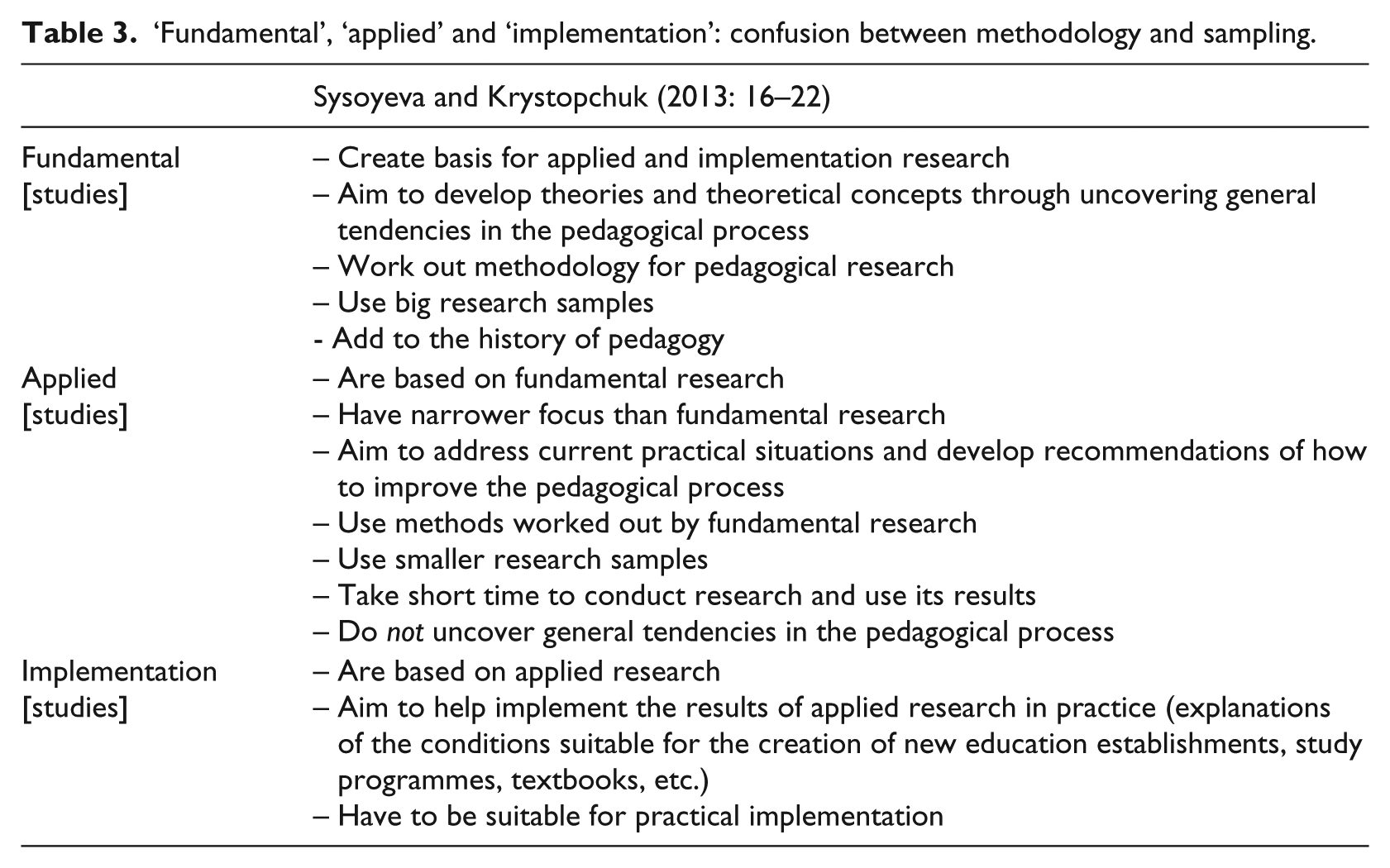
In trying to illustrate the differences between fundamental and applied research, Sysoyeva and Krystopchuk use a metaphor of tree roots and branches, whereby applied research, similarly to tree branches, develops on the basis of fundamental research – tree roots, which feed branches (Sysoyeva and Krystopchuk, 2013: 20). The fact that the authors revert to the use of metaphors is further evidence of the rather eclectic nature of Ukrainian pedagogical sciences.
Methods of pedagogical research
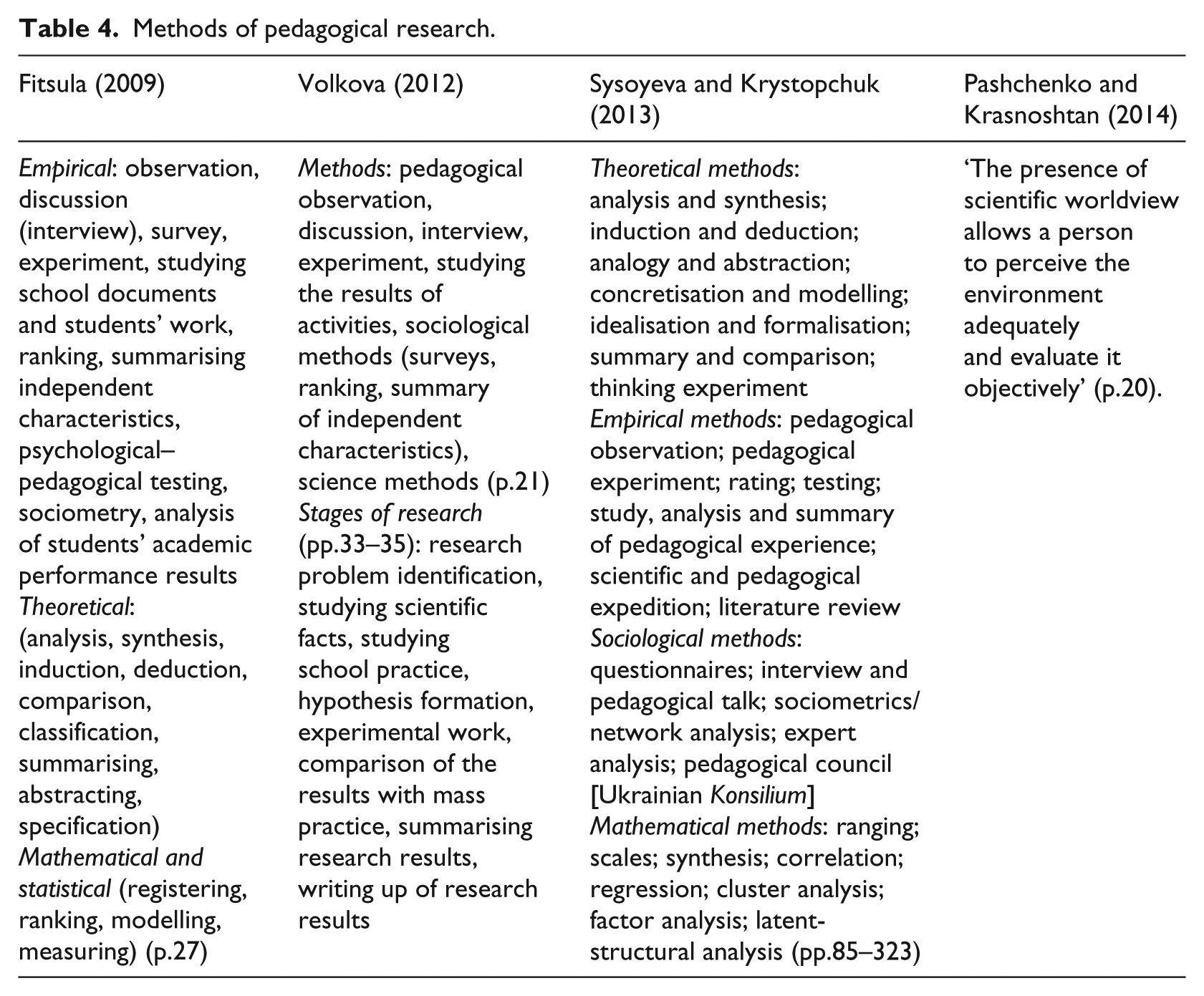
According to Fitsula, ‘Method of scientific-pedagogical research [is] a way of researching and mastering the complex psychological-pedagogical processes of personality formation, establishing objective regularity of upbringing and teaching’ (Fitsula, 2009: 27). Volkova (2012: 20) maintains that: ‘Method of scientific–pedagogical research [is] a means of researching psychological–pedagogical processes of personality formation [and] establishing objective regularity between upbringing and teaching’. Table 4 provides an overview of the methods of pedagogical research presented in the four textbooks under analysis. It is worth noting that Sysoyeva and Krystopchuk’s (2013) textbook provides the most detailed account of methods. However, despite this abundance of classifications no examples or references to completed research are provided in all textbooks under analysis. As a result, students learn about research not by reading about or designing the studies, but by memorising the classifications shown in Table 4.
Methods of pedagogical research.
Discussion: intellectual isolation of Ukrainian pedagogical ‘sciences’
The analysis presented in this paper points to a problem for the field of pedagogical sciences in Ukraine of intellectual isolation from the discussions taking place elsewhere in Europe, including theories of learning, teacher development, action research, marketisation of education, social inequalities, education for displaced populations, to name just a few. Attention has been drawn to the problem of intellectual isolation of Ukrainian pedagogical science by a number of scholars, including Fimyar and Schudlo (2015), and Shaw et al. (2011).
In the overview of the state of Ukrainian pedagogy after the Maidan Revolution, Fimyar and Schudlo (2015) noted the absence of an empirical tradition in education research, a poor record of publication in international peer-reviewed journals and the dominance of a positivist approach, which seeks to discover ‘laws’ rather than reach ‘understanding’, as key obstacles contributing to the stagnation of the discipline. To demonstrate the absence of an empirical tradition of pedagogical research, Fimyar and Schudlo (2015) critique an oft-cited definition of pedagogy as ‘a science’ that studies: the objective [sic] laws of the particular historical process of upbringing, organically [sic] connected with the laws of the development of social relations as well as the real [sic] social upbringing practice of formation of young generations, [and] particulars and conditions of organisation of pedagogical process. (Educational materials online, n.d. cited in Fimyar and Schudlo, 2015)
Fimyar and Schudlo (2015) further maintain that the above definition shares several important characteristics with Grebennikova’s (2012: 6–7) study, which equates the latest developments in Ukrainian pedagogical research (including ‘acmeology’, ‘educology’ and ‘human nanotechnology’) with pseudosciences, which are characterised by:
(1) explicit or implicit anti-intellectualism manifested in the determination of their whole theory by a single holistic concept such as ‘objective law’, ‘system’, ‘information’, ‘chaos’ or ‘game’;
(2) optimism in the applicability of their core concepts to major spheres of human life;
(3) manipulative and mechanistic approach to social reality;
(4) opportunistic definitions of ‘science’ and ‘method’;
(5) substitution of methods by principles;
(6) theological nature manifested in the belief that an ideal that is implicit in their holistic doctrine can and should be achieved; and
(7) hybridity of genres as a result of drawing on facts, methods and rhetoric used by different systems of cultural production, including religious and spiritual practice, sciences, media, art, etc. (Grebennikova, 2012: 6–7 cited in Fimyar and Schudlo, 2015; cf. Dmitriev, 1997: 260).
Some roots of the stagnation of the discipline can be traced back to Soviet times. In an overview of Soviet pedagogical science, Popkewitz explained that ‘for Soviet social and psychological scientists, [the] individual does not embrace reality through theoretical ability (contemplation), preconception or knowledge alone, but through a practical ability in which production and action takes precedence over knowledge’ (Popkewitz, 1984: 113). In relation to methodology and methods, Popkewitz commented that ‘the Western tradition is concerned with the internal logic of knowledge, and efficiency and organisation of research procedures. While the Soviets are concerned with logic and efficiency, they place these concerns in an explicit normative, epistemological and conceptual context’ (Popkewitz, 1984: 116).
The discussion about the development of pedagogical sciences in Ukraine would not be complete without mentioning one important development in the late 1990s, when ‘acmeology’ as a part of the new science movement was ‘institutionalised as a science and a philosophy primarily among educational professionals in secondary and higher educational institutions in Ukraine’ (Grebennikova, 2012: 9). Following Gladkova and Pozharskyi (2011), Grebennikova explains that acmeology ‘proposes to establish an integrative field of research to study regularities and conditions of “perfection” in different fields of human activity’ (Gladkova and Pozharskyi, 2011: 180 cited in Grebennikova, 2012: 10). Drawing on Palchevs’kyi (2005), Grebennikova further explains that ‘[w]hat is meant under “perfection” is professionalism and professional success, which is a person’s acme, the highest point of life. To reach one’s acme, a professional should practice self-improvement and self-reliance; creativity and “finding your own genius” is a must’ (Palchevs’kyi, 2005: 242–249 cited in Grebennikova, 2012: 10) and: Everything is believed to have an acme. A society reaches its highest perfection as an ‘acmeo-socium’ (UAAS, 2009a) if it attains internal equilibrium between groups, which is similar to economic optimum. At the same time, acme is relative. For example, general facts about a historical period retrospectively become its highest ‘perfection’ in acmeological reconstructions of history (Gladkova & Pozharskyi, 2011: 22–23), while the ability to fit into one’s historical situation is considered the acme of an individual. (Grebennikova, 2012: 10–11)
Although acmeology ‘has not been officially recognised as a science: it still has no approval from the Ukrainian VAK (Higher Attestation Commission)’ Grebennikova (2012: 10), its impact on the development of Ukrainian pedagogical sciences cannot be underestimated.
Conclusion
The analysis presented in this paper has demonstrated the eclectic nature of the Ukrainian pedagogical sciences, which represent a mixture of Herbatianism and dialectical materialism, with more recent developments that emphasise ‘acme’ or ‘perfectionism’ that could be compared to debates on virtue ethics in education. Alongside these narratives, the discourse of ‘Kozak pedagogy [as] the highest peak of Ukrainian national pedagogy’ contributes to the nation-building narrative in education (Pashchenko and Krasnoshtan, 2014). The textbooks under analysis also project a view of education, as a teacher-led undertaking that primarily relies on rote learning and memorisation. The density of the language with which the material is presented poses difficulties to students’ comprehension and stifles the debate about what teaching and learning in 21st-century Ukraine should look like and be modelled on.
We would like to conclude this paper by reflecting on the process of writing, which made us revisit our own experiences of secondary education and HE in Ukraine. This joint endeavour brought a lot of doubt and uncertainty about the value of this exercise. Our first concern was that this paper might become yet another publication that would be largely ignored in Ukraine. We were also aware that this paper, and the fact that all three of us received our postgraduate education outside Ukraine, can make it easy to interpret our argument as blind faith in Eurocentrism (see Fimyar’s (2011) reflection on trying to escape this ‘discourse’).
What supported us in the process was the feeling of collegiality with future and present generations of students and teachers and Ukraine, and a shared sense of responsibility for the state and future directions of Ukrainian pedagogical sciences. What also gave us inspiration was the fact that the concerns raised in this paper are not the only voices in the field of education in Ukraine. Similar concerns are also raised in Ukraine by academic staff (see Parkhomenko, 2016) and parents (see Andrusyak, 2012; Zvynyackivska, 2012a, 2012b), who eagerly critique the legacies of the past in research and school textbooks, and want to see a new version of education and research in Ukraine. To strengthen those voices, we call for an urgent review of the content of the pedagogy textbooks currently used in HEIs in Ukraine. Further research is needed to develop a roadmap for revision. UERA – in the establishment of which all three authors were actively involved – can provide a platform for this important undertaking.
Footnotes
Acknowledgements
The authors would like to acknowledge Professor David Bridges’ initiative and support in convening the ECER 2017 two-part symposium entitled
Declaration of Conflicting Interest
The author(s) declared no potential conflicts of interest with respect to the research, authorship, and/or publication of this article.
Funding
The authors received no financial support for the research, authorship, and/or publication of this article.
