




Abstract
In the present scientific era which prefers evidence-based educational research and methodological gold standards, ‘rigour’, ‘discipline’ and the ‘systematic’ serve as standardising and homogenising concepts and as powerful identifiers of ‘normal science’ in the context of historical and cultural contingencies. These concepts serve to construct disciplinary identities and, furthermore, have the power to define what counts as rigour, discipline and the systematic – and what not. The article starts with the problems of terminology and shows that rigour, discipline and the systematic are rather vague and ambivalent concepts, especially when considering their meaning in different languages and cultures. The second part uses different foci of several theoretical approaches in order to show the meaning and functions of rigour, discipline and the systematic for constructing educational research identities and to explain different notions of these concepts in different research cultures. The final part considers the future and argues for the strengthening of a transversal, (meta-)reflexive and communicative dimension which both opens and limits the forms and formats of educational research employing diversity and intercultural communication as a valuable and powerful resource of sound scholarly research, mutual understanding and intellectual delight.
In this scientific era which prefers evidence-based educational research and methodological gold standards – regarding both quantitative and qualitative educational research – ‘rigour’, ‘discipline’ and the ‘systematic’ serve as standardising and homogenising concepts and as powerful identifiers of ‘normal science’ (Kuhn, 1962) in the context of historical and cultural contingencies. They help to distinguish and differentiate good and poor research quality by setting up an order of quality hierarchies which defines insiders and outsiders and forms educational research milieus and their respective methodological and theoretical tribes and standards. The terms ‘rigour’, ‘discipline’ and the ‘systematic’ are semantically loaded with cultural and disciplinary meanings that depend on time and location and provide forms and demarcations of scientific fields according to their cultural specificities. Therefore, ‘rigour’, ‘discipline’ and the ‘systematic’ are core concepts for constructing identities and integrating centrifugal forces of diversification and fragmentation which we experience at present. They serve as instruments of power not only regarding scholarly self-governance but also in defining what counts as ‘good’ research and what does not.
The article is composed of three parts. It starts with the problems of terminology and shows that rigour, discipline and the systematic are rather vague and ambivalent concepts, especially when considering their meanings in different languages and cultures. The second part uses different foci of several theoretical approaches to show the meaning and function of rigour, discipline and the systematic for constructing educational research identities and to demonstrate different notions of these concepts in different research cultures. The final part considers the future and argues for the strengthening of a transversal, (meta-)reflexive and communicative dimension which both opens and limits the forms and formats of educational research employing diversity and intercultural communication as a valuable and powerful resource of sound scholarly research, mutual understanding and intellectual delight. In this context it advises against a ‘repatriation of difference’ (Appadurai, 1990) which might provide no more than a sophisticated and sugar-coated re-entry of tensions of diversity into one’s own research milieu, thus re-pacifying the dissonances by claiming ‘truth’ and power. In contrast to this concept of a clever (and dangerous) romantic ignorance, this article argues for maintaining differences, paradoxes, contradictions, breaks and frictions in order to combine intellectual playfulness, intercultural understanding and epistemological diversity, including the acceptance of incommensurability and incompatibility.
Linguistic diversities, semantic ambiguities, cultural and historical differences
At first sight, rigour, discipline and the systematic are just words. Their meaning is vague and unclear and depends on the semantic context of different languages and cultures. As they have become rather prominent in previous decades, not only in educational research, one may assume – from a sociological point of view – that this quality of vagueness is related to the exertion of disciplinary power, at least of some groups, because ‘power is control of uncertainty’ (Crozier and Friedberg, 1980). However, this is also a vague sentence. I will, therefore, start with some terminological considerations (without claiming linguistic rigour, discipline and the systematic). I am aware of the fact that I talk about words without context, but this is necessary to show how the respective meanings of these words result from their embeddedness in cultural, semantic fields. 1 Let me mention the attempts of the European Union and the project PERINE (Pedagogical and Educational Research Information Network for Europe) to build a multilingual education thesaurus, EUDISED (European Documentation and Information System for Education), which also includes maps of semantic fields of certain educational concepts in different European languages. Interestingly, the subsequent project, EERQI (European Educational Research Quality Indicators), strongly supported by the European Educational Research Association (EERA), tried to take a step forward and opened the perspective to research quality indicators (Botte, 2014; Bridges, 2009; Gogolin, 2016). When talking about the functions of rigour, discipline and the systematic we should keep in mind this historical development from an educational research information network to an information system for education to a system concerned with constructing educational research quality indicators. On the one hand, this process speaks of the professionalisation and the structuring of educational research. On the other, however, it also shows the trend of setting exclusive research quality standards and exerting power by means of performance measurement.
In order to show that rigour, discipline and the systematic are rather vague and ambivalent concepts, especially considering their meaning in different languages and cultures, I made use of a well-known translation tool (https://dict.leo.org), which may be considered a common and popular linguistic Wikipedia. 2 The English word ‘rigour’ clearly refers to seven words in the German language: Genauigkeit, Präzision, Stringenz, Unerbittlickeit, Strenge, Härte, Starre. Reversing the perspective and looking at the English translation of these German words, we find a high diversity of different words as displayed in Figure 1. This means that the English and the German notions of ‘rigour’ differ significantly. As a second step, I translated the German words into Italian and into French, i.e. two Roman languages – just to increase the variety and to look for etymological equivalents. Figure 2 shows some etymologically overlapping words but also an even increase of semantic diversity.
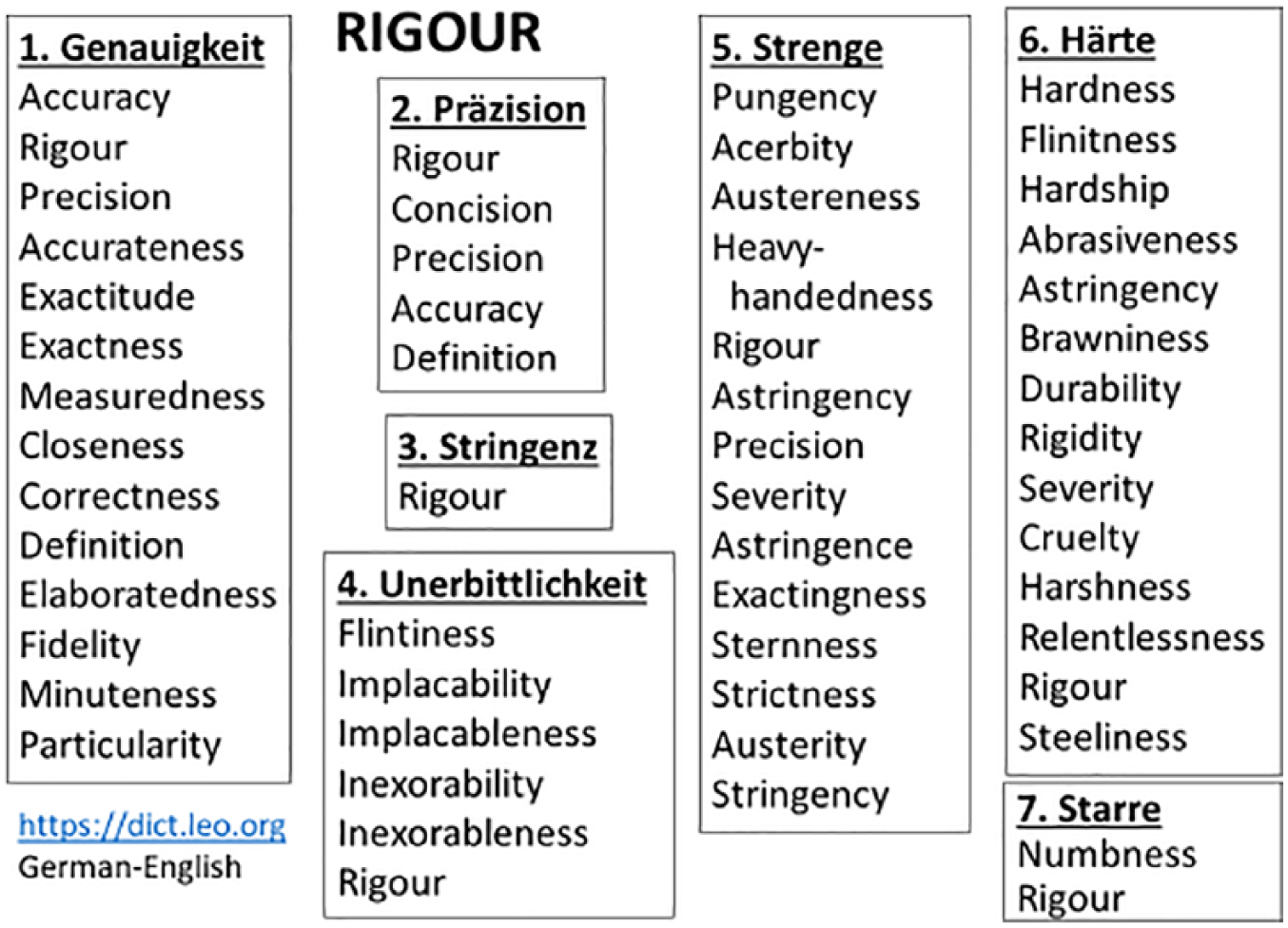
Translation of ‘RIGOUR’ to German and German words back to English (https://dict.leo.org).
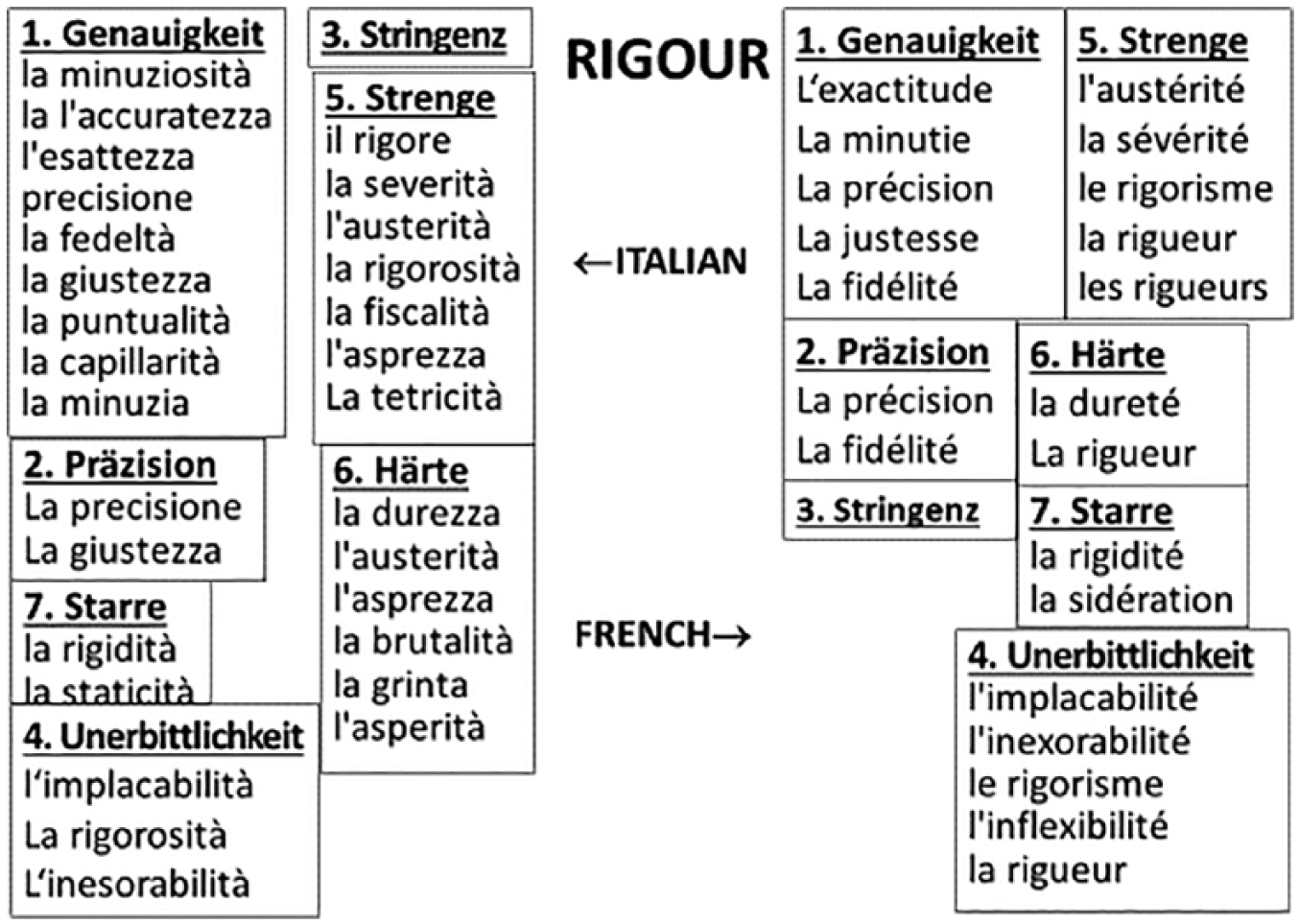
German equivalent words for ‘RIGOUR’ translated to Italian (left) and French (right) (https://dict.leo.org).
When you translate the term ‘discipline’ into the German language one comes up with similar results (Figure 3), which show five German words: Disziplin, Benehmen, Strafe, Fachrichtung, Lehrfach. The word ‘discipline’ is strongly associated with ‘Discipline and Punish’ (Foucault, 1995), but it also refers to a cultivated behaviour. A modern linguistic shift seems to be that ‘discipline’ also refers to branches and subjects taught, i.e. to ‘intellectual disciplines’. This could also be interpreted as a modern redefinition and application of national structures and patterns of thought of, e.g. law and politics to academic subject compartments, characterising the internal differentiation of modern universities (Stichweh, 1994; Wagner and Wittrock, 1991).

Translation of ‘DISCIPLINE’ to German and German words back to English (https://dict.leo.org).
The German synonyms for ‘discipline’, translated into Italian and French, reveal a similar picture as expected (Figure 4). The aspects of ‘discipline and punishment’ as well as the ones referring to cultivated behaviour show an intriguing and diverse distribution. It might be interesting to add that in the Italian case ‘discipline’ is of special importance regarding the (rather rigid and highly differentiated) disciplinary structure of the universities defined and governed by the central Ministry, the Ministero dell’Istruzione, dell’Università e della Ricerca (MIUR) (Keiner and Karlics, 2018). At all Italian universities every teaching and research activity is related to a particular scientific sector (il settore scientifico-disciplinare) and, within this sector, to a disciplinary branch (l’ambito disciplinare). This is particularly relevant for academic careers and the universities’ capacity calculations and budgets.
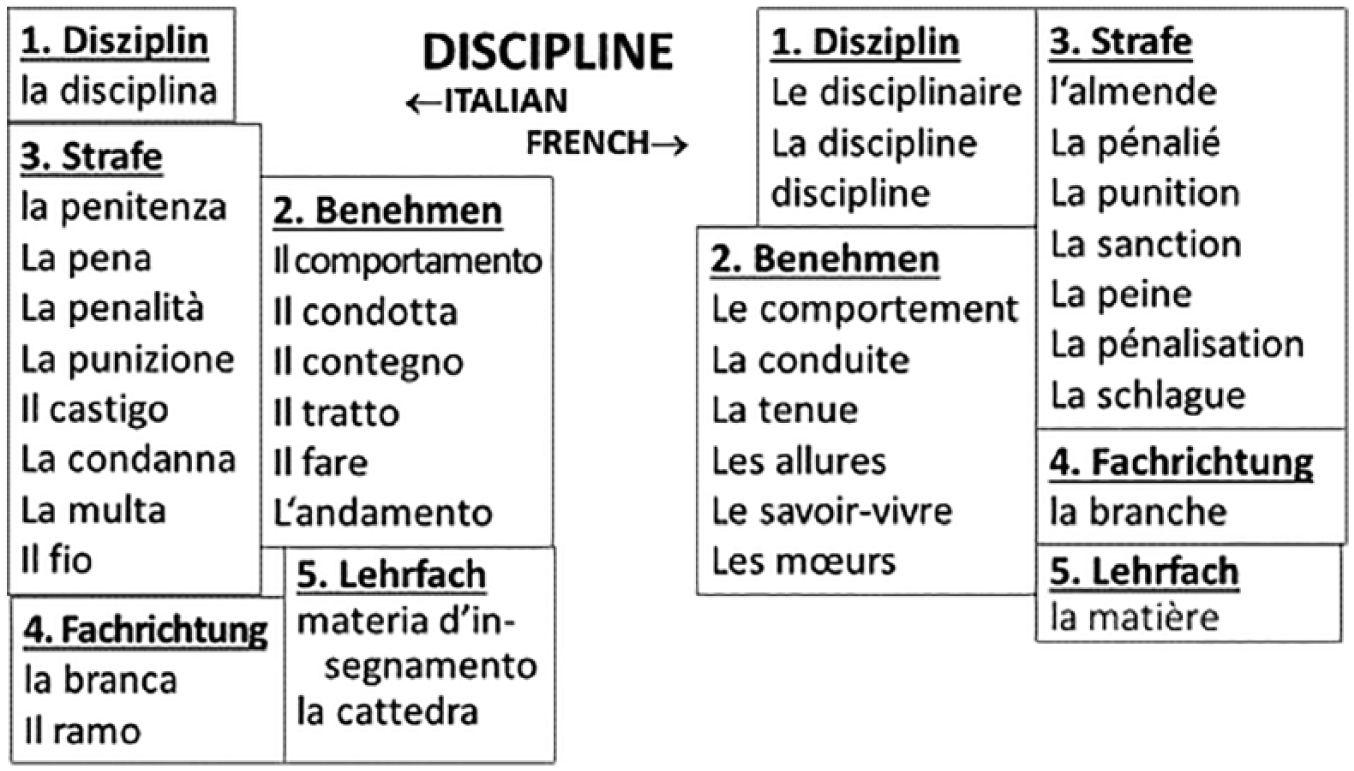
German equivalent words for ‘DISCIPLINE’ translated to Italian (left) and French (right) (https://dict.leo.org).
The third word, the ‘systematic’, is not a noun, but an adjective or adverb. The English word ‘systematic’ comes up as seven different words in the German translation: planmäßig, systematisch, gezielt, gründlich, methodisch, zielbewusst, geplant (see Figure 5). A re-translation of these words into English once again shows the diversity of meanings, which is, however, less pronounced than in the case of ‘discipline’. All these words are concerned with certain kinds of order and a behaviour that thoroughly follows certain methodical rules. Looking at the Italian or French equivalents for the German words representing ‘systematic’, one comes up with similar results (Figure 6). Interestingly, the French translation of the German planmäßig or geplant extends to the sectors of the economy and financial budgets.
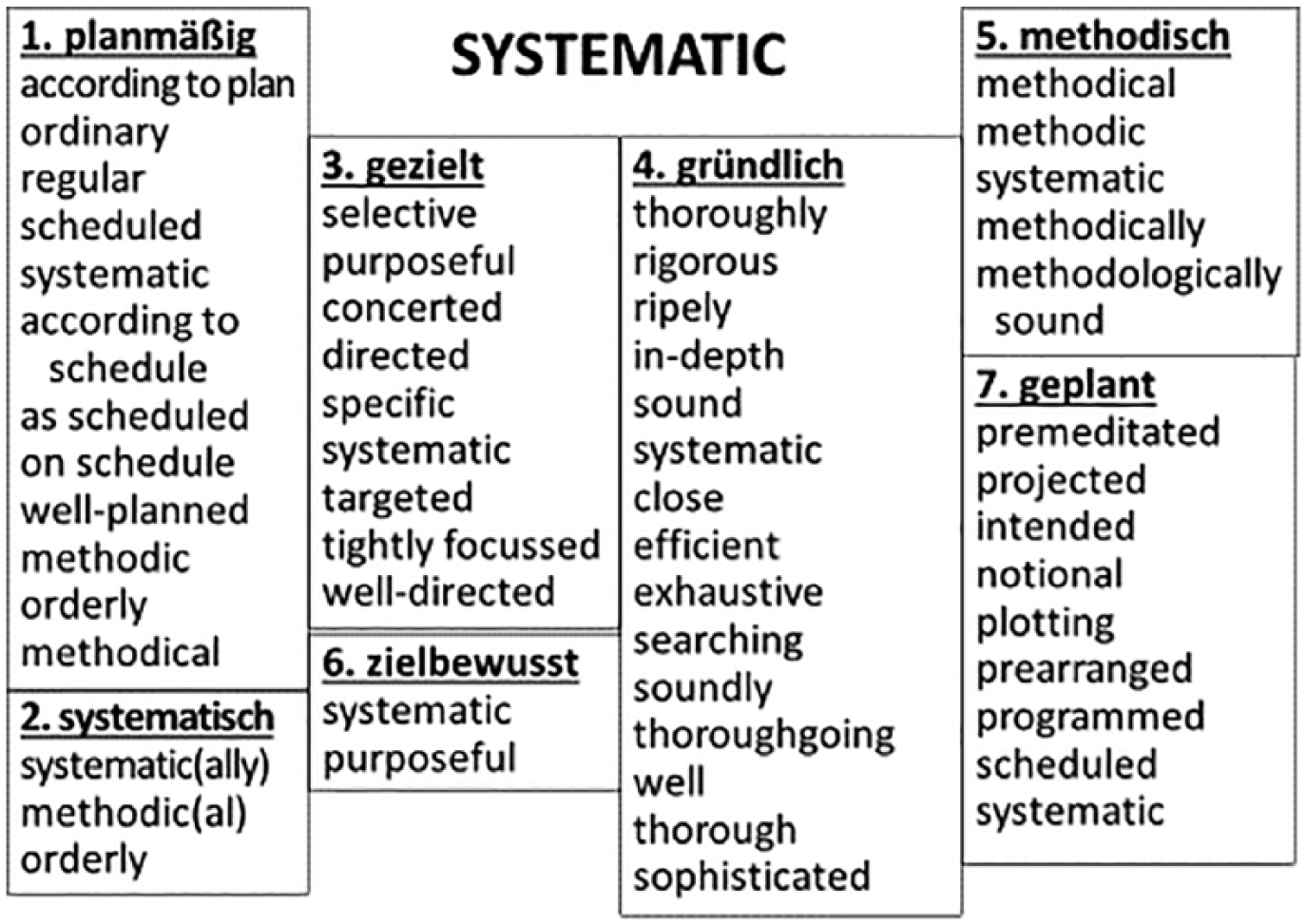
Translation of ‘SYSTEMATIC’ to German and German words back to English (https://dict.leo.org).
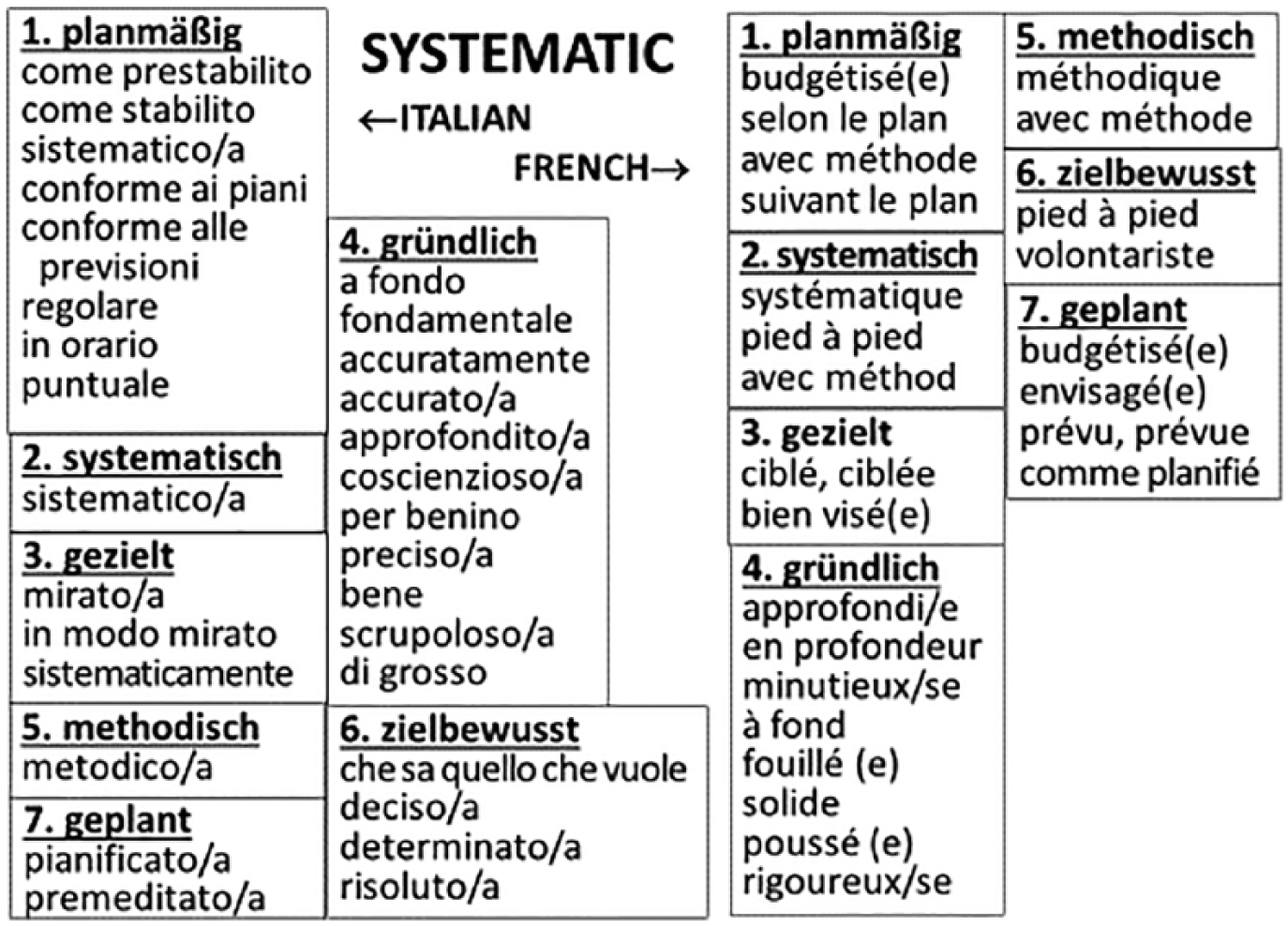
German equivalent words for ‘SYSTEMATIC’ translated to Italian (left) and French (right) (https://dict.leo.org).
In summary we find rather heterogeneous meanings, ambiguity and diversity when trying to understand the words ‘rigour, discipline and the systematic’ in other languages. Keeping this in mind we can expect to find the same ambiguity and diversity in a scientific and scholarly context. In sciences, English is accepted as the lingua franca; scientific language has developed and uses special and subject-specific terminology; it also uses symbolic languages primarily taken from mathematics. Therefore, we may assume commonly shared definitions and homogeneous meanings of these kinds of words in the natural sciences. However, arts, humanities and social sciences depend to a lesser degree on symbolic and formalist language; their special terminology and their problem construction are more closely linked to everyday language; the problems dealt with are also taken from social, political and economic contexts into which these ‘disciplines’ are embedded and to which they refer. Educational research especially has traditionally contributed and still contributes to national and cultural peculiarities and identity. The still very prevalent use of domestic languages in educational research indicates the reference to national and cultural peculiarities and self-involvement. The ambiguity is best highlighted by the carious English translations that are commonly used in the field of educational research: education, educational studies, educational research, education research, pedagogy, science of education, etc. Therefore, it is necessary to look at cultural diversity, which emerged with the development of the social sciences and educational research, and at theoretical approaches, which try to comprehend these diversities. 3
Different research cultures and different approaches
Again we could take up the basic methodological problem of the relationship between explanation and understanding (Smith and Keiner, 2015). Then we would see that there are not only different ways of approaching the world’s as well as scholarly problems but also struggles about the right, the adequate, the more successful and powerful way or methods of research, according to whatever criteria are used. Therefore, methodology is not only about ways to produce valid knowledge but also an important tool to defend and to conquer other academic territories. Meanwhile, it is not only the gold standard of evidence-based or the paradigm of standardised quantitative research which has gained in importance and power. You can also find very impressive attempts of ruling and regulating research procedures of qualitative research in detail, which allows us to talk about a process of standardisation of complex qualitative approaches. This means, ‘rigour, discipline and the systematic’ also play a significant role in establishing colonised and colonising areas of methodological ‘order’ (Honerød Hoveid et al., 2014: 131f.).
In addition, the conceptualisations of ‘rigour, discipline and the systematic’ can also be reconstructed in diachronic perspectives according to generations of scholars and the common implications, complications and consequences of alternations of generations and of generation gaps. As an example, the German educational research community started out by calling itself Pädagogik in the 19th century. During the 1970s it renamed itself Erziehungswissenschaft, and a few years later the term Bildungswissenschaft took over. During the 1990s, a group of scholars preferring quantitative-empirical, evidence-based research methods coined the term Empirische Bildungsforschung for their type of research (see Keiner, 2015). A closer look at these developments not only shows the changing political contexts but also attempts to increase the ‘scientification’ and ‘internationalisation’ of educational research and meeting global research standards. These developments also represent particular generations of educational researchers and indicate the transition from one generation to the next, researchers who in turn have to find their own scholarly place in relative independence from their predecessors or who might even violently oppose their predecessors.
Instead of further elaborating such methodological or generational aspects, I would like to use several theoretical approaches to show the different possible meanings of ‘rigour, discipline and the systematic’ when changing the theoretical lenses. Changing lenses could also help us to identify different functions of discussions about rigour, discipline and the systematic and how these concepts could be used as instruments to define disciplinary identities.
I will start with systems theory, which is complex, abstract and to some extent closed, and I will end with the theory of different ‘shapes’ (Appadurai, 1990), which is also complex, abstract, but to some extent open. The first one identifies systems, the latter one actors. Between these two poles I will discuss the historical and sociological approaches which were developed in the broader context of theories of modernisation and reflexive modernity. These approaches are similarly complex, but show more contradictions, paradoxes and ambivalence – also in view of historical or empirical analyses. In the realm of such theories it is interesting to alternate between perspectives which compare nations and cultures, and perspectives which compare different disciplines.
Systems theory
A system theory approach identifies educational research as an element of the modern science system (Luhmann and Schorr, 2000; Stichweh, 1994). For this theoretical point of view the concept of communication and the distinction and relationship between a system and its environment are fundamental. Educational research is perceived as a part of the science system, which is related (in a particular form, function and performance) to other systems. It maintains its autonomy and independence by autopoietically following its internal codes and principles, i.e. searching for ‘truth’ and presenting the results via publications. Publications in the science system are equivalent to money in the economic system.
However, in educational research, the system’s borders and demarcations are not quite clear as they are based on normative grounds, are related to political expectations and follow the interests of improving the structures of educational systems and processes (Keiner, 2017). Therefore, the question arises as to whether we regard educational research:
(a) as a mode of reflection WITHIN the education system, which would include a certain engagement in practical educational issues (Luhmann and Schorr, 2000), or
(b) as a mode of research ON the educational system (from the viewpoint of the science system), which assumes a certain detachment from practical educational issues.
According to Bourdieu (1998: 19), the degree of autonomy of a scientific field is defined by its ‘ability to break from external expectations or requests and turn them into a specific form that is consistent with, and constitutes, its logic of work’. Educational research, however, hardly breaks and redefines external expectations into the logic of methodologically distant research knowledge. In contrast, it shows a high power of resonance regarding public and political themes (Stross and Thiel, 1998). Moreover, educational research incorporates a broad range of normative orientations (goals and means, reforms, tasks and challenges, or the endless theory-practice-relationship-debate [Keiner, 2002a]). In addition, it prefers educationalising social problems (Smeyers and Depaepe, 2008). Therefore, educational research may be seen as a hybrid structure, a field of reflection, a composite area of studies (Schriewer and Keiner, 1992: 40ff.). Organisationally it is at home in the universities (Stichweh, 1994), but it proceeds and argues ‘in between’ universities (as modern organisations of the science system) and educational systems (as modern organisations of education systems) (see Gallmann, 2018; Keiner, 2006).
This place in between can be described as part of a loosely coupled system, a concept which was developed in the 1970s in the context of a system and organisational sociology (e.g. March and Olsen 1975; Weick, 1976, 1995; see also Göhlich, 2016). It describes education systems in contrast to rational organisations, using loose coupling as their defining characteristics. The theory of coupling comes from the computer sciences. It is advisable to go back to this very pure and formalised notion in order to see the consequences for rigour, discipline and the systematic. The computer theory of coupling very clearly states: Coupling refers to the degree of direct knowledge that one component has of another … Tight coupling occurs when a dependent class contains a pointer directly to a concrete class, which provides the required behaviour. … Loose coupling occurs when the dependent class contains a pointer only to an interface, which can then be implemented by one or many concrete classes. (‘Loose coupling’, Wikipedia, https://en.wikipedia,org/wiki/Loose_coupling, accessed 12 January 2019; see also Toft et al., 2000: 118f.)
Seen against this background, we find loose coupling in education and educational research between input and output, promises and redemption, between the ceremonial level of self-description and the operative level of daily work. Loose coupling shows a picture of an efficient, fluent, organic homogeneity. It offers flexible, deregulated provisions for transforming various, rather arbitrary information into respective kinds of knowledge. With regard to the social dimension, selectivity and accountability of bureaucratic, hierarchical structures and standards are replaced by social mechanisms, collectively ascribed roles and invisible criteria of evaluation and assessment. This means, the discussions are not only about the degree of rigour, the disciplinary (or interdisciplinary) frames and the criteria of the ‘systematic’ but also about gaining power about the social, political and economic definition of the respective degrees, frames and criteria. As an example: [Statistics] function as an interface to which a dependent class is able to point expecting that one or many other classes react by implementing the expected behaviour. Important is the one who constructs and controls the interface, who has the ability to define the direction and structure of transforming information into licensed/accepted knowledge. There is no actor, no devil, no conspiracy. It is the socialised and socialising habitus (Bourdieu), who exert high influence on this interface … Statistics as an interface serves both to show ‘facts’ and to hide function – transparent intransparency. (Stadler-Altmann and Keiner, 2010: 141)
History and sociology of social sciences: modernisation theories
A history of social science approach serves to analyse historical developments and to identify cultural contingencies of forms and modes of doing research as a ‘normal science’. Regarding rigour, discipline and the systematic, it could be fruitful to relate educational research to its neighbouring disciplines as well, especially sociology and psychology. Thereby, a cross-dimensional picture – of nations or cultures and intellectual disciplines – can be drawn, which could also indicate different functions of rigour, discipline and the systematic and the respective discussions.
There are several ideas, approaches and theories about the development and structure of social sciences. The first one tries to reconstruct the development of social sciences in the context of nation building beginning in the 18th and 19th centuries and points to the role of law for structuring particular cultural and methodical orientations (Wagner, 2004; Wagner and Wittrock, 1991). A second one tries to identify turns and shifts of knowledge production, for example, from mode I to mode II knowledge (Gibbons et al., 1994; Nowotny et al., 2003). A third approach distinguishes the ‘disciplinary’ pattern of scholarly communication (Ambrose, 2006; Meusburger, 2009b), and a fourth one describes different cultural academic habitus (Galtung, 1981). They all have significant consequences for the conceptualisation and the understanding of rigour, discipline and the systematic.
Different cultural academic habitus
In an attempt to keep this short, I will start with Galtung (1981). A research piece shown to a colleague from a Saxonic, Teutonic, Gallic (and I would add, Italian) or Nipponic research culture, would elicit different responses exemplified by particular questions:
How do you operationalise it? (US) or How do you document it? (UK)
How can you trace this back or deduce it from basic principles?
Is it possible to say this in good French (and I would add, Italian)?
Who is your master?
Regarding the definition of ‘rigour’ we can clearly distinguish different perspectives. In the Saxonic context, ‘rigour’ is primarily concerned with methodological issues, for example, the degree of precision of operationalisation and documentation. In the Teutonic context, ‘rigour’ would be based on argumentative consistency, theoretical complexity and comprehensiveness, indicated, for example, by the references to philosophical heroes, the number of footnotes and the number of titles in the reference list. In the Gallic (Italian) context, scholarly ‘rigour‘ would depend on linguistic aesthetics, classiness, elegance and the degree of cultural embeddedness.
Finally, in the Nipponic culture, it is only the master or the group of masters who define the degree of rigour, discipline and the systematic. To some extent this habitus is similar to the German ‘foundationalist’ perspective (see Van Goor et al., 2004), as in condensing the ‘basic principles’ to heroes and ‘masters’ to identification codes. In addition, this culture seems to mirror the organisational pattern of European/German medieval guilds, which to some extent still prevail in the German university system (historically, see Ringer, 1990).
Different modes of knowledge production and reception
Alongside this nation- or culture-oriented perspective, another approach tries to identify turns and shifts of knowledge production across nations and cultures, for example, as mode I to mode II knowledge (Gibbons et al., 1994; Nowotny et al., 2003). Such a knowledge or scholarly branch-oriented approach distinguishes two modes of knowledge production:
A pre-modern, more conservative knowledge production (mode I), which is characterised by hierarchical, disciplinary, homogeneous and closed knowledge production patterns. This mode of knowledge also distinguishes, even separates, scientific or scholarly and societal or political agents, i.e. ‘theory’ and ‘practice’.
Antecedent or in parallel, a modern, innovative, transdisciplinary and cooperative mode of knowledge production (mode II) is emerging, which is anti-hierarchical, includes diversity and heterogeneity of knowledge as productive factors, and incorporates a clear societal commitment and responsibility. It is oriented to processes of globalisation and includes the readiness for evaluation and quality assessment according to certain performance indicators. Policy, market, society, stakeholders, etc. are integral parts of knowledge production, dissemination and reception.
Irrespective of some criticisms of these distinctions and their historical presuppositions, it is clear that mode I and mode II knowledge arrive at significantly different views and values regarding rigour, discipline and the systematic. Regarding mode I knowledge, rigour would be bound to methodology and to evaluation criteria defined by the academic hierarchy. Discipline and disciplinary affiliation and demarcation would play a significant role in assessing and valuing the scientific knowledge produced. The systematic and consistency would be highly valued as they represent the close structure of the state, the law and standards of disciplinary knowledge. Regarding mode II knowledge, the definition of rigour would be related to societal expectations and political needs. Rigour would become the product of ‘roundtables’ of many, many diverse participants (Keiner, 2002b; Sirota et al., 2002). Inter-, even trans-disciplinary and reflexive knowledge would significantly gain in importance, at the cost of discipline- and subject-oriented ‘container knowledge’. The systematic and consistency of theories and knowledge would be of less importance, whereas diversity, tensions, frictions and breaks would be valued and regarded as a challenge and as a constantly changing mirror of ‘real’ societal processes.
Such conflicting and intersecting tensions have characterised educational research over the last decades: There are many partial perspectives, different theoretical and methodological approaches, various epistemological and normative grounds, intersecting networks and peer groups, and different sources, languages, infrastructural conditions and opportunities for producing and publishing educational research knowledge. These processes of fragmentation and differentiation also indicate a field of struggle and of hierarchisation. (Honerød Hoveid et al., 2014: 131f.)
The new managerialism to a large extent contributes to the power management by using the paradoxical challenge of ‘cooperation and competition’ on the basis of institutional, administrative structures. As a consequence, educational research becomes locked and locks itself into organisational and national frames (Lawn and Keiner, 2006).
Different patterns of theoretical and social formation of social sciences
A third approach takes a historical, cultural or national comparative perspective and reconstructs the emergence and development of social sciences against the background of the establishment of the nation state since the late 18th century. According to Wagner and Wittrock (1991), we find three different patterns of theoretical and social formation of social sciences (see also Keiner, 2010; Schriewer and Keiner, 1992):
The model of comprehensive social sciences (France and francophone cultures) is characterised by inter- or trans-disciplinary traditions of social sciences within the tradition of Emile Durkheim (and Comte), with a high degree of originality, comprehensiveness and multi-faceted scholarship, hardly caring about disciplinary structures and self-reflections.
The model of formalised disciplinary discourse (Germany, Austria, Switzerland, Belgium) with strong interests in disciplinary autonomy and demarcation, a high intensity of self-reflecting discourses on its own disciplinary status and profile. In these cultures, the theory–practice relationship usually is a crucial issue.
The model of pragmatically specialising professions (Anglo-Saxon countries), which comprises more pragmatic academic cultures focusing on particular practical issues. Research themes and groups emerge and stabilise according to economic, social and political needs. The ‘market’, the knowledge economy and the possibilities to sell knowledge play a significant role in research production – as well as the corresponding criticism usually addressed at (research) policy and governance – which urge researchers, for example through funding, to focus on politically relevant, useful and applicable research topics.
It is important to add that Wagner and Wittrock also emphasise the importance of the law for both the development of the nation state and the disciplinary formation of social sciences. The legal system has been of special importance in nations which emerged from rather fragmented territorial structures, for example Italy, but also Germany. Law played a significant integrating role in and for these nations. The systematic and hierarchical (subordinative and subsumptive) structure of Roman law in particular served as a model for structuring universities and disciplinary domains, especially some of the rather closed ‘formalised disciplinary discourses’. Even more than that, the structuring dominance of Roman law also led to an underdevelopment of empirical research, as the ‘empirical case’ was always regarded as a function of a superior category or principle. In contrast to the Anglo-Saxon and also to the Francophone social sciences (due to their Comteian and Durkheimian tradition), empirical social science research in Germany and Italy emerged rather late. However, one methodological approach, originating from the German Diltheyian philosophy, became prominent. It promised to integrate systematic structure and the ‘empirical’ (historical) case. This figure was condensed to the scholarly slogan of ‘the historical and the systematical’ (historisch-systematisch) as an epistemological unity (for a critical view, see Schriewer, 1983). 4 This slogan was also prominent as part of the basic terminological fundus of the German Geisteswissenschaftliche Pädagogik.
On the one side, this means that recent discussions about ‘rigour, discipline and the systematic’ may primarily come from Anglo-Saxon, market and performance-oriented social science research cultures. In the context of formalised disciplinary discourses, the connotations of ‘rigour’ are far from empirical research but close to discipline and the systematic, in fact, as constitutional, foundational problems from the very beginning and not as fashion or fetish.
On the other side, however, such cultural differences also seem to mark recent trends in the direction of an increasing dominance of Anglo-Saxon research culture: The more educational research crosses borders and unlocks its particular national and cultural restrictions (and certainties), the more educational research opens up its discourses and social networks and becomes exposed as a rather unstructured, diverse open space. This space does not only provide great opportunities for the future or, euphemistically, a space of creativity and innovation. It also appears as an un-transparent space of cooperation and competition, of unequal distributions of means and power, of representing and represented participants, of actors and victims of struggle and defence. (Honerød Hoveid et al., 2014: 132)
This means the global discussion about ‘rigour, discipline and the systematic’ may indicate that the distinctions of Wagner and Wittrock have become historical themselves due to push and pull factors in the last decades. At present we experience (euphemistically speaking) a process of convergence of research cultures, which might be based on a ‘fundamental fetish’ of globalisation and universalisation not only of education but also of educational research. 5
At this point I leave the cultural or national focus of approaches to understand different meanings of ‘rigour, discipline and the systematic’ and move on to approaches of disciplinary cultures. Of special interest in these contexts might be a comparison between educational research and psychology, which introduces a fourth approach within the group of history and sociology of social sciences and modernisation theories.
Fractured-porous and unified-insular disciplines
At present (educational) psychology and its methodological standards are becoming very important and gaining in attractiveness for educational research (Smeyers and Depaepe, 2013; see also Knaupp et al., 2014), as indicated, for example, by the controversy about evidence-based research and large-scale assessment projects and their (mainly quantitative) methodologies. One historical reason for this attraction might be that psychology was rather successful in professionalising its own disciplinary field both in regard to theory and to methodology. It was able to streamline its disciplinary basis and profiles to a disciplinary self-referential, internally highly differentiated and internationally standardised field of study (cf. Ben-David and Collins, 1966: 465; Kluwe, 2005; Rammsayer and Troche, 2005). Furthermore, psychology worldwide developed a more scientific profile close to experimental designs common in natural sciences (Mills et al., 2006; Smith and Keiner, 2015).
In several European countries educational research by contrast was locked in a national language and structural and cultural peculiarities. Also it was often shaped by a more normative mode of pedagogical and reformative reflection. Therefore, it was perceived as pre-modern, old-fashioned and not very ‘scientific’ – at least within academia and universities. As a reaction, educational research was forced to internationalise, to meet the international theoretical and methodological standards of psychology and social sciences. As a consequence, educational research topics became redefined according to psychological and sociological disciplinary perspectives and standards, theories and methods. In addition, educational research recently has started to intensify research which serves the demands of the educational policy and administration (see, e.g. Dedering, 2009; Grek and Ozga, 2009; Ozga, 2013). This illustrates the trend towards an Anglo-Saxon research culture.
These aspects point to the fact that educational research and (educational) psychology deal rather differently with research topics and methodological standards. While educational research incorporates rather diverse and culturally restricted research cultures, (educational) psychology seems to display a rather unified research culture across national borders (see Knaupp et al., 2014). Such contrasting patterns of scholarly communication can be analysed with the help of a model introduced by Ambrose (2006) and Meusburger (2009a: 117f). It distinguishes between (a) ‘fractured-porous disciplines’, characterised by internal dissent about theories and methods, weak disciplinary demarcation, negative import balance, but high creativity and innovative potential; and (b) ‘unified-insular disciplines’ with a high degree of internal consensus about basic theories, methods, research standards and evaluation criteria, clear and strict disciplinary demarcation, low interdisciplinary exchange, ‘normal science’ and little creativity. Educational research is an example of the first category, educational psychology of the second. In addition, the above-mentioned differences can be related to the distinctions made by Bourdieu (1998: 19): Fractured-porous disciplines are characterised by a high degree of heteronomy, unified-insular disciplines by a high degree of autonomy of disciplinary identity and problem definition.
This also means that meanings and connotations of ‘rigour, discipline and the systematic’ significantly differ according to different disciplinary cultures. The distinction between fractured-porous and unified-insular disciplines also points to different outcomes. Unified-insular disciplines are characterised by programme research, i.e. a bigger theme serves as a big ‘container’ (in order to avoid the term paradigm), in which researchers investigate rather differentiated partial problems, all related to the one bigger theme and with a high degree of internal theoretical and methodological consistency, cross-referencing and co-authoring. This kind of research meets high quality standards (according to the common gold standards of evidence-based, empirical research); it exercises high rigour and peer control; it is disciplinarily closed and self-referential (autopoietical); and, framed by a common programme (‘container’), it is highly systematic and consistent. However, seen from the outside, it produces more answers than questions, more predictable results than irritating residuals, it follows ‘normal science’, solves only solvable problems and lacks interdisciplinary connection, creativity and innovativeness. Regarding fractured-porous disciplines, the opposite would be true.
Against the background of the model described we may conclude that one has to pay a price for a high or low degree of rigour, of discipline and of the systematic. Severe rigour may result in predictable, trivial, even boring outcomes. Strong discipline might seal results within self-referential disciplinary frames and might prevent interdisciplinary exchange. A highly systematic approach may result in ignorance, lack of creativity and lack of transfer-oriented thinking. ‘Rigour, discipline and the systematic’, therefore, should be seen as relational concepts according to particular degrees, values or even as constructs between at least two poles and related to a similarly relational typology of possible and expected outcomes of different theoretical, methodological or disciplinary cultures.
Scapes: insights from social and inter-cultural anthropology
Just like the sociological systems theory, the anthropologically based theory of ‘Disjuncture and difference in the global cultural economy’ (Appadurai, 1990) has a broad coverage and is designed as a ‘theory for almost everything’. On the one side, its theoretical elements can be used creatively in order to show how and why meanings and connotations of ‘rigour, discipline and the systematic’ vary according to different ‘scapes’ and ‘imagined worlds’. On the other side, however, this concept is extremely relativistic and traces nearly everything back to specific environments and, in the end, to contingent individualistic constructions and ‘social imaginaries’. Appadurai (1990: 296) argues: The new global economy has to be understood as a complex, overlapping, disjunctive order, which cannot any longer be understood in terms of existing center-periphery models … Nor is it susceptible to simple models of push and pull … or of surpluses and deficits … or of consumers and producers … The complexity of the current global economy has to do with certain fundamental disjunctures between economy, culture and politics which we have barely begun to theorize …. I use terms with the common suffix scape to indicate first of all that these are … deeply perspectival constructs, inflected very much by the historical, linguistic and political situatedness of different sorts of actors … Indeed, the individual actor is the last locus of this perspectival set of landscapes. (Appadurai, 1990: 296)
‘Rigour, discipline and the systematic’ then become part of the ‘social imaginary’, i.e. cultural activities composed of different, interrelated and disjunctive global cultural flows. In the end there is no epistemic ground. Everything-including the scapes-theory itself – remains a construction and a convention of groups, clubs, communities, associations and other social entities, the individual being the final determinant.
However, this theory may provide us with some insights about the Janus-headed process of constructing such scapes in the process of the globalisation of culture in general, and social science and educational research in particular. It describes both an interesting and fatal dialectic mechanism of how to opt for diversity and difference and, at the same time, uses this option to fence and demarcate one’s own field. On the one side, scapes serve as commonly shared constructions, ‘tribal’ rules and regulations, styles and habitus, which contribute to communicatively forming and maintaining a disciplinary or other group identity. Particular meanings and connotations of ‘rigour, discipline and the systematic’ serve as integrating, including (and excluding) mechanisms. On the other side, scapes also serve as instruments for fighting and colonising other groups, for gaining in power (and money) and for homogenising one’s own ‘realm’ by the ‘repatriation of difference’ (Appadurai, 1990: 307): The globalization of culture is not the same as its homogenization, but globalization involves the use of a variety of instruments of homogenization (armament, advertising techniques, language hegemonies, clothing style and the like), which are absorbed into local political and cultural economies, only to be repatriated as heterogeneous dialogues of national sovereignty, free enterprise, fundamentalism etc. (Appadurai, 1990: 307)
Discussions about ‘rigour, discipline and the systematic’, but also about language, methodologies, quality assessment, etc., could indicate similar, even ‘functional equivalent’ processes and instruments of an ideological homogenisation through ‘repatriation of difference’. Standardisation of research methods and performance measurement criteria seem to play a significant role in these contexts as they, to a large extent, introduce comparability, compatibility and commensurability as preconditions to create (repatriatable) differences according to ‘rigour, discipline and the systematic’.
‘Rigour, discipline and the systematic’: further considerations
Combining all these considerations, theoretical approaches and their possible meaning for concepts and discussions about ‘rigour, discipline and the systematic’, one still might – from a philosophical perspective – (nevertheless and again) ask for ‘truth’, valid knowledge and (preliminarily) true answers to the right questions. From a sociological point of view, however, I suggest asking for ‘trust’, reliable knowledge and preliminary, irritating and ambiguous answers for ambivalent and unclear questions. As I have previously explained, I opt for keeping differences, paradoxes, contradictions, breaks and frictions in order to combine intellectual playfulness, intercultural understanding and epistemological diversity.
Historical processes show that theories of social classes have been replaced by theories of social certification, and those have been replaced by theories of post-materialist social milieus. We might also come to face such a sequence in view of the modern structures of educational research, if not social science research in general. At present the definition of ‘rigour, discipline and the systematic’ seems to be depending on particular research environments, research networks, research institutions, etc. When listening to considerations about ‘teachers as researchers’, for example, it seems to be nothing more than another attempt to establish a new research environment with a certain purpose. How to resist such kinds of ‘repatriation of difference’?
The question, then, remains whether there are standards of research, certain degrees of ‘rigour, discipline and the systematic’ which are defined beyond the market and beyond the interests of claiming research goldmines in order to dig for valuable research knowledge, to secure funds, gain reputation or at least recognition, if not to discover the ‘truth’.
It would be useful to first distinguish the philosophical from sociological perspectives (without any fight about hierarchies of these perspectives), as they might already be based on different conceptualisations of ‘rigour’, ‘discipline’ and the ‘systematic’. In a second step, I would suggest employing such perspectives on the basis and with the help of rather concrete topics. For example, the relationship of the construction of rigour, discipline and the systematic and:
(a) different conceptualisations of knowledge building and development (e.g. cyclic, hermeneutic, linear, cumulative, discrete, incompatible, incommensurable);
(b) the variety and diversity of different cultures and languages, and in intercultural and multilingual settings;
(c) the degree of self-governance of scientific or scholarly fields and milieus, and their degree of autonomy and heteronomy, also in view of, for example, journals’ peer review criteria and procedures;
(d) the degree of disciplinary closeness (unified-insular) and disciplinary openness (fractured-porous) and its epistemological, methodological and social consequences;
(e) the meaning of ‘criticism’ and ‘reason’, e.g. modo Mannheim or Marx, and of the ‘dialectics of enlightenment’ (Horkheimer and Adorno, 2002);
(f) the question whether we interpret these constructions (rigour, discipline and the systematic) as ex ante-criteria for normatively normalising and standardising research or as ex post-criteria for analysing, criticising and developing a structured knowledge ecology;
(g) and so on.
In conclusion, I opt first for strengthening a transversal, (meta-)reflexive, communicative and playful dimension (probably just like the traditional disputatio, an intellectually and secular refined form of the interplay between the advocatus dei and the advocatus diaboli, or a concept related to a ‘reflexive modernity’ (Beck et al., 1994)). Second, I suggest cultivating public scholarly referencing and criticism, which is to date the most important instrument for the recognition and appreciation of colleagues’ work. These options would both open and limit the forms and formats of educational research. Third, I would utilise diversity and intercultural communication as a valuable and powerful resource of sound scholarly production, mutual understanding and intellectual delight. Finally, I advocate for loosely coupled concepts of ‘rigour’, ‘discipline’ and the ‘systematic’ for accepting incompatibilities and even incommensurabilities, and for thinking about meta-criteria, e.g. explicitness, critical awareness, reasoning, reflexivity and self-limitation. Such meta-criteria would help to balance innovative and conservative elements of educational research and justify a few, but strict basic criteria to distinguish research and non-research, for example superficiality, arbitrariness and randomness, 6 thus helping to avoid a ‘repatriation of differences’ and cultivating reflexive diversity and distinction.
Footnotes
Declaration of conflicting interest
The author(s) declared no potential conflicts of interest with respect to the research, authorship, and/or publication of this article.
Funding
The author(s) received no financial support for the research, authorship, and/or publication of this article.
Notes

Author biography
His fields of investigation are: comparative history and sociology of education and education research in Europe; technological, epistemological and social conditions regarding the production, distribution, reception and application of education research knowledge; the usage and effects of media on learning processes and constructions of reality; methodologies of historical, empirical, comparative and interdisciplinary approaches of education research.