




Abstract
In this paper, we discuss the case of the recent introduction of a career guidance software within Italian schools with the aim to explore the use of digital devices in the governance of educational processes within the field of lifelong guidance. First, we provide a semiotic analysis of the software and its online platform with the aim of exploring how it articulates a complex network of material and discursive relations. Second, we show the types of practices the software makes ‘affordable’ within the Italian school context, and the organisational and cultural tensions it creates. Following recent studies on digital governance and adopting a policy instrument approach, we show how the introduction of a digital object within the school environment mobilises school actors around new ways of conceiving and delivering education that transcends the local dimension (looking towards national and European ideas) and favours the penetration of economic imperatives and rationales within Italian schools. The career guidance software analysed constitutes in this regard a meaningful illustration of how the governance of the European education space is mediated, activated and accomplished using digital instruments. Software, platforms and websites exert a persuasive power on their users, who in turn contribute to transform the educational order while transforming themselves.
Keywords
Introduction
Recent studies have pointed out that policy instruments and techniques of government in the field of education are increasingly intertwined with digital infrastructure, software and algorithms produced by programmers, technicians and experts. These are exerting increasing influence on policy processes as well as on the educational and learning practices of everyday school life (Lynch, 2015; Simons, 2015; Williamson, 2015, 2016a). The aim of this paper is to explore the use of digital devices in the governance of educational processes by looking in particular at the field of lifelong guidance, a key policy area within the European Union Lifelong Learning Strategy (Watts et al., 2010).
European documents (Council of the European Union 2004, 2008; European Commission, 2000) refer to lifelong guidance as key in enabling individuals to keep up with knowledge and to develop the capacity for adaptation and autonomy in a context of increasing job flexibility (Bengtsson, 2011; Pitzalis, 2016; Watts, 1996). In this regard, scholars have stressed that lifelong learning and guidance policies act as levers for restructuring the educational order to support the needs of contemporary, flexible, knowledge-based production systems (Ball, 2006: 68). Other studies, mostly relying on Foucault’s notions of technologies of power and technologies of the self (Foucault, 1988), have examined the role played by discursive or material devices in the production of subjectivities that meet the (neoliberal) political ambition of governing through the expansion of market logic (Bengtsson, 2011; Brunila and Siivonen, 2016; Dardot and Laval, 2009). Similarly to other policy fields, lifelong guidance policy is enacted through the active participation and co-optation of agents (states, municipalities, schools, teachers, private companies, etc.), within a framework that uses Europe-wide benchmarks and indicators to steer policy processes to be compatible with EU aspirations (Souto-Otero et al., 2008).
The field of lifelong guidance constitutes a key area to study how policy processes unfold in the European education space (Lawn, 2006). On the one hand, European programmes are increasingly funding and promoting projects aimed at implementing guidance services systems at national and European levels. On the other hand, this policy area allows an exploration of the key role of digital technologies as strategic resources to disseminate, monitor and ameliorate guidance services within the European education space (Iacob, 2012).
In this paper we discuss the case of SORPRENDO, a software product developed by a private company as the main output of the Career Guidelines project, funded by the EU Longlife Learning Programme – Leonardo da Vinci – in 2009. The aim of this software is to improve the quality of guidance services in Italy through the transfer of an English model of career guidance (International Career Assessment Software, created by CASCAiD Ltd; until 2017 a company of Loughborough University, UK) and through the adjustment and improvement of pre-existing Italian educational and occupational databases.
The software targets secondary school students, early school leavers, workers and the unemployed, and is currently used in lower secondary schools, as well as in public employment services in Italy. By discussing the case of SORPRENDO, as a point of intersection of a network of relations that connects, enables and conveys specific practices and meanings (Fenwick et al., 2011; Fenwick and Landri, 2012), this paper aims to: (a) account for the basis on which the software has emerged and become a part of career guidance activities within Italian secondary schools; and (b) outline how the software enactment within these educational setting participates in policy processes that favour the penetration of economic imperatives and rationales within Italian schools.
In what follows, we will provide the conceptual tools and theoretical framework used to gather and analyse the empirical material, and then discuss our main research choices and the methods used in the analysis. We will present our results by grouping them in two sections: we will provide a semiotic analysis of the software and its online platform, with the aim of exploring how it articulates a complex network of material and discursive relations; and explore the types of practices that the software makes ‘affordable’ within the Italian school context, and the organisational and cultural tensions it creates. We then offer our concluding remarks.
Theoretical framework
Despite the differences that undoubtedly exist between countries, references to a widespread emergence of new modes of governing education (and beyond) remain a constant in the literature of recent decades (e.g. Ball, 2012; Maroy, 2009; Ozga, 2009). The changes described include, amongst others, a diversification of actors at all levels and contexts of educational policy, including transnational organisations, private and philanthropic actors, experts and think tanks (Maroy, 2009), and the increasing importance given to performance results and efficiency (Ball, 2012). Data is increasingly central in these changing governing techniques (Ozga, 2009) and its collection, processing, and circulation has been highly facilitated by an extensive development of digital technologies over the last decades. Today, the governing of education is crowded with digital devices for those (and other) purposes, which in turn are often taken seriously as artefacts that allow for deep transformations in the paradigms of governing (Simons, 2014) and have led to the idea that it is now possible to speak of ‘digital education governance’ (Williamson, 2016a), an expression that signals that a ‘new software layer has been superimposed on the political layer of education’ (Williamson, 2017: 66).
Accordingly, educational policy analysis has recently been studying a variety of digital devices that collect, process and/or disseminate data on education. These are often websites or platforms of transnational (e.g. Decuypere, 2016; Hogan et al., 2016; Williamson, 2016a, 2016b) or national (e.g. Decuypere et al., 2014; Piattoeva, 2015) scope, but also platforms that assure the processing and circulation of data between contexts and levels of a particular educational system (e.g. Meira, 2017; Selwyn, 2016). The presence of digital devices in educational governance has also been addressed in works that deal with other subjects, such as the participation of digital technologies in the emergence of new power modalities in which constant exposure to performance feedback is central (Simons, 2014); the interaction between data on student performance and other sources of knowledge in the construction of judgements by inspectors (Ozga, 2016); or the presence and participation of a wide range of new actors in educational policy around digital data infrastructures (Hartong, 2016, 2018; Sellar, 2017).
Digital devices have symbolic and political dimensions. They carry discourses, ideas of what education and its governance are and should be (Carvalho, 2014; Decuypere, 2016; Hogan et al., 2016; Williamson, 2016a), as well as ideas about who is to be addressed and what type of actions he or she ought to take (Decuypere et al., 2014; Piattoeva, 2015). As such, digital devices can be appropriately conceived as policy instruments: techniques and methods of operations ‘that allow government policy to be made material and operational’ (Lascoumes and Le Galès, 2007: 4). This means recognising the importance of observations and analyses that help point out two elements that are profoundly relevant for contemporary governance of educational processes. First, policy instrumentation allows us to ‘reveal a (fairly explicit) theorisation of the relationship between the governing and the governed: every instrument constitutes a condensed form of knowledge about social control and ways of exercising it’ (Lascoumes and Le Galès, 2007: 3). Second, policy instruments ‘produce specific effects, independently of the objective pursued (the aims ascribed to them), which structure public policy according to their own logic’ (Lascoumes and Le Galès, 2007: 3).
From this point of view, digital technologies can be conceived as artefacts that have agency, or an ability to exert power (Kitchin and Dodge, 2011). This means acknowledging that ‘the materiality and obduracy of [software] artefacts create boundaries to the possibilities for interpretation and usage’ (Wajcman, 2015: 32) and that the scripts that a software or a digital platform carries from the moment of its design and development create the conditions for opening up certain possibilities and not others. In this respect, digital devices constitute key tools in the process of governing, understood in Foucauldian terms as the ‘conduct of conduct’ (Foucault, 1991). More precisely, digital policy instruments can act as technologies of the self (Foucault, 1988), enabling subjects to act and to think of themselves in particular ways (Williamson 2016b), according to the rationalities in which they are embedded (Piattoeva, 2015).
By following a policy instrument approach (Lascoumes and Le Galès, 2007), in this paper we have made the methodological choice of taking the point of view of a specific instrument to observe and analyse the operations it has made available and to see how it allows larger dimensions of educational policy within the European education space to be addressed. We have chosen to focus on lifelong guidance, a specific area of policy intervention that is emerging as strategic within European education governance.
The European member states have agreed upon two Council resolutions which seek to establish more systemic career guidance and to better integrate career guidance with lifelong learning (Council of the European Union, 2004, 2008). As has been highlighted (Bengsston, 2011), new strategies for lifelong guidance aim to dissolve the division between education and work, promoting the idea that a career guidance service should be provided to citizens at ‘any age and at any point in their lives’ (Council of the European Union, 2004: 2). Guidance activities thus constitute a key setting for the development of Career Management Skills (CMS): abilities that allow one to ‘evaluate oneself, knowing oneself and being able to describe the competences one has acquired in formal, informal and non-formal education’ (Council of the European Union, 2008: 8). On the one hand, this highlights ‘a conceptual change from viewing guidance as a remedial, one-off and directive activity to a preventive, lifelong and learner-centred process’ (Watts et al., 2010: 98). On the other, it allows for pointing out the radicalness of the lifelong guidance project, which aims to forge entrepreneurial subjectivities (Bengtsson, 2011) or, as Rose succinctly put it, ‘an active self and a calculating self, a self that calculates about itself and that acts upon itself in order to better itself’ (Rose, 1998: 184).
Following these considerations, this paper aims to provide an adequate account (Latour, 2005) of a widely-used career guidance software, its conditions of possibility, the operations it makes affordable, the way it addresses its users and constructs subjectivities, and how it enables social actors to be mobilised around the project of reforming the field of education. By looking at the use of SORPRENDO for career guidance, this paper will: (a) reconstruct the European networking process (Lawn, 2006) through which the software was designed, supported and legitimatised; (b) analyse users’ relationships with the software as a setting where subjectivities are shaped and where specific values and ideas about education and learning are conveyed; and (c) show how the apparently neutral and unproblematic penetration of an object (the software) within an organisational setting (the school environment) contributes to creating a new practical and discursive order that transcends the local dimension to enact (and negotiate with) broader Europe-wide governing processes.
Methods
In order to explore the operations made possible by this software and the processes through which it enacts particular visions of education and policy directions, we have gathered empirical material using the software and by carrying out interviews with a sample of teachers and guidance professionals. 1 First, we applied an autoethnographic approach (Davies, 2008). We were given the opportunity to use a demo (full-featured) version of the software and have positioned ourselves as potential users in order to observe the scripts available, how users are addressed, how information is provided, the type of actions the software makes affordable, and the ways in which subjectivities are constructed through interaction with the digital device (Decuypere et al., 2014). Whilst scrutinising the software in order to provide an ‘adequate account’ (Latour, 2005) of the items, buttons, clicking operations, visualisations and text, we have also observed the specific roles that diagrams (combinations of visual representations and textual elements) play as particularly powerful devices to convey meaning and create specific realities calling for specific ways of understanding (Decuypere, 2016). Hence, we have taken seriously the invitation to bring to the forefront the agency of the ‘missing masses’ (Latour, 1992) constituted by the materialisation of policies, ideas and views of the educational order, and we have rendered ourselves the subjects of the software in order to disentangle the agential effect of each component of the software (scripts, texts, graphics and styles).
The second part of the research uses in-depth interviews with teachers and guidance professionals to provide an historical reconstruction of the software (Landri, 2019) and an account of the processes through which SORPRENDO provides career guidance support in Italian schools. We interviewed a developer of the Centro Studi Pluriversum, the Italian occupations database on which SORPRENDO is based. We interviewed its CEO, Giulio Iannis, to highlight how the software came into being, the process by which it was designed, supported and spread in various training and educational contexts in Italy and, finally, the network engaged in its development and testing. In this second phase of the research, we interviewed teachers and guidance professionals involved in a small sample of secondary schools where the software has been used. The main aim of these interviews has been to explore the organisational and practical arrangements the software entails in different types of schools and socioeconomic contexts. Indeed, while considering the software as a policy instrument (Lascoumes and Le Galès, 2007), it is key to account for how enacting processes differ depending on the context of use. This is particularly true within the Italian context where strong educational tracking is used, and where territorial differences, particularly the North–South divide, mean that educational institutions can be inserted within territories that are significantly different in terms of socioeconomic structure and available resources. Using a map provided by the Centro Studi Pluriversum, which identifies the secondary schools where the software has been used, we have chosen to focus our analysis on two schools positioned at the opposite ends of the Italian educational field. One is a general school located in an upper-class area of Milan in Lombardia (the so-called Italian economic capital); the second is a technical–vocational school located in a working-class neighbourhood of Cagliari, Sardinia, an area characterised by economic depression. Our aim is to analyse the different ways the software has activated practical, organisational and discursive changes within these very different school contexts.
Historical reconstruction
SORPRENDO emerged as the result of a complex assemblage of technologies, policies, people and organisations, both public and private, developed since at least the beginning of the 2000s. The software is an Italian version of an English model of career guidance created by CASCAiD Ltd with the view of producing ‘a computer database of high-quality occupational information and a means of analysing interests to present career ideas’ (CASCAiD, 2018). The first Italian adaptation of this model dates back to 2005, within an initiative promoted by the Educational and Guidance Service of a north-eastern region, Friuli-Venezia Giulia, with the funding and support of a project funded by the European programme, Interreg III A Italy-Slovenia 2000–2006. This project involved public and private partners (Regione Marche, Provincia Autonoma di Bolzano, Provincia di Grosseto, CIOFS-FP Piemonte and Centro Studi Pluriversum di Siena) with the aim of developing an Italian version of the occupational database used by CASCAiD. In 2014, together with the issuance of the Italian Government Guidelines on Lifelong Guidance, the Ministry of Education supported a pilot project involving the use of the software – until then mostly used within Employment Services – in secondary schools to respond to the need to support and strengthen guidance activities and provide new resources and tools to teachers. This intervention of the Ministry of Education, and the ‘best practices’ it sponsored, provided critical reputational capital and allowed SORPRENDO to be identified as a reliable solution to address students’ guidance needs.
In broad terms, the discursive premises of the software and its conditions of possibility (including the funding sources allowing its development and dissemination) rely on the lifelong guidance paradigm promoted at the European level, and particularly a new emphasis on the need to allow citizens to acquire CMS (Council of the European Union 2004, 2008).
The adoption of the software within the school system was, however, not straightforward: a number of enabling conditions needed to be met. Whilst European documents identify schools as key institutions having ‘an essential role to play in ensuring that individuals […] develop effective self-management of their learning and career paths’ (Council of the European Union, 2004: 2), guidance activities still occupy a marginal position amongst student activities in Italian schools. They are mainly limited to the provision of standardised information about the educational and job offer and teachers’ recommendations on suitable paths. In this sense, the penetration of a guidance approach based on CMS into the school context is part of a broader process aimed at reforming the traditional school model discursively constructed – particularly in recent policy debates – as obsolete and ‘in crisis’. Indeed, recent policy discourse has represented the school for the new millennium as less focussed on the acquisition of disciplinary knowledge and more prepared to broaden the learning setting beyond the school environment and to provide students with competences and skills to self-manage their learning and working careers (Law 107/2015). Concepts such as adaptability, employability and flexibility are used to define the types of outputs that educational processes should promote. As previous studies have pointed out, this is a terminological anchorage for the penetration of neoliberal logic into the governance of educational processes (Ball, 1998; Levin, 1998; Olssen and Peters, 2005). It is precisely in this sense that the proliferation of institutional initiatives to boost career guidance within schools should be read as elements of a broader strategy to reform the educational system (Ministero dell’Istruzione, dell’Università e della Ricerca (MIUR), 2009). In accordance with the mainstream EU narrative, government documents increasingly aim to foster a person-centred approach to guidance that allows individuals to handle life transitions autonomously through the acquisition of CMS (Ministero dell’Istruzione, dell’Università e della Ricerca (MIUR), 2014). These documents are a key reference in persuading schools to provide innovative career guidance activities and are a source of legitimation for private companies and experts seeking to provide career guidance services.
Normative directives, however, cannot produce organisational, institutional and cultural changes without the engagement and mobilisation of social actors at the micro level. This is particularly true in the school sector due to its size and complexity. For educational reforms to take hold, social actors in schools, teachers in particular, need to be actively recruited (Ball et al., 2012). To accomplish this, a key role was played by a programme financed by the Italian Ministry of Labour (Formazione e Innovazione per l’Occupazione, or FIXO) with the aim of supporting synergies between educational institutions and the labour market. This programme was active between 2011 and 2013, involved 365 secondary schools and reached about 55,000 students with informational and counselling services and traineeships (Italia Lavoro 2013). As we will highlight in the following pages, FIXO has enabled a significant number of teachers to be trained and engaged in the reform process. In particular, the programme has sensitised teachers toward approaches to guidance based on CMS and, more generally, to the need to introduce innovative ways of preparing students for contemporary regimes of flexible production. Within this framework, SORPRENDO intercepts schools’ engagement in the policy process by offering an easy-to-use tool to provide students with a technology capable of developing their CMS.
The SORPRENDO platform
In this section we use an autoethnographic methodology to unpack the SORPRENDO online platform, showing its constitutive elements and their interactions. We show how SORPRENDO emerges as a configuration of multiple material and discursive elements occupying a recognisable position within the field of career guidance. We analyse how this digital platform enables specific programmes of action (scripts) and – by looking at how users are addressed and the types of tasks they are involved in – contributes to the construction of specific subjectivities.
It is worth noting at the outset that SORPRENDO is an online web-based software. It is launched through a web browser and, in particular, through a homepage constituted by a complex configuration of items, texts, visual elements, pieces of information, and scripts. The homepage exposes users to a vast amount of heterogeneous information that enables them to contextualise the operations they are going to accomplish within a broader picture (Figure 1). By clicking on the menu items on the blue header, or by scrolling down the webpage, the user can freely access texts that will allow him or her to be immersed in the career guidance model the software is based upon and learn why it is useful, what kind of recognition it has received at the European level, which policy areas it is worth using for, etc. On the one hand, SORPRENDO works as a technology aimed at elaborating data in order to produce a user-centred output: a profession-matching list based on a questionnaire filled by the user. On the other hand, it works as a resource from which users can acquire and compare information concerning European, national and local initiatives in the field of career guidance, ‘best practices’, news about conferences and study opportunities, occupational profiles and trends in the job market. In this way SORPRENDO exemplifies its own particular approach to career guidance: an explicit exhortation to actively search for information, engage in self-scrutiny and even, as we shall see, negotiate with the outputs of its algorithm.
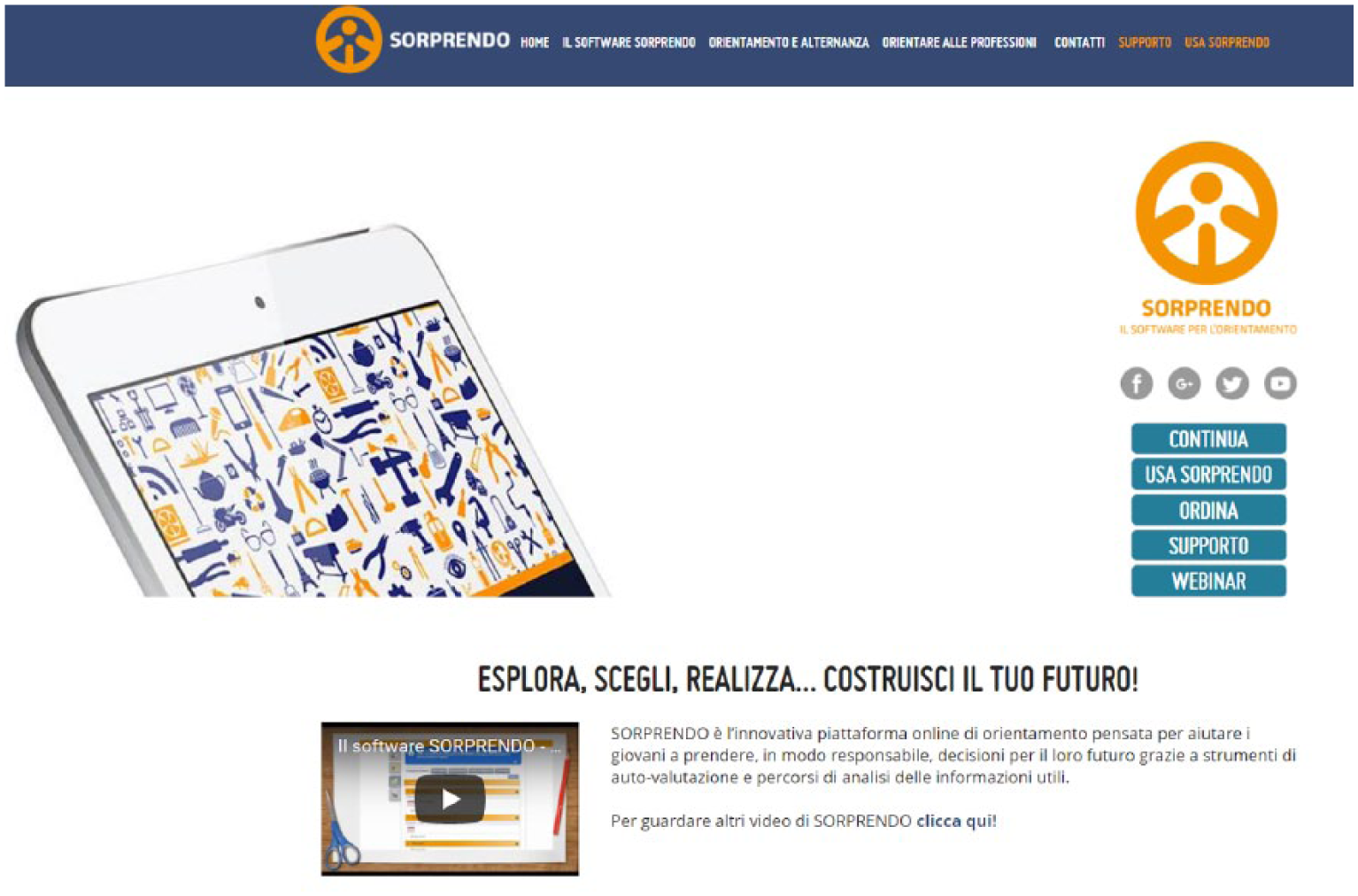
SORPRENDO’s platform homepage.
SORPRENDO’s distinctive approach to guidance is exemplified by a text in uppercase letters occupying a central position on the homepage: EXPLORE, CHOOSE, REALISE… BUILD UP YOUR FUTURE! This is both a motto synthesising the rationale of the software and a programme of action: an anticipation of what the software expects from its users. As shown in Figure 1, this textual element is supplemented by two visual items on the same screen, images of a tablet and a video), working together to convey specific meanings (Decuypere, 2016). The visual element of the tablet communicates the idea of SORPRENDO as a friendly and ready-to-use technology that can adjust to users’ routines. This message is further elaborated through the video, a 2-min animation. This video includes three visual representations that create a narrative operating both as a source of legitimacy for the software and an exhortation to its users to act (Figure 2).
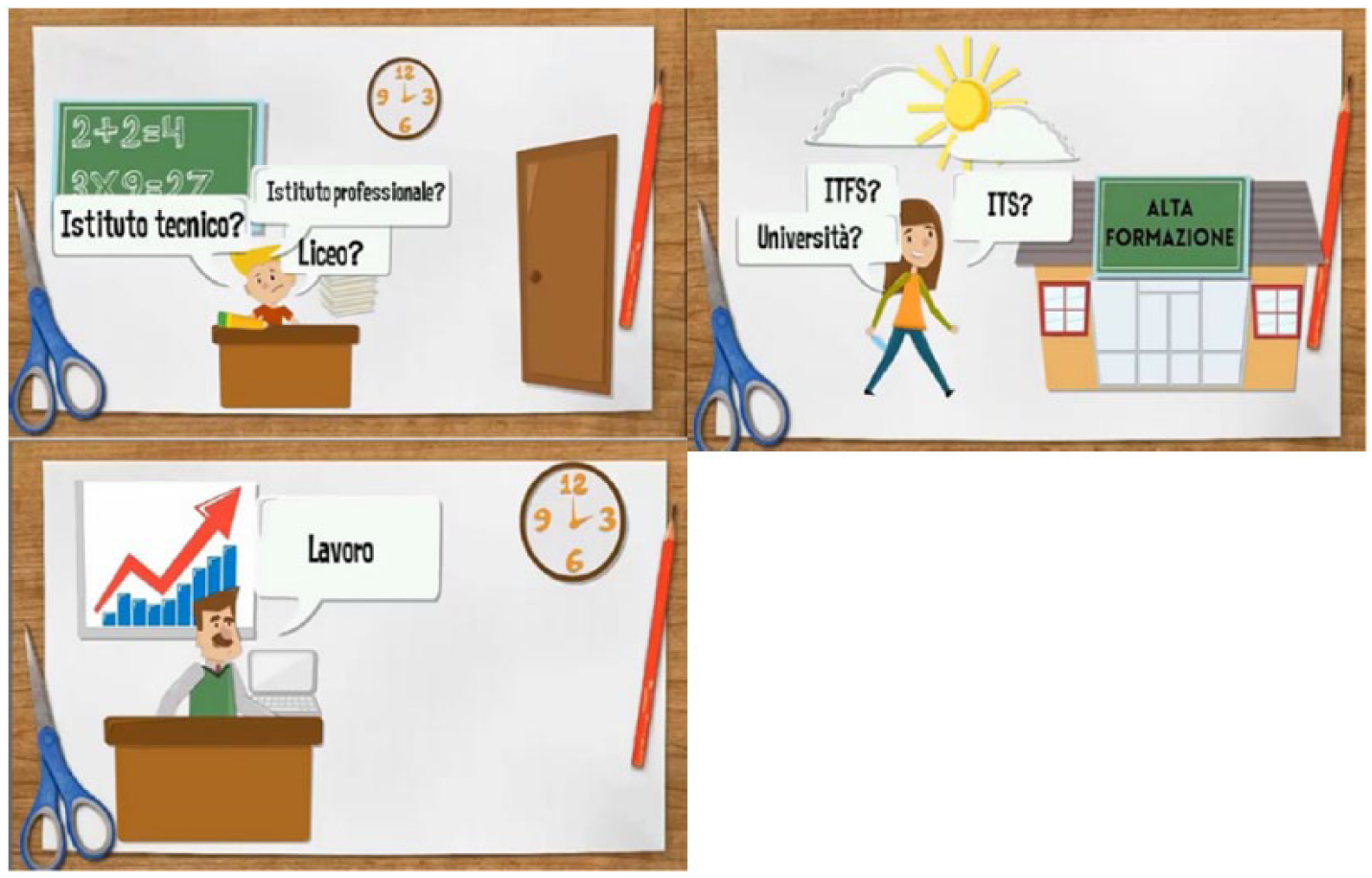
Video-frame: SORPRENDO’s target population.
The first representation is a rapid sequence of three images explicitly identifying SORPRENDO’s potential users: a school pupil, a young woman and an adult, all of whom are coping with the same difficult situation: making a choice for their future. These images perform a twofold function. On the one hand, they inscribe the software within the lifelong learning/lifelong guidance narrative, making explicit that career guidance is of interest to all individuals in all their life stages. On the other hand, they normalise users’ experience of being solicited to make a choice, whether to maximise their human capital or, instead, to cope with work trajectories that are increasingly precarious in the context of contemporary regimes of flexible production. These images, combined with the textual and visual items in the same screen, inscribe users within a specific subject position – that of a self-entrepreneur (Dardot and Laval, 2009) – and normalise the need to turn to guidance technologies to cope with the risks and difficulties associated with that subject position (Fejes, 2008; Romito, 2017; Usher and Edwards, 2005).
The second visual representation is of a crossroad with footprints of different colours. As the image appears, a voiceover states: ‘Being aware of who we are and where we want to go is the first step in the right direction’. The audio and visual representation combine to construct an image of a social reality where conflicts and inequalities are absent and where everyone is able to move in a direction of individual well-being if made properly aware and informed. SORPRENDO emerges here as both an individual and a societal solution. Using a Foucauldian conceptualisation, we could interpret this passage as a plastic representation of governmentality that mobilises individual freedom to reach the political objectives of growth and societal stability (Rose, 1999).
With the third visual representation (Figure 3) – a DNA molecule – SORPRENDO presents itself as a technical device that uses the data provided by its users and the information available on occupational databases ‘to identify users’ professional DNA’. A DNA molecule is often referred to as an ‘enabling structure’ that constrains and, at the same time, opens possibilities for interactions within the environment and, thus, for the growth of an organism. In this respect, the visual representation of the DNA’s double helix suggests that the outputs of the software’s algorithm are not the endpoint of the guidance process. SORPRENDO allows users to uncover their DNA but, in accordance with the CMS approach to guidance (Sultana, 2012), this DNA is intended as a compass for navigation that needs to be accompanied by users who will take full responsibility for their life choices.

Video-frame: identification of users’ professional DNA.
The DNA image is a key conceptual anchor in exploring the functioning of the software. This is accessible by clicking on the ‘Use SORPRENDO’ link in the upper-right hand corner of the homepage (Figure 1). This takes the user into a new environment, one that offers a multiplicity of scripts. This multiplicity is synthesised by the welcoming headline: ‘How can we help you today?’, followed by a list of available activities. These range from filling out a questionnaire about the user’s abilities and interests, to developing an occupational plan or reading information on occupational profiles. The structure of the platform allows users to move autonomously from one activity to the other without following a predefined order.
This feature is also clearly visible in Figure 4, a screen showing SORPRENDO’s core scripts. The centre of the page is occupied by a self-evaluation questionnaire on the user’s interests and abilities, and is highlighted by a clearly identifiable frame. Above this is a bar with two buttons allowing users to open new pages where they can monitor their answers and possibly modify them. On the left, four buttons allow users to access the questionnaire (Il profilo), a list of professions (Professioni), and an action-planning module (Il mio piano), or to find more general information about the educational system and the job market (Informazioni).
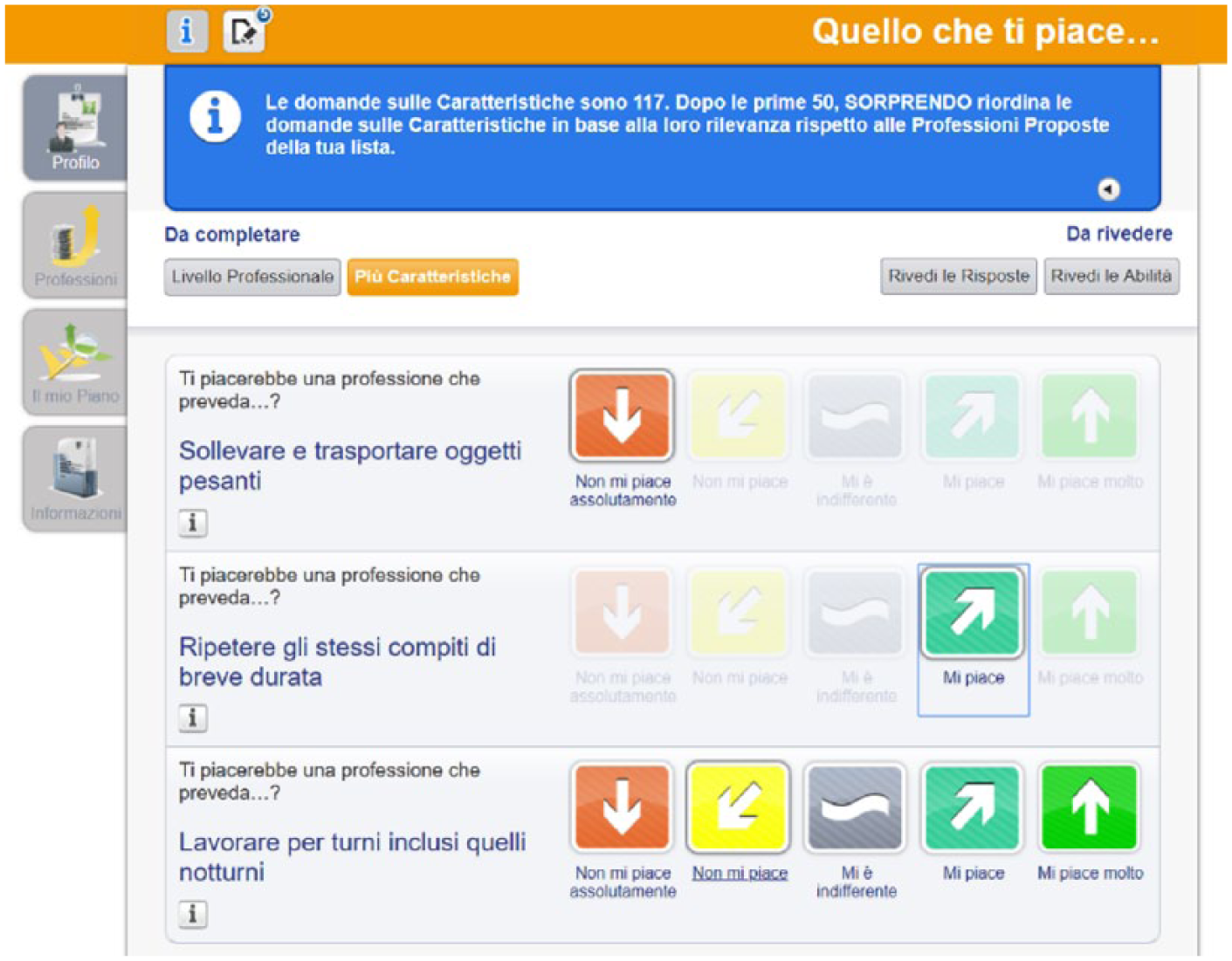
The software’s questionnaire.
Two points are worth stressing here. First, the structure of the software and the design of its interface enable and facilitate a certain flexibility and reversibility of action. To a certain extent, users are invited to jump from one activity to another. They can answer a predefined list of questions, interrupt this activity to monitor their answers, modify them if they have changed their minds, click on a button to have a look at the professions database, enter the action-planning environment to write some notes, go back to the questionnaire, and so on. This variety, openness and flexibility of the scripts available communicate a sense of freedom. This, again, aligns with the software’s aim of supporting individual activation and autonomy.
However, and this is the second key element, the various paths available are intertwined and act upon each other via an underlying algorithm. Users’ answers to the self-evaluation questionnaire instantaneously modify the ordered lists of professions available by clicking on the left button Professioni. The software algorithm is thus elaborated based on two types of data: those provided by the users whilst engaged in self-evaluation and those contained in a database in which professions are defined according to a list of needed skills. The output is a profession-matching list (Figure 5). This output, however, does not conclude the operations afforded through the software, but opens up to users a multiplicity of further actions. While orienting and framing these actions, the profession-matching list constitutes an access point from which to acquire information about specific professions and the skills they require, as well as to learn about users’ self-perceived abilities. These functions are accessible by clicking the two round buttons to the right of each listed profession. These round buttons visually signal the degree of compatibility between users’ answers and jobs’ features through a star rating. They are ‘clickable’ and allow users to enter a new environment where they can have a detailed picture of how their answers match with the features of the job. In this way, the algorithm that produces a specific output is made (to a certain extent) transparent so that users can learn how to modify their answers to modify their degree of compatibility with specific professions.
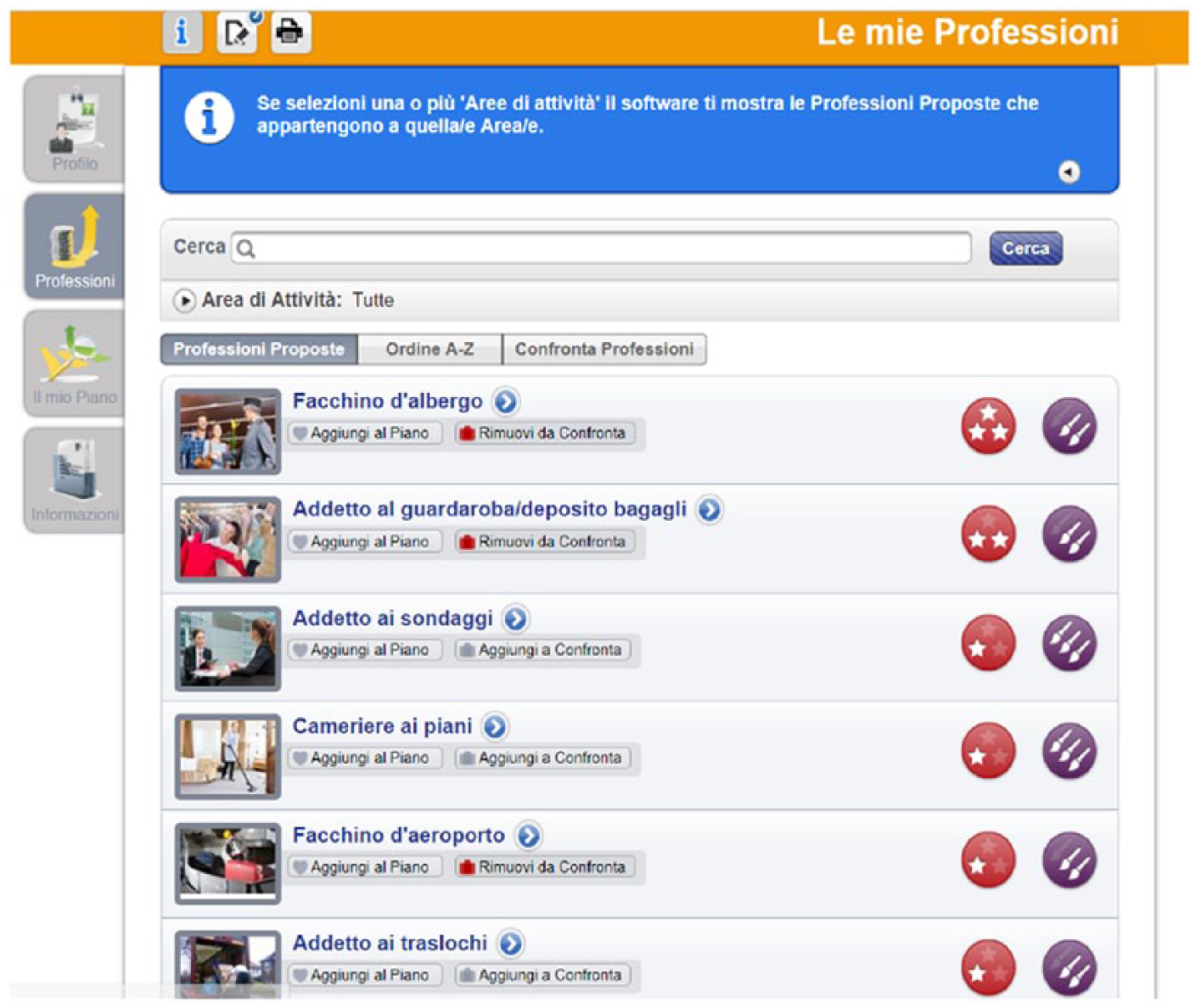
The matching list.
We find continuities between this individual-centred profession-matching algorithm that SORPRENDO offers and a broader rationale tending towards the ‘personalisation of education’ that researchers have identified when analysing the processes of digitisation of both the practices and the governing of education (Simons, 2014; Williamson, 2017). Furthermore, this tendency has been signalled as a transfer of ‘[t]he culture and technics of personalisation from the commercial social media sphere’ (Williamson, 2017: 12) and may also have the imprint of algorithmic recruitment products and discourses transferred from the labour market. These imports illustrate how discourses originating in spheres other than education may enter its domain through a digital artefact like SORPRENDO.
As an interview with the CEO of the Centro Studi Pluriversum made clear, ‘the whole point is not the matching list but that the matching list allows students to reflect about themselves and about themselves within specific work situations’. In this regard, the software constitutes a digital materialisation of an idea of career guidance as aimed to support the intentional management of work and learning path in a lifelong perspective. Whilst users’ exploration of the work profiles available in the database is mediated and framed by the data they have inserted in the software algorithm, the software invites them to take action, deepen their knowledge about themselves, or to further explore and compare available working options. We find here – inscribed in the materiality of the software – an exemplification of the abandonment of a ‘test and tell’ or matching paradigm in career guidance, in favour of a learning and development paradigm (Jarvis, 2003) that identifies the role of guidance technology as supporting individual self-scrutiny. It is worth pointing out that digital solutions like SORPRENDO offer new possibilities for this kind of subject engagement, as technology offers functionalities that enable new forms of interaction with information. These are perhaps akin to processes identified in studies of other digital devices in the world of education, namely those that compare data on the performance of students, schools and education systems, and which offer possibilities of interaction beyond ‘older’ models of passive consumption of information (in this case, matching results), towards creating a perception of co-creation (in this case, learning about oneself, constructing one’s own path; Williamson, 2016a). Furthermore, this feature seems to invite users to see themselves as having agency over the software, but it may be better described as a demonstration of the agency of the software (Kitchin and Dodge, 2011). That is, the ‘playing possibilities’ SORPRENDO’s algorithm offers remain closed within its own rules (the script it carries from its conception stage), thus users’ action is limited to the space created by those rules and respective premises (Wajcman, 2015); at the same time, with its ‘playing possibilities’ SORPRENDO acts upon its users’ subjectivities (Decuypere et al., 2014) by inviting them to see themselves as participant and co-creator agents.
SORPRENDO in use: perspectives of secondary school actors
Having explored the functioning of the software, we now move to account for the point of view of secondary school actors, and to explore the processes through which SORPRENDO has come to be known and used in these contexts. There are four preconditions of its use within the school environment. First, there is a relatively small amount of funds: schools pay approximately one EUR (€1) for each student’s license. Second, average information and communications technology (ICT) equipment must be available during the school day for the software to be used. Third, schools need to address specific organisational-bureaucratic issues in order to request licences for students, find teachers or experts capable of supporting students in the use of the software, and develop ad hoc arrangements to integrate guidance activities into school curricula. Fourth, schools and teachers need to share a particular problematisation of guidance issues, enabling them to recognise it as an object of intervention.
As emerged during our field interviews, the first and the second preconditions are rarely an impediment to the use of the software. Although schools differ in terms of the funding at their disposal and the quality of their ICT equipment, national policies allow for basic economic and ICT infrastructure needs to be met. Consequently, the aims of this section are: (a) to analyse the processes through which school actors’ interest in mobilising themselves to use the software is generated; and (b) to point out the expert network that allows its integration within guidance activities.
Most Italian schools base their guidance activities on teachers’ recommendations (a teaching staff judgment identifying the most appropriate educational paths based on their students’ perceived educational potential) and on information activities carried out through web searches and orientation fairs. Although government guidelines on lifelong learning and lifelong guidance are encouraging schools to frame guidance activities as an opportunity for students to develop more sophisticated CMS, Italian schools generally lack the instruments, the knowledge, or the organisational infrastructure to operationalise this approach to guidance. Moreover, our interviews reveal that in a context where schools are more and more pushed to compete with each other, most available guidance activities overlap with their own marketing strategies. This means that schools’ immediate interest is in concentrating their efforts on attracting prospective students.
I am in charge of coordinating guidance activities in this school for 13 years now. Fourteen years ago, we had a worrying decrease in enrolments so we have started working on guidance activities in order to address potential incoming students. Of course, I care about our outgoing students as well, but I have to admit that for our school it is much more important to reach a certain number of enrolments every year in order to keep our teaching staff. (Prof. Anna, technical–vocational school, Sardinia)
On the one hand, this situation enables specific sources of inequalities to be identified in the types of guidance activities provided according to schools’ positions within the educational field; 2 on the other hand, it allows us to point out that the penetration of a guidance paradigm based on CMS acquisition within the Italian school system needs specific interventions aimed at making it receptive to innovations. In this regard, a key role was played by FIXO, the project financed by the Italian Ministry of Work, through which schools were involved in a network, comprising trainers and experts from various government agencies and private organisations, that contributed to designing and supporting school guidance activities based on a CMS approach.
I have acquired these competences in the field, thanks to FIXO. This project has required lots of extra effort, but I have learned a lot from it. In the field, there were these consultants from the Ministry of Work and from the ministerial agency Italia-Lavoro… they were there for us, to help us. This is how I have learned specific formats and methodologies both to support students in their decision-making process and to build school projects capable of using resources and experts available in the territory. (Prof. Roberto, general school, Lombardia)
As this excerpt illustrates, through its support network of trainers and experts, FIXO is a key policy instrument enacting an articulated process of ‘conversion’ to an educational project embedded within the lifelong guidance and lifelong learning narrative. However, it must be noted that only a small proportion of teachers – in particular teachers occupying middle-management positions within the school organisation – were actively involved in this project (Hirschhorn, 1993). These teachers organised and coordinated school projects, particularly in the field of guidance. Additionally, they operated as organisational relé (Crozier and Friedberg, 1977), establishing relationships between their school and the network of private and public organisations. On the one hand, it is precisely through their active involvement in the policy process that the resocialisation of the educational system to a new educational paradigm can be accomplished. On the other hand, their efforts to promote specific guidance discourses and practices could be negated by changes in the school organisation structure or if they work with particularly resistant teaching staff. In this respect, the materiality, the design and the structure of the technologies translating and enacting this paradigm shift in career guidance are of key importance.
I think SORPRENDO is an instrument that has lots of potential. It is an easy-to-use instrument to a certain extent. It has an almost ludic approach. It is very easy to use by students and by teachers themselves. (Prof. Giacomo, general school, Lombardia) The software allows us during our interviews with students to frame the working or higher education sector to discuss. In this way we could pack within six hours all the activities that we have to accomplish within the FIXO project: writing a curriculum, a presentation letter, working on what I like and what I am particularly good at, what are my competences, my personal characteristics and so forth. (Prof. Elio, technical–vocational school, Sardinia) Taken on its own, it is not really useful. It has to be accompanied by a project where other instruments are also available. Above all it needs to be managed by someone that is trained in the field of guidance activities, because the output of the software needs to be understood, you can’t just take it literally, you need to see various elements, you need someone to help the students read the software results. Otherwise it is very superficial. (Prof. Giacomo, general school, Lombardia)
These interviews allow us to point out four main features through which the digital infrastructure of the software favours its penetration in the Italian educational field.
As the interview excerpts illustrate, it is easy to use and appealing in its design and scripts.
Teachers do not need particularly specialised knowledge – such as that required to administer psychometric tests – to use it with their students.
The software provides distance training for teachers and interested professionals through a set of online webinars.
The software structure allows a certain standardisation of guidance practices: It provides schools with a predefined design of career guidance activities and, thanks to its digital features and training provision, enables its particular approach to be easily disseminated.
However, as the last interview excerpt illustrates, although a ‘superficial’ approach to the use of the software is always possible (making students fill out the questionnaire to produce a profession-matching list), teachers acknowledged that its true potential lies in its capacity to activate students’ curiosity and ‘willingness to learn’ about themselves and the world of work. The software enables the drawing out of ‘possible stories’ that need to be clarified and treated through specific knowledge regimes that could be available only if networks of collaboration with guidance or counselling experts are established. In the next section we will point out how differences among schools and the territories they are embedded within shape the ways in which the software is used.
SORPRENDO in use: Contextual constraints and opportunities
The transformational promises of the CMS approach to career guidance and the technologies through which it is made operational can be significantly shaped by the competences, resources and professional cultures available in different contexts. In both schools examined, although interviewed teachers were enthusiastic supporters of the lifelong guidance paradigm, they pointed out the uncertain institutional framework characterised by often contradictory organisational pressures. On the one hand, teachers were exasperated by the continuous stream of external solicitations to deploy their energies towards new learning ventures. On the other, they stressed that the new learning and practices often had only transitory benefits.
There is the need to have here people, experts, whom we can rely on to help our students, to give them information, to help them if they face difficulties, to support their families. FIXO gave us this opportunity, but now we don’t have that network of supporting people anymore. (Prof. Anna, technical–vocational school, Sardinia) I would like to see a stable framework of guidance in the long term. We have to be able to select from among different guidance projects, to be able to organise a structural path, which remains a fixed point. This is because it would greatly simplify organisation year after year. (Prof. Roberto, general school, Lombardia)
Teachers attributed issues with discontinuity to various aspects that characterise the school organisational context, including the lack of teachers in charge of guidance activities and the bureaucratic red tape, as the following excerpt exemplifies.
It is difficult to send these projects up quickly. It is not possible. I mean, we could, but we should accomplish a whole series of bureaucratic procedures… we have to go through the school council, we have to define exactly the costs of the intervention, but then costs vary from year to year, in the meantime the teacher taking care of the issue maybe retires or goes to another school, so she has to be replaced… (Prof. Marco, general school, Lombardia)
Moreover, although the two contexts share the same difficulties in integrating SORPRENDO and the projects accompanying its use within their organisational structures, they differ considerably in the ways the software is actually used. Two main issues are worth stressing. The first pertains to the socioeconomic context in which educational institutions are embedded. In Sardinia, the unemployment rate is 17.3%, double the EU average (Eurostat, 2017). Unemployment amongst young people is 60%. In this context, SORPRENDO is used by only one technical–vocational school located in the region’s capital. In the north of Italy, where the general school studied is located, economic conditions are stronger and synergic relationships between education and employment have longstanding roots (Banca di Italia, 2015a, 2015b). Here, the software is used more commonly, not only by technical–vocational schools, but also by academic-oriented ones. The second issue shaping how the software is used pertains to the social composition of the student body, and to school curricula. In the Italian context these two dimensions are intertwined due to the strong tracking differentiation that characterises the secondary school system. In particular, technical–vocational school teachers have much more difficult working conditions than their peers in academic-oriented schools. On average, they face a higher number of school failures, disciplinary issues and low achievement scores. In these schools SORPRENDO’s capacity to provide meaningful career guidance tools needs to be supported by other interventions addressing students’ social and educational characteristics.
This sort of project is always not enough for our students as they need to be taken care of in much more depth. There are students having families that can support them in understanding the job offer or the higher education offer. But there are also these kids that do not really know where to start from because they lack a family in the background, supporting them. These are abandoned kids somehow, that never really thought of the possibility to move to higher education, for example. (Prof. Anna, technical–vocational school, Sardinia)
The teachers we met acknowledged quite clearly that their students’ guidance needs, curiosity and capacity to imagine future working and educational possibilities are intertwined with their background and family conditions. SORPRENDO, on its own, emphasises that learning (about oneself, and the educational and work offer) is good in itself, that individuals should acquire and improve throughout their life, but glosses over the socially determined roots of individual motivations, desires and preferences (Kelly, 2001, 2006; Reay, 2015). In this way, as the excerpt above illustrates, when inequalities of social conditions are considered, the use of the software allows the emergence of a tension between the specific aims of an individualistic approach to career guidance and broader issues of social justice (Hooley et al., 2018). This tension often remains unresolved as the material, cognitive and social resources to take charge of the complexity of students’ individuality and background conditions are unevenly distributed among schools.
I have seen there is a different approach to career guidance if you compare general and vocational schools. What I have experienced is that in the general schools SORPRENDO has been used as part of a larger set of guidance activities aimed to go a bit more in-depth to identify students’ well-being needs. And we have had also the university coming here to do a similar type of coaching project with other classes. With the vocational schools the approach has been different. We went more straight to the point. Students were much more interested in identifying their professions and the concrete aspects of those professions. (Prof. Lea, general school, Lombardia)
This excerpt exemplifies clearly how context shapes the enactment process. The teacher interviewed had the opportunity of being the promoter of a career guidance project making use of the software in two different schools: a general and a technical–vocational one. Based on her experience, we can point out two further elements structuring how the software is used. The first pertains to students’ characteristics, motivations and preferences. Although the use of an observational methodology would allow us to explore this aspect in much more detail, the teachers interviewed shared the view that the students’ approach to the digital tool, and to career guidance in general, contributes to defining the types of activities, questions and feedback employed during the guidance session. This excerpt shows that technical–vocational school students are particularly interested in going ‘straight to the point’ and identifying a suitable profession. The second element relates to schools’ differences in terms of their engagement within a network of actors that provide resources for career guidance activities. As the excerpt stresses, general schools have meaningful and sometimes stable relations with higher education institutions. The latter constitute one among the key actors in the production and spreading of contemporary expert discourse on career guidance, and are able to develop and organise guidance initiatives. Thus, while technical–vocational schools are relatively ignored by higher education institutions, as they hardly constitute a prolific source of prospective students, general schools can often count on institutional networks to provide richer immersion for their students (and teachers) within the new regime of governmentality of educational and working transitions (Besley, 2006; Johnson, 1972, 1995).
Conclusions
This analysis of a specific digital device providing career guidance within Italian secondary schools has a twofold aim. On the one hand, we have highlighted the discursive and material conditions of the existence of this device. On the other, we have focussed on its enactment within specific school contexts showing the ways it constructs subjectivities, enables practices, and conveys meaning and conceptions of educational processes. Following recent studies on digital governance (Williamson, 2016a) and adopting a policy instrument approach (Lascoumes and Le Galès, 2007), our attempt has been to show how the introduction of a digital object within the school environment helped mobilise school actors around new ways of conceiving and delivering education that transcend the local dimension, and instead look towards national and European ideas. In this regard, we have argued that the case of SORPRENDO constitutes a meaningful illustration of how the governance of the European education space (Lawn, 2006) is mediated, activated and accomplished, using digital instruments. Software, platforms and websites exert a persuasive power on their users, who contribute to transform the educational order while transforming themselves. The choice of focussing on a career guidance software, in this respect, is motivated by the pivotal role that the European lifelong guidance and lifelong learning strategies play in the process of reforming educational systems, their objectives, curricula and everyday practices. We have shown that the software constitutes a digital materialisation of an idea of career guidance aimed at supporting individual self-scrutiny and the intentional management of learning and working transitions. In this way, the software is both a product of, and a means conducive to, a Europeanisation process aiming at restructuring the educational order to support the needs of contemporary, flexible, knowledge-based production systems. We have argued that the software, its algorithm and scripts, constitute indeed a policy instrument that acts as a technology of the self (Foucault, 1988), enabling subjects to act and to think of themselves in particular ways (Williamson 2016b). At the same time, we have shown how it provides schools with an easy-to-use tool favouring the dissemination of its particular approach and a certain standardisation of guidance practices. However, we have also highlighted that the material, cognitive and social context in which the software is enacted shapes the operations accomplished, the objectives pursued and the meaning conveyed.
Thus, schools occupying a dominant position within secondary education are more fully immersed within networks of guidance experts, and are less likely to be solicited by students for immediate answers to their employment needs. These schools can provide in-depth career guidance, enabling students to be actively involved in self-discovery and learning management as depicted by the official documents promoting CMS at the European and national level. Based on their privileged position – defined by the educational, social and economic resources they can access – their students are offered the possibility of acquiring the skills they need to boost their learning and working careers within the contemporary regime of flexible production. Less privileged students, on the other hand, experience what interviewees depicted as a more ‘superficial’ approach to career guidance, and get a profession-matching list that frames their horizons of possibilities on the basis of socially constituted preferences, tastes and interests.
The case of SORPRENDO highlights how digital devices can constitute potent governing tools capable of conveying meaning and narratives through forms of visualisation, diagrams, texts, training tools and personalised outcomes. Our fieldwork enables us to uncover the tensions, resistances and inequalities that emerge as they are concretely enacted, and to show that the way subjects participate in governing processes is mediated by their embeddedness within specific networks of relations and resources.
Footnotes
Author’s note
Antonietta De Feo is now affiliated with Univerità degli Studi Roma Tre, Italy.
Declaration of conflicting interest
The author(s) declared no potential conflicts of interest with respect to the research, authorship, and/or publication of this article.
Funding
The author(s) received no financial support for the research, authorship, and/or publication of this article.
Notes

Author biographies
Marco Romito is postdoctoral researcher at the Department of Sociology and Social Research at the University of Milano-Bicocca. His research interests are in the sociology of education, inequalities, qualitative metodology and digitalization.
Catarina Gonçalves is a PhD student on Educational Policy and Administration at the Institute of Education, University of Lisbon. She is interested in the relation between knowledge and policy, with a particular focus on digital devices as governing instruments.
Antonietta De Feo is researcher at the Department of Philosophy, Communication and Performing Arts, University of Roma Tre. Her research interests lie in the area of sociology of education and culture. She is focused in particular on inequalities, digital education policies, school choice.