




Abstract
Based on Honneth’s recognition theory, this study aimed at investigating whether students with a migration background reported receiving less recognition from teachers than students without a migration background. Also, we explored whether such a difference contributed to explaining the disparity between the groups in reading achievement. To answer these research questions, we used data from a German study on school quality (STEG-S; n = 2105 students), and from the Programme for International Student Assessment (PISA; n = 6504 students). The results show that, indeed, students with a migration background experienced less recognition from teachers in terms of cognitive respect. Students reporting lower levels of cognitive respect from reading teachers further achieved poorer outcomes in the reading test at the end of the first term of grade 5, controlling for test results at the beginning of the term. Accordingly, cognitive respect from the reading teacher mediated the effect of the migration background on reading achievement. These effects were small but might accumulate over time. Hence, recognition in the classroom appears to be one piece of the puzzle for understanding how educational disadvantages persist and are reproduced for students with a migration background.
Introduction
Recognition has become a key concept and new paradigm for analysing social inequalities in the fields of social science (Fraser and Honneth, 2003) and education (Balzer and Ricken, 2010; Hafeneger et al., 2002; Stojanov, 2015). According to normative recognition theories, 1 experiencing intersubjective mutual recognition is essential for developing a positive relation-to-self and individual autonomy (Honneth, 1995) and, consequently, for education (according to the German notion of Bildung, see e.g., Honneth, 1995; Stojanov, 2015). Therefore, recognition of all students in the modes of emotional support, cognitive respect and social esteem can be considered an ethical principal for everyday school practice and a fundament of the bond between teachers and students (Helsper and Lingkost, 2002: 132; Prengel, 2006, 2008, 2013). However, this is an ideal that is often not reached in reality. A considerable number of students in Germany report frequent experiences of being disregarded at school (e.g., Prengel, 2013). To a certain extent, disregard can be considered innate to the structures of schooling, in particular when it comes to performance evaluation and the resultant allocation to social positions (Helsper et al., 2005; Prengel, 2002). However, not all students are affected to the same degree. Who is granted and who is denied recognition might be influenced by, inter alia, social inequalities along several axes, among them migration background. Such inequalities are associated with economic (dis-)advantages and have consequences for social status (Fraser and Honneth, 2003), which can, in turn, affect power structures at schools (Helsper, 2008). Considering the importance of recognition for education (Bildung), such recognition-related disadvantages for students with a migration background might explain in part the achievement gap between this group and students without a migration background. In our study we investigate whether students in Germany with a migration background indeed report receiving less recognition from teachers than students without a migration background. Also, we explore whether such a difference, if any, contributes to explaining the disparity between the groups in reading achievement.
Theoretical background
The term recognition can have a variety of meanings (see e.g. Ricoeur, 2007) in both everyday language and scientific discourse. Normative recognition theories (Fraser, 1995; Honneth, 1995; Taylor, 1992) refer to recognition as a form of acknowledgement or respect for another being, which is considered key to understanding the intersubjective process of identity construction. The individual self does not first exist and then get in touch with others, but from the moment individuals are born they experience themselves only through others, for whom they likewise constitute a condition for experiencing themselves as someone (e.g. a mother; Balzer and Ricken, 2010). The development of a ‘practical relation-to-self’ essentially depends on perceiving oneself from the normative perspective of interaction partners (Honneth, 1995: 92). Such a relation can be positive only when one experiences respect and acceptance by these others.
Honneth (1995) distinguishes three interrelated modes of recognition: emotional support, cognitive respect and social esteem. Taken together, they ‘constitute the social conditions under which human subjects can develop a positive attitude towards themselves’ (Honneth, 1995: 169).
Emotional support is unconditional affection and care received from others and is experienced mainly through primary relationships characterized by a strong bond between a limited number of individuals (e.g. parent–child relationships, romantic relationships and friendships). Because people do not feel the same fondness for, or attraction to, everybody, emotional support is always particularistic. However, having such a strong bond with someone (especially the parents) is paramount to understanding one’s own needs and developing self-confidence.
Cognitive respect refers to a form of mutual recognition in a legal sense and ideally should be universal within a ‘community of value’ (Honneth, 1995: 111). Being legally recognized as a member of this community means being the bearer of rights that are equally applicable to all members. Respective rights can, if necessary, be enforced by an authorized, sanctioning authority. In the same vein, individuals have normative obligations and duties toward others that are universal within the community (Honneth, 1995). By abiding by laws, each subject recognizes every other subject within the community as ‘persons capable of autonomously making reasonable decisions about moral norms’ (Honneth, 1995: 177). Granting equal rights as a result of learning that one deserves the respect of all others within the community enables subjects to acquire the potential to develop self-respect.
Social esteem is respect for an individual’s particular characteristics that distinguish the individual from other people (Honneth, 1995: 113). This implies that individual traits, abilities, achievements and forms of self-presentation are not only accepted but are judged positively in light of shared practices for the pursuit of common goals. Not all human characteristics are valued by all groups: Characteristics considered positive vary across social groups depending on their shared values. The experience of social esteem is necessary for developing self-esteem (Honneth, 1995).
The experience of disregard – either as an individual or as a member of a group that is devalued – violates a person’s identity. In its extreme, disregard through lack of emotional support takes the form of abuse, cognitive respect is violated through the denial of rights and/or exclusion, and social esteem is violated through denigration and/or insults (Honneth, 1995). The affected are likely to resist, for example by searching for love, taking action against discrimination, or attempting to gain public attention in order to revalue their own characteristics, achievements and ways of life (Honneth, 1995).
Recognition at school
At school, learning takes place within and through intersubjective relations between students and teachers as well as among classmates, which are – like any other intersubjective relation – structured by recognition. Consequently, in normative recognition theories the realization of all three modes of recognition at school is considered fundamental to providing access to education (in the emancipatory sense of the German notion of Bildung; e.g. Stojanov, 2015). Thus, recognition at school can be considered a ‘method and aim of pedagogical practice’ (Scherr, 2002: 40; see also Prengel, 2006, 2013).
Emotional support is realized at school when teachers interact with students in a positive, friendly, open and interested way. Cognitive respect is realized at school when all students have the same rights, that is, equal access to learning opportunities, equal chances to participate in class, fair grading and treatment in accordance with children’s rights and freedom from humiliation and physical and mental harm. Finally, social esteem is realized at school when the specific abilities, achievements, orientations, self-realizations and self-presentations of all individual students are valued (Helsper, 2001; Helsper et al., 2005; Prengel, 2013).
Teachers’ unconditional recognition of all their students is an ideal that is not always transformed into reality. In fact, empirical findings indicate that students in Germany are frequently disregarded by their teachers (Baier et al., 2009; Krüger et al., 2003; Prengel, 2013; Schubarth, 1997), meaning they have been treated unequally or unfairly, misjudged, denigrated and/or have experienced unfriendly, aggressive and sometimes even physically abusive behaviour toward them – as judged by external observers. From findings of empirical studies Prengel (2013) concluded that approximately one third of students in Germany have had such experiences with their teachers. More fundamentally, social esteem could be denied through grading, which structures the distribution of recognition at school in an unequal way by rewarding only particular achievements and self-presentations and not others. Grading is supposed to follow universalist principles and reflect the students’ academic achievement only. However, even if this was feasible, denial of recognition would still occur for those with poorer starting conditions in the learning process (Helsper et al., 2005; Prengel, 2013). Thus, recognition appears to be distributed unequally at school.
Who receives recognition from a teacher and who is subjected to denigration likely depends on the students’ individual competencies, personalities and interactive behaviours and whether they match the teachers’ values and expectations. In particular, teachers tend to direct more favourable non-verbal behaviours and emotional warmth toward high achievers (e.g. Babad, 1993; Rosenthal, 1994), and they appear to be less supportive of students who show disruptive classroom behaviour (e.g. Murray and Greenberg, 2000). However, social power structures also are likely to play a role in this context. Referring to Honneth’s recognition theory and Bourdieu’s (1990) concept of habitus, Helsper (2008) argued that each school can be considered a ‘community of value’, where particular achievements, orientations, self-realizations and self-presentations become exalted to excellence or at least accepted as legitimate, whereas others are only tolerated, marginalized, or even tabooed. The evaluative frame of reference develops through struggles of social groups for establishing their views as predominant in the continuing process of negotiating pedagogical orders of meaning within schools. The resulting order is specific for each school, but social structures of hegemony and subordination have an effect on the outcomes of these negotiations, and social groups that are predominant in society generally tend to have more resources to present their cultural orientations and practices as desirable at school, placing students whose life-world experiences are less in accordance with the scholarly expectations at a disadvantage. Helsper (2001, 2006) mentions an ‘institution-milieu complex’, where – through the involvement of teachers and students in different milieus – these milieus intrude into schools, in spite of schools’ universal claims concerning performance appraisal and the resultant allocation of students to social positions. For students, this implies ‘divergent spaces for the articulation and recognition of their selves’ (Helsper, 2001, p. 38). Hence, we expect to find variation within classes with regard to students’ experience of recognition.
Recognition of, and education-related disadvantages for, students with a migration background
Migration background is one of the axes of difference that structure inequalities and relations of power and oppression in society in general and in Germany in particular (Stosic, 2017) and thus might be relevant in the context of the so-called ‘institution-milieu complex’ described by Helsper (2001, 2006). 2 According to Fraser and Honneth (2003), each inequality axis is an organizing principle of domination, and the disadvantage for the dominated group usually is economic and social. This means that people in disadvantaged groups have fewer opportunities to amass economic capital, but also suffer from public devaluation. For people with a migration background, these disadvantages manifest themselves in a considerable gap in income (e.g., Aldashev et al. 2008) and, inter alia, in negative attitudes and prejudices toward their social category, which are widespread in Germany (e.g., Baier et al., 2009; EUMC, 2005).
At school, the performance of students with a migration background generally is poorer than that of students without a migration background (e.g. Stanat and Christensen, 2006), and the scholarly attainment rates for students with a migration background are lower than those of students without a migration background (OECD, 2008). This education-related disadvantage is likely to perpetuate the income gap between the two groups over generations. Additionally, there is evidence of a disadvantage in terms of status at schools: Several qualitative accounts of teacher misrecognition in the classroom appear to be linked to the ascribed group membership of students with a migration background (Dalhaus, 2016; Wischmann and Dietrich, 2014).
Forms of ‘othering’ appear to be quite common. For example, teachers might ask questions about students’ ascribed cultural heritage, for example, food, customs, behavioural norms, history and/or geography of countries the students might never even have visited (Scharathow, 2014). Even though the intention of the teacher in these cases very likely is good, such questions indicate that the student with a migration background is seen as a ‘migrant other’, that is, someone who is ascribed a culture that differs from the mainstream. Another example is assigning students with a migration background a role outside of the competition in competitive classroom games justified by an assumed or real lower level of competences. This means marking the student not only as someone who is different but also as someone who is deficient with regard to a competence that is highly valued at school (Wischmann and Dietrich, 2014). Further examples of ‘othering’ at school have been described in Rose (2012), including teachers giving students with a migration background stereotypical roles in a nativity play, or praising their performance by saying it ‘was not so bad for a foreigner’, or accusing them of being more likely to misbehave. The unfair treatment, described in the latter example, indicates a lack of recognition in terms of cognitive respect. In all of the qualitative examples individual traits, abilities, achievements and forms of self-presentation of students with a migration background further tend to be judged more negatively than those of their classmates without a migration background, which indicates a lack of recognition in terms of social esteem. On a more general level, other school observations also revealed a systematic lack of social esteem for multilingual students at schools in Germany, where competence in German and in a few other select languages (English, French, Spanish) is valued but multilingualism mostly is considered an obstacle to learning (the ‘monolingual habitus of the multilingual German school’; Gogolin, 2008, 2013). In contrast, there is less indication of a lack of recognition in terms of emotional support by teachers: In the qualitative studies cited above, the teachers involved in ‘othering’ were described as friendly and well-meaning by the students with a migration background (e.g. Dalhaus, 2016; Rose, 2014).
Given the situation described above, a thin line seems to exist between social esteem and a devaluation of the individual on the basis of ascribed otherness (Jenlink, 2009: 21–22), of which teachers apparently are not always aware. In most cases, the teachers’ behaviour is presumably non-reflective or well-meant. Nevertheless, these and other qualitative findings suggest that students with a migration background might be at greater risk of experiencing misrecognition in terms of cognitive respect and social esteem at school than their peers who do not have a migration background. However, it remains unknown how much greater this risk is; whether the instances reported in qualitative studies are isolated cases or examples of more systematic inequality.
Not all students with a migration background will be affected equally, because migration background intersects with several other axes of difference (Crenshaw, 1989; Davis, 2008; Leiprecht and Lutz, 2005; Sachverständigenrat deutscher Stiftungen für Integration und Migration, 2012). For example, Muslim immigrants have a considerably lower ascribed social status than other immigrants in Germany (Berliner Institut für empirische Integrations- und Migrationsforschung & Forschungsbereich beim Sachverständigenrat deutscher Stiftungen für Integration und Migration, 2017), and the visibility of minority group membership also can play a significant role in social status (Rose, 2014; Sachverständigenrat Deutscher Stiftungen für Integration und Migration, 2012). Nevertheless, we expect even this broad and heterogeneous social differences category of migration background to correlate with recognition at school, and we expect this correlation to persist when socioeconomic background and gender are controlled for. The size of the effect of the migration of the background, however, might depend on the school and on the teacher: Helsper (2001, 2006, 2008) argued that the teachers and administrators of some schools adapt more to their diverse student bodies than others. Therefore, the influence of social milieu on opportunities for recognition is likely to depend on school culture. Further, empirical research findings suggest that attitudes toward people with a migration background vary across teachers (Berliner Institut für empirische Integrations- und Migrationsforschung & Forschungsbereich beim Sachverständigenrat deutscher Stiftungen für Integration und Migration, 2017). Teachers with more negative attitudes towards people with a migration background are likely to give students to whom they ascribe this group membership systematically less recognition, so that differences between students with and without migration background with regard to their perceived recognition might also vary between teachers.
Overall, students with a migration background might experience, on average, less recognition in the classroom than their peers without a migration background and recognition of students with a migration background might vary considerably across classrooms. A mean-score difference could further (and despite the expected variance) contribute to explaining the achievement gap between students with a migration background and students without a migration background, given the assumed importance of recognition for education.
Research questions and hypotheses
In this study we investigate whether teachers’ recognition of students with a migration background differs from their recognition of students without a migration background and whether such a difference contributes to the reading achievement gap between these groups. We investigate reading achievement because it is an important precondition for all formal and self-led education and for participation in society (including politics) and because the achievement gap is rather large in this area (Stanat and Christensen, 2006).
We formulated the following hypotheses:
Students with a migration background will experience less recognition from the teacher in terms of cognitive respect and social esteem than their classmates without a migration background. This implies that: (a) the difference between students with and those without a migration background with regard to cognitive respect and social esteem (if any) will remain significant when students’ sex, socioeconomic status (SES) and reading achievement at the beginning of grade 5 are controlled for; (b) an effect of migration background will be observed within classes and not only between classes (because the former indicates that students with a migration background will report less recognition from the same teacher as compared to their classmates, whereas the latter effect indicates that students with a migration background will be only more likely to be taught by a teacher who generally treats all of his/her students with less respect).
Because schools differ in the extent to which they adapt their culture to disadvantaged students and because teachers differ in the extent to which they are prejudiced against students with a migration background, the size of within-class effects of migration background on cognitive respect and social esteem will differ.
An effect of migration background on reading achievement at the end of the term will be mediated by recognition from the teacher (controlling for reading test results at the beginning of grade 5). This mediation effect implies that: (a) students with a migration background will exhibit poorer reading achievement at the end of the term than students without a migration background (controlling for reading test results at the beginning of grade 5); (b) recognition from the teacher will correlate with students’ reading achievement at the end of the first term of grade 5, (controlling for reading test results at the beginning of grade 5); and (c) the effect of migration background on reading achievement at the end of the term will decrease when recognition from the teacher is controlled for.
Method
This study was based mainly on a sub-project of the Study of the Development of All-Day Schools (StEG-S), which was conducted at the German Institute for International Educational Research (DIPF) . 3 StEG-S was a longitudinal large-scale assessment conducted between 2012 and 2015 in seven federal states of Germany. Fifth-grade students completed questionnaires and a reading achievement test at three measurement points: the beginning (T1), middle (T2) and end (T3) of the school year 2013/2014 (Sauerwein, 2017). The analyses presented here are based on data collected at the first two measurement points. The tests and questionnaires were developed by researchers at the DIPF, and approval from the ministries of all federal states involved and an ethics commission was obtained prior to their administration.
Additionally, we carried out a secondary analysis of German data from the student questionnaire of the large-scale assessment Programme for International Student Assessment (PISA) 2015 to examine the consistency in differences between students with a migration background and those without with regard to one mode of teachers’ recognition (cognitive respect) across samples (fifth graders in StEG-S (9–12 years old) vs. 15-year-old students (grade 7 or higher) in the age-based PISA study). The PISA study is carried out every three years in all OECD countries and in a number of partner economies. It compares the achievement in reading, mathematics and science, and the learning conditions at school and outside of school of 15-year-old students in grade 7 or higher across education systems. In addition to achievement tests, questionnaires for students and for schools are administered each PISA cycle to collect information on educational input, processes, and non-cognitive outcomes. For the present study we only analysed data collected from the PISA 2015 student questionnaire concerning teachers’ recognition (cognitive respect) and students’ backgrounds. These scales were developed at the DIPF on the basis of the questionnaire framework (OECD, 2017a) and under guidance of the Questionnaire Expert Group, the OECD secretariat, and country representatives in the PISA governing board (for more information on the development of the questionnaires for PISA 2015, see Kuger et al., 2016; OECD, 2017b); Reiss et al, 2016).
Participants
In StEG-S all-day schools offering extracurricular social activities and reading programmes for fifth graders (which are not offered in all schools in Germany) in seven federal states were investigated. To identify those schools, a representative survey of school administrations was conducted in 2012 (StEG Konsortium, 2012). Administrators of those schools were sent a letter in which they were asked to participate in StEG-S. When they agreed to participate, they selected one or two fifth-grade classes and sent a permission form to all parents or guardians of students in those classes. Only students whose parents or guardians gave their consent participated in the study. The total StEG-S sample for our study consisted of 2105 students in 127 classes at 66 of these schools. Of the participants 46% were female and 54% male, 36% had a migration background (meaning that they and/or at least one of their parents had been born outside of Germany), and 64% were born in Germany to parents who both had been born in Germany. The average SES measured with the highest international socio-economic index of occupational status (HISEI; which has a theoretical range from 16 to 90) was
In PISA a sample representative of 15-year-old students in grades 7 and higher (7–11) at educational institutions in Germany was studied. To achieve representativeness, a two-stage stratified sample design was used. First, schools were sampled systematically from a comprehensive list of all schools with 15-year-old students (or possibly having these at the time of assessment) in Germany. Therein, the sampling probabilities were proportional to the estimated number of PISA-eligible 15-year-old students enrolled at the schools, and school characteristics were also taken into account. Second, 30 15-year-old students were sampled within each school (Reiss et al., 2016). Quality standards (see OECD, 2017b) had to be maintained with respect to the coverage of the PISA international target population, accuracy and precision, and the school as well as student response rates. In Germany, all sampled schools were required to participate in PISA and the target students at those schools were required to take the PISA tests. Completion of the student questionnaires was obligatory in seven German states but voluntary in eight. In the latter, parental consent had to be obtained in order for students to receive a PISA questionnaire. In Germany the sample was 6504 students representing a population of 741,872 students. Our analyses are based on 5397 of these students who provided information on their migration/non-migration background and the recognition they felt they received from their teachers.
Measures
For indicators of students’ perception of the recognition they received from their teachers and their individual positions on three axes of social difference (migration/non-migration background, sex and SES) we used those employed in both the StEG-S (all three modes of recognition) and PISA study (only cognitive respect as a mode of recognition). We further analyzed data from a reading achievement tests used in StEG-S at the beginning and in the middle of grade 5. Finally, we used indicators of school type and class composition in some of the analyses of StEG-S data.
Three modes of recognition
In StEG-S, the three modes of recognition were measured with 11 items on the student questionnaire. To assess the degree of perceived emotional support received by the reading teacher, students were asked whether he/she took them seriously, accepted them as they were, whether they could trust him/her, and whether they felt they got along well with him/her. To assess perceived cognitive respect, three negatively worded items were used. Students were asked whether their reading teachers treated them unfairly, ridiculed them in front of others, and/or yelled at them. Finally, to assess the degree of perceived social esteem from the reading teacher, students were asked whether the teacher cared about them, recognized their strengths, valued their abilities and gave them opportunities to demonstrate their competences. Students assessed the frequency of these experiences on a 4-point Likert scale, ranging from ‘strongly disagree’ to ‘strongly agree’. The fit of a confirmatory factor analysis model with ordinal data was acceptable (CFI = 0.96; RMSEA = 0.12) and Cronbach’s alpha was high for all three recognition scales (emotional support α = 0.89; social esteem α = 0.90 cognitive respect α = 0.83; for detailed analyses, see Sauerwein, 2017).
On the PISA 2015 questionnaire only recognition in terms of cognitive respect was surveyed. It contained three items to assess teacher fairness: ‘Teachers called on me less often than they called on other students’, ‘Teachers graded me harder than they graded other students’, and ‘Teachers disciplined me more harshly than other students’. It also had two items to assess freedom from humiliation: ‘Teachers ridiculed me in front of others’ and ‘Teachers said something insulting to me in front of others’. All these items were rated on a 4-point Likert-scale ranging from ‘never’ to ‘once a week or more’. Cronbach’s alpha supported high internal consistency of the scale (α = 0.78).
Students’ reading competence
Students’ reading competence was assessed using the Frankfurter Leseverständnistest 5-6 (FLVT 5-6; Adam-Schwebe et al., 2009; Souvignier et al., 2008). The FLVT is a standardized test with two versions developed for longitudinal studies. The test is sold by Hogrefe and assessment of the comparability of the test versions as well as the psychometric properties of the test are published in Adam-Schwebe et al. (2009) and Souvignier et al. (2008). Each test version consists of two types of text (narrative and non-fictional) with 16 questions for each text. To reduce testing time students were given only one text type (narrative or non-fictional) at each measurement point in the STEG-S study. The test versions and text types were allocated randomly to the students, they were distributed in four booklets, and a rotated booklet design was used. The test was scaled as an IRT 2Pl model (in R with the package TAM – see Kiefer et al., 2015). To consider possible differences in the difficulty of text versions, they were equated (see Kolen and Brennan, 2004). In StEG-S the reliability of the test was stratified (EAP reliability 0.78; infits and outfits for the items ranged between 0.90 and 1.10).
Student characteristics
Information on an individual student’s position on the three axes of difference (migration/non-migration background, sex and SES) was collected through the StEG-S and PISA student questionnaires. Migration/non-migration background was determined from students’ responses to questions about their birthplace and the birthplace of their parents. If both parents were born in Germany, the background was coded 0 = non-migration background; if at least one parent was born in a foreign country, the background was coded 1 = migration background even if the student was born in Germany (second generation migrant). In StEG-S and the PISA study only the traditional binary sex categories male (0=) and female (=1) were used. In both studies, the SES of students’ families was determined using the ISEI (Ganzeboom, 2010). Parents’ occupations were indicated on the parent questionnaire. ISCO codes (ILO, 1990) were assigned to the responses, which were mapped to the ISEI. The HISEI of both parents was included as an indicator of students’ SES.
Class characteristics
In StEG-S, information on the students’ track (academic v. non-academic) was available from the schools. Indicators of the class composition were derived by aggregating the student-level variables. Three compositional variables were used, that is, the class composition with regard to students’ migration/non-migration background (the percentage of students with a migration background), the socioeconomic composition (average HISEI), and the gender composition (the percentage of girls in the class). For some analyses, a dichotomous indicator of the presence of students with a migration background in the class was used (0 = no students with a migration background in the class, 1= one or more students with a migration background in the class).
Data analysis
To answer research question 1, we conducted an analysis of variance in the program SPSS to compare mean scores for the three recognition scales (emotional support, cognitive respect, and social esteem) of students with a migration background and those without. To answer research question 2, we computed regression models in Mplus and examined the effects of migration background on the three recognition scales controlling for students’ sex, SES and reading achievement. We compared the results from StEG-S, a study of a large but non-representative sample of fifth-grade students, with results from the PISA study, a study of a representative sample of 15-year old students (however, in PISA only one of the three recognition dimensions, cognitive respect, was investigated while in StEG-S all three modes of recognition were assessed).
To answer research question 3, we conducted in Mplus a multilevel regression analysis of StEG-S data (not PISA data, because the age-based sample of PISA does not permit analysis of class-level effects and because with a cross-sectional study like PISA it is not possible to control for prior achievement). In doing so, we were able to determine whether the effect of migration background on students’ perception of the recognition they received from the (reading) teacher was due to students with a migration background reporting less recognition from the same reading teacher than their classmates without a migration background (within-class effect) or to students with a migration background being more likely to have a reading teacher that generally was perceived as providing less recognition to all students, including students without a migration background (between-class effect). In this analysis, we used migration background (dummy-coded with 0 = no migration background and 1 = migration background) as a predictor at the student level and a dummy variable indicating whether there was at least one or no student with a migration background in the class as a predictor at the class level. Additionally, we included students’ sex, SES and reading achievement as control variables at the student level and sex composition, socioeconomic composition, achievement composition and school type as control variables at the class level. All student-level control variables were centred around their grand-mean so that the class-level effects could be interpreted as composition effects (see Lüdtke et al., 2009) and the intercept at the class level represented a cluster mean adjusted for the control variables (Enders, 2013).
To answer research question 4, that is whether classes differed with regard to the size of the differences in perceived recognition from the reading teacher between students with a migration background and those without, we included a random slope in the multilevel regression model described for step three. This means we allowed the effects of migration background on all three recognition scales to vary across classes and tested whether this random slope was significant.
To answer research questions 5 and 6, we used multilevel regression models with students’ reading achievement at t2 (end of the first term of grade 5) as a predicted variable and students’ migration background respectively and the reported recognition received from the reading teacher as predictors at both levels of analysis. Students’ sex, SES and reading achievement at t1 (beginning of grade 5) were included as control variables at the student level, and sex composition, socioeconomic composition, achievement composition and school type as control variables at the class level. To answer research question 7, that is to determine whether the effect of having a migration background on gains in reading competency was mediated by perceived recognition from the teacher, we used multilevel structural equation modelling (SEM). Following Zhang et al.’s (2009) suggestions for mediation modelling with multilevel data, we examined whether there was a within-class mediation effect, a class-level mediation effect, or both types of effects. Hence, recognition was group-mean centred, but the subtracted means were reintroduced at the class level to decompose the overall relationships among the independent variable, mediator variable, and dependent variable into between-group and within-group parts. We chose this strategy because our main focus was within-group effects, that is, we wanted to determine whether students’ perception of receiving less recognition than their classmates negatively affected student learning. Effects of the social climate on student achievement were additionally examined at the class level but were not our main focus.
All models were estimated in Mplus 7 (Muthén and Muthén, 1998–2012). To address missing data, we used full information maximum likelihood estimation (FIML; Arbuckle, 1996), which has been shown to be superior to traditional strategies of coping with missing data and comparably adequate to multiple imputation in the case of missingness at random (MAR; e.g. Enders and Bandalos, 2001).
Results
Mean differences between students with a migration background and students without a migration background with regard to perceived recognition from the teacher
Four steps of analysis were taken to examine mean differences between students with a migration background and those without with regard to perceived recognition from the teacher. First, we compared mean scores in all three recognition scales of students with a migration background to those of students without a migration background. Results (shown in Figure 1) indicate high average levels of perceived recognition in the total sample, but also differences between students with a migration background and those without. Students with a migration background reported experiencing less cognitive respect from their teachers (
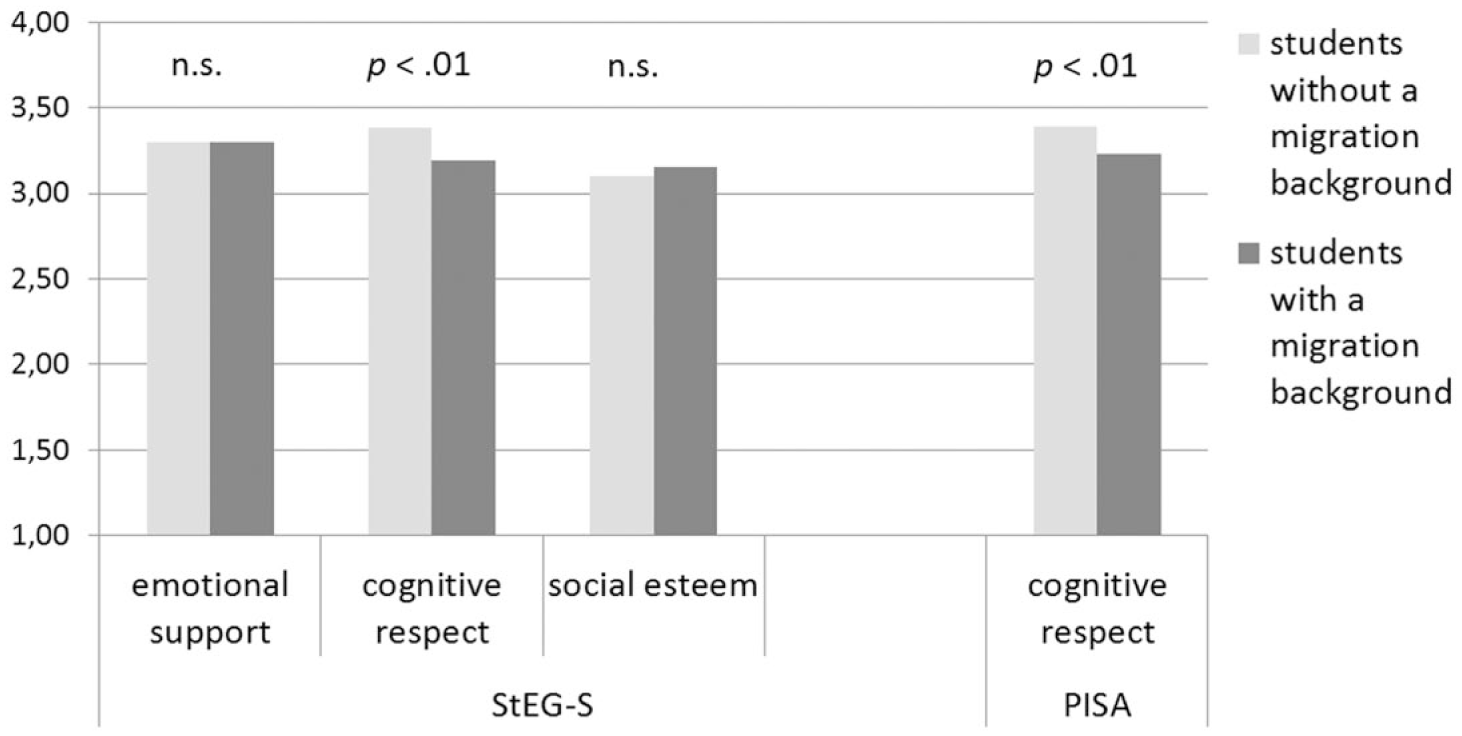
A comparison of mean scores on the three modes of teachers’ recognition of students with a migration background to those of students without a migration background using data from the StEG-S and PISA studies.
Second, we examined whether the difference between students with a migration background and those without with regard to self-reported cognitive respect received from the teacher remained significant when we controlled for students’ sex, SES and reading achievement at the beginning of grade 5 (see Figure 2).
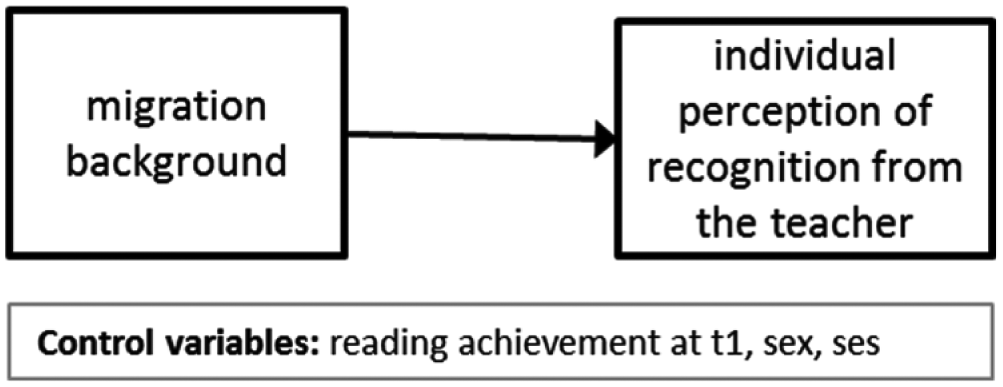
Regression of recognition from the teacher on migration background, controlling for reading achievement at the beginning of grade 5, sex and SES.
As can be seen in Table 1, a small but significant negative effect of migration background on cognitive respect was found, and it remained constant when the other social difference categories were simultaneously included in the regression model. Thus, the effect of migration background could not be explained by a lower SES of this group or by a higher percentage of boys in this group as compared to the group without a migration background; the effect remained independent of these other social difference categories.
Regression of recognition from the teacher on migration background, controlling for reading achievement at the beginning of grade 5, sex and SES (Standardized β Coefficient).
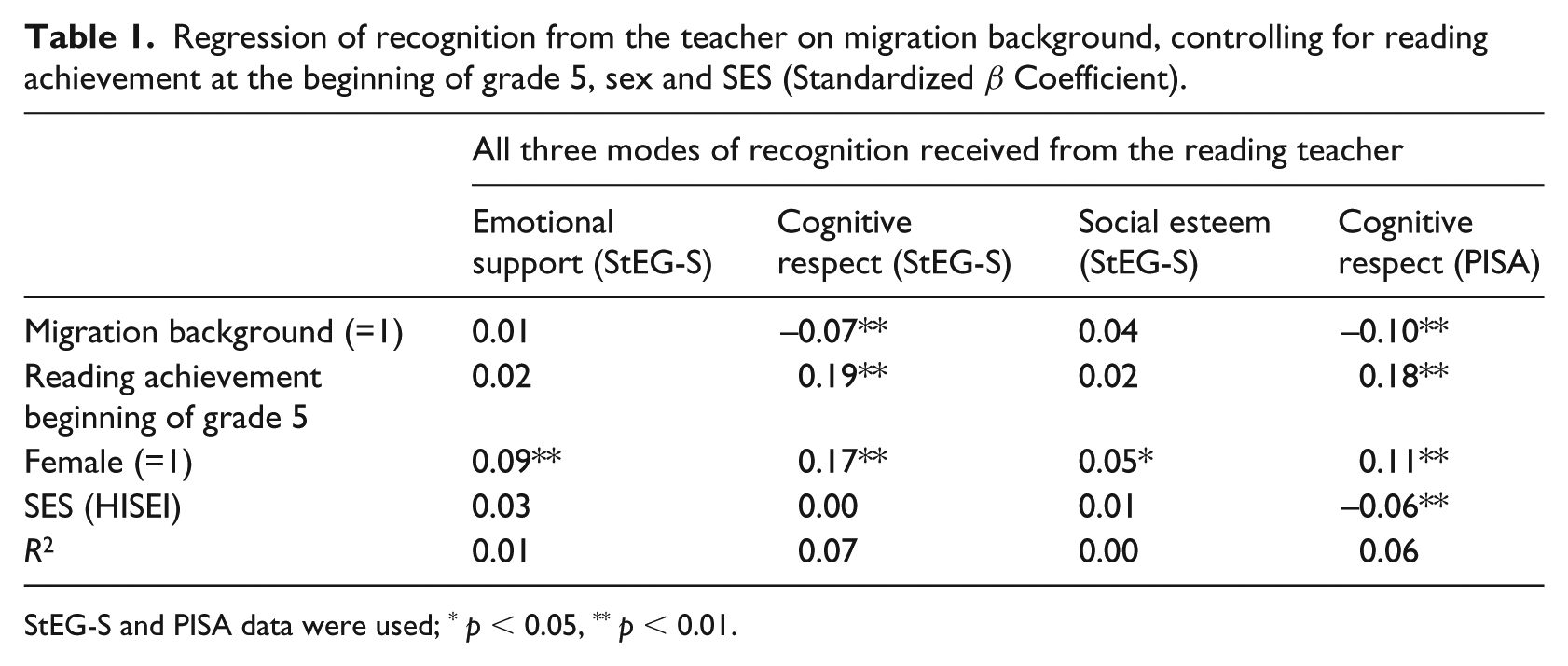
StEG-S and PISA data were used; * p < 0.05, ** p < 0.01.
Third, we investigated whether students with a migration background reported feeling less recognized than their classmates by the same reading teacher (within-class effect) or whether they were more likely to have teachers who were perceived by all students to be less respectful than other teachers (between-class effect; see Figure 3). Results of multilevel analyses, shown in Table 2, suggest that the former was the case: Students with a migration background had lower scores for the cognitive respect scale than their classmates without a migration background (within-class effect: β = −0.06*) while classes with at least one student with a migration background did not differ from classes with no students with a migration background with regard to students’ average evaluations of recognition (between-class effect: β = 0.00). 5
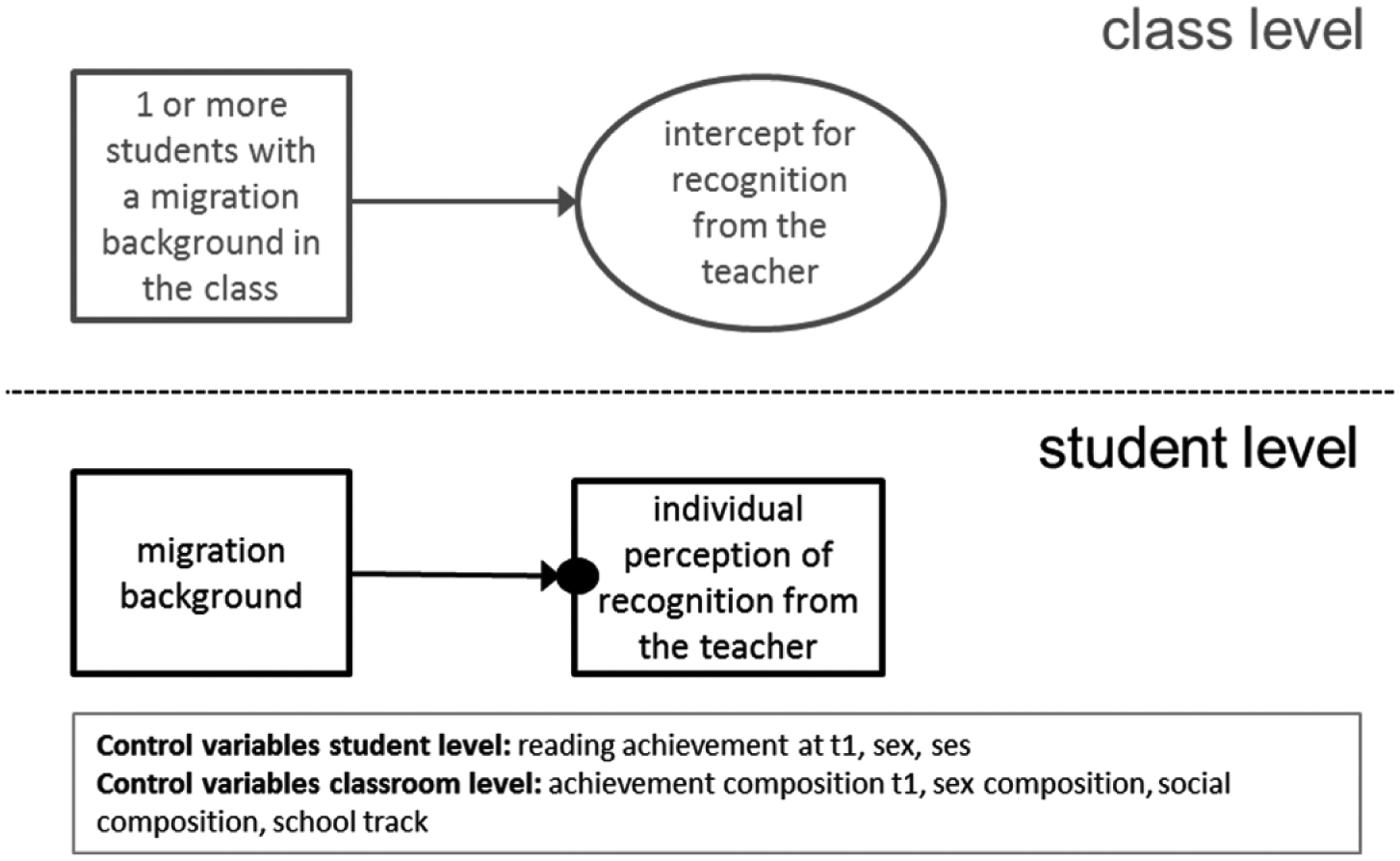
Multilevel regression of recognition from the teacher on migration background and presence of students with a migration background in a class, controlling for reading achievement at the beginning of grade 5, sex and SES at the student level and controlling for academic school type, achievement composition, sex composition and socioeconomic composition at the school level.
Multilevel regression of recognition from the teacher on migration background and presence of students with a migration background in a class.
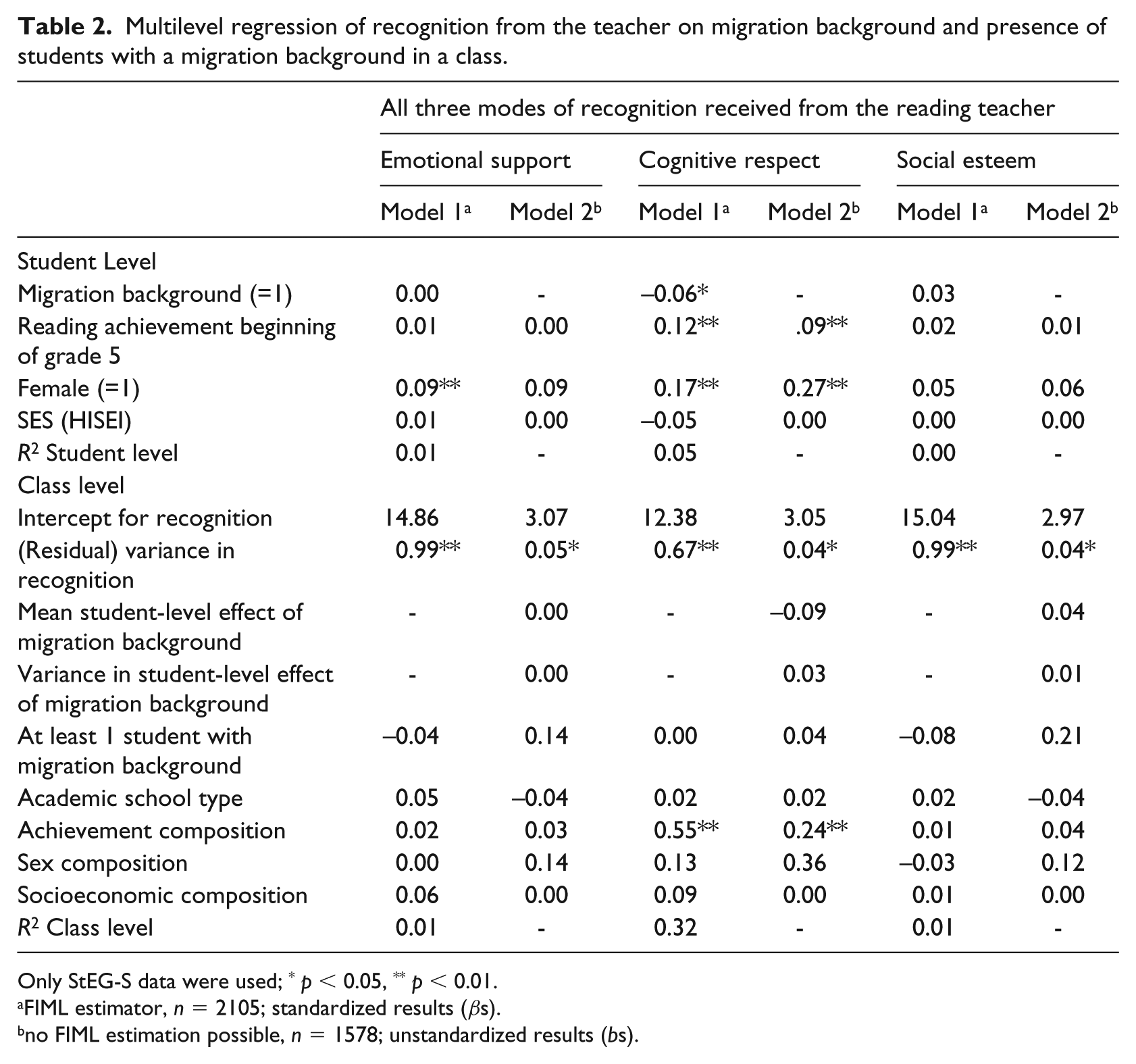
Only StEG-S data were used; * p < 0.05, ** p < 0.01.
FIML estimator, n = 2105; standardized results (βs).
no FIML estimation possible, n = 1578; unstandardized results (bs).
Fourth, we investigated whether the association between migration background and recognition from the teacher varied across classes by modelling a random slope for the student-level effect of migration background on all three modes of recognition from the teacher (which is indicated by the black dotted arrow from migration background to recognition from the teacher in Figure 4). As can be seen in Table 2, this was not the case: none of the random slopes was significant (Var(b) = 0.00 for emotional support, Var(b) = 0.03 for cognitive respect, and Var(b) = 0.01 for social esteem).
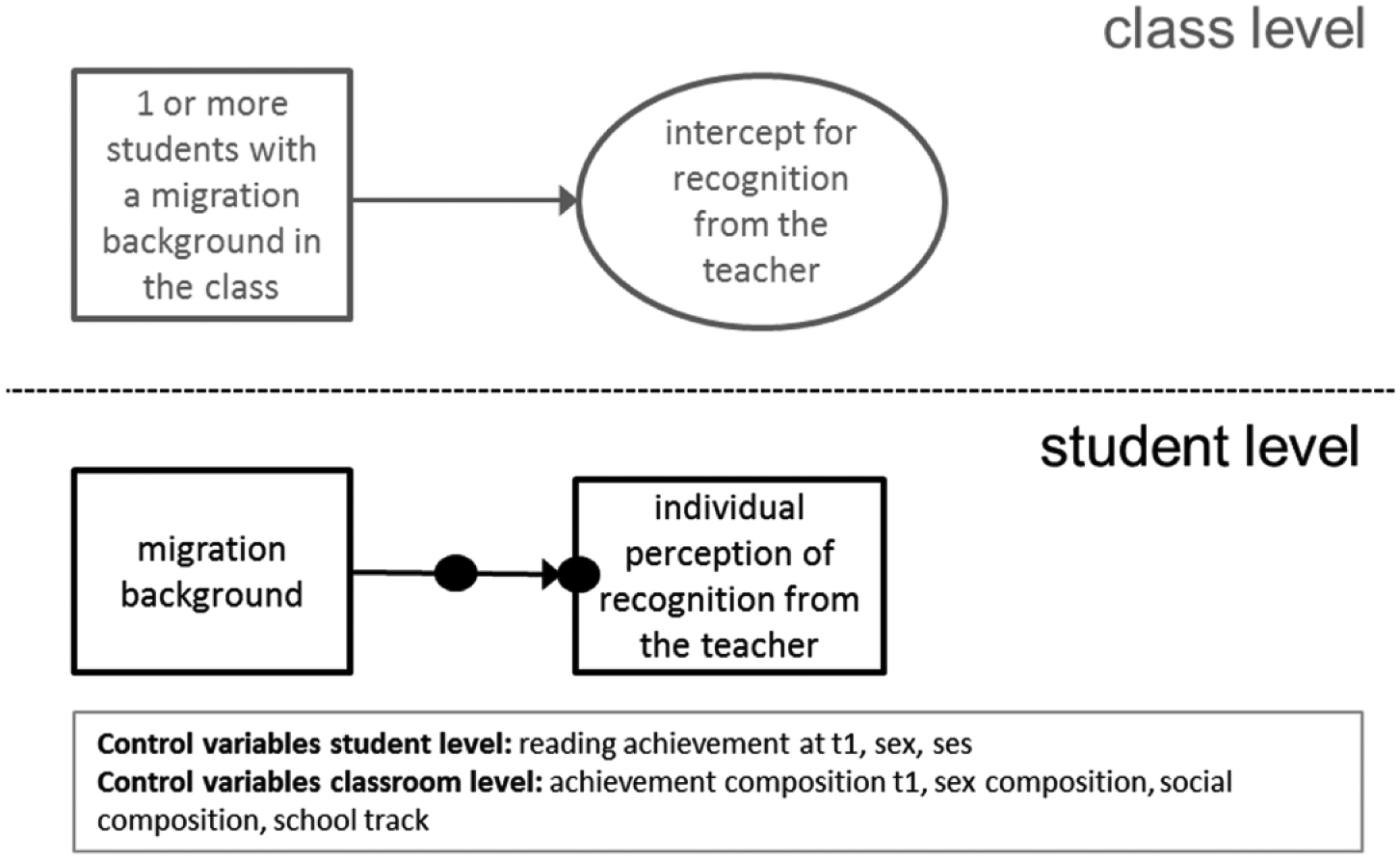
Multilevel regression of recognition from the teacher on migration background (random slopes) and presence of students with a migration background in a class, controlling for reading achievement at the beginning of grade 5, sex and SES at the student level and for academic school type, achievement composition, sex composition and socioeconomic composition at the school level.
Mediating effects of perceived recognition from teachers for the association between migration background and reading achievement gains
Three steps were taken to examine mediating effects of perceived recognition from the reading teacher on the association between migration background and reading achievement. First, we analysed whether students with a migration background had lower average scores in reading at the end of the first term of grade 5 than students without a migration background, while controlling for achievement scores at the beginning of grade 5 (see Figure 5). This was confirmed, but the effect was small (β = −0.05*, see Table 3).
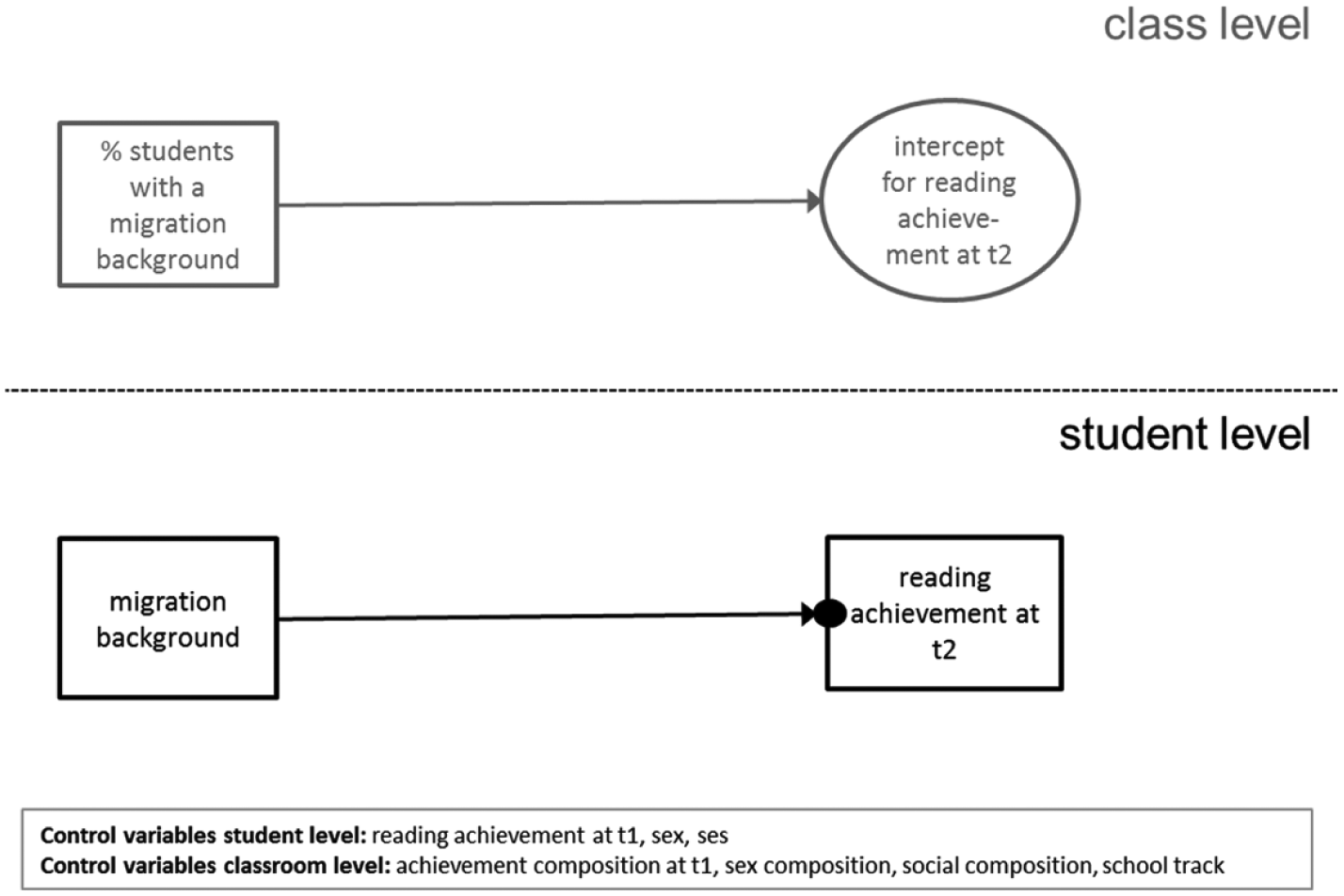
Multilevel regression of reading achievement at the end of the first term of grade 5 on migration background (random slope) and the migration background composition, controlling for reading achievement at the beginning of grade 5, sex and SES at the student level and controlling for the track, achievement composition, sex composition and socioeconomic composition at the class level.
Multilevel regression of reading achievement at the end of the first term of grade 5 on migration background and recognition from the reading teacher controlling for reading achievement at the beginning of grade 5, sex and SES at the student level and controlling for track, achievement composition, sex composition and socioeconomic composition at the class level.
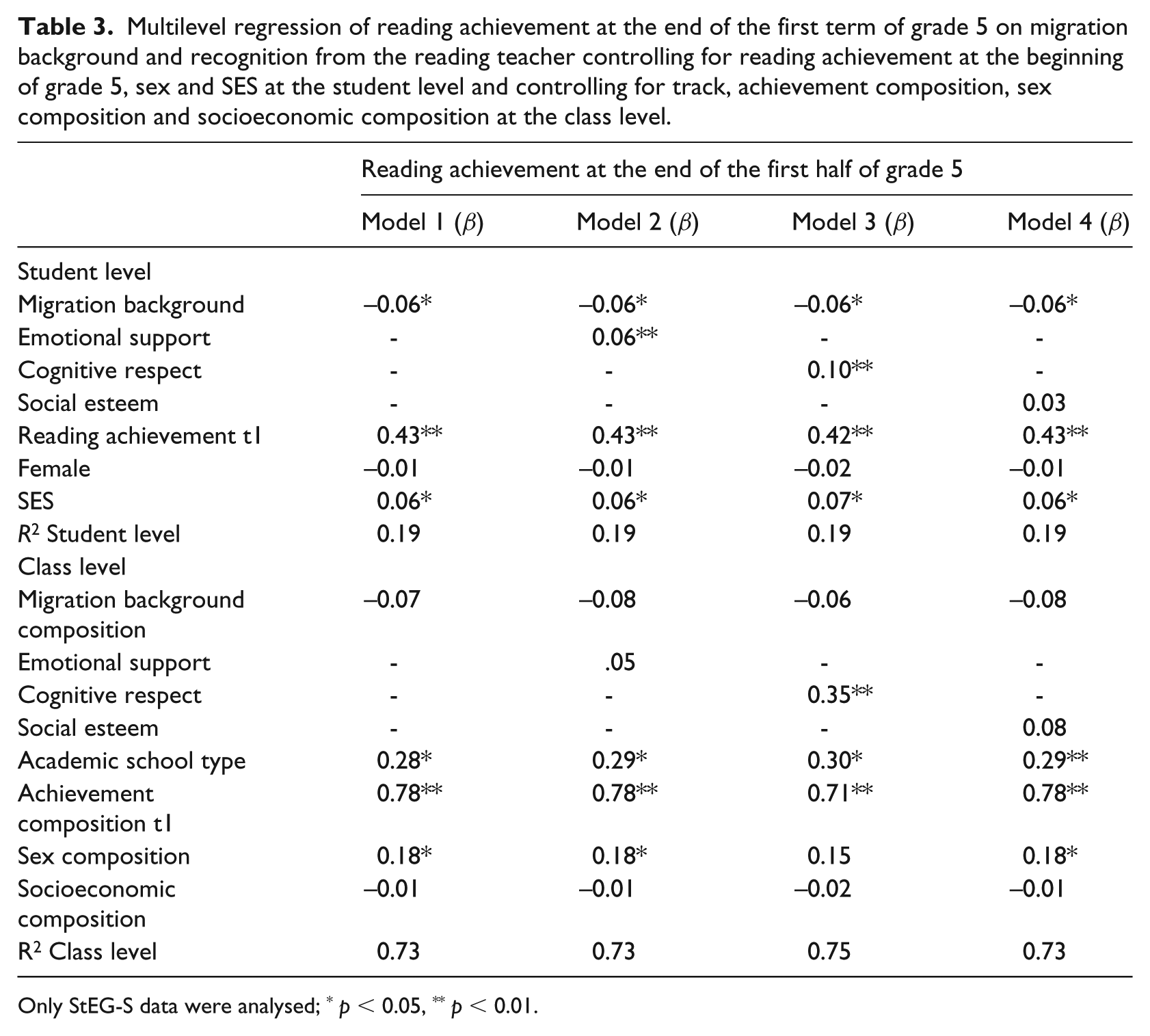
Only StEG-S data were analysed; * p < 0.05, ** p < 0.01.
In a second step, we analysed whether the three modes of recognition were associated with reading achievement at the end of the term at both the student and class levels, while controlling for prior achievement (see Figure 6). As can be seen in Table 3, the association between cognitive respect and reading achievement was significant at both levels of analysis (rather weak at the student level with β = 0.12**, and stronger at the class level with β = 0.51**). A weak but significant association between emotional support and reading achievement was found at the student level (β = 0.06**), but no associations between social esteem and reading achievement was found. Thus, students who had higher scores on the cognitive respect and/or emotional support scale(s) than their classmates had slightly greater reading achievement gains during the first half of grade 5, and in classes with higher average levels of cognitive respect the average reading achievement gains also were greater.
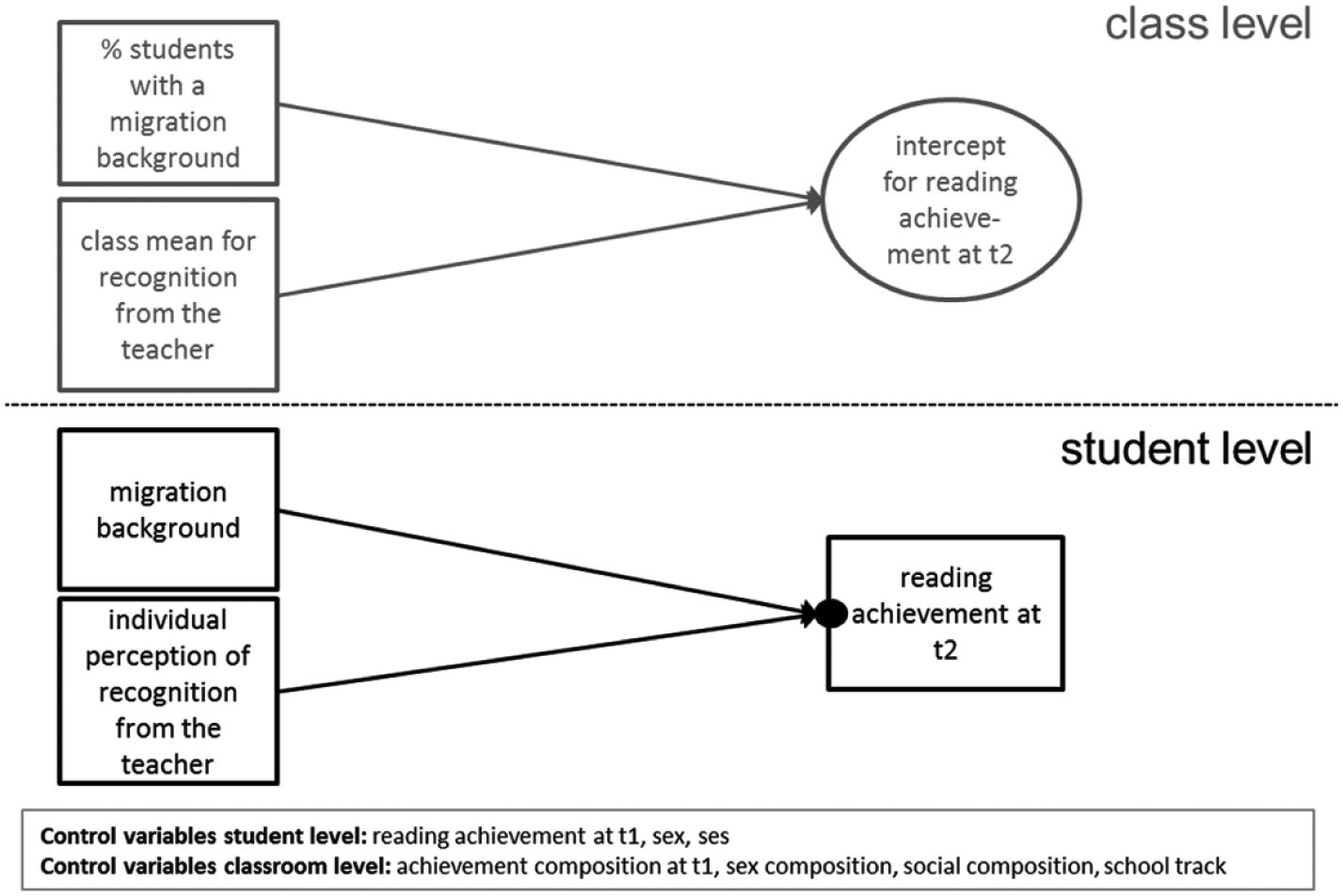
Multilevel regression of reading achievement at the end of the first term of grade 5 on individual and class average recognition from the reading teacher controlling for migration background, reading achievement at the beginning of grade 5, sex and SES at the student level and controlling for migration background composition, track, achievement composition, sex composition and socioeconomic composition at the class level.
In the third step, we tested a full multilevel mediation model in which the effect of migration background on reading achievement was mediated by recognition at the student and class levels of analysis (see Figure 7). We computed direct, indirect and total effects for all three modes of recognition and at both levels. While no significant mediation effects were found for emotional support or social esteem, such effects were found for cognitive respect. Migration background had both a significant direct effect (b = −0.12*) and a significant indirect effect via cognitive respect (b = −0.01*) on reading achievement at the student level. The total effect was b = −0.13*. At the class level, cognitive respect also had a significant effect on reading achievement (b = 0.25**), but the class composition with regard to migration background had no significant effect on cognitive respect or on reading achievement. Thus, students with a migration background experienced slightly less recognition from their teachers than their classmates and this difference also contributed to explaining why these students on average had smaller learning gains in reading during the first months of grade 5.
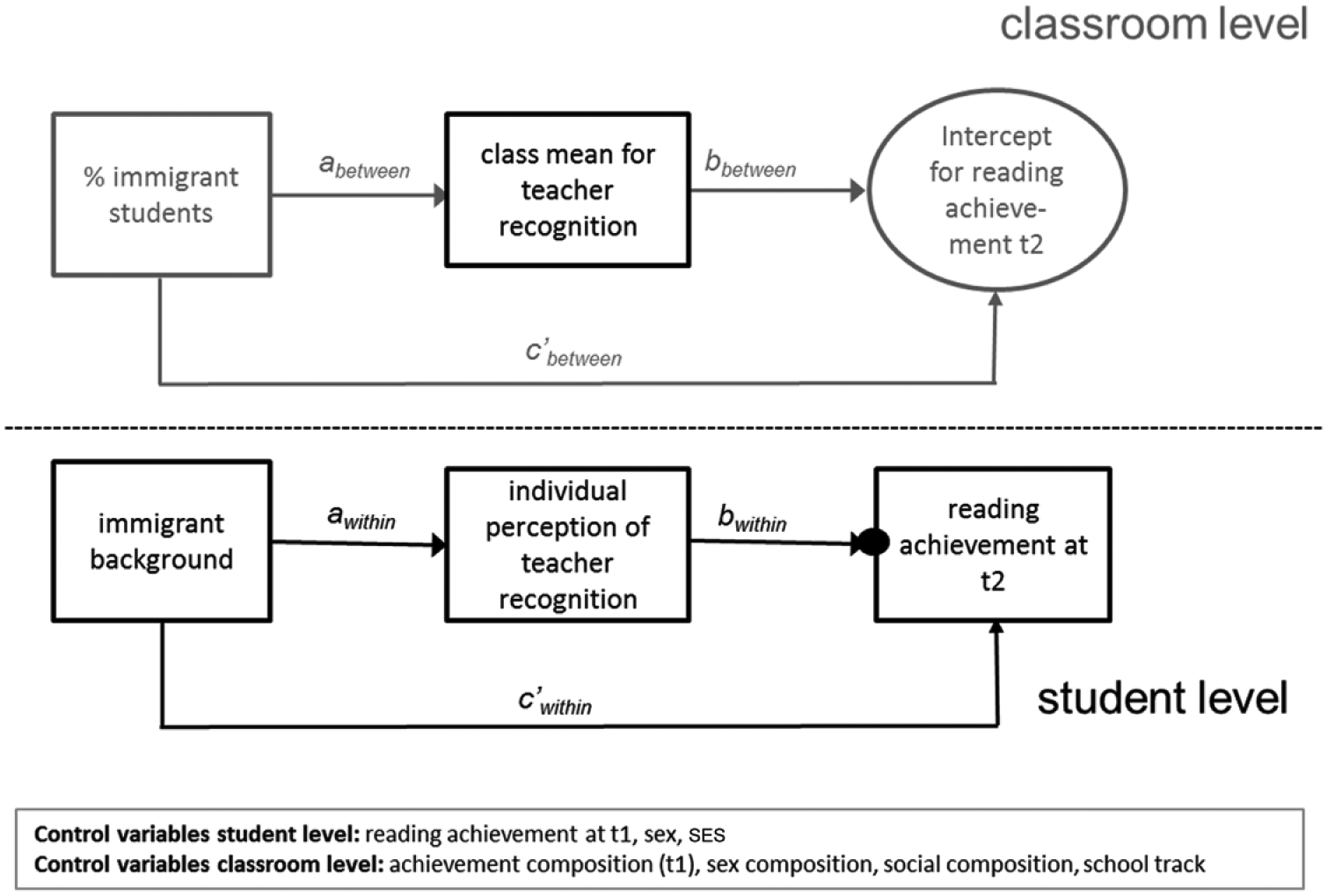
Multilevel mediation model (1-1-1 unconflated).
Discussion
The experience of intersubjective mutual recognition has been posited to be the main prerequisite for developing a positive relation-to-self and individual autonomy (Honneth, 1995) and for acquiring education (in the sense of the notion of Bildung; Stojanov, 2015). Recognition structures intersubjective relations in various spheres of life. With regard to the educational sphere, it has been argued that recognition from teachers in terms of emotional support, cognitive respect, and social esteem is fundamental to the bond between students and teachers and, thus, of central importance for classroom learning (Helsper and Lingkost, 2002; Prengel, 2008, 2013; Scherr, 2002). Our findings support this assumption: Within each class, those students who felt they were receiving more cognitive respect and emotional support from their reading teachers than their classmates learned more during the first months of grade 5. Moreover, classes in which students on average felt their reading teacher showed more cognitive respect also had greater average learning gains than other classes. In previous longitudinal studies teacher–student relations were found to be important for student learning (Hamre and Pianta, 2001; Hughes et al., 2008; Ladd et al., 1999; Pianta and Stuhlman, 2004; Zijlstra et al., 2013). However, most of these studies drew on attachment theory (except for Zijlstra et al., who drew on interpersonal theory) and focused on conflict and closeness in student–teacher relations (except for Zijlstra et al., who examined control and affiliation). In our study we also found the quality of student–teacher relations to be relevant for predicting achievement gains; however, we went beyond other studies by asking students about the recognition they felt they received from their teachers in the three modes described by Honneth (1995), and by examining longitudinal associations of this perceived recognition with reading achievement.
We were interested-even more than in general effects of recognition from teachers on student learning-in its (presumably unequal) distribution within classes and whether such distribution explained the persistence of education-related inequalities between students with a migration background and those without. First, we expected students with a migration background to report less recognition from teachers than students without a migration background, because the former suffer from lower social status in Germany (Hypothesis 1a). Helsper (2008) argued that social power structures influence school cultures in a way that opportunities for recognition become affected (although not determined) by ascribed group membership. This hypothesis was partly confirmed: on average, students with a migration background reported receiving less cognitive respect from their teachers than students without a migration background, implying that members of the former social category of difference, more often felt they were treated in an unfair or offensive way by their teachers. The difference was small but significant and consistent across two studies using different samples (a large but non-representative sample of fifth graders in StEG-S vs. a representative sample of 15-year-old students in PISA), and different questionnaire items (asking about the reading teacher in StEG-S and about teachers in general in PISA) in different years (2013/2014 for StEG-S and 2015 for PISA).
Further analyses revealed that this effect was due to differences among students within classes instead of differences between classes, and that the size of the difference did not vary across classes. Helsper (2001, 2006, 2008) argued that schools (and consequently classes) differed with regard to the degree to which their school cultures put certain social groups at an advantage or a disadvantage with regard to their opportunities for recognition. Also, variance in teachers’ attitudes toward people with a migration background was found in previous studies (Berliner Institut für empirische Integrations- und Migrationsforschung & Forschungsbereich beim Sachverständigenrat deutscher Stiftungen für Integration und Migration, 2017) and might be one reason for misrecognition by teachers. Nevertheless, we did not find any differences among classes. Rather, the effect of migration background on the cognitive respect students claimed they experienced from teachers was consistent across classes in our sample. This suggests that the recognition related disparity was due not only to a few teachers having negative attitudes toward people with a migration background and treating students differentially along this axis of social difference as a consequence of their attitudes, but rather to institutional arrangements or broader social structures. This is in line with observations made by Gillborn (1995), who described racism at schools as ‘a dynamic and complex facet of school life (in which routine institutional procedures and teacher expectations may be deeply implicated)’ (p. 36) instead of being the result of individual prejudices.
Contrary to our expectations, a disadvantage with regard to recognition of students with a migration background was observed for the cognitive respect scale but not the emotional support or social esteem scales. Hence students with a migration background reported more conflictual relations with their teachers than their classmates, but both groups felt they were taken seriously, accepted and cared for by their reading teacher. Likewise, the two groups of students did not diverge in their assessment of whether they could trust their teacher, whether they got along well with him/her, or whether he/she recognized their strengths, valued their abilities, or gave them opportunities to demonstrate their competences. Given the largely positive attitude of teachers in Germany toward people with a migration background and also toward the pedagogical idea of inclusion (Berliner Institut für empirische Integrations- und Migrationsforschung & Forschungsbereich beim Sachverständigenrat deutscher Stiftungen für Integration und Migration, 2017), it is not surprising that reading teachers offered equal amounts of emotional support to students with a migration background and to those without a migration background. This is also reflected in qualitative studies, where students described even those teachers from whom they had experienced ‘othering’ as friendly and well-meaning (e.g. Dalhaus, 2016; Rose, 2014).
The lack of a difference between students with a migration background and those without with regard to their perception of social esteem by the teacher is more surprising: Helsper (2008) had argued that struggles for recognition were taking place in each school and that their outcome determined the school culture and, thereby, also which specific achievements, behaviours and lifestyles were valued vs. devalued within the school. Groups dominant in society tend to have better resources for winning these school-internal struggles, so that their achievements, behaviours and lifestyles are more likely to be valued in school. Such a mechanism should manifest itself mainly in differences between students with and without migration background in the recognition-mode of social esteem, which concerns school-internal appreciation for individual competences, traits and lifestyles. Accordingly, results of qualitative studies have revealed a lack of recognition from teachers in terms of social esteem of students with a migration background. In contrast, in our study, we did not find any effect of migration background on this mode of recognition. One reason might be that the students in our study had accepted and adopted the standards that prevailed at their school and did not question why competences they had acquired during their primary socialization, for example, multilingual competences, were seen as an obstacle to learning rather than as valuable achievements. In fact, the lack of recognition of multilingualism at schools in Germany, which has been elaborated upon by Gogolin (2008, 2013), is seldom addressed by students or parents with a migration background when they are interviewed about their school experiences (for an exception, see Dietrich, 1997: 227–251). However, more research is needed to fully understand these contradictory findings.
When analysing the patterns of responses to recognition scales from students with a migration background and students without a migration background and combining the results of this analysis with findings from previous qualitative studies (Dalhaus, 2016; Dietrich, 1997; Rose, 2014; Scharathow, 2014; Wischmann and Dietrich, 2014), the following conclusions can be drawn: at schools in Germany many teachers are friendly, supportive and caring toward their students regardless of the students’ migration background, and misrecognition of students is rather rare; however, students with a migration background feel they experience slightly more misrecognition in terms of cognitive respect than their peers without a migration background. One reason for this difference might be the prevalence of subtle forms of ‘othering’ at schools, as found in qualitative studies. Previous qualitative studies have also revealed a systematic lack of academic esteem for competences that students with a migration background are more likely to have developed during their primary socialization than their peers, for example, multilingualism (Gogolin, 2008, 2013); however, most students do not appear to be aware of this unfairness, as they did not report lower levels of social esteem than their classmates in our study.
These findings indicate a small but consistent violation of the principle of ‘respect egalitarianism’, which Stojanov (2015) suggested as one way to conceptualize educational justice. Referring to Peters (1966) and Honneth (1995), he described this form of educational justice as ‘an inner dimension of social relations’, a situation in which all students experienced the same positive quality of social relations, implying that they were equally respected and recognized by their teachers and schoolmates (Stojanov, 2015: 3–4). Violation of this principal can be considered unjust (Stojanov, 2015).
Additionally, the observed lack of “respect egalitarianism” also appears to contribute to a lack of “luck egalitarianism”: Instances of malrecognition, misrecognition and disregard are likely to evoke negative emotional reactions, such as being ashamed or enraged and/or feeling hurt or indignant, and in the long run, they can have a serious effect on identity development (Honneth, 1995: 136). They also appear to pose barriers to learning. A lack of cognitive respect was associated with fewer learning gains in our study, and this effect explained part of the effect of migration background on reading achievement gains. Recognition appears to be only one factor among others; the mediation effect in this study was quite small. Still, if students with a migration background are likely to experience less cognitive respect from teachers repeatedly throughout their school lives (as suggested by the accordance between findings from the StEG-S and those from the PISA study and by the non-significant variance in the size of the effect of migration background across classrooms), the effect might accumulate and become more powerful over time. Hence, our findings suggest that classroom interactions and their recognition structures play a role in explaining the persistence of educational disadvantages for students with a migration background.
Such educational disadvantages can, according to Brighouse (2003), be considered unjust when they reflect not only choices made by individuals on the grounds of equal opportunities, but also life circumstances not under the control of the individual such as having a migration background. This is the principle of “luck egalitarianism” (Stojanov, 2015).
Strengths and limitations
While the focus of numerous studies has been the correlation between the general quality of teacher–student relations and students’ learning gains, in our study we explicitly asked students for their perceptions of the recognition they received from their teachers in all three modes described by Honneth (1995). Also, we examined whether differences in perceived recognition received from teachers between students with a migration background and those without explained differences in learning gains. To this end, we analysed data from two studies: StEG-S, a longitudinal study of the development of reading achievement during grade 5 and its links to teaching quality, and PISA, a large-scale assessment with a representative sample of students. The concordance of results between the two studies increases confidence in the validity of results of mean-score comparisons between students with a migration background and students without a migration background. Owing to the longitudinal design of StEG-S, we were able to examine associations between perceived recognition from teachers and learning gains: they reflect a differential development of those students who received more recognition as opposed to less. However, more measurement points over a longer period of time and in more school areas of achievement would allow for a better understanding of how experiences with different teachers accumulate or balance out in their effects on the development of individual identity and autonomy as well as school-based learning over time.
In both studies, StEG-S and PISA, recognition from teachers was further assessed via questionnaires. These self-reports reflect the subjective experiences of students, which represent an important psychological reality (Dion, 2003) but should be supplemented with objective events during classroom interactions. We do not know whether teachers treated students with a migration background and students without a migration background differentially or whether both groups systematically perceived similar treatment differently. Analogically, similarities in mean scores between the two groups might be due either to teachers’ treating both groups in a similar way or to students’ not being aware of being treated differentially. Various aspects (such as teachers’ objective behaviour as well as students’ unconscious and conscious perception and interpretation of this behaviour) are likely relevant for understanding student learning at school. With our study we could illuminate only students’ conscious perception and interpretation. In future research, it would be interesting to examine the interactive classroom processes and to link these observations with students’ responses on questionnaires and with learning gains.
Finally, some limitations to our study concern the wording of the items on the questionnaire on recognition. First, the items asked about very broad and general experiences of recognition/misrecognition in the classroom, not specifically about forms of ethnic discrimination. In responding to the items, students might, thus, not have considered this type of treatment, which might have led them to underestimate misrecognition from the teacher. Also, it is noteworthy that differences between students with a migration background and students without a migration background were observed exclusively on the one scale asking for negative experiences with teachers, not on the two scales with items that were worded in a positive way. Hence, the difference in results between the three modes of recognition might have been the result of the way the items were formulated, and so, in future studies it would be beneficial to ask for positive and negative experiences with regard to all three modes of recognition from the teacher.
Conclusion
Our findings indicate that recognition from teachers predicted learning gains both at the individual student level and the class level and that across schools’ students with a migration background experienced less recognition from teachers in terms of cognitive respect than their classmates without a migration background. The latter further explained part of the effect of migration background on reading achievement gains in grade 5. Hence, recognition in the classroom appears to be one piece of the puzzle for understanding how educational disadvantages persist and are reproduced for students with a migration background. The observed effects were rather small, but they might accumulate over time. These findings point toward a lack of respect egalitarianism in the German school system, which also contributes to the lack of luck egalitarianism that often has been described in the literature (e.g. Stanat and Christensen, 2006). The potential influence of educational institutions is limited. They cannot put an end to economic misery or political discrimination nor can they compensate for their effects on student development and learning. However, teachers should work actively toward changing micro-interactions in the classroom in a way that allows opposing social power structures and toward creating a climate that is more equitable, inclusive and empowering.
Footnotes
Author’s Note
Markus N. Sauerwein is also affiliated with Fliedner University of Applied Sciences.
Declaration of Conflicting Interest
The author(s) declared no potential conflicts of interest with respect to the research, authorship, and/or publication of this article.
Funding
The author(s) disclosed receipt of the following financial support for the research, authorship, and/or publication of this article: The StEG-S was funded by the Federal Ministry of Education and Research (BMBF).