




Abstract
Changing conditions in the realm of teacher professionalism have consequences for teachers’ professional values and ethics. To a large degree, the literature concludes that increases in accountability policies seem to result in more restricted space for teachers’ professional values and ethical autonomy. Less attention has been given to which kinds and forms of ethics and value logics teachers negotiate and prefer in situations involving accountability policies. In this paper, we analyze how the Union of Education Norway negotiated teacher values in the process of developing their professional ethics code and the final code text. Previous research has shown clashes and struggles between two value systems, or as a change from traditional professional to neoliberal values. However, based on the analyses in this article, a third relation is suggested—one where increased accountability creates a paradoxical situation for teachers’ professional values and ethics—in which the professional ethics of opposition may analytically empty teacher practice of ethical aspects and where professional ethics of engagement may lead to decreased conditions for ethical engagement.
Introduction
Education has a distinct value dimension. Educational practices involve human relations characterized by the distribution of power, trust and responsibility. Selecting educational content and methods implies judgments about what is good and right to know, learn and do (Peters, 1970; Jackson et al., 1993; Bullough Jr, 2011), and education is often understood as the main tool for achieving societal goods and rights, such as democracy, equity and respect (Biesta, 2017). Simultaneously, in many countries education is increasingly governed by accountability policies. They are characterized by external policy-given standards, an emphasis on certain basic skills, standardization, measurement, externally conditioned monitoring, and weakened teacher autonomy (Sahlberg, 2010).
This paper focuses on what is happening in the intersection between the value dimension of education and accountability policies. Teachers’ professional values can be analyzed from several perspectives. Our analyses focus on the making of an ethical code for the teaching profession in Norway, by asking the research question: How are teachers’ professional ethics made and negotiated in a condition of accountability? We understand the making of a professional code as an adaptation to current political and societal conditions and as an active positioning to create space for autonomous and professional ethical deliberations. Analyses of professional ethical codes are often limited to the final text. The debates before the final code was adopted, however, are also interesting. They are sources to which types of disagreements, contradictions, and negotiations are central in teachers’ reasoning about ethics in their profession. Therefore, we included a series of documents (e.g., preparatory documents, Board documents, summaries and hearing statements, including four drafts) produced before the final Union of Education Norway “Professional ethics for the teaching profession” (Union of Education Norway [Utdanningsforbundet], 2012). Our aim is not to analyze the contributions of particular actors, but to reveal the collective discourses that appeared in the process of developing the ethical code. We are interested in the contradictions and disagreements that occurred in documents involved in the making of the code (process-documents). Disagreements may be an indication of difficult issues and negotiations of different demands. Furthermore, we are interested in the scope of professional ethics, the kind of professional ethics agreed upon, and the kinds of ethics that are absent, in order to understand which conceptual tools and resources the collective profession offers teachers in their future production of professional values and ethics. The first part of the analysis uses discourse theory and techniques. The second part of the analysis is a search for mediating ethical tools in the final code text, using different value logics from moral philosophy.
Norway, and the Union of Education Norway, is a good case for studying the development of teachers’ professional ethics and responsibility. Norwegian education has a history of internal accountability and professional decentralization. In addition, recently numerous educational reforms have emphasized external accountability and centralized performance logic (Mausethagen, 2013; Hatch, 2013).
Much of the research literature understands the relationship between accountability policies and traditional teachers’ values either as a clash and struggle between two value systems, or as a change from traditional to neoliberal values. Based on the findings in this paper, we suggest a third relation: one where increased accountability creates a paradoxical situation for teachers’ professional values and ethics.
In the following, we situate this research more firmly in the debate on accountability and values and then establish a framework from ethical theory. After describing the study’s methodology, we present the results of analyzing the documents involved in the making of the code for teachers’ professional ethics and then of the final code. The paper ends with a discussion of the findings, making the empirical and theoretical contributions explicit.
Previous research on accountability and professional values
Accountability and professional values are elusive and have various meanings in the literature. We understand accountability broadly as processes of increased policy reforms that emphasize given, specified measurable outcomes, with a set of given skills, common standards, monitoring, and evaluation (Sahlberg, 2010; Solbrekke and Englund, 2011). We use the terms “professional values” and “professional ethics” interchangeably, and in a broader sense. This means that we understand ethics as theories of good and right, including various traditions. Furthermore, we understand values and ethics as processes, as something that is done and made; and as perspectives of social practices, not separate domains.
With intensified accountability policies internationally, and different trajectories in different national contexts, the literature on the relationship between these policy initiatives and professional values has grown vastly. We draw attention to certain characteristics of these contributions that are relevant for the analyses and discussion in this paper.
In the literature, accountability policies and professional values are treated as two distinct and dichotomous logics (Solbrekke and Englund, 2011; Apple, 2016; Bolyard, 2015; Biesta, 2009b). Formulated as the relationship between accountability and responsibility, the first logic follows an economic and legal rationale, whereas the second logic is constituted by a moral rationale (Solbrekke and Englund, 2011). Accountability initiatives lead education towards an economic emphasis on output, efficiency, monitoring, control and management—and to a legal emphasis on standardization and normalization. This double bind, maximization and standardization, clashes with an ethical logic characterized by professional judgment, phronesis and the collective search for good and the particular, situational and relational care (Hall et al., 2015; Ball and Olmedo, 2013; Solbrekke and Sugrue, 2014). The dichotomy is also constructed as a conflict between two value sets, one neoliberal and one traditional professional (Crick, 2008; Ball, 2013; Mausethagen, 2013). On the one side are traditional professional values, which are configured in key concepts—for instance, care (Ball and Olmedo, 2013), equity (Trujillo and Woulfin, 2014), democracy (Trujillo, 2013), and responsibility (Solbrekke and Englund, 2011). On the other side are neoliberal, market-oriented values such as competition, individual liberty, “what works,” and performativity (Ball, 2013; Apple, 2016). These valuable analyses demonstrate that the issues at stake are not only (or primarily) those of efficiency and transparency, but also ideals for education and society at large. To a lesser degree, the neoliberal, instrumental logic has been analyzed as a version of ethical utilitarianism or consequentialism, and standardization, as a version of rule- and duty-based deontological ethics. Teachers are situated in utilitarian and rule-based practices to different degrees. Teachers’ actions are guided by outcomes and rules, and nuanced analyses and critical discussions are needed to understand how difficult navigations of issues can be done in a better or worse way.
Furthermore, the relationship between accountability and traditional teacher values is mainly understood as a clash and struggle between value sets—or as a value change, from traditional teacher values to instrumental and neoliberal values (Englund and Frostenson, 2017). Many studies analyze the clash in perspective between traditional and instrumental values. A comparison between Swedish and Norwegian teachers argued that Norwegian teachers hold more traditional professional values than Swedish teachers (Helgøy and Homme, 2007). In a more recent study, Mausethagen (2013) found two groups of teachers: one that mainly accepted and embraced the new conditions and neoliberal values and one that actively argued against and resisted those conditions and subscribed to traditional professional values. Various contextual factors must be considered when interpreting such empirical analyses, including national conditions (Hall et al., 2015; Hatch, 2013). Other scholars argue that the relationship between accountability and traditional professional values should be understood as a change in values, where the last value set is domesticated by the first. In a case study of English schools, Ball et al. (2012) found that teachers, school leaders and management displace ethical and value perspectives in their reflections on practice, and that the reflections are characterized by instrumental logics and performance technologies.
A characteristic of the literature is the division between those who argue for opposing accountability and those who argue for engaging with and within accountability. The critical literature on accountability policies in education is vast; for instance, in the sociology of education (e.g. Ball, 2013; Apple, 2016; Sahlberg, 2010; Lipman, 2013) and the philosophy of education (e.g. Biesta, 2017; Biesta, 2009b; Bolyard, 2015). Although the criticism is diverse, many authors argue that one main issue is values. Authors claim that despite a political value rhetoric, accountability regimes imply educational practices characterized by competition, individualism, standardization, authoritarianism and performativity technologies and a narrow understanding of what education should be. The authors oppose accountability as such, and argue for education characterized by social justice, caring relationships with students, and professional teacher autonomy for enacting ethical, knowledge-based and situational wisdom and responsibility. The opposing literature gives valuable analyses of accountability regimes, but the main agenda is changing the system. These authors give limited help to teachers and schools that have to practice within accountability regimes. Another kind of literature is emerging, one that argues for engaging accountability—that is, working for ethical possibilities within the accountability system instead of trying to replace it. 1 One interesting contribution to the discussions of teachers’ professional values and ethics as negotiation is Gunzenhauser’s (2012, 2013) conception of an ethics of the everyday. Accountability policies distort teachers’ responsibility, he claims, but the solution for teachers and education is not in opposing power but engaging it. This means that a professional ethics can be developed through an active cultivation of an educational philosophy under conditions of accountability, an ethics which, in turn, challenges accountability.
In general, the research literature has paid more attention to the relationship between different given, substantial values and sets of values or rationales, than to how professional values and ethics are made and negotiated.
Theoretical perspectives: value logics
Our interest in the making of professional ethical code has consequences for our theoretical framework. The first part of the analysis uses discourse theory and techniques, described in the Methodology section. The second part of the analysis, a search for mediating ethical tools in the final code text, uses different value logics. Value logics do not focus on substantial principles, norms, values or virtues. Instead, value logics describe different ways of doing or producing ethics, that is, different logical procedures in the making of ethics. Furthermore, analyzing which logics are offered, and how they may constitute negotiations, including different ethical traditions, is important. It is analytically important to include utilitarian instrumental and rule-/duty-oriented logics in addition to relational and character logics.
The different scopes of professional ethics can be divided along a continuum from thin conceptions at one end to thick conceptions at the other (Afdal, 2014; Hov, 2008). Thin conceptions of professional ethics delimit ethics to the domain of specific situations of ethical dilemmas and conflicts and the question of justification of ethical choices. Ethics is differentiated from other domains, in the sense that there are certain exclusive ethical situations and questions and that the study of ethics is different from other domains, such as economy, law, politics and research. A thick conception understands professional ethics as an aspect of potentially all social, human and material practices. This means that ethics always intersects with other aspects, such as economic and policy perspectives, and concerns questions of the “good”: What is a good society, what is a good school, and what is a good teacher?
In the literature, teachers’ professional ethics is usually delimited and made thin in at least two ways. The first is by separating professional ethics as isolated dilemmas from teaching as an ethical practice and the value dimension of education (Strike and Ternasky, 1993). The second is by locating professional ethics in teachers’ micro-relations with students, colleagues, leaders, and parents, and thus, distinguishes ethics from politics, which involves discussions of good education and good society (Campbell, 2008; Hansen, 2001).
Ethical theory was long dominated by consequentialism (utilitarianism) and Kantian principle- and duty-based versions (deontological). Neo-Aristotelianism in the 1980s and 1990s re-included virtue-based ethics as the third main perspective. We include relational ethics as the fourth perspective and as the fourth logic due to the importance of care ethics in several professions, including teaching. The following brief descriptions of the four ethical logics are based on Afdal (2014), Baron et al. (1997), and Beauchamp (2001).
Utilitarian instrumentalist ethical logic is consequentialist in the sense that, for instance, the prioritization of school resources is justified by how resources maximize a given aim. In classical utilitarianism, the aim is happiness; in other utilitarian versions, the aims may be different. This is an instrumental logic in the sense that means have an instrumental value to a given aim. No teaching or learning activity has intrinsic value. Furthermore, the activities that effectively maximize the aim are more valuable than those that do not. This means that a teacher is justified in prioritizing resources such as time, attention, and care unequally, and not according to a principle of solidarity or recognition but one that secures an outcome as close to the given aim as possible. However, instrumental logics is widely used in education, as elsewhere, in the sense that one looks for the better consequences in acting and developing practice.
A rule- and principle-based ethical logic does not focus on outcome but on whether the actions are made according to authoritative rules or principles. The classical version is Kantian deontological duty ethics, where the universal categorical imperative of acting is to make the maxima or principled rule of your action into a universal law. This means that Kant based what he deems fundamental ethical principles on the idea of a universal, rational and morally autonomous human being. The ideas of human rights and students’ fundamental rights in education belong to this ethical logic. The teacher justifies her choices by abiding by students’ rights, independent of outcome. Using principles, norms and rules in creating professional ethics is also something teachers do frequently. In the analysis, we distinguish between abstract principles, such as principles of justice or equity, and specific rules that restrict teachers’ actions.
A virtue-based ethical logic is focused on the good, what characterizes the good, and the development of the good. This means that the scope of ethics is radically broadened, from what is right or effective to do in a certain situation to questions of character, identity and “what is a good life?” This is an ethical logic in the Aristotelian tradition, emphasizing the development of virtues, phronetic wisdom and judgment. The good is not given and static, but emerging and done. This means that the good cannot be possessed, frozen, operationalized and quantified. Furthermore, virtues and the good are interwoven. There is no instrumental separation between means and ends (MacIntyre, 1985). The aims of education cannot be set independently from the process of being educated or from what is desirable (Peters, 1970). A virtue-based logic searches for good education in a wide sense and as an emerging, collective project. The production of professional ethics is located in the trajectories of the good life for students and others, and in the space where teachers may enact professional wisdom and judgment.
A relation-based ethical logic, in many ways, was developed as a critique of the previous three logics. This way of ethical argumentation was partly developed in feminist theory (Gilligan, 1982; Held, 2006), as well as in phenomenological (Løgstrup, 1956/1997; Levinas, 1991) and empirical traditions (Pols, 2008). The main critique is that the previous three, in particular the first two, operate with an image of the autonomous, rational and principle-based atomized individual. In sum, these approaches can be called monological in the sense that there is a certain set of normative resources that the individual can apply to different situations. A relation-based logic is dialogical in a Bakhtinian sense in that one ethical utterance is always an appropriate response to another. This means that normativity cannot be decided upon independent of the other and the specific relation to the other. This does not mean adjusting to the other but acting in a way that takes care of the other and is responsible to the other. The situated, particular and adequate response to the student gives priority to actions of efficiency, abiding by rules and justice, and upholding one’s own and the profession’s conceptions of the good.
Methodology
Our aim is not to analyze the contribution and understanding of particular actors, but the collective discourses that appear in documents involved in the making of the ethical code. With this aim, we delimited our data material to key documents (and not, e.g., interviews).
The texts we analyze in this article are documents produced during the development of the ethical code (preparatory documents, Board documents, summaries, hearing statements, etc.), including four drafts and the final version. See the Context, Actors and Texts section for a more thorough overview. We use only excerpts from documents produced by the Union of Education Norway. Others are implicit and anonymized to protect individuals and specific institutions.
Our analysis draws on Jørgensen and Phillips (1999) discourse analysis. Some key premises shaped the analyses. Discourse is here understood as a horizon of communication and understanding where meaning-making is happening (Neuman, 2001).
We understand a discursive field as a limited number of discourses covering the same terrain (e.g., text involved in developing an ethical code). Frequently, a discursive field is composed of competing and/or contradictory discourses. The function of a discourse analysis, thus, is to reveal these competing and/or contradictory patterns of meaning in the discursive field.
The discourses we reveal are not mirrors of teachers’ everyday practice. However, these discourses and teachers’ everyday practice are related. The idea of the ethical teacher can be found in the discursive field. By analyzing the content of the documents, we unveil focal attitudes, values and intentions, as well as constraints on teachers’ ethical practice. The discourses across the documents and the final code constitute the ethical teacher in practice. We understand this as a deliberate but not deterministic structure–actor relationship. We looked for structures of meaning rather than using specific linguistic tools that some discourse analytical traditions offer. As researchers, we also become part of the making of the discourses, by selecting perspectives and descriptions.
Furthermore, we approached the process-documents and the ethical code to unveil dominant and/or competing discourses by identifying nodes (patterns of meaning and tensions) across the documents. Such analysis could potentially create disturbances in established conceptions and practices and open up discussions of premises, conditions and normative resources in establishing an ethical code.
As mentioned, we conducted two analyses, first of the process-documents involved in the making of the code and then of the web and text versions of the final code. The strategies of the two analyses have much in common, but there are differences. The first is inductive; the second is abductive and informed by ethical theory, as well as the data material. In the analysis, we searched for patterns of meaning and not the role of the different actors, based on two arguments: First, most of the documents summarize arguments and perspectives and do not identify the various actors present or authoring. Second, our aim is to identify patterns of meaning that might constitute professional practice and not where or from whom the discourses are coming. This means that we do not analyze the positioning of individual actors but the discourses in which actors may position themselves.
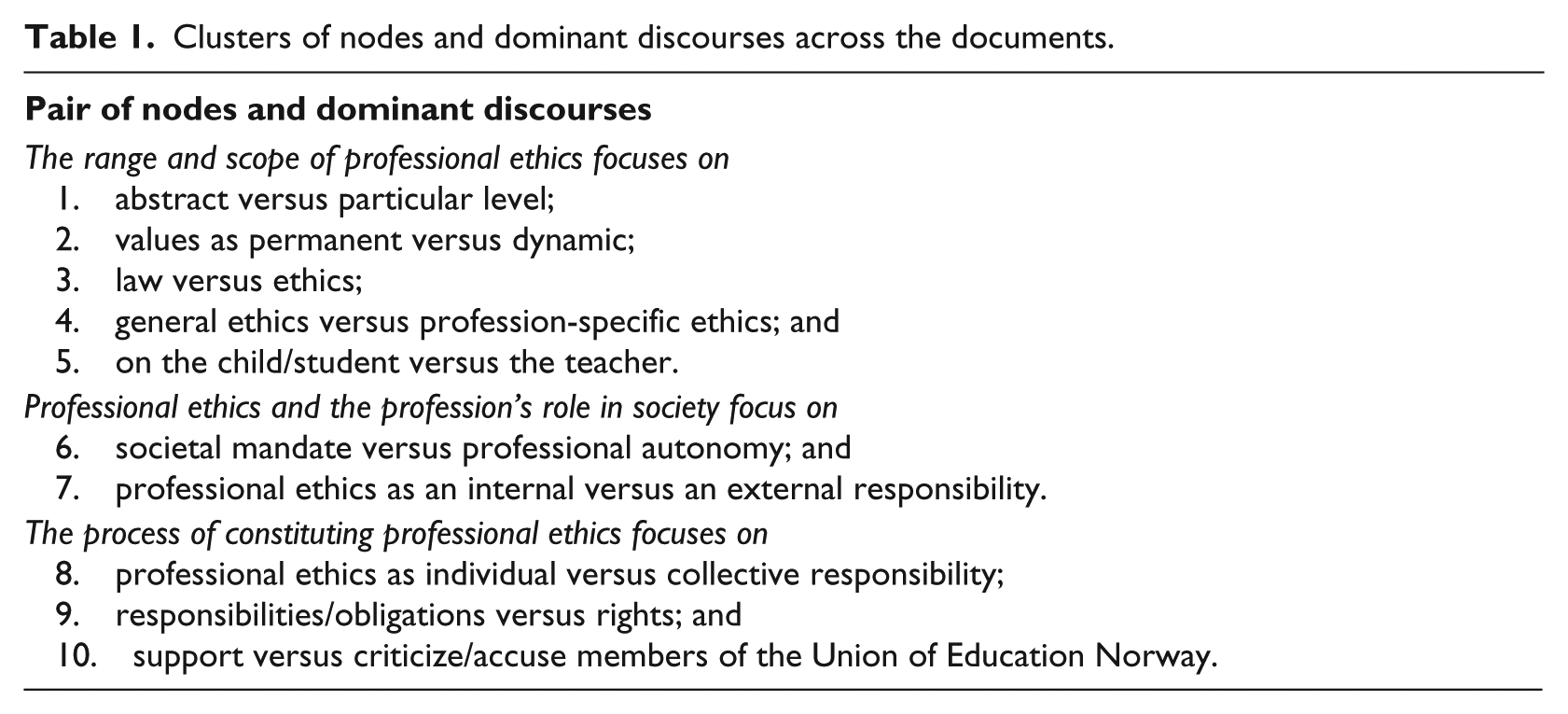
We conducted the first analysis in a number of steps: We clarified the context, including the limits and structures in and around the documents of interest (the discursive field). Then, we created an overview of the actors, type of texts and intertextuality (discourse and text structures). We identified prevailing nodes and meaning-making entities in the discourses inductively by repeatedly carrying out in-depth readings of the documents—in total, 10 pairs of nodes (see Table 1) across the texts. Then, we coded all the texts systematically based on the 10 pairs of nodes to ensure the validity of the analysis, and sorted the nodes into clusters and identified patterns of meaning.
Clusters of nodes and dominant discourses across the documents.
The second analysis also focused on context, on the web and text versions of the code. Initially, we performed an inductive reading. Then we used ethical theories as analytical devices to search for value logics in the data. We coded the text for two aspects of thin and thick professional ethics: whether ethics was formulated as a domain or an aspect, and whether ethics addressed micro- or macro-issues. We operationalized the four value logics and coded the text as instrumental aim-mean, rule- and principle formulations, expressions of character and virtues, and relational sections.
Developing an ethical code
While conducting the discourse analysis, we present the context, and an account, of the discursive field. We also provide an overview of the documents before we present and discuss the nodes and the dominant discourses we identified across the documents.
Context, actors and texts
The Union of Education Norway is the last of the teacher unions in the Nordic countries to develop a formal ethical code. However, ethical issues have been discussed by teachers’ organizations in the last three decades or so in various ways. In 2009, the National Congress of the Union of Education Norway (more than 80% of all teachers in Norway are members) decided to raise awareness of professional ethics among teachers as a primary objective for the future. The Central Board of the Union of Education Norway (hereafter, the Board) was made the directive body for this process in the Union of Education Norway, but the systematic work on developing an ethical code was formalized in January 2011.
The Board started the process by emphasizing that the term professional ethics should be used instead of the frequently used term occupational ethics to emphasize and strengthen the professional identity among teachers. Furthermore, the Union of Education Norway decided that the code should be a “platform,” not a set of rules. The concept of a “platform” was to be understood as scaffolding for the teaching profession to further develop professional values collectively. The concept of a platform was also argued for, to ensure and strengthen teachers’ professional responsibility and discretion. “Platform” implies process, participation, and deliberation—a platform does not give final answers but requires ongoing, further discussions and development of values and ethical practice (ST 11/00054-14). 2 The Board laid out basic premises for the set of values to be included in the final ethical platform or code:
● The values should have broad support in the broader society, incorporating:
– The principle of equality (equal cases is to be treated equally); and – The principle of public access (professional practice should be publicly accessible).
● The values should be consistent with the pluralism in the society; and the platform must balance between the particular and the general.
● The main loyalty should be with the child/student and in the teachers’ societal mandate (ST 11/00054-14).
Many parallel and overlapping processes were initiated and engaged internal members and external experts, elected leaders and representatives, and professional administrative personnel. Central to these processes was an internal Working Group, with representatives from the Board and the secretariat, as well as a teacher educator and a researcher in professional ethics to “secure professional sparring and correction” (ST 8/11). Actors from local Union of Education Norway branches at the district and national levels participated in the processes. The Union of Education Norway created an online discussion blog and a reference group with representatives of all member types in the organization, as well as teacher educators and researchers. Fourteen independent researchers, educators, and experts in education and philosophy were invited to participate in the discussion of the first draft. Neither of the authors were part of this process. Sister organizations in Scandinavian countries were consulted.
Four drafts of the ethical code were developed during spring 2012, and each was discussed by the Board. The fourth draft was sent for a broad hearing in March 2012. Seventy-seven internal (different branches of the organization) and external bodies were invited to give responses. Forty-one responded. The code was finalized based on the feedback from the hearing process. The final draft of the ethical code was passed by the Board in October 2012.
During this complex process, a range of different texts were produced. The discursive field in this analysis was delimited by which documents were made available to us. We included all the documents to which we were given access by the Union of Education Norway. Our analyses include texts such as preparatory proceedings for the Board and other internal Union of Education Norway meetings; minutes and summaries from internal and external meetings and seminars held by the Union of Education Norway; pamphlets and other materials developed by the Union of Education Norway and the Working Group; hearing statements from various actors (such as teacher education institutions, other professional unions, student unions, school districts, schools, preschools, ministries, the Board of Education, the National Parents’ Committee etc.); and the various drafts of the code. Most of the documents were made for or by the Board. The Working Group and the consulting researchers did not release their internal documents; however, their discussions were summarized in preparatory documents for the Board.
Nodes and dominant discourses across the documents
In the initial, inductive readings of the process-documents, the plan was to describe an unfolding chronological process, where the discourses evolved across the discursive field. However, early on we discovered opposing clusters of what we initially identified as dichotomies in the lines of argumentations instead of a successive chain of argument throughout the developmental process. It made us return to the documents several times. Further analysis showed that the opposites were better understood as end positions of a continuum (“Pair of nodes” in Table 1) rather than dichotomies. After we coded the documents based on the pairs of nodes, we organized the pairs into three distinct discourses across the discursive field: the range and scope of professional ethics, the professional ethics themselves, and the profession’s role in society and the process of constituting professional ethics (Table 1).
As Table 1 shows, the process of creating the ethical platform or code raised a wide range of challenging questions and discussions. The first pair of nodes concerned whether the code should focus on an abstract versus a particular, practical level (1). The key question is the degree of detail in ethical issues in the ethical code. The opinions varied: On one side was the belief that the formulations should be general, abstract and principal, while on the other side was the argument that formulations should be more detailed and concrete descriptions of values and ethical actions. Overall, this discussion dealt with whether the code should be normatively principal and instruments for navigation, or give prescriptive advice that could be used in more specific situations. Going through all the five drafts of the code, we found that the strongest argument was the one that the platform should be a navigation instrument or tool when ethical dilemmas are encountered in professional practice. However, the draft put out for hearing still held several formulations such as “This means …,” to give specific examples of how general ethical principles could be operationalized in practice. These formulations were omitted in the final code. The second and related pair of nodes is the discussion of whether the code should focus on values as permanent versus dynamic (2). Although the Union of Education Norway was clear about their intentions of not making the ethical platform a set of rules, the mode and the formulation of the code were a matter of discussion and disagreement. One node was constituted by the claim that the code should provide clear and stable norms for all. The opposite node understood values and rules as changing and wanted the code to facilitate fruitful processes of value and rule elaboration. Looking at the various drafts, a clear development appeared. The earlier drafts were comprehensive and detailed and provided many concrete solutions. Certain values and norms were understood as permanent and given, and these versions of the code outlined consequences. The final version, however, provides general values that must be developed and changed through discussion and reflection.
The third pair of nodes deals with the distinction of law versus ethics (3). This pair concerns whether the teaching profession needs an ethical code or not. On one side, the argument was that much of teachers’ work is framed by societal mandates, national educational laws, curricula, the Universal Declaration of Human Rights, the Convention on the Rights of the Child, and more. Teachers are already committed to the values and norms of the code through these laws and declarations; the law covers the ethical dimension of the teaching practice. The other argumentative node emphasized that professional ethics is much more than law. Professional discretion requires ethical deliberation, and in critical cases, ethics may overrule law. In the final version of the code, legal documents and declarations were included as part of the “Basic values.” In the process of making the code, there was no absolute dividing line between law and ethics. An issue in the ethics-versus-law discussion was the potential use of the code to sanction teachers. Teachers in Norway are certified by their education, not a formal public certification process. The Union of Education Norway has clearly stated that the code should not be used to sanction teachers.
The discussion concerning general ethics versus profession specific ethics (4) was not very heated. The key issue was whether professional ethics is different from general ethics. One argument for the need for a specific professional ethics was the need for a particular ethical focus on roles: teacher–student, teacher–teacher, and leader–teacher, and the need to make the ethical dimensions of teaching and learning explicit. The ethical responsibility for teachers to update their own professional knowledge was also discussed. Formulations such as “strive to be professionally and pedagogically updated” and “collaborate on further development of one’s knowledge, skills and ethical judgment internally and in interaction with research-based educational communities” entered the final platform after the hearing process.
There was broad consensus that the platform should focus on the best interests of children in the pair of nodes child/student versus teacher (5). Many of the inputs suggested that this dilemma was constructed. An early draft of the code included the following sentence: “Teachers need to put their own interests aside for the good of the child.” The sentence was removed due to the argument that it suggested that teachers are not professionals who actively reflect on their ethics.
To sum up, the analysis showed that the discourse on the range and scope of professional ethics while creating the code moved from a specific to a general mode. The discourse established that the code needed to lay out basic values but at the same time be open for dynamic discussions. The discourse also established that law is an important contributor of premises for professional ethics, but the profession at the same time must continuously develop a profession-specific ethic.
We analyzed the next two pairs of nodes together. Societal mandate versus professional autonomy (6) and professional ethics as an internal versus an external responsibility (7) can be tied to the debate about the societal mandate of the teaching professions and the discussion of teachers’ responsibilities in society. A document for the Board sums up the feedback given by the county branches in the Union of Education Norway: There exist different perspectives on what a professional ethical platform should or should not be, very roughly [ …] these can be outlined as 1) ‘internal perspective’—the desire for a document which helps us to grasp [our] own practice and promote ethical reflection in the workplace, and 2) ‘external perspective’— the desire for a document that helps us to refine our responsibility to the society and the education sector and thus serves as support for system critique. None of the counties make up for just one or the other, but it is clearly, the weighting of the arguments at times is very different. (ST 12-00151-34: 3)
The tension concerns exercising self-justice (internal right and good) and strengthening the professional community and framing and understanding teachers’ professional responsibilities and obligations to the society. Concerning teachers’ societal mandate, three issues arose. Actors claimed that the code must legitimize the societal mandate, allow teachers to criticize the mandate, and legitimize that teachers actively and critically participate in developing the teachers’ societal mandate. These tensions remain visible in the final code.
To sum up, in the discourse of professional ethics and the profession’s role in society we find tension between loyalty to the societal mandate and professional autonomy. An open question is how and in which kind of cases professional autonomy and integrity may overrule the societal mandate.
Development of an ethical code raises the discussion regarding distribution of responsibility. The discussion about whether professional ethics should be framed as an individual versus a collective responsibility (8) was intense. In previous drafts, responsibility was distributed on three levels: “the individual teacher,” “the collegium,” and “the profession.” This led to huge protests during the hearing process, because it implicitly opened up for individual and collective sanctioning, and the distribution of responsibility between the individual teacher and the professional community became unclear: “[H]ow should the distribution of responsibility be perceived in the document? Is the ethical responsibility distributed to the individual teacher, or is it the profession as a collective? Who shall ‘put [their] foot down’, in what contexts, and when should it happen?” Based on these objections, the distribution of the profession’s ethical responsibilities was clarified under three separate headings focused on encounters, not individuals or groups: “in our work with children, pupils and parents,” “in the workplace,” and “for early childhood education and schools as public institutions.” However, the previous headings or similar ones were kept as subtitles under the respective heading followed by examples of how the responsibilities should be promoted (see Appendix I). Until the second to last draft, the text also had a lengthy closing called “Collective discussion and personal responsibility” that described expectations for the individual and the profession for participating in ethical and reflective practice that evolved the good and the right in the teaching profession. This text was removed with the argument that such text could be part of a handbook or more spacious guidelines.
The final two pairs of nodes deal more specifically with whether the code should formulate responsibilities/obligations versus rights (9) and whether the code was developed to support versus criticize/accuse teachers (10). The feeling of limitless responsibilities and tasks given to teachers in the process was strongly argued. Many teachers had perceived various drafts of the code as yet another document specifying requirements and obligations for the individual teacher far beyond ethical obligations. For example, a teacher stated in the following hearing statement: The code expresses the need to control professional practice, and the text signals that there are no limits to our responsibilities and tasks. The platform increases expectations but not our resources to meet the expectations created for our profession. The platform will commit us and can be used against us, in the same way as we are supposed to use it.
Some were also afraid that the code would be used to sanction individuals or groups of teachers who could not fulfill these unlimited responsibilities. The process did not solve these issues, and this criticism of responsibilities and versus rights and the need for professional support remains strong among Norwegian teachers today.
To sum up, concerning the discourse of the process of constituting professional ethics, many actors experienced that a code of professional ethics makes teachers’ responsibilities vast and overwhelming. Furthermore, the process shifted the positioning of ethical responsibility from the individual teacher to the professional community.
The final text
We now turn to the final text. The analysis is divided into three parts. First, we present the text, its context, and then conduct some initial analysis; second, we analyze the scope of professional ethics; and third, we look for different ethical logics.
The text was materialized in several ways. There was a poster version and a pamphlet version. The web version of the text is interesting. On the home page for the teacher union (www.utdanningsforbundet.no), the link “professional ethics” is in the upper-left corner, is the first of a number of basic links and before “salary and work conditions” and “membership.” Professional ethics is the main concern for the organization. On the “professional ethics” page, the heading is “Professional ethics. Our values and our ethical responsibility.” Two abstract pictures with different angles and perspectives, a glass and steel wall, shadows and light from different perspectives, symbols and letters are combined. Sorting out the picture takes time, and new things can be seen when studying the image. As an image title of professional ethics, it may be interpreted as saying that professional ethics are not neat and orderly. Professional ethics consist of fragments of different kinds of knowledge, cultural symbols and perspectives that take time, interpretation, imagination and knowledge to understand. On the right side of the picture, there is a link to the ethical code. Further down the webpage, there is a link (September 9, 2016) 3 to an interview with the leader of the Union of Education Norway, who states that “we will use professional ethics to strengthen our profession.” Furthermore, there is a link to a YouTube video that presents an ethical dilemma concerning evaluation. Further down the page, there are links to different resources and materials that may be helpful in teachers’ work on ethics. The web context of the code text suggests that professional ethics is not only about ethics but also about profession.
The text consists of two pages. The first page has the main title for the entire text: “Professional ethics for the teaching profession.” The opening paragraph for the entire document reads: We are one profession of teachers and leaders in early childhood education and in primary and secondary schools. Our political mandate is to promote learning, development and bildung [education] for all children and pupils. Our values, attitudes and actions influence the impact of our work. These ethical principles constitute a common ground for the development of our ethical awareness. It is our responsibility to act in accordance with these values and principles.
The word “profession” (in different versions) is used 22 times in the document. The word “we” is used eight times. The document aims at including all teachers (and leaders) in a strong “we,” a collective professional identity constituted by the expression of basic values. The “we” includes teachers from preschool to high school and includes leaders and teachers in a joint value project or even a value mission.
The three main concepts of teachers’ political mandate—learning, development and bildung—are important. The German word bildung refers to the educational philosophical tradition that emphasizes education as personal and cultural maturation and as “being education” and character formation. Learning is not qualified by “effective” or “best,” which means the concept is left open. Development and bildung mean that the task of education and teachers is quite broad. It includes different aspects of the development of the children and students and the value aspects of education.
The rest of the text is divided into two parts. Part 1 is the rest of page 1, and the title is “Basic values of the teaching profession.” Part 2 is the entire page 2, and the main text body, under the title “Ethical responsibility of the teaching profession.” The titles seem to imply that the first part of the text should be read as a foundation of teachers’ professional values, whereas the second part expands the consequences for the different responsibilities teachers have, individually and as a collective. However, the document could be read the other way around, in the sense that the main text is the second part and the first part is a qualifier of the second part and an addition. The second part is divided into three sections that specify teachers’ responsibilities in three different relations: to children/students/parents, to colleagues and others in the workplace, and to society. This means that the relational aspect is fundamental in teachers’ professional ethics. The first part mainly consists of principles: human rights, principles of professional integrity, the principle of equality of all students, and the principle of the privacy of all. This means that the ethical language of part 1 differs from that of part 2.
How, then, is the scope of teachers’ professional ethics constructed in the document? The text does not delimit professional ethics to particular, “thin” ethical issues, dilemmas and choices. Professional ethics is understood as broad and “thick” and as the value dimension of teaching and education. “Our values, attitudes and actions influence the impact of our work,” (1) the document states, and later on page 2: “As a professional community we have a common responsibility to develop good education and to promote and develop our professionality” and “All teachers and leaders of pedagogical institutions […] are caring and are aware of the power we have by virtue of our position.” Professional ethics is an integrated perspective of all of education and of the teachers’ professional work, which means that values, epistemic knowledge and technical skills are not separate. Professional ethics is not understood as a restricted and autonomous domain but as a potential aspect of all educational practice and policy.
Furthermore, the text has a macro- not a micro-scope. Part 2 of the document starts out in the micro-relations with students and parents but ends in the macro-relations to society and education at large. “The profession,” the text states, “uses the freedom of speech actively and participates in relevant academic discussions and in policy debates on education” (2). Furthermore, there is a proactive tone in relation to policy, politicians and the public: “The profession […] stands up to pressure from actors who wants to make preschool children and pupils into means for their aims” 4 and “The profession […] takes responsibility to warn authorities and the public when poor framework causes unacceptable conditions for children and pupils.” The text emphasizes the commitment to the political mandate, but the mandate is framed in a particular way: “We are committed to the values of early childhood institutions and schools as these are set down in regulations decided by legal democratic institutions. The individual teacher and leader share the profession’s responsibility to advance the purposes and goals of education.” (2) The teaching profession is committed to the values, purpose and goals of education, which are democratically decided. The text does not express loyalty to other aspects of policy, such as accountability. In contrast, when accountability policies are questioned from a democratically defined value of education, teachers are encouraged to engage politically and use their professional autonomy: “Our right to methodological freedom and our professional discretion gives us a special responsibility to be open about our academic and pedagogical choices. Society should be confident that we use our professional autonomy both properly and ethically” (1).
In sum, the ethical code expresses a thick conception of teachers’ professional ethics. Mausethagen and Granlund (2012) find that the teacher union in Norway has taken a more active approach in educational policy than before. The authors also argue that the Union of Education Norway uses professional ethics as a tool for promoting professional relative autonomy. This analysis showed that the teacher union argues for an understanding of professional ethics, where teaching and education have a distinct value perspective. This, in turn, requires professional space for the enactment of discretion. Constructing professional ethics in a thick sense may be interpreted as a critical response to thinner conceptions. There are reasons to argue that accountability policies work for a thin conception of teachers’ professional ethics. Such a thin conception is documented by Ball et al. (2012) when they described situations where the techne of education is separated from the ethos and where the ethical is separated from the political. There are strict demands for loyalty to the given aims, procedures and authoritative structures, and professional ethics is made individual accountability more than a collective responsibility. The result is a professional ethics that argues for democratic loyalty but understands this as passive adaption to the current political regime.
This leads to the question of ethical logics. The code has a distinct relational character. The main ethical concept is responsibility. By using responsibility, the text positions itself in relation to two other discourses. The first is the discourse of accountability, and in this sense, one can read the entire code as a counter-discourse to accountability policies. The second discourse is the long tradition of understanding professional ethics and codes as rules and principles. The relational character of the Norwegian code, understanding the ethical as the proper response to the specific demands of a relation, can be understood as a counter-discourse to the tradition of rule-based ethical codes. The Norwegian code uses the language of rules and principles, but the principles are general and constitute the background. The relations are vivid and related to teacher practice in the foreground. Compared to other professional codes, the Norwegian code is characterized by the downplaying of rules.
The main text describes how “teachers and leaders,” “professional communities,” and “the profession” respond appropriately to children, students, and parents in the workplace and “for early childhood education and schools as public institutions.” Examples of these descriptions include the following: “All teachers and leaders of pedagogical institutions […] promote the possibility to play, learning and bildung for all children and pupils [and] work to be up to date academically and pedagogically” (2) and “The professional community […] initiates ethical reflection and dialogue with all employees at the workplace [and] cooperates to further develop knowledge, competences and ethical judgment, both internally and in interaction with relevant institutions in higher education and research” (2). These are examples of a relational ethical logic. The quotes are normative descriptions of ethical relations, not rule-based duty logics or instrumental logics. The text offers advice and elements for discussion, as well as reflection on appropriate responses. However, the text is also characterized by an ethical logic of virtues. The character of good teachers, leaders, professional communities and the profession is described. The teacher is “caring,” “shows respect,” “strives for good cooperation,” and so forth. Again, there are no rules for how to act, and there is no maximizing language.
The basic principles on page 1 mainly use an ethical logic of principles, such as, “Each individual person’s personality and integrity must be met with respect. No form of oppression, indoctrination or prejudiced opinions shall be tolerated.” Most are general and abstract principles: One section concerns human values and human rights, and another concerns respect and equality. The third section is more specific and concerns privacy whereas the fourth is more a proclamation of teachers’ professional autonomy and integrity than a tool for ethical discussion and reflection.
The relational and virtue logics may seem obvious and natural, considering the widely held conception in the educational literature of ethics as both relational and a responsibility. However, the dominance of relational and virtue logics and the absence of instrumental and rule-based logics is quite odd. The text seems to ignore the instrumental ethical logic in accountability policies and that teachers use instrumental reasoning in their ethical discussions and reflections all the time. In addition, the teachers must relate to, observe, and enforce a series of different practical rules in their professional practice.
In sum, which mediating tools are offered in the final code text for the making and negotiation of teachers’ professional ethics? The second analysis underscored the description of ambivalence, uncertainty and negotiation in the first analysis. Teachers do not need clear guidelines, but instead useful tools that can be used in various contexts and situations. Furthermore, the text uses a thick conception of professional values and ethics. Professional ethics is not differentiated from issues of politics and power; the text offers tools for the critical discussion of the conditions of education, as well as for the good and right performance of teaching. The text can be read as a counter-discourse of accountability policies. Interestingly, the main tools are relational and character- and principle-based value logics. The text does not offer tools from utilitarian or rule- and duty-based logics. This means that the code does not offer help in critical reflections on situations where teachers have to negotiate and act in outcome- and rule-oriented situations.
Concluding discussion
The two-part analysis showed that the making of the code and the final code text balance two considerations. The code gives teachers tools for negotiating ethical dimensions of their everyday practice. In the documents involved in the making of the code, we identified various professional ambivalences and dilemmas, and the code text supplies teachers with mediating tools that may help teachers navigate in an ethical-qualified manner, within a system of accountability. However, the code can be understood as a counter-discourse to accountability policies. The purpose of the code is political, to delimit accountability policies and strengthen teachers’ professional autonomy. The making of the code balanced engaging accountability and opposing accountability.
Furthermore, the code only partly engages and opposes accountability. Many useful mediating tools are offered, but not utilitarian and rule-based ones that might run the risk of legitimating accountability regimes and policies. The final code text is a counter-discourse, but only partly—because the discourses revealed in the process-documents showed that teachers need help in negotiating ambivalence and contradictory considerations.
The findings have theoretical implications. Accountability results not only in clashes among neoliberal, instrumental, and traditional professional values or a change from traditional to instrumental values. In this case, accountability leads to a value paradox. Accountability may lead to a paradoxical professional ethics between engaging and opposing accountability.
This paradox is also reflected in the research literature. Numerous valuable contributions argue for the negative effects of accountability policies in education (Apple, 2016; Biesta, 2017; Biesta, 2009a; Ball, 2003; Ball and Olmedo, 2013; Solbrekke and Sugrue, 2014). In these contributions, professional ethics is a counterpart, one that opposes accountability. The result is a dichotomy between professional ethics and amoral instrumental or neoliberal values. The problem is that teachers and schools are situated in accountability regimes, and they do not get much help from a set of ethics that is framed as opposed to accountability. Furthermore, research that frames ethics as dichotomous to accountability may have problems identifying the everyday ethical negotiations that teachers and schools must do. Emphasizing the ethical problematic aspect of accountability policies may paradoxically lead to analytically emptying teacher practice of its system of ethics. This is clear in the case of instrumental logic. Teachers in a situation of accountability have to use end-mean logic frequently. In conceiving ethics as pertaining primarily to care, relational responsibility, or practical wisdom, for example, and dichotomous to instrumental logics and utilitarianism, the end-mean situations of everyday life risk being understood as amoral or even immoral. Teachers are left with limited theoretical resources for pragmatically negotiating instrumental choices in an as-ethically-responsible a way as possible. And researchers have insufficient theoretical resources in analyzing how teachers actually negotiate end-means situations in a more or less responsible way.
Gunzenhauser (2012, 2013) argues for an everyday teacher professional ethics that does not oppose but engages accountability regimes. Realizing that an ideal, dichotomous ethics is of little help in teachers’ practice in schools and educational systems infused by accountability technologies, he prescribes an ethics of possibility and for cultivating relations of responsibility. Through developing a personal education philosophy, teachers will be able to “care for the educated self” (Gunzenhauser, 2012: 103). This approach, however, is individual: It is an ethic for individual professionality, not for the collective profession. It is helpful for individual teachers’ negotiations in difficult situations but at the expense of critically addressing structural, political and societal conditions for professional practice. A new paradox arises: The more everyday professional ethics there are, the fewer individual ethics that may change the conditions for education and teachers’ professional autonomy.
Therefore, we argue that accountability policies do not necessarily result in value clashes or changes in the value system; however, they may lead to paradoxical professional values and ethics. Accountability policies lead to two types of professional ethical theory: one that aims to change the accountability system, and another that offers help to teachers within accountability systems. The strength of the first type is the weakness of the second type—and vice versa. A situation of accountability policies has created a paradoxical situation in professional ethics. The emphasis of policy criticism may not help teachers to act ethically in their profession, and the emphasis on helping teachers acting ethically within accountability systems may lead to accepting the policies that increasingly limit teachers’ possibilities to act ethically in their everyday practice.
Footnotes
Appendix I
Declaration of conflicting interest
The authors declare that there is no conflict of interest.
Funding
This research received no specific grant from any funding agency in the public, commercial, or not-for-profit sectors.