




Abstract
Globally, education policy reforms are increasingly aimed at attending to excellence in education. This is mainly expressed as attempts at raising educational standards generally, but also of identifying intellectual elites and making special provisions for them. Denmark, which is otherwise considered an exponent of an equality-oriented tradition in education, is now pursuing strategies of developing talent throughout the educational system, which is to cater more to the needs of so-called gifted and talented students. This policy is claimed to have found inspiration from Australia, where some of the states have been pursuing such policies for several years and where we find a more developed tradition for this. The paper is focused on understanding what concept of excellence such education policies imply; we aim to analyse the targeted groups with respect to means of identification and development, and to analyse the wider implications of such policies. The analysis is empirically focused on education policy documents on gifted and talented educational provisions at national/state level. Beginning with the political discourse of talent development in education as it has appeared in Denmark, we analyse this in relation to the policies and curricular provisions for the gifted and talented in England and Australia.
Introduction
Contemporary reforms in education policies in many nations are widely aimed at inclusion of different groups and at raising educational standards generally (OECD, 2012). Along with political interest in attending to excellence in education on a global scale goes an attempt at identifying an intellectual elite and making educational provision for them, which has also been expressed as catering to the needs of those considered particularly gifted and talented (Ball, 2008). In Denmark, the latter has come about as an explicit policy objective since 2011, when a government-requested report on talent development in the educational system was published. Its recommendations include an enhancement of teachers’ competences in terms of ‘upward differentiation’ and that teachers should work actively to ‘spot and develop students with special learning potentials’ (Ministry of Education of Denmark, 2011).
This policy has found inspiration from Australia, where we find attempts to construct the so-called ‘gifted and talented’ as those who are outstanding but who are not fitting in (Merrotsy, 2015) or – when combined with some kind of learning difficulties – are defined as ‘dual exceptional’ (Worwald and Vialle, 2011). Thus gaining a particular status as a policy area, an entitlement to special provisions, can be viewed as way of redefining power and advantage in a globalised world and a sign that new processes of elite formation are being developed (Van Zanten, 2015; Maxwell, 2015). This links to the broader human capital framing of education policy that seeks to enhance the quality of nations’ or supranational entities’ such as the European Union’s human capital through education policies to ensure the future global competitiveness of the putative national economy. Here the concept of inclusion has been extended beyond the usual targeted equity groups.
Although Anglo-Saxon countries such as the United States of America and Australia have had special policies and provisions aimed at the so-called ‘gifted and talented’ for several years, this is a more recent phenomenon in European countries, especially in such countries as Denmark and Finland, in which there are strong egalitarian traditions for an inclusive comprehensive school (Reid and Boettger, 2015). But since the turn of the twenty-first century there has been an increased educational focus on the segregation of supposed higher-ability students – which is seen in, for instance, the setting up of programmes for the ‘gifted and talented’ to attend summer schools, take more extra-curricular activities and study for ‘world-class tests’ (Tomlinson, 2005, p. 125). It is alleged that if Europe’s economic lead, with its associated prosperity, is to be maintained, this will come about by the fostering of top talent (De Boer et al, 2013).
Large-scale testing and international comparison of educational performance are manifestations of this political interest in excellence and standards; setting up special programmes for the gifted and talented is another manifestation which is the particular focus of this paper. Here we intend to explore the underlying assumptions about excellence in education as expressed in policy documents and curricular provisions focused on students considered ‘gifted and talented’. The focusing on such policies has two aims; the first is to understand what concept of excellence this education policy implies, and the second is to analyse the target group of ‘gifted and talented’ – what means of identification and development are involved? And, in relation to wealth creation and distribution – what are the wider implications of such policies?
The research questions are empirically focused on public education policy documents on gifted and talented educational provisions and their enactments in Denmark, England, and Australia. Thus, the departure and primary focus are the discourse of talent development in education as it has appeared in Denmark, which we will analyse in relation to such curricular provisions for the gifted and talented as they have appeared in English and Australian policies of education. England is considered suitable for comparison, because it stands as one of the countries with the biggest class divides in education (Ball, 2008). Australia is relevant as a country that has a longer tradition of identifying and assuring special provisions for the group of gifted and talented and therefore is sometimes set up as an ideal to follow for Danish policies. Thus, the website of the Aussie Educator (http://www.aussieeducator.org.au/education/specificareas/gifted.html), containing information on the Australian school system and its various initiatives on talent development, is referred to as a place to look for inspiration (Nissen et al., 2011).
Although in many ways adhering to similar, political aspirations for excellence in education, the three countries in some ways also represent contrasts as to their practices of educational policies and provisions for the gifted and talented, reflecting and affecting differing local, national and global dispositions (Lingard et al., 2005). Before proceeding to the analysis of the Danish context, we will provide a conceptual and methodological outline for understanding excellence in education when pursued through public policies and provisions for the gifted and talented.
Excellence in education for the global knowledge economy
Explanations for moving from egalitarian projects of schooling towards more elite-oriented strategies are centred on an increasingly hegemonic view that in a world of global economic competitiveness every national economy needs high levels of knowledge and skills, with access to these being rationed to those regarded as best able to benefit (Tomlinson, 2008). For example, in Australia, concerning Australia’s Programme for International Student Assessment, or PISA results, there is more political concern about the drop in the numbers performing in the top two categories on the test than about the strengthened socio-economic correlation with outcomes (Sellar and Lingard, 2014). Embracing the culture of the new capitalism, there is an individualising of success and failure and claims that successful economies can only function if higher ability, gifted and talented persons are identified and differentially educated (Sennett, 2006).
Origin and means of identification
Defining the target group for whom special educational provisions should apply has been accompanied by much psychological debate and research as to both relevant testing measures and conceptions of giftedness (Robinson and Clinkenbeard, 2008). Thus there is a variety of qualities and distinctions involved in the identification of the groups of gifted and talented or educational giftedness, which also vary across cultures and socio-economic contexts, as do the criteria for excellence (Philipson and McCann, 2007).
An important distinction concerned with the origin of educational giftedness and talent is whether emphasis is given to nature or nurture, and of course developments in epigenetics have challenged this crude binary, accepting that humans are bio-social beings. Nonetheless, used synonymously with giftedness, talent might communicate the conception that certain children have ‘it’ whereas others do not, that it was a gift and not something you worked for (Feldhusen, 1998). Thus the words ‘gifted’ and ‘talented’ may sometimes be associated with the qualities of, respectively, ‘raw’ ability and developed power, whereas at other times the reverse meanings are found (Winstanley, 2004), or just one of the terms is used to express both meanings. This appears to be the case, when schoolhouse giftedness is distinguished from creative-productive giftedness (Renzulli, 2005), where the former primarily relates to being an excellent consumer of knowledge and the latter to being an excellent producer of knowledge. In this definition, giftedness develops in certain people, at certain times and under certain circumstances; but the socio-economic context of the factors and the behaviour are not visible or considered.
Another distinction concerning the origin and identification of giftedness is whether it is conceptualised as individual potentials or performances (Gagné, 2008), also modelled as critical states and exceptional performances (Ziegler and Heller, 2000). This raises the question if giftedness and talent should be subject to objective measurement or, as conceptualised by Ferrari (2003), should be judged against a normative standard shaped by the cultural-normative dynamic. Linked to this distinction is a criticism that an emphasis on potential is undermining dedication and hard work (Sennett, 2006, p. 121).
Focusing on potential is also an individualising move that obscures the social conditions of performance. In contrast to focusing on achievement, which compounds social and economic circumstances, fortune, and chance, with self, potential ability focuses only on the self and makes a more fundamental claim about who you are. Lacking potential, according to Sennett, conveys uselessness in a more profound sense than messing up performances (Sennett, 2006, p. 123). Therefore, if we emphasise potential, identification of excellence will be linked to the person in question, rather than to the skills that person has achieved and to the hard work involved in this. An emphasis on achievement, however, tends to disguise the social transmission involved in the appropriation of educational excellence and its dependence on cultural capital embodied in the family (Bourdieu and Passeron, 1977; Bourdieu, 1986).
Pedagogic provisions and policy perspectives
The wide variety of provisions available to cater for the gifted and talented is sometimes reduced to three primary approaches: segregation, acceleration, and inclusion (Moltzen, 2006). Segregation and/or acceleration involves identification of the groups defined as ‘gifted and talented’, typically by some kind of intelligence testing, and makes special provisions for them in either segregated classes or by accelerated programmes. The latter implies that the students are given the possibilities of moving through the curriculum at a faster pace than would normally be required. Inclusion involves that students regardless of their abilities are kept together in regular classrooms and accordingly taught in mixed-ability classes.
Schools do not necessarily pursue just one of the three approaches in a pure form; in practice, they might be and often are combined. Next to designating practical approaches to the organization of differentiated education for the gifted and talented, they also represent the different positions held in debates about whether gifted and talented students should be identified and placed in separate classes and schools or should be included in mainstream classes and comprehensive schools, and whether they should be educated with age peers or intellectual peers. This issue touches on broader philosophical, political, social and cultural values, influences on which might be similar throughout the globe, but which result in practices that have a vernacular character as they incrementally build on what has gone before within the specific educational systems (Rizvi and Lingard, 2010, p. 97). Hence, a classification into either an equality-oriented ideology or an elite-oriented ideology (Hopper, 1968) could capture the dichotomies mentioned above.
Summing up the understandings of excellence and policies addressing the gifted and talented, we have drawn distinctions and dichotomies that can be schematically ordered as follows (See Table 1).
Excellence in Education.
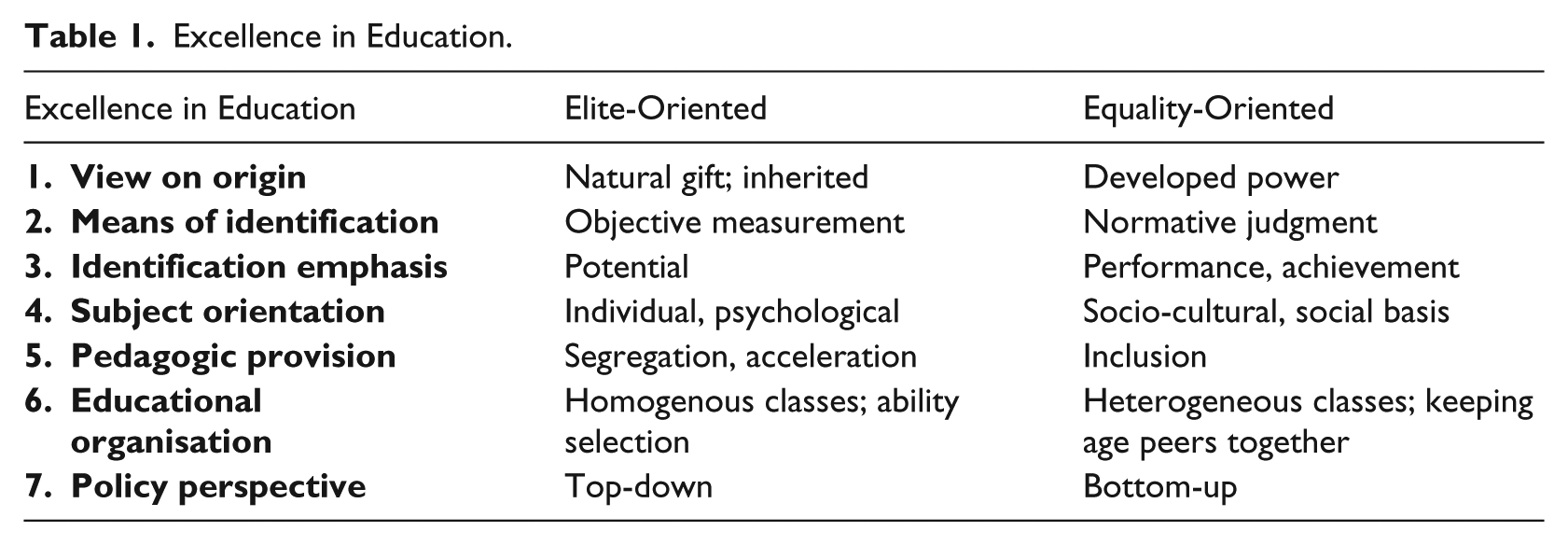
This table of distinctions and dichotomies contains binaries that are not quite as polarised as presented. For instance, an elite orientation that believes in giftedness as heritable might still measure performance and achievement, because potential would manifest as such. Some of the issues listed are binaries, whereas others work more on a continuum. The table, however, has an analytical purpose, and will frame the following policy analysis of academic excellence in primarily the Danish system, and secondarily the English and Australian systems.
Methodological outline
Policy is conceptualised as both national documents and enactments at school level. This involves a two-level process of interpreting the meaning of documents and of translating texts into action (Ball et al., 2012, p. 43). On the level of national policies it implies an interpretation of the language use in strategies for excellence in education, whereas on the school level it implies analysing the translation process of both making institutional texts and putting them into activities for the so-called ‘gifted and talented’.
On the level of national policies, the analysis of the Danish case is based on government documents on talent development in the five-year period from 2006 to 2011. These texts are analysed within the context of the Nordic school tradition of an undivided and comprehensive schooling for all, and later compared with English and Australian policies. The sources for the English and Australian cases are mainly secondary and located in the same years as for the Danish.
On the school level in Denmark, the analysis is based on ethnographic data from a qualitative evaluation of talent class activities that was carried out in a Danish municipality in the years 2006–2008. That is, we draw on primary data for this, as the evaluation was carried out by one of the authors. But for the English and Australian case, we draw on webpages and secondary sources for analysing and comparing the policy translation processes. These cases are included for the purpose – not of a direct comparison – but of deepening the understanding of the policies of excellence as pursued in the Danish case. Thus we trace the policies to contexts, which are culturally different from the Danish, and referred to as excellent examples to follow.
Challenging all students to reach their fullest potential
Denmark has a strong tradition of an undivided comprehensive schooling that was developed throughout the 20th century. A ‘school for all’ was the dominant vision and political majorities gradually amended legislation to describe a comprehensive school for all with no streaming, institutionalised in the ‘Folkeskole’ – the Danish municipal primary and lower secondary school (Rasmussen and Moos, 2014). Academic gifts, intelligence, or talent, it was believed, were evenly distributed in the whole population across all social groups and constituted unexploited ‘reserves’ (Hansen, 2003; Husén, 1968). Thus the dominant idea was that the educational system would have to cultivate unexploited talent from all social groups, including the lower societal strata, more efficiently (Olsen, 1986; Husén, 1968). This was considered to necessitate a flexible educational system in which the definitive choice between different educational lines was postponed for as long as possible, rather than a system with early selection, which was largely dependent on social background.
Following an underlying ideology of equality, the Danish Folkeskole developed towards an undivided school, in which the Education Acts (1975; 1993) first postponed streaming to the upper stages and to some school subjects, and finally, completing the reforms towards a comprehensive school with the 1993 reform (Act on the Folkeskole, 1993), had abolished all streaming (Kruchov, 1985; Hansen, 2003). Thus differentiation from an external division between types of schooling and differentiated classes had moved into the system as an internal differentiation; it had also moved into the curriculum (Goodson, 1992). The aim of providing adequate challenges for all students was, in principle, adopted in the school’s requirement of differentiated teaching, which was legally implemented with the Educational Act of 1993. The development of this school system happened parallel to other democratization initiatives in society and followed similar paths in the other Nordic countries (Antikainen, 2006; Arnesen and Lundahl, 2006; Telhaug et al., 2006).
From the 1990s, however, accountability and differentiation gained increased importance in the Nordic education policies because of a political desire to increase the competitive strength of the education system (Blossing et al., 2014). It was claimed that many gifted and talented children were not sufficiently challenged in the Danish school system, where the allocation of resources was considering primarily the needs of less able children, it was alleged (Baltzer et al., 2006).
Addressing new groups of ‘able students’
In the wake of such criticism, the Ministry of Education of Denmark, stating that ‘able students should be given room for development’ as ‘they are important social resources’ (Ministry of Education of Denmark, 2006), initiated a special funding of talent development projects to target the needs of so-called ‘able students’ (Ministry of Education of Denmark, 2006). Aided by such funding, talent classes were established in some, selected municipalities to function as a supplementary provision, offered after normal school hours for ‘able students’ in the upper stage of school, ages 14–17 (Ministry of Education of Denmark, 2008). Such classes have spread to several other municipalities, which have taken similar initiatives on their own.
Talent development as an official strategy made its official entry on Denmark’s education policy agenda with the Ministry of Education’s Talent Report in 2011. The report was authored by a working group formed by the government to follow-up on its work programme Denmark 2020 (The Government, 2010). The working group included prominent figures from education and research institutions, business and sports and had been given the assignment to formulate strategies for talent development in the educational system. The main recommendations for the Folkeskole were expressed as follows:
a broad lift in teachers’ competences and education with a view to mastering talent activities and differentiating upwards;
one talent counsellor at all schools, as a main rule, by 2016;
full line organization in 7th–9th grade within the framework of the comprehensive school, where the students are grouped according to interests and subsequently according to pedagogic and academic criteria; and
fewer teaching objectives than now and with talent focus as a natural element (Ministry of Education of Denmark, 2011, p. 11).
The recommendation that the teachers’ competences in terms of ‘upward differentiation’ needed to be enhanced, especially in relation to gifted students, built on the general assumption that teachers are not mastering differentiation, at least not in an upwards sense. In connection to this, it was further recommended that differentiation in teaching be transferred to talent development projects in the daily teaching and that teachers work actively to ‘spot and develop students with special learning potentials’ (Ministry of Education of Denmark, 2011, p. 58), which is also supposed to be a task for the recommended talent counsellor at each municipal school.
Rationales behind the talent development policies in Denmark
One rationale behind the recommendations appears in the claim that ‘a greater focus on talents will benefit all’ (Ministry of Education of Denmark, 2011, p. 5). In this way of pointing to the common good, the idea of ‘a comprehensive school for all’ is continued. But in other ways, although maintaining reference to the framework of the comprehensive school, the recommended reform represents a break with its basic idea of un-streamed schooling. This goes with its recommendation of ‘line organization in 7th–9th grade’, with students being grouped primarily according to interests and subsequently according to pedagogic and academic criteria. An obvious interpretation of the line organisation or ‘specialisation’ is to see it as a reintroduction of streaming in the older grades in primary school. The specialisation will be based on ‘continuous evaluation of the students’, implying that the massive introduction of test systems in recent years will have direct consequences for the students’ ranking and grouping according to performance.
The last recommendation challenges efforts in Danish education policies within the last two decennia – with inspiration from the Anglo-Saxon world – to define a series of, often detailed, teaching or learning objectives. On this background, the report states fewer objectives as an aim and later describes the necessity for an ‘enriched curriculum’ (Ministry of Education of Denmark, 2011, p. 17), which extends pedagogy beyond the bounds of curriculum and allows children to work at their own speed with more challenging problems (Baltzer and Kyed 2008; Wallace 2006).
The impetus to recommend an enriched curriculum thus follows from the recent education political reforms of defining curricular objectives, detailing the subject and academic skills to be achieved, which has been a general tendency and has formed part of the Danish education reforms since 2006. This represents another rupture with a Nordic tradition, which in addition to developing academic skills, emphasised the school’s responsibility for general education and formation of the student’s personality, thereby creating the foundation for citizenship (Carlgren and Marton, 2002). In the didactic tradition, instruction was guided more by the needs of the particular student group and context than by nationally set learning objectives, and so in principle established a framework of differentiated instruction.
The above education policies bear witness to the ‘Nordic school for all’ losing ground to other international influences. Schools have to be ‘useful’ in making the students ready for a global world, which defines the role of the school as having to develop each individual student’s talent to its full potential (Telhaug et al. 2006). In practice, the talent development policy is still left to the municipalities to administrate, and ultimately to schools to practise and there are always slippages in policy enactment (Ball et al., 2012). Recommending all municipal schools to formulate an explicit strategy of talent development to ensure gifted and talented students in their schools the appropriate challenges, the approach is primarily one of inclusion (cf. Moltzen, 2006).This is supposed to be achieved by academic specialisation aimed at the students in the upper stages of school, or by setting up provisions in cooperation with the municipal ‘youth schools’, offering the 14- to 17-year-old youths free supplementary education, while they still attend their ordinary classes in the Folkeskole (Ministry of Education of Denmark, 2011, pp. 56–58). There is no formal selection strategy; often it is set up as a voluntary activity for the students, and as such it represents a bottom-up approach.
But this new priority of talent development in education reflects a shift away from the egalitarian meaning of equal opportunity for all to focusing on optimal opportunities for individuals to reach their full potential. Hence it represents an individualising move, which is also seen elsewhere in Europe (Amsing and Bakker, 2014; Lawn and Lingard 2002) and outside of Europe (Lingard et al., 2014), where simultaneously the state has intensified its evaluative role, focusing both on the students’ academic skills and on monitoring local project initiatives (Jones et al., 2008).
Academically gifted students with special learning potentials
The individualising move in education policies is reflected in the way they translate into activities for selected groups. Qualitative evaluations of talent classes, carried out as extra-curricular activities, for students in grade 8 and 9 mainstream school classes, have shown that the participation in such talent class activities is based on a general interest in school matters rather than special needs (Rasmussen and Rasmussen, 2007; 2015).
Talent class students and their interests
Within the framework of the talent classes, the ‘talent’ was primarily interpreted in relation to the school and its subjects. The entrance criteria included personal qualities like drive, engagement, determination, initiative, and independence, which applied in an academic sense, although presented as more general qualities and potentials (Rasmussen and Rasmussen, 2015). As such, the classes represented a narrow understanding, a one-dimensional rather than multidimensional one, and an individual and psychological rather than sociocultural understanding of gifted and talented students (Renzulli, 2005; Ziegler and Heller, 2000). But in the Danish context, entrance was based on a combination of self-selection, the student’s written application, and encouragement from teachers, which diverges from the psychological approach of intelligence quotient (IQ) testing.
Interview data from the talent classes indicated that talent class students and their parents found it important to be able to make choices and independent decisions (Rasmussen and Rasmussen, 2007). The students in these classes generally described their personal qualities as an interest in school and a willingness to work hard and achieve good results, rather than perceiving themselves as excellent and extraordinarily talented, although to varying degrees. They did not see themselves as very different from their classmates in the Folkeskole, and in general did not feel excluded or held back in school. For this reason, they found stereotypical notions about talent misleading and tried to avoid them, like they also avoided associations of feeling better or superior to others, which might reflect the strong egalitarian dimensions in Danish culture, which have been nourished by this educational tradition.
The students in the talent classes thus adhered to understandings closely related to the egalitarian and democratic view that talent is randomly distributed in the population and its realisation mainly depends on active participation (Arnesen and Lundahl, 2006). This notion, however, was challenged by the fact that most students in the talent classes were recruited from culturally well-off families with high cultural capital and social status, and thus in practice incorporated an elite notion of talent (Rasmussen, 2011).
Typically the students would state the need for more challenges as their main motivation for applying, which was also one of the official criteria for being considered for the talent class. In interviews, the students further explained that teachers or parents had encouraged them to apply, but also emphasized that it was their own decision. Although the parents were only given an indirect role, they seemed important for the individual student’s decision because they gave them access to resources and could offer support if the student encountered resistance or insecurity (cf. also Ball, 2003; Power et al., 2003).
The students’ understandings of talent and perceptions of their own talent proved highly related to their social backgrounds. The qualitative analysis of the empirical material thus showed that their cultural capital in the form of educational resources and sociocultural environment framed whether school talent was seen as a natural, innate quality or was perceived as an achievement they had had to fight and work hard for. In this way the study illustrated that the richer in cultural capital the students were, the more naturally and outstandingly talented they perceived themselves and were perceived by others to be (Rasmussen, 2011).
Fostering more talented students
In the Ministry of Education’s Talent Report (Ministry of Education of Denmark, 2011) it is argued that the Danish education system should foster more talents, because the talented students constitute an inspiration for class mates and teachers and because otherwise they become demotivated and tired of school (p. 10). To ensure the continued motivation of the gifted and talented, the report, referring to experiences from Anglo-Saxon countries, recommends the use of curriculum acceleration and enrichment (p. 17). Concerning the identification of the gifted and talented, it is acknowledged that this could be problematic, because there is no general understanding of talent or discussion as to what it implies (p. 24). But even so, the educational focus on such a group has remained an issue of political importance.
In the agreement behind the 2014 school reform, as with the earlier policy documents, the discourse on the academically gifted students being let down by the Danish school system is continued, stating that Denmark has a small number of academically gifted students relatively. If the students’ academic level and the academic level in the public school are to be improved, then it is crucial for all students to get the opportunity to unfold their potential fully and for Denmark to be able to compete successfully on the increasingly international market (Ministry of Education of Denmark, 2013, p. 1).
There is a duality in this statement, partly pointing to the ‘small number of academically gifted students’, indirectly stating that this number has to be increased. But also partly pointing to the necessity of ‘all students’ unfolding their potential fully, it seems to maintain a ‘school for all’ approach, which should cater to the needs of all children. Similarly, the reform of standards states as the first of three main objectives that ‘the Folkeskole must challenge all students to reach their fullest potential’ (Ministry of Education of Denmark, 2014, p. 17). And whereas earlier the main task of the school appeared to be education for democracy and for all, it is now rather education for an international market and an individuality-oriented competition.
Provisions for gifted and talented students in Anglo-Saxon countries
To understand the concept of excellence in a broader international context, we turn our attention now to the types of provision and the education political rationalities behind them in England and Australia. As pointed out by Campbell and Eyre (2006), education policies addressing the group of gifted and talented for the purpose of establishing social justice might produce an understanding that is quite different from that dictated by the purpose of sparking economic resurgence (Campbell and Eyre, 2006, p. 463).
The English case
The model of gifted and talented education in England was formulated in 1999 by a House of Commons Select Committee. Thus the committee made the following recommendations.
Provide funding to support the education of gifted children should be incorporated into the generic funding of schools.
All national initiatives should incorporate a gifted and talented component, clearly specified.
The Office for Standards in Education should include data on provision for gifted and talented in its inspection of schools.
Initial teacher training should be required to give higher priority to the education of the gifted and talented.
All schools should be required to appoint a named person as the school’s coordinator for gifted and talented education (cf. Campbell and Eyre, 2007, p. 462).
The above policy laid the foundations of a national policy, embedded in mainstream schooling. It was accompanied by the establishment of a National Academy for Gifted and Talented Youth (NAGTY) at the University of Warwick in 2002, which was to provide the organisational basis for policy support. This policy period is over now, as NAGTY closed down in 2010. However, some of its elements remain with the introduction of new teaching standards in 2012, which expect schools to identify and support gifted children (Reid and Boettger, 2015).
Deconstructing the political statements behind the English model, Campbell and Eyre (2007) find it based on a three-part rationale. The first is an educational concern about catering to the needs of all pupils, the second an economic concern about realizing potential, and the third is a commitment to social equity that stresses the need to identify talent in hitherto unrepresented groups. There have been some barriers, however, to instigating the first and last-mentioned agendas into practice.
Especially the commitment to social equity has been facing problems and proved difficult to achieve. One problem is that middle-class elite groups challenge the meritocratic functioning of education. Having recognised the increasing importance of qualifications, they work and often manage to improve their children’s relative chances of ‘getting the best of them’ (Power et al. 2003, p. 151). This demonstrates the power of cultural capital in accessing public service benefits.
Another problem, also outlined by Power et al. (2003), is the market responsiveness of elite schools in the independent sector. When the demand for elite school places grew, they responded by specialising and creating market niches for themselves in assuring high academic standards and admission to top universities. They manage to do so by setting up strong academic selection processes for entry to them and thus are expected to attract ‘disproportionate numbers of the gifted and talented students’, which the English model of gifted and talented education in mainstream schools is up against (Campbell and Eyre, 2007, p. 469).
Although it includes an equity argument, the English model on gifted and talented education seems to contain mainly an economic rationale of promoting competitive advantages of individual students, which is then supposed to contribute to driving up performance in the knowledge economy.
The Australian case
The first national focus on special needs of gifted students in Australia is located to a conference in Melbourne in 1983 (McCann, 2007, p. 424). Two years later the national body, the Australian Association for the Education of the Gifted and Talented was formed, and in the following years the Association along with some Australian universities and private organisations lobbied for an enquiry on the issue. This was released in 2001 under the title of The Education of Gifted Children, whose subsequent policy recommendations included giftedness under the category of ‘special needs’ (McCann, 2007, p. 426). Although subject to much debate, formal state provisions of special education for gifted students in Australia had appeared already during the previous two decennia.
The most common type of provision schools have opted for is to establish special programmes within the regular school curriculum, which is usually done by combining the three strategies of acceleration, enrichment, and extension (McCann, 2007, p. 443; Bragget, 1997). Acceleration implies that students have early entry to the school curriculum or move through the curriculum at a faster pace than would normally be required (ACT, 2014; O’Reilly, 2006). Enrichment is regarded as a process that extends instruction beyond the bounds of curriculum and offers students the opportunity to undertake original research, and to solve problems that would be beyond the interests and abilities of students in general. Extension is to allow students to strengthen their skills in a particular area of expertise by studying at a greater depth within an already established area of strength. As with the other two strategies, there seems to be an assumption of teachers and students strictly following a curriculum and keeping to this, which could then – as goes for the gifted and talented students – be accelerated, enriched, and/or extended.
It has been problematized that the ‘common response’ of teachers who are not trained in educating gifted and talented learners is to ‘reward’ students who finish their work early and accurately with harder or more work, which indirectly trains the students in slowing down (McCann, 2007). Against this background, it is argued that education of teachers is essential to make them apply the options of acceleration, enrichment, and extension in more successful and productive ways.
Another option available is to use selective entry into either regular schools or academically selective schools. Most states in Australia have some examples of a special interest school concept, according to which schools provide a specialisation in a field at secondary level and then use selective entry for students specifically talented in that field. As remarked by a proponent of ability grouping and acceleration, many forms of this have been accepted as viable and valid for young people talented in sports, athletics and the performing arts, whereas they have been withheld from academically talented students on the grounds that they would cause stratification, promote elitism, arouse envy or feelings of inferiority in students not selected for such opportunities (Gross, 2006).
Selective entry to government schools on the basis of academic performance is another option. New South Wales has a raft of academically selective schools, whereas most other states have a small number of such schools. Differentiation of government school provision has been one response to the growth in numbers attending non-government secondary schools. Along with the other selective programmes in Australia, such ability selection has been debated as to its value and influence on the gifted students’ self-esteem, which in some research findings is seen to drop (Craven and Marsh, 1997). But an explanation of such decline in academic self-esteem, it is alleged, reflects these students’ realisation, often for the first time, of the gap between their remarkable achievements and their even more remarkable potential. It reflects an understanding that even greater effort is required if they are to realise their potential fully (Gross, 2006, p. 131).
Thus, gifted and talented students are considered equipped with a potential that they have an obligation to realise. The quote further touches on the notion of underachievement, which the literature on outstanding learners describes as the case when a student’s school performance is significantly below some measure of their high potential (Merrotsy, 2015). How this potential is identified however, or how it can be measured, and who belongs to the group of gifted and talented, remain highly questionable. This implies an understanding of excellence emphasising potential rather than performance; actual achievement is not considered as representing an accurate view of the students’ abilities when some are categorised as underachievers.
The Australian senate enquiry in 2001 was considered pivotal in dispersing funds to support practice and in placing gifted education in Australian federal policy within the category of special needs and recognising these needs (McCann, 2007). Accordingly, the gifted and talented students subsequently have been addressed as a special group, having special needs and being entitled to rigorous, relevant and engaging learning opportunities drawn from the Australian Curriculum and aligned with their individual learning needs, strengths, interests and goals (McCann, 2007; cf. Australian Curriculum, 2016).
Here we see an extension of the meaning of inclusion in education policy. This is an interesting expansion of the concept of special needs. The Australian policies reflect a top-down perspective on ‘talented and gifted’ as a group of learners who must be identified as a kind of diagnosis. This group is considered a special needs group, for whom special provision has to be set up.
Defining and identifying the gifted and talented
Concerning the identification of potentials – the outstanding abilities – and which students belong to this group, no simple answers are provided. In Australian policy and practice declarations, there appears to be a multiplicity of terms involved in the wider definitions of outstanding ability (Merrotsy, 2015; McCann, 2007). Asking what is ‘standing out’, Merrotsy (2015) concludes that outstanding ability generally refers to exceptional intelligence and then with reference to Flynn, the New Zealand psychologist known for the discovery of massive IQ gains from one generation to another, locates three important components of intelligence, including mental acuity, habits of mind and glial cells (Merrotsy, 2015, p. 235). Yet this work seems oblivious to developments in epigenetics.
In England
In the English model, teachers are supposed to play a key role in deciding and defining who is considered gifted. The nature of giftedness and its assessment is highly debated as to both its incidence of heritability and insecurity of measuring abilities, but also in respect of its extent in the population. The Select Committee report argued that about 5% of the population is considered] ‘very able, and that 2% might be “exceptionally able”’ (Campbell and Eyre, 2007, p. 466). The idea that ability is available in fixed and definable quantities supports Gillbourn and Youdell’s notion of a ‘new IQ’ism’ (Ball, 2008, p. 180).
This idea is somewhat challenged by the fact that the English model adopts a modernised theory of multiple intelligences rather than a single measured IQ. The identification of giftedness invokes ideas of Gardner (1999) and many others, and it is to work by provision rather than diagnosis and treatment (Campbell and Eyre, 2007). The use of multiple theories that justifies a broad conception of ability provides the justification for multimodal assessment rather than a unidimensional measurement.
The multimodal and criterion-based assessment of ability, which is used to recruit and set up criteria for entering the gifted and talented activities, could perversely counteract the before-mentioned equity agenda. Thus it might enable middle-class parents to act strategically and make a case for their children, if more ‘objective’ test data have excluded them (Campbell and Eyre, 2007, p. 470).
In Australia
When it comes to identifying students with outstanding abilities or measuring intelligence, the terms ‘gifted’ and ‘talented’ are commonly used to describe this group. However, there are many competing conceptions and approaches to this (Merrotsy, 2015). As noted by McCann (2007, p. 431), the state and territorial policies in Australia apply definitions of giftedness that vary widely across schools in Australia, but they also show some common elements such as drawing widely on the same psychological bases. This can be exemplified by the state education policies of Queensland, whose gifted and talented definition draws on Gagné (2008), when stating that Giftedness designates the possession and the use of outstanding natural abilities, called aptitudes, in at least one ability domain, to a degree that places an individual at least among the top 10% of age peers in the school. Talent designates the outstanding mastery of abilities over a significant period of time. These are called competencies (knowledge and skills). Outstanding mastery is evident in at least one field of human activity to a degree that places an individual at least among the top 10% of age peers in the school who are or have been active in that field (Education Queensland).
Thus, these definitions draw a distinction between giftedness of high potential, and talent as the realisation of that high potential or, in other words, talent is high performance. The terms are used normatively and based on comparison, as students are supposed to be compared with others of similar age. And both definitions give estimates of a prevalence of a ‘top’ 10%.
The Differentiated Model of Giftedness and Talent developed by Gagné is considered important and enjoys widespread favour in Australia (Merrotsy, 2015). Next to this model, a four-step identification process adopted state-wide is recommended, because it ‘ensures data-collection processes are reliable and valid’ (Education Queensland). The four-step process includes the following.
The teachers use current data from school-based screening and assessment.
The teachers collect data using checklists for ‘gifted and talented’.
The guidance officers and classroom teachers collect data using ability and academic assessments.
A guidance officer collects data using cognitive assessments.
It is remarkable that the identification process is highly based on using IQ or other cognitive assessments, where testing appears at high frequency. Although pointed out in psychology-based research that standardized psychological and academic tests alone do not constitute a sufficient basis for identifying talent (Nissen et al. 2011; Feldhusen 1998), because tests only measure a part of a child’s potential in one specific context at one specific moment, and so need to be supplemented by qualitative data and information, it seems that schools predominantly use such tests as their identification measure (Callahan and Hiatt 1998; Feldhusen 1998) and are advised to do so.
One reason for the dominance of such tests may be that using such assessment tools appears less resource-demanding than other, more qualitative methods, and perhaps has the appearance of objectivity or as being ‘scientific’ in approach. Considering the multiplicity of steps in the identification process and the involvement of both several teachers and a guidance officer, this, however, appears quite resource-demanding. Another relevant point is the fact that national standardized tests in literacy and numeracy have been introduced for all students in all Australian schools in Years 3, 5, 7 and 9 from 2008. This has seen an increased usage of additional standardised tests again in Australian schools as teachers seek to prepare students for the national tests and develop students’ ‘test literacy’.
Addressing an agenda of special needs – or competition of individuals?
The different definitions of outstanding abilities – of gifted and talented students – make it relevant to discuss how and whether such a group should be identified. When primarily understood by their academic performances at a given point in time, the resulting identification processes involve testing the students on such performances. If understood as a potential that has yet to be developed, then the question is how to identify such potential without focusing on the academic performances already achieved, which indeed seems what the above assessment processes are focused on. From an education politics perspective, this might be seen as a return to an ‘IQism’, in which ability is considered a fixed, definable and measurable quality, and thus an agenda where winners and losers should be identified at the earliest possible stage (Ball, 2008, p. 180).
Another point for discussion is who should perform the identification, or even if it should be performed at all. The need for qualitative data and information gathered via pedagogic observation points to it being primarily a task for teachers. As shown in some studies, however, teachers have found it challenging to pick out 5–10% of a cohort of students; they saw many students as having potential talent that had not been expressed in their test performances and so had to base their selection on their own ‘impressions’ and observations of students in class (Casey and Koshy, 2006). Experiences from the English context similarly show that the ‘objective’ identification of gifted and talented students is perceived to be the most problematic aspect of this type of policy (Eyre 2001), whereas multimodal recruitment processes, on the other hand, might provoke an equity problem.
The understanding of talent as a potential, in addition to the problem of identification, is associated with another issue. Designating some children as gifted and talented creates a dichotomy in relation to the children who do not achieve that designation. If the objective is to designate some limited percentage of the students as gifted and talented, the large majority will indirectly be designated as ‘non-talented’ (Sennett, 2006). This raises questions about the expectations and motivations such talent development practices will have for those nominated or not nominated as talented. In other words, selection processes – especially if carried out at early stages – have consequences for the general education purposes of school. Such an identification of the majority of students as non-talented runs against the trend of human capital policy in education that seeks to maximise the nation’s quality and quantity of future human capital.
When you communicate to a group of students that they are intelligent, it implies a risk that they see their own abilities as a given, rather than a potential that requires an effort to be developed. Moreover, it may trigger negative reactions from contemporaries when students are designated as intelligent or talented. Although this is often described as a special Danish ‘who-do-you-think-you-are’ mentality, such tendencies have also been shown in American and in Australian studies (Feldhusen, 1998; McCann, 2007). Likewise, it has been suggested that it may seem pedagogically incorrect to indirectly tell the large majority of students that they are not gifted and talented – even if it could be argued that this is what schools have always been doing.
The distinction between the talented few and the large majority is thus to a large extent related to the issue of differentiation and the question of what the most important role for teachers and schools is and should be. It seems fair to ask whether it is the teacher’s task, within the framework of the comprehensive school, to nominate students as gifted and talented and kick off the selection processes at this stage. As for differentiated teaching, the question is whether the school is required to guarantee suitable challenges for all students as an internal or external differentiation (cf. Goodson, 1992).
Legislation and school practices in Denmark reflect cultural-political differences between two philosophies regarding the school’s role in society (Nielsen 2006). Considered in their extreme versions, one emphasizes community, solidary and ‘soft values’ like working together on common causes, democratic education, interdisciplinary learning and undivided classes in a comprehensive school. The other emphasizes efficiency, economic growth, competition and individual ambition, expressed in an education policy that prioritizes subject-specific competences, tests, external evaluation and competition among students and among schools. Yet, as argued elsewhere, all nations today seek to maximise the quality and quantity of their human capital through education as insurance about their economic future within a competitive global economy (Rizvi and Lingard 2010).
Conclusions
Focusing on education policies that target the groups of students considered gifted and talented, we have aimed to understand their underlying assumptions about excellence in education and how to promote it. In doing so we undertook a twofold analysis, of which the first part was directed at identifying the education policies and provisions for ‘gifted and talented’ in Denmark and two Anglo-Saxon countries, England and Australia, to analyse them as vernacular expressions of similar globalisation moves. In the second, we dealt with the processes involved in identifying the group of gifted and talented to consider the wider implications of these ‘new’ tendencies of promoting elites and privileges in education.
Excellence as driving up performances of those with special interests
Excellence in education was until the 1990s not an explicit issue in Danish education policies. They were generally aimed at assured equality in education and therefore had followed a tradition of postponing grading and streaming for as long as possible. Thus, educational excellence was translated into visions of equality and democracy, with an ‘education for all’ policy. But with increased internationalisation and accountability pressures in the late 1990s, there was a push for specific initiatives aimed at so-called ‘able students’ so that in 2006, talent development entered the education political agenda and in 2011, it was developed into an official strategy. This contained misrecognition of teachers’ efforts of differentiated teaching and an indirect blame of the public, comprehensive school for promoting mediocrity on behalf of talent, which opened up for funding of specific talent initiatives and classes.
The policies behind the Danish talent development strategy build on a one-dimensional, narrow understanding, and an individual and psychological rather than sociocultural and epigenetic understanding of excellence and talent, although the ways of recruiting students for these are mainly based on a bottom-up perspective. In practice, it appeals to students whose backgrounds are characterised by plenty of cultural capital and strong interests in education.
In England, political drives for excellence in schooling have been voiced as a need to provide possibilities for those with energy and talent, rather than universal provision. By establishing the NAGTY to run talent searches and aiming to implement gifted and talented education in the mainstream system, it has demonstrated an educational equity ambition. But in practice, it appears to be facilitating new ways – in addition to the already existing ones in the old English elite schools – of attending to an agenda of opportunity and market individualism.
In Australia, political debates in education have also voiced excellence as something inherent in everybody. Thus, there has been some opposition to regarding gifted and talented children as a group who should be defined and given special opportunities on this basis. But even so, Australian states have been more prone to accept and have schools offer acceleration, enrichment, and extension strategies, which entail a top-down identification of the gifted and talented students for whom such programmes should apply. And most states have a ‘special interest school’ concept, according to which schools may provide a specialisation in a field at secondary level and then use selective entry for students specifically talented in that field; for example, science, technology, engineering and mathematics schools, performing arts schools, drama schools, sports schools, and also more traditionally academic selective schools. In 2001, the national policy recommendations included giftedness under the category of ‘special needs’ and so legitimated an increased focus on the gifted and talented in education and extended somewhat the professional taken-for-granted usage of ‘special needs’ in education.
The Danish report on Talent Development in the Education System, the English Select Committee report, and the Australian Curriculum stating the needs on the special provisions for the gifted and talented endorse in education a political vision of global competition and talent development as the driving forces for economic growth and development in line with those of the OECD (2012). This policy is disseminated at government as well as school level in the three countries and can be seen as partly a response to local political pressures from neoliberal policy-makers, partly to external, global pressures, advocating for the educational imperative of a globalization in a normative sense; that is, this refers to an economic policy aimed at unifying the global economic field by a whole set of measures, designed to remove all the limits to that unification (Bourdieu, 2005, p. 224; Ball, 2008). Thus from the OECD to the member countries, there is a policy transfer in which the discourse of the gifted and talented programmes appears as socially neutral and in line with managerial wishes to promote talent in all areas. But empirical evidence from the Danish and English contexts in particular shows that this is mainly to the benefit of the middle-class students, rich in cultural capital. As such, it contributes to the widening of existing inequalities in education systems.
Identification and selection procedures
When presented as if certain student groups are neglected in the comprehensive, mainstream system, there is a particular political appeal to some social groups for a focus on the so-called gifted and talented. Such programmes appeal to expectations of anxious middle-class parents to provide identification and selection of their children for the intellectual elite in an increasingly competitive education market (Ball, 2003). This results in pressures to differentiate provision within schools and also to create selective schools of various kinds.
Further arguments for making special provisions for the gifted and talented are based on assumptions of an unexploited intellectual potential in the student population that, if properly realized, would benefit the nations’ educational standard and competitiveness on the global market. Proponents of this contend that in the regular, comprehensive school system the highest performing students are prevented from developing and performing to their full potential because instruction and resources are primarily aimed at the needs of low-achieving students, while the ‘gifted and talented’ tend to adapt their achievement level to their lower-achieving peers in order to be socially accepted.
Although the three countries have different political experiences in education as to when policies of attending to the needs of gifted and talented students became an issue, they demonstrate similar traits as to the political arguments for the labelling of some students as ‘able’, ‘academically gifted’ or ‘gifted and talented’ for whom special provisions should apply. What appears from the debates on catering to the allegedly ‘special needs’ of the gifted and talented is an education political tension between dreams of excellence and concerns about equality. When focus is on excellence following the identified globalisation agenda, support for the gifted and talented increases, whereas the focus on equality decreases, which is a tendency similar to policies pursued in Britain (Tomlinson, 2008). Governments increasingly encourage within-school selection and students tracked by ability, thereby paving the way for specialist schools and programmes that can contribute to ‘modernising the comprehensive principle’ of schooling (Tomlinson, 2005, p. 125). The need for identification of special groups is a manifestation that universal provision has been replaced by one of individual opportunity (Lingard et al., 2014), which is driven by the aim of providing special possibilities for those with talent, or those selected as gifted and talented.
Selection procedures in Australian state initiatives demonstrate a strong belief in the power of psychological testing to determine academic potentials of students. Thus, the procedures outlined for identifying the academically gifted and talented refer to well-known psychologists to legitimise their use, and to underline that this is objective measurement of academic potentials. They bear witness to an adherence to the ideas of ‘IQism’ about ‘fixed intelligence’, thereby functioning as a prerequisite for identifying intellectual elites and legitimising the set-up of special educational provision for them.
Wider consequences of the war for talent
Assertions of neoliberal rationalities are obvious when education policies display an ever-more explicit concern with the preoccupations of advantaged social groups (Ball, 2008; 2015). In another criticism of assessment procedures, it is maintained that these indirectly create a mass of ‘untalented’ (Sennett, 2006). This is occurring at the same moment as the human capital framing of contemporary education policy asserts that all nations require more highly educated human capital, a move accompanied by the creation of mass higher education systems. As a wider consequence of the contested notion of identifying the gifted and talented in school, doors to education will open or close. Additionally, to many the logic of closure will be obscure, because the judgement of potential establishes no links to circumstances and experience.
Proponents of inclusive strategies have argued that the intellectual and social-emotional needs of talented students might just as well be accommodated in regular, mixed-ability classrooms. They consider the most important barrier to the effective accommodation of talented students in the regular, comprehensive classrooms the ‘inability of the teachers’ to effectively differentiate their teaching. It is argued that the needs of gifted and talented students can be met in regular classrooms, provided that teachers allow them to learn at an appropriate pace, develop their critical and creative thinking skills, pursue their passions, represent their knowledge in a variety of ways, and interact with mental-age peers (Pyrut and Bosetti, 2006).
In some ways, the accountability movement currently dominating public education might actually pose a barrier to the provision of appropriate challenges for gifted and talented students – and to differentiated instruction as such. Thus in the final years of the Danish Folkeskole, teachers increasingly teach strictly to the syllabus and omit content that is not in the syllabus (Rasmussen, 2011), an approach that is also encouraged by the new curricular policies of setting detailed learning objectives.
In Australia, strengthened national testing since 2008 has had a similar impact (Lingard et al., 2016). When teachers spend most of the time on syllabus-related content, provide instruction on testing strategies and practise items for this, the instigation of long-term projects that could enhance the students’ creative and problem-solving skills is more likely to become a rare occurrence.
Research on Australian schooling has also made the point that certain learning environments that enhance complex reasoning skills, conceptualised as productive performance, have often been restricted to gifted and talented programmes and rarely extended to students who come from traditionally marginalised groups within schools (Hayes et al, 2007, p. 143). This point indirectly takes issue with the earlier posited claim that it is the gifted and talented students who are neglected in education; rather they appear to be the ones that have the most productive learning opportunities.
The analysed education political agendas of excellence, transferred by the OECD, in several ways are seen to translate into elite-oriented rather than equality-oriented strategies. These strategies appear to appeal to social classes that are rich in cultural capital, and that have been apt to take advantage of such provisions that can assure them or their children a competitive advantage in the race for excellence in education.
Footnotes
Declaration of conflicting interest
The author(s) declared no potential conflicts of interest with respect to the research, authorship, and/or publication of this article.
Funding
The author(s) received no financial support for the research, authorship, and/or publication of this article.