




Abstract
Despite the increase of research on international students, the complexity of their learning experiences is yet to be fully understood. This study seeks to provide an expanded vision of their learning by considering students’ experiences beyond formal educational spaces, focusing especially on their out-of-classroom experiences. To achieve this, the narratives of 12 international students in Portugal were analysed in light of the theory of transformative learning. The results indicate that all students experienced particular forms of learning as an outcome of their international experience and were engaged in transformative learning processes. Moreover, the theory of transformative learning proved to be an appropriate analytical tool for understanding the learning narratives of international higher education students. Through the analysis of the transformative effects of engaging with a foreign cultural context, this paper makes a contribution to the ongoing debate on transformative learning and the experience of international students in the European context.
Introduction
The number of students traveling abroad has been rising significantly in the last few decades, contributing to the emergence of universities with increasingly diverse student populations. Even though crossing borders with the intention to study is not a new practice (Altbach, 2004), the number of students pursuing education abroad started to increase significantly in the final decades of the twentieth century. According to Chen and Barnett (2000), in the 1960s there were only 238,000 international university students worldwide: by 1995 their number exceeded 1.5 million. Almost two decades later, in 2012, the number had grown to more than 4.5 million international students globally (Caruso and de Wit, 2015). Whilst the university student population has also risen as a consequence of higher education massification (Mok and Neubauer, 2016), according to Beine et al. (2014) international students, within the different categories of migrants, represent the category that experienced the fastest increase in relative terms. Moreover, the global population of students who move abroad in order to study continues on the rise and international students have become an integral part of the student body, particularly in the world’s leading universities (Benson, 2015). Such a significant increase has resulted in ethnic and cultural diversification of most universities, creating in Europe a multicultural higher education context (Trahar, 2013). This significant rise of international students in higher education has been followed by increased research on the international sojourn (Brooks and Waters, 2011; Brown, 2009; Brown and Jones, 2013; Findlay et al., 2012; Murphy-Lejeune, 2003; Van Mol and Timmerman, 2014). However, the learning experiences of international students still tend to be reduced to polarised perspectives, based on positive or negative outcomes that scholars attach to the international experience (Leask and Carroll, 2011). Such polarised perspectives can be prejudicial both at a theoretical level, because they hinder the development of more inclusive approaches to learning, and at a practical level, because they tend to reduce the richness of an international sojourn to dichotomised learning outcomes. According to Weller (2015), simple binaries encourage reductive and inadequate ways to analyse the complex experiences of international students.
The rationale of this study is consistent with the ‘need to enrich academic understanding of the socialisation experiences of cross-border students in the host universities’ (Lingling Xu, 2015: 66). In this context, it is important to stress that this present work is not a study about international students’ learning in academic settings; rather, the objective is to identify and analyse the learning processes which may result from the actual experience of living and studying in a foreign country. In addition, following the distinction proposed by Findlay et al. (2012), it is necessary to mention that this study addresses the experience of international students involved in degree mobility and not in credit mobility. In other words, this paper does not discuss the experience of students enrolled in short-term exchange programmes – such as Erasmus – but is focused on those students who are enrolled in an overseas full higher education degree and generally spend a minimum of two years abroad.
Based on the main research objective, to understand and depict the learning experiences of international students in their complexity, this paper seeks to bring international students’ learning experiences to the core of the analysis and address them beyond polarised labels. In order to achieve this, the analysis of international students’ experiences will be conducted through the lens of the theory of transformative learning (Mezirow, 1990). This theory was considered to be an appropriate analytical tool for investigating international students’ trajectories because it allows researchers to regard learning as a holistic process (Morrice, 2014), and to surpass narrow binaries that describe learning experiences solely in positive or negative terms. Notwithstanding that, many similarities can be found between the way transformative learning emerges and the specificity of experiences that sojourners generally have while living abroad (Taylor, 1994).
According to Taylor (2007), the theory of transformative learning has been employed mostly in formal educational settings. In contrast, this present study seeks to achieve an understanding of learning beyond such settings and concentrates on the experiences of international students in informal contexts, considering their learning experiences not only inside the classroom but also in the wider context of their everyday lives. Accordingly, the main focus of this research lies with students’ informal learning, which is not always intentional but is a natural companion of everyday life (Alheit and Dausien, 2002). Based on the rationales and objectives expressed above, this paper thus attempts to provide answers to the following research questions.
Do international students experience learning beyond classroom settings as a result of their experience abroad, and how that learning emerges and develops?
Do international students engage in transformative learning processes during their international sojourns, and experience significant changes in their worldview and in the ways in which they make sense of their own experience?
Learning through the international sojourn
Learning through experience can be regarded as an intrinsic feature of human life, since ‘we learn as we breathe, all the time, without giving it any thought’ (Field, 2006: 45). Even though learning is ubiquitous (Webb, 2015) the international sojourn seems to have a direct impact on students’ learning outcomes (Commander et al., 2015). Travelling has an implicit educative benefit (Morgan, 2010), and during an experience abroad ‘a great amount of learning takes place out of necessity’ (Erichsen, 2011: 129). For these reasons, experiences abroad have been associated with very positive outcomes. For instance, Kennedy (2010) considers that moving overseas offers opportunities that are not equally available to those who remain in their home countries; and the value of a period of study in a different country is also highly regarded by some international organisations such as the EU (COM, 2009). Also, in the North American context, experiences abroad are frequently understood as having significant beneficial outcomes, especially at the level of personal development which can be reinforced ‘through a confrontation with other cultures, but also, and perhaps even more, with the home culture’ (de Wit, 2012: 94).
However, not all scholars subscribe to these positive views of the international sojourn. Part of the literature questions the very learning potential that previous scholars attached to the international sojourn. For instance, Stronkhorst (2005) noticed that the benefits of such an experience had been somewhat taken for granted; and Turner (2009) believed the idea that exchange between different students allows all to gain important life lessons needed further interrogation. In fact, exposure to cultural diversity does not automatically provide learning opportunities (Otten, 2003), and the paucity of contact between students from different cultural backgrounds is widely documented (Kimmel and Volet, 2012). According to De Vita, ‘the ideal of transforming a culturally diverse student population into a valued resource for activating processes of international connectivity, social cohesion and intercultural learning is still very much that, an ideal’ (De Vita, 2007: 75). The assumption that the mere presence of diversity within campuses provides significant learning outcomes to students has been subjected to questioning (Peacock and Harrison, 2008), and authors such as Leask and Carroll (2011) believe that universities have been ‘“wishing and hoping… and dreaming” that benefits will flow from cultural diversity on campus’ (Leask and Carroll, 2011: 648).
Most of the scholars who contest the learning outcomes of the international experience tend to concentrate on the lack of contact between international and local students. Matthews and Sidhu (2005) identify marks of separation and disconnection between the two groups, whilst Otten (2003) notices that international students form groups according to their nationalities or live in ‘international reservations’. When the experience of students becomes polarised and is described exclusively as positive or negative, the lack of intercultural contact becomes a synonym for a negative experience as a whole, somehow unworthy of the learning outcomes generally associated with the international sojourn. Such assumptions are highly problematic since they presume that there is homogeneity within the two groups and fail to consider the cultural diversity that can be found not only inside the group of international students but also among local students (Asmar, 2005). At the same time, by concentrating solely on the international–local dichotomy and subsequent intercultural interaction, other forms of learning are overlooked. Research by Montgomery and McDowell (2009), and Montgomery (2010), revealed that intercultural learning occurs even when students do not mix across nationality groups. Accordingly, the outcomes of an international experience should not be reduced to an international–local divide but, rather, should be viewed as a complex interplay of different factors that go beyond students’ academic experiences. A useful lens for looking at such factors in the ambit of an international sojourn and understand students’ learning experiences is offered by the theory of transformative learning (Kumi-Yeboah and James, 2014).
Transformative learning and international students
The theory of transformative learning was raised in the context of adult education by Jack Mezirow (1981) and it has been employed by numerous scholars from different disciplines. More than three decades later, it is still a theory in progress (Lilley et al., 2015) and it is considered as one of the major theories of adult learning (Cox and John, 2016). Even though ‘it is well acknowledged in the literature on the international sojourn that exposure to a new culture has transformative potential’ (Brown, 2009: 504), the use of the transformative learning theory in this field is not frequent (for some exceptions, see Morrice, 2013; Taylor, 1994). According to Mezirow (1990), transformative learning occurs when there is a change in our meaning perspectives. Considering that international students do cross not only geographic borders but also socio-cultural ones (Webb, 2015), the disjuncture often generated by such crossings can also lead to changed meaning perspectives. Since meaning perspectives are uncritically acquired in early childhood (Mezirow, 1990), the unfamiliarity international students encounter when they enter into contact with a different culture can force them to question such long-established frames of reference. According to Osborne, students ‘come equipped with a social identity provided by their former life, which, however, most of them have never examined or questioned before’ (Osborne, 2012: 1037). Engaging with unfamiliar places can cause disruptions to one’s worldview and such disruptions are capable of engendering the process of transformative learning (Morgan, 2010).
Change in our meaning perspectives is triggered by what Mezirow (1990) designates a disorienting dilemma, which leads to another conceptual similarity between the international sojourn and the theory of transformative learning. According to Taylor, ‘a disorienting dilemma seems similar in nature to culture shock’ (Taylor, 1994: 158). For Morgan (2010), culture shocks are disorienting dilemmas par excellence, and they can lead to perspective transformations, moments in which we become ‘critically aware of how and why our presuppositions have come to constrain the way we perceive, understand, and feel about our world’ (Mezirow, 1990: 14). Indeed, studies from several countries reported on transformative learning occurring through the international sojourn (Jones, 2013), and students themselves seem to value the potential for transformative learning offered by an experience abroad (Kelly, 2010). Because living in a new culture offers individuals enormous opportunities for informal and incidental learning (Morrice, 2013), and cross-cultural contact is known to ‘result in shaken life assumptions’ (Madison, 2006: 255), disorienting dilemmas are more likely to appear during the international sojourn when the experience of new cultures can shift habits of mind (Cranton and Kasl, 2012). Even though he does not specifically defend the pertinence of the transformative learning theory for analysing the international sojourn, Mezirow acknowledges its importance when he states that disorienting dilemmas might occur by ‘one’s efforts to understand a different culture that challenges one’s presuppositions’ (Mezirow, 1990: 13). Through living abroad, students not only learn new things but also learn in new ways (Berg, 2007) and that is paramount to the emergence of transformative learning. According to Kegan (2000), transformative learning is not about the content of learning as much as it is about the forms in which we learn, about how we know and not solely what we know.
The research
Considering the specificity of the main research objective, to understand and depict the learning experiences of international students in their complexity, a qualitative approach was favoured. However, not all qualitative methods appeared appropriate, especially because learning in an international setting is a process ‘difficult to describe, interpret, and conceptualize’ (Erichsen, 2011: 111). At the same time, ‘learning is subject to a high level of uncertainty both with regard to the process itself and to the outcome’ (Schrittesser et al., 2014: 152); in this research, therefore, we assumed that some participants might not be fully aware of their ongoing transformative learning processes (Mezirow, 1990). For this reason, they could not be readily available to provide insights about their learning experiences, and a methodology capable of encouraging them to actively reflect on the outcomes of the international sojourn was needed. Narrative inquiry was chosen because it allows researchers to ‘get at information that people do not consciously know about themselves’ (Duff and Bell, 2002: 209). Acknowledging that personal background exerts influence on one’s experiences (Hazen and Alberts, 2006), learning was analysed not only within students’ present experiences but also within the wider picture of their whole biographical baggage. This facilitated the understanding of ‘how biographies, social relations as well as past or simultaneous mobilities inform the ways students cope with situations perceived as challenging or adverse’ (Ploner, 2017: 421). Narrative inquiry allowed researchers to welcome diversity and subjectivity in the process of interpretation (Araújo, 1999), which permitted the analysis of learning as an individual process, triggered by different factors and experienced differently by each student. According to Scutt and Hobson, ‘allowing individual narratives space further allows us to recognise that if something is happening among a group of people, the same thing is not happening to each person’ (Scutt and Hudson, 2013: 22). Narrative also proved to be highly appropriate for grasping ‘the great biographical alteration’ (Trifanescu, 2015: 99) that students experience during their international sojourn.
Given the scarcity of research on international students in Portugal (Nada and Araújo, 2017), selecting participants exclusively from one university would not have provided the necessary basis for understanding the learning experiences of international students in this country, because it would have limited the scope of the research to a single and regional case. Instead, we opted to conduct research in four public Portuguese universities selected according to their total number of students, geographic position and number of international students enrolled. This choice was guided by the aim to obtain learning testimonials from students enrolled in the most prominent universities in the country, located in different regions, and presenting diverse institutional specificities.
Twelve international students agreed to participate and they were given the opportunity to withdraw from the research at any time. Their anonymity was assured by the use of fictitious names and the omission of some aspects of their stories that could render them identifiable. The students were chosen purposefully, using the maximum variation technique (Patton, 2015). The selection was conducted based on criteria established with the intention of maximising diversity between the students, aiming to obtain diverse learning testimonials. Students were different on many levels; for instance, nationality, ethnicity, study level (undergraduate and postgraduate), faculty, university and gender. Because the type of experience provided by an exchange programme is different from the experience of moving to a different country for more than one year (Gargano, 2009), all participants were students enrolled in a complete higher education degree in Portugal (bachelor’s, master’s or PhD). In other words, in order to be able complete their degrees, all research participants would spend at least two years in Portugal (in the case of master’s students); or at least three years (in the case of bachelor’s and PhD students). As a result, the experience of students involved in short-mobility programmes (Erasmus, for instance) lies beyond the scope of this research. Table 1 shows the results of the maximum variation technique with regard to students’ countries of origin, age range, university and level of study.
Details of the student participants.
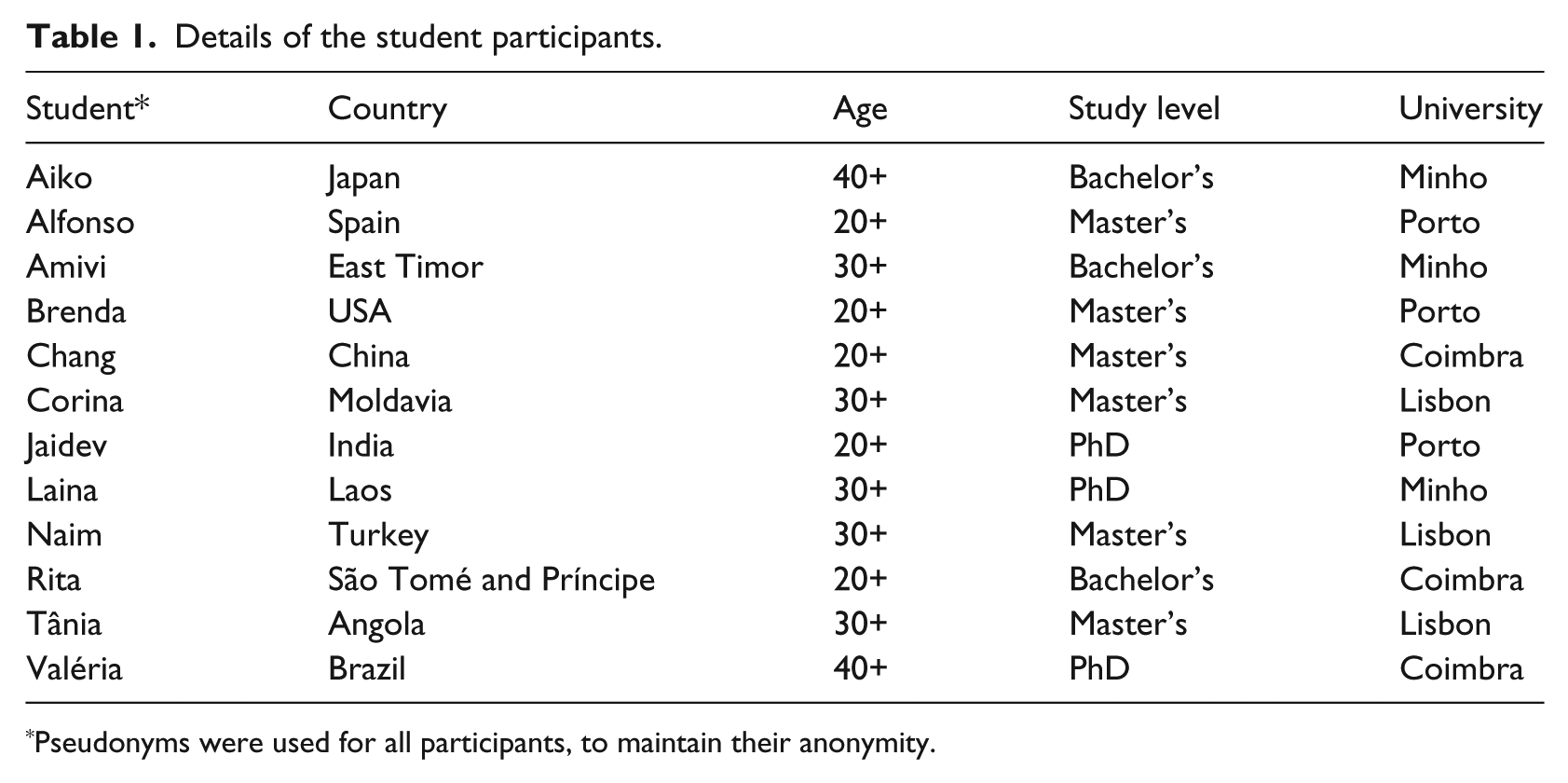
Pseudonyms were used for all participants, to maintain their anonymity.
After carefully choosing these research participants, in the first interview they were asked to narrate their lives from the time when they decided to leave their countries. The (audio) recordings were then transcribed and the resulting stories were rearranged chronologically (Hanhimäki, 2008). Instead of simply emailing students their written stories and asking for validation, each student was interviewed again and again (up to five times). In these following interviews, the story created based on the first interview was reviewed jointly with every student and, after each section, students were invited to add new observations or provide clarifications, always with the underlying intention of encouraging their reflexivity. Even though time-consuming, this approach proved to be empirically enriching. Consequently, this research was not based on a process of data gathering; rather, the students were involved in the co-construction of the data (Kouritzin, 2000; Riessman, 2008). In this sense, readers should bear in mind that the data presented in the following analytical sections are not simply bits of raw interviews: they are complex narrative excerpts that can be regarded as interactional accomplishments (Riessman, 2001). For this reason, following the distinction established by Polkinghorne (1995) between narrative analysis and analysis of narratives, the narrative excerpts presented below are not simply participants’ speeches but constitute the results of a previous analytical endeavour undertaken during the actual process of data collection.
The local–international divide and its effects on students’ learning
Regardless of students’ different international experiences, the findings suggest that learning is embedded in the international sojourn. All students attributed learning outcomes to their sojourn in Portugal – even those who were not well integrated with, or felt distanced from, the local population. Some even reported incidents of discrimination or racism, both inside the campus and in the wider society.
Most students related their learning experience with the hypothetical situation of not having left home. Rita, a female bachelor’s student from São Tomé and Príncipe, acknowledged the importance of leaving home for her learning process, reinforcing the idea that during the international experience students ‘gain knowledge that they could not acquire at home’ (Altbach, 2004: 12): No doubt that everything was a valuable experience, I learnt a lot on those levels, academically and personally. Things, day-to-day situations, and I feel I learnt or grew much more than I would if I have stayed in São Tomé. (Rita)
In this case, it is important to emphasise that Rita left her home country in order to study at an early age, only one year after finishing upper secondary education. In this scenario, her academic and personal growth may be related not solely to her engagement in an international sojourn but also to the fact that her enrolment in a higher education degree abroad constituted her very first experience away from home.
I think that I learnt more out of home than at home and more outside the classroom than inside the classroom. (Rita)
Another noteworthy issue in this excerpt is that students rarely mentioned their academic trajectories when they reflected upon the learning they experienced throughout the sojourn. Instead, they focused primarily on their informal learning, sometimes by attaching even greater value to more experiential forms of learning than to institutionalised learning. Rita’s narrative also diverges from the findings of previous research which suggests a tendency towards social segregation between groups of home and international students (Caruana, 2014). In fact, Rita had more contact with Portuguese people than with her co-nationals or fellow international students. At the same time, other students seem to become somewhat segregated. Amivi, a female Timorese bachelor’s student, lived in an ‘ethnic enclave’ (Antonio, 2001) for several months after entering university: Until May, I used to relate myself only with Timorese people. (Amivi)
Amivi also experienced several episodes of racism, even in classroom settings, referring to at least two teachers who, according to her perceptions, seemed to discriminate against international students based on the colour of their skin. In spite of the racial prejudice that Amivi perceived and the low levels of contact with locals, she identified learning as an important outcome of her international experience: Regarding persons from other countries, I started to relate myself to them, create this friendship, it’s fantastic. Know other realities, share ideas, it’s quite interesting. […] That makes me grow also, know new things, know new persons […] I actually felt I grew, I grew indeed […] compared with before, there are good things, the mind becomes more open, knowing new things and possibilities. (Amivi)
In this case, it is important to address Amivi’s personal growth within the wider framework of her trajectory. Amivi moved to Portugal as a member of a religious order, wanting to become a nun. For several years, before leaving the congregation and enrolling in higher education, she lived in a ‘bubble’ (Gu et al., 2010) in which her interactions were limited to the contact with other nuns. This resulted in isolation from the local community; thus, the new contact with culturally diverse people at university may have had an even stronger impact on her personal growth, as a result of this previous trajectory marked by limited interaction and isolation.
Regarding the contact with co-nationals and other international students, the narrative of Brenda, an American student taking her master’s degree, provides a more complex view of this issue: To have an enriching international experience means also to spend time with local people of course. But also with other expats because you learn more about the countries they come from. So, for me, it’s all part of the experience. (Brenda)
This account confirms the results of previous research which indicates that both friendships with co-nationals and fellow international students can be highly beneficial for international students (Smith and Khawaja, 2011). In this sense, the excerpts above contradict the idea that the international experience can be described on the basis of binary classifications of positive vs. negative experiences, and based solely on students’ levels of integration into the host society. Not only in the excerpts quoted above, but also in all the 12 narratives that were analysed, the learning outcomes of such an experience are significant regardless of the level of contact with the local population. Even though such contact is beneficial not only to international students but also to their local counterparts (Hyland et al., 2008), in these narratives it did not appear to be a crucial element for international students’ learning. In fact, Haigh argues that most international students ‘are already advanced learners, while many “stay-at-home” students remain novices’ (Haigh, 2008: 433). Working in diverse and unfamiliar environments is not an option for these students, it is simply embedded in their sojourn because usually they ‘cannot escape from the intercultural experience’ (Otten, 2003: 20).
Transformative outcomes of the international experience
This section presents and discusses the traits of transformative learning found in students’ narratives. Participants referred to their learning experiences in very different ways, but not all of them straightforwardly ascribed transformative outcomes to their international sojourns. However, even when students did not openly refer to their experience in terms of personal transformations, traits of transformative learning were detectable in their narratives. For instance, in the case of Naim, a male Turkish master’s student, transformative learning became visible through his interaction with friends and family back in Turkey, who noticed changes in the way he now thinks and behaves: There are some shocks between me and people from Turkey. When I go there, my habits, my reflections, I think they are [different] now. […] Sometimes my friends or my family criticise me: ‘You became very emotionless’. […] I’m here for five years now. I have a different life and, when I go there, they say I behave a bit differently, I think a bit differently from them. (Naim)
The experience of Amivi, the female Timorese bachelor’s student, is similar to Naim’s, because she was able to acknowledge her personal transformation through the observations made by her family who remained in Timor. In the excerpt below it is possible to see that Amivi’s international sojourn shaped the way in which she now relates to other people, confirming that those students who undergo transformative learning processes ‘are different afterward, in ways both they and others can recognize’ (Clark, 1993: 47). As a consequence of her experience in Portugal, Amivi stated that she does not remain silent anymore when people express opinions that contradict her own view – a shocking attitude from the point of view of most Timorese friends and relatives.
Before, I was a person incapable of contradicting someone’s thoughts. […] After coming to Portugal, when I went to Timor I would not accept anymore ideas that I consider wrong […]. This mentality shocked very much people from Timor. […] When I returned to Timor, my cousins even told me: ‘Sure, you went to Europe and returned different’. (Amivi)
In other narratives, the transformative outcomes of students’ international sojourns are clearly acknowledged by the interviewees, especially through the comparison with the period in which they were still living in their home countries. For instance, Corina, a female Moldavian master’s student, used her brother as a point of comparison regarding her own transformation, emphasising that she would be a different person if she had remained in her home country. For this student, engaging in an international sojourn had a transformative effect in terms of discovering and understanding diversity. As observed by Brown, the transformations occurring during an international sojourn can be the ‘…result of exposure to diversity and of the geographical and emotional distance from the home environment’ (Brown, 2009: 517).
If I had never left my country, I would be different. […] understanding the other, so many different people, face such a diverse world, that is a new experience and I like it. […] My brother is there [in Moldavia] and, during these holidays, I realised that he continues to be like he used to […] (Corina)
It is interesting to note that the transformations experienced by Corina are related not only to her student status but also to her immigrant background. Even though she was currently studying, Corina did not go to Portugal with an educational objective; rather, she migrated in order to reunite with her husband who had previously migrated in search of better work conditions. This example suggests that transformative experiences are not confined to those students who engage in an international sojourn with the specific objective of studying; they can also occur with longer-term migrants who become students only at a later time after arrival in a foreign country. Similarly, Tânia, a female Angolan master’s student, arrived in Portugal many years before enrolling in higher education, sent by her family to a boarding school when she was only 11 years old. In her case, transformation emerged from the comparison with an imagined self who had never lived abroad. In the excerpt below Tânia points out changes in her personality which occurred as a consequence of her international experience, together with the realisation that being away from familial protection contributed to her personal maturing, describing ‘change in terms of accelerated maturity’ (Lilley et al., 2015: 236).
If I had not left Angola, probably now I would have a son, a husband. […] I would be different if I had never left Angola even in terms of personality. Sometimes when we have a lot of family protection we end up not being that independent, autonomous, matured. (Tânia)
Although the excerpts above offer several examples of students who appear to have experienced significant changes in their meaning perspectives, transformative learning is a far more complex process and cannot be adequately described by simply identifying marks of transformations. Newman (2012) rightly criticises the field of transformative learning for its conceptual looseness, and especially for mistaking transformation for mobilisation. According to Cranton and Kasl, ‘far too often, researchers and scholars point toward changed behaviour as evidence of transformation’ (Cranton and Kasl, 2012: 396). In order to demonstrate that the excerpts above do indeed belong to students who were involved in transformative learning processes, a deeper analysis of the narratives was conducted. In line with the distinction between transformative learning as outcome and as process, proposed by Stevens-Long et al. (2012), the following section will focus not only on the outcomes but also on the entire process of transformative learning, analysed in the wider context of students’ biographical trajectories.
Understanding the process of transformative learning
Transformative learning, a dominant discourse in the field of adult education (Newman, 2014), is also a theory that has been increasingly used in other fields. Different scholars approach it in different ways, in accordance with the specificity of each discipline, enriching its theoretical development but also threatening its coherence and accuracy. As stated by Hoggan, ‘the lack of clarity around transformative learning theory decreases its value and usefulness’ (Hoggan, 2016: 60). In order to avoid conceptual confusion, it is important to clarify the specificity of the analytic process described in this section. Given that the previous section focused on the outcomes of transformative learning, and that those outcomes alone were not sufficient to give account of the transformative potential of the international sojourn in overseas students, the current section will discuss transformative learning as process: in other words, ‘what the learner does, feels, and experiences’ (Stevens-Long et al., 2012: 184).
In most narratives the process of transformative learning is clearly acknowledged by the interviewees – as in the case of Valeria, a Brazilian student who moved to Portugal to do her PhD and brought her nine-year-old son with her. She considers the obstacles that she was forced to deal with as the means by which she underwent a significant transformation, describing it using a Brazilian expression that she heard from her father: ‘You only need the sunrise in the morning to wake up a gazelle. The stone, on the other hand, will only wake up with dynamite’. I needed a lot of dynamite in order to wake up. I came here, it was a tremendous dynamite blast in my life, living here is [like] being [hit by] dynamite, every day that passes, every day when I wake up. It’s a dynamite bomb because it’s not easy. (Valéria)
The metaphor of the ‘dynamite bomb’ illustrates the depth of Valéria’s learning, confirming the precepts of transformative learning where learning arises when familiar perceptions and behaviours are perturbed (Webb, 2015). In line with Mezirow (1990), this student’s sojourn in Portugal involved many events that did not fit into her existing schemes, encouraging her to create new ones capable of integrating the specificities of her new experience. In this example, Valéria’s age (44) is an important factor to take into account, suggesting that transformations through the international sojourn can be even more profound in the case of older students, because meaning perspectives, taken for granted during a period of several years, can now be questioned. In Valéria’s case, the process of transformative learning appears to be profound enough to challenge her meaning schemes and to change not only attitudes but also behaviours, particularly regarding her previous materialistic lifestyle: I learnt so many things, you don’t have a clue. […] What I learnt is that you don’t need too much to be happy. […] I learnt precisely that, here in Portugal, that you can be happy with little. […] Besides this experience of living out of my own country, the most valuable thing this experience brought to me is that today I can consider myself a better person. (Valéria)
In line with this excerpt, previous research has related transformative learning with personal growth and development (Hoggan, 2016), a topic that also appeared in other narratives. For instance, in the case of Rita – a female bachelor’s student from São Tomé and Príncipe – personal growth emerged from her international experience, as a form of liberation from an overprotective familial environment.
Leaving home was, undoubtedly, a liberation. Our father confined us excessively, he wanted so much to protect us that he ended up limiting us. The protection was excessive, exaggerated, and we ended up being unaware of many things. (Rita)
In this narrative, the process of transformative learning implied, at the beginning, leaving a protective environment and ceasing to be innocent. In a subsequent phase, growth as a human being emerged from the experience of dealing with a multiplicity of new and, until then, unknown realities. At the same time, entering into contact with a different reality required of Rita not only a change in her meaning perspectives but also a transformation of her behaviour, without which she would not have been able to fit into a new cultural context: By being brought up in a place, I have been shaping myself to that culture. Moving from there to here, my personality by no means could remain the same because I would be like a fish out of water. (Rita)
In this narrative it is also possible to see that transformation is actually a prerequisite for a successful adaptation to a new and different cultural context. According to Taylor, transformation ‘occurs out of a necessity for survival, out of a need to relieve stress and anxiety often experienced as the stranger struggles to meet basic needs’ (Taylor, 1994: 155). Rita’s experience is also consistent with previous observations according to which ‘disjuncture or disharmony ultimately leads to greater cultural awareness, greater confidence, and competence in dealing with the new social context’ (Morrice, 2013: 261). Other narratives suggested that previous international experiences enhance even further the transformative learning potential of the international sojourn. Jaidev, a male PhD student from India, travelled repeatedly – both internationally and in his home country – and had a highly mobile lifestyle. As a result of his extensive and varied experiences in different cultural contexts, Jaidev clearly identified changes in his meaning perspectives.
These experiences lead us to changes in views and perspectives [… and I gained] a lot of international knowledge about different countries […]. Also people’s viewpoints, perspectives, how different they are and there is usually a tendency to compare but I don’t compare, I mean there is nothing to compare, it’s all in parallel, it’s all floating. I think what happens generally with traveling, with living in different places is that you get a more holistic sense of life. (Jaidev)
In this excerpt it is possible to note that Jaidev changed his view about his own experience, adopting a more holistic, ‘inclusive, discriminating, permeable, and integrative perspective’ (Mezirow, 1990: 14). Perhaps due to his extensive international experience, transformative learning appears to be actually embedded in Jaidev’s narrative, and disorienting dilemmas appear to have been normalised (Cox and John, 2016) throughout the course of his trajectory.
The narratives of Jaidev and Rita indicate that transformative learning is a complex and sequential process that can be understood by addressing the experience of international students through a biographic lens, taking into account how different events develop over time. Moreover, these two narratives raise the issue of social class in the case of international students. Certainly, being able to go abroad in order to study is not as simple for most people as it seems to have been for Rita and Jaidev. According to Carlson, ‘research on student mobility has repeatedly shown that a higher social class background and prior (personal or familial) experiences of geographical mobility raise the likelihood of going abroad’ (Carlson, 2013: 169). Even though the transformative outcomes of an international sojourn are not reserved to only those students who come from privileged backgrounds, as illustrated in Corina’s narrative, it is important to take into consideration that social class is a determinant factor in the process of migration (Pendergrass, 2013). Possessing the necessary capital for engaging in an international studying experience may allow some international students to focus on the positive outcomes of their sojourns, and achieve personal growth and potential transformations more rapidly than other migrants who move abroad in search of better life conditions and only become international students at a later stage of their sojourns. For instance, Jaidev, who had already had numerous international experiences, considered that being open to different perspectives is a ‘fun’ thing to do: All in all, I’ve lived in six or seven different cities in the last six or seven years. […] So you have to be open to different perspectives, different dimensions of every phenomenon, of every aspect. For me it’s fun, more fun than just sticking to my own ideas and to my own set of frames. (Jaidev)
In other narratives the existence of a privileged social status is also visible, as for instance in the case of Brenda, the American (USA) master’s student who was living in Germany when she decided to move to Portugal: After almost two years [in Germany] I decided to move on with my life and do something but I didn’t know exactly what to do so I decided to go to Portugal. Not really for a good reason […]. [There was] a moment in which I thought: ‘I’m done with Germany, I guess I’ll go to Portugal now’. (Brenda)
Other students acknowledged the transformative value of the international sojourn not only through their own experience but also by looking at other people’s experiences. Amivi, the female Timorese bachelor’s student who perceived racial discrimination on campus, considered that the international sojourn can diminish such behaviours by changing people’s views and rendering them more tolerant: Some persons are open because they left their place, their nest, and went to another place. You can notice very well that there are people, among my teachers, some of them emigrated, they went to work or to study, and […] they are not racist at all. […] The people who left their countries gained other life experiences and have a much wider view than the ones who never left. (Amivi)
As shown in the excerpts above, all students attached learning outcomes to their international experience and appeared to have been involved in transformative learning processes. However, there is one student who did not acknowledge the transformative effects of her sojourn, and even rejected the idea of a significant change in her inner self. This sole diverging narrative belongs to Aiko, a female Korean–Japanese bachelor’s student, who appeared to reject the idea of transformation as such: I think the fact that I am in Portugal now doesn’t add anything inside of me. I am having an experience as a Korean–Japanese. I think that my core, my centre doesn’t change. For instance, I will not be Portuguese. What I am doing now is to express myself as a Korean–Japanese in Portugal. These experiences are nice because every time I confirm the way I am, my being. (Aiko)
In spite of rejecting the idea of a change in her inner self, it is possible – taking into account not only the ideas expressed in this excerpt but the full narrative of this student – to observe that Aiko did experience transformative learning during her sojourn in Portugal. Transformations can assume different shapes and influence several aspects of an international student’s life, as shown in the typology of transformative outcomes proposed by Hoggan (2016). Even though she does not acknowledge any transformations, Aiko’s international sojourn provided her with the means to improve self-understanding and explain her experience as a Korean–Japanese living in Portugal, which implies self-analysis, an indispensable aspect of transformative learning (Newman, 2014). Considering that ‘transformation can also endow us with more power to explain our experience’ (Stevens-Long et al., 2012: 184), Aiko’s narrative gives an account of an ongoing process of transformative learning.
These findings show different nuances of transformative learning and suggest that this particular form of learning is related to numerous and diverse (individual) factors. Not all students have the same international experience and certainly not all students relate to the learning opportunities provided by their sojourns in the same way. However, a pattern was revealed in the analysis, the common denominator of the 12 narratives being the emergence of transformative learning during the international sojourn. This finding is consistent with previous studies which reported transformative learning experiences in most participants (Brown, 2009; Kumi-Yeboah and James, 2014). This finding also underlines the learning potential of an international experience and its ability to generate disorienting dilemmas which will eventually lead students to transform their meaning perspectives and achieve transformative learning. As stated by Valéria: [There are people who] do not have that kind of experience of going, traveling, seeing with their own eyes. People who never left their garden, who are very limited and conditioned by what is there, they think that what is there is life. (Valéria)
Similarly, Brenda, the female American master’s student, emphasised the importance of experiencing different contexts as a means to see beyond one’s ‘bubble’.
Sending students abroad it just opens them up to new contexts. […] it’s important to put people in a different context just so they can see outside of their bubble. (Brenda)
All narratives suggested that engaging in an international experience can favour the occurrence of transformative learning, although this finding should be approached with caution. It is important to keep in mind that people do not need to engage mandatorily in international mobility or, to use Valéria’s words, do not always need to ‘leave their gardens’ in order to be able to experience transformative learning. At the same time, leaving the familiarity of one’s home country forces students to adapt to a new and frequently challenging socio-cultural context, encouraging them to reconfigure their meaning perspectives, a fundamental condition for the occurrence of transformative learning (Mezirow, 1990). Even though international experiences should not be considered as panaceas for change (Lilley et al., 2015), the data indicate that engaging in an international sojourn appears to provide the necessary conditions for transformative learning to emerge and successfully develop.
Conclusion
The data presented here offer a positive answer to the research questions expressed above and confirm the results of previous research suggesting that living abroad provides numerous opportunities to learn (Morrice, 2014; Murphy-Lejeune, 2003; Webb, 2015). Most of the learning identified by the research participants was informal and appeared to be related to the experience of unfamiliar and sometimes harsh life situations. Through the immersion in a new cultural context, ‘the continuous flow between past, present, and future is momentarily broken down’ (Hoggan et al., 2017: 50), leading to disorienting dilemmas, a fundamental part of the process of transformative learning. In other words, the narratives above suggest that engaging in an international sojourn can constitute an enhancer of transformative learning, because major changes in international students’ meaning perspectives were shown to occur during their experience of living and studying in a foreign country. The data also show that transformative learning cannot be regarded as simply an outcome but, rather, that it needs to be addressed as a process, assessing ‘the degree to which a learning experience affects a particular part of one’s meaning perspective; minor changes with minimal affects to one’s meaning perspective do not merit the descriptor of transformation’ (Hoggan et al., 2017: 51).
In line with previous research (Montgomery, 2010), the narratives show that poor contact between international students and their local counterparts does not seem to nullify the learning outcomes of their international sojourns. A particularly noteworthy finding is that none of the 12 students who were interviewed referred to instances of formal learning when discussing their experiences of transformative learning. In other words, we can deduce that formal learning did not play a central role in students’ narratives and was overshadowed by the informal learning that occurs as students ‘cross geographic and socio-cultural borders’ (Webb, 2015: 79). The data show that informal learning assumes a crucial role during an international sojourn, reinforcing the idea that life abroad constitutes an ‘extensive natural learning situation which stimulates many more aspects of learners’ personalities than are usually catered for in educational institutions’ (Murphy-Lejeune, 2003: 101). This realisation also contributes to an extended and inclusive view of international students, stressing the need to analyse the learning experiences of this particular group beyond university settings, acknowledging that international students ‘are complex subjects who are much more than just students whose only function is life in higher education’ (King and Raghuram, 2013: 134).
The findings also indicate that the decision to look at narratives of international students in light of the theory of transformative learning was an appropriate analytical strategy. In the attempt to explain the process of transformative learning in which all students appeared to be involved, the diversity and complexity of their experiences was valued in the analysis, without reducing the empirical richness embedded in the narratives. Learning through the international sojourn is therefore a complex matter that requires a wider theoretical lens in order to be understood, and these findings indicate that the theory of transformative learning can provide such a lens. Also, due to the scarcity of research on transformative learning in informal contexts (Taylor, 2007), and to the central role that informal learning played in students’ narratives, this paper stresses the need for future research focused on the informal learning experiences of international students in Europe and on their day-to-day lives in environments marked by cultural diversity.
Taking into account its focus on degree mobility rather than credit mobility, this paper contributes to the production of knowledge about transformative learning emerging from extended (at least two years abroad) international sojourns. Given that all research participants revealed marks of transformations in their narratives, this may be an indication that the longer the sojourn, the deeper its transformative potential. However, this inference cannot be supported by the results of the current paper alone and, due to the complexity inherent in transformative learning processes, it is crucial to acknowledge that in some cases short-term sojourns could result in deep transformations, just as long-term sojourns may result in no change whatsoever. Consequently, we call for further research to be conducted through a comparative perspective between sojourns of different durations, and especially between the experience of international students involved in degree mobility and the experience of those students who go abroad through a short-term exchange programme, such as Erasmus.
Footnotes
Acknowledgements
Many thanks go to Dr Josef Ploner from the Department of Education (University of Hull) for his valuable comments on the ideas discussed in this paper.
Declaration of conflicting interests
The author(s) declared no potential conflicts of interest with respect to the research, authorship, and/or publication of this article.
Funding
The author(s) disclosed receipt of the following financial support for the research, authorship, and/or publication of this article: This work was supported by the Portuguese Foundation for Science and Technology (FCT) and by the European Social Fund, under the Human Capital Operational Programme (POCH) from Portugal 2020 Programme [grant number SFRH/BD/90745/2012]; and by the Portuguese Government, through the FCT, under the CIIE’s strategic funding [grant number UID/CED/00167/2013].
