




Abstract
The academic profession has been long recognized as a pivotal source of belief and identity alongside the discipline and the institution of belonging. However, the ways in which academics as a professional group organize themselves towards common objectives that possibly transcend systems, institutions and disciplines, has not been explored so far. Therefore, the goal of this article is investigate how academics organize themselves in the pursuit of their professional, scientific and scholarly interests outside the university setting and across national higher education systems. We address this question by studying European academic associations. Drawing from World Polity Theory, studies on Professions and Professionalism, as well as on Interest Groups, we derive expectations as to the growth in number of academic associations and their aims. Based on the analysis of 324 associations, our findings show that assuming that the founding of academic associations is related primarily to the emergence or presence of international organizations needs to be revisited, as foundations appear to be affected by other contingent events as well. As to their aims, there is more variety than usually posited and five types of academic associations can be identified. We discuss the implications of on-going European integration in higher education and research from theory and policy perspectives.
Introduction: academic associations as transnational actors in the European context
In his seminal work on higher education, Clark (1983) discusses the academic profession as one of the sources of identity (calling it ‘belief’, pp.72ff.) that are foundational to contemporary academia. Besides the discipline, the national system and the university, Clark explains that:
Sweeping across all the fields and institutions, assumed by professors of Biology, Sociology, and Classics alike, is the identity of “academic man”. All such men and women, in the doctrines of the profession, are part of a single “community of scholars” (…) (Clark, 1983: 91)
One of the major changes in the identity and social boundaries of the academic profession, according to Clark, has been the transformation from elite to mass higher education, which has set challenges in the organizing and linking between academics, as well as in the identification of shared interests and concerns. These issues remain present 35 years after the publication of Clark’s important monograph: not only the size of higher education has been relentlessly growing since, but also new elements of complexity can be observed, such as regional trends in the structuring of the academic field.
Thus far, the important insights provided by Clark have remained under-researched in studies addressing the changing academic profession (Altbach, 1996, 2000; Teichler and Höehle, 2013; Teichler et al., 2013). The conceptualization of academics as a broad occupational group able to organize and protect their interests by linking across institutional boundaries and national borders has been rather neglected (but see Schimank (1988) on German scientific organizations, Whitley on scientific communities (1983)). Research on the academic profession has focused more on the changing identity, work and career structures with the academics in the aggregate as a unit of analysis (Fumasoli et al., 2015a, Kehm and Teichler, 2013). On the other hand research on how the academic profession is organized in associations has been driven more by approaches based on the sociology of knowledge (see Meyer and Molyneux-Hodgson (2010) for a review of the literature), or on a historical perspective (Bates,1958; McClellan, 2003; McClellan and Dorn, 2015). The sociology of scientific knowledge acknowledges that science and scholarship evolve within social structures and practices (Kuhn, 1962/2012) but does not pay much attention to the organizational dimension that shapes opportunities and constraints of actors’ behaviour. Even in research investigating how academics define what knowledge is and what research agendas are to be pursued, the mediating role of the organization where such actors are located is neglected (Lam, 2010; Lamont, 2009). Following Selznick’s (1949) work on institutions and institutionalization we argue that organizational capacity – the organization’s structures, identities, positioning – significantly affects actors’ behaviour and shapes the available material and symbolic resources at hand, as well as the configuration of the field (Fumasoli, 2015).
This paper makes Clark’s elaboration on the academic profession its starting point, and aims to investigate how academics organize themselves in the pursuit of their professional, scientific and scholarly interests outside the university setting and across national higher education systems. Accordingly, we assume that academic associations are important, albeit neglected, collective actors in the academic field and their endeavours contribute to field evolution. We investigate the European academic field as a particular academic field: the ongoing integration of European institutions and, more recently, of European higher education and research, provides us with a geographically limited transnational space, whose actors, resources and policy structures and opportunity have been relentlessly growing.
We define the academic field following Fligstein and McAdam (2012: 9), who characterize strategic action fields as:
… constructed mesolevel social order in which actors (who can be individual or collective) are attuned to and interact with one another on the basis of shared (which is not to say consensual) understandings about the purposes of the field, relationships to others in the field (including who has power and why), and the rules governing legitimate action in the field.
The European academic field includes accordingly individual and collective actors that participate to the academic endeavour of producing scholarly and scientific knowledge in a geographically delimited area. Academic associations are organizations addressing, sharing and enhancing science and scholarship. In general, associations are considered key actors in the emergence of a European society, as they bring together individuals and other associations from different countries, on the basis of a common interest (Fligstein, 2008: 172).
With World Polity Theory, sociological institutionalism has pointed to scientization as one of the global forces, along with rationalization and bureaucratization, in contemporary society (Boli and Thomas, 1999; Drori et al., 2003; Schofer and Meyer, 2005). Against this backdrop, it is argued, international academic associations grow in number and converge towards similar organizational structures and aims (Schofer, 1999). While World Polity Theory offers major insights on the evolution, roles, interests and relationships of international academic associations, the conceptualization of isomorphism and convergence on a global scale leaves room to consider specificities at regional level. European integration in this respect offers an important case to explore the foundational hypotheses of sociological institutionalism and World Polity Theory.
This paper aims to contribute to this strand of research, and analyses European academic associations from an organizational perspective. European academic associations have grown in number, in scope and in membership, thus following the growing European integration, and particularly the development of the European Higher Education Area (EHEA) and the European Research Area (ERA) (Beerkens, 2008; Fligstein, 2008). In this way a European layer has been added between national and international/global academic associations, offering an additional arena where academics can pursue their professional goals and common interests in an organized fashion.
Our analytical framework is threefold: besides World Polity Theory, which posits the institutionalization of science (Boli and Thomas, 1997; Schofer, 2003; Schofer and Meyer, 2005) and the transition of scientific associations from purely scholarly to more socially relevant missions (Schofer, 1999), we use the perspective on Professions and Professionalism, arguing that academic associations primarily defend their ‘professional project’ (Larson, 2013), and studies on interest groups (Beyers et al., 2008), which assume that academic associations aim to influence policy making processes.
To uncover the structure of the European academic field we analyse 324 European academic associations founded between 1922 and 2014. We then conduct a cluster analysis according to the aims present in their missions, and identify five types of academic associations: the Multi-aim Scholarly, the Multi-aim Social, the Standards-oriented, the Discipline-oriented and the Profession-oriented. Our findings nuance World Polity Theory hypotheses by displaying a more diversified landscape of academic associations and less-than-expected frequency of socially relevant aims.
All in all our findings are relevant to ongoing debates on global educational and research governance and to the call for using different theoretical lenses to understand the role of transnational policy actors (Lawn and Lingard, 2002), as they show the emerging European structure of the academic profession, its link to broader regional political agendas, the complex dynamics of the ‘Europe of Knowledge’ and the various factors that contribute to its ecology (Gornitzka et al., 2007).
The paper is structured as follows: we introduce our analytical framework, we provide an overview of the development of the European academic field, followed by a methodological section where data, sample, coding, cluster analysis are explained. The empirical analysis section combines descriptive statistics and cluster analysis. The discussion elaborates on the theoretical and conceptual implications for our understanding of the European academic field, and discusses the potential repercussions for the European educational governance.
Analytical framework: conceptualizing academic associations and their missions
Given the different use of denominations – from scientific to scholarly and academic, from organizations, associations, to interest groups - for the purposes of this paper we call academic associations all those associations that articulate their mission around higher education and/or research. Further we define as European all academic associations that fulfil the two following criteria: a) have headquarters in a European country or in a country member/associate member of the European Higher Education Area and the European Research Area; b) their countries of membership are at least for two-thirds European (as defined under a)). Our main goal has been to cover the highest possible number of European academic associations and to prioritize the ‘European’ characteristics of international associations involved in higher education and research.
Science international non-governmental organizations
Our main theoretical approach is drawn from World Polity Theory, which focuses on international science non-governmental organizations (Boli and Thomas, 1999). Schofer (1999) argues that the accelerating founding of these organizations between 1870 and 1990 is the outcome of the ongoing rationalization and professionalization of scientific activity in developed countries. These drivers have also affected the mission of scientific associations: following the triggering of the ‘routinized application of science to social problems’ (Schofer, 1999: 250), academic associations have re-oriented themselves from purely scholarly objectives to socially relevant goals. Schofer (1999) accordingly points to the emerging dichotomy between two types of academic organizations: 1) the professional science organizations, focused on the interests of their research fields and of their members; and 2) the socially-oriented science international organizations, aiming to address social problems like economic development, global warming, or peace. The second type of associations concentrates its activities on science dissemination in the broader society, on the promotion of science and science policy supposed to directly solve societal problems, and on the promotion of ethics in the application of science.
World Polity Theory argues that the rationalization of science leads to the increasing number of European academic associations: first, because science is prone to be used and applied in an increasing number of sectors and fields; second, because formal European academic associations are perceived as the most appropriate vehicle through which legitimate identities and actions can be carried out (Meyer and Jepperson, 2000; Meyer and Rowan, 1977). Relatedly, neo-functionalist theories of European integration contend that the emergence of a European society is contingent on the progression of the construction of the European Union, that is, of European regulatory frameworks, European policies and European institutions (Sandholtz et al., 2001). This development shapes a dense latticework of linkages and relationships across Europe, offering ulterior opportunities for involvement in policy making and participation in the European project by societal sectors such as science and scholarship.
Professional associations
We compare World Polity Theory’s perspective on academic associations with theories on professionalism offered by the sociology of professions (Freidson, 2001; Larson, 2013), for which the role and objectives of professional associations are instrumental to their interests and concerns as an occupational group. As such, professional associations are devices to control exclusive jurisdiction on specialized work and knowledge, division of labour and career structures, entry credentials and certified training (Freidson, 2001: 127). Along this line the academic profession makes use of its associations in order to maintain its monopoly on expert knowledge, by restricting the arrival of newcomers, imposing formal requirements and career structures. This monopole is mainly negotiated with the state, which emanates the necessary legal frameworks to protect the profession (Larson, 2013). Abbott (1988) argues that professional associations have varied missions, from lobbying to information provision, training and practitioners’ control (p.79).
The perspective on professions and professionalism allows to flesh out the specific interests addressed by academic associations. They defend their role and position in relation with other societal actors by protecting professional autonomy in matters of certification for entry and progress in the profession, defend their protected labour markets by providing exclusive training, maintain, on the one hand, optimal relationships with public authorities, and on the other hand, the legitimacy of the profession as an institution in society.
Interest groups
A third perspective is put forward by Political Science and focuses on academic associations as interest groups. These are characterized as formal organizations with a specific membership, whose aim is shaping public policy according to their own interests (Beyers et al., 2008, Granados and Knoke, 2005; Greenwood and Ronit, 1994). Here again academic associations are attributed with not only the ability to get involved in and affect policy making process, but also to be endowed with rational behaviour and with the necessary capacity to identify and aggregate professional interests. The power perspective is expressed by the focus on how professional associations are able to pool financial and political resources of its members to coordinate collective action (Granados and Knoke, 2005: 295). It is important to underline that it is not necessary that academic associations enact their role of interest groups continuously: the concept of ‘latent interest groups’ (Beyers et al., 2008; Truman, 1951) points to those groups that get involved in policy making once an issue or a danger relevant to their existence emerges. European academic associations can thus be conceived of also as latent interest groups. Accordingly they are expected to engage in policy making under pressure for their existence.
The evolution of European academic associations and their purposes
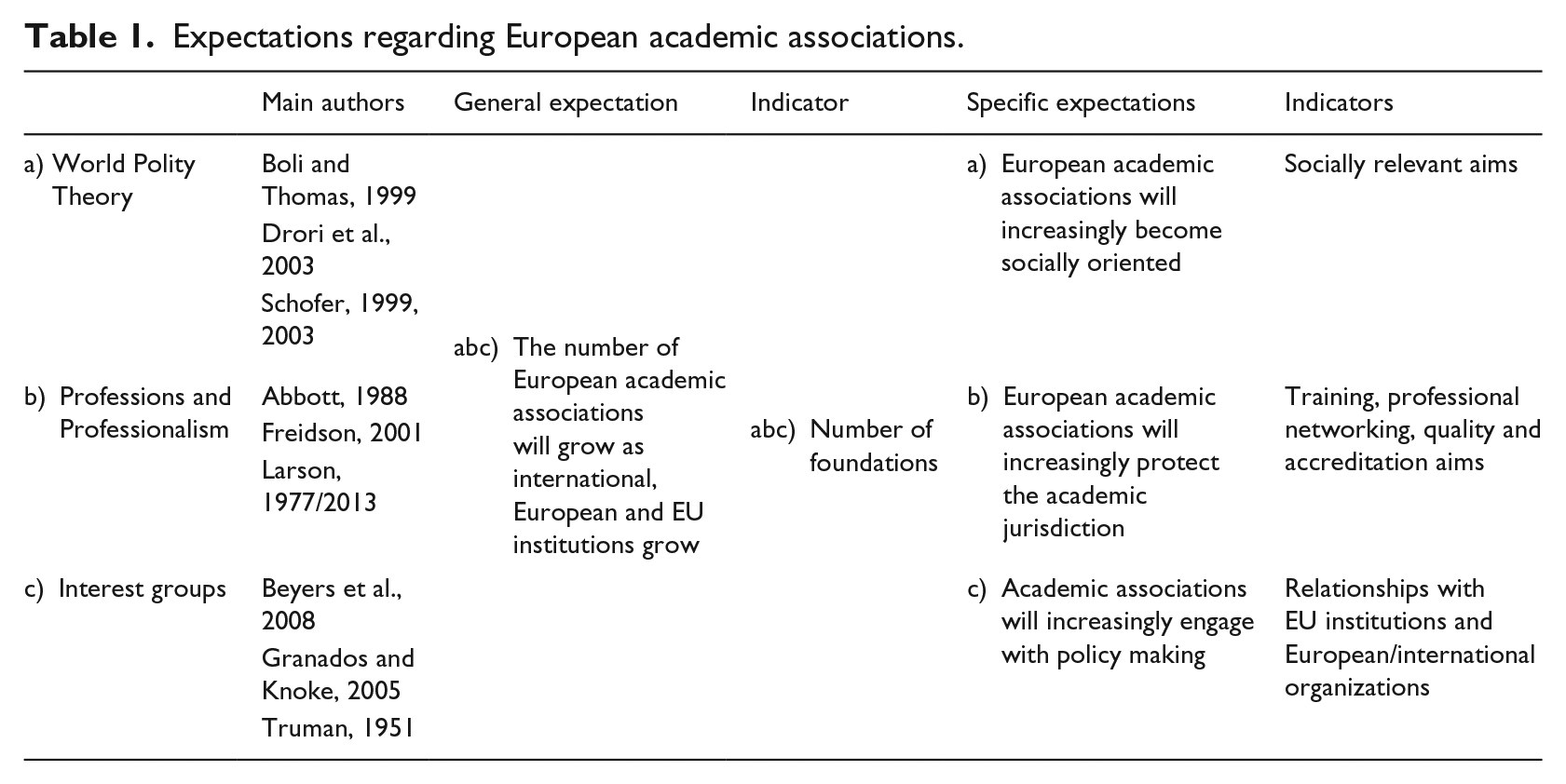
The three analytical perspectives concur in predicting that the founding of European academic associations increase following the growth of international, European and European Union (EU) institutions. However, as shown in Table 1, these perspectives differ distinctively as to the evolution of the aims. World Polity Theory points to the emergence of a dichotomy between scholarly and socially-oriented aims, Profession and Professionalism studies predict that aims will focus increasingly on the defence of academic professional values, the Interest Groups approach posits the intensification of relationships with policy making actors at EU, European and international level.
Expectations regarding European academic associations.
The context: the evolving European space of higher education and research
With respect to the foundation of international organizations and their agencies, in 1920 the League of Nations was established in Geneva (Switzerland). After the Second World War, the United Nations was created in 1945, with their European headquarters based, again, in Geneva, while UNESCO was located in Paris (France). Other European countries have hosted UN organizations and agencies: Italy (10), Austria (nine), Germany (five), Denmark, Malta, Norway, Spain, Sweden and UK (1). The OECD was created in 1948 in Paris, followed in 1949 by the Council of Europe in Strasbourg, both in France. The Treaty of the European Community was adopted in 1958 by the six founding members (Belgium, France, Germany, Italy, Luxembourg, The Netherlands), and the EU institutions have been based since in Brussels (Belgium), Strasburg (France), Luxemburg and Frankfurt (Germany).
The on-going processes of European integration have addressed both higher education – with the EHEA, and research – with the ERA. While EHEA and ERA are quite recent and originated at the end of the 1990s with the Bologna Process and the Lisbon Agenda, they can also be seen as milestones in the construction of European higher education and research, whose other important signposts are the creation of the Framework Programmes in 1984, and the establishment of the European Atomic Energy Community in 1957 (Chou and Gornitzka, 2014; Corbett, 2005; Fumasoli et al., 2015b).
The launch of the Bologna Process in 1999 saw 29 countries – both EU and non-EU members – participating with the intent to make the structure of study programmes in higher education institutions more similar, thus enhancing students’ mobility and the formation of a cohesive European higher education space. Born as an inter-governmental project, over the years the involvement of the European Commission has intensified. Nowadays 48 countries are members of EHEA, including Russia and other former Soviet republics.
European cooperation in research and innovation has been also achieved – to some extent – in a later phase of the European integration process, even though such ambitions were present from the beginning (de Elera, 2006). This happened in 1984, when the EU’s Multiannual Framework Programmes for Research & Development were institutionalized and became an important distributive policy instrument of the European Commission. From a fairly narrow focus on specific technological areas the Framework Programmes’ sub-programmes now encompass most topics of research. Not only the scope, but also the budget and the number of countries entitled to apply within the Framework Programmes have grown steadily with almost 80 billion euros allocated to Horizon 2020 (2014–2020) and 41 member and associate member countries in 2016 (http://ec.europa.eu/research/era/, accessed 1 December 2016). In the 2000s the European Commission has also established the Erasmus+ programme for the mobility of researchers and lecturers, and the European Charter for Researchers and the Code of Conduct for the Recruitment of Researchers was launched in 2005. Both instruments are devoted to enhance free movement of researchers within Europe. Further, the European Research Council and the European Institute for Innovation and Technology were created in 2007 and 2008. The Bologna Process with EHEA and the ERA have constituted an additional platform where issues of higher education and research can be addressed and resources distributed, thus forming an alternative arena to UNESCO and the Council of Europe.
Data and methods
Data source
We have constructed a dataset from the data provided by the Union of International Associations (UIA) based in Brussels. Born in 1907, UIA aims to maintain and provide comprehensive, up-to-date, and reliable information on international associations, their activities and concerns. It is considered the most reliable source by researchers studying international organizations (e.g. Schofer, 1999; Fligstein, 2008). Its Yearbook of International Organizations provides information on around 69,000 international organizations from 300 countries and territories. We selected from the online Open Yearbook the European academic professional associations according to country of headquarters and countries of membership. Then UIA provided us with the full database consisting of name, acronym, year of foundation, full address, aims, working languages, relations with international governmental organizations (IGOs) and non-governmental organizations (NGOs), and countries of membership, along with several other features that were not directly relevant to this research.
Methods
Our descriptive statistics illustrate the rate of founding of European academic associations from the first (1922) to 2014. We have explored them against the founding of international and European governmental organizations, and EU institutions.
When it comes to the missions, we have coded the aims listed in the database provided by UIA according to our analytical framework. The analytical elaboration of the aims described by each association has shown that associations may display one, more than one, or even all our theory-driven aims. We have further proceeded with a cluster analysis based on the types of missions with the objective of, first, categorizing European academic associations according to their aims and exploring the general expectations consistent with our analytical framework. Second, the cluster analysis has provided us with an illustration of the European academic field and has hence allowed for a characterization of the landscape by looking at each cluster focusing on country of headquarters, working language, country of members, types of activities, of funding, and relationships with IGOs and NGOs.
To identify the clusters a Latent Class Analysis (LCA) is employed, a statistical method for finding subtypes of related cases (latent classes) from multivariate categorical data (Collins and Lanza, 2013). The LCA was run on a matrix juxtaposing associations and types of aims. Therefore, preliminary to the clustering analysis, we have reclassified the list of aims included in the mission statements of each association. We have used Schofer (1999) categories of aims: professional academic associations (type 1) display one or more of the following aims: defending the professional interests of the discipline, of academics, fostering standards, conducting research. Socially-oriented academic associations (type 2) display aims such as addressing social problems, disseminating knowledge, promoting science policy, enhancing ethics. For replication purposes, the details of the coding process can be found in Table 2. First, coding rules on how to attribute an aim to a given category have been designed together by the two authors, discussed until each part was clear. Next, one author has coded all the aims of the 324 associations, while the other author has coded a 15% randomized sample. The rate of agreement at this stage has been 94%. To bridge our differences we had three detailed discussions, until the coding rules could be revised based on our mutual understanding of their meaning and structure. Accordingly one of the authors has coded the remaining aims of the whole database, followed by detailed discussions to revise the coding rules up to their final version. A third researcher, not directly involved in the study, has been invited to participate in the coding. The researcher has been briefed on the coding rules, which have been debated until it was clear how to proceed. Our colleague has then coded a 32% random sample. The final rate of agreement between the two coding output has been very high (96.4%), supporting the validity of the coding.
Coding rules.
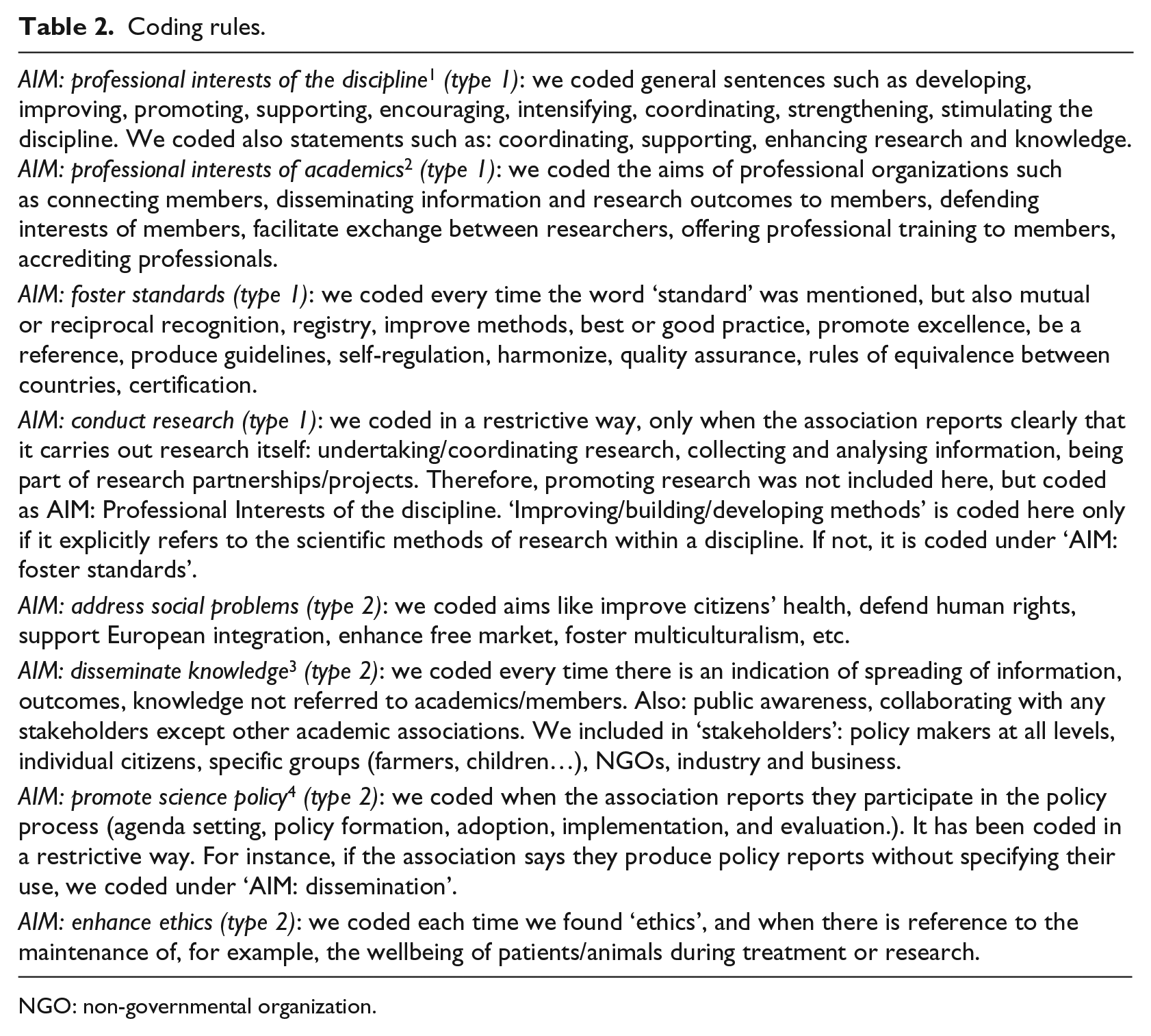
NGO: non-governmental organization.
As an example, the Carpathian Balkan Geological Association, founded in 1922, displayed the following mission: ‘Promote close international collaboration to solve fundamental problems of the geological structure of the region’. This was coded as AIM_Professional interests of the discipline (solve fundamental problems of the geological structure) and AIM_Professional interests of academics (promote international collaboration) 5 . The Nordic Microscopy Society, founded in 1948, states these aims: ‘Provide an interdisciplinary forum for the presentation of papers, discussions and the general exchange of knowledge on the field; collaborate with other societies at international level.’ As in the previous case, we coded AIM_Professional interests of the discipline (provide a forum for paper presentations and discussions, knowledge exchange) and AIM_Professional interests of academics (collaborate with other societies at international levels).
Analysis
Founding of European academic associations 1922–2014
Figure 1 shows practically no founding until the 1950s, with the exception of the Carpathian Balkan Geological Association in 1922, and the Nordic Microscopy Society in 1948, thus resonating with assumptions that periods of economic crisis and of war do not lead to the creation of international NGOs. In the 1950s, 1960s and 1970s the number of foundations accelerates, with 22, 25 and 51 foundations. In the 1980s the founding rate stabilizes (45). The 1990s saw a leap in the number of new associations (91+), which appears to be related to the end of the Cold War. The field expanded to many Central and Eastern European countries that were becoming members of the EU. This process arguably favoured the establishment of new associations, particularly in Eastern Europe (from only one founding in the 1980s to 10 in the 1990s) and in Belgium, the seat of EU institutions (from eight to 20). In the new millennium the founding rate decreased to 46 new associations and it appears even lower for the first four years of the 2010s.
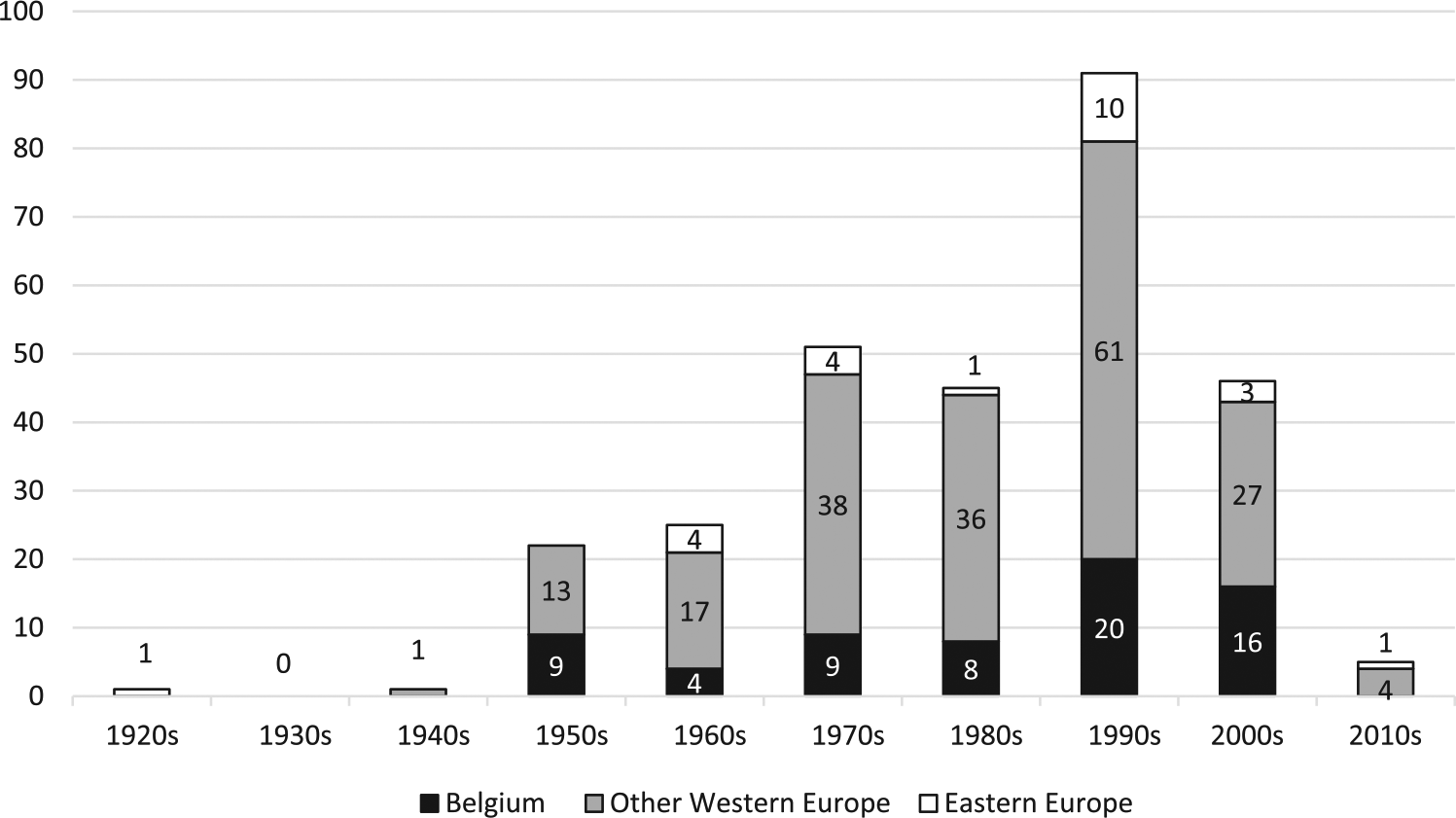
Number of European academic associations founded in each decade.
Overall, when it comes to the countries hosting European academic associations, Belgium tops the ranking with 21% of them, followed by The Netherlands, the UK, Germany and France (from 11% to 9%), which altogether are headquarters countries for 61% of total population. Between 3% and 5% we find Sweden, Italy, Austria, Switzerland, and Norway. Not surprisingly most European academic associations use English as their working language (69%), but European linguistic diversity can be observed in the following: French is spoken in 25%, German in 16%. Note that Nordic languages 6 are used in 6%, Spanish in 5%, Italian in 4%, Dutch and Russian in 2%.
Analysis of missions
Looking at the number of aims declared by each association, we found that two-thirds of the associations have between one and two aims, 30% have between three and four aims. Table 3 shows the frequency of aims pointing to the fact that more than half of the associations declare aims related to promoting the field of expertise and/or the interests of academics and researchers. One-third of associations declare to aim at dissemination of knowledge in broader society, slightly more than one-quarter to foster standards in their respective fields.
Frequency of aims.
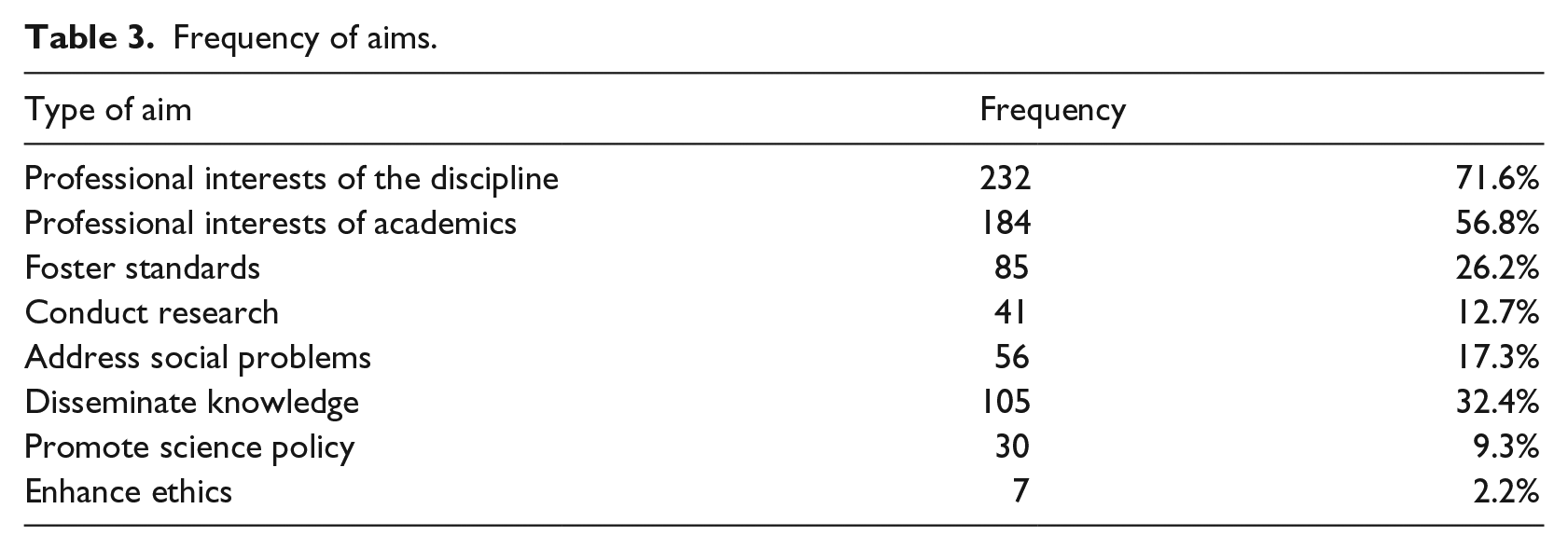
Remarkably, addressing social problems and promoting science policy are represented significantly less.
Cluster analysis
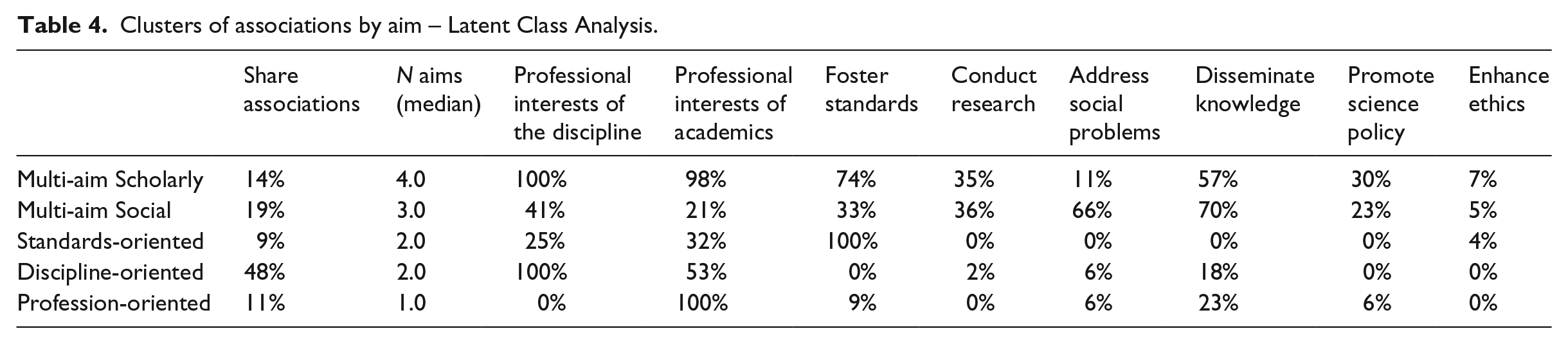
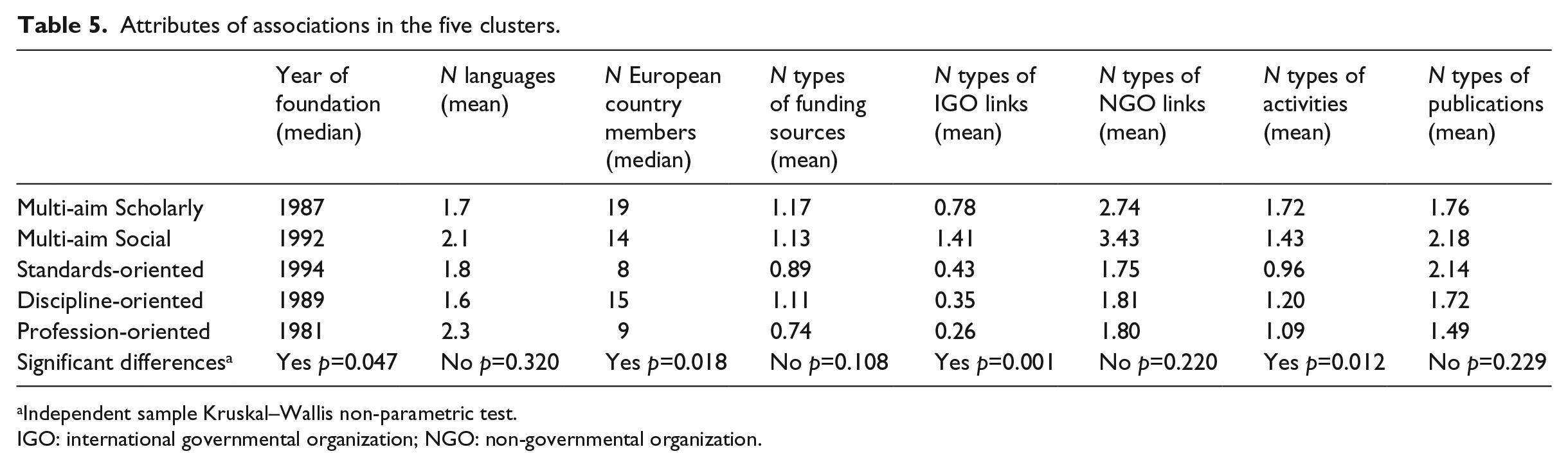
The main traits of the types of associations emerging from the cluster analysis are presented below, each type with a brief description of a prototypical association. 7 Table 4 presents the five clusters (classes) of associations identified by the latent class analysis according to the aims included in their mission. 8 Table 5 illustrates the characteristics of the associations included in the five clusters, whereas Table 6 identifies the main countries of headquarters location.
Clusters of associations by aim – Latent Class Analysis.
Attributes of associations in the five clusters.
Independent sample Kruskal–Wallis non-parametric test.
IGO: international governmental organization; NGO: non-governmental organization.
Country of headquarters.
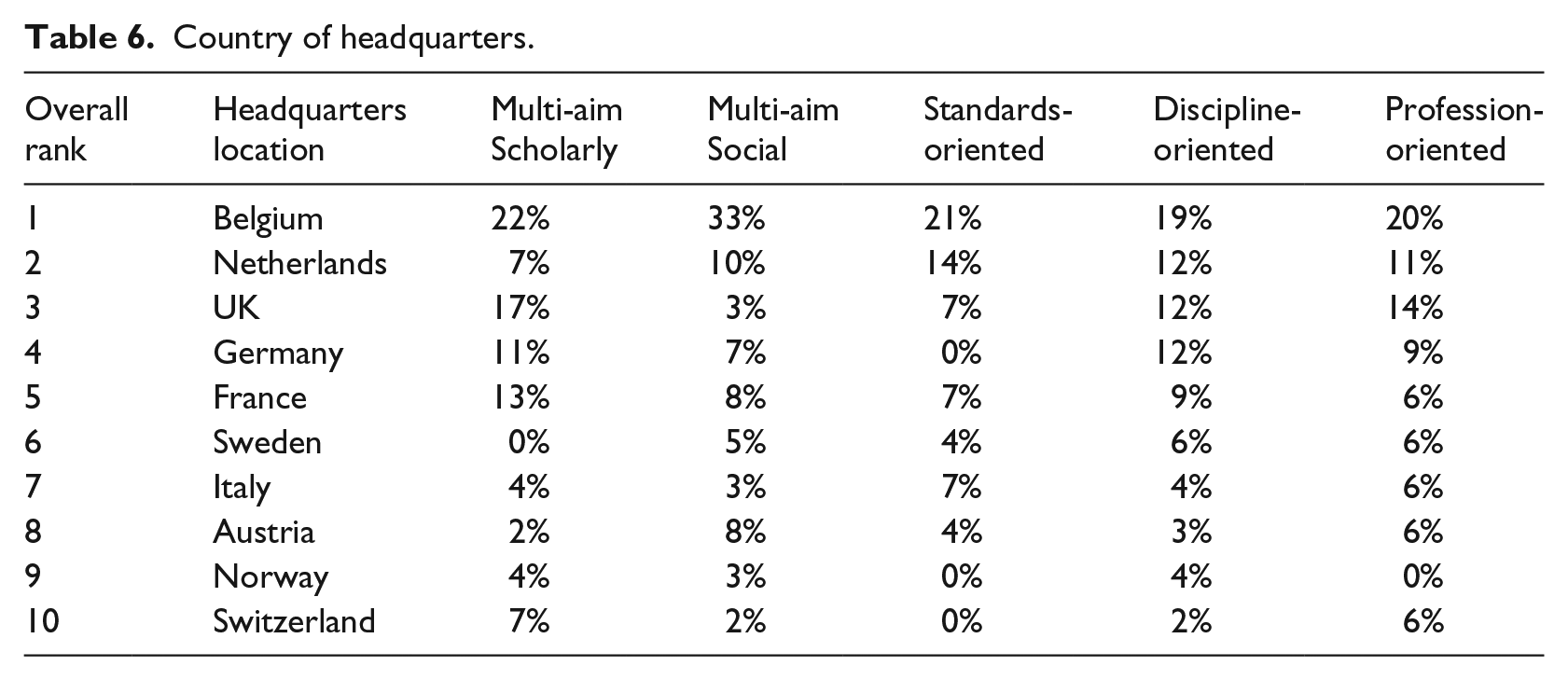
Almost half of the associations (48%) belong to the cluster Discipline-oriented. All the associations in this group aim to protect the professional interests of the discipline; 53% aim to protect the professional interests of academics and 18% aim to disseminate knowledge. These associations tend to be rather focused in their objectives – with a median of only two aims – but to be rather large in terms of countries represented among their members (15 on average). Given their scholarly orientation, connections with IGOs and NGOs tend to be rather weak. Of these associations 19% have their headquarters in Belgium, and 12% in The Netherlands, Germany, and the UK. A typical association in this cluster is European Orthopaedic Research Society (http://www.eors.info/), founded in 1991 and with its headquarters in Vienna. The association aims to ‘provide a platform for clinicians and researchers to discuss orthopaedic research, issues and innovations’. It is financed through membership fees and revenues, and English is its official language. It only links to European NGOs, it includes members from 16 European countries and only publishes scientific journals (two).
The second largest group, Multi-aim Social (19%), has a higher number of aims (median of three), which are represented mainly by ‘knowledge dissemination’ and ‘addressing social problems’. Not surprisingly these associations have established on average more relationships with IGOs and NGOs and present the highest variety of types of publications (from academic ones to leaflets and newsletters). These associations’ headquarters are concentrated in Belgium (33%), as well as in The Netherlands (10%) and France (8%). 9 This cluster can be exemplified by the European Federation for Research and Information on Sectarianism (http://fecris.org/), established in 1994 and located in Marseille (France). It aims, among others, at “studying and informing on the legal, medical, psychological, social, economic and scientific effect of [cults] on individuals, on their families and on democratic society and defend them against abuse carried out by such cults (…)”. Its official languages are French, English and German; its funding sources comes from fees. It has links with European IGOs. Its members come from 24 European countries.
The cluster Multi-aim Scholarly follows with 14% of associations, which have a median of four aims, primarily defending the professional interests of the discipline (100%), of academics (98%) as well as to foster standards (74%) and disseminate knowledge (57%). This group has the widest base of countries’ membership (median of 19). Headquarters are mostly in Belgium (22%), UK (17%), France (13%) and Germany (11%). A typical association in this cluster is the EUROCAT – European Surveillance of Congenital Anomalies (http://www.eurocat-network.eu), founded in 1979 and located in Cambridge (UK). Its mission is to provide essential epidemiologic information on congenital anomalies in Europe, provide a ready collaborative network and infrastructure for research related to causes and prevention of congenital anomalies and treatment and care of affected children; act as a catalyst for the setting up of registries throughout Europe collecting comparable, standardized data. 10 It is funded by international intergovernmental organizations, English is the official language and it includes members from 20 European countries.
The last two clusters are more specialized. The Profession-oriented cluster includes associations aiming to protect the interests of academics. They tend to be older associations (median foundation year 1981), they are often multilingual, but have a less varied membership in relation to countries (9). Their financial sources are less diversified and they hold fewer relationships with IGOs. They also have fewer relationships with international NGOs (in line with the other scholarly-oriented associations Discipline and Standards). They also carry out fewer types of activities and publications, mainly focusing on scholarly tasks and outlets. A typical association in this cluster is the European Association for Comparative Economic Studies (http://www.eaces.eu/), founded in 1990 with headquarter in Perugia (Italy). Its mission is to promote and coordinate international collaboration in the field of comparative study of economic systems, with specific focus on European transition processes. It is funded through fees, English is the official language and it includes members from nine European countries.
The Standards-oriented cluster (9% of the sample) mostly includes recently established associations (median 1994) which focus on fostering standards and in some cases also the interests of the discipline and of academics, while they hardly have socially-oriented objectives. Most associations adopt one official working language (typically English) and the lowest average number of countries is represented among their members (8). Headquarters are mostly located in Belgium (21%) and The Netherlands (14%). A typical association in this cluster is the European Society for Quality in Healthcare (http://www.esqh.net/), founded in 1998 with headquarters in Limerick (Ireland). Its mission is to support quality improvement in European healthcare, and increase cooperation between national societies in Europe. It is funded through fees, English is the official language and it includes members from 11 European countries.
Observing external relations with IGOs, we make three important observations: first, more than half of the European academic associations do not hold relationships with IGOs, the most isolated in this sense being the Profession-oriented cluster. Second, in existing relationships with IGOs, European ones benefit all five clusters, with the Council of Europe as favourite. Third, with respect to non-European IGOs, the second group to which the associations reach out is the UN – UNESCO, but also UNDP and others – Multi-aim Scholarly and Multi-aim Social tend to be equally connected to IGOs, while Standards associations are not connected at all. This could be explained by their specialized role in the European context. OECD scores lowest with maximum 5% propensity for European academic associations to link to it.
Discussion
Our paper has investigated European academic associations by focusing on their missions. We compared expectations from World Polity Theory – convergence towards socially-oriented goals; from studies on Professions and Professionalism – safeguard of professional jurisdiction; from research on Interest Groups – engagement with policy making processes. While these three approaches are not mutually exclusive, they have helped us to better characterize the role and the interests of European academic associations in different manners, because they posit different drivers for academic associations to exist. World Polity Theory assumes on-going rationalization and search for legitimacy; the sociology of professions posits the defence of professional interests and ideology; interest group studies explain the mechanisms through which organizations (rationally) engage with public policy processes.
Our analysis shows that the rate of founding of European academic associations has been generally increasing since the end of the Second World War, signalling stagnating numbers in the 1980s followed by a significant peak in the 1990s, after which a consistent deceleration can be observed. While intensifying European integration might explain the founding patterns until 2000, we can only make hypotheses on the development in the beginning of the 21st century. On the one hand, we could be observing a saturation of the European academic field in terms of European academic associations, and, unless there will be new waves of enlargement of the European Union, not much change can be expected. On the other hand, the economic crises at the beginning of the year 2000s and since 2008 could have limited new foundations and indicate the possibility for new growth once the European economy thrives again.
More generally, our findings show that the assumption that the presence of international organizations triggers the founding of academic associations needs to be revisited. At first sight it seems that socio-economic development (see oil crisis in the 1970s, fall of the Berlin Wall, new economy crisis in the 2000s, and recent financial crisis) affects consistently the demographics of this organizational population. Equally, the changing geographical size of the academic field appears to be an important factor in the establishment of new European academic organizations. This is clearly visible in the 1990s, when several Central and Eastern European countries became or were about to become EU members.
When it comes to the missions of European academic associations, the cluster analysis shows that there is more variety than the dichotomy posited by World Polity Theory between scholarly and socially-oriented objectives. The five categories identified – Multi-aim Scholarly, Multi-aim Social, Standards-oriented, Discipline-oriented, Profession-oriented – display a more complex articulation of the objectives and ambitions of 324 associations across Europe. Further research should take into account expectations according to the different disciplines represented. In order to do this, additional elaboration of our database is needed, after which we would be able to formulate and test hypotheses according to hard and soft, basic and applied disciplinary fields, but also interdisciplinary, multidisciplinary and problem-driven fields, as well as older and newer disciplines.
The five clusters also show that there are several dynamics at play in the European academic field. We see that clusters characterized by earlier foundations tend to have more aims, which could be explained by their broader institutionalization, accrued resources and increasing membership base. This allows them to broaden their objectives, address (also) societal challenges and operate accordingly in networks with IGOs and NGOs. Knowledge dynamics is an important dimension that needs to be considered in future research: some fields are more prone than others to orienting themselves towards problem-driven and socially impactful scientific activities. This means that not only the development of single disciplines needs to be taken into account, but also the ecology of evolving disciplinary fields needs to be considered (Abbott, 2001).
With respect to the cluster Profession-oriented we have seen less variety in terms of number of member countries, types of activities, of publications and of financial resources. Equally, these associations are the least connected to IGOs and international NGOs. Considering that they are generally older than those in the other clusters, we might hypothesize that these associations are either stagnating for lack of resources (they cannot take on new aims), or thriving in this niche position.
Finally, we gathered important (even though non-definitive) evidence of the involvement of European academic associations as interest groups. On the one hand, many of them do not cite explicitly ‘policy engagement’ in their mission; on the other hand, when they do cite it, this resonates rather with advocacy work for science to solve societal problems, rather than to defend the interests of the academic profession. This finding can be explained by our decision to analyse official missions as formalized in the Yearbook of International Organizations. More interestingly, however, one could hypothesize and test in future research that lobbying and advocacy work may be carried out in the national and/or the international/global arenas. This would be relevant to investigate, in order to understand whether academics build their professional associations at multiple policy levels with a division of labour, for instance defence of professional interests at national level, promotion of the academic discipline at European level. Following Larson (2013) this finding might indicate that the national context and state relationships remain central for academic associations.
What does this all mean for the governance of European higher education and research? In general, our paper has shown that an organizational approach to academic associations sheds light on the structure of the European academic field, offering a systematic analysis, pointing to the division of labour among European associations, their positioning and their resources. This said, we underline three relevant aspects for European educational governance. First, academic associations perform multiple tasks. The opportunity structure offered by on-going European integration has triggered the foundations of several such associations. However, our data has shown that the founding rate does not follow European integration in a linear way, as we can see from the shrinking number of new associations in the last 15 years. Yet, it might be too early to claim that the European field has reached a saturation point or that the positive trend will resume once good economic conditions are in place again.
Second, European academic associations are quite diverse according to their missions, geographical dispersion, working language and membership base. It appears rather clearly that the European academic field is structured in a centre based in Belgium, and particularly in Brussels, and partly in The Netherlands, which indicates the relevance of proximity to the European commission. The other big European countries – France, Germany, UK – host an important number of these associations but the number of new associations founded there is relatively smaller. The periphery is mainly represented by the newer EU member states, the Southern states, as well as the smaller ones. If we compare these findings with country performance in the Framework Programmes of the European Commission, we can see the same patterns of a core of higher education national systems and a larger periphery (Fumasoli et al., 2015b). It is then relevant to ask whether Europe is a distinctive case or whether we can observe similar patterns in other regions. To do so, comparative research in international perspective needs to be undertaken in other regions, but also academic fields established on a historical basis, such as French, Spanish, Portuguese or Russian speaking countries 11 .
Third, this research has examined the missions of European academic associations as an indicator of their role as transnational actors in Europe and has pointed to a diversified landscape, where academic professional interests co-exist with other concerns, such as the shaping and maintenance of scientific and technical standards, as well as contributing to society. Further investigations are needed to understand how the academic associations participate in the construction of the European academic field, their relevance for European policy in higher education and research, and their embedding in the broader European polity.
Footnotes
Acknowledgements
We thank Andrés Araos, Department of Education, University of Oslo, for his outstanding assistance in dataset construction.
Declaration of conflicting interests
The author(s) declared no potential conflicts of interest with respect to the research, authorship, and/or publication of this article.
Funding
This research received no specific grant from any funding agency in the public, commercial, or not-for-profit sectors.