




Abstract
We take the reception of Wolfgang Klafki’s didactics in Russia as our example for the difficult relations between knowledge transfer and knowledge transformation. We start with a description, analysis and evaluation of Klafki’s two didactical models, categorical didactics and critical-constructive didactics, and then describe and evaluate their reception in Russia. The paper demonstrates that while in Germany the concept of Bildung as transformation has pushed back interest in categorical and critical-constructive Bildung, interest in Klafki’s work is increasing in the Russian Federation and in other countries. Therefore we see an urgent need for didactical theory construction from an international and intercultural perspective.
Keywords
Introduction
Although small compared to its acceptance in German-speaking countries, in more recent times Russian didacticians have shown an interest in non-Russian didactical research and particularly in Wolfgang Klafki’s (1927–2016) works, thereby producing a more differentiated and less ideological picture of ‘bourgeois’ didactics than in Soviet times.
Klafki has been the dominant figure in general didactics (‘Didaktik’) in the Federal Republic of Germany. We take the reception of his didactics in Russia as our example for international and intercultural transfer and transformation of educational research. Our research question can be formulated as follows: what kind of critique and reconstruction do Wolfgang Klafki’s two didactical models, categorical didactics and critical-constructive didactics, need in order to be of use for comparative didactics and in particular for the intensification of exchange between German and Russian didacticians? This question is embedded into the larger context of research about lending and borrowing in the area of didactics and seeks to make a contribution to a more general question: what kind of transformation (if any at all) does Wolfgang Klafki’s concept of didactics undergo in the process of the international borrowing?
The theoretical and methodological framework of this study is the concept of international comparative didactics (Grunder, 2012; Hopmann and Riquarts, 1995; Hudson and Meyer, 2011; Kansanen, 2002; Ligozat et al., 2015; Meyer et al., 2017; Pepin, 1999; Wickman, 2012). The basic assumption of this concept is the idea that national and cultural contexts of teaching and learning, i.e. the national systems of education, used to make a substantial contribution to the nation building process and thus produced national and cultural differences regarding the ways of teaching and learning, which also influence the content of teacher education. Empirical research (Alexander, 2000; Stigler and Hiebert, 1999) demonstrates that there are stable patterns of instructional strategies that differ across the countries. These patterns are linked with the national versions of didactics, they ‘must arise out of a knowledge base that is widely shared by teachers within each country’ (Stigler and Hiebert, 1999: 83). Another foundation of comparative research is the assumption that the pedagogical knowledge circulates between cultures and countries and undergoes transformations in the local contexts under the influence of local traditions. There is a growing body of research in this field that focuses not only on the politics of borrowing and lending in the area of administration and institutional reforms in education but also in the area of teaching and learning (Caruso, 2004; Schriewer and Caruso, 2005).
In terms of methodology, the study is based on an extensive systematic literature review and seeks to provide a deconstructive critique and to identify ambiguities in Klafki’s concept of didactics and then to analyse its reception and transformation by educationalists in Russia. The methodological procedure is rooted in the tradition of philosophical inquiry (cf. Burbules and Warnick, 2006; Tenorth, 2010) with a focus on a historical reconstruction and theoretical analysis of epistemological and anthropological assumptions about teaching and learning and the institutional conditions for teacher–student interaction within given national and cultural settings (Rakhkochkine, 2012b). The study is based on the analysis of the original works of Klafki and a selection of major works by other philosophers and educationalists that provide a context and a reference for the development of Klafki’s concept over the years. For the part about the reception of Klafki in Russia there was a systematic review of publications on Klafki or references to his work in Russia that could be retrieved from libraries’ databases and the search engine Google Scholar. There are limitations due to a lack of systematic bibliographical work on Klafki’s reception in Russia, and this even holds for a doctoral dissertation that is dedicated to Klafki’s work, recently published in Russia (Surina, 2014).
We now present information on general didactics as an educational sub-discipline with the help of four sketches. Klafki regarded general didactics to be of central importance for pre- and in-service teachers. The first sketch refers to the founding father of didactics, Czech-born Jan Amos Comenius; the second gives comments on the so-called didactical triangle; the third shows the sub-disciplines of didactics and the fourth introduces the typically German tradition of didactical models.
First sketch: In his ‘Great Didactics’ (Didactica magna), Comenius identifies two basic assumptions. The first one deals with anthropological foundations: ‘If man is to become man, it is necessary that he be formed by education’ (Comenius, 1896: 5). 1 The second one defines the ultimate educational objective as ‘universal culture of mankind’ (Pampaedia, 1960: 15). 2
All of mankind, children and grownups (omnes) have to go to school and to go on learning in their later life stages; they have to learn everything that is necessary (omnia); and they have to do it thoroughly (omnino). Comenius therefore understands the world we live in as an artificial world. Only under this condition can man engage in improving it.
With this construct Comenius has become a trendsetter over the centuries (see, e.g., Hericks et al., 2005; Klafki, 1985/1991: 61 ff.; Meyer and Meyer, 2007; Tenorth, 1994).
Our second sketch presents the so-called didactical triangle (see Figure 1) which combines the three relations as basic content of didactics.
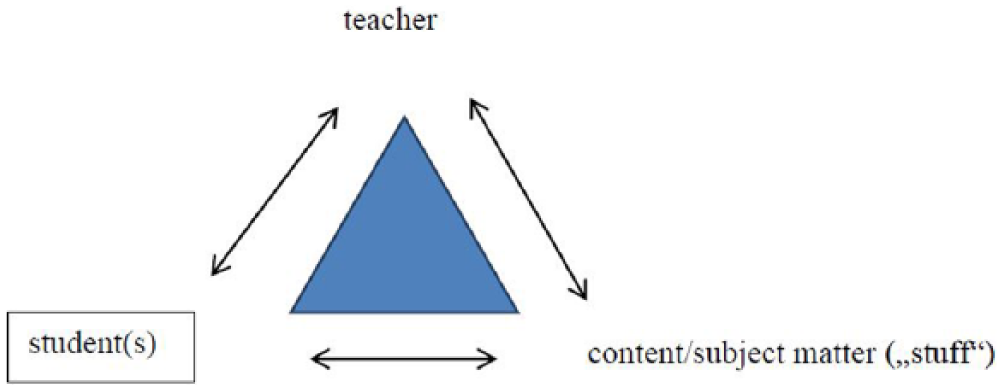
The so-called didactical triangle.
The triangle can be used to problematize what otherwise might be taken for granted: the basic obligation of teachers is not to teach but to help students to learn. The students’ task is not only to learn what they are taught; they also have to develop self-regulation in the learning process. What they have to learn and what the teachers have to help them to learn is the most difficult element in this triad. Content is a construct that has had realizations in great diversity, in the history of didactics, and is defined at present in ever new variations. The triangle allows the distinguishing of didactical from other educational literature, and Wolfgang Klafki’s didactical work is a good example for that.
Our third sketch presents the sub-disciplines of didactics which, as one can see in Figure 2, encompass a larger field than that of curriculum in combination with instruction in the English language educational traditions. General didactics and subject didactics are closely related, but subject didactics are not sub-disciplines of general didactics.
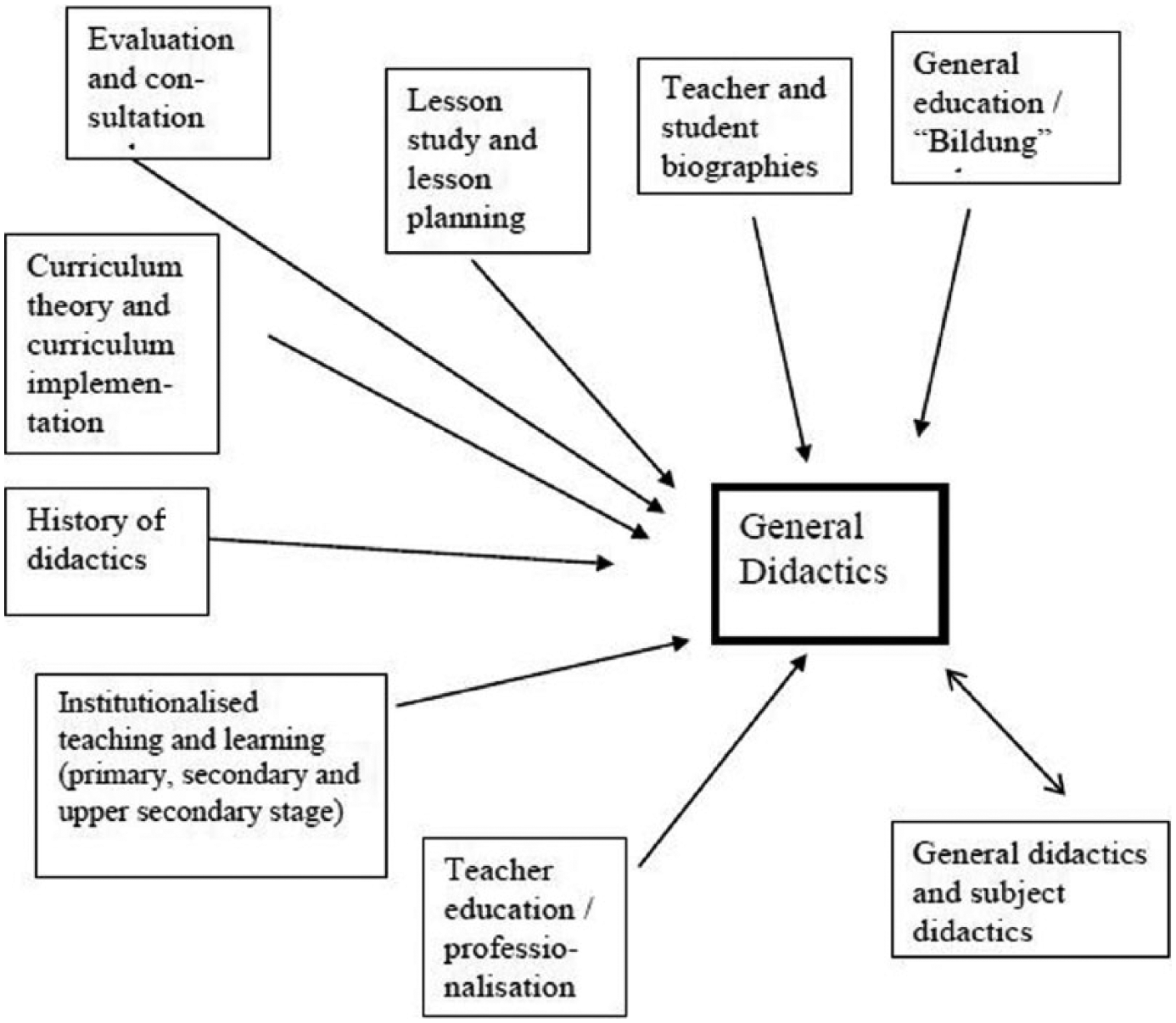
Table of content for general didactics.
Curriculum theory is a sub-discipline of didactics in the continental tradition while it is independent in English language higher education. Improving communication between the two traditions has therefore been required for a long time (Hopmann and Riquarts, 1995).
Our fourth sketch relates to a typically German practice. We enjoy producing a large number of didactical models competing with each other, and in this competition Klafki is the only didactician who has been successful in presenting two models: his categorical and his critical-constructive didactical model. There are several other models developed and discussed in the discourse on didactics in Germany: communicative didactics, didactics for learning and teaching (‘lehr-lerntheoretische Didaktik’), action-oriented didactics, didactics based on neuroscience, dialectical didactics, didactics with focus on learners and teachers (and not only on content), etc. (An extensive review of various models may be found in Terhart, 2009.) This list would need further extension with respect to didactical models of other countries, e.g. to the Joint Action Theory in Didactics in France and behaviouristic didactics as represented by Ralph W. Tyler in the United States (Tyler 2001). Wolfgang Klafki has contributed substantial research findings to all four sketch areas.
Wolfgang Klafki’s ‘Didaktik analysis as the core of preparation of instruction’ and its philosophical framing
As already indicated earlier, Wolfgang Klafki presented a first didactical model based on categorical Bildung theory in the 1950s; he developed a second concept, in the 1970s, which he called his critical-constructive model. Both models put special focus on content. Klafki uses a phenomenological and hermeneutical approach in accordance with human science pedagogy (‘geisteswissenschaftliche Pädagogik’) as developed by Wilhelm Dilthey (Klafki, 2000: 141); human science pedagogy in turn has to be seen as one strand of human science philosophy. 3
We now start our presentation of Klafki’s work with a small booklet that Klafki called ‘Didaktik analysis as the core of preparation of instruction’. 4 Here Klafki invites pre-service and in-service teachers to analyse educational content (‘Bildungsinhalt’) they want to teach with respect to its educational substance (‘Bildungsgehalt’), and finds substance in content when it is at the same time concrete and general, thus allowing students to develop categorical competence. ‘Didactical analysis’ made Klafki a fully accepted colleague in the educational discourse of his time, right from the beginning of his career (Klafki, 2000: 139–159; first German edition 1958 with dozens of later editions; cf. Hopmann, 2000; Meyer and Meyer, 2007). The booklet has been used in teacher education, in the Federal Republic of Germany, for decades, and was also in use in Danish teacher education. However, to the best of our knowledge, Klafki’s phenomenology as he needs it for his categorical Bildung theory poses research problems. Therefore, we now give a description, analysis and evaluation of Klafki’s ‘Didactical analysis’ with the help of his other didactical writings of that time.
Klafki poses five basic questions for didactical analysis:
What wider or general sense or reality does this content exemplify and open up to the learner? What basic phenomenon or fundamental principle, what law, criterion, problem, method, technique, or attitude can be grasped by dealing with this content as an example?
What significance does the content in question, or the experience, knowledge, ability, or skill to be acquired through this content already possess in the minds of the children in my class? What significance should it have from a pedagogical point of view?
What constitutes the topic’s significance for the children’s future?
How is the content structured (which has been placed in a specifically pedagogical perspective by Questions I, II and III)?
What are the special cases, phenomena, situations, experiments, persons, elements of aesthetic experience, and so forth, in terms of which the structure of the content in question can become interesting, stimulating, approachable, conceivable or vivid for children of the stage of development of this class? (Klafki, 2000: 151–155) 5
This program for lesson planning is very clear, with the exception of the first question. As we see it there are many phenomena in this world which do not exemplify a ‘wider or general sense of reality’.
In search for a problem solution it makes sense to turn to Klafki’s voluminous PhD thesis which was published one year after ‘Didactical analysis’, and we can go even further back to his school entrance examination paper on ‘Categorical education’ which was published only four years ago (Klafki, 2013). In his PhD thesis, The pedagogical problem of elementarisation and the theory of categorical Bildung (1959/1964), Klafki constructs an opposition of subjective or formal and objective or material perspectives on Bildung in order to synthesize the two perspectives. He writes that this process has to be simultaneously concrete and general because otherwise learners cannot develop competence to understand the world and act in it in situations which cannot be totally anticipated during school time. Therefore teachers have to search for fundamental, elementary and exemplary phenomena if they want to realize categorical Bildung in their classroom instruction. They have to take subject matter/content (‘Bildungsinhalt’), analyse it with respect to the developmental stages reached by their students, and discover what will have enough power to open up, for them, the concrete themes and at the same time ‘the general’ (‘das Allgemeine’) behind these themes. Klafki writes: B i l d u n g is that phenomenon through which we realize directly – in our own experience or in understanding other men and women – the u n i t y o f a s u b j e c t i v e ( f o r m a l ) a n d an o b j e c t i v e ( m a t e r i a l ) moment. The attempt to express the e x p e r i e n c e d u n i t y of B i l d u n g can only be realized with formulas that have combining power: Bildung is opening a reality of things and ideas for somebody (this being the objective aspect), but this means at the same time the opening of this person for this reality which becomes h i s o r h e r o w n reality (subjective aspect). The attempt to express the experienced unity of Bildung in language, can only come to realization with the help of formulations pre-supposing each other: Bildung is successful development (“Erschlossensein”) of reality for somebody with respect to body and mind (objective aspect), but this means at the same time: successful development of man with respect to this reality as it is his reality (subjective aspect). – The same holds for Bildung as process: In the confrontation of man and the world, of child and content, the subject and i t s mind world win order, structure, shape, one only through the other and with the other. Bildung is a concept of processes in which the content of a definite intellectual and corporal reality comes to realization, and this process – looked at it from the other side – is nothing else but the active opening (“Sich Erschließen”) and its being opened in the passive meaning (“Erschlossen-Werden”) of somebody for that content and its inter-dependencies as reality. Bildung i s indeed this unifying happening (“Geschehen”) and at the same time its product. (Klafki, 1959/1964: 297).
Klafki then combines the opening concept with his idea of generalisation: This d o u b l e s i d e d o p e n i n g takes place as process in which ‘general’ content on the objective side becomes visible parallel to the rise of ‘general’ insights, things realized, experiences on the side of the subject. In other words: the process in which ‘ g e n e r a l c o n t e n t ’ becomes visible on the side of the ‘world’ is nothing else but winning ‘ c a t e g o r i e s ’ on the side of the subject. (Klafki, 1959/1964: 297)
Bildung thus becomes ‘the subjective mode of culture’, bringing ‘order’ into the students’ life.
Klafki’s five rules for the preparation of instruction are directly related to this concept. The teacher who wants to foster the Bildung process of his students has to transform content to be taught (‘Bildungsinhalt’) into content with educational substance (‘Bildungsgehalt’), and this means that he/she has to find what is elementary, fundamental, exemplary or basic so that the students can relate the concrete content taught to ‘the general’.
Klafki is comparatively restrained concerning the justification of the pre-supposed parallelism of generalization and search for what is elementary, fundamental, exemplary or basic in the teachers’ didactical analysis of the content they have to teach. We do not get an answer, for example, to the question whether his approach is meant to hold for all school subjects and all the content arranged within these subjects.
If he had analysed how far or how close the school subjects are to his categorical analysis, he would have found that they are good for the social subjects, i.e. history, geography, politics, religious instruction, etc., but only to some extent for mathematics with its systematic qualities or for the languages, i.e. mother tongue and foreign language teaching and learning, and for the arts. Why for example, should teaching English as a foreign language be open for generalization? Because it is only one language amidst a thousand other languages? And can one teach the English irregular verbs in an exemplary way? Certainly not!
We thus have to ask why Klafki needs this parallelism, and the answer will most likely produce a surprise. He needs it for philosophical reasons. We therefore have to reformulate the research question introduced above for the reconstruction of Klafki’s Bildung theory. We should ask in which sense categorical teaching and learning, i.e. the combination of concrete and general content via didactical analysis, can be of help for Russian and German didacticians in their curriculum research and also for comparative didactics. Our tentative answer may be the following: understanding the world with the help of categories can work when and where the world has a categorical structure so that the acquisition of categorical knowledge allows a never ending use of this knowledge in deciphering and handling this world. But there is very much to be learnt at school and out of school that does not follow the scheme of categorical analysis. What we need then is the renewed establishment of curriculum theory in order to analyse the content of instruction under the specific perspective of elementarization and generalization. This should be of interest for Russian, but also for German, didacticians.
We cannot go into details of Hans-Georg Gadamer’s analysis of the German philosophical tradition which defines Bildung as the individual’s rise to universality, but there is a second philosophical uptake in Klafki’s programme which we have to take into consideration. 6
Klafki and Scheler
In his publication on ‘Categorical Bildung’ (2013: 41), i.e. his Second State Examination paper, Klafki writes that he depends on Max Scheler’s phenomenology for his theorizing. Max Scheler (1874–1928) was a German philosopher, anthropologist and sociologist. He authored important publications in which he placed Bildung into an anthropological–philosophical framework. He held that the development of humankind (‘Mensch’) has led man into a ‘dead-end street’ with respect to his position in nature, but man can develop Bildung, i.e. ‘well-formedness’, thus developing a position in the cosmos ranking higher than the positions possible for animals. Scheler elucidates his concept with respect to ‘the moral’ which he defines as a concrete fixation of value within a system of four layers, namely: (1) the sensual world; (2) the vital world by which man can be compared with the animals; (3) the world of the mind; and (4) the ‘Geist’ world, a principle opposite to life, mind and spirit, surpassing all of it, a supreme kind of being.
Due to man’s capacity of trespassing the limitations of the first three layers, he can be successful in understanding the basic ideas of our world, i.e. ‘the whole in its natural essence’ (‘die wesenhafte Gesamtheit’), and thus he can acquire Bildung (Scheler, 1962 [1928]). 7
Klafki integrates Scheler’s conception of four layers into his categorical didactics. He writes, quoting Max Scheler: If we give the concept of Bildung the broad meaning as it makes sense when we analyse the linguistic content of this concept, and if on the other side man is a being stratified via a number of layers […], this means that Bildung is ‘a particular form, shape, rhythm, within the borders of which all free actions of the mind of man take place, but also – led and guided by it – all psycho-physical automatic life activities, i.e. expression and habitus, talking and silence, all kinds of behaviour of this man.
With this quotation Klafki has reached the centre of his argumentation for categorical Bildung. He writes: Bildung is the becoming and the being of a general feature of valuable humankind. The analysis of the anthropological foundations of a theory of Bildung did already show that this value status means before all a determination by those kinds of values that find resonance in the mind. But I have also referred to the fact that these values cannot be experienced as arising from out of the individual but indeed as above individuality, as leading to something beyond the individual, as “objective”. Therefore, individuality can neither be the only nor the decisive part of Bildung. […] The claim that experiencing values and (as its correlation in the mind) the stratum of the mind in mankind as one fundamental experience of human life can be corroborated in many achievements of great persons, from classical antiquity till our present time. (Klafki, 2013: 42)
We hope that these two quotations help to clarify what Bildung is in Klafki’s categorical theory. Bildung makes man rise to a world above individuality, and that is why ‘the general’ is so important.
We see two points needing further analysis and reflection:
It is not enough to get clear about the question how the general can be realized by understanding a concrete phenomenon. We also need a description of the process of generalization. Klafki assumes that this means identifying an objective of Bildung, i.e. an object and a learning task independent of the individual person, and that is why, again, the concrete must be general at the same time. Contradicting this model, we hold that there are many ways in which generalization of concrete phenomena can take place, e.g. as induction in which a person experiences a number of similar things, or as deduction or as conclusion from a number of similar experiences towards a general rule, or – with the Russian psychologist and mathematics didactician Vladimir V. Davydov (1977) – as rise from the abstract to the concrete, e.g. in primary arithmetic when school children have to transform a vague conception of ‘more to count’ into a concrete mathematical operation (to be formalized as n + 1). In addition to these kinds of generalizations, there may even exist what Klafki takes as his only accepted procedure, namely the concrete phenomenon which is at the same time general.
Scheler’s metaphysical construction of Bildung as understanding what he calls the whole in its natural essence has to arouse our suspicion, but at the same time, we understand why Klafki refers to Scheler’s philosophy. Klafki, like Scheler, needs the whole in its natural essence in order to start the process of categorical learning and to give this process direction towards the value strata constructed by Scheler.
An improved and adapted version of our research question therefore runs as follows: can we realize categorical Bildung by focusing not only on the general, but also on the process of generalization? Our answer has to be that today we don’t know. But we do know that it makes sense to think about an ultimate objective of teaching which somehow must be beyond the subjectivity of the learning subjects. We need empirical research for that, and the reader can imagine that the development of tools for this empirical research will be demanding!
Sense constructions, not phenomena, and a linguistic plus political turn
If Klafki had developed a further interest in philosophy he would have found that the phenomenology of Max Scheler, Edmund Husserl and other philosophers had attracted critique and that a new basic orientation had come into being, existential philosophy, which can best be exemplified by Martin Heidegger’s Being and Time (1927). We start with a few comments concerning the relevance of the existential turn for Klafki’s categorical and his critical-constructive didactical model and then think about the relevance of the linguistic turn in philosophy for Klafki’s didactics.
Klafki and Heidegger
Heidegger states and elucidates that the world we live in is primarily a world of meaning and sense, open to hermeneutics, and not a world of phenomena. Man’s whole life, as well as that of the other men, women and children, has direction and drive; a drive towards the future. Man does not live in such a way that he gives name tags to the phenomena he sees. A world of phenomena is not enough, and sense becomes the basic concept for describing man’s mode of existence, of his ‘Being-in-this-world’ (‘In-der-Welt-sein’). Understanding the world gives sense to it, and as educational researchers we can add that children and youths live in existential worlds full of destination and change, full of developmental tasks. Heidegger writes: Sense is what holds the understandibility of something, and what can be articulated in understanding is called sense. The concept of sense comprises the formal scaffolding of what does necessarily belong to what interpretative understanding articulates. Sense is the objective of the draft out of which something becomes understandable as something. (Heidegger, 1927/1963: 151)
8
It is a pity that we cannot ask Heidegger today what the educational part of ‘being-in-this-world’ may be. In Being and Time one doesn’t find a single sentence on education. But we conclude from this reference to sense that the world of teachers and students is a communicative world, a world of sense and nonsense, of understanding and misunderstanding, of meaning and lack of it.
Key problems
In his critical-constructive didactics, Klafki defines a world of key problems (‘Schlüsselprobleme’) which students must be competent enough to understand and willing enough to communicate with others if they want to realize ‘general education’ (‘Allgemeinbildung’), 9 and we see the communicative world in it, the world of sense.
Basing his model on the works of Jan Amos Comenius, Wilhelm von Humboldt and many others, Klafki defines the ‘objective’ or ‘material’ side of the learning process producing general education by identification of the key problems; he defines the ‘formal’ or ‘subjective’ side of general education as the faculty of self-determination, co-operation and solidarity. The model is – in this respect – a more concrete version of the categorical model.
Klafki finds the problems via sociological, political and other publications (e.g. by the ‘Club of Rome’ on the future development of the world or by Ulrich Beck’s conception of risk societies; cf. Klafki, 1985/1996: 64–69). Klafki suggests the following key problem tasks (knowing that others will come over time):
how to gain and maintain peace in times of nuclear and chemical–biological weapons;
how to balance out the interests of nations and nationalities in relation to internationality and interculturality;
how to solve environmental problems and how to take care of sustainability;
how to solve the problem of a rapidly growing world population;
how to overcome inequality in society – in our own country and across the whole world; and
how to solve gender problems and balance out the different interests of sexual orientations, including homosexuality.
As Klafki sees it, the critical-constructive model sticks to the synthesis of the objective and the subjective part of Bildung as assumed in his first model:
The key problems represent the objective (material) part of learning. Treating them in class has to lead to a very high degree of common understanding among the students (Klafki, 1985/1996: 62).
The key problems should be relevant for a whole era thus increasing their acceptability and understandability (Klafki, 1985/1996: 97). But this build up of understanding needs, as Klafki writes, ‘polar completion’ by a bunch of obligatory and free subjects of instruction, dependent on societal demand.
The subjective or formal part of the programme relates to the development of the students’ capacity of self-determination and well-founded critical competence, to the development of the capacity of co-determination, and to the development of empathy, solidarity and morale.
We see once more that Klafki’s model is a variation of the categorical first model with its two sides, the objective and the subjective side thus duplicating our problems. But also in the second model we are not told why the unity of the objective and the subjective parts of general education should hold and why other problems, fields of knowledge, etc., next to the field of societal problems are excluded from learning in the medium of the general, for example mathematics and foreign languages.
However, an important positive difference between the two models can be seen in two points: (a) with his key problems, Klafki produces a more concrete concept of content for the objective part, based on linguistic framing and not on phenomenology; (b) Klafki no longer claims that the unity of formal and material learning produces categorical competence.
The linguistic turn, the political turn and the evaluation of the second model
If Klafki had once more observed the philosophical development, he would have found that there had been a ‘linguistic turn’, and this not only in philosophy (cf. Rorty, 1967). He might have found that this turn – in combination with the turn towards existential philosophy – could have given him a much better philosophical framing for the description, analysis and evaluation of teaching and learning than the categorical programme of the first model. The classroom is a communicative world and by that a world of sense construction, not a world of phenomena.
Klafki however states that his critical-constructive didactics is basically categorical didactics; he doesn’t think in linguistic categories (1985/1996: 96), and the reason for this neglect has most likely to be seen in Klafki’s political interest, and the integration of a political dimension into the new model which is, without doubt, again a very positive step. Klafki and with him a large number of his colleagues and an even larger part of teacher students were convinced that educational reform opens the door for political change (for broader evaluation, see Meyer and Meyer, 2007: 91–115). But again we also see problems concerning his key problem approach which we summarize as follows:
Klafki does not bring his key-problem approach into a concrete shape as framework for the curricula of the German school system.
We do not know how to define ‘era’, and this means that we do not know how to transform the catalogue of the 1970s into a catalogue for the 21st century. Was the Cold War period an ‘era’? Or the time since 9/11? Or is it the rise of the People’s Republic of China that marks the starting point of a new ‘era’? The reader will accept that the list of key problems will be very different depending on the definition of ‘era’.
Klafki did not do empirical research on his new model’s practicability.
Klafki is very sensitive concerning his top objective, Bildung of the students, but they have no role in the planning process, they are merely ‘objects’ of the teachers’ curricular planning.
It may be that the lack of a categorical and critical-constructive curriculum is the decisive reason for Klafki’s success. His suggestions for lesson planning are so abstract and basic that they could be used for any subject and for students of any age (see Klafki, 1985/1996: 270–284, with the schema for lesson planning on page 272), while at the same time we have to realize that the majority of German subject didacticians have never accepted Klafki’s key-problem approach; teaching key problems would have produced problems concerning the basic school subject structure in Germany and, as we can add, also abroad.
We can now come back to our evaluative thesis as formulated in the first section. An improved, better applicable version of our guiding question may run as follows: in which sense can the key-problem approach on the one side and the conception of Bildung as self-determination, co-determination and solidarity on the other side improve the conception of categorical teaching and learning in its second, critical-constructive version? And can it be of help for Russian comparative didacticians?
Again our answer is tentative, but more concrete and interesting for the future of comparable didactics.
The didactical analysis program and the key-model approach can become integrated into present-day curriculum reform.
We have to think about the role of mathematics, foreign language, etc., for general education. And the other way round, all subject didacticians should be invited to think about general education.
We cannot accept Max Scheler’s anthropology with the fourth layer, ‘Geist’, as world absolutely different from the minds of the people. But we have to think about the highest sense constructions governing our didactics.
The linguistic framing of instruction has to be further elaborated. Instruction is basically communication, and classroom communication is an extremely complex activity.
The fact that Klafki stresses the political dimension of curriculum construction is very positive; it needs further elaboration.
We assume that this part of Klafki’s programme can be of highest interest for Russian as well as German didacticians, but it will be difficult to find adequate empirical research methods that allow an answer to the questions. All this can be understood as invitation of Russian comparative didacticians for co-operation with their German colleagues.
We wrote above that the definition of the students’ role in classroom instruction needs improvement. This is our next (and last) topic concerning the presentation of Klafki’s two didactical models.
Bildung as a transformative process
Bildung cannot be taught, it can only be fostered. We take the work of the educational philosopher Helmut Peukert (born 1934) as our example for this point. Peukert offers a perspective on teaching and learning which we have not considered so far. His first argument relates to present-day society. He understands it to be fundamentally transformative, and this is of decisive importance for the self, i.e. the children and youths in their identity development and understanding of their world full of developmental tasks. Peukert writes: What really matters is the existence of the self which is confronted with radical experiences of contingency and contradiction and which does not crumble away. In the contrary, it has to be capable of bearing global problems which are of impact right in everyday life. It has to bear them, not push them away. It even has to search for solutions of the problems, in a productive way and this in co-operation with others. (Peukert, 1998: 22, and reprint 2015: 37)
The second argument relates to the instructional objectives and the content of instruction needed as equivalent to the ‘potential liberty structure’ defining the children’s and youths’ situation. Peukert states: Now a momentum becomes visible, a momentum that in everyday interaction tends to remain hidden and that turns out to be constitutive for the structural analysis of an innovative, transformative process of interaction and has to be thought as such, namely freedom as capacity of constructing behaviour in respect to one’s own, contingent, time-dependent, becoming, transforming self, an existence that establishes a relation to the freedom of the other and that recognises them in this self-conditioned performance […]. (Peukert, 1998: 26, 2015: 41)
Under this condition, children and youths can transform the world views and self-concepts offered by the grown-ups and by their teachers in particular. Peukert therefore defines ethical demands for the teachers’ interaction with their students as follows: Especially where adults act as representatives of a historically developed language and culture, they have to assume [for the students, Meyer and Rakhkochkine] a subjective potential of the capacity to act, the faculty of creative re-construction and new-construction […] for the child. […] [M]aking use of children’s and juveniles’ educational potential does not mean that they are clay in the educator’s hand, on the contrary, what the transcendental analysis gives is the identification of a potential freedom structure of the juveniles. (Peukert, 2000: 520)
This potential freedom structure of classroom interaction has to be realized as intergenerational communication (Klingberg 1984). A careful analysis of Klafki’s paper on lesson planning (Klafki 1985/1996) however demonstrates that his top didactical sense-construction is not reflected in his model for lesson planning. Here he demonstrates sympathy and empathy for the students, but they remain the teacher’s ‘objects’, they don’t show up in their intergenerational support role. Fostering Bildung in schools (in our sense) however needs a school culture which secures the reproduction of society and societal transformation.
We come to an end concerning our attempt to define, analyse and evaluate Wolfgang Klafki’s didactical models: Bildung requires freedom to become a transformative process in the classroom. Because of the freedom teachers and students may explore and transform varying conditions of the classroom and develop a new understanding of the content. Thus, the context might influence how Bildung occurs in the classroom. Since the context might be different in different countries, it is plausible to assume that the national conditions of schooling and traditions of teaching might also influence how Klafki’s concept is perceived and put into practice in different countries. The international perspective would help to provide a deeper understanding of Klafki’s work both for present-day research in Germany, and in other countries.
Klafki’s concepts in the pedagogical research in the Soviet Union and the Russian Federation
Describing the reception of Klafki’s didactics in Russia poses problems, but also opens perspectives. The analysis can show growing interest in Klafki’s works in recent times and a more differentiated and less ideological reception of Western German didactics research today than what occurred in Soviet times (Pisareva, 2003; Rakhkochkine, 2011; Surina, 2014). We therefore start by putting the spotlight on didactics and instruction in the Russian past. By doing so, we provide a context for the understanding of the reception and transformation of Klafki’s work. In the next step we provide an overview of the publications in Russia that deal with Klafki’s ideas, and finally we draw a few conclusions about the assumed transformation of Klafki’s concept in the Russian didactics.
There is a long, well established tradition in Russia of studying German educational publications and work on didactics in particular (Zajakin, 2004). Johann Friedrich Herbart has been read, starting in the mid-19th century. But international comparative research was more or less blocked during the Stalin era. In the Soviet era the reception of the Western (German) didactics was mostly limited to description and ideological critique. Since the late 1980s there are works with a more detailed analysis combined with the considerations about transfer and enrichment of the local pedagogical tradition (Fedotova, 1998; Nikandrov, 1989; Pevsner, 1996; Pisareva, 2003; Trebuhina, 2006). With reference to the international publications and summarizing evaluations of the Russian didactics (inter aliis Rakhkochkine 2011, Rakhkochkine 2012a) we can present five statements:
First of all, we note that most Russian didacticians accept the thesis that the teacher should have the leading role in the instructional process. This principle seems to hold both for instructional practice and for the research done by the mainstream of Russian didacticians. The centuries-old Russian tradition of focusing on the teacher’s leading role may be the reason why Russian didacticians did not want or need Klafki’s didactics. And, besides, the strong focus on the teacher does not exclude teacher–student interaction on a high level.
This obviously coincides with a critical evaluation of Russian didactics and the way instruction takes place in Russia. Detlef Glowka, one of the very few West German educational researchers who spoke Russian and thus could do research in Russia, conducted a study on classroom practice and its evaluation in collaboration with Russian colleagues from the USSR Academy of Pedagogical Sciences (Akademia Pedagogiceskikh nauk SSSR), a short time before the collapse of the Soviet Union in 1991 (Glowka, 1995). The research teams observed more than 160 lessons in Russian and German schools using videography and field notes, they surveyed teachers, students and their parents and conducted interviews with headmasters and teachers and group discussions with students. The analysis of the observations was carried out in mixed national teams. However, the research teams did not develop common criteria for the comparison. Instead, they reported on impressive differences and commonalities from both the German and Russian perspectives. The German researchers found the following characteristics of Russian classroom instruction:
a strong leading role of teachers; a strict focus on the subject matter; the orientation of objectives and content of instruction to the curriculum and to the principles of instruction such as science orientation and development of a world view (naucnost and mirovozzrenie); small instructional steps while explaining new subject matter; indoctrination of values (reference to ‘eternal values’ and to the ‘cultural heritage’, emotional involvement); the high pressure and high speed of instruction; formalization of student participation (short replies, short presentations in a ritualised way); and feedback addressing the students as persons, and thereby not only feedback on the specific contributions of the students (cf. Glowka, 1995: 222 ff.).
A few years later, Robin Alexander (2000) engaged in large-scale, world-wide research on types of instruction. He found in India what we had wanted to find for Russian didactics and classroom practice, namely teaching as transmission. In France, and partly in Russia and India, Alexander saw teaching as initiation. Typical for the English and partly for the US classrooms is teaching as facilitation. Only in Russia did Alexander see what he named teaching as acceleration. This type of instruction is mainly influenced by the works of Vygotsky that stress the importance of an adult in the instructional process to facilitate and even to accelerate the students’ development. According to Vygotsky development can be accelerated when a more experienced adult person supports students acting in their zones of proximal development. Vygotsky’s ideas about teaching and learning were integrated into didactics. Based on psychological research, innovative didactical concepts and curricula (e.g. curricula for the primary school based on the work of Zankov, developmental education based on the work of Elkonin and Davydov, and programmed instruction based on Galperin’s theory of the stage-by-stage formation of mental actions and concepts) were developed and tested in schools. Even though there were limitations of the practical implementation in schools, Vygotsky’s ideas still constitute the central reference for the majority of researchers on teaching and learning and for teachers in Russia (cf. Alexander, 2000; Rakhkochkine, 2011).
According to Uman (2007), most research on didactics in the Soviet and Russian tradition can be classified in three approaches: didactics of the learning environment (sredovaya didaktika), didactics from the point of view of student activity or student didactics (didaktika uchashchegosya) and didactics from the point of view of the teacher’s activity or teacher didactics (didaktika uchitelya). Teacher didactics is a theory of institutionalized learning processes in the context of teacher activities. The teachers’ own didactic system (it is more than just a teaching style) becomes the main factor in the organization of teaching and learning. This approach is linked to research on the professional development of teachers, reflective teaching, action research, the projection, modelling and construction of instruction, assessment, and learning support (Uman, 2007).
Since the 1990s, different approaches have been developed, in Russia, to establish truly co-operative forms of learning and reduce the dominance of the teacher. One example is the conception of a collective form of teaching (kollektivnyy sposob obucheniya) (Dyachenko, 1991, 1996). It is characterized by the involvement of all students in a mutual teaching process involving flexible pairs (pary smennogo sostava). Students explore new topics in pairs on their own or preferably get any explanation needed from a peer: one student who has already mastered the problems cooperates with another student who has the problem of finding a solution still before him. The pairs preferably consist of students of different ages, and are changed after a short period of time. The responsibility of each student grows since he or she has to take care of the learning progress of their partner. Everything that happens in the small groups has a direct effect on the learning outcomes of the whole group.
Studies of the development and implementation of Dyachenko’s model (e.g. Mkrtčân, 2010) demonstrate that the classroom practices of mutual teaching and cooperative learning and other collective modes of teaching and learning (kollectivny sposob obuchenia) can have a positive effect for the learning outcome. In Dyachenko’s model the teacher focuses on preparing the media to be used, and divides the texts for instruction into small packages, and he or she does the initiation (zapusk) including an explanation of the goals of the lesson/unit, and instructions for the work in pairs (teaching and learning strategies, final assessment).
The mutual collective teaching allows realization of student cooperation in spite of the mass schooling that is present in Russia these days. The teacher promotes the didactic competence of his students, not merely their social behaviour.
The five statements on Russian instruction and didactics should lead us to accept that there is not ‘one’ Russian didactics and not ‘one’ practice of teaching and learning. Didactics, teaching and learning in Russia are as multi-faceted as is the case in other regions of this globe. The next step therefore is to inquire into the influence that Klafki’s didactics may hold on the didactical situation in Russia.
This inquiry has to start with the information that, up until recently, Klafki was known only by a few experts in Russia. But there has been a change in the recent past. We can refer to a few, albeit new, papers on Klafki (Pisareva, 2003; Stelnik, 2011, Stelnik 2012a, Surina 2013; Surina, 2014; Vorobev and Novakova, 2004), and, last but not least, we can report there is an entry on Klafki in the Russian Educational Encyclopedia (Yarkina, 1993).
Surina (2014) analyses in her PhD thesis the development of Klafki’s ideas and their impact on German educational thought. Even though the thesis primarily describes findings from similar publications on Klafki’s work in Germany and does not contain explicit comparisons with the Russian pedagogical traditions, it provides a comprehensive description of the origins of Klafki’s ideas for the researchers in Russia. Surina explicitly states that her work provides a basis for promising research on current problems in Russian didactics (Surina, 2014: 17). In her previous publications (Stelnik, 2011: 326 ff.), she explicitly honours the potential of Klafki’s concept of key problems for current educational challenges of the young generation (ecological problems, challenges of the multi-ethnic society, social inequality, etc.). A critical analysis of Klafki’s work as explicated above is not produced. However, Klafki is regarded as a researcher who in the 1970s was not politically neutral but has been influenced by the political programmes of the German Social Democrats. The diminishing role of the teacher who loses his authority as character educator is criticized against the implicit background of the Russian pedagogical tradition (Stelnik, 2012b: 132).
It is interesting that Klafki’s ideas are considered to be productive for the area of higher education. For example, Aleksashenkova (2007) explores the potential of Klafki’s concept of key problems. She argues that one of the current challenges for universities is the education of specialists that is not limited to the knowledge and methods of a subject area but also requires the development of an active role in the civil society. The experts should contribute to the solution of the problems human beings face nowadays. In the area of linguistics and studies of foreign languages, intercultural competence plays a crucial role. With the reference to Klafki’s concept of key problems Aleskashenkova argues that key problems are international in their nature and can build a foundation for the didactics of higher education to facilitate the development of a responsible expert. Agafonov et al. (2014) refer to Klafki when criticizing the traditional approach to the selection of the content of law studies and propose the use of the concept of critical-constructive didactics to promote a more active participation of the students.
There is no final conclusion with regard to Klafki’s influence in Russia. An evaluation of the impact of his work in the Russian Federation today appears to be very risky. The current references to Klafki in the research on didactics in Russia demonstrate that the reception is predominantly limited to the descriptions/reconstructions in the context of the pedagogical developments in Germany. There are only occasionally (implicit) comparisons with the Russian pedagogical traditions. The transformation of Klafki’s ideas in the Russian publications on Klafki’s work is limited mostly to applications in higher education.
Conclusion: Transfer or transformation?
In the preceding sections of this paper we have described, analysed and evaluated Wolfgang Klafki’s didactical models, the categorical and the critical-constructive one, and we have shown the start of an increasing interest in Klafki’s didactical works in Russia. We now attempt to identify perspectives for comparative didactics, once more with Klafki’s reception in Russia as background information since, to the best of our knowledge, there are no empirical studies on international/intercultural didactical theory transfer. There is, however, an interesting paper by Cynthia E. Coburn, Northwestern University, Evanston, Illinois (2003) in which she thinks about conditions of success for substantial knowledge transfer. The first quality criterion she suggests is expansion of transfer, the second is its depth, the third its sustainability and the fourth, most interesting for us, is ‘ownership’ of transfer, and by that she means transfer with transformation of what is transferred by the recipients. As we see it, the ownership level of transfer has not yet been reached in most of Russia, but there is enough motivation and energy to strive for it, allowing the following statements for Klafki:
The author who is to be accepted in other countries must have an outstanding reputation at home. This holds for Klafki.
He/she must be a person who can arouse sympathy, an argument, we know, that is not normally brought into the discourse of scientific communities; it holds for Klafki as well.
When such a person is willing to accept PhD students from abroad, this is good for international transfer. In this respect Klafki obviously ranks not at the top. Stübig and Kinsella (2014) name two PhD examinations (Kambo Moghbeli and Shin-Kyung Park) out of 73 and one with Klafki’s participation as external supervisor (for Bijan Adl-Amini) out of 19 internal and 10 external habilitations.
Researchers from other countries need comparably easy access to the writings, videos, etc., of the author, but we have seen that this is a problem for Klafki in English-speaking as well as in other countries, including Russia. But – as shown above – it looks as if the situation will change in the near future.
Theory transfer is always pushed by problems and perspectives at home. The didacticians from abroad must have the feeling that substantial elements of research are missing in their own community. Further work in curriculum theory and content analysis in Klafki’s sense can thus be of help for Russian didacticians who already have an intensive, tradition-backed interest in teacher roles.
Our research on didactics in Germany and in Russia, as documented in this paper, allows the following statement. In Germany the interest in Bildung as transformation has pushed back the interest in Klafki’s categorical and critical-constructive Bildung program (cf. Koller, 2012; Peukert, 2015; Roselius and Hericks, 2013); the interest in Klafki’s concepts is also increasing in the Russian Federation and in other countries.
This transfer leaves Klafki’s didactical works to the most of it untransformed, as documented by Surina, but this means devaluation, not ownership, and identifies exactly the difference of the present-day German and the present-day Russian situation.
The evaluative result of our analyses thus is an invitation for further research on collective and self-defined modes of teaching and learning in different countries. Parallel to this focus, we see an urgent need for reflection on the construction of empirically-based didactical theory in general and in comparative didactics.
Footnotes
Declaration of Conflicting Interest
The authors declare that there is no conflict of interest.
Funding
This research received no specific grant from any funding agency in the public, commercial, or not-for-profit sectors.