




Abstract
This article adds a political perspective to the phenomenon of higher education de-differentiation, by building on Gary Rhoades’ neo-institutionalist account. Diversity is operationalized on a hallmark dimension for Central and Eastern Europe: the public–private divide. Higher education is conceived of as a structured organizational field and its institutionalization in Central and Eastern Europe is surveyed in a comparative approach, focusing on the institutions governing the competition for (tuition paying) students and the normative images of higher education (accreditation, quality assurance, classifications and rankings). Critical junctures are identified in regard to the structuration and re-structuration of higher education in Romania, and the agency of the ministers is traced in relation to their academic background. The article builds on evidence from studies of system-level diversity or differentiation in higher education, the structuration of higher education as an organizational field, and the more recent empirical accounts on the impact of the agency of academics in policy formulation in Central and Eastern Europe (especially those in office as ministers of education).
Keywords
Introduction
The issue of diversity has occupied the work of scholars of higher education systems in Europe since the mid-to-late nineties (for example, Huisman, 1995), and increasingly so over the past decade. This relatively recent body of work was preceded by earlier related accounts, such as the studies on academic drift of the late 1970s (Neave, 1979) or the foundational works of United States (US) scholars (Birnbaum, 1983; Riesman and Stadtman, 1973; Stadtman, 1980; Trow, 1979). Recent accounts suggest a supranational discourse emphasizing diversity in Europe which peaked during the last decade (Hazelkorn, 2011; Kehm and Stensaker, 2009; Rauhvargers, 2011, 2013) and which is linked, among others, with the policy interests of the European Commission (Sabic, 2015).
In Central and Eastern Europe (CEE), 1 the closely related question of systemic differentiation was picked up primarily in connection with the rise of private higher education after 1990 (Čaplánová, 2003; Levy, 1999; Tomusk, 2004). At the same time, the topic is specific for CEE higher education more generally, with its two ‘crucial dimensions’: the ideological, associated with the neoliberal policies of the Washington Consensus; and the financial, determined by the transition from command to market economies, which generated severe financial austerity in the public sector in some of the CEE countries (Kwiek, 2012).
In this article, we pull together three strains of research: studies of system-level diversity or differentiation in higher education, 2 the structuration of higher education as an organizational field, and some very recent empirical accounts on the impact of agency in policy formulation in CEE (Kralikova, 2016; Sabic, 2016). Our conceptual approach is grounded in the neo-institutionalist tradition and builds, among others, on Rhoades’ (1990) perspective concerning the impact of the ‘rational myths’ (Meyer and Rowan, 1977) deployed by powerful professional actors on the choice of diversity-sensitive policy alternatives. More specifically, we aim to explore the mechanisms behind several important drivers of de-diversification by focusing on the private–public dimension in higher education.
The structure of the article is as follows. First, we introduce the research problem, then describe the conceptual approach. Each of the two main empirical sections follows a similar structure: we initially outline common developments in the growth of private higher education across CEE countries in relation to the resources and normative images of higher education; we subsequently discuss the roles played by the agency of professional academic actors (especially ministers) in the Romanian context. We provide an overview of the findings and their relevance in the conclusive discussion section.
The problem
Levy (2009) distinguishes between three broad types of private higher education institutions (HEIs): 3 elite and semi-elite, demand-absorbing and religious–cultural. Simply stated, the first type caters to the most scholastically able; the second, to the large mass of ‘regular’ students; while the third accommodates a more or less narrow segment of students with specific cultural needs. In our country, Romania, the first type is totally absent; the second includes the large majority of private organizations, which are considered to be of inferior quality (Reisz, 2003); while the niche for the third type has been marginal. Most of the private HEIs in Romania are ‘public-isomorphous’, which ‘basically argue to be no different from public universities’ (Reisz, 2003: 30). These serve as ‘demand compensating’ organizations, contributing to massification and to ‘the conflicts associated with it’, quality concerns prominently among them (Reisz, 2003). The recent shrinkage of private higher education relative to the public subsector under conditions of constricting demand offers a statistical corroboration for the deficit of legitimacy experienced by this particular group, in Romania and in other CEE countries (see Figure 1), especially Poland (Kwiek, 2012, 2016).
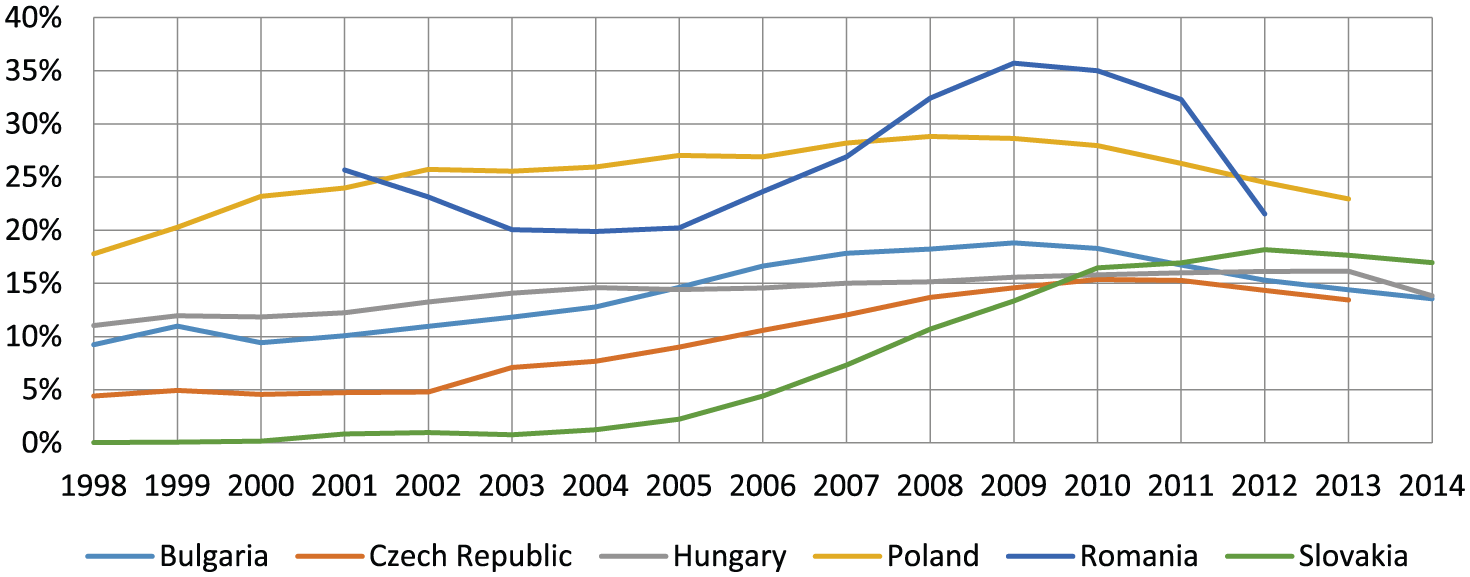
Share of private higher education in total higher education enrolments in several CEE countries (data source: Eurostat; students counted in full time equivalents).
The main goal of this article is to provide a (partial) explanation for the complete absence of the other category of organizations according to Levy’s typology (2009), namely, of elite and semi-elite private universities. This is particularly striking given what otherwise appears to be a strong (at least in terms of size and accreditation status) private higher education sector in Romania. Notably, elite or semi-elite organizations exist and have consolidated their market position in other CEE countries, Hungary’s Central European University or Bulgaria’s American University being bold examples. Other instances, not all of them international like the aforementioned ones, exist across the CEE. In Poland, which is perhaps the paramount example of a large demand-absorbing private higher education sector and thus similar to Romania in this respect, several semi-elite private organizations have been operating for a couple of decades (Musial, 2009). Some specialize in double degrees (Kozminski University), others in less traditional modes of delivery (National Louis University).
The question of why the private higher education subsector did not generate elite schools was rarely asked publicly in Romania, 4 as if this was not even among the expected outcomes. This is particularly ironic given the fact that primary and secondary education operates in a relatively similar context (socially speaking, but also governed by the same ministers and primary legislation), yet looks completely different. Niche and elite organizations are very visible. Numerous medals at national and international Olympiads are won yearly by pupils in private schools, which therefore get a lot of publicity and are highly sought after. 5
A second, related problem concerns the development of other ‘niche’ higher education organizations. In Romania, this group consists primarily of confessional organizations created after 1990, related to the Catholic, Protestant or so-called Neo-protestant (Evangelical) denominations and mostly focusing on theological (divinity) 6 studies, as described for example by Andreescu (2010). We would include in the niche category an even smaller and more heterogeneous subgroup of what Reisz calls ‘diversity [organizations]’ (Reisz, 2003), such as the New Europe College in Bucharest, a postgraduate school for the social sciences established in the early 1990s through Western grants on the model of an institute of advanced studies; or the aptly named Alternative University, which can be described as an afterschool for students offering learning programmes focused on entrepreneurship, business administration, media and education.
The relationship of these niche organizations with the state accreditation system spans the gamut from formal compliance (religiously-affiliated or theological organizations) to avoidance (the New Europe College, the Alternative University). We do not aim to provide a comprehensive inventory, but a brief look at these organizational profiles strongly suggests that their strategy to provide either high-quality education and/or a substantially different educational experience entails avoidance of the formal rules of the higher education system.
To sum up, we regard the absence of (semi-)elite organizations, together with the narrow profiles or marginality of niche HEIs, as a mark of the limited diversity of higher education in Romania. (This is a convenient, if simple, approach to operationalizing systemic diversity, which is notoriously difficult to capture adequately in terms of straightforward measures such as indicators or composite indices (Huisman et al., 2007; Morphew, 2009).) While these characteristics do not, taken in isolation, make Romanian higher education atypical against the CEE background, if viewed in the wider context of the domestic higher education system they do point to a special case. After all, not only did the private subsystem enjoy a dramatic expansion throughout the 2000s exceeding even that in Poland, but it consisted almost completely of fully accredited universities, matching the public subsystem in number of organizations and, for a brief period, approaching it in matriculation figures (peaking above 35% in 2009, according to Eurostat data – see Figure 1). The absence of even a single (semi-)elite organization under these circumstances is worth investigating comparatively.
The conceptual approach
Our thesis is primarily concerned with (the lack of) systemic diversity in (private) higher education. The conceptual approach expands on the strategies employed in recent influential studies of the topic. These include studies growing out of the population ecology school (Birnbaum, 1983; Hannan and Freeman, 1977; Riesman and Stadtman, 1973); neo-institutionalism (DiMaggio and Powell, 1983; Morphew, 2009); and the kindred resource-dependence theory (Huisman, 1995; Pfeffer and Salancik, 2003). This being said, we aim to add here a different emphasis, which enriches the explanatory frame.
Our contribution relies on the ‘political’ frame proposed by Gary Rhoades (1990) in the tradition of DiMaggio and Powell (1983) and Meyer and Scott (1983). Rhoades considers the perspectives that strongly emphasize the structural dimension of (de)diversification, such as those enumerated in the previous paragraph, as too insensitive to ‘state and group political action’. Therefore he attaches a political agency dimension to the interplay between institutions and organizational and individual actors. He claims, more specifically, that the decisional dominance of academics in higher education policy-making ‘inhibits the advancement of new or alternative images of and roles for higher education [… and] encourages accommodation to change within existing institutional frameworks and according to prevailing predilections concerning the work of higher education’ (Rhoades, 1990: 190). In other words, the more academics as opposed to laypersons are in control of higher education policy-making, the less differentiated the system will tend to be. Different forms of academic and, respectively, lay control will, furthermore, lead to different (de)differentiation outcomes. The core argument is reminiscent of Guy Neave’s (1979: 158) observation, almost four decades old, that in order to keep their binary systems functional the central authorities in Western European countries would have to exercise strict control over policy, since the ‘greater the autonomy permitted, the sooner [academia’s universalistic] values will translate themselves into action and rebound upon the internal organization, study programmes and priorities of new establishments’.
Rhoades frames his contribution in social theoretical terms as ‘incorporat[ing] […] agency […] into explanations of differentiation’ (1990: 189), hoping to cast light on how academic elites and ‘lay’ (non-academic) interest groups acting politically shaped the paths of diversification in several academic systems. Herein, we are less concerned with the foundational ‘structure and/versus agency’ debate (Archer, 1995, 2010; Giddens, 1984, 2015) to which Rhoades seeks to contribute. Our chief interest lies in his methodological point that in describing diversification it is worth paying attention to the behaviour of organizational and individual actors in the concrete social interactions which, under the constraints imposed by rules and resources, (re)constitute the higher education system. Specifically, we will direct our inquiry towards the ways in which such actors have deployed ‘rational myths’ and other resources, including direct control over policy, in the context of an effort to accommodate private higher education after the collapse of communism. Rhoades’ (1990: 190) major thesis that the ‘more the academic/external lay group balance of power favors academics, the less open the system will be to differentiation’ raises the problem of localizing the balance of power in question. He explores different venues of operationalization, variously locating it, across several higher education systems, at legislative, executive and/or bureaucratic administrative level.
Our approach is inspired by recent comparative analyses of post-communist systems of higher education (Kralikova, 2016; Sabic, 2016). While Rhoades seeks to explain de-differentiation with recourse to the lay-academic composition of (higher) education decision bodies, we seek to identify the exercise of individual and organizational academic agency at several ‘critical junctures’, that is, ‘moments when substantial institutional change takes place thereby creating a “branching point” from which historical development moves onto a new path’ (Hall and Taylor, 1996: 942). The exploration of critical junctures is useful particularly for the opportunity of investigating how different actors’ choices in specific circumstances end up creating institutional order and path dependencies. We will be concerned primarily with the national executive level, that of the (higher) education ministers, more specifically with the policy options which affected the development of private education in the CEE countries. Our option is determined by the fact that most of the accounts that we surveyed for this article identify (higher) education ministers as prime movers in institutional (re)definition in CEE countries (Kralikova, 2016; Miroiu, 2015; Sabic, 2016).
As noted previously, critical junctures are points at which actors’ choices shape institutional structures such that ‘historical development moves onto a new path’ (Hall and Taylor, 1996: 942). It should be emphasized, however, that critical junctures do not necessarily involve the creation of new paths, but may simply represent choices that ‘close off alternative options’ and lead to the entrenchment of trends already underway (Capoccia and Kelemen, 2007: 341). Nor do critical junctures necessarily imply choices that are substantially free from existing constraints. Some ‘may entail considerable discretion, whereas with others the presumed choice appears deeply embedded in antecedent conditions’ (Collier and Collier, 1991: 27). One additional word of caution is needed: while, particularly in CEE higher education, relevant critical junctures cannot be properly understood in the absence of their international dimension (Kralikova, 2016; Sabic, 2016), especially the transnational policy efforts briefly mentioned in the introduction, our focus will remain on how these opportunities were translated into measures which affected, intentionally or unintentionally, the domestic private–public dimension of higher education.
Critical junctures in the development of (private) higher education and ministerial agency
The year 1990 represents the first major juncture in our narrative, as it disrupted the relatively similar institutional orders of CEE societies and, more particularly, it sparked private higher education in the region. Across ex-communist systems, policy decisions made in the immediate aftermath of the collapse of communist systems induced path dependencies, out of which we will discuss the ones we consider relevant to the public–private divide. Alongside the change of regime, academics reclaimed the previously communist party-controlled universities, organized according to the Soviet model (Reisz, 2003), and exercised control over more or less extensive aspects of organizational autonomy, outside the formal institutional order and, in many cases, before the legislative changes which eventually enabled such actions (Pišút, 1993; Scott, 2009). Proper institutional definition commenced early in 1990, when across CEE the sole actors in higher education were the ‘state’ higher education institutions (Reisz, 2003). The system embarked on a transition from state control towards organizational autonomy, understood initially, at least within comprehensive (non-technical) HEIs, as a restitution of the Humboldtian model (Dobbins and Knill, 2009). Thus, in the initial phase, the public sector benefited from de facto predominance due to a lack of organized competition, which gave it ample freedom to define itself on its own terms.
One of the key CEE developments of the period is thus central to our thesis: the pivotal role that state universities which operated before 1990 came to play in the structuration of the higher education systems. Their agency was exercised through several venues. The first and, perhaps, the most important, was the Cabinet. Simply put, starting around 1990 the position of the minister of education was predominantly held by ‘career academics’ from HEIs founded before 1990. As observed previously, in most Central and Eastern European countries the literature tends to ascribe education ministers a key role in institutional reform in higher education (Kralikova, 2016; Miroiu, 2015; Sabic, 2016). This particularity of CEE countries is illustrated by a simple comparison of the occupants of several national education ministerships with other major Western European systems. 7
In the spirit of Rhoades (1990), we take these figures as indicative of the balance of powers between academic professionals and lay actors. We also note that few of the former had a primary background in private higher education. Romania provides a particularly striking example of this imbalance. Between 1990 and 2015, out of 21 Romanian ministers of education, one was a writer, one a secondary-school teacher, a third a career politician and 17 were academics (one served three terms a few years apart – hence the figure of 19 in the table). The Ministry was headed by a non-academic for around 14 months, out of which six were immediately after the change of regime in late 1989. The single minister with a pre-higher education background remained in office for less than a month. Tellingly, out of 25 years of post-communist democracy, the ministry was headed by career academics from the dominant HEIs in the two flagship academic cities of Bucharest and Cluj for approximately 70% of this period. Only one of the Romanian ministers, Daniel Funeriu, came from the so-called ‘scientific diaspora’ to take this political position – and returned thereafter.
The second important channel through which the agency of dominant academic organizations was exercised has been that of the national buffer bodies – the various councils for accreditation/quality assurance, higher education funding, scientific research, etc. As Reisz (2003: 10) notes, in CEE ‘[a]cademics from these universities [the comprehenisve national universities] have usually a monopoly for the most important positions in consultative and buffer organizations’. Writing about Romania at the end of the first post-communist decade, Temple and Billing (2003: 255) judged these bodies to be ‘effectively in the control of the elite’ state organizations. The set of dominant (or ‘elite’) HEIs also includes, in Romania and other CEE countries, the technical universities (‘polytechnics’) in the major university centres, a notable legacy of the ‘politechnisation reforms of the 1950s’ (Reisz, 2003: 11; Sabic, 2016: 68).
It is important, at this point, to highlight what the argument about the professional-lay balance of power in policy-making does not claim, namely, that all or most ministers coming from within dominant traditional organizations promoted a similar reform agenda or with equal intensity; or that the various national buffer bodies, in their incarnations through time, consistently supported the same policies. To refer to the heads of the central administration alone, ‘academic’ ministers often succeeded each other in a reform–counter-reform pattern despite their individual professional roots in the same small subset of traditional universities. Instead, the argument states that, when lay policy-makers lack voice, academic professionals will tend to justify their reforms (or counter-reforms) by projecting an image of the higher education system which defines the latter in terms of the images of the dominant organizational types. In this fashion, even reformist ‘academic ministers’ may indirectly inhibit diversification through the kind of institutionalized ‘myths’ (Meyer and Rowan, 1977) which encourage isomorphic behaviour within organizational fields. Thus, it is not surprising that, of the three arguably most reform-oriented minister-academics in Romanian higher education, one (Andrei Marga) is a philosopher of ‘the university’, while two others (Mircea Miclea and Daniel Funeriu) have framed their reforms primarily in terms of ‘performance’ and ‘competitiveness’ defined as scientific output and ranking in international league tables.
Having noted these two important channels of professional control over higher education, the Ministry and the buffer organizations, the following sections explore them in connection with the public–private dimension through a set of critical junctures grouped thematically. The first issue concerns the competition for students, in particular through funding mechanisms, coming from a resource dependence perspective (Huisman, 1995; Pfeffer and Salancik, 2003), which was pursued in the Romanian context as well (Andreescu et al., 2012). The second deals with normative definitions of higher education, especially through mechanisms of accreditation and classification, coming from an isomorphism perspective (DiMaggio and Powell, 1983; Morphew, 2009), pursued in the Romanian context by Miroiu and Andreescu (2010). Each section starts with a brief comparative examination of developments across CEE and continues with a mostly contrastive discussion of the Romanian case.
The competition for students
Distinctions between private and public higher education are fluid, both in general and in CEE particularly, as public HEIs often attract private resources and vice versa (Duczmal, 2006; Enders and Jongbloed, 2007; Kwiek, 2012; Proteasa and Miroiu, 2015). We will not enter into details regarding theories of privatization; instead, for the purpose of this analysis, we limit ourselves to positing two ideal types at the extremes of the public–private spectrum and operationalizing them in terms of higher education funding mechanisms. Thus, we conceive of the private ideal type as an organization run by non-state actors, which receives no support from the state in terms of either direct funding of educational costs or indirectly through student support schemes. Due to reasons of parsimony we refer to the most substantial and common (thus, adequate for comparison) forms of student support in the Romanian context: grants, loans and scholarships (Proteasa and Miroiu, 2015). The public ideal type resembles quite well the arrangements inherited from the communist regime: fully subsidized education, complemented by various additional support schemes. Both public and private higher education providers are part of the same organizational field, thus operating under the influence of the same normative and coercive institutions (to be discussed in the coming subsection).
Private higher education emerged at somewhat different moments across the CEE countries. In Romania, Hungary, Poland and Bulgaria the communist legislation was amended or replaced with new laws and private providers opened their doors to prospective students in the early 1990s, sometimes without proper higher education legislation (Duczmal, 2006; Nagy-Darvas et al., 1997; Reisz, 1997; Slantcheva, 2005). Private HEIs in early 1990s CEE often resembled the corresponding ideal type well. The legislation adopted in early 1990 in Czechoslovakia did not allow for the private provision of higher education (Pišút, 1993), hence preserving the public character of higher education until 1998 in the Czech Republic (Beneš et al., 2003; Pabian, 2010) and 2002 in Slovakia (Čaplánová, 2003). The demand for higher education in the early 1990s was met there by creating branches or new public tertiary organizations in medium-sized towns to provide post-secondary education. ‘The initiative in these cases came from citizens and municipalities’ (Pišút, 1993: 426) but the latter type of organizations were not initially granted the status of university proper.
According to Kralikova (2016: 194) ‘both academics’ and M[inisters’] o[f] E[ducation] leadership played a crucial role’ in the adoption of the first post-communist law on higher education in 1990 Czechoslovakia. The law was prepared by a committee appointed by the Ministry, whose members were academics and ‘shared their university colleagues’ views’ (Pišút, 1997 cited in Kralikova 2016: 196). The preparation of the law in relative isolation from the political parties and the society is explained both in principled and pragmatic terms: ‘the intrusion of people from outside of universities into HE [higher education] reform was seen as contradicting the principle of university autonomy as defined after 1989’; on the other hand, politicians and the general public did not perceive higher education reform to be a priority comparable with the other challenges of the early 1990s, such as the formation of new political parties and rising nationalism. ‘In this situation the reforms were mostly inspired by the higher education and research communities and ministries of education, with limited assistance from outside’ (Pišút, 1993: 425). These early observations concerning professionals’ dominance in higher education policy-making also apply elsewhere in the CEE, certainly also in Romania, where 1990 was defined by a ministry that took a hands-off approach to change in academia.
As far as the relationship between public and private higher education in terms of the competition for students is concerned, Duczmal (2006) usefully distinguishes two periods in the evolution of the two subsectors in Poland. The term ‘rivalry’ is employed to refer to the extent to which private and public organizations perceived themselves as competing with respect to overlapping pools of students. The first period, one of limited rivalry, is placed before 1998. (We did not include it in our chart of trends covering several CEE countries.) The second one, of rising rivalry, is placed in the period before 2004. Recent accounts (Kwiek, 2012, 2016; Proteasa and Miroiu, 2015), corroborated with the trends in Figure 1, suggest the level of rivalry between the two subsectors will increase significantly in Romania and Poland, the countries with the largest share of private in total matriculations.
The early-to-mid nineties period of limited rivalry was characterized in its initial phase in Romania as ‘anarchic growth’ (Miroiu, 2015). The similar context in Poland has been called a ‘policy of non-policy’ (Kwiek, 2012). It included, more broadly, a politically induced delay of higher education massification in CEE (Reisz and Stock, 2006). Where it existed, the private sector was enjoying substantial resource slack at the time (specifically, many tuition-paying students), while public education, like all public services in the 1990s, was suffering from ‘insufficient resources’ (Georgieva et al., 2002) and from a limited capacity to expand provision. In this context, individual academics in public universities rounded out their income by taking teaching positions in private institutions, in spite of the low-quality concerns. Such a strategy is reported in Poland (Duczmal, 2006), but it was common in Romania, as well.
During limited rivalry, a departure of the public HEIs from the ideal type presented earlier would provide them with additional resources, thus strengthening their relative position. Such a thrust occurred in all countries in the 1990s, except for Romania, where it had to wait until the turn of the decade and was limited to the matriculation of tuition-paying students. In Poland, public HEIs were allowed to charge tuition fees to ‘part-time and evening-time students, to full-time students but only for repetition of regular diploma courses due to inadequate student performance, and on various short-cycle post-graduate courses’ after a Decree in 1991 (Duczmal, 2006: 234). In Bulgaria, public HEIs registered tuition-paying students on top of the subsidized ones in the early nineties, followed by generalized partial fees (up to 30% of the education costs) in 1999 (Georgieva et al., 2002) in spite of the ‘strong public opposition’ (Slantcheva, 2007: 67). Hungary’s evolution is marked by additional junctures: the 1994 generalization of partial tuition, followed by the 1996 permission to enrol full tuition students on top of the partially subsidized ones, and the retraction of generalized fees in 1998 (Vossensteyn, 2003).
The period of rising rivalry starting in the late 1990s is characterized by public HEIs’ increased capacity to attract resources from students. One of the risks inherent in this development was the generalization of the ‘economies of scale’ strategy, channelling competition towards opportunity costs for obtaining a diploma, as described in detail in Andreescu et al. (2012). As these authors argued in the case of Romania, quality assurance was not powerful enough to counterbalance market forces pushing for lowering quality standards and maintaining the homogeneity of study experiences. In Poland, Hungary and Bulgaria, new student support schemes, geared towards students in both public and private higher education, were institutionalized, and/or the existing ones were extended to the students from the private subsector. Some nationally important critical junctures in the institutionalization of university funding and student support schemes are:
Poland’s 1998 loans and credit scheme, followed by the 2001 extension of the state scholarship scheme to full-time students in private higher education, and later, in 2004, to part-time students as well (Duczmal, 2006);
the 1998 attempt to set up a loan scheme for all students in Bulgaria (Georgieva et al., 2002);
the 2012 loan system and the tax exemption scheme in Hungary, generalized to students from private universities as well (Eurydice, 2015), which complemented a tradition of private higher education being subsidized directly or indirectly by the state (Nagy-Darvas, 2004; Vossensteyn, 2003). More than that, in Hungary an important share of private higher education was supported by congregations or municipalities.
These developments can be interpreted as lowering opportunity costs for private higher education on the financial side, which in theory, would allow them to maintain adequate quality standards. Overall, in the three countries above, during the rivalry period the private subsector departed (further away) from its ideal type. On our abstract map, they positioned themselves somewhat closer to the position of public HEIs, building also on the latter’s departures from their ideal type in the previous period.
Seen against this CEE background, Romania’s development is particular: on the axis of public–private ideal types, the distance between the two subsectors remains the greatest among the analysed countries. As of this writing, private HEIs continue to closely resemble the ideal type, as the students they enrol cannot access any state-provided grants or scholarships, and no student loan scheme is available (Proteasa and Miroiu, 2015). Instead, developments in this respect are determined by the evolution of the public subsector.
The latter slowly moved away from the ideal type towards the market, on several dimensions (Dobbins and Knill, 2009). In 1993, a Cabinet Ordinance set the scene for public HEIs enrolling tuition-paying students on top of the subsidized ones. The move was met with resistance in the public sphere, where ‘the view that state education must be free became compelling’ (Proteasa and Miroiu, 2015: 155). The Cabinet reconsidered their position and decided to subsidize the students that entered on ‘non-budgeted positions’, on the basis of the Ordinance.
A critical juncture occurred in 1999, when the minister successfully implemented the decision which was withdrawn years before, so that public universities were awarded a number of fully state-subsidized places and could enrol tuition-paying students on top of that. The measure is sometimes interpreted as a thrust towards marketization (Dobbins and Knill, 2009; Kralikova, 2016), but we argue that in practice it represented an empowerment of public universities in their competition with the private ones, by enabling the former to expand their enrolments as far as their facilities would permit (and even beyond that). According to the interviews interpreted by Kralikova (2016: 141), Minister Andrei Marga, an academic from the comprehensive university in Cluj, one of the ‘dominant’ organizations according to the typology advanced by Reisz (2003), was instrumental in this institutional re-definition.
Another proposal which exhibited the potential to alter the status quo came in 2012, when the minister of that time proposed to ‘allow [public] universities to offer students full or only partial study grants’ (Proteasa and Miroiu, 2015: 156), a measure which could have paved the road towards the generalization of partial fees in public higher education. The proposal was abandoned with the fall of the government in the same year, and the subsequent ministers never picked up the issue again.
To sum up, throughout this period of major funding reforms and more limited changes, the question of extending state support schemes beyond the public subsystem, to private universities, either directly or by funding students who attended these organizations, was never seriously entertained in Romania. Instead, the major significant development along the public–private axis was beneficial to the state universities and was passed with the agency of an influential academic minister. This particular development is in sharp contrast not only to the cases of Poland, Bulgaria and Hungary, but also to primary and secondary education in Romania. As of 2016, study grants have been distributed to primary and secondary private education in this country. 8
Quality assurance and ‘transparency instruments’
The influence of academic ‘rational myths’ can be traced beyond the competition for resources, perhaps nowhere more explicitly than in the normative approaches to higher education which took the form of state accreditation in the early nineties. Public bodies in charge of accreditation were considered ‘gate-keepers’ limiting the uncontrolled growth of the private sector (Teixeira and Amaral, 2001) or even regarded as a ‘quality police’ closing down private HEIs (Tomusk, 2000). Accreditation was re-branded as ‘quality assurance’ after the turn of the century, along with the shift of power from the state to an increasingly autonomous ‘academic oligarchy’ (Temple and Billing, 2003), under the influence of the Bologna Process (Dobbins and Knill, 2009). After 2010, an additional policy dimension was often added to the ‘quest for quality’, namely, classifications and rankings which were meant to complement the insufficiently discriminating quality assurance mechanisms and to contribute to the public recognition of the ‘genuine’ universities (Sabic, 2015; Tochkov et al., 2012).
Accreditation systems were institutionalized in 1993 in Romania, in 1995 in Bulgaria (Georgieva et al., 2002) and in Hungary through a sequence of measures, the first of which came in 1992 (Kozma et al., 2003). Though successful in limiting the ‘rapid emergence of a private HE [higher education] sector of dubious quality’ (Teixeira and Amaral, 2001: 375), 9 accreditation has often worked as a Procrustes’ bed for the innovative approaches to the delivery of education in all the three CEE countries (Miroiu and Andreescu, 2010; Slantcheva, 2005; Teixeira and Amaral, 2001). Thus, notwithstanding its advantages, accreditation often put a brake on the development of private HEIs in the years when public, traditional universities lacked the capacities to compete for market resources. In the previous subsection, we termed this period one of limited rivalry, characterized mainly by public budget deficits.
Poland took a somewhat different path: Kwiek (2012: 134–135) describes the response to growth in higher education as based on more ‘liberal approaches to quality assurance mechanisms, licensing, and accreditation that encouraged the nascent private sector during its first decade of operation’ (1990s). A designated accreditation or quality assurance body was not created until 2001, when the private subsector matriculated close to one-third of Polish students (Duczmal, 2006). In the early nineties, a General Council of Higher Education, comprised of HEI representatives, academics and students, was in charge of ‘gate-keeping’, according to the cited author. Its requirements were minimal and rather formal, and they became even less demanding for the providers of bachelor-only education under the 1997 Law on Vocational Education. As Duczmal (2006: 241) details, out of the ‘growing disquiet’ concerning quality in the private subsector sprang a non-state accreditation initiative in 1994. Notably, and less typically for the CEE, it was framed in terms of self-regulation of the private business schools and it was considered successful in stemming the flood (Duczmal, 2006).
Returning to Romania, the 2006 transformation of accreditation (originally introduced in 1993) into quality assurance did not, in fact, represent a major departure in terms of the normative understandings of higher education. It too relied on an accreditation logic with stringent standards, was dominated by academics in traditional universities (though the new body’s composition was more diverse than the council established in 1993) and was also considered aimed at containing the expansion of private universities (Sabic, 2016: 160). Critics of the revamped system noted that the newly expanded set of national standards (or ‘quality criteria’) for organizational and programme accreditation continued to impose on private and new public universities the organizational arrangements prevalent in the traditional universities (Păunescu et al., 2012).
The transition from the accreditation to the quality assurance regime implied a transfer of authority from the Parliament to the independent quality assurance agency. 10 The minister in office, Mircea Miclea, led the initiative (Sabic, 2016). He came from the comprehensive state university in Cluj, one of the oldest in the country, the same as Andrei Marga’s – the minister mentioned in the previous section. The previous accreditation council functioned under the authority of the Parliament and included some academic parliamentarians in its structures. Building on interviews, Sabic (2016: 160) gives credit to the view that under the authority of the Parliament accreditation was ‘highly politicized […], and because of this, the council often approved the establishment of private universities if there was a political interest for it’. The Parliament represented an arena where ‘local politicians’ sought and found supporters for their initiative ‘to establish a university in their hometown, either to improve the status of that particular town or the public perception of that political party’ (Sabic, 2016: 221). Even if the perception of Sabic’s interviewees was that this represented an illegitimate channel toward accreditation, the new solution, initiated by a reformist academic minister, was to place the process more directly under the authority of academic professionals. Therefore, even if the normative image of higher education was not significantly changed through the transition, 2006 represents another critical juncture in the re-structuration of the organizational field.
These normative images on higher education were later challenged in 2011–2012, in the context of increasing rivalry, with the adoption of a new law on education (Andreescu et al., 2015; Miroiu and Vlăsceanu, 2012; Sabic, 2015). The draft law was prepared in a commission where academics from dominant universities were prominent (Miroiu, 2015; Sabic, 2016) and included a formal classification of universities and a ranking of study programmes. The commission had been established in late 2006 under the sponsorship of the Romanian President (as a part of the so-called ‘presidential administration’) and was headed by Mircea Miclea, the former minister who also played a key role in the transition from accreditation to quality assurance. Another prominent member was Daniel Funeriu, the future minister who would be among the key movers behind the 2011 law, according to Kralikova (2016) and Miroiu (2015). Universities were to be classified in three categories, research-intensive, research-and-education and education-intensive organizations. The research-intensive category was the most prestigious and enjoyed the right to organize doctoral education and the benefits of receiving more grants for master’s programmes, where the per capita allowances are twice those for bachelor’s.
All in all, both material and symbolic benefits hinged on an HEI’s inclusion in the research-intensive category. The positioning was determined by computing numerous indicators, a veritable ‘black-box’ approach which was criticized for its lack of transparency (Sabic, 2016). The single most important determinant was scientific output, measured especially in terms of Thomson ISI-indexed publications and impact factors (Andreescu et al., 2015). Not only were all private universities placed in what was almost universally perceived to be the ‘lowest’ category of education-intensive organizations (Andreescu et al., 2012), but the most esteemed category was populated, with one or two exceptions, by HEIs belonging to the dominant types: large organizations established well before 1990 in Bucharest, Iași and Cluj – the main university centres in Romania. For contrasting purposes, we note that three years before this official classification, a national economic policy newspaper published a ranking of Romanian HEIs. The ranking was realized with an international consultancy, used different criteria and generated substantially different results. For example, employers’ perception was given significant weight, while the 2012 official classification and rankings did not include any direct measure of employability or of employers’ views. In this ‘unofficial’ ranking, private HEIs are distributed less compactly, 11 and they also feature among the top 10 positions.
Minister Daniel Funeriu, a researcher in chemistry originally from the scientific diaspora, was instrumental in the construction of this image of higher education (Sabic, 2016), defined overwhelmingly by research performance measured with tools which are specific for the hard sciences. (Most of the students in Romania, especially in private HEIs, have been enrolled in economics, law and the social sciences, a situation common across the CEE.) The centrality of the classification in the reform can be explained partly in terms of the minister’s (and other influential reform-oriented academics’) enchantment with rankings, especially with the ‘Shanghai Rankin’, 12 documented by Sabic (2016), and partly through the dissatisfaction with the ability of the quality assurance system to highlight the top organizational achievers. Though criticized for its biases, we see the classification as an attempt to restore formal recognition to the Humboldtian universities in Romania (at least in terms of how these organizations perceived themselves), a type of discourse which, to some degree, also marked the previous wave of reforms in the late 1990s initiated by minister Marga. It must be noted that formal distinctions between HEIs were abolished in early nineties Romania and were not formally re-installed as of this writing: all existing providers became ‘universities’, as they did also in the Czech Republic (Pabian, 2010) and Slovakia (Reichert, 2012).
In conclusion, one of the striking facts about the approach to classifications and rankings in Romania is that they were designed and carried out almost completely from an academically-minded perspective. These ‘transparency tools’ served two primary functions. One was to guide public financial allocations to the ‘best’ organizations – essentially among state HEIs. Secondly, they were designed to guide the distribution of private resources (money from tuition) by altering prospective students’ preferences (Vercruysse and Proteasa, 2012). This is visible if one corroborates the informational function of classifications and rankings with the increased rivalry for enrolments in the period in which they emerged. However, despite the rhetoric of public accountability, neither of these functions was pursued in terms that responded to either broader societal interests or to individual student concerns. The classifications and rankings worked by highlighting ‘the best’ according to very specific criteria of scientific productivity, biased towards certain profiles of public universities. In other words, the instruments departed substantially from the ‘consumer report’ logic, replacing it with a logic oriented by narrow professional values. Leading academics have played an important role in the structuration of the organizational field along these lines, as they did with the earlier reform of accreditation.
Discussion
After the 1993 law on accreditation, which essentially brought private HEIs in line with the public system, funding and quality assurance (and other) reforms in Romanian higher education exhibited a pattern of systematic neglect of private universities. The operation of the latter was hardly unregulated or unmonitored – they have been expected to function under the same rules designed for the public subsystem. But they were not directly targeted by policy. The reforms of minister Marga, perhaps the most comprehensive in post-communist Romania and an example of strong ministerial leadership, are illustrative in their ignorance of the private subsector. In Marga’s programmatic account of 20 ‘major options of academic policy’ (Marga, 2007: 75–79), none is specifically directed at the private academic organizations. Already a large group by the turn of the millennium, the latter are mentioned only once, in the context of justifying the differential treatment of public HEIs to render them more competitive, among themselves and with the ‘privates’.
More than half a decade later, the aforementioned presidential commission, whose working core consisted entirely of academics perceived as strong reformers, among whom a former and a future minister, published one of the most prominent policy documents on Romanian education. 13 The Presidential Commission Report on the Analysis and Elaboration of Educational and Research Policy (Presidential Commission, 2007) was the main influence behind the 2011 law on education. Its section on higher education only mentions private HEIs a couple of times, as an afterthought, and its strong package of measures targets the system as a whole, and in particular its public part. The changes proposed in funding and quality assurance (including diversification and transparency tools), two broad areas where private universities could have been considered as a distinct subject of public policy, ignore the latter. 14
This policy blind spot is a testimony to the public-dominated, self-oriented outlook on higher education reform that has been pervasive in Romania since the early nineties. Kralikova (2016) documents in some detail the systematic failure of policy-makers coming from public universities to introduce outside ‘stakeholders’ into organizational governance, either in the shape of advisory bodies or, more modestly, in selection committees for rectors. Both the Conference of Rectors and the main higher education unions unsurprisingly opposed these measures vehemently. But, revealingly, even the reformers were sceptical about giving outsiders a substantial role in strategic decision in HEIs (Kralikova, 2016: 146–147).
In our overview earlier, we departed somewhat from a systemic perspective on higher education diversity (Birnbaum, 1983; Morphew, 2009) by focusing on the public–private distinction, due to reasons of both pragmatism (easy operationalization) and relevance. We argued that the level of diversity on this dimension was affected by normative images of higher education embedded, through the agency of academic professionals acting as national policy-makers, at critical junctures in the institutions governing the organizational field. We now close the loop and connect our account with other aspects of diversity. Proteasa and Miroiu (2015) argued that the incapacity to establish intermediate positions between ideal-type private and public HEIs poses issues of equity in the distribution of state support for higher education, affecting what Reichert (2012) terms the ‘student clientele’ dimension. Other authors (Miroiu and Andreescu, 2010; Slantcheva, 2005) note that the private–public dimension is sensitive to issues related to ‘programmatic diversity’ (Birnbaum, 1983), and that the private subsector is often the one fostering innovation, not only mimetism. Since we do not have enough empirical information to properly test all these relationships, we accept them in the form proposed by their original authors. In this context, we consider that these observations underline the fact that the absence of (semi-)elite private universities in Romania represents one symptom of a larger systemic problem: the marginality of alternatives to the path-dependent academic routes in higher education which are at least treated equitably, if not supported in the institutional settings of this organizational field. There are other dimensions that attest to this restricted diversification, for example, the virtually complete absence of short-cycle programmes in public as well as private universities (Andreescu, 2014).
Why has this happened, in Romania arguably more than elsewhere? One important part of the explanation is the manner in which the market for higher education was designed or, better said, how competition on this market was controlled. On the one hand, the private subsector was permitted to expand and, slowly but surely, to be accredited. This happened in good part due to the political pressure caused by the high demand combined with the low absorption capacity of the public subsystem. On the other hand, the growth was tightly controlled, more specifically channelled so that the paths or routes of expansion kept the organizational profile of traditional universities as the guiding standard. This perpetuated the dominance of the latter and was achieved through the agency of the academics that influenced national higher education policy. This picture adds an important qualification to the finding of increasing marketization in Romanian higher education described by Dobbins and Knill (2009). Unlike them (2009: 424), we find the relevant section of the academic community to have been very assertive in higher education policy-making. Perhaps the best qualification to their overall argument is the continuing virtual absence of laypersons on HEI governing boards (including private ones), in buffer organizations and on ‘presidential’ and other commissions tasked with strategic planning in higher education.
We can now directly engage the question of whether one should bemoan this lack of diversity in Romanian higher education. We do not need to assume that more diversity is always better in order to recognize that the current equilibrium is, at least in Romania, suboptimal. It was shown elsewhere that the current pattern of market-driven resource allocation, promoting economies of scale in the organization of study programmes, determines suboptimal results for the universities and students alike (Andreescu et al., 2012). Miroiu (2015) has recently argued that the allocation of the state budget to higher education resembles a ‘tragedy of the commons’ (Hardin, 1968): by channelling their political influence through the education ministry, and through the person of the minister in particular, public universities compete for a larger number of state-subsidized students, in fact simply diminishing the absolute value of the award per ‘equivalent’ (standardized) student, in the context of a limited total budget. As a result, public universities continue to matriculate a large share of publicly-funded students, but they do so for increasingly less per student, facing increased difficulties to maintain quality standards.
Furthermore, it appears to be a common opinion in Romanian society that the quality of higher education is suboptimal. Most of the private universities, the ones absorbing ‘excess demand’ (that is, demand defined function of the public subsystem’s absorption capacity), have been in a perpetual situation of uncertainty after the dramatic fall in student numbers of the past half a decade. Now, they have fewer resources to invest in improving their quality, paired with increasing uncertainty. When, previously, the abundant demand gave them the financial leeway that would have allowed them to consider development strategies along the path of diversification the institutionalization of higher education did not encourage them to do so.
Conclusion
If one accepts the broad thesis that, overall, the institutional setting in the early 1990s was fairly similar across CEE countries, one can plausibly connect the development of Romanian private higher education under the most disadvantageous conditions, comparatively speaking, to its being the country with the largest number and share of academic ministerships among our comparators in Table 1. We obviously do not intend this observation as a statistical validation of the relationship between ministers’ professional background and the level of diversity on the public–private dimension. But in exploring the critical junctures which led to such a development, and how they were influenced by academics and an academically-minded perspective on higher education, we provide a case study that seems to lend support to Rhoades’ thesis. The comparative perspective sheds light on mechanisms which may have inhibited diversification across CEE more broadly, and puts these mechanisms into regional context, while highlighting the particularly influential role that academic ministers’ agency played in Romania.
Academics’ control over the executive governance of higher education in Romania, Hungary, Poland and several Western European countries.
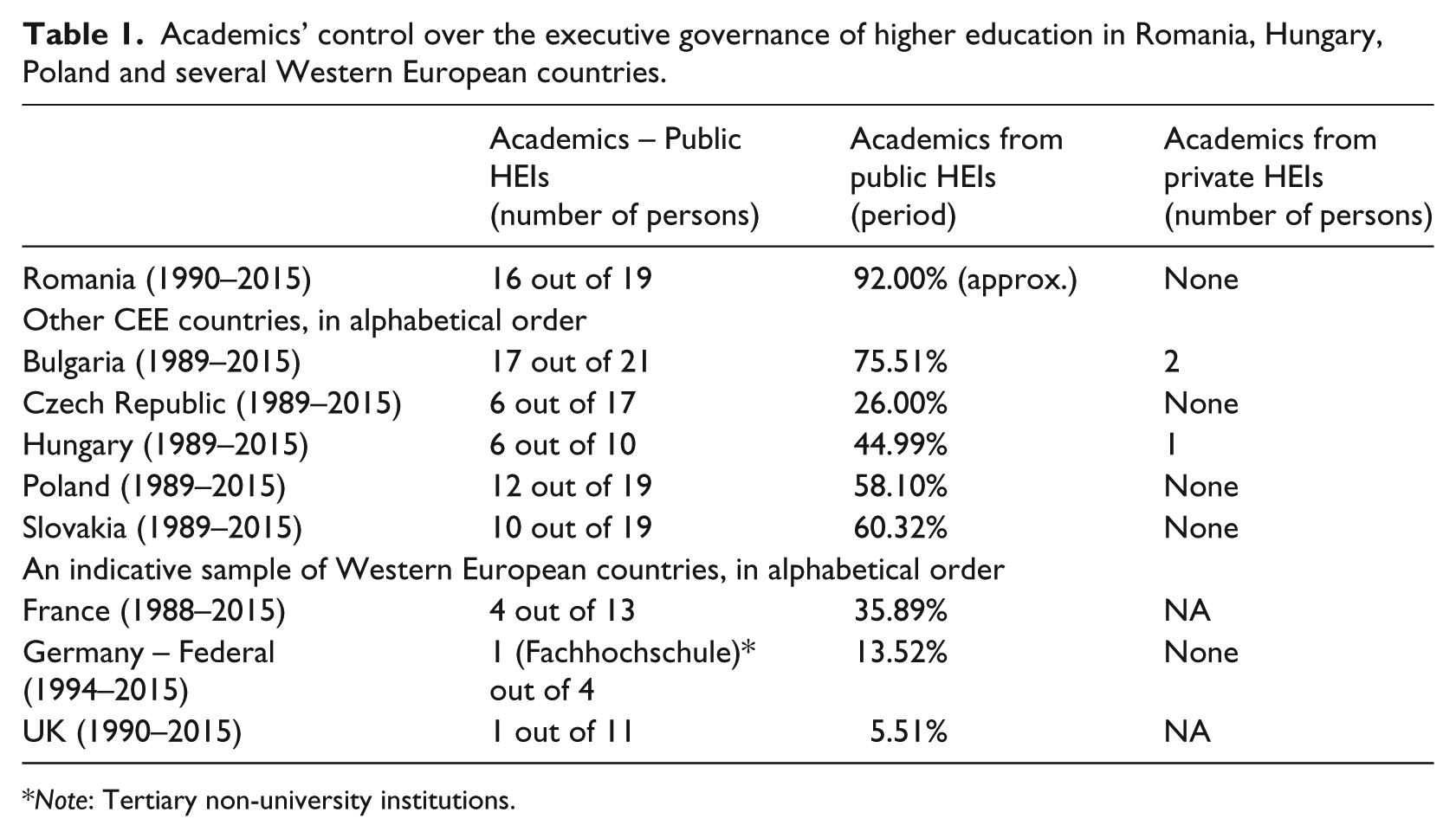
Note: Tertiary non-university institutions.
What this suggests, in effect, is that when academics are in charge of policy their agency tends to perpetuate the ‘rational myths’ (the rules describing existing structures as rational means to desirable ends) that are aligned with the immediate interests of their professional group. As we noted above, in spite of alternating pro-reform or counter-reformist programmes, successive ministers in Romania did not differ in terms of the myths they supported. Other, ‘inconsistent’ myths (Meyer and Rowan, 1977: 356) – such as, in higher education, ‘student-centred learning’ or ‘diversification’, for example – have failed to be appropriately translated into organizational ‘technologies’ and, ultimately, to generate considerable effects. Some constituencies, such as students, stand to lose. So do the organizations in the longer term, we would argue.
To return to our question, then: why are there no elite or semi-elite private universities in Romania, despite the fact that in the recent past the private subsystem, consisting of fully accredited organizations, was roughly as numerous as the public system and matriculated a large share (over a third, at one time) of students? Our thesis is that, after the communist regime collapsed, higher education systems were institutionalized in ways that restricted systemic differentiation. In response to the persistently high demand for higher education and the corresponding actual or projected growth of private universities, the dominant academic actors (the traditional universities) stepped in to protect their market share through policies in domains such as funding, accreditation and classifications. These policies were generally underpinned by a normative model of the university. While they inhibited the prospects of diversification across the board, they locked private HEIs in a ‘copycat’ position, which essentially condemned them to an inferior status given this subsector’s legacy of questionable legitimacy (Andreescu et al., 2012). Thus, post-communist Romania was unlikely to grow domestically – or import – an elite private university because, among others: the law on education (particularly the first one, passed in 1995) would have imposed upon it an organizational structure that closely followed the template of traditional universities; the accreditation mechanism would have forced it to hire state-university faculty en masse (given stringent staffing standards) and to mirror the structure and curricula of existing programmes in state universities; all of this without simultaneously granting any access to public resources (unlike, for example, in Hungary) or even additional private ones (through study loans). Last but not least, had this elite organization not followed in the shoes of traditional universities – if, e.g., it emphasized the educational mission over research or applied research resulting in patents over the publication of articles, and so on – it would have most likely suffered in the recent national rankings. Looking back, these barriers seem almost insurmountable.
Most of this has happened through the agency of ministers of education and other influential policy- and decision-makers who came almost exclusively from traditional academia and had virtually total control over the paths of (higher) education reform. Our approach has been not to present evidence on the ministers’ motivation to hamper the development of (semi-)elite private universities; we argued instead that this was a consequence of the aggregation of a set of individual decisions which all led along the path of the traditionally dominant higher education. We thus conclude by noting that time is ripe for a more agency-oriented perspective in the study of systemic diversification: 25 years offer a reasonable palette of critical junctures, and the evolution and influence of the international narratives provide nuanced perspectives on the translation from the supra-national to the national context, exhibiting common rational myths and highlighting the way the academic organizational field is structured. As some of the recent work cited herein suggests (Kralikova, 2016; Sabic, 2016), such a perspective completes the arguments regarding the impact of transnational discourses, rather than competing with them.
Footnotes
Acknowledgements
The authors would like to express their gratitude for the helpful comments received from the two reviewers, within the process of blind peer-review. We are also thankful for the empirical data collected by Alexandra Dodiță, Vlad Botgros and Victor Miclăuș, from the West University of Timișoara.
Declaration of Conflicting Interest
The authors declare that there is no conflict of interest.
Funding
The contributions of Viorel Proteasa and Liviu Andreescu were supported through the research project ‘From Corporatism to Diversity: A Neoinstitutionalist Study of Representative Student Organizations in Postcommunist Romania’ (code PN-II-RU-TE-2014-4-2296, contract no. 379/2015), funded under the Human Resources – Young Teams programme of Romania’s National Plan for Research, Development and Innovation (PN2).