




Abstract
In the last 20 years, reforms of higher education have produced a Southeast Asian higher education space. It resembles the European educational space in being a supra-national development and some scholars suggest it is inspired by Europeanization. These reforms include credit transfer, twinning, distance learning, and academic mobility programmes. But, researchers are divided about the character of these reforms. Some scholars describe these developments as ‘transnational higher education’ but others suggest that dual degree programmes, such as those between Britain and Malaysia, are ‘international’ initiatives. Is the ‘dual degree’ an international or transnational space of higher education? Using the concept of ‘curriculum making’ to understand the cultural character of dual degree programmes, this paper reports on an interview-based study of curriculum writing in Malaysia to understand the character of Malaysian–British dual degrees. The experiences of two Malaysian curriculum writers are drawn upon to explain the process of curriculum making, how discussions about content and organization of curriculum are resolved, and the complexities of these curriculum decisions. I argue that the dual degrees are neither strictly transnational nor international in character but a novel intersectional education space where ‘Europeanization’ and ‘transnational’ influences inflect historic understandings of Malaysian higher education.
Keywords
Overview
Historical settings
Southeast Asia (SEA) is a region comprising eleven sovereign nation-states 1 . However, prior to becoming independent territories or states in the 20th century, most of the mainland and maritime areas of this region were colonies to European countries. European influence in this region can be traced back to the 16th century when the Portuguese colonized parts of Malaysia and the Philippines. Between the 17th and 18th centuries, parts of Malaysia and Indonesia were Dutch and British colonies whilst parts of Indochina were French colonies. By the 19th century, the entire SEA region, with the exception of Thailand, had been colonized by Europeans. Around the mid-20th century, nationalistic sentiments in the region made Vietnam and Indonesia independent of French and Dutch rule respectively in 1945, Cambodia from the French in 1953, followed by the Federation of Malaya (now Malaysia) from the British in 1957. To foster regional collaboration, these newly independent countries came together in 1967 to form the Association of Southeast Asian Nations (ASEAN) with the aim of promoting inter-governmental cooperation and socio-economic development. Today, ASEAN’s membership comprises all SEA countries except East Timor.
Higher education – international and transnational positions
Higher education in SEA in the 1960s and 1970s mainly took the form of technical and vocational certification by British professional bodies 2 via distance learning or through local (in-country) tuition providers. By the 1980s and 1990s, cross-border credit transfer and twinning arrangements were introduced, with countries like Malaysia and Singapore serving as host countries for the local delivery of foreign higher education curricula (Knight and Morshidi, 2011; Mok, 2010; Ziguras, 2003). This period of higher education reforms saw the region growing in terms of population and demand for higher education (Jayasuriya, 2000). According to Welch (2012, 2013), the increasing demand for higher education coupled with limited public resources caused some governments, like Malaysia, Indonesia, and the Philippines, to privatize and/or liberalize their higher education sectors.
This move allowed growth in the number and types of cross-border, off-shore, or transnational higher education (TNHE) programmes offered between local and foreign higher education institutions (HEIs). According to McBurnie and Ziguras (2001: 85), the SEA higher education space in the 1990s was “something of a laboratory in the development and regulation of transnational education with high demand for higher education and keen competition among providers”. The literature on cross-border programmes commonly uses the term ‘transnational education’ (TNE) to denote higher education programmes where learners are located in a country different from the one that locates the awarding institution (UNESCO, 2000). Another way of appreciating TNE or TNHE is in terms of the mobility of programmes, providers, and people between countries (Knight, 2016: 39–40). Whatever the definition, cross-border or transnational 3 collaborations in higher education continued to grow apace in SEA through the 2000s and 2010s (Welch, 2007, 2013; Ziguras, 2003; Ziguras and McBurnie, 2008).
The liberalization and privatization of higher education in countries like Malaysia, Indonesia, and Singapore make SEA a significant case of internationalization and regionalism in higher education (Jayasuriya, 2003, 2010; Morshidi, 2009; Robertson, 2008, 2010; Welch, 2012). Some scholars describe ASEAN regionalism as motivated by European regionalism (Morshidi, 2012), and labelling it ‘less mature’ compared to Europe’s (Robertson, 2010: 25, 35). Morshidi (2012) explains ASEAN’s aspiration for a common higher education space in SEA to be inspired by Europe’s regionalism in higher education and development of its European Higher Education Area (EHEA). Similarly, the idea of ‘Europe’ as conceived by Novoa and Lawn (2002) is about a European educational space formed by transnational governance, networks, cultural and educational projects. Does this notion of ‘Europe’ influence SEA’s construction of its formal and informal rules, procedures, policies, and norms in forming its common space of higher education? Is there ‘Europeanization’ 4 , understood as Europe’s way of doing things, at work in SEA’s higher education?
Discourses of higher education in SEA acknowledge aspects of TNHE (McBurnie and Ziguras, 2001; Ziguras, 2003) and internationalization of higher education (Huang, 2007; Knight, 2008a; Tham and Kam, 2008). The ‘transnational-ness’ of cross-border collaborative programmes is inferred through the flow of people, knowledge, ideas, policies, and projects across national and/or regional jurisdictional borders. Gough’s (2004) work on transnational curriculum inquiry suggests there is a shift from the national to the transnational, and for this reason he stresses the need to understand TNHE curricula beyond its contents, objectives, and outcomes. Some researchers argue that the flows and exchanges in TNHE allow mixing of ‘inter-national’ and ‘inter-cultural’ dimensions into curriculum and teaching–learning processes which make them ‘internationalized forms’ of higher education (Knight, 2008a, 2012; Tham and Kam, 2008). Beginning in the mid-2010s, new forms of TNHE like joint and dual/double degree 5 programmes between local and foreign HEIs have emerged in SEA. Knight (2008b:. 3) argues these joint degrees have been instrumental in developing the EHEA and improving the competitiveness of European higher education around the world. She suggests it is important to acknowledge Europe’s leadership in developing and promoting such collaborative programmes.
However, questions persist around the meanings of these terms with continuing controversies about the legitimacy of dual/double awards conferred through such programmes of study. Some scholars regard TNHE programmes, like twinning, joint, and dual/double degrees, as part of the internationalization process of higher education (Huang, 2007; Knight, 2008b, 2016; Tham and Kam, 2008). But Knight (2008b: 22; 2016: 40, 41) highlights how the ‘joint curriculum model’ in collaborative programmes brings together teaching–learning processes that produce novel forms of knowledge production between people in different countries.
So, which terminology best captures SEA higher education based on collaborative programmes between local and foreign HEIs? Is the SEA higher education space national, international, or transnational? To answer these questions, this paper reports research that investigated the cultural character of dual/double degree programmes in Malaysia. Tracing how curriculum is made between Malaysian and British HEIs reveals the trajectories that are remaking higher education in SEA.
Curriculum making – cultural and historical perspectives
This paper uses the concept of ‘curriculum making’ as a framework for understanding the cultural character of the Malaysian–British dual degree programmes in Malaysia. The term ‘curriculum making’ indicates a perspective that looks past ostensibly rational curriculum decision-making about aims, objectives and subject-matter selection and, instead, focuses on the processes that realize curriculum as an effect of curriculum-oriented practices that unfold through specific contexts. For example, around the late-2000s, undergraduate dual degree programmes between Malaysian and British HEIs were introduced in Malaysia. These programmes now exist as formalized curriculum designs, with dual or double certification that is organized through what have come to be known as Malaysian–British ‘dual degrees’. While there has been some research on certification through these programmes, not much has been written about the making of these dual degrees or the meaning and effects of degree programmes that are ‘Malaysian–British’. Using ‘curriculum making’ as a conceptual lens looks past technical–rational narratives about curriculum development and surfaces other questions, for example: How is its curriculum made? Who makes it? And, is it national, international or something else?
This perspective sees curriculum as a social construct that embodies its society’s prevailing beliefs, attitudes, and standards (Franklin, 1999; Pinar et al., 1995; Seddon, 1989). A curriculum is not just a thing in the here and now but is inflected by cultural, social, political, and historical dimensions of education and societies, which are now globalizing (Green, 2003; Pinar, 2004). This notion of curriculum has been associated with the idea of an ‘autobiographical text’ (Pinar and Grumet, 1976), that involves the ongoing process of meaning making, with constant recovery and reformulation of one’s embodied history (Davis and Sumara, 2010). Grumet’s (1981: 115) characterization of curriculum as ‘collective stories’ by one generation to another also dematerializes the notion of ‘curriculum-as-object’ and rematerializes it to reveal ‘curriculum-as-text’. Other scholars present ‘curriculum-as-text’ as representations of social realities that rest on complex interconnections and interactions between people and social practices (Da Silva, 1999: 18; Kemmis, 1993: 35).
With this understanding of curriculum making, I ask two questions about the ‘curriculum-as-text’ that materializes dual degrees and the SEA higher education space. First, ‘what is the dual degree curriculum that is made by Malaysian and British institutions and delivered in Malaysia?’ This question focuses attention on the way cultural and historical experiences of different societies and peoples become embodied through the process of curriculum making. The second question asks ‘how does the Malaysian–British dual degree curriculum materialize an international, national, or transnational space of higher education?’ It considers how practices of governing unfold through the lived contexts of curriculum writers and with what effects these have on the indigenous/Malaysian and Anglophone/British knowledge practices.
Approaching a higher education space
Methodologically, this analysis draws on Clifford’s (1997: 54) anthropological comprehension of ‘space’ that embraces both notions of ‘objective structure’ and ‘social experience’. In this sense, probing the making, governing, and experiencing of a Malaysian–British dual degree curriculum produces a physically delineated place of higher education which becomes a ‘higher education space’ as peoples’ practices, rules, norms, and ideas in education are established in it. Education spaces continually change and shift according to the socio-spatial relations created by cultural, social, political, and economic interactions including peoples’ imaginings, desires, and relations (Singh et al., 2007: 197). Lawn (2002: 20) imagined a ‘European’ space of education that is ‘borderless’, not bounded by nation-states but extending beyond it, and that is continually being shaped and re-shaped by nation-state collaborations, new guidelines and products, academic networks, social movements, business links, and virtual connections.
The higher education spaces of SEA and Europe are also changing in response to regionalism (Jayasuriya, 2003, 2010; Morshidi, 2009; Robertson, 2007, 2008, 2010). Robertson (2007) explains that regionalism promotes formal inter-governmental collaborations between two or more states and creates awareness and opportunities for collaboration in higher education between regions. Projects between ASEAN and the European Union (EU), for example, have included policy dialogues, qualifications frameworks, and credit transfer systems in support of supra-national integration 6 . Are these EU projects that support higher education reform in SEA processes of ‘Europeanization’ in the sense that they convey, construct, diffuse, and institutionalize Europe’s formal and informal rules, procedures, paradigms, beliefs, and norms into SEA’s higher education space (Featherstone and Radaelli, 2003: 30)?
For Novoa and Lawn (2002: 5), the education space of ‘Europe’ is not just borderless but also ‘de-nationalized’, with new meanings in education being constructed continually within its emerging de-nationalized space. But how countries and peoples respond to regionalizing and de-nationalizing processes depends on their local histories and cultural dispositions (Kress, 1996; Rizvi, 2007). Nationalizing and internationalizing pressures that work in opposition also disturb national and international boundaries and habits of mind. These processes blur historical, political, and social dimensions of states and societies, driving processes that de- and re-nationalize territories (Sassen, 2003, 2005), and rescale education spaces (Robertson et al., 2002). These socio-spatial reconfigurations happen through the interplay between processes of political and sociological boundary work and actors that are differently positioned in this space (Seddon, 2014).
The nature and effects of these regionalized higher education spaces emerge alongside growing economic, social, and political linkages. Travelling ideas and policies, and flows of peoples, images and goods, shift the boundaries and possibilities of cross-border connections and dialogue between people, places, and institutions across and between nation-states, reconstituting regions in ways that materialize an ‘emergent transnationalism’ (Vertovec, 2009: 3). ‘Transnationalism’, as concept, refers to the multiple relationships and interactions linking people and/or institutions across the borders of nation-states, and the conditions (i.e. social spaces) that emerge, despite ‘great distances’ and the presence of ‘barriers’ (like forms of laws and regulations), as these interactions develop, intensify, and spread across geographic, cultural, and political borders (Vertovec, 2009: 25, 27; Yeoh et al., 2003: 208). Rizvi (2011) explains that transnationalism requires new ways of examining issues of culture and diversity because of the way they are now experienced through ‘de-territorialized’ spaces which are shaped by novel contradictions, dilemmas, and risks imposed by multiple networked affiliations.
These anthropological understandings of social space suggest a new paradigm for understanding curriculum making and its effects that remake higher education spaces. Instead of seeing curriculum making framed with reference to the binary opposites of ‘local/national’ or ‘global/international’, it is possible to analyse the curriculum of dual degree programmes through a ‘transnational’ bifocal optic that views the nation-state and transnational practices as ‘mutually constitutive’ (Smith, 2001: 3–4). These notions of social space and the overlaps or ‘borderlands’ between the supra-national/international, national/local, and sub-national/institutional levels, together with ideas of regionalism and transnationalism, highlight the importance of ‘intersectionalities’ in the making of Malaysian–British dual degrees.
The research design probed these intersectionalities in dual degree curriculum making through interviews with curriculum writers in Malaysian private HEIs. The interviews targeted intersectionalities (see Figure 1) to understand how Malaysia’s higher education space is defined not only by its geopolitical coordinates but is also shaped by the interplay of rules and practices at the national (e.g. government agencies), sub-national (e.g. educational institutions), and supra-national (e.g. transnational agencies) scale. For example, the Malaysian government has established national agencies like the Malaysian Qualifications Agency (MQA) to accredit local qualifications and benchmark them with foreign quality frameworks like UK’s Quality Assurance Agency (QAA) in preparation for regionalization and internationalization of its higher education space (Sarjit et al., 2008).
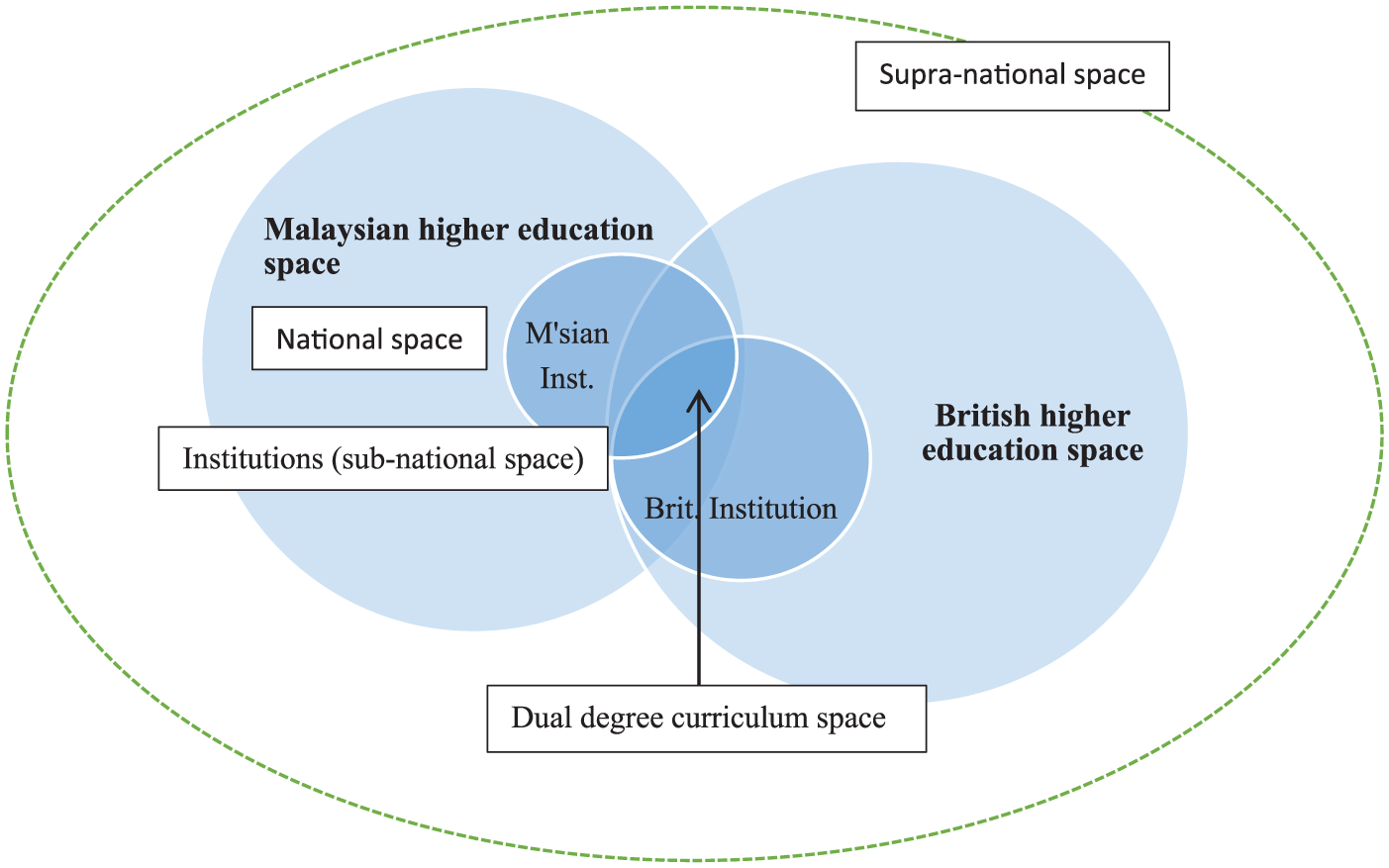
Dual degree curriculum space as an ‘intersectionality’ of multiple spaces of education.
Researching Malaysian–British dual degrees
Interview and narrative analysis
This paper reports on interviews with curriculum writers involved in making Malaysian–British dual degree programmes between Malaysian private HEIs and their British partner institutions. Interview questions investigated the relationships and perspectives that tied these curriculum writers to national, territorial, and institutional settings, and how curriculum writers’ biographies and experiences of the Malaysian–British knowledge building processes affected their practices that made dual degree curricula. This analysis draws on two curriculum writers in particular, and reports on the dual degree curriculum making process, how discussions and conflicts about content and organization of curriculum are made and resolved, and the significance of these curriculum decisions for their institution and Malaysia’s higher education system. These two curriculum writers were selected because of their different personal, educational, and professional backgrounds. The in-depth interviews allowed them to explain their experiences in the dual degree curriculum making process. Their narratives were analysed to surface how they comprehended these curriculum making situations and struggles (Bryman, 2012: 213, 471; Cohen et al., 2007: 352–353). The findings revealed what curriculum making in a dual degree programme means to them in terms of relationships, institutional priorities, and territorial settings.
Curriculum writers’ profiles
Molly Chong (pseudonym) is Malaysian–Chinese. She was schooled in the 1950s in English-type schools that were established by the British in Malaya. She witnessed the educational reforms of post-colonial Malaysia as she completed her schooling and entered a Malaysian public university where she obtained her undergraduate and postgraduate qualifications. Molly completed her PhD studies at a British university and returned to Malaysia where she worked in various academic roles in both public and private universities. She has also worked in projects for organizations like the World Bank, Commonwealth Secretariat, and UNESCO. Between 2006 and 2013, Molly was the curriculum writer for four undergraduate courses in a Malaysian private HEI’s dual degree in Business and Management with a British university.
Fred Tan (pseudonym) is also Malaysian–Chinese. Born after Malaysia’s independence from British rule, he studied in national-type schools where Malay is the main language of instruction and English the second language. Instead of going to university, Fred pursued UK professional accounting qualifications and worked in Malaysia as an accountant in the commercial sector for about 20 years before pursuing postgraduate studies. He obtained his master degree through an Australian twinning programme in Malaysia and became a lecturer at a private college. After completing his doctoral qualification with an Australian university, he joined a newly established Malaysian private university that delivered dual degrees in Business with a British partner university. Fred was involved in writing the Accounting and Marketing courses for the dual degree in Marketing between his institution and its British partner.
Although both Molly and Fred are Malaysians, they carry Western or Anglophone resources; Molly from her school education through to her doctoral work, and Fred through his professional accounting studies and postgraduate education. Both encounter the borders between Malaysian and Western habits as they cope with what ‘local/national’ and ‘foreign/international’ mean to them. ‘Western’ is not an empirical given but a form of representation at work – for Molly and Fred, it can be the creation of a particular form of Eastern or Malaysian–Chinese way of knowing 7 . Aspects of Molly’s and Fred’s biographies are important in this paper on a Malaysian–British dual degree curriculum because curriculum making is a kind of autobiographical text and draws on the educational experiences of individuals (Pinar and Grumet, 1976). Molly and Fred have both had to negotiate, experience, and understand the knowledge building processes they encounter through working with their British counterparts. These encounters affect the making of Malaysian–British dual degree programmes.
West is best in ‘home-grown’ degrees
Both curriculum writers felt that the dual degrees emerged from the curriculum approaches in Western countries. Molly explained that their genesis lay in the late-1990s
8
liberalizing reforms in Malaysian higher education that allowed the curricula of foreign universities to be delivered in the country. These reforms also paved the way for local private colleges to be upgraded to university colleges (UCs) and universities. These newly formed private UCs and universities were required to offer their own ‘home-grown’ curricula and not that of foreign partner universities. According to Molly, this condition was problematic because most newly upgraded private UCs and universities had no experience in building their own curricula. Until then, they had been offering their foreign partner universities’ curricula via credit transfer and twinning arrangements. Although the institutional upgrade was welcomed by local private HEIs, it also presented new challenges to them. Molly went on to say: “Following this proviso, the UCs feared that if they introduced their own degrees would there be any takers? There was this concern about the faith in local degrees with regards recognition by foreign universities and potential employers.”
According to Molly, this lack of confidence in demand for local ‘home-grown’ degrees prompted her institution to explore the possibility of offering joint or dual degree programmes with Western universities. She recalled her institution’s Board making clear its ambition of working with Western universities that are ‘top-ranked’ in international ratings and a preference for British and American universities because all the Board members had received their tertiary qualifications from Anglophone universities. Fred also described how the senior management of his newly formed private university wanted a Western university to validate its home-grown degrees. He agreed there was a local bias towards ‘things-of-the-West’. As he said, “the Malaysian mind-set is that you always want something Western to back you up, and I guess that’s what the Malaysian market wants as well.” Fred also confessed his own bias: “I think my first language is English, and in a sense my thinking is English.” To both curriculum writers, there is a pro-Western, or more specifically a pro-British, sentiment prevailing in Malaysia. Molly offered an analogy: “There is this fear that local Malaysian education, just like Malaysian products, will not sell. And, Philips light bulbs made in England are better than those made in Malaysia! Somehow in this part of the world, the premium is still on British universities for undergraduate studies.”
Preference for British
For Molly and Fred, the higher education preference in Malaysia is inclined not only towards Western approaches but, more specifically, towards British qualifications. Both acknowledged their ‘familiarity’ with the British education system having been educated in, or worked with, aspects of it. As Molly explained: “Most of our lecturers would be using text from the West as they have been educated in America, Britain or Europe, and Australia. There is the tendency for us to use British material because whatever we have learnt we tend to use in our teaching. And also because the textbooks available at the present time are mainly from the West or British … There is little research done by local academics, so there is no alternative but to adopt the Western texts and approaches.”
Molly believed that Malaysia’s colonial past played an important part in the ‘closeness’ between her Malaysian institution and the British partner. Her institution’s search for a Western university partner to build dual degrees included reaching out to American, British, and Australian universities. However, she understood that her institution’s decision to work with the British university was because “we were able to connect and there was good fit in what we wanted to do.” To Molly, both HEIs shared compatible goals in that her Malaysian institution preferred a British university to validate its home-grown curriculum whilst the British partner wanted its international outreach to extend to SEA.
The dual degree in Fred’s institution is also based on curriculum validation by a British university. According to Fred: “The dual degree model we are referring to for my university and ‘British University’
9
is one where a student undergoes one course of study and at the end of the day will get two parchments or certificates … Although ‘British University’ has a degree by the same name, the curriculum is not identical (to ours). There are differences in academic calendars as we have three semesters versus their two terms a year, and so on. It is basically our programme and it’s validated by our British partner.”
Fred’s institution has had a long-standing relationship with its British partner. For more than two decades, Fred’s Malaysian institution had been offering the British partner’s undergraduate curriculum via a twinning arrangement. The British institution’s curriculum is delivered locally by Fred’s Malaysian institution and students who complete the twinning programme receive the British institution’s award. When the Malaysian institution was upgraded to private university status, it was ‘natural’ for the two institutions to continue running collaborative programmes together. However, the British institution’s role now is to validate the home-grown curriculum developed by its Malaysian partner. The liberalization and privatization of Malaysia’s higher education space have caused the roles played by Malaysian private HEIs and their foreign partner institutions to change. Molly described this new form of collaboration between local and British HEIs as internationalization of higher education in Malaysia, although that was not the case with her institution: “There really wasn’t any idea of internationalization at that time … When you look at it, you would think that that is internationalization but there was no idea of internationalization. It was just growing out of necessity.”
Curriculum making across borders
Bridging gaps and conflicts
The making of the dual degrees between the Malaysian and British HEIs was not without conflicts. When asked about the curriculum making process, who makes decisions about the content and final form of the dual degree programme, both Molly and Fred explained that these decisions were made by curriculum writers or academics at the Malaysian HEIs. Fred offered the following account on the curriculum making process at his institution: “The ultimate decision will come from us because we are the ones mounting the degree and we are the ones who understand the market here in terms of demand for the degree. We are also the ones who need to get the approval from the MQA
10
, and so, we ultimately have the final say … The dual degree curriculum is basically designed by us. It is initiated and designed by the local faculty. It could be in consultation with the professional bodies if it’s a professionally recognized degree, and in some cases in consultation with the local industry.”
Both curriculum writers also view MQA rules as a means of putting ‘national-ness’ into private HEIs’ home-grown curricula and ‘harmonizing’ private HEIs’ curricula with that of public HEIs. Molly’s ‘matter-of-fact’ view was that: “National priorities would come in the way of aligning with the quality agency in the Ministry of Education (MOE). In other words, whatever we do in terms of curriculum development, the major factor to consider is the MOE and in particular the MQA because without their approval no collaborative programme can be on the market. So, we put in 120 credits and General Studies so that our curriculum harmonizes with public universities.”
The Malaysian–British dual degree programmes award students with certificates from both Malaysian and British HEIs. This means the dual degree curricula must fulfil the requirements of both Malaysia’s MQA and UK’s QAA. Molly shared how she and her colleagues had to look at the UK curriculum standards and verify every step of the way as they developed the curriculum with their British counterparts: “We would video conference about the contents of the curriculum, where topics can be improved and where they were happy or not with resources. We even needed to change the naming of the qualification … ‘British University’ also made some changes to the topics and the reading lists because there was insufficient academic theory. And so, we modified them to include more theory to suit ‘British University’s’ requirements.”
Although Molly and Fred acknowledged the dual degree curriculum had to meet UK QAA’s requirements, they were “stressed-out” by the “difficult tasks” of bridging differences between MQA’s and QAA’s quality assurance processes and requirements. Both cited gaps and different practices in terms of academic credits, weighting of different assessment methods, and variations in external moderation processes. To Molly, the area of biggest concern for Malaysian–British dual degrees was the difference in academic load or credits: “The MQA says all undergraduate programmes must have 120 credits, but for UK institutions an undergraduate degree has 90 to 100 credits. One British credit is equivalent to 10 hours of interaction and learning time but one Malaysian credit equals 40 hours of interaction and learning time. (As) you know, in the Malaysian or Asian context, there is a tendency to say ‘more is better’ and ‘the more subjects the better’. So, we introduce additional subjects to make up another 20 credits or so in order to meet MQA requirements. Now, what happens when students pass the subjects validated by the collaborative partner but fail the additional MQA ones? Do we give the students their degrees or not? It is a real dilemma … It’s like you have ‘one country, two systems’!”
Fred echoed similar frustrations and added that the challenges he faced were not just the differences between MQA’s and QAA’s quality assurance frameworks but also differences in how Malaysian and British HEIs operate: “The dual degree has to follow our academic regulations and academic structure (but) another difference is in the way we deliver the programme which is by semester whereas ‘British University’ delivers it over terms. We have three semesters and they have two terms in a year. It’s quite complex.”
Fred suggested the differences and gaps between his Malaysian institution and British partner could be reduced if his British counterparts understood situations in Malaysia better. Somewhat frustrated, he complained, “They have to understand the local market. And the challenge in understanding is either because they don’t want to understand or because they are not exposed to our situations.” Molly also saw the gaps between her Malaysian and British HEIs in terms of what the former can do in curriculum making and what is expected by the latter. However, she was pragmatic about these gaps: “We know the gaps between ‘British University’ and our institution. We are realistic and pragmatic about it. It is fortunate for curriculum development that we have a partner like ‘British University’ which requires certain standards and we all have to meet those standards.”
Differences in cultures and expectations
Molly and Fred have each worked for about five years in building dual degree programmes with their counterparts from the British HEIs. Their narratives reveal differences in cultures and expectations between Malaysian curriculum writers and their British counterparts. Fred described working with his British counterparts to be ‘just as difficult’ as working out the differences between MQA’s and QAA’s requirements. Fred described the people at the British HEI as ‘difficult’ and ‘uncooperative’. He admitted that there was expectation on his and his local colleagues’ part that the ‘more established’ British institution should offer more help to its ‘less established’ Malaysian partner. Instead, he experienced the opposite, encountering difficulty in making communication and soliciting responses from his counterparts at the British HEI. Fred used the metaphor of ‘David and Goliath’ to describe how he perceived his work relationship with his British counterparts to be: “Some of the work, especially at the early stages, was very tumultuous and very turbulent. It was like David dealing with Goliath. Over here, we’re all the ‘David’, you know. The Goliath is with the management school at ‘British University’. Probably, not many people there have ever heard of this ‘little David’ in Southeast Asia. So, sometimes there are different levels of understanding and sometimes because they don’t want to know … It was really very condescending initially. There are bad days when I get very nasty emails. It was very much a master-servant type of relationship. But over the years, things sort of get better, or at least people are trying to make it better. It’s like a marriage, you know, and there are ups and downs but overall you stick to it. That’s my experience.”
Molly also recalled situations where the academics at her Malaysian and British HEIs did not see ‘eye-to-eye’. In Molly’s experience, Malaysian academics tend to ‘over-teach’ and ‘spoon-feed’ students which is contrary to the British partner’s preference for students to be more independent, inquisitive, and resourceful. There were instances when her local academic colleagues were criticized for too much ‘chalk-and-talk’ and ‘rolling out facts’ to students and for not doing enough in questioning and interacting with students. Molly referenced these disagreements to differences between the Eastern and Western cultures of learning and upbringing as she stressed that the maxim “East is East, and West is West, and never the twain shall meet” is changing with technology and internationalization of education: “It’s the way (our) young ones are brought up and that’s why the kids from the West are more inquisitive than ours in the Asian context. In the Asian context, it is always about studying, don’t ask questions, and your elders know best. But in the West, they go to the other end of questioning everything. So, it’s really about changing how we think.”
The curriculum making work between curriculum writers at both Malaysian and British HEIs is tensioned by such differences in cultures and expectations and this can have impact on what becomes their dual degree.
Malaysian–British curriculum makings and meanings
Whilst there are similarities between Molly’s and Fred’s accounts of how they understand the dual degree curriculum making process and their sense of working in the Malaysian and British higher education spaces, there are also differences which can be attributed to their dissimilar personal and professional backgrounds. Molly’s responses showed her to be better at handling differences between her Malaysian and British HEIs probably because of her prior dealings with supra-national agencies like the World Bank and UNESCO. Importantly, both curriculum writers’ narratives tell us that the Malaysian–British dual curriculum making space is a dilemmatic and unequal one, and that the gaps in it are real. Although the newly formed Malaysian private universities do not want to wean-off their ties with British institutions, due to the positive perceptions and branding associated with British higher education, they are mandated by Malaysian laws to build their own home-grown programmes and cease offering their foreign partners’ curricula. In performing the latter, they have to grapple with the ‘what’s’ and ‘how’s’ of curriculum making as they work on ‘bridging the gaps’ in making their Malaysian–British dual degrees.
But the local curriculum writers struggle with the differences between the Malaysian and British education systems. They confront contradictions and gaps in Malaysian and British curriculum expectations and what the MQA and QAA want in quality assurance (i.e. ‘governing’), and how the HEI partners and curriculum writers understand these differences. These contradictions and gaps have implications that inform the knowing and doing of curriculum making and how different ways of ‘experiencing’ higher education spaces get translated into cross-border knowledge building work that makes the dual degree programmes. Similarly, there are ‘gaps’ in work cultures and expectations between the Malaysian curriculum writers and their British counterparts, which in turn produce conflict and tension in the process of curriculum making. As such, the cross-border partnerships between people in Malaysian and British HEIs, together with their respective national governance requirements related to offshore programmes, fabricate a ‘new space’ of higher education through the ‘intersectional’ space of Malaysian–British dual degree curriculum making.
Molly calls this space ‘one country, two systems’. It is arguably a ‘de-nationalized’ space formed by local/national and global/international forces working in opposition (Sassen, 2003, 2005), and it is a space with ‘gaps’, ‘disconnects’, and ‘discontinuities’ (Sassen, 2003: 169). The curriculum writers’ responses reveal how these gaps emerge in-between ways of ‘governing’ education (e.g. policies, regulations, and standards) and ways of ‘experiencing’ education (e.g. work cultures, expectations, and traditions), and how they produce particular conflicts and struggles that require new ways of examining and understanding them.
These gaps and conflicts in the ‘de-nationalized’ dual degree curriculum space in that they are not solely Western (i.e. European) or Eastern (i.e. Asian) are ‘new’. Instead, the curriculum writers recognize and work through the blurring boundaries between what is ‘Malaysian/national’ and what is ‘British/international’ in this so called ‘local’, in-country, space of higher education. The fact that conflicts and dilemmas can occur in this Malaysian–British curriculum space where different cultures, traditions, and expectations are at play is not new. Rizvi (2011), in his discourse on ‘emergent transnationalism’, had similarly described the intersectionality between different cultures as a ‘de-territorialized’ and ‘transnational’ space and explained the contradictions and dilemmas experienced in it as due to the cultural diversity and networked affiliations of that space.
A national, international or transnational higher education space?
This research suggests the cultural character of the Malaysian–British dual degree curriculum is a complex mix of national, international, and transnational practices. The ‘national-ness’ of the dual degree curriculum rests on compliance to local or MQA requirements. But both curriculum writers appreciated how that compliance was affected by the cross-border and cross-cultural elements in their work relationships that produced an ‘international-ness’ in their dual degree programmes. As Molly noted, this internationalization of curriculum making process was “not from what is promised on paper but from people working together collaboratively and side by side.” Likewise, Fred emphasized that internationalization of his dual degree programme was about him and his British counterparts coming to “better understand each other and their environments.” These findings indicate that people understand and respond to curriculum making in ways that depend on their personal biographies and cultural dispositions (Green, 2003; Pinar, 2004). But as they pursue and sustain linkages and exchanges between institutions across and beyond borders, they also contribute to the ‘transnationalism’ of the Malaysian–British curriculum and higher education space (Vertovec, 2009).
Britain’s colonial influence affects the making of Malaysian–British dual degrees but is not a sufficient explanation of these curriculum making processes. Molly’s and Fred’s accounts of their curriculum making work with British counterparts involved feelings of being ‘unequal partners’ and the sense of being in ‘master and servant’ and ‘David and Goliath’ relationships. But they also highlighted how their curriculum making looked beyond colonialism, playing out as something different in the conflicted and dilemmatic Malaysian–British education space. For example, their dual degree curricula are not mere ‘transplants’ from their British partner institutions but are ‘home-grown’ by locals (in-country) who work with validation and regulatory pressures at national and supra-national scales.
These findings indicate that dual degree curriculum making does not just rest on two nation-states’ ways of governing, but also on culturally diverse ways of experiencing and embodying education. The emerging space of SEA higher education may have involved some form of policy borrowing, but it is unfolding through the practices, rules, and ideas about education carried by people with different Asian and European backgrounds and dissimilar life histories. As such, I argue that curriculum making processes that produce Malaysian–British dual degree programmes also produce a space of higher education that is neither strictly national nor international in character but, rather, a novel intersectional educational space where ‘Europeanization’ and ‘transnationalism’ shape ways of knowing and doing higher education in Malaysia.
Footnotes
Acknowledgements
The data used in this paper were collected as part of the author’s PhD research project. The author wishes to thank the participants for their responses and supervisors for their inputs.
Declaration of conflicting interest
The author declares that there is no conflict of interest.
Funding
The study received no specific grant from any funding agency in the public, commercial or not-for-profit sectors.