




Abstract
Performative technologies are increasingly relied upon as a means of controlling the work of teachers. As noted in the literature, one possible outcome of this trend is the performer, a teacher identity that presupposes the internalization of, and adaptation to, a performative logic. Based on the findings from an empirical study of a Swedish upper secondary school, we suggest that teachers who actually submit to the underlying logic of performative technologies – i.e. who intentionally strive towards a performative identity – will encounter a number of performance evaluation uncertainties, due to how performative technologies may: (a) reflect and recognize teacher performances based on qualitative judgements, (b) fail to take into account their entrepreneurial endeavours, (c) depict essentially collective effects as individual performances, and (d) reflect and recognize performances in a relativizing way. Such performance evaluation uncertainties will, in turn, provoke perceived tensions as performative teachers want to be (perceived as) performers but become uncertain as to when and why they did (not) perform well. And importantly, we find that such tensions tend to turn the ongoing reproduction of a performative identity into a cognitive struggle. Based on this, we introduce and elaborate on a particular type of performative teacher identity; the struggling performer.
Keywords
Introduction
During the past decades, performative technologies have become important means for managing educational settings (see e.g. Ball, 2003, 2015; Clarke, 2013) 1 . According to the extant literature, such technologies are not only spreading at the transnational/supra-national level (Biesta, 2009; Wedlin, 2006), but also at the national level (Blomgren and Waks, 2009; Webb et al., 2006). In fact, recent trends point to an increasing use of performance technologies also at the individual level, where teachers are evaluated with regard to their individual performances (see e.g. Biesta, 2009; Katsuno, 2016; Lingard et al., 2012; Ozga, 2009). In this paper, we focus on this latter aspect, namely how various technologies for evaluating teacher performances have come to be seen as highly useful and almost inevitable means for managing the individual teacher.
From a more critical stance, two major lines of reasoning may be detected in the literature discussing the effects of this ongoing trend. A first one suggests that performative technologies will be met by resistance and refusal when ‘touching ground’ in educational settings (e.g. Ball, 2015). The premise is that the neo-liberal underpinnings of many performative technologies tend to ‘clash’ with traditional teacher values (Lasky, 2005; Tang, 2011) – a clash that is variously referred to as the collision of ‘a collegial humanistic system’ and a ‘managerialist’ one (Lasky, 2005), ‘service ethics’ and ‘external accountability’ (Mausethagen, 2013), ‘professional responsibility’ and ‘accountability’ (Solbrekke and Englund, 2011), and ‘old professionalism’ and ‘new professionalism’ (Helgøy and Homme, 2007). And, to the extent that such collisions threaten to de-professionalize and completely re-orient the teaching profession (Ball, 2003; Liew, 2012; Page, 2015), it is argued that performative technologies will encounter scepticism and resistance in educational settings.
A second line of reasoning de-emphasises the ‘clash perspective’ and suggests that, despite potential collisions, performative technologies will prevail over time. In fact, when the neo-liberal machinery is allowed to grind on for some time, it will not only change what teachers do, but also who they are – i.e. their identities (Ball, 2003). Teachers will, it is suggested, become performers as they are gradually colonized by the new regimes of performativity (Anderson and Cohen, 2015; Jeffrey, 2002; Troman, 2008).
Arguably, a common point of departure in both these lines of reasoning is that performative technologies, due to their (neo-liberal) underpinnings, constitute a form of antithesis to more traditional teacher values. And again, based on this, a large and growing literature has directed its attention towards how such technologies are (negatively) received in educational settings and/or the new kind of teacher identity that they (may) bring about. Importantly though, considerably less attention has been devoted to what happens when teachers have already developed performative identities and go ‘all in’ in their attempts to secure a sense of self as performers. That is, when a ‘performative culture’ (cf. Jeffrey, 2002; Troman et al., 2007) 2 has already been established and teachers strive towards performing the practices that the performative technologies invoke.
Indeed, based on extant writings (e.g. Forrester, 2011; Møller, 2009; Tang, 2011), it would be easy to assume that such a situation would reduce the subjective aspects as well as the uncertainties and complexities of being a teacher. That is, an increased reliance upon, and acceptance of, performative technologies would engineer the professional milieu towards uncertainty reduction where work in general and output in particular are monitored and evaluated according to standards that are, allegedly, accurate and able to capture teacher performances, like a lighthouse that teachers can orient themselves against. However, based on the findings from a qualitative field study of a number of teachers working in a highly performative culture in a Swedish school – a culture where teachers stressed the continuous need (and also desire) to perform, regardless of whether they talked about the school as such, the pupils, or themselves as individuals – we argue that this is not necessarily the case. Rather, as we started to interview teachers in this performative school culture the emerging empirical evidence strongly suggested that, even when teachers submit to the underlying logic of performative technologies, the ongoing reproduction of a performative identity may involve substantial cognitive struggles. Based on these emergent findings, the purpose of the current paper is twofold. First, to elaborate on the notion of teachers as struggling performers, i.e. teachers who attempt to secure their identities through performing the practices that the performative technologies invoke, but where such identity work becomes a struggle because of the uncertainties revolving around such idealized practices. Second, to identify and theorize on the type of uncertainties that seems to bring about such a teacher identity.
The remainder of the paper is organized as follows. In the following section, we deal with relevant parts of the literature that focus on how and why performative technologies mediate contemporary teacher identities. This is followed by a section on research strategy and methods. We then present a brief background and context to our empirical findings which, in turn, are presented in three different sub-sections; the performative technologies in use in the particular school under study, the notion of teachers as struggling performers, and the type of performative technology uncertainties that seems to give rise to the struggling performer identity. In two final sections, we discuss how our findings contribute to existing literature and provide concluding thoughts.
Performative technologies and teacher identities
Teacher identity has become a ‘hot topic’ in recent educational literature (see e.g. Beauchamp and Thomas, 2009). As suggested above we direct our attention to one part of this literature, namely the one focusing on how teacher identities are shaped by their broader social and political settings (see Leonard and Roberts, 2014). In particular, we concentrate on the idea that an increased reliance on performative technologies in schools tends to produce a particular form of teacher identity; the performer (cf. Ball, 2003; Jeffrey, 2002).
Performative teacher identities
Generally speaking, teacher identity concerns an individual’s attempts to understand who one is and what it means to be a teacher. 3 It is about making sense of, or conceptualizing, the ‘self’ in an educational context (Beijaard et al., 2004; Izadinia, 2013). Such introspective sense-making processes are typically ongoing and influenced by a range of contextual aspects (Beauchamp and Thomas, 2009). We direct our attention to one such aspect, namely performative technologies. The reason is that a number of authors have argued that a new form of teacher identity will develop in response to an increased reliance on performative technologies in educational settings, namely the performative teacher (Jeffrey, 2002; Jeffrey and Troman, 2011; Troman, 2008).
A common theme in this literature seems to be the notion that teachers to an increasing extent have to orient themselves toward those externally defined criteria for success that the performative technologies offer. That is, in order to secure a sense of self in an increasingly performative educational landscape teachers have to develop a number of qualities which allow them to perform, where performing means ‘not the pursuit of educational ideals, like personal autonomy, or emancipation but, instead, the subsumption of education under the demands of efficiency for the total social system’ (Marshall, 1999: 310). Table 1 summarizes the identity qualities that have been identified in extant literature.
Qualities of performative teacher identities.
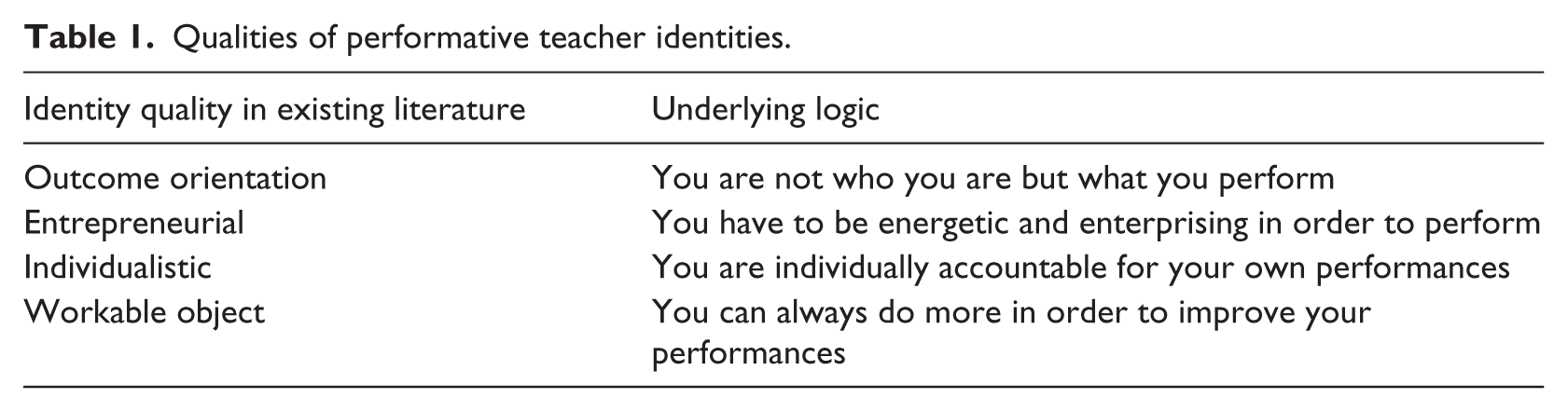
One such quality relates to an overall focus on (improved) outcomes (cf. Lyotard, 1984). Regardless of whether such outcomes refer to the number of pupils passing a particular course or the ranking one receives in a pupil survey, a performative teacher is one who is able to prove herself as a continuously ‘delivering individual’. That is, as one who is able to provide results and who is willing to go for ‘what works’ (cf. Ball, 2003; Collinson, 2003; Jeffrey and Troman, 2011).
A second quality often referred to in the literature relates to the entrepreneurial self. A quality which stresses the need to be, for example, enterprising, striving, and risk-taking – traits which will not only allow the teacher to perform as an individual but also to validate herself in comparison with competing others (cf. Anderson and Cohen, 2015; Collinson, 2003; Stoten, 2013). Third, and related, a performer also has to nurture her individualistic qualities. The premise is that the neo-liberal performative discourse individualizes. It endows the individual with increased forms of freedom, of autonomy, and of possibilities of individual choice. However, performative discourses also restrict as much as they liberalize, through providing performative ideals. Ideals which the individual, despite their often-unattainable characteristics, is assumed to rely on through being, for example, enterprising and risk-taking. Put differently, in a performative society there is no one else to blame but yourself (cf. Knights and Clarke, 2014). A final, and related, quality concerns the individual’s overall adaptive ability. That is, in order to be(come) an entrepreneurial and delivering individual, the performer has to conceive of herself as a workable object; as something that is malleable and formable; as something that is adaptable to the performative demands. Even to the extent that one is prepared to show important others what they want to see (Jeffrey, 2002), through ‘fabricating’ and displaying a particular version of self (Ball, 2003).
Performative technologies as mediators of teacher identities
What then is it about the performative technologies that make teachers develop and nurture such qualities? A general answer in the literature is that in a performative society respect is earned, social acceptance is secured, and self-esteem is achieved when people are able to prove themselves in and through the language provided by such technologies. Put differently, it is suggested that when being exposed to performative technologies people have a tendency to, over time, come to recognize, talk about, and evaluate themselves and others in and through such a language. But then again, why are individual teachers willing to conform to such ideas? We suggest the literature provides two main answers to this question, reflecting two mechanisms that enhance the willingness to conform.
The first answer is well-rehearsed in the critical educational literature and refers to the kind of (potential) visibility that performative technologies engender. In particular, a number of scholars have drawn upon Foucault and his discussion of Bentham’s architectural design of a prison in terms of a ‘panopticon’ to suggest that performative technologies may indeed create a form of ‘complete visibility’. The premise is that in Bentham’s prison the cells were arranged in such a way that the total interior of every single cell was observable from a single watch tower. Under such an architectural figure, Foucault (1977) suggests, visibility becomes a trap; the observed is seen but cannot himself see; he becomes the object of information but not a part of communication. Surveillance becomes permanent in its effects even though it may be discontinuous in its action (Foucault, 1977: 201). Under such arrangements, the observed will, it is argued, become reflective and disciplined.
Transferred to the educational arena it has been suggested that the use of classroom observations, open learning spaces, pupil surveys, etc. help to bring about such a mesmerizing gaze, whereby the daily work of teachers becomes increasingly visible and available for public scrutiny (Helgøy and Homme, 2007). A development that tends to make teachers more aware of who they are and increasingly attentive to the particular format and values cherished by such technologies (e.g. Perryman, 2006).
This brings us to the latter strand of arguments, namely that performative technologies have an ability to elicit our ‘entrepreneurial self’. This strand adds to the former through highlighting the particular format by which performative technologies construct the world. The premise is that performative technologies not only render visible particular people and their activities, but do so in a particular format; a format that de-contextualizes, reduces, and simplifies (e.g. Møller, 2009). In the words of Jeffrey (2002), it formalizes and categorizes in ‘little boxes’. It focuses on pre-determined targets according to the logic of ‘one size fits all’; it narrows the goals of education and the assessment instrument by which such goals are evaluated; it visualizes and translates the complexities of professional work ‘into a generic form’ (Helgøy and Homme, 2007: 234; see also Mockler, 2011).
An important reason for doing so is that such a format – especially when educational settings are turned into numbers – eliminate all those contextual specificities that make comparisons difficult. Performative technologies make work achievements commensurate with each other. Regardless of whether, for example, a pupil survey concerns a course in mathematics or psychology, a first year or a final year course, its results may always be compared to those received in other contexts. They may be aggregated, differentiated, standardized, and normalized. Such further transformations of the results, in turn, constitute an important part of the performative logic since they not only allow for different times and spaces to be linked to each other (cf. Latour, 1999), but also for competition to emerge. Competition presumes something to compete on, and once aware ‘that we can become more than we were and be better than others’ (Ball, 2003: 218–219) that condition is fulfilled. A condition that through the work of performative technologies encourages us to be(come) self-managing, striving, enterprising, results-oriented, so that in the end, we may all become competitive.
The story would probably end here if we could ascertain that the introduction of performance technologies would (perhaps after some initial clashes with traditional conceptions of what constitutes a teacher) bring about a reflective, disciplined, results-oriented, and enterprising professional teacher. Whether this is the case is, of course, an empirical question. But furthermore, and perhaps more importantly, even if performers are ‘created’ through performance technologies, one may also argue that even though we can point to the general identity features of performers, it is not necessarily the case that the qualities of the performer (see Table 1) are enough to finally define his or her identity as a working professional. That is, since human beings, in this case performers, must reconsider themselves in relation to the ideals that they strive to attain, the final result and components of their identity construction must not necessarily imply that the technologies give final guidance that implies a clear and fixed identity construction. It is human beings (i.e. the performers themselves, but not the systems or technologies) that construct their identity (Katsuno, 2016). Even if they accept the relevance and legitimacy of the technologies as a foundational ideal of their professional work, the final answer to who they are (the identity issue) has not been given. For this reason, the question of how and why performing teachers construct their identity remains an open question that should be answered empirically, and not just assumed based on the supposed qualities of the performing teachers or the performative technologies (cf. Leonard and Roberts, 2014). The paper now turns to this empirical task.
Research methods
Research context and design
The field work reported here is part of a larger research programme that aims to further our understanding of how the teaching profession is reconstructed against a background of increased individual and collective evaluation and assessment of teachers’ work. In the project, a large number of Swedish primary and upper secondary schools are studied primarily by means of interviews and archival data, but also via a questionnaire. In this particular paper, we explore parts of the collected material, namely that which originates from one of the independent upper secondary schools (here referred to as Fungor).
Considering our overall purpose to explore how teacher identities become constituted in and through performative technologies, we became particularly interested in Fungor after having conducted an initial interview with the principal in September 2014. In Fungor, the use of performative technologies seemed both extensive and thorough. In fact, the principal vividly and enthusiastically told us about all the means by which she could manage the teachers, ranging from individual meetings for planning and evaluation to classroom observations and pupil surveys. She also testified to a general need for teachers to ‘put themselves on display’; ‘you have to dare to look at yourself, to scrutinize yourself’ and if you are not ready to do that, ‘perhaps you shouldn’t work here’.
Based on this, we asked and were permitted to interview a number of teachers on how they perceived that they were affected by the fact that their teacher performances seemed so extensively visualized and evaluated.
Data collection
During 2015, all in all ten people that were either working at the school or had recently worked there were interviewed, including the principal and the assistant principal. Although the number of interviewed staff is limited, one should bear in mind that the total number of people working at the school does not amount to more than around 25 (see below). Two researchers were present during all interviews and each interview lasted approximately one hour. They were all recorded and transcribed.
Apart from interviews we also had access to a large number of documents and archival data. Of particular importance were all those documents that materialized the performative technologies per se. For example, we had access to the pay policy and related performance-related pay criteria, various course evaluations and pupil surveys, templates for classroom observations, and also, to more general school documents such as job descriptions and quality reports.
Data analysis
The analysis of interviews and documents was ongoing all through the duration of the case study (cf. Troman, 2008). On the one hand, this allowed us to bring an initial literature-based understanding to the field, whereby we could define a particular interest, and based on this, focus our interviews on themes related to teacher identity and performative technologies. However, on the other hand, an ongoing analysis also allowed us to gradually reflect upon, and even redefine the field as we came to experience it, especially when empirical insights did not seem to match our pre-understandings. For example, it was through such an ongoing reflection that we became interested in the notion of performance evaluation uncertainties. The premise was that while our pre-understandings built upon the idea that performative technologies mainly reduce uncertainty through transforming a complex world into a de-contextualized and simplified format, they seemed to add other forms of uncertainty to our interviewees.
When this emergent empirical insight was made during one of the early interviews we went back and re-read the few interviews already conducted. And, as the re-reading gave us reason to further explore this emerging theme, we also made sure to more thoroughly penetrate it during the remaining interviews.
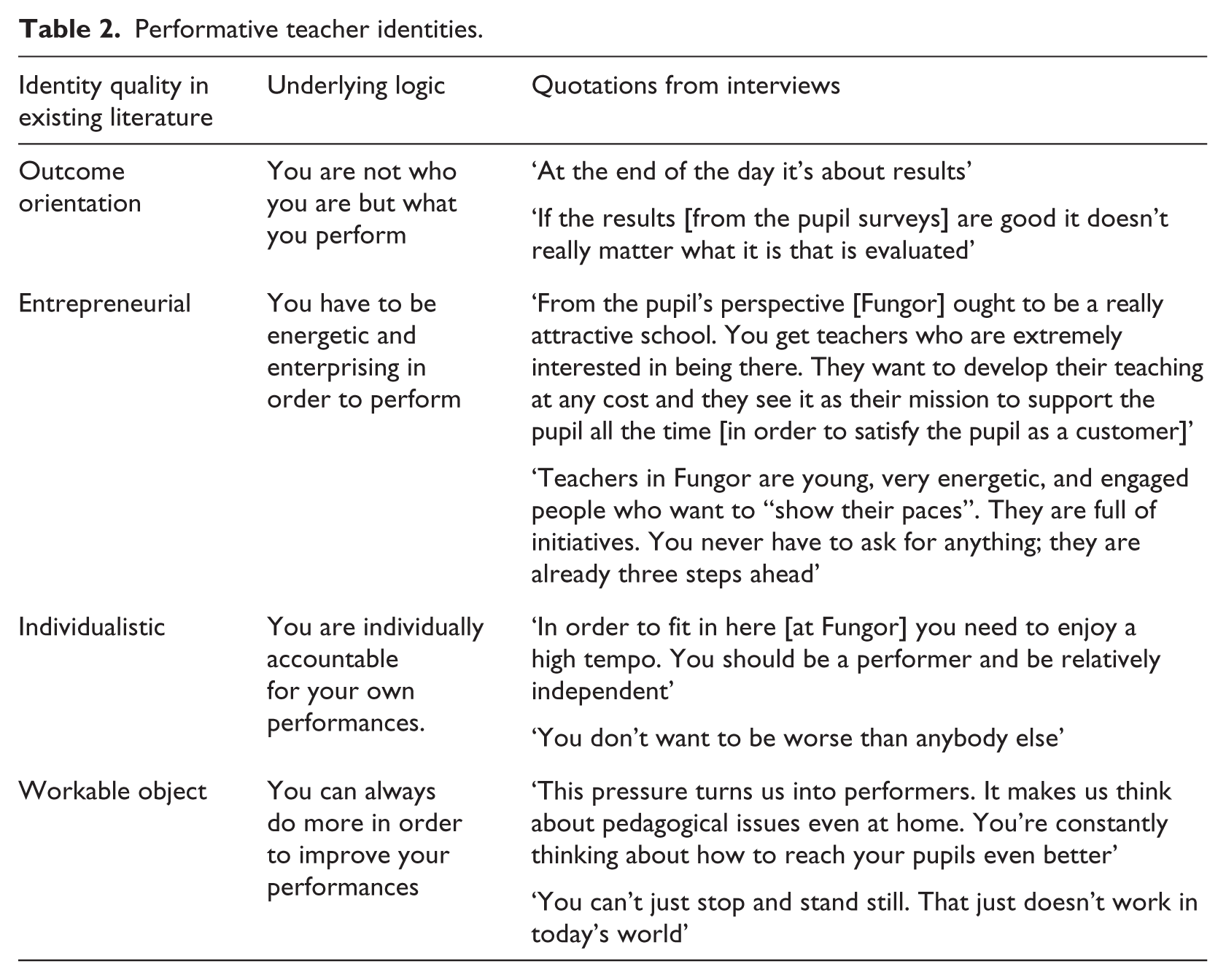
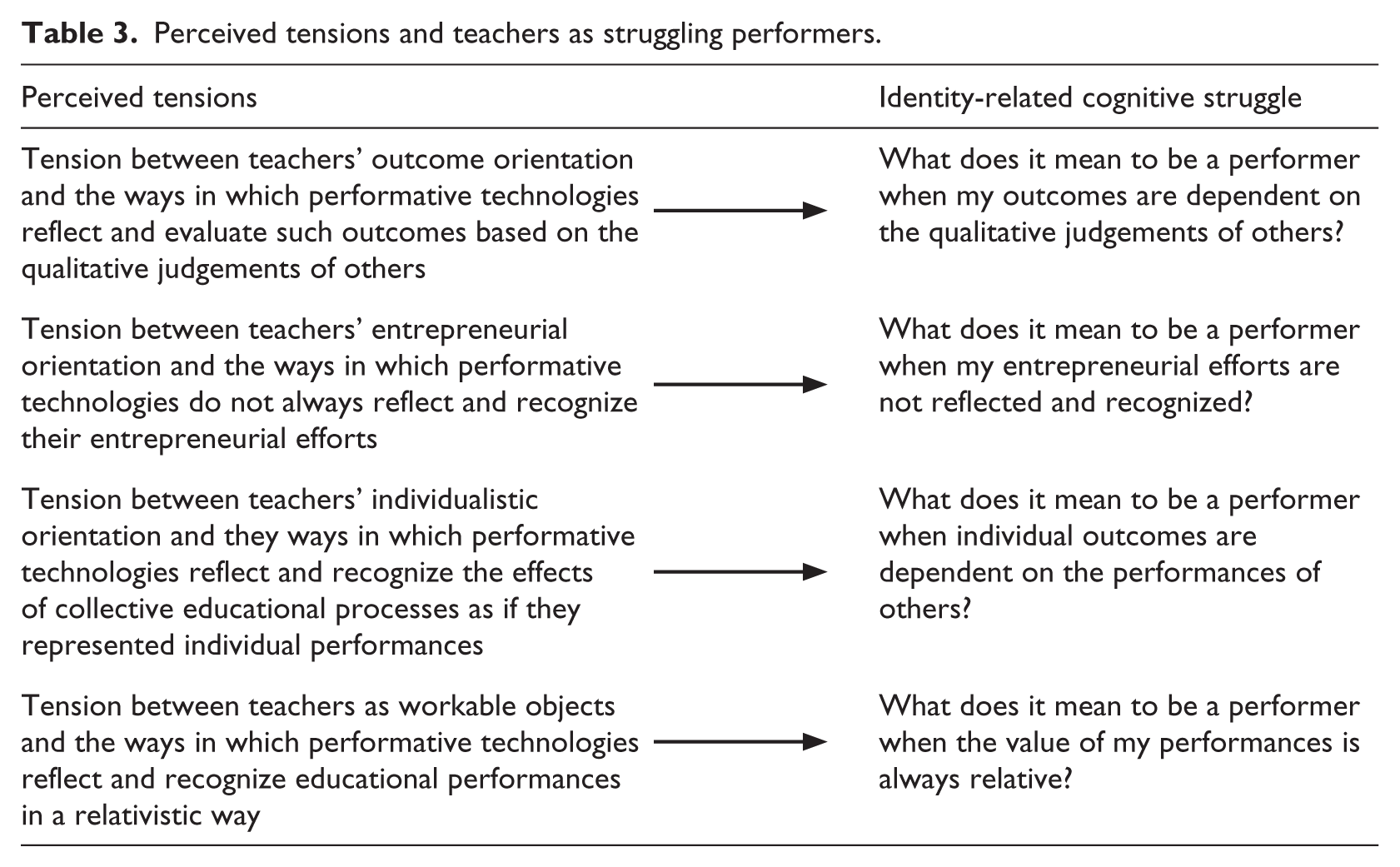
After having collected all data we conducted a more systematic analysis of the material related to the focal theme of this paper. Basically, this analysis could be seen as a two-step procedure. First, the empirical material was analysed to establish empirically the existence of performers. As noted previously, the mere use of performance technologies does not necessarily imply that people in organizations become performers. The result could be clashes, resistance or mere disinterest. The empirical material confirmed, however, self-descriptions in line with the four performative identity qualities identified in the literature (see Table 1). For each of these four qualities, an underlying logic was identified and substantiated with interview material (see Table 2). Second, using the same four identity qualities as analytical nodes and given that the teachers could be identified as performers, four different performance evaluation uncertainties were identified together with four corresponding identity-related struggles found in the empirical material (see Table 3). This second level analysis made it clear that the teachers articulated a number of uncertainties and cognitive tensions associated with these uncertainties. These tensions warrant us to draw conclusions about the problematic identity construction of the professional teachers, who were finally defined and understood as struggling performers.
Performative teacher identities.
Perceived tensions and teachers as struggling performers.
Background and context to the empirical findings
The growing performance orientation of the Swedish school system
In the last decades, the school system of Sweden has undergone substantial reform and change. Most notably, a number of reforms in the 1990s changed the traditionally centralized and regulated systems (see Stenlås, 2009; or Lundahl et al., 2010 for a thorough account of these reforms). The state was replaced by municipalities as the principal organizer of public education, implying strong decentralization of the school system. Since the early 1990s, teachers in the public-school system have been employed by local municipalities rather than the state. Free school choice was introduced in the 1990s, and a new voucher system made it possible for private school organizers to establish themselves as alternatives to the public education organizers. From a governance perspective, management by objectives was introduced as a central principle replacing the old rule-based system. Along with these general reforms, other reforms have been launched that have changed the field, for example new systems for marking, ongoing changes in the teacher education curriculum, and the recent teacher certification reform, implying that (with some exceptions) only certified teachers are allowed to perform central tasks of the profession (Solbrekke and Englund, 2014).
One aspect of particular interest in this study is how the reforms tend towards marketization of the school system (Holm and Lundström, 2011; Lundahl et al., 2013). Following free school choice and the establishment of a high number of new schools and principal education organizers, a market for school choice has emerged (Erixon Arreman and Holm, 2011; Lundahl et al., 2013). One important reason for this has been the voucher system, implying that schools – whether public or independent (encompassing both profit and non-profit driven private schools) – are paid for each pupil they attract, in principle without any attention being paid to school quality or school performance with regard to, for example, pupil achievements. For this reason, scholars tend to talk about a school market in Sweden (Erixon Arreman and Holm, 2011; Holm and Lundström, 2011; Lundahl et al., 2013; Lundström and Holm, 2011; Lundström and Parding, 2011; Wermke, 2013), where pupils are socialized into a behaviour of consumerism.
General interpretations of how the school system has changed emphasize the logic of accountability as central to schools and teachers in the wake of the reform era (Solbrekke and Englund, 2014). Being held accountable for what one can offer pupils becomes a reality for teachers. This goes hand in hand with extended demands on the teachers’ professional engagement in, for example, the marketing activities of the school, which is one example of how non-traditional tasks, not related to teaching, are challenging the traditional autonomy of the teaching profession (Stenlås, 2009; Wermke, 2013). Another aspect of the threat to autonomy, related to the control and appraisal of teachers’ work, is the rising importance of quality measurement and student voice. Such tools and technologies become an increasingly important aspect for schools, not least for competitive purposes (cf. Page, 2015). Making schools attractive to present and potential pupils (and their parents and others) implies not only ‘offers’ (laptops, free Wednesdays, etc., see, for example, Erixon Arreman and Holm, 2011), but also making the teachers accountable for the perceived quality of their teaching and the results of it. Evaluation of teachers and pupils becomes instrumental in attracting others.
Another, perhaps unforeseen, consequence of the development of the school market is the rise of a small number of large private educational organizers owned by private equity companies that have established themselves as major players in the field. These commercially driven companies control a substantial share of the school market as a consequence of consolidation in the last decades. The focal school in this study belongs to one of these private education organizers. It is an example of an originally small and independent school group (consisting of some 15 schools) that was overtaken by and incorporated into a large profit driven educational organizer. Our focal unit within this group – Fungor – is an upper secondary school that is situated in one of Sweden’s larger cities. Again, the staff list includes some 25 people and the number of pupils is just under 300 (of which 75% are girls). A majority of the pupils follow a vocational programme such as the ‘child recreation programme’, ‘business and administration programme’ or the ‘handicraft programme’. The latter one is the largest by far and includes specializations in hairdressing, hair-styling, and makeup.
Findings
Performance management in Fungor
Performance management in Fungor covered a wide range of technologies and practices. Largely in line with the taxonomy provided by Page (2015), teacher work was visualized and evaluated by various means, including classroom observations, learning walks by the principal, open learning spaces, and pupil voice.
For reasons of space, we will focus on one of these technologies, namely pupil voice. In particular, we will direct our attention to the ways in which pupils were allowed to make their voice heard through formal course and customer satisfaction surveys. The reason for this is twofold. First, such surveys stood out as important technologies in all teacher interviews. Second, the outcomes from pupil surveys constituted one of the criteria for setting performance-related salary rates, which clearly made them a constitutive part of the performative climate in Fungor. We will start out with this latter aspect of the pupil surveys, namely that they fed into the process whereby salaries were related to teacher performances.
A central tenet of Fungor’s salary policy was that there should be no differences in salary due to sex, age, skin colour, sexual orientation, disabilities, nationality, or social/ethical background. Rather, salaries should be based on ‘development, competence, and experience. It is achieved results that should be encouraged in [Fungor]’. Such results were specified in and through nine criteria, divided into two main areas; ‘My role in Fungor’ (which included seven criteria) and ‘Development of the school and our operations’ (two criteria). For each criterion, teachers could be classified as ‘good’, ‘great’, or ‘excellent’ (see Figure 1).

Examples of criteria for performance related pay in Fungor (internal document).
As illustrated in Figure 1, evaluations (of different kinds) constituted one of the criteria based on which salaries were set. In Fungor, examples of such evaluations were course evaluations conducted by teachers on individual courses and a yearly survey among pupils in the form of a Customer Satisfaction Index (CSI). Whereas course evaluations were conducted by the individual teacher and focused largely on providing the teacher with formative feedback for course improvement, the CSI was conducted electronically by an external agency and had more of a summative character. The external agency also compiled and distributed the results to the principal and teachers individually. And as summarized by one of the teachers, such results fed into the performance review: ‘We use these as a basis to review our results at the end of the school year. I go through them and she [the principal] goes through them and then we meet and discuss’. In the two following sections, we will discuss: (a) how the existence, and rather intense mobilization of such performance evaluations contributed towards a performative teacher identity in Fungor, and (b) how uncertainties revolving around the design and use of such evaluations made performances somewhat of a struggle among teachers.
Performative teacher identities in Fungor
We find plenty of evidence of a performative mind-set among the teachers in Fungor. Table 2 provides an overview of the key findings related to the notion of teachers as performers. As suggested in Table 2, teachers reproduced a number of qualities typically associated with a performative identity in the existing literature; qualities implying, for instance, that ‘you are not who you are but what you perform’ and that ‘you need to rely on yourself and your enterprising qualities in order to perform’.
One particular part of the teachers’ performative mind-set that became abundantly clear during the interviews was their distinct outcome orientation (cf. the first identity quality in Table 2). That is, regardless of whether they talked about the school, the pupils or themselves, it was evident that they had a clear focus on (improved) outcomes (cf. Lyotard, 1984). A focus that typically revolved around an assumed reciprocal relationship between their own performances and those of their pupils, according to the logic ‘if I perform well my pupils will too, and when they perform well it will be to my (and my school’s) benefit’.
For example, related to the pupil surveys referred to above, one teacher suggested that ‘sure, it’s a lot of evaluations, but I really like the pupil survey because there you get the final result; are they happy or not?’, while another one said that ‘I think it’s good that we have these evaluations. They ensure that everyone looks for progress since you know that there will be an evaluation in the end’.
Linked to such an outcome-orientation, the interviews with teachers also suggested that other qualities associated with a performative identity were being reproduced (cf. Table 2). That is, it was clear that teachers in Fungor were not just passively awaiting the outcomes of such pupil surveys – hoping for ‘the best’. Rather, almost all teachers testified to a general ‘performance culture’ in which the individual teacher had to be energetic and enterprising in order to make a good teacher in Fungor. Or, as phrased by one of the teachers: ‘I don’t think that Fungor has ever recruited a teacher that wasn’t a highly competitive person’.
The principal, and also the formal job descriptions, corroborated this assertion. In fact, it seemed to be an important strategy to recruit teachers who were not only focused on results, but also prepared to develop themselves and their entrepreneurial traits. Part of this strategy seemed to be to recruit ‘young and hungry’ people who had a background in sports (on elite level), for two main reasons. First, and as suggested by the principal, teachers in Fungor had to be prepared to put themselves on display. The ‘former athletes’ were used to this type of scrutinizing from their sports careers, and hence, were used to finding ways to make it to the team. Second, and related, this was also a category of people that would – allegedly – be best placed to adapt to the requirements from both pupils and school management.
Being an independent individual was considered another important quality in order to obtain results in Fungor (see Table 2). That is, and as suggested above, individual teachers clearly felt a pressure to compete in relation to their colleagues in order to not ‘be worse than anybody else’. Hence, and as suggested by the principal’s indication that ‘the school isn’t stronger than its weakest link’, the individual had to put her own house in order if she wanted to be promoted or receive a pay rise; that is to say, if she wanted to secure a sense of self as a performer. The existing performance management practices also encouraged such an individual orientation. Hence, it was clear that the performer not only had to nurture her energetic and innovative qualities but also to put herself as an individual in the first place. And, linked to this, the performer also had to conceive of herself as a person who is willing to constantly improve; as one who is willing to be progressively ‘efficient’ (cf. Ball, 2003; Collinson, 2003; Jeffrey and Troman, 2011).
To summarize and conclude thus far, we find plenty of evidence of a performative identity among teachers in Fungor. The use of performative technologies had arguably become a normalized aspect of their daily work, and they clearly reproduced the language and logics underlying these technologies.
Performance evaluation uncertainties and teacher identities in Fungor
While teachers in Fungor clearly had a performative mind-set, we also find that the reproduction of performative identities in Fungor was associated with a number of cognitive struggles that teachers had to deal with as they aspired to perform. Generally speaking, such cognitive struggles seemed based on the following (empirical) premises. First, when you are a performer, and hence, derive a sense of self largely from how (others perceive that) you perform, it becomes highly important how your performances are represented and recognized by performative technologies. Second, any uncertainties related to such representations and recognitions will typically provoke cognitive tensions as you want to perform but become genuinely uncertain how to do so, when you did (or did not) perform, and/or why you did (or did not) perform well. Third, such cognitive tensions may fuel a number of identity-related questions such as what it really means to be, for example, ‘outcome-oriented’ or ‘individually accountable’. That is, rather than foster the emergence or reproduction of performative identity qualities per se, the experienced tensions may give rise to a number of introspective questions related to such qualities, thereby turning the realization of a performing identity into a cognitive struggle. In this paper, we depict such struggles of what it means to be a performer in a performative culture as a particular type of performative identity; the struggling performer.
Table 3 summarizes these findings. As suggested by the left-hand side of the table, the performative technologies may produce uncertainties related to each performative quality of a performative identity, thereby giving rise to (at least) four different tensions. And as suggested by the right-hand side of Table 3, these tensions may propel a number of identity-related questions. Importantly though, before going into details it should be noted that the different performance evaluation uncertainties are not necessarily independent of each other. Rather, they reflect different aspects of one and the same phenomenon, namely teacher performances, and hence may be related and to some extent even overlapping. For analytical reasons though, we present and discuss them separately below.
If we start out with their outcome-orientation, this quality suggests that teachers will value visible and tangible outcomes. Related to this, we identify a first type of perceived uncertainty among teachers; an uncertainty that is rooted in the ways in which performative technologies reflect and recognize such outcomes based on qualitative judgements made by others, where such judgements are largely beyond the control of the individual teacher. For example, when it came to the pupil surveys referred to above, it was largely up to the pupils and their ‘whims and wills’ to establish and evaluate the performances of teachers. In a similar manner, the criteria used for classroom observations and wage discussions had to be construed by someone, typically the principal, thereby leaving room for rather open ended and qualitative evaluations of outcomes.
This judgement-related dimension of performance representation and evaluation made the process highly unpredictable to the teachers, since they felt that there were many different aspects that could affect the discretionary judgements of the pupils and the principal; aspects that were not necessarily related to the individual teacher’s performances per se. As suggested by one of the teachers, ‘you never know what you will get [in the pupil surveys]. They can come up with just about anything at all’. Or, as suggested by another teacher when talking about what affects the pupils when evaluating teachers, ‘I mean they are controlled by their emotions like any human being. The difference though is that you and I can control our emotions because we’re adults and we can control our thoughts in a different way than the pupils can’. And importantly, based on the performer’s genuine interest in the actual outcomes, this type of unpredictability clearly gave rise to perceived tensions which, in turn, resulted in reflections related to what it meant to be a performer. To illustrate, consider the following reflection from a teacher, when talking about the pupil survey.
It was really pressuring as these [i.e. the pupil surveys] were used as a basis for our salaries. And I mean, based on these, they also picked out three teachers per school who were nominated to the pedagogical award [of the group]. And if you were nominated this would also affect your salary. But if you’re working with a vocational programme, where the pupils want to become stylists or hair-stylists or if they’re taking the handicraft programme, it will probably be a lot easier to teach things like make-up, hair dyeing or hair cutting. At least a third of the pupils haven’t passed the X course from secondary school. So, as a X teacher, I won’t have the same chance to reach these pupils in class. It will be a lot harder for me to get their approval. And still, they were the ones who would answer questions like ‘does your teacher have the ability to involve you in class?’, ‘does your teacher inspire you?’and ‘is your teacher competent in the subject that s/he teaches?’
And, when asked about how that made you feel as an individual teacher, she continued:
Well, it’s not very motivating. When you’re competitive as a person it’s like fighting with one hand on your back. […] When you feel that you’re doing the job as well as anyone else or even better, but your colleagues are paid more because it’s easier for them to reach the pupils, then it gets really frustrating. […] You have to care about the outcomes because otherwise you’ll fall behind salary-wise, but you really start wondering whether these are the aspects that should be allowed to affect our salaries.
A second, and related, type of perceived performance evaluation uncertainty that (through the tensions it produced) seemed to give rise to cognitive struggles could be referred to the entrepreneurial identity quality. Unlike the first type of uncertainty which emphasizes the many aspects that seem to affect those that make the qualitative judgements of outcomes, this type of uncertainty is premised on the ways in which the performative technologies under study are sometimes perceived not to reflect the individual teacher’s efforts underlying such outcomes. In fact, despite that the performative technologies (such as the performance-related pay criteria) explicitly encouraged teachers to be enterprising and inventive, teachers experienced that the performance evaluation practices failed to account for such activities. As suggested by one of the teachers: ‘every year I reflect upon all the things I have done as a teacher. I write almost like a novel that I hand over to the principal. And she says that all my efforts should affect the salary, but it is hard to tell. I mean I can’t see what my colleagues get and I can’t see how she converts these [efforts] into my salary’.
An important reason for this uncertainty was that teachers perceived that the performative technologies did not have the ability to ‘sort out’ the efforts of individual teachers from all the other particularities, eventualities, and contingencies that led up to a particular outcome, at least not in a fair way. To illustrate, consider the following quotation from a teacher who reflects upon the problem that no matter what you did as a teacher, it was hard to see whether the efforts ‘paid off’ or not.
We have this overall demand that all pupils must pass, and that’s something that I value as a teacher; I really want my pupils to do well. So I reflect a lot upon how my teaching can contribute towards this. I always try to find new ways of teaching and new examples in order to facilitate their learning. But it is not always that the outcomes reflect this [i.e. all the things that I do], and that can be frustrating. You want to achieve so much but then you feel, well, why isn’t it working [i.e. why don’t my efforts pay off]? And when you feel stressed and you cannot devote any more time than you’re already doing, then it becomes really tough. […] You know that you’re working hard, but still you wonder whether you’re doing enough. For example, I’m currently mentoring a pupil with some social issues, and s/he texts me every night to tell me whether s/he will show up next day or not. And I’m really struggling with this feeling; could and should I do more for this particular pupil? I feel that I can’t answer every night, at least not when the messages come rather late. And yet, I feel this inner conflict.
Hence, although teachers were both allowed and encouraged to find innovative ways of ‘reaching their pupils’ (including various efforts to secure that they looked good in the surveys), teachers problematized the extent to which contextual aspects allowed each and every one to convert such innovativeness to actual outcomes, and also, the extent to which performance management practices really valued such innovative activities. Taken together, these prerequisites seemed to give rise to frustration and feelings of injustice; feelings which, in turn, turned efforts to secure a sense of self as a performer into a struggle. For example, this was evident when one of the teachers reflected upon how the judgement-related issue (i.e. the first performance evaluation uncertainty in Table 3) also meant that it became unclear how her actual efforts were reflected and recognized in the outcomes.
Some had tougher subjects than others. That really affected the evaluations. I can give you an example. In 2011 I met a pupil that had a real phobia for my subject; for real. I mean I meet pupils all the time that don’t like my subject, but this time it was a real phobia. She broke out in cold sweat and felt sick. She was ill as soon as she entered the classroom; as soon as she saw me. I mean, she didn’t know me but she knew that I was a X teacher. It was all part of her history; she had had some really bad experiences. And she was going to evaluate me! I had to spend hours just talking to her. I had to ‘prepare’ her; make her realize that I was there for her; that I wanted her to succeed. She thought I was her enemy, and she was going to evaluate me. Just because I was a X teacher I was going to get a bad evaluation. That’s not really fair. There were lots of situations like that; you’re an ambitious person who just wanted the best for the pupils but you just could not reach them. You represented a subject that the pupils experienced as tough and just because of that you would have a bad evaluation. It makes you sad really. You could get really tough comments; ones that weren’t really linked to teaching but to you as a person. ‘Don’t wear those ugly trousers’. Completely meaningless comments, or that ‘you need a better haircut’. Obviously, that kind of comments do not reflect the teaching as such.
A third and related type of perceived uncertainty could be linked to the individualistic identity quality, and emphasizes how the (lack of) efforts from others may affect the outcomes of a particular teacher. In contrast to the second type of uncertainty then, the problem here relates not so much to whether or not the performative technologies actually reflect the efforts of an accountable teacher, but rather to how they portray outcomes as if they were the result of individual endeavours when, in fact, they are the result of collective performances. Arguably, under such circumstances, teachers may typically be left with feelings of uncontrollability since the boundaries of a particular outcome go well beyond the individual teacher. And importantly, when you consider yourself (and also want to be perceived as) a performer, such feelings of uncontrollability will typically give rise to tensions which, in turn, provoke cognitive struggles.
To illustrate, consider the following quotes from two teachers. In the first quote, one of the teachers reflects upon how her deep and extensive engagement with pupils was pushing the limit of what she was capable of, and still, she felt dependent on others to reach the sought-after outcomes. In the second one, another teacher reflects upon how her performances are dependent on the will of the pupils to be ‘part of the game’. Clearly, in both cases, such tensions leave the teachers with essentially irreconcilable thoughts, and hence, turn the reproduction of a performative identity into a struggle.
What can I [as an individual teacher] do to make these pupils [who do less well in their studies] more engaged? I think we need to reorganize; we need better cooperation [between different actors within the organization]. The school counsellor needs to be involved too. Not that I can’t establish good relations with the pupils; that’s one of my strengths I would say. I care about the individual. I see the whole individual, but that’s part of the problem. It really affects me personally. I feel for them [i.e. the pupils who do less well in their studies] and I really want the best for them, but still, I want to carry out my teaching also for those who don’t have problems. Make sure that they are motivated, push them, give them challenges, make sure that they receive feedback. But time doesn’t really allow me to do that when these social aspects take most of my time. As long as I have the pupils in my classroom I know that I can help them reach their grades. But if they’re not in the classroom […], well, then I can’t really help them in the same way. Sure, I could try to call them, but that’s not really part of my job I would say; to track them down if they’re out doing other stuff in the city-centre. But as long as I have them in my classroom then of course I can help them.
Such uncertainties then, are typically grounded in the ways in which the performative technologies in use individualized performances regardless of the extent to which the individual teacher could indeed ‘control’ such performances. A condition which seemed to produce a form of ‘inner stress’ by those teachers who felt that they were not ‘competing on equal terms’.
A fourth and final type of perceived uncertainty relates to the ways in which performative technologies contribute to reflect teacher performances in a relative rather than absolute way. This is premised on the ways in which performative technologies de-contextualize, reduce, and transform what goes on in educational settings into a format that allows for comparisons to be made (e.g. Miller and Power, 2013). Comparisons that allow teacher (and other) performances to be related to the past, present, and future, thereby making individuals aware that they are ‘better or worse than they used to be’, that they are ‘performing better or worse than a competitor’, and above all, that they ‘can always do more’. That is, performative technologies not only allow for single performances to be related in time (i.e. to past and future performances) and space (i.e. to the performances of others), but also to the ideal. An ideal that in many cases is unattainable or at least impossible to sustain over time.
From a performance management perspective, such comparisons (not least to the ideal) are pivotal as they materialize the possibilities; the potential; the unfulfilled. They display to the performer that there is always room ‘to improve, to be better, to be excellent’ (Ball, 2003: 220). In short, they construct the performer as a workable object; as something that can and should be worked upon. Importantly however, as such relativizations of teacher performances materialize the tension between ‘actual’ and ‘potential’ (or wished for) performances, they may also give rise to cognitive struggles. That is, they may leave largely outcome-oriented teachers with feelings that no matter how well they perform it is never enough.
This dual character of comparisons was manifested in different ways by teachers in Fungor. One telling example may be taken from a one-day workshop organized to define the mental boundaries of ‘good enough’. That is, at the time of our study, the members of staff had just had a workshop where they discussed what could (not) be expected from them. The reason was that it had become an organizational fact (among teachers) that ‘good enough’ was no longer good enough; a fact that had resulted in a number of sick leaves and arguably also contributed to the high staff turnover. As explained by one of the teachers: ‘We’ve just had a whole day where we tried to reach an agreement on what is “good enough”. What we actually need to do and what is just a bonus if we do. We’ve had a really hard time finding a balance there. I think it’s very much related to the individuals working here, the core teachers, the ones that new teachers adapt to. But it’s really important that our ambitions do not escalate in absurdum. At the end of the day we need to keep our health”. Such mixed emotions regarding how far the teachers were able and/or willing to push themselves were also displayed in other ways. As suggested by another teacher: ‘Sometimes you feel this inner stress that you constantly need to improve even though you’re already doing alright. Sure, you can always get better, but perhaps it would be better if you could stick with the things you do for a while instead of looking for improvements all the time’.
Arguably, this points to another aspect of the uncertainty surrounding the performative technologies, namely how performative technologies relativize particular performances through relating them to other performances in time and space and also to the ideal. Arguably, such relativizing fuels the inexorable pressure to perform, and hence, to conceive of the self as an object that needs to be worked upon; to be developed; to be improved. Importantly, however, due to the uncertainties revolving around such ‘continuous improvements’, they also give rise to questions regarding what it means to be a performer, as suggested by one of the teachers; ‘all these demands, they make people ponder over how much they are prepared to do’.
Taken together, these findings largely corroborate a widespread idea in the extant literature, namely that performative technologies tend to turn individual teachers into performers (Garland and Garland, 2012; Jeffrey, 2002; Troman, 2008). Interestingly though, they also extend previous findings through providing insights into some of the complexities involved in actually upholding a performative identity. In fact, our findings strongly suggest that the reproduction of a performative identity is no straightforward task, but rather may involve substantial cognitive struggles, even to the extent that we may talk about a particular type of performative identity; the struggling performer. A teacher identity which on the one hand gets its shape from the identity qualities of a performer, and on the other hand from all the cognitive struggles it takes for a performer to handle essentially irreconcilable thoughts in the ongoing pursuit of a sense of self.
Discussion
This paper engages with and elaborates on the idea in the extant literature that an increased reliance on performative technologies in schools not only affects what teachers do but also who they are – i.e. their identities. In accordance with large parts of this literature (e.g. Ball, 2003; Jeffrey, 2002; Troman, 2008) we find that performative technologies may clearly turn teachers into performers.
Arguably though, we also add to this stream of research through elaborating on how performance evaluation uncertainties are involved in producing a particular type of performative teacher identity; the struggling performer. In short, the findings presented above suggest the following. First of all, we identify four different performance evaluation uncertainties revolving around how performative technologies often (but not always) reflect and recognize teacher performances; (a) based on qualitative judgements, (b) in a way that fails to take into account their entrepreneurial endeavours, (c) in a way that depicts essentially collective effects as individual performances, and (d) in a relativizing way. Secondly, we conclude that when performative teachers – i.e. teachers who want to be (perceived as) high performers – are subject to such uncertainties they typically experience cognitive tensions. Such tensions then, are the result of the fact that teachers with a performative identity value being perceived as performers but, because of the performance evaluation uncertainties, experience that they do not (know how to) achieve that or struggle to understand why they did (not) achieve that. Third, and finally, our findings suggest that ongoing experiences of such tensions will trigger various identity-related questions revolving around what it means to be a performer, thereby turning the reproduction of a performative identity into a cognitive struggle.
Arguably, these overall findings suggest three main contributions to the literature on performative technologies and teacher identity. A first contribution relates to the identification of four different uncertainties associated with the performative technologies as such. The premise is that these uncertainties provide further insights into the ways in which performative technologies relocate issues of subjectivity and complexity. Again, a common belief in the extant literature is that performative technologies decontextualize educational settings (Møller, 2009) and re-present them in rather narrow, generic, unidimensional, and superficial ways – often in the form of numbers (Dahler-Larsen, 2014; Helgøy and Homme, 2007; Jeffrey, 2002; Troman, 2008). Moreover, it is often emphasized that such numbers are evaluated by means of comparisons with pre-determined targets, so that the success of individual schools and teachers may be judged in terms of how well they conform to previously determined criteria (Jeffrey, 2002; Perryman, 2006). This is a process that, at least when looked at from a distance, appears to accord objectivity, neutrality, and rationality to things that would otherwise appear to be highly subjective (cf. Ball, 2003; Clarke, 2013).
A closer look at how such re-presentations of teacher performances are produced and reproduced though suggests that neither are issues of subjectivity resolved by seemingly objective performative technologies, nor are issues of complexity dissolved by seemingly simplifying technologies; they are merely relocated. That is, they are relocated from the professional teacher(s) to the ones bringing the performative technologies to life. Arguably, our findings put the finger on two such relocations. First, they show how, regardless of teachers’ own perceptions of what constitutes ‘good teaching’ or ‘teaching quality’, such elusive concepts are typically pinned down in and through a number of performative technologies (such as the pupil surveys focused in this paper). That is, what is seen as ‘good teaching’ is to a large extent stabilized and materialized in the forms constructed by others (e.g. the principal or school management), and filled out by yet others (e.g. pupils and parents). Importantly however, while such forms may revolve around a number of decontextualized and pre-determined questions/criteria, issues of subjectivity and complexity do not simply disappear in performative cultures. Rather, they are absorbed and transformed by the ones feeding the performative technologies with information, regardless of whether they affirm such subjectivity and complexity or not. Second, they are also absorbed and transformed by the ones who mobilize the result of such processes, i.e. the performance information per se. That is, even though performance information may be seen as decontextualized in the sense that many aspects of reality are lost when actual teaching activities are translated into e.g. a number, new context and new forms of subjectivity are typically added as different actors try to render such information meaningful and act upon it.
Taken together then, the identification of four different uncertainties related to the performative technologies as such problematize the view of performative technologies as producing ‘generic’ information whose content is ‘pre-determined’ and determines the success of individual teachers and schools. The reason is, we argue, that it is not the performative technologies per se that make certain things stand out and count, while others are obscured. Rather, what comes to count is typically constituted in and through the complex and ongoing social processes whereby elusive phenomena such as teaching quality are transformed from matter to form (e.g. by representing actual teaching activities in and through a number of survey questions) and back again (e.g. through being rewarded with a salary increase due to such survey results). Processes that are largely in the hands of other actors than the teachers themselves, but still, have to be (cognitively) dealt with by the individual teachers if they want to, for example, be promoted or receive a pay rise. Arguably, such predicaments may also help explain why teachers (such as those at Fungor) perceive that performative technologies add to rather than reduce issues of subjectivity and complexity despite their seemingly objective and neutral character.
A second contribution relates to how and why performative technologies tend to bring about certain types of teacher identities. Again, in the extant literature much has been written about how educational reforms underpinned by neo-liberal values tend to bring about a new type of teacher identity; the performative teacher. A teacher that is valued not because of her beliefs, principles, or moral compass, but because of her performances and the outputs she can produce (Ball, 2003: 223; see also Woods and Jeffrey, 2002). A teacher that derives a sense of self less from what she does and more from the results that she achieves (cf. Gendron, 2008). But also, a teacher that struggles with feelings of inauthenticity and meaninglessness (Ball, 2003; Wilkins, 2011). According to previous writings, such feelings are typically premised on the ‘clash’ that teachers are said to experience when squeezed between the neo-liberal values underpinning performative technologies and the values traditionally associated with the teacher profession (whether professional autonomy and judgement or more progressively inspired values such as holism, person-centeredness, caring relationships, etc.). Or more precisely, when teachers experience such a clash, and feel that they are unable to resist the ‘ideological assault’ that performative technologies exert on the very nature and primary intent of school education (Tang, 2011), it is suggested that they will start to question their own practices (Ball and Olmedo, 2013) and the existential meaning of what they do (cf. Knights and Clarke, 2014).
Indeed, our findings also illustrate how performative technologies may invoke feelings of anxiety and insecurity. Interestingly though, in our case, the mechanism of these feelings was not to be found in a clash between neo-liberal and professional values, but rather in the tensions produced by performance evaluation uncertainties. Or more precisely, in the tensions that arose when teachers wanted to perform well, and hence, be perceived as performers, but became genuinely uncertain as to how, when, and/or why they did (not) do so because of the uncertainties surrounding the performative technologies per se. Again, it was not the case that teachers at Fungor opposed the extensive use of classroom observations, pupil surveys or individual pay per se. Neither did they seem to oppose the ideological underpinnings of such technologies; they rather cherished them. What did invoke feelings of anxiety and insecurity though, was the different types of uncertainties surrounding them, as such uncertainties made them struggle as to what it really meant to perform. In contrast to previous literature then, this finding suggests that existential struggles and the individual’s ‘care of the self’, do not have to be grounded in cognitive conflicts and perceived contradictions between traditional teacher values and performative technologies (cf. Ball and Olmedo, 2013; Liew, 2012). Rather, they may just as well be grounded in the tensions produced when individual teachers on the one hand value something, and hence, want to experience and/or achieve that (e.g. to be perceived as performers), and on the other hand, experience that the extent to which they achieve that is reflected and recognized by performative technologies in highly uncertain ways.
A third and final contribution relates to the notion of teachers as struggling performers. Again, the existing identity-oriented literature has provided many valuable insights into the type of teacher identity that an increased reliance on performative technologies in the educational sector may be expected to bring about. For example, Ball (2003) and others (see e.g. Jeffrey, 2002, Jeffrey and Troman, 2011; Sachs, 2001; Troman, 2008) have argued (and also shown) how the performative discourse produces a new kind of teacher: ‘a teacher who can maximize performance, who can set aside irrelevant principles, or outmoded social commitments, for whom excellence and improvement are the driving force of their practice’ (Ball, 2003: 223).
Importantly though, as suggested above, this new kind of teacher identity has been identified and studied largely in contrast to alternative teacher identities. For example, Jeffrey (2002: 532) contrasted the performative teacher discourse with one emphasizing ‘a set of values centred around holism, person-centeredness, and warm and caring relationships’ (see also Woods and Jeffrey, 2002), while Ball (2003: 215) concluded that the performativity discourse requires that teachers ‘set aside personal beliefs and commitments and live an existence of calculation’. In a similar manner, Troman (2008) showed how values of holism, humanism, and vocationalism have been challenged by a new teacher identity; an identity which is more managerial as the responsibilities and accountabilities of individual teachers are transformed. From such a perspective, focus has been on identifying and contrasting particular identity qualities (cf. Table 1), and also, on discussing how the new ‘assigned’ performative identity may (and should) be met by coping strategies, resistance, and fabrication (see e.g. Anderson and Cohen, 2015; Ball, 2003; Jeffrey, 2002; Jeffrey and Troman, 2011).
Yet, what is less clear in the existing literature is what happens when teachers have already developed performative identities and go ‘all in’ in their attempts to secure a sense of self as performers. That is, when they actually identify with notions of aspiration and improvement; when they see themselves as workable objects that need to be continuously improved. As a first step towards remedying this, this study develops the notion of a struggling performer. A notion that focuses not so much on the development of a new identity in contrast to a more traditional teacher identity, but on the ongoing and intentional reproduction of a performative identity in the presence of thoroughgoing performance evaluation uncertainties. A notion that acknowledges that uncertainties associated with performative technologies as such may not only bring about a resistant self (Collinson, 2003) or a ‘cynical compliant’ (Ball, 2003), but also someone who embraces the performative technologies and their ideological underpinnings, but struggles as to what it means to conform. And, not least, a notion that may help remedy some of the concerns raised by Mockler (2011: 517), and others (e.g. Leonard and Roberts, 2014) when they suggest that neo-liberal reforms tend to bring us further and further away ‘from an appreciation and understanding of complexity and uncertainty’ in the educational sector. Indeed, while the notion of a struggling performer is also an example of ‘what works is what counts’, it provides important insights into some of the complexities and uncertainties that teachers have to deal with in order to actually ‘make it work’, even in a performative school culture.
Conclusions
A key conclusion of this study is that although teachers may be largely colonized by the regimes of performativity, such a colonization does not necessarily lead to a clear-cut and secure performative identity. Rather, despite a deep desire to perform, teachers may come to struggle over what it really means to perform; a struggle that our analysis suggests is traceable to the tensions produced by different types of performance evaluation uncertainties. Such tensions, in turn, tend to induce, and/or enforce, individuals’ reflections on what it means to perform (i.e. what is important?), how to achieve a particular performance level (i.e. how should I go about in order to reach what is important?), and what an acceptable performance level is (i.e. what is ‘good enough’?).
Indeed, we certainly acknowledge that our findings are limited to a school strongly characterized by a performance culture, which is possibly a prerequisite of the struggling performers that we identify. However, as performance technologies and commensurate cultures tend to be diffused across school systems at a local and global level, our findings should be relevant also for understanding what it means to be a professional more generally in a contemporary expanding context of individual performance evaluation.
Based on this, we suggest that future research should more than is typically the case today take an interest in the performative technologies as such, and acknowledge the complexities and uncertainties that arguably characterize them. In particular, we suggest that future research needs to ‘unpack’ the rather monolithic concepts of neo-liberal reforms and performative technologies, so that the characteristics and (identity) effects of individual technologies, instruments, and ideas may be further scrutinized. Arguably, the identified performance evaluation uncertainties and the notion of a struggling performer may constitute a useful basis for such further scholarly efforts.
Footnotes
Acknowledgements
We gratefully acknowledge the useful comments of Eva Bejerot, Jonas Gerdin and participants at CEROC (Centre for Empirical Research on Organizational Control) workshops at Örebro University.
Declaration of Conflicting Interest
The author(s) declared no potential conflicts of interest with respect to the research, authorship, and/or publication of this article.
Funding
The author(s) disclosed receipt of the following financial support for the research, authorship and/or publication of this article: We gratefully acknowledge research funding from the Swedish Research Council (grant number 2013-784) and Örebro University.