




Abstract
This article examines how three national curricula for basic education in Finland reflect transnational policy perspectives from 1994 to the present. By developing a conceptual apparatus for curriculum analysis, we examine how national curricula in Finland can be interpreted as modifications of transnational policy transfers shaped by international comparisons in today’s society. Transnational policy has been the subject of numerous studies, but ongoing curriculum modifications of policy transfers across reform periods have rarely been examined. Using a systems theory approach, we seek to understand how curriculum revisions are designed as combinations of conditional and purposive orientations. The most important contributions of this paper lie in its use of a mixture of these orientations, and its demonstration of the particular functions that these orientations play in both facilitating and constricting transnational policy transfer as evidenced by our analytical apparatus.
Introduction
An increasing body of research literature has recently been devoted to the ways in which transnational policies affect national reforms in European countries. Several researchers consider such effects to be the outcomes of traveling knowledge or knowledge processes, in which scientific and future-oriented programs play a vital role (Drori et al., 2003; Ozga and Jones, 2006; Radaelli, 2000). Numerous studies in education research have examined the implications of such policy transfers for curriculum construction and design (Afsar, 2007; Bachmann and Sivesind, 2012; Karseth and Sivesind, 2010; Nordin, 2011; Sundberg and Wahlström, 2012), but few have examined the ongoing translations and modifications of such transfers in relation to the limitations and delimitations of formal curricula.
This article examines how iterations of the Finnish curriculum across three reform cycles (henceforth, “the three curricula”) during the 1990s and the 2000s reflect policy transfer, as informed by comparative research designs used within globalization studies and international assessments. The new national curriculum to be implemented in 2016 has already attracted global attention in social media and research. One issue concerns the way in which school subjects are outlined within the new national curriculum, particularly with regard to the transversal competence areas and the 21st-century skills promoted both globally and within European policy-making (Sahlberg, 2015). Another issue has been the new methods suggested by the new curriculum to organize students’ learning in schools (Halinen, 2015).
The article will demonstrate how the new curriculum was developed as a reformulation of core sections of the preceding curricula. These sections consist of core curriculum components that form a topical structure of curriculum matters, which we term: values and responsibilities; subject matters and aims; organizational guidelines and principles; and evaluation and assessment, and which link policies to practices in schools. However, our core purpose addresses a research problem beyond the Finnish curriculum. By adopting Steiner-Khamsi’s (2013) four-field scheme to identify a transfer of comparative policy approaches and by developing a conceptual apparatus to examine how these approaches are modified by policy programs articulated by curricula, we examine how national curricula can be interpreted as translations and modifications of transnational policy transfers in today’s society. We also consider how such curricula reflect a mix of policy programs that both facilitate and constrict transnational policy transfer. This facilitation is then explained by the limitations of curriculum formulation in relation to its own space configuration; that is, how curriculum formulation allows for policy transfer by, for example, integrating world problems and standards as core themes, each of which has its origin in knowledge which inform comparative studies used to govern education internationally. What constrictions and unlimited boundaries are evident within the policy transition from a curriculum point of view? Which delimitations can curriculum-making pursue as an official statement about national and local conditions for organizing teaching and learning in schools?
This study positions its findings and interpretations within the historical context of two decades of reform, drawing on systems theory to clarify how state authorities revise and restructure their curricula. Thus, the article introduces a concept of systems 1 that will be used to empirically analyze our documentation. We argue that curricula are informed by policy documents developed within both national and international contexts, such as legal documents, white and green papers, formal agreements, assessment results, etc. We also consider this documentation to reflect communication, taken into account when formulating policy in and between different societal arenas. Transnational policies can, for this reason, be recovered by analyzing national documents which are not necessarily developed for communicating within an international policy context (and vice versa). We therefore argue that, through its chosen topics and formulations, national documentation can effectively as a product express transnational policy transfer.
However, first and foremost, we argue that curriculum-making reflects its own institutional logic, which is empirically constructed through a topical structure embedded within local and national histories of curriculum-making. This logic must be taken into account when considering historical reform iterations. We argue that a topical structure that characterizes curricula in several contexts cannot be explained through the impact of generic aspects of transnational policy formation or implementation, although it could potentially be modified by a transnational policy transfer (e.g. by emphasizing certain components over others). Instead, we consider the topical structure of the categories to be a response to problems which must be dealt with in educational contexts, such as: why educate the young generation of citizens? what to teach? how to organize schools and classrooms? and when and in what way can a study course or a learning process be considered as accomplishing certain aims or ends? Answers to these questions are developed through the formulation and use of curriculum documents as guiding instruments in school governance (Gundem, 2000; Westbury, 1998). For this reason, similar constellations of topics can be observed by reading curriculum documents across national contexts.
One of the most important contributions of this study lies in the different mixtures of policy programs identified by our analytical apparatus, which are demonstrated through examinations of the recent curriculum history of Finland. A conceptual distinction between conditional and purposive-oriented programs, as suggested by Niklas Luhmann (1990b, 1995, 2004; Luhmann and Schorr, 2000), serves as a heuristic device for identifying the temporal, factual, and social orientations of formulations and issues within the curricula. Moreover, by clarifying the different ways in which each of these orientations connects to transnational policy approaches, as outlined by Steiner-Khamsi (2013), our study demonstrates how these program orientations modify transitions by playing distinctive roles in both constricting and facilitating transnational policy transfer.
Comparative policy approaches
In education policy and curriculum research, there are different views on how education reforms, including national curricula, transform within a transnational context. On one hand, changes can be considered products of globalization and the global society. For example, Meyer (2006:267) argued against the old celebration of the primordial nation-state and the subordination of the human person within this state, as reflected in the theories of the late 19th and early 20th centuries. Instead, he conceived of the individual person as a member of a global society. This assumption has implications for the ways in which curriculum-making, as an aspect of reform efforts, is expected to converge across geographical borders as a solution to world problems. In political terms, this means reorganizing curricula in local and national contexts to accomplish certain outcomes, such as creating world identities for the sake of the emerging problems and issues on the global policy agenda.
However, on the other hand, changes in educational policy across nations can also be regarded as responses to international demands sparked by the construction and use of standardized comparisons (OECD and Schleicher, 2012). In this case, descriptive measurements and standards are developed to project the future of how schools can improve and be successful within an international policy context. In this respect, assessment outputs are crucial, as they provide the basis on which international organizations make prognoses to foresee risks to be handled. Such prognoses are further elaborated into expectations that specify what can be learned and achieved in schools. Reform efforts both in Europe and globally have approached curriculum development in this way. A core goal in these efforts has been to improve education and make education more efficient and profitable.
Steiner-Khamsi (2013) argues that the two approaches—that is, globalization studies in the neo-institutional sense and international assessment studies, most often informed by quantitative research methodologies—differ in the orientations of their perspectives; that is, systems 2 versus outcomes. This argument rests upon the methodological problem of designing comparative studies, as well as on empirical observations of the ways in which different forms of policies make use of and transfer the comparative perspectives derived from these studies. The practices of comparing different systems according to similar outcomes (DS-SO), as institutional theorists do, and comparing similar systems according to different outcomes (SS-DO), as international organizations and experts do, represent, according to Steiner-Khamsi (2013), diverse strategies, not only in comparative research, but also in relation to how reform policies, as informed by this research, are designed and developed within and across contexts (see Table 1).
Uses/abuses of case-study design in Comparative Policy Studies (Steiner-Khamsi, 2013: 28).
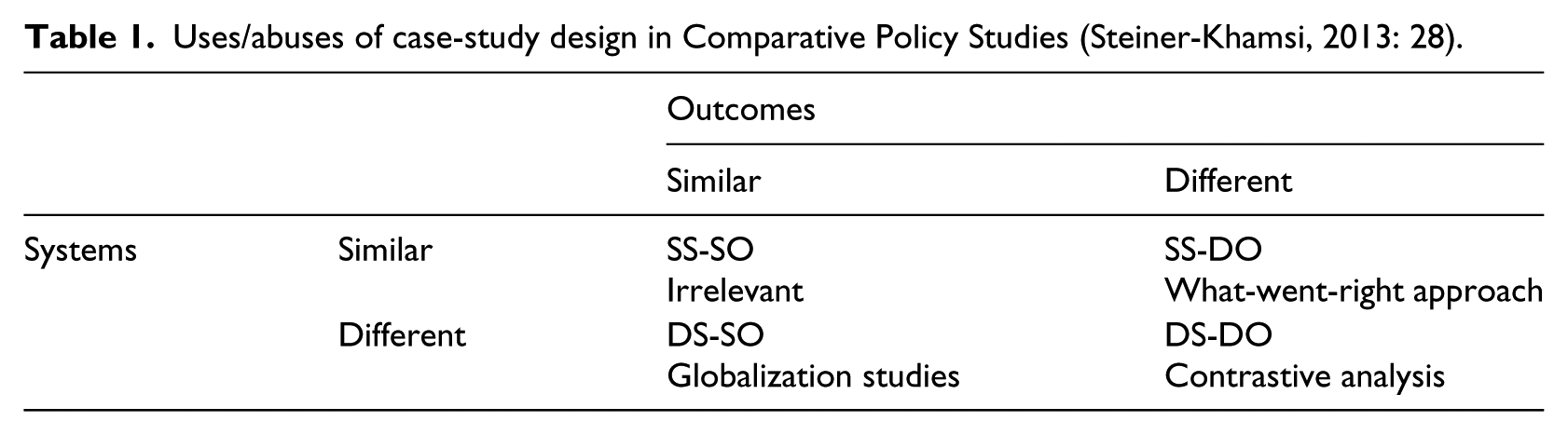
Still, the two approaches operate in tandem, a phenomenon that Schriewer (2003) interpreted as a multiple construction of internationality. His claim that this tandem operation leads to a de-territorialization of education policy does not exclude history as a reference, however, since he argued that constructions and reconstructions of international reference horizons include “historical interpretations of national debates on educational reform to international models, ideas and theory developments” (Schriewer, 2003: 274).
A third approach to comparison, following Steiner-Khamsi (2013), takes as a starting point the idea that state and local authorities are constantly confronted with expectations to create and recreate conditions for education reform. Moreover, according to this perspective, these authorities are in a position to develop their own interpretations and judgments regarding systems, programs, and outcomes. In this case, international comparisons report about differences concerning both dimensions (DS-DO). This perspective also takes as a starting point the view that states and communities are in a position to create their own conditions and achieve different outcomes, a process that occurs more or less independently of globalization processes and which may even conflict with standardizing systems created by transnational assessment policies. Within this perspective, historicizing and, thus, cultural viewpoints are of core significance, since these can be seen as outcomes of curriculum-making processes beyond national and global expression (see Tröhler, 2016, this issue). Steiner-Khamsi (2013) also argued that the fourth comparative research approach—seeing systems and outcomes as similar (SS-SO)—is not an interesting route for comparative analysis and, thus, is neither dominant in transnational policy studies nor used as a device for transnational policy renewal.
We agree with Steiner-Khamsi (2013) that the search for systems predicting the same outcomes independent of cases or contexts is not significant within a comparative research approach or for tracing the impact of such research on policies. However, structural aspects of education systems that are likely to lead to similar outcomes across contexts may still be valid to explain certain features of such systems and their outcomes in a national setting. Here, we are thinking of structural components, such as the legal rules used to regulate schools in particular ways which work out in more or less similar ways independent of cultural contextual variations. For example, the formal rule that children should start school at a particular age is a regulative decision put into effect by law that leads to similar results: almost all children start schooling at the mandated age.
Nonetheless, Steiner-Khamsi (2013) argued that the various research designs that exist are more or less relevant for policy-making, not only as research models, but through locally constructed policy. For example, the SS-DO approach of “What-Went-Right” claims to be generic in the sense that countries can adopt system features from other countries, implying an impetus for policy transfer independent of factual significance. In a similar way, globalization studies can also be influential by creating expectations about world cultures and shared problems as devices for change independent of territorial borders. Contrastive analysis is also relevant for comparison; however, it is not capable of standardizing policies across contexts to the same degree, since delimitations shaped by, for example, formal curricula create spaces for cultural variations beyond national and global boundaries, thus constricting international influences, which can be highly biased by their chosen perspectives. Moreover, following Steiner-Khamsi (2013), who suggested that systems and outcomes are the same, there is no imperative to conduct comparisons of transnational and national policies for adoption.
There are a number of research designs for comparative studies that relate systems to outcomes (see Table 1); thus, there are different options for transferring these designs and perspectives across contexts through education policy.
Our analysis takes this four-field scheme as a starting point to examine how the three curricula implemented in Finland from 1994 to the present have been formulated to reform education by achieving either similar outcomes assuming different systems (DS-SO) or similar systems assuming different outcomes (SS-DO). Both orientations are congruent with transnational perspectives on how to plan for a future in which institutions beyond the realm of national policy are not in a position to formally authorize plans on behalf of their member states. Such institutions are assumed, however, to still be in a position to advocate that the best models and most urgent problems be taken into consideration at the national and local levels.
Thus, we consider the DS-SO and SS-DO alternatives to be expressions of soft governance (Lawn, 2006), encompassing the assumption of more-or-less shared commitments to international decrees, declarations, and frameworks of different kinds (e.g. The European Framework for Lifelong Learning. These documents have an impact insofar as they are adaptable and found relevant within the context of curriculum formulation. Thus, drawing on such commitments and associated expectations, and recognizing the importance of international agreements and comparisons, a national curriculum will adjust to transnational policy and facilitate transfer as far as it is not delimited by any formal or substantial boundaries set out for the policy.
In the next section of this article, we will develop an analytical apparatus to examine how national curricula connect with international policy perspectives to reflect the research and policy approaches mentioned above. As Steiner-Khamsi (2013) noted, the ways in which different approaches to comparative studies resonate at particular moments of policy processes differ. Moreover, we claim that globalizing and de-territorializing policies are modified within national and local reform contexts, which are partly dependent on substantial concerns shaped by delimitations that counteractively interplay with transnational policy intentions and systems. Thus, there are good reasons to study not only the formation of policy as a transnational pursuit, but also how transnational policies are transformed through the formal and substantial translations taking place in local and national reform contexts. We argue, along with Schriewer (2003), Waldow (2012), and Steiner-Khamsi (2012: 14), that this act of translation is a question of both how policies connect to societal subsystems (e.g. economy, law, politics, and education) through communication and how they become coupled through the ways in which they are guided by knowledge and decisions 3 (cf. Luhmann et al., 2013: 28).
Analytical framework: two program orientations
Since our study aims to examine policy transfer not through the ways in which curricula are influenced by external comparative research perspectives, but through how they adopt and modify such perspectives internally within a transnational policy space, we will make use of a systems-theoretical approach. Luhmann (1990b) refers to the ways in which educational communication is structured as “educational planning” or curricula, which we understand as ways of governing conduct by programming communication about teaching and learning in schools. According to Luhmann (1990b: 69), in terms of communication, instructional processes involve very specific forms of action, which are not typical of life in general. Moreover, a curriculum is not necessarily congruent with or reflective of the same realities as systems of instruction; rather, it is communicated as an expression of politico-administrative decisions for school reformation. Thus, this article conceptualizes a formal curriculum as resulting from organizational decisions taken by national authorities through communication about the curriculum within a transnational policy environment.
As policy, curriculum formulation reflects the political ambitions of a welfare state. However, Luhmann (1990b: 68) argued that the welfare state is unstable because “it is faced with a necessity of reacting that it itself creates but cannot foresee, i.e. to the extent that it invokes the competence to compensate for incompetence and to the extent that its measures are absorbed by this.” The problems of pedagogical and social selection, therefore, are not necessarily consequences of the curriculum or its instructional systems, which Luhmann (1990b: 70) sees as expressions of “the hidden curriculum.” Nonetheless, formal educational programs are needed to create stability and change, but they do not necessarily predict or explain success (see also Luhmann, 1995: 207). It is within these limits that a formal curriculum makes sense and other instruments, such as comparative studies, evolve as complementary tools for governance. Nonetheless, through organizational communication, a formal curriculum authorized by national authorities creates structures that connect law, politics, education, and the economy, depending on priorities and selections. This combination, which reflects various codes and themes, is typical of contemporary reform in a state-sanctioned mass education system (Lindblad, 2014). Moreover, through this communication, which is structured by educational topics, various programs are developed and made available for further action. Luhmann (2000: 260–274) distinguished between two program types that are relevant for our analysis: conditional and purposive. This distinction clarifies how social systems reduce complexity through programming actions via decision-making, through which structures, processes, and outcomes are related and linked via input/output schema (see also Steiner-Khamsi, 2013).
According to Luhmann (2000: 261), conditional programs are characterized by a decision form that is past–present oriented, or what he labeled as “an input orientation.” In such programs, decision sequences refer, in an internal way, to former decisions, dictating what comes first and what comes next through procedural expectations. Luhmann (1990b: 131) argued that this type of program has been the basis for the decision processes of the welfare state throughout modern history, since it creates procedures for organizing public affairs and services. In our case, we can, for example, think of students being sent to schools at a particular age representing a procedural decision based on a program form described by Luhmann (2000: 263) as if-then.
However, as Luhmann (2000) also noted, conditional programs are not straightforwardly conducted along linear paths or lines; instead, they occur as responses to reoccurring paradoxes. Programming is, in this regard, not only the application of codes, but also the process of complementing coding by filling it with content (Luhmann, 2004: 203). Against this background, the most important function of a conditional program is to frame actions through a normative closure, creating conditional certainties through procedures and content. This is typical of, for example, formal curricula developed in Northern and Central Europe, in which formal curriculum guidelines describe subject matter content (i.e. what to teach in schools) framed by an overall legislative structure based on legal acts and/or national constitutions (see Tröhler, 2016, this issue).
Nevertheless, as Luhmann (2000) also noted, conditional programs are not sufficient to control systems for governing communication within an evolving society, and they are also considered to create a cognitive openness. For this reason, purposive programs are established, not to regulate actions through internal references to past decisions concerning rules and content, but to coordinate communication according to cognitive expectations of future outcomes. Consequently, purposive programs are formulated in relation to future goals—and can, therefore, be characterized in pure terms as future-oriented programs (Luhmann, 2000: 266).
Since decisions in this case rest, to a lesser degree, on informative means related to where people are located and what they are going to do or become in a yet-unknown future, Luhmann (2000: 266) characterized a purposive program as being even more uncertain than a conditional one. Due to a lack of contra-factual reflections comparing outcomes with conditions, future outcomes will, according to Luhmann (2000: 266), always remain uncertain. While a conditional program frames actions by the principle that “what is not allowed is forbidden,” a purposive program implies the opposite: “what is not forbidden is allowed.” This means that, in the next step, problems that arise in relation to purposive programs are followed by increasing risks, which must be addressed.
Luhmann (1995) characterized this dilemma as being pragmatically conducted or approached by descriptions, which we see as reflecting the DS-SO or SS-DO alternatives outlined by Steiner-Khamsi (2013). In this situation, the governance of conduct is accomplished through cognitive orientations towards differences, as if disappointments were evident and secure (Luhmann, 2000: 266–267) and the future called for a learning approach, as follows: “In this case, would one give up the expectation, or change it, or not?” Luhmann (1995: 320) argued that expectations of being willing to learn are stylized as “cognitions.” This presumption rests on the fact that it “…deals with an external world that remains unknown and, as a result, has to come to see that it cannot see what it cannot see.” Luhmann and Rasch (2002:129). For this reason, the core question within the conduct of purposive programs becomes: to learn or not to learn?
Consequently, a purposive program adjusts in response to anticipations of the future and the present through processes of learning, changing its trajectory by cognitions, depending on both systems and their outcomes, which are stabilized through the programming of conduct. Thus, decisions based on a purposive program are supported through the transparency of how the actions are actually performed—which, in the political-administrative realm, can be articulated through local, national, and transnational requests to test and assess learning processes and their outcomes. By contrast, expectations that are not disposed toward learning are configured using overall values and “norms” of a procedural and most often regulative type, which, for paradoxical concerns, is complemented by content.
A national curriculum can, for example, describe ideas of what a student should become over a course of study, following certain stages organized by age. It can also indicate, in line with a conditional program, what teachers are not going to teach by formulating which content represents core values at different stages. The opposite is the case when a formal curriculum formulates objects and aims for achievement in terms of learning processes or products. In this program, what is expected to be learned is measured and guided by some form of assessment. In this case, students and teachers are confronted with learning expectations, styled as “cognitions,” which may be expressed by projects of world problems or descriptive norms, or what are usually called “standards.” Moreover, these standards can be used to compare students’ performance with objects or goals.
Most cases involve some combination of norms expressed by regulations, rules or guidelines, on one side, and complementary expectations expressed as cognitions in terms of projections and standards, on the other. This means that combinations and even mixes of conditional and purposive programs are possible: A mixture of cognitive and normative expectational components is a normal, daily state of affairs and requires a great deal of skill (with corresponding problems of agreement in social behavior) to dispense reactions to disappointment. Only in such mixed forms can a readiness for expectation be extended to fields of meaning and modes of behavior that are so complex one cannot blindly trust in an assumed course of action. (Luhmann, 1995: 321)
However, a system can transform input into output through a programming action based on conditions that call for procedural actions, which either respond to expectations or are compelled by goals—or, as Luhmann (1995) assumes, follow a combination of both: This occurs in the form of programming actions, fixing conditions for the action’s correctness by providing either conditions that trigger action, or goals that actions should aim for or both. (pp.203–204)
Alternatively, one can assume that there is no fixation at all. This occurs in communications in which expectations are not followed by necessary conditions or in which boundaries between systems (e.g. between politics and education) are misinterpreted. In such cases, there is a constant need to make new selections (Luhmann, 1990b: 74–75). Consequently, organizations and programming can achieve productivity by stabilizing and connecting proper conditions with actions and/or expectations about possible processes and outcomes.
Against this background, we extend the four-field scheme of Steiner-Khamsi (2013) with a theory about alternative programs and pathways through which transnational policy, shaped by comparative studies, can be modified. Reconfigurations in relation to temporality will occur, such that selected inputs will transform into outputs differentiated and conducted by normative, past–present expectations, as in the case of conditional programs, and/or by cognitive expectations toward future processes and outcomes, as in the case of purposive programs. Thus, we gain the sociological scheme used by Steiner-Khamsi (2013) to compare systems and outcomes, which is extended by Luhmann’s (1995, 2000) proposed methods of transforming input into outcomes by way of configuring systems and actions using programs, as illustrated by the first row in Table 2. 4
Analytical framework for studying curricula as policy programs.
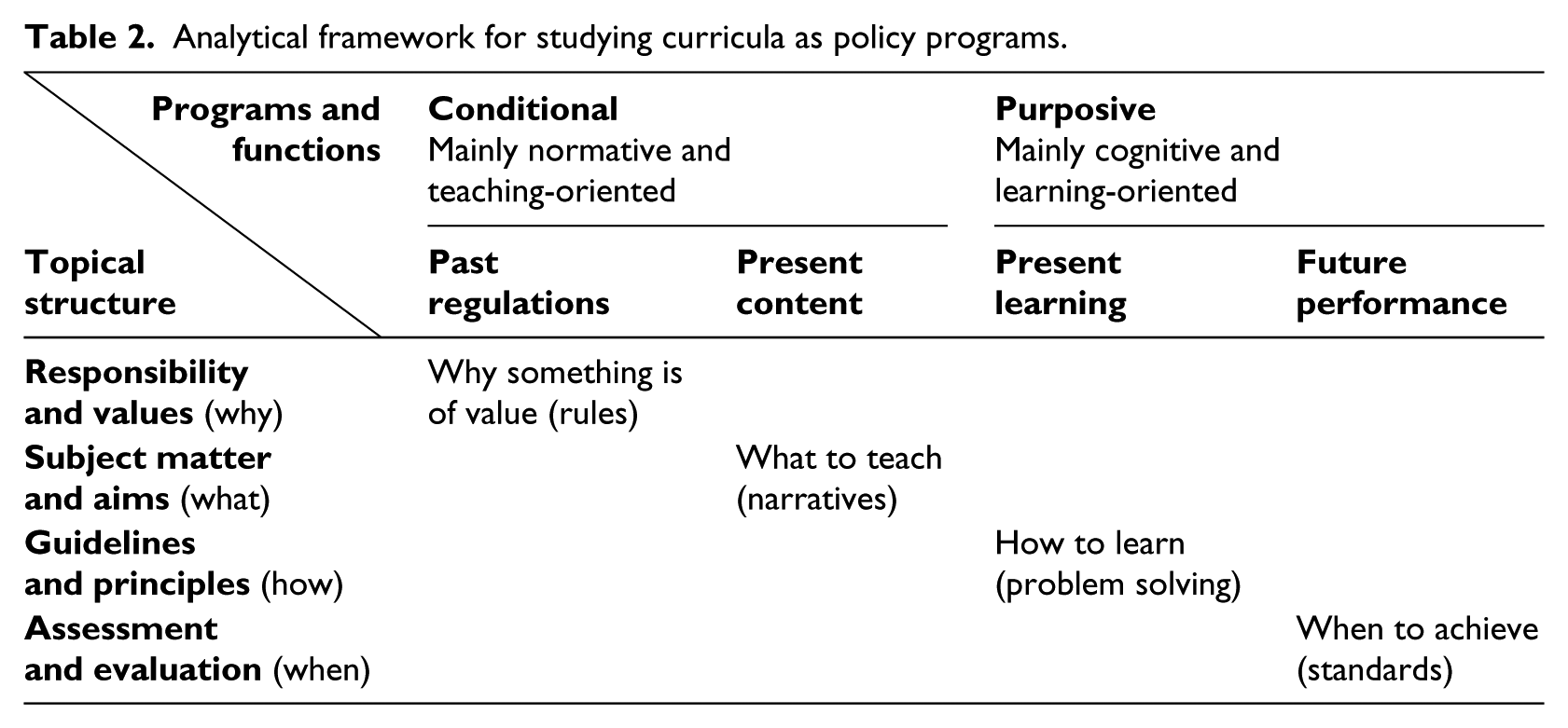
We argue that the two policy programs and their subcategories, which reflect the topical structure of a curriculum (see the rows in Table 2), create helpful distinctions for clarifying how curricula correspond with transnational policy. While the horizontal dimension reflects alternative selections and, thus, decisions shaped into conditional and/or purposive programs, the vertical dimension reflects a factual dimension of relevant matters in preparing a policy program for teaching and learning in schools. As has already been mentioned, a cluster of topics seems to structure a formal curriculum into sections and components, which will be used as categories in our analysis (Table 2).
We know already, from research on curriculum history, that traditional curriculum-making in the Nordic countries and Central Europe refers primarily to educational processes, with a conditional orientation toward the content to be taught in schools, and thereby not setting standards for education (Hopmann, 1999). Invented as types of state-based reforms, these curricula are formally regulated by the state and are designed to be interpreted and enacted according to procedures that are not instrumental in terms of approaching learning performance, but that presume the responsible selection of content according to a sequenced set of actions, assuming that learning takes place without specifying how learning is made (see the first and second columns in Table 2). For this reason, the curricula formulate principles that refer to state legislation describing why something is of value, which must be followed up through actions and subject matter content formulated as narratives about what to teach. This latter must then be interpreted and used in textbook production and preparatory enterprises to support teachers in schools (see first and second row in Table 2). In this context, traditional curriculum making can also refer to teaching methods and formal criteria for examination, as in the case of curriculum-making of the late 19th century in, for example, Norway (Gundem, 1995). In this case, all topics, as expressed by the rows in Table 2, are covered, without specifying the elements in any purposive way.
However, ongoing reform work inspired by assessment systems and standards-based reforms, in addition to global-institutional frameworks for learning and instruction, serves opposing references, as illustrated by the right side of the matrix (the fourth and fifth columns of Table 2). Moreover, we argue that the world society orientation belongs to the fourth column, which is associated with projections of risks and problems and pragmatic systems of reason: that is, motivating schools to approach global problems by creating expectations for which learning strategies, or how to learn, including instruction methodologies, are considered powerful tools. Then, activities are politically construed to accomplish similar future outcomes, as demonstrated by Steiner-Khamsi (2013).
We argue that international assessment and standard-setting policies belong to the fifth column: making use of “standards” or “benchmarks” to compare and improve systems by learning, while taking the measure of individual performance, differences, and achievements as a point of departure. This method of controlling schools is associated with education reforms within the US context, in which systems are promoted to accomplish individual goals at different stages and levels (Westbury, 2007). Thus, not only what to achieve but when to achieve becomes a core question in curriculum making (see Table 2). Here, standards are developed to simultaneously measure differences and help systems improve their systemic quality, thereby creating transparent processes and results (Waldow, 2012). 5
Documents and methods
In Finland, the Finnish National Board of Education (FNBE; Utbildningsstyrelsen) is the authority responsible for writing the national curriculum, which is binding for both local school authorities (i.e. the providers) and schools across the country. The FNBE is mandated by the parliament (Riksdagen) and the government to formulate a national curriculum based on a set of regulations and guidelines (Mølstad and Hansén, 2013). In the following sections, we will describe and compare the three curricula that have been published every 10 years since 1994: Finland’s national curriculum from 1994 (LP94) (Utbildningsstyrelsen, 1994); its curriculum from 2004 (LP04) (Utbildningsstyrelsen, 2004); and its curriculum from 2014, to be adopted in the school year 2016–2017, to which we pay special attention (LP16) (Utbildningsstyrelsen, 2014).
All three curricula have been launched as national school reforms and offered as guiding programs for textbook producers, local authorities, and schools. The three curricula are comparable for a number of reasons (see Mølstad and Karseth, 2016, in this issue). First, they are all written for a public education system that is comprehensive in that it includes nearly all students from the ages of six or seven to the ages of 15 or 16. Moreover, they are all authorized by the same institution, the FNBE, and they all represent the same kind of document, reflecting a topical structural characteristic of national curriculum documents, as already mentioned.
Each curriculum contains a general section that introduces the reforms by goals and principles. This is followed by subject-specific sections that essentially reflect the same rationales and principles described in the first part. In our study, we did not examine subject-specific characteristics; instead, we observed general patterns across the different parts. In particular, we analyzed the text with regard to the categories of the topical structure illustrated in Table 2 (i.e. responsibilities and values, content and aims, guidelines and principles, and assessment and evaluation), each of which corresponds to a different part of the Finnish curriculum. Moreover, the labels presented in the upper row of Table 2 (i.e. regulations, content, learning, and outcomes) were adjusted after reading and analyzing the curricula through the lens of theory, in an effort to construct categories that covered the various options capable of linking theory with data (i.e. the three curricula).
The analysis of each topic was structured in consideration of the distinctions among the program orientations presented in the first row in Table 2, making use of a matrix recommended for comparative document analysis (Kuckartz, 2014). This matrix helped us draw comparisons vertically, horizontally, and between cells, first for each curriculum (since we constructed tables for each curriculum) and then among curricula (after synthesizing the three tables into one; see Table 3). Table 3 presents key words and expressions within the curricula, which are formulated as themes that demonstrate how topics have been formulated and emphasized within the 1994, 2004, and 2016 curricula. Inspired by Luhmann (1995), we began our analysis by seeking to construct the differences between the conditional- and goal-oriented formulations of sentences and paragraphs.
Overview of the three national curricula in Finland from 1994 to the present (LP94, LP04 and LP16).
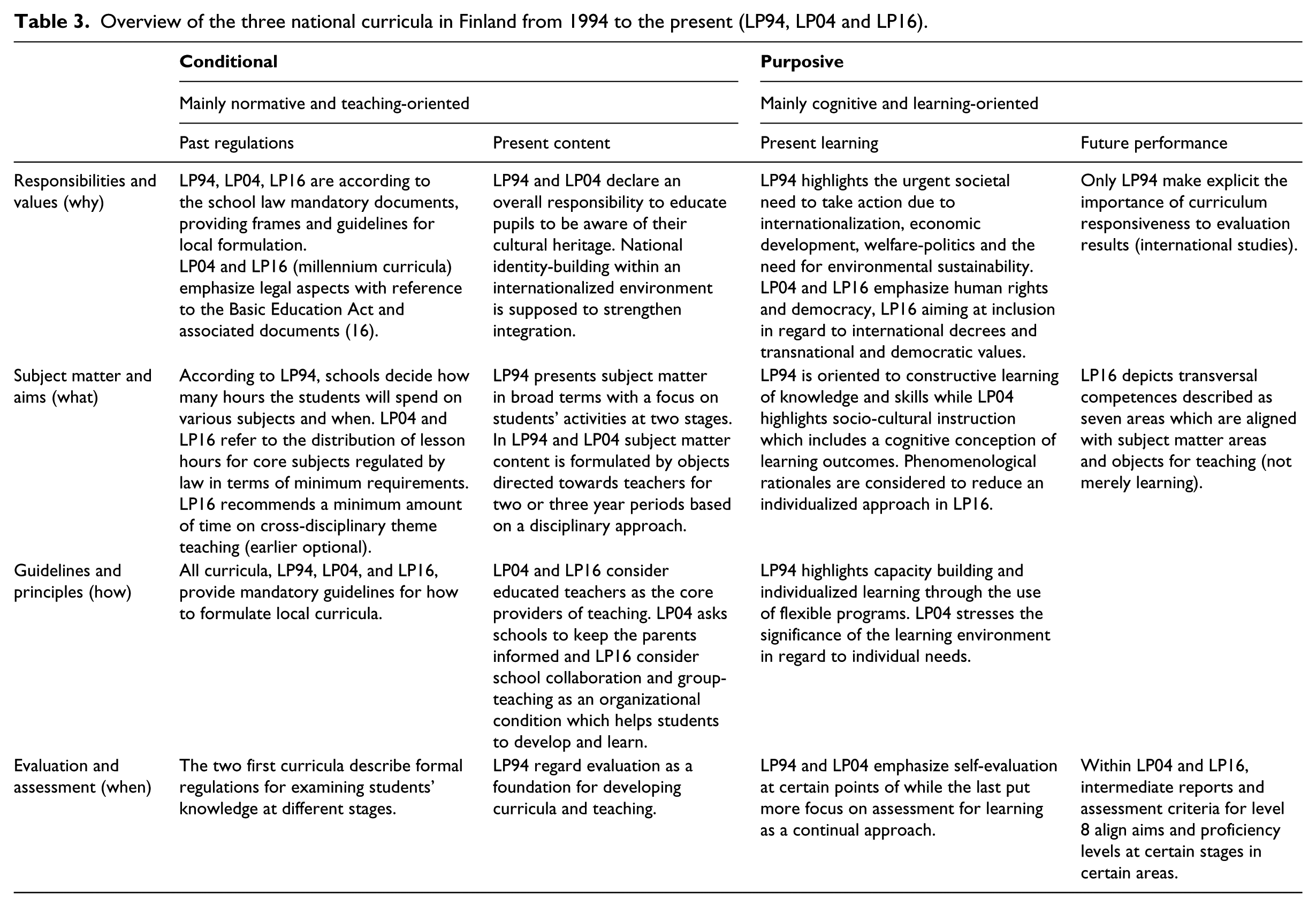
The formulations and condensed descriptions for each section categorized as an expression of a curriculum topic were analyzed according to their temporal order (i.e. past or future) and their factual order (i.e. normative or cognitive). They were also observed in terms of style and content; for example, does the curriculum provide guiding norms and rules for action, or does it formulate “cognitions” to act upon when considering particular matters? All in all, our study required a careful reading of the text while asking questions about normativity, such as “Do the formulations within the curriculum presume normative, procedural work based on core values, ideas, and content, or vice versa: do they presume cognitive translations and competencies, expected to be possessed or to exist as outcomes?” and “Do the parts or components within the curriculum declare norms for what to do in teaching preparation or teaching, or does the curriculum draw the attention to the qualities of students’ learning, as described as systems or products of activities of some kind?” These questions refer to the left and right columns of Table 2, respectively, and they point in opposite directions.
In addition to analyzing the temporal dimension, answering these questions will provide a basis for a qualitative content analysis (Coffey, 2014). This kind of analysis is oriented toward the meaning dimensions and the ways in which the formulations and semantics of curricula are anchored by local, national, and global narratives and references, which, in Luhmann’s (1995) terms, also express the social dimension of the meaning-making processes. These processes may refer not only to the political, economic, legal, and scientific systems, but also to the core educational problems, such as the ordering of content and activities to be organized in schools and classrooms. Thus, in our analysis, in addition to exploring school matters and associated meanings, as formulated within the curricula, we also reference to other documents and supplementary materials. In this way, we study both internal and external issues relevant to curriculum-making processes.
In the following sections, we present our analysis of the three curricula in a historical-chronological order, but with the ambition of comparing the analytical apparatuses of the three documents in the process. In the final part of the article, we discuss the patterns articulated across the curricula through the lens of Luhmann’s (1995, 2000) theory of program orientations and Steiner-Khamsi’s (2013) four-field scheme. In this section, we will also discuss the limitations and de-limitations of national curricula that facilitate and constrict transnational policy transfer within national and local contexts.
Curriculum reform in Finland
LP94
The national curricula for basic education in Finland are characterized by their mandatory nature and represent, by principle, a regulative and normative foundation for the organization of public education laid down by school law. Thus, we expect the curriculum to reflect a conditional program. However, the first part of the curriculum highlights an opposite orientation: the urgent societal need to reform education in response to internationalization. The productive and future-oriented qualities of learning are emphasized when the curriculum highlights certain activities, such as preparing students to be able to formulate questions for enquiry and providing education that responds to future societal changes, such as internationalization, economic development, welfare politics, and the need for environmental sustainability. These projections are problems for consideration within an internationalized environment (cf. Utbildningsstyrelsen, 1994: 8–10).
Simultaneously, the mandate and goals of the 1994 Finnish curriculum highlight core educational values while declaring that education should contribute to educating 6 the individual, both personally and as a social human being. This normative declaration suggests the imperative of educating pupils to be aware of their cultural heritage so that they can interpret and understand the society in which they live (Utbildningsstyrelsen, 1994: 11). Thus, the realization of a national curriculum and teaching processes in terms of responsibilities and values can be seen, in one sense, by declared intentions founded in history (i.e. national traditions congruent with a conditional program), and in another sense, by the acknowledgement of an internationalized environment and the need to integrate all individuals in a rapidly changing society (see the first row of Table 3).
From this perspective, the curriculum suggests a broad orientation toward capacity building, which should enable students to participate constructively in cooperation with others, to be critical, and to take responsibility for actions and outcomes. Moreover, actions are expected to accomplish overall purposes in terms of goals and outcomes. This future orientation draws attention to the results of evaluations, societal risks and challenges, along with a purposive policy program.
The subject-specific parts of the Finnish curriculum are revised by the national distribution of lesson hours allocated to particular subjects or topics, which are regulated by law (cf. Table 3) and, thereby, conditional. However, the 1994 curriculum gives local school authorities and schools the flexibility to decide how many hours students will spend on various subjects and the order in which these subjects will be introduced during the course of study (Utbildningsstyrelsen, 1994: 16). The curriculum also refers to areas of knowledge and skills that are expected to be learned during the course of study (Utbildningsstyrelsen, 1994: 17–18). This formulation indicates a purposive orientation toward learning, but without any ambition to standardize systems by comparing individual performance, as proposed in the SS-DO approach (see Table 1).
Moreover, in LP94, generic areas are not mandatory; they may be taught and learned whenever the school prefers, not necessarily in each year (Utbildningsstyrelsen, 1994: 17), and they can be learned by certain groups or classes, not necessarily by everyone. Thus, the knowledge and skill orientation, which reflects a cognitive orientation toward what to learn, does not dominate the 1994 curriculum in this regard. Moreover, strikingly, the curriculum focuses on objects or aims rather than content. This indicates that the school authority in Finland during the early 1990s found a purposive program orientation significant for deciding content.
We see the same purposive orientation in the area of assessment, in which the curriculum presents formal principles for examining students and developing local curricula and practices on the basis of evaluations (see Table 3, the fourth row). As formulated within the curriculum (Utbildningsstyrelsen, 1994: 23): “The teachers’ evaluation of their own work, in addition to evaluation of the teaching, together with the students, form the sound foundation for the way in which instruction is going to be developed” (our translation). At the same time, teachers will assess learning in such a way that students are encouraged to learn in accordance with their capabilities, and not with regard to objective criteria concerning their capacities. This indicates a preference for a purposive program for the way in which teachers work, although the recommendations for assessing students clearly reflect a conditional program. Table 3 provides an overview of the core ideas and formulations within the curriculum (LP94), showing how school authorities wished their basic education to be organized over a period of 10 years (1994–2004).
LP04
The two Finnish curricula published since 2000 have referred to the ways in which learning is to be organized. In this sense, they have formulated aims for learning and continued to follow a purposive orientation toward students’ work in the classroom. Moreover, the legitimation of these curricula refers more frequently than that of the former to external documents, including international agreements, programs, and declarations to which Finland is committed, such as the UN Convention on the Rights of the Child of 1989, the Salamanca Statement of 1994, the Charter of Luxembourg of 1996, and the UN Convention on the Rights of Persons with Disability of 2006 (Utbildningsstyrelsen, 2011: 3). From a social point of view, they appear to legitimize priorities by founding decisions on written statements within international documents. At the same time, the curricula do not refer to international assessment studies in order to outline their overall values, as the 1994 curriculum does. This shifts the orientation toward normative points of view and a disregard for standard-setting policies as the overall macro-vision.
Both of the curricula from the new millennium are based more profoundly within national legislation than the 1994 curriculum. Thus, they are shaped by past regulations in keeping with a conditional program. For example, although sustainable development is significant in both LP94 and LP04, the latter aims more specifically to accomplish a common orientation toward world problems, which is a normative (rather than cognitive) perspective and, thus, suggests a differentiated orientation of outcomes based on the notion that systems are different (cf. Table 1, DS-SO). Moreover, although the same core values are present in the curricula from both the 1990s and the 2000s, the latter focus more on what to teach in a school context in light of global problems and society. For this reason, content is more detailed in curricula from the new millennium. For example, while LP94 emphasizes content in terms of aims and activities, rather than what content to teach, LP04 extends the subject-specific sections by describing the aims, content, and, for some subjects, assessment criteria for two-, three-, and four-year periods. This pattern illustrates that the 2004 curriculum is more conditionally oriented than the 1994 curriculum.
However, the overarching principles for the selection and sequencing of subject matter remain similar for both reforms. By considering the structural aspects of teaching, we find a shared notion of knowledge structures and/or fields as core parameters for organizing a set of school subjects. Within the 2004 curriculum, these are differentiated according to year. LP04 also emphasizes the link to scientific disciplines, which is not as important for LP94. Moreover, both curricula are structured by cross-disciplinary themes, which are to be integrated within each subject and which are expected to be concretized by local curricula to meet local needs. This element of integrating subjects by theme seems to be important for reflecting a conditional program focused on the organization of content rather than on the competencies in which general skills serve a similar integrating function. 7
Within the 1994 curriculum, aims found within the subject matter sections point to expectations of students learning particular content, which we consider to be an instructive dimension to teaching, referring to purposes rather than to conditions. What to learn is not specified in a detailed way (see Table 3). By contrast, in the 2004 curriculum, the subject curricula provide concrete guidelines for how to teach content, while also laying the foundation for what to do in other contexts, such as within reform work at the national and local levels. Here, the aims focus on core values in reform work, reflecting teaching norms, which are followed by a content focus and a conditional orientation. At the same time, it seems that this content orientation specifies teachers’ responsibilities concerning what should be cognitively or otherwise learned as an output of school lessons (see also Mølstad and Karseth, 2016, in issue). Thus, we observe a cognitive openness toward the future, warranted by a normative orientation toward the curriculum being taught in schools.
An important problem underlying the description of content and aims, which leaves open the question of what each student should learn, is the significance of considering special education and linguistic differences among groups of students when designing a learning environment. Moreover, differentiation and individualization become important issues, supported by a shift in orientation from a constructivist to a socio-cultural approach to learning from LP94 to LP04. Learning as a type of classroom activity is, thus, considered a core element in both curricula; however, this element is framed by the other elements, such as a theory of teachers and their teaching, that make the 2004 Finnish curriculum more conditional than purposive in orientation.
Nonetheless, both LP94 and LP04 include a conception of literacy designed to equip students with skills for use across different areas and contexts (a conception present in the curricula of all three reform periods). These conceptions follow a purposive and goal-oriented approach in terms of requests for evaluation and assessment (illustrated by the last row in Table 3). Knowledge and skill areas are presented in the two curricula with various weights relating to what is taught in schools, however. The curricula’s specifications of what to learn within the subjects addresses both the preparation of teaching, representing a conditional-oriented program in our framework, and the ways in which individual students’ learning styles are taken into account, which are more purposive in orientation. In addition, teachers must assess whether students have met the objectives and assessments documented through intermediate reports and discussions with parents. As a result, we see a mix of conditional and purposive ambitions when it comes to questions about the guidelines and principles for organizing school activities and student assessment.
LP16 8
In all reforms, Finnish culture is considered a foundation for identity building within an environment characterized by internationalization, a concern that motivated the new curriculum revision in 1994. Accordingly, individualization is also of significance, and demands for flexibility change within Finnish society. In addition, the new curriculum (LP16) highlights, more than the former curricula, transnational and democratic values, not least human rights, declared as a core dimension of reform work, replacing the notion of integration with inclusion. As already mentioned, this dimension was strengthened during the 2000s, and in LP16, it is highlighted by a number of references to international decrees and agreements (cf. Table 3).
However, in regard to subject matter and aims, LP16 draws even more attention to transversal (or generic competences) to work across subjects, as LP94 and LP04 did. We interpret this as an outcome of transnational policy transfer, inspired by international assessments and frameworks as a cognitive future-oriented strategy for learning, which also demands for restructuring subject matter knowledge into broader areas than the traditional disciplines. At the same time, as outlined by Decree 422/2012, competence areas do not replace school subjects, and they do not encourage a primary focus on the individualization of learning, which seems to be a response to public criticism of the former two curricula. Instead, the new national curriculum serves, via the ways in which objects for teaching are formulated, as a conditional reform by pointing to the formal regulations and the role of collective practices through teachers’ teaching (cf. Table 3). This is demonstrated by the objects within LP16, and in particular within the subject matter part, where the curriculum objects describe how teachers will support students, help them, and provide them with opportunities to learn knowledge, skills, attitudes, and judgment. These terms are used to structure curriculum objects into different categories or classes, which cover subject matter content about what to teach from a conditional point of view, highlighting the point of view that common places for teaching are as important as individualized learning.
Nevertheless, the objects and content are both designed to accomplish transversal competence goals, which are grouped into seven categories: the capacity to think and learn (C1); cultural and communicative competence (C2); everyday competence (C3); multi-literacy (C4); digital competence (C5); working life competence and entrepreneurship (C6); and the capacity to participate in, influence, and contribute to a sustainable future (C7). These areas create expectations for what each of the stages structured by the decree should accomplish (i.e. how the lesson hours should be distributed). In this way, the objectives for what the teachers will do with their student link the subject matter with its goals, thereby attempting to achieve transversal or generic competences (Halinen, 2015).
Furthermore, LP16 articulates principles for how students will be assessed at different stages within their education. While the first curriculum from 1994 focuses more on assessment to support students’ self-evaluation in accordance with overall goals and tasks, the 2004 curriculum approaches learning achievement as a key concept, while the 2016 curriculum describes both purposes in detail, with an emphasis on assessment for learning. The most significant variation between the 1994 and the 2004 curricula is the introduction of assessment criteria for level 8, aligned with the aims, and proficiency levels in certain areas, such as the second national language, which will indicate good performance at the end of each stage (e.g. for Grades 5 and 8). This implies a product orientation with benchmarks for how to perform and how to monitor students in their learning efforts (cf. Table 3) along with a standard-setting model borrowed from international frameworks. Thus, the main shift to learning assessment and achievement measurement, strengthened through the reform decades, occurred during the early 2000s in line with a purposive program.
What is new within the most recent curriculum (LP16) is a micro-orientation, which aligns pedagogy with assessment. Not only are objects for teaching linking a particular content with learning ambitions reflecting transversal skills, LP16 also advocates a particular approach to teaching: the “phenomenon-based” approach. While former curricula emphasized theories of learning (e.g. constructive learning in LP94 and socio-cultural learning in LP04), the new curriculum expects students to be active not only in assessment, but also in planning activities. By this approach, students are not only responsible for assessment and learning, but also for normative decisions for what and how to learn within a local school context. This approach is, however, not excluding the teacher as the main responsible actor for preparing teaching courses and lessons, which is a core idea reflected by the many objects directed to teachers and their teaching, which is in line with a conditional approach.
The combination of references to programming, both past and future, shows, however, a tendency to align the two program forms within the national curriculum (a teaching-oriented and a learning-oriented curriculum, reflecting a conditional- and purposive-oriented mix). At the same time, conditions are considered important to fixate teacher–student communication, thereby achieving productivity by stabilizing and connecting proper conditions with both actions and expectations about possible processes and outcomes, following Luhmann (1995: 203–204). Consequently, a conditional-oriented curriculum suggesting content seems to match a progressive-purposive scope in which students are not merely passive receivers, but considered active participants within the communication with teachers.
Conclusion
In this article, we examined how three national curricula for basic education in Finland from 1994 to the present are approaching international policy perspectives. We searched for answers regarding how curricula both constrict and facilitate a transnational policy transfer, which, among different factors, are shaped by policy perspectives derived from comparative studies. The study shows how curricula are used to establish formal and substantial boundaries by delimiting their own mandate and roles through a normative closure by the use of regulations filled by content. However, the study also shows how curricula, in a quite unlimited way, adopt projections of world problems and standards for when to evaluate and assess the performance of students at different levels.
There are few doubts that comparative studies are important tools for managing global risks and for increasing performances to cope with international demands in our society. Although the two strands—a world-societal approach that focuses on the common problems and evolutions that are similar for everyone, and a what-went-right approach, which searches for similar solution despite individual differences—are contradictory by character, they are both included in the formulation of formal curriculum. Our examination shows, however, the way in which these perspectives with their particular themes are modified into reform programs within a curriculum-making context. From our study, we see that selections are made in terms of their emphasis as well as their content.
We studied formal curricula as an outcome of state-based curriculum-making in Finland, however, primarily to interpret how they reflect a transnational policy. Based on a qualitative-content analysis, we argued that formal curricula express transnational requests at the same time as they also reflect their own topics, decisions, and educational views, depending on how they draw upon their own histories.
We adopted Steiner-Khamsi’s (2013) four-field scheme to identify the underlying research methodologies of comparative studies and the ways in which they were translated into policy perspectives to be translated across contexts. In the article, we extended the model by incorporating Luhmann’s (1995) distinction between conditional and purposive programs. On this basis, we developed an analytical framework to understand how program orientations played different roles in both constricting and facilitating transnational policy transfer. Such transfer can, from Luhmann’s (1995: 203–204) point of view, be both productive and contra-productive given the circumstances and the fixation of actions and expectations played out within the communication. We argued, following Luhmann et al. (2013), that an organizational system, as we have observed in our study, is able to synchronize communication by outlining and combining programs to ensure stability, which serves a productive function within an ever-changing society. On this theoretical background, we formulated research questions, which will be discussed in the last part of the article:
How are national curricula in Finland over the three last reform efforts modifying transnational policy transfer within a reform context by reformulating core curriculum topics: the overall values and responsibilities, subject matter content and aims, and guidelines and principles for learning and assessment?
How are curriculum revisions designed as a mix of conditional and purposive orientations to cope with demands articulated within a transnational policy context?
How can national curricula be interpreted as constricting transnational policy transfer by de-limiting their mandates and perspectives and vice versa, by facilitating such a transfer by permitting world problems and standards to become core references in reform work?
To address the first question—how curricula are being modified by transnational policy—we examined the ways in which themes were formulated for each of the core topics. Our examinations showed that Finnish curriculum revisions as early as the 1990s articulated reform ambitions that were highly transnational, referencing international standard-setting policies in their section for values and responsibilities. The curriculum even included concepts such as knowledge and skills that created present–future expectations of learning, which by soft governance targeted students’ learning. By describing core problems related to the environment, the need for creating integration among a differentiated population, the importance of human rights, etc., formulations were chosen to avoid risks and to approach problems in an increasingly internationalized world. These references signify, by Luhmann’s (1995) two program forms, a present–future direction for school reform and a common past–present orientation to adjust processes and people. We concluded by analyzing LP94 that the curriculum was highly purposive because of a lack of content specifications and with its request to decentralize choices related to pedagogy and teaching.
As this purposive orientation presumes a transparency of how actions are performed, cognitive rather than normative dimensions are highlighted in reform work, congruent with what Steiner-Khamsi (2013) describes as globalization studies and a what-went-right approach (see Table 1). In our study, we could see that standards were formulated as cognitive criteria within the curricula, used to compare students individually to improve practices. These kinds of standards were first introduced in the 2000s, as an addition to the curriculum, and in 2016 integrated into the formal document, which more thoroughly than the other documents described guidelines and strategies for how to assess students in core subjects along their study course.
Simultaneously, and possibly paradoxically, a regulative and normative point of view was also strengthened. In the LP04 and LP16 curricula, a number of objects for each subject indicated what should be taught in schools. They re-presented a cluster of areas, clarifying which subject matter teaching should address and how the students should work in the classroom contexts. Both the objects (in terms of how they approached teaching) and the content descriptions (in terms of what to cover by teaching) implied a normative orientation and thereby a conditional approach. However, the elaborated text-sections about what to teach, placed in between objects for teachers and their teaching on the one side, and transversal competencies on the other side, indicated a combination of elements and approaches.
This aspect among the patterns of how elements were linked and perspectives were approached by the curricula shows, in regard to our second research question, that curriculum revision preferred a mix of conditional and purposive orientations to cope with the demands articulated within a transnational policy context. The curriculum drew attention to both objects for teaching subject matter content and transversal competences. In addition, the curriculum also located itself in between the national and the global by referencing other formal documents, such as national regulations and international declarations and agreements, to which the legitimation of national curricula explicitly makes reference. Moreover, international assessments and their methodologies were reflected by cognitive standards. The present–future approach and the internal–external dimension were reflected by competence goals and assessment criteria, which signify a highly cognitive order of national curriculum.
In regard to the third research question, we studied how transnational policy transfer is both restricted and facilitated by official statements within the national curricula, expressing both a purposive and conditional policy program filled by content. How the two program forms were weighted is interesting, not merely as a theoretical problem, but as an empirical one as well. As we have shown, the program forms seem to serve complementary functions, as the conditional program attaches with values and responsibilities formulated within curriculum-making processes and by the order and choice of content. The purposive program is first associated with individual and social learning and development strategies targeting how schools are going to deal with anticipated problems within the society in which we live. At the same time, our comparison of the three curricula shows that the emphasis on the two program forms varies, and they might also operate as competing programs and contradictions that accountability systems, by the use of present–future perspectives, do not allow for or support (Møller and Skedsmo, 2013). Thus, there is no guarantee that the same mix of programs reflected in Finland is evident in the next Finnish reform or in other European countries or elsewhere, and this fact supports Steiner-Khamsi’s (2013) view that both historical and contrastive analysis are needed (cf. Table 1).
Our examination demonstrates how the FNBE has underscored the importance of the curriculum as a conditional reform program in schools with a past–present direction, in particular during the reform period between 2004 and 2016, referring back to legal decisions made by the national parliament and the public administrative apparatus. The application of such an approach is consistent with the DS-DO alternative, following Steiner-Khamsi (2013), and a conditional program in respect to Luhmann’s (1995, 2000) program types, who argues that conditions limit actions but lack any possibility of causally steering learning activities and their outcomes in a direct way. Thus, curriculum may, despite regulations and normative rules, offer a large space for choice and interpretation.
As the Finnish case demonstrates, a content-oriented approach does not necessarily support a linear and predictive transmission of knowledge through learning, due to the underlying logic of normative closeness, which opens for cognitive interpretations. Whether the conditional orientation to curriculum and learning closes the gap between what students are expected to learn and what they actually do and accomplish, therefore, remains an open question. For this reason, there is a need for reflective policies which compare external demands with ongoing practices in schools and classrooms. Moreover, professionals within the education system will always face the problem of how to differentiate between groups of students in learning and assessment contexts for the sake of education and learning, depending on their ambitions and interests. This problem calls for reflexivity, weighting purposive ambitions for individual learning against traditional modes of reasoning. In this respect, the Finnish curriculum asks teachers to having a common orientation to teaching groups of students, rather than individualized learning-based assessment criteria as devices for instruction.
Due to limitations of this study, we did not compare Finnish curriculum policy with similar constructions in other European countries. There are also limitations in terms of our analytical apparatus, which helps to systematize and analyze policy construction but which does not by itself single out educational ideas and rationales. However, we still argue that our analytical apparatus provide categories and perspectives which illuminate the complexity curriculum-makers and others are facing within a transnational policy space. Empirically we have demonstrated how decisions and priorities have been and can be made.
The national footprint in the Finnish curricula is illustrated by the different solutions evolving across the reform periods. Our analysis shows that these solutions integrate reform elements that may have been borrowed from abroad, but that are reinterpreted and modified within a transnational and national reform context. All three curricula show efforts to combine reform elements in creative ways, with ambitions not only to steer systems or outcomes, but also to trigger action by policy conditions and guidance in a non-affirmative way (Uljens and Ylimaki, 2015). Comparative policy perspectives and assessment systems cannot explain this productive line of reasoning. Rather we will say that this variation in the curricula is constructed and allows results from what is considered “the smart thing to do” in regard to transnational, national, and local policy contexts.
Footnotes
Declaration of conflicting interests
The author(s) declared no potential conflicts of interest with respect to the research, authorship, and/or publication of this article.
Funding
This research received no specific grant from any funding agency in the public, commercial, or not-for-profit sectors.