




Abstract
Improving numeracy learning outcomes for students is a goal of the European Commission. While many European countries have placed increased emphasis on links between mathematics and other subjects, in some countries numeracy is seen as an integral part of subjects across the curriculum. However, for this latter approach to be successful teachers need to have the capacity to embed numeracy into the subjects they teach. This article builds on previous research where it was suggested that teacher identity could be used to identify ways to support teachers to embed numeracy in subjects across the curriculum and that an adaptation of Valsiner’s zone theory could be used to understand this identity. The purpose of this article is to use the detailed case study of a secondary school history teacher to explore how the theoretically developed framework for identity as an embedder-of-numeracy plays out in an empirical study. The analysis permits suggestions to be made about ways this teacher could be supported to embed numeracy in history and points to areas for further research.
Keywords
Introduction
Numeracy, sometimes called mathematical literacy or quantitative literacy, includes the disposition to critically use mathematical knowledge and appropriate tools in a given context (Goos et al., 2014). These attributes are important for individuals and countries in an increasingly globalised world (OECD, 2013). However, in the 2012 Programme for International Student Assessment (PISA 2012), 23% of students from participating countries did not demonstrate the level of mathematical literacy considered necessary for full participation in today’s world (OECD, 2014). Within the European Union (EU), concerns about the achievement levels of students in member countries have led to an EU target to reduce the proportion of students who perform below this benchmark to less than 15% by 2020 (European Commission, 2010). While this target was achieved by some European countries in PISA 2012 (e.g. Finland), or is well within the reach of other countries, for many European countries the target will be challenging, if not problematic (e.g. Greece, where the proportion of students below the benchmark was 33%; see OECD (2014) for information about other countries). While the validity of PISA as a means of measuring mathematical literacy has been challenged (e.g. Kanes et al., 2014) and there are many factors outside of school, such as socioeconomic status and geographical location of students, which influence student achievement, in light of the EU target and the performance of students in many European countries in PISA 2012, there is a need to investigate how schooling can enhance the numeracy capabilities of students.
Although there is debate about the best way to promote numeracy learning in schools, two broad categories of integrated curriculum approaches have shown promise: interdisciplinary enquiry where two or more subjects are combined to varying degrees, and exploiting numeracy learning opportunities in subjects across the curriculum (Geiger et al., 2015). In both of these approaches subjects other than mathematics provide meaningful contexts for the development of numeracy capabilities (Steen, 2001). Revisions to mathematics curricula in Europe over recent years have resulted in a reduction in content, increased emphasis on mathematical processes, and more explicit links between mathematics and other curriculum areas (European Commission, 2011); however, this is a limited interdisciplinary enquiry approach because it maintains relatively strong disciplinary boundaries between mathematics and other subjects. In some European countries the approach taken has been to exploit numeracy learning opportunities in subjects across the curriculum (e.g. Department of Education and Skills, 2011; Education Scotland, n.d.). This latter approach requires teachers to have the capacity to identify where and how numeracy can be embedded into the subjects they teach but is unlikely to be fully embraced by teachers of subjects other than mathematics unless they can also see a positive impact on learning in these subjects.
This article arises from a study that sought to identify ways to support teachers to embed numeracy into subjects across the curriculum. Previously in this research it has been argued that teacher identity could be used as the analytic lens (Bennison, 2015a) and proposed that a sociocultural approach could be employed to understand this situated identity (Bennison, 2015b). The purpose of this article is to utilise a detailed case study to explore the ways in which these theoretical perspectives can be used to inform those seeking to assist teachers to promote numeracy learning by addressing the following research question:
In what ways can a conceptual framework for identity as an embedder-of-numeracy inform understanding of how teachers of subjects other than mathematics can be supported to embed numeracy into subjects across the curriculum?
In the next section the theoretical perspectives that inform the research reported on in this article are described. The research design is outlined in the subsequent section and this is followed by the detailed case study of Michelle (pseudonym), a mid-career history teacher. The article concludes with some suggestions for further research.
Theoretical perspectives
Identities are complex, dynamic, and context dependent (Wenger, 1998). Therefore, one of the challenges of using teacher identity in empirical research is to find a way to capture both the complexity and dynamic nature of this construct. As identities are also context dependent, a theoretical approach was used to develop a framework for identity as an embedder-of-numeracy (see Benison, 2015a). However, although this framework can be used to guide the design of empirical studies, it does not enable the analysis of data collected in such studies in a way that contributes to the understanding of a teacher’s current and future identity as an embedder-of-numeracy. Thus, the framework for identity as an embedder-of-numeracy enables the identification of factors that may influence a teacher’s capacity to embed numeracy into the subject they teach, but does not allow consideration of how these factors interact and change over time to produce particular teacher identities. As sociocultural perspectives can provide insights into the developing identities of teachers (Lerman, 2001), it has been proposed that Valsiner’s (1997) zone theory could overcome this limitation (see Bennison, 2015b). The way in which the framework for identity as an embedder-of-numeracy was developed and the sociocultural approach that was employed in the study are now described.
A framework for identity as an embedder-of-numeracy
While there has been an increasing amount of research on teacher identity in the last decade, there does not appear to have been any research on teacher identity in the context of teachers fostering the development students’ numeracy capabilities. Furthermore, research using teacher identity has tended to concentrate on one or two factors (e.g. Graven, 2004), but this approach does not take into consideration how these, and the many factors that have been identified in other research, interact to produce particular teacher identities. In order to capture the complexity of teacher identity in a way that overcomes some of the difficulties associated with investigating this construct (e.g. Enyedy et al., 2005), an extensive literature review was conducted to identify those characteristics most likely to have an impact on a teacher’s capacity to embed numeracy into the subjects they teach.
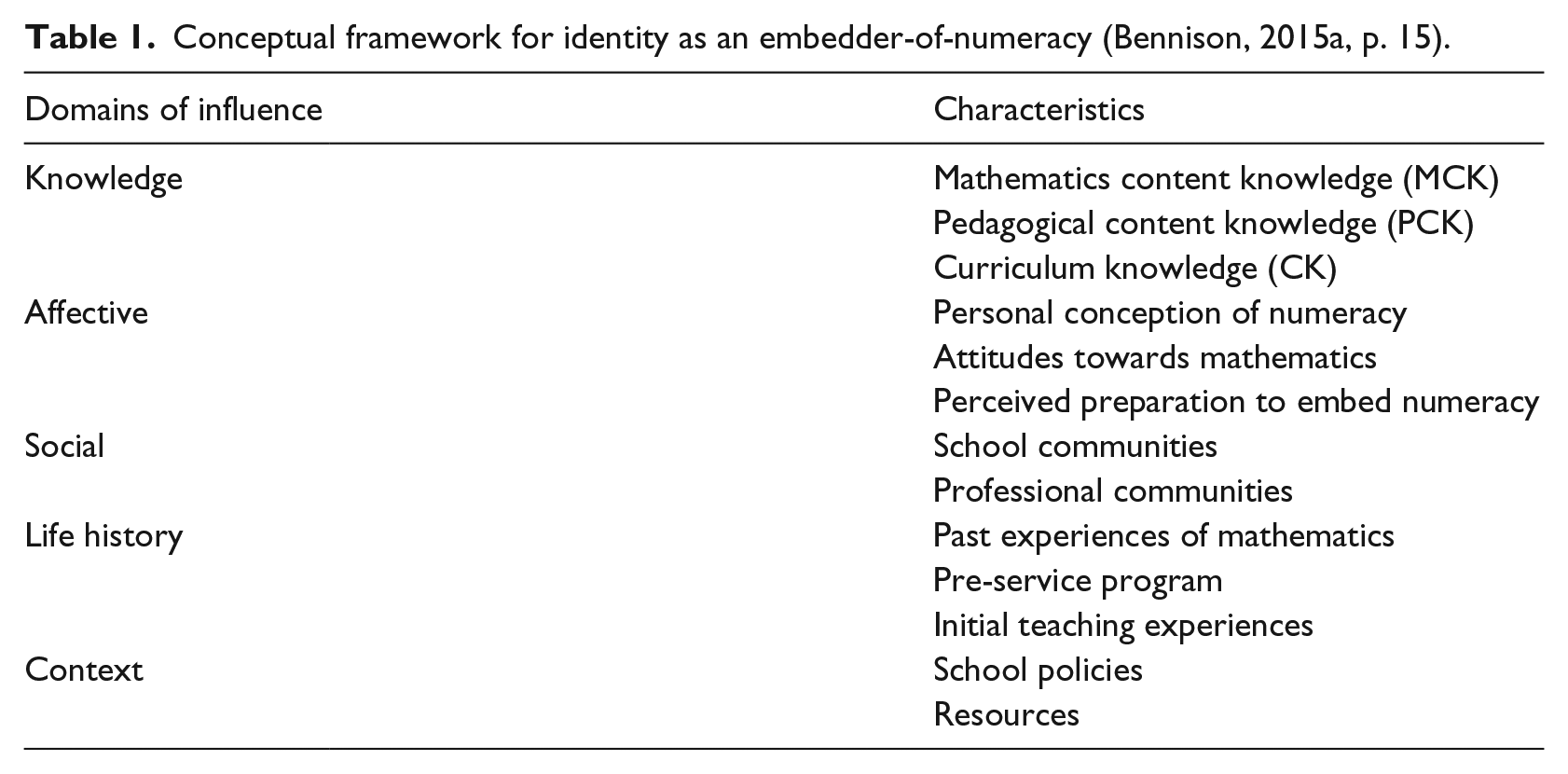
The framework for identity as an embedder-of-numeracy that was developed (summarised in Table 1) is organised around five domains of influence: knowledge, affective, social, life history, and context. Each characteristic within the domains was identified using the characteristics of teacher identity that have been studied previously (e.g. Graven, 2004; Van Zoest and Bohl, 2005) and defined in a way that reflected how that particular characteristic might impact on a teacher’s capacity to embed numeracy into the subjects they teach. For example, a teacher’s identity encompasses their beliefs (e.g. Van Zoest and Bohl, 2005); therefore, a teacher’s belief about what numeracy is (their personal conception of numeracy) was included within the affective domain.
Conceptual framework for identity as an embedder-of-numeracy (Bennison, 2015a, p. 15).
An adaptation of Valsiner’s zone theory
According to Valsiner (1997), who drew on the work of Vygotsky and others, an individual’s past knowledge and experience create a set of possibilities for development, which he interpreted as the individual’s zone of proximal development (ZPD). However, the actual development of these possibilities is mediated by how the individual interacts with their environment and the people in it. Valsiner represented these interactions with two additional zones: the zone of free movement (ZFM) and the zone of promoted action (ZPA). He argued that these two zones work together as a ZFM/ZPA complex, which could direct but not guarantee development in a particular way; thereby allowing for agency on the part of the learner.
Although Valsiner’s zone theory has been used in different ways by several researchers in mathematics education (e.g. Bansilal, 2011; Blanton et al., 2005), the approach that showed most promise for the current study was that taken by Goos (2005) to investigate how mathematics teachers developed identities as users of technology. She focussed on the ZFM/ZPA experienced by the teacher to provide insights into teacher learning. Recently, Goos (2013) argued that this approach enables the complexity of teacher learning and development to be analysed while still allowing for agency on the part of the teacher to direct their own development – an approach consistent with that of Valsiner. Thus, this approach has the potential to provide insights into a teacher’s identity and how it might develop over time, thereby capturing the dynamic nature of identity.
Goos (2013) interpreted the zones of proximal development, free movement, and promoted action in terms of how each zone applies in the context of teacher learning and development. For her:
the teacher’s ZPD becomes a set of possibilities for development of new knowledge, beliefs, goals and practices created by the teacher’s interactions with the environment, the people in it and the resources it offers. The ZFM structures the teacher’s environment or professional context … [and] suggests which teaching actions are permitted, [whereas] the ZPA can be interpreted as activities that promote certain teaching approaches. (p.523, emphases in original)
Mapping the characteristics in the framework for identity as an embedder-of-numeracy (see Table 1) onto the zones of proximal development, free movement, and promoted action in a way that is consistent with the interpretations of the zones provided by Goos (2013) has shown some promise for analysing data that were collected in the current study (Bennison, 2015b). Further information about this study and the approach taken to data analysis is provided in the next section.
Research design and methods
The study was conducted over two years (2013–2014) and involved eight teachers from two Australian secondary schools. The teachers were recruited from those teachers who had previously agreed to participate in a larger study (hereafter referred to as the Numeracy Project). The teachers were selected because their participation in the Numeracy Project indicated an interest in developing their capacity to provide numeracy learning opportunities for students in a range of subjects (English, mathematics, science, and history) and the workshops that were part of the Numeracy Project provided access to a range of activities that had the potential to assist the teachers in developing this capacity. Therefore, while the focus of this study is not on the impact of the Numeracy Project on these teachers per se, conducting the study within the Numeracy Project meant that there was one known set of activities contributing to each teacher’s ZPA.
The case study of Michelle, one of the teachers who participated in the study, is presented in this article. While it is recognised that two or more cases would enable common themes and differences across cases to be identified, a single case study was chosen for this article to enable a detailed exploration of how the theoretical perspectives taken in this study play out in empirical research. Furthermore, as Michelle taught history, her case provides an opportunity to explore how numeracy might be used to enhance historical understanding.
The Numeracy Project
The Numeracy Project investigated the potential of a professional development intervention based on a numeracy model for the 21st century developed by Goos et al. (2014). Although there are many definitions of what is meant by numeracy, and related terms such as mathematical literacy, there appear to be some commonalities across these definitions. While discussions of the different conceptualisations of numeracy are beyond the scope of this article and are provided elsewhere (e.g. Geiger et al., 2015), the major themes in many of the definitions of numeracy are encapsulated in Goos et al.’s (2014) numeracy model. According to this model, to be numerate a person needs to have the disposition (i.e. confidence and willingness) to use the requisite mathematical knowledge (e.g. skills and problem solving) and appropriate representational, physical, and digital tools in a given context. They must also be able to take a critical orientation in order to evaluate their results and information presented to them. Goos et al. have defined each of these dimensions and used the numeracy model in empirical studies to assist teachers in planning for numeracy, to describe classroom activities, and to enable teachers to articulate their personal conceptions of numeracy (e.g. Goos et al., 2014).
The Numeracy Project was conducted over three years (2012–2014) and involved both generalist primary and specialist secondary teachers. The teachers took part in a series of professional development workshops followed by school visits where teachers were observed and interviewed. The purpose of the workshops was to promote engagement with the numeracy model and provide opportunities for teachers to plan and share tasks that attended to numeracy learning opportunities in a range of subjects.
The author was a contributor to the Numeracy Project workshops and visited schools in order to observe and interview teachers. Data collected in school visits contributed only to this study, to both this study and the Numeracy Project, or only to the Numeracy Project. Ethical clearance for the study and informed consent of participants were obtained in accordance with institutional requirements.
Data sources and analysis
Two methods of data collection were employed in the study: interviews and lesson observations. Each teacher participated in a scoping interview and, over the course of the study, was observed and interviewed after the lesson on several occasions. The lesson observations provided an opportunity to explore how what the teacher said in the scoping interview played out in their classroom practice. The associated post-lesson interviews enabled the teachers to be asked about their reasons for using particular tasks and implementing these tasks in the way they did.
Scoping and post-lesson interviews were semi-structured to allow for follow-up questions, recorded, and transcribed. Guiding questions for both interview types were informed by the characteristics within the framework for identity as an embedder-of-numeracy (see Table 1). For example, guiding questions for the scoping interview included:
What opportunities have you had to develop your capacity to embed numeracy into the subjects you teach (e.g. pre-service teacher education program and professional development)?
What do you see as your role in developing the numeracy capabilities of your students?
For the post-lesson interviews, guiding questions included:
Why did you use this task?
Were there any difficulties in implementing the tasks you used? What were they? How could you overcome these difficulties if you used the task again?
Lesson observation focused on the tasks used and how these tasks provided opportunities for students to develop dimensions of the numeracy model (Goos et al., 2014). Field notes were used to record the timing and content of lessons, questions that the teacher asked, and what teachers and students wrote on the whiteboard. In order to construct a complete account of the lessons, lesson artefacts, such as task sheets and PowerPoint presentations, were collected.
Content analysis of the text of interview transcripts was used to identify the aspects of each teacher’s ZPD, ZFM, and ZPA where these zones were interpreted as described earlier. Comments a teacher made that related to their knowledge, attitudes towards mathematics, and beliefs about numeracy were coded as belonging to the ZPD; affordances and constraints provided by a teacher’s professional context were coded as belonging to the ZFM; and activities that a teacher participated in that promoted particular teaching approaches related to numeracy, such as an across the curriculum approach, were coded as belonging to the ZPA. Transcripts were independently coded by a colleague and discrepancies discussed and resolved. Michelle’s personal conception of numeracy, along with the tasks she used in lessons that were observed, were described in terms of the numeracy model, as has been done previously by Goos et al. (2014).
Drawing on the analysis of data that were collected from each teacher, a narrative was constructed and combined with examples of practice drawn from lesson observations to form an individual case study for each teacher. In the following section the case of Michelle is presented. As the data used to develop this case study were collected in a visit to Michelle’s school early in the first year of the study, her identity as an embedder-of-numeracy that is portrayed in this article represents her initial identity within the time frame of this study.
A case study: Michelle
Michelle was a mid-career teacher who taught history, English, and geography in a large metropolitan school. The case study that is presented in this section focuses on her teaching of history and draws on data collected in the scoping interview along with a lesson observation and post-lesson interview, and includes information about her professional context, background, experiences, and an example of her teaching practice.
Professional context
There are two major influences on numeracy in Australian schools. Firstly, a national curriculum is currently being developed and implemented that identifies numeracy as one of seven general capabilities to be developed across all curriculum areas (ACARA, n.d.). Secondly, as well as participating in international testing programs, such as PISA, all Australian students in Grades 3, 5, 7, and 9 are assessed through the National Assessment Program – Literacy and Numeracy (NAPLAN). Comparison of individual school NAPLAN results with those of like schools, as well as comparison with state and national averages, is used as a measure of school performance and accountability. Therefore, there is considerable pressure on schools to improve NAPLAN results and this can result in a narrow focus on numeracy as mathematical skills by requiring teachers to prepare students for the tests (Thomson and Harbaugh, 2013). At the school where Michelle taught, the new history curriculum was introduced in the first year of the study, and student performance on NAPLAN, while similar to that of students from similar backgrounds, was substantially below the Australian schools’ average. Michelle described the impact of NAPLAN on her role as an English teacher:
Our English department is very much, particularly in the middle school is very much focused on providing structured literacy skills, particularly in the lead up to NAPLAN. We do use our data, data from their practice test, Year 7 NAPLAN tests, and focus on their weaknesses from there.
Junior classes (Grade 8 and Grade 9) at Michelle’s school were organised in “pod” groups where students had one teacher for both English and history and another teacher for both mathematics and science. The school day was structured around four 70-minute lessons, which Michelle reported enabled her to cover quite a bit of material, but required her to use three activities to ensure variety and maintain student engagement. The structure of the school day meant that Michelle had her Grade 9 POD class six times a week and she found this arrangement to be “quite beneficial because I can move my time around where needed”. Access to computer technology was limited: there were only a small number of computers in classrooms and, although the school had a laptop hire scheme, only a few students had laptops in the observed lessons.
Background and experiences
Michelle completed a Bachelor of Arts degree, majoring in Geography, then worked, both in Australia and overseas, in Outdoor and Environmental Education. She returned to university about eight years before the study began, completing a Graduate Diploma in Education where the focus was on teaching in the senior school. Michelle completed her practicum at her current school and was subsequently offered a full-time teaching position. She was in her seventh year of teaching and described herself as primarily a social science, geography, and English teacher. As she was responsible for digital learning and the pastoral care program across the school, Michelle had a reduced teaching load, which in the first year of the study consisted of a Grade 9 class that she took for both English and history and a Grade 12 Geography class.
Michelle reported that her pre-service teacher education did not address numeracy across the curriculum and that she had not participated in any formal professional development to assist her to design activities that promote numeracy learning. She stated that:
Everything that I do in my classes is either self-taught or relying on resources. We’ve done a five-day literacy course but I’ve never done any numeracy stuff. It’s just what I teach myself.
According to Michelle, many of her colleagues believed that “the literacy stuff is dealt with by the social science and English teachers and the numeracy stuff is left with maths and science [teachers]”. Since she began participating in the Numeracy Project, she reported that these colleagues had questioned her reasons for putting a numeracy focus in her history lessons and that she had sensed a lack of understanding of the difference between numeracy and mathematics which “may be related to some issues with level of comfort” that these teachers had with numeracy and/or mathematics. She also reported some confusion about the meaning of numeracy among students. For example, she felt that students didn’t recognise that mathematical skills can be applied to other subjects:
Like the language I’ve been using, mean, median, mode, range, and a lot of them are looking at me and going, “Why are you saying this to me in History?”
However, Michelle said she wanted students,
to recognise that what they do in maths can be applied in other subjects … I just want them to realise that it’s not just skills for a maths lesson or maths test. It’s skills that can be applied in other situations and if that situation at the moment is another subject, then maybe as they progress they will realise that they will need it in part-time work [and] university.
Developing numeracy capabilities in a history lesson
In the Australian Curriculum (ACARA, n.d.), history is organised into two interrelated strands: historical knowledge and understanding and historical skills. The concepts for developing historical understanding are evidence, continuity and change, cause and effect, significance, perspectives, empathy, and contestability. Phillips (2002) has argued that numeracy can make abstract historical concepts such as these concrete. He illustrated this claim with a series of calculations designed to help students understand the historical significance of the Atlantic slave trade and why it endured for so long despite moral arguments against it.
The focus in the Australian Curriculum for Grade 9 is on the period 1750 to 1918 and schools have some flexibility in choosing specific content. One option is to study Australian history during this period, including a focus on living and working conditions around the beginning of the 20th century; an important time in the history of Australia as the Federation of six Australian colonies took place on 1 January 1901 (i.e. Australia became a nation). The following example provides an insight into how Michelle was able to promote numeracy learning through the history curriculum while making the abstract historical concept of empathy more concrete.
Michelle noticed that her students did not understand how difficult life was at the beginning of the 20th century, so she chose an activity that she thought would assist students to develop an understanding of what it was like to live at that time. She explained her rationale for the lesson:
They didn’t quite get that everything they did they worked really hard for … a lot of these guys were working 50 hours a week and were earning 10 cents an hour … so it was just to give them a little bit more of an idea of how tight things were.
Michelle modified an activity from a resource package developed by the state education authority. The original task sheet provided students with data about wages and prices in Australia in 1901, the 1901 prices adjusted for inflation, and the actual prices in 2000 (see Table 2 for an excerpt of this data). Students were asked to compare data for the 1901 prices after inflation with the actual prices for 2000. Specifically, they were asked to highlight items that had decreased in price, rank all the items in descending order of price, and construct a graph to illustrate the prices of 10 items from the data set.
Excerpt of data from the task sheet.
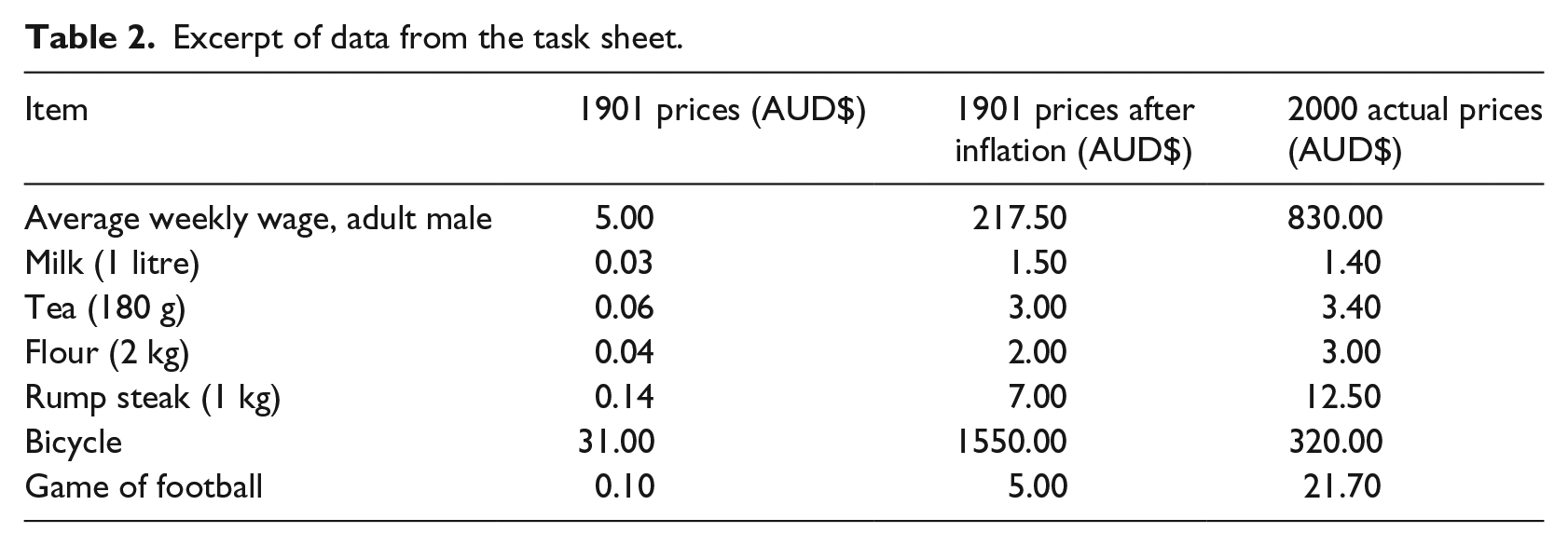
For the modified activity, in addition to asking students to complete the task sheet, Michelle divided the class into groups and asked students to develop a weekly budget and comment on apparent anomalies between the prices for items in 1901 after inflation and actual prices in 2000. Once students had completed this task, they were required to modify their budget in response to a change in circumstance for the family (e.g. illness to the wage earner that prevented him from working for two days). In terms of Goos et al.’s (2014) numeracy model, this activity involves mathematical knowledge, including addition, multiplication, and problem solving; is set in the context of developing historical understanding of what life was like in Australia at the time (empathy); incorporates the use of representational tools (table of data and graphs) and, for some students, a digital tool (calculator); and promotes a positive disposition by providing an opportunity for students to work in groups to develop confidence in using mathematics. Students applied a critical orientation when they chose the type of graph to illustrate the data (original activity) and made judgements about how to modify their budget in response to the change to family circumstances (modified activity).
Although Michelle adapted the activity to provide a greater opportunity for the development of students’ numeracy capabilities, she did not fully exploit the numeracy learning opportunity this activity provided. The latest data in the table was collected before many of the students in her class were born; but as only one third of the class had access to appropriate technology (laptop or classroom computer) students were unable to obtain current prices for the items listed in the table, speculate on anomalies (e.g. why the relative cost of a bicycle had decreased), or create graphs electronically. Michelle could have asked students to comment on the source of the data and why it was necessary to compare the 1901 prices after inflation and actual prices in 2000 rather than using the 1901 prices; thereby taking the critical orientation further.
Michelle’s identity as an embedder-of-numeracy
As Michelle’s ZPD is the set of possibilities for development (Goos, 2013), this zone will depend on her knowledge and beliefs about numeracy and its place in learning history. Her educational background, an Arts degree with a major in Geography, suggests that she is likely to have the mathematical content knowledge needed for the mathematics inherent in the history. Furthermore, there had been no formal opportunities for Michelle to develop pedagogical content knowledge for designing numeracy tasks, either through her pre-service teacher education program or subsequent professional development prior to her participation in the Numeracy Project. Michelle expressed the belief that numeracy exists beyond school but spoke of numeracy as the application of mathematics in other subjects and beyond school. This indicates a personal conception of numeracy that was focussed on mathematical knowledge and context – only two of the five dimensions in Goos et al.’s (2014) numeracy model. Although Michelle stated that “maths could be applied in other subjects”, she gave no clear indication that she saw numeracy as an important aspect of developing historical understanding as advocated by Phillips (2002). Michelle’s narrow personal conception of numeracy and insufficient pedagogical content knowledge for designing effective numeracy-focused tasks may have been contributing factors to her not taking full advantage of the numeracy learning opportunity she identified in the lesson described above.
The ZFM/ZPA complex represents the interplay between teaching actions that are permitted and those that are promoted, respectively (Goos, 2013). A number of factors were identified that contributed to the ZFM/ZPA complex experienced by Michelle. These factors included the views of her colleagues who saw numeracy as the domain of the mathematics department, possibly as a result of the focus in the English department on preparing students for the NAPLAN literacy test; the limited availability of technology, which would have prevented Michelle from getting students to find current prices for the items in Table 2; and the introduction of the new curriculum (ACARA, n.d.), which supports the approach of embedding numeracy in history. Michelle’s current exposure to teaching actions that promote this approach (i.e. her opportunities to learn about teaching numeracy across the curriculum) have come from her participation in the Numeracy Project. As the data drawn on in this article were collected near the start of the professional development activities of this larger project, the impact of this project, if any, on her identity as an embedder-of-numeracy is likely to be small and potentially will be seen when data from the second year of the study is compared to these data.
When Michelle’s ZPD is mapped onto her ZFM/ZPA complex there is some overlap. She is likely to have the knowledge and beliefs that will allow her to access the ideas presented in the professional development workshops of the Numeracy Project. However, she will need to manage the lack of access to resources and the contradictory elements in the professional context: on one hand, a new curriculum that supports her use of numeracy in history and, on the other hand, colleagues who do not see a place for numeracy in history. Furthermore, even though Michelle demonstrated some capacity to be able to identify where numeracy can be used to support learning in history, it is likely to take some time for her to be able to identify the extent of numeracy learning opportunities in the new curriculum.
This analysis suggests that Michelle’s trajectory towards an identity as an embedder-of-numeracy, where she has a greater capacity to effectively embed numeracy in history, could be assisted in at least three ways. These are: helping her to broaden her personal conception of numeracy, as her current personal conception of numeracy seems limited; helping her to increase her understanding of how numeracy can support learning in history, as she did not explicitly connect numeracy to historical understanding; and helping her to extend her pedagogical content knowledge, as there had been limited prior opportunities for her to develop this type of knowledge. One way of achieving these outcomes could be through targeted professional development, such as the Numeracy Project, which would possibly enhance Michelle’s set of possibilities for development (i.e. augment her ZPD). Such approaches may also help her to be better able to justify to her colleagues the value of having a numeracy focus in history lessons, thereby potentially enabling her to modify her environment (i.e. expand her ZFM) by influencing the views of her colleagues.
Concluding remarks
With growing recognition of the importance numeracy (e.g. European Commission, 2010; OECD, 2013) and an EU target to improve the performance of students in international numeracy testing (European Commission, 2010), there is a need to look at how schools can assist students to develop the numeracy capabilities needed for life in the 21st century. Although mathematics is the discipline that underpins numeracy and the mathematics curricula in many European countries have been revised to identify cross-curricular links (European Commission, 2011), in some European countries (e.g. Scotland and Ireland) the approach has been to view numeracy as part of all curriculum areas. However, this latter approach, while showing promise (Geiger et al., 2015), requires teachers of subjects other than mathematics to attend to numeracy demands and opportunities in the subjects they teach.
Building on previous research (Bennison 2015a; 2015b) that has focused on developing the theoretical basis for investigating ways to support teachers to embed numeracy in subjects across the curriculum, the detailed case study of Michelle shows how the use of Valsiner’s (1997) zone theory, in conjunction with the framework for identity as an embedder-of-numeracy, sheds light on some of the ways that this teacher could be supported to assist her to achieve the dual goals of developing students’ numeracy capabilities and historical understanding by embedding numeracy in her history lessons. Similar findings, with regards to personal conceptions of numeracy, understanding connection between numeracy and the subject taught, pedagogical content knowledge, and factors within a teacher’s professional context have been reported previously for two other teachers in the current study (Bennison, 2015b). Therefore, the case of Michelle provides further evidence that these characteristics are important aspects of a teacher’s identity as an embedder-of-numeracy. Furthermore, no characteristics, other than those already included in this framework were identified.
The research reported in this article suggests that the approach taken in the current study has promise for understanding a teacher’s identity as an embedder-of-numeracy. However, further research is needed in three areas: firstly, to strengthen the theoretical justification for using the adaptation of Valsiner’s (1997) zone theory described in this article; secondly, to employ the case studies of the other teachers participating in the research project from which Michelle’s case was drawn to support or challenge aspects of the approach; and thirdly, as identity is dynamic (Wenger, 1998), to map the trajectories of the teachers over the course of the study in order to explore if this approach can be used to predict the way in which a teacher’s identity might develop over time. Such work will assist in designing ways to support teachers to increase their capacity to promote numeracy learning through the subjects they teach, thus enhancing learning in subjects across the curriculum and enabling teachers to be better able to prepare students for life beyond school.
Footnotes
Acknowledgements
The author gratefully acknowledges the feedback provided by Merrilyn Goos and Katie Makar on the draft of this article. Some of the data drawn on in this article were collected as part of a project funded by the Australian Research Council (Discovery Project DP120100694).
Declaration of Conflicting Interests
The author(s) declared no potential conflicts of interest with respect to the research, authorship, and/or publication of this article.
Funding
The author(s) received no financial support for the research, authorship, and/or publication of this article.