




Abstract
The quest continues to standardise quality assurance systems throughout the European Higher Education Area (EHEA) under the auspices of the Bologna Process and led by the European Network for Quality Assurance (ENQA). Mirroring its member organisation in England, the Quality Assurance Agency (QAA), ENQA identifies, as one of its core aims, the development of quality assurance processes as instruments for both ‘accountability’ and ‘enhancement’. However, the recent history of QAA appears to indicate that the balance between these core aims has been lost and the discourse of accountability and efficiency prevails. This paper presents a case study of a Business Faculty (BF) in a post-1992 English university based on interviews with academics and documentary data. Findings suggest that the BF’s Quality Assurance Unit affirms the primacy of accountability and efficiency, resulting in, paradoxically, a distortion of academic professional practice. For example, undergraduate curriculum development is narrowly framed as an ‘administrative process’ from which most academics feel ‘dissociated’ and approaches to teaching appear to lack coherent organising principles beyond standardised learning outcomes expressed as ‘skills’. The paper concludes by briefly considering the implications of the case study findings for the future direction of ENQA Standards and Guidelines for Quality Assurance.
Introduction
Developing a ‘quality culture’ in higher education institutions (HEIs) across the European Higher Education Area (EHEA) has been a central goal of the European Network for Quality Assurance (ENQA). ENQA (2015: 5) defines a ‘quality culture’ as continuous improvement ‘embraced by all’: the students, academic staff and institutional management. According to ENQA, external quality assurance processes are particularly important in developing this culture through setting standards for institutional accountability and quality enhancement. Established in 2000, under the auspices of the Bologna Process, ENQA has been tasked with promoting European co-operation in quality assurance through: devising standards, procedures and guidelines on quality assurance; developing a peer review system for quality assurance and reporting back to the Bologna ministers (ENQA, 2009: 5). This remit grants the ENQA power, as a major political actor, to influence the values, principles and expectations in relation to quality across the EHEA. For example, full membership of ENQA is based on periodic external reviews that confirm compliance with the European Standards and Guidelines (ESG). As a full member, the English Quality Assurance Agency (QAA) has, to date, undergone two cycles of external review and self-evaluation, in 2008 and 2013 (QAA, 2013). Compliance with new values, principles and external regulatory mechanisms may transform the conduct of institutions and individuals in a process of steering organisational outcomes ‘at a distance’ (Miller and Rose, 2008; Ozga, 2011: 308). One such steering mechanism in the European Learning Space has been defined as ‘soft governance’ (Lawn, 2006), or the use of networks, seminars, reviews and expert groups to ‘re-imagine’ Europe into a space that can be governed: mapped, projected and changed in particular ways. On this account, ENQA may be contributing to the re-imagining of the EHEA as a governable space where the role of standards is as much to steer institutions as to enhance a ‘quality culture’.
Within this broader context, this article focuses on the impact of quality assurance systems in a Business Faculty (BF) in a ‘post-1992’ English university, in which the use of standards to ensure accountability and enhancement evolved from a lightly managed process of ‘soft power’ (Lawn, 2006) to more intrusive forms of micro-management. ‘Post-1992’ universities are former polytechnics which were granted university status in 1992 and are sometimes referred to as the ‘new’ universities (Ainley, 1994). Following the establishment of 74 ‘new’ universities in 1992 by the Further and Higher Education Act (1992), there were now 166 universities and HEIs in the UK (Scott, 1995). This movement towards a mass higher education system was promoted through the New Labour governments’ (1997–2010) policy of ‘widening participation’ (Dearing, 1997). Young people from families which had not previously participated in university education were encouraged to pursue higher education study, with most of these ‘non-traditional’ students securing places in the ‘new’ universities (ESRC, 2008: 7). More recently, the ‘widening participation’ agenda came to a halt as a result of the Browne Report recommendation to raise tuition fees, in order to ensure financial sustainability and ‘world class’ quality of teaching (Browne, 2010: 2). In effect, tuition fees were tripled by the Coalition Government (2010–2015), with most English universities now charging £9,000 for a year of undergraduate study (Complete University Guide, 2015). This was accompanied by more rigorous quality assurance, higher standards and the creation of a functional need for a new stratum of administrators to manage the proliferation of performance data. Before turning to the research findings relating to the case study of the BF, this article will briefly outline the history of quality assurance in England.
Quality assurance in England
Whilst there is insufficient scope to document the complex history of quality assurance policy in England, some note is taken of specific UK government policy developments which appear to have been critical in shaping the character of the institutional quality assurance regime within the Business Faculty (henceforth referred to as QA-BF). For example, Roger Brown, former Chief Executive of the Higher Education Quality Council (HEQC),
1
identifies UK government legislation such as the Education Reform Act (1988) and the Further and Higher Education Act (1992) as junctures in the ongoing dilution of university autonomy or self-governance. As Brown (2004, location 182) asserts: These landmark pieces of legislation heralded a subtle dilution of institutional autonomy and a move towards a more centrally planned system, with the funding bodies losing their purported buffer role and acting more or less directly as agents of government.
The Dearing Report (Dearing, 1997) and the Further and Higher Education Act (1992) created new mechanisms for the financing, regulation and governance of HEIs. Under the new arrangements, the Higher Education Funding Council for England (HEFCE) was created to centrally administer government funding. The QAA was contracted by HEFCE to audit the quality of HEIs in order to calculate how much government funding they would receive. Of particular significance here is the influence of Dearing (1997) on the new arrangements. Dearing set out 93 recommendations for improving the quality of teaching throughout the higher education sector, framing educational outcomes in terms of specific knowledge, understanding and skills that students ‘will be expected to have upon completion’. In promoting a procedural, standards-driven approach to measuring the quality of higher education, the Dearing Report separated teaching from learning and curriculum development from ‘delivery’. In this way, the facilitation of quality assurance is made more ‘calculable’ (Morley, 2003: 28), but can also create conditions for a ‘peripheralisation of pedagogues’ (Antunes, 2012: 454). This point will be developed further in the ‘Pedagogy of confinement’ section below.
According to Williams (2010), former Chief Executive of the QAA, HEFCE is now used as a steering mechanism for achieving the political and economic objectives of the Department for Business, Innovation and Skills (DBIS). This can be illustrated by changes made to the university research funding methodology, the Research Excellence Framework (REF), reflecting policy discourse on the economic mission of higher education (DBIS, 2010). In the REF 2013 exercise, the ‘impact’ criteria for the allocation of funding favoured instrumentalist, economy-focused research at the expense of alternative research orientations such as those found in the arts and social sciences (Pain et al., 2011). In effect, Pain et al. argue, successive English governments (both New Labour and Coalition), through the HEFCE, have skewed research funding to serve their agendas aimed at harnessing higher education to neoliberal economic policies. 2
QAA is also widely regarded by academics as an agency of government policy and described by Salter and Tapper (2000: 84) as ‘a pliable instrument of ministerial will’. QAA exercises its role with the use of three main regulatory instruments: institutional auditing, performance indicators and accreditation. The criteria for assessing institutional performance are based on performance indicators such as academic achievement, attendance rates, dropout rates and compliance with procedures for the standardisation of educational provision and data management. 3
One of the main criticisms of QAA is that the balance between its core purposes of ‘accountability’ and ‘enhancement’ has tipped too far towards the former. In essence, it is argued, the purpose of promoting the ‘enhancement’ of teaching and learning by academics within their own institutions has been negated by a disproportionate emphasis on institutional auditing and surveillance (Deem and Brehony, 2005). Instead, quality enhancement in universities has been contracted out to the Higher Education Academy (HEA), a national agency funded by HEFCE, whose mission is to ‘enhance the quality and impact of teaching and learning’ (HEA, 2011). This agency is an example of an ‘expertocracy’ (Yanow, 2010) which works on the principle of voluntary engagement by academics in continuing professional development (CPD) within a nationally-recognised framework of UK Professional Standards (UKPSF). Through a range of incentives such as fellowship awards and research grants, HEA promotes ‘teaching champions’, ‘e-learning champions’ as well as ‘champions networks’ formed to share excellent practice (HEA, 2015). Although crucial to developing a ‘quality culture’, championing excellence can also lead to divisions within the academic community if the expertise of teaching champions is elevated as ‘superior inside knowledge’ (Amann, 2011) or translated into an individualistic pursuit of recognition. This division can be deepened by what could be referred to as ‘superior outside knowledge’ of the new ‘experts’ on teaching and learning – academic managers – whose focus on the administration of standards and performance data places them on the ‘outside’ of day to day teaching. The impact of these new teaching and learning experts on the relationships within the academic community in the BF is a key point that we will return to in the Key findings section below.
Several commentators contend that the relationship which has evolved between universities, the QAA and the HEFCE tends to be low on trust and adversarial in nature (Hoecht, 2006; Morley, 2003; Rolfe, 2013). Amann (2011), the former Chief Executive of the Economic and Social Research Council (ESRC) 1992–1999, draws parallels between the English approach to university regulation and the centralised command and control of the old Soviet Union economy. Amann explores several paradoxes in identifying the common characteristics between Gosplan and the ‘market state’ that has developed in England. For example, the preoccupation of both (ideologically opposed) systems with performance targets and surveillance measures which appear more concerned with control than quality. As Amann (2011: 289–291) points out, ‘Gosplan thinking’ in the USSR, paradoxically, led to low quality products, poor morale, lower worker performance and innovative ways of ‘gaming the system’ by workers and local administrators. The punitive element in ‘Gosplan thinking’, he argues, also resonates with perceptions of the QAA’s auditing function, generating organisational anxiety and defensive postures from HEIs. 4
The proliferation of intrusive forms of auditing regimes in English education since the 1990s has been well documented (e.g. Power, 1997; Randle and Brady, 1997; Seddon, 2008). According to Williams (2010), the more collaborative, collegial educational aims of the ‘Quality Assurance Framework’ which emerged post-2001 have not led to institutional behaviours which foreground the enhancement of educational processes within universities themselves. He argues that quality assurance processes in practice are dominated by a performativity paradigm reified by the QAA audit known as the ‘institutional review’ (QAA, 2010). Williams links this phenomenon to the parallel development of an increasingly marketised system of higher education. As Williams (2010: 10) puts it: Coincidentally, as the political stakes have risen, institutional authorities have been unwilling to leave anything to chance (or to their academic colleagues) – a ‘bad’ audit outcome can cost an institution dear in reputation and increased financial liabilities.
It could be argued, therefore, that in some ways quality assurance has become a key factor along with university league tables and the REF exercise in meeting the financial imperative linked to university brand-building in an increasingly competitive and stratified higher education market (Brennan and Patel, 2011). Williams (2010) argues that the fear of receiving an unsatisfactory review by QAA creates a dynamic in which internal quality assurance units prioritise the policing of academic processes in order to protect the institution from the potential threat of QAA sanctions.
It is argued, therefore, that internal quality assurance processes are constituted by both the discourse of external quality assurance (QAA) and the material influences of audit linked to funding. According to Amann (2011: 295): what is of high value (in common sense terms) but not auditable tends to be neglected, while on the other hand what is auditable, but of little real value, can come to dominate the collective consciousness of institutions. In this way the audit process does not simply function as a narrow technical exercise in measurement but defines the core activity of an organisation and shapes the priorities of those who work within it.
This paper also contends that whilst the work of the QAA is constitutive of internal quality assurance processes, internal university quality assurance is, in turn, constitutive of specific approaches to teaching and undergraduate curriculum development. Gibbs and Iacovidou (2004: 114) describe the impact of quality assurance on teaching as leading to a ‘pedagogy of confinement’ which aims at reducing: the risks of acceptance of what is unknown and new by structuring learning in predetermined outcomes, outcomes that are often constructed in the form of past achievements; of standards and criteria… this defines the relationship of teacher and student in a static directives mode.
The data from the case study appear to confirm Gibbs and Iacovidou’s assertion above. However, before examining how the quality assurance discourse of QAA has played out in the BF, the next section summarises the research methodology.
Research methodology
The case study (Yin, 2009) focused on two Bachelor of Arts (BA) programmes: ‘Business Studies’ and ‘Entrepreneurship and Innovation’ as well as the processes which underpinned their development, ‘delivery’, assessment, monitoring and review. The two programmes are typical of other undergraduate programmes taught in the BF in terms of their modular design and compliance with QA-BF specifications. 5
In addition to documentary data such as strategic planning documents and programme materials, 24 semi-structured interviews were conducted with all academics who taught on the two BA programmes. The case study data were coded using NVivo 9.2, cross-checked using content analysis and interpreted within Fairclough’s (2003) discourse analysis framework (Table 1).
Analytical framework (adapted from Fairclough, 2003).
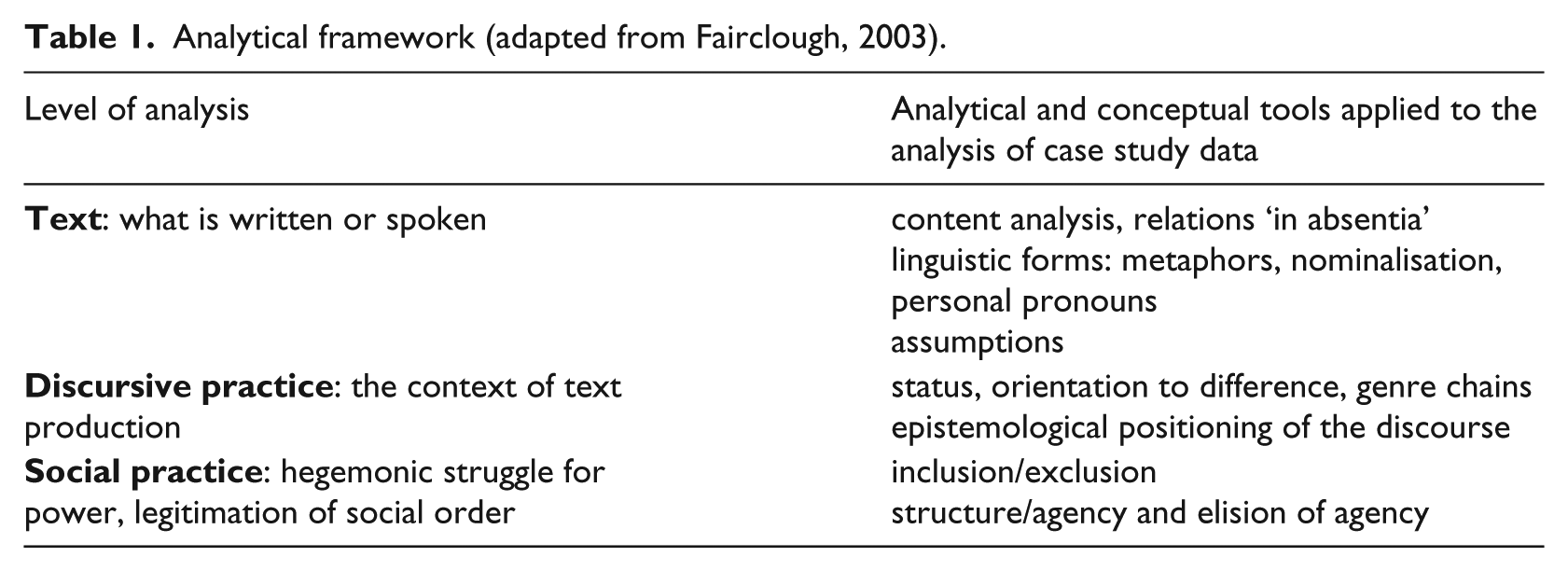
Fairclough’s (2003: 2) approach to discourse analysis is based on an assumption that social research ‘always has to take account of language’, because language is an ‘irreducible part of social life, dialectically interconnected with other elements of social life’. The language of what is written or spoken (text level) needs to be considered both within the context of text production (discursive practice) and broader context of social practice. Discourse is constitutive of particular social orders and, consequently, far from being a ‘neutral’ medium for representing reality, it both expresses and enacts a hegemonic struggle for power and the legitimacy of knowledge. Textual data in the present case study included verbal discourse in the form of interview transcripts, as well as curriculum and quality assurance documents related to undergraduate programmes.
Through its constitutive power, discourse may effect material changes within networks of social practice (Fairclough, 2003) and it is to the evaluation of such changes within the university and the BF that we now turn.
Key findings
The findings from the case study focus on how discourse on quality in teaching and learning impacts on curriculum development and ‘defines the core activity’ (Amann, 2011: 5) of academics working in the BF.
Curriculum development as an ‘administrative process’: power hierarchies and patterns of exclusion
This case study found that curriculum development in the BF is highly regulated through QA-BF procedures and that collaborative, collegial working relations amongst academics are being inhibited by managerial structures (Twale and Luca, 2008). The faculty is organised hierarchically (see Figure 1), with the quality in teaching and learning being defined, managed and audited at institutional level by the university’s Quality Assurance Unit and at faculty level by QA-BF led by a Director of Quality. Inherent in this structure is the separation of teaching (as the task of academics) from the evaluation of the quality of teaching (a management task). As Seddon (2008: 27) argues, this separation may lead to a ‘bureaucratic management factory dictating how [teaching and learning] should be designed and managed’, whilst, paradoxically, it is the academics who are better positioned to ‘understand and improve the work’. One related consequence of this dynamic is the phenomenon of ‘dissociation’ experienced by academics in the BF, discussed later in this paper.
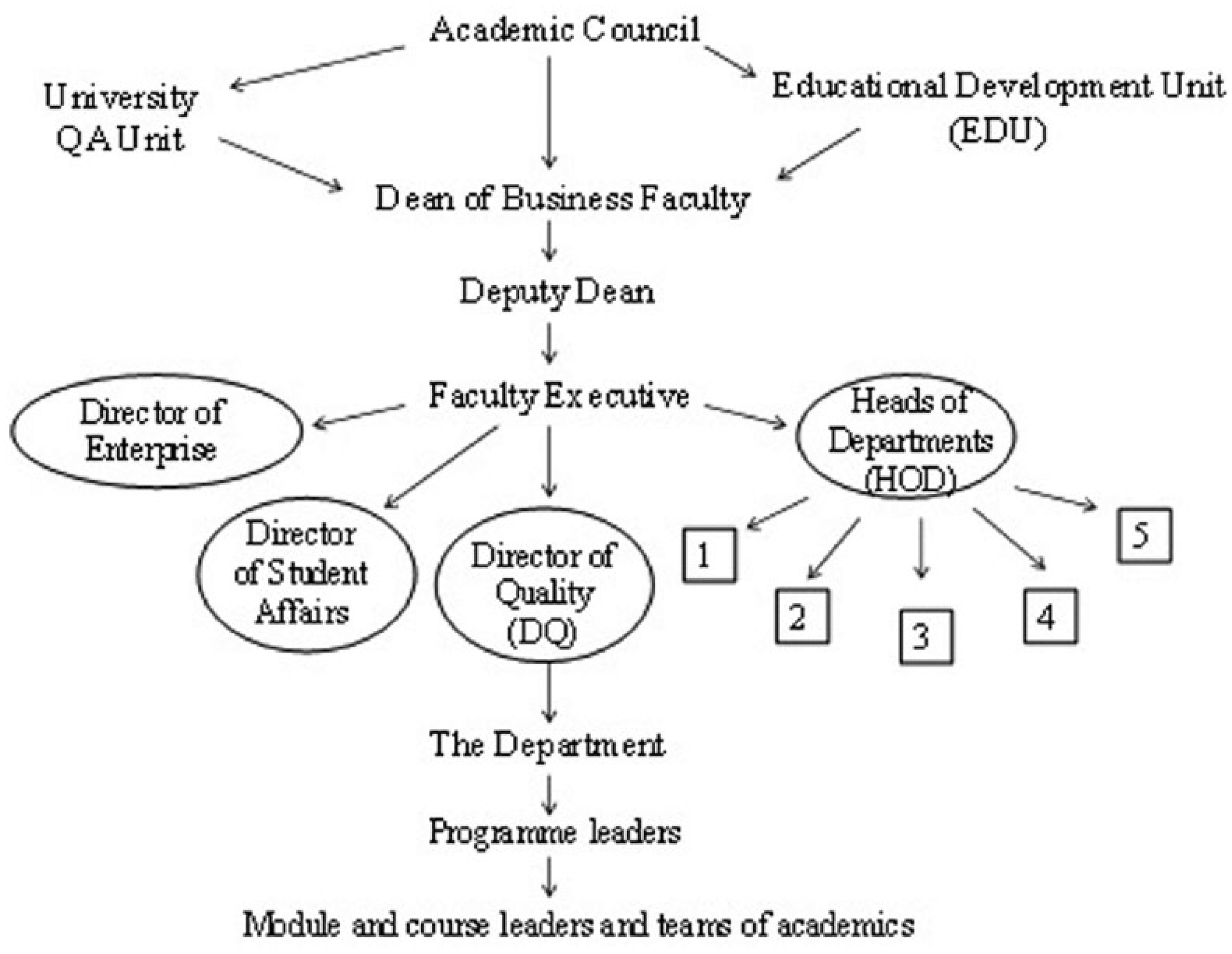
The hierarchical management structure in the BF.
At the university (institutional) level, the ‘quality framework’ is described in the Academic Regulations (2012) as follows: In exercising the power to grant and confer academic awards, the University will be required to demonstrate that it has the capacity and resources to establish procedures for the initial validation, approval, regular monitoring, periodic review and modification of its courses and programmes. Its quality assurance system will adhere to the QAA Code of Practice. (Academic Regulations)
Though the above text, in some senses, simply states an official commitment to the academic regulations imposed by the QAA, it also typifies managerial discourse in the university around the quality of teaching and learning and curriculum development. Here quality assurance is represented as performing a ‘neutral’, ‘functionalist role’ in ensuring that the quality of programme provision complies with QAA regulations. The use of the term ‘establish procedures’ signifies value-free, systemic activities relating to the role of quality assurance in degree programme ‘validation’, ‘monitoring’, ‘review’, etc. The following text from the same source maintains the same ‘functionalist’ tone: The Academic Council’s policies have been successful in enhancing the quality of teaching and learning and the student experience through the promotion of developmental activities, the arrangements for the identification and exchange of good innovative practice, and responsiveness to course and programme teams. (Academic Regulations)
The reference to ‘arrangements for the identification and exchange of good innovative practice’, suggests that enhancing the quality of teaching and learning is a consequence of senior management ‘policies’. These texts convey curriculum development and teaching and learning as primarily an ‘administrative’ or ‘management’ process which is then implemented at faculty level by QA-BF. According to Fairclough (2003: 29), discourse has the transformative power to shape teaching by being inculcated as ‘ways of being’. Therefore, whilst this discourse may appear ‘neutral’ or ‘functionalist’ in tone, it signals certain values and assumptions concerning power relations in the BF viewed as a network of social practice. In particular, the implicit message conveyed here is that the leadership of ‘developmental activities’ and ‘arrangements’ rests with the Academic Council rather than the academics in the programme and module teams. This discourse thus defines quality enhancement around managerial expertise and procedures, positioning academic teams as the ‘implementers’ of policies.
These characteristics also appear in texts developed by the BF management in which academics are consistently positioned as ‘deliverers’ of the curriculum and not involved in strategic decision making in relation to teaching and learning. As Fairclough (2003: 17) argues: ‘[o]rganizational structures are hegemonic structures, structures which are based in and reproduce particular power relations between groups of social agents’. In the case of the BF, management discourse on quality enhancement assigns academics to a relatively diminished power position. The following two extracts from the Faculty Strategic Plan (authored by the Deputy Dean) construct a discursive disempowerment of academics similar to the one found in university Academic Regulations discussed above: The faculty has set up a project team to embed graduate attributes into the curriculum across all programmes… In January, the team, working with the Educational Development Unit, will review specific skills-based courses with the aim of embedding aspects of graduate attributes for delivery from September 2012. We are implementing changes in the delivery of learning to make it more inquiry based and interactive. A learning enhancement task group under the auspices of the Educational Development Unit (EDU) has been set up to incorporate the latest learning techniques into course delivery. (Strategic Plan)
As the above texts illustrate, quality enhancement strategies in the BF use discourse which elevates the knowledge of teaching and learning experts as ‘superior’ to that of academics directly engaged in teaching, framing the quality of teaching within hierarchical systems and procedures. As stated in the Strategic Plan, the leadership, management and implementation of changes to teaching and learning lies in the hands of the ‘project team’, the ‘Educational Development Unit’ (EDU) and the ‘learning enhancement task group’, not academics within the departments. The EDU comprises a team of e-learning experts and HEA fellows who have a remit for the enhancement of teaching and learning across the university (Figure 1), whilst the ‘learning enhancement task group’ and ‘project teams’ include academics organised ad hoc and directed by the EDU, for ‘implementation’ purposes. Noteworthy in this discourse is the elision of agency (Fairclough, 2003: 143–146) through the use of impersonal and collective nouns such as ‘the faculty’, ‘the project team’, ‘the EDU’, and not referring to individuals who have ‘set up’ the ‘learning enhancement’ tasks. As well as disempowering academics, this is suggestive of viewing social actors instrumentally, as elements of organisational structures and processes. The use of impersonal nouns (and of the plural pronoun ‘we’) also obfuscates difference or disagreement, fostering a homogenous, standardised approach to enhancing teaching and learning. The references to the ‘delivery of learning’ and ‘course delivery’ are examples of nominalisation, a grammatical metaphor which represents ‘processes as entities’ (Fairclough, 2003: 22), excluding academics and students as agents who could make learning more ‘interactive’.
Paradoxically, therefore, making learning more ‘interactive’ is conveyed here as a matter of the ‘task group’ rather than academics directly involved in teaching and interacting with students. The exclusion of students is also implicit in this discourse through the reference to the ‘project team’ embedding ‘graduate attributes into the curriculum’. Graduate attributes have become disembodied, externalised and objectified. This discourse seems to convey the priority of procedures and systems over individuals.
Even within the academic cohort itself, a hierarchical approach to curriculum development was suggested by the data. The review and subsequent redevelopment of the ‘Business Studies’ programme provides a further striking example of a pattern of exclusion of academics from decision-making in matters related to curriculum development. In the ‘interests of efficiency’, the departmental Director of Quality decided that the review and subsequent redevelopment of the ‘Business Studies’ programme would be conducted by a team of three including the Director of Quality, the programme leader and a senior manager. Subsequently, module team leaders were presented with the newly developed programme and asked to ‘fill in’ module specifications based on the faculty’s quality assurance templates. All other academics were excluded from the programme development process, even though they were then tasked with its ‘delivery’ to students. Typically, these generic templates were presented by QA-BF in rational, functionalist discourse as technical mechanisms to ensure standards and adherence to QAA regulations. However, as the findings detailed below demonstrate, these generic templates cast the curriculum in a narrow, instrumentalist, outcomes-based mode. Designed in an easily ‘inspectable’ format, the templates seem to promote a model of academic accountability that ‘elides with policing… and disciplinary mechanisms linked to neoliberal governmentality’ (Morley, 2003: 56). Importantly, this approach to quality assurance promotes a shift in focus from the direct evaluation of the teaching quality by the academics themselves to the ‘management of quality and standards’ through the indirect processes of ‘institutional review’ (QAA, 2010: 18). As argued by Rolfe (2013: 10), institutional excellence is thus conceived of as achievable (and demonstrable) through the ‘effective management or administration of quality and standards’ rather than by direct attempts to improve the quality of everyday academic practice. The consequences of this approach in relation to teaching and learning in the BF are now examined.
‘The pedagogy of confinement’
As emphasised by Gibbs and Iacovidou (2004), a ‘pedagogy of confinement’ arises from the framing of teaching and learning in terms of predetermined outcomes. Although this approach is designed to reduce the risk of student failure, paradoxically, it increases the risk of ‘fragmenting and atomising the learning process’ (Antunes, 2012: 455). It confines learning within narrowly specified parameters of what is predictable and simplistic, rather than complex and open ended. From the quality assurance perspective, structuring learning within predetermined outcomes facilitates steering and controlling individuals and institutions ‘at a distance’ (Fairclough, 2003: 31; Ozga, 2011). This is achieved through a genre chain, a network of texts linking together different social practices (Fairclough, 2003). That teaching and learning in the BF are directly linked to quality assurance regimes as well as government policy texts becomes apparent through an analysis of the undergraduate ‘Business Studies’ and ‘Entrepreneurship and Innovation’ programme specifications. The specifications explicitly state that they are predicated on the external ‘QAA Benchmark Statement on General Business and Management’ (2007). For example, the ‘Entrepreneurship and Innovation’ programme specification begins as follows: Benchmarking statements for the subject you are studying define what a student is expected to learn from studying that subject. They are defined by academic staff in the field and provided to students and universities by the QAA. (Entrepreneurship and Innovation Programme Specification)
The programme specification then proceeds to quote verbatim the list of standards outlined in the QAA Benchmark Statement (2007). The links between these two texts, government policy (Dearing, 1997) and module learning outcomes are presented in Table 2.
A policy – QAA benchmarks – programme specification – module learning outcomes genre chain.
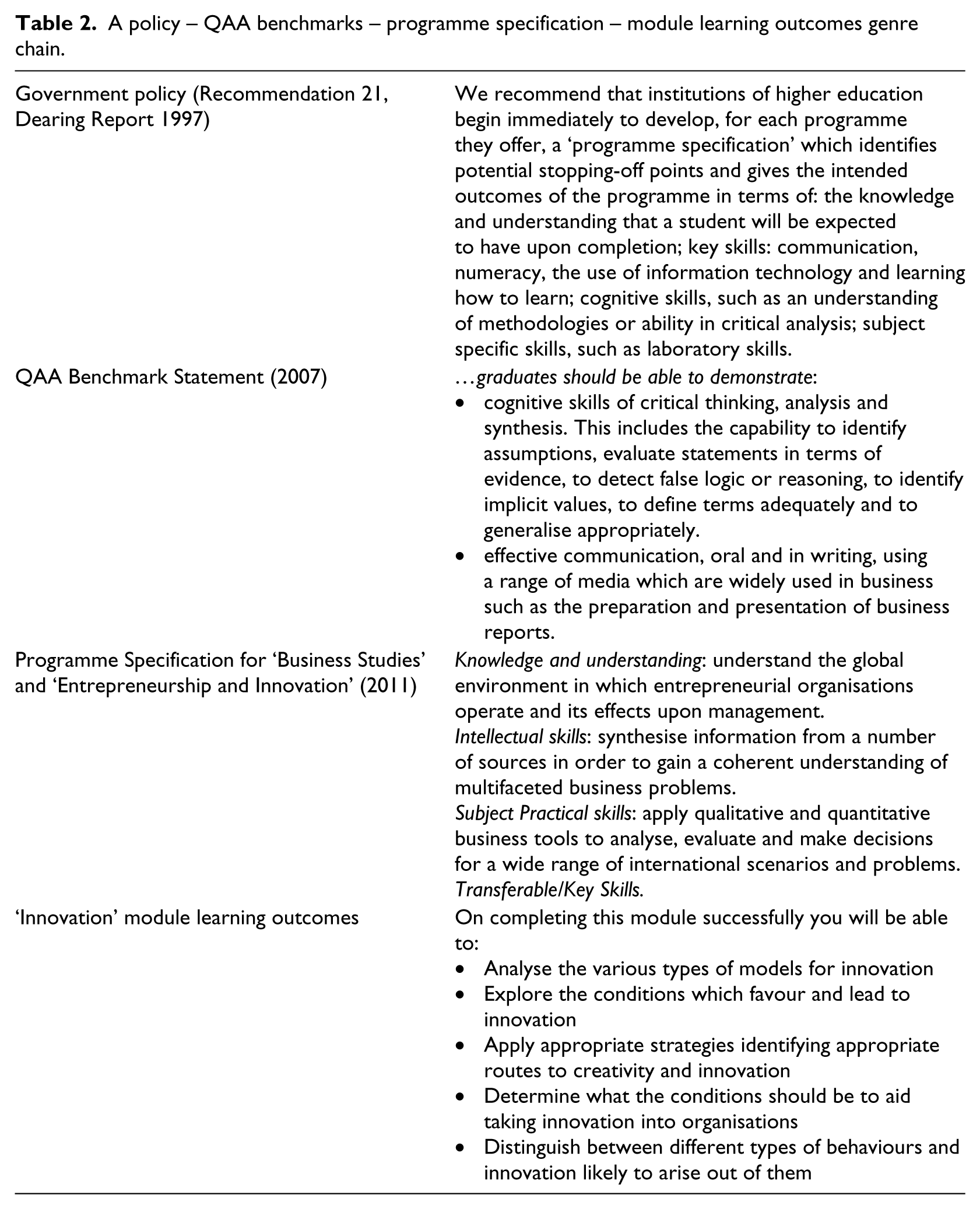
All programme specifications in the BF are based on a generic QA-BF template which, in turn, attempts to apply the recommendations of the QAA Benchmark Statement (2007). Generic statements seem to have been ‘cut and pasted’ into all of the programmes described in the Programme Review (2011). However, as exemplified in Table 2, the genre chain has been transformed into module learning outcomes with some notable omissions, termed by Fairclough (2003) as ‘relations in absentia’. Firstly, the framing of learning outcomes in terms of demonstrable behaviours excludes the knowledge and understanding dimensions to learning which are a common thread identified by Dearing (1997), the QAA Benchmark Statement (2007) and the Programme Specification (2011). Secondly, neither the Programme Specification nor module learning outcomes prioritise ‘cognitive skills of critical thinking’ over more procedural knowledge and understandings, as in the QAA Benchmark Statement (2007).
The discourse on teaching is restricted in the BF documents to disconnected, frequently random lists of ‘Learning Outcomes’ together with ‘Indicative Content’, ‘Learning and Teaching Activities’ and ‘Assessment’ which are, in almost all cases, so concise as to be practically meaningless. For example, there is little attempt to rank the relative importance of ‘outcomes expressed as skills’ nor to indicate how they might signify progression or skills development over the three years of the undergraduate programme cycle. Therefore, whilst these ‘skills expressed as outcomes’ may satisfy QAA regulations, they are disconnected from a coherent body of disciplinary knowledge. For example, the learning outcomes for the ‘Innovation’ module could become replicated in a module on ‘Strategy development’ by replacing references to ‘innovation’ with ‘strategy development’ (Table 2). The QA-BF templates thus appear to impose an instrumentalist approach to curriculum development which may engender an instrumentalist approach to learning. The scaffolding provided by the QA-BF templates appears to consist mainly of ‘skills as outcomes’ and learning driven by assessment. The concern here is that outcomes-based curricula can lead to ‘epistemological closure’, where both the method and the content of teaching may become confined to the achievement of explicit, narrow and measurable assessment objectives (Barnett, 1994).
Indeed, this paradigm has been reinforced in the BF by inserting the management tool of Key Performance Indicators (KPIs) into the assessment process. KPIs are applied to student assessment results by explicitly requiring specified percentages of ‘fail’ (less than 40%) and ‘distinction’ (70% and above) grades as measurable outcomes of teaching quality. Failure by the module cohort to achieve grade averages which fall within the KPIs automatically triggers a review of the module and a lengthy report by the module leader whom the system makes accountable for student performance. In this way, the meaning of teaching and learning for the academic, the student and the institution has been located under the auspices of the QAA in the extrinsic value of grades and degree classifications. Excellent grade point averages translate into a ‘win-win-win’ situation, where the academic acquires system-approval for teaching prowess, the student gains accreditation and the institution improves its league table position. In Amann’s (2011: 290) words, everyone succeeds ‘in “fulfilling” their plans’.
As a result, however, what constitutes quality in teaching and curriculum becomes confined by outcomes and performance indicators which may facilitate quality assurance rather than pedagogical quality. This ‘win-win-win’ situation may be a result of ‘gaming the system’ (Amann, 2011) by all involved: the students, academics and auditors. As Seddon (2008: 148) warns in the context of what he sees as the rise of ‘public-service factories’, when managers become preoccupied with the implementation of KPIs: we can only anticipate that… service and cost performance will worsen. The KPIs… will dictate how the work of these factories will be designed and managed… Alongside will sit the inspectors, who will be seeking evidence of compliance. Together, these will become a meta-system of non-learning.
One consequence of QA-BF’s influence may be that both academics and students in the BF conceptualise the curriculum as an ‘object’, a static obstacle to be overcome, rather than an enabler of learning (Hussey and Smith, 2003). Academics may also become averse to experimenting with more creative approaches to teaching. In order to assert their own professional discretion, they may need to defy official regulations, behind the closed doors of their seminar rooms (Tyack and Cuban, 1995). However, in a paradigm where compliance to KPIs becomes paramount, raising the levels of uncertainty amongst students about ‘outcomes’ which are not easily measured could be perceived by academics as ‘risky’ (Jackson et al., 2006). Crucially, academics may also perceive a process of curriculum development in which their agency has been obviated as a signal of a lack of trust in their professional capacity to deliver ‘quality’ (Hoecht, 2006). It is this dimension of the case study that this paper now examines.
‘I am just a cog in this wheel’: the discourse of dissociation
The hierarchical systems and expectation of compliance with procedures and templates appeared to disconnect academics in the BF from the process of evaluating their own practice. As emphasised by Morley (2003: 162): the compliance culture and command economy in higher education threatens to produce self-policing, ventriloquising apparatchiks, as opportunity for cultural agency is reduced.
Most academics who taught on the two programmes were excluded from the process of their design and development entirely. Margaret, describing her modus operandi in teaching her undergraduate students, at one point applied a ‘machine’ metaphor in the following way: Because I am just a cog in this wheel, my attitude to any course that I’m involved in, my attitude is the best I can do is to widen their experience.
The expression ‘I am just a cog in this wheel’ appears to signal a feeling of diminished agency, in the form of perceived powerlessness or disconnection from the organisation or both. Dissatisfaction with their teaching experience at the BF was expressed by 22 out of 24 interview participants in a variety of forms which can be conceptualised as types of ‘dissociation’. 6 The Oxford Dictionary of English (2010) defines ‘dissociation’ as ‘the action of disconnecting or separating or the state of being disconnected’. ‘Dissociation’, in this context, refers to patterns of discourse in which participants consistently suggested behaviours linked to ‘splitting away’ or ‘disconnection’ from the BF as a community bound by relationships of co-operation and collegiality. Table 3 presents a ‘typology of dissociation’ based on the interview data.
Typology of dissociation amongst interview participants.
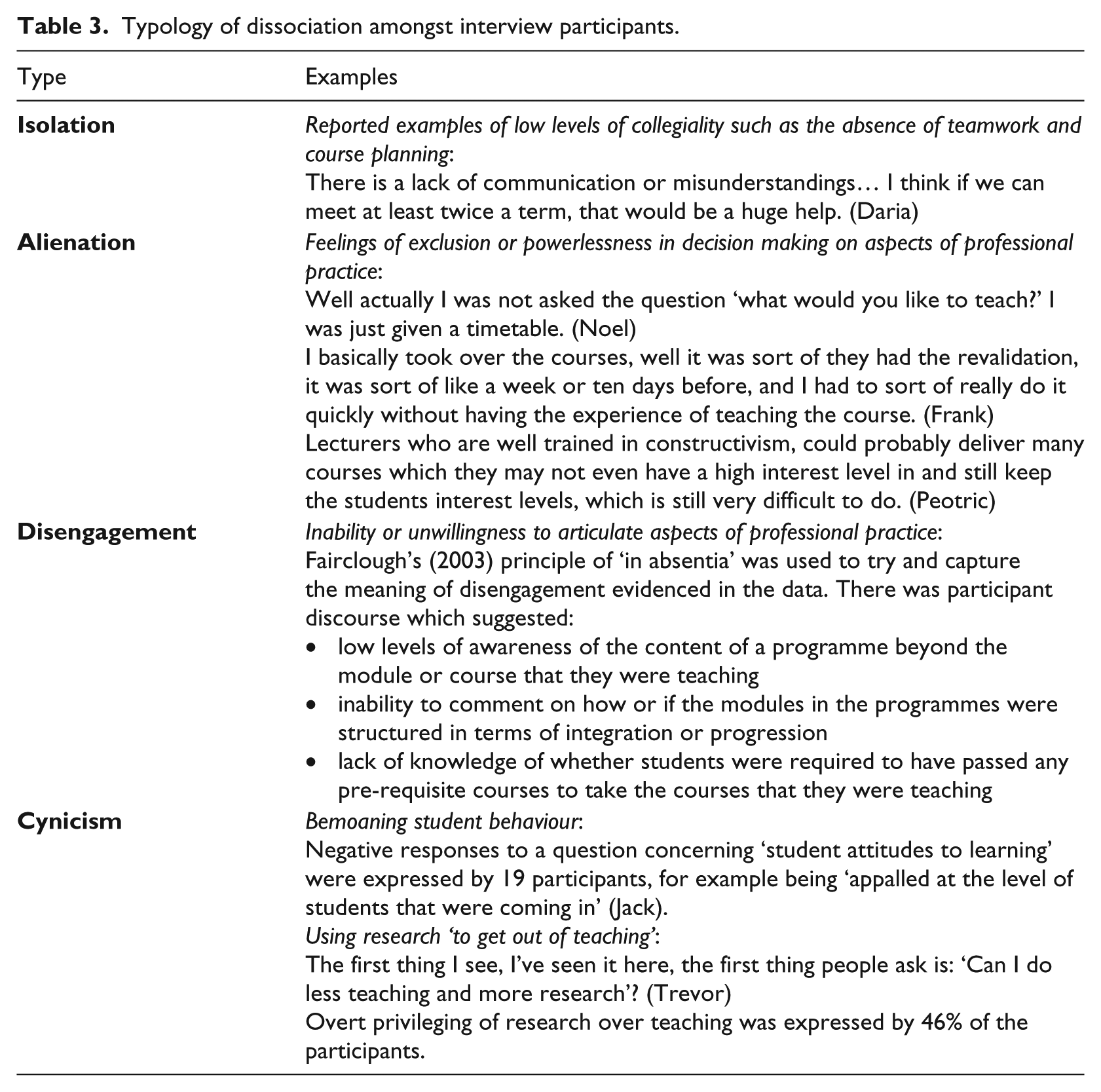
It is beyond the scope of this paper to present a detailed analysis of the typology, but two key points are identified in relation to the link between ‘dissociation’ and the ‘standards paradox’. Firstly, a feeling of alienation expressed by some participants was caused by the managerial practice of timetabling academics to teach on or lead modules as a fait accompli rather than by negotiation. Several participants expressed resentment that they had been timetabled for modules, sometimes at short notice, in which they had neither experience nor an epistemological base. Other forms of alienation included participants’ feelings of powerlessness in terms of developing the curriculum. This found expression in relation to the tight control which the BF quality assurance function was perceived to exercise on course innovation. Dennis typifies a perception held by some participants of being restricted by regulations: It’s a matter of procedures; it’s a matter of what kind of power we have in our own hands. For example if you want to change a course that will be taught in February 2013, you need to make the changes a year before.
Dennis went on to point out the irony of teaching a dynamic subject like business within an administrative ‘straightjacket’: business is a very dynamic environment. You cannot, if you are not allowed to change and get things updated or even the title, update the title of your course whenever you want, whenever you believe you can justify this change. This is something very, very important… We need to become more agile and we need to have more power in decision making as teachers. Because I have a feeling that we have less power.
Secondly, the different forms of dissociation appear to have led to an ‘atomisation’ of academics in the formation of their professional identities. One of the most striking paradoxes in the BF’s organisational culture is that, despite the overt power differentials signified in the hierarchical structure and managerial processes, participants referred to certain powerful forms of professional autonomy and development. Unlike the disciplinary techniques employed in many modern organisations (Stacey, 2012), academic workers in the BF still remain, to a significant degree, in control of their working time. For example, according to participants, it is custom and practice for academics, having met the demands of teaching, compulsory meetings and nominal ‘office hours’, to work for long periods of time beyond the campus, ostensibly free of direct surveillance. Research, especially applied research, is valorised in managerial discourse and bidding for research grants is communicated by management as a highly esteemed activity. Significant university resources are devoted to the training of academics in the skills of applying for research grants. Participants are permitted to ‘buy themselves out of teaching’ to conduct funded projects, whilst publications are rewarded with up to 20% of workload devoted to research activity. Participants are also encouraged, through generous funding, to present academic papers at UK and international research conferences. Therefore, in terms of control, a dichotomy appears to arise where academics are highly regulated by quality assurance in curriculum development and teaching, yet appear to be empowered to freely engage as individuals in professional activities beyond the campus such as research or knowledge transfer. It therefore seems probable that academic autonomy in this specific context is accepted by management as a necessary accommodation to achieve the ‘entrepreneurial university’ (Barnett, 2013; Clark, 1998) or attract academics with a strong research orientation.
Conversely, in terms of teaching and learning, managerial discourse subordinates academics to the designs of experts. One unintended consequence of the discourse which constitutes teaching (a highly regulated activity) as less esteemed than research (a more autonomous, prestigious endeavour), may be that academics construct their professional identity accordingly. As pointed out by May (2006: 340–341), prioritising research over teaching: produces isolation because environmental opportunities, such as the pursuit of research grants, have less transformative capacity because they are translated into internal accumulations in the pursuit of peer recognition.
In summary, participants within the BF appear to have reconstructed themselves as ‘atomised’ or ‘disengaged’ academics (Macfarlane, 2005). Atomisation in this context is a negotiated self-identity in which the academic is referenced to and references him/herself to the singular activity of commodity-knowledge generation through research rather than to pedagogical practice. This may accentuate a ‘pursuit of personal visibility’ and lead to a ‘fundamental departure from the collegiality, solidarity and service values which once characterised large parts of the British workplace’ (Amann, 2011: 297). 7
These key findings point to a connection between the QA-BF processes and academics’ perceptions and behaviours in relation to teaching and learning. The connection needs to be drawn tentatively, due to the complexity of factors affecting academic practice, such as specific institutional and departmental cultures, personal epistemologies as well as the nature of business as a discipline of knowledge. 8 However, based on the power of discursive practices to legitimate particular social orders (Fairclough, 2003), quality assurance texts and procedures have both symbolic and material consequences (Morley, 2003). Particular notions of quality create a perspective ‘that illuminates and defines certain objects and obscures and hides others for governance purposes’ (Grek et al., 2009: 5). For example, within the broader context of the EHEA, the vision of a homogenised ‘quality culture’ promoted by the ENQA (ENQA, 2010) simultaneously obscures the importance of difference ‘for which there is no common scale’ (Harris, 2012: 69) in defining educational quality in genuinely novel ways. This paper will now turn to this broader context, in which the rise of the European discourse on Quality Assurance and Evaluation is associated with a ‘shift from the attempted fabrication of Europe through shared narratives and projects to its projection’ (Grek et al., 2009: 7). Reading ENQA texts as ‘projections’ of a particular version of European higher education calls for a cautious approach to standards, especially in view of the resemblances between the European discourse on quality and the QA-BF quality discourse and its material consequences discussed above.
ENQA Standards and Guidelines for Quality Assurance in the EHEA
An analysis of ENQA discourse (ENQA, 2009, 2010, 2012; EUA, 2014) reveals tendencies which resemble those at play in the case study of the BF. These resemblances create a genre chain (Fairclough, 2003) connecting ENQA texts to QAA texts as well as the QA-BF documentation (see Table 2). Content analysis of the Standards and Guidelines for Quality Assurance in the EHEA (ENQA, 2009) reveals a tendency to frame them in terms of ‘accountability’ rather than ‘enhancement’. The text makes 38 references to ‘accountability’, in relation to: ‘giving an account of’, ‘accountability procedures’, ‘real accountability’ and ‘demonstrating accountability’. In contrast, ‘enhancement’ is referred to 15 times, in relation to procedural (rather than educational) matters, such as ‘enhancement of quality’ or ‘enhancement policies’, with just one reference to ‘enhancing the education’ offered to students. The ‘quality of education’ is couched in the language of outcomes, skills and competencies. For example, a report on ‘Sharing Practice in Enhancing and Assuring Quality’, frames teaching and learning as a ‘transfer’ of ‘knowledge, skills, competencies and values’ (EUA, 2014: 40). As with QAA, ENQA also positions external quality assurance agencies as expert in steering HEIs ‘toward excellence by setting the standards, definitions or frameworks for excellence’ (ENQA, 2012: 20). Despite a claim that quality assurance ‘should not stifle diversity and innovation’ (ENQA, 2009: 14), a highly prescriptive model is recommended for quality assurance review in member countries. The amount of technical detail required by the model (pp. 35–39) resembles the QA-BF templates discussed above. Quality is defined quantitatively through measurable outcomes, benchmarks, performance indicators and other statistics reminiscent of the KPIs used in the BF. These methodologies make quality assurance susceptible to advances in technologies for data production. Such advances, in turn, increase the pressure to ‘produce, analyse and act upon the data’ (Lawn, 2013: 110) and, by privileging comparative statistics, may enable steering and shaping higher education in line with political rather than educational purposes.
Despite its ‘neutral’, functionalist focus on matters of ‘procedure’, ENQA discourse appears to reinforce the political narrative of globalisation and economic imperatives and construe higher education as a ‘driving force for future economic and social well-being of Europe’ (ENQA, 2010: 1). The normative intent of the discourse asserts obligation to comply with standards and procedures as follows: Institutions should have a policy and associated procedures for the assurance of the quality and standards of their programmes and awards. They should also commit themselves explicitly to the development of a culture which recognises the importance of quality, and quality assurance, in their work. (ENQA, 2009: 7)
The functionalist tone silences issues of ministerial influence over higher education, whilst the apparent ‘neutrality’ enables the ENQA to withhold value judgements about the aims of quality assurance in relation to the aims of higher education. The judgement-free statements about the ‘appropriate relationship’ between external QA agencies (such as QAA in England) and HEIs exemplify this as follows: Some [agencies]… take the view that external quality assurance is essentially a matter of ‘consumer protection’… while other agencies see the principal purpose of external quality assurance to be the provision of advice and guidance in pursuit of improvements in the standards and quality… Yet others wish to adopt a position somewhere between the two… (ENQA, 2009: 12)
Despite its ‘neutral’ tone, this discourse appears to normalise quality assurance for ‘consumer protection’ as the basis of ‘appropriate relationships’ in higher education. Similarly, the notion of the ‘quality culture’ (ENQA, 2009) may be read as seeking to effect a change of perception whereby: Quality is no longer perceived as being done to stakeholders, but by stakeholders. With this change in perception, proactive participation is in the power of the individual but is channelled into the community that individual belongs to. (EUA, 2014: 42)
A ‘quality assurance community’ is thus both fabricated and projected (Grek et al., 2009), conceived as a homogenised collection of individual stakeholders ‘committed to continuous quality improvement’ (ENQA, 2010: 3). By contrast, in a ‘community of practice’, thinking and judgement rather than ‘proactive participation’ constitute the main modes of belonging (Harris, 2012). According to Harris (2012: 94), neither thinking nor judgement are based on ‘endless lists of criteria’, standards, or ‘universals’ but on paying attention to the particulars that define each situation anew. This is because ‘there are no ultimate foundations where standards are sustained in the light of precedent, comparison and projection’ (p. 94). Consequently, a ‘community of practice’ relies on shared understandings of what constitutes quality derived from direct involvement in practice rather than from criteria which can be ‘ticked off’ or disseminated for ‘implementation’ by administrators, ‘teaching champions’ and other experts. It is a lack of thought or judgement in adhering to standards that might distort professional practice and atomise academic communities in the ways encountered in the BF.
Conclusion
Although the quality assurance processes in the BF bear resemblances with the standards and procedures of European quality assurance, it would be injudicious to draw more than tentative connections between them. The EHEA is characterised by diversity in relation to political and educational systems, cultural traditions and languages and this diversity is recognised by the ENQA (2010) as an important value and a principle underpinning its future activities. Consequently, the case of the BF is developed here as a ‘cautionary tale’ which may illuminate some possible consequences of prioritising the pursuit of standards and uniformity over quality enhancement and diversity.
Conversely, there are also lessons to be learned from some of the consequences of the Bologna Process and the ensuing remit for ESG. Despite their principles, the regulatory frameworks seem to progressively disarticulate education as a ‘social and human right related to the formation of individuals and communities’ and shape it into a market service for ‘individual, private consumption’ (Antunes, 2012: 450). In this context, the key role of quality assurance may shift in the future from ‘accountability’ or ‘enhancement’ to ‘consumer protection’. For students – consumers – this could give rise to standardised forms of higher education described above as the ‘pedagogy of confinement’, delivered by ‘atomised’ academics who have lost control of, and perhaps interest in, working as a ‘community of practice’. As suggested by the case study findings, improving quality assurance across the EHEA through the ‘use of agreed standards and guidelines’ (ENQA, 2009: 6) may rely too heavily on an assumption that, once agreed, standards will ‘deliver’ quality. The culture of dissociation which developed in the BF seems to confirm that a combination of standards and excessive institutional control may result in a decline in the quality of teaching and learning, rather than a ‘quality culture’. Although undeniably important as an element in improving educational quality, standards need to be approached with caution. This is because of the ‘standards paradox’; by aiming at the uniform and the measurable, quality assurance standards shape the future ‘in the form of past achievements’ (Gibbs and Iacovidou, 2004: 114), simultaneously constraining higher education in its quest to aim higher, beyond what is already uni-formed and measured, into alternatives which are as yet unknown.
Footnotes
Declaration of conflicting interests
The author(s) declared no potential conflicts of interest with respect to the research, authorship, and/or publication of this article.
Funding
The author(s) received no financial support for the research, authorship, and/or publication of this article.