




Abstract
This study examined awareness of and knowledge of how to address increasing linguistic and cultural diversity among 89 teachers in an ethnically and racially diverse school located in Southwest Finland. The empirical evidence suggests that in a school with many years of experience with a diverse student population the levels of awareness and knowledge among teachers are relatively low and teachers themselves expressed the need for much more information, in particular, strategies for meeting the needs of their students. In addition, teachers showed distinct levels of awareness of diversity which successively predicted their knowledge of strategies for addressing diversity in the classroom. Implications for research and teacher education are discussed.
Introduction
As more and more students from diverse backgrounds populate 21st-century classrooms, it has become imperative that teachers acquire competencies in cultural and linguistic diversity (Banks, 2010; Gay, 2010). While countries like the US and Britain have had long-standing experience with immigrants and thus have developed a more defined curriculum for multicultural education, many European countries are still at the threshold. There is the prospect to seize the richness and opportunities offered by these changing demographics to raise linguistic and cultural competencies of all the children at school regardless of their backgrounds. This is badly needed since to date there is limited material related to linguistic and cultural awareness in these countries (OECD, 2010).
Increasing diversity shifts the landscape for educators who must adapt to these changes, each within their unique contexts. In European countries with more recent international migration, and where linguistic and cultural diversity is a relatively recent phenomenon, immigrant students and second language learners pose new challenges for teachers who, for the most part, have had little or no exposure to teaching students from varied ethnic, cultural and linguistic backgrounds in a single classroom.
Finland is one such country currently experiencing these rapid changes. As migratory patterns change the demographics in Finland, the government and many schools are seeking to plan ahead for increased diversity in public school classrooms. In Finnish education policy, multiculturalism is described as a series of encounters between Finns and foreigners where immigrants are perceived as being outside the Finnish society (Wahlbeck, 2005). Building on that definition for the purposes of this study, diversity and diverse learners refers to students who are racially, ethnically, culturally and linguistically different from the native Finnish-speaking students from the dominant/traditional Finnish culture.
According to Statistics Finland (2013), Finland’s population grew by 25,407 people in 2012. The number of people speaking a mother tongue other than Finnish or Swedish grew by 22,122. This represented 87% of the population growth, while the number of additional people whose native language is Finnish grew by only 3497. Clearly, the number of diverse learners in Finnish schools is growing and is projected to steadily increase as upward trends in migration continue in Finland. Consequently, many teachers currently in Finnish classrooms and teacher candidates in teacher education programmes will teach students who are different from themselves in race, ethnicity, culture, language and social class. Similar to most western European countries, the teaching force, as well as teacher candidates in Finland are white, female, middle class, and from the dominant culture. A gap exists between the cultural, social and linguistic background of teachers and their students (Darling-Hammond, 2005). These mismatches bring about incongruences that influence the teaching and learning that takes place in the classroom due to unresponsive curricular and instructional strategies, teachers misreading students’ abilities and behaviours, over-representation of immigrant and multilingual learners in special education classes, and disparities in educational achievement (Banks, 2009; Gay, 2010; Ladson-Billings, 2009; Nieto and Bode, 2008).
Increasing diversity has been strongly linked to student achievement in school (Gay, 2010; Ladson-Billings, 2009; Mitchell, 2010; OECD, 2004, 2006, 2010, 2015). Data from the OECD Program for International Student Assessment (PISA) 2003 and 2006 have identified family background, socio-economic background and migration status as the main determinants of students’ performance in school over and above other factors (OECD, 2004, 2007a). Data from the US suggests disproportionate achievement gap between diverse learners and their mainstream peers (Gay, 2010; Goldenberg and Coleman, 2010; Ladson-Billings, 2009; Mitchell, 2010). Several national and state assessments show that when standardised tests scores are disaggregated by proficiency level, multilingual learners (students learning through English as a second language) tend to have lower scores (English Language Learners (ELL) Subcommittee, 2009; National Assessment of Education Progress (NAEP), 2004). Furthermore, multilingual learners tend to have low graduation rates, high drop-out rates and an over-representation in special education programs (ELL Subcommittee, 2009).
Recent reports indicate that this disparity in educational achievement is paralleled across OECD countries (OECD, 2010, 2015) although rates are much smaller in Australia, Canada and New Zealand. Rapid changes in the origin of and skills of immigrants entering these countries may explain the decreases in achievement gap. For example, Australia and New Zealand uses points-tests to screen entry in their territory in favour of better-qualified immigrants and this has significantly reduced the number of immigrant students from low-educated families; and first and second generation immigrant students, mostly from India and China, score 61 and 94 points higher in mathematics respectively than non-immigrant Australian students (OECD, 2015). Countries that hitherto perceived diversity issues as low on the agenda and did not have to worry about achievement gaps now have to confront these issues as the demographic transformation of student populations continues.
Finland’s education system is viewed as highly effective, based on the level of student performance in international comparisons (OECD, 2004, 2007a), as well as parity in achievement in terms of sex, domicile, school and socio-economic background (Kivirauma and Ruoho, 2007). There are indications, however, that increasing diversity through immigration is beginning to result in some achievement gaps. Recent data from the OECD (2015) suggests that in 2012, the performance gap in mathematics between immigrants and non-immigrants in Finland was 85 score points, which was much higher than the OECD average of 37 score points. Itkonen and Jahnukainen’s (2007) analysis of PISA results revealed that when results are disaggregated, diverse learners who are largely immigrants have lower academic outcomes than native Finnish students, especially in reading literacy, but also in mathematics and science.
Schools in Finland treat students as a culturally homogenous group (Koivisto, 2014; Siimekselä and Tarvainen, 2010) yet equality is of prime importance, so much so that there is almost no room for pedagogies that address cultural differences (Koivisto, 2014; Mansikka and Holm, 2011; Wahlbeck, 2005). Issues related to linguistic and cultural diversity are often treated as special education needs (Savolainen, 2009). As defined by Kivirauma and Ruoho (2007), special education in the Finnish context is conceptualised as providing special support resources in the first years in comprehensive school towards supporting students in learning basic skills in literacy and numeracy. Based on this policy, beyond an initial year of intensive Finnish language instruction, special education support has been used to respond to the increased diversity in classrooms (Savolainen et al., 2011).
While this practice can and does provide better education for a wide range of students (Moberg and Savolainen, 2008; Savolainen, 2009; Savolainen et al., 2011), the problem with monocultural or assimilationist teaching as is currently practiced in Finland is that it likely transmits the beliefs and values of the dominant culture in uncritical ways to students (Nieto, 2005; Nieto and Bode, 2008), poses linguistic challenges for second language learners (Brisk, 2006; Nguyen et al., 2001), and divests students of the social, cultural and linguistic resources that they bring to class every day thus making them vulnerable for academic failure (Gay, 2010; Lucas and Villegas, 2013).
Research of Finnish teachers’ knowledge and attitudes about diversity suggests that Finnish teachers do not have the appropriate knowledge base and strategies to address diversity (Metsänen and Kärmäräinen, 2011; Soilamo, 2008). Koivisto’s (2014) review of many studies revealed that Finnish teachers still are trailing in practical knowledge regarding how to conduct teaching. Mansikka and Holm (2011) found that most Swedish-speaking teachers (there is a Swedish-speaking minority in Finland, thus, Swedish is officially recognised as mother tongue) had little experience with issues relating to diversity and did not feel well enough prepared to teach diverse students. These teachers had difficulty establishing meaningful relationships with students and their families and considered teaching to be independent of culture and mainly adopted a colour-blind approach to their work. Soilamo’s (2008) study of Finnish teachers showed that teachers held deficits notions about diverse learners, felt inadequately prepared to teach in culturally diverse classrooms and, in fact, did not change their teaching style even when their classrooms became diverse.
Teachers’ beliefs have been shown to be associated with their classroom practices (Borg, 2003; Zheng, 2009). Fang’s (1996) and Zheng’s (2009) review of many studies suggest that teachers’ beliefs are often congruent with their classroom practices, albeit a majority of these studies have been conducted in the field of reading and literacy. Little is thus known about this subject in multicultural teacher education (Bryan and Atwater, 2002; Horenczyk and Tatar, 2002). Among Finnish teachers, research suggests that most teachers report using practices that are more consistent with a direct transmission and monocultural approach to teaching than practices that are more inclusive and pluralistic (Koivisto, 2014; Mansikka and Holm, 2011).
The changing demographics and the appearance of achievement gaps among students in Finland make it imperative to prepare teachers for culturally and linguistically responsive practice (Gay, 2010; Ladson-Billings, 2009; Lucas and Villegas, 2013). Teachers need special knowledge and skills to teach diverse learners well. They need a conceptual framework, as well as strategies to address the challenges posed by diversity to ensure that all their students are learning to the best of their abilities. A framework that accepts and affirms the pluralism of students and their communities (Nieto and Bode, 2008), uses students’ cultural knowledge (Gay, 2010; Ladson-Billings, 2009) and diverse languages and communication styles (Brisk, 2006; Lucas and Villegas, 2013; Nguyen et al., 2001) as conduits to facilitate teaching and learning is not only empowering but also required to address the needs of diverse learners. These approaches to teaching are embodied in the concept of culturally responsive teaching (Gay, 2010; Ladson-Billings, 2009).
Culturally responsive teaching has been defined as using the cultural knowledge, prior experiences, frames of reference and learning styles of ethnically diverse students as conduits for teaching them more effectively (Gay, 2010; Ladson-Billings, 2009). It teaches to and through the students’ personal and cultural strengths, their intellectual capabilities and prior accomplishments. Culturally responsive pedagogy is based in the knowledge that culturally different students come to school having mastered many cultural skills and ways of knowing and if teaching builds on these capabilities academic outcomes will be improved and the achievement gap bridged (Gay, 2010; Ladson-Billings, 2009). Fundamental to culturally responsive teaching is that culture plays an important role in teaching and learning and teachers need to thoroughly understand this to be able to teach diverse students well.
Culturally responsive teaching is often understood in limited and simplistic terms such as cultural celebration, trivialising culture and substituting cultural for political analysis of inequalities (Sleeter, 2012). Culturally responsive teaching understood in a superficial manner tends to relegate culture to the side lines of instruction and focuses on a celebration of culture such as hosting a multicultural day at school or celebrating Chinese New Year. Such trivialisation ignores the connections between culture and low academic expectations and disconnects culture from academic learning in classrooms (Sleeter, 2012). Nykiel-Herbert (2010) noted that while minority cultures are celebrated in schools they are not utilised as a resource for learning. Culturally responsive teaching is not merely a celebration of minority cultures with steps to follow but also a praxis for teaching and learning where students are engaged as they see their histories, communities and experiences reflected in content and curriculum. Teachers need support and training to acquire this knowledge.
In order to support teachers in moving along a meaningful trajectory of competency building, it is important to understand what competencies they already have about culturally and linguistically responsive teaching. This study examined teachers’ awareness of cultural diversity and how to address increasing linguistic and cultural diversity in classroom. The aim was to gain an understanding of what teachers already knew from their experiences about teaching diverse learners in their classrooms and what strategies they currently used to address cultural and linguistic diversity, as well as to pinpoint where they were lacking. Additionally, the research sought to discover if there were any distinct profiles that might emerge that could become the basis for creating appropriate professional development opportunities for teachers to become more culturally and linguistically responsive. Three main research questions guided this study as follows:
What type of interactions did the teachers have with diverse populations in their own educational journey and current work, if any?
What distinct knowledge profiles regarding culturally and linguistically responsive teaching are identifiable among teachers with prior experience with diversity?
Does teachers’ awareness of diversity predict their knowledge of strategies for addressing diversity in their teaching?
Method
Research context
This study was conducted in a Finnish school that for at least 15 years has had a high number of immigrants from countries such as Russia, Estonia, Kosovo, Somalia, Thailand and China. At the time of the survey, the school served over 1100 students in 1st to 12th grade. About 54% of pupils in basic education and 19% in upper secondary spoke a home language other than Finnish or Swedish and were learning through Finnish as a second language. The large number of diverse learners in this school is explained by the fact that the school is located in an immigrant neighbourhood in a city in Western Finland. The current sample of teachers was useful to survey because these are teachers who work with diverse learners on daily basis, without any prior formal training in culturally and linguistically responsive teaching and teaching diverse learners, but who have learned a lot through the long experience working with diverse students.
Participants
All 130 teachers in this school were potential subjects for this study. The survey was administered by one of the researchers to all the teachers present during an end of semester staff meeting (N=104). Of the 104 teachers who were given the survey, 98 respondents (representing 94%) of teachers present at this meeting completed the survey. Six participants who could not finish answering the survey were allowed to take it home and return it later but none of these were returned. Of this number (98), nine responses were incomplete so their results were excluded from the analysis. Thus, a total sample of 89 complete surveys (N = 89, Male = 26, Female = 63) were analysed. Of this sample, 86 teachers (97%) self-identified as Finnish and three teachers (2.7%) were non-Finnish.
Measures and procedures
Awareness questionnaire
The survey comprised 14 questions of which eight were open ended (see Appendix I). The closed-ended questions (1–6) gathered data on the teachers’ awareness of diversity. These questions sought information about the participants’ level of confidence and experience with regards to teaching diverse students. Informants were asked to rate their self-perceived levels of understanding and skill in each area on a six-point Likert-type scale as follows: 1 = extremely low, 2 = low, 3 = moderately low, 4 = moderately high, 5 = high, 6 = extremely high. The open ended questions (7–14), gathered information about the teachers’ experiences and interactions with people from diverse backgrounds in their own journeys as students in Finnish schools. This information was included to determine if the participants had academic and/or social contact with non-Finnish students as peers and classmates thus making them aware of differences in teaching, learning and academic outcomes.
Strategies for teaching questionnaire
The survey comprised 11 questions of which three were open ended (see Appendix II). The closed-ended questions (1–8) gathered data on the strategies teachers use in the classrooms including content modification and strategies for working with diverse parents and communities to enhance learning in the classroom. Informants were asked to rate their self-perceived levels of knowledge and skill in each area on a six-point Likert-type scale as follows: 1 = extremely low, 2 = low, 3 = moderately low, 4 = moderately high, 5 = high, 6 = extremely high. The open-ended question (9–11) solicited teachers’ understanding of how to support multilingual learners and in what areas they felt they would need support.
Participants were given the questionnaires to complete during an administrative meeting of the teachers and staff at the school in April, 2013. At the beginning of the meeting, the researcher explained the purpose of the survey to the participants and that participation was voluntary and promised anonymity and confidentiality. The survey was distributed and collected within 25 minutes. During informal discussions following the survey, many of these seemingly veteran teachers revealed that they had not sought further understanding beyond their formal preparatory years either because they were unaware of the fact that such a support existed or did not know where to get such support from. Others cited conflict with work schedule as preventing them from taking part in professional development activities.
Analysis
Data analysis occurred in two stages. First, the quantitative data were analysed for descriptive statistics for each of the six awareness measures and eight strategies measures. To determine competency profiles of teachers, cluster analytic procedures were used to classify teachers into subgroups based on comparable knowledge levels of issues related to diversity. Ward’s cluster method was selected as it has shown to be quite effective in recovering dimensionality of item response data (Tay-Lim and Stone, 2000). The resulting cluster solutions were saved and used in multivariate analysis of variance (MANOVA) to determine whether levels of awareness of diversity would predict knowledge of strategies for addressing diversity in the classroom.
In the second stage of data analysis, the open-ended responses were qualitatively analysed by coding and creating categories based on participants’ responses (Corbin and Strauss, 2008). All data was approached inductively and was hand-coded. The type of interactions the practising teachers had with diverse populations in their own educational journey and current work were initially divided into four categories. The number of responses that fell into each of the categories was tallied and percentages were computed. To examine the skills and knowledge teachers indicated they needed to effectively teach diverse learners, a recursive thematic approach was employed whereby themes that recurred in participants’ responses were coded and classified as a category.
Results
Descriptive statistics
Overall, the participants in this research demonstrated an awareness of the links between language, culture and learning. Teachers’ knowledge and skills about diversity was highest for the influences language has on learning (M = 4.74, SD = 0.99). Teachers’ knowledge and skills were high for the following items: the nature of academic Finnish and the challenges it poses for multilingual learners (M = 4.17, SD = 1.06), how culture influences learning (M = 4.06, SD = .98) and the differences between proficiency in oral language and in written language (M = 4.06, SD = 1.09). The data statistics showed that item-specific means were lowest among teachers for knowledge regarding how people learn a second language (M = 3.99, SD = 1.08) and language variation and dialects (M = 3.51, SD = 1.32).
Questions regarding assessment, programmes and teaching strategies for diverse learners showed that teachers’ knowledge was highest for ability to modify classroom instructions for multilingual learners (M = 4.00, SD = 1.04) and high for strategies for teaching academic content to multilingual learners (M = 3.89, SD = 1.09). Item-specific means were lowest for the nature and purposes of different types of programmes for multilingual learners (M = 2.59, SD = 1.19), strategies for using students’ native language and culture to enhance acquisition of academic Finnish and grade level content (M = 3.08, SD = 1.20) and strategies for reaching out to and working effectively with multilingual learners’ parents/guardians (M = 3.19, SD = 1.35). The means for the other items, although variable, were well within the group mean.
Teachers’ exposure to diversity in their years as students
Our research participants reported limited connections with people of different cultural backgrounds during their education and social histories. The analysis of the participants’ personal experiences with cultural and linguistic diversity showed that 79.2% of teachers had not had any opportunities to experience diversity during preschool and nursery years, 75% during their secondary school years, and 76% during their high school years. Some 6% of participants reported having between one to three diverse children during their years as students in Finnish schools. Additionally, 79% of participants had never been taught by non-Finnish teachers during their years as students in Finnish schools, while 9.4 had one non-Finnish teacher in their school. Since a high percentage of teachers in this study had not experienced any diversity in their childhood or adolescent years, they had limited context and references about learners from foreign countries.
Skills and knowledge required by teachers
The analysis of the data shows that the perceptions of knowledge and skills participants wished they would have known about diverse students varied. Qualitative analysis of participants’ written responses revealed five distinct categories of the kind of information teachers wanted:
General, everyday life and cultural knowledge.
Everything about multilingual learners.
Knowledge about behaviour, responsibilities and taboos.
Realistic information on different cultures.
Addressing perceived rude behaviour.
The teachers in this diverse school considered their knowledge and skills about culturally and linguistically responsive teaching to be very low. Some reported to not having been taught anything about diversity and diverse learners and expressed a desire to know more about these issues, while others seemed to hold deficits views especially regarding students’ behaviour. These results suggest a gap in knowledge regarding the culture and lived experiences of diverse learners and strongly corroborate the limited connections teachers had with people of different cultural backgrounds, supporting the notion that without experiences with diverse people and formal training in issues related to diversity, teachers have limited repertoire for addressing diversity.
Distinct knowledge profiles regarding culturally and linguistically responsive teaching
To determine whether distinct profiles regarding level of awareness of teachers with several years teaching experience in a diverse context would emerge, a cluster analysis was run on 88 cases, each responding to six items on awareness of diversity. A hierarchical cluster analysis using Ward’s method produced three clusters for awareness, between which the variables were significantly different in the main. Table 1 shows the results for awareness of diversity, as well as the significant ANOVAs. The first cluster showed comparatively sound awareness around how people learn a second language, influences of language on learning, language and dialects variation, differences between proficiency in oral and written language, challenges posed by academic Finnish to second language learners and the influence of culture on learning. The second cluster showed relatively average awareness on all awareness measures. The third cluster was predominant and showed mainly low awareness on all awareness measures.
Means, standard deviations, and cluster centres for items on awareness of diversity.
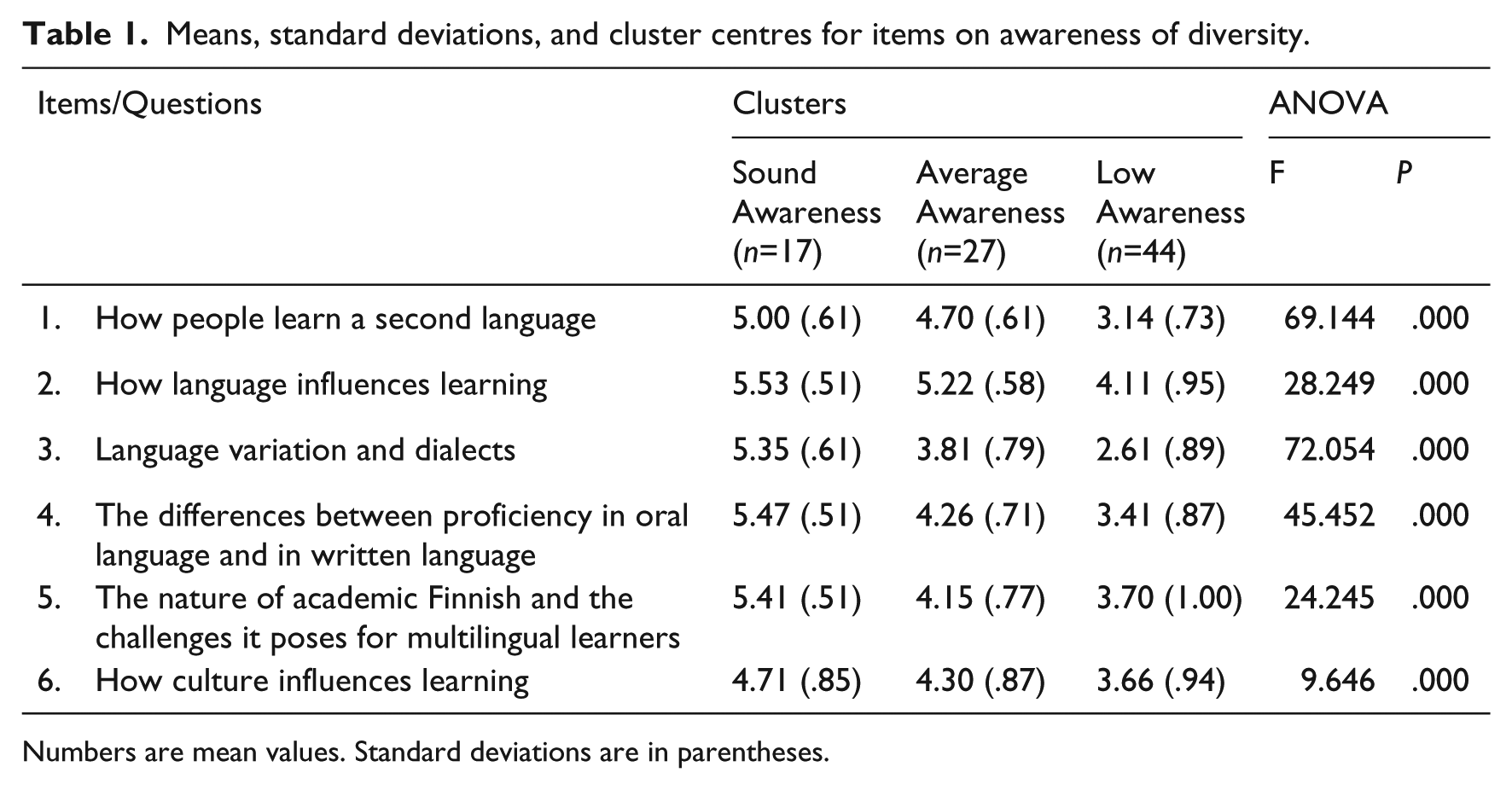
Numbers are mean values. Standard deviations are in parentheses.
ANOVA test revealed statistically significant differences between the means of various clusters for each variable. This suggests that participants in each cluster had comparable levels of awareness that differed from the two other clusters. Post-hoc (Tukey) comparisons revealed that all variables reliably differentiated the three clusters through their cluster means except for the nature of academic Finnish and the challenges it poses for multilingual learners, which only significantly differentiated between clusters 2 and 1 and 3 and 1 but not clusters 2 and 3, and how culture influences learning, which only significantly differentiated between clusters 2 and 1 and 3 and 1 but not clusters 2 and 3.
Awareness levels of diversity and knowledge of strategies for teaching a diverse student
In order to examine whether teachers’ awareness levels of issues related to diversity would predict their knowledge of strategies for teaching a diverse student, a one-way multivariate analysis of variance (MANOVA) was conducted. Table 2 shows that, as might be expected, there was a statistically significant awareness effect, Pillais’ Trace = 42, F(16, 1480) = 2.48, p <.05. The multivariate effect size was estimated at .212, which means that 21.2% of the variance in the canonically derived dependent variable was accounted for by awareness level.
One-way ANOVA’s with strategies measures as dependent variable and awareness levels as independent variable.
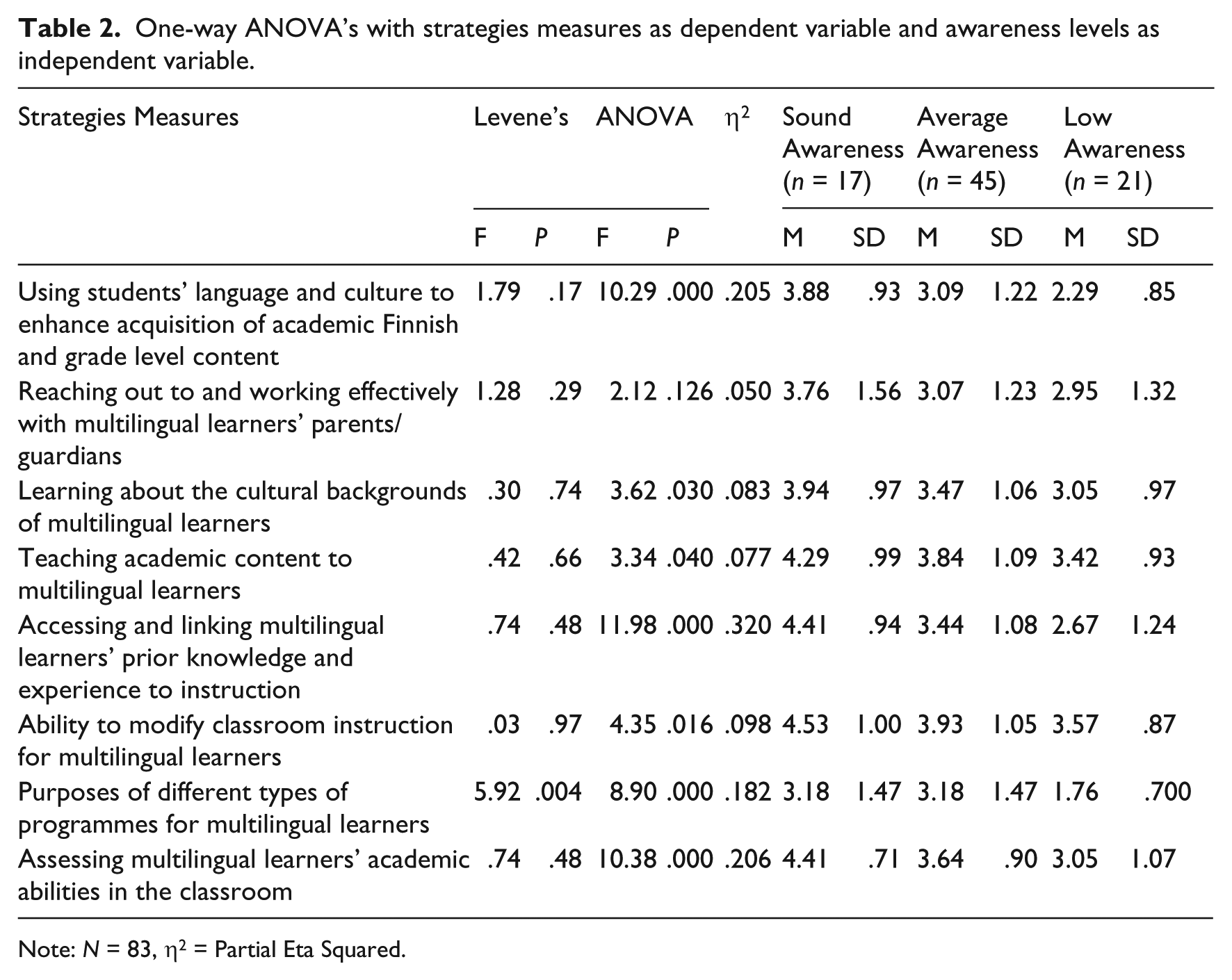
Note: N = 83, η2 = Partial Eta Squared.
Prior to conducting a series of corresponding ANOVAs, the homogeneity of variance assumption was tested for all eight strategy measures. Levene’s F tests of homogeneity of variance assumption were considered satisfactory, although one of the eight Levene’s F tests were statistically significant. Specifically, the Levene’s F test showed that the variance associated with the nature and purposes of different types of programmes for multilingual learners was not homogenous. However, as none of the largest standard deviations (see Table 2) were more than four times the size of the corresponding smallest, an ANOVA would be robust.
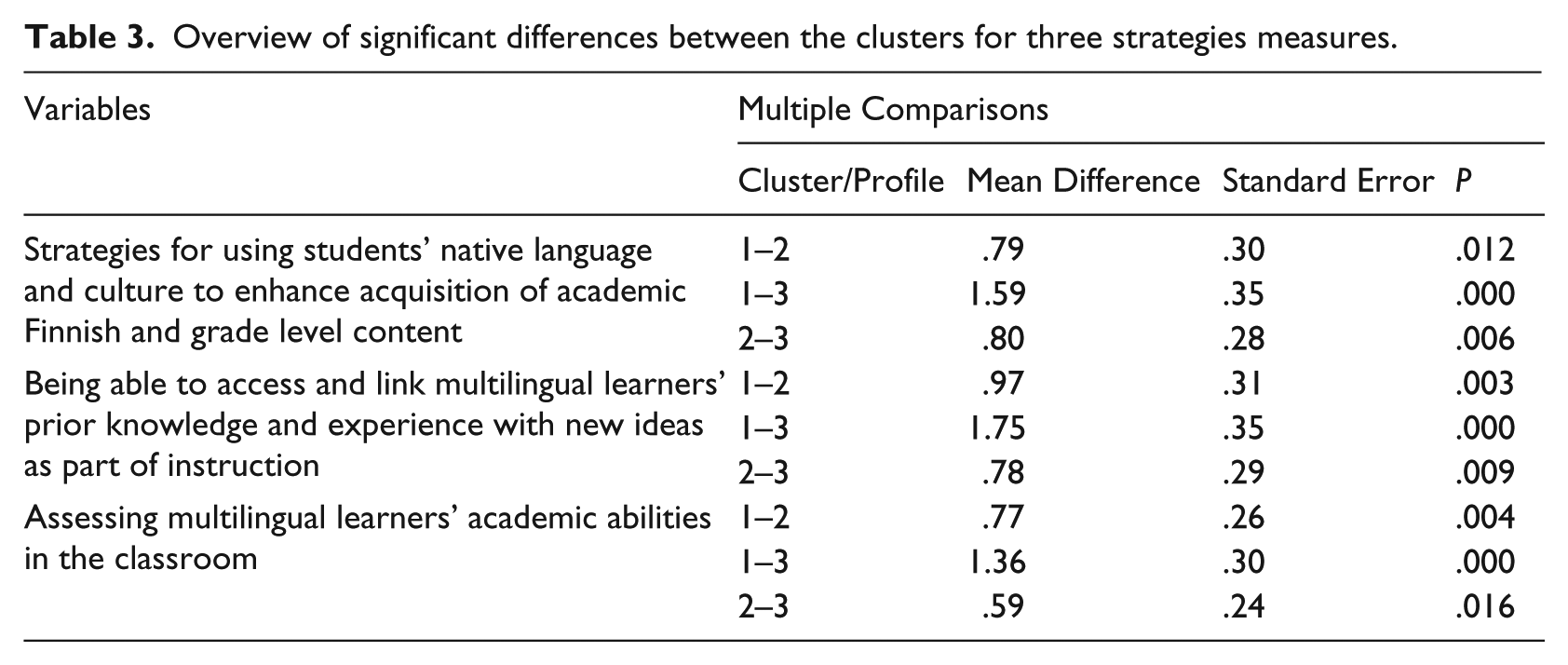
ANOVAs revealed that except for strategies for reaching out and working with multilingual learners’ parents or guardians, there were statistically significant differences among the three clusters for all seven dependent variables, with effect sizes (partial η2) ranging from a low of .077 (strategies for teaching academic content to multilingual learners) to a high of .230 (accessing and linking multilingual learners’ prior knowledge and experience with instruction). Post-hoc analyses (Fisher’s LCD) in Table 3 shows that there were statistically significant differences between the clusters with respect to only three variables. The sound awareness cluster, however, differed from the low awareness cluster in all strategies except for strategies for reaching out to and working effectively with multilingual learners’ parents or guardians in which all three clusters did not differ and from average awareness only in strategies for modifying classroom instruction for multilingual learners. The average awareness cluster did not differ much from the low awareness cluster.
Overview of significant differences between the clusters for three strategies measures.
Discussion
This study examined practising teachers’ awareness of and knowledge of how to address increasing linguistic and cultural diversity in their classrooms. The findings suggest that the vast majority of teachers in this study who worked with immigrant and diverse learners had limited prior experience in interactions, even fleeting ones with people different from themselves in terms of race, culture and linguistic background. Most of the participants spent the first two or three decades of their lives in a homogenous environment, largely white and Finnish and are now teaching an increasingly diverse population of students. Having little history of immigration (aside from Russians and Estonians) and little to no formal training in issues related to diversity, it is easy to see how challenging it could be for these teachers to keep up with the demands of diverse classrooms. As the profile of teachers in this study is consistent with those across Europe and the US (Acquah and Commins, 2013; Clarke and Drudy, 2006; Darling-Hammond, 2005; Gay, 2010; Larzen-Östermark, 2009; Sleeter and Owuor, 2011), it would be imperative that teacher preparation programmes both in Finland and in other Scandinavian and European countries provide cultural exposure through activities such as cultural immersion programmes in order for them to be successful in today’s classroom (Marx and Moss, 2011).
Teachers were asked to take an introspective look at their years in preparation and in practice and to think of what they wished they would have known about diverse learners. The data revealed that many would like to know more about diverse students’ culture, everyday life and how to teach them. The data demonstrate teachers’ strong desire to learn more about culturally relevant pedagogies. What they need then are appropriate ways to develop a strong knowledge base about students’ culture as well as strategies and approaches that are effective in teaching them. This translates to a need for teacher trainers to construct the pedagogical practices that are critical for diverse learners. Coaxing educators away from assimilationist teaching can move them forward towards providing culturally relevant pedagogies for diverse learners (Gay, 2010; Ladson-Billings, 2009).
The findings suggest that teachers’ awareness of diversity could be categorised into sound awareness, average awareness and low awareness. About half of teachers in a multicultural school showed relatively low levels of awareness regarding how the factors of language, culture and ethnicity influence the academic outcomes of diverse learners. Thus, while there seems to be surface knowledge of diversity among teachers, many had not acquired the knowledge base necessary to teach to and through students’ culture (Gay, 2010; Ladson-Billings, 2009). This may be due in part to teachers’ lack of exposure and formal training in issues related to diversity and working with diverse students. Diverse cultural exposure and formal training in diversity have been shown to provide context for and enhance teachers’ ability to address diversity in the classroom (Acquah and Commins, 2013; Banks, 2010; Gay, 2010; Ladson-Billings, 2009). Without this knowledge, teachers are at an increased risk to impose their ethnocentric notions on ethnically and culturally diverse students and/or ignore them entirely in the instructional process (Banks, 2010; Gay, 2010; Nieto and Bode, 2008).
This result suggests that there is much room for improvement in terms of better targeting types of professional development that reflects teachers’ needs. Our result provides the possibility that teachers could be supplied a profile of their strengths and opportunities for learning to become culturally and linguistically responsive teachers. With that profile, teacher educators can design programmes that would provide teachers and candidates with options for supportive and differentiated learning opportunities related to their areas of potential growth that builds on their strengths.
An important finding in this study was that teachers’ level of awareness of diversity reliably predicted their knowledge of strategies for teaching a diverse student. The more aware teachers were of issues related to diversity, the more knowledgeable they were about strategies for working with these students. These findings are consistent with studies that have shown teacher beliefs to be associated with their classroom practices (Borg, 2003; Fang, 1996; Horenczyk and Tatar, 2002; Zheng, 2009) and those that have shown prior experience and exposure to be associated with teachers’ ability to implement strategies that fit with the needs of diverse students (see Sleeter and Owuor, 2011 for a review). Thus, the implicit theories that teachers hold about students’ culture, language and ethnic backgrounds do and can shape the nature of their instructional practice. In the light of the disturbing reality of the appearance of achievement gaps among students across Europe (OECD, 2006, 2010, 2015) and teachers’ inability to address the complexities of teaching and learning in a multicultural context (Banks, 2010; Gay, 2010; Ladson-Billings, 2009; Lucas and Villegas, 2013), the present results can inform preservice teacher education.
Taken together, the findings suggest that although a teacher’s aptitude, credentials and experience are important factors in determining their success with diverse students, all these factors will be meaningless if the teacher lacks cultural competence (Gay, 2010; Ladson-Billings, 2009). It also supports the notion that teachers teach in accordance with their experiential and theoretical beliefs (Fang, 1996; Zheng, 2009). Teachers in Finland and likely others like them across Europe need to be empowered through self-knowledge and a systematic process of self-renewal to acquire knowledge, skills and dispositions about linguistic and cultural diversity in education if they can teach diverse students well (Banks, 2010; Gay, 2010; Ladson-Billings, 2009).
Finally, the teachers in this diverse school who responded to the survey represented demographic profiles similar to those of Finnish teachers in more monocultural schools and thus the results of this study should have relevance in the broad context of Finnish classrooms and in European countries in general. However, conclusions based on the findings must be interpreted with caution because by virtue of working in a diverse school, these teachers had more exposure to students from immigrant backgrounds and second language learners and might be expected to have more awareness. At the same time by virtue of their experiences, they provide a stronger insight into what teachers need in order to face diverse classrooms.
The limitation of this study is, however, that the study used self-reported data. A major methodological problem with self-reported data concerns the extent to which these methods yield reliable and valid information about teachers’ beliefs. In studying sensitive matters such as diversity, self-reported data may yield to socially desirable responses. This bias interferes with the interpretation of average tendencies as well as individual differences. Furthermore, because this study did not include actual classroom observation of the teachers in action, responses may reflect what would be done rather than what is actually done in actual instructional settings. Future research may use alternative methods such as classroom observations of teachers in action, teacher reflections and autobiography. Such studies should lead to improved understanding of the relationship between personal experience, beliefs and practices.
Conclusion and implication
Although the quality of teachers and teacher education plays a sizeable role in Finland’s educational success (Sahlberg, 2011), there is a need to prepare teachers for the changing demographics if Finland is to maintain its high educational standards and stated goals of equity including academic achievement for all students. This implies that teachers need to learn skills that will elicit high outcomes from their immigrant students, as well as the native Finns.
In countries that attract immigrants such as Finland, public schools are primary focuses of social interaction with peers from different racial and socio-economic backgrounds. Schools are also spaces where children learn to work cooperatively with other children who do not look or sound like them. The role of the teacher is crucial in this. The results of this study matter because students are not doing as well as we would hope and part of the reason is that their teachers need more preparation. And these teachers fall into different groups who would benefit from differentiated training and professional development opportunities. Teachers and candidates in preparation both in Finland and in other Scandinavian and European countries need to know more about culturally responsive teaching because what they have been doing up until now with a monocultural approach to teaching has not produced favourable outcomes for many students from diverse backgrounds.
These findings have important implications for the training of practising and preservice teachers and for curriculum development in Finland, as well as for school systems, the selection of teachers into teacher education programmes, mentorship for teachers and professional learning communities. There is a need to build Finnish teachers’ understandings of the importance of cultural characteristics, experiences and perspectives in teaching. This need is urgent, given the changing demographic student populations and projection, as well as the appearance of gaps in achievement between diverse students (mainly immigrants) and native Finnish students (Itkonen and Jahnukainen, 2007). Teacher educators must act now to design programmes that provide experiences with diversity and culturally and linguistically responsive teaching to teachers and candidates in preparation that focus on the specific needs of teachers. Substantial work needs to be done to help teachers view their diverse students from an asset perspective and as cultural beings with lived and living histories and to utilise this knowledge to make effective instructional decision (Banks, 2010; Gay, 2010; Ladson-Billings, 2009).
This study showed where teachers currently are in their knowledge regarding culturally and linguistically responsive teaching by characterising their diversity competence and specific needs. Multicultural training and intervention, especially, those already in place in a number of universities in Finland need to be streamlined to provide teachers with the opportunities for learning as equitable culturally and linguistically responsive teachers and provide support and differentiated learning opportunities that meet their specific needs. These courses and interventions should provide critical curricular experience for these teachers so that teacher candidates and teachers can have real opportunities to confront the issues of diversity including racial, ethnic, cultural and linguistic diversity, as well as confront their own prejudices and worldviews through consistent reflection, and to practise the knowledge and skills gained (Sleeter and Owuor, 2011).
Multicultural training and intervention alone cannot solve the problems of improving the education of historically marginalised students of minority backgrounds. Other aspects of the education system (such as funding, administration, mentoring and professional support, selection of teacher candidates, professional learning communities and policymaking) also must be reformed (Gay, 2010; Nieto and Bode, 2008; Sleeter and Owuor, 2011). Schools, in collaboration with teacher education programmes should address the career needs of teachers as they face the challenges of diverse classrooms by providing mentorship and other professional support. This is important as recent data from the OECD Teaching and Learning International Survey (TALIS) 1 shows that over half of teachers surveyed required more professional development than they received during the previous 18 months and 14% reported having a high level of need for professional development for teaching in multicultural setting on average across TALIS countries (OECD, 2009).
Developing teachers’ professional capacity can improve academic outcomes of ethnically diverse students. In the US, Bryk et al. (2010) studied 22 elementary schools in Chicago that served mainly ethnically diverse students from socio-economically disadvantaged backgrounds over a six-year period to find out why some schools undergoing reform substantially improved student achievement whereas other schools did not. They found that schools that improved student achievement had a strong principal leadership, engaged in continuing professional development, reached out to parents, used a student-centred learning approach and organised curriculum to build grade-level competence.
Society and teacher education institutions can and do have a role to play in ensuring students’ success in school, and they are called upon to take these responsibilities and accommodate the needs of culturally and linguistically diverse students. At the institutional level, there is a need to increase diversity within the ranks of teacher candidates including acceptance of an increased number of teacher candidates with an immigrant background into teacher education programmes (Hollins and Guzman, 2005; Sleeter and Owuor, 2011). Major changes must be made to stamp out the social, political and economic inequalities rampant in society at large. Countries need to do more to support minority/immigrant integration and education. They need to strengthen the capacity of their education systems to unleash the potential of culturally and linguistically diverse students (OECD, 2015). Subsidies and resources for structured language instruction for culturally diverse students would help improve the educational outcomes of these students. Such a claim has research support. Data from the OECD (2015) suggests that countries with effective programmes and support systems for culturally and linguistically diverse students appear to be making substantial progress in closing the performance gap.
Activities for personal, school and community change may help improve teachers’ knowledge base. Teachers themselves can, and should be encouraged to start professional discussion groups where they can share freely experiences, knowledge and information about what (strategies) works in diverse classroom settings. Such social learning activities have been shown to develop ways of doing things, views, values and power relations (Eckert and McConnell-Ginet, 1992; Lave and Wenger, 1991).
Finally, given that the stakes are so high for the students, this study shines a light on the knowledge base of teachers and provides direction for how to improve it. Increased effort must be applied to help teachers in Finland view their diverse students as cultural beings with lived and living histories and diversity as a resource rather than a problem.
Footnotes
Appendix 1
Tick the appropriate box
Ethnicity: Age:
1 = extremely low; 2 = moderately low; 3 = low; 4 = high; 5 = moderately high; 6 = extremely high
7 How many students from backgrounds different from your own did you have in your elementary class while growing up?
………………………………………………………………………………………………………………………………
8 How many students from backgrounds different from your own did you have in your secondary school class while growing up?
………………………………………………………………………………………………………………………………
9 How many students from backgrounds different from your own did you have in your high school class while growing up?
………………………………………………………………………………………………………………………………
10 How many teachers from backgrounds different from your own did you have in school?
………………………………………………………………………………………………………………………………
11 If you had, please describe the subjects they taught (math, science, sports, etc):
………………………………………………………………………………………………………………………………
12 Have you had experience with people from backgrounds different from your own in authority besides school (e.g. church, work, volunteer groups, etc.)? If so, please describe:
………………………………………………………………………………………………………………………………
………………………………………………………………………………………………………………………………
………………………………………………………………………………………………………………………………
13 Have you ever discussed racism or classism? If so, with whom are you comfortable discussing it? (Friends, family, academic classroom, anyone):
………………………………………………………………………………………………………………………………
14 Have you ever witnessed acts of racism in your life? If so, please describe:
………………………………………………………………………………………………………………………………
………………………………………………………………………………………………………………………………
………………………………………………………………………………………………………………………………
Appendix 2
Tick the appropriate box
Tick the appropriate box
Ethnicity: Age:
1 = extremely low; 2 = moderately low; 3 = low; 4 = high; 5 = moderately high; 6 = extremely high
9 What do you think are the three most important things teachers can do to support multilingual learners in their classrooms? __________________________________
10 What are three areas of concern you have in terms of working with multilingual learners effectively? __________________________________
11 What three areas of professional development you would like to engage in to better support your work with multilingual learners? __________________________________
Declaration of conflicting interest
The author(s) declared no potential conflicts of interest with respect to the research, authorship, and/or publication of this article.
Funding
The author(s) received no financial support for the research, authorship, and/or publication of this article.