




Abstract
This article examines the role of global representations in immigrant-background children’s social imaginaries in primary schools in France and England. Increased globalisation, mobility and migration hold strong implications in terms of identity and belonging for children from immigrant backgrounds in schools in European countries, based on traditionally monocultural educational systems. However, most studies of immigrant children’s identities are restricted to national frameworks which overlook the role of the global in children’s experiences and representations. Based on a cross-national ethnographic study, which investigated the identity narratives of 10- and 11-year-old immigrant-background children in two primary schools, one in France and one in England, this article investigates the way in which these global imaginaries participate in children’s identity narratives, through a re-negotiation of fixed national imaginary frameworks. Building on central concepts from the work of Paul Ricoeur on social imaginary and ideology and utopia, this article argues that immigrant-background children’s global imaginary, in both cases, held a utopian function, allowing children to transcend lines of national, ethnic or linguistic differentiation created around the construction of Otherness in school. This utopian function, however, was defined differently in the French and English schools.
Introduction
Increased globalisation, new forms of mobility and migratory flows have participated in the development of a new ‘superdiversity’ in European societies (Blommaert, 2011). These changes have contributed to the blurring of national boundaries, and allowed multiple forms of national and ethnic identification, which articulate global, national and local representations. Whilst national imaginaries appear under strain (Modood and Salt, 2011: 261) global imaginaries are taking unprecedented forms. This carries strong implications for the ways in which identities and notions of belonging are being re-defined.
Whilst the impact of the global on the experiences and identities of adult migrants has been widely explored (Appadurai, 1996; Arnot et al., 2013; Modood and Salt, 2011; Tonkiss, 2013), children remain largely absent from these discussions. To date, most literature on immigrant-background or minority-ethnic children is situated within national frameworks, often focused on the dichotomy between dominant culture and home culture (Archer and Francis, 2007; Basit, 2009) or between sub-cultures and institutional cultures (Youdell, 2006). Within this perspective, the role of global representations in the identities of immigrant and minority-ethnic children has remained under-researched (Ansell, 2009; Blommaert, 2011). What role does the global, and the new forms of mobility and imaginaries associated with it, play in the way children from immigrant backgrounds negotiate Otherness as part of their identities in school? This article aims to shed light on this question by examining the role of global imaginaries in the way immigrant-background children negotiate Otherness as part of their identity narratives in two primary schools in France and England.
The experience and identities of children from immigrant backgrounds are still strongly defined by unequal power hierarchies, inscribed in nationalist and postcolonial memory and imagery (Lorcerie, 2011). These participate in processes of Othering, segregation and discrimination, which articulate old and new categories of difference (ethnicity, race, religion and language) (Modood and Salt, 2011). They reflect a polarisation between them and us, strongly inscribed in European history and identity, in which immigrant-background children are constructed as Other to the dominant culture, language or religion; this impacts on forms of identity construction and feelings of belonging or Otherness (Lorcerie, 2011; Youdell, 2006).
This paper addresses these issues and investigates the role of global imaginaries in the narratives of immigrant-background children in France and England. It draws on findings from a small-scale exploratory study with 10- and 11-year-old immigrant-background children in two primary schools, one in France and one in England. Building on Ricoeur’s notions of social imaginary and ideology and utopia (Ricoeur, 1986), this article discusses the ways in which global imaginaries participated in the children’s identity narratives, through a re-negotiation of notions of difference and Otherness amongst peers. It argues that in both the French and the English schools, children’s global representations allowed them to transcend traditional national, ethnic and linguistic boundaries in their identity narratives by constructing alternative symbolic representations of Otherness in informal school spaces. Given the social and educational contexts of these children’s lives, these global imaginaries can be considered both emancipatory and alienating.
Defining global imaginaries
Despite the flourishing literature on globalisation and the global (Appadurai, 1996; Steger, 2009) there is a lack of consensus around those terms (Delanty, 2009; Kamola, 2012). This lack of clear definition reflects the division in interpretations around the role and impact of new global dimensions, often constructed around a series of dichotomies: local versus global; homogeneous versus heterogeneous; and emancipatory versus alienating (Beck, 2004; Burns, 2008). In addition, critiques have stressed the often unproblematised understanding of the term ‘globalisation’ in academic research, and the need to develop more theoretically embedded frameworks within which to think about the global (Blommaert, 2011; Burns, 2008; Kamola, 2012).
Some common trends can nevertheless be identified from the literature, in the form of an increased awareness of the importance of cultural and symbolic aspects of globalisation, and the ways in which they participate in the formation of new imagined identities which are multiple, fluid, diverse and transcend traditional boundaries and categories (Appadurai, 1996). Appadurai argues that by recognising the role of the imaginary, it is possible to acknowledge the way certain global cultural trends are mediated by minoritised groups (Appadurai, 1996). In this sense, globalisation has given a new role to imagination, which functions as a social practice and recognises the agency of individuals (Appadurai, 1996; Burns, 2008). Imagined worlds allow for negotiation between individuals and ‘globally defined fields of possibility’ (Appadurai, 1996: 31) and participate in a new ‘economy of [globalised] symbolic resources’ (Blommaert, 2008: 439). In the same vein, Delanty offers the notion of ‘cosmopolitan imagination’ as a ‘normative critique of globalization’ from the perspective of critical social theory (Delanty, 2009: 250), whilst Nussbaum argues for a sympathetic ‘narrative imagination’ as a central capacity for cultivating shared humanity (Nussbaum, 1997, 2002). Appiah (2006) also builds on the idea of the ‘sympathetic imagination’ as a fundamental characteristic of cosmopolitanism, to favour coexistence, dialogue and conversation in the human community.
Along with this emphasis on the social role of imagination, the notion of ‘global imaginary’ has been tentatively put forward as a way of theorising the more abstract dimensions of globalisation. This notion, however, has been criticised for lacking theoretical foundations (Kamola, 2012), whether it builds on the concept of social imaginary (Steger, 2009; Taylor, 2004) or the idea of cosmopolitanism (Delanty, 2009; Nussbaum, 2002). In most instances, the concept remains descriptive, and maintains a dichotomous view of the global versus the national or versus the local (Steger, 2009), often supported by notions of fixed or additive categories such as a ‘third culture’ or ‘hybridity’ (Delanty, 2009). In most of the literature, the concepts of Self and Other are also generally understood in terms of binary interactions, which do not explore the complexity of their dialectical relationship or the theoretical foundations of notions of difference and Otherness.
Findings presented in this paper question these dichotomous constructions of the global and offer further theoretical reflections on the notion of global imaginary by examining the identity narratives of immigrant-background children. These narratives highlighted a complex interplay between global, national and local imaginaries, which are not simply in opposition but act in mutually constitutive ways to perform what Ricoeur terms ‘a utopian function’‘(Ricoeur, 1986), in a dialectical relationship between the Self and the Other. This theoretical understanding of global imaginaries builds on the concepts of social imaginary, ideology and utopia and identity narrative as developed by Paul Ricoeur (1986, 1992).
Social imaginary and the global: revisiting the work of Paul Ricoeur
Social imaginary, in Ricoeur’s view, can be understood as the range of stories and representations that societies possess. Social imaginary builds on imagination, to construct social identity. It is developed through collective narratives, with reference to symbols, norms and ideals, in which individuals and groups recognise each other. These narratives are both collective and individual, inscribed in ideological and utopian dimensions.
Ricoeur’s dialectic of ideology and utopia builds on an understanding of social action as symbolically mediated, which participates in shaping ‘ideological imagination’ (Kearney, 2004: 85). Although they appear as opposites, ideology and utopia are held together in a dialectical relationship, through imagination. Ideology and utopia, as two antagonistic models of the collective imagination, form a ‘double imaginary’ 1 which together shape the social and cultural imaginary (Ricoeur, 1984: 53). Social imaginary represents the stories that make up the symbolic realm of society and rests on the tension between the integrative function of ideology and the subversive function of utopia (Ricoeur, 1984: 63). Through this dialectic of ideology and utopia, social imaginary acquires a temporal dimension; whilst ideology functions as integration and ‘symbolic construction of social memory’ (Ricoeur, 1984: 57), utopia opens up to alternative and future possibilities (Ricoeur, 1984), ‘the horizon and aspirations of symbols’ (Kearney, 2004: 84).
Social imaginary is also underpinned by a dialectic between Self and Otherness, which can be understood through the concept of narrative identity. This view of identity recognises both sameness (idem, permanence, mêmeté) and change (ipse, selfhood) held together through narrative identity (Ricoeur, 1992). Ipse and idem associate sameness and change, through a dialectic of Self and Otherness. Otherness has a polysemic character and is not reduced to the Otherness of an Other (Ricoeur, 1992: 368), but also to Otherness within identity, which gives its full meaning to the notion of ‘oneself as another’.
Within narrative, imagination, memory and belief hold the two dimensions of identity (Ricoeur, 1992: 153) and ‘synthesize the different horizons of past, present, and future’ (Kearney, 2004: 108). Identity goes beyond self to the culture around us, through temporal references to symbols and collective imaginary that are embedded in culture through time. It is inscribed in the dialectic between ideology and utopia.
The concept of global imaginary developed in this paper builds on Ricoeur’s notion of social imaginary. In this view, imagination is at the heart of the dialectic between ideology and utopia and Self and Other, formulated through both individual and collective narratives. The symbolic and material representations of the global, but also the national and the local, are articulated through narratives to create global imaginaries, inscribed in memory and in future horizons. Global imaginaries are both utopian (across spaces) and uchronic (across time). This perspective helps address some of the limitations of globalisation theories, which are caught in a binary opposition between the global and the local or the emancipating and alienating roles of globalisation (Appadurai, 1996; Burns, 2008).
Imagination, diversity and citizenship
Whilst Ricoeur’s concepts of social imaginary and ideology and utopia offer a strong theoretical basis for thinking global imaginaries beyond dichotomous constructions, it is helpful to examine further literature on the role of imagination in a plural and global society, and its implications for wider conceptions of citizenship.
Greene argues that imagination, art and metaphor offer the possibility of extending existential possibilities and creating a community of persons by getting to know people through dialogue (Greene, 1995). For her, imagination can help repair the damage caused by silence and discrimination of different cultures, races and sexes through a truly public culture which is responsive to silence around differences. Imagination is the key to looking through different perspectives of people with different experiences (Greene, 1995). It holds the potential of ‘changing the idea of time, lives, relationships and memories that we once constructed’ (Greene, 1997: 3). In her view, imagination offers the possibility to think of ‘alternative realities’ and construct ‘what may be conceived as possible’ (Greene, 1997: 3). As such, imagination is what offers hope for the possibility of change, and it is fundamental for young people to develop a sense of agency and a belief in the potential to alter the order of things. Imagination is what allows new creative spaces in experience to open. Through narrative and dialogue, imagination allows young people to ‘explore the influences of social life on their becoming, of race and gender and ethnic membership, of traditions, of the stories told to them’ (Greene, 1997: 5).
This social role of imagination and the possibilities for change that it offers in the public space underpin conceptions of cosmopolitan citizenship. For Nussbaum, ‘narrative imagination’, the capacity to imagine what life might be like for another person as a condition of being world citizens and essential to ‘cultivating humanity’ (Nussbaum, 1997), allows identification with humanity and empathic connection with others. This is a pre-requisite for developing cosmopolitan citizenship. Narrative imagination requires self-examination and critical thinking about one’s own culture and tradition (Nussbaum, 2002).
Imagination is also central to Delanty’s definition of cosmopolitan citizenship, defined as focused on ‘common experiences, learning processes and discourses of empowerment that make possible immanent transcendence’ (Delanty, 2009: 128). In this view, cosmopolitan imagination is at the core of citizenship, and holds ‘the power to name, create meaning, construct personal biographies and narratives’ (Delanty, 2009: 128).
These understandings of global imaginary and the social role of imagination offered a framework to explore the multiple levels of immigrant-background children’s symbolic representations in their identity narratives and understand how the stories they told spawned across different spaces and different times.
Listening to children’s voices: migration, mobility and the global
The value of listening to children’s voices has been well established in the past decades in new sociological approaches to childhood, underpinned by the idea that children are competent social actors who can be narrators of their own lives (James, 2007; Qvortrup et al., 2009).
However, despite the increased attention given to children as social actors, children’s voices remain unheard or under-represented in certain areas. Children tend to still be treated uncritically as a homogeneous category overlooking issues related to difference and Otherness in terms of social class, gender, ethnicity or disability (James, 2007). Although an increasing amount of studies have focused on the diversity of views of children from minority backgrounds and the complexity of their identity constructions (Basit, 2009; Youdell, 2006), most of these studies focus on young adolescents within specific national contexts; few studies to date focus on younger children (Connolly, 1998) and less so in different national contexts (Welply, 2010).
This absence can be deplored. As argued by James ‘immense political capital […] is increasingly being attributed to “listening to the voices of children” within both local and global policy arenas’ (James, 2007: 267). Listening to children’s voices, in a theorised and contextualised way can help develop ‘understandings in relation to larger issues of social and political change’ (James, 2007: 267).
The views of immigrant and ethnic-minority children still remain largely absent within migration, globalisation or cosmopolitan studies. Whilst a range of studies have examined the impact of youth culture, local cultures of computing, economic globalisation and neoliberal policies on young people’s lives (Holloway and Valentine, 2000; Philo, 2003), global perceptions of younger children remain to be explored (Ansell, 2009; Katz, 2004). This absence can be explained by a general emphasis on the local when examining young children’s experience and identities (Ansell, 2009). However, recent studies show that children’s experiences, although strongly embedded in the immediate ‘local’ are also shaped by other wider processes, including global representations (Aitken, 2004; Katz, 2004; Philo, 2003). Recent theorisations of the ‘politics of scale’ in geographical research argue that lenses that interpret global and local representations simultaneously offer a more inclusive analysis of children’s lives and suggest that traditional divisions in terms of space can be subverted through an approach that combines ‘flat ontology’ and ‘embodied subjectivity’, which encourages research beyond the micro-level to understand ‘the processes, decisions and events that shape the world they perceive, interpret and act upon’ (Ansell, 2009: 204).
This article hopes to contribute to these debates by exploring the global imaginaries of young immigrant-background children in a way that allows their voices and multiple interpretations to be heard.
The research
The data presented in this paper are drawn from a cross-national ethnographic study, which explored the experiences and identity narratives of 10- and 11-year-old immigrant-background children in two primary schools, one in France and one in England. The choice of France and England was motivated by the fact that the two countries face similar issues in relation to diversity, integration and identities in schools, yet are underpinned by contrasting approaches to difference (Raveaud, 2008).
Both schools were located in average-size towns in socially disadvantaged areas with a significant proportion of immigrant families. The English school was selected on the basis of ethnic statistics and free school meals, as well as looking at the school’s Ofsted (Office for Standards in Education) report, whereas the French school was identified on the basis of its classification as ZEP (Zone d’Education Prioritaire), which was, at the time, an indicator of social deprivation and a higher proportion of ‘immigrant origin’ children in the school. In the absence of ethnic statistics in France, the choice of school also relied on information given by schools themselves.
Within each school the study focused on two classes that corresponded to the final year of primary schooling (Year 6 in the English case, CM2 in the French case). Criteria for selecting the classes in each country were that they had a culturally diverse population. As this study sought to explore the diversity of children’s experiences in multicultural classrooms, it did not focus on a single ethnic group. Trying to match children in terms of ethnicity held strong limitations, as assuming sameness between ethnic groups cross-nationally carried methodological flaws and essentialist assumptions that were not consistent with the philosophical orientations of this study. As such, the study cannot claim to compare like with like, but aimed to gain insights into immigrant-background children’s identities in culturally and linguistically diverse classrooms across the two different ‘national’ sites.
This study focused on children who could be classified as second-generation immigrants, that is, who were born in France and England but whose parents had experienced migration. This allowed the study to look at the processes of identity and integration over time, by examining the views of immigrant- background children who had experienced the whole of primary schooling there. It also meant that most children would be proficient in French and English and thus able to participate in interviews without interpreters.
The term ‘immigrant-background’ was chosen to refer to the children who participated in this study, in an attempt to overcome the conceptual gap between ‘ethnic minority’ and ‘immigrant origin’ (issu de l’immigration) identified in the English and French literature (Welply, 2010). The term encompasses children from second-generation immigrant families. The term second-generation family designates the families of children whose parents experienced immigration and a different educational schooling system and who spoke a different language at home. This term is used to differentiate children from newly arrived immigrant children, with a different migration experience. In this paper, the focus is essentially on children from second-generation postcolonial immigrant-backgrounds. It thus does not seek to generalise findings to all ‘immigrants’ and recognises the heterogeneity of the population under this term. However, this article recognises that the term ‘second generation’ is problematic because it assumes a form of categorisation and filiation around migration that rarely corresponds to the experience of the families themselves (De Rudder, 1998; Lorcerie, 2011). Accordingly, the term ‘non-immigrant’ refers to children who were born in France and England, whose families had not experienced immigration in the past three generations and who spoke only French and English at home. There are, however, limitations to such a crude distinction between these categories as ‘non-immigrant’ children are likely to also experience forms of Othering and discrimination. In this paper, these terms are thus used as an initial lens. It is acknowledged that these labels cannot account for the complex ways in which the participating children defined themselves, which, as will be discussed in this paper, often transcended set categories. Thus the use of the terms ‘immigrant-background’ and ‘non-immigrant’ recognises these categories as socially constructed, fluid and changing.
Although the study focused primarily on children from immigrant backgrounds, their experience in a national school context was only relevant insofar as it was contrasted with pupils in general. Thus, to explore the dynamics and processes of identity negotiation, and to situate the experience of children from immigrant backgrounds in the wider classroom context, the study included all children.
Overall, 34 children in each class took part in the study, 17 in each class. In the French class, 11 children out of 17 participants could be designated as ‘immigrant-background’. This included 6 girls (1 Hmong, 1 Laotian, 1 Indian, 1 Moroccan, 1 Algerian background and 1 Turkish/French) and 5 boys (1 Hmong, 1 Hmong/French, 1 Laotian/Chinese, 1 Algerian and 1 French Réunion/Cambodian). In the English class, 7 children out of 17 participants could be considered ‘immigrant-background’, which included 5 girls (3 Bangladeshi, 1 Russian and 1 part Italian) and 2 boys (1 Bangladeshi and 1 Portuguese). All children spoke the majority language of the country fluently.
As many of the issues surrounding immigration and integration in Europe are intertwined with issues of social disadvantage, exclusion and urban segregation (van Zanten, 2000), this study focused on immigrant-background children in socially deprived areas. In both the French and English cases, the classes were selected to represent immigrant-background children from similar socially disadvantaged backgrounds. In both cases, participants’ parents’ occupation could be classified as working class (e.g. factory worker, agricultural worker, school cook, lorry driver, cleaner, waiter, electrician, nursery worker) or unemployed.
A sustained period of time was spent in each location (six months in the French school, four months in the English school) between January 2009 and December 2010. During this time the researcher was present full-time in each classroom and followed the same timetable as the children. Full-time participant observation helped gain deeper insights into school and classroom cultures, become familiar with the local environment, and develop trust and rapport with the participating children.
The choice of methods was driven by an emphasis on hearing the voice of children throughout the research. This encouraged the use of child-centred methods, namely interviews (group and individual) and diaries. Group interviews were carried out initially in order to help children feel more at ease and challenge the adult/child power differential in the research process (Eder and Fingerson, 2003). Two phases of group interviews of about 45 minutes each were conducted in each school. The first phase involved mixed-gender groups and the second phase single-gender groups. Shorter individual interviews of about 20 minutes were also carried out towards the end of the fieldwork, once rapport was built with the children.
Particular attention was given to adapting interview techniques to primary-age children. The interviews were semi-structured and included games and drawings in addition to interview questions, to allow children to engage with the research through a range of activities. The choice of multiple methods in this study was aimed at encouraging the children to talk about issues of belonging, difference and Otherness in a variety of ways. Asking young children to talk about their perceptions of difference and Otherness was one of the core methodological challenges of this study. It was important to design the interviews in ways that would avoid researcher-imposed categories in order to allow children to initiate discussions of difference in their own words. Drawings have been shown to offer innovative and creative ways of hearing children’s perceptions (Kendrick and McKay, 2004) and were encouraged during interviews. However, children responded differently to these tasks depending on their own confidence in their artistic abilities. Other more supported visual methods were more helpful in encouraging children to talk about Otherness in their own terms. In particular the ‘map activity’, which involved providing children with a blank world map, asking them to colour in the countries they felt were important to them, and explain why during the interview, was popular amongst children in both schools.
In addition to interviews, children were given diaries in which they were asked to write about or draw their experience of school, over a period of two weeks. Diaries were chosen because they can offer alternative insights into children’s perceptions and views of school that might not be expressed in formal interview settings (Alaszewski, 2006). They can also allow participants to make links between the public and the private (Plummer, 2001), which, in this study, provided interesting perspectives on children’s identities and experience of school. However, as the diaries were voluntary, they were not systematically used by all participants and tended to be favoured by children who felt more confident in their literacy skills.
Despite certain methods being favoured by some children over others, the use of multiple methods allowed a range of forms of expression for children to talk about difference and have their voices heard. In both schools, children expressed views about difference and Otherness that reflected both their immediate local experience and wider representations from the media, youth culture, family members, and in some cases, trips or holidays.
All names and identifying details have been changed to ensure anonymity and confidentiality for the participants. The young age of the children raised specific ethical issues, which were given particular attention in this study (Hill, 2005). Confidentiality issues related to sharing information with a group were made clear to the children. Group interviews were monitored to help minimise antagonisms that might arise during discussion (Lewis, 1992). In order to encourage greater participation of children in the research process, the researcher ensured that the use of language and concepts matched the children’s understanding. Both the choice of methodology and the length of time spent in each class helped minimise the adult/child power differential and build an environment in which the children could feel safe to express their views to the researcher and to each other.
All interviews were audio-recorded, transcribed and coded thematically using a qualitative software package (NVivo). Central themes were examined between data sources and across cases. This article draws on the themes that highlighted immigrant-background children’s global imaginaries and forms of negotiation of Otherness amongst peers.
The next section examines the role of global imaginaries in immigrant-background children’s narratives of difference and Otherness amongst peers. In both the French and English schools, children’s global imaginaries performed a utopian function by offering alternative representations of Otherness in school, which allowed children to transcend traditional national, ethnic and linguistic boundaries in their identity narratives. This, however, was defined differently in the French and English schools. These differences can be understood in relation to the wider national and school ideologies.
Otherness and global imaginaries: findings from the French and English cases
This paper focuses on children’s perceptions of Otherness in informal school spaces, by examining the role of global imaginaries in their identity narratives. Each case is examined individually and the overarching themes are then considered jointly in the final discussion.
In this paper, the distinction between formal, official school spaces and informal school spaces is built essentially on the representations of the children themselves. Formal school spaces encompassed the classroom, but also interactions with adults in the school, inside and outside the classroom. Informal school spaces consisted of the playground and ‘in-between’ spaces (Lucey and Reay, 2000) such as corridors, toilets and staircases, as well as interactions with peers inside and outside the classroom. These representations showed the limitations of trying to establish formal and informal spaces of school as clearly bounded and fixed categories. In children’s views, the boundaries between these two realms were fluid, and built on both physical and symbolic representations, as well as on the immediacy of interactions. Moreover, the degree of separation between formal and informal spaces was different for children in the French case and those in the English case. This reflects differences in separation between the public and the private spheres in France and England (Modood and Kastoryano, 2007; Raveaud, 2008).
Thus, the use of the terms ‘formal’ and ‘informal’ school spaces recognises that these are not clearly bounded spaces, but that they intersect and overlap in children’s representations; furthermore, the use of the plural ‘spaces’ rather than ‘space emphasises the plurality of children’s representations, rather than a unitary understanding of these spaces.
In informal school spaces in both schools, immigrant-background children constructed alternative representations of the place of Otherness. These alternative representations built, in both cases, on children’s global imaginary. However, immigrant-background children’s global imaginaries performed different functions in the French and English cases. In the French case, immigrant-background children built on global imaginaries to symbolically counter the ‘indifference to differences’ ideology prevalent in the formal school spaces and position Otherness as central to peer group relations. In the English case, immigrant-background children’s global imaginaries helped immigrant-background children construct narratives of mobility, which transcended forms of stereotyping and discrimination amongst peers.
The French school: global imaginaries, belonging and joint-cultural creation
In the French case, immigrant-background children’s global imaginaries participated in a reversal of norms in the informal school spaces. The French school was characterised by an emphasis on collectivism and a negation of individual particularities, with teachers and staff summarised as ‘indifference to differences’. As a result, there was never any mention of ethnic, religious or linguistic difference in the classroom. However, in contrast to this overall ‘indifference to differences’ approach, children constructed other languages and cultures as central to peer-group relations, which redefined Otherness as a form of belonging.
Otherness as belonging
Most children described cultural and linguistic differences as central to relationships between peers in school. As such, children’s narratives constructed cultural and linguistic Otherness as a symbol of belonging in peer-group relations, through a range of representations. These representations were inscribed in children’s global imaginaries, particularly present in their future representations.
This was illustrated by Clara’s narrative. Clara was a girl of Indian background, born in France. Whilst she felt that she should not talk about cultural or linguistic differences with teachers in formal school spaces, she considered these differences to be central to her friendship with Ophélie (a non-immigrant child).
And would you like to talk about it [India] more with teachers?
no, I would not, I do not like speaking about India with the teachers.
[…] Because I do not like it, because afterwards, imagine, there is a teacher who looks at me like that…who looks at me differently. And because of that, she might…perhaps because of that, well…sometimes if I have to go to the next year, she says I have to repeat the year […] hmmm. Already there are teachers who don’t like it hey! Who are racists.
This comment reflects Clara’s uncertainty about the place of linguistic and cultural differences in school. Her interpretation of ‘indifference to differences’ in school is translated into feelings of unease or even threat in relation to Otherness in formal school spaces. This view contrasted strongly with her perception of the place of Otherness in her friendship with her close friend Ophélie.
Do you sometimes speak hindou 2 [hindi], do you speak to people who are not hindous [Indian], to other children?
Yes, Ophélie, she doesn’t stop…she wants to go into…for example as soon as she grows up, she will not even want to go to America, or…she will not want to stay, she will want to go directly to India.
[…] She always wants to go to India, she speaks, she says ‘how do we say this in hindou [hindi], how do we say that?’ Not even…she knows how to say hello in hindou [hindi] […] Ophélie is the girl I know that most wants India, she always wants India. She cannot go up [go upstairs in school from the playground] without India. Ophélie, she’s the girl who most wants …she’s a girl who wants to go to India so much.
In this extract, Clara develops a narrative of fascination on the part of her friend Ophélie for India, her friend’s interest in the language and her desire to ‘know everything about it’. In doing so, Clara gives India and Hindi a high symbolic status in the girls’ friendship. This is based on a construction of linguistic and cultural Otherness as desirable, through the image of Ophélie’s quasi-obsession with India. This symbolic representation also carries what Ricoeur termed ‘futural aspirations’ (Kearney, 2004: 85; Ricoeur, 1986) inscribed in a global dimension, displayed in Ophélie’s strong desire to go to India when she is older. This future imaginary confers a high status to Clara’s symbolic Otherness, which is made up of her other language and culture. In her global imaginary, she hierarchically positions India as more attractive than the US for Ophélie, as shown in her comment ‘she will not even want to go to America’. In doing so, she re-imagines a hierarchy of the global, which positions her Otherness as high status. In this narrative, Clara constructs Otherness as central to her friendship with Ophélie, in contrast to the ‘indifference to differences’ ethos of the school.
This reversal of norms builds on Clara’s global imaginary, through her representation of India and the US in an imagined global hierarchy of desirable Otherness. It also builds on a global imaginary of mobility and fluidity, with the future possibility of Ophélie moving from France to live in India. The role of Clara’s global imaginary can be understood through the lens of Ricoeur’s concepts of ideology and utopia (Ricoeur, 1984, 1986). Clara, in her first comment, shows an awareness of the dominant monocultural ideology of school which she criticises as having negative consequences for her school career if she mentions Otherness. In her second comment, however, she builds on her global imaginary to create an alternative symbolic representation, in which Otherness is central to her friendship with Ophélie in school. This friendship, in her narrative, performs a utopian function by constructing a set of alternative symbolic representations to the monocultural school space. This articulation of a global imaginary performs a utopian function (Ricoeur, 1984), through the creation of alternative symbolic representations which transcended traditional categories and the school ideology of ‘indifference to differences’. This alternative symbolic construction of Otherness draws on global imaginary and the recognition of linguistic and cultural diversity, to develop a narrative of ‘belonging through difference’. This re-imagining of Otherness, in Clara’s global imaginary, highlights Greene’s idea that through imagination young people can think of ‘alternative realities’ that hold the potential of altering ‘the way things are’ (Greene, 1997: 4).
Joint-cultural creation
The narrative of Marine, a girl of Hmong background, also illustrates the way global imaginaries mediated representations of difference through alternative sets of symbols. In this case, Marine’s global imaginary was expressed through a form of joint-cultural creation with her friend Farida, a girl of Moroccan background.
And singing I share with Farida. Her and me we like to sing, we compose songs, we sing all the time, even at school. Her and me, when we sing we feel things, the songs that we compose it’s for a reason, we try to convey a message and share. For Farida, her passion is singing and I sing with her because she shared her passion with me. She sings a bit in Arabic and I sing in Hmong, it’s very pretty, in her songs she speaks to me and I answer her. (Marine, diary)
In the above excerpt, Marine constructs a narrative of friendship and interculturalism with Farida. The girls’ other languages are integrated in a form of ‘joint-cultural creation’, through a bilingual dialogue in which they ‘speak and respond’ to each other. This narrative draws on the girls’ global imaginaries, articulated around references to intercultural and interlinguistic practices. This is inscribed in global youth culture, in this case music. Singing in different languages echoes other contemporary forms of music, popular in urban youth culture, which mix languages such as Raï, R&B or Rap and have a global dimension (Marancini, 2001; Shapiro and Heinich, 2012). Raï mixes Arabic, French and English, R&B mixes French, Spanish and Arabic and Rap mixes French and English. Arabic Raï is not a new phenomenon but is part of contemporary French youth culture and influential in French forms of R&B and Hip Hop. It is also a symbol of ‘beur identity’ (second generation North African immigrants, born in France) (Marancini, 2001). This multilingual dialogue developed by the girls through singing echoes Greene’s view that art and imagination offer the possibility to extend existential possibilities and get to know people through dialogue (Greene, 1995).
The girls’ global imaginaries offer alternative symbolic representations, which again contrast with the French ‘indifference to differences’ approach in formal school spaces. The girls’ singing in different languages together in school counters more monocultural formal music education in school, which many children described as boring and outdated. Farida and her peers had indeed mentioned during a group interview that one thing they did not like about school was the fact that they sang outdated songs and that they preferred a singer called Kenza Farah. This R&B singer is of immigrant-background (Algerian background) and grew up in a quartier’ (urban fringe area).
I like singing but I don’t like…the songs that we sing.
[…]
oh, if we were learning Kenza Farah, I would be so happy!
yeah…I could sing the whole song straight away.
[…]
but instead, what do they make us sing? La vie en roooooooose 3 (mocking voice).
and you don’t like that?
no!
It’s rubbish! It’s outdated!
It’s for old people.
and now they are teaching us la Java 4 …
This example also illustrates the dialectic between ideology and utopia (Ricoeur, 1984, 1986). The girls are aware of the dominant monocultural ideology that underpins the curriculum, often judged irrelevant to children, as illustrated by the above criticism of the outdated songs that they are made to sing in school. In contrast, Marine and Farida’s joint singing at school introduces another cultural approach, which serves a utopian function by constructing alternative symbolic representations to what prevails in monocultural school spaces: contemporary music inscribed in global youth culture, intercultural and bilingual singing. This corresponds to Ricoeur’s understanding of utopia as rupture, a critique of the dominant ideology, which is creative and builds on its own set of symbols and aspirations.
The above has shown how, in the French school, children’s global imaginaries carried a creative dimension, through futural aspirations, cultural exchanges and creation (Kearney, 2004: 85). These imaginaries participated in alternative symbolic constructions of Otherness, which developed narratives of ‘belonging through difference’ amongst peers in informal school spaces.
Global imaginaries, intersecting spaces
Children’s global imaginaries did not emerge in a void, but articulated multiple spaces and representations at local, national and global levels.
These global imaginaries and the central place of Otherness in children’s representations of peer-group relations reflected, to some extent, the multi-ethnic cultural and linguistic practices in the local urban environment of the French school, the banlieues or quartiers (Boubeker, 2003), in which diversity represents the ‘imaginative norm’ (Hatzfeld, 2006: 20).
Children’s global imaginaries in the French case articulated global youth culture with the more immediate local urban youth culture and multi-ethnic linguistic practices, and its mediatised form through, for example, national television (Dortier, 2005). This interaction between different forms of global representations, the local experience of youth cultural practices and their national mediatisation allowed children to establish connections between their own linguistic and cultural backgrounds and global dimensions.
Some of the boys (Benoît, Yannick, both of Hmong background, Ewen of Cambodian background and Imed of Algerian background) took part in breakdancing inside and outside school. In this context, the practice of breakdancing occupied a pivotal position between local urban culture and global youth culture 5 (Shapiro and Heinich, 2012). It combined global references through the use of English terms associated with breakdancing (‘crew’ (breakdancing groups), ’bboy and ‘bgirl’ (these terms are used to refer to breakdancers) with ethnic identification: ‘I have a nickname, it’s not French, and it’s not Hmong: bboy’ (Benoît); ‘Almost all of the crew are Hmong or Laotian’ (Marine, diary); and ‘I don’t know why but most breakdancers are Hmong around here’‘(Yannick)).
Children’s global imaginaries also associated high status global languages with other home languages. Yannick, Ewen and Benoît claimed they could speak both Hmong and Japanese because of their interest in manga. Clara claimed that her name was Italian, Britney, a girl of Laotian background, insisted on the fact that her name was American, not Laotian. References to the US were also strongly present in children’s global imaginaries. Clara, as discussed earlier, used a reference to America to emphasise how important India was to her friend Ophélie. Kenny (of Laotian background), Ewen and Yannick highlighted the US as an important country to them (see maps below, Figures 1–3), and Imed, Yannick, Benoît, Ewen and Kenny all projected to live in the US in the future. These forms of imagined mobility and the points of connection established in children’s global representations built on friendships and re-negotiation of Otherness. This also gives them the capacity to re-define existing global hierarchies in their own narratives. As such, they carry a form of cosmopolitanism in which global (narrative) imagination is central (Delanty, 2009; Nussbaum, 2002).
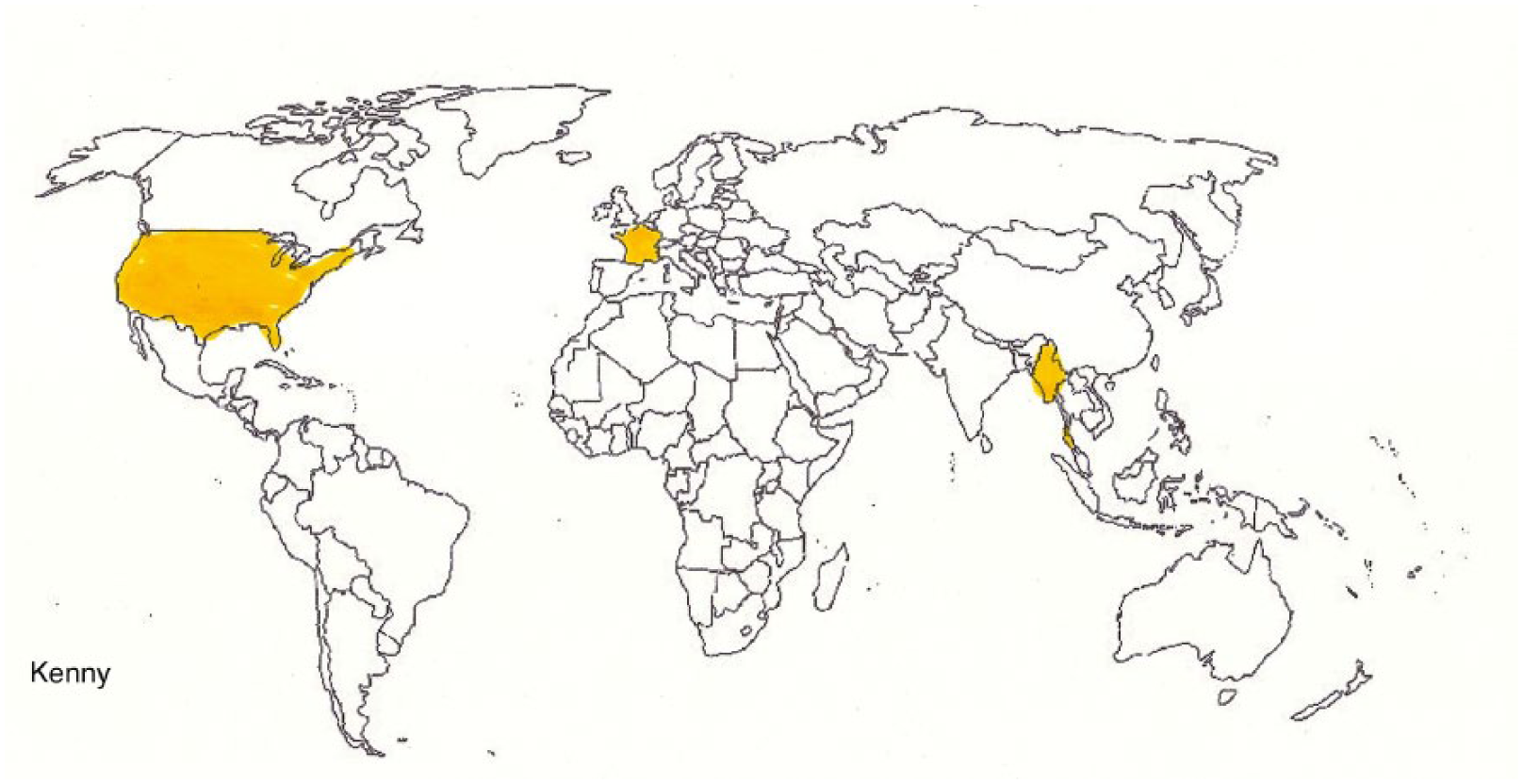
Kenny’s map of ‘important countries’.
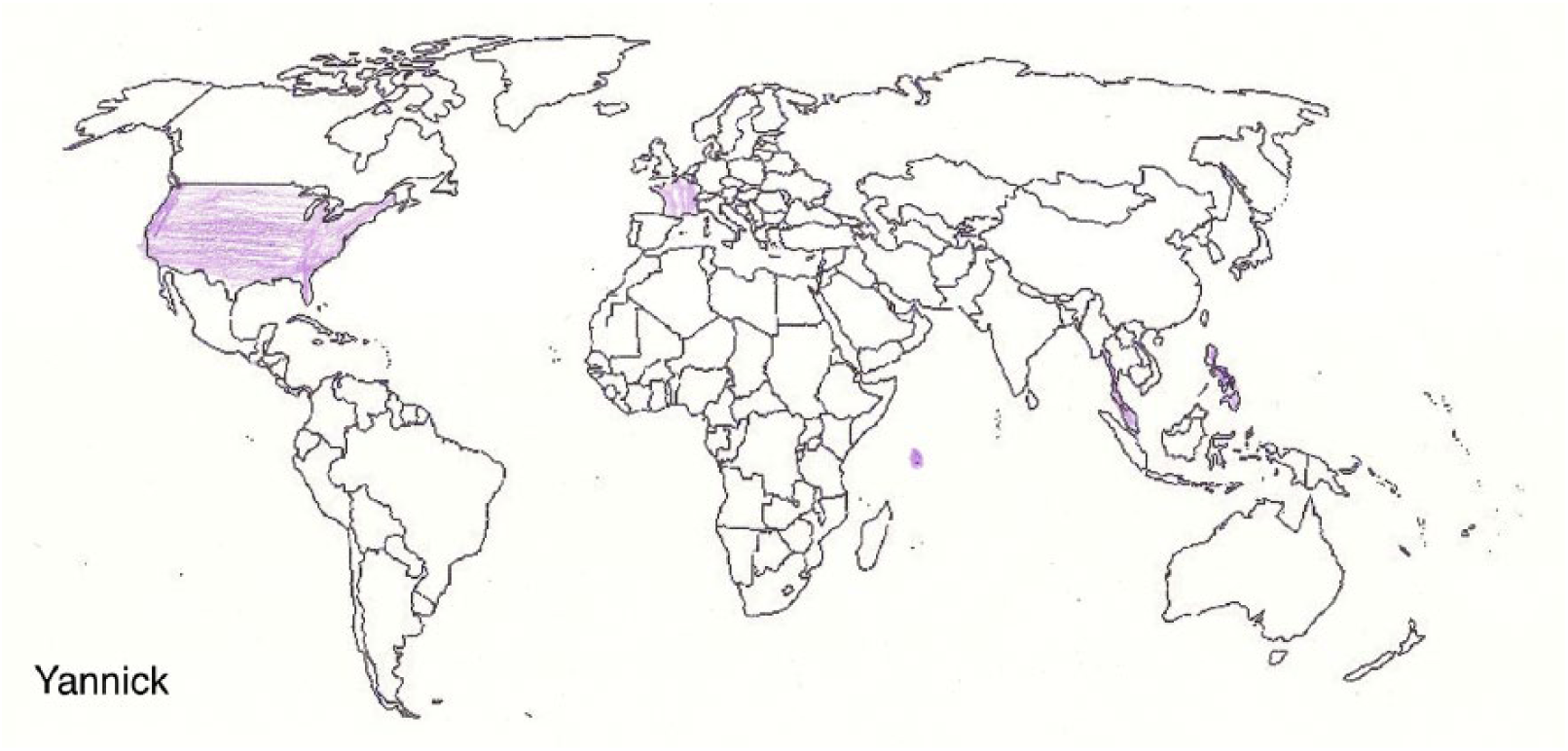
Yannick’s map of ‘important countries’.
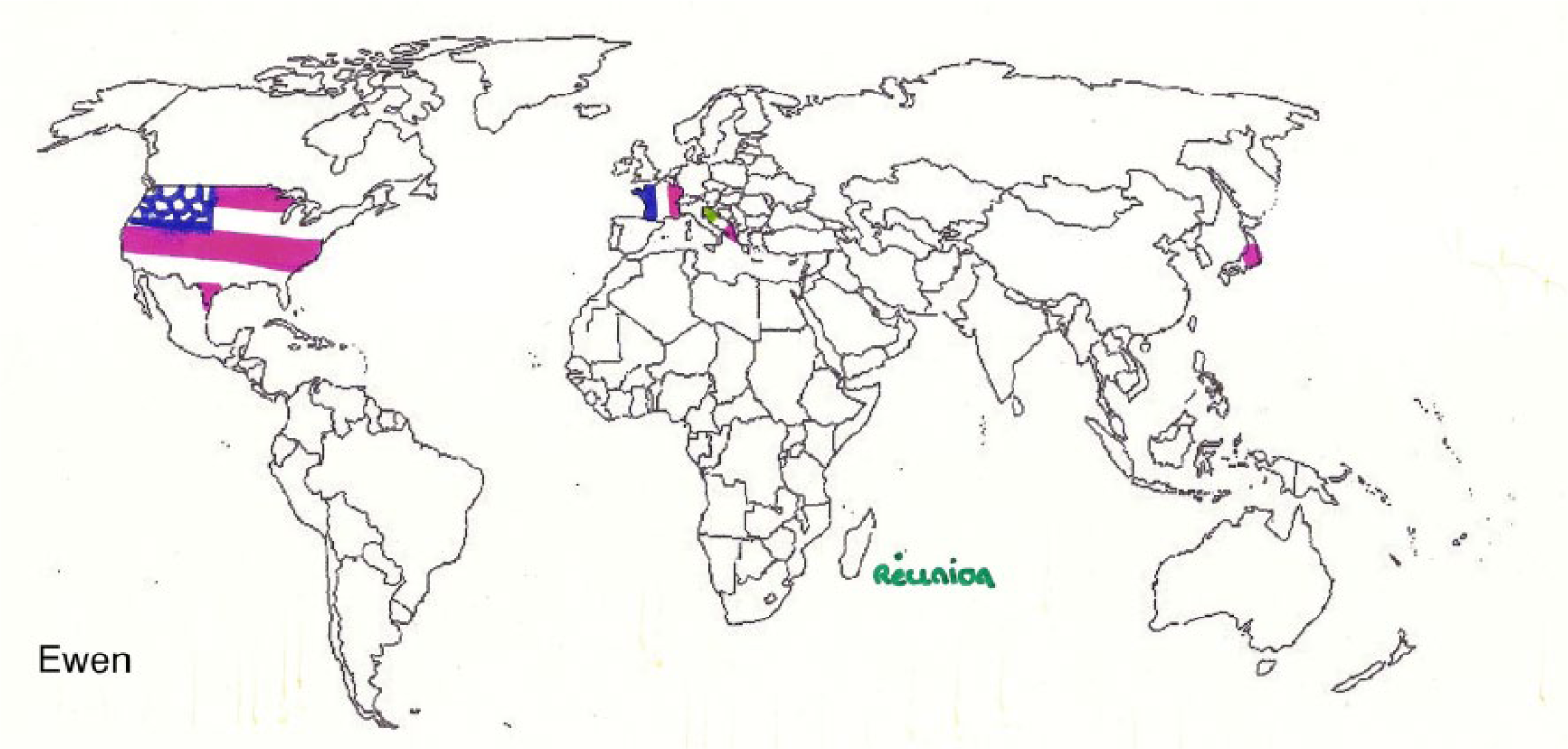
Ewen’s map of ‘important countries’.
In the French school, children’s global imaginaries encompassed identification with their families’ country and culture, with languages they spoke at home, and other countries which they knew essentially through youth culture and media. Although the interculturality of these global imaginaries contrasted with the official school rhetoric, these representations were not merely a form of counter-culture that rejected the French republican school values of ‘indifference to differences’. Rather, in their narratives, children attempted to negotiate conflicting discourses on Otherness, mediating universalist and egalitarian school values with their lived experience of multi-ethnic diversity in school, and in their local urban area (the quartier). These were articulated with wider representations of these urban cultural and linguistic practices in national media (Dortier, 2005), as well as global representations; children’s global imaginaries built on multiple symbolic spaces. The local (the quartier and the school) the national (national republican values, as well as the representation of banlieue culture in national media) and the global were articulated together to construct narratives of difference, Otherness and belonging.
These spaces were not exclusive of one another. Through children’s narratives, the local and global were mutually constitutive in that they participated in creating alternative representations of Otherness in informal school spaces, which drew on forms of urban youth culture, and were rearticulated through children’s ‘imaginative variations’ (Ricoeur, 1992). This supports the idea that children’s lives are not only defined by the local, but also by global youth cultures and representations (Ansell, 2009; Katz, 2004). These diverse influences were mediated through children’s global imaginaries to construct representations of Otherness that transcended traditional categories and lines of divisions.
The English case: global imaginaries as points of imaginary encounters
In the English case, children’s global imaginaries were defined differently to the French case. References to global imaginaries were not as frequent in children’s narratives and as such did not occupy the same central place in narratives of friendships and difference as they did in the French school. Whilst in the French school global imaginaries played a central role in mediating Otherness into intercultural representations, in the English school, children’s global imaginaries were more restricted when it came to Otherness in relation to peers.
Constructing the Other
The more restricted scope of global imaginaries in relation to Otherness in the English school can be explained by the way in which Otherness was constructed in peer group relations. Children’s narratives of difference symbolically articulated differences and Otherness as the basis for separation between peers, as illustrated by the quote below.
Sometimes it depends on your skin colour, because quite often you will find that people with a different skin colour are like always hanging around in the same group, because…
yeah because of the skin colour and stuff…
yeah like these people they kind of all follow the same religion and they’ve got the same skin colour and everything, and they’ll all stay together and be best friends, and then all the other people they will all just stay together and be best friends.
These perceptions of Otherness contrasted strongly with the school ethos, which promoted multiculturalism, ‘the celebration of diversity of backgrounds, race, cultures, religions and languages’ (school policy document) and ‘a whole-school ethos of tolerance and respect’ (interview with bilingual coordinator).
Points of imaginary encounters
There were, however, some limited forms of intercultural exchanges which emphasised the role of the global in shaping children’s social imaginary about the place of linguistic and cultural differences in school. This took the form of ‘points of imaginary encounters’. These imaginary projections built on immigrant-background children’s ‘futural aspirations’ (Kearney, 2004: 85; Ricoeur, 1986) and the idea that children wanted to live in a different country later on because of their friends. This global imaginary as an ideal of being able to live anywhere in the world was best represented by Andre, a boy of Portuguese background.
And where would you like to live later on?
I’ve got loads.
Really?
Um.
[…]
New York.
New York, wow, why is that?
Um, I just like America and… my friend has been there […]
and California.
Yeah
And London…I have a friend…I don’t know what school; it’s somewhere in London.[…]
New York, California, hmmm…Washington
[…]
Yeah, and Paris…and I think Belgium; it’s in Germany.
Belgium is next to Germany, yeah. It’s a separate country.
Berlin.
Oh yeah. Have you been to Berlin?
No, I have a friend […] who is from Germany.
Really?
He lived near Berlin.
The above excerpt draws attention to a particular aspect of Andre’s global imaginary: although his future aspirations position him as very mobile globally, thus defining himself as above any forms of national identification or constraints, his aspirations of mobility build essentially on knowing friends from these different places. As such, Andre’s global imaginary is not just a narrative of freedom and mobility in isolation, but builds on intercultural exchanges and friendships. These imagined global connections participate in constructing a sense of belonging through Otherness. This view was echoed by other immigrant-background children in the English case, in different individual interviews. Saalima, a girl from Bengali background wanted to live in Spain because of her school friend Rodrigo.
and do you know where you would like to live later on?
In Spain.
In Spain, really, why is that?
I like Spain, I don’t know, because…
Have you ever been there?
I’ve never been, but I wanna go. Well, one of… this boy; he was in our class last year, yeah Rodrigo […] and then he left, and then he is going to come back when we go to secondary.
Really? And is that why you would like to go there?
Yeah, he always talks about it, so he does like lots of skiing, and he goes there for nearly at least one to three weeks.
Akhil, of Bengali background wanted to live in Russia because of his school friend Anna, a girl of Russian background.
[…] where do you think you would like to live later, if you have any idea?
Well, I’ve got one. I would like to live in Russia.
And how do you know about Russia?
Anna told me about it.
It is interesting to note that these comments occurred in individual interviews, so there was no copying or build-up effect. These global imaginary constructions of the future constitute a form of ‘bridging’ and intercultural connection by projecting oneself as living in the country a friend comes from. There is also a form of ‘global connecting’ with the idea that children can live anywhere in the world, rather than a national attachment to either England or the country their family came from. In this way, it could be argued that children positioned themselves as global or cosmopolitan citizens. Their capacity to, through imagination, identify common experiences, define a form of agency, ‘construct personal biographies and narratives’ (Delanty, 2009: 128) and allow empathic connection with others echo notions of global or cosmopolitan citizenship in the literature (Appiah, 2006; Nussbaum, 2002). This is illustrated in Saalima and Anna’s maps of important countries (Figures 4 and 5).
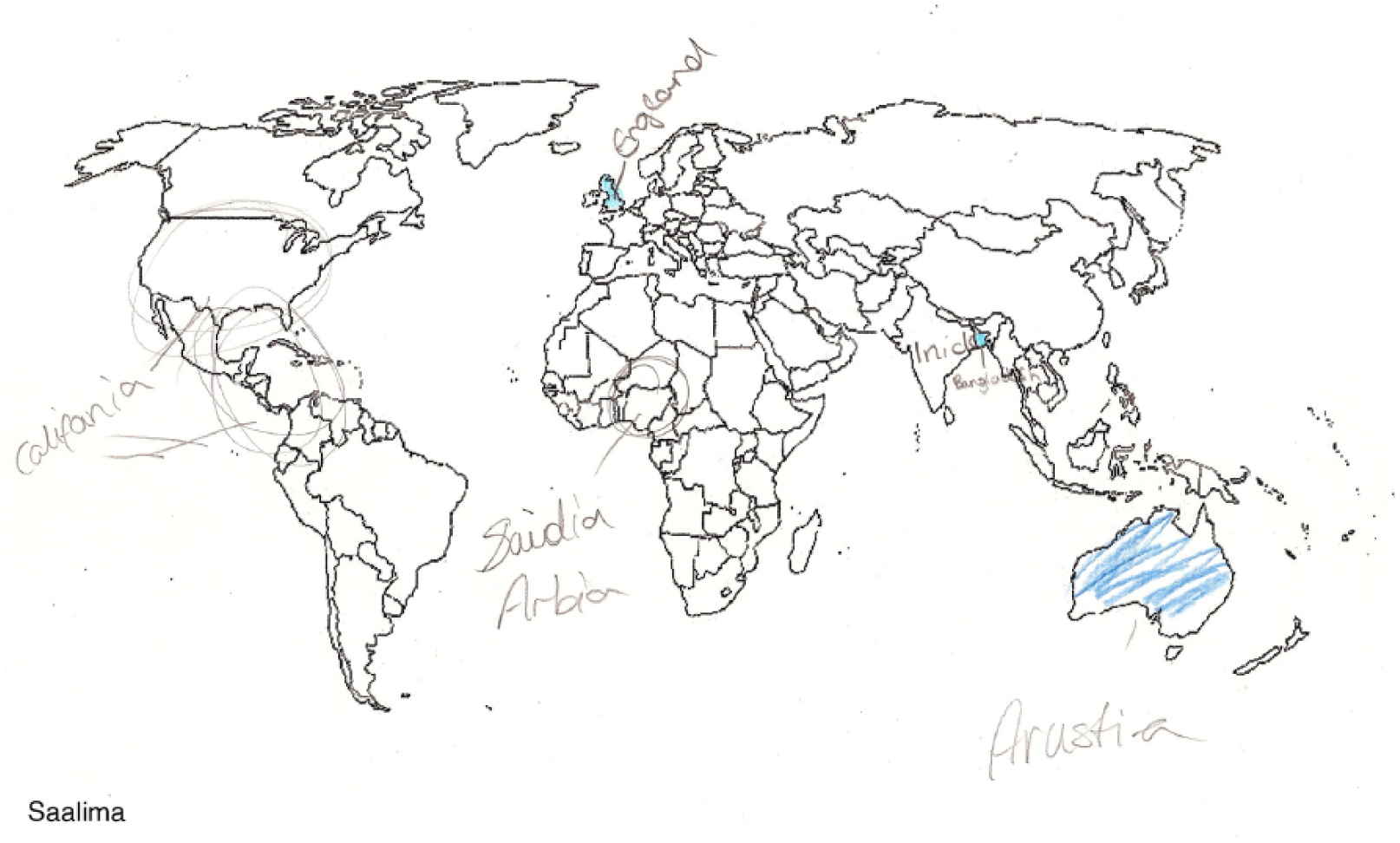
Saalima’s map of ‘important countries’.
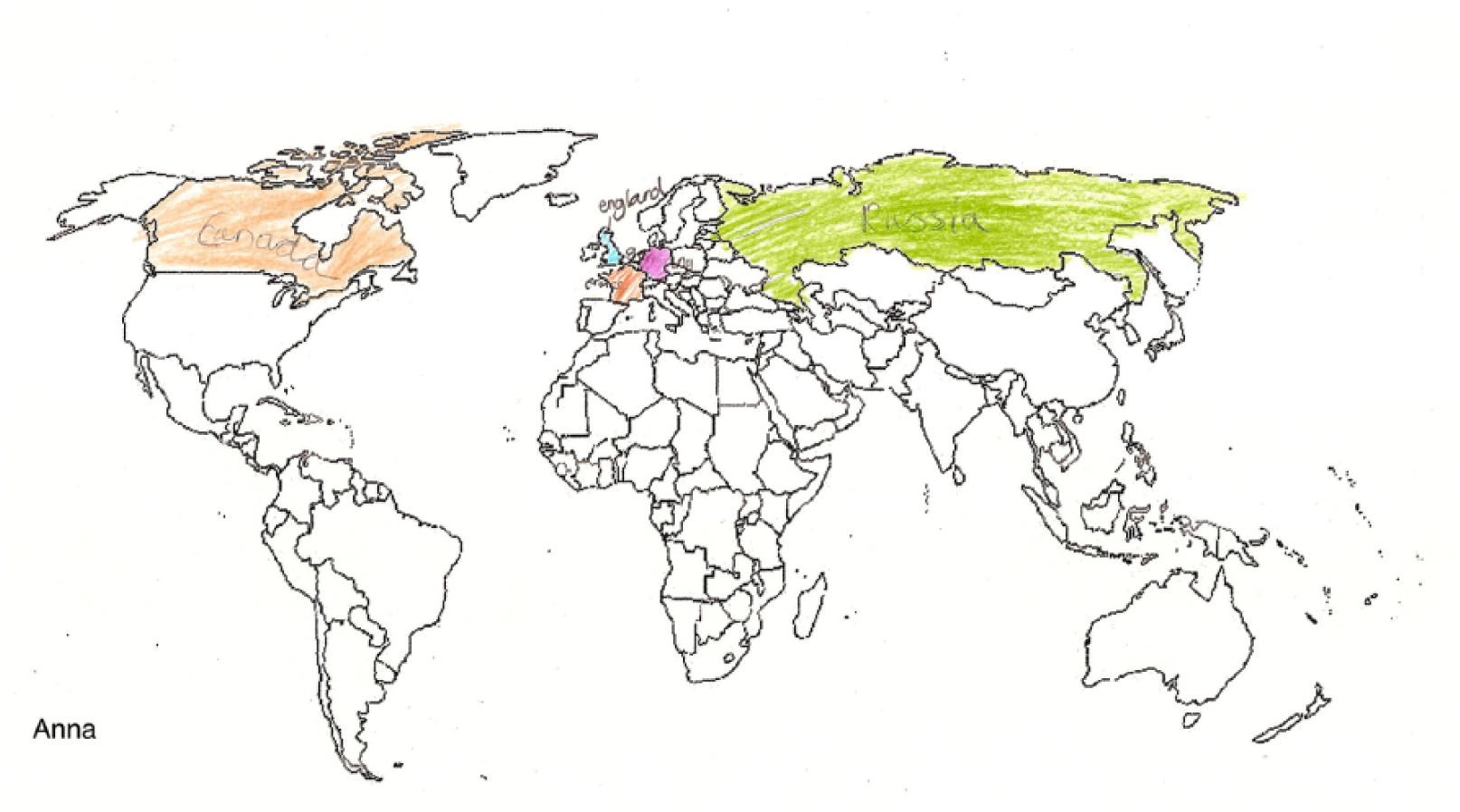
Anna’s map of ‘important countries’.
Transcending local separations
These global projections draw attention to how children articulate Otherness in relation to the global and the local. The local tended to confirm the construction of Otherness as separation since immigrant-background and non-immigrant children lived in different areas, and did not see each other outside school; whereas future projections drew on forms of global imaginary to create representations of Otherness as cosmopolitanism and belonging to the world, rather than separation and exclusion. This reference to the global as uniting rather than excluding is illustrated by an exchange between Andre and Akhil:
And like, they have like… I watch this show; hmmm it’s a channel, called Islam channel. On 13.
oh I have seen that channel! And if you go down.
And you can see a live prayer like from Medina.
Really?
Oh, I’ve seen that channel, if you go down to 12, then you are on a Brazilian channel.
In this exchange, Andre constructs a form of joint belonging through Otherness, represented here by global media. Although the two channels mentioned were in different languages there was nevertheless a form of sharing through difference. Andre’s insistence that he has seen the channel creates a connection beyond the lines of segregation experienced in school.
In the English case, these global, cosmopolitan representations were only voiced by immigrant-background children and were not shared by non-immigrant children. Non-immigrant children projected living somewhere in England in the future. Ben mentioned that he wanted to live in Southwold, Colin wanted to live ‘somewhere posh in England’ and Karen wanted to live in the local town. The only exception was Louise who wanted to ‘travel the world’ but was not specific about where. This shows how the relationship between the global and the local differed between immigrant-background and non-immigrant children, and highlights the multiple dimensions at play in the construction (or non-construction) of global imaginaries. Furthermore, this supports the criticism of approaching childhood as a homogeneous category with homogeneous voices (James, 2007) and offers a different perspective to the ‘politics of scale’ approach to children’s engagement with the global (Ansell, 2009).
For immigrant-background children, these global imaginaries of the future constituted a form of intercultural connection by projecting oneself as living in the country a friend came from. Building on global imaginaries, immigrant-background children defined themselves as free to live anywhere they chose in the world, rather than a national attachment to either England or the country from which their family had migrated. These ‘futural aspirations’ built on ‘imaginative variations’ of the global (Ricoeur, 1992) and positioned children as ‘cosmopolitan citizens’ who were free to live anywhere they chose (Appiah, 2006; Delanty, 2009; Nussbaum, 2002). In the context of peer group relations marked by segregation and stereotyping on the basis of racial, linguistic or religious differences, these global imaginaries performed a utopian function (Ricoeur, 1984) by enabling immigrant-background children to symbolically transcend fixed essentialist labels that were applied to them by peers, through references to global representations. In this sense, immigrant-background children’s global imaginaries and their forms of aspired mobility allowed children to position themselves as cosmopolitans rather than as Other, thus blurring lines of differentiation defined by peers.
Re-negotiating Otherness: the utopian function of global imaginary
This examination of global imaginaries across two schools remains exploratory and does not allow for any form of generalisation or comparison. Indeed, the aim of this paper was never to offer a comparison in the traditional sense. Nevertheless, looking at each case in relation to the other can help shed light on aspects that would not be noticed in a single case study. Exploring different forms of global imaginary in the French and the English schools has shown that, despite contrasting conceptual constructions of difference in formal school spaces (indifference to differences versus celebration of differences), in each case immigrant-background children’s global imaginaries performed a similar function: they constructed alternative symbolic representations of Otherness, which transcended lines of division and binary categories of Self and Other. As such, children’s global imaginaries, in their multiple forms, performed a utopian function, the creation of an elsewise and an elsewhere, which allowed immigrant-background children to re-negotiate ideologies of difference and Otherness in their identity narratives.
In the French case this took the form of an alternative to the school’s ‘indifference to differences’ principle and the construction of Otherness as central to peer-group relations. It also mediated multiple symbolic spaces, the local, the national and the global. In the English case, children’s global imaginaries allowed immigrant-background children to transcend lines of segregation and essentialist labels imposed by peers, and to construct imagined intercultural connections with friends. In both cases, it allowed children to re-negotiate imposed Otherness by defining themselves as cosmopolitans with aspirations of mobility (Delanty, 2009; Nussbaum, 2002).
In both cases, children’s identities and global imaginaries were constructed through a dialectic of permanence (idem) and change (ipse) (Ricoeur, 1992). This was expressed through an articulation between self-constancy and the changing, fluctuant dimensions of self, which was dynamic and subject to reinterpretation, underpinned by contradictions and inconsistencies. Change and permanence were articulated across different spaces, and different times. In their global imaginaries, children articulated references to their past and their trajectory as pupils, along with future projections of themselves as cosmopolitan citizens who could live anywhere in the world. In this dialectical relationship, imagination played a key role in children’s narratives by synthesising the horizons of past, present and future (the uchronic function) and articulating different school spaces (the utopian function) at different levels (local, national and global) in their representations (Ricoeur, 1992). Through these representations, children were able to redefine Otherness and transcend dichotomies between belonging and Otherness by creating alternative intercultural symbols.
This dialectic is also one of self and Otherness which builds on collective narratives, children’s global imaginaries, institutional symbolic representations of Otherness and the views and labelling of others. Children’s narratives and global imaginaries highlight the full meaning of Ricoeur’s understanding of ‘oneself as another’ (Ricoeur, 1992).
Global imaginaries also built on a dialectic between ideology and utopia, held together by imagination (Ricoeur, 1986, 1992). In this process, ‘imagination engender[ed] the hope and potentiality of becoming otherwise or of inhabiting an elsewhere’ (Burns, 2008: 351). Imagination allowed children to re-articulate difference and Otherness by positioning them in a global framework.
Globalisation has defined imagination as a social practice, as a ‘form of negotiation between sites of agency (individuals) and globally defined fields of possibility’ (Appadurai, 1996: 31). These ‘fields of possibility’ were opened up through children’s global imaginaries, echoing the central space Greene gives to imagination in constructing alternative realities that can overcome silence towards and discrimination of other cultures (Greene, 1997).
In that sense, children’s global imaginaries held an emancipatory dimension, which offered an alternative to monocultural ideologies, be they institutional values as in the French case or peer group relations, as in the English case.
This emancipatory dimension of global imaginaries could hold implications for thinking about global or cosmopolitan citizenship (Delanty, 2009; Nussbaum, 2002). Findings presented in this paper show that the way the children articulate local, national and global representations in their narratives reflects a social imaginary which builds on the notion of common experiences despite linguistic and cultural differences at a local level, which then enables them to transcend national boundaries and see themselves as global or cosmopolitan citizens.
However, caution is needed in taking a simplistic view of the liberating dimension of children’s global imaginary and its cosmopolitan corollary. Whilst global imagination gave children the possibility to re-negotiate Otherness in their narratives, global representations are also alienating, and carry their own forms of ideology. Global representations build on a consumer model which tends to essentialise the Other (Beck, 2004: 150). The idealised, cosmopolitan, consumerist, self-developed citizen in fact offers limited possibilities and is not accessible by all (Burns, 2008). As such, many remain at the periphery of globalisation or emerge as the victims of globalisation (Blommaert, 2011).
Whilst children’s representations allow imaginary connections to the global, and re-negotiation of identities and narratives of Otherness and belonging, these children’s lived realities were very far from these ‘horizons of possibilities’ and structural inequalities may mean that they never reach this position of ‘cosmopolitan citizen’. In this sense, global imaginary contains a disempowering dimension in that it builds on values and representations of the dominant ideology based on white, middle-class and neo-liberal values. Children from both cases, living in situations of social disadvantage in marginalised urban settings would not have the possibility to fulfil their imaginary future aspirations. Although this is beyond the scope of this paper, it is worth noting that children from both schools spoke about the tensions in their present lives, be it the weight of tradition and the difficult contrast with modernity, the limited movement outside of their immediate local urban environment, and forms of global threat and tension that made them feel insecure. Akhil’s comment below offers an illustration of the possible threatening aspects of global imaginaries.
Yeah, because I remember like it said on the news that someone wanted to burn copies of the Koran…in New York…called Pastor Jones.
These children are thus caught in a material and symbolic peripheral position, which participates in processes of social exclusion. At its worse, this alienating dimension could constitute no more than what Berlant termed ‘cruel optimism’ (Berlant, 2011), a situation which would lock children in their own global imaginaries and false aspirations of mobility, and detract them from constituting themselves as political subjects who can critique and act upon their immediate environment and the forms of exclusion of which they are part.
Turning once again to Ricoeur’s dialectic of ideology and utopia can help address these tensions between the emancipating potential and the alienating dimensions of children’s global imaginaries. For Ricoeur, ideology and utopia are mutually constitutive as ‘we are always caught in this oscillation between ideology and utopia’ (Ricoeur, 1986: 312). This view allows interpretation of children’s global imaginary as liberating and alienating, thus holding creative and emancipatory possibilities at the same time as oppressive and restrictive functions. One need not invalidate the other, and as such offers new challenges for schools to address.
Conclusion
This article has highlighted the role of global imaginaries in immigrant-background children’s representations, an area which remains under-researched in literature about immigrant children’s identities in schools and in globalisation or cosmopolitan studies. It has examined the ways in which these imaginaries performed a utopian function and participated in blurring lines of division and Othering in the narratives of immigrant-background children from socially disadvantaged areas. These insights have contributed to reflections on the relationship between global and local spaces in children’s experiences (Ansell, 2009; Katz, 2004) and shown the limitations of a dichotomous approach. Finally, this paper has offered further theorisation of the notion of global imaginary, based on the concept of social imaginary in the work of Paul Ricoeur (1986) and the dialectic between ideology and utopia. As such, it has explored the social role of imagination and its potential for engaging with diversity and the global (Appiah, 2006; Delanty, 2009; Greene, 1997; Nussbaum, 2002)
The role played by children’s global imaginaries in transcending differences and Otherness raises new questions in relation to integration and diversity in schools. This is particularly relevant in an era when schools are dealing with the tension between traditional national values and new forms of global imaginaries and flows. In particular, how can schools, still strongly embedded in national traditions and values, participate both in nurturing the empowering potential of global representations whilst at the same time offering the space and tools to develop a critical examination of global issues and representations?
This article has highlighted the ways in which global imaginaries allowed immigrant-background children to construct intercultural understanding and representations. These global imaginaries have implications for education. This paper suggests that a deeper engagement on the part of schools with children’s own global representations holds potential for developing a more integrated approach to global citizenship, which has become a central focus for national and international educational programmes (UNESCO, 2012). The more alienating aspects of global imaginaries also call for schools to encourage children to critically engage with their own representations and aspirations of mobility and develop discerning views between, for example, the more hegemonic aspects of global consumerism and more enhancing forms of intercultural understanding.
Building on children’s own imaginaries can help shed new light on old lines of differentiation and division and offer creative solutions for schools to engage with new forms of diversity. The map below, by Imed, a boy of Algerian background in the French school, perhaps offers the most representative illustration of the creative ways in which children transcended traditional forms of categorisation through global imaginaries (Figure 6).
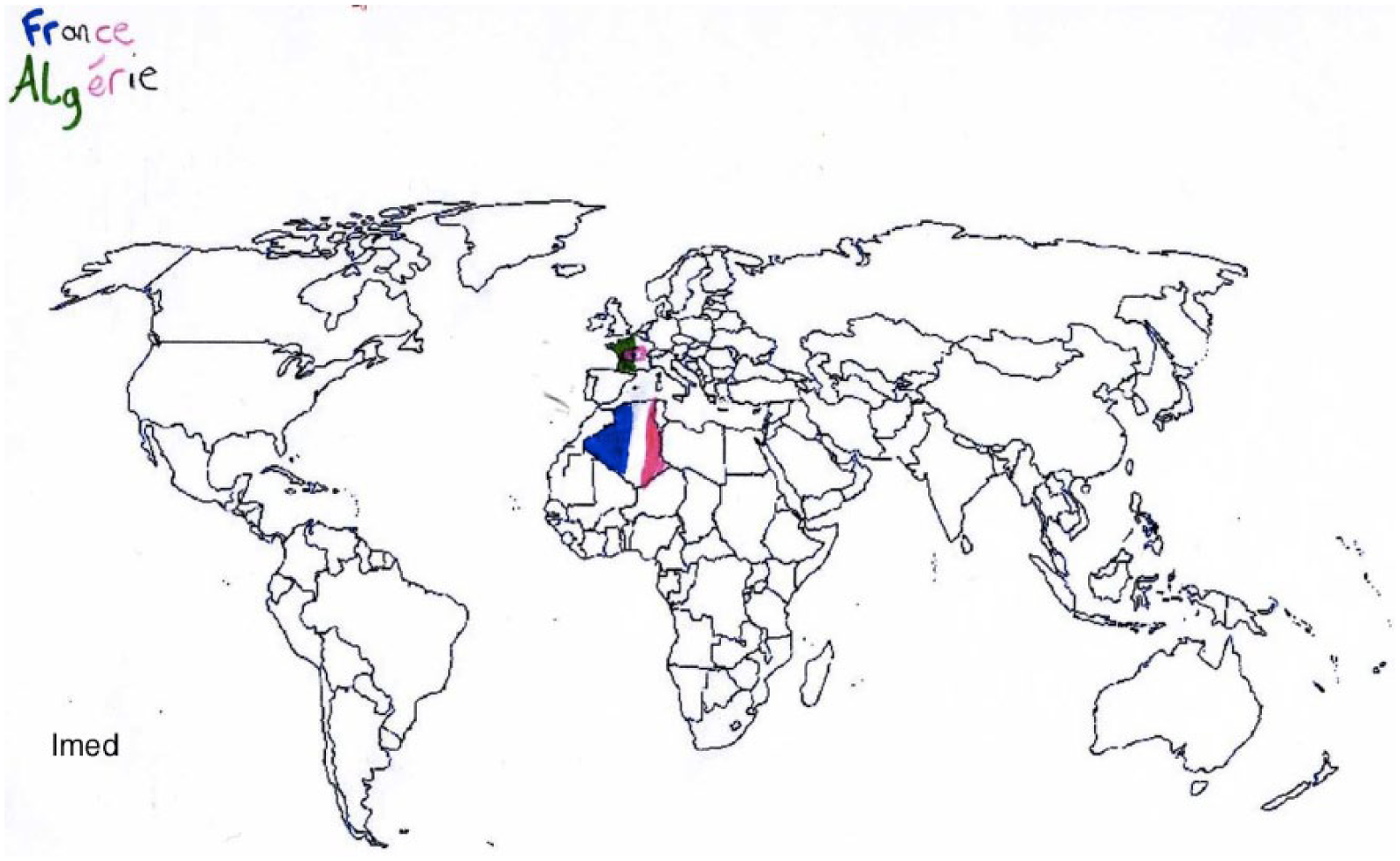
Imed’s map of ‘important countries’.
Look what I did….
Ah, why did you do it like that?
Because in Algeria I speak French and in France I speak Algerian.
Footnotes
Acknowledgements
The author is grateful to Edith Esch and to the editors and anonymous reviewers for their comments on drafts of this article.
Declaration of conflicting interest
The author declares that there is no conflict of interest.
Funding
This work was supported by the Economic and Social Research Council under a doctoral studentship (1+3).