




Abstract
This article argues that research on teacher preparation over the last 100 years can be understood in terms of the major questions that researchers examined. The analysis is guided by the framework of “research as historically situated social practice,” which emphasizes that researchers’ interests, commitments, and social experiences guide the research questions they pursue and the theories and perspectives they adopt. Past research on initial teacher education is described in terms of the emergence of three broad questions: “the curriculum question,” “the effectiveness question,” and “the knowledge question.” Present research focuses on two broad animating questions: “the policy question” and “the learning question.” We recommend that future research address questions that link teacher learning with student learning and teacher candidates’ beliefs and practices as well as questions that examine the relationships between research practices and social, economic and institutional power.
Introduction
This article focuses on the past, present, and future of research concerning initial teacher preparation, 1 drawing on our recent major review of research on teacher preparation (Cochran-Smith et al., in press) and related analyses (Cochran-Smith, 2005, 2008; Cochran-Smith et al., 2012). The article argues that although research on teacher education is an emerging, complex, and multifaceted field, influenced by competing ideas about the purposes of research and the goals of education, it can be accurately characterized in terms of the changing research questions that have driven the work. The article includes references to studies of teacher preparation that were conducted by researchers with a wide range of nationalities and interests; however, it takes a primarily US perspective in its analysis and critique of the research.
Identifying our US-centered perspective at the outset of this article is important because although there is much that is similar about the policies and practices that influence research related to initial teacher preparation across nations, there is also a great deal that is different. Along these lines, for example, there are many enduring questions that nearly all initial teacher preparation programs and institutions must deal with, among them: What knowledge is necessary for teaching? How are theory and practice related? What experiences prepare teachers to work with students who are different from them? What is/should be the role of initial teacher education in school and social change? On the other hand, there are also complex international differences in history, culture, economics, and politics that influence not only how these and other questions are answered, but also how the answers are worked out in local and broader teacher education policy and practice. These differences across countries include, for example: dominant ideas about a nation’s broader purposes of education; the history of teacher education, especially its place and status in universities or other contexts; how teacher education is linked to the public, private, and religious education a country provides for its primary and secondary school students; how and by whom initial teacher education is organized, governed, funded and evaluated; and dominant views about the esteem and professional status of teachers and the impact of teachers and teacher education on a nation’s economy.
This article offers a necessarily general analysis of research on teacher preparation over the last 100 years in terms of the questions that drive research. The analysis straddles a paradox. First—given, as noted above, that international differences in teacher education policy and practice have an enormous impact on research—this analysis is situated primarily in the history, culture, economics and policy contexts of the US. Second, however—given that we live in an increasingly globalized and culturally and economically interconnected world—many of the themes of this analysis, particularly our analysis of the present and future of research on teacher preparation, are also relevant to research in developed and developing countries beyond the US.
The article begins with discussion of a new theoretical/analytic framework for understanding and evaluating research (Cochran-Smith and Villegas, 2014), followed by three sections that analyze teacher preparation research in the past, present, and future. These sections are not equal in length nor are they parallel in degree of detail and scope. The section on “the past,” which is relatively brief, focuses almost entirely on the questions that drove teacher preparation research in the US during the 80 years or so that preceded the new millennium. The section on “the present” state of research on teacher preparation is the most detailed and international of the three. It draws directly on our larger review of research on teacher preparation published in the 13-year period between 2000 and 2012 (Cochran-Smith et al., in press), focusing not only on the questions that are currently driving research, but also the larger social, cultural, economic and material forces within which these questions emerged and with which they are complexly intertwined. The final section on “the future” also draws on our larger review, particularly on our recommendations about the research that will be needed to respond to the demands of the next few decades.
The questions that drive research
To characterize teacher preparation research in the past, present, and future, we adapted our theoretical/analytic framework titled “teacher preparation research as historically-situated social practice” (Cochran-Smith and Villegas, 2014). The framework emphasizes that researchers’ interests, commitments, and social experiences guide the research questions they pursue and the theories and perspectives they adopt. This framework is informed by Bourdieu’s ([1977] 1980) “theory of practice,” which conceptualized sociology as a science of social practices situated in social spaces and defined by struggles among agents with different resources and inclinations about how to use those resources (Heilbron, 2009). In their analysis of research on technical and professional communications, Herndl and Nahrwold (2000) drew on Bourdieu to contrast the notion of research as social practice with the more traditional notion of research paradigms, arguing that people who actually do the work of research are engaged in research practices, not simply paradigms. They suggested that a shift from paradigms to practices allowed considerations of not only research methods, but also, as we show below, purposes and the relationship between research practices and social, economic, and institutional power. We argue here that conceptualizing research as social practice is appropriate to many fields, but is especially appropriate in emerging fields like research on teacher preparation, which is made up of multiple contested territories and which borrows from many disciplines.
To elaborate the idea of teacher preparation research as social practice, we include some of the major practices involved in research on Figure 1. As the figure suggests, social practices include: how researchers construct research problems and frame research questions; the underlying assumptions they make and the logic of their arguments; researcher identity and positionality as well as intended audiences and purposes; research designs, theoretical frameworks, and uses of evidence; and how findings are described and analyzed, and how implications are characterized. All of these research practices are situated within larger historical contexts; social, political, and economic forces; and, the resulting ideologies that have shaped the development of ideas about teacher preparation. We return to and elaborate this latter point in our discussion of “the present” context of research on teacher preparation.
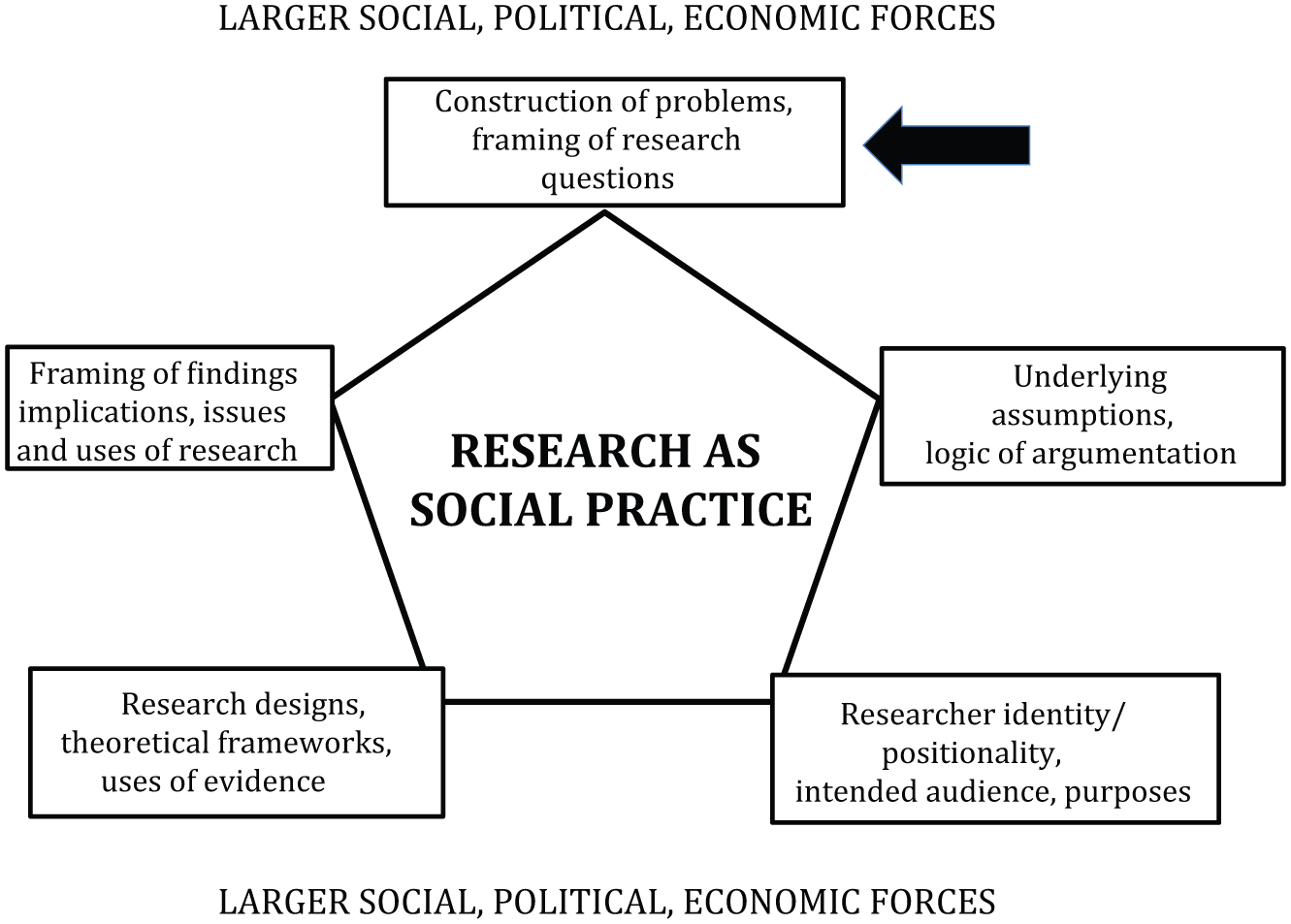
Teacher preparation research as social practice.
We focus in this article primarily on the social practice of constructing research questions regarding teacher preparation. The key idea here is that research questions (and problems) do not exist “out there,” simply waiting for researchers to discover them and take them up. Rather questions are deliberately constructed by researchers in keeping with their major assumptions about knowledge, teaching and learning, the purposes of schooling, and the relationships of research, policy, and practice. Research questions are also shaped by researchers’ identities, purposes, audiences, and the larger policy/political agendas with which they align their work.
Research on teacher preparation: the past
As noted above, by “the past” of teacher preparation research in the US, we mean roughly the 80 years prior to the turn of the 21st century. Focusing primarily on the questions that drove research on teacher preparation during this time allowed us to piece together a loosely chronological (and admittedly, simplified) account of past research on initial teacher education as the emergence and evolution of three broad questions, which we refer to here as “the curriculum question,” “the effectiveness question,” and “the knowledge question.” To identify these questions, we drew on previous reviews of early research about US teacher education (Cochran-Smith and Fries, 2005, 2008; Zeichner, 1999, 2005) and on our recent analysis (Cochran-Smith et al., in press) of the treatment of teacher preparation research in the four published editions of the Handbook of Research on Teaching (Gage, 1963; Travers, 1973; Richardson, 2001; Wittrock, 1986), which is a long-term effort of the American Educational Research Association (AERA) to analyze and critique the emerging field of research on teaching within which research on teacher preparation is a subset. Our larger literature review is the sole chapter on teacher preparation in the fifth edition of the AERA handbook (Gitomer and Bell, in press).
The curriculum question
From the mid-1920s through the 1950s, researchers concerned about teacher education in the US focused their investigations on the “curriculum question.” The question had two general forms: “What are the core traits of effective teachers and are these appropriately reflected in the teacher education curriculum?” and “What are the contents and emphases of the curriculum across teacher education institutions, programs and state requirements?” These questions reflected a desire to move the field beyond simple descriptions of curricula toward statistical summaries, systematic analysis of surveys by experts, and correlational studies applied to curricula (Travers, 1983). This was part of a larger push to upgrade the teaching profession by developing a unified approach to teacher preparation. The two broad questions identified above reflected major debates of the time about where teacher preparation should be located and ongoing caustic critiques of its academic and professional emphases (e.g., Bestor, 1953; Lynd, 1953; Smith, 1954). In keeping with the primary educational research method of the period (Lagemann, 2000), the curriculum question was pursued primarily through surveys, although observations and interviews were also used. Some studies were designed to uncover and organize systematically the perceptions of school principals, teachers, parents and others of the personal and academic attributes of good teachers, while others were intended to determine the range and variation of the general and special preparation of teachers across institutions and state/local requirements. Between 1930 and 1945, there were several major studies intended to codify and unify teacher preparation (e.g., Charters and Waples, 1929; Evenden, 1933). Although handbooks that synthesized research on teaching and teacher preparation did not yet exist, there were several early efforts to review the research (e.g., Peik, 1940, 1943, 1946; Peik and Hurd, 1937a, b). Most of these concluded that the teacher preparation curriculum was narrow in both professional and subject matter emphases, inconsistent across institutions, not reflective of professional consensus about core teacher attributes, and in need of major reorganization (Cochran-Smith and Fries, 2008; Zeichner, 1999).
Exploration of the curriculum question marked the first attempts in the US to study teacher education empirically and to use “scientific” methods to improve preparation. Much of what was recommended as a result, however, was too general to be of direct use to educators and too complicated to implement and track (Zeichner, 1999).
The effectiveness question
The “effectiveness question” drove much of the research on initial teacher preparation in the US in the 1960s, 1970s, and 1980s. During this time, “process-product” research on teaching, which reflected many of the tenets of positivism, was dominant (Shulman, 1986). The goal of this program of research was developing “the scientific basis of the art of teaching” (Gage, 1978) by specifying teacher behaviors correlated with student achievement and applying these as treatments to classroom situations.
In essence, the effectiveness question of the process-product research on teaching was this: What are the teaching processes (i.e., teaching behaviors, techniques, and/or practices) that lead consistently to desired teaching products, especially student achievement defined as test scores? Applied to teacher preparation, which was referred to as “teacher training,” the effectiveness question mirrored the former: What are the teacher training processes (i.e. training techniques, methods or approaches) that lead consistently to desired teacher training products, defined as teacher candidates’ ability to demonstrate in classroom or simulated settings techniques and methods that empirical research has shown to be effective? As is well known, the effectiveness question was critiqued and more or less rejected by the mid-1980s (Hamilton and McWilliams, 2001), in keeping with the general rejection of positivist approaches to education and social sciences research (Lather, 1986). In practice however, the effectiveness question never actually disappeared, and many studies animated by similar questions continued and eventually regained dominance in the US and elsewhere (Floden, 2001), a point we elaborate below.
The importance of the effectiveness question was reflected in the first two Handbooks of Research on Teaching. The first (Gage, 1963) did not have a separate chapter on teacher preparation, focusing primarily on research methods and the variables that influenced teaching. Just ten years later, however, the second handbook (Travers, 1973) had an entire chapter (Peck and Tucker, 1973) on teacher preparation, focused almost exclusively on research that identified training procedures that successfully induced in new teachers empirically effective teaching behaviors.
Although the effectiveness question was clearly dominant in US teacher preparation research during this time, it is important to note that new alternative questions were also emerging. These were rooted in anthropology, sociology, sociolinguistics, and critical theories about the meanings of classroom events for participants and relationships of classroom teaching to larger systems of power and privilege. The emerging alternative perspectives countered the effectiveness question, challenged the positivist paradigm, and pointed to what was left out of the effectiveness question (Erickson, 1986; Popkewitz et al., 1979).
The knowledge question
The “knowledge question” was central to US research on teacher preparation during the 1980s and 1990s. It emerged partly in response to perceived flaws in previous research wherein teaching was regarded as technical and teacher preparation as training. The knowledge question, which moved away from what effective teachers did to what they knew and how they learned to teach, became almost a mantra in the field: What should teachers know and be able to do? What is/should be the knowledge base of teacher education?
These and other knowledge questions were prompted by high-profile reports about the supposedly declining quality of the US education system, which was assumed to be directly linked to the health of the national economy (Lagemann, 2000; Mehta, 2013). At the heart of the knowledge question was the desire to enhance teacher quality by building a common knowledge base that would professionalize teaching and teacher education. Knowledge question studies built on early research about students’ and teachers’ thinking and cognition (Clark and Peterson, 1986), on the idea that teaching was an intellectual activity (Lanier and Little, 1986; Zumwalt, 1982), on the premise that good teachers drew on knowledge of learning/learners, subject matter, general pedagogy, and content-specific pedagogy (Shulman, 1987), and on the notion that people learn to teach over time (Feiman-Nemser, 2001). With this broad focus, this program of research also came to include questions about teacher candidates’ dispositions, beliefs, attitudes, and values (Wideen et al., 1998) as well as the professional contexts and partnerships within which they learned to teach (Abdal-Haaq, 1998; Levine and Trachtman, 1997). Although the program of research driven by the knowledge question was expansive and generative, it also prompted serious critiques, including the charge that it did little to challenge the arrangements of schooling that perpetuated the status quo (Britzman, 1991; Liston and Zeichner, 1991) and that it paid inadequate attention to diversity, social justice, and equity (Cochran-Smith, 1991; Ladson-Billings, 1995; Villegas, 1991).
There were two volumes in the AERA handbook series that bookended this time period. The third handbook (Wittrock, 1986) included a chapter devoted entirely to research on teacher education (Lanier and Little, 1986), which stood in stark contrast to the second handbook’s chapter. Consistent with challenges to positivist paradigms more generally, Lanier and Little explicitly excluded experimental research on teacher training, asserting that it offered nothing new. Instead, in keeping with broader efforts to professionalize teaching and teacher education, their chapter synthesized interdisciplinary research on teacher educators, prospective teachers, curriculum, and higher education/school policies that influenced teacher education. The fourth handbook (Richardson, 2001) reflected the proliferation of paradigms related to research on teaching and teacher education that had developed over the 15 years since the previous handbook. This volume had multiple chapters related to teacher learning, but most of the teacher preparation research per se was in the chapter by Richardson and Placier (2001) on formal programs of “teacher change,” which situated the knowledge question in the context of school cultures and reflected growing recognition that identity issues and the politics of difference mattered in learning to teach. The fourth handbook included many critiques of current research and called for more inclusive voices in the field.
Summing up “the past”
Of course our three question—about curriculum, effectiveness, and knowledge—do not cover all of the US research about teacher preparation during the 80 years preceding the new millennium. There have always been competing questions, and our short list knowingly leaves out much that is important, especially the critical questions that were emerging about the purposes of schooling, whose interests were served, and ethics/justice questions. But the truncated overview we have offered here captures the general shift during this time from positivist to interpretive (and critical) perspectives in research on teacher education. However, it is important to reiterate that multiple research agendas long co-existed, and the history of teacher preparation research was not one unified march from one research paradigm to another (Cochran-Smith and Fries, 2005; Gage, 1989; Lagemann, 2000). Indeed, as we move to “the present” of research on teacher preparation, it is worth noting that none of the questions we have loosely associated with particular time periods was really settled during those times or disappeared from consideration after those times. Rather, as we show in the next sections of this article, many were periodically recycled into new contexts and policy climates.
Research on teacher preparation: the present
We analyze “the present” by focusing on teacher preparation research published since the new millennium. For the purposes of this article and in keeping with our focus on questions, we consider this research in terms of two broad animating questions: “the policy question” and “the learning question.” Below, we situate these within the larger contexts in which they emerged and offer examples that reflect the international character of this research.
Defining and situating the research
In the larger review we are drawing on in this article, we examined empirical, peer-reviewed studies about initial teacher education and/or certification and licensure in various preparation contexts published between 2000 and 2012. Although the majority were US studies, some 40% were conducted in other nations, and several areas of research were highly international in focus. To locate this literature, we searched 54 major national and international journals and research institutions, and we conducted targeted electronic searches. 2 This process yielded some 1500 studies.
To situate current research in terms of social, political, and economic forces and resulting ideologies, we drew on Karl Mannheim’s ([1936] 1949) perspectives on the sociology of knowledge, which emphasized relationships between the ideas of human beings and the historical and social contexts from which they emerged. In his classic text, Mannheim suggested that the task of the sociology of knowledge was “to analyze the relationship between knowledge and existence” (p. 237). The three layers of Figure 2, which is a companion to Figure 1 presented earlier, represents our analysis of the forces that have shaped current research on initial teacher education. The bottom layer emphasizes the major shift from an industrial economy based on manufacturing and material goods to a knowledge economy based on the production and distribution of information. Most important for initial teacher education research and policy is that this shift to a knowledge society was also a shift in many countries to neoliberal economics wherein individualism, free markets, and private goods took precedence over collective responsibility, human rights, and the public good (Apple, 2005; Luke, 2004; Mehta, 2013).
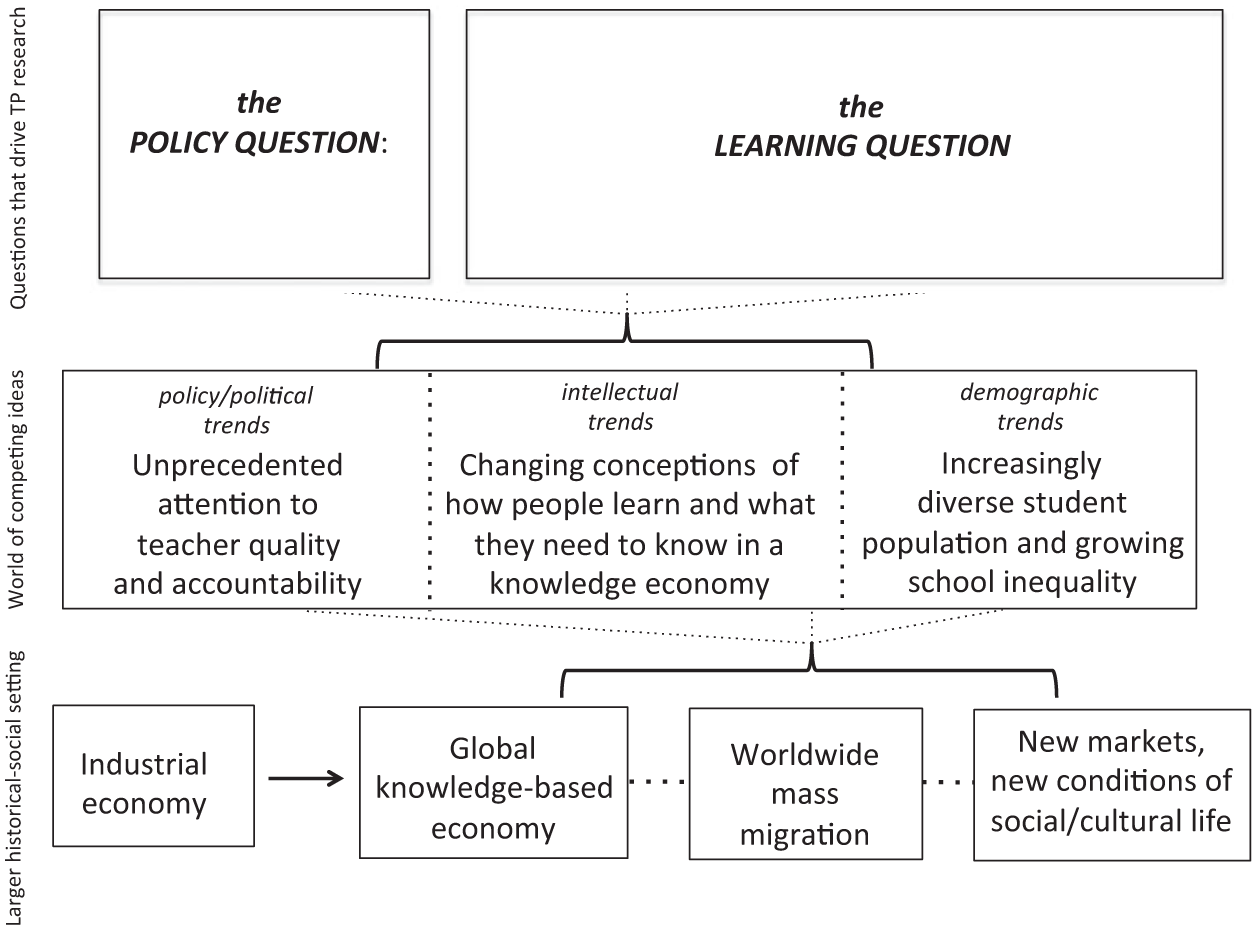
Teacher preparation research contexts and questions.
These shifts were related to major changes in how we think about initial teacher education. As the middle layer of the figure indicates, three trends converged and shaped the development of research on teacher preparation: unprecedented attention to teacher quality with a heavy emphasis on outcomes accountability; changing conceptions of how people learn and what they need to know in the knowledge society; and, increasingly diverse student populations coupled in many countries with persistent school/social inequalities. Finally, as the top layer of Figure 2 indicates, these trends shaped the development of two major questions that are driving current research on initial teacher education. In the remainder of this section, we describe these two and the complex contexts from which they emerged.
The policy question
The policy question that drives current research on teacher preparation has to do with accountability, effectiveness, and the impact of policies related to these. The dominant version of the policy question is this: Which broad policy parameters related to initial teacher education and/or certification and licensure should be manipulated by policy makers in order to achieve desired educational outcomes, such as increasing school students’ achievement, enhancing teacher retention, or generating well-prepared teachers? In addition, the policy question also includes inquiries about how institutions or programs respond to policies as well as general policy trends. The point of much of this research is to provide empirical evidence to guide the decisions of policy makers about matters such as who provides teacher preparation and in what kinds of settings, what the content and duration of initial teacher education should be, and how teacher candidates should be assessed for certification and licensure.
The policy question is being explored in present-day research on initial teacher education in four clusters of studies. The first, which is almost entirely US-based, has to do with the impact of labor market policies allowing “alternative” certification and entry pathways, which were initiated or expanded in all but a handful of US states during the 1980s and 1990s. The second cluster includes studies of institutional responses to new education policies and/or analyses of policy trends and discourses. Many of these studies, conducted in nations attempting to boost teacher quality, have to do with new regulations regarding initial teacher education, new standards for graduating teachers, new institutional arrangements for preparation, and/or how programs and institutions respond to these. A smaller group of studies within this cluster analyzes the influences, discourse patterns, political agendas, and development of major policies at the state, country, or supranational level. The third cluster has to do with policies regarding the testing and assessment of teacher candidates or programs, including the development and use of new assessment tools, such as performance-based assessments, and portfolios. The final cluster of studies, the smallest of the four, focuses on program evaluation of individual teacher preparation programs, curricula, or partnerships for local purposes.
A recent study animated by the policy question is Papay et al.’s (2012) examination of the Boston Teacher Residency program (BTR), a school-based clinical teacher preparation pathway. The study was intended to inform policy, programmatic, and funding decisions about residencies, which are a rapidly expanding and well-funded model of preparation, regarded as policy levers for improving teacher quality in the US. This study assessed the efficacy of the model on four outcomes by comparing the effectiveness of BTR and non-BTR new teachers, drawing on five years of administrative data and students’ achievement scores. The researchers found that BTR was substantially more successful than other local sources of new teachers in producing math/science teachers, diversity, and retention. However, a fixed-effects value-added assessment indicated that BTR teachers were not more effective than non-BTR teachers in terms of their students’ performance on English language arts tests and were much less effective in mathematics. Papay et al. also found that by the fourth or fifth year, BTR teachers out-performed veterans. Given BTR’s high retention rate, the researchers suggested that BTR could have a positive cumulative impact, although they noted study limitation because of very small comparison groups.
A second example (Brennan and Willis, 2008), which focused on the context in Australia, asked a policy question about changing directions in the discourse surrounding teacher education policy at the country and global level with emphasis on politics and power. Drawing on two federal inquiries into teacher education, conflicting position statements about relationships between state and federal jurisdiction for accreditation, and their insider perspectives as deans of schools of education, Brennan and Willis examined how global trends were reflected in contemporary teacher education policy. They suggested that teacher preparation in Australia was a field of contestation played out in the larger university context, in budget decisions, and in state-federal tensions related to accreditation. They demonstrated that in Australia, as in many other countries, university sectors are increasingly being reorganized to increase “academic capitalism” (p. 298) for the knowledge economy. Along these lines, they pointed out that some fields, such as teacher education, are less able and/or willing to participate in the entrepreneurial aspects of the new fiscal climate.
The learning question
The learning question has two versions. In our phrasing of both of these questions, we use the word “how” to mean: under what conditions, in what contexts, based on what pedagogies, guided by what theoretical frameworks, and according to what curricula, content, and fieldwork experiences. The first question is: How do teacher candidates learn to teach in ways consistent with new understandings of how people learn and what they need to know in the 21st-century knowledge society, which demands workers who can think critically and work collaboratively? The second question is: How do teacher candidates learn to teach increasingly diverse student populations?
The first question builds on research from the learning sciences and the anthropology and sociology of education to conceptualize learning as a process of active construction. This is linked to new views of teaching as complex intellectual work and evolving views of learning to teach as ongoing over the professional lifespan. This question is being explored in current teacher preparation research in six broad areas: preparing teachers to teach subject matters, such as math, science, history, literature, and the arts; examining the influence of coursework and programs on teacher candidates’ learning to teach; understanding the influence of fieldwork, especially student teaching and mentoring arrangements, on teacher candidates’ learning to teach; analyzing teacher education program contents, structures, and pedagogies; studying teacher educators’ learning, characteristics, strategies, and knowledge; and exploring how teacher candidates learn to teach over time, including relationships between the initial teacher education period and the early years of teaching. We offer just three examples to illustrate the variation of these studies.
The first study, which was conducted by teacher educators Sharpe et al. (2003), at the National Institute of Education in Singapore, is grounded in research suggesting that time and distance limitations between university and school placements negatively influence supervisory quality and constrain collaborative learning. These researchers studied the technical feasibility and pedagogical value of synchronous videoconferencing technology, designed to allow virtual meetings, by analyzing student teachers’ post-discussion questionnaires and focus group discussions. They found that, despite some technical challenges, multipoint desktop videoconferencing and streaming video of student teachers’ own practice during scheduled meetings provided opportunities for reflective conversations, examination of experiences, and clarification of points of view.
A second example (Cartaut and Bertone, 2009), from a French university institute of teacher training, is grounded in research revealing conflict, power struggles, and poor communication between cooperating teachers and university supervisors in the traditional student teaching triad. The researchers conducted a triad case study using videos of lessons, post-lesson advisory conferences, and self-confrontation interviews of cooperating teachers and teacher candidates. Themed dialogic interactions were evaluated using principles of social-discursive interactionism and activity theory to identify whether the candidate applied feedback to subsequent teaching. They found that both the candidate’s teaching and the cooperating teacher’s mentoring were transformed because the joint advisory conference served as an interactive training modality.
In the third study, conducted in the US, Windschitl and Thompson (2006) explored secondary science teacher candidates’ understandings of models during Windschitl’s two-semester science course. Drawing on pre-post questionnaires and course data, the researchers found that most teacher candidates grew in their understandings of models over two semesters, but candidates engaged in relation-based rather than model-based reasoning, and their final arguments were method- rather than theory-directed. Windschitl and Thompson concluded that despite carefully planned course activities, most candidates clung to school-based notions of science, which lacked attention to the unseen aspects of explanatory theories and model-based reasoning and emphasized instead the linear relationships of measured variables and the division of modeling and empirical inquiry into separate processes.
As we suggest above, the second general version of the learning question has to do with preparing a teaching force capable of producing equitable learning opportunities and outcomes for diverse students in the context of enduring inequalities. Studies animated by this question are rooted historically in demographic changes worldwide resulting from the mass movement of people across the world, which has dramatically increased the enrollment of students from diverse backgrounds in elementary and secondary schools. In many nations, this is exacerbated by persistent patterns of inequality between privileged and marginalized students, particularly those living in poverty. Collectively, studies that address this learning question reveal how teacher preparation has responded to the changing demographics of the pre-college student population since 2000.
This learning question is being explored in four broad areas: the influence of courses and field-based opportunities on teacher candidates learning to effectively teach increasingly diverse student populations, including students traditionally marginalized and not well served by existing school systems; strategies for recruiting and preparing a diverse teaching force; analyses of content, structures, and pedagogies for preparing teacher candidates for diverse populations; and examinations of teacher educators’ learning about and experiences with preparing teacher candidates for diversity. We offer two examples here.
Haddix (2008)—a US teacher educator—examined the influence of a sociolinguistics course on the development of two white, Standard-English-speaking teacher candidates’ understandings of themselves as linguistic/cultural beings and implications for teaching. Based on discourse analysis of interviews with the two teacher candidates and their autobiographical narratives, Haddix found that both candidates learned that the lesser-valued varieties of language in a society are rule-governed and complex and the perceived superiority of the standard variety is arbitrarily determined and socially constructed; however, neither teacher candidate developed an understanding about the interplay of language, identity, and power. Haddix concluded that a single course, even when designed to affirm diverse ways of speaking and being, is insufficient.
In the second study, Lambe and Bones (2007), both faculty members at the University of Ulster, Northern Ireland, examined whether the teacher candidates’ attitudes toward inclusion in a one-year preparation program changed after an early teaching practicum in a non-selective school site where they had opportunities to observe and use inclusive teaching practices. The researchers situated the study in the context of changing policies in the UK that call for the inclusion of students with special education needs in mainstream classes. Using a pre-post test of beliefs about inclusive education, Lambe and Bones found that study participants had significantly more favorable beliefs about inclusive education upon completion of the practicum than at the start of the program.
Summing up “the present”
The teacher preparation research of “the present” is complex, massive in size, and sprawling in scope. This is not surprising given that questions about how teachers should be recruited and prepared and for what purposes, what kinds of research about teacher preparation should be privileged, and what counts as research at all are highly contested issues in many countries around the world. Along these lines, it is worth noting that although they are quite different, the two major questions currently driving research on initial teacher preparation—one focused on policy and the other on learning to teach—co-exist; one is not “replacing” or “succeeding” the other. Although these questions co-exist, however, they have grown up and developed quite apart from one another. In fact, especially in the US, the UK, and other nations where the accountability focus of neoliberal education reform is especially strong, we currently have segregated research spaces in teacher education which are the result of profound differences in researchers’ purposes and disciplines, the ways they position themselves as insiders or outsiders to the professional teacher education community, the larger agendas to which they align their work, and the extent of available resources and infrastructure that support their research.
As our examples in this article show, although this varies to a certain extent by country, one large research space is occupied primarily by researchers who are also teacher education practitioners asking variations of the learning question. They often focus on their own courses, programs, partnerships, and students as strategic research sites, and they are primarily small scale and qualitative, using the data of teacher candidates’ writing and other work as well as observations and interviews. Their purposes are generating knowledge about how to enhance and/or critique the contexts in which candidates learn to teach, on one hand, and theorizing and conceptualizing the processes and conditions of learning to teach, on the other. The primary audience for research in this space is other teacher preparation practitioners and/or researchers.
A second space, smaller but often more powerful in terms of influence on education policy, is occupied by social scientists or education researchers who are asking variations of the policy question. They focus primarily on local/state/provincial or national policy, such as the effects of human capital policies, especially the personnel practices of regions, schools, and teacher preparation providers. These studies often use large-scale databases and quantitative methods of analysis. The purpose of research is to inform and influence policy regarding initial teacher education and certification, and the audience is policy makers. (A much smaller set of studies within this second space is intended to critique these policies rather than fine-tune them.)
Research on teacher preparation: the future
The final section of this article considers research on teacher preparation in the (relatively near) future. We work from the assumption that the major trends we identified in our discussion of current research will likely continue: intense attention to teacher quality in keeping with neoliberal approaches to education reform; changing ideas about how people learn and what they need to know in the knowledge society; and increasingly diverse school populations and growing educational disparities. Below we suggest four broad question areas that the teacher preparation research of the near future ought to address.
Questions about teacher learning and teacher education practice
As we pointed out above, the vast majority of current studies about initial teacher education was conducted by teacher educators using their own courses, programs, and students as strategic research sites to address questions about teacher candidate learning. This kind of research theorizes and explains salient aspects of teacher preparation practice and critiques problematic but persistent ideas.
A limit of these studies, however, is that they focus on particular cases of practice and generally rely on small numbers of participants. Although we very much need these studies, the teacher preparation research of the future should also ask questions about teacher learning and teacher education practice using larger-scale research studies, studies that use data from regional and national data bases, genuinely longitudinal studies, studies that use well-established research instruments, and multi-site studies that are not limited to the features and idiosyncrasies of particular programs. However, in many countries the resources and infrastructure needed to conduct these studies has not been available, unless defined in terms of labor market policy and linked directly to students’ achievement, a point to which we return below. The teacher education research of the future should include high-quality studies that address questions about teacher candidate learning and teacher preparation practice—whether the context is university programs or alternative teacher certification programs—at a level that is broader than the individual course, fieldwork site, or program.
Questions about teacher candidates’ beliefs and practice
Relative to the number of current studies that examine how teacher preparation enhances or alters teacher candidates’ beliefs and understandings, there are far fewer studies that investigate how preparation enhances practice and/or the relationships between beliefs and practice. The teacher education research of the future needs to go beyond assuming that changing teacher candidates’ beliefs or understandings necessarily leads to different behaviors and actions in their classrooms. The research should address questions about what role beliefs and understandings play in teachers’ abilities to navigate the complex tasks of teaching often within school cultures with limited resources and competing expectations.
At the same time that there are relatively few studies about how teachers learn to enact the tasks of teaching, there are many current studies about how they learn to reflect on, inquire into, and learn about changing classroom situations. This does not lead us to conclude, as some have done, that the teacher preparation research of the future needs to eschew its emphasis on theory and beliefs and return to the technical aspects of teaching that were the emphasis of the research of the past. Rather we conclude that we need research that acknowledges both that teaching is partly a technical activity in that there are particular practices that research has shown to be productive in a variety of contexts and that teaching is also and always an intellectual activity wherein teachers must understand, adjust, adapt, and modify practices so they are fine-tuned to local histories, cultures, and communities. The teacher education research of the future needs a new line that extends over time and asks questions about how and under what conditions teacher candidates learn the complex skills of teaching as part of developing a reflective practitioner stance.
Student learning
Current research on teacher preparation includes relatively few studies that connect aspects of teacher preparation or certification to primary and secondary students’ learning, except for studies that ask policy questions, such as questions about the impact of teacher quality policies on students’ test scores. In contrast, most current studies that pursue questions about teacher candidates’ learning more or less ignore the issue of students’ learning. Underlying these studies is an assumption that is especially relevant to this discussion: teacher learning is a necessary condition for student learning, thus teacher learning is a legitimate and worthy enterprise in and of itself. Although these assumptions may well be true, lack of attention to student learning in the current teacher preparation research exacerbates the long-perceived (and long-critiqued) disconnect between university-based teacher preparation and the schools.
We believe that teacher preparation research of the future should include questions about the connections between teacher learning and student learning. This would involve, for example, questions about the conditions that support or impede the enactment of what teacher candidates have learned about constructing environments that enrich students’ learning opportunities and questions about challenging a tradition of low expectations for non-dominant student groups. Research along these lines would require funding for the development of authentic ways to assess student learning, defined not simply as test scores, but as students’ academic learning as well as their social and emotional development, their ability to be critical and creative, and their development of the deliberative skills necessary for participation in democratic societies. Research that explores the connections between teacher and student learning based on questions developed jointly by school-based and university-based educators could provide alternative ways to think about teacher and student success, equity, and access.
Questions about teacher preparation research, power and equity
Our final suggestion for the teacher education research of the future has to do with the relationships between research practices and social, economic, and institutional power. As we noted in our discussion of current research on teacher preparation, in many countries, a perspective based in neoliberal economics has become the dominant approach to education reforming. There are striking differences in the degree to which the teacher preparation research of the present is aligned with the neoliberal program of education reform, which fundamentally conserves existing power relations and thus tacitly supports the reproduction of inequalities.
In our larger review, we found a relatively small number of studies fully aligned with this dominant agenda. Likewise, we found a relatively small number of studies that completely rejected the neoliberal agenda and directly challenged its tenets. By “completely” rejecting and challenging the dominant agenda, we mean studies that assume that teaching and schooling are political, that schools and teachers are complicit in the reproduction of inequalities, and that achieving educational equity would require not simply providing access to educational opportunities but also interrogating how current institutional arrangements and existing social and material relations influence who does and does not have access in the first place. The vast majority of current teacher preparation studies occupy points within a vast “middle” area between complete alignment and misalignment. The teacher education research of the near future needs new emphases along these lines. Most of the existing research is not sufficiently powerful to substantially challenge the material conditions and social relations that reproduce inequalities and profoundly influence teaching/learning in elementary and secondary schools. We need much more research about aspects of teacher preparation and certification—conducted with many different kinds of research designs—that deeply acknowledges the impact of social, cultural, and institutional factors, particularly the impact of poverty, on teaching, learning, and teacher education.
Footnotes
Declaration of conflicting interest
The author declares that there is no conflict of interest.
Funding
This research received no specific grant from any funding agency in the public, commercial, or not-for-profit sectors.