




Abstract
Throughout the history of education different conceptions have been developed about the role and the function that education has in society as a whole. Such conceptions have been constructed around different discourses that show underlying social conflicts. The different educational practices acquire their legitimacy through such discourses, which organize the action of the subjects participating in them. In the research works that have been developed from the University of Valencia over the period 1994 to 20141, discursive keys through which educators of comprehensive measures legitimate their action have been identified. In those analyses a notion of discourse as the structure of arguments and justifications articulated around a rationale that gives meaning and allows organization of reality in a given socio-historical context with participation of different subjects was assumed.
Keywords
Introduction
Throughout the history of education different conceptions have been developed about the role and the function that education has in society as a whole. Such conceptions have been constructed around different discourses that show underlying social conflicts. The different educational practices acquire their legitimacy through such discourses, which organize the action of the subjects participating in them. If this is true of the more institutionalized spheres of education, it is even more evident in its marginal spaces, and particularly in those fields where the fragility of social cohesion is clearly at stake – that is, what could be termed as spaces of vulnerability, according to Castel (1997).
In the research works that have developed from the University of Valencia over the period 1994 to 2014, discursive keys through which educators of PGS and PCPI legitimate their action have been identified. In those analyses a notion of discourse as the structure of arguments and justifications articulated around a rationale that gives meaning and allows organization of reality in a given socio-historical context with participation of different subjects was assumed (Alonso, 1998). The work at the University of Valencia has been based on the model of ‘Economies of Worth’ 2 (Boltanski and Thévenot, 1991) as well as on the extension of this model proposed by Derouet (1989) for the study of educational institutions. Both proposals have allowed the differentiation of various rationales providing meaning to the subjects’ action, so that it can be valued (that is, situated in a hierarchical order) and legitimated according to the criteria of ‘greatness’ inscribed in each logic. Therefore, discourses are not regarded here as mere forms of naming reality, but as a significant influence upon it as far as they legitimate particular modes of action and contribute to maintenance or transformation of social orders (Alonso, 1998).
Comprehensive reforms of educational models in the European context
Derouet (2005, 2009) characterizes the first educational project of modernity, that can be traced back to the 18th century Enlightenment vision, as a ‘grand renfermement’ that would shield the educational system from productive requirements. Such an educational project is clearly a bourgeois enterprise where an ideal of ‘position according to talent’ is proclaimed so as to counteract the nobility articulating a principle of ‘position according to birth’. Although this model always searched for some balance with an efficacy principle, its most prominent features are homogenization (justice equals equality) and a deliberate insulation of school from ordinary social life. Such insulation was regarded as a form of protection, aiming to safeguard school selection from pressures from the clergy and the nobility. The bourgeois conception of justice in education crystallized in the 1930s around the ideal of equal opportunities, attuned to a certain representation of the social system and a certain conception of the role of the state.
A first conception of comprehensiveness
In the 1930s, early industrial modernity had evolved towards ‘wage society’ (Castel, 1997), where representation of the social system was no longer confined to a dual capital–labour schema of class domination, but a wider and more flexible scope for the middle classes was envisaged – socio-professional categories became the key articulating element of the social system, and the state was mandated to sustain inter-group dynamics as well as to regulate competition among them so as to protect vulnerable groups. Such a social democrat model of the welfare state bloomed and developed through the central decades of the 20th century – from the 1930s until the 1970s – anchored in an ideal of redistribution of social positions through generations. It eventually resulted around the late 1950s and early 1960s in a set of guidelines about educational systems in OECD countries, that member countries implemented in the late 1960s and early 1970s through various reform acts of their national educational systems (Casal et al., 2007; Derouet, 2005, 2009; Merino, 2004; Merino et al., 2006).
A second conception of comprehensiveness
However, when those national reforms started to take effect their source model (that of equal access or equal opportunities) was already showing signs of crisis and depletion. The 1970s, a decade marked in OECD countries by the oil crisis, were years of deep reconsideration of the role of the State. At the same time an emerging sociology of education showed that, although the model inspired by the ideal of equal access or opportunities had proved instrumental to generalize basic education to far higher rates of general population, it was failing in its declared aspiration to redistribute social positions through generations (Derouet, 2005, 2009).
In the 1980s it was already evident that the justice ideal that had inspired the educational project of early modernity was undergoing a substantial change. It seemed clear by then that equal access did not result in equal output or achievement, and that the model that had been instrumental in generalizing basic education among the middle classes was not having a comparable degree of success regarding the working classes. In fact, during the late 1960s and 1970s the original model had been incorporating a new rhetoric and new practices of compensatory education (Derouet, 2005, 2009).
The mandate of the state was redefined as that of fighting social exclusion; the justice principle shifted from an ideal of equal access to an ideal of equal achievement; the notion of ‘giving according to need’ instead of ‘giving everybody the same’ began to be regarded as a better embodiment of the equality principle. A claim for a new ‘grassroots democracy’ also emerged, linked to local demands and particularities, requiring decentralization of educational planning and wider autonomy for educational establishments. The ‘grand renfermement’ was openly questioned, as it began to be regarded as the main handicap for those (lower middle and working classes) who anyway had to alternate the school world and the ordinary social world through their educational trajectories, usually because they needed to work while studying. The middle classes began to strive for new strategies to achieve distinction in the centralized and homogeneous school system that had eventually embodied their ideal of equal access. Among such distinction strategies, a growing claim arose that demanded freedom of choice regarding educational establishments (Derouet, 2005, 2009).
Eventually, the emerging model reached a compromise and social legitimation around the notion of ‘user-consumer rights’. The shift from the concept of citizen to the concept of user-consumer made natural and acceptable that users would: (a) assess the quality of the service provided; (b) assert their right to change supplier if they were not satisfied with the service; (c) demand transparency from the public administration; and (d) require efficacy in their tax investment. In this way, reintroduction of family interests in the system’s planning became legitimate, and the various educational system decentralization norms enacted by OECD member countries in the late 1980s and early 1990s were anchored in the notion of a contract between the project of the educational establishment and the project of the family/student. Such a shift was presented as a Copernican revolution in which power shifted from educational institutions to users, students and families – a new model that put the student at the centre of the system, consonant with the tradition of ‘new education’ and constructivist pedagogies (Derouet, 2005, 2009).
A third conception of comprehensiveness – or maybe post-comprehensiveness?
In recent years, there has been a third significant shift in educational systems’ planning and shaping that may be regarded as a result of the consideration of national systems in an international context – educational systems’ rankings, international certification processes to foster mobility and the Programme for International Student Assessment (PISA).
This new conception retains the rhetoric of respect for user–consumer rights and introduces a requirement of accountability for results which fit a managerial representation of the role of the state. It is a model that seeks to end the insulation of the school from the ordinary world upon which the early modern project was founded, and advances a project-based dynamics that involves: (a) flexibility and geographical mobility for people; (b) a regulation that eventually dissolves the distinction between public and private interest; and (c) an arrangement of educational establishments in networks, although such networks may differ in size and quality depending on social position – wide networks (international exchanges) for the upper-middle classes and narrow (locally inscribed) networks for the working classes. This model aims to put an end to school years as a phase insulated from production demands, traditional educational institutions (that are now being replaced by the emerging notion of ‘learning enterprises’), and formal general certifications that used to be transferable to the labour market and are now being replaced by a portfolio of individually negotiable competences (Derouet, 2005, 2009).
The particularities of the Spanish case
Some context has to be provided regarding the erection and development of the Spanish educational system in order to understand the attempts at reforms to introduce comprehensive policies.
At the beginning of the 20th century the country could still be considered as illiterate. Primary education was not widely spread and secondary education was both elitist and meritocratic. Secondary education was limited in scope. Efforts to remedy the situation were made at the time, particularly during the short period of the Second Republic (1931–1936/1939), but these efforts were interrupted by the Civil War. By the late 1960s there had been an increase in the rates of population enrolled in the school system, yet education was not a priority until 1970, when a law was approved introducing compulsory education until the age of 14 (an obligation that the state itself was not able to fulfil until 1982, when there were finally enough desks for every student eligible for compulsory schooling).
Such an effort was welcomed by most of the population, yet it also met some resistance in certain areas and population groups (particularly among ethnic minorities and rural areas, as well as working class urban areas). At the same time, the schools themselves showed reluctance to provide education for those groups, as most of them had been left out of the system until recently and they demanded an effort on the part of the educational system to provide them with proper education.
In 1970 the law grouped together all students between the ages of six and 14, with no chance to attend optional modules; under the dictatorship, the system was centralized and highly curriculum-driven, with all decisions on content taken by the central government. This can be considered the first comprehensive attempt in the Spanish system, even if it only provided general basic education. Almost inevitably, given the circumstances of massification in classrooms, this resulted in new problems that had not existed until then, namely school failure, absenteeism, school leaving, lack of discipline, violence and bullying – although some of these notions, of course, were given a name only decades later. These were collateral effects of comprehensive education brought into a highly centralized and massified system.
Yet another feature is worth considering. After the end of the Spanish Civil War, the rest of Europe was about to enter the Second World War, by the end of which Spain and neighbouring Portugal would be the only fascist regimes left in Europe. Thus, due to Franco’s repression of many teachers in the Second Republic and their consequent exile after the war, the new regime sought support in the Catholic Church in order to reconstruct and establish the network of schools (buildings and teaching staff) in a context of extreme nationwide poverty. The result was that by the mid-1970s more than one-third of the education system was private (yet publicly supported) while barely two-thirds were state-owned.
Two further considerations are needed here. On the one side, the 1970 system, comprehensive by law yet lacking any sort of comprehensive measures, contributed to the increase of literacy among the Spanish population, and allowed many people access to post-compulsory education and to university. Vocational education was disregarded as an educational pathway, while university was too highly regarded. This explains the fact that the active population in Spain currently has educational qualifications inverse to all other European countries.
The 1970 law introduced a single structure of school for compulsory education and two different types of school for post-compulsory education (vocational and academic). That structure was reshaped in 1990, but this new law had to adapt to both the conditions of the schools as well as of teaching staff. In other words, comprehensiveness was embodied in a non-comprehensive system. Even though the formal divide ended in 1990, the real divide has remained until very recently.
Franco died in 1975, a new Constitution was approved in 1978, and democracy and decentralization started taking shape in the late 1970s and early 1980s. In 1990, the first democratic educational law was approved, extending compulsory education until the age of 16 and introducing a divide between primary and secondary education. Comprehensiveness was not merely a fact of having all the population together, but for the first time some measures were taken to facilitate it – optional subjects for students in the last two years of secondary education, flexible and decentralized curriculum (at both regional as well as school level), and specific measures like individual or group curricular adaptations, curriculum diversification or external schooling 3 of certain students and groups with particular education needs.
The introduction of comprehensiveness with fostering measures came together with the extension of the compulsory age and a restrictive measure in order to be able to attend post-compulsory education – only those having succeeded in compulsory education would be able to attend either vocational education or the alternative academic route (baccalaureate). In a way, comprehensiveness within compulsory education fulfilled all possibilities to satisfy the right to education. If it failed, the failure would have an impact upon people for the rest of their lives. This has remained so until today, despite the many legal changes since 4 and, of course, clearly in contrast with almost any understanding of lifelong learning.
However, this restriction after compulsory schooling has resulted during the past three decades in an almost parallel subsystem of vocational training (non-formal, lacking accreditation and recognition) addressed to those left out of the educational system. Among these a particular attempt can also be found 5 within compulsory education to remediate the right to education. This was approved in 1990, and it consisted in segregation within compulsory education to prevent abandonment of those who had already shown disaffection with school. Such measures could be offered in either secondary schools or by municipalities or by non-governmental organizations (NGOs) working with young people with particular vulnerable living conditions. All of these informal measures are a cleavage in comprehensiveness as they introduce a kind of education–employment relation that is restrictive and selective, that diverts young people out of the educational system, and that is embodied in a dual society with high levels of unemployment and a huge offer (before the financial crisis) of low- and non-qualified jobs. And, indeed, these measures show a Spanish way of managing comprehensiveness: providing remedial education out (or around the margins) of the school system. All three of these measures are under the rubric of compulsory schooling. And those regulated under the 2002 Act and succesive laws allow for the acquisition of the Certificate of Secondary Education; if successful, this allows for progression along the education pathway within the school system. And this is indeed a way to understand comprehensiveness – the chance for all to acquire the only certification and recognition to which compulsory schooling is shaped and addressed.
It has finally to be noted that in the first decade of the 21st century the reforms of the Spanish national educational system that have been enacted by three different laws (LOCE in 2002, LOE in 2006, LOMCE in 2014) try to respond to new social challenges such as Spanish integration in the EU, and a requirement to foster an entrepreneurial spirit in a globalized society (Casal, Colomé and Comas, 2003). These new regulations, although with subtle differences among them, would be a good example of the third shift in comprehensive policies mentioned above.
Thus this last reorientation of the educational system may be illustrated by the principles declared by the LOCE (BOE 24/12/2002) to inspire the Spanish educational system – a conviction that effort and personal improvement values are basic requirements to warrant quality in educational systems; an increased openness of the educational system to achievement and results, intensifying assessment processes of educational actors and the whole system; and a need to develop autonomy in educational establishments as well as their accountability for students’ results.
Justification rationales in educational systems and the transformation in the notion of comprehensiveness
In this section, the analysis of comprehensiveness in the Spanish educational system is approached using the work done by J.L. Derouet (1989, 2005, 2009) as a framework; Derouet’s work uses the analytical grid developed in several works by Boltanski and Thévenot. 6 Derouet’s proposal aims toward the development of complete normative models of educational institutions where coherence can be found in a specific definition of knowledge, a theory of infants, a justification of scholarly selection, and a conception of the natural relationships between the involved agents, particularly teachers and pupils.
By reviewing French educational institutions, Derouet (1989) concluded that only civic, domestic and industrial rationales were able to give a full response to the issues raised in the previous paragraph, allowing the articulation of a ‘pure’ model of educational institutions regulated by each of these logics. Those models constitute the basis for subsequent compromises from which educational systems have legitimated their responses to various critiques and social demands, particularly responses to equity and social mobility demands placed on basic education that have been developed through the three different notions of comprehensiveness discussed above.
First, in the civic model, the principle of organization is the general interest. Individuals are not regarded as such but as far as they embody a general interest or value. Therefore, relationships are in principle fairer the more impersonal and detached they are. An educational system of civic inspiration displays diplomas, estates and national degrees, a teaching based on universal values and strongly constituted school subjects. This conception outlines a strong, collectivist route where each educational unit is considered a particular projection of a national definition of educational institution – and, given that it is anchored in a local society, a certain extraterritoriality is considered as a sign of independence of the institution from the surrounding society. The institutional identity of educational establishments is grounded on their mandate to safeguard scientific knowledge and high culture, fighting nepotism or commercial interest. Civic pedagogy is clearly linked to academic disciplines, a particular form of knowledge structure in which knowledge pieces are organized so as to fit in a small number of principles with a high level of generality. This entails that schools are split from profane knowledge. Teachers anchor their legitimacy in their membership in this delocalized disciplinary community, where control is bestowed on a more distant instance representing the community. Such a vertical, intra-disciplinary hierarchy shields teachers from local control, something that would constitute an unacceptable pressure according to civic moral principles.
This civic model finds itself in strong tension with a domestic logic that is anchored in continuity between children’s education within the family and at school. The criterion of domestic justification is not the generality of the principles, but the cohesion and kindness of a small community rooted in its particular principles. The typical domestic establishment is thus a scholarly community that looks out for the quality of the people that constitute it as well as for the quality of the relationships between them. One of the favourite topics of domestic pedagogy is denunciation of the gap between school and street, between educational establishment and local environment, between culture and everyday life. The central aim of domestic pedagogy is shaping character. Pedagogical concepts revolve around ‘knowing how to behave’, as opposed to the kind of disciplinary knowledge valued by the civic tradition, or to the ‘know-how’ of industrial tradition. From this perspective, education is not an analytical and depersonalized relationship with knowledge – as it would be in the civic proposal – but a global impregnation that has more to do with emotion and personal relationships than with intelligence. Disciplinary division poses a problem for such a theory of global and lifelong learning. Control upon teachers is exerted not by a distant hierarchy, but by their own community where the establishment is grounded. Control is more permanent and vague, being extended to all the aspects of life. Regarding school selection, both civic and industrial traditions, although with different mechanisms and arguments, justify and legitimate the school system on the basis of social mobility. This is not the case with domestic traditions, where school is justified as a space of lifelong learning and training. This tradition does not reject hierarchies, but prefers them to be discreet, functioning with the metaphor of the family structure. Domestic evaluation seeks to avoid tests focused on differences of realization, and its evaluation instruments fit in with a global and subjective proposal. Group work is preferred over individual work, because human qualities such as cooperation and mutual help are valued over individual execution and cognitive skills.
The regulating principle of the industrial model is efficiency, and that explains the centrality of concerns about assessment in the industrial logic – assessment of student achievement, teacher performance assessment, assessment of educational institutions and assessment of the educational system as a whole. Similar to a business company, the school principal must be granted a wide scope for action. Unlike the key role that abstract knowledge plays in civic logic or face-to-face personal relationships in domestic logic, industrial logic revolves around objects that seem to prevail in institutional dynamics. Industrial rationale despises ‘metaphysics’, no matter if it is cultural – civic – or related to daily life – domestic – and focuses educational matters on technical problems. Thus, the first aim of teaching is not ‘knowing’ nor ‘knowing how to behave’, but rather a set of various ‘knowing how to do’ pieces of operational knowledge, just as industrial production tasks are split up. Here the issue of selection is no longer a moral problem but is approached from an industrial perspective – unequal individual skills are an empirical fact and their measurement is only a technical problem. Therefore, evaluation is justified as something natural and the challenge is making it as objective as possible, reducing margins of error. Such an approach is not interested in disciplinary knowledge taxonomies, since its priority is to arrange operational mechanisms – usually of an interdisciplinary character, overcoming disciplinary divisions.
The generalization of basic education as a civic–industrial compromise
Generalization of education since 1970 has taken place in a context of productive modernization and political change that has nourished a compromise between civic and industrial principles. This compromise has supported education both as a key for growth of human capital and as a right of citizenship.
In this analysis of Spanish secondary education (Bernad, 2006; Bernad et al., 2013), based on the contributions made by Derouet, a compromise between two rationales has been marked out as key to the system dynamics – a civic and an industrial logic. The constitutive ideal of such establishments is civic as long as it aims to assure education of and for everyone, with the intention of reducing original social differences and allowing social promotion in a society that needs to provide its general population with better qualifications than those that primary schools can provide. This civic ideal is combined with the industrial approach to a better qualification of workers in order to address the increasing technification and growth of complexity in production processes. Moreover, industrial logic inspires the organization of educational establishments seeking professionalization as well as organizational functionality. These elements, essentially industrial in character, are combined with typically civic devices aiming at democratization of decision-making processes.
The Spanish national educational system inspired by such a civic–industrial compromise has been a device in which teaching action was legitimated by official technical qualification and teachers’ statute; a device that strongly insulated formal education provided by school from education provided by families and local environments, regarded as informal; a device that considered relational and curriculum-related homogeneity and impersonality as a guarantee of justice; a device that aimed to eradicate particularity on behalf of an egalitarian principle; and a device that valued abstraction of academic disciplines for its generalist potential, that would overcome an understanding of knowledge as a strictly contextual application device.
Attention to diversity as a civic–domestic compromise
The civic–industrial compromise started to weaken when its selective and reproductive character became manifest through phenomena such as early school leaving, low rates of graduation or achievement correlated with the social position of individuals.
Criticism of the former model focused on homogenization and standardization of curriculum, which was regarded from domestic logic as unable to meet differential needs of students. From this point of view, educational action was lacking efficacy, as only individualized monitoring could make education effective.
In this framework, the value of the abstract (distant or general) and the concrete (close and particular) is inverted and a new conception emerges, arguing that the content of central education should prove useful for everyday life. The link with close, ordinary reality is what turns knowledge assimilation into significant learning, and it is also the basis for motivation and involvement of students in educational processes.
Thus, the key devices of the formal educational system that embodied the civic–industrial compromise were successfully subject to criticism from supporters of a new comprehensive model, which was to be articulated through the incorporation of domestic keys to the architecture of formal education.
Education and competences in a connectionist framework
More recent changes in the production model toward a flexible capitalism, linked to a knowledge economy and representations of a new ‘projective city’ (Boltanski and Chiapello, 2002), have involved new criticisms and demands upon the educational system. Connectionist logic highlights mobility and flexibility as principles of the productive system as well as keys for success – education must focus on individual potential development, making each subject an active entrepreneur in an ever changing world. An activity principle becomes the key for learning experiences that (physically and chronologically) exceed the limits of school.
However, in this context, the educational system becomes a discrimination factor if designed with an individual and non-compensatory approach – opportunities for some people become risks for other people, depending essentially on relational, social, or financial capital distribution that is linked to original social position.
Comprehensiveness in the margins of the education system: Measures of attention to groups at high risk of school dropout and school failure
Since the mid-1980s, the different Spanish governments have launched a wide and heterogeneous range of tools and policies with the stated aim of addressing a fundamental problem for the educational system as well as for society as a whole: to respond to social exclusion that results from the lack of basic training.
As a result of such efforts, a multitude of training instruments have been developed that, in spite of their significant differences, intend to qualify youth for the achievement of a job, something regarded as the gateway toward social inclusion.
As an illustration of such proposals, LOGSE (adopted in 1990) introduces in its article 23.2 7 the option to develop Social Guarantee Programs to enable the educational system to meet the needs of those persons who, after having attended several measures of curricular adaptation, have left the educational system without the formal certification of Compulsory Secondary Education. In a certain way, this law recognizes the inability of the educational system for successfully schooling all those who are of compulsory education age, which means to tacitly admit the generation of inequalities from the educational system. That is, these are measures that show the limitations of comprehensiveness within a context of strong inequality.
Such approaches can still be found without remarkable alterations in LOCE (whose implementation was suspended just when it should have started, in 2004) as well as in the LOE and even in the recently approved law, LOMCE. Although the particular configuration of such programs has changed in each of those legislative texts, all of them recognize their role – to attend to the educational needs of youth who have not obtained the certificate of Compulsory Secondary Education.
Some figures framing measures designed to prevent abandonment from 1990
As stated above, measures designed to prevent abandonment within compulsory education could be offered in either secondary schools or by municipalities and NGOs from 1990; four of these measures are referred to, although one of them 8 did not come to fruition because of a new Education Act in Spain:
PGS [Social Guarantee Scheme] from 1990 to 2006;
PIP [Program for the Initiation into the World of Work] under the 2004 Act;
PCPI [Program for Initial Qualification in a Vocational Path] from 2006 to 2013;
FPB 9 [Basic Formation on Vocation] under the 2013 law that came into effect in September 2014.
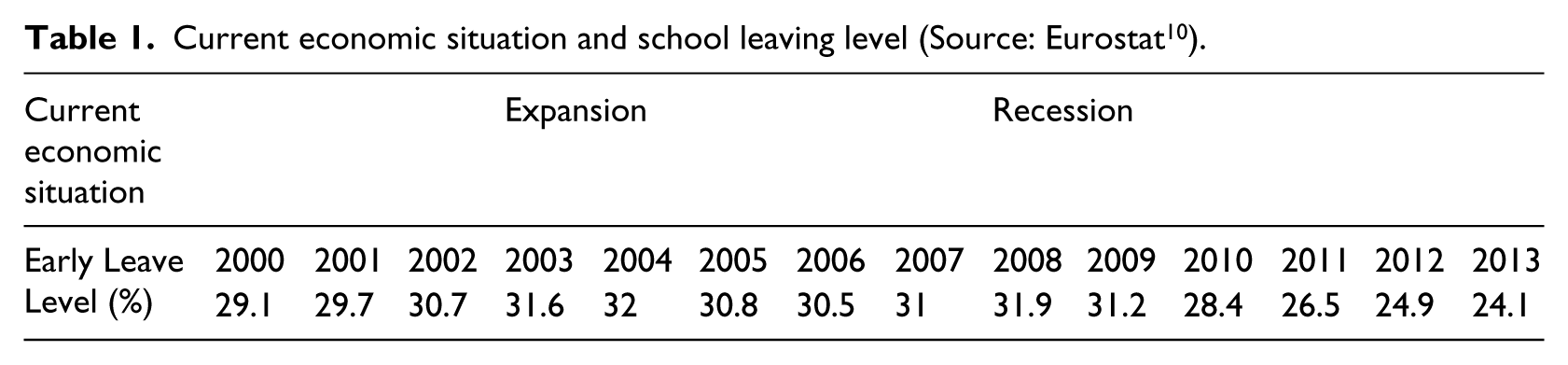
Again, many of these programmes were an attempt to provide a secondary education degree for those designated as early leavers. The label ‘early leaver from education and training’, previously named ‘early school leaver’, generally refers to a person aged 18 to 24 who has finished no more than lower secondary education and is not involved in further education or training. If the figures of early leaving rates are analysed, noting the number as a percentage of the total population aged 18 to 24 in Spain for the last years, it can be concluded that the percentage is higher in an expanding market (job opportunities in low qualification sectors), while it decreases in recession times, with 2013 being the lowest of the last 14 years (Table 1).
Current economic situation and school leaving level (Source: Eurostat 10 ).
If enrolment in any kind of vocational training schemes is analysed (both vocational training and second opportunities schemes), an increasing trend is found (Table 2).
Vocational training enrolment figures (Source: Ministry of Education).

There are several paths an individual may pursue to get a secondary education degree. Table 3 reflects the number of students who got a diploma in Secondary Education, sorted by the path followed to obtain it – the academic path (ESO), second chance school (PCPI) and adult education programmes (Adult). In essence, it may be stated that the number of diplomas has increased in recent years.
Secondary education diploma (Source: Ministry of Education).

Contradictions of comprehensiveness in the margins of the educational system
As discussed above, the Spanish educational system has taken different successive approaches to comprehensiveness, in line with other European countries – from early homogenizing arrangements that allowed generalization of education to large sections of the population, through the turning point that measures of attention to diversity involved, until recent conceptions of competency development linked to individual potential for socio-economic productivity. However, such approaches have resulted, throughout the various educational reforms that have been implemented, in the segregation of the most vulnerable groups in marginal itineraries with a more flexible development and with objectives adapted to such groups.
Thus in all three models some devices can be found that are presented with different apparent rhetoric, but they share similar designs and they are all aimed at the same population – those who have followed a conflicting school process and can be assumed to drop out early. There are thus deep basic analogies, in spite of differences linked to the socio-economic context of each proposal, among a devalued itinerary of vocational education (LGE), community-anchored Social Guarantee Schemes (LOGSE) or the more recent Programs for the Initial Qualification in a Vocational Path (LOE) and Basic Vocational Formation (LOMCE).
The analysis of the discourses of agents that have developed their work in PGS and PCPI may prove useful to illustrate the rationale that has inspired such programmes as well as its contradictions. PGS and PCPI programmes have been fundamental in the confrontation of these dilemmas in the period 1994–2014. Through different research projects several agents have been interviewed, which has allowed the understanding of the various discursive logics that inspire educational action in these contexts; 12 the re-contextualization of comprehensiveness policies makes contradictions within them visible.
Comprehensiveness and equity in vulnerable contexts
As discussed in the first section of this paper, the various successive reforms in the Spanish educational system have been grounded on different conceptions of comprehensiveness that can be linked to a transformation of the underlying justice principle. First, LGE was based in the notion that justice is ‘giving everybody the same’ – a standardizing arrangement consistent with a civic–industrial compromise that allowed generalization of basic education as a requirement of human capital for the modernization process that the country was facing, as well as a right of citizenship (despite the limitations and distortions that a dictatorial political system entails regarding traditional civic logic). Then the design embodied in the LOGSE fit with a notion of equity or ‘giving each one according to need’, in the spirit of a civic–domestic compromise. Lately, more recent laws (from LOCE to contemporary LOMCE) are grounded on a conception of equity linked to individual potential development (‘giving each one according to their individual competences’) that can be regarded as a re-definition of the objective to promote diversity in the context of market logic and an emerging projective city.
These devices, such as PGS and PCPI, aimed at vulnerable groups, are inspired and legitimated mainly on the second of those comprehensiveness conceptions mentioned above – a conception that links the civic ideal of equality with a more domestic requirement of attention to particularity.
The argument of attention to diversity can be regarded as a domestic–civic commitment device that attempts to overcome critiques of a traditional civic logic that founded equity on homogenization and equal treatment, guaranteeing in this way the right to education through formal devices that were clearly structured and legally recognized. The civic–domestic logic of attention to diversity entails a transformation in the regulation of such devices in order to be able to fulfil the ideal of education for everybody. In other words, the idea that attending to differences and working from them is a necessary requirement of equality becomes central in the organization of the educational system: [Talking about PGS students] What characterizes them is the fact that they were lost in an educational world that is worthless… this is to say, that it is worthless to them, … You cannot give aspirin to all the patients, because if you suffer from stomach ulcer, it can kill you. In the same way, all the students cannot receive 3rd ESO pure and simple… and the physics teacher cannot insist on everyone being able to develop and do the program, because it is impossible. I think this is the big mistake. (PGS teacher)
However, this discourse reveals some tensions that undermine the very notion of comprehensiveness that was initially subscribed to. In some cases, a discourse can be found that emphasizes with civic keys the need to empower those students who have more difficulty, by adapting to their initial situation and adjusting procedures, without giving up the objectives that prepare them to enter an adult society where they will not find the protective measures that they find in the educational context: I… I would not give up participation. Participation in daily life is a value no citizen should give up. I think that is fundamental. This is to say, teaching and providing those students that are in school with the indispensable tools for a reasoned participation in their community: at a cultural level, at sports level, at social level. (PGS teacher)
However, another more frequent discourse is found that is more identified with the domestic key that stresses the need to adapt to particular needs without attempting to achieve the same objectives for everyone, a point that results in entering the adult world under conditions of inequality. In this sense, the key question is to what extent Spanish society (beyond school) is able to integrate under full conditions of citizenship those subjects with a lower potential of autonomy and with specific needs that hardly fit in a system organized around flexible productivity, enduring a very real risk of being condemned to a permanent position of dependence (at best) or even abandonment and exclusion.
This discourse of domestic emphasis, dominant in actors in vulnerable educational environments such as PGS and PCPI, demands pedagogical alternatives anchored in daily life and in adaptation to the various needs of different collectives. Moreover, this approach is directly linked with the civic emphasis that regards attention to diversity as a formula to reduce original social differences among students, making a supplementary effort for those groups with greater needs, and working in this way towards reduction of inequalities. It is thus regarded as a way to adapt the basic civic principle of the right to education for everyone.
This discourse argues that educational intervention has to define its objectives on the basis of the students’ diversity, by adapting contents and didactic forms to them, and even providing them if possible with personal training, far from the kind of uniformity that characterized the civic educational project of early modernity. The objective is to put everyone in the appropriate place for his or her needs and possibilities: … all measures are ultimately for attending diversity. All of them are measures aimed to work with students that have compensatory education needs. Otherwise, they would fall into absenteeism and school dropout. […] Because if we handle it well and each student gets where he or she can be better, we will avoid early school leaving. (School principal) [What elements do you think are important, that have led them to lose their way, just as you mentioned…?] The educational system… it is bread for all, whether you are obese or not. This is to say, it has to be a little more diversified. We all know that individualized teaching is utopian, but utopian to some extent. (PGS teacher)
The problem arises when this discourse of personalization/individualization, that talks of the need to adapt teaching to each student’s needs and abilities, results in a requirement (termed as ‘realist’ and presented as a methodological strategy) of reducing expectations about the learning potentialities of some youth. Such a discourse legitimates the reduction of the training level that is to be offered to students with difficulties by adapting objectives to the possibilities expected of each one (Bernad et al., 2015): The point is that we need to somehow ‘re-programme’ them, because the way they arrive here… well, nothing can be done. I always use this example: if by the end of the course they are able to button their kitchen jacket, I am more than satisfied. And if they would have also learnt some terminology, I would be really surprised. (Team responsible for PCPI)
Here the problem is not only that such an approach clashes with the civic ideal of an equal training for all, aiming to reduce social differences among students and to foster social promotion; the fundamental problem is that this discourse of processes and educational objectives adaptation takes place in a competitive society in which the demands placed on individuals are not adapted to their different potentialities, although it may be so in the educational context. And, when there is some kind of adaptation (either through financial aid or through the creation of protected fields of insertion or assistance) it involves a devaluation of citizenship status that becomes assisted, dependent or subsidized. These situations entail subordination to social providers of assistance, who design, authorize, supply, supervise, evaluate and penalize differential treatment after judging which individuals deserve it or not.
In this way, those initiatives that, beyond increasing flexibility of the procedures demand a reduction of educational objectives as a requirement of comprehensiveness, are presented as effective regarding the maintenance of students in the educational context (which certainly allows working with them longer than if they leave the system). However, at the same time, such initiatives lead those students in situations of high vulnerability to formative pathways of lower empowerment, increasing their disadvantage when faced with a competitive work environment (Bernad et al., 2015). At best, these pathways lead to low-skill sectors of the labour market and, in a more general way, to its more precarious spheres.
Duality in the practical nature of training
Another very significant tension revolves around the role and shape that technical culture should assume in a comprehensive educational system. The shift of the educational system toward notions of competitiveness and productivity involves the re-introduction of a technical–practical component that had been relegated by the protective civic insulation of the school from the ordinary world. But such re-introduction of a technical–practical culture adopts a dual shape and has different translations depending on the students’ social position.
In fact, part of the discourse that can be found among educators of PGS and PCPI emphasizes the centrality that configuration of basic work habits should have in educational intervention with those students. Such a discursive emphasis articulates domestic with industrial concerns, undermining the civic component: Contents remain in the background. Here you work mainly with the person: his/her habits, that person’s attitude. (PGS teacher) This is an educational resource aiming to shape the whole issue of habits, to create a professional and human profile that would get as close as possible to something really valid; although they may later undertake something else, that doesn’t matter; but personal and professional profile is something basic in any profession, and that is it. And if, moreover, they have learnt something from the specialization they have chosen, I will feel very satisfied… But honestly, we use it as an educational resource. (Responsible team for PCPI)
In sharp contrast with a generalized discourse in the educational system that regards vocational training as the acquisition of competences, in environments such as PGS and PCPI a discourse is found that is linked to domestic–industrial commitment – the key articulating notion is not that of ‘competence’ but that of ‘habit’. Such a notion brings the acquisition of productive routines to the centre of the learning process, linking domestic ‘knowing how to behave’ to the industrial ‘know-how’. Through the incorporation of habits of punctuality, order, productivity and clear task execution, the ‘good worker’ is shaped. So, far from the paradigms of learning through competences linked to advanced industrial order, a discourse of character formation is found that is related to modes of production that are prevalent in the secondary labour market and low-skilled occupations: Look, what I always emphasize are behaviour and habits, because I watch the students and they don’t have habits of punctuality or habits of obedience. That is what I emphasize most. Habits for me are… I have a chance there, because a student that is going to apply for a job and does not even know how to introduce him or herself, is losing from the beginning. (PGS teacher)
Thus, comprehensive practices addressed to the margins of the educational system generate initiatives that in many cases result in a reduction of demands and expectations as an adaptation strategy (justified from the discourse of attention to diversity). Such practices may induce a decrease in school dropout rates, but they do not strengthen students’ empowerment for their professional and personal future. Instead, they risk generating a devalued, non-egalitarian citizenship that keeps this collective in a space of social vulnerability (Castel, 1997) shifting between dependence and precariousness.
Final thoughts: The limits of educational comprehensiveness in a dual society
Comprehensive postulates in education mark a change of direction away from those selective, elitist academic practices that used to characterize the Spanish educational system during the years of the dictatorship. Such transformation has a turning point in the measures of attention to diversity that were implemented in the late 1980s (De Puelles, 1999) in an effort to meet the diversity found in educational centres, reducing educational tools’ rigidity in order to pursue the civic ideal of education for all. In this light, attention to diversity may be regarded as an update of the classical civic commitment to universal education – a commitment that requires strengthening the civic component of the civic–industrial compromise that inspired the formal education system in earlier stages of its historical development (Bernad and Molpeceres, 2006).
As has been shown throughout this paper, the Spanish educational system from the 1970s to recent years has formally followed some steps towards comprehensiveness that are roughly equivalent to those steps followed by most other member countries of the OECD. Three successive stages in this evolution have been identified here and linked, according to Derouet (2005, 2009), to three different underlying conceptions – a model focused on generalization of basic education, a model focused on attention to diversity and a model focused on individual competences training.
However, the Spanish educational system has been burdened during the process by an initial situation that was substantially different from that of neighbouring countries, both regarding the political regime and the cultural and material resources required to implement comprehensiveness. This is why it has never attained an acceptable level of ‘actual comprehensiveness’, but it has always endured high rates of educational exclusion in each of its different embodiments. Forms and acceptable legitimations for exclusion have changed through time and successive legal reforms, but in spite of its formally comprehensive design the system eventually eliminates a large proportion of youth who are at most shunted to marginal trajectories.
It has been shown how educational processes and models that aimed to develop a comprehensive system have been strained by tensions and balanced through compromises between various rationales. Such tensions are particularly evident in the discourses of educators of programmes aimed at young people who became detached from school, even comprehensive school. The request to adapt educational processes to the needs and possibilities of students has been highlighted as a significant source of tension, particularly when such adaptation is conceptualized from a deficit perspective. Then it can lead to lowering expectations and goals in learning processes, thus worsening social integration probabilities that it should improve. The interest in preventing vulnerable persons and groups from experiencing failure may induce protection practices regarding exigency levels, assessment devices and definitions of success. This may have as a non-intended consequence the marginalization of the young person to an assistance space with high levels of protection, since facing the ‘real world’ would be something he/she is not prepared for. However, such dynamics will hardly lead to full social integration (Castel, 1997), and they may result in configuration of protected and segregated spaces that contribute to second-order citizenship status.
But even the most able and successful among the students in these programmes are only likely to obtain a precarious job in low-qualification sectors, driving them to what has been labelled as ‘disqualifying integration’ (Paugam, 2000). It has been shown how some educators seem to design their instruction with such a horizon in mind, focusing on adjusting students’ expectations, domesticating their habits and giving them a preview of the reality they are expected to live.
In a dual, unequal labour context, where success is linked to mobility dynamics within network connected projects as well as to management of broad scope competences and relational capital, youngsters studying in PGS or PCPI are at best bound to live in subordinate, low-skilled productive spaces. Such spaces are those that suffer changes in the productive dynamic with greater virulence, since people working in them have not developed those competences required to adapt to change, and they are at a greater risk of facing consequences of flexible labour markets (temporality, work stoppage) without any protection, particularly at a time when the welfare state is in decline.
Thus, the fundamental question is whether comprehensive measures designed for those who risk school failure are not shaping a devalued ‘secondary path’ in the educational system, creating segregated itineraries addressed to vulnerable individuals and groups that would restrict their aspirations to a sort of ‘second-order citizenship’, thus contributing to deepen cleavages and inequalities in a dual society.
Nevertheless, the civic logic that inspired comprehensive schools may also constitute a source of resistance to the approaches that articulate flexible capitalism (Sennet, 2000), since this is a configuration of capitalism that requires dismantling all civic–industrial commitments that articulated the social model of the wage society, among which may be found homogenizing mass education; moreover, the demand of openness to local needs and local policy entailed by the second conception of comprehensiveness described above sets promotion of active citizenship as an educational goal. The local community emphasis of such a conception (Sennett, 2000, 2012) may also foster resistance against more individualistic positions and requirements of flexible capitalism (Beck and Beck-Gernsheim, 2003; Boltanski and Chiapelo, 2002; Sennett, 2006).
However, the most recent updates of civic principles in education – what has been here labelled as a third comprehensiveness or post-comprehensiveness – align the educational system with a connectionist rationale while keeping some remnants of civic rhetoric (Boltanski and Chiapello, 2002; Castells, 2000). From this point of view, the educational system requires less standardization of pedagogical practice, favouring deregulation and flexibility, in order to become more adapted and sensitive to students’ differential needs and potential. This may veil severe consequences in terms of social vulnerability.
In essence, even if measures of attention to diversity allow for the inclusion of many students who were banished from school before, there are many contradictions underlying comprehensiveness discourses. Such contradictions signal the limits of the educational system regarding its potential to make egalitarian integration possible in a society marked by deep inequalities.
Footnotes
Declaration of conflicting interest
The authors declare that there is no conflict of interest.
Funding
Research mentioned in this paper was partly funded by the Spanish Ministry of Science and Technology (ref. SEC2000-0801) and the Spanish Ministry of Economy (ref. CSO2012-31575), as well as by a scholarship supporting the PhD of three of the authors (Bernad, Navas and Abiértar).