




Abstract
The OECD report ‘Equity, Excellence and Inclusiveness in Education’ (Schleicher, 2014) highlights the disparities in attainment and opportunity between children in many countries across the world putting them at risk of marginalisation. This article draws from both sociological and psychological theory to forward a new theoretical framework by which marginalisation, as it applies to a wide range of contexts, can be conceptualised and further interrogated. It examines how marginalisation is experienced, with a specific focus upon children and schooling, and uses the concept of resilience as a lens through which marginalisation can be understood. It recognises the importance of the wider societal and political context whilst also taking account of the interpretive framework of the individual and how risk and protective factors within the wider environment shape the experience and perceptions of the individual.
Introduction
Marginalisation is a global problem that impacts negatively upon societies across the world. The OECD report ‘Equity, Excellence and Inclusiveness in Education’ states: The challenge we face is how to ensure our education systems give every child the quality learning experiences they need to develop and realise their individual potential, and to do so in ways that value who they are, their language, identity, and culture. How do we harness diversity, create fairness, and ensure our learning environments engage and achieve the best outcomes for all individuals, not just a few? (Schleicher, 2014: 3)
Within a context, in which, across Europe, neoliberal trends prevail (Connell, 2013; Grimaldi, 2012), evident within the marketisation of education, represented within the knowledge economy and within the increasing focus upon accountability, performativity and a ‘standards agenda’ (described by Ball (2010: 126) as the ‘commodification of the public professional’), as manifested within international programmes such as PISA (Programme for International Student Assessment), PIRLS (Progress in International Reading Literacy Study) and TIMSS (Trends in International Mathematics and Science Study) (Ball, 2010; Jeffrey and Troman, 2011; Slee and Allan, 2001), there will be ‘winners’ and ‘losers’ (Caro and Mirazchiyski, 2011; Ringarp and Rothland, 2010; Shapira, 2011; Slee and Allan, 2001). Connell describes education within a neoliberal agenda as being focused upon a narrow conceptualisation of human capital: ‘It is the business of forming the skills and attitudes needed by a productive workforce – productive in the precise sense of producing an ever-growing mass of profits for the market economy’ (2013: 104).
As education in Europe becomes more market-orientated, a process of decentralisation is underway with a concordant emphasis upon projectisation (Brunila, 2011). Such a process has led to a paradigm change in which societal problems (such as inequality and youth employment) are seen as individual problems, ‘as problems of a wrong kind of mindset’ (Brunila, 2011: 429). Within the context of increasing mobility across Europe, this can present as problematic, particularly with regard to migrant populations. Studies have focused upon the attainment of migrant populations in international testing programmes, identifying a range of variables, such as socio-economic status, which impact upon attainment outcomes (Dronkers and Van der Velden, 2012; Shapira, 2011), indicative of the structural aspects of marginalisation.
A problem that is increasingly coming to the fore within Europe and beyond is the radicalisation of some of its young people (as tragically exemplified through recent events in France), yet little attention has been paid to the influence of education as either contributing towards, or in the prevention of, it (Pels and de Ruyter, 2012). Van San et al. (2013), within a European context, identify the main thrust of response to this significant problem as being to perceive such young people as a ‘security risk’ with a concordant focus upon detection and containment. The authors argue that ‘the dominant security perspective on the radicalization of young people has little to offer in helping parents and other educators confront radicalization’ (2013: 288) and that parents and schools are often at a loss to know how to deal with it or, indeed, offer the wrong or an inadequate response. Such a focus is akin to shutting the stable door after the horse has bolted. Instead, one needs to examine the conditions – societal, cultural and structural – that lead young people in the first instance towards the adoption of extremist ideals. This author would argue that those who lack a clear sense of identity grounded in moral principles, who do not have a sense of worth or of being valued and/or who feel alienated from their communities (they lack a sense of belongingness), and who do not have a voice and are on the margins of society are much more susceptible to, and lack the resilience to withstand, extremist propaganda and, in so doing, pose a risk to society and to themselves. A central quest therefore is to understand the subjective experience of marginalisation of young people (and the affective aspects of it) as it is only through examination of such that this very difficult dilemma can begin to be understood and addressed.
Rather than examine marginalisation in relation to a specific population, this article takes a broader focus and examines marginalisation as it manifests itself in a range of forms with a particular focus upon children and their schooling, forwarding a new theoretical framework through which the concept can be interrogated and further illuminated. It achieves this end through the lens of resilience theory, examining how risk and protective factors at the individual, social and societal levels (Olsson et al., 2003) can impact upon how those who might be regarded as being marginalised will experience their lives.
This article argues that marginalisation takes many forms (Booth and Ainscow, 1998; Messiou, 2012; Petrou et al., 2009) (not all of which are readily apparent to the observer or even the individual concerned (Messiou, 2012)); occurs at different levels (formal and informal) (Petrou et al., 2009); may be situated within time and place (Munn and Lloyd, 2005; Razer et al., 2013); and may become part of the lived experience of the individual if internalised (Hjörne and Säljö, 2013; Skovlund, 2013). Further, it can only be fully understood when account is taken of the subjective and emotional aspects of human life and the interpretative framework of the individual. The article forwards the hypothesis that an examination of marginalisation through the lens of resilience enables us to arrive at a much more nuanced and complex understanding of marginalisation and how it may be experienced, integrating the macro and micro at the level of the institution – the school – and individual perception, whilst also taking account of the political context.
This article will attempt to answer two key questions which are central to this understanding: ‘What does it mean to be marginalised?’ and ‘Marginalised from what?’ In examining the literature, it became evident that whilst many authors discuss issues pertaining to marginalisation (often framed in terms of (social) exclusion), few authors addressed these fundamental questions explicitly. Marginalisation is often considered at the broader, societal level in public policy (Policy First, 2012) and in terms of marginalised populations or groups (Scottish Government, 2012c) but the questions above can only be fully addressed by looking at the experiences of individuals.
Initially the article draws upon both sociological and psychological theory to examine the concepts of marginalisation and resilience, building upon current theory, before forwarding a new theoretical framework by which marginalisation can be understood.
A focus upon marginalisation
The conceptualisation of marginalisation
The concept of marginalisation permeates the current literature but is rarely defined (Messiou, 2012). When it is discussed, it is usually in relation to the concepts of inclusion and (social) exclusion and indeed social exclusion and marginalisation appear to be interchangeable. Hansen (2012) and Armstrong et al. (2011) make the case that inclusion and exclusion are two interrelated and interdependent processes, however, the latter argue that it is over-simplistic to equate exclusion as being the opposite of inclusion (or vice versa).
Messiou (2012) claims that marginalisation is not a unitary entity but has multiple conceptualisations. She forwards four different ways of thinking about it encapsulated within Table 1.
Messiou’s conceptualisations of marginalisation.
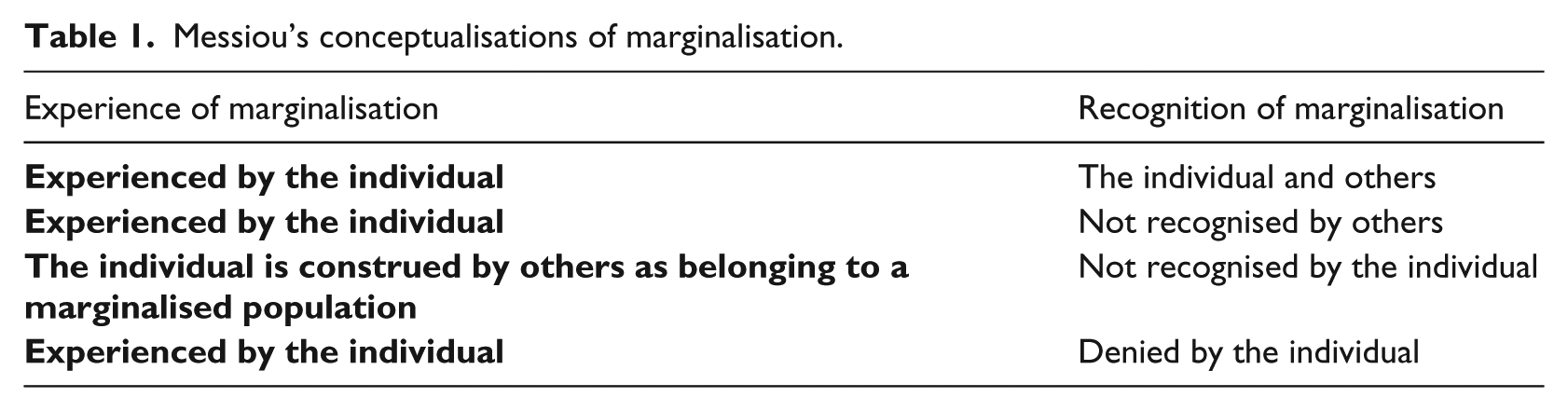
What is significant in Messiou’s work is the distinction made between the experience of marginalisation (as construed by the individual or others) and the recognition of it (by the individual and/or others), recognising the subjective nature of the construct. However, it also raises the important question, ‘If an individual does not recognise their life as marginalised (which implies that they do not experience their lives in this way), by what legitimacy can they be considered by others to be marginalised?’ –a question which has particular significance for public policy.
Interrogation of the literature through examination of the discourse around ‘marginalisation’ and ‘(social) exclusion’ reveals a range of conceptualisations. Amongst these are marginalisation as relating to: social exclusion, arising from a lack of equal opportunities and barriers to learning and participation (Messiou, 2012; Petrou et al., 2009); social justice and equity, seen through the lens of cultural and social capital (Brann-Barrett, 2011); the quest for ‘inclusion for all’ (Ainscow et al., 2006a; Messiou, 2012; Petrou et al., 2009; Slee and Allan, 2001); specific groups perceived to be specially vulnerable to exclusion and stigmatisation (Bottrell, 2007; Petrou et al., 2009); social and relational aspects of poverty (Carter-Wall and Whitfield, 2012; Dickerson and Popli, 2012; Ridge, 2011); and the need to give marginalised groups a voice (Slee and Allan, 2001). It is also perceived as ‘identity work’ and resistance (Bottrell, 2007; Bright, 2011); as expressed through ‘clauses of conditionality’ in public policy (Watts et al., 2014); and as being contextually related (pertaining to the concepts of relativity, agency and dynamics) (Mowat, 2010; Munn and Lloyd, 2005; Razer et al., 2013).
Social Exclusion is defined by Razer et al. as a state in which individuals or groups ‘lack effective participation in key activities or benefits of the society in which they live’ (2013: 1152). Thus, to be socially excluded is to be marginalised from that society. However, it is important to recognise that marginalisation is more than a state: it encompasses feelings about that state. To be marginalised is to have a sense that one does not belong and, in so doing, to feel that one is neither a valued member of a community and able to make a valuable contribution within that community nor able to access the range of services and/or opportunities open to others. In effect, to feel, and be, excluded. For some, marginalisation can be experienced as transient and context related (Frisen et al., 2012; Razer et al., 2013). For others, however, it can become global and forms part of their identity and lived experience (Hjörne and Säljö, 2013; MacLeod, 2013; Orsati and Causton-Theoharis, 2013; Skovlund, 2013).
But, how does one come to be considered marginalised and does one come to be marginalised through identification with a specific group – for example, gypsy travellers? My starting point would be to question the notion of a ‘marginalised group’. The difficulty with this conceptualisation is that it equates marginalisation with a global and stable state, inherent within a given population, presenting people as victims of their own fate over which they have little agency, the solution invested in the actions of the state and others. It also takes away any sense of the subjective experience of the individual and confers upon them the identity of ‘other’. This is not to fail to recognise that marginalisation arises from the actions of others whether deliberate (Bottrell, 2007; Sercombe and Donnelly, 2013; Slee and Allan, 2001) or inadvertent, whether individually (as can be the case in bullying (Sercombe and Donnelly, 2013)) or collectively. Not is it to negate the responsibility that we hold towards others which is part of our shared humanity.
There are two assumptions inherent within the concept of a marginalised group: first, stereotypical assumptions that there is a shared experience which can be associated with people who share certain characteristics (e.g., poverty) – that of marginalisation; and second, there is a shared conceptualisation of whatever it is they are being marginalised from – ‘an ideal’, ideas which will be explored at a later point within this article.
To return to the earlier discussion about the legitimacy by which we position others as marginalised, can the assumption be made that because someone is living in poverty that they will experience their life as marginalised? Can the opposite assumption be made that someone who appears to have all of the advantages in life will not experience their life as marginalised? (Messiou’s second categorisation – ‘Experienced by the individual – not recognised by others.’) Perhaps it comes down to the answer to the question that was posed above: ‘Marginalised from what?’ Inherent within this question is the assumption of societal norms (which are collective expressions of our understandings and experiences, shaped through culture and relative in time and place), values (what is held to be true and right), expectations and a sense of what is valued (held to be important and of worth) by that society, related to the concept of relativity (Munn and Lloyd, 2005). There is a set of norms, values and aspirations which dominate (Bottrell, 2007) and which are perceived to be the ‘ideal’. Anyone who falls short of these norms, values and aspirations is perceived to be wanting in some way, deficient, disadvantaged and/or marginalised. There is a failure to recognise that not all will share these values and aspirations and that there can be legitimacy in such positioning. Hence, people whom others would consider to be disadvantaged and/or marginalised may not perceive their lives in this way (Messiou’s third category).
A focus upon how marginalisation can manifest itself in society
Petrou et al. (2009) draw a distinction between groups which have been formally identified as marginalised according to government policy, such as children living in poverty (Department for Education, 2013; Policy First, 2012), and those who are marginalised because they fail to conform to the cultural norms and expectations which prevail within schools (Bottrell, 2007). Social capital theory attests that people can be marginalised and disadvantaged through the lack of social networks (and the trust and reciprocity associated with them) which others can routinely call upon, and the concept of cultural capital (Bourdieu, 1972) perceives marginalisation through the lens of the status and power which people are able (or not) to exercise through their knowledge, skills and symbolic and material endowments (e.g., qualifications) (Bourdieu, 1972; Brann-Barrett, 2011).
Marginalisation manifests itself in a wide range of ways in society from those who are disenfranchised through poverty and locale (Brann-Barrett, 2011; Carter-Wall and Whitfield, 2012; Deuchar, 2009; Dickerson and Popli, 2012; Hirsch, 2007; Öhrn, 2012; Ridge, 2011), to those who are disenfranchised through race and ethnicity (Deuchar, 2009; Slee, 2013), sexual orientation (Taylor, 2010), disability and/or ill-health (Hakala, 2010; Skovlund, 2013; Slee, 2013; Squires, 2012), religion (Smith and Barr, 2008) and through personal circumstances, such as children of migrants (Dronkers and Van der Velden, 2012; Shapira, 2011) and refugees (Sime et al., 2010), and children who are bullied (Sercombe and Donnelly, 2013): Only a ginger, can call another ginger ‘Ginger’, yep. When you are a ginger, life is pretty hard. The years of ritual bullying in the school yard.
People can also be marginalised in ways that are subtle and not so readily identifiable such as the children who are consistently not allowed to participate in ‘Golden Time’ 2 or other ‘rewards’ because their behaviour has fallen short of expectation. Teachers draw upon psychopathologising discourses to describe such children (Berg, 2010; Orsati and Causton-Theoharis, 2013): ‘Behaviours were understood as an individual characteristic of the student, or their family; and when they get compared with the norm for students’ behaviours they were seen as inferior’ (Orsati and Causton-Theoharis, 2013: 516). Likewise, the child who may have all of the material attributes of wealth but who has not experienced the love and warmth that is characteristic of other family homes, leading to attachment problems and behavioural difficulties (Cooper, 2008) which then serve to marginalise the child.
A focus upon how marginalisation may be experienced and its impact upon children’s lives
Poverty
For low-income children in the UK, living in poverty has a wide range of negative outcomes leading to feelings of anxiety, sadness, frustration and anger. This is compounded by negative experiences of school with pupils identifying their teachers as behaving in discriminatory ways towards them. Their lives are impoverished in a wide range of ways, amongst which are economic and material deprivation, the negative impact upon relationships and homelife, poor housing conditions, living in unsafe neighbourhoods with limited leisure opportunities and access to affordable public transport, and through the constraints of poverty upon schooling which extend far beyond material issues such as not being able to participate in school outings and trips (Ridge, 2011).
Poverty impacts not only upon children’s experiences of schooling but also their future aspirations and chances. Within the UK, 3 the attainment gap between children in poverty and those in more affluent circumstances emerges at an early age (by age 3) and becomes cumulative, resulting in children in impoverished circumstances being half as likely as other children to go on to higher education (Carter-Wall and Whitfield, 2012). Within Scotland, differences in attainment between children from low- and high-income households form at an early age (with a differential of 10–13 months by age 5) and at age 16, despite evidence of an overall rise in attainment, a significant and persistent gap remains. Socio-economic background is the greatest predictor of pupil outcomes; and, not unexpectedly, low attainment impacts upon leaver destinations and future prospects (Sosu and Ellis, 2014). Thus children in poverty are marginalised in ways that have long-term implications for their future wellbeing, perpetuating cycles of deprivation.
Findings from the Millennium Cohort Study (Dickerson and Popli, 2012) indicate that persistent rather than episodic poverty has the greatest negative impact upon children’s cognitive development in the early years. The relationship between the two variables may be indirect – low income impacts upon the capacity for effective parenting which, in turn, impacts upon cognitive development – and this effect extends beyond the period during which poverty is experienced, highlighting the importance of targeting poverty alleviation in the early years.
Whilst child poverty rates within the UK in the past decade to 2010/11 declined and the number of working-age adults with dependent children living in poverty fell within this period (The New Policy Institute, 2013: key points), this trend has recently been reversed in Scotland (Scottish Government, 2014a). Watts et al. (2014) identified that the conditionality associated with recent welfare reforms (e.g., benefits being dependent upon participation within government schemes) can have unintended consequences, impacting negatively upon children’s welfare and also disproportionally upon young people (the under 25s). Health inequalities are not only stark but increasing: ‘A boy born in the poorest tenth of areas can expect to live 14 years less than one born in the least deprived tenth. For girls, the difference is eight years’ (The New Policy Institute, 2013: key points).
Vulnerable populations
Some children, such as those who are looked after and accommodated, are particularly vulnerable. In Scotland, in 2013, there were 16,041 children looked after by local authorities – a 1% decrease on the previous year (Scottish Government, 2014b). This group had the second lowest participation in higher education of any group – 3.5% – and the second highest unemployment rate – 28% (Scottish Government, 2013: table L4.1). It is also disproportionally represented in exclusion statistics (by a factor of nine) (Scottish Government, 2011). Further, the ‘Edinburgh Study of Youth Transitions and Crime’ established that children who had been excluded from school by age 12 were more likely (by a factor of four) to be in prison by age 22 (Seith, 2013).
Synopsis
It can be seen that children living in poverty and those with multiple deprivation, when considered collectively, may be marginalised in a wide range of ways which impact not only upon their day-to-day experiences but also upon their future aspirations and prospects and upon their quality of health and life expectancy, putting them at risk in many different ways.
Marginalisation and schooling
A sense of belongingness
This article has forwarded the argument that marginalisation, at any point in time, cannot be conceptualised solely as a state: inherent within it are feelings about that state. A sense of belongingness to school is correlated with a range of positive academic, psychological, behavioural and social outcomes for children with SEN (Special Educational Needs), whereas a poor sense of belongingness is correlated with a wide range of negative indicators such as ‘behavioural problems, lower interest in school, lower achievement, and increased dropout’ (Prince and Hadwin, 2013: 249). The latter are associated with outcomes such as poor mental health, depression and anxiety, all of which potentially could lead to further marginalisation within the wider community. Positive relationships between teachers and pupils and between peers were identified as important mediating influences and protective factors promoting resilience, as does a supportive, caring school ethos (Prince and Hadwin, 2013: 249).
Bossaert et al. (2013) identify four key themes as being important in promoting belongingness in children with SEN: relationships (mutual friendship and social networks), interactions (verbal or non-verbal communications towards others), perceptions (the subjective impressions and feelings of the pupil with SEN, e.g., loneliness) and acceptance by classmates.
The role schools play in marginalisation
Whilst education is perceived as one of the routes out of marginalisation, schools can inadvertently act as agents of marginalisation: an inappropriate curriculum which fails to take account of individual pupil needs; inflexible and inappropriate systems and structures which fail to recognise the gap between the standards set for pupil behaviour and pupils’ capacity to meet such standards; the adoption of mindsets which lead ultimately towards the path of exclusion (Munn and Lloyd, 2005); and the pursuit of a ‘standards agenda’ which creates winners and losers can all serve to marginalise pupils (Razer et al., 2013). Lloyd argues that the quest for inclusion through removing barriers to learning perpetuates deficit models of the child within an exclusive curriculum in which success is equated with achieving norm-related standards: ‘members of the excluded groups can join the game if they submit to the rules and demonstrate that they can play the game at a standard which is acceptable’ (2008: 234).
Within an exclusive school environment (as characterised above), both teachers and pupils become marginalised, feeding off each other in negative ways (Razer et al., 2013), as exemplified in Figure 1.
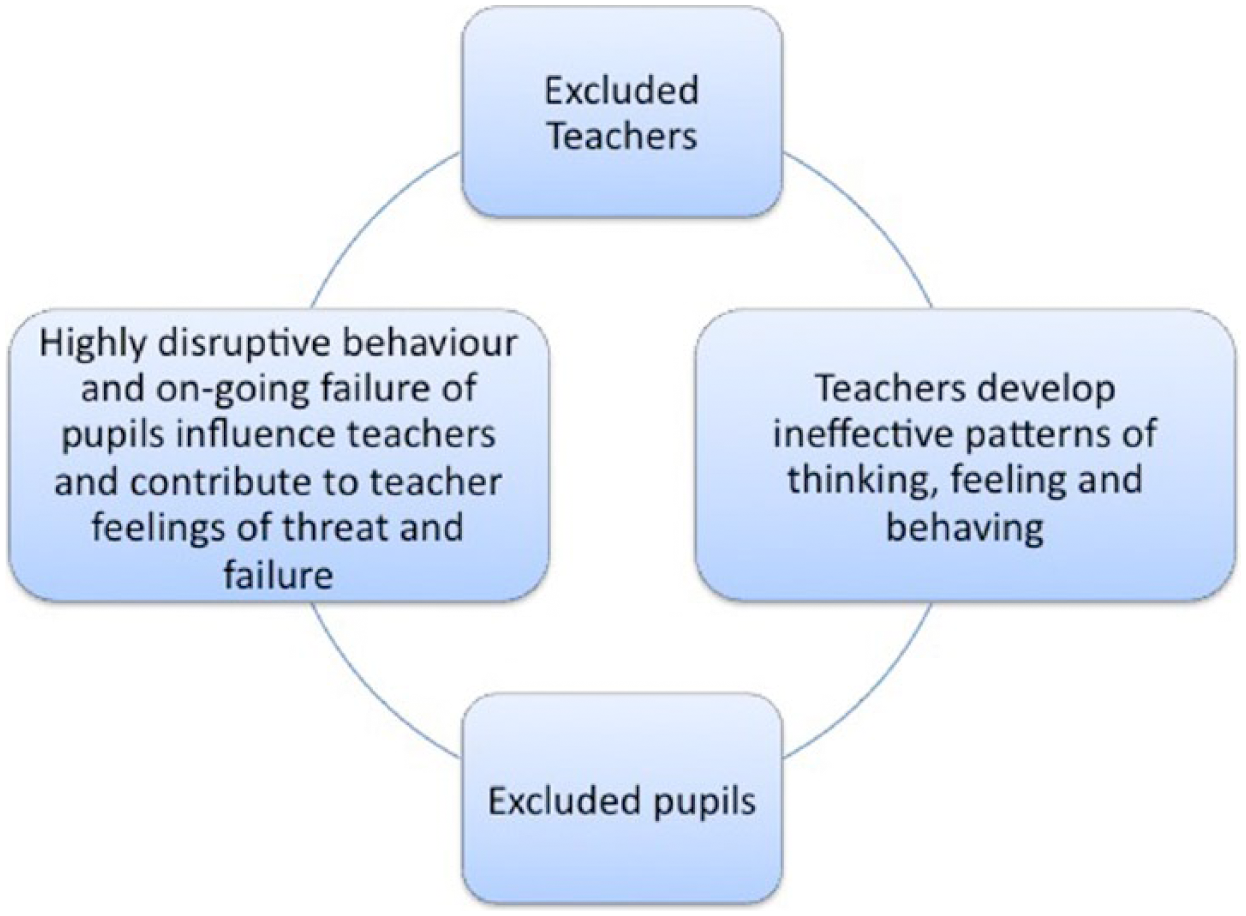
The cycle of exclusion in schools (modified from Razer et al., 2013: 1156, Figure 1).
Teachers adopt either a ‘helplessness frame’ (characterised by feelings of worthlessness, inevitability, guilt and helplessness) or a ‘false-identity’ frame in which they ‘cling to the goals, standards, methods and rules’ (Razer et al., 2013: 1161) of schools in more fortunate circumstances, serving to disenfranchise pupils who do not match up to these standards: ‘the frame sends a clear message to these pupils that they are not wanted and they do not really belong to the school’ (Razer et al., 2013: 1163), leading to their sense of marginalisation, exclusion and alienation. Thus teachers are marginalised in the sense that their identity and agency as a professional are compromised and pupils are marginalised in that they are unable to access a quality curriculum and to feel that they are valued and accepted members of an inclusive school community. Such marginalisation may not pervade all aspects of the individual’s life but may be confined to the specific context of the school (Razer et al., 2013) but the effects may extend far beyond this context, impacting on the life chances and sense of self-efficacy and self-esteem of the individual. It should be stated that the standards agenda is not only complicit within this but also creates the conditions under which it thrives (Ainscow et al., 2006b; Graham and Harwood, 2011; Lloyd, 2008; Razer et al., 2013; Slee, 2013).
Human agency and marginalisation, and the forging of identities
This discussion will examine issues pertaining to how young people take on identities, how they position themselves in relation to schooling, the degree to which they are perceived as being able to exercise agency, the underlying issues of power and how these are related to marginalisation.
Berg, within the context of a case study of a Norwegian child (Tom) ‘with’ Social, Emotional and Behavioural Difficulties, describes how professionals used their power to ‘define Tom as an outsider, and to construct an identity for him as a deviant student in the school’s margins’ (2010: 172), whilst simultaneously presenting themselves as ‘normal’.
In contrast to the above, some would argue that individuals or groups marginalise themselves through rejection of the dominant values (often white and middle class (Bottrell, 2007)) and cultural norms (‘and the power relations which underlie them’ (Ball, 2012)) of a community or society. However, this reasoning positions the individual or group who/which has been marginalised as being responsible for their own fate (whilst also positioning them as ‘victims’ – ‘the marginalised’) and fails to take account of the wider systemic, structural, political and cultural factors which have interacted with each other to create the context in which they find themselves. Such positioning Riddell aligns with the discourse of the ‘moral underclass’, the solution for which is to ‘change people’s attitudes and culture’ (2009: 5).
Bright makes the case that the resistance of young people to schooling is a manifestation of political action or what the author describes as ‘a propensity for “bottom-up action”’ (2011: 502) rooted in the historical memories and experiences of the community (what Bourdieu would describe as ‘habitus’) and patterns of school resistance exercised by older generations which the author characterises as ‘a dignified process of non-servile challenge from below’ (2011: 512).
Bottrel (2007) and Deuchar (2009) examine the interaction of agency and structure in marginalisation processes. Children and young people who fail to find fulfilling relationships within the school community seek affirmation out with that environment through engaging in risk-taking behaviours and negative relationships which could impact negatively upon their wellbeing (Deuchar, 2009; Prince and Hadwin, 2013), rejecting what school has to offer and affiliating themselves with alternative cultures such as gangs (Bottrell, 2007; Deuchar, 2009). Deuchar observes that gang membership for many young people provides social bonding, a sense of identity and a way of coping with social exclusion (2009: 96) and Bottrell describes how young people, through actively positioning themselves within a different culture, find a sense of belonging and affirmation (2007: 610). However, this positioning serves to marginalise young people from wider society more broadly and confers the disadvantages which this may bring.
Bottrell, in a study of marginalised teenage girls, describes the distancing of young people from the values and norms of the school as a form of resistance – part of their identity work: For marginalised young people, school is problematic in a variety of ways that are educational, relational and social. In the context of academic success, ‘school as boring’ may also be a euphemism for the pressures, expectations of failure (Teese and Plesel 2003) and inability to change the situation. (2007: 604)
The teenage girls within the study were aware of their low social status within the school environment and saw themselves as not cared about and ‘not worth bothering about’ (2007: 605). Bottrell (drawing from Apple (1997) and Hey (1997)) proposes that resistance, within the school context, is ‘both a cause and an effect of marginalisation of those whose cultural capital is different from that centralised and privileged by the school’ (2007: 607). However, the author also positions resistance as a form of positive adaptation to a difficult, rejecting environment.
Both Bottrell and Deuchar discuss the great difficulties which young people experience in trying to break away from their marginalised positioning, limiting their opportunities and aspirations.
Synopsis
This discussion has highlighted the many ways in which marginalisation is understood and manifests itself within society and the underlying issues of power, reflected in social and cultural capital theory. Marginalisation has been explored as it has been experienced by a wide range of individuals and groups, examining the multiple effects of poverty and multiple deprivation upon people’s and children’s lives, the centrality of a sense of belonging in their emotional wellbeing, and the importance of relationships. It has examined the role that schools can play in marginalisation, issues around agency and identity, and the seeking of affirmation through alternative subcultures that ultimately serve to marginalise children and young people even further.
A focus upon resilience
A ‘slippery’ concept
The concept of resilience is generally credited to the work of Garmezy who sought explanations as to why children in similar situations facing adverse circumstances had different experiences and outcomes. Rather than focusing upon psycopathology, poverty and post-traumatic stress, he focused upon why some children demonstrated positive adaptation (Condly, 2006; Kolar, 2011). Within the literature, the concept has been used inconsistently across a range of disciplines, reflecting different paradigms, leading to a lack of clarity as to its meaning (Kolar, 2011). Further, there is a failure to critique the assumptions and biases about what constitutes positive rather than negative adaptation or outcomes within a specific context (Kolar, 2011: 423). The difficulty with resilience as a concept is that, as highlighted above, it is highly subjective. By who’s judgement and by which criteria might an individual be deemed to be resilient (if regarded as a stable trait) or to exhibit resilient behaviour when facing adverse circumstances and how might adverse circumstances be characterised and by whom?
Resilience has been defined as ‘a label that defines the interaction of a child with trauma or a toxic environment in which success, as judged by societal norms, is achieved by virtue of the child’s abilities, motivations and support systems’ (Condly 2006: 213) or, alternatively, ‘a relative resistance to environmental risk experiences, the overcoming of stress or adversity or a relatively good outcome despite risk experiences’ (Rutter, 2012: 34). Just as risk is multidimensional and takes a variety of forms, so, likewise, resilience is multifaceted and is situational (i.e., it is mediated by context) (Condly, 2006).
The concept of resilience has also come to the fore in relation to social structures and spheres, such as communities. Within this context it is often portrayed as the stability of the system in response to threat, which according to MacKinnon and Derickson ‘privileges established social structures’ (2013: 2) that are characterised by unequal power relationships whilst closing off the possibility of transformational change; places the onus on communities to ‘become more resilient and adaptable’ (2013: 2), reproducing social inequality; and places responsibility (without power) within social spheres rather than recognising the wider political forces which act upon the context.
Thus, in examining the concept at both the individual and the wider societal level, it can be seen that it is highly contested and can by no means regarded uncritically as ‘a good thing’. However, notwithstanding the above, this author would argue that it is still of value in helping to explain why marginalisation may be experienced differentially by people sharing similar circumstances.
Resilience as a state or process
But, can resilience be considered as a state at which one has arrived – ‘a stable pattern of low distress over time
It is argued that resilience should not be perceived as a single dichotomous variable inherent within an individual (you either have it or you don’t) expressed through traits that lead the individual to cope or not within situations of adversity (Condly, 2006; Rutter, 2012), nor should it be seen as a response to a single event (Condly, 2006). Underlying conceptualisations of resilience as a continuous process are normative views of what would constitute adaptation within a given context (Condly, 2006). Likewise, Rutter (2012) conceptualises resilience as an interactive dynamic process that operates across the lifespan. It is concerned with the wider social contexts and influences that impact upon the individual within that context. Its starting point is recognition of the heterogeneity in human response to a range of stressors. It is not directly measurable but is inferred from the response of individuals to risk and adversity (2012: 34)
A historical perspective
Kolar (2011) traces the development of the concept of resilience over four waves (cf. Figure 2), although there is controversy regarding the third and fourth waves. It is evident that over time a much more nuanced understanding of what constitutes resilience and how it can be fostered in children and young people has developed and there has been a gradual movement away from the idea that it is a global trait primarily located at the individual level towards conceptualisations of resilience as an iterative process (the individual and the individual in relation to his/her environment) situated within time and place.
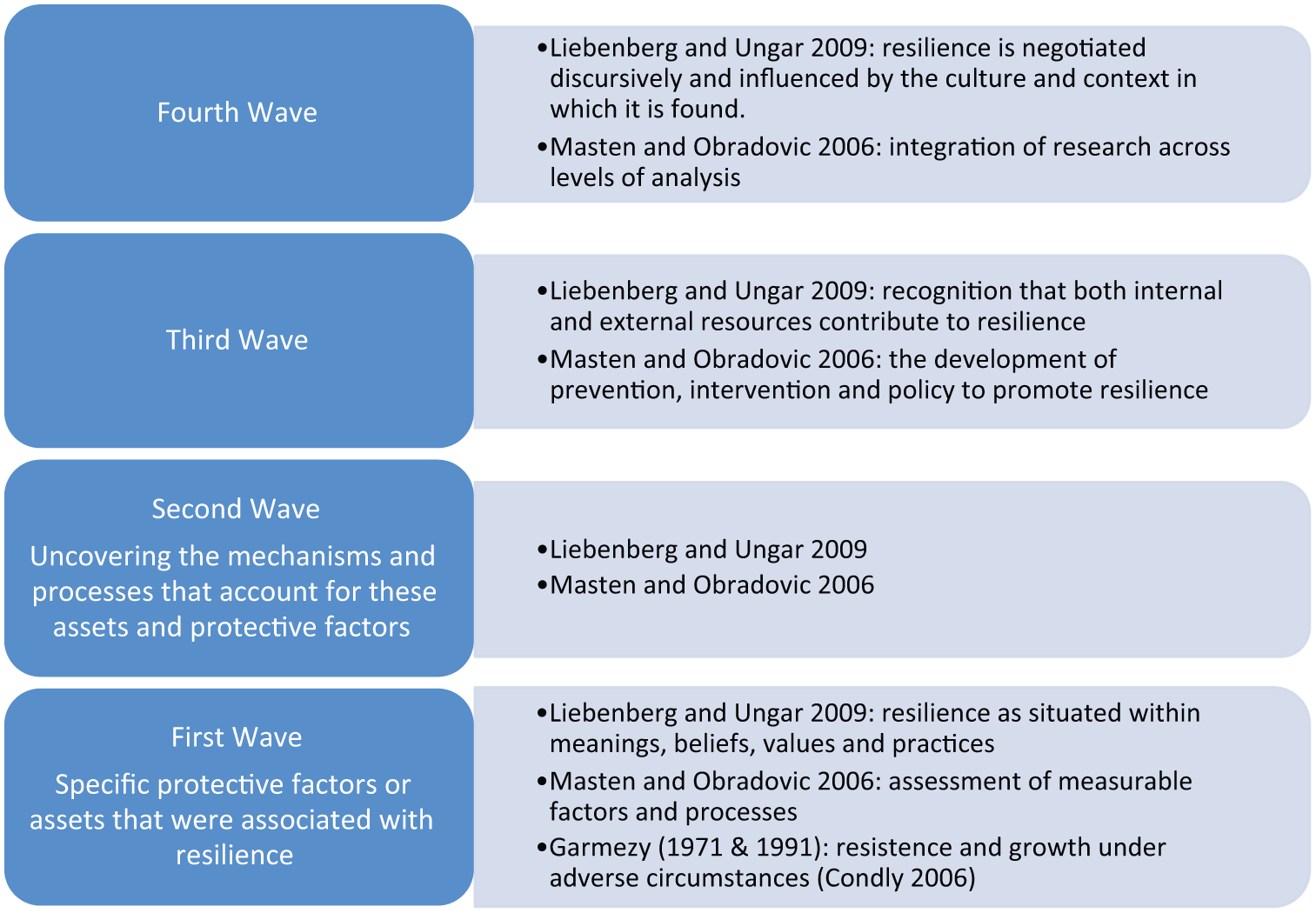
Representation of historical development of the concept of resilience as outlined in Kolar (2011); Garmezy (1971); Garmezy (1991).
A psychological perspective on resilience
There is an extensive psychological literature on achievement motivation (Dweck, 2000, 2002, 2006; Dweck and Elliot, 1983; Yeager and Dweck, 2012), a major component of which is the focus upon mindsets which promote (or not) resilience in learners. Likewise, Yeager and Dweck (2012) explore the impact of implicit theories of personality upon reactions to peer exclusion and victimisation and how these impact upon social stress and academic performance. Those who attribute the behaviour of others or their own behaviour to fixed traits which are stable over time (e.g., perceiving a bully as a ‘bad person’ or perceiving themselves as unlikeable) would be regarded as having an entity mindset, whereas those who see personality as malleable (people are able to change over time) would be regarded as having an incremental mindset. In a range of controlled trials, it was demonstrated that those who hold an incremental mindset are less likely to respond negatively to social conflicts and are more likely to be resilient in the face of them than those who hold an entity perspective on personality (Yeager and Dweck, 2012: 306–309), making it less likely that they will become socially marginalised. Resilience does not exclusively reside within an individual or a context but arises from the interpretation which the individual makes of the adversities in their lives (2012: 312).
An ecological perspective on resilience
Olsson et al. (drawing upon Garmezy (1991) and Werner (1995)) conceptualise resilience as a framework which encompasses, ‘protective processes (resources, competencies, talents and skills) that sit within the individual (individual-level factors), within the family and peer network (social-level factors), and within the whole school environment and the community (societal-level factors)’ (2003: 3). Olsson et al. draw from the literature to propose that multiple risk factors (or conversely, multiple protective factors), if acting in synergy with each other, may combine to have a more powerful effect than a single life-event (2003: 4).
The above is in keeping with ecological conceptualisations of resilience as described by Ungar and his colleagues (Ungar, 2012b), deriving from the earlier work of Bronfenbrenner. A range of authors (Cassen et al., 2009; Howard and Johnson, 2010; Mowat, 2010; Siraj-Blatchford et al., 2013) bring an ecological perspective to their work. Howard and Johnson observe, no man (or child) is an island: we live in and are affected by nested social systems that interact and influence each other in complex ways. Clearly, things that happen in the family, the school and the community – all microsystem environments in which the child is physically located – can have a major impact on the development of resilience. (2010: 336)
Siraj-Blatchford et al. (2013) examined the learning journeys of children ‘at risk’ and identified a wide range of factors both internal and external to the child that served as risk and protective factors. It is not a single factor that promotes or impedes resilience as it pertains to children’s learning but the ‘active reciprocal and iterative interactions between these factors that determine the parameters for children’s pathways to academic success’ (2013: 16). Resilience was dependent upon the presence of supportive networks and the child developing a sense of self-efficacy and exercising agency: By having people around them that believe in them, encourage them, challenge them and support them, children develop a strong sense of self-efficacy with regard to academic and social success. Through their interactions with these people, children learn to build and sustain relationships (i.e. develop social and cultural capital) that support and facilitate academic success. (2013: 17)
Ungar brings an ‘interactional, environmental, and culturally pluralistic perspective’ to the frame which is based upon the understanding that the environment is a much stronger variable than had initially been countenanced in accounting for the antecedents of positive coping in adverse circumstances (2012a: 14). He argues that resilience arises from a ‘clustering of ecological factors that predict positive human development’, influenced by the nature of the challenge faced (2012a: 14), and, further, that it is the capacity of the environment to ‘potentiate (the author’s emphasis) positive adaptation under stress’ that is of the essence (2012a: 15). Focusing solely on the individual level can lead to other important variables being overlooked, leading to errors in attribution when researchers take account of individual agency whilst underestimating the impact of socio-political, economic and cultural factors. In coming from an ecological perspective, account can be taken of variability in the environment of the individual whilst also recognising that the strengths and challenges of the individual are expressions of culturally embedded values that influence how coping and risk are understood. The author argues that the starting point for understanding resilience has to be an exploration of the context in which the individual experiences adversity and only then should account be taken of factors at the individual level, ‘making resilience first a quality of the broader social and physical ecology, and second a quality of the individual’ (2012a: 27). He describes this as a paradigm shift: ‘it is like turning a pair of binoculars around and looking at the world differently’ (2012a: 28). Drawing from a range of studies, he observes that protective processes do not impact equally upon individuals (they are more likely to impact upon those with higher levels of risk) and that both protective factors and risks need to be taken into account in any intervention. He draws from a study conducted by Sloboda et al. (2009) of a substance abuse prevention programme, the findings demonstrating that young people who were already substance abusers benefited from the intervention, whilst the programme had an adverse effect upon those who had previously not been substance abusers (Ungar, 2012a: 21).
Synopsis
Resilience is largely a concept that traditionally has been associated with the psychological literature, hence the focus upon the individual, but it is a concept which can only be understood in its full complexity when insights from both psychology and sociology are integrated. Ecological theory bridges both the individual and the individual in relation to his or her environment. Figure 3 is a representation of resilience that draws from the above discussion and attempts to integrate the various elements within a single framework. The model integrates risk and protective factors as they may impact upon the individual at the individual and social levels and at the societal/political, building upon Olsson et al.’s model, 4 which, as they interact with each other, shape the experiences of the individual, determining the degree to which an individual may or may not be resilient within a specific context. It recognises that the experiences which shape the individual are mediated through societal norms, values and expectations which are located within time, place and culture, in keeping with an ecological perspective on resilience as forwarded by Ungar and his colleagues. It will (at a later point) be integrated into a theoretical representation of marginalisation.
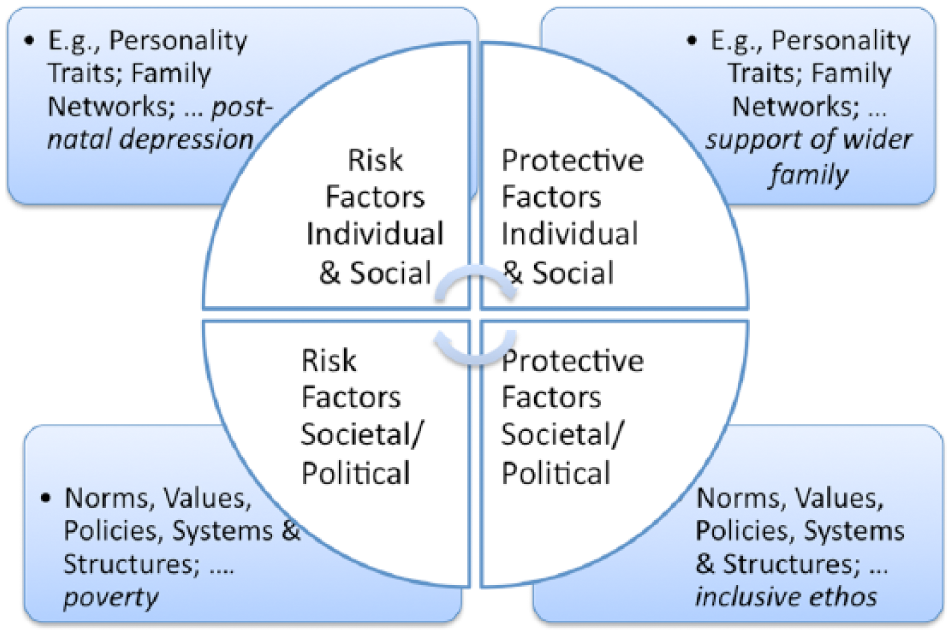
A representation of resilience building upon previous conceptualisations.
Towards a new conceptualisation of marginalisation
This article posed a series of questions, central to which were, ‘What does it mean to be margin-alised? and ‘Marginalised from what?’ It asked how one could come to be considered as marginalised and whether such marginalisation could arise from identification with a specific group. It questioned the notion of a marginalised group and the legitimacy by which marginalisation could be conferred on individuals through their affiliation with a specific group, and the assumptions and prejudices underlying such positioning. Might it be the case that a sense of marginalisation is dependent upon the interaction between what society holds to be desirable and that which is valued by the individual (cf. Figure 4(a)) and that what is valued by the individual, in turn, may be shaped by the degree to which risk and protective factors (at the individual, social, societal/political levels) interact with each other to shape their experiences? Individuals then draw upon their conceptual framework (in relation to which, it is argued by Gardner (1999), thoughts and feelings are inextricably intertwined) to interpret these experiences (cf. Figure 4(b)).
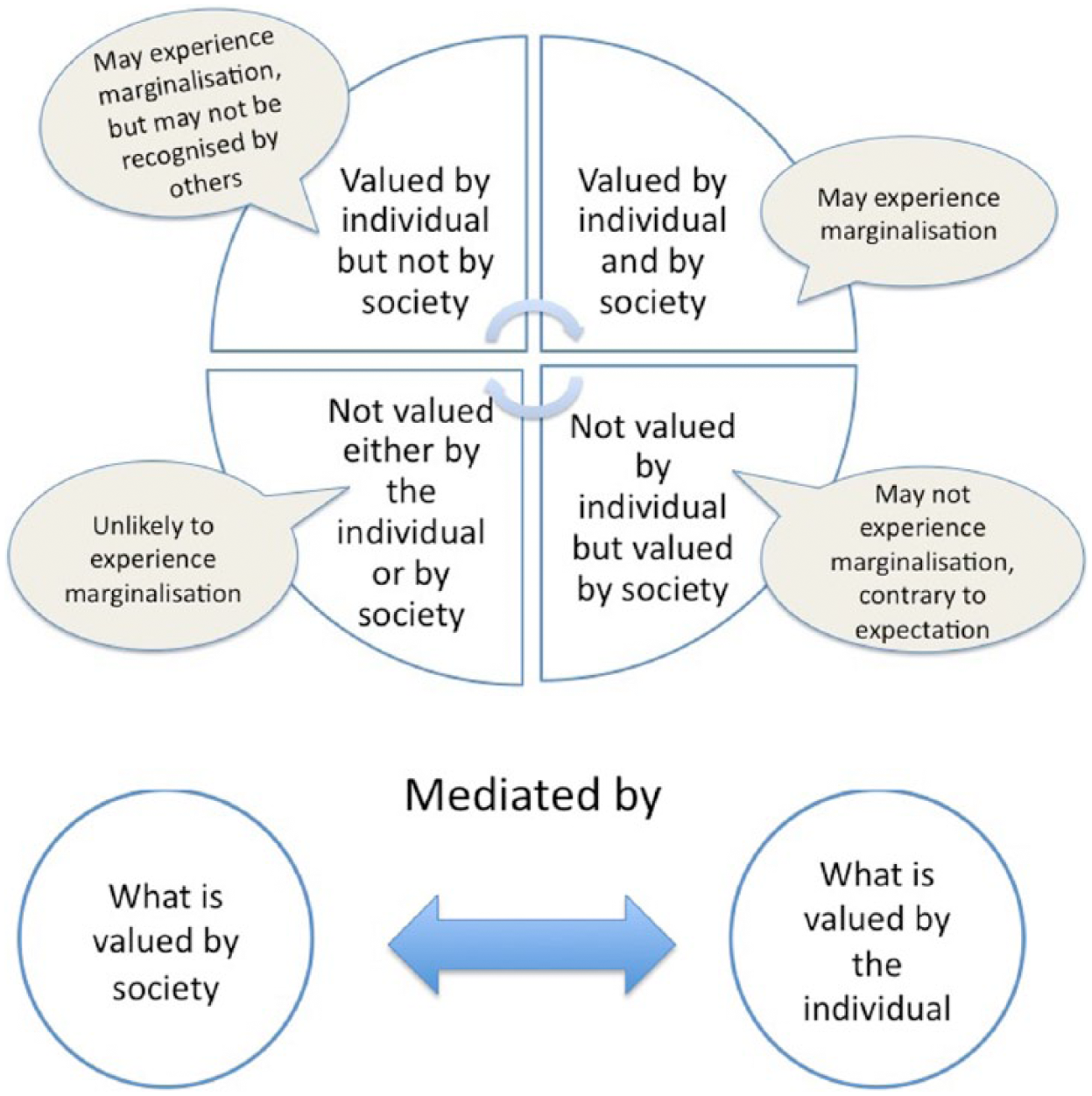
The relationship between marginalisation and what is valued by the individual and by society.
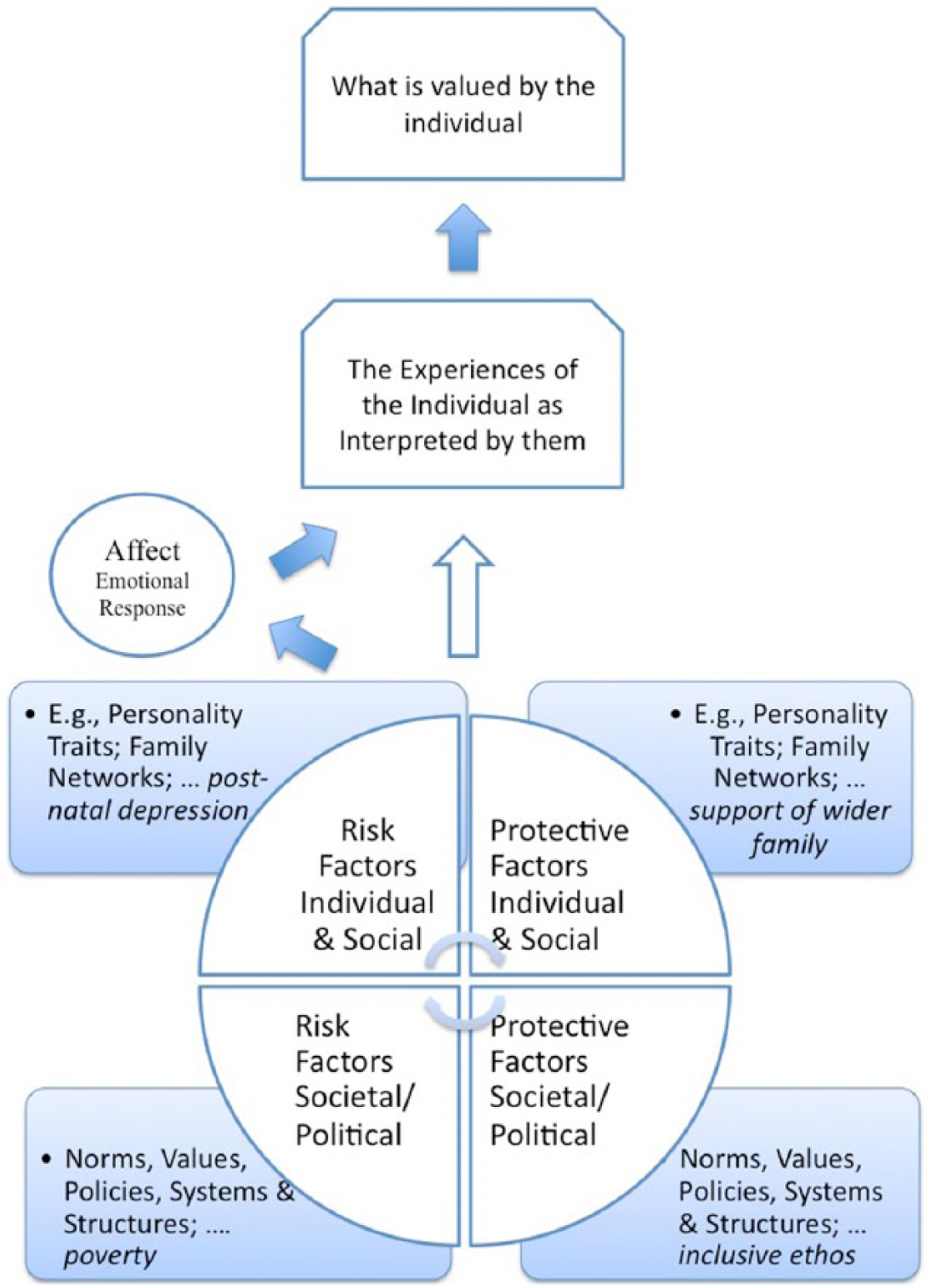
The relationship between resilience and what is valued by the individual.
Societal norms do not exist in a vacuum. They are mediated through the lens of culture and are situated in time and place. They reflect collective values and expectations of how people should behave towards each other, reflected within which are the ideals to which people within a culture aspire. They also exist within a political context which both reflects and shapes that culture (Bronfenbrenner, 1994) (cf. Figure 4(c)).
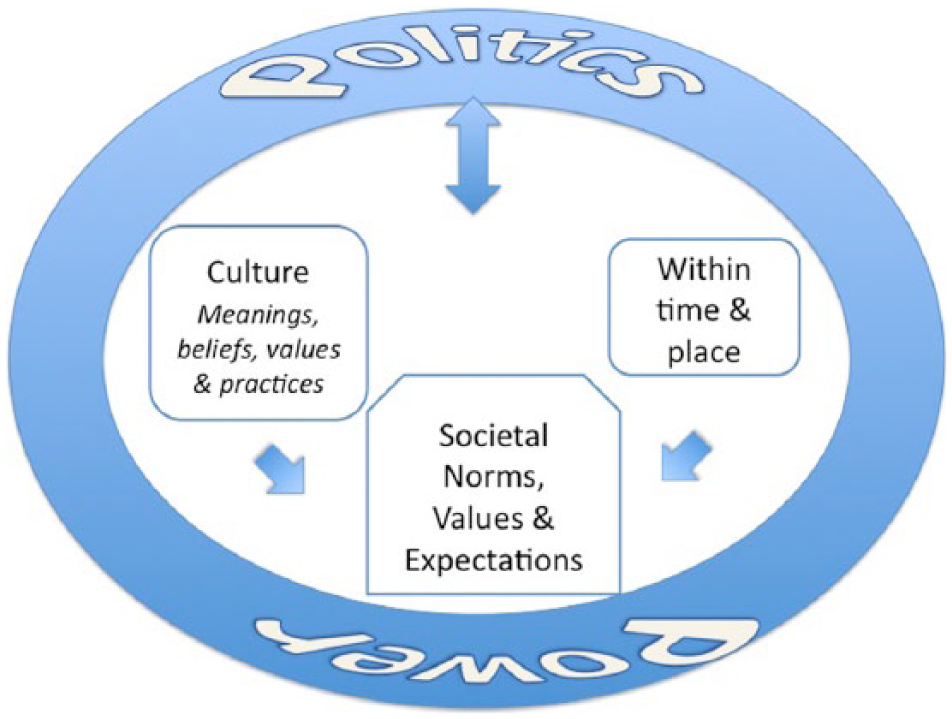
The political and societal context which frames both resilience and marginalisation.
Just as societal norms, values and expectations are mediated by time, place and culture, so too are the risk and protective factors which together intertwine to determine the resilience of the child within a specific context and situation, and all of these are mediated by issues of power (Ball, 2012) reflected within the political context, which create and act upon that context. Thus, a child, living in poverty, but in a loving and caring home in which there are wide family networks (social capital), in which education is valued (cultural capital) and in which there is the ‘scaffolding of experience that supports human development’ (Ungar, 2012a: 14, citing Vygotsky, 1978) may not experience their life as marginalised and will be more able to draw upon the opportunities which are open to them that children in similar circumstances who do not have these protective factors in their lives, as illustrated in Brann-Barrett’s (2011) study comparing the life trajectories of those from an impoverished community who went on to higher education with those who did not. However, there is no doubt that, these arguments aside, the risk factors for some children (e.g., those who are looked after and accommodated) are such that the likelihood of marginalisation is much greater and that, in order to be able to come to a deeper understanding of the barriers to participation and learning which are experienced by such children and young people, it is important to examine their experiences from a range of perspectives whilst also recognising that how (and if) marginalisation is experienced will be individual to the child or young person and the set of circumstances pertaining to the child, mediated through the wider societal and political context. Figure 5 sets out the hypothesis as described above.
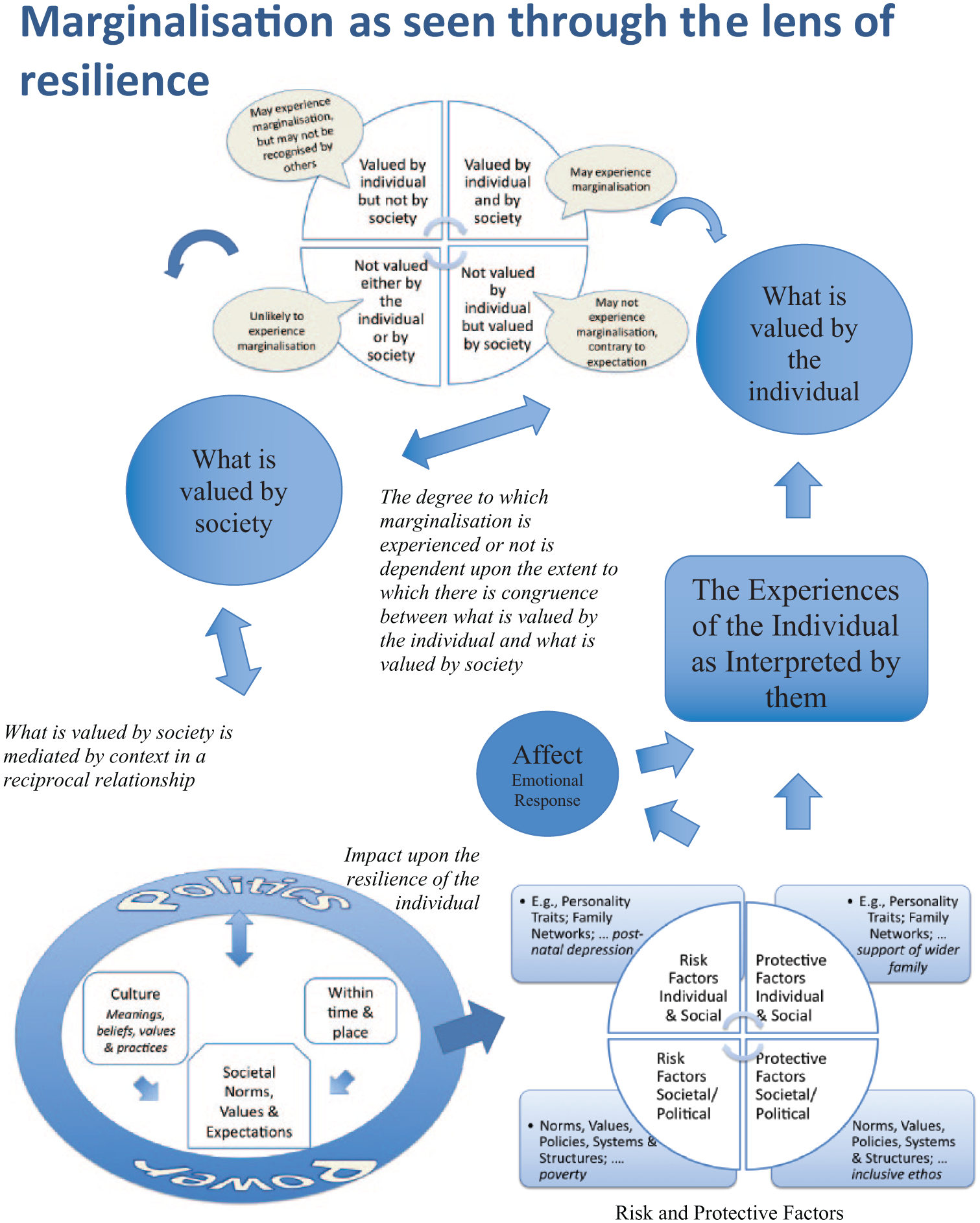
A theoretical framework through which marginalisation can be understood.
Conclusions and implications for policy and practice
This article commenced with a discussion of the neoliberal trends pervading education in Europe and beyond, focusing upon a narrow conceptualisation of human capital in which some children are identified as ‘winners and losers’. Whilst it is claimed that programmes such as PISA, PIRLS and TIMSS provide the raw data that enable nation states to identify where inequalities exist and how they might, potentially, be addressed (e.g., Schleicher, 2014, drawing upon the PISA 2012 results), increasingly the focus upon such programmes has come under fire with questions raised about the validity of the assessments and the dangers of stifling independent thinking and civic participation as being key goals of education (Meyer and Benavot, 2013). It has been argued in this article and beyond that the focus upon a ‘standards agenda’ (of which comparative international tests are a part) and upon normative standards in general (whether in terms of academic performance or behaviour) create and perpetuate the conditions under which children and young people become disenfranchised and marginalised with the concomitant risks highlighted within this article.
What has emerged within this discussion is the complexity of the construct of marginalisation. It is not as simple as examining the range of circumstances which pertain to an individual and placing them within a category of ‘marginalised’, nor to make the assumption that marginalisation will apply to all aspects of their lives, in all places and at all times. This article has argued that it is how individuals interpret their life experiences (which in itself is framed through their past experience) and how they perceive their lives in relation to others and the ‘ideals’ which are a representation of cultural norms, expectations and values, shaped by and through political forces and the systems and structures (including legal systems) of society, which will determine whether or not they will experience their lives as marginalised.
If it can no longer be held to be the case that there is a shared experience (marginalisation) which can be held to be true for all people who share certain characteristics, the implication for public policy and practice is that differentiated solutions are required which take account of the subjective experience of individuals and the interaction between risk and protective factors which shape those experiences – a ‘one-size-fits-all’ approach is unlikely to be successful and could, indeed, be counter-productive and wasteful of public funding, as was demonstrated by Ungar. If full account is to be taken of the subjective experience of the individual within public policy, this is dependent upon a commitment towards giving people a voice and working in true partnership with communities rather than imposing solutions upon them. Within the school context, it means valuing children and young people for who they are (the concept of unconditional positive regard (Rogers, 1957)), enabling them to participate fully in the life of the school and in decisions pertaining to their wellbeing and learning (beyond tokenistic approaches), tailoring interventions to the individual child and investing in the professional development of teachers.
Resilience is not only a concept that helps to frame people’s life experiences (and their interpretation of them), but can also be perceived as the means by which people can rise above their personal circumstances. So, in answer to Schleicher’s question, ‘How do we harness diversity, create fairness, and ensure our learning environments engage and achieve the best outcomes for all individuals, not just a few?’, part of the answer lies in developing a more sophisticated understanding of how children and young people experience marginalisation at a subjective level (drawing upon the theoretical model forwarded within this article which takes cognisance of the risk and protective factors in their lives) as the solutions one brings to bear upon a problem are mediated by one’s understanding of that problem. Ungar argues that the greater the fidelity between the intervention and ‘the way good development is theorized for a particular sample of at-risk individuals in a particular context’ (2012a: 13), the more likely the intervention is to be successful. The implication of this is that further research is needed to inform such public policy and practice and it is hoped that the theoretical framework forwarded in this article could inform such research.
Seddon (2014) draws attention to the conflict between global enactments of policy (as reflected in neoliberal agendas) and the European sociological tradition with its focus upon social justice that is being marginalised through the focus upon performativity, standards and competition. This is conceptualised in relation to three concepts: sociology of education as a space for knowledge making, as a space of knowledge and sociology of education as network. It is hoped that this article will open up these three spaces as they pertain to European educational research through providing opportunities for collaboration and debate, through the creation of new knowledge which will inform policy and practice and through opportunities for researchers to work across boundaries. Such collaborations would enable the research community to come together so that insights from a range of fields can be integrated and the conceptual confusion across a range of paradigms to which Kolar drew attention addressed.
Limitations
The hypothesis upon which this article has been founded has not yet been tested within the field and it is not implied that resilience is the only lens through which marginalisation can potentially be understood. It is recognised that areas such as race, ethnicity and poverty are fields within their own right and, within the constraints of the article which draws from a broad theoretical base, it may not be possible to do justice to these fields.
Footnotes
Declaration of conflicting interest
The author declares that there is no conflict of interest.
Funding
This research received no specific grant from any funding agency in the public, commercial, or not-for-profit sectors.