




Abstract
Induction in enterprises is a crucial phase for each employee not only to become able to fulfil all relevant tasks but also to enable professional development as well as social and value-oriented integration into the new organisation. This is even more relevant for young people coming from initial vocational education and training with intermediate-level qualifications (European Qualification Framework 3 and 4). The research question of the presented doctoral thesis is to discover how induction processes are organised for these employees in two selected countries, and to interpret possible differences. Therefore, the author presents a mixed-method approach that focuses on qualitative case studies in selected enterprises in car service in France and Germany. This approach is complemented by an in-depth literature review of pedagogical literature and from other selected disciplines, for example Human Resources Development. This paper presents the conception and first results of the case studies. The focus therefore is on the description of induction processes. The few existing differences are interpreted by two aspects: Hofstede’s cultural dimensions and organisational differences between the cases.
Introduction
A focus on induction at intermediate qualification level is scare. However, especially in times of workforce mobility and skills shortage, this is a field of research that has to be deepened. It can deliver information on how enterprises deal with a skill mismatch of delivered competences by the educational system and the demands of a qualified workplace. Through the comparative approach, researching this topic helps one to understand processes and mechanism and their differences and communalities between countries. If there is any research, mostly the focus is either on induction of graduates of higher education (Leuze, 2007) or on selected enterprises (Rappe, 2006). Though, induction often is just treated as a black box (Grollmann, 2009). Furthermore, it mostly focuses only on one point of view, either that of the employers or the employees. Therefore, the presented study is an enlargement of actual research by comparing impressions and the estimation of employers with those of employees in the same empirical setting.
The author assumes that induction varies according to occupations, work organisation and (vocational) education and training settings. Hence, it is worthwhile to concentrate on one occupation and select cases with a highest possible difference in terms of educational setting and work organisation. The focus is on car mechatronics in two countries that involve different educational systems and traditions and in-company organisation: Germany and France. Although in France there is a possibility to graduate from initial vocational education and training (IVET) via an apprenticeship, most of the youth choose a school-based setting; only about 13% choose an apprenticeship (La Ministère de l‘éducation nationale, jeunesse et vie associative, 2012). In contrast, in Germany, the dual model is a very important and popular pathway to access intermediate-level qualifications (nearly 60%; Bundesinstitut für Berufsbildung, 2013). Furthermore, cultural differences can be determined between France and Germany, according to Hofstede et al. (2010), in terms of hierarchical organisation and of implicit and explicit norms and values. These two aspects are supposed to influence all day work organisation heavily, which leads to the assumption that work is organised differently in the two countries. Therefore, the question is if there are differences in induction processes between France and Germany and how they can be interpreted.
Theoretical background and definitions
Definitions
As there are only few researches on the induction of job entrants with an intermediate-level qualification (see above), a single theoretical framework is difficult to define. Therefore, several approaches from various disciplines (pedagogic, psychology, sociology and economics) have to be respected by creating the theoretical framework. In particular, research on work-based learning (Malloch et al., 2010) or communities of practices (Lave & Wenger, 2008; Smith, 1999) can serve as theoretical background from a pedagogical point of view. Looking at economic theories, aspects of human resource development (HRD) have an important impact, especially those dealing with, for example, inplacement, personal development or employer branding (Kieser, 2009; Rosenstiel et al., 2009). Looking at sociology, theories of organisational and professional socialisation have to be respected (Lempert, 2002). In the field of psychology, the sub stream of work and organisational psychology could play a role (e.g., employee retention; Mudra, 2010).
Based on these literature reviews, a definition of induction could be developed. The focus is on learning aspects during the induction process, reflecting the pedagogical approach. For this research, induction is defined as
a period up to two years;
including all measures to fulfil the tasks of the original job description autonomously (professional induction);
including all measures for the social integration of the new employee in the existent team (social induction);
including all measures to enable an identification of the new employee with the culture, norms and values of the enterprise (value-oriented induction).
Two more definitions are crucial for the presented research: the terms of job entrant and intermediate-level qualifications.
The job entrant is a person that has just finished his or her IVET. Between the recruitment for the actual position and the end of IVET a period of a year is possible. The person is working after IVET at longest for about three years.
Jobs on intermediate-level qualification need an IVET qualification at European Qualification Framework, level 3 or 4. In general, these are qualifications with a strong Professional relevance. For the case of France, the relevant certificates are the “Baccalauréat Professionel”, the “Certificat d’Aptidude Professionnel” or the “Brevet de Technicien Supérieur” (level 5). In Germany, most certificates after the dual apprenticeship system lead to this qualification level.
Conceptual framework
The project aims at discovering induction practices and their relevance in all day work in car workshops in France and Germany. Although the focus is to find out how induction is organised in the two countries, a second step is to try to interpret possible differences between the cases. Therefore, the approach of the cultural dimensions created by Hofstede et al. (2010) was implemented. While knowing the critique of this approach (e.g., Hansen, 2000; McSweeney, 2002; Reimer, 2005) it was chosen because it did not only create cultural dimension for nations 1 but also for organisations 2 . This aspect supports the comparison of the researched establishments based on the size and the organisational structure. Furthermore, the dimensions of Hofstede have been validated in a way by reproducing at least comparable results several times within different studies.
To compare Germany and France, two important dimensions are the power distance (PD) and the uncertainty avoidance (UA). The first named dimension describes the level of inequalities between people and the awareness of social and hierarchical differences within a country (Hofstede et al., 2010: 53–88). The dimension of UA describes how persons deal with ambiguous or unknown situations (Hofstede et al., 2010: 187–234).
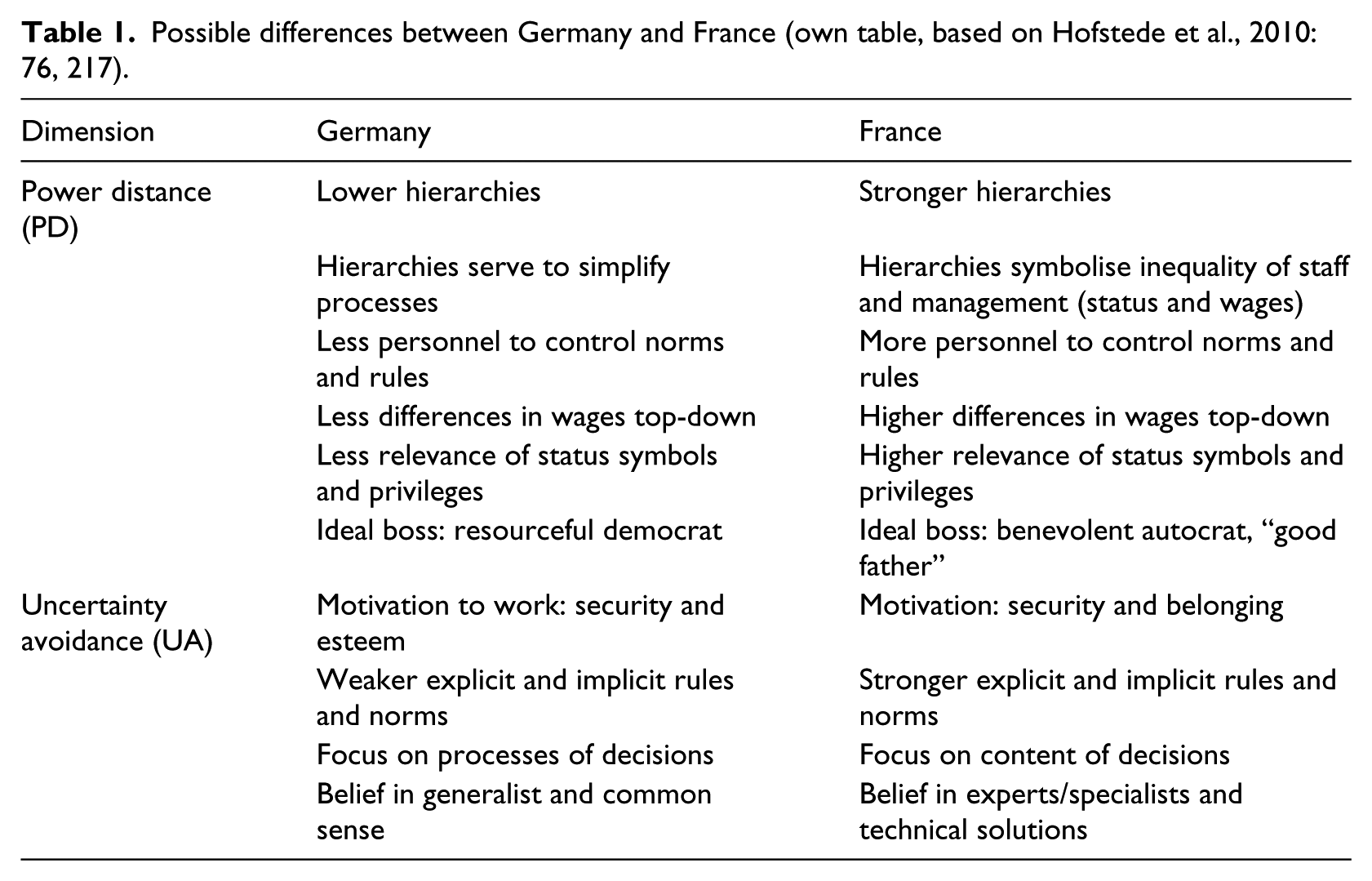
Based on this approach, selected differences between Germany and France were detected as relevant for the process of induction. Those differences concern, for example, the structure of the hierarchies or differences in wages for the PD or the motivation to work or explicit and implicit rules and norms for UA (see Table 1).
Possible differences between Germany and France (own table, based on Hofstede et al., 2010: 76, 217).
According to these differences, the two countries can be classified in different fields of an UA–PD matrix where Germany is classified as a “professional bureaucracy” and France as a “full bureaucracy” (see Figure 1; for an explanation of the terms see 3 ).
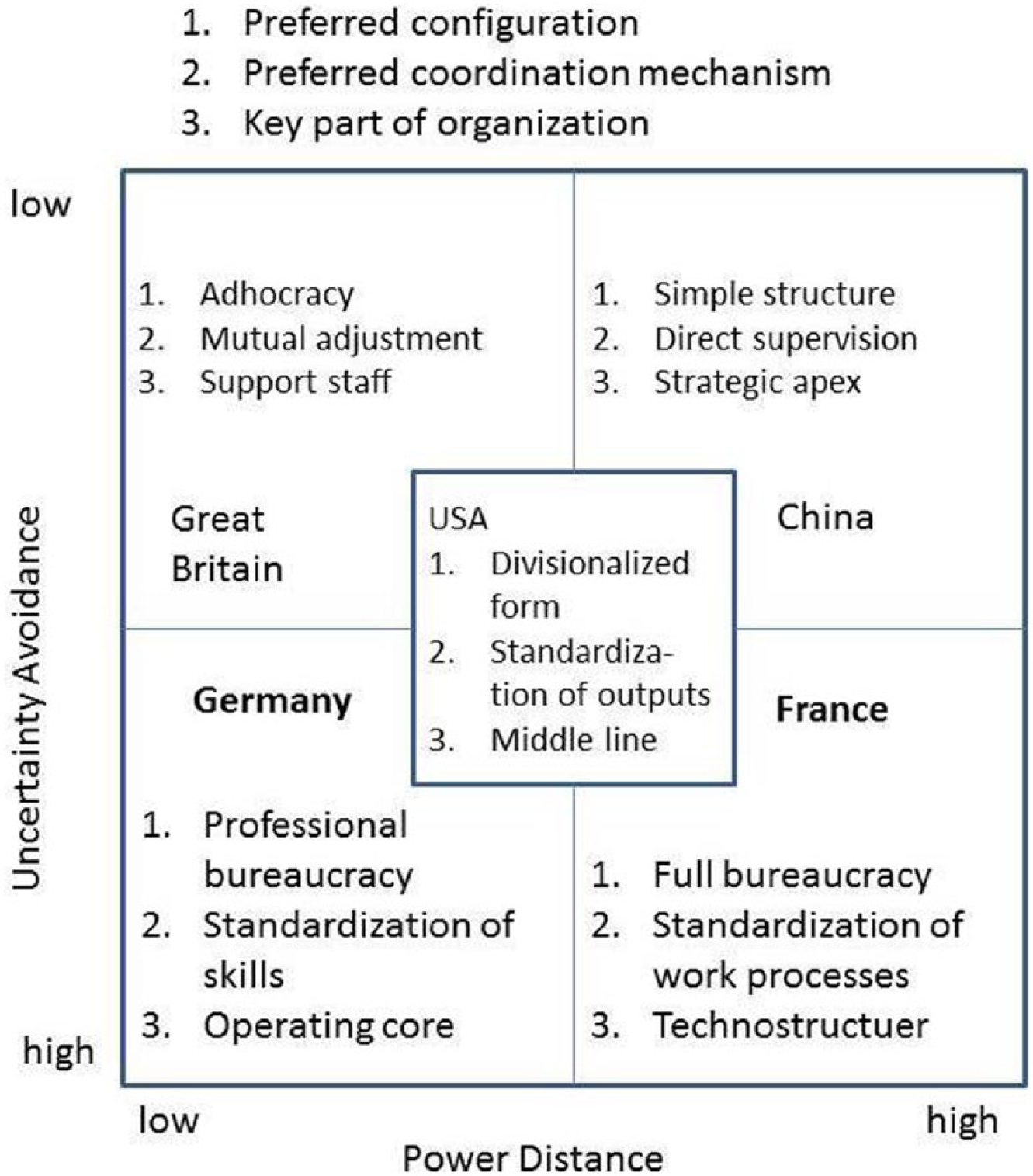
Germany and France in an uncertainty avoidance–power distance matrix (own figure, according to Hofstede et al., 2010: 314).
Research questions
As shown above, the aspect of induction for job entrants with intermediate-level qualifications has only rarely been analysed. Therefore, the main focus is to detect how induction is organised and the awareness of induction and patterns of interpretation. To enlarge the empiric research until now, the research compares the employers’ and the employees’ perspective.
The main research question is
How is induction organised for job entrants with intermediate-level qualifications?
Regarding the comparison between France and Germany, this main question is completed by the following:
2. Is induction organised the same way in all enterprises? And, if not:
(a) Can these differences be explained by Hofstede’s cultural dimensions?
(b) If there are differences that cannot be explained by Hofstede’s cultural dimension, what other reasons could lead to these differences (e.g., size or organisational structure, educational system)?
Regarding the difference between employers and employees, a second comparison of the interviews is part of the research question:
3. Are the interpretative patterns of induction the same for employees and employers? Are there some common aspects that show a professional socialisation of these patterns? 4
Based on the analysis in the conceptual framework, the following hypotheses were developed by the author and are to analyse by comparing the French and German interviews.
I. In countries with traditionally more hierarchical organisations (France), induction could be more organised and symbolises more the hierarchical structure of an organisation. The organisation of induction could serve as a transmitter of hierarchies. In contrast, in countries with traditionally lower hierarchies (Germany), the focus could be more on collegial advice and support than on transmission of hierarchies.
II. In cultures where organisations are seen as a “professional bureaucracy” (Germany), the relevance of social and value-oriented induction is higher due to a standardisation of skills. Here a person with a special qualification has to be able to fulfil certain tasks. Whereas in France, professional and practical-oriented induction is more important, due to less practical elements during IVET and to a higher standardisation of processes that are assumed to be more enterprise-specific.
However, it is to be kept in mind that the main focus of the research is on HOW induction is organised and IF there are differences between France and Germany. Only in a second step are the possible differences to be interpreted and explained. The hypotheses above only serve as a conceptual background if any differences can be found.
Methodological approach
Conception of the interviews
The study employs a mixed-methods approach. Elementary aspects are on the one hand an in-depth literature analysis of relevant literature from different disciplines (see above). On the other hand, case studies in Germany and France (four per country) were conducted, interviewing one person representing the employers’ point of view and one representing the employees’ point of view. The main focus in the interviews with the person representing the employer’s point of view is the enterprise’s strategy for training, recruitment and induction and its practice within the enterprise. These statements were completed by strategic documents of the enterprise, if possible. The focus within the interview with the employee is rather the individual experience(s) during the first year of employment. For this purpose, younger employees (up to maximum of 25 years old) were selected for the interviews. By this setting, four “groups” of interviews are created (see Table 2), composed of two different types of interviews (employer 5 and employee) in two different national settings (France and Germany).
Groups of interviews.

The interviews were all designed as a semi-structured interview. For the employees’ interview, more “creative” approaches were included with the objective to facilitate the memory and to support the capacity to formulate the experience: the “watch of emotions” and a “fairy tale”. The “watch of emotions” (see Figure 2) supported the expression of the feeling within the first year.
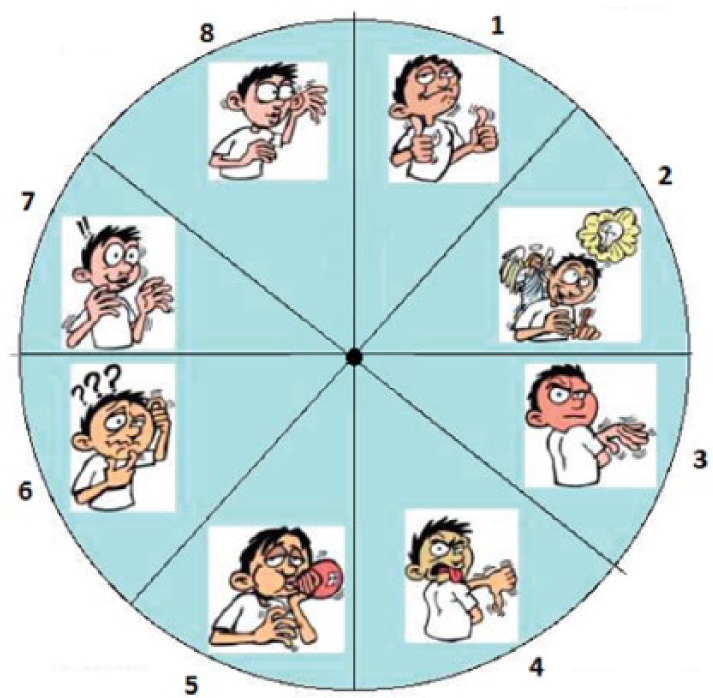
“Watch of emotions”; source: Rademacher and Koschel (2006).
These emoticons enabled the young employees to express more detailed about their feelings and impressions. They identified a feeling that corresponds most to the feeling they had at the beginning. With the help of example situations they could describe these easier and in more detail than before. During the “fairy tale”, the young men could describe their “ideal induction”. Here, the aim was to discover aspects that were missed unconsciously and/or that the young men did not dare to express directly for different reasons (e.g., the phenomenon of social desirability or the fear that the statement could be told to the employer, although the concept of secrecy was explained beforehand).
Sampling criteria and interview situation
The contact to the enterprises was organised by the German umbrella association for the car industry (Zentralverband Deutsches Kraftfahrzeuggewerbe, ZDK) and the largest provider of initial and continuous training for vehicle-related occupations in France (Association National Pour la Formation Automobile, ANFA). The sampling in both countries covers small as well as large enterprises and also enterprises that are contractual partners of one or more auto brand(s) and those that are not. This sampling enables to cover the variety of possible organisational structures of enterprises in the car service sector. In this way, it allows one to grasp for as different as possible settings for induction to discover the range of possible practices. It was also a selection criterion that the enterprises had employed job entrants during the last three years.
The interviewee on the employer’s side had to be a person with strategic knowledge and knowledge of training and induction processes. Mostly, the interviewee was the owner or director of the enterprise or the person responsible for training. For the interview with the employee, the selection criterion was that he had finished his initial vocational education during the last three years.
The interviews all were held in separated and closed rooms in a face-to face situation. There were no further persons than the interviewer (i.e., the author) and the interviewee. At the begin of the interview, especially with the employees, the situation of the interview was explained, as well as the fact that there was no further relation to the employer than the interview itself, that there has been no order or the like by the employer for the interview and, therefore, no results or details of the interview would be transferred to the employer.
Editing and analysis of the interviews
The interviews were conducted in the national language (French, German), to avoid translation problems (Inhetveen, 2012) transcribed according to GAT 1 (Selting et al, 1998) and analysed with a five-step analyse according to Merriam (2009: 175-193):
1) open coding (interview 1);
2) analytic coding (interview 1);
3) coding interview 2 (according to steps 1 and 2);
4) discovering of a “master list” of codes;
5) development of different levels of abstraction (level 1: chronological order; level 2 using concepts for the description of phenomenon; level 3: generating theories).
The original steps by Merriam were adapted to the fact that there were four “interview-groups” (see above). Steps 1 and 2 were done with each interview (step 3); afterwards the interviews were analysed within “their” group (employer, employee; step 4). At the end of this coding, different “master lists” for each type and grouping of interview were developed and compared.
First results (and further expected outcomes)
Based on the first two steps of analysing the interviews, the master lists for the employees and the employers show slight differences due to different foci of the interviews (see Table 3 and 4). There were three codes defined beforehand: professional induction, social induction and value-oriented induction. Further codes were developed by indexing relevant phrases and structuring the index/keywords afterwards.
Code list for employers.
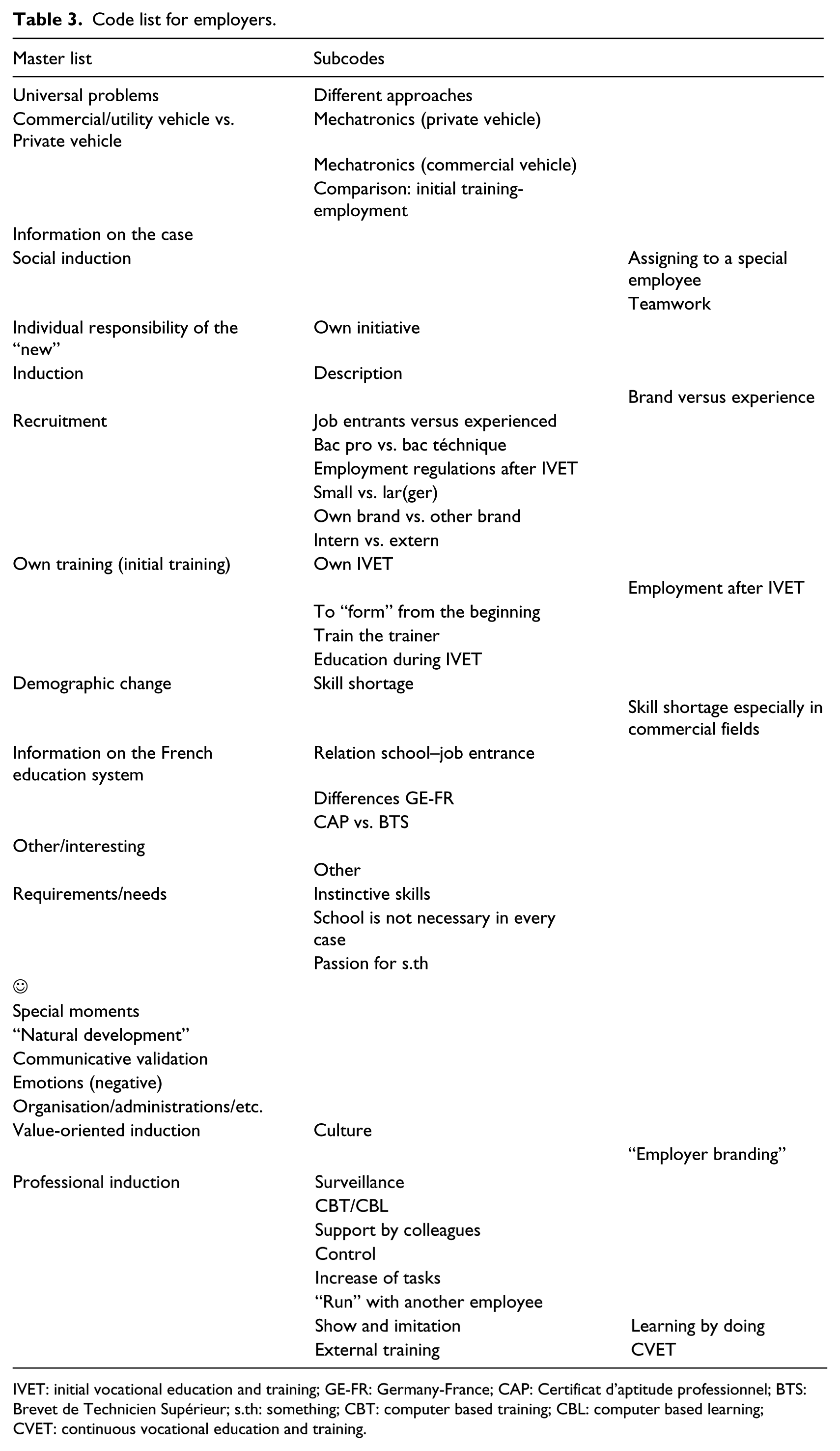
IVET: initial vocational education and training; GE-FR: Germany-France; CAP: Certificat d’aptitude professionnel; BTS: Brevet de Technicien Supérieur; s.th: something; CBT: computer based training; CBL: computer based learning; CVET: continuous vocational education and training.
Code list for employees.
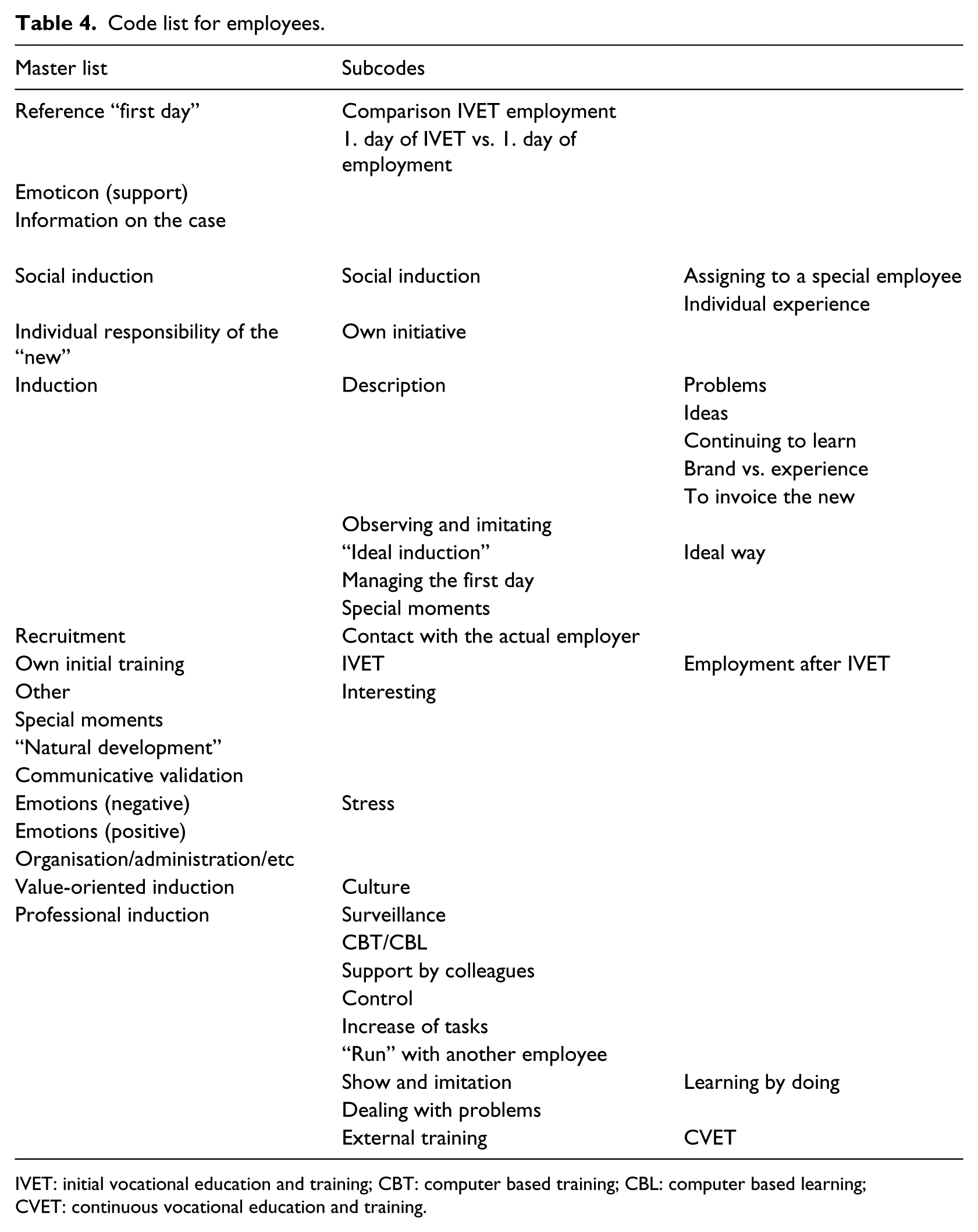
IVET: initial vocational education and training; CBT: computer based training; CBL: computer based learning; CVET: continuous vocational education and training.
The following selected results 6 show some surprising aspects of the influence of culture, education system and organisational structure, with focus on the employers’ perspective:
1) there are differences in recruitment, induction and training of job entrants in France and Germany, which could be interpreted by the differences in the education system;
2) there are furthermore some differences in training and recruitment of job entrants in between the cases that could be explained by the organisational differences;
3) BUT there are no differences that could clearly be explained by cultural differences;
4) the main aspects and methods of induction are the same in all cases;
5) induction in the view and awareness of the employees shows nearly no differences between the cases.
Differences that could be interpreted by the education system
This statement shows one of the most significant differences concerning apprenticeships between France and Germany. Whereas in Germany, the apprenticeship pathway is still an interesting choice even for pupils with higher education entrance qualifications (Bundesinstitut für Berufsbildung, 2014), in France, most pupils stay in a school-based setting. So, employers in France are faced with the difficulty of finding qualified personnel for the so-called blue collar work. This difference leads to the phenomenon that in France, the recruitment and selection of persons in car service seems to be more complicated than in Germany. This again leads to the phenomenon that in France, there seems to be a higher awareness of problems in relation to induction in the employers’ interviews. In the French cases, the employers mentioned already having thought about the problem or even to be working on it.
Differences that could be interpreted by organisational structure
The bigger an enterprise is the higher is the possibility that they have a kind of strategy for training and HRD. This is also shown by the fact that in France and in Germany, the cases that are in a larger structure (one in Germany and two in France) all have this kind of department or at least a responsible person, who has a purely strategic and administrative position:
Another influencing factor on the organisation of (continuous) training is the relation to one or more car brands.
If an enterprise or a workshop is related to any brand, this influences strongly the structure of training and thereby also of the (professional) induction process. The brands mostly provide a training plan that has to be fulfilled within a certain period (mostly a year). One following hypothesis is that, therefore, training between all workshops with the same brand relation could be quite similar. 7 This structured training plan is missing for workshops without brand relation. So they are freer in organising their training and also the induction process.
Commonalities in the induction process
Mostly, induction happens the same way in both countries with the same foci. In both countries and in both types of interviews, the most important element of induction is to “assign” an experienced person to the new employee. This more senior employee serves as a kind of mentor, although this term is rarely used. Although the focus during induction is on professional aspects, this person is responsible for the holistic process of induction, that is, for professional, social and value-oriented induction. It mostly happens in the working process.
Social and value-oriented induction are seen as something that is important but that also happens by the way of professional tasks. Employers do not see many possibilities to influence this process. Nevertheless, they see some possibilities to support it by choosing selected employees for a kind of mentoring.
Another common point between France and Germany is that the own apprenticeship scheme is the most important source for the recruitment of new employees. In France and in Germany, most of the new employed young men were former apprentices of the enterprise.
Induction from employees’ point of view
A very important aspect for the new employees is the feeling that they can ask everyone if they have questions. Mostly this happens by being “allocated” to a special/selected employee from the existing staff. However, as the first quote shows, it is important that the team is aware of the new and is willing to show and explain how the processes are in the workplace.
All employees mention that they felt a bit afraid of coming to an unknown team. However, in all cases, the social integration was unproblematic. They all said that the integration into the team happened without any problems and in a way automatically. The value-oriented integration was no subject in the interviews.
Conclusion and outlook
In total one can say after this first analysis, that there is much commonality between the interviews. The few appearing differences seem – at a first glance - to be less due to the nationality but rather to organisational structure (such as size or brand relation) or the education system.
Having a look at the main questions of the theses (see Research questions), we can assume the following.
1) The most important aspect of induction is the same in all cases; nevertheless, if it is a French enterprise or a German one, the most used “instrument” of induction is to “assign” the new employee to a more experienced one (mentoring system). This instrument combines induction of all aspects: professional, social and value-oriented induction. The main focus is mostly on the professional induction. Social and value-oriented aspects are seen as important but there are only very few organised elements for these induction processes.
2) (a) For the differences that were detected between the cases, they cannot be explained by a single aspect. Some of them are due to national differences, for example, a stronger seniority principle in France, and the education system, for example, the higher relevance of apprenticeship in Germany.
(b) It seems that the most important differences are rather due to organisational differences, that is, the size of an enterprise or the brand relation.
3) Comparing the employers’ and the employees’ views on induction, we can see that both assume the mentoring system as the most important method for the induction period. For the employees, the social induction is even more unconscious that it is for the employers, the same for the value-oriented induction.
Coming to the hypothesis regarding the main questions, we can see in a first step that in France, the problematic issue of the induction process seems to be more present than in Germany. The reason seems to be rather the problematic situation on the labour market than the stronger hierarchy. Furthermore, the thesis that in cultures where organisations are seen as “professional bureaucracies” the relevance of social and value-oriented induction is higher seems to be disproved, at least for the analysed cases. It could be an interesting research question to analyse this more in depth and with a larger sampling.
In a next step, it will be worthwhile to compare the results of this study with other existing data on a European level as well as on a national level (e.g., the CVT-survey, the German survey on qualification (“Qualifizierungspanel”), or the French study on development of graduates (“Génération”)). This could link the research to a larger context and open existing quantitative data for a more in-depth view to selected phenomena.
Footnotes
Declaration of conflicting interest
The authors declare that there is no conflict of interest.
Funding
This research received no specific grant from any funding agency in the public, commercial or not-for-profit sectors.