




Abstract
Grounded normative theory focuses on enriching normative political theory arguments through recursive empirical engagement that strives for inclusiveness and accountability. It is increasingly influential but also has been critiqued as too broad to provide clear guidance. We argue that the approach, when understood as anchored in a complex conception of intellectual humility, can give crucial practical guidance, while also helping us to make sense of and evaluate ways of empirically informing normative theory. We demonstrate how different emphases on self-regarding and other-regarding intellectual humility guide research design, methods, and analysis in two main variants of grounded normative theory: theory testing and theory building. We show how specific normative-empirical projects can be situated and unpacked within the variants, and how each can give insights for project execution and assessment on empirical and normative criteria.
Keywords
Introduction
Grounded normative theory, which seeks to strengthen normative arguments through the conduct of related empirical research, while also emphasizing inclusiveness and accountability to those being theorized, has become increasingly prominent as a way of empirically informing normative political theory. Since being “unearthed” by the co-authors and four other practitioners of the approach (Ackerly et al., 2024), 1 it has been more explicitly adopted by a range of theorists (Aitchison, 2024; Rejón, 2025; Riddle, 2022; Wojciechowska, 2023), and it has attracted systematic engagement and commentary (Bauböck et al., 2022; Behl, 2021; Eckersley, 2020; Johnson, 2023; Mansbridge, 2023). Both are reflected in the contributions by dozens of authors to the Oxford Handbook of Grounded and Engaged Normative Theory (Ackerly et al., 2026).
Yet, grounded normative theory also has been critiqued as constituting simply a broad ethos for theorists to follow in conducting empirical research, rather than a distinctive approach capable of giving them practical guidance in doing so (Asenbaum, 2022: 6). It also is said to reflect an “activist orientation” or solidaristic identification with specific groups that limits its critical theoretical purchase (Rossi, 2023). Meanwhile, several other approaches to incorporating empirical research into normative theorizing have emerged and been developed. These include ethnographic sensibilities (Herzog and Zacka, 2019), empirically informed (Hill, 2017; Perez, 2020, 2025; Perez and Fox, 2021), and fact-centric political theory (Aytac and Rossi, 2023; Floyd, 2017; Rossi, 2023), among others (Ercan et al., 2022; Kittel and Traub, 2024). Each represents a response to longstanding calls for normative political theorists to give more systematic attention to empirical dynamics (Bauböck, 2021; Herzog, 2012; Miller, 1991; Prinz, 2020; Waldron, 2016: chapter 1; Westphal and Willems, 2023).
We demonstrate here that grounded normative theory can provide crucial practical guidance for specific projects, while also helping us to make sense of a range of ways of empirically informing normative political theory arguments. It can do so in ways that enrich rather than limit critical insights, and it can facilitate both the empirical and normative evaluation of specific projects. We work to support these claims by delving more deeply into the foundations of the approach and clarifying how intellectual humility can be understood to provide its “animating spirit” (Ackerly et al., 2024: 168). Specifically, we demonstrate how distinctive interpretations of intellectual humility guide research design, methods and analysis in two main variants of grounded normative theory, focused broadly on theory testing and theory building. 2
The Theory Testing and Investigation variant is anchored primarily, though not exclusively, in self-regarding intellectual humility, which entails an acknowledgment of one's own cognitive limitations and a desire to fill gaps in one's knowledge. Projects typically begin with draft normative claims and involve the testing of empirical hypotheses or the broader investigation of empirical contexts and processes that are central to those claims. The Epistemic Politics and Theory Building variant gives more emphasis to other-regarding intellectual humility, which recognizes others as potentially valuable sources of insight and as worthy interlocutors who deserve to be able to speak on their own terms. This variant wrestles with the epistemic hierarchies that have framed disciplines and lived experience. It challenges these epistemic politics with methodological innovations that treat those engaged as intellectual partners in determining research questions, appropriate hypotheses, relevant data, and interpretation of analyses.
The article is structured as follows. First, we discuss four key grounded normative theory commitments. We show how they are anchored in the complex conception of intellectual humility and how they differ in practice across the two variants. We devote a section to each variant and the types of projects that can be situated within them, emphasizing how the distinctive orientations to intellectual humility in each variant inform project development and execution. Overall, the discussion highlights how grounded normative theory can clarify ways of incorporating empirical insights into normative political theorizing, while also giving guidance in practice and facilitating the empirical and normative evaluation of specific projects.
Grounded normative theory and intellectual humility
Grounded normative theory uses four commitments to guide empirical research design for informing normative political theory (Ackerly et al., 2024: 165–166). Comprehensiveness refers to ways in which empirical research can expand the set of empirical and normative claims, understandings, emotional expressions, etc., to be considered. The theorist's own empirical or normative understandings are often challenged in the process. Recursivity involves the ongoing revision of argument as new insights are gained, and it calls theorists to revisit methodological decisions made throughout the process for their potential to prematurely undermine the other commitments.
Epistemological inclusion is concerned with engaging the voices of persons who are being theorized, often those excluded from political and social power structures, and seeking to better incorporate them into normative understandings and claims. Epistemic accountability is a commitment to address imbalances in power, knowledge, and agency, in particular between the theorist-researcher and those being engaged, by making sure that the theorist's use of empirical data does not misrepresent their views. Each of these commitments can be understood as anchored in a complex conception of intellectual humility.
Humility more generally has been framed as a significant pro-social virtue marked by openness and the regulation of egotism. Studies of humility have expanded in philosophy (Alfano and Lynch, 2021) and psychology (Chancellor and Lyubomirsky, 2013: 827; Rowatt et al., 2006: 196; Worthington et al., 2016; Van Tongeren et al., 2023), and it has been highlighted as a disposition to adopt in social science field research (Asenbaum, 2022; Koch, 2020; Zeitlyn, 2022). Humility also has been identified as central to a feminist research ethic (Ackerly, 2013: 99; Ackerly and Attanasi, 2009), and political humility as essential to a normatively defensible democratic practice, whereas corresponding vices such as political arrogance are a threat (Button, 2016; Cabrera, 2020: ch. 2).
Intellectual humility focuses on understandings of our own epistemic limitations (Medina, 2013; Whitcomb et al., 2017) and on how we relate to others as interlocutors. Such self-regarding and other-regarding dimensions of the virtue are detailed in a systematic review article of both philosophical and social psychology treatments by Porter et al. (2022). Each dimension, they show, has both internal and expressed aspects. Self-regarding intellectual humility is marked by an internal awareness of one's own ignorance and intellectual fallibility, and an expressed willingness to admit both and take steps to address them. It anchors the grounded normative theory commitments to comprehensiveness and recursivity, and it is foregrounded in the Theory Testing and Investigation variant.
Other-regarding intellectual humility is represented internally as an “awareness of value in other peoples’ intellect,” and outwardly as a demonstrated willingness to listen to others’ ideas and be open to critical input (Porter et al., 2022: 579–581). In some types of Theory Testing and Investigation accounts, a focus on the former may be narrowly instrumental, where persons are approached as potentially valuable sources of information for filling identified knowledge gaps. This would be a form of inclusion in the grounded normative theory frame, but a limited and highly structured one, as discussed in the next section.
The openness to critical input creates possibilities for more dialogic forms of inclusion as regard for the other, for example, in more open-ended exchanges where those engaged are treated as worthy interlocutors who have standing to speak (Tanesini, 2016: 76). In grounded normative theory, this normative sense of other-regarding intellectual humility is manifest in more robust commitments to epistemic inclusion and accountability. These are foregrounded in the Epistemic Politics and Theory Building approach, which emphasizes methods for dialogic inclusion, treating those engaged as agents who should be enabled to offer their own narratives and raise challenges from their own agendas. Recursivity enhances comprehensiveness, inclusion and accountability in this variant.
The anchoring in both self- and other-regarding intellectual humility and the corresponding emphases on the four commitments enable grounded normative theory to help us better understand what lies behind a range of choices involved in empirically informing normative arguments, while also giving tools for pursuing and assessing specific projects, as the next two sections demonstrate.
The theory testing and investigation variant
This section shows how a range of projects can be situated and unpacked within the Theory Testing and Investigation variant. It discusses some steps theorist-researchers typically follow, including the identification of draft normative claims and related empirical gaps in knowledge, the selection of research design and methods, and the incorporation of empirical findings into processes of normative theorizing. Choices made at each step will be primarily influenced in this variant by self-regarding intellectual humility and corresponding aims to expand comprehensiveness and enable the recursive development of normative arguments. We also show, however, that other-regarding intellectual humility and aims for inclusion and accountability can have a significant influence on how projects are designed and executed, how findings are incorporated and how projects can be assessed.
Draft normative claims and gap identification
Theory Testing and Investigation projects typically begin with draft normative claims that are linked to empirical suppositions identified as needing further investigation. Step 1 thus involves theorists practicing an expressed form of self-regarding intellectual humility. They develop draft claims through engagement with relevant normative literatures and academic dialogue. They identify a gap in empirical knowledge that must be filled before their draft normative claims can be fully developed, and they take steps to address the gap through conducting their own research or an analysis of existing research. Such gaps may be relatively narrow, lending themselves to tests of specific empirical hypotheses. Or, they may be broader gaps in knowledge about an empirical context, phenomenon or set of processes, for example, specific democratic contexts, aspects of migration, civil disobedience, etc. In such cases, the theorist-researcher will undertake broader, more extended investigations, but ones still primarily motivated by filling gaps in knowledge relevant to draft normative claims.
Relevant gaps in empirical knowledge may also become evident for sets of normative claims which have been offered over an extended period, often through challenges lodged by commentators. For example, David Miller and Sundas Ali sought to test Miller's longstanding empirical supposition that “national identity provides the ‘cement’ or ‘glue’ that holds modern, culturally diverse, societies together and allows them to function effectively” (2014: 237–238), especially in facilitating social welfare distributions. Such suppositions have undergirded various normative arguments by Miller for reinforcing shared national sentiment, including through limiting migration (2016). He and Ali drew on existing cross-national survey data and empirical studies to test whether stronger expressed national identity correlates to stronger support for distributions, finding only mixed results (Miller and Ali, 2014: 253–257).
To reinforce, such initial processes of identifying and seeking to investigate empirical suppositions on which normative claims rest in part distinguish the Theory Testing and Investigation variant from the Epistemic Politics and Theory Building one. Because theorists in the latter give stronger emphasis to inclusion and accountability, they typically develop their normative claims and research questions through initial engagement with non-theorists in a chosen empirical context. Research design and execution choices also will be influenced by the more fundamental emphasis on inclusion and accountability.
In addition, Theory Testing and Investigation is distinct from the process of “conversion” described by Perez and Fox, where “normative intuitions that have empirical content [are converted] to a testable empirical statement” (2021: 499–500). Rather, specific normative claims and prescriptions are seen here to depend on empirical assumptions which are tested or investigated separately. Broad investigation in particular may expand the sets of normative inputs to consider, for example as new objections are encountered, but those would still be distinct from empirical suppositions.
Overall, the primary aim in Theory Testing and Investigation can be understood as enhancing the robustness of normative arguments, or “the degree to which a theory warrants belief by virtue of the evidence and arguments it marshals” (Kirshner and Spinner-Halev, 2024: 2; Leader Maynard, 2024). Through conducting research to fill gaps in empirical knowledge on which certain normative claims depend, the theorist seeks to increase the volume and quality of evidence marshaled, and the persuasiveness, coherence, and applicability of the normative argument produced.
Finally, we note that the Theory Testing and Investigation variant excludes empirical investigation that involves normative concepts but is not conducted to inform a specific normative argument. An example would be Bunel and Tovar's (2024) survey experiment study investigating perceptions of fairness in affirmative action, along with a wide range of others featured in the journal Social Justice Research since 1987. Such work, often conducted by social psychologists or economists, can certainly inform normative theorizing, but it is distinct from grounding/empirically informing a specific normative argument and is not included in this discussion.
Design and execution of empirical research
Once draft claims have been formulated and knowledge gaps identified, the next steps in the Theory Testing and Investigation variant will typically focus on research design, methods and execution. These can vary widely. Such choices are influenced first by the nature of the gap in empirical knowledge to be filled and the kinds of research questions to which it gives rise. In Miller and Ali's project, for example, the gap concerns knowledge about how far national sentiment correlates to social welfare redistributions. Thus, a relatively narrow, hypothesis testing design was chosen. Other gaps in knowledge may not be so clear cut and will lead to broader investigations, typically involving comparative or single case study designs, or qualitative or mixed-methods field research designs, per examples below.
Significantly here, design and execution choices also are influenced by the weight a theorist-researcher gives to other-regarding intellectual humility, alongside the primary emphasis on self-regarding aspects. This can be reflected again in relatively structured and instrumental consultation of others to fill a specific knowledge gap the researcher has identified, or it can entail more robustly dialogic inclusion through focus groups, open-ended interviews, etc. Thus, we distinguish projects by whether they focus on narrow hypothesis testing or broader investigation of empirical contexts, but also by the types and extent of epistemic inclusion and accountability they extend, as presented in Table 1.
Types of theory testing and investigation projects.
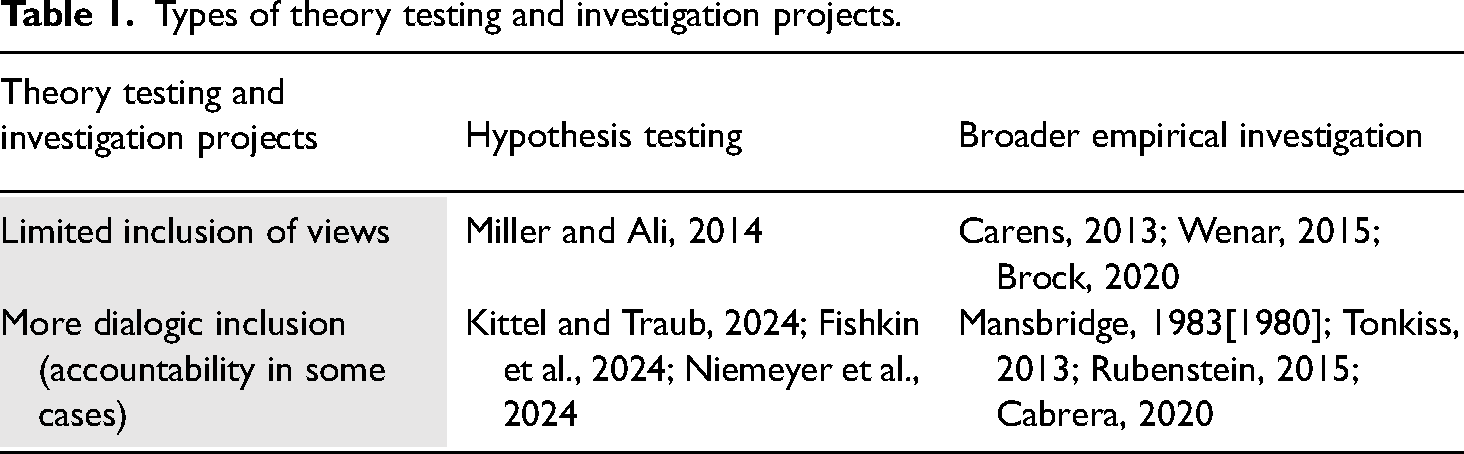
Miller and Ali's project would be an example of relatively narrow hypothesis testing that extends very limited inclusion of the views of those engaged. While it draws on existing survey data and thus incorporates the structured views of persons in contexts salient to the normative claims, it does not engage them more directly. Likewise, some broader-based investigations focus narrowly on comprehensiveness and recursivity. These would include ones highlighted in Nahshon Perez's ‘empirical political theory’ approach, in which theorists use secondary sources to identify empirical/institutional patterns, normatively assess them, and prescribe alternatives (Perez and Fox 2021: 488; Perez 2025; Thacher, 2006). Leif Wenar's (2015) treatment of state sovereignty over natural resources is an exemplar (see also Brock, 2020; Carens, 2013; Floyd, 2017: 185ff).
Some hypothesis-testing projects more directly engage persons’ views in salient contexts. For example, the contributors to Kittel and Traub (2024), which presents a collectively produced, empirically informed normative argument for a needs-based approach to redistribution, draw primarily from lab and survey experiments but also include some more detailed views via semi-structured qualitative interviews. Numerous studies in deliberative democracy are structured as tests of hypotheses about the effects of deliberation but also provide opportunities for more robust dialogue in “minipublics” and other fora (Ercan et al., 2022; Fishkin et al., 2024; Niemeyer et al., 2024).
More extensive inclusion is a hallmark of broader investigations based in qualitative and mixed-methods field research designs. Here, the insight of persons in salient contexts is a primary source of data, but myriad opportunities also arise for robust and dialogic forms of inclusion and accountability. Such projects often revolve around broader normative claims or conceptualizations that are closely linked to a context, set of processes, or institutions, and require extensive practical knowledge of them. For example, Jane Mansbridge's pioneering normative-empirical project drew on field research and quantitative surveys around Vermont town meetings and a crisis center to inform her conceptualizations of democratic equality (Mansbridge, 1983 [1980]: 99, 304–332). Luis Cabrera (2010) interviewed migrants, migration activists and officials in the United States, Mexico, and Europe to develop normative claims for an institutionally oriented conception of global citizenship. With a collaborator, he also conducted quantitative surveys comparing attitudes of civilian border patrollers to those of migrant-rights activists and non-activists (Cabrera, 2010: chapter 7; Cabrera and Glavac, 2010).
Others have extended robust dialogic inclusion through qualitative focus groups, semi-structured interviews, and related field research, in projects focused on clarifying normative concepts including political obligation, disadvantage, hospitality, constitutional patriotism (Doty, 2009; Klosko, 2005: 190–222; McNevin and Missbach, 2018; Reed-Sandoval, 2020; Stivens, 2018; Tonkiss, 2013; Wolff and De-Shalit, 2007: 42–43), or highlighting the role of deliberation in “democratizing” global justice (Dryzek and Tanasoca, 2021). Finally, some broader investigations have extended inclusion and accountability through adopting ethnographic designs to identify normative-ethical principles for institutions and their agents. Such studies have sought to fill gaps in knowledge around humanitarian work (Rubenstein, 2015), service delivery in bureaucracies (Zacka, 2017), and border enforcement (Longo, 2017). 3
Each such study reflects a primary anchoring in self-regarding intellectual humility. This is expressed in efforts first to expand the comprehensiveness of inputs—to fill narrow or broader empirical knowledge gaps identified by theorist-researchers as crucial to their normative claims. Such emphases strongly influence the way specific projects are pursued, from the researcher's development of empirical research questions to the choice of research design, choice of cases and persons to engage, development of survey instruments or semi-structured question routes. As highlighted, however, emphases on other-regarding humility also can have significant influence on project design and execution. This can range from the limited inclusion granted in some hypothesis-testing projects, to the robustly dialogic inclusion and some accountability reflected especially in projects involving broader investigation and extended field research. Thus, while Theory Testing and Investigation projects are motivated and largely shaped by the emphasis on self-regarding intellectual humility, it is not necessarily their sole emphasis.
We have indicated that such inclusion and accountability concerns figure in the assessment of specific projects. To show how, we turn now to processes of incorporating findings into normative arguments. We argue for a robustly grounded approach to reflective equilibrium—one focused on giving due emphasis to the empirical and normative claims identified through empirical research, but also to expanding opportunities for receiving critical input and challenges in empirical work.
Incorporating empirical findings and assessing projects
As conceptualized by Rawls (1971: 19–20), reflective equilibrium involves ongoing reflection designed to achieve a stable balance between normative principles and considered moral judgments or intuitions. Some theorists have sought to incorporate greater sensitivity to empirical dynamics in such a process, for example, in seeking a ‘pragmatic equilibrium’ focused on empirical evidence about the consequences different institutional choices can have in democratic contexts (Fung, 2007). George Klosko argues that the process should go a step farther, involving the conduct of original research aimed specifically at incorporating “ordinary opinion” into theorizing (2005: 185ff) and seeking to balance it against the theorist's own considered judgments. Wolff and De Shalit, in advocating a related ‘public reflective equilibrium’ approach, assert that “people's intuitions, claims, and theories should be a fundamental point of input for a political philosophy of democracy which seeks policy change. Indeed, one might argue that if a theory does not tie in with the way citizens behave and think, then the theory needs to be modified” (Wolff and De-Shalit, 2007: 43).
Wolff and De Shalit model robustly dialogic exchanges with their set of 100 interviewees, comprising persons facing disadvantage and social workers and others serving them. Their approach offers important insights for empirically informed normative theorizing that aims to influence policy choices on poverty and other social issues within a society (Wolff and De-Shalit, 2007: 187–191). Yet, given the border-spanning nature of so many pressing normative issues, including poverty but also climate change, migration, pandemics, etc., a public reflective equilibrium approach could reinforce some problematic citizen/non-citizen distinctions within and across polities. It could exclude the views of large numbers of persons with a stake in particular policy choices. A more comprehensive and fundamentally grounded reflective equilibrium 4 aims to expand as far as practicable the set of empirical and normative findings to be considered by the theorist in finalizing a normative text. This entails extending instrumental but also more robust dialogic inclusion to a broad set of interlocutors, and ideally some direct accountability to them.
The initial aim in such a process is empirical and normative data saturation. In qualitative research, data saturation is the point at which no substantively new normative claims or understandings are surfacing in interviews or documents (Faulkner and Trotter, 2017). In a process of grounded reflective equilibrium, saturation implies not only expanding the comprehensiveness of empirical and normative inputs the theorist has identified as salient to a project, but an openness to considering new gaps in empirical knowledge, new questions, agendas, and orientations that can arise in engagement with persons in empirical contexts. This can in fact recursively transform a project's case selection and other aspects of execution, thereby expanding the ultimate set of persons to be engaged and inputs to be considered, balanced, and incorporated.
For example, Cabrera (2010) notes that dialogue with unauthorized migrants during field work persuaded him he must expand his conception of key global citizen actors to include them, alongside cross-border activists. That significantly modified his emphases in further field work, in terms of the types of actors he engaged in various countries and the empirical and normative questions he pursued. In a separate project addressing neo-imperialism objections against global citizenship and cosmopolitanism, he determined that he should engage not only the globally oriented Dalit activists in India who were broadly aligned with his preliminary normative claims, but also their most visible critics in the governing Hindu nationalist Bharatiya Janata Party (2020: chapter 8).
Such expansion of case/interviewee selections, corresponding question routes, and other aspects of project execution may be primarily instrumentally oriented, helping the theorist-researcher take due account of the range of insights in a context. It also can have normative content, however, where those others are treated as worthy interlocutors who have standing to speak, offer their own narratives, raise challenges from their own agendas. Hard questions can arise around including groups that espouse and practice violence, are overtly racist, etc. In general, though, extending broad inclusion aligns with the normative valence of grounding normative political theory in the Theory Testing and Investigation variant. It can enable the researcher to approach the incorporation of findings into text with confidence that she has been open to critical views and recognized an appropriately broad set of persons as having standing to speak in an empirical context.
Such normative commitments can also be fulfilled when the research extends more direct accountability, as when draft claims are transparently shared with those engaged or written draft findings are shared with key interlocutors. Both enable persons within the research context to respond to or challenge the researcher's own suppositions and orientation to that context. Being open to such challenges may unsettle a carefully structured research agenda, but it also can provoke the researcher to consider whether agendas deserve to be modified, and if not why not.
Beyond such openness and aims for normative-theoretical data saturation, those engaged in empirical research are treated as worthy interlocutors when their insights are given full consideration in reflective processes of moving from context to final text. Such processes incorporate both their empirical and normative insights. The latter may not be packaged in neat theoretical statements, and fully elaborating them typically will require some work in sympathetic interpretation. But such claims can be transparently reported, unpacked, and presented in the final text, and assessed there against claims from the normative-theoretical literature. This does not require the theorist to accept the views of those engaged, or otherwise adopt a solidaristic ‘activist orientation’ that aligns with the aims of a specific set of interlocutors (Rossi, 2023). Rather, engaging in such processes of grounded reflective equilibrium can help to reinforce the robustness of a normative argument, in demonstrating that it has marshaled a rich range of insights and evidence to support its central claims (Kirshner and Spinner-Halev, 2024), and gained “critical distance” from those claims through respectful but rigorous analysis of them (Perez, 2022). 5 Such processes also can reinforce the normative credence of a normative argument, in reflecting dialogic inclusion and some accountability.
Finally, we acknowledge that many theorists who would be situated in the Theory Testing and Investigation variant will choose to pursue narrower projects, including because of time and funding constraints, or because they are seeking to solve a fairly narrow problem. A brief hypothesis test or limited engagement may be all that is practicable or necessary for a given work. We maintain, however, that more extended efforts to empirically inform normative theory which do not seek to offer robustly dialogic inclusion or accountability are in some tension with the enterprise of normative political theorizing, in relation to its concerns for the interests, agency, and moral standing of persons. If, over time, empirically engaged normative theorists find but repeatedly reject opportunities to enable those theorized to share their own concerns in their own way, and ideally to give input on their own theorization, then they are also rejecting opportunities to recognize those persons as worthy interlocutors who have standing to speak in their own contexts. Overall, projects in the Theory Testing and Investigation variant will still be shaped by their primary motivation in self-regarding intellectual humility, but as the discussion has demonstrated, they can incorporate significant other-regarding emphases.
The epistemic politics and theory building variant
The Epistemic Politics and Theory Building variant of grounded normative theory moves from Critical Theory's genealogical and deconstructive methodologies toward theory-building by destabilizing the epistemic privilege inherent in practices of normative theorizing. It does so by centering the lived experience of those disadvantaged by epistemic politics in a way that respects their agency (Ackerly, 2018: 135ff, 2021: 401–406). This is why we refer to it as relying on “other-regarding” intellectual humility: practitioners center the knowledge of others.
The approach is informed by political calls for theorizing with persons rather than about them that date back to Eastern European anti-monarchy politics and were brought into contemporary vernacular by the disability rights movement, “Nothing about us without us” (Charlton, 1998: 3; Szemere, 1860: 173). Comparable calls come from within political theories as diverse as analytic (Ackerly and Bajpai, 2017), critical (Tully, 2008), feminist (Ackerly, 2001; Crenshaw, 1991; Johnson and Porth, 2023; Khader, 2013; Lorde, 2007 [1984]; Oparah et al., 2015; Ruddick, 1989), indigenous (Coulthard, 2014; Dotson and Whyte, 2013; Simpson, 2017; Whyte, 2013), decolonial (Dotson, 2018; Mills, 2007, 2015; Nagar, 2002, 2013, 2014; Tuck and Yang, 2012; Wiebe, 2020), and democratic (Asenbaum, 2022; Asenbaum et al., 2023; Brettschneider, 2002).
Theorists utilizing this variant often refer to their work as “engaged.” Working solidaristically, theorists are responsible “to ideas and persons disadvantaged in political struggles against exploitation, exclusion, oppression, and domination” (Ackerly et al., 2024: 160), specifically by attending to the privileges and asymmetries in which theorists are embedded, including “status quo norms related to whiteness, masculinity, heterosexuality, ableism, and capitalism” (Johnson, 2022: 52) and other norms that create privilege in certain contexts and not others such as those related to caste, religion, nationality, national origin, rurality, immigrant status, and accent.
Being relevant to lived experience does not mean “can be applied to…,” but rather “is useful to…” those denied epistemic privilege. Out of respect for their agency, researchers attend to the relationships with “research subjects.” “Research subject” is often an inaccurate characterization of that relationship; “partner,” “participant,” and “community member” are often better characterizations, and the work often develops from or develops into solidaristic relationships. The questions that theorists pose, and their framing of the normative claims at stake in those questions, develop from those relationships and engagements (e.g., Ackerly, 2008, 2018; Apostolidis, 2019; Cruz and Forman, 2022a; Johnson and Porth, 2023; Kenyon, 2020; Simplican, 2015).
To illustrate the effect of other-regarding intellectual humility on methods, this section shows how theorists have used the four commitments to guide decisions at each of four stages of research practice. To do so, we draw on published scholarship of others and two collaborative works in progress led by Brooke Ackerly. The first is a longitudinal climate justice project sited in 26 communities in the Global South that are currently experiencing the effects of climate change and other environmental degradation. 6 The second is an environmental justice project in the United States, where a history of environmental extraction, degradation, and neglect has created neighborhood-level concentrations of cancer across the community that are not visible at the county or postal code levels of aggregation and yet are beyond chance.
Asking the right question
The approach begins by asking, What is the normative question at stake? This immediately implies a related question: Whose question is it? And then, Who are we/they? “They” may be, for example, persons who share a common experience such as living precariously in a border community (Cruz and Forman, 2022a, 2022b), or a set of communities affected by climate change or environmental degradation. They could be social movement actors who are engaged in a broadly related project such as women's human rights (Ackerly, 2008, 2018), social movements led by persons facing poverty (Deveaux, 2021), people with cognitive disabilities (Simplican, 2015), or people who share a related work context such as sex workers (Johnson and Porth, 2023), or migrant workers (Apostolidis, 2019). Normative theory in this vein centers the agency, knowledges, and questions of “others” and recursively returns to the question, What does epistemic accountability require?
Before scoping the normative question, other-regarding engagement gives the theorist a better understanding of the problem. As Ackerly found in the climate justice project, climate justice is not only about the global inequalities caused by the distributions of the harms and benefits from greenhouse gas emissions, but also a more complex normative question of imbricated injustices in governance (Ackerly, 2016; Ackerly et al., 2015).
Data and empirical analysis
The most appropriate methods of empirical inquiry can leave open the normative research question (Page, 2018: Introduction) as long as the research design does not forestall any considerations. Comprehensiveness requires casting an empirical net wider than a specific question would require. Research designs can use conventional single, mixed, or multi-methods. To develop and deploy the most appropriate and workable research design given constraints, researchers can rely on their own trained expertise (Woodly, 2022: see especially the Appendix), partnerships within disciplines (e.g., Ackerly et al., 2017b; Ackerly and Cruz, 2011), or partnerships across disciplines (e.g., Cruz and Forman, 2022a).
Research designs can use methods developed through relationships with research partners in order to be accountable to epistemic politics. Paul Apostolidis, for example, engaged in a long-term, Freirean-informed community partnership (2019). Cruz and Forman built field schools that became part of the community (Cruz and Forman, 2022a). Genevieve Fuji Johnson and Kerry Porth developed a movement-based partnership (Johnson et al., 2025; Johnson and Porth, 2023).
Other methods can enhance epistemic accountability. A multi-method research design can generate cross-method recursivity whereby one method can be used to revisit and enrich the findings of another (Traut, 2023). Recursive memoing contextualizes preliminary reflections and revisiting preliminary understandings of the context and the reflections as situated within the research process and the life of the community (Simplican, 2015: 103).
Ackerly (2018) deployed a multi-method research design involving discourse analysis of a portfolio of grant applications from women's human rights groups which her team coded for the actions that reveal the groups’ normative commitments, and qualitative analysis of four of the 125 grantees, using interviews, context analysis, site visits, and focus groups with a range of stakeholders. Each element of the research design destabilized the epistemic privilege of the author by creating opportunities for collective insight among research participants.
The climate justice work recursively expands the empirical research design in light of preliminary findings. Data includes variables proposed by local environmental activists, a local journalist and historian who covered the region for decades, an anthropologist, and physical scientists from the fields of hydrology, geology, sedimentology, and seismology. The team collected household survey data on experiences with livelihoods, politics, economics, sudden onset environmental events such as cyclones and flooding, and slow onset environmental change, such as siltation of canals, seasonal waterlogging, and acidification of agricultural land. To interpret these data across and within community contexts, a small team of anthropologists collected rich qualitative data through two-week guided rapid ethnographic assessments in 12 of the 26 communities and one pilot site (on this methodology see Sangaramoorthy and Kroeger, 2020). Co-authors Brooke Ackerly and Mujibul Anam triangulated across methods to identify the normative issues at stake in community members’ experiences, in order to be comprehensive and epistemically inclusive.
Projects such as the climate justice one need a representative sample of households within a community and purposive sampling of communities to get geographic and environmental diversity. Others, such as the environmental justice project, Johnson and Porth's sex worker research, and Apostolidis's migrant worker research, require over-sampling on the people who are affected. Qualitative methods demand the right techniques to enable each person's voice to be appropriately heard in research. Methods also have to be appropriate to the situational contexts. Confidential interviews, focus groups, observations, participants’ photostories, or social media posts might each be better for supporting the voice and agency of participants, depending on context.
Concluding the research
The research design needs a plan for when and how to end the empirical research. The discussions above illustrate that recursivity plays a role in attending to the epistemic politics of research and attention throughout the research process. Recursivity is a mechanism for making empirical research more comprehensive, more inclusive, and more accountable to “others’” epistemologies.
At the conclusion of data collection, recursivity can lead in two main directions. A first is sharing back with communities, research partners, or other research participants. Such recursivity enacts commitments to epistemic inclusion and accountability. A second is revisiting the data, methods, and methods of analysis. Either direction may yield a demand for more data or call for future research. Practices of recursive memoing throughout the project (mentioned above) provide crucial context for that choice.
In an example of the first kind of recursivity, in the climate project, Ackerly with Mujibul Anam, Bishawjit Mallick, and Anna Carella shared with donors funding a water initiative in each of the 26 studied communities the problems with accountability that prevented the success of these projects (Carella 2023). In the environmental justice project, high schoolers test their own water and see immediate results. The team then shares the aggregate findings with the class and the community. Findings can also be shared more broadly and through creative means, for example in the graphic novel by Genevieve Fuji Johnson and Kerry Porth to share their findings related to sex worker politics (2023; Johnson et al., 2025). Ackerly describes writing a cover letter to each interviewee who is directly quoted in which she summarizes the findings, shares the work, and highlights the quotation (2008: 170, fn. 135). She describes how feedback from that correspondence shaped the argument (2008: chapter 6).
Despite the value of this engagement, epistemic accountability itself provides the limit of the first kind of recursivity. Communities and academics work on different timelines (Ackerly, 2007). Human participants research takes time and other resources from people (Smith, 2012 [1999]). The urgency of sharing findings and the burden on community of participation (Salole, 1991) create two natural limits to endless recursivity of the first type.
The second mode of recursivity offers a solution: developing future research or appropriate policy. Johnson and Porth have a sustained movement-based collaboration that seeks to redefine the policy dialogue about sex work (2023: 103). This reflects a notion of political accountability (not just epistemic accountability). Another way is to indicate directions for future research or to support research that entails community support, as in the climate and environmental justice projects (see also, Cruz and Forman, 2022a, 2022b).
Normative analysis and theorizing with empirical data and political theory
In this variant, being epistemically accountable to those in struggle does not mean that the “other regarding” theorist is a mouthpiece for them or must adopt some clearly “activist orientation” in relation to them (Rossi, 2023). The community's research question may not be the normative question around which the theorist's scholarship turns. Rather, a theorist may identify normative concepts that can help the community see their circumstances more clearly or enable the academic community to better understand a normative question at stake in a certain set of lived experiences. In both cases, the theorist finds the question and the theory through and from that engagement and develops project-specific ways to be recursive with the community during theory building.
There are two rough approaches to bringing the theoretical insights from the research into conversation with the existing theoretical literature: concept-by-concept and constellation-of-concepts. For an example of the first, Apostolidis develops his argument about the politics of precarity concept by concept. Each core normative concept—“desperate time,” “fighting for the job,” “risk,” and “community”—emerges as central to the workers’ lives. He develops each concept in relation to Critical Theory. For example, ‘desperate responsibility’ is a normative value that puts two kinds of pressure on day laborers (Apostolidis, 2019: chapter 2). The idea was neither in Critical Theory waiting to be tested, nor in day laborers’ vernacular for which he became a mouthpiece. Rather, it is a normative idea that he develops by placing the laborers’ reflections “side by side” with the analysis of other theorists (Apostolidis, 2019: 103). Similarly, the other building blocks of the theory are developed “side by side” throughout the book. Then, he provides a normative theory of “the fight against precarity” in which these core concepts are integrated.
In an example of the second Epistemic Politics approach to theorizing with empirical data, Ackerly kept at bay the engagement with normative theory scholarship until she had identified ten core activities of women's human rights activists (2018: chapter 5). She theorized that these exhibit five normative commitments (2018: chapter 6), which form the foundation of her human rights theory of taking political responsibility (2018: chapter 7). The concluding chapters put that theory of taking responsibility, of stepping up to take on structural and epistemic injustice, in conversation with other normative theories of human rights (2018: 205–216).
The climate project illustrates the advantage of the constellation of concepts model, whereby the building blocks are not developed independently through engagement with theory until the way the constellation of concepts functions together can be theorized. Consider, the empirical question in the climate project was originally focused on vulnerability. It focused on ways climate change intensified the vulnerabilities of people living in poverty in climate-vulnerable areas, and how their vulnerability may have exacerbated their impact on the environment. These vulnerabilities are those that centrally inform most theories of climate change justice which focus on global inequalities in contributions to climate-changing greenhouse gases and consequent harms from climate change. These theories identify certain empirical bases of the global injustice of climate change, but they do not reflect on the empirics of daily lived experience beyond descriptions of vulnerability which are accurate but are not the focus of the agents themselves. To be sure, they were the focus of local leaders and outside donors and researchers, but not of the community members themselves. Had the climate change project followed a Theory Testing and Investigation approach, there would have been plenty of claims to consider.
However, the empirical data both of lived experiences and of what people said about their observations defies many of these claims or at least challenges their significance in daily lived experience. Villagers in interviews and focus groups kept returning to all of the things that do not make sense, for example, when post-disaster aid funds projects that give people employment to build infrastructure that is of questionable benefit to the entire community, or to the least advantaged. Or, foreign aid funds a water project that uses a community's sole water source, its pond, even though the project cannot provide water for the entire community.
From a theoretical perspective, these injustices do not “fit” with any of the claims generated by climate justice theories related to patterns of global inequality and local vulnerabilities. Rather, governance gaps, accountability failings, and exploitation of community-level hierarchies were the core empirical findings with normative import in the climate justice project. Hierarchies, political decisions, economic decisions, and the distribution of aid and work follow these hierarchies and go unchecked by the structures of government or donor systems of accountability. Weak accountability and democratic governance in managing difficult environmental and economic circumstances, and not climate change per se, were the sources of their chronic vulnerability.
Ironically, this research shows that those advantaged and disadvantaged by community hierarchy recognize their power to dictate how the community is governed. If this results in responsive rebuilding and jobs after a natural disaster, and provides resources that can be shared by the community overall, the use of power to these ends is not considered unjust. For the communities, hierarchies (power inequalities) are not unjust even if they are morally arbitrary structural injustices related to legacies of land tenure, clan, caste, religion, or political party. No matter how they originate, such hierarchies, if used for the benefit of all, are not considered unjust. Rather, injustice is the abuse of hierarchy. Power is centrally important but not something other than considerations of justice; it is part of these.
More broadly, such normative insights provide the payoff of grounded normative theory in this vein. By suspending even determining what is normatively at stake until those in struggle have meaningful ways to weigh in, comprehensiveness, recursivity, epistemic inclusion, and accountability pay off in fresh normative insights unreachable if we theorize at a remove from lives lived in struggle.
In sum, by centering concern for epistemic oppression and the power of epistemologies of normative theory to constrain the theorist's imagination about what kind of normative problem is at stake in a particular lived experience, a grounded normative theorist may identify what normative issues are at stake in that experience. This is transparent (even testable), robust, and defensible theory-building work, as illustrated by the works cited in this section.
Conclusion
This article has sought to demonstrate how grounded normative theory, understood as anchored in a complex conception of intellectual humility, can help us to categorize and make sense of various ways normative claims may be empirically informed. It has highlighted the essential practical guidance grounded normative theory offers for both pursuing specific projects and evaluating them empirically and normatively, and for doing so in ways that afford sufficient critical-theoretical distance from empirical contexts and actors within them.
We have focused on two variants or ways of doing grounded normative theory. The Theory Testing and Investigation variant gives primary emphasis to self-regarding aspects of intellectual humility, manifest in commitments to comprehensiveness and recursivity. Projects typically involve the identification of draft normative claims and the conduct of empirical research to fill closely related gaps in empirical knowledge. The variant also gives some emphasis to other-regarding aspects, in projects extending dialogic inclusion and some accountability to those engaged. The Epistemic Politics and Theory Building variant gives more emphasis to other-regarding intellectual humility. Epistemic inclusion and accountability complement comprehensiveness and recursivity throughout research design, data collection, and analysis. In both of the variants, the four commitments give theorists practical guidance for conducting empirical research, and for empirical and normative assessment.
Future work could delve more deeply into “how to” aspects of grounded normative theory, providing more fine-grained practical guidance on conducting grounded research in the two variants. That could be complemented by guidance on research consciously informed by the dimensions of intellectual humility and focused on uncovering normative claims, understandings, expressions of emotion in salient empirical contexts, analyzing such information and incorporating it recursively into normative arguments. Such work also could give guidance on best practices for conducting research in ways that are epistemologically inclusive of and accountable to those engaged.
Footnotes
Acknowledgements
For helpful comments, the authors thank Monique Deveaux, Fonna Forman, Genevieve Fuji Johnson, Haig Patapan, Antje Wiener, David Wiens, and the editors and anonymous reviewers for this journal. They also thank audiences at workshops sponsored by the Center on Global Justice at the University of California, San Diego, and the Centre for Governance and Public Policy at Griffith University.
Declaration of conflicting interests
The authors declared no potential conflicts of interest with respect to the research, authorship, and/or publication of this article.
Funding
The US Office of Naval Research funded the first four phases of the research in Bangladesh. Additional funding was received by the Institute for Humane Studies and Vanderbilt University for phase five. The study proceeded under two ethical reviews: Vanderbilt IRB approval 120454 for first four phases and BRANY IRB approval 23-132-734 (during phase five, international social science projects conducted by Vanderbilt researchers received ethical review from an outside firm, BRANY). The Environmental Justice Project in Tennessee was funded by the ASCEND interdisciplinary project sponsored by the Grand Challenge Initiative of the College of Arts and Science at Vanderbilt University, and conducted under Vanderbilt University Institutional Review Board approval 220066. Brooke Ackerly’s writing time in completing this article was supported by the Hamburg Institute for Advanced Study.
