




Abstract
Until relatively recently, the study of victimization has been largely outside the purview of behavioral geneticists and evolutionary psychologists. Recent victimology research, however, has shown that genetic and evolutionary forces are connected to the risk of victimization. The current study expands on these findings by examining whether genetic influences differentially explain victimization in males and females. To do so, we use a sample of sibling pairs drawn from the National Longitudinal Study of Adolescent to Adult Health (Add Health; N = 4,244). The analyses revealed no significant quantitative sex differences in the etiology of adult victimization. However, the results of this study do highlight the importance of accounting for genetic factors when studying the etiology of specific types of adult victimization. We conclude by discussing the implications of the current study for future research.
Public opinion polls show that for the first time since 2016, a majority of adults in the United States are worried about crime and violence. Of the adults polled, approximately 80% of respondents indicated that they are concerned about being a victim of a violent crime, which ranks crime and victimization near the top of the list of national concerns (Brenan, 2022). Whether this concern about crime is justified depends, in part, on a number of different factors, including demographic data and where a person resides. In some places and for some people, the chances of being the victim of crime are relatively low, whereas for others the odds of being victimized can be quite high. Overall, though, more than 11 million households report being victims of a property crime annually in the United States. Meanwhile, approximately 3 million people reported being victims of at least one violent crime in 2021 (Thompson & Tapp, 2022).
Given these statistics, the fear of being victimized, and the serious consequences associated with victimization, there has been an explosion of research attempting to uncover the causes of victimization (e.g., Lauritsen & Rezey, 2018; Turanovic & Pratt, 2019). This area of literature has flourished in the last few years as scholars have called for the “revitalization” of victimization theory (Pratt & Turanovic, 2021). From these calls, scholars have expanded their theoretical lenses to be more “unapologetically interdisciplinary” (Pratt & Turanovic, 2021, p. 4) and have drawn not just from the traditional fields of criminology and sociology but also from fields such as psychology and biology (Beaver & Joyner, 2021).
Relatively recently there has been interest in examining the ways in which evolutionary psychology and behavioral genetics could be melded together to more fully understand the causes and correlates of victimization (Beaver & Joyner, 2021). Although traditionally these research areas are often seen as “at odds” with the more general victimization research, scholarship that has emerged in recent years has shown that they are not nearly as disparate as originally conceived. Indeed, the movement towards sex-specific research in victimization (e.g., Kruttschnitt & Kang, 2021) dovetails perfectly with an approach that centers on evolutionary psychology. To date, however, there has not been much research explicating either the various ways in which an evolutionary psychological approach could be applied to the understanding of victimization generally or, more specifically, to male-female differences. Against this backdrop, the current study partially addresses this gap in the literature and examines sex differences in the etiology of adult victimization using a family-based research design.
Sex Differences in Victimization
Research examining male-female differences in victimization has revealed a somewhat interesting pattern of results. Studies, for example, have shown that rates of nonviolent victimization are relatively similar for males and females, a finding that has been shown to be robust and stable across time and space, with only a slight trend towards a greater proportion of female than male victims (Rand, 2009). A very different picture emerges, however, when examining sex differences for rates of violent victimization. For violent victimization, whether males or females are disproportionately victimized depends on the type of victimization. Stark differences emerge for homicide victims, for example, where males account for approximately 80% of all victims (Gartner, 2011; Lauritsen & Heimer, 2008). Other types of violent victimizations, however, are disproportionately accounted for by female victims, such as sexual assaults, rape (e.g., Planty et al., 2013), and intimate partner homicide (e.g., Catalano et al., 2009; Lauritsen & Heimer, 2008).
There has been no shortage of research and theory exploring reasons for male-female differences in victimization. For example, within the victimization literature, explanations for sex-based differences in rates of violent victimization have included structural/societal-level factors, such as examining the gender structure of society (e.g., LeSuer, 2020; Willie & Kershaw, 2019; Xie et al., 2012), as well as broader structural changes in educational attainment and labor force participation (Cohen & Felson, 1979). Meanwhile, other explanations have focused on individual-level factors, including offending and antisocial behaviors (e.g., Jennings et al., 2010), as well as personality traits and friendship characteristics (e.g., Peterson et al., 2018). Despite this literature, there is no consensus on the causes of male-female differences in victimization and, moreover, most studies only explain a relatively small percentage of variance (∼20%–30%) when attempting to explain male-female differences in victimization.
One potential reason why research has not fully accounted for male-female differences in victimization is because not all potential causes have been examined. A possible contributor to male-female differences in victimization that has not been fully explored is the theory of evolution and, more specifically, the influence of genetic factors. To explain, genetic variants have been shown to be non-randomly selected based on their ability to improve fitness (Buss, 2009; Tooby & Cosmides, 1990). This nonrandom selection of genetic factors then contributes to the development of the brain and certain traits that can enhance fitness. Although this body of work is far from complete, there is reason to suspect that adaptations exist within our species that specifically deal with various forms of victimization (e.g., Duntley & Schackelford, 2012; Wyckoff, Buss, & Markman, 2019). Daly and Wilson (1997) and David Buss (2005), for example, both directly discuss how evolution, and the nonrandom selection of genetic variants impacts the likelihood of being a victim of homicide. Specific traits that are commonly connected to the risk of victimization, such as self-control, have also been revealed to be adaptive traits (e.g., Conroy-Beam et al., 2019) that influence the risk of being victimized (e.g., Pratt et al., 2014).
Behavioral genetic research has likewise supported the application of the theory of evolution to the study of victimization by demonstrating that victimization is partially heritable. To be specific, the results generated from these studies have underscored the importance of genetic influences in the etiology of victimization. For example, heritability estimates of adolescent victimization hovers around 40% to 50% in twin- (e.g., Beaver et al., 2009) and adoption-based samples (e.g., Beaver et al., 2013) meanwhile studies examining adult victimization have revealed estimates ranging from 15% to 51% depending on the type of victimization being studied (e.g., Hines & Saudino, 2004). Kavish et al. (2019), for instance, used the sibling subsample of the Child and Young Adult sample of the National Longitudinal Survey of Youth (CNLSY) to examine differences in genetic and environmental influences between single and chronic victimization. Their analyses revealed that while the influence of genetic factors on single violent victimization hovered around 36%, the heritability estimate of chronic violent victimization in adulthood was 51%.
Although genetic influences on victimization vary based on sample-specific characteristics, collectively the results of these studies reveal that victimization is influenced, at least to some extent, by genetic factors. As a consequence, studies examining male-female differences in victimization should account for genetic influences to maximize the amount of variance explained and to shed light on reasons for male-female differences in victimization (Barnes et al., 2014; Harden et al., 2008; Haynie & McHugh, 2003).
Perhaps the most straightforward approach to begin to examine whether differences exist in the extent to which victimization is explained by genetic influences is to analyze males and females separately. To our knowledge, there are not any studies that have estimated male-female genetic differences in variance in victimization. Despite the lack of research on this topic, there are reasons to suspect that such differences in the influence of genetic and environmental factors exist. Prior studies, for instance, investigating sex-specific pathways for victimization have identified a number of salient risk factors that account for at least part of the differences between males and females on victimization. Heritability estimates of these factors have been shown to vary between males and females (e.g., Goldstein et al., 2001; de Vries et al., 2021; Zheng & Cleveland, 2015). For example, aggression (e.g., de Vries et al., 2021; Vierikko et al., 2003), conduct problems, antisocial behavior (e.g., Goldstein et al., 2001), chronic offending (e.g., Zheng & Cleveland, 2015), and callous-unemotional traits (e.g., Bezdijan et al., 2011; Fontaine et al., 2010; Viding et al., 2007), have all been shown to have different heritability estimates for males and females. Since the factors that have been shown to partially account for male-female differences in victimization have also been shown to have different heritability estimates for males and females, it points to the possibility that there are differences in the heritability of victimization for males and females.
Current Study
Behavioral genetic models represent an important tool that has yet to be consistently integrated into the mainstream literature examining the causes and correlates of victimization. The few studies that have used such methods to investigate the etiology of victimization represent an important first step into furthering our understanding and subsequent theorizing of victimization. Yet, ignoring the possibility of sex-specific genetic pathways to victimization clouds the ability to explain how and why gender disparities exist in victimization. Against this backdrop, the purpose of the current study is to examine quantitative sex differences in the etiology of adult victimization.
Method
Data
Data for this study were drawn from the National Longitudinal Study of Adolescent to Adult Health (Add Health; Harris, 2009). Beginning in 1994, Add Health is a school-based longitudinal study of adolescents living across the United States. 1 Five waves of data have been collected spanning 20 years of development. The first and second waves of data were conducted when most of the respondents were adolescents and enrolled in either middle or high school. The third wave of data was collected in 2001 when most of the respondents had reached young adulthood. Wave 4 data were collected in 2007 while Wave 5 data were collected from 2016 to 2018 when the respondents were well into adulthood (Harris et al., 2013).
One of the most unique features of the Add Health data is that siblings were purposefully oversampled during Wave 1 data collection. To do so, supplemental samples were drawn based on the genetic relatedness of siblings in a household. During the in-school survey, the respondents were asked to indicate whether they have a sibling who live with them between the ages of 11 and 20 years old. Those respondents who indicated affirmatively that they had a sibling were selected for inclusion in the in-home Wave 1 sample. Respondents with full siblings naturally occurred in larger numbers in the core in-home sample, but those with a cotwin, half-sibling, cousin, and unrelated sibling (e.g., stepsiblings, foster and adopted children, etc.) were purposefully oversampled. During Wave 1 data collection, the decision was made to only sample two children from each household. These sibling pairs took the same questionnaires and shared the same home, school, and neighborhood environments. A total of 4,368 siblings in total were interviewed (Harris et al., 2013). Analyses comparing demographic characteristics between respondents in the main sample and the sibling subsample have revealed no significant differences in demographics between the two samples (Jacobson & Rowe, 1998).
The final analytical sample consisted of monozygotic (MZ) twin pairs, dizygotic (DZ) twin pairs, full-sibling pairs, and half-sibling pairs. All cousins and unrelated siblings were dropped from the final analytical sample as these respondents never reported the amount of time they resided in the same household. Only same-sex sibling pairs are used in the analyses to detect quantitative sex differences. The final sample size is 2,122 sibling pairs. A family-based design was used over a more traditional twin-based design for two reasons. First, previous studies have revealed that family-based designs more accurately capture the influence of shared environmental factors on the phenotype than twin-based designs. Second, using inclusive samples of both nontwin siblings and twin pairs has been shown to address some of the limitations of twin-only studies such as issues regarding the presence of assortative mating and the violation of the equal environments assumption (Medland & Hatemi, 2009).
Victimization
Wave 3 personal victimization. At Wave 3, respondents reported whether, in the past 12 months, they had a knife or gun pulled on them, been shot, jumped, or cut, had been beaten up, as well as seen someone get shot or stabbed. Responses to each of these items were coded such that 0 = no and 1 = yes. The scores across the seven measures were summed together and then recoded to a dichotomous measure so that 0 = not victimized and 1 = victimized at least one time in the last 12 months. 2
Wave 4 personal victimization. The Wave 4 personal victimization measure included six items assessing the victimization experiences of the respondent. All six items contained in the Wave 4 victimization measure were binary items (0 = no, 1 = yes) and had considerable overlap with the Wave 3 victimization measure. To be specific, respondents indicated whether in the past 12 months, someone had stolen something from them that was worth more than $50, had someone pull a knife or gun on them, shot or stabbed, slapped, hit, choked, kicked, or beaten them up as well as saw someone shoot or stab another person. 3 The Wave 4 items were summed together and then recoded to a binary measure so that 0 = not victimized and 1 = victimized at least once in the last twelve months. Both personal victimization measures have been used in prior work assessing etiological pathways of victimization (e.g., Barnes et al., 2012).
Stability in personal victimization. A stability personal victimization measure was created by summing together the Wave 3 and 4 personal victimization measures. The scale, therefore, ranges from 0 to 2 so that higher scores indicate greater levels of stability in victimization.
Wave 3 violent victimization. At Wave 3, respondents were asked whether, in the past 12 months, they had a gun or knife pulled on them, were jumped or beaten up, shot, or stabbed. Responses to these items were coded so that 0 = no, 1 = yes. The five items were summed together and then recorded as a binary measure so that 0 = not victimized and 1 = victimized at least once in the past 12 months.
Wave 4 violent victimization. The Wave 4 violent victimization measure included some of the same items as the Wave 3 measure. To be specific, respondents reported whether they had a knife or gun pulled on them, were beaten or jumped, or were stabbed or shot. Each item was coded as a binary measure (0 = no, 1 = yes). The Wave 4 violent victimization measure was created by summing together the three items and then recoding the variable to a dichotomous measure so that 0 = had not experienced victimization and 1 = had experienced at least one victimization in the past 12 months. The Wave 3 and 4 violent victimization measures have been used previously throughout the victimization literature (e.g., Semenza, et al., 2021).
Stability in violent victimization. Similar to the stability of the personal victimization measure, the stability in the violent victimization measure was created by summing the Wave 3 and 4 violent victimization measures. The index, therefore, ranges from 0 to 2 so that higher scores indicate greater levels of stability victimization.
Wave 3 intimate partner violence. Four items were drawn from Wave 3 to assess intimate partner violence. Respondents were asked to indicate how often in the past twelve months their partner slapped, hit, or kicked them, threatened them with violence, pushed or shoved them, threw something at them, forced themselves sexually on to them, as well as injured themselves while fighting their partner. All four items were scored based on a 7-point rating scale wherein each item was coded such that 6 indicated experiencing intimate partner violence more than 20 times in the past year. The Wave 3 intimate partner violence measure was created by summing the scores of the four items together and then dichotomizing the measure.
Wave 4 intimate partner violence. The Wave 4 intimate partner violence measure contains four items identical to the Wave 3 measure. Specifically, respondents reported how often in the past twelve months their partner slapped, hit, or kicked them, threatened them with violence, pushed or shoved them, threw something at them, injured themselves while fighting their partner, as well as had their partner force themselves on them sexually. These items were scored based on an 8-point rating scale wherein each item was coded such that 7 indicated experiencing intimate partner violence more than 20 times in the past year of the relationship. The Wave 4 measure was created by summing the scores of the four items together and then dichotomizing the measure so that 0 = not experienced intimate partner violence in the past year and 1 = having experienced intimate partner violence in the past year. Intimate partner violence measures have been used in previous investigations of victimization (e.g., Connolly, et al., 2022).
Stability in intimate partner violence. Stability in intimate partner violence was created by summing together the Waves 3 and 4 intimate partner violence measures. Therefore, the index ranges from 0 to 2 wherein 2 = experiencing intimate partner violence at both waves of data collection.
Wave 4 sexual victimization. Sexual victimization was assessed at Wave 4. Respondents were asked to indicate whether they have ever been forced, in a nonphysical way, to have any type of sexual activity against their will as well as physically forced against their will. 4 These items were coded dichotomously (0 = no, 1 = yes). The measure, therefore, was created by summing together these two items and then recoding the variable as a dichotomous measure. This measure has been used in previous peer-reviewed studies investigating the etiology of sexual victimization (e.g., Farrell, 2020). Due to the fact these items were only measured at Wave 4, stability in the sexual victimization measure was not able to be created.
Repeat victimization. A binary repeat victimization measure was created by assessing whether respondents experienced the same types of victimizations between waves. To do so, the items contained within each victimization measure were broken out and a flag was created to indicate if a respondent experienced the victimization measured by each item at both waves. To illustrate, if an individual reported being jumped or beaten at Waves 3 and 4, they would be coded as a 1. However, if a respondent reported being jumped or beaten at Wave 3 and stabbed at Wave 4, then they would be coded as a 0 as they did not experience the same type of victimization twice. 5 Table 1 includes the descriptive statistics for this study. 6
Descriptive Statistics for Add Health Study Variables.

Note: Descriptive data were calculated from a single-entered data file.
Plan of Analysis
The analyses for the current study proceeded by conducting univariate ACE models for all ten victimization scales. The models were estimated using the OpenMx package in R. The results of these models provide direct estimates of the extent to which genetic, shared environmental, and nonshared environmental factors explain the variance in the Waves 3 and 4 victimization measures (Neale et al., 2016). To explain further, the ACE model partitions the variance of a given phenotype, in this case victimization, into three latent variables – an additive genetic component (A), a shared environmental component (C), and a nonshared environmental component (E). 7 The components in the tables are standardized estimates representing the proportion of variance in each wave of victimization that is explained by that component. To illustrate, if the models revealed an additive genetic component of 0.00, then the estimate can be interpreted as indicating that 0% of the variance in that phenotype is explained by additive genetic factors. Conversely, if the model revealed an estimate of 1.00, then 100% of the variance in the phenotype can be explained by additive genetic factors. The shared environmental and nonshared environmental components (i.e., C and E, respectively) can be interpreted similarly. 8 It is important to note that since the victimization measures used in the present study are dichotomous and categorical, the presented models are threshold liability models rather than traditional additive genetic variance (A), common (or shared) environmental factors (C), and specific (or nonshared) environmental factors plus measurement error (E) (ACE) models. ACE models were initially developed for the purposes of continuous measures but have since been modified to allow for the estimation of dichotomous and categorical measures (Neale, 2009). The threshold liability models rely on covariance estimates using tetrachoric correlation coefficients rather than more traditional Pearson correlation coefficients. These models gain their name from their ability to identify an underlying “threshold” within each dichotomous or categorical measure that represents the point in a normal distribution in which a respondent would move from one category to another. Despite these differences, the interpretation of the threshold model remains the same as the traditional univariate ACE model. Age was included in each of these models as a covariate.
One of the advantages of estimating ACE models to examine the etiology of victimization is that the ACE model allows for the estimation of nested models which fulfills two purposes – the first to determine the most parsimonious model, the second to examine quantitative sex differences in the etiology of the phenotype (Medland & Hatemi, 2009). Therefore, for each univariate model, two equations were estimated. The first was a baseline model in which separate additive genetic, shared environmental, and nonshared environmental variance components were estimated for males and females. The second equation constrained the variance estimates of the phenotype between males and females to be equal. The two equations were then compared based on model fit diagnostic tools including examining standard errors and corresponding p-values for each estimated component, and a log-likelihood ratio test (LRT). If the model estimating separate variance components for males and females revealed significantly better fit than the full model, then we can conclude that the etiological pathway to adult victimization is likely sex-specific. Qualitative sex differences were not estimated as sex-specific genes are not expected for victimization. Only quantitative sex differences were assessed as there is some prior research to suggest that the impact of certain risk factors differs between males and females (e.g., Peterson et al., 2018). For a balloon diagram of the ACE model, see Figure 1.
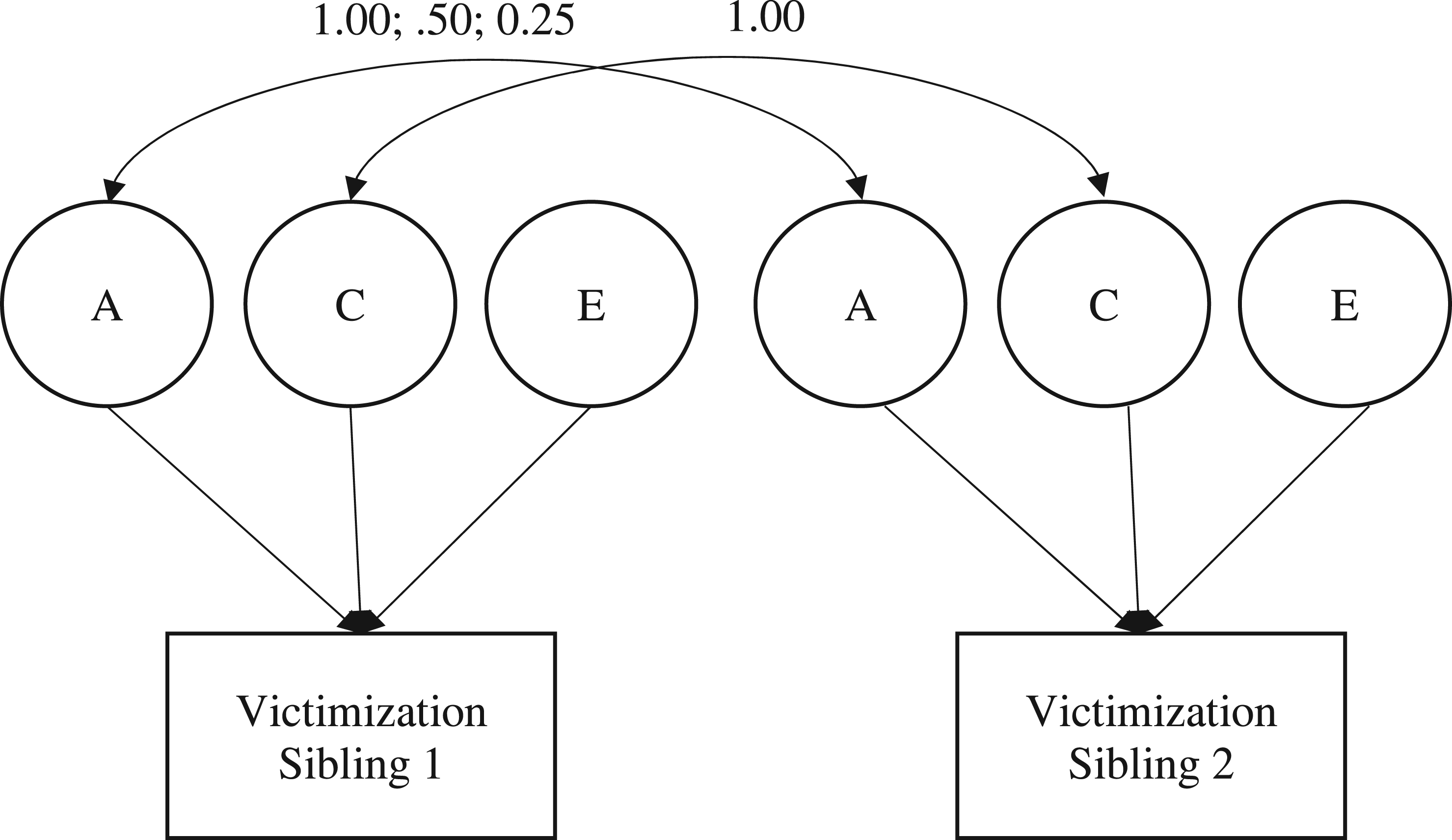
Balloon diagram of the additive genetic variance (A), common (or shared) environmental factors (C), and specific (or nonshared) environmental factors plus measurement error (E) (ACE) model.
Results
The current study progressed in a series of interlinked steps. First, we examined whether gender-specific pathways to personal victimization, violent victimization, intimate partner violence, and sexual victimization are present in each wave of data by estimating a series of univariate ACE models. For each univariate model, two equations were estimated. The first series of models were baseline models in which we estimated separate additive genetic, shared environmental, and nonshared environmental variance components for males and females. We then tested for quantitative sex differences in the variance components by constraining the variance estimates of the phenotype between males and females to be equal allowing us to examine estimates for the full sample. The fit of the models was then compared with the model fit diagnostic tools previously discussed which can be seen in Table 2. On top of examining the standard errors of each estimated component, if a p-value for the model is significant (p < .01), the fit of the constrained model is significantly worse than the fit of the more complex model. Therefore, as can be seen in Table 2, the model fitting results demonstrated that no quantitative sex differences were detected for any of the measures. 9
Model Fitting Results of the Univariate Models.

Notes: Bolded models represent models with best fit.
Abbreviations: Base = baseline model with sex differences, ep = estimated parameters, − 2LL = minus two times the log-likelihood, df = degrees of freedom, AIC = Akaike information criterion; best-fitting model in bold letter. ACEq = full model estimating sex-specific parameter estimates for additive genetic, shared environmental, and nonshared environmental influences, ACE = full model estimating parameter estimates for additive genetic, shared environmental, and nonshared environmental influences with parameter estimates held constant across sexes, AE = nested model including parameter estimates for additive genetic and nonshared environmental influences, CE = nested model including parameter estimates for shared environmental and nonshared environmental influences; E = nested model only capturing the influence of the nonshared environment. The sample used to conduct these analyses consisted of same-sex MZ twin, DZ twin, full-sibling, and half-sibling pairs.
Table 3 contains the results of the univariate ACE models examining the victimization measures. As can be seen in the table, the shared environment does not appear to explain variance in any of the victimization outcomes. For Wave 3 personal victimization, 46.1% of the variance for males and females was explained by additive genetic factors with the remainder (53.9%) explained by nonshared environmental factors. For Wave 4 personal victimization and the stability in personal victimization measures, all the variance is explained by nonshared environmental factors.
ACE Model Parameter Estimates for Victimization.

Note: 95% confidence intervals in brackets; results are presented for the best-fitting model. The sample size is based on the number of sibling pairs.
Moving further down the table, the results of the models examining the etiology of violent victimization are presented. For Wave 3 violent victimization, Wave 4 violent victimization, and stability in violent victimization, all the variance is explained by nonshared environmental factors.
Turning to the results examining the intimate partner violence measures, for Wave 3 intimate partner violence, 29.9% of the variance for males and females was explained by additive genetic factors with the remaining variance explained by nonshared environmental factors (70.1%). All the variance in the Wave 4 intimate partner violence measure was explained by nonshared environmental factors. Finally, for stability in intimate partner violence, 20.3% of the variance for males and females was explained by additive genetic factors with the remaining 79.7% explained by the nonshared environment.
Unlike the previous measures of victimization, only one measure of sexual victimization was available in the Add Health data at Wave 4. Therefore, we were unable to examine differences between waves as well as stability in victimization. For Wave 4 sexual victimization, 46.7% of the variance was explained by additive genetic factors for both males and females, and the remaining 53.3% was explained by the nonshared environment. Lastly, for repeat victimization, 100% of the variance was explained by the nonshared environment.
Discussion
In the past few decades, studies examining the origins of criminal victimization have expanded to investigate risk factors that might explain male-female differences in victimization. As this area of research has expanded, more risk factors of victimization ranging from personality traits to environmental risk factors have been identified as being moderated by biological sex (e.g., Fisher et al., 2002; Fisher et al., 2010; Reyns et al., 2016). The research questions, therefore, have shifted away from whether there are male-female differences in victimization to what are the risk factors that distinguish these two groups? The current study added to this line of research by using behavioral genetic methods to assess whether the magnitude of genetic and environmental influences on adult victimization differs between males and females.
The results presented herein suggest that there are likely no significant quantitative genetic and environmental sex differences in the etiology of adult victimization. None of our models detected a significant difference between males and females in the proportion of variance in victimization that was explained by additive genetic, shared environmental, and nonshared environmental influences. A possible explanation for this null finding may lie in the results of studies examining the link between age and victimization. To be specific, previous research has shown that as individuals age, they are less risk-prone and less likely to engage in criminal behavior and, therefore, are less likely to be victimized (e.g., Sant’Anna et al., 2016). Due to the fact our sample at Waves 3 and 4 was well into adulthood and, on average, in their mid- to late-twenties (x̄ ≈ 28; range = 24–34) by Wave 4, it may be that this natural “aging out” effect of crime reduced the differences in risk factors between males and females in adult victimization leading to our null finding. Future research should examine whether risk factors associated with male and female victimization experiences are dependent on the age of the respondents as well as whether they engage in criminal behavior.
Additionally, genetic factors were found to significantly influence some of the victimization measures for both males and females. Specifically, the models examining Wave 3 personal victimization, Wave 3 intimate partner violence, stability in intimate partner violence, and Wave 4 sexual victimization were all revealed to be significantly influenced by genetic factors. Variations in the remaining measures of victimization were totally explained by the nonshared environment. These findings have important implications for future victimization research and theory. For example, the differences in results between waves of personal victimization and intimate partner violence suggest that even within the broad category of “adulthood,” there may be significant developmental phases that need to be accounted for in future research examining the etiology of adulthood victimization. To illustrate, approximately 46% of the variance in Wave 3 personal victimization, when the sample was in their late teens to early twenties, was explained by genetic factors. However, once that same sample reached their mid- to late-twenties, genetic factors were shown to no longer significantly impact personal victimization. A similar trend was revealed for the models examining intimate partner violence. Therefore, from these analyses, it is possible to conclude that as one ages the importance of nonshared environmental factors increases. These findings fall in line with prior research showing similar trends of influence of the nonshared environment as individuals age (e.g., TenEyck & Barnes, 2018).
It is interesting to note there are two victimization measures that did not follow a similar trend – the sexual victimization measure and violent victimization measures. To be specific, the Wave 4 sexual victimization measure was the only Wave 4 measure to reveal significant genetic influences. Further research is needed to understand why genetic factors may influence sexual victimization farther into adulthood than other types of victimization. The results examining violent victimization were also markedly different from the other types of victimization to be measured. Genetic factors were revealed to not significantly influence violent victimization at Waves 3 and 4 as well as the stability victimization measure. This result is noteworthy as the majority of evolutionary work that discusses evolutionary theory, and the non-random selection of genetic variants has focused on violent victimization (e.g., Buss, 2005; Daly & Wilson, 1997). One possible explanation for these null results may be that the results are a consequence of the sampling method and the way in which “violent victimization” is measured. Add Health is a school-based sample meaning that the initial population from which Add Health drew its sample were adolescents who were attending school. More than likely, this sample would not contain individuals who were engaging in seriously risky acts that would increase their risk for seriously violent victimizations. Therefore, the current sample may not be representative of the population that would most likely be violently victimized. Additionally, the majority of evolutionary work that has been done on this topic has focused specifically on homicide victimizations (e.g., Buss, 2005; Daly & Wilson, 1997). It is possible that the conclusions drawn from previous studies do not extend to other types of violent victimizations and, therefore, would explain the difference in results.
It is important to note that although the shared environment was not significant for males or females in any of the models in this study, these null findings do not negate the importance of contextual-level factors. Rather, the null findings suggest that future research examining the influence of potential community-based or contextual-level factors should be examined as an interactive effect with individual-level factors. To explain, the difference between shared environmental risk factors and nonshared environmental risk factors is very fine. The nonshared environment is typically thought of as differences in experiences of environmental factors between siblings, such as when siblings have different peers. However, the nonshared environment can also arise when siblings interpret the same event or experience differently from one another (Turkheimer & Waldron, 2000). For example, siblings may react differently to an event they both experience such as exposure to neighborhood violence and parents divorcing. Therefore, studies demonstrating that the effect of these structural-level factors are contingent on the individual experiencing them, is not unexpected and establishes how these factors should be investigated in the future – not as a universal constant but as contingent on the individual. This finding likely does not come as a surprise as much of the research that has examined contextual-level factors have shown them to be contingent on individual-level factors such as marital status (e.g., Dugan, 2003; Dugan et al., 2003; Xie et al., 2012).
With these findings in mind, there are a few limitations that need to be addressed in future research. First, the victimization measures used in this paper are based on self-reports which inevitably raise concerns over the validity and reliability of the measures (Krohn et al., 2010). Even so, these victimization measures have been used repeatedly in prior research and have been shown to be reliable and valid (e.g., Barnes et al., 2012). Future research would benefit from comparing the current results to those examining the etiology of official records of victimization. Lastly, the current study only examines quantitative sex differences in the etiology of victimization and does not examine potential qualitative differences. As has been discussed previously, quantitative sex differences refer to differences in the magnitude of genetic, shared environmental, and non-shared environmental influences between the sexes. In contrast, qualitative sex differences refer to sex differences in the actual genetic or shared environmental factors influencing the analyzed phenotype. Future research should use other genetically informed methods to examine the differential effect of potential risk factors of victimization for males and females.
As research on male- and female-specific pathways to victimization expands, results of behavioral genetic models, such as those presented here, may be used as a guiding framework from which to more fully specify sex-specific risk for victimization. The models herein revealed the importance of genetic and nonshared environmental influences in explaining adult victimization experiences. Findings such as those presented in the current study support calls for theoretical refinement and the introduction of interdisciplinary methods to the study of victimization, including methods used by behavioral geneticists and evolutionary psychologists.
Supplemental Material
sj-docx-1-evp-10.1177_14747049241267950 - Supplemental material for Sex Differences in the Etiology of Victimization in Adulthood
Supplemental material, sj-docx-1-evp-10.1177_14747049241267950 for Sex Differences in the Etiology of Victimization in Adulthood by Bridget Joyner-Carpanini and Kevin M. Beaver in Evolutionary Psychology
Footnotes
Acknowledgments
This research uses data from Add Health, a program project directed by Kathleen Mullan Harris and designed by J. Richard Udry, Peter S. Bearman, and Kathleen Mullan Harris at the University of North Carolina at Chapel Hill, and funded by grant P01-HD31921 from the Eunice Kennedy Shriver National Institute of Child Health and Human Development, with cooperative funding from 23 other federal agencies and foundations. Special acknowledgment is due to Ronald R. Rindfuss and Barbara Entwisle for assistance in the original design. Information on how to obtain the Add Health data files is available on the Add Health website ( ). No direct support was received from grant P01- HD31921 for this analysis.
Declaration of Conflicting Interests
The author(s) declared no potential conflicts of interest with respect to the research, authorship, and/or publication of this article.
Funding
The author(s) received no financial support for the research, authorship, and/or publication of this article.
Supplemental Material
Supplemental material for this article is available online.
Notes
References
Supplementary Material
Please find the following supplemental material available below.
For Open Access articles published under a Creative Commons License, all supplemental material carries the same license as the article it is associated with.
For non-Open Access articles published, all supplemental material carries a non-exclusive license, and permission requests for re-use of supplemental material or any part of supplemental material shall be sent directly to the copyright owner as specified in the copyright notice associated with the article.
