



Abstract
On the surface, fear and humor seem like polar opposite states of mind, yet throughout our lives they continually interact. In this paper, we synthesize neurobiological, psychological, and evolutionary research on fear and humor, arguing that the two are deeply connected. The evolutionary origins of humor reside in play, a medium through which animals benignly explore situations and practice strategies, such as fight or flight, which would normally be accompanied by fear. Cognitively, humor retains the structure of play. Adopting a view of humor as requiring two appraisals, a violation appraisal and a benign appraisal, we describe how fear-inducing stimuli can be rendered benignly humorous through contextual cues, psychological distance, reframing, and cognitive reappraisal. The antagonistic relationship between humor and fear in terms of their neurochemistry and physiological effects in turn makes humor ideal for managing fear in many circumstances. We review five real-world examples of humor and fear intersecting, presenting new data in support of our account along the way. Finally, we discuss the possible therapeutic relevance of the deep connection between humor and fear.
Fear and humor seem polar opposites: Fear is generally perceived as a negative emotion while the experience of humor is positive. Fear is energizing and stressful, activating our sympathetic nervous system and flooding our bloodstream with adrenaline and cortisol (Panksepp & Biven, 2012). Humorous amusement, on the other hand, is palliative, involving soothing endogenous opioids (Manninen et al., 2017). Fear is prototypically involved in life-or-death situations that require immediate action (“fight-or-flight”), while humorous amusement is associated with times of leisure (Gervais & Wilson, 2005). The two are such seemingly opposed states of mind that we should hardly ever expect them to intersect. Yet throughout our lives, they continually do just that.
For example, one of the first games that parents play with their child across cultures is some version of peekaboo, during which the baby's fearful startle from seeing their caregiver disappear and reappear quickly turns to amused laughter (Fernald & O’Neill, 1993). When the child gets a little older, they may graduate to playing with the fears of others through scare pranks, which may entail hiding in a room until their friend enters it and then jumping out to scare them for their own amusement. Anyone who has watched a horror film with others or walked through a haunted house with their friends knows that particularly impactful jump scares during such activities are similarly often followed by bouts of laughter, a fact that studies of audience responses at haunted houses verify (Andersen et al., 2020).
Fear may be the single most extensively studied emotion, with a lot known about its character, purpose, and evolutionary origin (LeDoux, 2014; Öhman & Mineka, 2001). Theories of humor, amusement, and laughter go back centuries, and recent years have also seen considerable advances in our scientific understanding of these phenomena (Polimeni & Reiss, 2006; Warren et al., 2020). The paradoxical fact that some situations that lend themselves to fear also lend themselves to humor has long been known, and the increasing popularity of the horror-comedy film genre only makes this relationship more apparent (Carroll, 2022). However, no account of the phenomenon has yet been advanced which adequately explains all of the aforementioned examples of fear and humor colliding with one another. We attempt to provide such an account here.
In this paper, we synthesize neurobiological, psychological, and evolutionary research on fear and humor, arguing that the two are deeply connected. The evolutionary origins of humor lie in play, a medium through which animals benignly explore situations and practice strategies, such as fight or flight, which would normally be accompanied by fear. Cognitively, humor retains the structure of play. Adopting a view of humor as requiring two appraisals, a violation appraisal and a benign appraisal, we describe how fear-inducing stimuli can be rendered benignly humorous through contextual cues, psychological distance, reframing, and cognitive reappraisal. The antagonistic relationship between humor and fear in terms of their neurochemistry and physiological effects in turn makes humor ideal for managing and coping with fear in many circumstances. Excessive fears and phobias are a significant source of psychological pain for many and may stand in the way of personal growth and fulfillment (Nesse, 2019). Humor can help us approach the things that scare us, transforming them into occasions for playful recreational fear. We review five real-world examples of humor and fear intersecting, presenting new data in support of our account along the way. Finally, we discuss the therapeutic relevance of the deep connection between humor and fear.
Fear: What Makes Scary Things Scary?
Fear has long been considered one of a limited set of emotional systems that are shared not just among the mammalian clade but among most vertebrates, testifying to its archaic nature. This has been richly documented by Jaak Panksepp and others in the field of affective neuroscience (see Panksepp & Biven, 2012). More recent arguments have offered dissenting views, suggesting that human fear specifically is more evolutionarily novel, though it involves neural circuitry designed for detection of threats which are quite ancient (see LeDoux, 2022). What does seem clear is that fear is generated by a coherently operating brain system that runs from the periaqueductal gray in the midbrain through the anterior and medial hypothalamus to the amygdala and back again while also interacting with higher cortical brain regions (LeDoux, 2022; Panksepp, 1998, 2003; Panksepp et al., 2011). Chemically, it involves a cascade of stress hormones, including adrenaline, noradrenaline, and cortisol (Panksepp & Biven, 2012). What makes peekaboo, scare pranks, horror films, and haunted houses alike capable of activating this emotional system?
Functionally, the primary purpose of fear is to prepare us to deal with a potential threat (Adolphs, 2013; LeDoux, 2022). This is evident from the physiological processes involved in fearful states. When we are in a state of fear, stress hormones activate our sympathetic nervous system, preparing us to flee or fight. Heart rate rises, and blood is diverted from the digestive system to the large muscle groups, which can cause dry mouth and a sensation of butterflies in the stomach. Our pupils dilate to take in as much visual information as possible. Goosebumps erupt, an “atavistic relic from a time when we were covered with fur and piloerection caused the fur to stand on end, defensively making us look bigger and more fearsome” (Clasen, 2017, p. 26). Cognitively, our attention becomes sharply focused on the potential threat. All of this happens quickly and automatically, largely outside of conscious control (Öhman & Mineka, 2001).
The capacity for some variety of fearful experiences seems innate, as evidenced by the fact that electrical stimulation of the relevant brain regions can produce the full gamut of fear responses in animals that have been reared in complete safety (Panksepp & Biven, 2012). From birth, however, only a very limited set of unconditioned stimuli can elicit fear. Pain is an innate trigger of fear (Panksepp, 2000). So are “startling” stimuli like loud noise or sudden movement—things that can elicit a reflexive “startle response” from us, where we tense up, bend our limbs, and move our head away in avoidance (Ladd et al., 2007). The startle response predates fear evolutionarily, but a startle typically leads to fear in animals that possess this emotion, even if only momentarily. Already being fearful, in turn, amplifies the startle response, making it more violent and easier to trigger. This is called a “fear-potentiated startle.”
Peekaboo and scare pranks both capitalize on the startle response. In a popular version of peekaboo, the parent will cover their face and then periodically “reappear” to the infant while saying “peekaboo” in an enthusiastic, high-pitched voice (Bruner & Sherwood, 1976). This can cause a mild startle in young infants, especially in the first half of their first year. Since Piaget (1954), it has been speculated that this may be because they have not yet developed “object permanence,” an understanding that things continue to exist even when they cannot see them. When the parent's face suddenly reappears from behind their hands, the infant may thus find this genuinely startling. Gradually, however, they habituate and start expecting the parent's “reappearance,” at which point they stop being startled and instead become amused (see Andersen et al., 2023).
Scare pranks take this to the next level. While scare pranks have not yet been the subject of serious academic study to the same extent as peekaboo, the phenomenon is amply documented online on websites like YouTube, where hundreds of thousands of people have uploaded videos of themselves startling their partners, friends, family, or even strangers. A simple version involves sneaking up on someone who is inattentive and then startling them with a loud noise like a scream. Alternatively, the prankster may hide in a room and wait until the victim enters, at which point they jump out to startle the victim, employing both sudden movement and loud noise. Sometimes it takes the victim a long time to overcome the instinctual fear response that accompanies their startle. They may grab at their pounding chest or pace around, waiting for their breathing to calm down and their adrenaline rush to subside.
Yet, it is not only startling things that can lead to fear. While only a very limited number of unconditioned stimuli can evoke fear in us from birth, Joseph LeDoux has documented how fear works in tandem with memory, centrally involving the hippocampus, to create conditioned fear responses (LeDoux, 1996, 2002, 2022). Through associative learning, we thus come to fear many things throughout our lives. Many of the things people learn to fear are near-universal and reflect dangers that our ancestors faced throughout our evolutionary history. This has caused some researchers to postulate “prepared” fears (Seligman, 1971). Prepared fears are not “hardwired” like our fear of loud noises or sudden movement, but they are nevertheless proposed to be genetically transmitted as predispositions that need environmental input to be activated. They include snakes, spiders, blood, and the dark.
Scare pranks and horror media both make use of prepared fears. Pranksters may spice up their scare pranks by not jumping out themselves to scare their victim but instead throwing a spider toy at them, hoping to activate a likely fear of theirs. Similarly, horror media routinely invoke prepared fears, often in incarnations that are exaggerated or counterintuitive for increased salience, including giant spiders or supernatural monsters (Clasen, 2017). Monsters are usually supercharged versions of ancestral predators, constituting a kind of “supernormal stimuli” (Clasen, 2012; Morin & Sobchuk, 2022). Monsters may also combine multiple different sources of threat, making them especially scary. The vampire, for instance, is simultaneously a predator with sharp teeth and homicidal intent, a parasitic disease-bearer, and a live corpse, playing on multiple prepared fears. Audiences already having been made fearful by the objects and events of a horror film make its jump scares even more effective (by way of the fear-potentiated startle).
In one sense, fear is an implicit appraisal that a stimulus is a threat, but such immediate, intuitive appraisals are very different from the kind of deliberative, conscious judgments that our expanded neocortex makes possible (Asma & Gabriel, 2019). In cognitively mature humans, such judgments are able to elicit fear as well, hence we can be afraid of abstract and entirely novel things that neither evolution nor previous experiences have directly prepared us for, like the prospect of nuclear war. However, fear long predates these kinds of judgments both phylogenetically and ontogenetically, and it persists even in animals that have been surgically deprived of their neocortex at a young age (Panksepp & Biven, 2012). Moreover, fear can persist directly in the face of such judgments, hence we can be acutely frightened by a horror film despite knowing well it is fiction, not a real threat.
Humor: What Makes Funny Things Funny?
Much less is known about humor than fear from a neurobiological perspective, but in recent years a rough picture of its neural correlates has emerged. Humor detection critically relies on higher brain regions, centrally including certain parts of the prefrontal cortex (Grodal, 2014), while the humorous amusement that follows involves deeper subcortical structures (Martin, 2007). As with most emotions, the neural pathways of amusement reach at least all the way down to the periaqueductal gray in the midbrain, enlisting many limbic structures along the way, including certain nuclei of the thalamus and the nucleus accumbens, both of which have been tied to reward processing and feelings of pleasant emotion in general (Farkas et al., 2021; Mobbs et al., 2003; Taber et al., 2007; Wild et al., 2003). Like fear, humorous amusement also seems to involve the amygdala (Moran et al., 2004).
While fear and humorous amusement enlist some of the same brain structures, they are complete opposites in terms of their neurochemistry and physiology. Whereas fear releases stress hormones that can send our sympathetic system into overdrive, amusement involves endogenous opioids that have an opposite, pleasantly soothing effect (Manninen et al., 2017). Inherently rewarding, it also enlists dopamine (Mobbs et al., 2003). Fear causes us to tense up, in preparation for immediate action, whereas laughter, the main physiological effect of amusement, involves involuntary, spasmodic contractions of the diaphragm that are often accompanied by a relaxation of other muscle groups (Martin, 2007). Hence, people in the grip of an intense, vigorous humor response may fall to the floor with laughter, and the expression “weak with laughter” is common to many languages (Overeem et al., 1999).
Since antiquity, scholars have argued about what causes laughter and amusement in us—what kinds of things tend to strike us as funny. Historically, three theories have dominated the literature: the superiority theory (e.g., Hobbes, 1651), which holds that humor relies on a feeling of superiority; the release theory (e.g., Freud, 1916), which holds that humor is the release of pent-up nervous energy; and the incongruity theory, which is historically associated with such thinkers as Aristotle (1895), Kant (1911), Schopenhauer (1818), and Kierkegaard (1846). While the superiority and release theories are now largely considered scientifically disconfirmed, most humor theorists working in the fields of psychology, philosophy, and aesthetics today subscribe to some derivation of the incongruity theory (see Morreall, 2009, 2016; Smuts, 2006).
Broadly speaking, the incongruity theory holds that humor depends upon “incongruity,” something that violates our expectations or our normal mental patterns (Morreall, 2009, p. 11). A joke, for instance, is often theorized to be humorous to the extent that its so-called “set-up” successfully sets up an expectation that its “punchline” then violates. While incongruity in the sense of something surprising or atypical may be required for humor, however, it is far from sufficient. Why, for instance, is slipping on a banana peel stereotypically considered humorous while unexpectedly winning the lottery or suddenly being attacked by a rabid dog in the street is not, despite all three scenarios being both incongruously surprising and atypical? By itself, the traditional incongruity theory is incapable of answering such questions and thus distinguishing that which is humorous from that which is not.
A modern derivation of the incongruity theory is the benign violation theory, originally formulated by Thomas Veatch (1998) but significantly expanded upon by the psychologists Peter McGraw and Caleb Warren (2010). The benign violation theory specifies that the violations required for humor must have a negative valence instead of simply departing incongruously from our expectations or our normal mental patterns, hence slipping on a banana peel is typically considered humorous while winning the lottery is not. In other words, for something to be humorous it must violate not just our expectations of how things usually are but rather our normative sense of how they “ought” to be. Such a negative violation, not mere surprise or atypicality, is the precondition for humor.
For such a violation to elicit humor instead of a purely negative emotion like fear, the benign violation theory further specifies that it must ultimately be appraised as benignly non-worrisome, hence being attacked by a rabid dog in the street is not typically thought humorous. According to the benign violation theory, for something to be humorous it must thus simultaneously be appraised as a violation (i.e., somehow wrong, bad, or threatening) yet benign (i.e., ultimately normal, harmless, or okay). Violations come in many forms, including linguistic norm violations (e.g., wordplay), social violations (e.g., embarrassment humor), or moral violations (e.g., black humor). In a series of experiments, Warren and McGraw (2016) have demonstrated that this theory is better than other prominent conceptualizations of incongruity at predicting what people will find funny.
The view of humor as consisting in benign violations explains what makes some scary things funny. Given that fear is an implicit appraisal of threat, all that is needed for something scary to become humorous is a simultaneous appraisal of benignity. The benign violation theory also helps us make sense of the connection between fear and humor by pointing to the strong continuities between animal play and humor. Since Darwin (1872), it has been recognized that the evolutionary origins of humor lie in mammalian play. Since potentially fear-eliciting stimuli feature prominently in the play of animals, delineating the relationship between animal play and humor helps explain how and why we evolved the ability to find some scary things funny, and it illuminates the conditions under which we do so.
Play: Why Do We Find Some Scary Things Funny?
Like fear, play appears to be governed by a coherently operating brain system that is shared by all mammals (Panksepp & Biven, 2012). The play system is not as well-understood as the fear system, but many of the subcortical structures implicated in play are the same ones that are thought to be involved in humorous amusement, including certain thalamic nuclei, the nucleus accumbens, and the amygdala (Siviy, 2016). As with amusement, play also depends on endogenous opioids along with dopamine. In other words, it seems that play and humor, below the hood of our neocortex, may rely on the same basic emotional circuitry (Panksepp, 2000). In this light, humor can be conceived as a cognitive elaboration of play in humans, a play of the higher mind that is rewarding because it taps into subcortical processes originally evolved to sustain a much simpler kind of physical play in mammals.
In non-human animals, play almost invariably takes the form of play fighting, or “rough-and-tumble play,” during which the participants will take turns physically violating each other's boundaries through tickling, wrestling, chasing, and the like (Aldis, 1975). Such play is adaptively functional in that it allows animals to explore what their own bodies can do and endure, training them in the vital skills needed for activities like actual fighting, while also serving as a medium for amicable social bonding. The mock attacks that constitute the backbone of rough-and-tumble play are benign versions of stimuli that would normally evoke fear and thus a legitimate fight-or-flight response in animals. In the safe and secure context of rough-and-tumble play, those stimuli undergo a kind of “hedonic reversal” in that they instead become a source of positive affect (see Grodal, 2014).
A number of contextual cues serve during rough-and-tumble play to ensure that all participants understand that all physical violations are intended as benign, ensuring no misunderstandings occur that could trigger a real fearful fight-or-flight response and perhaps escalate the play-fighting into actual violence. For instance, animals often move in exaggerated ways during rough-and-tumble play so that their physical violations are visibly more like caricatures of attacks instead of actual attacks (Palagi et al., 2015). Animals also have so-called “play signals,” evolved specifically to advertise the benignity of their violations. Human laughter is thought to have originated as such a play signal, with an evolutionary antecedent manifested in the distinctly laugh-like panting vocalization that accompanies the so-called “play face” of some of our related primates like chimpanzees (Gervais & Wilson, 2005; see Figure 1).

Play faces of juvenile chimpanzee, gorilla, and human.
The neurochemistry and physiology of play, and consequently humor, likely serve a similar function. While dopamine makes play rewarding, the soothing and palliative effect of endogenous opioids keeps any startles or minor pains sustained during play from eliciting genuine fear and a defensive fight-or-flight response (see Panksepp & Biven, 2012, pp. 371–3). As a cognitive elaboration of play in humans, humor replicates the structure of animal play but at a higher level of cognitive appraisals, allowing us to tap into those same subcortical circuits responsible for the inherently rewarding experience of play. When elicited by humor, we call this emotional component amusement, but its neurochemistry remains the same. While it is almost exclusively benign physical violations that evoke playful effects in animals, humor can take the form of many different kinds of benign violations.
Normally, any kind of violation (e.g., a scare) would evoke a negative emotion in us (e.g., fear), but if the violation in question is appraised as being ultimately benign then humorous amusement and laughter are elicited instead. Humorous amusement, originating from the depths of our subcortical play system, floods our brain with endogenous dopamine and opioids, which keeps our stress levels low and motivates us to explore and play with the violation in question. Our physical response of laughter in turn serves as a play signal, advertising to others that the violation is benign and inviting them to join us (McGraw & Warner, 2014, pp. 76–8). There is some evidence to suggest that the medial prefrontal cortex may be critical for the appraisals of benignity that can render a violation humorous, which would explain why this brain region seems prominently involved in humor detection (Grodal, 2014, p. 184).
It would make sense that the cognitive processing of the benign appraisal mechanism should be located close to the premotor areas of the prefrontal cortex where motor action is controlled. In this way, the benign appraisal may act as a gatekeeper for motor action, blocking our typical response to an apparent violation (e.g., fearful fight-or-flight in response to an apparent threat). Just as in animal play, contextual cues play a central role in determining which violations we appraise as benign and thus humorous. Something which we initially find purely threatening can be made humorous through placing it in a different context, through psychological distance, through reflective reappraisal, or through the process of cognitive reframing. We will tackle each of these ways in which scary violations can become benignly humorous in the following section, where we review a number of real-world examples of fear and humor intersecting.
As our examples will demonstrate, approaching the things that scare us through humor can help us transform them into opportunities for playful recreational fear. To be sure, we are not claiming that humor evolved specifically or exclusively to manage human fears, but only that it represents a widely employed and effective means of doing so. Like the play it evolved from, humor serves both explorative and social functions. Playing around with and exploring the things that normally scare us can offer us beneficial and even therapeutic practice in coping. Beyond this, garnering humor from fear often has a social dimension, potentially serving as a medium of amicable bonding with our peers. There is thus ample reason to dive deeper into the cognitive processes behind how exactly the things that scare us can be rendered benignly humorous.
The Cognitive Intersections of Humor and Fear
Peekaboo
While the game of peekaboo varies across cultures, it always involves four basic stages: initial contact (e.g., the parent establishes eye contact with the infant), disappearance (e.g., the parent covers their face with their hands or hides out of the infant's view), reappearance (e.g., the parent removes their hands from their face or reenters the infant's field of vision), and reestablishment of contact (e.g., the parent re-establishes eye contact, says “peekaboo!”, and laughs together with the infant) (Bruner & Sherwood, 1976; see Figure 2). Numerous ideas have been forwarded to explain why infants can find this game fear-inducing in the first half of their first year, invoking everything from a lack of understanding of object permanence to innate separation anxiety (see Kleeman, 1967). The simplest possible explanation is that the infant just finds the parent's sudden disappearance and reappearance startling.
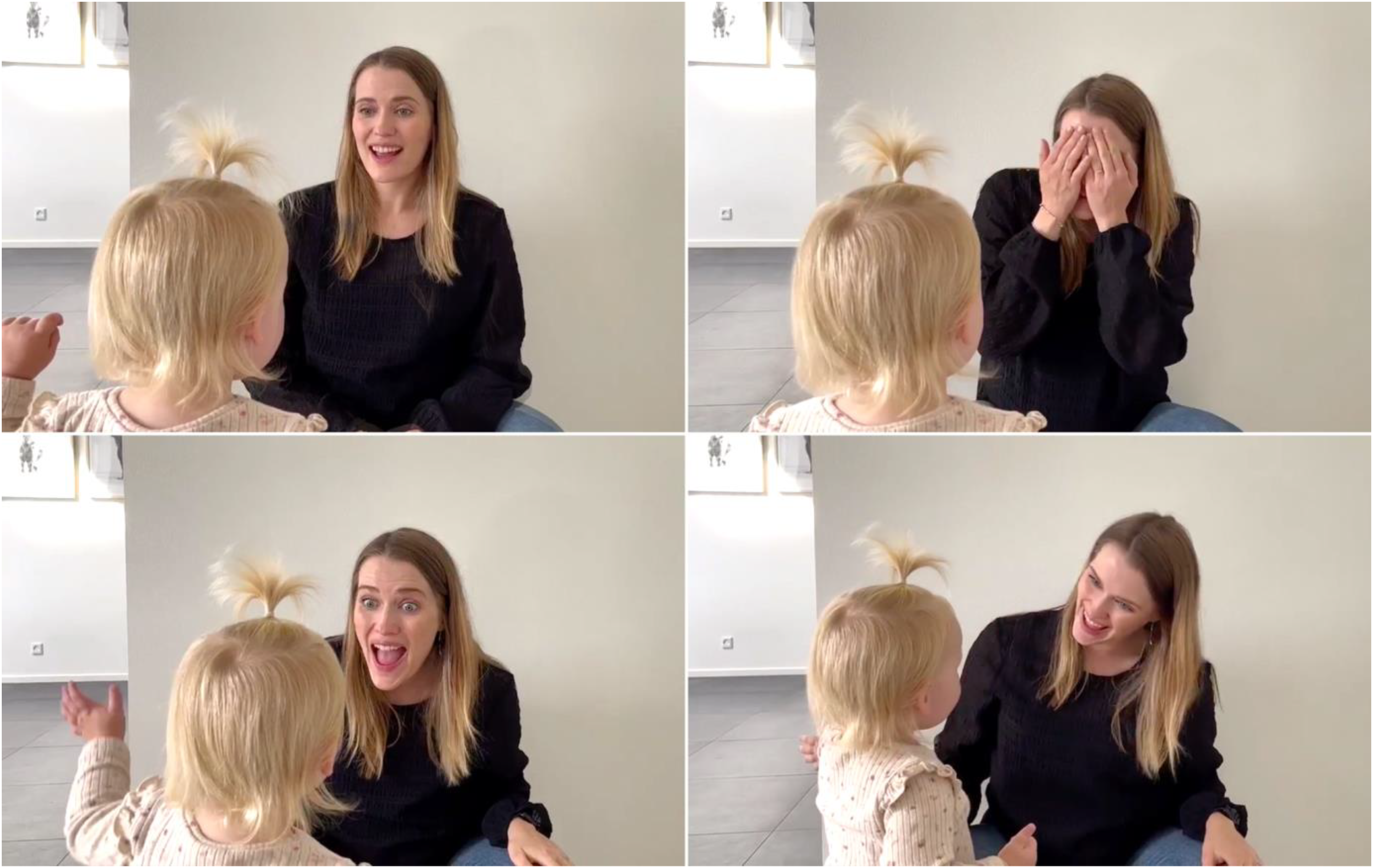
Picture sequence of the four stages of peekaboo.
Quickly, the infant comes to find the parent's disappearance and reappearance humorously amusing, laughing at it together with the parent. Surely, a major part of the explanation is that the infant habituates to the peekaboo routine and therefore no longer finds it startling. The game's repetitive nature is ideal for this purpose, with the same four basic stages of initial contact, disappearance, reappearance, and reestablishment of contact repeated in a predictable, stereotyped manner such that the infant comes to know what to expect (see Andersen et al., 2023). As such, what was before merely a violation, a distressingly unexpected and unexplained event, becomes benignly humorous since the child now knows there is really nothing to worry about. Instead, the routine becomes something to have fun and play with, serving as an early source of bonding between parent and child.
While the emerging familiarity of the peekaboo routine is likely part of what makes it benign, it cannot be the whole explanation. Parents also include an abundance of cues in the routine that serve to indicate its benignity to the infant. These would be unnecessary if benignity was only a matter of the infant expecting the routine. One contextual cue to the routine's benignity lies in the utterance of the phrase that the routine takes its name from in English, “peekaboo.” The parent may utter this phrase either after their reappearance, or they may time it such that they say “peek-a-” while still hiding and “-boo!” when revealing themselves in the routine's climax. The phrase uttered varies from language to language even though it is often half-nonsense: “titte-bøh!” in Danish, “inai-inai-ba!” in Japanese, and “Na-a-a-a-a-n ku!” in Xhosa, to name a few examples (Fernald & O’Neill, 1993).
It is specifically the way in which parents utter the phrase that signals the peekaboo routine's benignity to the child. Examining the phrases spoken by parents as part of their peekaboo routine in a sample of parents from both Western and non-Western cultures, Fernald and O’Neill (1993) found that they were characterized by inordinately high and variable pitch (see Figure 3). These are the precise characteristics that cross-culturally characterize “motherese,” the soft and upbeat tone that parents often take when addressing their infant (Hilton et al., 2022). These acoustic features are ideal for both holding the infant's attention and soothing them. In other words, the way in which parents utter the phrase “peekaboo” (or its equivalent in different languages) is ideally designed to signal the routine's benignity to the infant, reassuring them that there is nothing to worry about.

Pitch contour of a Danish peekaboo vocalization.
Moreover, parents also signal the routine's benignity to their infant by smiling widely at them while establishing initial contact and then reappearing at the routine's climax. The evolutionary origins of smiling are to be found in the “grin face,” or “bared-teeth display,” of our related primates (van Hooff, 1972). When displaying their grin face, primates keep their mouth closed or only slightly open while retracting their lips and the corners of their mouths. The grin functions as an appeasement display, used by a submissive animal towards a dominant to show deference and keep it from attacking. In some species, it may also be used by a dominant animal towards a submissive as a reassuring signal that they do not have to feel threatened. Human smiling, a general signal of good feeling and affection, still retains this function. Smiling during peekaboo thus reassures the infant that no real threat is at hand.
Parents performing the peekaboo routine may also laugh at the routine themselves, thereby signaling to their infant that the violation of their startling dis- and reappearance is meant to be benignly humorous. Laughter is contagious, and this is no evolutionary accident: When we laugh at a benign violation, we signal to others that it is an opportunity for explorative and bonding play that they should join us in having fun with (Gervais & Wilson, 2005). Between an infant and their caregiver, laughter may be especially contagious since they are already emotionally bonded. By laughing at peekaboo themselves, parents may empathetically activate their infant's humor system, effectively teaching them to find peekaboo funny through associative learning. Such a gradual expansion of our palette of violations that we find benignly humorous may happen continually throughout our lives.
Through all of these cues, parents thus prime their infants to find peekaboo benignly humorous instead of disconcertingly startling. As the infant habituates to the routine, they may stop finding it startling at all. Since this means that there is no longer a violation involved, it would thus no longer be humorous. To compensate, parents continually tweak the routine such that their infants can never perfectly anticipate what will happen. In their study of mother-infant peekaboo routines, Bruner and Sherwood were “struck by the skill of mothers in knowing how to keep the child in an anticipatory mood, neither too sure of outcome nor too upset by a wide range of possibilities” (1976, p. 283). In this way, mothers make sure that the routine retains some kind of violation at its center instead of veering into the territory of pure benignity, incapable of eliciting not just a startle but also humor.
While infants find the peekaboo routine humorous, it is never far from becoming too startling and thus upsetting instead of funny. In an experimental study, Parrott and Gleitman (1989) found that too large deviations from the expected routine reduced children's smiles and laughter in response. Too large deviations included the adult reappearing somewhere else than where they disappeared or swapping places with another person. The smaller successful variations that Bruner and Sherwood (1976) found parents used instead included varying the vocalization “peekaboo” or varying the timing of the disappearance and reappearance. Peekaboo, one of the earliest instances of humor enjoyment in the lives of many people around the world, thus relies on a close association with fear. In this sense, it may be considered the first instance of recreational fear in the lives of many, perhaps most people.
Accumulating evidence shows that most people throughout their lives engage in “recreational fear,” defined as “behaviors where people voluntarily seek out activities that elicit negative emotions and expect to derive pleasure from such emotions” (Clasen, 2023, p. 36). Such activities may be psychologically beneficial in that they allow us to practice dealing with our fear and the things that evoke it (Scrivner et al., 2021). For these activities to be tolerable, they cannot be too frightening. Yet to be fun, they must not be too tame either. They have to hit our “sweet spot of fear” between these two extremes (Clasen, 2023, p. 38; see also Bloom, 2021). As the very first recreational fear activity in the lives of many people, peekaboo is thoroughly on the side of humorous benignity, yet it may be considered the first step on the way towards later activities that feature more acute levels of fear and only occasional humorous benignity, like watching horror films or visiting haunted houses.
Scare Pranks
Scare pranks consist of a prankster scaring a victim for the sake of their own amusement, typically by triggering the victim's startle response. While the phenomenon is widely attested in modern times on video sharing platforms like TikTok or YouTube, where videos with titles like “BEST SCARE PRANK EVER (GUARANTEED EPIC REACTION)” rack up millions of views across diverse audiences, Ronald Simons (1996) has documented that the phenomenon exists not just across cultures but going far back in history. In Aristophanes's The Frogs (405 B.C.), for example, the slave Xanthias startles his master Dionysis for his own amusement by pretending to see a monster. Simons (1996) notes that in many cultures it is common for children to startle their mothers for fun. In this sense, children may thus graduate from being recipients of peekaboo when they are infants to pulling scare pranks themselves.
Scare pranks demonstrate that experiencing surprise is neither necessary nor sufficient for experiencing humor. In a scare prank, the person who is surprised (i.e., the victim) is not the person who is amused. For the surprised victim, the scare prank is rather aversive, at least at first, in that they experience a fearful startle, and Simons (1996) documents how some victims find the state of hypervigilance that follows deeply uncomfortable. By contrast, the person whose amusement the prank serves, the prankster, is not surprised by it. What they enjoy about it is not surprise, but the victim's fearfully startled response to what they believe momentarily is a potential threat. While there is no incongruous violation of expectations for the prankster, there is a violation in the sense of a negatively valenced event in which they can find humor because they know full well that it is actually benign.
Scare pranks have an antecedent in animal play in the form of mock ambushes. Especially common among (though not exclusive to) felids, including domestic cats, mock ambushes consist of the animal lying concealed in wait for another animal (e.g., one of its littermates in the case of domestic cats), then making a surprise pounce on the unwitting victim once they approach (Aldis, 1975, p. 41). Here too, the pleasure is for the sake of the animal that pounces, not the surprised victim, although the mock ambush might function as an invitation for further play. Scare pranks in humans can also lead to the victim joining in the fun and laughing at the incident, but this requires them to first overcome the state of fear triggered by their immediate startle response. Even after knowing they are safe, they may still be irritated or angry about the prank and hence not able to see it as benignly humorous.
For the victim of the scare prank, finding humor in it requires them to go through a process of cognitive reappraisal. The immediate startle and fear evoked in them by the scare prank is a so-called “primary appraisal” of threat. Primary appraisals are fast, automatic, and happen outside conscious awareness, setting the brain and body into a state of action-readiness (Oatley & Johnson-Laird, 2014). A fearful startle has a very visible and audible manifestation in the form of spasmodic defensive posturing and potentially a scream, and it is this reaction that the prankster seeks to evoke. The victim's primary appraisal of threat is then followed by a secondary appraisal, which involves conscious reflection. This is when the victim of the scare prank reassesses the situation and sees that they are not actually in danger, which may be accompanied by an appraisal of benignity and a consequent humor response (see Figure 4).

A scare prank.
The construct of psychological distance is relevant for explaining when scare pranks are considered funny. There is substantial literature documenting that psychological distance modulates our emotional responses to events (Soderberg et al., 2015), and McGraw et al. (2012) have shown that psychological distance can make an aversive stimulus benignly humorous. The two relevant dimensions of psychological distance here are temporal distance (between now and the event in question) and social distance (between the event happening to you or to someone else). While the victim of a scare prank is not likely to find their own fearful startle funny immediately after realizing they have been pranked, a little time (temporal distance) may soften the sting of the joke and they may come to see the funny side, perhaps egged on by the play signal of their prankster's laughter.
Since the prankster and any onlookers have social distance, they can enjoy the prank as benignly humorous immediately. However, too much social distance can render the prank tame. Seeing a video of a complete stranger being the victim of a scare prank may not evoke much emotion at all. To compensate for this, online videos of scare pranks may be more extreme than normal scare pranks. For one, they often feature victims with particularly vigorous and easily triggered startle responses, so-called “hyperstartlers” (Simons, 1996, p. 26). The title of the videos may promise a major startle (e.g., “GUARANTEED EPIC REACTION”), and Hobbs and Graffe note that some feature an “instant replay loop of the emotional reaction of the victim of the prank so that viewers can witness again (sometimes in slow motion or with a laugh track) the fear, shock, or distress of the victim” (2015, p. 8).
Online pranksters also spice up their scare pranks by intensifying the stimulus to which their victims are exposed. They may do this through targeting common phobias to increase the startle (e.g., throwing a toy spider at their victim) or by putting them through an elaborate fear-inducing scenario that lasts beyond an initial startle, such as dressing up as a monster and chasing the victim around. To investigate the thesis that online pranksters intensify their scare pranks in this way to overcome the social distance of third-party viewers, we had three independent raters, unaware of our research questions, code the top 100 most viewed scare prank videos on YouTube. Interrater reliability was measured as Light's Kappa (κ), which was above .75 for almost all items, indicating an “excellent” level of agreement between raters, and at least above .4 for all, indicating a “fair to good” level of agreement (Banerjee et al., 1999, p. 6).
All 100 scare prank videos involve a prankster startling at least one victim, and the vast majority involve either a monster of some kind, a prankster dressed up as something other than a monster, or an animal (see Table 1). While dressing up as a monster or throwing a toy animal at someone is a way to enhance the victim's startle response by targeting their fear, the non-monster costumes employed by pranksters are typically aimed at enhancing the startle by making it even more unexpected. One way the pranksters achieve this is through dressing up in costumes that will blend them into the environment, such as dressing up as a bush in a park. They also dress up as human-shaped inanimate objects like statues or mannequins and stand perfectly still only to suddenly lunge at passersby, who are thereby startled and have their sense of reality momentarily shattered as an inanimate object seems to have come alive.
Common Scare Tactics Employed in YouTube's 100 Most Popular Scare Pranks.
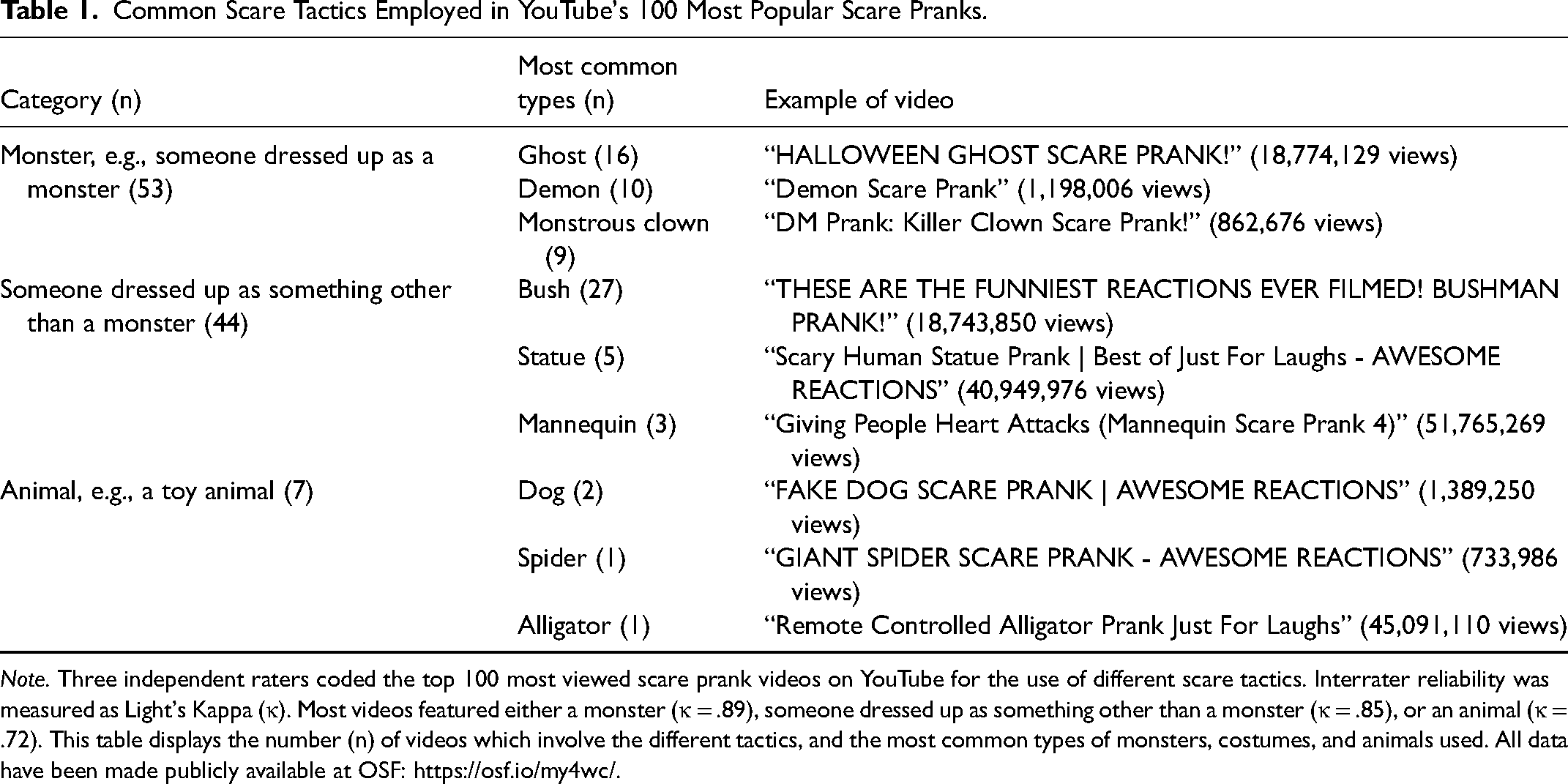
Note. Three independent raters coded the top 100 most viewed scare prank videos on YouTube for the use of different scare tactics. Interrater reliability was measured as Light's Kappa (κ). Most videos featured either a monster (κ = .89), someone dressed up as something other than a monster (κ = .85), or an animal (κ = .72). This table displays the number (n) of videos which involve the different tactics, and the most common types of monsters, costumes, and animals used. All data have been made publicly available at OSF: https://osf.io/my4wc/.
Scare pranks may be the only recreational fear activity that people participate in without their consent. The scare prank thrusts its victim into a fearful situation which they have no chance of knowing immediately is not actually threatening, hence it is unlikely to be enjoyed just when it happens. Instead, it can be appreciated in hindsight. In real life, most scare pranks are just simple cases of someone being startled shortly before reappraising the situation and realizing its benignity, but even in the case of the more extreme online scare pranks from YouTube only 52 of the videos involve a victim who is upset, annoyed, or mad after finding out they have been pranked (κ = .45) while 76 of the videos involve at least one victim who seems to enjoy the prank by virtue of smiling or laughing at it (κ = .86). This result underscores how even extreme fear can be transformed into benign humorous amusement through contextual change. For some of the videos, victims’ responses are so extreme, such as running away in sudden abject terror, that it leads one to wonder whether they are fake and the victim is in on the prank. This is, of course, a subjective judgment, but our raters guessed that 23 of the videos featured fake reactions by victims, with surprisingly good inter-rater reliability (κ = .71). In 76 of the videos, the prankster can be seen or heard finding their own prank funny (κ = .61).
Upon realizing one has been pranked, choosing to take the situation lightly and to see the humorousness in it can help people to destress by way of their humor response quelling the stressful effects from their fear response. Playing along and being a good sport can thus make the scare prank positive for victims. However, some online scare pranks are so extreme that few victims can be supposed capable of finding them benignly funny. One type involves playing a fake audio message on the victim's radio or television meant to convince them that a nuclear missile has been launched at their region of the world and that they are about to be annihilated by the blast (e.g., see mschmitt08, 2018). Instead of just targeting a startle response, this kind of scare prank seeks to induce the chilling fear and slowly building panic that such an imminent threat triggers.
While audiences may find such extreme online scare pranks funny because they occur to strangers, it is likely that they would find them less benignly humorous if they happened to people less socially distant for them—that is, people they had a preexisting bond with and sympathy for. Most would probably find it upsetting to see their own friends or family go through the emotional agony of believing they are about to die for such an extended period. Hence most people, in their own lives, opt for the much tamer scare pranks of simply hiding and then startling their loved ones for fun, only putting them through an emotional ordeal that lasts the milliseconds or seconds between an initial threat appraisal and a subsequent reappraisal. Even these tamer pranks nevertheless target fear, something which extreme scare pranks of the online variety only make more obvious.
Laughter After Jump Scares
Closely related to scare pranks are jump scares. Also called “film startles” or “cinematic shocks” when they occur on film, jump scares refer to the major startle effects that horror films and related media deliberately induce in their audience at designated moments (Clasen, 2021, p. 20). They have a long history in the film medium and beyond (Baird, 2000). When people watch horror films in a social setting such as at the cinema, it is not uncommon for humorous laughter to follow particularly successful jump scares (see Clasen, 2021, pp. 96–9). Empirical research shows that the same is true of guests at haunted house attractions. Andersen et al. (2020) found that guests at a commercial haunted house either smiled or laughed after jump scares a great majority of the time, between 74–77% (see Figure 5). These are cases when humor intrudes into what are otherwise extended periods of voluntarily experienced fear.

Audience reactions after jump scares.
Horror films immersively simulate for their audiences extended threat scenarios conducive to evoking fear. With their dark surroundings, awesome sound systems, and screens that fill their audiences’ visual field, modern movie theaters are designed for maximum immersion and minimal distraction (Cutting, 2021, p. 215). The stylistic features of mainstream Hollywood movies, such as continuity editing, are similarly designed to make audiences forget the fact that they are watching a movie at all, instead immersing them in the diegetic world of the film (Tan, 2013). Once immersed, the structure and content of horror films are ideally designed to stimulate audiences’ fear systems (Clasen, 2017). Given that already being scared amplifies the startle response (the “fear-potentiated startles” mentioned above), horror films are supremely situated to startle audiences with their jump scares.
Whereas horror films are generally designed to promote narrative immersion in the service of instilling fear, jump scares pull audiences out of the diegetic illusion of the film. The startle response orients us towards our immediate environment to prepare us for dealing with the potential threat that elicited it. While the filmmaker may have done everything in their power to make their audience forget that they are watching a film at all up until the startle, thereby intensifying their threat appraisals of the film's depicted events, audiences’ vigorous startle responses remind them of their actual setting, e.g., sitting safely in a movie theater surrounded by friends and other moviegoers. This frees them up to find their own startle response or the startle responses of their friends benignly humorous, appreciating that what caused their dramatic reactions were in fact no real threats at all.
The same is true of the jump scares guests experience at haunted house attractions. While haunted houses are generally set up to immerse guests in their make-believe world of fear-inducing sights, sounds, and events, the startles elicited by their jump scares pull guests out of that make-believe world to instead appreciate the benign humorousness of the frights they are experiencing (see Figure 6). However, it is not just the guests at haunted houses who find humor in their own reactions and the reactions of their friends; it is also the scares’ creators (Clasen, 2021, pp. 98–9). This has been our personal experience when conducting research at a haunted house: After a night of scares, the volunteers—actors, technicians, builders, makeup artists, and so on—gather to swap humorous stories about the most vigorous reactions they managed to elicit from guests that night.

Laughter following jump scare at haunted house.
This points to a significant continuity between scare pranks and horror media like haunted house attractions. In a sense, walking through a haunted house is consenting to be the butt of one long, elaborate scare prank, with the willing consent given here helping to make the mock threats that guests are subjected to benign—they cannot reasonably be angered by the jump scares since they have agreed to be scared and have even paid for the privilege. Having signed up to be scared, they may therefore be more likely to find their own startles benignly humorous. Just like the crews behind haunted house attractions, creators of other horror media, including horror authors and directors, also often seem to gain a humorous, benignly sadistic pleasure from scaring their audiences. As the horror icon Vincent Price is often quoted as saying, “It's as much fun to scare as to be scared” (Hamilton, 2007, p. 28).
It may also be the case that some smiles and laughter from audiences following jump scares are actually fear grins and nervous laughter. As has been mentioned, smiling is thought to have evolved from the submissive “grin face” seen in other primates, and humans still use smiles to signal appeasement like this, though these smiles may differ from humor smiles in subtle ways (Rychlowska et al., 2017). People sometimes mask their emotions with fake smiles (Ekman, 1985), and we sometimes laugh nervously even when we do not find a situation funny (Provine, 1996). These are all ways in which people use smiles and laughter as signals of benignity not because they genuinely find a situation to be benign but because they want to make it benign through emitting the signals. Indeed, it may be that some people laugh after their own startles to save face, trying to show that they are not truly bothered.
In practice, it is hard to distinguish fear grins and nervous laughter from genuine smiles and laughter. Andersen et al. (2020) found that the smiles and laughter of haunted house guests after jump scares were not correlated with their own reported enjoyment of the experience. However, most guests did report enjoying themselves, which is hardly surprising since they had paid to be there. While fear grins and nervous laughter may be mixed in with audiences’ genuine smiles and laughter after jump scares from horror media, this should not therefore distract from the fact that people do find startles, sometimes even their own, benignly funny under the right circumstances. This only further underscores the deep connection between fear and humor. As the volunteers at a haunted house attraction told one of the authors of this manuscript about their visitors: First they scream, then they laugh.
The fact that horror media continually pull audiences out of their immersive fictional worlds with their jump scares means that horror is a much more social genre than most. It is obvious how haunted houses are social since people typically walk through them in groups with their friends, but this is also the case with horror films. Instead of simply sitting in a dark theater next to people who are each individually immersed in the narrative of the film, as is the case with most genres, watching a horror film with others is a social event where audience members can laugh with each other about their moviegoing experience as it is happening. This is something horror films share with so-called “trash films” that are “so-bad-they’re-good” (Hye-Knudsen & Clasen, 2019). The entertainment when watching a horror film comes not just from the screen but also from the people you are with.
Since the neurochemistry and physiological effects of humor are antagonistic to fear, soothing and calming us down instead of winding us up, these natural moments of laughter after jump scares may help audience members hit their “sweet spot” of recreational fear when watching a horror film or visiting a haunted house. Intense scenes in a horror film may build up to a climax with a jump scare, which then pulls audiences out of the diegetic world and allows them to calm down and lighten up, giving them the opportunity to shed some of their pent-up nervousness before letting themselves become immersed in the film once again. This can stop the experience of fear from becoming too overwhelming. While these moments of fear being interspersed with laughter are a natural part of watching regular horror films, one subgenre of horror leans directly into it, namely horror-comedy.
Horror-Comedy
Horror-comedies powerfully demonstrate how the same thing can be scary in one context yet funny in another. As philosopher of film Noël Carroll (2022) notes, there is possibly no better example of this than the character of Frankenstein's monster as portrayed by the actor Glenn Strange in the 1940s. In 1944, Strange played Frankenstein's monster in the horror film House of Frankenstein, wearing the exact same make-up designed by Jack Pierce for Boris Karloff in the original 1931 film Frankenstein. Then in 1948, Strange once again portrayed Frankenstein's monster, but this time for the comedy Abbott and Costello Meet Frankenstein: “From being the object of horror, Strange was transformed, often from scene to scene, into a target of laughter. And yet nothing had changed in his look – neither his make-up, his costume, his gait, nor anything else in his behavior” (Carroll, 2022; see Figure 7).

Frankenstein's monster in horror vs horror-comedy.
While Frankenstein's monster originates from Mary Shelley's 1818 novel Frankenstein, it is the early Universal Studios movies starring first Boris Karloff and then Glen Strange that established the conception of the character that still looms in the public consciousness. As a monster, he is designed in part to evoke horror: An unnatural creature pieced together by body parts from many different corpses and then brought to life, his freakish size and strength make him an imposing and dangerous figure, and his sickly-colored, partly decomposed body parts with their highly visible scarring make him disgusting. His personality (in the Universal Studios movies, he has the “abnormal brain” of a dangerous criminal) combined with understandable rage at the unfortunate circumstances of his life sets him on a path of rampage, making him a fearsome threat to his surroundings.
We have already seen that psychological distance can make the difference between whether a stimulus is legitimately frightening or benignly humorous. Filmmakers routinely manipulate dimensions of psychological distance in their films through their narrative and stylistic choices to elicit their desired emotional response from audiences (Hye-Knudsen, 2018, 2022; Kjeldgaard-Christiansen, 2021). The original Frankenstein films do everything in their power to decrease audiences’ psychological distance to make the monster as fearsome as possible. One relevant dimension of psychological distance here is hypothetical distance, which refers to whether something is real or imagined. All else being equal, we have a stronger emotional reaction to things that seem real than unreal. All fiction is of course ultimately unreal, but works of fiction vary in their realism, the lengths to which they go to hide their artifice and feign authenticity.
The original Frankenstein films remove hypothetical distance by placing the monster in a realistic context. The monster is an impossible creature, but Frankenstein spends significant screen time alluding to the “science” behind its creation and setting up its creator as “a most brilliant … man of science” who can do the impossible. Moreover, the film is made in the style of classical Hollywood realism: The monster may be unreal and unnatural, but all characters around the monster react realistically to him, often with intense fear, portrayed by their actors in a naturalistic acting style. This also lowers social distance. In a fictional narrative, social distance refers to how relatable and sympathetic the characters are. Frankenstein surrounds the monster with sympathetic victims—like his creator's innocent fiance or the sweet, young girl Maria—for whom audiences can feel vicarious fear.
By contrast, Abbott and Costello Meet Frankenstein reaps humor from the monster by offering both hypothetical and social distance. The fictional nature of both the film itself and the monster is continually referenced—indeed, the characters in the film know the monster from other movies. Moreover, the monster is not surrounded by sympathetic victims here but rather farcical characters who deserve the terror it induces in them. For instance, Lou Costello's character is idiotically lured into the clutches of the monster in the sleazy pursuit of a woman he wants to have sex with. When he reacts to the monster with fear, his acting is stylized and exaggerated in the manner typical of comedies (Grodal, 2014). This is similar to how animals exaggerate their movements during rough-and-tumble play to signal their benignity. Costello's broad acting signals the audience not to take his fear seriously.
Another dimension of psychological distance that comes into play here is spatial distance. Obviously, filmmakers cannot control how far audiences are from the screen, but they can control audiences’ perceived sense of distance to depicted events through shot scale. Empirical research backs up the common-sense idea that shot scale has a determinative effect on audiences’ responses to a film, with close-ups typically triggering more emotional responses than long shots (see Bálint et al., 2020). All other things being equal, we generally have a stronger emotional response to objects and events that seem spatially close rather than distant. In Abbott and Costello Meet Frankenstein, Frankenstein’s monster mostly appears in distant long-range shots conducive to finding him benignly humorous instead of scary, though intermittent closer shots remove this dimension of distance (see Figures 8 and 9).

Shot scale of all shots with the monster in Frankenstein and in Abbott and Costello Meet Frankenstein.

Stills of the monster in all shot scales.
In moments when Frankenstein's monster is depicted with closer shots, the contextual cues that otherwise render him benignly humorous are removed and he is thus transformed back into a frightening monster. These moments help make the film a spoof instead of a parody, in Miller's terminology: There are frights strewn in between the laughs, just as many straight horror films strew in comic relief between their frights. In this sense, the comedy-horror genre nicely demonstrates the fine line between funny and scary. While Abbott and Costello garnered their laughs from Frankenstein's monster in the 1940s, the hybrid genre of horror-comedy continues to enjoy popularity, with filmmakers continually recontextualizing horror monsters for laughs, such as zombies in Shaun of the Dead (2004; see Eitzen, 2012) or vampires and werewolves in What We Do in the Shadows (2014).
What makes the blend of humor and fear so potent a combination for movies is their antagonistic relationship in terms of their neurochemistry and physiological effects. Inserting moments of comic relief in between scares may help audiences hit their “sweet spot” of recreational fear. Whenever an intense horror sequence has tensed up audiences by building up their fear levels, a moment of comic relief can keep this from teetering over into an unpleasant experience, with the palliative and soothing effects of humor taking the edge off the effects of sustained and pent-up fear. Since the horror-comedy genre leans heavily into mixing fear with humor in this way, it may be more palatable to some audiences than straight horror films. This may help explain why this subgenre has had such enduring appeal and why directors keep veering into this fruitful territory of mixing humor and fear.
Using Humor to Cope with Fear
The fine line between scary and funny has therapeutic relevance and points to the efficacy of humor as a coping mechanism for dealing with fear. There is a large body of research on humor as a coping mechanism (Pistoia, 2022). “Coping” here refers to the thought and behavior patterns people use to deal with stressful situations (Algorani & Gupta, 2023). Psychologists distinguish between four categories of coping mechanisms: Problem-focused (addressing the problem causing the stress); support-seeking (calling upon others for help); meaning-focused (attempting to change or understand the meaning of a situation); and emotion-focused (attempting to reduce the negative emotions associated with the situation). Humor is typically counted as belonging to the last category, although usually changing the emotional impact of a situation also involves changing its meaning, and how it is cognitively construed.
Consider an example taken from Panksepp and Biven (2012). A 2-year-old girl had been frightened by a boisterous puppy and was left afraid of all dogs, especially at night when she was trying to sleep and could hear them barking outside. Her father used humor to help her cope with her feelings: He sat with her one night and when the dogs barked, he waved his hand in a disparaging way, saying that “the doggies are stupid” and adding in a loud voice, “Be quiet, you stupid doggies! We don’t like you!” Then he laughed conspiratorially, telling her that the doggies were so silly because they could not understand and kept barking. … He said, “Do you know what I think about doggies?” His little daughter shook her head. He made a raspberry sound with his mouth, which made his daughter erupt in peals of laughter. After a while, the little girl joined in the game, saying that doggies were stupid and that they should “be quiet,” making a raspberry sound of her own. After a few days of playing with her dad, she began to play the game alone in her cot … In due course, her fear of dogs disappeared and she was able to pet a neighbor's dog without any signs of distress. (p. 201)
Just as we have described how filmmakers turn frightful monsters into spectacles of humor through the way in which they present them to viewers, the father here used cognitive reframing in order to make his daughter see the dogs’ barking as a benign sign of stupidity rather than a threat, thereby transforming dogs into sources of humorous amusement for her instead of fear.
There is experimental evidence to support the notion that people can and do use humor effectively to cope with fear in this way. Clasen et al. (2019) asked participants at a haunted house attraction (n = 280) to focus on either maximizing or minimizing their own fear. They found that the participants who sought to minimize their fear response were effective at doing so, and one of the most common coping strategies they reported using was humor, e.g., “I made fun of it … tried to see the funniness of it” (p. 66; see Table 2). The participants who sought to maximize their own fear response instead reported avoiding humor, trying not to see the funny side of the experience but instead taking it seriously, e.g., “I tried not to use humor … to distance myself from what was happening” (p. 66). In other words, people seem aware of humor as a mechanism they can and do employ to cope with fear.
Self-Described Tactics Employed by Guests at a Haunted House When Using Humor as a Coping Strategy Against Fear.

Note. 131 participants at a haunted house attraction attempted to minimize their own fear response. 19.1% of these reported (unprompted) that they had used humor as a coping strategy. Coping strategies are sometimes divided into cognitive, behavioral, and social strategies, but using humor to cope with fear may draw on both cognitive tactics (reframing), behavioral tactics (deliberately smiling and laughing), and social tactics (joking with others), as demonstrated by the above quotes from interviews with participants from the study. Data taken with permission from Clasen et al. (2019) and translated from Danish into English by the authors of this article.
Humor is such an effective tool for dealing with fear in particular because its effects are opposite, with its endogenous opioids having a soothing effect that counteracts the cascade of stress hormones involved in fear. Appraising threats in our midst as benign—“distancing ourselves” to see the funny side of what is happening, as a participant at the haunted house put it—is thus a powerful psychological resource. Of course, since fear is an adaptive mechanism that serves to keep us alive by alerting us to potential threats, it is an emotion that should at least sometimes be heeded. Taking a comically distant perspective on our own fear could theoretically be calamitous under the wrong circumstances. Yet, very few people suffer from too little fear in their daily lives. Rather, many suffer unnecessary stress from an oversensitized fear system (Nesse, 2019, pp. 67–83).
Treading this fine line successfully may involve using humor consciously and deliberatively instead of habitually as a mechanism for dealing with fear. The human fear system operates according to the “smoke detector principle”: Evolutionarily, the cost of not reacting to a real threat is worse than overreacting to a non-threat, so our fear systems have been adaptively tuned to err on the side of being overresponsive (Nesse, 2006). For many people, this leads to unnecessary stress and sometimes even debilitating phobias. Even though we may consciously know that our own feelings of fear are unfounded and excessive, this does little to help us since an emotion like fear is largely outside of conscious control. Here, humor can be an effective tool as a coping mechanism to bring our emotional response in line with what we consciously and rationally know would be a better reaction.
There is emerging evidence that recreational fear activities like watching horror films or visiting haunted house attractions can be psychologically beneficial by allowing people to practice dealing with their own fear and the things that evoke it (Scrivner et al., 2021). As Clasen et al.'s (2019) study of guests at a haunted house suggests, humor is one of the mechanisms people can use to calibrate their own fear response to hit their sweet spot: When it gets too scary, they can try to distance themselves and see the funny side of what is happening; when it gets too tame, they can once again try to take the experience seriously (see Figure 10). Becoming aware of humor as a coping strategy that works ideally for dealing with fear in this way may open up the realm of recreational fear to some of those who are too nervous about their own fear reaction to venture into this territory.

Humorous and fearful reactions at haunted house.
Researchers have already argued for recreational fear as an avenue of therapy: By willingly being exposed to the things they are afraid of through horror activities, people can build resilience to the negative emotions evoked (Scrivner, 2021). Actively using humor as a coping mechanism could be beneficial for these therapeutic uses of recreational fear. Watching horror movies or visiting haunted houses are great opportunities for practicing seeing the funny side of things that scare us—in fact, as we have noted, this happens naturally all the time when people laugh after jump scares or during moments of comic relief. The deep relationship between humor and fear is thus not just a curiosity of the human mind but also a potential treasure trove of new therapeutic practices. After all: Anything that has the potential to make us scream also has the potential to make us laugh.
Conclusion
The account we have presented sees humor and fear as closely connected at the cognitive level. We have built on existing neurobiological, psychological, and evolutionary research on the subject to make our case and marshaled preliminary evidence in favor of our account. Novel, testable predictions also follow. On our account, anything that has the potential to make people fearful should also be capable of evoking humor under the right circumstances. For something to be potentially scary, a threat appraisal is required, and if a simultaneous or subsequent benign appraisal can be triggered—for instance, through the manipulation of psychological distance—humor should be elicited. This is a prediction that can be empirically tested: So far, none of the experimental studies of the effect of psychological distance on humor have used potentially fear-inducing stimuli. If our account of how horror-comedies manipulate psychological distance to make audiences laugh at what are traditionally objects of fear is true, this should also be observable when comparing an entire corpus of horror-comedies to regular horror films instead of just using two specific examples, as we have done here.
We have also proposed that the antagonistic relationship between humor and fear at the neurochemical and physiological level makes humor an especially adept mechanism for managing and coping with fear. This should hold true above and beyond alternative means of coping. If instructed to attempt to quell their fear response to a horror film or a haunted house attraction either through using humor or simply through reminding themselves of its unreality, our account predicts that subjects instructed to use humor specifically should be more successful. This is a promising line of inquiry that could be pursued in the burgeoning field of recreational fear research. If humor is indeed a particularly powerful mechanism for managing fear, continuing this line of research has the potential not just to offer insights into how the human mind works but also to offer people actionable strategies and new therapeutic practices for managing and coping with fear in their everyday lives.
Footnotes
Acknowledgments
We would like to thank Sofie Thinggaard, Sofie Vittrup, and Peter Westergaard for assistance with the scare prank content analysis. We would also like to thank Bonnie and Felicia Kjeldgaard-Christiansen for demonstrating the four stages of peekaboo (Figure 2).
Declaration of Conflicting Interests
The authors declared no potential conflicts of interest with respect to the research, authorship, and/or publication of this article.
Funding
The authors disclosed receipt of the following financial support for the research, authorship, and/or publication of this article: This work was supported by the Carlsberg Foundation and by the Independent Research Fund Denmark (grant numbers 35891 and 0132-00204B, respectively).
