



Abstract
What features of people’s childhood environments go on to shape their prosocial behavior during adulthood? Past studies linking childhood environment to adult prosocial behavior have focused primarily on adverse features, thereby neglecting the possible influence of exposure to enriched environments (e.g., access to material resources, experiences with rich cooperative relationships, and interactions with morally exemplary role models). Here, we expand the investigation of childhood environmental quality to include consideration of enriching childhood experiences and their relation to adult prosociality. In two cross-sectional studies, we found promising evidence that enriched childhood environments are associated with adult moral behavior. In study 1 (N = 1,084 MTurk workers), we adapted an existing measure of enriched childhood environmental quality for retrospective recall of childhood experiences and found that subjects’ recollections of their enriched childhood experiences are distinct from their recollections of adverse childhood experiences. In Study 2 (N = 2,208 MTurk workers), we found that a formative composite of subjects’ recollections of enriched childhood experiences is positively associated with a variety of morally relevant traits in adulthood, including agreeableness, honesty-humility, altruism, endorsement of the principle of care, empathic responding to the plights of needy others, and charitable donations in an experimental setting, and that these associations held after controlling for childhood environmental adversity, childhood socioeconomic status, sex, and age. We also found evidence suggesting that some, but not all, of the relationship between enrichment and adult prosociality can be explained by a shared genetic correlation. We include a new seven-item measure as an appendix.
Introduction
Why are humans generous and helpful toward strangers? Notwithstanding the idea that impersonal human prosociality is the product of evolved social preferences (Fehr et al., 2002), recent research suggests that the developmental context in which children are reared may also shape the distinct patterns of prosociality that characterize social interaction (Mell et al., 2018). Here, we explore the possibility that adults’ tendencies toward prosocial behavior are influenced by exposure during childhood to an enriched environment, which may promote the development of generalized trust, moral identity, and conscience (Benson, 2003; Ianni, 1989; Leffert et al., 1998). By enriched environment, we mean an environment that features rich mutualistic relationships with kin and non-kin, abundant material resources, social institutions that inculcate moral values such as compassion, kindness, and humility, and an emphasis on investing in long-term outcomes rather than short-term gains. We also consider past research on the influence of childhood environmental quality upon adult prosociality, beginning with a review of how past scholars have investigated the developmental origins of prosocial behavior.
Childhood Environmental Adversity as an Explanation for Adult Prosociality
Many researchers have conceptualized the influence of childhood environmental quality upon adult prosociality using conceptual tools from evolutionary biology. An evolutionary perspective on development suggests that adult phenotypes might be shaped during development by environmental cues that are present earlier in life. According to this view, which has been variously studied under the labels phenotypic plasticity, adaptive plasticity, and evolved calibration, people calibrate some of their traits and behavior in accordance with input from their local environment, which usually occurs during trait-specific developmental windows (West-Eberhard, 1989). Scholars argue that, for at least some traits, a plastic response to the environment enables organisms to strategically solve those recurrent adaptive problems that involve anticipated variation in the environment. For instance, plasticity has been proposed as an explanation as to why people vary in their personality traits (Buss, 2009), and differ in their reproductive behavior (Belsky, 2010).
Much of the evolutionary theorizing about plasticity in prosocial development has drawn on life history theory, which rests on the idea that phenotypic differences among individuals—including psychological differences—emerge in response to variation in the harshness and unpredictability of local environmental conditions, creating individual differences in so-called life history strategies (Figueredo et al., 2005). Life history strategies are frequently characterized as positions along a continuum that ranges from “slow” to “fast” (Ellis et al., 2009; Kaplan et al., 2000). Environmental harshness reflects environmental circumstances that produce high rates of extrinsic morbidity-mortality, while unpredictability reflects the availability of fitness-relevant resources such as food and shelter (Brumbach et al., 2009). Although morbidity-mortality and unpredictability are distinct dimensions within life history theory (Young et al., 2020), prominent empirical work on the relationship between early-life experiences and later-life outcomes has combined morbidity-mortality and unpredictability into a single measure of adversity (e.g., Mell et al., 2018; Wu et al., 2017). For the remainder of the article, we refer to the joint effects of environmental morbidity-mortality and unpredictability simply as adversity.
Adversity comes in various forms: poverty, threats of violence perpetrated by other members of the community, frequent changes of residence, delinquent peers, abusive family members, and neglectful parents are common examples. Children from adverse environments are thought to adopt fast life history strategies, characterized by a willingness to trade off large future gains in resources in favor of smaller gains that can be realized over shorter time horizons. In contrast, children from less adverse environments are thought to adopt slow life history strategies that are characterized by investments in growth and maintenance that pay off only later in life (Ellis et al., 2009).
Some psychologists have applied the principles of adaptive plasticity – and specifically life history theory – to adult prosocial development, claiming that environmental adversity shapes moral development in young people by encouraging them to adopt an exploitative social strategy (Sheskin et al., 2014). When people make moral decisions, after all, they must weigh the short-term benefits of exploitation against the long-term benefits of cooperation (Stevens et al., 2005; Trivers, 1971). For people living in adverse environments, some researchers have speculated, short-term gains are more valuable than long-term gains from cooperation because residents of adverse environments might not prosper long enough to enjoy the benefits of cooperation (Pepper & Nettle, 2017). Children who are exposed to harsher environments during childhood therefore might invest in exploitative social strategies to maximize their short-term gains, which causes them to become less cooperative during adulthood. Some research suggests this is the case: People who score higher on self-report measures that reflect the traits associated with a slow life history strategy – including the endorsement of altruistic motivations – are more likely to hold more prosocial attitudes towards out-groups, reflecting the slow life history strategy of engaging in long-term mutualistic behaviors that benefit kith and kin (Figueredo et al., 2011; but see Figueredo et al., 2020 for concerns about interpretations of this association).
However, studies to date on the links of childhood environmental adversity with measures of adult prosociality have yielded mixed results. In several studies, for example, people who grew up with stressful home lives and scarce access to resources were more likely to (a) retaliate following exploitation by their partner in the Prisoner’s Dilemma game (an economic game where both players simultaneously decide whether to cooperate or defect), (b) defect unilaterally, (c) behave antisocially, and (d) transfer less money to their partners in a dictator game (an economic game where one player is endowed with a sum of money, and can share as much or as little as they wish with a second player). They also volunteered to help others less frequently (McCullough et al., 2013; Wenner et al., 2013; Nettle et al., 2011; Wu, Yuan, et al., 2020; Lettinga et al., 2020). In contrast, Amir et al. (2018) found that a measure of childhood SES was negatively, rather than positively, correlated with giving in a Dictator Game and offers made in an Ultimatum Game (an economic game where one player is endowed with a sum of money that they can split with a second player, but the second player has the opportunity to reject the offer, so that neither player receives any money), suggesting that subjects from more adverse childhood environments behave more prosocially. Moreover, a meta-analytic investigation of the link between adverse childhood experiences and adult prosociality revealed a small negative correlation for self-report measures of prosociality, but not laboratory and hypothetical measures, suggesting that the effect of childhood adversity on adult prosociality may be elusive or nonexistent (Wu, Guo, et al., 2020; Wu, Yuan, et al., 2020; see also Lettinga et al., 2021).
Additionally, scholars have raised concerns about the validity of the link between adverse childhood environmental quality and adult outcomes more generally (Stearns & Rodrigues, 2020; Zietsch & Sidari, 2020). As noted earlier, much of the research linking early-life exposure to adversity with prosocial development is guided by life history theorizing. However, the fast-slow continuum that is theorized to underlie the inter-individual trait covariation that life history theory explains has been challenged by meta-analytic evidence from studies of non-human organisms showing that the clusters of traits that are hypothesized to constitute the fast-slow continuum are only weakly related to one another (Royauté et al., 2018). Other scholars have pointed out that the Darwinian mechanisms that explain inter-species trait covariation are unlikely to explain inter-individual trait covariation (Del Giudice, 2020; Stearns & Rodrigues, 2020; Zietsch & Sidari, 2020). In other words, life history varies between species, but not between people (Sear, 2020). Finally, life history theory focuses almost exclusively on the influence of environmental adversity in shaping developmental trajectories towards fast life history strategies, but mathematical models have revealed that environmental adversity can encourage the acquisition of either fast and slow life history strategies, depending on the particulars of the trait in question (Stearns & Rodrigues, 2020).
Childhood Environmental Enrichment as an Explanation for Adult Prosociality
The associations between childhood environment and prosociality that researchers have expected on the basis of Life History Theory may have proven so difficult to identify empirically because researchers have measured the relevant features of the childhood environment solely in terms of exposure to adverse conditions such as poverty, violence, unpredictability, and neglect, excluding the influence of enriching exposure to abundance, care, and moral role models. This oversight is unfortunate because moral and educational psychologists have observed that so-called developmental assets, which include nurturing social systems, community-level prosocial norms, associations with peers who engage in constructive activities and avoid risky behavior, and large networks of sustained interpersonal relationships, are likely to promote the development of integrity, ethics, and morality (Benson, 2003; Benson et al., 2004; Leffert et al., 1998; Lerner, 2002, p. 2004; Scales et al., 2000). Collectively, we refer to the joint effects of these developmental assets as environmental enrichment 1 .
Environmental enrichment might encourage moral development by exposing young people to interactions with parents, peers, and moral role models from whom they learn the value of virtues such as self-control, modesty, trust, honesty, generosity, and empathy (Barry et al., 1976). Children in enriched environments, after all, encounter people across multiple community contexts (e.g., home, school, community spaces) who deliver a consistent moral message that stresses social interdependence and personal responsibility for the welfare of others and society (Benson & Scales, 2009; Damon, 1997). Although prosocial interaction with peers is a crucial cause of young people’s moral development in enriched environments—particularly for adolescents—interaction with adults is especially important for younger children (Ruggeri et al., 2018). Influential adult figures surely include family members, but might also include a wide range of non-kin adults such as teachers, religious leaders, public officers, and neighbors, all of whom model warmth and prosocial norms (Benson and Scales, 2009; Damon & Gregory, 2003; Ianni, 1989; Scales et al., 2000). Enriched childhood environments promote moral development not simply by preventing children from being exposed to negative events and experiences, but also by encouraging the formation of meaningful relationships and supportive social bonds that encourage prosociality.
A small body of empirical evidence is consistent with our proposal that enriched childhood environments are instrumental in shaping adult prosociality (e.g., Colby & Damon, 1992; Wilson et al., 2009). McNamee and Wesolik (2014), for instance, compared the personality traits of winners of the Carnegie Medal award for bravery to the personality traits of a control group. The key difference between the two groups was that award winners reported that their parents had higher expectations that they would help other people. Likewise, Kosse et al. (2020) provided causal evidence that non-kin adult role models can foster prosociality in young children: In a sample of children from low-SES households, those children who were randomly assigned a non-kin mentor for one year went on to evince more prosocial behavior than a low-SES control group, and displayed as much prosocial behavior as did a high-SES control group. Moreover, differences between the treatment and control groups persisted for up to two years. Kosse et al.’s results are especially important because they suggest that the relationship between one specific feature of enriched developmental environments— caring attention from non-relatives—exerts a causal effect on adult prosociality.
Heritability as an Explanation for Adult Prosociality
In contrast to the idea that adverse or enriched environments influence prosocial development, some scholars propose that early-life experiences shape adult prosociality only minimally, if at all. Instead, they argue that children develop their adult traits through socialization with peers and genetic inheritance, rather than the values that are passed down by their parents. On this view, many childhood experiences – such as those associated with parental warmth – might have a negligible effect on later-life prosociality (Harris, 1995). Consistent with their view, some studies indicate that genetic associations explain more than 50% of the variance in adult prosociality (Gregory et al., 2009; Israel et al., 2015; Lewis & Bates, 2011). Moreover, the association between life history traits and antisocial behavior can be explained mostly by genetic variation (Tielbeek et al., 2018), and, in general, variation in adult traits and behaviors that scholars attribute to the mechanisms of adaptive plasticity might be more parsimoniously explained by genetic influences (Zietsch, 2016). For instance, some research suggests that parents’ support and care for their children has little influence upon their outcomes in adulthood (Wright et al., 2008), and Wootton et al. (2016) found heritability estimates for any trust exceeding 50%.
Even so, other evidence suggests that genetic factors have only a moderate effect on adult prosocial behavior. The heritability coefficients estimated for economic games such as the Dictator Game, Trust Game, and Public Goods Game range from small to moderate (Cesarini et al., 2008; Cesarini et al., 2009; Hiraishi et al., 2015), and are virtually zero for generalized trust (Van Lange et al., 2014) and children’s charitable donations (Van IJzendoorn et al., 2010), suggesting that a substantial portion of the variance is explained by either shared or non-shared environmental influences. Indeed, non-shared environmental influences persist in explaining a significant proportion of the variance in adult traits (Harris, 1995; Plomin & Daniels, 1987). Enriched environmental experiences do include felicitous home conditions like parental affection and warmth, but they also include events that occur outside of the home: The influence of peers, experiences school systems, and interactions with neighbors and other members of the community. Few studies have been designed to simultaneously examine the effects of genes, shared environment, and non-shared environment upon adult traits, but those that have examined this possibility have revealed a substantial role for non-shared environment. For example, Kupfer et al. (2022) found that heritability explained 29% of the variance in jealousy, with the remaining variance mostly explained by the non-shared environment. However, Kupfer et al.’s (2022) identification of the role of non-shared environment was possible only because they used a genetically informed research design involving twin data. Considering the mixed evidence surrounding the association between genes, environmental enrichment, and adult prosociality, the links of childhood environmental experiences and adult prosocial outcomes remains a tantalizing scientific puzzle.
The Present Research
Here, we investigated the role of enriched childhood environments, in tandem with adverse environments, in shaping adult prosociality. We focused primarily on illuminating the psychological underpinnings of charitable donations to needy others, a ubiquitous form of adult prosociality (Gittell & Tebaldi, 2006). Most laboratory studies indicating a link between childhood environmental quality and adult prosocial behavior have focused instead on interactions between anonymous strangers (for example, in dictator games or other experimental economics games designed to measure prosocial preferences; Eckel & Grossman, 1996) in which partners cannot be assumed to have any particular need that would require the subject’s intervention (Amir et al., 2018; Pepper & Nettle, 2017; Wu, Guo, et al., 2020; Wu, Yuan, et al., 2020). Although longitudinal studies have found an association between some adverse childhood experiences and prosociality in young adulthood (Bandy & Ottoni-Wilhelm, 2012), to our knowledge, no researchers have examined the association between childhood environments and prosociality towards needy beneficiaries in a laboratory context, despite evidence that people treat needy strangers differently in economic games from how they treat non-needy strangers (Andreoni & Rao, 2011).
In addition, we examined associations between childhood environmental quality and state empathy following exposure to information about a needy other, which is one of best-established predictors of helping (Batson, 2011) and a crucial component of children’s prosocial development (Eisenberg, 2018). We also measured a variety of prosocial personality traits including honesty-humility, agreeableness, and altruism (Ashton et al., 2014). Moral personality traits are a strong indicator of a person’s prosocial behavior (McAdams, 2009), and adults’ personality traits are influenced in part by childhood experiences (Shiner et al., 2002). For example, children exposed to childhood adversity go on as adults to become more aggressive and neurotic, and less agreeable and conscientious, relative to children who were exposed to less adversity (Carver et al., 2014; Chen et al., 2017).
Here, we describe two studies. In Study 1, we introduce the Perceptions of Enrichment scale, a scale we adapted from an existing measure of childhood enrichment (Leffert et al., 1998) to measure subjects’ recollections of the extent to which they experienced an enriched childhood environment. In Study 2, we test whether people’s recollections of environmental enrichment, over and above their recollections of environmental adversity, are associated with costly charitable donations in adulthood in a laboratory setting. We examine the extent to which people’s recollections of enriched environments, over and above their recollections of environmental adversity, are associated with state empathy, along with people’s self-reports of their personality traits and moral values including honesty-humility, agreeableness, altruism, and the endorsement of the principle of care (Bekkers & Ottoni–Wilhelm, 2016). We measured childhood environmental quality using retrospective measures that feature items assaying the presence or absence of events and experiences (e.g., membership in youth organizations), as well as subjective perceptions of past behavior, similar to the measurement procedures typically used in other studies that investigate the effects of environmental quality beyond parental affection (e.g., Amir et al., 2018; Mell et al., 2018; Wu, Guo, et al., 2020; Wu, Yuan, et al., 2020). Finally, we conducted sensitivity analyses to determine how plausible it is that our results could be attributed to an unmeasured genetic correlation between early-life experiences and adult prosociality.
Studies 1 and 2 test the following hypotheses:
Hypothesis 1: People’s recollections of childhood environmental enrichment are distinct from their recollections of childhood environmental adversity.
Although hypothesis 1 may seem trivial, it is possible that environmental enrichment is simply the absence of environmental adversity or vice versa. If this is the case, then there is no need to introduce a new concept that would merely contribute to construct proliferation (Kelley, 1927).
Hypothesis 2: People’s recollections of childhood environmental enrichment uniquely predict adult prosocial behaviors, emotions, and traits over and above recollections of childhood environmental adversity, and even after controlling for rival predictors including people’s recollections of their childhood SES, sex, and age.
In addition to childhood SES, past research has revealed that adult prosocial behavior is explained in part by sex (Balliet et al., 2011) and age (Matsumoto et al., 2016). If environmental enrichment is a useful construct, it ought to have incremental validity beyond that which is already explained by these established predictors.
Study 1
The goal of Study 1 was to examine the psychometric properties of the Perceptions of Enrichment scale, a self-report instrument we adapted from the Developmental Assets scale (Leffert et al., 1998) to measure peoples’ recollections of enrichment in their childhood environments. We conducted all analyses in R (R Core Team, 2013).
Study 1 Method
Participants
Data collection took place September 2019 2 . Subjects (n = 1,397) were recruited from Amazon’s Mechanical Turk (www.mturk.com). Before analyzing data, we excluded subjects who took the study multiple times (we retained the first chronological completion) (n = 187), who had duplicate internet protocol (IP) addresses (n =7), who had duplicate geographic coordinates (n = 115), and whose IP address was flagged as originating outside of the United States (n = 4). Our final sample comprised 1,084 subjects (MAge = 39.65, SDAge = 13.13, Range = 18–87; Females = 52%).
Procedure
We collected data online using Qualtrics surveys (Qualtrics, 2014). Subjects were informed the study was about understanding peoples’ positive and negative life experiences, and were informed they would be paid $0.80 for their time. After providing consent to participate, subjects completed the Perceptions of Enrichment Scale and provided demographic information before being debriefed. Subjects also completed other measures which we don’t include here.
Measures
Perceptions of enrichment
Subjects completed 20 self-report items with which we sought to measure their recollections of the extent to which they experienced an enriched environment during childhood. 19 of these items were adapted from the Developmental Assets scale, which measures children’s contemporaneous perceptions of their homes, schools, and communities (Leffert et al., 1998). These 19 items were re-written for adults’ recollection of childhood experiences. Subjects were instructed to recall childhood experiences (from ages 5–15), such as the quality of the parenting they received, their involvement with the local community, and the extent to which authorities in their lives enforced rules (see Table 1 for item details). Response options ranged from 1 = Not at all (or not often), to 5 = Very much (or very often). We also included one additional item to assess whether subjects had an influential mentor during childhood. Specifically, subjects were asked, “When you were growing up, was there an important adult who was NOT your parent or guardian that did a lot of good things for you, someone you thought was a special person in your life? This could be a teacher, a neighbor, someone in your community, or anyone that did a lot of good things for you.” Response options ranged from 1 (There was no one like this) to 4 (There was someone exactly like this). These 20 items were presented to subjects in a random order.
Preliminary Items for Developing the Perceptions of Enrichment Scale.

Note: * Indicates items that were retained to form the seven-item composite.
Perceptions of adversity
Subjects completed 32 self-report questions with which we sought to measure their recollections of the extent to which they experienced an adverse environment during childhood. These items have previously been used to measure retrospective perceptions of adversity in Mell et al. (2018). Subjects were instructed to recall childhood experiences (from ages 5–15) such as abuse in their household, the unpredictability of their living situation, and exposure to violence. Items were presented in a fixed order, as some item responses were dependent on previous responses, and the response options varied between items. Responses to the 32 questions were scored to form a 13-item measure 3 . See Table S1 for details about response options for the 32 questions, and the scoring methods used to form the 13-item measure.
Perceived childhood SES
People’s perceptions of their childhood SES were measured with three items developed by Griskevicius et al. (2013). These three items were the same items that were originally included as part of the Perceptions of Adversity scale, but were treated as a separate measure here to test their distinction from environmental enrichment and adversity. We formed a weighted average of responses to the three items (M = 45.85, SD = 26.37, min = 0, max = 100, McDonald’s ω = 0.86).
Study 1 Results
First, we pared down the 20 environmental enrichment items to avoid over-weighting any single source of environmental enrichment. The Perceptions of Enrichment scale is based upon items from the Developmental Assets scale, a measure that was designed using confirmatory factor analysis (CFA) methods (Leffert et al., 1998), which rely on the premise that the items are “reflective” in nature inasmuch as they are caused by a single latent variable: developmental assets (Diamantopoulos & Siguaw, 2006). However, people’s recollections of their childhood environments ought to be modeled instead as a formative or emergent phenomenon because it seems unrealistic to assume the existence of a latent feature of the environment called “enrichment” that produces the distinct environmental conditions that lead to enrichment (Brumbach et al., 2009; Gruijters & Fleuren, 2018). It is more theoretically conservative, we think, to assume that each form of enrichment has its own unique cause (or causes), and that it is the joint effects of those causes that enrich the childhood environment.
We therefore conducted an exploratory factor analysis (EFA) on the 20 items reflecting perceptions of enrichment to ensure that we measured people’s recollections of any given enriched childhood experience only once, so that no single experience would be overrepresented simply because of the arbitrary number of times it was measured. The decision to categorize a measure as formative or reflective is consequential for how items on the measure are developed. Items from reflective measures typically include multiple measures of a common construct, while items from formative measures typically include single-item measures of many unique constructs (but see Edwards, 2011, for an example of how formative and reflective modeling techniques can be combined). Unlike the typical goal of an EFA, therefore, our goal was not to determine the number of latent variables and maximize the covariation amongst items; instead, we sought to identify item clusters and remove redundant items, with the goal of retaining a single representative item from each cluster.
To reduce the number of items, we first created training dataset upon which to conduct the EFA using half of the data from the total sample (NTraining = 542); the other half of the data (NTesting = 542) was retained as a testing sample. Next, we used the training sample to examine the simple structure of the 20 items by calculating very simple structure (VSS) using the VSS function from the psych package in R (Revelle & Revelle, 2015). We used a sample-sized adjusted Bayesian information criterion (SABIC) value – a metric that outperforms other global fit indices in identifying the best fitting model amongst correlated items (Sclove, 1987; Tofighi & Enders, 2008) – as our model selection criteria, retaining the model with the lowest sample-size adjusted BIC. The seven-factor model had the best fit (SABIC = −81.65) and was retained for further analysis.
Next, we fit the seven-factor solution to a CFA model using the data from the testing dataset. Each factor included two items: (1) The item with the highest factor loading in the EFA (which also served as the marker variable for the factor), and (2) The item with the second highest loading for that same factor in the EFA. We fit the model using a diagonally weighted least squares (DWLS) estimator, as DWLS estimation provides more precise results than the standard maximum likelihood approach when the data are ordinal and non-normally distributed (Mîndrilã, 2010), as was the case in our data. The CFA model indicated that the seven-factor model had acceptable fit for the data from the new sample of subjects in the testing dataset according to alternative fit indices, although the fit was mediocre according to the χ2 test (χ2(56) = 163.765, p < .001, Robust CFI = 0.987, Robust RMSEA = 0.060, Robust SRMR = 0.042), suggesting that seven factors sufficiently describe the pattern of covariations among the items from Perceptions of Enrichment scale.
Finally, we retained the item with the highest factor loading for each factor from the seven-factor CFA solution. The seven items that remained included “People in my family cared about me” (loading = 0.949), “Adults in my community that weren’t part of my family cared about me” (loading = 0.768), “My parents were involved with events at my school” (loading = 0.799), “I wasn’t afraid of getting hurt at my school” (loading = 0.646), “I could make an impact on my community” (loading = 0.887), “My close friends got good grades in school” (loading = 0.820), and “I was involved with sports teams” (loading = 0.565).
We then fit these seven items to a unidimensional CFA model using data from all subjects (i.e., subjects in both the training and testing datasets). The model had acceptable fit according to alternative fit indices, although the fit was mediocre according to the χ2 test (χ2(14) = 81.481, p < .001, Robust CFI = 0.977, Robust RMSEA = 0.067, Robust SRMR = 0.039; see Table S3 for the factor loadings for the unidimensional CFA model). We saved the factor scores for the unidimensional model for use in analyses that are detailed below.
We formed a scaled composite of these seven final items to measure perceptions of enrichment by separately z-transforming each item, and then summing the seven z-scores (M = 0, SD = 4.44, min = −11.52, max = 10.60, McDonald’s ω = 0.76). Next, we formed a scaled composite of the thirteen items from the Perceptions of Adversity scale by separately z-transforming each item. The scaled composite approach is appropriate for modeling people’s recollections of events and experiences during childhood because it places all items on the same standardized scale, so that higher standardized scores are associated with the endorsement of rarer events that might impact development (Brumbach et al., 2009; Mell et al., 2018). We summed the thirteen z-scores to obtain our composite for the Perceptions of Adversity scale (M = −0.11, SD = 5.28, min = −6.83, max = 24.79).
Finally, we examined the correlations amongst the resulting seven-item composite for measuring perceptions of enrichment during childhood, the perceptions of adversity composite, and the childhood SES composite. The perceptions of enrichment and adversity composites were moderately negatively correlated (r(1,058) = −0.41, p < .001; Figure 1). Childhood SES was also moderately correlated with both the enriched environments composite (r(1,082) = 0.35, p < .001) and the adversity composite (r(1,058) = −0.27, p < .001).

Intercorrelation between the perceptions of enrichment and perceptions of adversity composites (r = −0.41
In addition, we examined the correlations that perceptions of enrichment shared with other variables using the factor scores derived from the CFA model in which the seven perceptions of enrichment items loaded onto a single factor. The observed scores for the composite were almost perfectly correlated with the factor scores (r(1,082) = 0.98, p < .001).
Finally, to further test whether perceived enriched and adverse environments are distinct from one another, we compared the fit of a model in which the seven items from the Perceptions of Enrichment scale and the thirteen items from the Perceptions of Adversity scale load onto separate factors (i.e., a multidimensional model) against a model in which all items from both scales load onto a single factor (a unidimensional model). Since the multidimensional and unidimensional models are nested in one another, we compared the models using a likelihood ratio test, using the Satorra-Bentler χ2 test statistic as the criteria for model comparison (Satorra & Bentler, 2001). All seven of the perceptions of enrichment items were treated as ordinal indicators, as were the perceptions of adversity items pertaining to parental divorce, living with a stepfather, living in an institution, experiencing a chronic illness, mother dying before age 18, father dying before age 18, and the death of a sibling.
Both the unidimensional model (χ2(170) = 1219.994, p < .001, Robust CFI = 0.845, Robust RMSEA = 0.076, Robust SRMR = 0.107) and the multidimensional model (χ2(169) = 800.693, p < .001, Robust CFI = 0.907, Robust RMSEA = 0.059, Robust SRMR = 0.095) had mediocre fit according to both the χ2 test and alternative fit indices. A likelihood ratio test revealed that the unidimensional model had significantly poorer fit to the data compared to the multidimensional model (Satorra-Bentler χ2(1) = 354.87, p < .001), indicating that the perceptions of enrichment and perceptions of adversity dimensions are best treated as separate constructs.
Study 1 Discussion
In Study 1, we developed a seven-item measure for assessing people’s perceptions of the amount of environmental enrichment they experienced in childhood. The resultant scale reflected a diverse array of sources of enrichment, including warm and engaged relationships with parents and other family members, interactions with prosocial peers, a sense of neighborhood safety, and involvement in community activities. In support of Hypothesis 1, the scale was also relatively distinct from a measure of subjects’ perceptions of the amount of environmental adversity they perceived in childhood.
One drawback of our analysis was that we were unable to test whether recollections of enriched environments could be adequately fit to a formative model, as formative models require outcomes to define the composite, such as in multiple indicator multiple cause (MIMIC) models, which include both latent and observed covariates, usually for the purpose of simultaneous parameter estimation (Diamantopoulos & Winklhofer, 2001). Formative models often cannot be statistically identified without including one or more variables that are predicted by the formative composite, because unique values of the model parameters cannot be obtained in the absence of an endogenous outcome (Bollen & Bauldry, 2011). Furthermore, although both the moderate correlation between enriched and adverse environments and the better fit of the multidimensional model observed here would seem to indicate that the constructs are distinct, a more rigorous test of their distinctiveness would entail determining if the constructs differentially predict adult outcomes. In Study 2, we tested whether subjects’ recollections enriched environments can be sufficiently modeled as a formative variable by using our new measure of perceptions of enrichment, along with the measure of perceptions of adversity, to predict a variety of prosocial emotions, traits, and behaviors.
Study 2 Method
Participants
We collected data between June 2017 and August 2017 4 . Subjects (n = 4,272) were recruited from Amazon’s Mechanical Turk. We excluded subjects who attempted to take the study multiple times (we retained the first chronological completion) (n = 1418), who had duplicate IP addresses (n = 44), and who had duplicate geographic coordinates (n = 606). Our final sample consisted of n = 2,208 subjects (MAge = 36, SDAge = 11.29, Range = 18–75; Females = 51%).
Procedure
All data collection took place online using Qualtrics surveys (Qualtrics, 2014). After providing consent to participate, subjects were informed they would be paid $1.00 for their time, with the opportunity to earn up to an additional $4.00 bonus depending on their performance in the study. Subjects then viewed a 48-s video about the devastation and human suffering caused by hurricanes during the summer and fall of 2017. Afterwards, they completed 13 self-report items to indicate the discrete emotions they were feeling at that point. Subjects were then given the opportunity to donate some or all of their bonus earnings to a charitable fund dedicated to helping victims of the hurricanes. After making their donations, subjects engaged in an experimental decision-making task that is unrelated to the current paper. Subjects then completed a battery of measures related to childhood environmental quality, personality traits, and demographics, along with other self-report measures that are beyond the scope of this paper. Finally, subjects responded to a short suspicion probe and were debriefed.
Self-Report Measures
State empathy
State empathy was measured using the Emotion Response Questionnaire (ERQ; Toi & Batson, 1982). Subjects were presented with a list of 13 emotion adjectives and instructed to indicate how much they felt each emotion following the short video about hurricane-related damage and suffering. We used five of these adjectives (compassionate, empathic, softhearted, sympathetic, and tender) to measure state empathy. The other eight adjectives (e.g., angry, bored, confused) were included as distractors. Response options ranged from 1 (Not at all) to 7 (Extremely). The five items had good internal consistency reliability (McDonald’s ω = 0.94) and were averaged to form a composite (M = 5.43, SD = 1.51, min = 1, max = 7).
Perceptions of enrichment scale
Subjects completed the same 20 items that we considered in Study 1 as measures of their perceptions of environmental enrichment in childhood, and we selected the same seven items from Study 1 for further analysis (M = 0, SD = 4.40, min = −11.74, max = 10.39, McDonald’s ω = 0.75).
Perceptions of adversity scale
From the 32 question responses we considered in Study 1 as measures of subjects’ perceptions of childhood environmental adversity, we created the same thirteen-item composite as in Study 1 (M = −0.08, SD = 5.57, min = −6.52, max = 42.34, McDonald’s ω = 0.66).
Perceived childhood SES
People’s perception of their childhood SES was measured with three items developed by Griskevicius et al. (2013). These three items were the same items that were originally included as part of the Perceptions of Adversity Scale. We formed a weighted average of responses to the three items (M = 45.58, SD = 26.79, min = 0, max = 100, McDonald’s ω = 0.85).
The principle of care scale
We used a three-item version of the Principle of Care Scale (Wilhelm & Bekkers, 2010) to measure how much people value helping someone in need. Subjects were asked to rate their agreement with three statements: ‘‘People should be willing to help others who are less fortunate’’, “Personally assisting people in trouble is very important to me’’, and ‘‘These days people need to look after themselves and not overly worry about others’’ (reverse scored). Response options ranged from 1 (Strongly disagree) to 5 (Strongly agree). We formed a weighted average of responses to the three items (M = 3.76, SD = 0.74, min = 1, max = 5, McDonald’s ω = 0.72).
HEXACO-100
We used the HEXACO-100 (Lee & Ashton, 2018) to measure several prosocially relevant personality traits. Subjects were presented with a list of 100 statements and asked to indicate how much they agree with each statement. Response options ranged from 1 (Strongly disagree) to 5 (Strongly agree). We formed a weighted average of responses to 16 items to measure honesty-humility (M = 3.53, SD = 0.68, min = 1.25, max = 5, McDonald’s ω = 0.86), 16 items to measure agreeableness (M = 3.13, SD = 0.64, min = 1, max = 5, McDonald’s ω = 0.87), and 4-items to measure the interstitial altruism facet (M = 3.81, SD = 0.73, min = 1, max = 5, McDonald’s ω = 0.66).
Study 2 Results
First, we inspected the correlation between the composites reflecting childhood enrichment and adversity. As in Study 1, the Perceptions of Enrichment and Environmental Adversity composites were moderately negatively correlated (r(2,163) = −0.27, p < .001), as in Study 1, suggesting that the constructs are distinct from one another. Intercorrelations between all predictors and outcomes are shown in table S4.
Structural Equation Models
Next, we estimated a series of structural equation models to test whether childhood experiences in enriched environments predict adult prosociality. Due to a procedural error, the principle of care scale was omitted from testing materials for 694 subjects. Since maximum likelihood estimation requires complete data in both the predictors and outcomes, including the principle of care as a predictor in analyses removed those 694 from analyses, so that only N = 1,514 subjects were included in analyses. We conducted analyses using the dataset with missing data, but we also re-conducted analyses after removing the principle of care as an outcome, and found that the results from the analysis where the principle of care was omitted were qualitatively identical to the results of the analysis where the principle of care was included (see supplemental materials, and Table S6, for results pertaining to the model without the principle of care).
Does the perceptions of enrichment factor-analytic model have acceptable fit?
We tested whether the seven-cluster 14-item CFA model reported in the testing dataset of Study 1 (i.e., the model that was used to obtain the final seven items) replicated in Study 2. This was the case: the model had acceptable fit according to alternative fit indices (X2(56) = 707.380, p < .001, Robust CFI = 0.978, Robust RMSEA = 0.073, Robust SRMR = 0.042), indicating that the seven clusters identified in Study 1 sufficiently capture the variation in recollections of enriched environments.
Does a formative model of enriched environments predict prosocial outcomes in adulthood?
Next, we estimated a structural equation model in which we regressed prosocial outcomes in adulthood on a formative composite of subjects’ recollections of their early enriched environmental circumstances. Specifically, we examined the association of subjects’ responses to the seven items of the Perceptions of Enrichment scale with six prosocial outcomes: a prosocial emotion (state empathy following a video of a needy other), a costly prosocial behavior (decisions to make a charitable donation, and the amount of money donated), three prosocial personality traits (agreeableness, honesty-humility, altruism), and endorsement of a moral principle (the principle of care; helping someone who is in need).
The formative composite was scaled by setting the path from the item “Adults in my community that weren’t part of my family cared about me” to 1, and the residual variance for the error term was fixed to zero. Subjects’ responses to the trait honesty-humility, agreeableness, and altruism scales were normally distributed and did not require robust estimation methods. However, responses to the state empathy measure and the principle of care scale, as well as the measure of charitable donations, were non-normally distributed. As such, we estimated the model using robust maximum likelihood estimation with a mean- and variance adjusted test statistic (also known as the Satterthwaite approach; Satterthwaite, 1941), and test statistics were estimated with a Satorra-Bentler scaled-shifted correction (Satorra & Bentler, 2001). All coefficients are reported as both unstandardized and standardized estimates.
The formative model without covariates had mediocre fit (Satorra-Bentler χ2(30) = 142.659, p < .001, Robust CFI = 0.912, Robust RMSEA = 0.050, Robust SRMR = 0.030). The formative enriched environments composite significantly predicted honesty-humility (b = 0.020, SE = 0.007, B = 0.083, p = .003), agreeableness (b = 0.061, SE = 0.011, B = 0.262, p < .001), altruism (b = 0.076, SE = 0.013, B = 0.289, p < .001), state empathy (b = 0.179, SE = 0.030, B = 0.323, p < .001), and donation amounts (b = 0.041, SE = 0.011, B = 0.111, p < .001), but not the principle of care (p = .433). Four of the six formative indicators significantly contributed to the composite: “People in my family cared about me” (c = 0.940, SE = 0.232, p < .001), “My parents were involved with events at my school” (c = −0.336, SE = 0.144, p = .019), “I could make an impact on my community” (c = 1.153, SE = 0.297, p < .001), and “My close friends got good grades in school” (c = 0.422, SE = 0.197, p = .033). Only “I wasn’t afraid of getting hurt at my school” (p = .789) and “I was involved with sports teams” (p = .353) were not significant contributors (the item “Adults in my community that weren’t part of my family cared about me” did not have coefficients, since it was the marker variable).
Since the model had suboptimal fit according to both the χ2 test and alternative fit indices, we inspected the modification indices for the model. The largest misspecifications for the model were an omission of a direct effect for “I could make an impact on my community” predicting agreeableness (Δχ2 = 56.635) and state empathy (Δχ2 = 55.857), respectively, and a direct effect for “Adults in my community that weren’t part of my family cared about me” predicting state empathy (Δχ2 = 53.747). We list the ten largest modification indices in Table S5.
Do recollections of enriched environments predict prosocial outcomes after controlling for rival predictors?
Next, we estimated a second formative model that included covariates for environmental adversity, childhood SES, age, and sex (Figure 2). The model that included covariates had acceptable fit according to alternative fit indices, although the fit was mediocre according to the χ2 test (Satorra-Bentler χ2(30) = 100.162, p < .001, Robust CFI = 0.954, Robust RMSEA = 0.040, Robust SRMR = 0.018). Results are shown in Table 2. The formative enriched environments composite remained a significant predictor of honesty-humility (b = 0.018, SE = 0.006, B = 0.093, p = .004), agreeableness (b = 0.053, SE = 0.011, B = 0.284, p < .001), altruism (b = 0.060, SE = 0.013, B = 0.289, p < .001), state empathy (b = 0.143, SE = 0.030, B = 0.326, p < .001), and donation amounts (b = 0.039, SE = 0.011, B = 0.132, p < .001), but not the principle of care (p = .686). There were significant effects for the other covariates as well (see Table 2 for all path coefficients and R2 values for the outcomes).
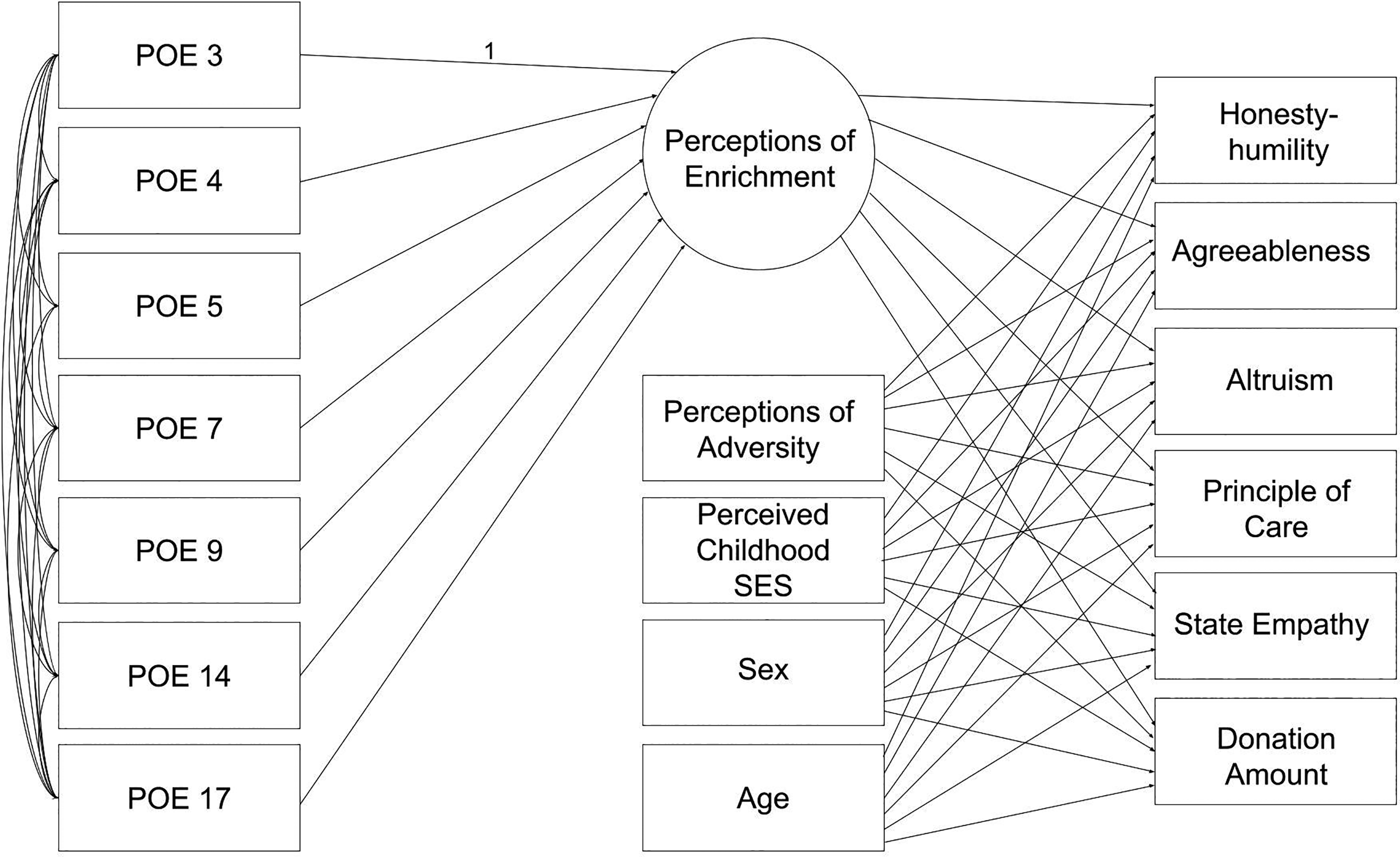
Conceptual diagram of the structural equation model that features the formative enriched environments composite, and covariates for perceived environmental adversity, perceived childhood SES, age, and sex. Note: POE = Perception of Enrichment.
R2 of Outcome Variables, as Well as the Standardized Coefficients, Unstandardized Coefficients, Standard Errors, and Significance Levels for the Independent Variables Included in the Structural Equation Model That Features the Formative Enriched Environments Composite, and Covariates for Perceptions of Adversity, Perceived Childhood SES, Age, and Sex (N = 1,514).

We then compared the AIC value for the two formative models. The model that included covariates for childhood environmental adversity, childhood SES, age, and sex (AIC = 20,339.36) fit the data better than the model without the covariates (AIC = 21,127.09). Thus, although a formative enriched environments composite significantly predicted several prosocial outcomes, childhood environmental adversity, childhood SES, age, and sex persisted in explaining some of the variance in adult prosociality.
Do our results change if we include subjects who had been excluded for missing data?
We conducted an additional sensitivity analysis to determine whether our results for the structural equation model – and specifically the effect of the formative enriched environments composite upon the prosocial outcomes – were due to missingness in the principle of care scale. To test this possibility, we removed the principle of care as an outcome and re-estimated the model. The results were not qualitatively different (see the supplemental materials and Table S6 for details).
Genetic Confounding Analyses
Is the relationship between perceptions of enrichment and adult prosociality robust to genetic confounding?
Because subjects in our study were not randomly assigned to their childhood environments, we cannot rule out the possibility that our results are due to an unobserved third variable that influences both enriched childhood environments and adult prosocial behavior. One potential threat to the causal explanation we have proposed is genetic confounding: Prosocial behavior is at least partly heritable, so if those genes also cause parents to expose their children to enriched environments, then a correlation between children’s exposure to an enriched environment and the children’s prosociality in adulthood will appear, even if an enriched childhood environment does not exert a causal effect on adult prosociality. For instance, parents that are predisposed towards rearing their children in enriched environments may also have a genetic predisposition for prosocial personality traits and behavior, so that their children develop prosocial tendencies regardless of the influence of enriched environments.
How plausible is it that unmeasured genetic effects explain our pattern of results? One way to address this question is to estimate the strength of the relationship that a genetic confounder would have to share with both (1) The features of the childhood environment that are posited to exert a causal effect on children’s behavior, and (2) The adult behavior of interest; then, one can assess whether the estimated genetic relationship is sufficiently plausible to reduce the observed correlation to zero. This kind of sensitivity analysis can be conducted using a simulation-based method introduced by Barbaro et al. (2017). Barbaro et al.’s (2017) method models the influence of unobserved genetic confounding using estimates of heritability derived from empirical findings in the behavioral genetics literature, and comparing these heritability estimates to the observed phenotypic relationship in one’s data (in this case, childhood environmental quality and adult prosocial outcomes).
To model the influence of potential genetic confounders, one must first have data pertaining to the phenotypic traits X and Y that they are interested in investigating, and estimate rxy, the relationship between the two traits. Next, four unobserved coefficients must be estimated: h2X, the heritability of X; h2Y, the heritability of Y; rp, the phenotypic correlation between the two traits in question; and rg, the genetic correlation that the two phenotypic traits share. Finally, the unobserved estimates of the heritability coefficients are entered into the following equation to estimate h2cov:
However, estimates of h2X, h2Y, rp, and rg are imprecise, and no single set of values is sufficient for estimating h2cov. To deal with this uncertainty, Barbaro et al.’s (2017) method simulates the results of h2cov given a plausible range of values for h2X, h2Y, rp, and rg. Barbaro et al. (2017) recommend using k = 10,000 simulations to obtain a stable solution for estimates of h2cov. Although no single estimate is correct, one can use the mean of the h2cov values produced by the simulation to determine the most likely value of h2cov, and in turn, how much of the observed rxy relationship is plausibly explained by a shared genetic correlation between the phenotypic traits X and Y. Finally, because rg is usually unknown, Barbaro et al. (2017) advise conducting the simulation multiple times for a range of rg estimates, which they conservatively suggest to be between 0 and 0.20. That is, one ought to conduct k = 10,000 simulations for rg = 0.01, rg = 0.05, etc.
We used Barbaro et al.’s (2017) method to estimate the extent to which our results might have been driven by genetic confounding. We selected h2X values according to heritability estimates related to (a) the mechanism by which enriched environments cause adult prosociality, and (b) h2Y values according to heritability estimates related to the traits and behaviors that enriched environments are hypothesized to impact downstream (i.e., charitable behaviors and prosocial personality traits). Heritability estimates were drawn from Polderman et al.’s (2015) database (match.ctglab.nl). Each h2X and h2Y value, then, reflects the meta-analytic estimate of the heritability for traits that are related to broad domains of behavior, motivation, cognition, emotion, and physiology.
For h2X, we selected heritability estimates that map onto a key mechanism by which enriched environments are hypothesized to engender adult prosociality: predisposition towards participating in community, social, and civic life (h2X = 0.35). Likewise, for h2Y, we selected the heritability estimate related to the acquisition of social values (h2Y = 0.31). These estimates are imperfect, since each estimate reflects a confluence of traits related to enriched environments and adult prosociality, respectively, but they nevertheless provide an approximation of the heritability for the traits in question. To obtain values of rxy, we extracted the standardized coefficient for the formative enriched environment composite from the structural equation model we conducted that included the environmental adversity, sex, and age as covariates. Thus, each rxy in the genetic confounding analysis can be interpreted as a semi-partial correlation coefficient, capturing the unique variance between perceptions of enrichment and each of the dependent variables. Finally, in accordance with Barbaro et al.’s analysis, we conducted the simulation on a range of rg values between 0 and 0.20. We selected five outcomes from this range: 0.01, 0.05, 0.10, 0.15, and 0.20. We conducted separate genetic confounding analyses for each of the five prosocial outcomes that were significantly predicted by enriched environments in Study 2, as each outcome corresponds to a different rxy estimate. (We did not compute genetic confounding analyses for the rxy estimate pertaining to the endorsement of the principal of care as the outcome, because the apparent effect of recollections of enriched environments on prosocial behavior was non-significant.)
Results are shown in Table 3. To interpret the results, we focus on those pertaining to the observed correlation between enriched environments and donation amounts (rxy = 0.12). At small values of rg (rg = 0.05), the mean value of h2cov is 0.15, indicating that it is plausible that 15% of the variance in the rxy relationship is explained by a genetic correlation between the mechanisms by which enriched environments realize their effect, and adult charitable donations. This would indicate that, if the observed rxy relationship is 0.12, then we should expect that rxy = 0.10 after adjusting for the shared correlation between the genes that promote traits associated with enriched childhood environments, and genes that promote traits associated with donating money to charity as an adult. At the largest value of rg (rg = 0.20), the mean value of h2cov 59% indicates that, when the genetic correlation is moderately large, approximately half of the variance in the rxy relationship can be explained by a shared genetic relationship. In this case, we should expect that rxy = 0.05 after controlling for the genetic confound.
Means and 95% CIs for the h2cov Estimates Pertaining to Each Genetic Correlation That was Estimated Using Barbaro et al.’s (2017) Simulation-Based Method.
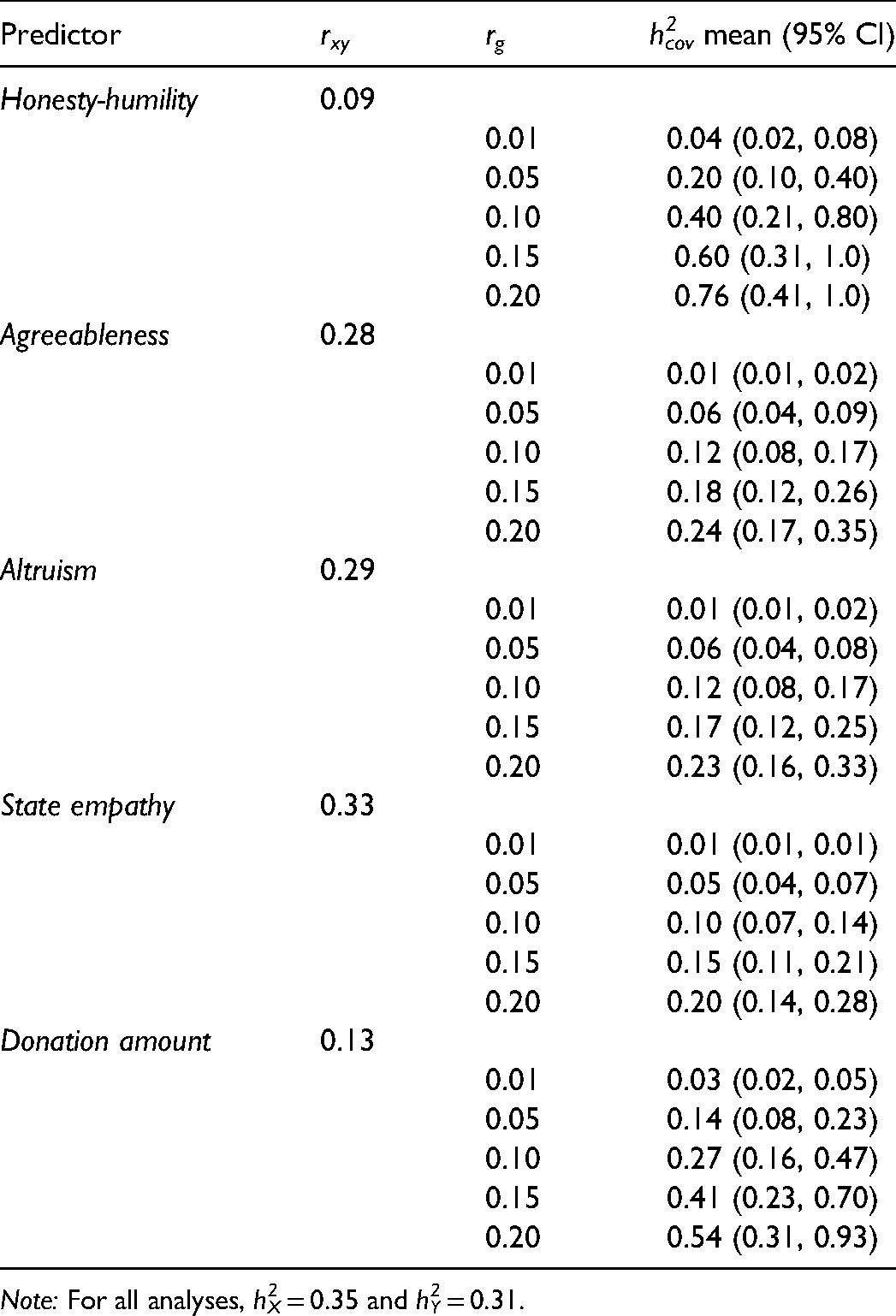
Note: For all analyses, h2X = 0.35 and h2Y = 0.31.
We interpret these results in light of two other features of our study. First, the genetic confounding analyses presented here should be interpreted in the context of the statistical adjustments already included in analyses that were used to obtain the estimates of the rxy relationship (i.e., age, sex, socioeconomic status, environmental adversity). Second, we believe that, while genes may account for a substantial portion of the variance observed in enriched environments, it is unlikely that genes could fully explain the relationship between enriched childhood environments and prosociality. Although the largest mean values of rg included in our analysis (rg = 0.20) reduced the smallest rxy relationship (rHonesty−Humility = 0.76) by 76%, for the rest of the outcomes, the largest mean values rg in our analysis failed to reduce even the smallest rxy relationships by more than 54%. For most values of rg and rxy, heritability plausibly explained only a fraction of the rxy relationship, suggesting that our results are mostly robust to genetic confounding.
Study 2 Discussion
In Study 2, we found support for the hypothesis that people’s recollections of enriched childhood environments predicted adult prosocial outcomes, even after controlling for recollections of childhood environmental adversity, recollections of childhood SES, sex, and age. A genetic confounding analysis suggested that a shared genetic correlation likely constitutes a non-trivial portion of the variance attributed to enriched environments, but that it is implausible that these effects can be explained entirely by a shared genetic correlation between enriched environments and the various prosocial outcomes included in our analysis, even after controlling for rival predictors.
General Discussion
Dating back nearly a century to the work of Jean Piaget and Lawrence Kohlberg, moral psychologists have pondered the origins of human virtue. Likewise, evolutionary scientists have pondered why putatively self-interested humans are often generous toward strangers, leading to a hypothesis based on Life History Theory that developmental experiences – and in particular, experiences with stressful childhood environments – might exert a causal influence on prosocial dispositions in adulthood. In the present paper, we united these research orientations by examining the joint influence of enriched and adverse childhood experiences on prosocial personality traits, emotion, and behavior. We proposed that enriched environments, which are rich in resources, cooperative interactions, and exemplary moral role models, have been overlooked in evolutionary models of moral development, and might be instrumental in explaining human generosity.
Across two studies in which we asked adults to recall their childhood experiences, we found that subjects’ recollections of enrichment in their childhood environments were distinct from their recollections of adverse experiences, and that subjects who had more enriched experiences tended to report more empathy for those who are in need, give more money to charity, and score higher on trait measures of prosocial personality. Our results also suggest that, although some of the observed relationships can be explained by a shared genetic correlation between genes that favor a predisposition towards enriched environments and genes that favor adult prosociality, the effect of enriched environments appears to be somewhat robust to genetic confounding. Our studies provide some of the first evidence that adult prosociality is associated not only with variation in adverse childhood experiences, but variation in enriched childhood experiences as well. Moreover, these are the first studies in any capacity to have found that adult charitable giving – a distinct strain of prosociality that is tightly linked to moral identity, and generalizable to other instantiations of prosociality (McAuliffe et al., 2019) – is associated with childhood environmental quality.
We have speculated that evolved psychological mechanisms might be responsible for people’s responsiveness to the features of enriched childhood environments. But which domain-specific psychological mechanisms might be especially sensitive to the cues that are present in enriched childhood environments? It is plausible that mechanisms designed to manage cooperative social interactions cause children who have more enriched developmental experiences to learn that helping others can be a payoff-maximizing strategy, which in turn causes them to persist in cooperative behaviors beyond childhood (Baumard et al., 2013; Sheskin et al., 2014). Perhaps prosocial learning is driven by mechanisms that specialize in learning social expectations, norms (Haley & Fessler, 2005; McAuliffe et al., 2019), and locally optimal social strategies (Burton-Chellew et al., 1853; Ezaki et al., 2016; FeldmanHall et al., 2017; Gillan et al., 2015). It is conceivable that enriched environments chronically activate such mechanisms, causing children to develop strong prosocial motivations, especially in response to experiences with the supernormal levels of cooperative social interactions that are possible in the modern world (Henrich et al., 2010).
We situate our findings in the existing literature on life history theory’s application to human psychology and behavior and, more broadly, theories about developmental plasticity. Recent years have seen research calling into question the validity of life history theory as an explanation for inter-individual differences in human traits related to cooperation, mating, and personality (Zietsch & Sidari, 2020). For instance, scholars have challenged the ontology of human life history strategies (Sear, 2020), along with the idea that life history strategies can be conceptualized as latent variables (Gruijters & Fleuren, 2018; Međedović, 2021). They have proposed instead that phenomena traditionally attributed to life history theory are better understood through the theoretical lens of pace-of-life-syndrome (Mathot & Frankenhuis, 2018), and have argued that life history theorizing about human psychology and behavior is distinct from life history theory’s orthodox applications to evolutionary biology (Nettle & Frankenhuis, 2020). We view our contribution as offering another nuance: Life history theorists have focused mostly on the influence of adverse childhood environments as shaping people’s later-life outcomes, but our results furnish novel evidence that enriched characteristics of childhood environments might also play an important developmental role.
This finding has implications for how scholars theorize about the impact of early-life experiences on adult outcomes. If, as we have suggested, enriched early-life experiences uniquely predict later-life behaviors, then theories about how life history strategies are shaped during childhood ought to be amended to accommodate explanations for the causal role of enriched childhood experiences. However, regardless of whether the structure of the relationship between early-life and later-life features is best captured by life history theory or some other theoretical apparatus that aims to explain developmental plasticity, researchers should consider the role that enrichment might play in shaping adult preferences, rather than limiting the domain of relevant developmental experiences solely to those that reflect deprivation.
Altruism Born of Suffering
One surprising finding in our study was that exposure to childhood environmental adversity was associated with increased empathic concern for the suffering of others, and more charitable donations. Why might environmental adversity correlate positively with indices of generosity? We believe these otherwise puzzling results might be explained by a sizable literature suggesting that exposure to traumatic events promotes prosociality (Dunlop et al., 2015; Frazier et al., 2013; Gillen, 2005; Tedeschi & Calhoun, 1996; Vollhardt, 2009). Although trauma is most commonly associated with negative social and psychological outcomes, traumatic experiences are also associated with prosocial behaviors such as charitable giving (Piferi et al., 2006) and volunteering to help others who are in need (Vollhardt & Staub, 2011), with these prosocial behaviors persisting far beyond the initial traumatic exposure (Frazier et al., 2013).
Trauma-induced prosociality is especially pronounced when the target of prosocial behavior is a needy other who has also experienced hardship (Kaniasty & Norris, 1995), which is exactly the kind of target that subjects in our study donated to. Indeed, our results are consistent with Greenberg et al.’s (2018) finding that people who experience traumatic events report more empathy following the trauma. It may be that traumatic events uniquely affect prosociality by compelling people to make meaning of otherwise senseless and unexpected events that cannot be blamed on the insensitivity or malevolence of other people (Dunlop et al., 2015). There is evidence that prosocial trauma is linked to moral identity as well: Walker and Frimer (2007) found that experiencing the death of a child was one of the few delineating characteristics of people who had won awards for moral exemplarity. Moreover, adverse experiences are associated with empathic dispositions and increased perspective-taking (Vollhardt & Staub, 2011), processes that are closely linked to the development of moral virtue (Hoffman, 2001) and altruistic behaviors (Batson et al., 1997). The unusual experience of trauma, then, might influence the development of some of the psychological resources that enriched environments also influence, including meaning in life, moral identity, and perspective-taking.
Limitations and Future Directions
Although we believe our findings call attention to an understudied component of prosocial development, our conclusions should be interpreted with some care. For instance, our results relied on subjects recalling the quality of their early childhood environment, which might have influenced our results in a few ways. First, self-report errors are largely caused by lapses in memory (Tourangeau, 1999), and our study relied almost entirely on subjects’ ability to recall past events. Second, retrospective recall might be especially problematic when asking subjects to recall the frequency of minor events, because people’s ability to recall relatively minor events declines sharply after just one year (Raphael et al., 1991). Finally, adult recollections of childhood events tend to be biased towards a failure to recall, rather than over-recall, so subjects might have systematically under-recollected events in our study (Hardt & Rutter, 2004). However, subjects’ failure to recall events that occurred in their childhood environment would not necessarily mean that correlations between perceptions of childhood environmental experiences with the prosocial outcomes we investigated here are spurious, as measurement error typically reduces, rather than increases, the strength of correlations (Hutcheon et al., 2010). Moreover, if we assume that these biases did impact subjects’ recollections of childhood environmental, we should expect that this bias would be equally distributed across the population, so that they have no consequence for the correlations of between measures of those recollections with other variables.
Additionally, it is crucial to keep in mind that even though we conceptualize early life experiences as exogenous influences on later-life prosociality, it is likely that children are not randomly assigned to their childhood environments, which necessarily complicate any causal inferences one might make on the basis of data such as those we investigated here.
In light of limitations such as these, how might researchers best study the association between childhood environment and adult prosociality going forward? Optimally, they might implement experimental research designs that manipulate the presence of prosocial cues during childhood—for example, through lottery mechanisms (Kosse et al., 2018). Additionally, they might conduct longitudinal assessments of enriched and adverse childhood experiences (e.g., Barragan & Dweck, 2014), or use quasi-experiments that permit causal inference without random assignment, such as regression discontinuity or instrument variable designs (Kim & Steiner, 2016). Another approach would entail collecting peer reports from siblings, parents, and childhood acquaintances, which would serve as validation targets for self-reports of subjects’ childhood experiences. Peer reports are particularly appealing, as they reduce (though cannot completely eliminate) the socially desirable responding that might contaminate self-reporting of sensitive information (Vazire, 2010). Finally, researchers would do well to include genetically informed research methods such as cross-twin correlational studies, which would allow researchers to partition variance due to heritable traits from shared and non-shared environmental effects. A genetically informed study might be especially important in this case, as past research using such designs has found that the relationship between early-life experiences and adult outcomes can be explained by genetic correlation (Figueredo et al., 2020), and our own analyses indicate that a shared genetic correlation may be a plausible explanation for some or much of the variance that we observed in prosocial personality and behavior. Ideally, future research would combine experimental, peer-report, and behavior-genetics designs in investigations of the childhood environment-adult prosociality link, which has been theoretically fruitful on other topics (e.g., Kupfer et al., 2022).
Finally, it is worth acknowledging that the associations we have covered here are small in magnitude by any meaningful standard, so future theoretical work on the developmental causes of individual differences in prosocial behavior should invoke these data with that important caveat in mind.
Conclusion
Over the past several decades, scholars have made great strides in understanding some of the causes of prosociality in adulthood, but the developmental origins of our social preferences – and our propensity for charitable giving in particular – are not as well understood as it should be. Our results suggest a novel explanation for how early life experiences might influence morality during adulthood: Childhood environments vary not only in their adversity, but also in their enrichment, and the cumulative variation in both kinds of experiences influence prosociality in adulthood. A greater understanding of both adverse and enriched childhood experiences is therefore a promising avenue for better understanding the roots of human virtue and vice.
Supplemental Material
sj-docx-1-evp-10.1177_14747049221110603 - Supplemental material for Retrospective Self-Reported Childhood Experiences in Enriched Environments Uniquely Predict Prosocial Behavior and Personality Traits in Adulthood
Supplemental material, sj-docx-1-evp-10.1177_14747049221110603 for Retrospective Self-Reported Childhood Experiences in Enriched Environments Uniquely Predict Prosocial Behavior and Personality Traits in Adulthood by Thomas G. McCauley and Michael E. McCullough in Evolutionary Psychology
Supplemental Material
sj-csv-2-evp-10.1177_14747049221110603 - Supplemental material for Retrospective Self-Reported Childhood Experiences in Enriched Environments Uniquely Predict Prosocial Behavior and Personality Traits in Adulthood
Supplemental material, sj-csv-2-evp-10.1177_14747049221110603 for Retrospective Self-Reported Childhood Experiences in Enriched Environments Uniquely Predict Prosocial Behavior and Personality Traits in Adulthood by Thomas G. McCauley and Michael E. McCullough in Evolutionary Psychology
Supplemental Material
sj-csv-3-evp-10.1177_14747049221110603 - Supplemental material for Retrospective Self-Reported Childhood Experiences in Enriched Environments Uniquely Predict Prosocial Behavior and Personality Traits in Adulthood
Supplemental material, sj-csv-3-evp-10.1177_14747049221110603 for Retrospective Self-Reported Childhood Experiences in Enriched Environments Uniquely Predict Prosocial Behavior and Personality Traits in Adulthood by Thomas G. McCauley and Michael E. McCullough in Evolutionary Psychology
Supplemental Material
sj-R-4-evp-10.1177_14747049221110603 - Supplemental material for Retrospective Self-Reported Childhood Experiences in Enriched Environments Uniquely Predict Prosocial Behavior and Personality Traits in Adulthood
Supplemental material, sj-R-4-evp-10.1177_14747049221110603 for Retrospective Self-Reported Childhood Experiences in Enriched Environments Uniquely Predict Prosocial Behavior and Personality Traits in Adulthood by Thomas G. McCauley and Michael E. McCullough in Evolutionary Psychology
Supplemental Material
sj-R-5-evp-10.1177_14747049221110603 - Supplemental material for Retrospective Self-Reported Childhood Experiences in Enriched Environments Uniquely Predict Prosocial Behavior and Personality Traits in Adulthood
Supplemental material, sj-R-5-evp-10.1177_14747049221110603 for Retrospective Self-Reported Childhood Experiences in Enriched Environments Uniquely Predict Prosocial Behavior and Personality Traits in Adulthood by Thomas G. McCauley and Michael E. McCullough in Evolutionary Psychology
Supplemental Material
sj-RData-6-evp-10.1177_14747049221110603 - Supplemental material for Retrospective Self-Reported Childhood Experiences in Enriched Environments Uniquely Predict Prosocial Behavior and Personality Traits in Adulthood
Supplemental material, sj-RData-6-evp-10.1177_14747049221110603 for Retrospective Self-Reported Childhood Experiences in Enriched Environments Uniquely Predict Prosocial Behavior and Personality Traits in Adulthood by Thomas G. McCauley and Michael E. McCullough in Evolutionary Psychology
Supplemental Material
sj-RData-7-evp-10.1177_14747049221110603 - Supplemental material for Retrospective Self-Reported Childhood Experiences in Enriched Environments Uniquely Predict Prosocial Behavior and Personality Traits in Adulthood
Supplemental material, sj-RData-7-evp-10.1177_14747049221110603 for Retrospective Self-Reported Childhood Experiences in Enriched Environments Uniquely Predict Prosocial Behavior and Personality Traits in Adulthood by Thomas G. McCauley and Michael E. McCullough in Evolutionary Psychology
Footnotes
Data Statement
All data and analyses for both studies are available in a data repository, but references to those materials data have been removed from this manuscript for peer review, as provision of this information will compromise our anonymity
Declaration of Conflicting Interests
The author(s) declared no potential conflicts of interest with respect to the research, authorship, and/or publication of this article.
Funding
The author(s) disclosed receipt of the following financial support for the research, authorship, and/or publication of this article: Study 2 was funded by a grant from the University of Miami College of Arts and Sciences to investigate the effects, impacts and influences of Hurricane Irma awarded to M.E. McCullough..

Supplemental material
Supplemental material for this article is available online.
Notes
Appendix
The following table contains the final seven items that we retained from the perceptions of enrichment scale, which we make available for other researchers to use. We note that these items are adapted from items that appeared on the developmental assets scale developed by Leffert et al. (1998).
References
Supplementary Material
Please find the following supplemental material available below.
For Open Access articles published under a Creative Commons License, all supplemental material carries the same license as the article it is associated with.
For non-Open Access articles published, all supplemental material carries a non-exclusive license, and permission requests for re-use of supplemental material or any part of supplemental material shall be sent directly to the copyright owner as specified in the copyright notice associated with the article.
