



Abstract
Vocal characteristics are important cues to form social impressions. Previous studies indicated that men with masculine voices are perceived as engaging in higher rates of infidelity and being less committed to their relationship. In the current study, we examined how women in China perceive information regarding infidelity and relationship investment conveyed by the voices (voice pitch and vocal tract length) of males, and whether different vocal characteristics play a similar role in driving these impressions. In addition, we examined whether these perceptions are consistent in Chinese and English language contexts. The results indicated that women perceived men with more masculine voices (lower voice pitch and longer vocal tract length) as showing a lower likelihood of infidelity and higher relationship investment; further, women who preferred more masculine voices in long-term relationships, but not in short-term relationships, were more likely to perceive men with masculine voices as less likely to engage in infidelity and more likely to invest in their relationship. Moreover, the participants formed very similar impressions irrespective of whether the voices spoke native (Chinese) or foreign (English) languages. These results provide new evidence for the role of the voice in women's choices in selecting long-term partners.
Introduction
The human voice is an important provider of information used in forming social perceptions (Belin et al., 2011). Previous research indicated that women show a stronger preference for men with masculine voices, which suggests that a masculine voice in men may signal desirable mate qualities like other masculine traits (Folstad & Karter, 1992). For example, men with lower-pitched voices were judged as more attractive (Feinberg et al., 2005), more dominant, older, healthier, and masculine than those with higher-pitched voices (Collins, 2000; Feinberg, 2004; Feinberg et al., 2005; Puts, 2005).
Voice pitch is inversely related to testosterone levels (Cartei et al., 2014; Evans et al., 2008). Sexual dimorphism in voice characteristics may be based on differences in testosterone levels between men and women (Puts et al., 2012). Extant research has provided evidence that both intersexual selection and intrasexual competition have influenced sexually dimorphic characteristics. For example, women prefer men with lower-pitched voices over those with higher-pitched voices (Feinberg et al., 2005) and this preference becomes more evident during ovulation (Puts, 2005). According to the perspective of intra-sexual competition, sex differences between male and female voices evolved through male dominance competition (Puts, 2010; Puts et al., 2012). Some research indicated that sexual selection affected men more strongly than women as they found that voice pitch predicts reproductive and mating success in men but not in women (Apicella et al., 2007). However, another study found that voice pitch and handgrip strength were predictive of women's reproductive success (Atkinson et al., 2012).
There have been extensive studies on voice pitch and perceptions of trust, but the results were inconsistent. For example, previous studies indicated that men with lower-pitched voices are perceived as generally more trustworthy (Oleszkiewicz et al., 2017; Tigue et al., 2012); however, other studies found that men with higher-pitched voices were rated as more trustworthy (McAleer et al., 2014; Ponsot et al., 2018), and some studies found no association (Baus et al., 2019; Vukovic et al., 2011). In romantic relationships, women perceive men with lower pitched voices as more likely to be unfaithful (O’Connor & Barclay, 2017; O’Connor et al., 2011, 2014). Additionally, infidelity and relationship investment are two opposing aspects in mating relationships. Men who engaged in infidelity tended to be less satisfied with their relationship and were less committed to their romantic partners (Klimas et al., 2019). Previous studies have indicated that ratings of relationship investment may be related to voice pitch perception, reporting that men with lower-pitched voices were judged to invest less in their romantic relationship (O’Connor et al., 2011, 2012).
Past research indicated that formant frequencies, an indicator of vocal tract length (VTL), is another important variable that influence vocal attractiveness and might influence other social impressions (Collins, 2000). VTL was a reliable indicator of body size (Pisanski et al., 2014); taller individuals sound more dominant, and dominant individuals are judged as more trustworthy in the political domain (Re et al., 2012). Montano et al. (2017) found that the apparent VTL has a marginal effect on trust, and men with longer VTL were perceived as more trustworthy to divide financial resources equitably. Knowles and Little (2016) found that men with longer VTL were perceived as more cooperative than individuals with shorter VTL when the pitch was constant. However, it is unclear whether there exists a relationship between VTL and perceptions of infidelity or relationship investment in the mating domain.
Women may evaluate both infidelity and relationship investment in relation to the same voice indicators because they have the same biological basis—testosterone levels (O’Connor & Barclay 2017; O’Connor et al., 2011, 2014). Fundamental frequency (F0) and formant frequency are sexually dimorphic traits dependent on testosterone levels (Cartei et al., 2014; Evans et al., 2008; Puts et al., 2012), and testosterone levels could influence the relationship quality. Men with higher testosterone levels show more sexual interest outside of their present relationship (McIntyre et al., 2006), have more sex partners and extramarital affairs (Fisher et al., 2009; Peters et al., 2008), and are less likely to be in a long-term committed relationship than men with lower testosterone levels (Van Anders & Goldey, 2010). In addition, men with lower testosterone reported higher marital satisfaction, lower interest in extra-dyadic sex, and lower likelihood of divorce (Julian & McKenry, 1989; McIntyre et al., 2006; Perini et al., 2012). Further, men with higher testosterone levels invest less in their relationship and offspring (Gray et al., 2007). Testosterone reduced relationship promoting behavior such as empathy and trust (Bos et al., 2011), and thus affects the functioning of romantic relationships.
The Present Study
Most research has focused on the association between voice pitch and trust, in this study, we considered voice pitch and VTL as predictor variables to discuss the role of voice pitch and VTL in romantic relationships. Generally, research on vocal social perception lacks diversity and representation of samples from non-Western countries; Chinese culture has been especially underrepresented. Traditional Chinese cultural concepts of marriage, long-term and stable partnerships are of great significance to Chinese women, and most women still have a subordinate status in marriage (Zheng et al., 2011). Generally, traditional marriage ethics and cultural concepts still influence Chinese individuals’ attitudes towards love and marriage, and Chinese women have a stronger motivation to maintain long-term relationships and marital stability (Sorokowski et al., 2017; Zheng et al., 2011). Thus, women's perception of infidelity and relationship investment based on voice indicators in the context of Chinese culture may perhaps be different than their Western counterparts.
There is substantial evidence that the relationship context (long- vs. short-term) influences the attractiveness ratings of sexually dimorphic faces and voices (Fraccaro et al., 2010; Little et al., 2011). Women showed a stronger preference for masculine traits in faces and voices in short-term relationships compared with long-term relationships. Previous studies have indicated that women's preference for lower voice pitch in long-term relationships was positively associated with perceptions of men's relationship investment (O’Connor et al., 2012). In the present study, we also considered the influence of two relationship contexts (long- and short-term) on women's perceptions of men's infidelity and relationship investment tendencies.
Generally, we tested whether men's voice pitch and VTL influenced women's perceptions of infidelity and relationship investment, and whether these perceptions of infidelity and relationship investment are related to voice pitch and VTL preferences in the context of different relationships. We predicted that if women utilize men's voice pitch as a cue to proclivity for infidelity or relationship investment, then women will select feminized men's voices as investing more into their relationship and less likely to commit any infidelity.
In addition, the association between infidelity, relationship investment, and voice indicators across languages is not clear. We further explored whether there are differences when hearing native and foreign languages. English and Chinese belong to two completely different language systems. Voice pitch varies in different languages; for example, the mean voice pitch of males is 120 Hz, 125 Hz, 160 Hz for Spanish, English, and Chinese speakers, respectively (González et al., 2002; Natour & Wingate, 2009). Apicella and Feinberg (2009) found that Hazda women preferred men with higher voices regardless of language. Similarly, Baus et al. (2019) showed that listeners across different languages form similar personality impressions regardless of their voices being native or foreign, although other studies found that individuals with foreign accent were perceived as less trustworthy, less educated, less intelligent, or less competent compared to native speakers (Dewaele & McCloskey, 2015; Fuertes et al., 2012; Gluszek & Dovidio, 2010; Lev-Ari & Keysar, 2010). However, previous studies examined the cross-country influence of voice perception based on participants speaking foreign languages, but not foreigners speaking their (foreigners’) native language. Listeners may perceive speakers’ relationship investment and infidelity behavior similarly irrespective of the language and whether the speaker is native or foreign; however, there may also be an in-group advantage in recognizing the native language (perception of one's native language is more accurate than that of a foreign language). To explore this issue, in Experiment 2, we asked native Chinese speakers to rate relationship investment and infidelity behavior of English speakers based on their own language.
Study 1: Chinese Listeners Rating Chinese Speakers
Following the O’Connor et al. (2012) study, we asked native Chinese listeners to perceive the voices of native Chinese speakers. Participants rated the voice stimulus in different contexts (relationship investment, infidelity, short-term relationship, and long-term relationship).
Methods
Participants
A total of 444 heterosexual women participated in the present experiment. The mean age was 23.05 years (SD = 4.82; range = 17–46 years). All participants were native Chinese speakers and self-reported to be heterosexuals. To prevent the participants from experiencing auditory fatigue and confusion, voice pitch (n = 221) and VTL (n = 223) judgements were performed by different participants. This research was approved by the Ethics Committee of the relevant University. Demographic data of participants are presented in Table 1.
Demographic Variables of Participants.

Voice Stimuli
A total of 6 male undergraduates who are native speakers of Chinese (Mandarin; Mage = 19.17, SDage = 1.17) were recruited to speak Chinese words: nan bei (“north and south”), zuo you (“right and left”), ming ci (“noun”), li kai (“get away”), and guan bi (“turn off”; Zhang et al., 2018). The voice stimuli were recorded in a quiet room with the Audio-Technica ATR-2500 microphone and Cool Edit Pro recording software at a sampling rate of 44.1 kHz with 16-bit amplitude quantization. Prior to manipulation, the original mean pitch of the voices was 120.44 Hz, SD = 2.58 Hz.
We used Praat software to conduct voice manipulation, lowering and raising the pitch by 0.5 equivalent rectangular bandwidths (ERBs) of the original voice pitch to create more masculine and feminine versions of the male voices (Apicella & Feinberg, 2009; Jones et al., 2010). This method selectively manipulated F0, leaving other features of the voice to remain constant (Feinberg et al., 2005). After manipulation, the mean pitch of the lowered voices was 101.61 Hz, SD = 2.96 Hz, the raised voices was 139.05 Hz, SD = 3.15 Hz. The change in VTL was obtained by raising or lowering the whole spectrum by 10%, making the formant position of the manipulated voice about 90% or 110% of the original formant position (Pisanski et al., 2014). Ultimately, we created 24 new voices (12 pairs): 6 male voices with higher voice pitch, 6 male voices with lower voice pitch, 6 male voices with longer VTL, and 6 male voices with shorter VTL. Each pair of voices comprised a masculinized and a feminized version of the same individual. All voice stimuli were normalized to 70 dB RMS SPL.
Procedure
This study was conducted online via the Chinese survey platform (www.sojump.com). The participants signed informed consent and were informed that the investigation was entirely anonymous. Subsequently, they provided their gender, sexual orientation, age, occupation, education level, monthly income and partnership status.
Next, participants applied the two-alternative forced choice paradigm to judge 6 pairs of male voices in different contexts. In the infidelity context, participants were asked to select one voice from each pair of male voices according to the question “If you were his partner, which of the following voices do you think is more likely to be unfaithful to you?” In the relationship investment context, participants were asked the question “If you were his partner, which of the following voices do you think is more likely to invest more time and effort into your romantic relationship?” Then, participants were asked to select which of the following voice was more attractive in a short-term relationship (i.e., the relationship lasts a short time, such as an affair within a long-term relationship or a one-night stand) or a long-term relationship (i.e., the relationship lasts a long time, such as living together with someone you wish to marry). For the F0 manipulation condition, 221 participants completed infidelity and investment tests. Among them, 112 participants continued completing the long- and short-term relationship. For the VTL manipulation condition, 223 participants completed the four forced choice tests (infidelity, investment, short-term, and long-term). The order of the items (high and low pitch/formant position) in the pair and the tests were randomized.
Data Analysis
We used one-sample t-tests to calculate the proportion of trials in which participants selected the lowered or raised pitch and lengthened or shortened VTL separately in the condition of relationship investment and infidelity perception. Subsequently, we performed the ANCOVA using SPSS 18, statistical significance was set at “0.005 < p < .05” as suggestive and those below 0.005 as significant (Benjamin et al., 2018). In the analysis of ANCOVA, the context was within-subject variable which have two levels, infidelity and relationship investment; vocal preference in short-term and long-term relationship as the covariates. The method and data analysis were similar to O’Connor et al. (2012).
Results
The one-sample t-tests (0.5) was used to determine if voice pitch and VTL manipulations influenced the proportion of trials in which participants selected the masculinized voices over the feminized voices. For voice pitch, women selected lower-pitched voices as having less infidelity behaviors and investing more to their romantic relationship on a significantly greater proportion of trials than they selected higher-pitched voices. For VTL, women selected longer VTL voices as having less infidelity behaviors and investing more to their romantic relationship on a significantly greater proportion of trials than they selected shorter VTL voices. In both short-term and long-term relationship condition, women showed stronger preference for men with lower voice pitch and longer VTL, which was consistent with previous research (O’Connor et al., 2012). The results are illustrated in Table 2.
Perceptions of Infidelity and Relationship Investment in Dimorphic Voices of men.
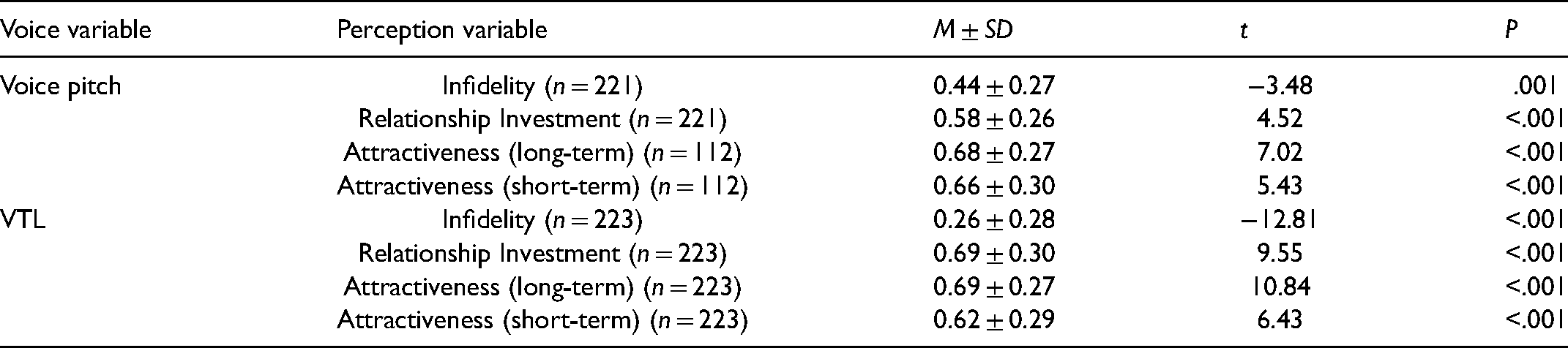
We used an ANCOVA to investigate the relationship between voice pitch preferences and perceptions of infidelity and relationship investment, with the context (infidelity, relationship investment) as within-subject variables, vocal preference in short-term and long-term relationship as covariates. The results indicated that the effect of context was significant (F(1,109) = 11.03, p = .001, partial η2 = 0.09), the proportion of choosing a lower pitched voice in the context of relationship investment was significantly higher than that in the context of infidelity (Minvestment = 0.55, SD = 0.24; Minfidelity = 0.47, SD = 0.27; d = 0.31). The main effect of short-term vocal preference (F(1,109) = 0.98, p = .325, partial η2 = 0.009) and long-term vocal preference (F(1,109) = 0.49, p = .486, partial η2 = 0.004) were not significant. There was a significant interaction effect between long-term voice preferences and rating context (F(1,109) = 20.74, p < .001, partial η2 = 0.16), further, the correlation analysis demonstrated that long-term vocal preference was negatively correlated with infidelity perception (r = −0.32, p = .001), while positively correlated with investment perception (r = 0.31, p = .001). The interaction effect between short-term voice preferences and rating context was not significant (F(1, 109) = 0.04, p = .834, partial η2 < 0.001).
To test the association between VTL preferences and infidelity and relationship investment perceptions, we conducted an ANCOVA. The results indicated that the effect of context is significant (F(1, 220) = 4.51, p = .035, partial η2 = 0.02), the proportion of choosing a longer VTL voice in the context of relationship investment was significantly higher than that in the context of infidelity (Minvestment = 0.69, SD = 0.30; Minfidelity = 0.26, SD = 0.28; d = 1.48). The main effect of short-term vocal preference was significant (F(1, 220) = 6.54, p = .01, partial η2 = 0.03), correlation analysis revealed that the proportion of choosing longer VTL voice in short-term partnership was significantly positively correlated with the overall proportion of choosing longer VTL voice in infidelity and relationship investment context (r = 0.15,p = .029). The main effect of long-term vocal preference was not significant (F(1, 220) = 1.81, p = .18, partial η2 = 0.008). There was a significant interaction effect between long-term voice preferences and rating context (F(1, 220) = 16.55, p < .001, partial η2 = 0.07), further, the correlation analysis demonstrated that long-term vocal preference was negatively correlated with infidelity perception (r = −0.34, p < .001), while positively correlated with investment perception (r = 0.29, p < .001). The interaction effect between short-term voice preferences and rating context was also significant (F(1, 220) = 17.26, p < .001, partial η2 = 0.07), the correlation analysis demonstrated that short-term vocal preference was negatively correlated with infidelity perception (r = −0.24, p < .001), while positively correlated with investment perception (r = 0.40, p < .001).
Discussion
The results suggest that women perceived more masculine voices (lower voice pitch and longer VTL) as engaging less in infidelity and investing more to romantic relationships, which was inconsistent with past research by O’Connor et al. (2011), reporting that women judged men with masculine voices to be more likely to engage in infidelity, and O’Connor et al. (2012), reporting that women judged men with feminine voices as investing more in their romantic relationships. Further, women judged men with both lower pitched and longer VTL as more faithful and investing in romantic relationships. This suggests that VTL and voice pitch play equally important roles in the perception of variables related to mating relationship.
In addition, we found that women who preferred more masculine voices in long-term relationships tended to select masculine voices as less likely to engage in infidelity behaviors and more likely to invest in their relationship, which was consistent with O’Connor et al. (2012). These results suggest that the relationship between personality attributions and mate preference significantly affects women's choice of long-term partners. In our study, we found that women showed a stronger preference for men with more masculine voices (longer VTL) in long-term relationships than in short-term relationships, although this effect was not significant for voice pitch. The preference for more masculine voices in different relationship contexts may be the reason why Chinese women's perception of infidelity and relationship investment in this study was inconsistent with past research. Further discussion on these issues is presented in the General Discussion.
Study 2: Chinese Listeners Rating English Speakers
In Study 1, we found that women perceived more masculine voices (lower voice pitch and longer VTL) as engaging less in infidelity and investing more in romantic relationships, which was inconsistent with our hypothesis and previous research (O’Connor et al., 2011). In Study 2, the first aim was to explore whether there are differences when hearing native and foreign languages (compared to study 1); the second aim was to explore whether perceived infidelity and relationship investment according to sexually dimorphic voices are influenced by Western speakers of English. If the results were affected by Western participants and language, we predicted that women will select feminized men's voices as investing more in their relationship and less likely to engage in infidelity.
Methods
Participants
A total of 170 women participated in the experiment. All participants were native speakers of Chinese and self-reported as heterosexuals. Ninety-two (Mage = 20.23, SDage = 1.51) were assigned to the voice pitch manipulation condition, and 78 participants (Mage = 19.76, SDage = 1.65) were assigned to the VTL manipulation condition.
Voice stimuli
The process of voice collection and manipulation was same as study 1. We recruited five international students (Mage = 18.80, SD = 1.79) from the United States and France from the university to record sound materials in the laboratory. Among them, the four participants from United States were native speakers of American English, another participant was half American and half French, English is his second language. They were asked to speak English words: stay put, finish it, sit down, leave it there, be quiet (Zhang & Reid, 2017). Prior to manipulation, the original mean pitch of the voices was 106.44 Hz, SD = 2.97 Hz. After manipulation, the mean pitch of the lowered voices was 89.81 Hz, SD = 3.18 Hz, and the raised voices was 122.30 Hz, SD = 5.73 Hz.
Procedure
The procedure was the same as study 1.
Data Analysis
The analysis was the same as study 1.
Results
The results indicated that for voice pitch, women judged men with lower-pitched voices as having less infidelity behaviors (p = .018) and investing more time and effort to their romantic relationship compared to higher-pitched voices (p = .046). For VTL, women judged men with longer VTL voices as having less infidelity behaviors (p < .001), while there was no significance in context of relationship investment (p = .780). Compared with Study 1 (infidelity: voice pitch, p < .001, VTL, p < .001; relationship investment: voice pitch, p < .001, VTL, p < .001), these preferences were more pronounced when rating Chinese voices. In both short-term and long-term relationship conditions, women showed stronger preference for men with lower voice pitch, which was consistent with Study 1 and previous research (O’Connor et al., 2012), while for short-term relationship condition, participants did not show significant VTL preference. The results are illustrated in Table 3.
Perceptions of Infidelity and Relationship Investment in Dimorphic Voices of Western men.

We used an ANCOVA to investigate the relationship between voice pitch preferences and perceptions of infidelity and relationship investment, with the context (infidelity, relationship investment) as within-subject variables, vocal preference in short-term and long-term relationship as covariates. The results indicated that the effect of context is significant (F(1, 89) = 9.12, p = .003, partial η2 = 0.09), the proportion of choosing a lower pitched voice in the context of relationship investment was significantly higher than that in the context of infidelity (Minvestment = 0.56, SD = 0.30; M infidelity = 0.42, SD = 0.32; d = 0.45). The main effect of short-term vocal preference (F(1, 89) = 0.09, p = .765, partial η2 = 0.001) and long-term vocal preference (F(1, 89) = 0.19, p = .664, partial η2 = 0.002) were not significant. There was a significant interaction effect between long-term voice preferences and rating context (F(1, 89) = 32.19, p < .001, partial η2 = 0.27), further, the correlation analysis demonstrated that long-term vocal preference was negatively correlated with infidelity perception (r = −0.46, p < .001), while positively correlated with investment perception (r = 0.46, p < .001). The interaction effect between short-term voice preferences and rating context was not significant (F(1, 89) = 0.15, p = .697, partial η2 = 0.002).
To test the relationship between VTL preferences and perceptions of infidelity and relationship investment, we conducted an ANCOVA. The results indicated that the effect of context is significant (F(1, 75) = 11.94, p = .001, partial η2 = 0.14), the proportion of choosing a longer VTL voice in the context of relationship investment was significantly higher than that in the context of infidelity (Minvestment = 0.51, SD = 0.33; M infidelity = 0.37, SD = 0.28; d = 0.46). The main effect of short-term (F(1, 75) = 0.12, p = .179, partial η2 = 0.02) and long-term vocal preference (F(1, 75) = 0.23, p = .634, partial η2 = 0.003) were neither significant. There was a significant interaction effect between long-term voice preferences and rating context (F(1, 75) = 20.93, p < .001, partial η2 = 0.22), further, the correlation analysis demonstrated that long-term vocal preference was negatively correlated with infidelity perception (r = −0.50, p < .001), while positively correlated with investment perception (r = 0.32,p = .005). The interaction effect between short-term voice preferences and rating context was not significant (F(1,75) = 0.53, p = .47, partial η2 = 0.007).
Discussion
The results indicated that women judged men with masculine voices as less likely to be unfaithful and investing more in romantic relationships compared with men with more feminine voices, which was consistent with the results of Study 1. Generally, the relationship of sexually dimorphic voices with infidelity and relationship investment perceptions was unaffected by language.
In this study the judgement of voice pitch and VTL in two contexts was not exactly consistent. Women judged men with lower-pitched voices as more faithful and likely to invest in romantic relationships; women perceived men with longer VTL as less likely to engage in infidelity, while we found no significant relationship between VTL and relationship investment perception. This may be due to differences between foreign and Chinese men or the difference between languages, leading to a lack of significant association between VTL and relationship investment perception; however, the direction was consistent with the results of Study 1. The sample size may have also influenced the results; thus, it is necessary to replicate this finding with a larger sample in the future.
In this study, we also found that women who preferred more masculine voices in long-term relationships were more likely to perceive men with more masculine voices as less likely to engage in infidelity and more likely to invest in their relationship. However, in short-term relationships, there was no association between vocal preference and perception of infidelity or relationship investment; this means that women's perception of infidelity and investment was not a halo effect.
General Discussion
The results of this study are inconsistent with previous studies reporting that men with masculine voices (lower pitch and longer VTL) tend to be rated as more likely to engage in infidelity and less likely to invest in their romantic relationship (O’Connor et al., 2011, 2012). On the contrary, the participants in this study perceived men with a lower voice pitch and longer VTL as less likely to engage in infidelity and more likely to invest in their relationship. Previous studies found men with higher testosterone levels invest less in their relationship and offspring and have more sex partners and extramarital affairs (Fisher et al., 2009; Peters et al., 2008). Considering the relationship between testosterone and voice in men, subsequent studies indeed found that men with lower voice pitch reported having more sexual partners (Puts et al., 2006). Recent studies also found that men's voice pitch was negatively correlated with infidelity intention, while positively correlated with relationship commitment (Zhang et al., 2021). This suggests that previous research reporting that women judged men with lower voices as more unfaithful and less invested in the relationship was based on the relationship between hormones and partner-related behaviors. While Chinese women in our study may not have taken this as a clue to judge voice and infidelity or investment, there may be other cues that influenced their perception.
First, except for biological cues, it is possible to infer other relevant characteristics, such as attitudes, intentions, values, and personality traits, from somebody's voice (Borkenau et al., 2004; McAleer et al., 2014; Scherer, 1972). These personality perceptions may influence infidelity or relationship perceptions. Although there are significant associations between voice and perceptions of social dominance, threat, and aggressiveness (Borkowska & Pawlowski, 2011; Hodges-Simeon et al., 2010; Zhang & Reid, 2017), masculine voices in men were perceived as indicative of order (Feinberg et al., 2005), higher leadership (Klofstad et al., 2015; Tigue et al., 2012), better hunting reputation (Smith et al., 2017), and more agreeableness (Scherer, 1978), all of which are features strongly desired by women in long-term partners. Further, masculine traits associated with aggression and dominance may provide direct benefits such as protection to long-term mates (Snyder et al., 2011), which could explain why masculine voices received higher relationship investment and lower infidelity ratings. These attributes may offset the negative effects associated with masculine voices. Thus, the combination of attributes desired in long-term relationships ascribed to masculine voices may explain why men with masculine voices were judged as less unfaithful and more likely to invest in the relationship.
Second, we speculated that there may be no domain differences in Chinese women's voice perceptions. Previous studies suggested that voice perception may be affected by the domain (e.g., mating or economic domain; O’Connor & Barclay 2017). In the economic domain (economic games for theoretical money), individuals trusted men with higher-pitched voices more than men with lower-pitched voices. For example, Montano et al. (2017) found that women trust men with higher-pitched voices to equitably divide a hypothetical sum of money, and the O’Connor and Barclay (2017) study also replicated it. In the political domain (voting behaviors), participants trusted men with lower voices. For example, Anderson and Klofstad (2012) found that participants preferred men with lower-pitched voices in voting for the President of the School Board and Parent Teacher Organization. Similarly, other studies also found that participants preferred to vote for the individuals with lower-pitched voice as leaders (Klofstad et al., 2015; Tigue et al., 2012). Regarding general trustworthiness, most research has found men with lower voices are perceived as more trustworthy no matter what assessment method is used (Oleszkiewicz et al., 2017; Tigue et al., 2012; Tsantani et al., 2016). The results of this study were consistent with previous studies on general trustworthiness perceptions. The dominant cultural characteristics may have influenced voice perception. Chinese society is mainly characterized by “collectivism” and “relationalism.” Therefore, partner choice will be influenced by external factors such as family and society, which guide the social value orientation of individuals. Studies in Western countries found that masculine male voices are perceived as more trustworthy than feminine male voices in terms of general trust (Tigue et al., 2012), cooperative relationships (Knowles & Little, 2016), and even leadership candidates (Anderson & Klofstad, 2012). Chinese women may be influenced by “collectivism” and “relationalism,” and the perception of male voices may not be limited by domains. Future studies should examine Chinese women's perceptions of trustworthiness in general and other domains (e.g., economic, leadership) to confirm whether different domains influence Chinese women's trust perception.
Moreover, in this study, we found that women who preferred more masculine voices in long-term relationships were more likely to perceived men with masculine voices as less likely to be unfaithful and more likely to invest in romantic relationships than were women who preferred more feminine voices. This result is consistent with past research suggesting that women who prefer relatively more masculine men for long-term relationships also perceive more masculine men as more suitable mates, namely more faithful and investing more in the relationship (O’Connor et al., 2012). Similarly, another study indicated that women who perceived masculine male voices as more trustworthy showed a higher preference for masculine male voices in long-term than in short-term relationship contexts (Vukovic et al., 2011). These findings underscore the importance of the relationship between personality attributions and partner preferences when women choose long-term partners. In the present study, we found that women preferred more masculine VTL in long-term relationships than in short-term relationships, while we found no significant effect for voice pitch. The result was inconsistent with a previous study that found that in Western countries, women showed a stronger preference for masculine characteristics than feminine ones in short-term relationships (Puts, 2005). In the context of Chinese Confucian culture, individuals are more likely to advocate long-term relationships, while short-term relationships are rarely mentioned or even considered immoral (Xu, 2019). As such, the results for infidelity and investment perception in voices may reflect the long-term relationship standard.
In addition, the mate value of women will influence their vocal masculine preference. For example, women who rated themselves as more attractive showed a stronger preference for masculine voices. According to the assortative mating theory (Burley, 1983), women with higher mate value have a greater possibility to attain or retain parental investment and avoid infidelity from relatively more masculine men. Women of lower mate value, for example those who perceive themselves to be in poor health (Feinberg et al., 2012) would also prefer masculine voices than the feminine ones for the heritable traits (health) may benefit their potential offspring. However, long-term investment and avoiding infidelity is available from alternate sources. Future studies should pay more attention on these factors. In conclusion, the results that women perceived men with more masculine voices as more faithful and investing more in their romantic relationship were contrary to the previous studies (O’Connor et al., 2011, 2012); therefore, future research should explore the causes of this inconsistency.
The two studies in the present work showed that infidelity and relationship investment perceived in voices were consistent among participants regardless of the language. These results complement previous findings that both Italians and Spaniards showed stronger preference for medium-pitched voices (Cussigh et al., 2020), and that listeners across different languages formed very similar personality impressions (Baus et al., 2019). Furthermore, in our study Chinese women judged men with more masculine voices as being more faithful and investing more in the romantic relationship in both Chinese and English contexts, but this preference was more pronounced when rating Chinese voices (native language). However, we did not find a significant effect on perceived relationship investment for the VTL-manipulated voices speaking English. Thus, future research with a larger sample is needed to confirm this conclusion. Generally, this result further confirmed that social voice perception contains certain elements that are invariant across cultures/languages, while certain others are modulated by the cultural/linguistic background of the listener (Baus et al., 2019).
Conclusions and Limitations
This study had some limitations. First, the method of rating voices may have influenced the results. In this study, women judged infidelity and relationship investment using the forced-choice method; other methods, such as rating each voice separately on a Likert scale, should be used in future studies to replicate these results. Second, to prevent the participants from experiencing auditory fatigue and confusion, the participants judging voice pitch and VTL, as well as rating Chinese and English voices, were different; the variation between participants may have affected the results. Future studies should consider replicating these results with similar participants. Third, this study only focused on women's perceptions of men's voices. Future studies may examine how men use voice pitch and VTL as indicators of infidelity and relationship investment in women's voices. Fourth, the students from United States and France have noticeably different accents, which could impact the results of this study. It is necessary for future studies to replicate this study with participants from the same country to generate a more accurate result. Fifth, for heterosexual women, masculine preferences for male faces were modulated by state hormone levels (Jones et al., 2005), hormonal contraceptives (Feinberg et al., 2008), while in our study we did not take that into account. Further, future research should explore how Chinese men and women use voice as indicators in other domains, such as the domain of economic, political, and cooperative.
Generally, although men with more masculine voices are generally perceived as likely to provide low investment in the relationship and engage more in infidelity, our results suggest that this does not generally hold true for voice pitch and VTL for Chinese women. In this study, participants did not perceive negative behavior conveyed by masculine voices on a perceptual level; instead, they perceived men with more masculine voices as more faithful and investing more in their relationship. This influence was evident regardless of the linguistic contexts. It is necessary for future studies to continue exploring this issue.
Footnotes
Declaration of Conflicting Interests
The author(s) declared no potential conflicts of interest with respect to the research, authorship, and/or publication of this article.
Funding
The author(s) disclosed receipt of the following financial support for the research, authorship, and/or publication of this article: This work was supported by School-level project of Sichuan Normal University, China (22XW081).
