



Abstract
Disgust, as a part of the behavioral immune system, leads people to avoid behaviors of pathogens so as to reduce the probability of infection. Disgust also shows the source effects based on familiarity. However, these source effects have not been tested on the older population. Thus, we tested the source effects of emotional and behavioral reactions from the disgust toward older adults and the possible moderating effects of filial piety on disgust. In the first study, we employed the self-report method to test the source effects of emotional feelings of disgust amongst undergraduates. In the second study, we measured whether filial piety among community adults produced moderating effects of the disgust toward older adults. In the third study, we employed the shape discrimination task to test the source effects of behavioral avoidance to older adults among undergraduates. The first and third studies show stronger negative emotional/avoidance reactions towards unfamiliar older adults than familiar older adults, affirming the source effects of disgust towards older adults that we expected. However, we did not find moderating effects of filial piety associated with disgust. These findings can help us understand the evolutionary origin of disgust toward older adults, which is likely activated more intensely and quickly in response to unfamiliar individuals as compared with familiar individuals.
In recent years, some researchers have proposed a new theoretical framework to explain ageism from an evolutionary perspective. They believe that such discrimination stems from a self-protection mechanism of human beings in the face of disease pathogens, namely, the behavioral immune system (Miller & Maner, 2012). A study conducted by Duncan and Schaller (2009) indirectly supported the relationship between behavioral immune system and ageism. It was found that there was a positive relationship between the tendency towards ageism and individual's disease susceptibility. After priming the disease threat in the experiment, subjects with high susceptibility to disease showed a stronger discrimination towards older adults.
According to Schaller and Duncan (2007), the behavioral immune system is a defense system selected under the persistent disease pressures in an evolutionary environment. Its function is to minimize contact with living organisms and objects that have potentially infectious pathogens, thus reducing the risk of infection. The behavioral immune system is highly sensitive to perceptual cues which indicate the presence of pathogens and will detect cues of possible pathogens in the surrounding environment. The results of cue detection will trigger subsequent psychological and behavioral responses, specifically the disgust emotion (Oaten et al., 2011).
Disgust is the key factor linking the behavioral immune system and ageism. It explains how behavioral immune system responses could cause ageism. The behavioral immune system tends to overgeneralize, meaning people will often regard abnormal body shape, movement, or behavior as cues indicating the existence of pathogens. Coincidentally, aging is a process of physiological changes, accompanied by many changes in appearance, posture, and movement such as wrinkles or age spots. These appearances of old age could be perceived as unhealthy (Duncan & Schaller, 2009; Miller & Maner, 2012), and thus cause disgust against the older adults, which increases levels of discrimination against older adults.
This paper will focus on disgust, since it is the key factor in the behavioral immune system (Lieberman & Patrick, 2014). Variation in the disgust emotion can increase or decrease its effect on ageism. Some recent studies show that disgust appears stronger towards unfamiliar persons than familiar ones, which is referred to as the source effect of disgust (Case et al., 2006). To be specific, the disgust experience caused by stimulants changes based on the source nature of disgust. Compared to strangers, participants will have relatively less disgust towards familiar people and themselves (Peng et al., 2013). In a quantitative study with a large sample size, when asked who they would be most reluctant to share a toothbrush with, the most popular responses were postmen (59.3%) and bosses (24.7%). Less than 2% of participants chose close friends or spouses (Curtis et al., 2004). Another study comparing four groups of intimate people varying in familiarity (parents, close friends, partners, acquaintance) with strangers found that participants had less disgust towards the body secretions, sexual behavior, and skin damage of an intimate partner than that of a stranger (Bužekova & Išova, 2010). Researchers also found a similar source effects of disgust on mothers. Prokop and Fančovičová (2016) suggested that compared to childless females, mothers were less sensitive to disgust stimuli. Also, a child's feces, vomit, and urine were relatively less disgusting to its mother. Even if the mother did not know which diaper belonged to her child, she still showed a higher acceptance of her child ‘s diaper (Case et al., 2006).
Although the source effects on disgust have been confirmed in a series of studies, there is no research on the source effect of disgust towards older adults. Hence, the present study aims to test the source effects of disgust and avoidance responses triggered by older adults. We believe through explaining the variation of the critical emotional factor—disgust in older adults; we can get some ideas of how ageism is strengthened and weakened. For instance, ageism would be weakened towards familiar older adults due to the weakened disgust by the source effect. Besides, the older adults group is highly special and needs to be studied for a variety of reasons. First, they possess potential negative cues which make them suitable for studying disgust. Second, attitudes towards the older adults are deeply affected by sociocultural factors. In eastern culture, people's attitudes toward the older adults may differ from the attitudes in the traditional paradigm under the western background, namely, the stress on filial piety in eastern culture. Filial piety, which is considered a virtue in eastern culture, means showing respect and care for ones’ parents and grandparents, as well as ancestors. Filial piety can be a crucial moderating factor in our exam of the source effect of disgust. Therefore, this study will test the source effects of disgust feelings triggered by the older adults using the samples in eastern societies and added measures of filial piety. Additionally, it will broaden the scope of applications for using the idea of a source effect to explain the variation in disgust towards different populations. This study will test the source effects of emotional and behavioral reactions toward older adults by examining both self-reports as a subjective expression of disgust and the approach-avoidance movement, which is expected to be functionally driven by the experience of disgust. Approach-avoidance movement is behavior that decreases the distance between participants and experimental stimuli. We measure disgust behaviorally using approach-avoidance movement because studies have shown that stimuli with negative valence facilitate behavior to withdraw from the stimulus or push the stimulus away (Seibt et al., 2008). Moreover, we expect to see moderating effects of filial piety.
Study 1: Self-Report
The purpose of this study is to use self-report methods to investigate whether the same source effect as generated in the previous studies would appear in our population of interest – the older adults(adults over 65) (Peng et al., 2013; Stevenson & Repacholi, 2005). Specifically, the disgust triggered by older adults who carried negative cues, would show hypothesized similar source effects presented in classic studies which involve different population (Case et al., 2006; Stevenson & Repacholi, 2005). In other words, people would report less disgust when the source of the disgusting material came from older adults, they knew rather than strange older adults. This study used a 2 × 2 mixed factorial design with one independent variable being a common familiarity of the older adults and the other independent variable being the sentence type (disgusting vs. neutral sentences). The dependent variable was the self-reported feelings of the subjects.
Method
Participants
A priori statistical power analysis was carried out for sample size estimation, based on data from a published study (Peng et al., 2013) (N = 56). The effect size (ES) in this study was 0.45, considered to be large using Cohen’s (1969) criteria. With an alpha = .05 and power = 0.80, the projected sample size needed with this effect size (GPower 3.1) is approximately N = 58. Thus, our proposed sample size of 63 will be more than adequate for the main objective of this and following two studies and should also allow for expected attrition.
A total of 63 undergraduate students from a university in eastern China voluntarily participated in this experiment for extra credits. A total of five invalid data were removed, and 58 valid data were kept, consisting of 13 males and 45 females at an average age of 19.4 years (Standard deviation [SD] = 1.28). We explained the reasons they were excluded in the following procedure section. Participants were randomly assigned to one of two experimental conditions, namely, the familiar group, or the stranger group.
Disgust stimuli
Thirty disgusting sentences (e.g., “someone emits a strong body odor”; “someone takes a sip after stirring the soup with a fly swatter”) and thirty neutral sentences (e.g., “someone buys shoe polish and goes home shining shoes”; “Someone visits a friend who is ill in the hospital”) were used in this experiment. These experimental materials have been used and proven valid in previous research (Peng et al., 2013). Those studies found that while disgusting sentences can cause significant disgusting feelings, neutral sentences will not cause disgusting feelings (Peng et al., 2013). Sixty sentences were randomly arranged, presented one by one on the computer screen. A paired sample t-test of the subjects’ feelings towards disgusting and neutral sentences showed that the disgusting feelings caused by negative sentences (M = −2.64, SD = 1.16) are significantly different (t = −25.07, p < 0.001) from the emotional feelings caused by neutral sentences (M = 2.52, SD = 1.05).
Procedure
Half of the participants (N = 29) were randomly assigned to the familiar group, and the other half were assigned to the stranger group (N = 29). The participants in the familiar group and the unfamiliar group heard different instructions and completed the experiment according to the requirements of the experimenters.
For participants who were assigned into familiar groups, they were asked to imagine an older adult with the closest relationship, such as their grandfather or grandmother, and entered this relationship title into the experiment program. Specifically, “Let us imagine an old man who is very close to you, such as your grandfather or grandmother, who has a close relationship with you. Fill his/her title in the dialog box below; he will become the main character in the next scenario.” For participants in the unfamiliar group, they were asked to imagine an older adult who was completely unfamiliar with them and whose age was close to their grandparents’ and entered this relationship title fabricated for the stranger into the experiment program. Specifically, “Let us imagine a completely strange old man whose age is similar to that of your grandparents. This old man has nothing to do with you. Please make up a title for this completely strange old man and fill the title in the dialog box below. He/she will become the main character in the next scenario.”
After entering the title, the participants saw the experimental instructions: “In this experiment, you will need to read a series of sentences, and after finishing reading each sentence, select your own feelings in the 11-point scoring scale, ranging from −5 to 5 by clicking your mouse, where the numbers −5 to 0 mean that you experience disgusting feelings and the numbers 0 to 5 mean you experience positive feelings.”
All sentences’ subjects were the titles that were previously entered by the participants and were presented in the middle of the screen without limiting the reading time. Finally, the participants filled out the questionnaire and entered relevant demographic information.
Some participants didn't follow the above instructions, so we excluded their data. five participants’ abnormal data was discarded according to the following conditions: first, compared to titles, names are difficult to help participants maintain a stable perception of the older adults among many priming sentences, and one invalid data was removed due to this (the participant failed to understand the guidance and filled in specific names instead of titles). Second, the participants of the familiar group need to be intimate with the “closest older adults” of their choice, and two invalid data were deleted because their grandparents passed away and could not guarantee a meaningful priming effect. Third, two invalid data were removed considering the possible practice effects, which was caused by two participants repeating the experiment due to the computer failure.
Results and Discussion
A 2 (neutral vs. disgusting sentences, within participants) × 2 (stranger group vs. familiar group, between participants) mixed model ANOVA yielded a significant interaction (F1, 56 = 4.30, p = 0.04, η2 = 0.07). Specifically, compared to the unfamiliar group (M = −3.13, SD = 1.01), the familiar group (M = −2.14, SD = 1.10) experienced a lower level of disgust when reading disgusting sentences (t56 = 3.57, p < 0.001), but the familiar group (M = 2.60, SD = 1.07) and the strange group (M = 2.44, SD = 1.04) showed no significant difference in disgusting feelings towards neutral sentences (t56 = 0.57, p = 0.57).
Consistent with the hypothesis, the results confirmed the source effect on disgusting feelings. While reading a disgusting sentence with a subject related to “unfamiliar old people,” a participant developed stronger disgust than reading a sentence with a subject affiliated to “familiar old people.” But when it comes to neutral sentences that have nothing to do with disgust, there is no significant difference in feelings caused by subjects associated with older people with different familiarity levels. This result is consistent with the previous studies on the source effect of disgust (Case et al., 2006; Peng et al., 2013; Stevenson & Repacholi, 2005). We can explain why we observe the same effect on our hypothesized group—the older adults—in more detail: As a key component of the behavioral immune system, disgust has a specific adaptive function to detect threat cues and defend against pathogenic threats and disease infections (Curtis et al., 2004; Fessler & Navarrete, 2003). Although older people may carry more pathogenic cues than young people (Duncan & Schaller, 2009; Miller & Maner, 2012), the identity of the inner group and relative familiarity of older people still represent a higher immune similarity. So, the health threats of social interaction with familiar older adults are relatively low. When the cues are the same, familiar older adults represent a lower level of health threats than unfamiliar older adults. Therefore, under the regulation of the behavioral immune system, people will experience less disgust when faced with familiar stimuli.
Study 2: Community Sample and the Family Responsibility
In Study 2, we used a sample of community adults to replicate the impacts of familiarity of older adults on disgusting feelings. Compared with college students, community adults are more prone to realistic factors, such as the responsibility of support for their older parents. In Chinese society, traditional filial piety culture emphasizes the care and support of older adults. Therefore, inviting community adults as participants to confirm the source effects on disgust caused by the older adults have practical implications. More than that, the emotional feelings caused by older adults are not only influenced by the evolutionary behavioral immune system, but also the social-cultural factors. There is theoretical significance to consider the real-life problem of duty of support when examining the reaction to older people. Especially in China, the traditional culture of filial piety emphasizes respecting relatives and supporting older adults (Chen, 2020). This traditional culture affects the attitude of individuals toward older adults heavily. Therefore, this study (1) used a different sample to test the hypothesis, and (2) replicated Study 1, including a moderating factor, filial piety, to rule out potential social and cultural effects (e.g., traditionally prepared responsibility of family support). This study hypothesizes that participants will report less disgust when the source of disgusting materials were older adults that they knew rather than those they did not know, and the participants’ filial piety would moderate the relationship between familiarity and disgust. The predictions of filial piety as moderators were exploratory due to the lack of empirical findings.
Method
Participants
A total of 88 adults volunteered to participate in the experiment in eastern China. In the study, six participants failed to understand the instructions and filled in a specific name instead of a general name required by the program. So, the six participants’ data were removed, while the 82 participants’ valid data were kept, consisting of 49 males and 33 females, with an average age of 33.6 years (SD = 8.44). The average monthly income of the participants was 6,096 yuan (≈858 US dollars). Among them, 44% lived with their parents, and 49% contacted their parents by phone three or more times a week.
Experiment materials, design, and procedure
The disgust stimuli, instructions, and experimental procedures used in study 2 were the same as study 1. Filial piety was measured by using the Chinese version of the Filial Piety Scale (Fu et al., 2020). The scale is composed of 12 items. Example questions are “son and daughters should always show warmth to their parents,” “when the parents are sick, their offspring should arrange suitable treatment for the parents,” and “Children should try their best to fulfill their parents’ expectations.” The participants responded to each item on a five-point scale (1 = very disagree, 5 = very agree). The average score was used as the composite score. The Cronbach ‘s α coefficient of this scale is 0.81 in the present study.
Results and Discussion
A 2 (neutral vs. disgusting sentences, within participants) × 2 (stranger group vs. familiar group, between participants) mixed model ANOVA yielded a significant interaction (F1, 80 = 5.11, p = 0.03, η2 = 0.06). Compared to the unfamiliar group (M = −2.54, SD = 0.96), the familiar group (M = −1.48, SD = 0.85) reported a lower level of disgust when reading the disgusting sentence (t80 = 5.27,p < 0.001), while the familiar group (M = 3.24, SD = 1.19) and the stranger group (M = 2.97, SD = 1.24) showed no significant difference in feeling when reading neutral sentences (t80 = 0.99,p = 0.32). The findings were consistent with Study 1.
In order to investigate the potential influence of filial piety on the source effect of disgust caused by older adults, we included filial piety as a moderator variable. Following Hayes’s Bootstrap method, we used model 1 (using PROCESS macro plug-in), with familiarity as independent X variable, filial piety as mediator variable M and disgust as dependent variable Y. The results showed that the interaction between filial piety and familiarity had no significant effect on the prediction of disgust (β = −0.74, p = 0.14). That is, the moderating effect was not significant.
Consistent with the findings of study 1, these findings confirmed the source effect on disgust in the sample of community people. But, it should be noted that in the context of the eastern filial piety culture, participants may be influenced by the social norms which require respect for older adults, and may consider that they were not supposed to have extreme disgust for their grandparents. Hence, there may be bias in the participants’ self-reports. Based on the hypothesis of the behavioral immune system, the behavioral immune system is an automated mechanism formed by evolutionary adaptation (Schaller & Park, 2011). Individuals will have a stronger tendency to avoid a more threatening disease cue. Therefore, the source effect of disgust on older adults should also be reflected in people's automated behavior avoidance tendency. This hypothesis will be further tested in Study 3.
Study 3: Approach and Avoidance
According to the definition of the behavioral immune system by Schaller and Duncan (2007), the behavioral immune system is a set of defense mechanisms for suppressing contact with living organisms that may carry the infectious pathogens and is mainly constituted by two mechanisms: detection of cues to the threats of pathogens and the reaction to the threat of the pathogen. Usually, this reaction is avoidance or exclusion to the source of the disease. The purpose of this study is to explore the source effects on the tendency of behavioral avoidance to older adults with different levels of familiarity when they carry the disgusting cues. This study hypothesizes that compared to the unfamiliar older adults; people will show a lower level of behavioral avoidance to the familiar older adults who carry disgusting cues.
Method
Participants
A total of 71 undergraduates from a university in eastern China participated in this experiment. Participants received extra credits for a course as a reward. The data of two participants were removed since they failed to complete the experiment in accordance with the requirements of the experimenter. However, there were 69 valid data left, including 13 men and 56 women, with an average age of 19.4 years (SD = 1.28).
Approaching / avoiding movement measurement
In this study, we used the shape discrimination task to measure the reaction time of the participants’ approaching / avoiding actions. A keyboard was placed between the participant and the computer monitor. The participants were asked to respond to the shapes that appeared on the screen by pressing the key as quickly as possible (Mortensen et al., 2010). Before each sentence appeared, the participants were asked to press the “/” key in the middle of the vertical keyboard to start the round (The experiment contains 60 rounds). At the same time, the subjects were told that after each time the key was pressed, they needed to put their hands in the original position and stay still. In each round, a fixation (“ + ”) lasting 500 milliseconds would appear at the center of the screen to help the participants focus their attention. Afterward, 60 sentences used in study 1 were presented in a random form in the center of the screen, and each sentence was presented for 4,000 milliseconds.
Then a disgust or neutral sentence, authored either by a familiar or unfamiliar older person, was presented on the center of the screen for 4,000 milliseconds and was followed either with a circle or a triangle that appeared for 75 milliseconds. The participants were asked to make a quick judgment for this shape by pressing the keyboard. If the participants saw a circle on the screen, they were required to move their hands from the middle of the keyboard to the small keyboard area and clicked one of the 1-9 numeric keys; if they saw a triangle on the screen, they were required to click one of the following keys: “q”,“w”,“e”,“a”,“s”,“d”,“z”,“x”,“c.” According to the principles suggested by Eder and Rothermund (2008), the action of moving forward and approaching the target was called the approaching action, and the action that moves away from the target was called avoidance action. Therefore, in this study, the participants’ arm movement to the target on the screen was the approaching action, while the participants’ arm movement away from the screen and to themselves was the avoidance action. According to the method adopted by the previous literature (Cacioppo et al., 1993; Mortensen et al., 2010; Peng et al., 2013), this study used a “difference score” as a measurement of the participants’ tendency to avoid. The difference score was the difference in reaction time between the approaching action and the avoidance action. The higher the difference score, the slower the participants’ approaching action, and the stronger the participants’ tendency to avoid.
Study design
This study used a 2 × 2 mixed factorial design. The between-participants variable was the familiarity of older adults. Participants were randomly assigned to the familiar group (N = 35) or the unfamiliar group (N = 34). The within-participants variable was the types of sentences, which were classified into disgusting sentences and neutral sentences. The dependent variable was the reaction time of pressing keys.
Results
In this study, only the correct shape discrimination response made by the participants would be regarded as valid data, and the overall correct rate was 97.98%. Besides, according to the previous research method (Mortensen et al., 2010), the responses of the participants who exceeded the mean by three standard deviations or less than 250 ms in reaction time were also removed from the final analysis. The difference score of the participants’ response to different actions was used as an indicator to measure the individual's tendency to avoid. The difference score was the difference in reaction time between the approaching action and the avoidance action—the higher the difference score, the stronger the participants’ tendency to avoid.
A 2 (neutral vs. disgusting sentences, within participants) × 2 (stranger group vs. familiar group, between participants) mixed model ANOVA yielded a significant interaction (F1.67 = 4.39, p = 0.04, η2 = 0.06). Specifically, in the disgusting sentence, there was a significant difference between the familiar group (M = 37.01, SD = 162.68) and the strange group (M = 134.01, SD = 171.64; t67 = −2.411,p = 0.019). In the neutral sentences, there was no significant difference between the familiar group (M = 49.87, SD = 209.83) and the unfamiliar group (M = 31.18, SD = 165.30; t67 = 0.41, p = 0.68) (see Figure 1).
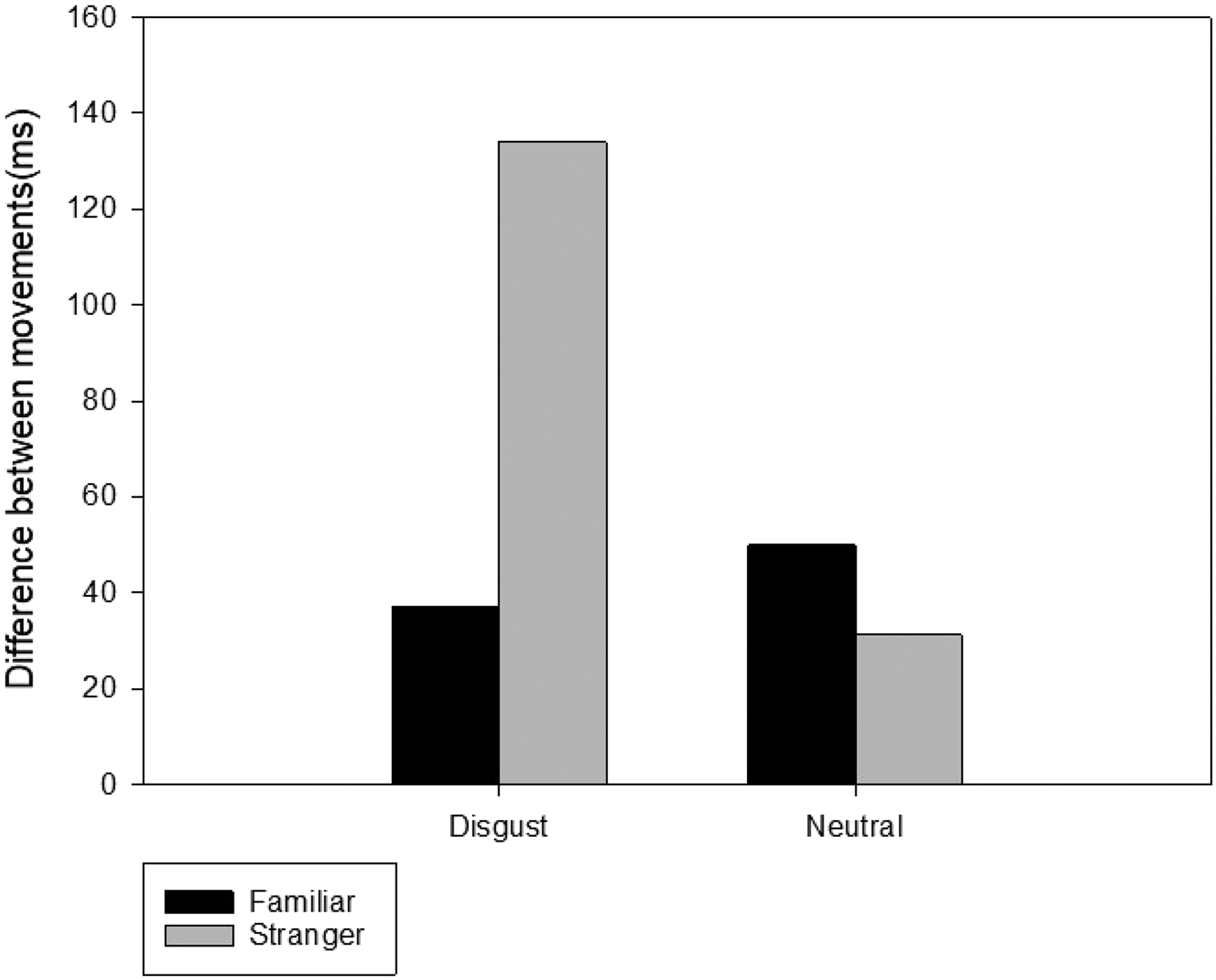
The interaction effect of the types of sentences and the familiarity on behavioral response difference score.
Discussion
Consistent with the hypothesis, when older people carry negative cues, unfamiliar older people will trigger a stronger behavioral avoidance tendency than familiar older people. When primed with neutral sentences, participants showed no significant difference in behavioral tendency caused by older people with varied levels of familiarity. This is consistent with the results of Studies 1 and 2 and the hypothesis of behavioral immunity theory, which holds that disgust is triggered by the perception of specific threat cues, which in turn enhances functional adaptive behavior (Schaller & Park, 2011). This study employed the reaction time of the behavioral response to the shape discrimination task as the dependent variable indicator. It aimed to avoid social desirability bias that may occur due to the self-reporting method in the first study. Also, the shape discrimination tasks masked the original experimental purpose and reduced the impact of any possible errors.
General Discussion
Pathogens play a vital role in the evolutionary history of many organisms, including humans. They restrict the survival and reproduction of most species. Despite the advancement of medical technology and the popularization of public health since the 20th century, various infectious diseases are still the main reason for human death at present (Morens et al., 2004). The number of deaths caused by infectious diseases worldwide is close to 25% of total deaths each year. In recent years, countries around the world are still faced with serious threats to public safety caused by infectious pathogens. A new type of coronavirus disease (COVID-19) broke out worldwide in early 2020, causing millions of people to be infected globally, which has had a great impact on the economic and social development of the world. From an evolutionary perspective, these stressful public health events will lower the activation threshold for people's immune systems and affect many social activities such as interpersonal interaction, intimacy, social decision-making, social norms, prejudice, and stereotypes (Ackerman et al., 2018).
As a key component of the behavioral immune system, disgust is responsible for the specific adaptive function of detecting threat cues, resisting threatening pathogens and preventing infection (Curtis et al., 2004; Fessler & Navarrete, 2003). Our three studies unanimously show that there is a source effect on disgust caused by older people with different familiarity levels. When older people carry negative cues, familiar older people will induce a lower level of disgust than that of the unfamiliar older people and trigger a lower level of behavioral avoidance. This result responds to a recent study which suggested the relationship between disgust proneness/sensitivity and ageism is indirect, mediated by many other factors like aging anxiety (Nicol et al., 2021).
Familiar older people often have more frequent contact with individuals and share similar microbial flora (Stevenson & Repacholi, 2005). Higher familiarity indicates higher immune similarity and lower levels of threats to health (Fincher & Thornhill, 2012; Navarrete & Fessler, 2006). On the contrary, unfamiliar older people are more likely to carry new and non-immune pathogens. Thus, individuals who come in contact with strange older people are more vulnerable to unknown bacteria and viruses. Therefore, when cues are the same, familiar older adults are at a lower level of health threats than strange older adults. Also, high interpersonal value, which is a moderating factor in the behavioral immune system, can mitigate social pathogen avoidance (Tybur et al., 2020). People often have a higher valuation for their grandparents and other elderly relatives since they offer more interpersonal value. Therefore, they show less avoidance to familiar older adults than strange older adults. Hence, under the regulation of the behavioral immune system, people will experience less disgust and show fewer avoidance behaviors. At the same time, while there is a certain cost of opportunity to interacting with outer groups, the cost of alienating with inside groups is undoubtedly higher. Due to the decline in the relative social exchanges and reciprocal values of the older adults (Cottrell & Neuberg, 2005), the reciprocal benefits of interaction with strange older adults are relatively lower, which makes the tendency to exclude strange older adults more obvious. On the contrary, familiar older people serve the function of emotional connection and social support. Also, they increase the success of their offspring by providing child care or transferring knowledge (Lahdenperä et al., 2004). Therefore, in the above cost-benefit balance, humans have evolved the mechanism that mitigates the possible disgust emotion, considering the familiarity of an older person. This mechanism helps people maintain the necessary social supports and social interactions while avoiding the threats posed by pathogens.
We also observed the same source effects on different populations in our study. In addition to the population of college students (as addressed in study 2), community adults were also regarded as participants, thereby improving the study's ecological validity. On the one hand, college students have relatively limited contact with old people on campus; on the other hand, their relationship with older adults is not affected by realistic factors such as the pressure of support duty. Using the middle-aged community population as experimental subjects provides strong support for the theory that the source effect of disgust as an evolutionary mechanism is widespread in different populations. The source effects are “unfair” since they favor people who have a close relationship with you. However, they are based on the differences in immune similarity and the degree of pathogen threats and are not affected by demographic attributes such as the age of individuals or their employment situation.
In addition, this study indicates that filial piety had no significant effect on the degrees of disgust caused by the older adults, and the moderating effect of the filial piety on the source effect of the disgust caused by the older adults was not significant either. This result shows that though different individuals are varied in terms of filial piety, their disgust for the older adults is in line with the results of evolutionary mechanisms. That is, familiar older people cause lower levels of disgusted feelings than the strange older people. According to the dual-channel model of discrimination proposed by Pryor et al. (2004), the response to the older adults includes an automated response driven by perceptual cues and a relatively slow conscious response based on the rules. These two responses are independent from each other. Therefore, the strength of filial piety may affect people's conscious response based on the rules, but it will not affect the automatic process of disgust response.
Finally, it is worth pointing out that this study is limited to some extent. First, the study examines the source effects on disgust caused by the older adults from two aspects: self-report and behavioral response. The basic emotion of disgust includes both subjective and perceptible disgust and behavioral avoidance tendencies, as well as changes in certain nervous systems, such as the generation of disgust accompanied by a decline in heart rate (Porges, 1997) and the nervous system changes in the middle-insula and basal ganglia system (Feng et al., 2006). Therefore, it is important that future studies measure participants’ disgust more accurately through physiological indicators of disgust or changes in the nervous system. Second, in the exploration of the source effects on disgust caused by the older adults, this study did not control the level of individuals’ sensitivity to disgust. There may be an interaction between individual disgust sensitivity and the familiarity of the older adults, which can be explored in future research. Thirdly, though the evolved behavioral immune system operates with behavioral avoidance responses that are consistent across cultures and populations, they are also functionally resilient and may be moderated by factors such as culture (Schaller et al., 2007). We focused only on Chinese culture, so different sample populations and cultural contexts should be included in the future. For example, individualism and collectivism could be influential cultural factors; compared with collectivistic societies like China and Japan, adults show higher independence in individualistic societies like US and UK. Therefore, we expect higher disgust towards older adults in individualistic societies in future studies. Fourthly, we didn't use younger adults as the control group. To isolate the effect of age rigorously in future studies, we may consider manipulating age by replacing the subject in the sentence with a younger version or using pictures of their younger faces (produced by Photoshop or applications employing deep learning).
Footnotes
Data Availability Statement
Data can be obtained upon request. Requests should be directed toward the corresponding author.
Declaration of Conflicting Interests
The author(s) declared no potential conflicts of interest with respect to the research, authorship, and/or publication of this article.
Ethical Approval
All of the procedures performed in studies involving human participants were in accordance with the APA ethical standards.
Funding
This study was supported by the research fund of the School of Social Development and Public Policy at Fudan University.
Informed Consent
Informed consent was obtained from all individual participants included in the study.
