



Abstract
Many have examined the desirability and mate competition tactics of adults higher on psychopathy using cross-sectional data, but few have studied the longitudinal associations between the lower-order factors of psychopathy (e.g., primary and secondary psychopathy) with indices of mating behavior in adolescents. More work is also needed to unravel how psychopathic youth outcompete rivals for mates. Delinquency has long been associated with dating and sexual behavior in adolescents, which may help to explain the competitive success of youth higher in psychopathic traits in vying for mates. We used cross-lagged panel modeling with three waves of data from a randomly drawn sample of 514 Canadian adolescents who provided annual self-reports of primary and secondary psychopathy, delinquency, and dating involvement from Grades 10 to 12 (15–18 years of age). Constructs were temporally stable. Secondary psychopathy and delinquency had positive within-time correlations with current dating status in Grade 10. A cross-lagged pathway from delinquency to dating involvement was supported from Grade 10 to 11, which replicated from Grade 11 to 12. However, this effect was specific to boys and not girls. An indirect effect also emerged whereby secondary psychopathy in Grade 10 increased the likelihood of being in a dating relationship in Grade 12 via heightened delinquency in Grade 11.
Keywords
Many researchers have studied the reproductive tactics and desirability of adults higher in psychopathy (Blanchard et al., 2016; Jauk et al., 2016; Jonason et al., 2009; Jones & de Roos, 2017; Rauthmann & Kolar, 2013; Visser et al., 2010). This body of work shows that those expressing heightened psychopathy devote more time and energy toward competing for and gaining access to mates than those lower in psychopathy, particularly in the context of brief romantic and sexual relationships (i.e., short-term mating). Although informative, most of this research has been cross-sectional with convenience samples of adults thus precluding an assessment of the temporal ordering and developmental unfolding of these variables in adolescents. Psychopathy is also more often studied at the dimensional level, with less attention devoted to its lower-order factors, such as primary and secondary psychopathy, that appear to be differentially associated with various aspects of mating psychology (Blanchard et al., 2016; Lyons, 2015; Vaillancourt & Sunderani, 2011). Further research is also needed to elucidate the specific mechanism(s) by which individuals higher in psychopathic traits outcompete rivals for mates. Given its concurrent and longitudinal associations with both psychopathy (Geerlings et al., 2020) and mating behavior in adolescents (e.g., dating; Rebellon and Manasse, 2004), delinquency may help to explain the mating success of those higher in psychopathic traits in adolescence. In the current study, we examined the longitudinal relations between primary and secondary psychopathy, delinquency, and current dating involvement in a randomly drawn sample of Canadian adolescents from Grades 10 to 12 (15–18 years of age).
Psychopathy: A Multidimensional Construct
Psychopathy is a subclinical personality dimension denoting the absence of remorse, impaired empathy, and a callous disposition, as well as erratic, impulsive, and antisocial tendencies (Cleckley, 1941; Hare, 2003). Psychopathy has long been conceptualized as representing two modestly related lower-order factors (Blackburn, 1975; Hare et al., 1991; Karpman, 1941; Lykken, 1995). The first factor, known as primary psychopathy, embodies callousness, flattened affect, manipulation, and a lack of remorse, in addition to low emotional empathy and fear. The second factor, labeled secondary psychopathy, encompasses impulsivity, boredom, irresponsibility, and antisocial behavior. Primary and secondary psychopathy have been shown to be underpinned by unique neurophysiological systems, and exhibit differential relations with cognitive, affective, and psychosocial processes (Yildirim & Derksen, 2015). In comparison to those higher in primary psychopathy, individuals with a stronger expression of secondary psychopathy have heightened cortisol levels, but this may be specific to girls and women (Vaillancourt and Sunderani, 2011), as well as prefrontal (Lasko et al., 2019) and serotonergic deficits (Minzenberg & Siever, 2006), which predisposes them to elevated anxiety (Vaillancourt & Brittain, 2019), emotional instability (Ray et al., 2009), and reactive aggression (Reidy et al., 2011). These findings substantiate the importance of assessing heterogeneity in psychopathy at the factor level (Lilienfeld, 2018).
Psychopathy and Life History Trade-Offs
Given that psychopathy is heritable (Tuvblad et al., 2014), apparent across time (Hervé, 2007) and cultures (Cooke, 1998), shaped by specific developmental experiences (Farrington et al., 2010), and contains precursors (e.g., impulsivity) evident in non-human primates (e.g., chimpanzees; Lilienfeld et al., 1999), evolutionary researchers have considered how it may promote the execution of adaptive strategies that facilitate reproductive success (da Silva et al., 2015; Krupp et al., 2013; Lalumière et al., 2008; Mealey, 1995; Međedović & Petrović, 2019). Through the lens of life history theory, personality traits like psychopathy are posited to embody resource investment trade-offs (e.g., time, energy, and material resources) between the different components of fitness (e.g., health, reproduction, and parenting; da Silva et al., 2015; Gladden et al., 2009; Jonason et al., 2010; Lalumière et al., 2001; McDonald et al., 2012; Patch & Figueredo, 2017; Visser et al., 2020). Those with elevated levels of psychopathy devote more resources toward short-term mating effort and fewer resources toward personal health, long-term mating effort, and parental investment. Trade-offs in the adaptive costs and benefits of personality characteristics are posited to influence various life history outcomes, including pubertal timing, reproductive age, and longevity (Sear, 2020). For example, higher psychopathy is related to precocious sexual development and an earlier onset of sexual activity (Harris et al., 2007; Sadeh et al., 2019), which has been supported for both primary and secondary psychopathy (Visser et al., 2010).
Psychopathy and Mate Competition
Following this life history perspective, psychopathy is argued to be part of an organized system of co-adapted traits that facilitates investment in early sexual development, short-term mating strategies, risk-taking, sexual deviance, coercion, delinquency, and aggression; a so-called “fast life history strategy” (da Silva et al., 2015; Gladden et al., 2009; Jonason et al., 2010; Lalumière et al., 2001; Visser et al., 2020). This is contrasted with personality traits like honesty-humility (avoidance of exploiting others) that are linked to a “slower life history strategy” whereby resources are invested in producing fewer offspring later in development, heightened parental care, risk-aversion, as well as greater physical and psychosocial health (Davis et al., 2019). However, there have been several criticisms of life history theory in evolutionary psychology, particularly regarding personality, which has become fractioned from its roots in biology (Nettle & Frankenhuis, 2020). Some are skeptical that large suites of traits aggregate along a single “fast–slow continuum” (Holtzman & Senne, 2014; Sear, 2020). Others contend that the evolutionary processes that lead to differences between species in life history (i.e., Darwinian evolution) are not the same as those that lead to differences in psychological traits among members within a species (e.g., developmental plasticity; Zietsch and Sidari, 2020). Some have responded that these critiques are overstated and that several evolutionary mechanisms have been delineated that can align trait covariation at the between- and within-species levels, including frequency-dependent and fluctuating selection (Menie et al., 2021). Regardless of the validity of “fast” or “slow” life history strategies, researchers continue to show how life history theory is useful in studying adaptive trade-offs in various psychological traits, such as psychopathy (Međedović, 2019; Međedović & Petrović, 2019; Visser et al., 2020).
To explain their heightened short-term mating success, researchers have proposed that those higher on psychopathy more often mate opportunistically by lowering their mate preference standards for short-term partners (Jonason et al., 2011 and by committing sexual infidelity in comparison to those lower on psychopathy (Jones & Weiser, 2014). People high in psychopathy also use sexually exploitive tactics to manipulate and take advantage of mates, such as by expressing rape-enabling attitudes (Jonason et al., 2017), deceptively self-promoting traits valued by potential mates (Brazil and Forth, 2020), and by abusing partners to retain them through intimidation, fear, and violence (Cunha et al., 2021). Other researchers have speculated that psychopathic individuals may possess “good genes” and attract mates via dominance and flashy displays of status (i.e., conspicuous consumption), as well as by exuding sexiness, confidence, and charisma (Blanchard et al., 2016). These signals would presumably operate in a sex-differentiated manner in line with men's and women's mate preferences (Buss, 1989): psychopathic men's desirability may hinge on dominance and indicators of resource holding (e.g., status), whereas psychopathic women's attractiveness may be driven by signaling sexual availability. Nonetheless, evidence is mixed regarding whether hypothetical and real psychopathic men and women are actually perceived to be more attractive as short- or long-term mates (Blanchard et al., 2016; Carter et al., 2014; Jauk et al., 2016; Jonason et al., 2015; Rauthmann & Kolar, 2013).
Although informative, most previous research on the relations between psychopathy and mating behavior has focused on psychopathy at the dimensional level, with less attention devoted to its lower-order factors (Blanchard et al., 2016; Brazil & Forth, 2020; Visser et al., 2010). Across species, mating behavior encompasses the formation of a pair-bond, courting, copulatory and post-copulatory actions, as well as mate retention (Alexander et al., 1997). Another important limitation of previous work on psychopathy and mating behavior is that most of the research has involved convenience samples of adults with cross-sectional data. Therefore, much less is known about how the lower-order factors embodying psychopathy in adolescence may be differentially associated with mating behavior across time.
Adolescent Development, Mating Behavior, and Personality
Adolescence is a developmental period characterized by emotional, social, morphological, and physiological changes in conjunction with puberty (Baams et al., 2015). This stage of life is marked by increases in peer affiliation, the importance of status hierarchies, risk-taking, sensation-seeking, and heightened emotional reactivity (Ellis et al., 2012; Hymel et al., 2014; Steinberg et al., 2008). Furthermore, competition with peers for mating opportunities intensifies during adolescence (Gallup et al., 2011; Volk et al., 2015). For instance, dating is a salient feature of adolescent courtship and social dynamics, wherein youth assess the romantic and/or sexual compatibility of desired mates (Collins et al., 2009; Seffrin et al., 2009). The expression of “dark” personality characteristics, including psychopathy (Hartung et al., 2022), and the perpetration of peer aggression also increases for many across adolescence (Reijntjes et al., 2013). Antisocial personality traits (Volk et al., 2012, 2015) and aggression (Arnocky & Vaillancourt, 2012; Lee et al., 2018) can promote mating effort and mating success in youth. For example, bullying among adolescents is associated with having more sex partners, which is explained by the expression of heightened antisocial personality characteristics (e.g., lower honesty-humility; Provenzano et al., 2018). Nonetheless, limited research has been devoted to studying psychopathy and mating behavior in non-referred adolescents.
Among adolescents in Grades 7 to 12, primary and secondary psychopathic traits were positively correlated with risky sexual behavior, including number of sex partners and frequency of unprotected sex (Ručević, 2010). These relations were similar for boys and girls. Although, consistent with previous research (Hoyle et al., 2000), secondary psychopathy shared stronger links with risky sexual behavior. Controlling for sex, callous-unemotional traits in adolescents positively predicted risky sexual behavior six years later (McCauley et al., 2016). Psychopathy, particularly secondary psychopathy, also positively predicts engaging in various forms of delinquency, and this relation does not appear to be moderated by sex (see Geerlings et al., 2020 for meta-analysis). Like psychopathy, delinquency has long been associated with dating and sexual behavior (Haynie et al., 2005; Miller & Simon, 1974; Rosenbaum & Kandel, 1990; Savioja et al., 2017).
Relations Between Psychopathy, Delinquency, and Mating
Despite its damaging personal, interpersonal, and societal-level outcomes, delinquency, like psychopathy, may function to adaptively confer important social (e.g., status) and reproductive (e.g., dating and sexual partners) benefits to youth (Rebellon & Manasse, 2004). Among boys and girls aged 11–17 years, dating status and delinquent behavior demonstrated temporal stability, and earlier delinquency positively predicted dating involvement two years later (Rebellon & Manasse, 2004). The reverse pathway from dating to later delinquent behavior was not supported. Although, perceived dating importance did predict later delinquency. In adolescents in Grades 7–11, earlier self- and teacher-reported delinquency (e.g., antisocial behavior and substance use) correlated with an earlier age of sexual intercourse and number of years of sexual activity (Schofield et al., 2008). In a three-wave longitudinal study of adolescents aged 15–18, dating effort and number of dating partners positively predicted delinquency across time (Seffrin et al., 2009). In adolescents aged 16–18, sexual behavior in non-romantic relationships positively predicted delinquency six years later (Harden & Mendle, 2011). Therefore, longitudinal research indicates that delinquency and mating behavior may positively predict one another across time in adolescence.
In some longitudinal work, delinquency, or conduct problems, have been assessed alongside psychopathy and mating behavior in adolescents. Among students in Grade 6, parent-rated primary psychopathy interacted with conduct problems in predicting sexual debut by Grade 8, but not engagement in unprotected sex in Grade 12 (Wymbs et al., 2013). Conduct problems, but not primary psychopathy, predicted an increased risk of pregnancy by Grade 12. Sex did not moderate these associations. Controlling for sex, race, age, socioeconomic status, and severity-risk screening scores, parent-rated conduct problems positively predicted a composite of self-reported risky sexual behavior (sexual debut, condom use, and sexual solicitation) among students in Grade 7 (Anderson et al., 2017). In first-time offender adolescent boys aged 13–17, baseline self-reported primary psychopathy positively predicted risky sexual behavior 18 to 24 months later, which was mediated by increased substance use (controlling for delinquency; Thornton et al., 2019). Thus, previous work supports both concurrent and longitudinal links between psychopathic traits, delinquency, and sexual behavior in adolescents. Furthermore, evidence suggests that delinquency may mediate (i.e., explain) the positive relations between psychopathic traits and mating outcomes (Thornton et al., 2019).
Delinquency likely increases mating success in sex specific ways, despite largely sex-invariant links between delinquent behavior with dating and risky sexual activity among adolescents (Anderson et al., 2017; Rebellon & Manasse, 2004; Ručević, 2010; Schofield et al., 2008; Wymbs et al., 2013; but see Seffrin et al., 2009). Like the argument for those who are psychopathic (Blanchard et al., 2016), delinquency in boys might signal desirable attributes such as dominance, bravery, and toughness; qualities that can speak to their possession of “good genes” and the capacity to win physical contests, fend off predators, and provide protection. Women rate these characteristics as attractive in men across societies (Buss, 1989). In contrast, men are especially attentive to cues of sexual availability in the context of short-term mating (Schmitt & Buss, 1996). Since delinquency in adolescent girls is linked to engaging in risky short-term sex with a variety of partners (Anderson et al., 2017; Miller et al., 2010), they may be regarded as attractive dating partners because they signal a greater opportunity for sex. In addition, delinquency can facilitate the acquisition of status in contexts where risk-taking propensities are valued (see Rebellon & Manasse, 2004). Although delinquency does not unequivocally grant youth acceptance among their peers (Rulison et al., 2014), minor delinquent acts (e.g., sneaking into a movie without paying) can promote popularity, while more serious forms of delinquency (e.g., assault) can decrease popularity (Allen et al., 2005). Indeed, delinquent youth may be socially magnetic in childhood and early adolescence, but their antisocial tendencies appear to harm their likeability (i.e., sociometric status) in later adolescence (Cillessen & Borch, 2006; Rulison et al., 2014; Young, 2014). Furthermore, even if they are not well liked by peers, different kinds of delinquent behavior can afford adolescents greater social rank, power, and autonomy (Agnew, 1990; Agnew et al., 2008; Garandeau & Lansu, 2019). Evolutionary scholars have emphasized how social status can facilitate outcompeting peers for desired mates in boys and girls, through the strategic use of intimidation and aggression to subordinate rivals (Lee et al., 2018; Vaillancourt and Krems, 2018). Therefore, delinquent youth may both self-promote desirable qualities (i.e., intersexual selection) and exercise their power over peers (i.e., intrasexual competition) to enhance their success when competing for mates (Rebellon & Manasse, 2004).
The Present Study
Many have examined the cross-sectional links between psychopathy with mating behavior among adults (Jauk et al., 2016; Jonason et al., 2009; Jones & de Roos, 2017; Rauthmann & Kolar, 2013; Visser et al., 2020). However, far fewer have used an evolutionary lens to study the lower-order factors of psychopathy, such as primary and secondary psychopathy, in relation to mating dynamics, particularly using longitudinal data with adolescents. It is also unclear what mechanism(s) account for the relation between more antisocial personality traits and mating behavior in youth (Provenzano et al., 2018). Delinquency may signal the possession of desirable qualities, including courage, bravery, and formidability in boys and a greater willingness to engage in sexual behavior in girls (Rebellon & Manasse, 2004), which might help to explain the heightened mating success of youth higher in psychopathic traits. Delinquency shares cross-sectional and longitudinal relations with psychopathic traits (see Geerlings et al., 2020 for meta-analysis), dating, and sexual behavior in youth (Eklund et al., 2010; Giordano et al., 2010; McCarthy & Casey, 2008; Miller et al., 2010; Rebellon & Manasse, 2004; Savioja et al., 2017; Seffrin et al., 2009). Few, however, have examined the longitudinal relations between psychopathy, delinquency, and indices of mating behavior in adolescents (e.g., Anderson et al., 2017; Thornton et al., 2019; Wymbs et al., 2013), and there are some limitations of this empirical work. In this research, risky sexual behavior (e.g., frequency of unprotected sex) has been measured primarily at the exclusion of more normative forms of mating behavior during adolescence, such as dating (Rebellon & Manasse, 2004). Furthermore, despite research indicating that secondary psychopathy may share stronger links with mate-seeking and copulatory behavior in youth (e.g., Ručević, 2010), primary psychopathic traits have also been the center of attention in previous longitudinal studies.
In this literature, researchers also do not often employ longitudinal analytic techniques that permit controlling for the stability of constructs across time and their concurrent associations within-time, while estimating cross-lagged associations to gather insight into change, such as cross-lagged panel modeling (CLPM; Masten and Cicchetti, 2010). A related point is that many investigators tend to assume that sexual behavior is an outcome, and not potentially an antecedent, of psychopathy or delinquency (Harden & Mendle, 2011; Seffrin et al., 2009). CLPM enables researchers to simultaneously estimate the direction of cross-lagged effects and to establish temporal priority among constructs (i.e., their sequential ordering over time), which provides critical insight into dynamic developmental processes (Masten & Cicchetti, 2010). In the current study, we generated a three-wave CLPM of primary and secondary psychopathy, delinquency, and dating involvement in a randomly drawn sample of Canadian adolescents from Grades 10 to 12 (15–18 years of age).
Several researchers have posited that psychopathy is part of a “male-typical” strategy that facilitates investment in short-term and exploitive mating tendencies (Brazil & Forth, 2020; Jonason et al., 2009). Among youth, boys often self-report higher primary, but not necessarily secondary, psychopathic traits (e.g., Ručević, 2010). Boys also tend to score higher in different measures of delinquency (Seffrin et al., 2009). At the dimensional level, meta-analytic work shows that the relations between psychopathy and delinquency are not moderated by sex in youth (Geerlings et al., 2020), despite some evidence that the link between secondary psychopathy and delinquent behavior is stronger for boys than for girls (Ručević, 2010). Adolescent boys report greater dating effort and number of dating partners, whereas adolescent girls are more likely to be involved in a dating relationship (Seffrin et al., 2009). Nonetheless, the relations between delinquency and mating behavior are often not moderated by sex (Anderson et al., 2017; Ručević, 2010; Schofield et al., 2008; Wymbs et al., 2013). Therefore, the relations between psychopathy, delinquency, and dating were not expected to differ by sex. Considering findings from previous cross-sectional and longitudinal research on these constructs in youth, we set out to test the following hypotheses: Hypothesis 1: Primary and secondary psychopathy, delinquency, and current dating status would be stable across time.
Hypothesis 2: Primary and secondary psychopathy, as well as delinquency would be positively correlated with being in a dating relationship within each time point.
Hypothesis 3: Primary and secondary psychopathy, as well as delinquency would positively predict being in a dating relationship one year later.
Hypothesis 4: Indirect effects would emerge from elevated primary and secondary psychopathy in Grade 10 through increases in delinquent behaviour in Grade 11 to being in a dating relationship one year later.
Method
Participants
Participants were drawn from the McMaster Teen Study, which is an ongoing longitudinal cohort study in southern Ontario on the relations between mental health, well-being, and social behavior. In 2008, 875 students in Grade 5 (Mage = 10.91, SD = 0.36) were randomly recruited from 51 public elementary schools and agreed to participate in the study. Of this initial sample, 704 students agreed to participate in at least one follow-up assessment. Assessments have continued each year since the beginning of data collection. For the current study, longitudinal data for N = 514 (56.8%, n = 292 girls) adolescents between 15 to 18 years of age were drawn from Time 6 (Grade 10; ages 15–16), Time 7 (Grade 11; ages 16–17), and Time 8 (Grade 12; ages 17–18) from the larger dataset. Time 6 was selected as the first time point because this is when dating behavior was first assessed. At Time 6, when students were in Grade 10, the average age was 16.00 (SD = 0.34).
Procedure
The McMaster Teen Study has received ethical approval for every year of data collection from an institutional research ethics board. Parental consent and child assent/consent have been obtained throughout the course of the study. At each time point, participants have been asked to complete either a paper-and-pencil or online questionnaire at their place of residence. Participants have been compensated with a gift card that has increased in monetary value throughout the study. Self-report measures for psychopathy, delinquency, and dating behavior were used for the present study (see Vaillancourt et al., 2013 for a discussion of recruitment procedures for the McMaster Teen Study).
Measures
Primary and secondary psychopathy
The 20-item Antisocial Personality Screening Device–Self Report (APSD-SR; Frick & Hare, 2001) was used to assess primary and secondary psychopathic traits. The 6-item Callous-Unemotional subscale (e.g., “You feel bad or guilty when you do something wrong” [reverse-coded]) was used to measure primary psychopathy, whereas the 5-item Impulsivity subscale (e.g., “You do not plan ahead or leave things until the ‘last minute’”) was used to assess secondary psychopathy. Following Vaillancourt and Brittain (2019), the items “You hide your feelings or emotions from others” and “You keep the same friends” were omitted because they produced unacceptable internal consistencies (α = .37–.47). Participants responded to items along a 3-point scale ranging from 0 (Not at all true) to 2 (Definitely true). Items were averaged to calculate mean scale scores (no items were allowed to be missing), with higher scores denoting heightened primary and secondary psychopathy. The Callous-Unemotional (α = .61 for Grade 10; α = .54 for Grade 11; α = .54 for Grade 12) and Impulsivity subscales (α = .63 for Grade 10; α = .60 for Grade 11; α = .62 for Grade 12) had low internal consistency in the present study. Average measure intraclass correlations (ICCs) for the Callous-Unemotional (r = .76, p < .001) and the Impulsivity subscales (r = .84, p < .001) suggested good to excellent reliability across time (Koo & Li, 2016).
Delinquency
Delinquent behavior was assessed using 15 items from the Rule Breaking Behavior Scale of the Child Behavior Checklist (CBCL; Achenbach and Rescorla, 2001) youth-report. Respondents reported the degree to which they perpetrated delinquent acts (e.g., “I break rules at home, school, or elsewhere") over the past six months using a 3-point scale ranging from 0 (Not true) to 2 (Very true or often true). Items were averaged to create a total score (four items were allowed to be missing), with higher scores describing greater delinquency. The Rule Breaking Behavior Scale was internally consistent across time in the current study (α = .83 for Grade 10; α = .80 for Grade 11; α = .80 for Grade 12).
Current dating Status
To assess current dating status, participants were asked “Are you currently dating someone?” to which they responded either Yes (coded 1) or No (coded 0). This item serves as an indicator of competitive success in the domain of mate competition and has been successfully employed in previous research on the longitudinal links between aggression and dating behavior in adolescents (Arnocky & Vaillancourt, 2012).
Analytic Plan
The Statistical Package for the Social Sciences (SPSS; version 27) and Mplus (version 8.1) were used to conduct analyses in the present study. SPSS was used to examine missing data, as well as to calculate descriptive statistics and independent samples t-tests. CLPM in Mplus was used to examine the dynamic relations among primary and secondary psychopathy, delinquency, and current dating status over time. Due to the dichotomous nature of the dating status variable, weighted least squares mean and variance adjusted (WLSMV) estimation was used with theta parameterization (DiStefano & Morgan, 2014). The following statistics were employed to assess model fit: the χ2 test of significance, the comparative fit index (CFI), the Tucker-Lewis index (TLI), the root mean square error of approximation (RMSEA), and the weighted root mean square residual (WRMR). A non-significant χ2 suggests adequate model fit; however, this test is sensitive to variation in sample size (Kline, 2015). CFI and TLI values > 0.95, RMSEA values < 0.06, and WRMR values < 1 indicate adequate model fit (DiStefano et al., 2018; Hooper et al., 2008).
A series of CLPMs were estimated for primary and secondary psychopathy, delinquency, and current dating status. In each CLPM, one-year (e.g., Grade 10 primary psychopathy → Grade 11 primary psychopathy) and two-year autoregressive paths (e.g., Grade 10 primary psychopathy → Grade 12 primary psychopathy), within-time correlations (e.g., Grade 10 psychopathy with Grade 10 dating status), and one-year cross-lagged paths (e.g., Grade 10 delinquency → Grade 11 dating status) were incorporated. Following others using CLPM (e.g., Kim et al., 2014), this unconstrained base mode was compared to models with equality constraints (i.e., paths constrained to be equal over time) imposed on the one-year autoregressive paths (Model 2), within-time correlations in Grades 11 and 12 (Model 3), and one-year cross-lagged parameters (Model 4). Imposing equality constraints allows for greater degrees of freedom and aids in model interpretability. To assess invariance of autoregressive paths, within-time associations, and cross-lagged relations, the DIFFTEST command was used (Asparouhov et al., 2006). Significant differences describing a deterioration in model fit suggest that effects across time between variables are unequal, and that the specific parameters of interest (e.g., the autoregressive paths) should be freed. Parameter constraints were imposed in a final Model (Model 5) when comparisons showed no differences. To test for the indirect effect of delinquency on the predicted relations between primary and secondary psychopathy with dating involvement, 95% bootstrap confidence intervals (N = 5000) were used in Model 5.
Results
Descriptive statistics for variables can be seen in Table 1. For continuous variables, skewness and kurtosis values fell within acceptable ranges for each time point (skewness < + /-3 and kurtosis < + /-10; Kline, 2015). For dating status, 24.1% (n = 106 of 439) in Grade 10, 30.9% (n = 132 of 427) in Grade 11, and 39.3% (n = 172 of 438) in Grade 12 reported that they were currently in a dating relationship. Compared to those who were not selected, adolescents in the analytic sample were more likely to be a girl, χ2 (1, N = 875) = 8.036, p = .005, ɸCramer = .10. In comparison to those not selected, the parents of adolescents in the analytic sample had higher educational achievement, t(805) = 7.96, p < .001, d = 0.57. Across variables in the analytic sample, an average of 14.1% of the data were missing (min. = 12.6%, max. = 16.9%). Little's Missing Completely at Random test showed that data in the analytic sample were missing completely at random, χ2 (172) = 173.135, p = .461.
Descriptive Statistics for Primary and Secondary Psychopathy and Delinquency.

Note. Significant sex differences were found for primary psychopathy in Grades 10, 11, and 12 with boys scoring higher than girls at each time point.
Repeated measures ANOVAs showed that boys and girls differed in their expression of primary psychopathy across time points, F(1, 370) = 33.279, p < .001, η2 = .08 (see Table 1 for means and standard deviations by sex). Pairwise comparisons indicated sex differences at each time point (p < .001), with boys reporting higher scores. No sex differences emerged for secondary psychopathy, F(1, 370) = 0.532, p = .466, η2 = .00, or delinquency, F(1, 370) = 0.128, p = .721, η2 = .00. Chi-square tests of independence indicated that there were no sex differences in dating status in Grade 10, χ2 (1, N = 439) = 3.381, p = .072, Grade 11, χ2 (1, N = 427) = 2.308, p = .140, or Grade 12, χ2 (1, N = 438) = 3.044, p = .093.
Pearson correlations revealed that secondary psychopathy, delinquent behavior, and dating involvement were all positively intercorrelated within and across time points (see Table 2). However, primary psychopathy did not correlate with dating status within and across time. Separate correlations were calculated for boys and girls (see Table 2S in Supplemental Materials). Fisher's r-to-z transformations indicated that the correlations between primary psychopathy in Grade 10 with current dating status in Grade 10 (z = −1.96, p = .025) and Grade 11 (z = −1.84, p = .033) were positive for girls and negative for boys. Similarly, the relations between primary psychopathy in Grade 11 with current dating status in Grade 10 (z = −1.85, p = .033), Grade 11 (z = −2.56, p = .005), and Grade 12 (z = −2.88, p = .002) were positive for girls and negative (or uncorrelated) for boys.
Bivariate Correlations Between Measured Variables.
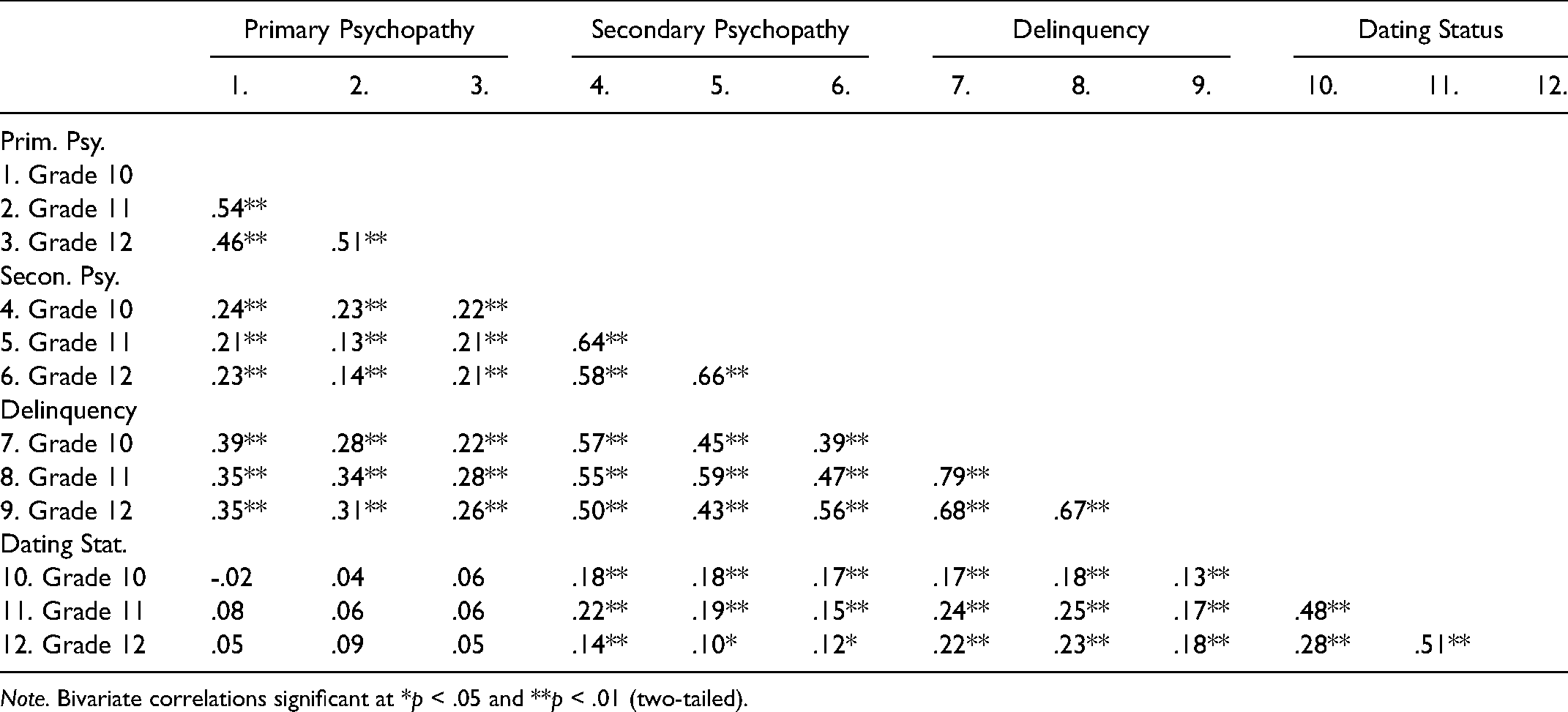
Note. Bivariate correlations significant at *p < .05 and **p < .01 (two-tailed).
Cross-Lagged Panel Model Analyses
A base CLPM model (Model 1) had excellent fit to the data (see Table 3). Imposing equality constraints on the one-year autoregressive paths (Model 2) resulted in a deterioration in model fit. In contrast, constraining the within-time correlations in Grade 11 and Grade 12 (Model 3) did not influence model fit. Likewise, a model wherein the cross-lagged pathways were constrained to be equal (Model 4) did not differ from the base model. Therefore, equality constraints were imposed on the within-time associations in Grade 11 and Grade 12, as well as the cross-lagged effects in a final model (Model 5). Standardized coefficients (r and β) are reported for analyses below, and unstandardized coefficients (covariances and b) are provided for the final model in Figure 1.

CLPM for primary and secondary psychopathy, delinquency, and dating from Grades 10 to 12. Note. Above CLPM (Model 5) includes one- and two-year autoregressions, within-time correlations, and cross-lagged effects. Equality constraints imposed on within-time correlations in Grades 11 and 12, as well as the cross-lagged paths. Note. Statistically significant (p < .05) values are unstandardized covariances and regression coefficients (b).
Model fit Statistics for CLPM Analyses.

Note. Mod. = model; χ2 = Chi-square; CFI = comparative fit index; TLI = Tucker-Lewis index; RMSEA = root mean square error of approximation; WRMR = weighted root mean square residual; Comp. = model comparison; Δχ2 = Chi-square difference for DIFFTEST. Model 1 = base model; Model 2 = one-year autoregressive paths constrained; Model 3 = within-time correlations in Grades 11 and 12 constrained; Model 4 = cross-lagged paths constrained; Model 5 = within-time correlations in Grades 11 and 12 and cross-lagged effects constrained to be equal (Final Model); Model 6 = multi-group model where paths were free to vary by sex; Model 7 = multi-group model where paths for boys and girls were held equal.
One-year stability paths from Grade 10 to 11 were supported for primary (β = .53, p < .001) and secondary psychopathy (β = .62, p < .001), delinquency (β = .68, p < .001), and dating status (β = .51, p < .001; Hypothesis 1). Likewise, one-year autoregressions from age Grade 11 to 12 for primary (β = .39, p < .001) and secondary psychopathy (β = .50, p < .001), delinquency (β = .21, p < .001), and dating involvement were found (β = .75, p < .001). Two-year autoregressive paths were further supported for primary (β = .22, p < .001) and secondary psychopathy (β = .20, p = .001), as well as for delinquency (β = .44, p < .001), but not for dating involvement.
In Grade 10, primary psychopathy correlated positively with secondary psychopathy (r = .24, p < .001) and delinquency (r = .39, p < .001). Secondary psychopathy also correlated with both delinquency (r = .59, p < .001) and dating involvement (r = .23, p < .001; Hypothesis 2). Delinquency further correlated with dating involvement in Grade 10 (r = .19, p < .001). In Grade 11, primary (r = .10, p = .003) and secondary psychopathy (r = .42, p < .001) correlated positively with delinquency. But dating status did not correlate with primary and secondary psychopathy, as well as delinquency, in Grade 11. In Grade 12, primary (r = .08, p = .002) and secondary psychopathy (r = .37, p < .001) correlated with delinquency, but none of the variables were associated within-time with dating involvement.
Both primary (β = .09, p < .001) and secondary psychopathy (β = .13, p < .001) positively predicted delinquency from Grade 10 to 11, and these paths were replicated from Grade 11 to 12 (primary psychopathy: β = .09, p < .001; secondary psychopathy: β = .12, p < .001). In Grade 10, secondary psychopathy positively predicted delinquency, (β = .13, p < .001), which replicated from Grade 11 to 12 (β = .12, p < .001). Cross-lagged effects also emerged for secondary psychopathy in Grade 10 predicting primary psychopathy in Grade 11 (β = .10, p = .001), which was replicated from Grade 11 to 12 (β = .10, p = .001). From Grade 10 to 11, there was a cross-lagged effect from delinquency to dating involvement (β = .15, p = .005), which replicated from Grade 11 to 12 (β = .12, p = .007; Hypothesis 3).
Bootstrap confidence intervals (95%) indicated that secondary, but not primary, psychopathy in Grade 10 was indirectly related to current dating status in Grade 12 through delinquency in Grade 11 (β = .02, p = .041, 95% CI = .004–.028; Hypothesis 4). This indirect association was characterized by a small effect size (∼ab = .03; Wu et al., 2018).
Exploratory multi-group models for sex were created to test for differences between boys and girls. The DIFFTEST command showed that a model where parameters were free to vary by sex (Model 6) had better fit to the data than a model where paths were constrained to be equal between boys and girls (Model 7; see Table 3), indicating that sex was a moderator (see Figure 2 for boys and Figure 3 for girls). Inspecting the individual paths, the one-year autoregressive pathway from delinquency in Grade 11 to 12 was supported for boys (β = .34, p < .001), but not for girls. Primary and secondary psychopathy in Grades 11 and 12 were negatively correlated in boys (Grade 11: r = -.13, p = .004; Grade 12: r = -.15, p = .005), and uncorrelated in girls. Delinquency and dating status in Grade 10 were also positively correlated in girls (r = .24, p < .001), but not in boys. And primary psychopathy correlated positively with delinquency in Grades 11 and 12 for girls (Grade 11: r = .17, p < .001; Grade 12: r = .16, p < .001), but not boys. Across time points, secondary psychopathy positively predicted primary psychopathy (Grade 10 to 11; β = .10, p = .031; Grade 11 to 12; β = .10, p = .025) and delinquency in girls (Grade 10 to 11; β = .20, p < .001; Grade 11 to 12; β = .20, p < .001), but not for boys. Delinquency only positively predicted dating status across time in boys (Grade 10 to 11: β = .21, p = .015; Grade 11 to 12; β = .18, p = .016), and not for girls. Furthermore, dating status positively predicted secondary psychopathy in boys (Grade 10 to 11: β = .04, p = .035; Grade 11 to 12: β = .12, p = .026), but not for girls. Despite sex differences in the cross-lagged pathways for secondary psychopathy and delinquency, as well as delinquency and dating status, the indirect effect was not found in either model for boys (p = .596) or girls (p = .484).

CLPM for primary and secondary psychopathy, delinquency, and dating from Grades 10 to 12 for boys. Note. Above CLPM for boys includes one- and two-year autoregressions, within-time correlations, and cross-lagged effects. Equality constraints imposed on within-time correlations in Grade 11 and 12, as well as the cross-lagged paths. Note. Statistically significant (p < .05) values are unstandardized covariances and regression coefficients (b).

CLPM for primary and secondary psychopathy, delinquency, and dating from Grades 10 to 12 for girls. Note. Above CLPM for girls includes one- and two-year autoregressions, within-time correlations, and cross-lagged effects. Equality constraints imposed on within-time correlations in Grade 11 and 12, as well as the cross-lagged paths. Note. Statistically significant (p < .05) values are unstandardized covariances and regression coefficients (b).
Discussion
In the current study, the longitudinal associations between primary and secondary psychopathy, delinquency, and current dating involvement were examined in a randomly drawn sample of Canadian adolescents from ages 15–18 (Grades 10–12) via CLPM. There is limited work on the relations between multifaceted “dark” personality traits, like psychopathy, and indices of mating dynamics in youth across time. It is also important to unravel how adolescents higher in factors of psychopathy successfully appeal to and outcompete peers for mates over time. Because of its previous concurrent and longitudinal associations with psychopathic traits and mating behavior in adolescents (Anderson et al., 2017; Thornton et al., 2019; Wymbs et al., 2013), we assessed whether delinquency facilitated the mating success of youth in the context of dating (Rebellon & Manasse, 2004).
In support of Hypothesis 1, across time points the unconstrained one-year autoregressions for primary and secondary psychopathy, delinquency, and dating status were all positive, suggesting temporal stability in paths from Grades 10 to 12. This aligns with previous longitudinal research on youth (Diamantopoulou et al., 2011; Lynam et al., 2009).
In partial support of Hypothesis 2, dating status correlated positively with secondary psychopathy and delinquency in Grade 10. However, these within-time associations did not replicate in Grade 11 or 12. When using CLPM, within-time correlations at the first wave of data are often stronger than subsequent waves because stability and cross-lagged associations have not yet been controlled for, leading to smaller effects across time points (Masten & Cicchetti, 2010). This may result in a failure to replicate paths, particularly when effect sizes are small, and the positive bivariate correlations for secondary psychopathy (r = .12–.22) and delinquency (r = .13–.25) with dating involvement were small to medium (r = .10–30; Cohen, 1988). Alternatively, these relations may not have replicated in Grade 11 and 12 because of a development process whereby secondary psychopathy and delinquency are effective in middle, but not older, adolescence in appealing to and competing for a dating relationship. However, this seems less likely considering evidence that secondary psychopathy (Visser et al., 2010) and delinquency (Savioja et al., 2017) are related to mating outcomes (e.g., number of sex partners) among young adults.
In contrast to Hypothesis 2, primary psychopathy did not correlate with current dating in the final CLPM at any time point. Similar results were found for the bivariate correlations. This result is consistent with some previous research where secondary psychopathy was a stronger and more reliable predictor of short-term and risky sexual behavior in youth (Ručević, 2010), and young adults (Kastner & Sellbom, 2012; McDonald et al., 2012; Visser et al., 2010). This is important because primary psychopathic traits have been the predominant focus in previous longitudinal work on psychopathy, delinquency, and risky sexual activity in youth (Anderson et al., 2017; Thornton et al., 2019; Wymbs et al., 2013). Therefore, our results help to demonstrate the importance of assessing both primary and secondary factors of psychopathy to avoid incorrectly attributing unique effects to one over the other when both are not collectively modeled and examined (Lilienfeld, 2018). Furthermore, from an evolutionary perspective, these findings align with the argument that there is an asymmetry in life history trade-offs between the different factors of psychopathy. Secondary psychopathy seems to encourage devoting significantly more resource toward short-term mating effort, at least in young adults (McDonald et al., 2012), at the expense of personal health and the well-being of offspring (Međedović & Kujačić, 2020). Secondary psychopathy also appears to be uniquely associated, at least in young adult women, with a range of risk-taking behavior, including maintaining more than one long-term relationship simultaneously (Lyons, 2015). Similarly, secondary psychopathy shares stronger links with hypersexuality in young adults (e.g., sexual excitation and compulsivity; Kastner and Sellbom, 2012).
However, there were sex differences in the bivariate correlations and within-time associations for primary psychopathy and dating status. These variables were unrelated among boys. In contrast, in girls, primary psychopathy was positively associated, although inconsistently, with being in a dating relationship at the bivariate level, as well as in Grade 10 in the CLPM. Therefore, primary psychopathy may enhance the dating success of adolescent girls, but not boys. These results, however, contrast with previous findings where no sex differences were found in the relations between primary psychopathy and sexual behavior among adolescents (Wymbs et al., 2013).
Partial support was found for Hypothesis 3: the cross-lagged relations between delinquency and dating status were positive. Therefore, delinquent behavior in Grades 10 and 11 increased the likelihood of being involved in a dating relationship one year later. This finding is consistent with past longitudinal work where delinquency predicted perceived dating importance (Rebellon & Manasse, 2004), as well as various indices of risky sexual behavior, including frequency of unprotected sex and number of sexual partners (e.g., Miller et al., 2010; Schofield et al., 2008). However, evidence for the alternative pathway—dating status to greater delinquency one year later—was not supported. This contrasts with other work where number of dating partners and dating effort (Seffrin et al., 2009), sexual debut (Armour & Haynie, 2007), and sex in non-romantic contexts (Harden & Mendle, 2011; McCarthy & Casey, 2008) contributed to greater delinquency over time in youth. Also, in contrast to Hypothesis 3, there were no cross-lagged relations between primary psychopathy with dating. This is despite secondary psychopathy sharing significant positive bivariate relations with dating within and across time, as well as sharing a within-time correlation with dating involvement in Grade 10 in the final CLPM.
Importantly, however, examining pathways by sex indicated that delinquency predicted dating status across time in boys and not girls. This finding runs in contrast to some previous work where delinquency predicted dating involvement for both sexes (e.g., Rebellon and Manasse, 2004). Furthermore, dating status also predicted heightened secondary psychopathy across time among boys. These findings suggests that for boys, delinquency can contribute to future dating success, and that being in a dating relationship may encourage the expression of secondary psychopathy over time.
Primary and secondary psychopathy also both positively predicted delinquency across time, which accords with previous longitudinal work (Geerlings et al., 2020). Furthermore, consistent with past research (e.g., Walters, 2015), delinquency positively predicted secondary psychopathy across time. These findings suggest that secondary psychopathy and delinquency share reciprocal relations and potentiate each other across time in adolescence. The same cannot be said of primary psychopathy. A caveat is that secondary psychopathy only predicted delinquency across time in girls and not boys.
In partial support of Hypothesis 4, secondary, but not primary, psychopathy in Grade 10 was indirectly related to current dating status in Grade 12 through greater delinquency inGrade 11. Therefore, impulsivity appears to encourage mate-seeking behavior and dating success over time in later adolescence, which is facilitated by engagement in delinquent behavior. Delinquent youth may be attractive dating partners for sex-specific reasons (Rebellon & Manasse, 2004). Girls may be particularly drawn to delinquent boys because they display a willingness to take risks, bravery, and toughness which can signal a greater capacity to win physical contests, fend off predators, and provide protection. In contrast, evolutionary scholars highlight how boys and men are particularly attentive to cues of sexual availability in the context of short-term mating (Schmitt & Buss, 1996), and delinquency in girls is reliably linked to engaging in risky short-term sex with a variety of partners (Anderson et al., 2017; Miller et al., 2010). Therefore, perhaps delinquency in girls signals a greater opportunity for sex, which boys find particularly appealing in the context of dating relationships. A similar argument was proposed regarding why more psychopathic women may be attractive to men in the context of short-term mating (Blanchard et al., 2016). Delinquency may also augment the mate value of adolescent girls and boys via heightened power and social status (Agnew, 1990; Agnew et al., 2008), and minor delinquent acts can grant youth popularity (Allen et al., 2005), particularly in early adolescence (Rulison et al., 2014; Young, 2014). Social status and popularity not only enhance attractiveness, but they also facilitate social and reproductive competition for boys and girls (Lee & Vaillancourt, 2018; Vaillancourt and Krems, 2018). Thus, delinquency may augment competition for dating relationships through self-promoting attractive qualities (Rebellon & Manasse, 2004) and exercising power over peers.
Limitations and Avenues for Future Work
Despite important strengths of the current research, such as the use of a non-convenience sample of adolescents with annual repeated assessments, some limitations should be addressed. Although consistent with previous research where the APSD-SR (Frick & Hare, 2001) was used (e.g., Poythress et al., 2006), the internal consistencies of the Callous-Unemotional (i.e., primary psychopathy) and Impulsivity subscales (i.e., secondary psychopathy) were low. However, the ICCs indicated that the subscales were reliable across time. Nonetheless, it would be sensible for researchers to examine the longitudinal links between psychopathic traits, delinquency, and dating involvement in youth using a different well-validated psychometric measure for assessing the factors of psychopathy (e.g., the Inventory of Callous-Unemotional Traits; Kimonis et al., 2008).
The way current dating status was assessed is also a limitation of the present study. Although familiar to adolescents, “dating” was not defined for participants and it is uncertain whether youth and researchers have the same understandings of the construct. For example, youth and scholars are both familiar with the term “bullying,” but conceptualize the phenomenon differently (Vaillancourt et al., 2008). Relatedly, we could not determine whether adolescents interpreted “dating” as involvement in a short- or long-term committed relationship. Therefore, we could not ascertain whether being in a current dating relationship was driven by short- versus long-term mating effort, which researchers often conflate (see Albert et al., 2021). This is important given that psychopathy is associated with a short-term mating orientation (Jonason et al., 2009; Patch & Figueredo, 2017; Tsoukas & March, 2018). Therefore, it is sensible for investigators to define “dating” for their participants and to use indices that better differentiate short- (e.g., having multiple dating partners) versus long-term dating effort (e.g., forming emotionally intimate dating relationships) in future studies. Nonetheless, involvement in a dating relationship indicates competitive success in courting and securing a mate, even if non-exclusive and for a brief period (Arnocky & Vaillancourt, 2012).
We also focused on one prominent typology of psychopathy (i.e., primary and secondary psychopathy), but other conceptualizations of the construct have been advanced to capture its multidimensional structure. For example, the triarchic model encompasses three overlapping factors: disinhibition (impulsivity and hostility), meanness (low empathy and exploitativeness), and boldness (confidence and social assertiveness; Patrick & Drislane, 2015). Using this framework, the APSD-SR (Frick & Hare, 2001) emphasizes meanness and disinhibition, which are conceptually similar to primary and secondary psychopathy respectively. Among adult parents, disinhibition was the strongest positive correlate of mate-seeking behavior (Međedović, 2019), which is consistent with the findings in the current study regarding the relations between secondary psychopathy and being more likely to be in a current dating relationship. Although direct evidence is lacking, some have argued that boldness may increase the desirability of adolescent boys and men in the context of dating (Brazil & Forth, 2020). Therefore, it would be fruitful in future research to examine the triarchic model of psychopathy in relation to delinquency and dating status across time in adolescence.
Also important, the cross-lagged paths were characterized by small effects (∼β = .10; Adachi and Willoughby, 2015), as was the indirect effect (∼ab = .03; Wu et al., 2018). This is common in CLPM analyses where autoregressive pathways are statistically controlled, because these paths tend to be described by large effects which “…removes a large portion of variance in the outcome that is shared with the predictors” (Adachi & Willoughby, 2015, p. 8). Therefore, although meaningful, the strength of the effects needs to be taken into consideration.
Conclusion
In contrast to the idea that psychopathy is indicative of dysfunction or neurological deficits, evolutionary scholars propose that psychopathy may be part of a system of co-adapted traits that encourages investment in brief romantic and sexual relationships (i.e., short-term mating effort) through the use of opportunistic and exploitive mate competition strategies (da Silva et al., 2015; Jonason et al., 2010; Krupp et al., 2013; Lalumière et al., 2001; Međedović & Petrović, 2019; McDonald et al., 2012; Visser et al., 2020). In the current study, a three-wave CLPM of self-reported primary and secondary psychopathic traits, delinquency, and dating involvement was used with a random sample of adolescents aged 15–18 years (Grades 10–12). In accordance with previous research, primary and secondary psychopathy, delinquency, and current dating status were temporally stable (Hypothesis 1). Secondary psychopathy and delinquency shared within-time positive relations with dating involvement in Grade 10, but not Grades 11 and 12 (Hypothesis 2). As predicted, cross-lagged effects emerged from delinquency in Grades 10 and 11 to being in a dating relationship in Grades 11 and 12 respectively (Hypothesis 3). However, these effects appeared to be specific to boys and not girls. There was also an indirect effect whereby secondary, but not primary, psychopathy in Grade 10 positively predicted being in a current dating relationship in Grade 12 through delinquency in Grade 11 (Hypothesis 4). Results support the utility of an evolutionary perspective in examining the lower-order factors of psychopathy in relation to mating dynamics in adolescents over time, as well as the role of delinquency in facilitating the mating success of youth higher in secondary psychopathic traits.
Supplemental Material
sj-docx-1-evp-10.1177_14747049211068670 - Supplemental material for Longitudinal Associations Between Primary and Secondary Psychopathic Traits, Delinquency, and Current Dating Status in Adolescence
Supplemental material, sj-docx-1-evp-10.1177_14747049211068670 for Longitudinal Associations Between Primary and Secondary Psychopathic Traits, Delinquency, and Current Dating Status in Adolescence by Adam C. Davis, Heather Brittain, Steven Arnocky and Tracy Vaillancourt in Evolutionary Psychology
Footnotes
Author’ Contributions
Adam C. Davis conducted the analyses and wrote the manuscript draft. Tracy Vaillancourt designed the larger study from which the current research was a part of (i.e., the McMaster Teen Study). Heather Brittain and Tracy Vaillancourt collected the survey data. Steven Arnocky helped with editing the manuscript, as did the other co-authors.
Declaration of Conflicting Interests
The author(s) declare no potential conflicts of interest with respect to the research, authorship, and/or publication of this article.
Funding
The author(s) disclosed receipt of the following financial support for the research, authorship, and/or publication of this article: This work was funded by grants awarded to Tracy Vaillancourt by the Social Sciences and Humanities Research Council of Canada (SSHRC) [grant numbers 833-2004-1019, 435-2016-1251] and Canadian Institutes of Health Research [grant numbers 201009MOP-232632-CHI-CECA-136591, 201603PJT-365626-PJT-CECA-136591]. Adam C. Davis is supported by a Joseph-Armand Bombardier SSHRC Canada Graduate Scholarship (CGS) Doctoral award. Heather Brittain is supported by a SSHRC Vanier CGS award.

Supplemental material
Supplemental material for this article is available online.
References
Supplementary Material
Please find the following supplemental material available below.
For Open Access articles published under a Creative Commons License, all supplemental material carries the same license as the article it is associated with.
For non-Open Access articles published, all supplemental material carries a non-exclusive license, and permission requests for re-use of supplemental material or any part of supplemental material shall be sent directly to the copyright owner as specified in the copyright notice associated with the article.
