



Abstract
Ecological conditions provide information about available resources for one’s environment. In humans, this has been shown to influence reproductive behavior, as individuals may engage in trade-offs between partner quality and investment. For instance, many women may trade-off preferences for men with physical features indicative of social dominance and health over physical features indicative of commitment and investment. The current study explored women’s preferences for formidable men under safe vs. harsh ecological conditions. Across three studies, U.S. university women (N = 1,098) were randomly assigned to a perceived harsh or safe ecological condition. They were asked to rate the attractiveness of men’s body types (i.e., muscular vs. less muscular). Findings revealed that in general, women rated stronger men as more attractive than weaker men irrespective of the ecological condition. Evidence for preference as a function of ecology appeared only when a two-alternative forced-choice task was used (Study 3), but not in rating tasks (Studies 1 and 2). Study 3 showed that women had a relatively stronger preference for stronger men for short-term relationships in a resource scarce ecological condition. This research provides some evidence that perceived ecological conditions can drive women’s preferences for men with enhanced secondary sex characteristics as a function of mating context. These findings are consistent with previous research indicating the importance of physical characteristics in men’s attractiveness, and it adds to the existing literature on ecological factors and mating preferences.
Women’s mate preferences are influenced by men’s physical features that convey indirect (i.e., genetic quality) and direct (i.e., resources acquisition) benefits (Buss & Schmitt, 1993). Assessing men who display these physical features is an evolved mechanism that is used in mate choice, as these features may signal information to women about genetic quality and potential investment in a mate and offspring (Sell et al., 2017). For instance, women have shown biases toward men’s faces that display exaggerated sexual dimorphic characteristics (i.e., masculinity) and facial symmetry (Thornhill & Gangestad, 1999). It is suggested that men with such features advertise a healthy genome (Jones et al., 2001; Scheib et al., 1999). Although research has suggested a “universal preference” for attractive physical features (Langlois et al., 2000), women’s preferences for attractive features in men may vary as a function of ecological conditions where trade-offs are made between choosing a mate with high-quality features (e.g., muscularity), over a mate who may be more willing to invest (Brooks et al., 2010; DeBruine et al., 2010; Marcinkowska et al., 2019).
Physical Features: Indirect and Direct Benefits
In addition to women’s mate preferences for men faces, men’s bodily features are highly desirable in women’s mate choice. For example, women are more attracted to men’s physical features that signal sexually selected characteristics, such as high waist to hip ratios (Henss, 2000), low waist to chest ratios (Braun & Bryan, 2006; Buunk & Dijkstra, 2005), high shoulder to hip ratios (Pazhoohi et al., 2019), and strong body types (Sell et al., 2017). It is argued that such physical features signal good genetic quality and women may benefit from choosing a high-quality mate to potentially pass down such traits to their offspring (Sell et al., 2017). These physical traits are considered to be honest signals, since they are costly to produce, and only high-quality individuals can afford to display such features (Thornhill & Gangestad, 1999; Zahavi & Zahavi, 1997). Strong bodies require energetic demands, and the ability to resist diseases; therefore, men’s phenotypic qualities reflect genetic quality (Sell et al., 2017). Men with formidable features are more likely to succeed during intrasexual competitive displays, such as being successful in direct conflict over resources (Sell et al., 2009), hunting (Apicella, 2014), and in coalition formation (Lukazsweski et al., 2015). Direct benefits, in the form of protection and immediate resource acquisition, plays an important role in women’s mate preferences and indicates that formidability is an important criterion in mate selection (Sell et al., 2017).
Mating Strategies
Humans have a set of complex mating strategies (Buss & Schmitt, 1993). Women’s mating strategies focus around recurring adaptive problems faced ancestrally, such as securing immediate resources, assessing long-term commitment, and assessing mates for good genes (Buss & Schmitt, 1993, 2019). Depending on the prevailing temporal or ecological conditions, utilizing one mating strategy (i.e., short-term mating) over another (i.e., long-term mating) could provide women with securing benefits aimed at solving recurring adaptive problems (Buss & Schmitt, 1993). Research has demonstrated that women pursuing men for a short-term encounter prefer men that demonstrate physical qualities associated with good genes, such as increased physical attractiveness (Kenrick et al., 1993; N. P. Li, 2007). In order to access immediate resources, women may be willing to engage in quick sexual encounters, as formidable men may be less likely to invest if chosen as a long-term mate (Little et al., 2013). Research investigating preferences for somatotypes has shown that short-term mating-oriented women consider men with muscular body types as more attractive (Provost et al., 2006, 2008). When considering body types for short or long-term mating contexts, women prefer body types associated with masculinity for short-term mating contexts (Little et al., 2007, 2011).
Ecological Conditions
Women’s mate preferences are influenced by their mating strategies that are nested within ecological conditions (Del Giudice et al., 2015; Kaplan & Lancaster, 2003; Little et al., 2011; Little et al., 2007; Marcinkowska et al., 2019; Voland, 1998), such as harsh environments (Little et al., 2007) and pathogen prevalence (Al-Shawaf et al., 2019; Lee & Zietsch, 2015; Watkins et al., 2012). Availability of resources can serve as cues in determining which strategy is optimal, such as considering choosing a partner who is highly investing over a partner who displays good genetics (Little et al., 2007; Quinlan, 2007). This trade-off may present advantages depending on the degree of unpredictability or harshness in one’s environment. Individuals in harsh environments may gain from faster reproductive strategies by selecting mates with good genetics and maximizing reproductive output is more beneficial due to the degree of unpredictability and high extrinsic mortality (Belsky et al., 1991; Gangestad & Simpson, 2000). Indeed, in harsh environments, women show preferences for men with masculine facial characteristics (Brooks et al., 2010; Dixson et al., 2017; Little et al., 2013). Women in harsher environments may choose men with masculine characteristics for direct benefits since exaggerated masculine characteristics are indicative of successful intra-sexual competition (Gangestad & Scheyd, 2005). Experimental evidence shows that women in a threatening condition report a preference for masculine characteristics (Reeve et al., 2019), as a consequence, impacting short- and long-term mating preferences (Thomas & Stewart-Williams, 2018). Women primed with male-male violence demonstrate a preference for masculine traits (Y. Li et al., 2014; Little et al., 2013), and women from countries with income inequality prefer men with masculine facial characteristics (Brooks et al., 2011). However, other studies have found no preferences for masculinity under perceived environmental threats signaling resource scarcity (Lee & Zietsch, 2015; Pazhoohi et al., 2021). However, a recent study found that women preferred feminine men under a pathogen environmental threat (Pereira et al., 2020). In environments with low harshness and extrinsic mortality, offspring are more likely to survive and reproduce, therefore, channeling investment and resources to offspring aids in their survival (Belsky et al., 1991).
An alternative perspective for environment contingent preferences suggests that ecological harshness may prompt reproductive strategies favoring high-investing partners (Geary et al., 2004; Mace, 2000). In environments with low resource availability and unpredictability, channeling resources from both parents may lead to increase survival of offspring (Kaplan & Lancaster, 2003). However, if extrinsic risk is too high (e.g., warfare, famine), parental effort in an ecologically harsh environment may not be beneficial; instead, channeling resources from parenting to mating effort may enhance fitness (Quinlan, 2007). Using resource scarcity to prime ecological harshness has shown that women favor traits associated with good-dad qualities (Lee & Zietsch, 2011). Further, women’s fear of crime is positively related to their preferences for formidable men as long-term mates, and this has been shown to not be influenced by experimental harshness manipulations (i.e., violent primes; Snyder et al., 2011). However, in safe ecological conditions, there may be fewer benefits from an investing partner, as resources have already been met and provided by the high-resource environment (Little et al., 2007; Marcinkowska et al., 2019). This ecological contribution can influence reproductive strategies by engaging in short-term sexual encounters and channeling mate selection by focusing on optimal characteristics instead of high investment (Geary et al., 2004; Little et al., 2007). Research on women’s mate preferences under safe and harsh ecological conditions reveal that women prioritize masculine features for short-term mating under safe ecological conditions (Little et al., 2007). Favorable ecologies, as measured by high health and developmental indices, may influence preferences for masculine features as a function of dispositional short-term mating orientation (Marcinkowska et al., 2019). These findings are supportive of the perception that in safer ecologies, there may be fewer benefits from an investing partner, therefore, women channel their mate preference for men with desirable physical characteristics.
Current Study
To further investigate the effects of ecological conditions on mating strategies (Geary et al., 2004; Little et al., 2007; Mace, 2000), we manipulate the effects of ecological differences (safe vs. harsh) on women’s preferences for men’s formidable features. Previous research has been limited in examining women’s mate preferences to men’s facial characteristics (e.g., Little et al., 2007; Marcinkowska et al., 2019). However, men’s bodily attractiveness can convey additional fitness information (Fink et al., 2010; Frederick & Haselton, 2007; Hönekopp et al., 2007; Peters et al., 2007; Saxton et al., 2009; Snyder et al., 2011). Therefore, in the current study we aimed to fill this gap by extending the effect of perceived ecological harshness vs. safeness on mating strategy using men’s bodily traits. While harsh ecologies can prompt individuals to invest in faster reproductive strategies and focus their effort to mating and reproduction (Belsky et al., 1991), research has also suggested that women’s preferences for masculine men in safe ecologies is driven by short-term mating motivations (Geary et al., 2004; Little et al., 2007; Mace, 2000; Marcinkowska et al., 2019). Accordingly, we predict that 1) women in general rate stronger men as more attractive, and 2) their preference for strong men is associated with their mating strategies which is influenced by the ecological conditions. Specifically, we test these assumptions by looking at women’s preferences for strong or weaker men under perceived ecological harshness.
Study 1
Method
Participants
Two-hundred and ninety women between the ages 18 and 29 (M = 19.06, SD = 1.38) from a Midwestern University in the United States (Oklahoma State University) participated in an online experiment in exchange for course credit. Participants were recruited from the university’s online SONA system and were directed to the experiment using a Qualtrics link. The demographics for the entire sample were White (N = 224), Native American (N = 25), Hispanic (N = 16), African American (N = 15), Asian (N = 6), and Other (N = 4). All participants identified as primarily heterosexual.
Measures
Male images
We used images of men from Lukaszewski et al. (2015) that depicted men that had been objectively measured for strength using weightlifting machines and a dynamometer grip strength. There were four images of strong and four images of weak men. The images only showed the torsos, as shown in Figure 1.

Strong (left) and weak (right) stimuli used.
Ecological manipulation
The ecological manipulation prime was taken from Cohen (2004) and Little et al. (2007). It depicts a scenario where participants imagine that they are financially secure and resources are stable (safe condition) and a condition where participants imagine that they are financially unstable and resources are scarce (harsh condition). The scenarios were text-based where participants were asked to imagine themselves in the condition they were randomly assigned to. Scenarios are presented in Appendix A.
Sociosexual orientation inventory (SOI-R)
The revised Sociosexual Orientation Inventory (SOI-R; Penke & Assendorpf, 2008) is a 9-item scale measuring one’s willingness to engage in uncommitted sexual encounters. Sample responses to the SOI-R include, “Sex without love is OK,” in which participants respond on a 9-point Likert-type scale where “1 = Strongly Disagree” to “9 = Strongly Agree.” Higher scores represent attitudes in favor of uncommitted sexual encounters and lower scores represent attitudes in favor of committed sexual encounters.
Procedure
The study was approved by the institutional review board (IRB) at Oklahoma State University (OSU). The experiment was conducted online and included women who identified primarily as heterosexual. All participants indicated they were heterosexual using a prescreener. Upon consent, participants were randomly assigned to and exposed to the safe or harsh ecology conditions. After the completion of the study, participants were asked to rate eight images of men’s torsos who had been pre-rated for strength Lukaszewski et al. (2015). There were four weak men and four strong men. Images were presented sequentially and in random order; participants were asked to rate their attraction to the images using a Likert scale, where “1 = unattractive” to “6 = extremely attractive”. Participants then answered demographic questions about their age, sexual orientation, relationship status, ethnicity, and the SOI-R.
Results
Attractiveness ratings were analyzed using a custom mixed ANCOVA. Ecological conditions were a between-subjects factor, body type (i.e., strong, weak) was a within-subjects factor, and women’s sociosexuality (i.e., SOI-R) was entered as a covariate. There was a significant main effect for body type, F(1, 287) = 16.41, p < .001,
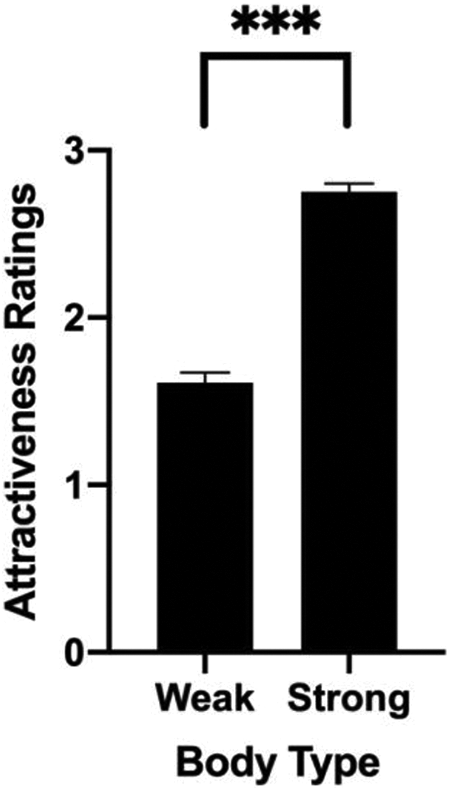
Mean and standard errors (+SEM) attractiveness ratings for weak and strong men. ***p < .001.
Discussion
This study investigated women’s short-term mating orientation and their preferences for strong men under a safe or harsh ecological condition using vignettes. Hypothesis 1 predicted that stronger men would be rated more attractive compared to weaker men. This finding was supported, and it is consistent with previous research on women’s preferences for strong bodily traits (Dixson et al., 2003; Sell et al., 2017). The second hypothesis predicting differences in women’s preferences for strong men in different ecologies as a function of mating strategies, was not supported. Women’s mating orientation as measured by SOI-R, did not influence attractiveness to men under a safe or harsh ecological condition. However, there was partial support for women’s mating orientation predicting preferences for stronger men. Women with dispositional short-term mating strategies were more likely to rate stronger men as more attractive; however, this relationship was weak.
One possible explanation for the present results is the ecological manipulation used. Previous studies (Li et al., 2014; Little et al., 2013), for example, have used ecological factors and manipulations that were consistent with direct physical harm (e.g., homicide rates, self-protection threat, threatening conditions) in which favoring strong men would provide physical protection. However, in the present study we used vignettes where participants were asked to imagine themselves in a safe or harsh ecological environment. Perhaps, utilizing a variety of ecological conditions would provide a more comprehensive account of women’s preferences for strong men and how they calibrate these preferences for those specific contexts. We explore this possibility in Study 2. In Study 2, we explore the role of ecological and mating conditions on preferences for strong men. In Study 1, the ecological condition used were prompts that participants read portraying a safe or harsh ecology. In Study 2, however, in addition to the safe ecological prompt from Study 1, we adopt Grisekevicius et al. (2011) and Hill et al.’s (2013) resource scarcity and violent ecology conditions.
Study 2
Method
Participants
Three-hundred and nineteen women (M = 19.82, SD = 2.40) from the same subjects pool as Study 1participated in this online experiment in exchange for course credit. They were recruited from the University’s online SONA system and were directed to the experiment using a Qualtrics link. The entire sample consisted of White (N = 229), Native-American (N = 28), Hispanic (N = 25), African American (N = 21), Asian (N = 8), and Other (N = 8). All participants identified as primarily heterosexual.
Measures
Ecological manipulation
The ecological manipulations included a safe ecology prompt from study 1, a resource scarce ecology slide-show (Hill et al., 2013), and a violent ecology slideshow (Hill et al., 2013). The resource scarce ecology slideshow depicted an economic recession with home foreclosures, unemployment, and vacated offices (Griskevicius et al., 2011; Hill et al., 2013). The violent ecology depicted images of shootings and unstable environments (Hill et al., 2013).
Socioeconomic status (SES)
We assessed socioeconomic status by asking participants to complete a 6-item Likert scale from Griskevicius et al. (2011). The SES scale measures socioeconomic status in childhood (3-items) and adulthood (3-items). Respondents answered a 7-point Likert scale where “1 = Strongly Disagree” to “7 = Strongly Agree” to statements, such as “My family usually had enough money for things when I was growing up,” and “I have enough money to buy things if I want.”
Mating context
For the mating condition, participants read a prompt from Little et al. (2007) where they were asked to imagine looking for a person who they would find attractive for a short-term relationship, a casual encounter, or for a one-night stand. The long-term mating condition asked participants to imagine looking for a partner who they would find attractive for a long-term relationship. This partner they would consider moving in with, and possibly marry him.
Procedure
The study was approved by the institutional review board at Oklahoma State University. The study was conducted online using Qualtrics. Upon consent, participants were randomly assigned to both, an ecological condition (either safe, dangerous, or resource scarce), and a mating condition (short-term or long-term). Participants were presented with the ecology slide show first, then presented with the mating context prompt second. After completion of the study, participants were asked to rate eight images of men’s torso’s used in Study 1. After the rating task, they completed a demographic questionnaire, an SES measure, and SOI-R.
Results
Data from the participants ratings were entered into a 2 (Mating: short, long) × 3 (Ecology: safe, resource scarce, violent) × 2 (Body type: weak, strong) mixed ANCOVA with body type (Weak, Strong) as a within-subjects factor, mating and ecology as between-subjects, and SES and SOI as covariates. There was a significant main effect for body type, F(1, 308) = 64.60 p < .001,
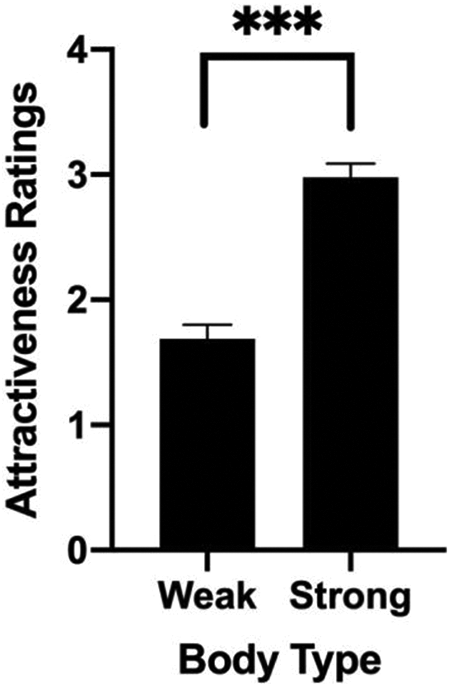
Mean (+SEM) attractiveness ratings for weak and strong men. ***p < .001.
Discussion
Study 2 investigated the role of mating strategy and ecology on women’s preferences for strong men. In addition to the ecological manipulation of Study 1, a slide show was used to depict a resource scarce and a violent ecology in Study 2. In addition, mating strategy was included to determine whether women’s preferences for strong men was influenced by considering them for a short or long-term relationship. Our main hypothesis was not supported. Women’s mate preferences were not influenced by perceived ecological condition and mating context. Overall, women considered strong men more attractive than weak men, regardless of mating context and ecological condition. This null result could be due to the experimental design (rating task), as it is suggested that perception of attractiveness might differ as the result of the study task where women are completing a forced-choice between pairs of men (Bartlett et al., 1960; Jones & Jaeger, 2019). Therefore, in the next study (Study 3), we used similar ecological manipulations but instead of a rating task, we asked participants to choose their preference on a two-alternative forced choice (2afc).
Study 3
Method
Participants
Four-hundred and eighty-nine participants between the ages of 18 and 29 (M = 20.29, SD = 3.17) from a Midwestern University and a South Texas University participated in an online experiment in exchange for course credit. Participants were recruited from the university’s online SONA system and were directed to the experiment using a Qualtrics link. To increase diversity in our sample, we recruited participants from Texas A&M International University (TAMIU), a predominantly Hispanic serving institution. The demographics for the entire sample were White (N = 320) Native American (N = 33), Hispanic (N = 96), African American (N = 17), Asian (N = 13), and Other (N = 10). All participants identified as primarily heterosexual.
Measures
Forced-choice paradigm
The two-alternative forced choice paradigm is a forced choice task where participants choose which image (i.e., shown in pairs) they prefer. It is often used in the psychological literature in human mate preferences to obtain a preference score. In the current study, 32 pairs (16 × 2) were presented, where weak men were presented on the left side of the presentation and on the right side in another presentation. A preference score was obtained by computing?? The amount of times women chose stronger men divided by the total number of trials.
Procedure
The study was approved by the both, OSU and TAMIU’s IRB. The study was conducted online using a Qualtrics link following the same procedures as study 2. Heterosexual women were recruited to participate in the study rating men’s images. As in study 2, participants were randomly assigned to an ecological condition (i.e., safe, resource scarce, violent) and a mating condition (i.e., short-term, long-term). However, we used a 2-alternative forced-choice paradigm (2afc) instead of showing images sequentially. The assignment to ecological and mating conditions was similar to the procedure in Study 2. Participants where then presented with pairs of men displaying a weak and a strong body type simultaneously. Pairs were randomly presented to show a weak or strong man on either the left or right side of the screen. Participants were asked to select which male they preferred by pressing on the male image. In total, 32 pairs were presented. After the experiment, as in Study 2, participants completed the same questionnaires’s. Women’s preferences for strong men were calculated by adding the total number of strong men selected divided by the number of presentation trials.
Results
A manipulation check was conducted to determine the effectiveness of the ecological harshness primes. Participants were asked on a “1 = not very much” to “7 = very much” Likert scale, their response to the following questions: 1) How much did this make you feel that the world is becoming more violent? 2) How much did this make you feel that you are becoming the victim of a crime? 3) How much did this make you feel emotionally aroused? And 4) To what extent did this make you feel that the world is becoming uncertain? One-way ANOVA’s were conducted to determine the effectiveness of the ecological primes. Ecological manipulations were effective for participants responses to the world becoming violent, F(2, 236) = 83.02, p < .001, being a victim of a crime, F(2, 236) = 34.74, p < .001, feeling emotionally aroused, F(2, 236) = 7.51, p = .001, and feeling that the world is becoming uncertain, F(2, 236) = 35.74, p < .001. In thinking that the world is becoming more violent, participants rated the violent condition higher (M = 5.56, SE = .16) than the resource scarce (M = 4.31, SE = .19) and safe ecology conditions (M = 2.16, SE = .20). For being a victim of a crime, participants rated the violent condition higher (M = 4.38, SE = .21) than the safe condition (M = 2.07, SE. = .18), however it was not rated significantly different than the resource scarce condition (M = 3.72, SE = .19). For the emotionally arousal condition, the violent condition was rated higher (M = 3.54, SE = .23) than the safe condition (M = 2.46, SE = .18). However, it was not rated significantly different than that resource scarce condition (M = 3.40, SE = .22). For feeling emotionally aroused, the resource scarce condition was rated higher (M =. 4.99, SE = .18) than the safe condition (M = 2.74, SE. = .22), but it did not differ from the violent condition (M = 4.79, SE = .21). For the emotionally aroused and uncertainty about the future, the resource scarce condition was rated higher (M = 3.45, SE = .21; M = 5.12, SE = .18) compared to the safe condition (M = 2.52, SE = .18; M = 2.80, SE = .20). However, it was not rated significantly different than the violent condition (M = 4.82, SE = .13; M = 3.42, SE = .22).
One sample t-test was conducted to determine if stronger men were preferred over weaker men by comparing it to a test statistic of .50; positive values indicate preferences for stronger men and negative values indicate preferences for weaker men. The t-test was significant, t(488) = 69.05, p < .001. Women indicated an overall preference for stronger men (M = .90, SE = .01). The role of ecology and mating was analyzed using a 2 (Mating: Short or Long) × 3 (Ecology: Safe, Resources Scarce, or Violent) ANCOVA with SOI and SES as covariates and women’s preferences for strong men as the dependent variable. All post-hoc comparisons were conducted using a Bonferroni correction. The main effect for ecology was significant, F(2, 481) = 4.86, p = .008,

Women’s preferences (+SEM) for stronger men for short and long-term relationships as a function of ecology. On the graph, 0.5 is indicative of equal preferences. *p < .05. **p <.01.***p <.001.
Discussion
In Study 3, we used a forced choice design where participants were asked to choose which men they preferred under perceived ecological conditions and mating contexts. By using this paradigm, we were able to determine if stronger men were preferred over weaker men by comparison when primed with ecological and mating contexts. The results showed that women preferred stronger men for a short-term relationship in a resource scarce ecological condition.
General Discussion
Results of the current investigation provides evidence for women’s overall preferences for strong men. Across three studies, women were more likely to find stronger men more attractive than weaker men. However, manipulating mating context and ecological conditions were only effective when participants viewed men in pairs using an alternative forced-choice task (2afc) in Study 3, as opposed to viewing men sequentially, in Studies 1 and 2. This discrepancy provides empirical evidence supporting the argument that the judgements of attractiveness might differ according to study task (Jones & Jaeger, 2019), as Likert-type scale responses may be measuring something different compared to forced-choice measures (Bartlett et al., 1960). Accordingly, results of this research suggest that women consider differences in men’s attractiveness under a short and long-term mating contexts and perceived harsh ecology (i.e., resource scarcity), only when making comparisons to other men. This might imply that the priming effect to harsh ecology is small and imaginative resource scarcity do not induce prolonged effects influencing mate preference in women. Such effects might be more meaningful and conspicuous while measuring mate preferences as the result of exposure to an actual ongoing environmental harshness.
Women’s preferences for strong men has been supported by previous research (Braun & Bryan, 2006; Buunk & Dijkstra, 2005; Pazhoohi et al., 2019; Provost et al., 2006, 2008; Sell et al., 2017). Men with strong body types are more likely to be successful in intrasexual competitions (Puts, 2010), secure access to resources (Buss & Schmitt, 1993; Sell et al., 2017), and establish relationships with higher social status individuals (Lukaszewski et al., 2015). Additionally, strong body types are reflective of overcoming energetic demands to maintain strength and muscularity, and this may reflect putative good genes to women in mate choice (Sell et al., 2017).
Ecological conditions have been shown to be influential in women’s mate preferences, as women may trade-off indicators of investment for good genetics when in a safe versus harsh environments (Brooks et al., 2011; Dixson et al., 2017; Little et al., 2013; Reeve et al., 2019; Sacco et al., 2015). Overall, the effects of ecological conditions on ratings of attractiveness to men across mating conditions were only significant in Study 3 when an alternative forced-choice task was used. Women were more likely to select stronger men for a short-term relationship under a resource scarce environment. Preferences for masculine men have been shown to be related to ecological harshness (Little et al., 2007, 2013). Others have demonstrated that preferences for good-dad traits (i.e., parental investment, commitment) and not good-genes are associated with resource scarce environments (Lee & Zietsch, 2011). We did not find that women preferred stronger men under a violent ecological condition, as women preferred stronger men in a safe and violent ecology more than in a resource scarce ecology. Research has suggested that women can significantly gain from indirect and direct benefits in violent ecologies through protection and resource acquisition (Puts, 2010). Traits associated with masculinity are beneficial in male hierarchies, particularly in environments with income inequality (Brooks et al., 2011).
The current studies suggest that female mate choice favored strength in males, as women considered strong men more attractive than weak men (Study 1 and 2), and more so when they were presented in pairs (Study 3). These findings are in line with sexual strategies (Buss & Schmitt, 1993) and strategic pluralism theory (Gangestad & Simpson, 2000). Mating strategies are highly context dependent, and women may evaluate potential partners for short- or long-term relationships. Additionally, when provided with different ecological scenarios and presented with men in pairs, women may make trade-offs in the evaluation of potential mates. According to this view, women’s mate preferences are contingent upon prevailing environments, such as environments with increased pathogen prevalence or resource scarcity that would have been recurrent in ancestral conditions. This suggests that women may trade off indicators of parental investment and good genetics contingent upon environmental conditions. For instance, in a resource scarce environment, women may prefer stronger men for long-term relationships due to their ability to acquire resources. In Study 3, we found that women preferred the opposite (i.e., masculine over good-dad traits) when considering men under a resource scarce ecology. Were resource scarcity to affect preferences, we would expect this to primarily apply to preferences for long-term, not short-term partners, therefore this finding may not prove robust to replication. It is possible that the current economic outlook (i.e., lockdowns, slow economic growth) during the pandemic may have made resource scarcity more salient in considering stronger men under different mating conditions. Indeed, the resource scarce condition was rated higher on emotional arousal, which warrants further investigation. Our findings are inconsistent with previous research where women considering masculine men in a safe ecology for short-term mating were rated as more attractive (Little et al., 2007, Marcinkowska et al., 2019), and depictions of violence influenced women’s preferences for masculine men (Little et al., 2013). Furthermore, our findings are in direct contrast to Lee and Zietsch (2011) who found that women preferred good-dad traits for a resource scarce environment. Moreover, in line with Snyder et al. (2011), violent manipulations did not affect women’s preferences for stronger men.
The discrepancy between our results and the previous research on facial preference may reflect differences in the way that women rate men’s facial compared to bodily traits. We suggest further research investigate the effect of women’s choice for men’s body form (in combination with and separate from faces) as a function of ecological environments. In our study, ecological vignettes and slides depicting safe and harsh ecologies were used. Although these methods have been effective in demonstrating ecological contingent responses in laboratory settings (Griskevicius et al., 2011; Hill et al., 2013; Little et al., 2007), they did not generate an effect when target stimuli were presented in a sequential format for attractiveness ratings (Studies 1 and 2). Our study also relied on a between-subjects design for mating strategy across ecological conditions. Previous studies (Al-Shawaf et al., 2019; Thomas & Stewart-Williams, 2018) have shown that ecological conditions can affect mating at the strategy level, such as using short- and long-term mating preferences as a within-subjects condition as opposed to a between-subjects condition. Future work may want to consider if women adjust their mating strategy preferences (short-term vs. long-term) when facing a harsh ecology. Furthermore, the reliance of a college-aged sample limits the generalizability of the findings. All women participants were in the age range of 18–20 attending a public state university and were mostly White, with the exception of Study 3 where the inclusion of a larger Hispanic population was used compared to Studies 1 and 2. Although participants did indicate that the ecological manipulations were considered violent, arousing, and influenced their likelihood of being a victim of a crime, they may not captured actual ecological harshness compared to populations living in harsh environments. In Study 2 & 3, the inclusion of an SES measure to capture childhood and adulthood resources availability was used to account for actual ecological harshness. Further, the lack of a control group could limit the interpretability of women in the safe condition. Safeness could have served as a prime to influence women’s mating psychology, and it was shown in Study 3 that women’s preferences for stronger men in a safe ecology was similar to a violent ecology. It is important to use a control group in future work to make more definitive conclusions on the comparison across ecological conditions. The study relied on women only, and the effects of perceived ecology may not reflect women’s mating psychology but human psychology in general. Future work would benefit from making comparisons to both men and women’s perceptions of men’s body types in order to make stronger conclusions on the role of perceived ecology on mate preferences. Finally, it is important to note that the ratings of attractiveness (Study 1 and 2) were at the low end of the spectrum (i.e., closer to unattractive). The results for these studies should be interpreted as differences in relative attractiveness and not an indication of the highest rating of attractiveness. Therefore, we suggest future research look at these effects using a control group examining difference in both men and women’s preferences for men’s body types across perceived ecology.
Conclusion
Men’s physical features connoting strength provides information relating to indirect (i.e., genetic) and direct (i.e., resource acquisition) benefits in mate preferences. Given these cues, women should be sensitive to these physical features and indicate preferences for them, and they should be influenced by their mating strategies and ecological cues. Consistent with the importance of physical cues in mate choice, women preferred strong over weak men, and their preferences for strong men were associated with ecological cues when using an alternative forced-choice task.
Footnotes
Appendix A
Safe: “You are single, have a university degree, and do not have any children. Your parents and siblings are supportive and you get along well with them. You live in a neighborhood that is generally safe, relatively clean, quiet and well maintained. Your neighbors are OK, either friendly or keeping to themselves. You have a stable job; as far as you can tell you will remain employed for the foreseeable future. In general, you are happy at work and get along well with your boss and co-workers. Your job provides you with a steady income that meets your needs satisfactorily. You own your own flat and are able to pay your mortgage on time. You have some savings and/or investments and look forward to a reasonably secure future.”
Harsh: “You are single and you have no children. You left school at 16 years of age, which didn’t make your parents very happy, but that didn’t really matter since you didn’t get along with them anyway. In fact, you still don’t get along with them and barely get along with your siblings. At best, your family relationships could be described as distant and at worst conflicted. You live in a neighborhood that is dirty and noisy. The community areas are not well maintained, and some areas are even dangerous. Your neighbors are generally unfriendly or keep to themselves, but a few are quite nasty and you don’t like running in to them, which is sometimes unavoidable. You recently lost your job because of a combination of economic cutbacks as well as conflicts with your boss and coworkers. You only started this job a few months ago, and so are faced with unemployment yet again. From your previous job searches, you know that work is limited and you have no idea when you will be employed again. You rent a flat that needs repairs, but the landlord has refused to fix the problems, partly because you owe back rent. And this is not the only bill that has gone unpaid.”
Declaration of Conflicting Interests
The author(s) declared no potential conflicts of interest with respect to the research, authorship, and/or publication of this article.
Funding
The author(s) received no financial support for the research, authorship, and/or publication of this article.
