




Abstract
Keeping an intimate relationship is challenging, and there are many factors causing strain. In the current research, we employed a sample of 1,403 participants from China and Greece who were in an intimate relationship, and we classified 78 difficulties in keeping an intimate relationship in 13 factors. Among the most common ones were clinginess, long work hours, and lack of personal time and space. Clinginess was reported as a more common source of relationship strain by women, while bad sex was reported as a more common source of relationship strain by men. Fading away enthusiasm, bad sex, infidelity and children were reported as more important by older participants, while lack of personal time and space, and character issues were reported as more important by younger participants. The factor structure was similar in the Greek and in the Chinese cultural contexts, but there were also differences. In addition, there were significant interactions between the sample and the sex. For instance, for the non-monogamous factor, men gave higher scores than women in both samples, but the difference was much more pronounced in the Greek sample.
Introduction
The vast majority of people, at some point in their lives, enter in an intimate relationship. Yet, as testified by the high rates of divorce (Cherlin, 2009; Raley & Bumpass, 2003; Schoen & Standish, 2001) and the high incidence of involuntary singlehood (Apostolou, Papadopoulou, & Georgiadou, 2019), keeping an intimate relationship is not always a smooth ride. For instance, recent studies have found that one in four adult people faced difficulties in keeping an intimate relationship (Apostolou, Paphiti, et al., 2019; Apostolou, Shialos, & Georgiadou, 2019). Accordingly, the current research aimed to examine the difficulties that people face in keeping their relationship in the Greek and in the Chinese cultural settings. These difficulties could be best understood in the context of an evolutionary theoretical framework that will be discussed next.
The Nature of the Difficulties in Keeping an Intimate Relationship
Why People Form Long-Term Intimate Relationships
Humans are sexually reproducing species, meaning that in order to have offspring, they need to gain access to the reproductive capacity of the opposite sex. To do so, they adopt specific mating strategies, which are integrated sets of adaptations that organize and guide individuals’ reproductive effort. They influence, for instance, how people choose mates, what mates they choose and how much mating effort they expend (Gangestad & Simpson, 2000). Perhaps the most common mating strategy is to divert mating effort toward finding long-term partners, and have a family. There are several reasons why a long-term mating strategy is widely adopted by both men and women.
To begin with, given the nature of her reproductive system, a woman cannot increase her reproductive success by mating with multiple men in a short amount of time (Buss & Schmitt, 1993). Furthermore, pregnancy and breast feeding decrease the mobility of women, and thus, their capacity to provide food for themselves and their children (Hrdy, 2009). These facts would make it beneficial for a woman to look for a long-term mate that would stay with her and would assist her during her pregnancy and with child rearing after birth (Buss & Schmitt, 1993, 2019).
On the other hand, following a sexual contact which leads to pregnancy, men who do not have to bear the burden of pregnancy, could fertilize another woman in a few hours or event minutes. Even so, for men to gain access to the reproductive capacity of the opposite sex, they usually need a consenting woman. Yet, as discussed above, it would not pay for women to have casual mates, so they may not consent to sex with a man who does not adopt a long-term mating strategy. Accordingly, by adopting a long-term mating strategy, men become more appealing to women as prospective mates (Buss, 2017). In addition, children require considerable parental investment to reach sexual maturity, which, even in the absence of a female preference for exclusivity in a partner, would make a long-term mating strategy fitness-increasing for men (Lancaster & Lancaster, 1987).
Non-Monogamous Mating Strategies
Having one long-term partner is not the only mating strategy people adopt, as there are potential benefits in having more than one partners, which would select for non-monogamous strategies. In more detail, such strategies have evolved because they give considerable benefits to those who adopt them. For instance, it could potentially be profitable for people who have recently started their mating careers to enter and stay in a relationship for some time in order to gain relationship experience, and subsequently use this experience to attract and retain higher mate value mates. Among other benefits, extra-pair mating could enable men to have additional children, women to secure better genes for their children, and both men and women to probe other partners (Buss, 2000; Buss et al., 2017). Yet, despite the benefits that these strategies can accrue for one partner, they cause strain to the relationship, one reason being that they are costly for the other partner.
More specifically, the adoption of a non-monogamous mating strategy by one partner conflicts with the long-term mating strategy (i.e., to attract and retain a long-term partner) of the other partner. A mixed mating strategy, which involves finding a long-term partner but having at the same time opportunistic sex with extra-pair mates, constitutes a good example: A partner’s infidelity may interfere with a long-term mating strategy because people risk losing their partners, or risk losing part of their partner’s investment on them which is diverted to others (Buss & Schmitt, 2019).
Another non-monogamous mating strategy is for people to enter in a relationship only to gain experience, material benefits, or sexual gratification without intending to have a family with this partner, and eventually move on to the next one. Such strategy would conflict with the partners’ long-term mating strategy, as they would divert their effort in keeping a relationship which has no long-term potential, while at the same time, they forgo the opportunity to be in a relationship with a partner who adopts a long-term mating strategy.
Partner-monitoring adaptations
A non-monogamous mating strategy could result in considerable reproductive or fitness losses for people’s partners. These losses translate in selection pressures for mechanisms to evolve that would monitor partners in order to minimize them. One such mechanism is jealousy, which motivates people to monitor their partners’ behavior, and take corrective action, including physical and verbal aggression, and threats for terminating the relationship, in cases of suspected or actual infidelity (Buss, 2000). A related mechanism is clinginess i.e. to keep partners close so that they do not have the opportunity to meet and flirt with others, and to be better able to detect infidelity (Apostolou & Wang, 2020).
These mechanisms are likely to generate relationship strain. The most obvious reason is that, when a partner acts on a non-monogamous mating strategy, these mechanisms would trigger, generating tensions. For example, suspected infidelity may result in bouts of jealousy and increased clinginess, which in turn, would cause strain to the relationship. In more general terms, these mechanisms aim to interfere with the partners’ non-monogamous mating strategies, causing their adverse reaction. For instance, by being clingy and monitoring their partners closely, people could prevent the latter from cheating, or probing other mates. Such interference is costly for partners, who cannot reap the benefits of an extra-pair affair, and so they are likely to react negatively. Accordingly, they would find incidences of jealousy and clinginess undesirable, and they would attempt to discipline their partners, so as to reduce such behaviors and presumably acquire more space to act on their non-monogamous mating strategies.
These mechanisms may cause tension to the relationship even if partners do not adopt non-monogamous mating strategies. For instance, monitoring partners closely, may result in them feeling that they lack breathing space, and consequently, to react negatively. Another reason is that some of the mechanisms work on the basis of the smoke alarm principle (Nesse, 2018). That is, similar to a smoke alarm, they are more likely to generate false positives than false negatives (Nesse, 2005). For example, jealousy may be triggered without the partner being unfaithful or even considering to be so. Such false alarms are likely to tax the relationship, as partners may not tolerate unfounded accusations.
Desire for partner variation
Adoption of a non-monogamous mating strategy needs to involve a desire for partner variation; if individuals were completely satisfied with being with one partner, they would not be motivated to seek different ones, and so they would follow a monogamous mating strategy. Simply put, a desire for partner variation constitutes the main component of non-monogamous mating strategies. This desire would make it difficult for people to keep an intimate relationship, because they will not be satisfied with being with one partner, which would be a source of relationship strain.
The Mismatch Problem
Following the industrial revolution in the 18th century, most human societies became industrial (i.e., a considerable part of the population was employed in the industrial sector), and eventually postindustrial (i.e., a considerable part of the population was employed in the services sector). This transition has been very recent in evolutionary terms for selection forces to have adjusted adaptations to the demands of the postindustrial context. Consequently, people carry adaptations which have evolved to work well in a preindustrial context, and may not work equally well in the modern one. This is known as the mismatch problem (Crawford, 1998; Li et al., 2018), and it is likely to have a considerable impact on the domain of mating (Apostolou, 2015; Goetz et al., 2019).
In the preindustrial context, where most human evolution took place, individual rights are not well protected, and physical violence against a partner is tolerated. For instance, in some preindustrial societies, men would mutilate the noses of unfaithful wives (Frembgen, 2006). In addition, in preindustrial societies people are heavily dependent on their partners in order to gain their subsistence. For instance, among hunters and gatherers, the husband would hunt and provide meat, a rich but unpredictable source of calories, while the wife would gather plants and seeds, a less rich but more predictable source of calories (Lee & Devore, 1968). In agricultural societies, people gain their subsistence by farming the land, an endeavor which falls predominantly on the husband, the wife and their children (Shennan, 2018). Furthermore, lacking institutions, such as the police, people depend heavily on their partners and other family members for protection against external threats. In addition, in the preindustrial context, raids and wars, in which men come together to attack other men in order to monopolize their resources including women, are relatively frequent (Puts, 2010). Consequently, some men manage to get the women of other men by force, in order to have them as wives or concubines. In this case, women remain in a long-term relationship, predominantly by use of force and not by choice.
The transition to postindustrialism has changed considerably the context in which mating takes place: Individual rights are well protected, most people do not depend on their partners for their subsistence and protection, and individuals can readily terminate a relationship. This transition was very recent in evolutionary terms for selection forces to have adjusted the mechanisms involved in mating to the demands of the modern conditions. In effect, several people today carry adaptations that would cause them few difficulties in keeping an intimate relationship in an ancestral context, but would give them considerable more difficulties in the contemporary one.
In particular, partner-monitoring adaptations discussed above, may produce a response which could enable people to keep their intimate relationship in the ancestral context, but can have the opposite effect in the contemporary one. For example, jealousy may have evolved to work by generating aggressive behavior against a partner, such as the mutilation of nose, which could be effective in deterring infidelity in the ancestral preindustrial context. Such response would have however, adverse effects in the contemporary context: Mutilating a partner would most likely lead to the termination of the relationship and in imprisonment.
Furthermore, in a preindustrial context, traits that can potentially harm intimacy are likely to have been favored by selection forces for giving specific advantages to individuals outside the mating domain. For instance, aggressive disposition and lack of empathy would enable men to become effective warriors. These traits would have a limited negative impact on keeping an intimate relationship in a preindustrial context, as people may overlook them because they depend on their partners for their subsistence and protection. The potential benefits of these traits, along with their relatively small cost in keeping an intimate relationship, would favor a relatively high frequency in the population. Yet, such traits would be considerably impairing to a relationship in the contemporary context: People are less likely to tolerate, for instance, aggression from their partners, as they do not depend on them.
In addition, people devote resources, such as time and money, in keeping an intimate relationship. However, the required amount of mating effort in ancestral human societies was probably different from the respective effort in postindustrial societies. More specifically, in the former, the economic and protection benefits would provide strong incentive to people to keep their intimate relationship, so in comparison to the postindustrial context where these motives are weaker, a lower amount of mating effort would be required. Accordingly, selection forces have optimized behavioral mechanisms to provide mating effort sufficient for keeping an intimate relationship in the ancestral context, but this amount of mating effort is insufficient for the modern one. That is, several people today may not put the mating effort required in order to keep an intimate relationship, which would cause them difficulties in keeping it.
Relationship-Resources Depleting Factors
Keeping an intimate relationship requires resources, including time and money. In addition, for many people the purpose of being in an intimate relationship is to have and raise children, which also require considerable resources. Accordingly, factors, such as children and high job demands that divert resources away from the relationship, would cause difficulties in keeping it. More specifically, having children would strengthen the bond between the two partners, but they could also increase strain between them because raising children requires considerable resources that the partners have to divert away from their relationship to their daughters and sons. Furthermore, the modern way of life usually involves long work hours, leaving limited time available for people to invest in their relationship. Financial difficulties and health problems, are two additional factors which could deplete the resources people would otherwise divert to their relationship. In particular, partners losing their job or facing a health problem that would prevent them from working, would reduce the monetary resources that they have available in supporting their relationship.
In addition, the purpose of several intimate relationships is to have and raise children, which also require considerable resources. Factors, such as financial difficulties and health issues, would reduce the resources that partners have available in achieving this goal. As a consequence, considerable strain is likely to arise in the relationship, as partners would realize that having and raising a family is at stake.
Sex Differences
Biological differences arising from different evolutionary specializations, result in men’s—but not women’s— reproductive success to be positively related to the number of opposite-sex partners they can gain sexual access to (Buss & Schmitt, 1993, 2019). In effect, non-monogamous mating strategies are potentially more fitness-increasing for men than for women, who are then more likely to adopt them. On this basis, it could be predicted that men would be more likely than women to indicate that not being monogamous caused them strain in keeping a relationship. It could also be the case that women would be more likely than men to experience relationship strain from their partners’ infidelities.
Overall, in the proposed theoretical framework there are at least three main sources of relationship strain: a) The adoption of a non-monogamous mating strategy, which has resulted in the evolution of partner-monitoring adaptations generating reactions that could cause relationship strain, and in partners not being satisfied with being with one partner. b) The mismatch problem, which has resulted in several people having character traits that cause them difficulties in keeping a relationship, having mechanisms to protect them from infidelity producing responses that are not optimal for the present context, and having mechanisms that do not divert sufficient mating effort for keeping an intimate relationship. c) Relationship-resources depleting factors, which divert resources away from the relationship, making it more difficult to keep it. On this basis, we hypothesize that the difficulties people face in keeping their intimate relationships would predominantly reflect these factors. We will examine next whether the existing literature is consistent with this hypothesis.
Current Literature
One line of evidence comes from studies based on the reasons for getting a divorce. In particular, if the above reasons cause strain to the relationship, such strain may lead to the termination of marriage. Thus, the reasons that lead to divorce, would reflect the factors that cause strain to the relationship. One study employed a sample of 153 newly separated but not yet divorced individuals in the United States, and found that communication difficulties, value conflicts and boredom were common source of marital dissatisfaction, while physical abuse, drinking and drug abuse were less common sources (Bloom et al., 1985). A different study analyzed the interviews of 208 divorced individuals in the United States, and found that infidelity was the most commonly reported cause, followed by incompatibility, drinking or drug use, and growing apart (Amato & Previti, 2003). Similarly, another study in the USA, employed a sample of 886 divorcing individuals, and found that, the most common reasons for divorce, were growing apart, communication problems, not enough attention from the spouse and infidelity (Hawkins et al., 2012). Divorce studies offer evidence in support of our hypotheses, as infidelity, physical abuse and not enough attention were common reasons for divorce. Nevertheless, reasons for getting a divorce constitute an indirect way for examining the sources of relationship strain, and more direct evidence is required.
To our knowledge, there has been only one study, which has specifically attempted to identify the difficulties that people face in keeping an intimate relationship. In particular, Apostolou and Wang (2020), employed a combination of qualitative research methods, and identified 78 difficulties in keeping an intimate relationship. Subsequently, they asked a sample of 1,099 Greek-speaking participants, how likely each item was to cause them difficulties in keeping an intimate relationship. On the basis of the participants’ responses, they classified these difficulties in 12 broader factors. Consistent with the proposed framework, two factors were produced, namely “Not monogamous” and the “Infidelity and abuse,” which reflected difficulties arising from adopting a non-monogamous mating strategy. Moreover, factors, such as “Character issues,” “Clinginess” and “Lack of effort,” are consistent with the mismatch hypothesis. In addition, the “Long work hours” and the “Children” are consistent with the relationship-resources depleting factors hypothesis. Moreover, men were more likely than women to indicate the “Not monogamous” as a source of relationship strain.
The Present Study
One limitation of the Apostolou and Wang (2020) study, was that it asked participants to rate how each difficulty could potentially cause them difficulties in keeping an intimate relationship. Consequently, many participants have answered hypothetically as they were not in a relationship (about 40% of the sample indicated that they were single, divorced or widowed). In effect, validity issues arise, while the findings were not informative on which are the most common sources of relationship strain. Furthermore, the study was confined to one culture, and its findings may not directly generalize to other cultural settings. Accordingly, the current study aimed to address these limitations by examining the difficulties that people who were in a relationship faced in two different cultural contexts, namely in Greece and in China.
In more detail, it aimed to identify the most common sources of relationship strain among people who were actually in a relationship. In addition, it aimed to test the hypothesis that the difficulties that people face in keeping an intimate relationship would cluster in factors reflecting the adoption of a non-monogamous mating strategy, the mismatch problem and relationship resources depleting factors. It aimed further to test the hypothesis that the proposed factor structure would be consistent across postindustrial cultures, but there would also be important differences. More specifically, the adoption of non-monogamous mating strategies, and the factors depleting resources are expected to cause difficulties in intimate relationships in all human societies, while the mismatch problem would predominantly affect people in postindustrial societies. On this basis, as both Greece and China are postindustrial societies, we predict that the factor structure of the difficulties in keeping and intimate relationship would be similar in both cultural contexts. In the same vein, a non-monogamous mating strategy could potentially be more beneficial for men and women across different cultural settings, which leads to the prediction that men would indicate more relationship strain from not being monogamous than women both in the Chinese and the Greek cultural contexts.
There is a plethora of cultural factors that could affect how important each factor is in causing strain to the relationship. For instance, if in a given cultural setting there is a wide prevalence of a religious dogma that promotes monogamy and is critical of infidelity, adoption of a non-monogamous mating strategy would be less likely to be a source of relationship strain than in a cultural context where such a religious dogma is not adopted. Given that the Greek and the Chinese cultures differ in many ways, we predict that there would be cultural differences in how much strain each factor causes to the relationship. Our hypothesis is non-directional, as we have not identified specific cultural differences which could affect the difficulties in keeping an intimate relationship.
Methods
Participants
The research ran online in Greece and in China. In Greece, participants were recruited by promoting the link of the study to social media including the Facebook and the Instagram, and it was also forwarded by email to students and colleagues who were asked to forward it further. The requirements for participation was to be an adult (at least 18 years old), and to be in an intimate relationship at the time of the study. Participants did not receive any monetary or other reward for participating. In total, 604 Greek-speaking participants took part (391 women, 213 men). The mean age of women was 31.3 (SD = 9.2) and the mean age of men was 36.8 (SD = 12.0). Moreover, 68.4% of the participants were in a relationship and 31.6% were married.
In China, participants were recruited online with “Sojump” software (version 2.2.42). No monetary or other reward was given. The requirements for participation was to be an adult (at least 18 years old) and to be in an intimate relationship at the time of the study. In total, 799 Chinese-speaking participants took part (415 women, 384 men). The mean age of women was 26.8 (SD = 8.5) and the mean age of men was 27.8 (SD = 9.0). Finally, 65.8% were in a relationship and 34.2% were married.
Materials
The survey had two parts. In the first part, participants were asked to indicate their agreement on how each of the 78 items identified by Apostolou and Wang (2020) caused them difficulties in keeping their current intimate relationship. Participants’ answers were recorded in a 5-point Likert scale: 1-strongly disagree, 5-strongly agree. In the second part, demographic information was collected (sex, age, marital status).
Results
Initially, we attempted to classify the 78 difficulties into broader factors. For this purpose, we employed principal components analysis on the pooled sample using the direct oblimin as the rotation method. The KMO statistic indicated that our sample was very good for such analysis to be performed (KMO = .97). On the basis of the Kaiser criterion (Eigenvalue > 1), 13 factors have been extracted, and are presented in Table 1. Internal consistency (alpha) ranged from .59 to .88 with a mean of .75. Although the .300 is typically employed as the cut off level for including an indicator into a component, in the present study we employed the .250. The reason is that, to our knowledge, this was the first study which has attempted to assess these 78 difficulties in people who were in a relationship, and consequently the produced factor structure could be used by future research. Accordingly, we did not want to drop items which could potentially have a higher factor loading in different samples.
The Extracted Factors and the Respective Factor Loadings.

We further attempted to classify these factors in broader domains by using second-order principal components analysis. More specifically, 13 new variables were created by averaging the scores of the difficulties which composed each extracted factor. Subsequently, principal components analysis was performed on these variables, using direct oblimin as the rotation method. All factors were classified in a single domain, indicating that the difficulties in keeping an intimate relationship had thirteen facets.
Principal components analysis was performed on the pooled sample, and thus, the factor structure may be different in the Chinese and the Greek samples or in men and in women. In order to examine if this was the case, we ran confirmatory factor analysis using the maximum likelihood method, separately on each sample. For the Chinese sample, the Standardized RMR (.054) and the RMSEA (.045) indicated a good fit, but the CFI (.824) indicated a moderately good fit (χ2 = 5968.3). For the Greek sample, the Standardized RMR (.080) and the RMSEA (.063) indicated a good fit, but the CFI (.724) indicated not such a good fit (χ2 = 6524.1). Using the same procedure, we examined further whether the factor structure was similar across men and women. For women, the Standardized RMR (.065) and the RMSEA (.052) indicated a good fit, but the CFI (.780) indicated not a very good fit (χ2 = 6699.5). For men, the Standardized RMR (.057) and the RMSEA (.051) indicated a good fit, but the CFI (.790) indicated not a very good fit (χ2 = 5637.8).
The factors were named predominantly based on the items that had the highest loadings. The first factor to emerge was the “Fading away enthusiasm,” where participants indicated that they faced difficulties in keeping their intimate relationship because their feelings of romantic love, as well as their sexual interest for their partner quickly resided. Next, the participants indicated that the “Infidelity” was another source of relationship strain. Here, the “I find it difficult to communicate with my partner” difficulty loaded, suggesting that people may have considered that the lack of communication led their partners to be unfaithful. The “I try to exercise constant control on my partner,” also loaded to this factor, one possible reason being that people would exercise control to prevent their partners from cheating again. In addition, the “I tend to choose as partners people I do not fit well with” loaded to this factor, probably reflecting a regret of participants for choosing partners who were unfaithful.
Furthermore, the “Bad sex” factor, which included lack of sexual compatibility and sexual interest from a partner, caused strain to their relationship. Moreover, in the “Not being monogamous” factor, participants indicated that they faced difficulties in keeping their relationship because they found it difficult to be exclusively with one partner, and because they could not resist temptations. In the “Violence and addictions” factor, participants’ own and their partners’ violent behaviors, as well as their own addictions, caused strain to their relationship.
In order to assess the commonness of each factor, we calculated the means and the standard deviations for each factor, and we placed them in hierarchical order in Table 2. Furthermore, in order to get a different measure of commonness, we calculated the percentage of the participants who had a mean score above “3” (i.e., the middle of the scale). In this way, we could see how many participants indicated that they faced difficulties in keeping an intimate relationship due to a specific factor. From Table 2, we can see that about 30% of the participants indicated the “Clinginess” as an important difficulty, 23% indicated the “Lack of personal time and space,” and about 22% indicated the “Long work hours.” We have also estimated that 34.9% of the participants indicated no difficulty, 22.8% indicated one, 12.1% two, 8.8% three, and 21.4% four or more difficulties as important.
Sex, and Sample Effects.
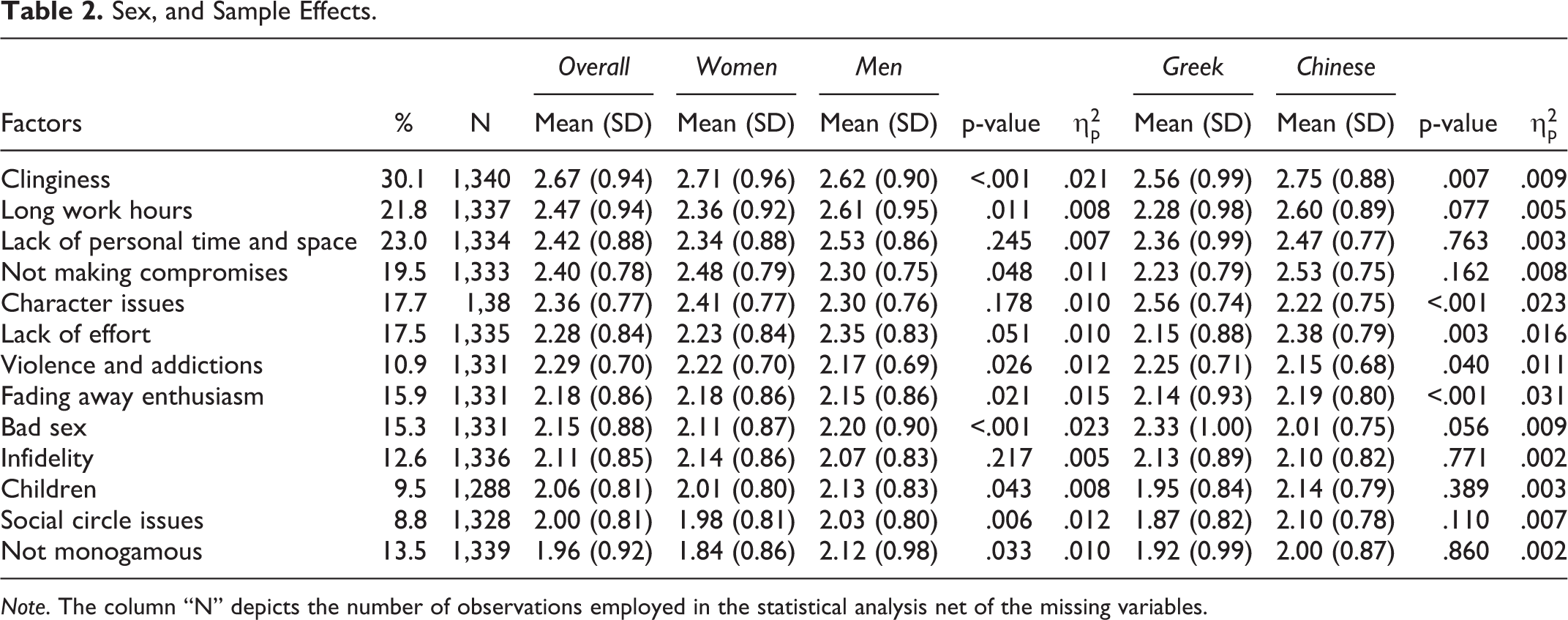
Note. The column “N” depicts the number of observations employed in the statistical analysis net of the missing variables.
Significant Effects
In order to identify significant sex, age, country and marital status effects across factors, we performed a series of MANCOVAs, where the difficulties composing each factor were entered as the dependent variables, participants’ sex, the sample (Chinese/Greek) and the marital status (in a relationship/married) were entered as the categorical independent variables, and participants’ age was entered as the continuous independent variable. The analysis was performed 13 times, once for each factor. In order to avoid the possibility of alpha inflation, Bonferroni correction could be applied so, for the current and subsequent analysis, the reader may choose not to consider as significant any effects with a p-value larger than .004 (.05/13). Note also that, across variables, there were a few missing values. In our analysis, we did not altered any of these values, which were not taken into consideration by the statistical tests.
From Table 2, we can see that women gave significantly higher scores than men for the “Clinginess” factor, while men gave significantly higher scores than women for the “Bad sex” factor. The age was significant for several factors (Table 3). As indicated by the effect size, the largest effect was over the “Children” factor, followed by the “Bad sex” and the “Infidelity.” All came with a positive regression coefficient, indicating that older participants gave higher scores than younger ones. The marital status was significant for several factors (Table 3). As indicated by the effect size, the largest differences were over the “Children” and the “Fading away enthusiasm” factors, where married participants gave significantly higher scores than participants in a relationship.
Marital Status and Age Effects, Sex and Age, and Sample and Sex Interactions.

* The sign of the regression coefficient is reported inside the parenthesis.
Significant sample differences were found for three factors (Table 2). As indicated by the effect size, the largest difference was over the “Fading away enthusiasm.” The sample differences were predominantly over the “my enthusiasm soon fades away” difficulty, where the Chinese participants gave higher scores than the Greek participants, and the “I get bored quickly” difficulty, where Greek participants gave higher scores than the Chinese participants. The second largest difference was over the “Character issues,” where Greek participants gave higher scores then the Chinese participants, followed by the “Lack of effort,” where Chinese participants gave higher scores than Greek participants.
From Table 3, we can see that there was a significant interaction between the sex and the sample over the “Not making compromises” factor, where women gave slightly higher scores than men in the Greek sample, but when we moved to the Chinese sample, the scores of both sexes increased, but much more for women, resulting in a more pronounced sex-difference. In addition, there was a significant interaction for the “Violence and addictions” factor, where in the Chinese sample, women gave slightly higher scores than men, but when we moved to the Greek sample, men’s scores remained relatively the same, but women’s scores increased considerably.
Furthermore, there was a significant interaction for the “Character issues” factor. The interaction was confined to the “financial difficulties” item, where in the Greek sample, women gave slightly higher scores than men, but when we moved to the Chinese sample, both sexes gave lower scores but men gave lower than women, resulting in a more pronounced sex difference. Finally, there was a significant interaction for the “Not monogamous” factor, where in the Chinese sample, men gave higher scores than women, but when we moved to the Greek sample, the scores of women decreased and the scores of men increased, resulting in the sex difference to be more pronounced in the Greek sample.
Furthermore, there was a significant interaction between the sex and the age for three factors. To begin with, for the “Clinginess” factor, women’s scores tended to decrease with age, while men’s scores tended to increase with age. For the “Bad sex” factor, men’s scores increased more sharply with age than women’s scores. In addition, for the “Children” factor, as age decreased, women’s scores decreased more sharply than men’s scores. Finally, there were no significant interactions between sex and marital status, and between sample and age, and sample and marital status.
Discussion
Our analysis indicated that there were at least 13 factors that caused strain in keeping an intimate relationship. Among the highest rated ones were clinginess, long work hours, and lack of personal time and space. Women rated clinginess higher than men, while men rated bad sex higher than women. Older participants rated fading away enthusiasm, bad sex, infidelity and children higher, and lack of personal time and space and character issues lower than younger participants. Married people tended to give higher scores to several factors, such as fading away enthusiasm, than people in a relationship. The factor structure was similar in the Greek and in the Chinese cultural contexts, but there were also differences. For instance, the “Character issues” factor was rated higher in the Greek sample, while lack of effort was rated higher in the Chinese sample. There were also significant interactions between the sample and the sex. For instance, for the non-monogamous factor, men gave higher scores than women in both samples, but the difference was much more pronounced in the Greek sample.
Our study was designed with the purpose of identifying the most common sources of relationship strain among people who were actually in a relationship. For a factor to be rated highly, it had to be both frequent and strenuous. If a factor was frequent, but caused little strain, participants would probably tend to disagree that it caused them difficulties in keeping their relationship. Similarly, if a factor was a source of considerable strain, but it was rare, most participants would disagree that it caused them strain to their relationship. Nevertheless, if a factor was both frequent and strenuous, many participants would agree that it caused them strain to their relationship. In effect, at the top of our hierarchy were factors that were both common and strenuous.
Our findings indicate that there are no factors which cause difficulties to most people in keeping an intimate relationship, but most people are affected by one or more. More specifically, we can see that all the factors had a mean score below the middle of the scale, and frequencies close to 20%. However, more than 65% of the participants indicated that at least one factor caused them difficulties, and more than one in five indicated that four or more factors caused them difficulties. We also need to say that our data constitute a snapshot of the difficulties that people faced at the time of the study. Accordingly, although about one in three participants indicated that they did not face any of the difficulties examined here, they may had done so in the past, or may do so in the future.
In our theoretical framework, one main source of relationship strain is the adoption of a non-monogamous mating strategy. As indicated by the “Infidelity” factor, the adoption of such a strategy by one partner, if detected, is likely to trigger negative feelings to the other, which would make the continuation of the relationship difficult. As indicated by the “Not monogamous” factor, the adoption of such a strategy makes also being with one partner difficult. These factors however, were located at the bottom of the hierarchy, suggesting that they were not the most common sources of relationship strain. One reason is that, non-monogamous mating strategies are adopted only by a small proportion of the population. Another reason is that, people, when act on such strategies, take precautions not to be detected (see also Buss, 2000), and if they succeed in doing so, their mating strategy may not cause strain to the relationship. In effect, although infidelity is potentially a source of very strong relationship strain, it is relatively rare, and when it occurs, it is likely to go undetected, which could explain why many participants did not indicate that it caused them difficulty in keeping their intimate relationship.
On the other hand, the partner-monitoring mechanisms constitute a much more common source of relationship strain. In particular, the “Clinginess” was reported to be the most common source of difficulties. The “Character issues,” part of which was jealousy, was also reported as a common source of relationship strain. The “Lack of personal time and space” is the consequence of the functioning of the partner-monitoring mechanisms, and was reported as the third more common difficulty. These findings are expected, because these mechanisms have a preemptive function; that is, they protect people from having their partners to act on a non-monogamous mating strategy, and for doing so, they need to be always “on.” To put it differently, they could not have a preemptive function if they are triggered only when the partner is cheating.
Another reason that factors, such as the “Clinginess” and the “Lack of personal time and space,” top the hierarchy of difficulties is the mismatch problem. Mechanisms that give rise to clinginess have been optimized for a context where people were heavily dependent on their partners, so they had higher tolerance in being closely monitored. Similarly, the “Character issues,” the “Not making compromises,” and the “Violence and addictions” are also likely to reflect the mismatch problem, as traits, such as violent disposition and inflexibility, were more likely to be tolerated in the ancestral than in the modern context. Furthermore, since partners are relatively independent from each other, the contemporary environment requires more mating effort in order to keep an intimate relationship. Yet, mechanisms involved in regulating mating effort have evolved in the ancestral context where less of this effort was required, which could explain, why the “Lack of effort” was a common difficulty in keeping an intimate relationship in the contemporary context.
Long work hours was the most common relationship-resources depleting factor, ranking second in the hierarchy of difficulties. This finding probably reflects the reality that job demands in contemporary societies are high, requiring many hours to be devoted to work, which are deducted from the relationship. Children constitute another relationship-resources depleting factor, which was located near the bottom of the hierarchy. This rank is probably due to the fact that our sample was relatively young, so most participants did not have children. We would expect financial difficulties to arise as a separate factor, which was not the case. Similarly, Apostolou and Wang (2020) did not find financial difficulties as a separate factor causing difficulties in keeping an intimate relationship. One possibility is that participants considered financial difficulties to arise from other factors, such as having children, as Apostolou and Wang (2020) have found, or from the character of the partner, as indicated in the current study.
The “Fading away enthusiasm” and the “Bad sex” factors, have most probably multiple explanations. In particular, the adoption of a non-monogamous mating strategy may involve reduction in enthusiasm and sexual satisfaction with the current partner that would motivate people to seek other partners. Furthermore, in the ancestral context where people were heavily dependent on their partners, the levels of enthusiasm and sexual pleasure received from a long-term partner required for keeping an intimate relationship, were most probably lower than in the modern context where people are less dependent on their partners. Thus, mechanisms responsible for generating enthusiasm and for regulating sexual behavior, may not work optimally in the modern environment. In addition, relationship-resources depleting factors, may also be at play here. For instance, working long hours may lead to physical exhaustion, which in turn, would negatively affect the quality of sex.
Our original prediction that men would face more difficulties in keeping their relationship was partially supported. In particular, for the pooled sample, men scored higher than women, but the result was significant only if Bonferroni correction was not applied. On the other hand, our prediction that women would face more difficulties in keeping a relationship arising from the infidelities of their partners was not supported. One possibility is that men are more likely to adopt a cheating mating strategy than women, but they are more efficient in hiding it. Future research could enable a better understanding of the difficulties that infidelity causes in keeping an intimate relationship.
Age was also significant for several factors. The largest effects were for the “Children” and the “Bad sex” factors, with older participants giving higher scores than younger ones. With respect to the former, this effect is predominantly explained by older participants being more likely to have children than younger ones. With respect to the latter, quality and quantity of sexual contact may deteriorate as people spend more time in their relationship, with age acting as a proxy of time spent in it. Another reason is that libido declines as people get older (Travison et al., 2006), which has a negative impact on the quality and quantity of sex they have with their partners.
We also found that married participants tended to give higher scores to a number of factors than people in a relationship. The most likely explanation is that, when they first enter in a relationship, people are overwhelmed by emotions, such as romantic love, which lead them to overlook or tolerate factors that negatively affect the relationship. As years go by, these emotions reside and these factors become more taxing for the relationship. Thus, the more time people spend in a relationship, the higher the strain arising from different factors becomes. Most likely, participants who were married have spent more time in a relationship than participants who were not married, so marital status acted as a proxy of time being in a relationship. Future studies could disentangle marital status from time being in a relationship effects by measuring both variables.
Consistent with our original prediction, the factor structure was similar in the Chinese and in the Greek cultural contexts. There were differences however, between the two cultural settings. In particular, Chinese participants reported the lack of mating effort to be a more common source of relationship strain, than Greek participants. One possible reason is a wider use of dating applications among young people in China, which could lead them to believe that they can easily substitute their current partner, so they do not spend considerable effort in keeping their relationship (Ding, 2020; Ya & Zhang, 2020). In addition, Greek participants indicated that character issues were a more common source of relationship strain than Chinese participants have indicated. One explanation is that, the Greek culture is more individualistic than the Chinese one (in Hofstede’s index for individualism Greece scored 35 and China 20 see https://clearlycultural.com/geert-hofstede-cultural-dimensions/individualism), so traits, such as being selfish, are more pronounced in the former than in the latter.
Furthermore, there were significant interactions between the sample and the sex. More specifically, the sex difference in the “Not monogamous” factor was less pronounced in the Chinese sample. One likely explanation is that, in the Chinese cultural context, men outnumber women (Liang & Ni, 2018), which turns finding a partner more difficult for them. Such a difficulty may suppress an innate desire for variety in partners, something which is not the case in the Greek context where the sex ratio is balanced. The difference in the sex ratio may also explain why in the pooled sample the sex-difference for the “Not monogamous” factor did not pass the Bonferroni-adjusted significance level. There was a higher number of Chinese than Greek male participants, and if the sex ratio imbalance influenced the former in suppressing their desire for partner variety, then the pooled sex difference would be relatively small. In addition, the sex ratio effect, possibly explains the significant interaction between the sex and the sample for the “Not making compromises” factor. In particular, by being in scarce supply, women in China can be selective, and can afford to make fewer compromises than women in Greece.
One limitation of the present work is that it is far from sufficient for understanding the difficulties that people face in keeping an intimate relationship, and it should thus, be considered as one of the first steps toward this direction. In the same vein, given the complexity of the phenomenon, there are probably more difficulties that people face in keeping an intimate relationship that have been accounted by the present study. For instance, men are expected to earn more than women (Hogue et al., 2010); thus, a situation where a husband earning less than the wife may generate considerable strain to the relationship. Future research needs to identify and account for additional sources of relationship strain.
Moving on, we paid particular attention in developing a theoretical framework that would account for the observed difficulties. Still, this framework may need further development, which could involve incorporating arguments from other schools of thought. Further limitations include that our findings were based on self-report data, and participants may not have had a good understanding or may have been unwilling to be honest about what caused them difficulties in keeping their relationship. In addition, we employed non-probability samples, so our results may not readily generalize to the population. That is, it is possible that the recruited individuals were different from those who opted not to participate in ways that affect the generalizability of the results. Moreover, for the Greek-speaking respondents, the survey link was also forwarded by email to students and colleagues, so there is the possibility that some of those who answered the survey were in a relationship with each other, and thus, their answers were to some degree correlated. We do not think that this limitation had a considerable effect on our findings, because the bulk of the participants were recruited through promoting the link in social media.
Furthermore, our theoretical framework predicted cross-cultural consistency but also variation in the causes of relationship strain. Evidence from more than two different cultures is required for adequately testing these predictions, and future research needs to extend our work by replicating it in different cultural settings. In addition, the current study did not examine how likely each of the identified difficulties would be in leading to the termination of the relationship. Future studies could address this limitation by asking how each of the identified difficulties have actually caused people to terminate an intimate relationship.
In conclusion, we identified thirteen factors causing relationship strain. We have also found that these factors were similar in the Chinese and in the Greek cultural contexts, but there were important differences. Considerable more research is required, however, in order to understand this fascinating and complex phenomenon.
Footnotes
Declaration of Conflicting Interests
The author(s) declared no potential conflicts of interest with respect to the research, authorship, and/or publication of this article.
Funding
The author(s) disclosed receipt of the following financial support for the research, authorship, and/or publication of this article: This research was supported by Humanities and Social Sciences Planning Project of the Ministry of Education (18YJAZH095).
