



Abstract
The vertical-horizontal illusion is the overestimation of a vertical line compared to a horizontal line of the same length. Jackson and Cormack (2007) proposed that the vertical-horizontal illusion might be a byproduct of the mechanisms that generate the environmental vertical illusion, which is the tendency to overestimate vertical distances (i.e., heights) relative to horizontal distances the same length. In our study, 326 undergraduate participants stood atop an 18.6-meter parking structure and estimated both the height of the structure and the horizontal distance of a target placed 18.6 meters away, using a moveable horizontal target across the length of the structure. Participants also completed a vertical-horizontal illusion task by drawing a horizontal line below a 9.1 cm vertical line. We correlated vertical distance estimates with vertical line estimates to test Jackson and Cormack’s byproduct hypothesis. This hypothesis was very weakly—if at all—supported by the data: Participants’ overestimations in the vertical-horizontal illusion task explained 1% of the variance associated with their overestimations in the environmental vertical illusion task. Additionally, to test whether the environmental vertical illusion is impervious to explicit awareness, a random half of our participants were advised to be mindful that people tend to overestimate heights. The results supported our second hypothesis: Even when participants were made aware of the environmental vertical illusion, they still reliably overestimated heights. Discussion addressed implications for the robustness of the environmental vertical illusion (e.g., treatment of those with acrophobia).
Keywords
The origins of some optical illusions have yet to be revealed by science. One such illusion is the vertical-horizontal illusion (Hunt, 1855; Künnapas, 1957; Thompson, 1880). When looking at a vertical line and a horizontal line of the exact same length, the length of the vertical line appears to be longer than the horizontal line. The current study seeks to explain the origin of the vertical-horizontal illusion by examining the relationship between the vertical-horizontal illusion, environmental vertical illusion, and evolved navigation theory.
To minimize the costs of traversing an environment, it is important to accurately perceive the area which one needs to navigate. Evolved navigation theory encompasses the differentiated psychological mechanisms that are responsible for safely navigating the environment and avoiding hazardous falls (Jackson & Cormack, 2007). Evolved navigation theory predicts the presence of the environmental vertical illusion (also known as the height illusion) which states that individuals over-perceive dangerous distances (e.g., heights) relative to safely navigated distances (e.g., clear, horizontal pathways). Finally, we explored the relationship between the environmental vertical illusion and the vertical-horizontal illusion. We proposed that the vertical-horizontal illusion is a byproduct of the environmental vertical illusion; specifically, that the vertical-horizontal illusion will be correlated with the environmental vertical illusion, and the environmental vertical illusion will be robust despite explicit awareness.
Evolved Navigation Theory
In contrast to the typical perception of low-risk horizontal surfaces, vertical surfaces often produce overestimates (Sinai et al., 1998; Stins et al., 2013). To the extent that this effect stems from a surface’s orientation in the environment, researchers have labeled it the environmental vertical illusion (Jackson & Cormack, 2008). Similar effects include the largest known distance illusion in humans which consists of greater vertical overestimates from the top than the bottom of a vertical surface (Jackson, 2005; Jackson & Cormack, 2007). However, the extent to which this effect also occurs on two-dimensional illusions, such as the vertical-horizontal illusion, is unknown. These illusions were discovered under an approach titled Evolved Navigation Theory, or ENT (Jackson, 2016; Jackson & Cormack, 2007).
Jackson and Cormack (2008) outlined ENT as an evolutionary explanation for phenomena that included the environmental vertical and other perceptual illusions related to navigation (e.g., the descent illusion). Given that a fall from a height would likely cause injury or death, the cost of navigating in the direction of vertical descent is greater than traveling in the horizontal direction where there is typically less risk of serious injury. Over time, humans may have evolved to overestimate heights as a way of managing navigational risks. Selection would have favored individuals who overestimated, rather than underestimated, heights and did so in proportion to the falling cost (Jackson, 2005, 2016; Jackson & Cormack, 2007).
The Environmental Vertical Illusion
Past research has indicated that individuals are generally accurate in their perception of distance across the horizontal plane in which relative risk of navigation was low. Jackson and Willey (2011) had participants estimate a horizontal distance of 5.48 m by directing a research assistant with hand signals until the participant judged that the research assistant was equidistant from them compared to the horizontal distance they were judging; the participants accurately estimated those horizontal distances that posed no falling risks, but overestimated those that did pose falling risks (i.e., heights). While visual perception is an important component of navigating one’s environment, the perception of surfaces within the environment and an individual’s navigational strategy influences how they perceive distance (Willey & Jackson, 2014). Individuals accurately estimated distances which did not pose substantial navigation risks (e.g., surfaces without evolved falling risks) independent of their navigational strategy while those most reliant upon visual context (compared to bodily kinesthetics) overestimated heights and feared falling significantly more.
As further evidence of the environmental vertical illusion, the overestimation of vertical distance relative to distances without falling risks (e.g., horizontal distances) was greater in the environment than when people judged the distances in drawings or photographs (Yang et al., 1999). Jackson, Willey, and Cormack (2013) explored how learning affects distance perception, focusing on familiar environments. Their findings suggested that our distance perception may have evolved to assess costs of navigation rapidly; repeated exposure (i.e., learning) did not change individuals’ height estimates. Stefanucci and Proffitt (2009) assessed participants’ perception of height when viewed from the top and from the bottom; both vantage points reported greatly overestimated distances. Acrophobia, the fear of heights, certainly influences an individual’s perception of heights, specifically acrophobia scores were predictive of the magnitude of the overestimation of heights (Jackson, 2009). Interestingly, individuals without acrophobia still overestimated the distance of the vertical surface.
The Vertical-Horizontal Illusion
The vertical-horizontal illusion can be measured through a basic task which involves estimating the length of a vertical line on a piece of paper by drawing a horizontal line of the same length on the piece of paper, typically in an upside-down T-shape. More often than not, people draw a horizontal line that is longer than the vertical line on the paper (Gavilán et al., 2017).
Jackson and Cormack (2007) proposed that the vertical-horizontal illusion might be a byproduct of the mechanisms that generate the environmental vertical illusion. If the vertical-horizontal illusion is simply a derivative of the same evolved psychological mechanisms that give rise to the environmental vertical illusion, then one would expect a relationship between the magnitude of one’s overestimation of heights and the magnitude of their overestimation of a vertical line compared to a horizontal line. That is, one would expect that the two estimates would be positively correlated. The individual differences in the environmental vertical illusion (e.g., some people overestimate heights more than others) would correspond in the same direction to the line length estimates of the vertical-horizontal illusion, if the vertical-horizontal illusion is a byproduct of the environmental vertical illusion. Testing Jackson and Cormack’s (2007) proposal that the vertical-horizontal illusion might be a byproduct of the environmental vertical illusion, our first hypothesis (H1) stated that the environmental vertical illusion will be positively correlated with vertical line estimates from a vertical-horizontal illusion task. Unrelated to H1 is the question of how impervious to awareness the environmental vertical illusion is (i.e., how robust is the environmental vertical illusion?)
Robust Illusions
Researchers have yet to investigate if the environmental vertical illusion is impervious to conscious awareness (i.e., there is no evidence if the environmental vertical illusion is a robust illusion). Robust optical illusions persist even when the observer is explicitly aware of the illusion. The vertical-horizontal illusion, the Adelson checker-shadow illusion, and the Ebbinghaus illusion, for example, all persist even when the observer is aware that the lines are the exact same distance, the tiles are the exact same color, and the circles are the exact same size (see Figure 1). If the environmental vertical illusion is truly a robust illusion (i.e., impervious to awareness), one would expect to see that there is no difference in the overestimations of heights for those who have or have not been made aware that people tend to overestimate heights. Our second hypothesis (H2) stated that the environmental vertical illusion was robust and impervious to awareness, so there would be no statistical difference in vertical height estimates for those participants who were informed of the environmental vertical illusion compared to the vertical height estimates of those who were ignorant of the illusion. Our two hypotheses are related through the larger concept of the environmental vertical illusion.

The three robust illusions presented persist with explicit knowledge of the illusion: A. Vertical-horizontal illusion, B. Adelson checkerboard illusion, C. Ebbinghaus illusion.
Method
Participants
Three hundred and twenty-six undergraduates (237 women; 89 men) at a public university in Southern California volunteered for this study. The mean age of the participants was 21.13 years (SD = 3.42, Range = 18–45). The sample was ethnically diverse, identifying as Hispanic/Latinx (46.7%), Asian (21.9%), White (21.6%), and other (8.4%). Five participants were dropped from the study due to incomplete responses. Four univariate outliers were “brought to the fence” and participants’ vertical distance estimates were replaced with a value representing three standard deviations above the mean in accordance with Tabachnick and Fidell (2013). Because the univariate outliers were reflective of our target population (i.e., individuals with normal or corrected vision) but had more extreme perceptions of distance compared to the majority of our sample, we changed the outlying values to that of three standard deviations above the mean to decrease the impact they had on our analyses.
Materials
Targets
Three identical, handmade 30.48 cm [12-inch] diameter particle board circles (see Figure 2) were used as targets. Two targets were permanently positioned 18.6 meters [61 feet] from the location where the participants were instructed to stand. One target was placed 18.6 meters away from the participant on the horizontal plane, and the second target was placed 18.6 meters below the participants (see Figure 3). A third, movable target held by a research assistant was used to measure participants’ perception of distance.
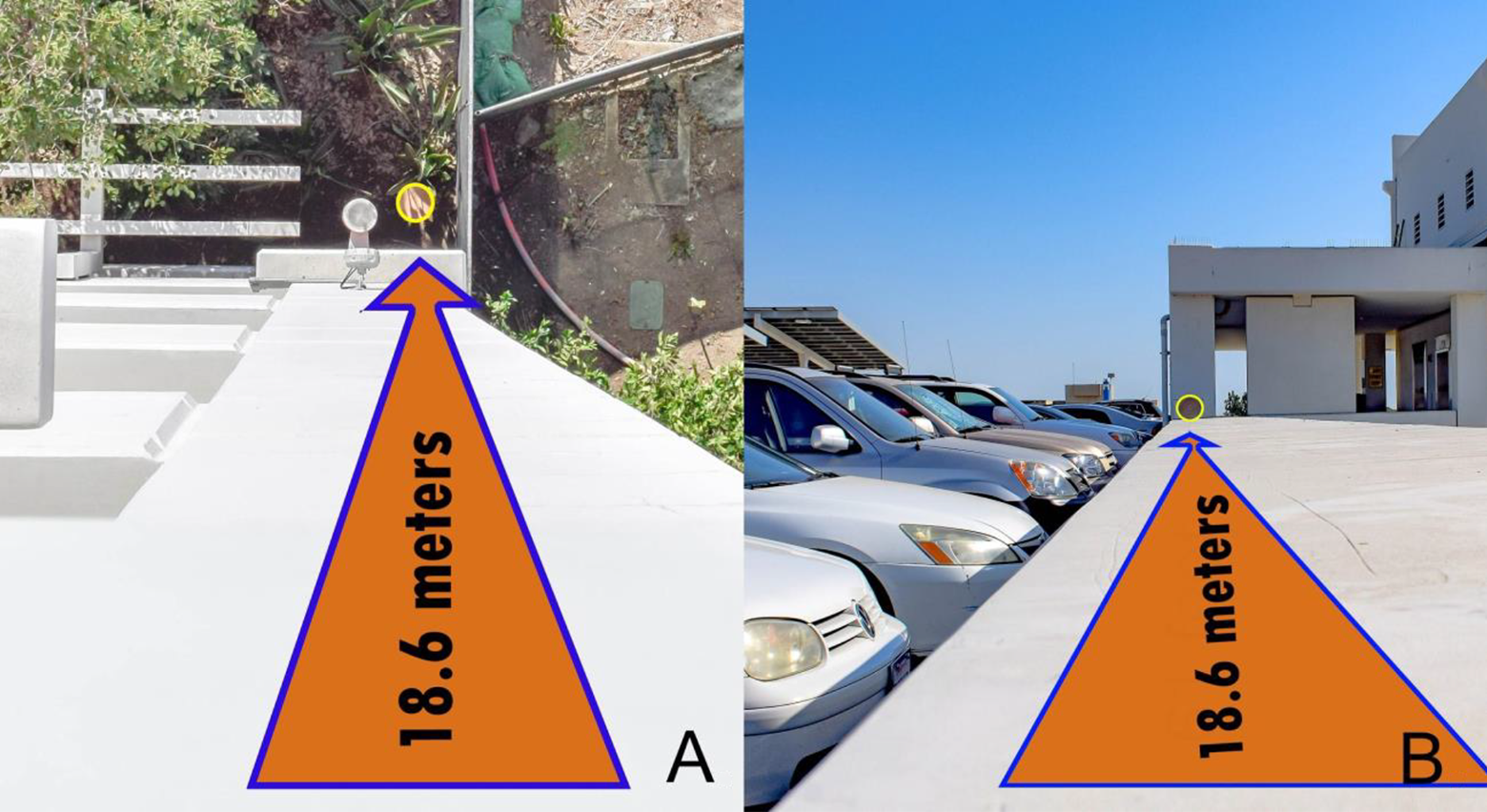
As described in 2.2.1, (A) Each participant looked over the edge of the sixth floor of the Eastside Parking Garage at [[author’s institution]]. A 12-inch (30.48 cm) diameter particle board target was placed at the bottom (highlighted by the yellow circle), 18.6 meters below. (B) An identical 12-inch (30.48 cm) diameter particleboard target was placed horizontally on the same plane as the participant (highlighted by the yellow circle), 18.6 meters away from them. Both distances were estimated perpendicular to the target.

As described in 2.2.1, targets were secured exactly 18.6 meters from the participants in horizontal and vertical directions.
Vertical-horizontal illusion task
Participants were instructed to draw a horizontal line below a 9.1 cm vertical line (as per Gavilán et al., 2017). The questionnaire item stated, “Please draw a horizontal line (——) as long as needed until your horizontal line is as long as the vertical line above. Make as many adjustments as you like.” Participants completed this vertical-horizontal illusion task on the paper questionnaire directly after providing their vertical estimates in order to capitalize on any potential priming or activation effect of the environmental horizontal illusion.
Because we were not treating vertical distance and horizontal distance estimates as levels of an independent variable here, order effects were not a concern. Instead, all participants were required to complete a vertical distance estimate before completing the vertical-horizontal illusion task to activate their evolved navigation and height psychology. We conducted the experiment this way to activate the necessary evolved psychology rather than presenting the prime followed by demographic questions then the relevant questions.
Beyond the vertical-horizontal illusion task, participants were asked several other questions on the one-page survey. Other items on the questionnaire included questions about the participants’ frequency of visits to the parking structure, their visual acuity, whether they had any expertise in distance measurement, and if they were regularly at great heights. These questions were designed to assess any possible special knowledge or experience that may cause a participant to compensate for the environmental vertical illusion. No participants were removed from the study because of their answers to these questions. Each participant submitted the questionnaire anonymously.
Conditions
We randomly assigned participants to the “explicit awareness” condition or the “no explicit awareness” condition, and we counterbalanced whether participants made the vertical estimate first or the horizontal estimate first. While walking to the ledge of the parking garage, participants placed in the “explicit awareness” condition were told by the research assistant, “keep in mind that almost everyone overestimates this distance; they think it is a lot higher than it really is. Take that into account.” All participants were told that they would obtain more entries to winning an Amazon gift card depending on how close their estimates were.
Procedure
The participants were instructed to meet two research assistants at the top of a nearby parking structure on campus. After signing an informed consent form, the participants were asked demographic information as they were escorted to a corner of the parking structure. From this location, the participants would be instructed to look over the ledge and down 18.6 meters to the ground at a target to estimate the vertical distance and 18.6 meters to their right to estimate the horizontal distance (see Figure 2).
To measure the participants’ perception of distance, a research assistant held a third target and moved it per the instruction of the participant perpendicular to the two stationary targets of interest, with no time limit imposed. Participants were asked to instruct the research assistant to move incrementally back and forth as they pleased until the participant perceived that the horizontal distance between themselves and the moving target was equal to the vertical distance between themselves and the target on the ground (see Figure 4). The same procedure was followed for the target on the horizontal plane.

As described in 2.2.1 and 2.3, a research assistant held a third target, which was identical to the secured targets. This target was moved at the participant’s direction until the distance between the participant and the target was estimated to be the same as the vertical height and horizontal distance.
The distance between the participant and the moving target estimate was marked and measured using chalk and an open reel tape measure for both distance estimates (i.e., perceived vertical distance and perceived horizontal distance). Research assistants rounded the estimates to the nearest half inch and recorded them onto the questionnaires without the presence of any participants. Each participant completed the vertical-horizontal illusion task on a questionnaire directly after they made their vertical distance estimates.
Results
Is the VHI a Byproduct of the EVI?
Not really. To test our first hypothesis that the vertical-horizontal illusion was a byproduct of the environmental vertical illusion, we conducted a Pearson product-moment correlation to determine if participants’ horizontal line estimates (from the vertical-horizontal illusion task) were associated with their height estimations of vertical distance (from the environmental vertical illusion task). The horizontal line estimate was marginally correlated with the estimation of vertical distance, r(321) = 0.10, p = 0.07 (see Figure 5); however, with an R 2 of .01, the relationship between the two variables explains a meager 1% of the variance.
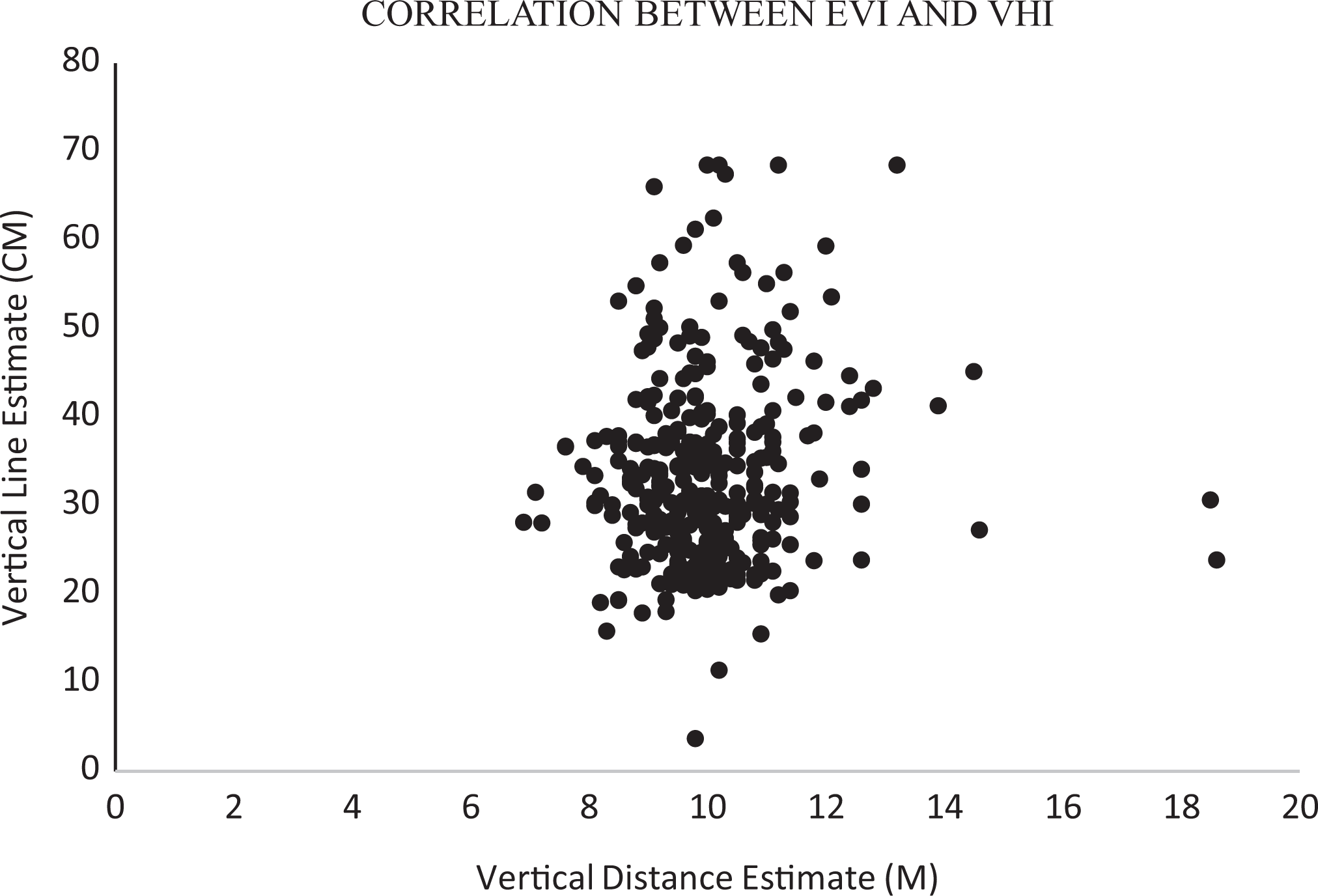
Scatterplot of the correlation between participant’s environmental vertical height estimation in meters as measured from the sixth floor to the bottom of the parking garage and their responses on the vertical-horizontal illusion (VHI) task in centimeters, r(321) = .10 , p = 0.07.
To determine if age, gender, familiarity, or experience with heights influenced the correlation between participants’ height estimations and their horizontal line estimation, we conducted a multiple regression. When holding age, gender, expertise, number of garage visits, and the amount of time participants are at great heights regularly constant, 2% of the variance in scores were accounted for. The overall model was not statistically significant, F(5,319) = 1.21, R2 = .019, p = .304.
Was the EVI Impervious to Conscious Awareness?
Yes. To test our second hypothesis that the environmental vertical illusion is impervious to awareness, we conducted an independent samples t-test comparing the height estimations of participants who were made explicitly aware of the environmental vertical illusion to estimations of participants who were not informed that people reliably overestimate heights. Supporting this hypothesis that the environmental vertical illusion is impervious to conscious awareness, estimations of height statistically differed between participants who were made explicitly aware of the environmental vertical illusion (N = 158, M = 32.73 m, SD = 9.9 m) compared to the participants who were not (N = 163, M = 34.84 m, SD = 10.8 m). The average estimated height of the parking structure was not statistically different between groups, t(319) = −1.83, p = 0.068 (see Figure 6). Lakens et al. (2018) have argued that equivalence tests provide more support for claiming non-statistical differences between groups when a simple t-test fails to find statistical differences. Therefore, we also conducted the appropriate equivalence test: a two one-sided tests (TOST) procedure. The TOST procedure, based on Student’s t-test, indicated that our observed effect size (d = −0.20) was within the equivalent bounds of d = −.043 and d = 0.43 and therefore, the two conditions were statistically equivalent, t(319) = 2.02, p = 0.022 (Lakens, 2017). In other words, participants who were made explicitly aware of the environmental vertical illusion were statistically equivalent to participants who were not made explicitly aware of the environmental vertical illusion.

Participants who were made explicitly aware of the environmental vertical illusion estimated the height of the parking structure to be 32.73 meters from the top to the bottom. Participants who were unaware of the environmental vertical illusion estimated the height of the parking structure to be 34.85 meters from the top to the bottom. Error bars represent standard error of the mean.
Were Heights Reliably Overestimated?
Yes. To confirm that our data were congruent with all previous research, we conducted a dependent samples t-test to determine if height was estimated differently than horizontal distance. Consonant with all published research on the environmental vertical illusion, there was a statistical difference between participants’ estimations of vertical distance (M = 33.8 m, SD = 10.4 m) and horizontal distance (M = 21.4 m, SD = 4.8 m), t(320) = 20.95, p = 5.9−62, d = 1.53. The mean estimations of vertical and horizontal distances in meters were 34 and 21.4 respectively, with the actual distance being 18.6 meters for both orientations (see Figure 7).

Mean estimates of relative distance for both vertical (M = 33.8 m) and horizontal (M = 24.4 m) targets in meters. The actual distance was 18.6 meters. Error bars represent standard error of the mean.
Discussion
Following Jackson and Cormack’s (2007) logic, our first hypothesis was that the environmental vertical illusion would be positively correlated with vertical line estimates from a vertical-horizontal illusion task. Our test of Jackson and Cormack’s (2007) prediction that the vertical-horizontal illusion might be a byproduct of the environmental vertical illusion was very weakly supported (although not by traditional standards because p > .05; see also Pritschet et al., 2016). The length of horizontal lines drawn by participants on a vertical-horizontal illusion task were weakly correlated with the degree to which participants overestimated the height of the parking structure; however, this relationship only explained 1% of the variance between the two variables. These data do not provide good evidence that the vertical-horizontal illusion comes from the environmental vertical illusion and add support to Jackson, Cook, et al.’s (2013) speculation suggesting that the vertical-horizontal illusion is a byproduct of multiple mechanisms which work in combination. If the vertical-horizontal illusion was a byproduct of the environmental horizontal illusion, the relationship between the vertical-horizontal illusion and the environmental horizontal illusion would account for more than 1% variance.
Our second hypothesis that the environmental vertical illusion would be robust and impervious to awareness was supported; there was no statistical difference in the estimated height provided by participants who were explicitly aware of the environmental vertical illusion compared to participants who were ignorant of the environmental vertical illusion. With this demonstration, the environmental vertical illusion joins the ranks of other robust optical illusions that are impervious to conscious awareness.
To determine that our data resembled previous evidence of the environmental vertical illusion when in a naturalistic setting (Jackson & Cormack, 2007), we examined the difference between participants’ estimations of vertical and horizontal distances. Participants reliably overestimated the vertical distance estimate compared to the horizontal distance estimate—as expected. The average estimated height from the top of the parking structure to the bottom was 34.9 meters while the average horizontal distance was an estimated 21.4 meters; the actual height of the parking structure was 18.6 meters. Participants were reliably closer in their estimates of horizontal distances compared to vertical heights replicating past research findings and providing further evidence for the environmental vertical illusion (Jackson, 2009; Jackson & Cormack, 2008; Stefanucci & Proffitt, 2009).
While Jackson and Cormack (2008) demonstrated that participants overestimate vertical heights from different vantage points (i.e., from the bottom looking up and from the top looking down), the effect is much stronger from the top vantage point. Due to the potential life-threatening risks of falling but lack of risk when viewing the same height looking from the bottom up, it makes evolutionary sense that our perceptions would be skewed in this manner. Our study added further evidence of the reliable overestimation of heights from the top looking down.
Our study has made contributions to the literature on the environmental vertical illusion and indicates several practical uses. The results found can be used by clinical psychologists to help ease the minds of patients with a fear of heights. The mere knowledge of the environmental vertical illusion may help these patients understand that their fear is a natural and functional response to our environment.
While we verbally requested that the participants not disclose any information to the other participants who were waiting, they were able to interact with each other, making diffusion a likely limitation of this study. Researchers conducting future studies exploring the relationship of the environmental vertical illusion and vertical-horizontal illusion could contribute to the literature by randomly selecting their participants, testing participants at a variety of times, and selecting a location less familiar to their participants. Experimental conditions such as height, angle, location, and time of day, are also possible variables to consider.
Overall, our study added support for the environmental vertical illusion and vertical-horizontal illusion to join the Adelson checkerboard illusion and Ebbinghaus illusion as robust illusions impervious to awareness. The study did not find a relationship between the environmental vertical illusion and the vertical-horizontal illusion, suggesting that the vertical-horizontal illusion is not a byproduct of the environmental vertical illusion. Supporting Jackson, Cook, et al. (2013), the vertical-horizontal illusion may be a byproduct of multiple mechanisms—not one domain-specific adaptation.
Footnotes
Declaration of Conflicting Interests
The author(s) declared no potential conflicts of interest with respect to the research, authorship, and/or publication of this article.
Funding
The author(s) received no financial support for the research, authorship, and/or publication of this article.
