




Abstract
Beliefs about which sex lies more or is better at lying can have subtle but widespread effects on human interactions, yet little is known about such beliefs. In Study 1, an American sample of participants (N = 407, ages 18–64) completed a 12-item survey on perceptions of sex differences in deception. In Study 2, a Korean sample (N = 197, ages 19–58) completed the same survey. Men from both cultures and Korean women perceived no difference regarding which sex tells more white (i.e., relatively harmless or low-stakes) lies. American women perceived that women tell more white lies. Women from both cultures and American men perceived that men tell a greater number of serious (i.e., nonwhite or high-stakes) lies. Korean men perceived no difference regarding which sex tells a greater number of serious lies. Both sexes from both countries reported a perception that (1) men are more likely to lie about height, income, and sexual infidelity, (2) women are more likely to lie about weight and age, and (3) women are better at lying. The findings were mixed regarding perceptions about emotional infidelity. Results are interpreted in light of sex-different challenges to mating and parenting.
There is no conclusive evidence regarding which sex lies more overall. This is due in part because lying is a heterogeneous construct. That is, lying varies in severity (e.g., serious vs. nonserious lies; Levine et al., 2003; Vrij & Taylor, 2003), delivery (e.g., verbal vs. nonverbal lies; Feldman et al., 1999; Okubo et al., 2012), subject (e.g., lying about oneself vs. someone else; Cantarero et al., 2017; Whitty & Carville, 2008), target (e.g., lying to a male vs. a female; Lo et al., 2013; Tyler & Feldman, 2004), purpose (e.g., lying to avoid punishment vs. to make someone feel better; Cheung et al., 2015; Kashy & DePaulo, 1996), content (e.g., lying about sexual infidelity vs. emotional infidelity; Guitar et al., 2017; Haselton et al., 2005),and so on. Furthermore, a review of decades of studies on sex differences suggests that which sex engages in more deception depends on what the deception concerns (Ellis, 2008). As examples, one meta-analysis reveals that men are more likely to cheat on exams (Whitley et al., 1999), whereas other studies reveal that women are more likely to lie about their bodyweight (e.g., Betz et al., 1994; Pirie et al., 1981). The heterogeneous nature of deception also leaves much room for variation in the public’s beliefs about which sex lies more overall. This raises the first question of the current study: Which sex do people think lies more?
Understanding when men versus women are more likely to lie is aided by understanding sex-different motivations that would prompt a lie, and sex-different motivations stem in part from sex-different reproductive physiology. Parental investment theory posits that the sex with a higher minimum level of investment in offspring (in time, energy, resources, etc.) will be more selective when choosing reproductive mates and that the other sex will engage in more intrasexual competition for reproductive mates (Trivers, 1972). Women exhibit higher minimum parental investment than men, that is, months of gestation, lactation, nursing, and so on. Given the higher cost of pregnancy to women compared to men during the ancestral past, the limitation of one pregnancy at a time for women versus the possibility of multiple pregnancies at a time for men, the guarantee of maternity certainty versus the lack of guarantee of paternity certainty, and so on, men and women maximized reproductive success during the ancestral past by engaging in sex-different mating behaviors (Buss & Schmitt, 1993; Geary, 2010). Women maximized reproductive success by mating with a male who had resources and a commitment to invest those resources in her (Buss & Schmitt, 1993; Low, 2015), and evidence supports the notion that men are more likely to lie about resources and commitment in mating contexts (e.g., Haselton et al., 2005). Men maximized reproductive success by engaging in sexual intercourse with as many women as feasibly possible, and women are indeed more likely than men to lie about sexual interest (e.g., Haselton et al., 2005). Men increased paternity certainty by being vigilant about women’s sexual infidelity, and a meta-analysis of sex differences in jealousy revealed that men are more upset than women by sexual infidelity (Sagarin et al., 2012). However, men are also more likely to commit sexual infidelity (Petersen & Hyde, 2010) and therefore more likely to lie about it. Women would have procured more resources from mates by ensuring that these mates did not develop emotional attachments with—and spend resources on—other women. Hence, women maximized reproductive success by being vigilant about a male’s emotional infidelity (Buss et al., 1992), and studies show that women are more upset than men by emotional infidelity (Sagarin et al., 2012). However, there is no evidence about which sex is more likely to commit and subsequently lie about emotional infidelity.
Thus, sex-different mating preferences motivate sex-different deception regarding those preferences. Online dating provides clear examples: Heterosexual women more than men have a preference for a relatively tall mate (Buss, 2016; Stulp et al., 2013), and men are more likely to lie (overstate) their height in online dating ads (Epstein, 2007; Toma et al., 2008). Women more than men have a preference for earning potential in a mate (Buss, 1989; Hatfield & Sprecher, 1995), and men are more likely to lie about their income in online dating (Epstein, 2007). Men prefer mates with a lower waist-to-hip ratio (Singh & Singh, 2011). Waist-to-hip ratio correlates with body mass index (C. Li et al., 2006; Mayer et al., 2017), and women are more likely to lie (understate) their weight in online dating ads (Epstein, 2007; Toma et al., 2008). Men more than women have a preference for relatively younger mates (Buss, 1989; Kenrick & Keefe, 1992), but both sexes have been known to lie about age in online dating (Epstein, 2007; Hall et al., 2010). However, a closer examination reveals that lying decreases for men and increases for women in their 40s in online dating (Hall et al., 2010). This may suggest women are increasingly understating age as they approach a nonreproductive life stage and are aware of a male preference for relative youth and fertility. These findings raise the second question of the current study: Are men and women aware of what each sex might be inclined to lie about regarding mating preferences?
Perhaps even more intriguing is the question of which sex is better at lying. No published studies have unequivocally answered this question. A master’s thesis on deception detection involving 97 participants reported that men may be more skilled at lying (L. Li, 2011). Also, regardless of which is sex is actually better at lying, there is a question of which sex is simply perceived to be better at lying. Interestingly, CNN (2010) and The Telegraph (2010) reported the results of a survey administered by OnePoll (a market research firm) to 3,000 Britons for the London Science Museum and revealed that women were believed to be better liars. A scientific replication and interpretation of such results could have significant theoretical value. This raises the third question of the present study: Which sex do people think is better at lying?
Taken together, beliefs about which sex lies more or is better at lying can have subtle but widespread effects on human interactions, yet little is known about such beliefs. Furthermore, there is an evolutionary “arms race” between women and men regarding deception and deception detection skills in mating contexts (Buss, 2017). Failure to deceive or to detect deceit in a mate may be costly from a reproductive standpoint. A clearer understanding of this arms race and whether there is a difference between perceptions of sex differences in deception and actual sex differences in deception awaits. The present study, however, was exploratory and aimed to reveal several perceptions of sex differences in general deception and in mating-relevant deception. Specifically, the following questions were asked: 1. Which sex do people think tells more lies? We divided this question into two parts: white lies and serious lies. White lies are defined here as relatively harmless lies or low-stakes lies. Although white lies can be further divided into subtypes, for example, altruistic white lies (lies that cost the liar but help someone else) and Pareto white lies (lies that help both the liar and someone else; Capraro et al., 2019), these subtypes were not used in order to keep the survey brief. We predicted that both sexes would think women tell more white lies because women score higher on Agreeableness (Costa et al., 2001), that is, a personality trait that includes concern for others, cooperation, and social harmony. This may predispose women to tell more white lies in a wide range of social contexts. To predict a perception of women’s greater likelihood to tell white lies, however, requires evidence that people are aware of the sex difference in Agreeableness traits. To that end, there is support for the notion that people have an intuitive or folk psychology understanding of basic sex differences (Geary, 2010). Regarding Agreeableness specifically, people associate higher (feminine) voice pitch with higher cooperativeness (Knowles & Little, 2015). In other cases, the perception of women’s higher cooperativeness is explicit (e.g., Eckel et al., 2008).
Serious lies are defined here as nonwhite lies or high-stakes lies, similar to other deception research (e.g., Porter & ten Brinke, 2011). We predicted that both sexes think men tell more serious lies, given that men engage in more illegal behaviors that motivate lies. The Federal Bureau of Prisons (2020) reported that men outnumber women in prison by more than ten to one. Men also lie more in various nonillegal contexts, for example, by engaging in sexual infidelity (Petersen & Hyde, 2010) and cheating on exams (Whitley et al., 1999). Finally, a meta-analysis revealed that men tell more black lies (lies that help the liar but cost someone else; Capraro, 2018). Not all black lies are serious, but we can safely assume that many are indeed serious. Again, our prediction rests on the notion that people are aware of such sex differences, at least of the fact that men outnumber women in prison because the ratio is extreme and because of the attention this issue receives in the media (e.g., Blakinger, 2019; Roberts, 2016; Shaw, 2019). 2. Are men and women aware of what each sex might be inclined to lie about regarding mating preferences? We hypothesized that both sexes would perceive men as more likely to lie about height, income, and sexual infidelity, and women as more likely to lie about weight and age. (We assessed perceptions regarding emotional infidelity but made no predictions because too little published evidence suggests which sex is more likely to commit it.) Our hypotheses are based on the premise that people have a folk psychology understanding of these basic mate preferences because, for example, one sex’s typical online dating lies generally correspond to the other sex’s heterosexual mating preferences (e.g., Epstein, 2007). Knowledge of these sex differences may also be explicit because mating preferences are often covered in the media (e.g., Phillip, 2014; Morris, 2019; Whitbourne, 2013; Williams, 2019). 3. Which sex do people think is better at lying? We predicted that both sexes would perceive women as more skilled at lying because, on average, women outperform men on verbal ability (Hyde & Lin, 1988) and people are aware of this fact (e.g., Swim, 1994). Furthermore, not all lies are verbal (e.g., Okubo et al., 2012), and there is evidence for both that women are better at reading nonverbal cues and that people perceive women to be better at reading nonverbal cues (Swim, 1994). Although reading nonverbal cues may be associated more with deception detection than deception itself (e.g., Vrij et al., 2010), it is conceivable that the ability to read nonverbal cues may be related to the ability to control nonverbal cues when engaging in a lie/deception.
Study 1
Method
Participants included 407 students (144 males and 263 females), ages 18–64 (M = 31.37, SD = 8.43), enrolled in undergraduate psychology courses at a Western U.S. University. A large sample size of 400+ was decided upon a priori to ensure representativeness and sufficient power for unknown and potentially small effect sizes; the decision was based on a power analysis using G*Power Version 3.1.9.4 for a one-sample t test with a Cohen’s d effect size of .2 that produced a sample size of 327. Participants completed a 12-item survey administered via email, located in Appendix. Item 1 asks which sex tells more white lies. Item 2 asks which sex tells more serious lies. Items 3, 4, 5, and 6 ask which sex is better at lying; these items were averaged to provide a single score. Item 7 concerns weight, Item 8 concerns age, Item 9 concerns height, Item 10 concerns money, Item 11 concerns sexual infidelity, and Item 12 concerns emotional infidelity. Hence, there are nine constructs.
For the 4 items measuring perceptions about which sex is better at lying (Items 3–6), by omitting Item 5 (Who are less likely to get caught lying?), we raise Cronbach’s α from .59 to .65 and thereby improve the internal consistency of the items. Although values above .70 are generally recommended (Nunnally & Bernstein, 1994), values above .60 may be acceptable for new scales (Hair et al., 2006; Nunnally, 1967). We then added the responses for Items 3, 4, and 6 and divided the sum by 3 to get an average value with a potential range of 1–7 like the other items in the survey.
We conducted 18 one-sample t tests (9 for each sex) to determine whether responses for each of the nine constructs were significantly different from a neutral score of “4”in the item responses. We divided the traditional alpha cutoff of .05 by 18 (given 18 t tests) to get a new cutoff of .003 and reduce Type 1 error rate. Therefore, any p value greater than .003 was not considered statistically significant.
Results
Men perceived no difference regarding which sex tells more white lies, t(143) = −.27, p = .788, in contrast to women who perceived that women tell more white lies, t(261) = 6.36, p < .003. Men and women responded similarly for all other questions. That is, men and women both perceived that men tell a greater number of serious lies, that men are more likely to lie about their height, money, and sexual infidelity, that women are more skilled at lying, and that women are more likely to lie about their weight, age, and emotional infidelity, ps < .003. Descriptive statistics are presented in Table 1.
Descriptive Statistics of Americans’ Perceptions of Sex Differences in Deception.

Note. Item responses in each cell ranged from 1 to 7. Cohen’s d effect sizes: ≥.2 = small; ≥.5 = medium; ≥.8 = large (Cohen, 1988).
a Means are significantly different from a neutral score of 4 using α .003.
Study 2
Method
In this follow-up study, we aimed to determine whether the findings from Study 1 would generalize to a non-Western population and, if so, add some measure of cross-cultural validity. Moreover, attempting to replicate the findings was important because intentions, evaluations, and explanations of lying vary by culture (Bond et al., 1990; H. J. Choi et al., 2011; Fu et al., 2001). Our predictions are cross-cultural, and the potential cultural differences in perceptions of sex differences in deception were thus far unchecked. We chose the Republic of Korea for Study 2 because it is Eastern, collectivistic, and has less distinct gender roles, whereas the United States is Western, individualistic, and has more distinct gender roles (Hofstede, 1991). Such differences may produce different perceptions of sex differences in general deception and mating-relevant deception. Participants included a mix of university students and nonstudents. Specifically, there were 197 individuals (91 males and 106 females), ages 19–58 (M = 42.03, SD = 8.17). Given some of the large effect sizes from Study 1, we decided a priori to obtain a sample size of approximately 200 for Study 2 (i.e., about half of that from Study 1). Participants received a small monetary sum for completing the same survey from Study 1, this time administered via Tillian Pro, an online survey tool. The survey was translated to Korean and back-translated in a check for accuracy. We developed an additional item for the Korean survey to raise Cronbach’s α for the items that measured perceptions about which sex is better at lying (i.e., Items 3–6 in Study 1). This new item is Item 7 in the Korean survey: Overall, who are superior at lying? As such, 5 items in the Korean survey measured perceptions about which sex is better at lying (Items 3–7). Again we raised Cronbach’s α, this time to .79, by omitting Item 5 (Who are less likely to get caught lying?). We added the responses for Items 3, 4, 6, and 7 and divided the sum by 4 to get an average value with a potential range of 1–7 like the other items in the survey. The same analyses were performed as for Study 1.
Results
Men perceived no difference regarding which sex tells more white lies, t(90) = −1.52, p = .132, nor did women perceive a difference, t(105) = 2.69, p = .008. Men reported no difference between which sex tells a greater number of serious lies, t(90) = .86, p = .394, but women reported that men tell a greater number of serious lies, t(105) = −4.86, p < .003. Both sexes reported that women are more skilled at lying, that women are more likely to lie about weight and age, and that men are more likely to lie about height, income, and sexual infidelity, ps < .003. Men perceived no difference regarding which sex is more likely to lie about emotional infidelity, t(90) = 1.47, p = .144, whereas women perceived men as more likely to lie about emotional infidelity, t(105) = −3.28, p = .001. Descriptive statistics are presented in Table 2.
Descriptive Statistics of Koreans’ Perceptions of Sex Differences in Deception.
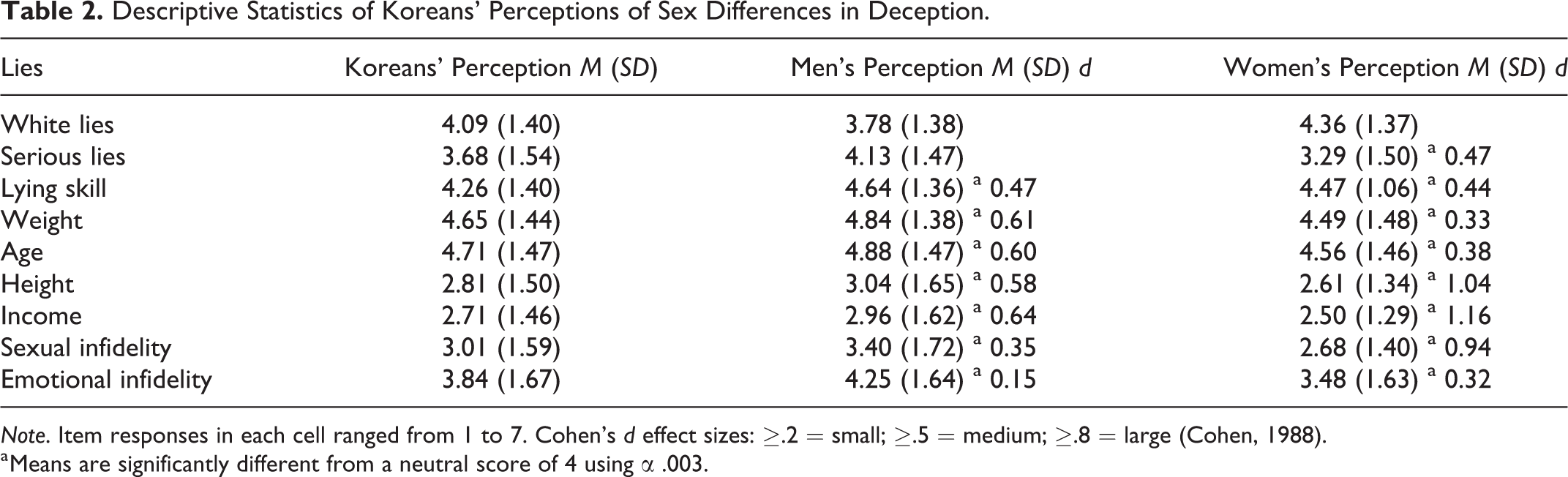
Note. Item responses in each cell ranged from 1 to 7. Cohen’s d effect sizes: ≥.2 = small; ≥.5 = medium; ≥.8 = large (Cohen, 1988).
a Means are significantly different from a neutral score of 4 using α .003.
Discussion
This study aimed to present theoretically significant findings about perceptions of sex differences in deception. American men reported no sex difference in terms of their perception of which sex tells more white lies, whereas American women perceived women as telling more white lies. Korean men and women both perceived no sex difference in terms of who tells more white lies. The common denominator may be that neither sex from neither country reported a belief that men tell more white lies. This is not contrary to our hypothesis that women would be perceived to tell more white lies, but it also does not confirm our hypothesis. Moreover, men are more likely to tell altruistic white lies, but there is no clear sex difference in terms of who tells more Pareto white lies (Capraro, 2018). The current study may not reveal consistent perceptions of sex differences because of this heterogeneous nature of white lies.
Regarding serious lies, American men and women and Korean women perceived men to tell more serious lies. Korean men reported no sex difference. The common denominator may be that neither sex from neither country reported a belief that women tell more serious lies. Thus, our hypothesis that men would be perceived to tell more serious lies was partially confirmed. Given that men tell more black lies (Capraro, 2018), the current study may suggest that people might accurately perceive which sex engages in more serious black lies.
Our hypotheses that men would be perceived to be more likely to lie about height, income, and sexual infidelity were confirmed by both sexes in both countries. Our hypotheses that women would be perceived to be more likely to lie about weight and age were also confirmed by both sexes in both countries. American men and women both reported that women would be more likely to lie about emotional infidelity. To speculate, perhaps Americans interpreted this item as a juxtaposition to the sexual infidelity item and responded to them in opposite ways. Korean women reported that men would be more likely to lie about emotional infidelity, whereas Korean men reported no sex difference. Perhaps Koreans, who also perceive men as more likely to commit sexual infidelity, perceive greater overlap in the constructs of sexual and emotional infidelity. A review of causes of infidelity in Korea proposed that the culture’s conceptual overlap between sexual and emotional infidelity may stem from immature (undeveloped) social discourse on the concept of infidelity (Y. Choi & Park, 2015). Overall, there is less agreement on what constitutes emotional infidelity versus sexual infidelity (Guitar at al., 2017), and this may explain some of the inconsistent findings regarding emotional infidelity.
Regarding which sex is perceived to be better at lying, both sexes from both countries perceived that women are better at lying, thus confirming our hypothesis. To our knowledge, this study is the first of its kind to make this observation and is consistent with the British survey discussed in the introduction. Given this consistency, and given that deception comes in nonverbal forms, more interpretation is demanded beyond the idea that people have a folk psychology understanding of women’s better verbal ability. It is possible that there may be, or may have been during the ancestral past, greater benefits for successful lies or greater costs for unsuccessful lies for women versus men in some contexts. For example, lying about infanticide may be one such context. Infanticide has been practiced in every culture (Williamson, 1978) and is more often performed by women than men (e.g., Kaye et al., 1990). Polygynous mating, which characterizes many current and past societies (Low, 2007), means that a husband is more likely to have a son than any one of his wives (because he has multiple mates), and this coupled with patrilineal inheritance may motivate a mother to commit infanticide of her daughter or a rival wife’s son (e.g., Strassmann, 1997). Lying about sexual infidelity may be another such context, given that women are more likely than men to be killed for sexual infidelity by romantic partners (e.g., Chimbos, 1978; Gartner et al., 1998). Lying about paternity may be yet another context. If the median nonpaternity rates are approximately 2%–3% (Anderson, 2006), that means there are hundreds of thousands of men in the United States who are unaware that they are raising another man’s child, and about an equal number of mothers who are aware of their child’s paternity uncertainty.
If women are indeed better at lying, then the perception of both sexes that women are more skilled at deception reflects an accurate appraisal. If women are not better at lying, then this perception reflects a cognitive bias. This bias may be of the kind predicted by error management theory: Cognitive errors that had asymmetrical consequences to reproductive fitness during the ancestral past would have placed adaptive pressure for a bias in favor of the less costly error (Haselton & Buss, 2000; Haselton & Nettle, 2006). That is, it may have been less costly for men to overestimate rather than underestimate women’s skill in lying in order to, for example, avoid being cuckolded. Likewise, it may have been less costly for women to overestimate women’s skill in lying in order to, for example, defend against intrasexual threats such as the spreading of false rumors about a woman’s sexual reputation.
A limitation of the study is that the survey was short. Although this was purposeful, it meant that potentially interesting areas of perceptions of sex differences in deception were unexplored. Mating and parenting are the two broad domains of human reproduction but only the former was examined here. A future study could examine perceptions that pertain to parenting. For example, do people believe mothers or fathers are more likely to tell lies that are meant to nurture, encourage, and protect their children? Another opportunity is to examine which sex actually engages in more such lies toward children using different methods such as diaries (e.g., DePaulo et al., 1996) or experimental designs (e.g., Capraro, 2018).
Another limitation is that we do not know whether participants had prior knowledge about actual sex differences in deception about mating factors, for example, that men do indeed lie more about height. If so, then participants may have simply applied that knowledge when responding to the mating items. If participants did not have such knowledge, and given that their responses for the most part accurately reflected what men and women do in fact lie about, then this suggests that each sex is attuned to what the other sex is seeking in terms of mating factors and that each sex is motivated to lie accordingly. This would be consistent with the idea that the sexes’ mating efforts have coevolved in a mutually antagonistic manner (Buss, 2017). A future study could attempt to statistically control for prior knowledge about sex differences in deception about certain mating factors by asking, for example, how frequently participants engage in online dating or use dating apps.
In sum, the importance of contexts that are directly or indirectly relevant to reproduction is emphasized as a guide for future research on sex differences in deception. Differences between men and women in the quantity or quality of lies may be absent in contexts that are irrelevant to reproduction, for example, lying about the playing cards one is holding, and for good reason—there is no theoretical grounding for why the sexes should be different in such an example. Conversely, contexts that in one form or another relate to the sex-different challenges to mating and parenting faced during the ancestral past have the potential to reveal a great deal about men’s versus women’s deception.
Footnotes
Appendix
For each question, use the following scale and circle the number that best reflects your response:
For the following 4 items, “potential mate” refers to a potential short-term or long-term sexual partner.
Declaration of Conflicting Interests
The author(s) declared no potential conflicts of interest with respect to the research, authorship, and/or publication of this article.
Funding
The author(s) received no financial support for the research, authorship, and/or publication of this article.
