



Abstract
Individuals vary in their personal space (PS) size as reflected by the preferred distance to another person during social interactions. A previous study with adults showed that pathogen-relevant disgust proneness (DP) predicted PS magnitude. The present study investigated whether this association between DP and PS already exists in 8- to 12-year-old children (144 girls, 101 boys). The children answered a disgust questionnaire with the two trait dimensions “core disgust (contact with spoiled food and poor hygiene) and “death-relevant disgust” (imagined contact with dead and dying organisms). PS magnitude was assessed with a paper–pencil measure (drawing a PS bubble; Experiment 1) or with the stop-distance task (preferred distance to an approaching woman or man; Experiment 2). In both experiments, only death-related disgust predicted PS magnitude and only if the approaching person was male. The current study questions the relevance of pathogen-related disgust in children for regulating interpersonal distance.
Over the course of human evolution, physical proximity to others has often been associated with an increased vulnerability to interpersonal violence and infectious disease (Neuberg & Schaller, 2016). Even today, most people would not consider it wise to spend too much time in close proximity to people that are displaying overtly aggressive behavior or recognizable symptoms of illness, as the first characteristic implies an increased risk for physical harm, whereas the second a transmission of pathogens. Both types of these threats elicit specific emotions fear and disgust, which in turn facilitate certain behavioral strategies, such as escape and active avoidance/rejection (Cottrell & Neuberg, 2005).
These behaviors regulate interpersonal distance or “personal space” (PS). PS is defined as the region immediately surrounding our bodies. It can be conceptualized as an imaginary safety zone that should not be invaded by others (Hayduk, 1978). This zone has a variable magnitude, which is influenced by several characteristics of the approaching person as well of the person who is approached. For instance, biological sex moderates PS size. Women typically choose a greater distance to a male stranger relative to a female they have never met before. From a bio-evolutionary perspective, this response tendency seems to be adaptive because men are more physically aggressive than women and were historically more likely to participate in violent conflicts (Neuberg & Schaller, 2016).
Emotional states are also associated with PS size. We allow a smaller distance when we are happy and when someone is approaching us with a friendly face (Gessaroli, Santelli, di Pellegrino, & Frassinetti, 2013). On the other hand, facial expressions of anger lead to increased arousal and withdrawal even in very young children (4–24 months old; e.g., LoBue, Buss, Taber-Thomas, & Pérez-Edgar, 2017). There is also disgust-based interpersonal distancing. We try to maintain a greater distance to people who provoke feelings of disgust (e.g., because of signs of illness). Blacker and LoBou (2016) showed that children aged 6–7 years chose a greater distance to a confederate who was described as being sick. The best predictor of avoidance was the child’s knowledge about illness transmission and possible outcomes.
Finally, certain personality traits are associated with PS preferences. PS tends to be larger among anxious and introverted individuals (e.g., Pedersen, 1973; Sambo & Iannetti, 2013). Park (2015) conducted the first study on the association between the personality trait disgust proneness (DP) and PS size. He showed that individual differences in pathogen-relevant DP predicted PS magnitude independent of trait anxiety and introversion in a sample of adults. DP is the temporally stable tendency of an individual to experience disgust across different situations (Schienle & Rohrmann, 2011).
Disgust researchers generally agree that DP is a multidimensional construct (e.g., Olatunji et al., 2009; Tybur, Lieberman, & Griskevicius, 2009; Tybur, Lieberman, Kurzban, & DeScioli, 2013). For example, Olatunji et al. (2009) conducted a large cross-cultural study to evaluate the factor structure of DP in eight countries. The authors identified three central dimensions labeled “core disgust” (e.g., “You are about to drink a glass of milk when you smell that it is spoiled”), “contamination disgust” (e.g., “I probably would not go to my favorite restaurant if I found out that the cook had a cold”), and “animal-reminder disgust” (e.g., “It would bother me tremendously to touch a dead body”). With partial overlap, Tybur, Lieberman, and Griskevicius (2009) and Tybur, Lieberman, Kurzban, and DeScioli (2013) described three DP domains with the functions of pathogen avoidance and functional decision-making in the domains of mate choice and morality.
These examples demonstrate that very consistently a disgust factor related to contamination risk could be identified. This factor is part of a disease-avoidance mechanism that motivates specific behaviors (e.g., grooming, cleaning, avoidance, distancing) aiming at reducing the risk of pathogen transmission (e.g., Tybur et al. 2009). A similar disgust dimension has also been identified in children. Schienle and Rohrmann (2011) constructed a DP measure for children. Two interrelated disgust factors were identified: core disgust and “death-related disgust.” The latter factor corresponds to the factor animal-reminder disgust as described by Olatunji et al. (2009) for adults.
The present investigation analyzed whether DP (core disgust; death-related disgust) is associated with PS size in children. Two different PS tasks were employed. In Experiment 1, 110 children were asked to draw a PS bubble around a silhouette representing their own person in order to describe the preferred interpersonal distance to a woman and a man. In the second experiment with 135 children, the stop-distance task (Kennedy, Gläscher, Tyszka, & Adolphs, 2009) was conducted. A female and a male adult slowly approached the children, who were instructed that the confederate would walk toward them until they said stop.
Method
Two experiments, labeled “PS bubble” (Experiment 1) and “stop-distance task” (Experiment 2), were conducted. A total of 245 children, all of whom were either fourth or fifth graders, participated exclusively in Experiment 1 or 2. The children were tested in their school setting. Informed consent was obtained from all children and their parent(s) or legal guardian. The ethics committee of the university approved the study.
Experiment
Sample
A total of 110 children (40 boys, 70 girls) with a mean age of 135.5 months (SD = 14.4) participated in the experiment. Boys and girls did not differ in mean age (p = .43). Of the children, 95% were born in Austria and 5% in other European countries. All families reported that German was spoken at home.
Questionnaires
The children completed the “Questionnaire for the Assessment of Disgust Proneness in children” (QADP-C; Schienle & Rohrmann, 2011), which consists of 16 items that have to be judged on 5-point scales (0 = “not disgusting”; 4 = “very disgusting”). The QADP-C has two dimensions labeled core disgust (aversion to spoiled food and poor hygiene; 8 items, e.g., “You smell spoiled food,” “You go to a restaurant with your parents and find out that the cook has a cold,” “A child with bad breath speaks to you”) and “death-related disgust” (imagined contact with dead and dying organisms; 8 items, e.g., “You see a dead animal during a walk through the forest,” “You touch a skull,” “You sit in the passenger’s seat of a hearse”). Cronbach’s α for the subscales were α = .84 and .88.
Additionally, the children anxiety test (CAT; Thurner & Tewes, 2000) was filled out. The CAT is a measure of trait anxiety in children aged between 8 and 15 years with 20 items (Cronbach’s α = .85; e.g., “I often experience anxiety”).
PS measure
The children were asked to draw two PS bubbles. Girls were presented with two black silhouettes of a girl from the side, and boys were presented with two silhouettes of a boy on a white sheet of paper (silhouette height: 5 cm; width: 1.5 cm; see Figure 1). They were asked to draw a bubble around each silhouette (representing themselves) to indicate the distance they would like to maintain between themselves and an approaching woman or a man (strangers). The bubble diameter (cm) was taken as an indicator of PS size. The bubble drawing measure showed sufficient retest reliability (2-week interval) of .79 (approaching woman) and .84 (approaching man) in this sample. The children were tested individually in a quiet room at school. Half of the subjects answered the questionnaires before the PS assessment; for the other half, the sequence was reversed.
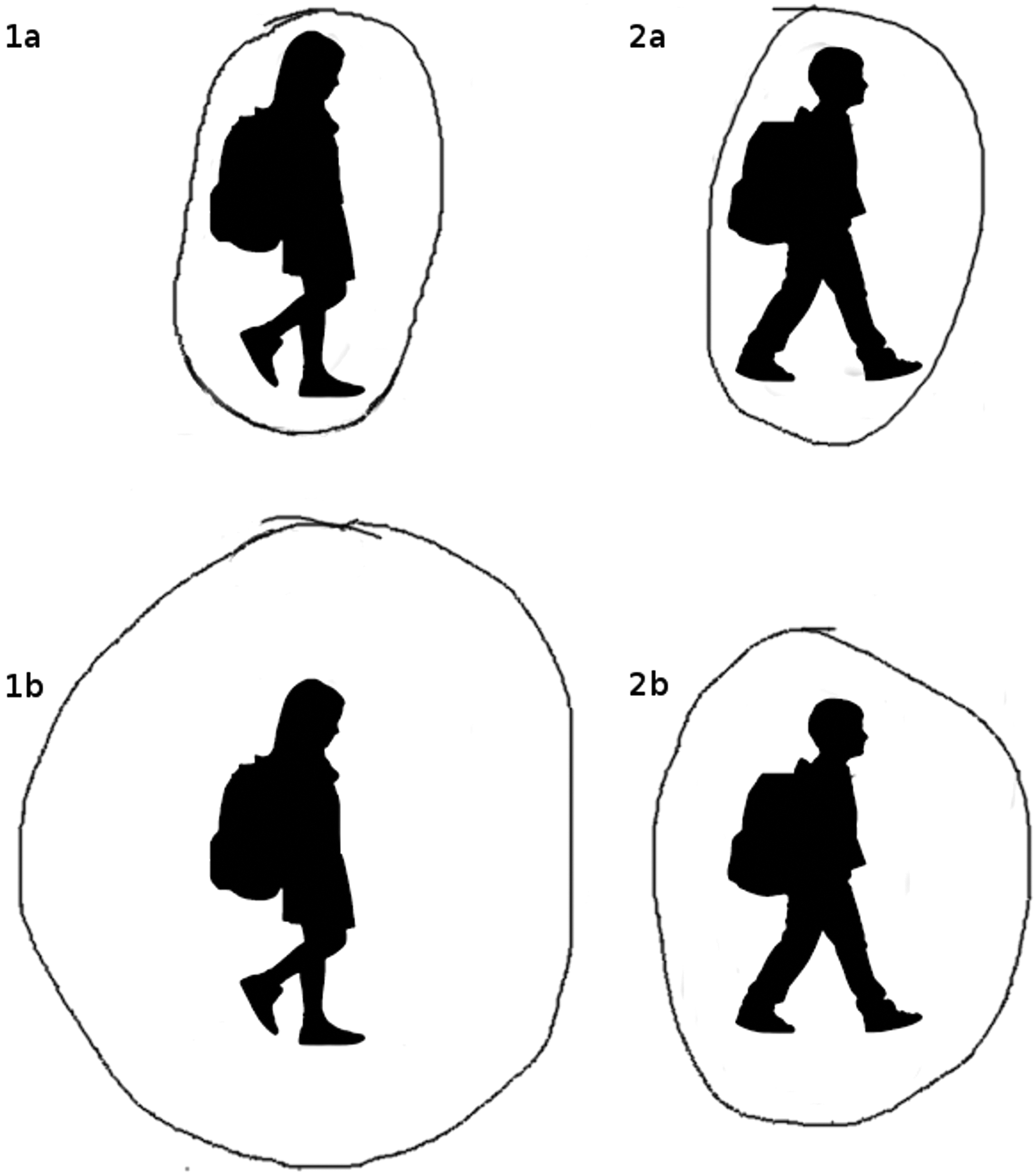
Bubble drawing task for girls (left) and boys (right). Examples for an approaching woman (1a, 2a) and an approaching man (1b, 2b).
Results
Relative to boys, girls obtained higher scores (M, SD) for trait anxiety, M girls = 7.08 (4.27), M boys = 5.28 (3.81), t(108) = 2.19, p = .030; and death-related disgust, M girls = 2.65 (1.05), M boys = 1.56 (1.12), t(108) = 5.08, p < .001. No group difference was found for core disgust, M girls = 2.49 (0.95), M boys = 2.25 (0.75), t(108) = 1.39, p = .167.
The conducted analysis of variance for PS size with the between subject factor “rater gender” (boys, girls) and the within-subject factor “approacher gender” (man, woman) revealed a significant main effect for approacher gender, F(1, 108) = 53.71, p < .001,
Personal Space Size in Girls and Boys.
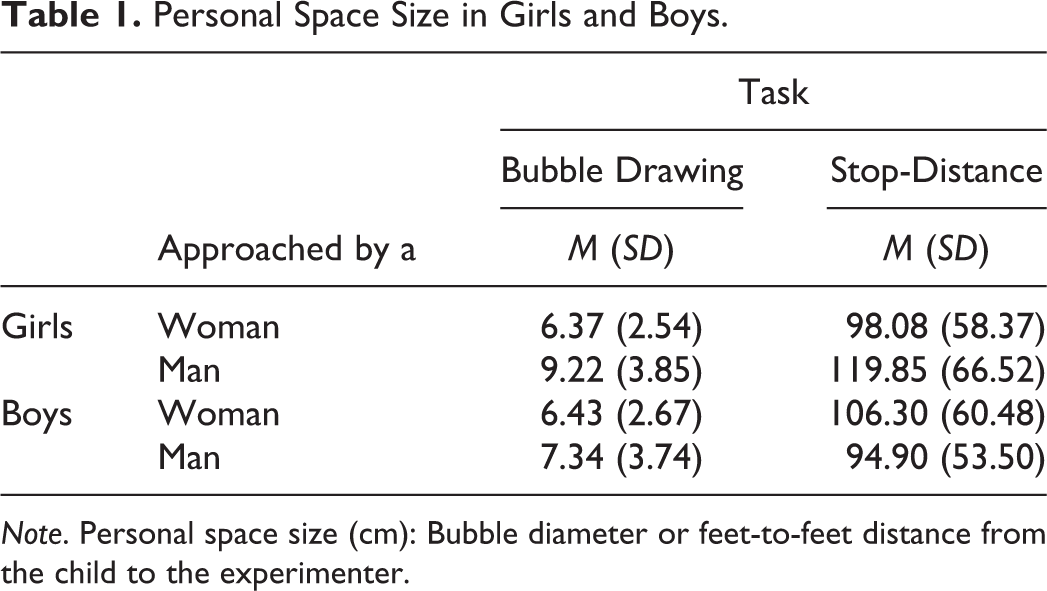
Note. Personal space size (cm): Bubble diameter or feet-to-feet distance from the child to the experimenter.
Two regression analyses were calculated in which the two dimensions of DP (core, death) and trait anxiety were simultaneously entered as predictors and either PS with regard to an approaching woman or an approaching man served as the criterion variable. The analysis for the male approacher, Model R 2 = .18, F(3, 99) = 7.01, p < .001, revealed a significant predictive effect of trait anxiety (β = .27, p = .008) and death-related disgust (β = .26, p = .013), whereas core disgust (β = .01, p = .99) exerted no predictive effect. For an approaching woman, the regression model was not adequate (p = .46).
Experiment 2
Sample
A total of 135 children (61 boys, 74 girls) with a mean age of 133.8 months (SD = 14.9) participated in Experiment 2 (stop-distance task). Boys and girls did not differ in mean age (p = .30). Of the children, 98% were born in Austria (three children were from other European countries). All families reported that German was spoken at home.
Questionnaires
The children completed the QADP-C (Schienle & Rohrmann, 2011). Cronbach’s α for the subscales were α = .86 (core) and .87 (death).
PS measure
The stop-distance task (adapted version of the task described by Kennedy et al., 2009) was conducted. All children were tested individually in a hallway of their school by two experimenters (one woman, one man) they had never met before. The female experimenter (age: 22 years, height: 162 cm, normal weight) and the male (25 years, 176 cm, normal weight) were both university students (psychology). Testing began with the child positioned at a fixed location in the hallway with the experimenter standing 5 m away, facing the participant. The experimenter approached the child at a natural gait (in half of the trials, the female experimenter started the task; in the other half, the male experimenter). The children were instructed to tell the experimenter to stop at their preferred distance (i.e., the distance between themselves and the experimenter at which they still felt comfortable). During the approach, the experimenter made no direct eye contact and maintained a neutral facial expression. PS size was measured with a digital laser (distance in cm between the toes of the experimenter and the toes of the child). All children were asked after choosing their distance whether they would like to correct the distance by either moving toward or away from the experimenter. Only 10 children made use of this option and made minimal adaptations.
Results
Girls obtained higher scores (M, SD) for death-related disgust, M girls = 2.56 (1.01), M boys = 1.58 (1.00), t(133) = 4.01, p < .001, than boys. No group difference was found for core disgust, M girls = 2.68 (0.84), M boys = 2.58 (0.87), t(133) = 0.72, p = .47.
The conducted analysis of variance for PS size with the between subject factor rater gender (boys, girls) and the within-subject factor approacher gender (man, woman) revealed a significant interaction, F(1, 133) = 20.81, p < .001,
Two regression analyses were calculated in which the two dimensions of DP (core, death) were simultaneously entered as predictors and PS with regard to an approaching man or an approaching woman who served as criterion. The analysis for the approaching man, Model R 2 = .09, F(2, 133) = 3.59, p = .030, revealed a significant predictive effect of death-related disgust (β = .22, p = .029), whereas core disgust (β = .03, p = .80) exerted no predictive effect. For an approaching woman, both disgust facets were no significant predictors (p > .15).
Discussion
This study is the first to investigate the association between DP and PS in children aged between 8 and 12 years. It was assumed that core DP is able to predict the chosen interpersonal distance. The core-disgust items of the QADP-C refer to contamination and disease. For example, the children were asked to imagine the following: “You go to a restaurant with your parents and find out that the cook has a cold.” This item directly refers to possible infection. It has been argued that pathogen-related disgust is part of a disease-avoidance mechanism that motivates behaviors such as avoidance and distancing from health-threatening stimuli. In a study with adults (Park, 2015), individual differences in pathogen-relevant DP (particularly with respect to other humans) predicted PS size. This was not the case in children.
However, death-related disgust was a significant predictor of PS size in both experiments. The items of this subscale of the QADP-C mainly describe situations related to death and dying (e.g., “You see a dead animal during a walk through the forest”; “You touch a skull”). According to the functional disgust model by Tybur et al. (2013), envelope violations and death are typical elicitors of pathogen-related disgust because contact with wounded, dying, or decaying organisms enhances the risk of transmission of microorganisms and infectious disease. However, it seems unlikely that fear of contamination by dead organisms modulated PS size in the children, as it was shown that death-related DP only predicted PS when the approaching person was a male. In terms of pathogen transmission, the biological sex of the infected person should not be of consequence.
For this reason, another function of PS might be more relevant within this context. One of the core functions of PS is the protection of the individual from aggression projected by others. If we allow other people to get too close to us, an act of physical aggression can have serious consequences. By keeping someone at a distance, allowances are made for defensive reactions in case of an attack. In this sense, it has been speculated that PS regulation evolved over time in order to reduce the physical harm suffered from associated acts of violence (e.g., Evans & Howard, 1973). Considering the higher aggressive potential of males compared to females, a greater preferred personal distance toward men seems logical. Similar results were obtained in a study with children (aged 7–9 years), who exhibited larger PS when approached by a man than by a woman (Vranic, 2003).
In line with the described fear-related PS concept, trait anxiety was a predictor of PS size in Experiment 1. This finding corresponds with previous studies in which trait anxiety positively correlated with preferred interpersonal distance (e.g., Pedersen, 1973; Sambo & Iannetti, 2013).
It has to be noted that in both experiments with the two different PS tasks (bubble drawing, stop-distance task) the same disgust predictor (death-related disgust) was identified. This can be considered a validation. Moreover, the projective and behavioral task led to similar estimates of PS size. In the first experiment, the participants had to imagine the approaching adult. On average, the children chose a frontal distance to the other hypothetical individual which was approximately 2/3 of the silhouette height representing the own person (≈ 1 m). In the second study, we used the stop-distance task with a higher ecological validity. The chosen distance to the approaching experimenter was on average 1.05 m. Thus, PS sizes determined by means of the bubble task and the stop-distance task were very similar, but considerably higher than the preferred distance by adults (M = 0.42 m) as reported by Park (2015). Since PS size is correlated with the status, authority, and age of the approaching person, this finding seems plausible.
In conclusion, PS size in children was modulated by death-related DP and trait anxiety. This suggests that fear of aggressive acts by others and not fear of infection influenced PS in children.
The current research also has some limitations that should be covered. First, we only conducted PS tasks that involved approaching adults. Children very likely perceive adult strangers as more physically threatening than their peers. This affordance might have overwhelmed their concerns about possible infection.
Second, the approaching experimenters were healthy-looking young adults. Tybur et al. (2013) have argued that pathogen-related disgust responses (e.g., withdrawal) require specific input cues associated with pathogen presence. Therefore, it can be suggested that future studies include additional conditions, such as experimenters who are described as being sick (see Blacker & LoBue 2016) in order to more directly study the moderating role of DP within this context.
Third, proximity to others not only implies potential threats (e.g., infection) but also benefits (Kupfer & Tybur, 2017). Positive social interactions (e.g., verbal exchanges, caressing) are only possible if a PS is relatively small. Costs and benefits of proximity need to be weighted and integrated in order to be able to determine the “value of contact” (Tybur et al., 2013). It is important to note that not only DP but also “positive traits” such as dispositional trust (which reflects how much a person values social interactions) relate to PS size in disgust-related contexts. For example, Kupfer and Tybur (2017) showed that the personality dimension agreeableness (the tendency to be trustworthy, empathetic, and cooperative) negatively correlated with experienced disgust toward human pathogen cues. Therefore, this trait should also be considered in a future PS study with children.
Footnotes
Authors’ Note
The study was approved by the local ethics committe of the University. Written informed consent was obtained from the children and one parent. All procedures performed were in accordance with the 1964 Helsinki Declaration and its later amendments.
Declaration of Conflicting Interests
The author(s) declared no potential conflicts of interest with respect to the research, authorship, and/or publication of this article.
Funding
The author(s) received no financial support for the research, authorship, and/or publication of this article.
