



Abstract
Research has shown a positive association between cues of physical formidability and perceptions of status, supporting a generic “bigger-is-better” heuristic. However, does better also lead to appraisals as bigger? Recent research suggests that the perceptual association between body size and social status can also be explained in terms of prestige. To test whether perceptions of prestige lead to higher appraisals of body size, we examined whether people apply a “better is bigger bias” (BBB) in football, where performance and body size tend to be uncorrelated. In two studies, we examined real coalitional sports groups on a national (Study 1) and team level (Study 2), and we manipulated target performance in an experimental third study. Results suggest that perceived performance significantly predicted both the perceived height (Studies 2 and 3) and perceived weight (Studies 1 and 2) of professional football players, supporting the BBB. Support for the team had a positive effect on body size estimations of the players; however, we did not find any support for winner or loser effects. We discuss these results in light of individual versus team performance and coalitional affiliation.
In 2015, the professional football player Lionel Messi was the first player in history to win the Fédération Internationale de Football Association Ballon d’Or for the fifth time. The 169-cm tall Argentine goes by the nickname of La Pulga (“the flea”), due to both his short stature and his speed. Even though Messi’s physique does not match that of a typical high-status male individual, who is expected to be tall and strong (e.g., Murray & Schmitz, 2011; Re et al., 2012, 2013), he has achieved a very high status owing to his extraordinary footballing skills. Would Messi be perceived as larger than he really is due to the higher prestige that is attributed to him because of his football skills?
Physical formidability refers to someone’s body size and physical strength which is related, at least ancestrally, to the amount of cost that an individual can inflict on same-sex competitors (Sell et al., 2009). Formidability is positively associated with social status in human status hierarchies (e.g., Ellis, 1994) and social perception (e.g., Blaker et al., 2013; Jackson & Ervin, 1992; Re et al., 2012; Young & French, 1996). Recent research suggests that the association between physical formidability and status, which we refer to as the status-size hypothesis, is not only grounded in dominance but can also be grounded in prestige (Lukaszewski, Simmons, Anderson, & Roney, 2016). To test the strength of the association between prestige-based status and perceptions of body size, we study professional football (soccer) players who are highly prestigious. Furthermore, a majority of studies suggest there is no objective positive relationship between body size (especially height; results on weight are mixed) and status in football (e.g., Karageanes, 2005; Reilly, Bangsbo, & Franks, 2000). Thus, perceived formidability of a football player is not functional per se, as their height or weight will not necessarily influence the result in terms of winning matches. The current study examines whether individuals overestimate football players’ height and weight based on their prestige, as indicated by their performance on the pitch. If supported this would be an indication of a “better is bigger bias” (BBB), where skills (prestige) lead to overestimation of body size. Furthermore, we examine whether the outcome of a match (winning or losing) and the coalitional affiliation with the player (being a supporter of the same club) affect perceptions of body size.
Body Size and Prestige-Driven Social Status
The positive association between body size and social status has been linked to dominance in earlier studies: Individuals who have physical supremacy also attain more social status within the hierarchical group. Indeed, more formidable men actually occupy a high social status position more often than less formidable men, and this has been documented in a variety of cultures (Bernard, 1928; Brown & Chia-yun, n.d.; Egolf & Corder, 1991; Ellis, 1994; Gawley, Perks, & Curtis, 2009; Handwerker & Crosbie, 1982; Judge & Cable, 2004; Mazur, Mazur, & Keating, 1984; Werner, 1982). In line with these findings, male tallness has also been linked to dominant behavior, such as having priority of way when walking (Stulp, Buunk, Verhulst, & Pollet, 2015), and dominant personality characteristics (Melamed, 1992). Finally, taller individuals are perceived as more dominant than shorter individuals are (Batres, Re, & Perrett, 2015), and cues of dominance, in turn, lead to perceptions of larger body size (Marsh, Yu, Schechter, & Blair, 2009).
In addition, the perceptual association between body size and social status can be explained in terms of prestige (Lukaszewski et al., 2016): Research shows that taller individuals are perceived as more competent (Hensley & Cooper, 1987; Young & French, 1996), charismatic (Hamstra, 2014), and as better leadership material overall (Blaker et al., 2013; Re et al., 2013) than shorter individuals are. Lukaszewski, Simmons, Anderson, and Roney (2016) argue that the higher social status attained by physically formidable men is more likely due to “their perceived benefit generation capacity (prestige) than to their aggressive intimidation of rivals and subordinates (dominance)” (p. 388). In other words, formidable men gain social status when through their physique they provide group benefits. Men with greater physical formidability are perhaps better able to effectively regulate within-group processes such as settling disputes, maintaining social order, and offering solutions to group challenges (Lukaszewski et al., 2016; Von Rueden, 2014), as well as representing the group during collaborations or conflicts with other groups (Blaker & Van Vugt, 2014; Brown & Chia-yun, n.d.; Murray, 2014; Sahlins, 1963; Vugt & Ahuja, 2010). The association between physical formidability and perceived prestige-driven social status is mediated by perceived leadership abilities, and the association does not hold for physically formidable men who were perceived as being aggressively self-interested (Lukaszewski et al., 2016; in line with, e.g., Price & Van Vugt, 2014). Thus, prestige is allocated to those individuals who can contribute benefits to the group because they possess certain skills, knowledge, or abilities (e.g., Cheng, Tracy, Foulsham, Kingstone, & Henrich, 2013; Henrich & Gil-White, 2001; Von Rueden, Gurven, & Kaplan, 2008; Vugt & Tybur, 2014), and physically formidable men are perceived as being higher in prestige (Blaker et al., 2013; Lukaszewski et al., 2016).
BBB
Social perception research suggests that men with larger body sizes are perceived as being higher in prestige, leading to higher social status perceptions. This implies that when perceiving large men, individuals make use of a heuristic of “bigger is better.” As the association between size and (prestige-based) status is at least partly grounded in reality, it is arguably a good representativeness heuristic for making “quick and dirty” judgments about others: Physically formidable men do tend to occupy high-status positions, so the odds are in your favor when evaluating bigger men as being higher in status (see Gilovich, Griffin, & Kahneman, 2002). Haselton and Funder (2006) defined these odds as a “useful degree of accuracy”: The association is strong enough that the estimation is probably right. More importantly, the costs of overestimating someone’s status would probably be less than the costs of underestimating it, making the used heuristic likely sufficient for short-term survival and mating purposes, even when it is not entirely accurate (Haselton & Buss, 2000; Zebrowitz & Montepare, 2006).
Is there also a “better is bigger” prestige bias? According to the status representation hypothesis by Holbrook, Fessler, and Navarrete (2016), there is a positive perceptual association between envisioned body size and envisioned social status for nonthreatening male targets. When individuals automatically perceive more skilled (prestigious) in-group men to also be more physically formidable, this could be an indication of a strongly embedded prestige-based status-size heuristic or a BBB. Indeed, there is some evidence that competent, high-status individuals are judged to be taller (Cann, 1991; Dannenmaier & Thumin, 1964; Lechelt, 1975; Wilson, 1968). Furthermore, Knapen, Blaker, and Pollet (2017) found that the positive effect of individuals’ voting intentions on estimated height and strength of target politicians was mediated by perceived political skills of those politicians. Finally, Masters, Poolton, and van der Kamp (2010) have shown that action capabilities and performance success are positively associated with size estimations of goalkeepers and a famous football player (David Beckham).
Body Size of Professional Football Players
To test whether this version of the BBB is a strong, default heuristic that is automatic and implicit or a more informed perceptual process, we need to examine it in a situation where it is not useful to rely on such a heuristic. The domain of football is a good fit for testing the “better is bigger” effect because there is no obvious link between body size and performance, and the distribution of height and weight of professional players approximates “the average man” (Karageanes, 2005; Reilly et al., 2000). The average professional European league football players’ height is roughly the average European male height (181.98 cm; cohort of European men 1976–1982 = 174–183 cm; Hatton & Bray, 2010). Goalkeepers, defenders, and central strikers tend to be taller than other positions, while midfielders and forwards tend to be of average height (Nevill, Holder, & Watts, 2009; Reilly et al., 2000). Notably, the latest International Centre for Sports Studies (CIES) Football Observatory (Poli, Besson, & Ravenel, 2018) reports no correlation between average height of the players in a team and team success.
Our review of research in both adolescent and adult male football players suggests that excellence in football is not associated with tallness. Studies among youth and adolescent males of different nationalities suggest that body size contributes relatively little to variation in performance in these players and that the variation is probably mostly due to biological maturity (Beunen, Ostyn, Simons, Renson, & Van Gerven, 1981; Malina et al., 2005; Malina, Eisenmann, Cumming, Ribeiro, & Aroso, 2004; Reilly et al., 2000), as youth selections tend to favor players who are advanced in biological maturation (Coelho E Silva et al., 2010; Sarmento, Anguera, Pereira, & Araujo, 2018). Studies comparing youth and adolescent elite male soccer players to control groups did not find any differences in body size between the groups (Franks, Williams, Reilly, & Nevill, 1999; Mirkov, Kukolj, Ugarkovic, Koprivica, Vladimir & Jaric, 2010), suggesting young players’ movement agility and coordination are the best predictors of future performance in soccer (Mirkov et al., 2010; however, see Gravina et al., 2008).
Reilly, Bangsbo, and Franks (2000) reviewed the literature on anthropometric and physiological characteristics of adolescent and adult soccer players and concluded that it is not possible to isolate individual prerequisites for success (including height) with great confidence. A review of research concerning adult elite soccer players found that, compared to their European counterparts, Brazilian players are shorter in stature, yet similar in body mass (Diniz, Silva, Bloomfield, Carlos, & Marins, 2008). This makes sense as Brazilian males in general tend to be shorter than European males (especially Northern/Western European males from countries like the United Kingdom, the Netherlands, and Germany; Hatton & Bray, 2010), suggesting that elite soccer players’ height follows the patterns of the average male height according to country of origin. Furthermore, when comparing physical characteristics of adult players in both elite and amateur soccer leagues, two studies have found that player heights were similar; however, while one study found that the weight of elite players was significantly higher (Hazir, 2010), the other study also found no differences regarding weight between the two player levels (Ostojic, 2004). Nevill, Holder, and Watts (2009) found that adult professional football players’ body size tended to increase over time; however, they did not account for the effect of increased body size in the general population. Furthermore, their results suggested that more successful professional players are becoming taller, but this effect was only significant in the most recent of four seasons. Thus, the majority of research suggests that body size (within the normal range) does not affect an adult’s professional performance in soccer, and elite (high-performing) soccer players are not taller than amateur soccer players or the general public. In this study, we test the general hypothesis that increased prestige is associated with greater perceived formidability. More specifically, we predict that:
A possible contextual factor that could influence individuals’ perceptions of football player body size is whether the player’s team wins or loses a match. Higham and Carment (1992) and Sorokowski (2010) found that, compared to height judgments before the elections, politicians who won were judged as being taller, while politicians who lost were judged as being shorter (note that these findings were not replicated by Knapen et al. (2017), who did not find substantial evidence for a “winner effect” in their study). Following work by Higham and Carment (1992) and Sorokowski (2010), we expect that player body size will be perceived as larger when a team wins compared to when a team loses.
Coalitional Affiliation
Being a supporter of a football team means being a part of a sports coalition, and sports fandom has been argued to be a by-product of an evolved coalitional psychology (Kruger et al., 2018; Winegard & Deaner, 2010). The forming of sports teams reflects the importance of the role of coalitional behavior in societies and illustrates the attraction that coalitional membership still holds for individuals (e.g., Fessler, Holbrook, & Dashoff, 2016; Hirt & Clarkson, 2011). Fandom provides a sense of group affiliation that can help meet our basic need to belong by sharing something in common—in this case, the support of a particular sports team (Hirt & Clarkson, 2011). Indeed, supporting a sports team can lead to psychological benefits, as identification with the team increases social connections for the supporter, thereby facilitating well-being (Wann, 2006). Thus, individuals form and maintain coalitions with others (sports teams), in the context of intergroup conflicts (matches between teams). In this context, players of the teams would be the most prestigious and thus high-status members of the coalition. This makes football fans a very relevant group of participants for examining the social perception of high-status individuals in real empirical coalitional sports groups.
Men tend to be especially invested in sports teams and have been argued to behave in ways similarly to how males behaved in their coalitional context during human evolutionary history (Kruger et al., 2018; Winegard & Deaner, 2010). For example, a study by Wann, Haynes, McLean, and Pullen (2003) showed that when supporters identify more strongly with their team, they also report greater willingness to consider acts of hostile aggression against players and coaches of the other team, and this was more likely for male supporters than for female supporters. Considering these findings, we expect that coalitional affiliation will be positively related to estimated body size of football players:
Overview of the Current Research
This study aims to test the BBB by assessing the relationship between performance (a measure of skills and thus prestige) and perceptions of body size in a novel domain, namely sports, specifically football (soccer). To examine this, we asked participants to rate performance, height, and weight of adult professional football players in three studies. We chose to have participants rate weight instead of strength of the players because we could compare the estimations to actual weight of the players and examine whether they are being overestimated. As weight is related to muscle mass, and professional football players are physically in very good shape (weight is not related to fat percentage/being overweight), we believe this is a reasonable proxy measure for perceived strength. This is in line with earlier research showing that weight is related to perceived fighting ability for mixed-martial-arts fighters (Třebický, Havlíček, Roberts, Little, & Kleisner, 2013). The context of sports teams gives us the opportunity to test our predictions in a real-world coalition, which can be identified with both on a national level (Study 1: the national Dutch team) and team level (Study 2: two Dutch premier league teams). In Study 3, we will test the causality of the BBB by manipulating performance before body size will be rated.
Previous research has shown that different types of measurement can lead to different results (Knapen, Blaker, & Pollet, 2017). We will therefore use multiple measurements of physical formidability: height and weight and estimations in centimeters/kilograms as well as sliders from 0 to 100. We report how we determined our sample size, all data exclusions (if any), all manipulations, and all measures in the studies. All the research reported in this document was approved by the Scientific and Ethical Review Committee (VCWE) of the university where the research was conducted (approval number VCWE-2016-155). All participants gave their informed consent before participating in the studies and were given a debriefing afterward. They were also given contact details of the primary investigators to be used for questions or complaints. Additional information about the used analyses is included in the Electronic Supplementary Materials (ESM 1), where we also report additional analyses and tables with detailed results of all the linear mixed models for Studies 1 and 2 (ESM 2 and 3).
Method Study 1
Participants
A total of 294 participants were recruited on campus by four female experimenters and from a participant pool. Five responses were excluded from analyses (three participants indicated they did not know all four of the players, and two participants made extremely unrealistic weight judgments; e.g., estimates of 34 or 800 kg). All analyses were conducted with data from the remaining 289 participants (250 males, 39 females; M age = 22.29, SD = 3.44; 98.6% Dutch nationality). As compensation for taking part in the study, the participants were entered into a raffle to win one of the two vouchers with a monetary value of €100 each.
Materials and Procedure
During the European Football Championship 2012 (EFC 2012, “European cup”), participants were approached on campus by the experimenters and asked to participate in a study about the EFC. The collection strategy for Study 1 was to get as many participants as possible at the recruitment days during the EFC. Recruitment took place on four different occasions during the EFC: 2 days before the first quarterfinal match and 2 days after each quarterfinal match (against Denmark 9th of June, against Germany 13th of June, and against Portugal 17th of June). Date of completion had no effect on height and weight judgments of the players, and therefore, we excluded it from further analyses.
While under supervision of an experimenter, 258 participants completed the survey on an iPad tablet. The remaining 31 participants completed the survey online. Excluding participants who completed the survey online rather than on an iPad tablet led to similar results as those reported below. After some sociodemographic questions, participants were asked to estimate the body size of four prominent football players in the Dutch team: Mark van Bommel, Robin van Persie, Arjen Robben, and Wesley Sneijder (for heights and weights of the individual players, see Table 1). Height and weight were estimated by participants in centimeters and kilograms and with sliders that indicated height and weight compared to the average Dutch male from 0 (very short/very light) to 100 (very tall/very heavy). No pictures of the players were shown. The players and the accompanied questions were presented in random order. Participants were instructed to keep the player’s most recent match performance in mind while answering.
Actual and Estimated Height and Weight of Football Players in Study 1 (www.tablesleague.com).

Note. N = 289.
Next, participants answered some final questions on their familiarity (yes/no) with and performance of the four players (“How well do you think this player performed, compared to the other players in the team?”) on a 100-point scale ranging from 0 (very bad) to 100 (very good). After completion of the survey, participants were thanked and entered into the raffle, if they wished so.
Analyses
Initial analyses showed that the two different height measurements were only weakly correlated, r(287) = .154, p = .009, and the two different weight measurements were not significantly correlated, r(287) = .067, p = .255. The kilogram and centimeter measurements were moderately correlated, r(287) = .311, p < .001, and the height and weight slider measurements were moderately to strongly correlated, r(287) = .687, p < .001.
For each outcome variable (height in centimeters, continuous height, weight in kilograms, and continuous weight), we conducted three linear mixed models with the corresponding body size variable of the four players as dependent variable, and participant sex, participant height or weight, and estimated performance of the four players as independent variables. The units of analysis were the height, weight, and performance estimations made by the participants, and the four individual players were added as groupings. Tables for all analyses and the results of participant sex and participant body size are reported in the ESM 2.
Results Study 1
We expected that when players were perceived as performing well, they would also be perceived as larger in body size (“BBB”). As the Dutch team lost all four matches, we were not able to examine winner/loser effects in this study.
Height Estimations in Centimeters
On average, participants were able to correctly estimate the footballers’ height in centimeters; however, some players were better estimated than others (see Table 1; although four one-sample t tests showed that only the average height estimation of van Persie did not significantly differ from his actual height (p = 468), average height estimations of Robben (p < .001) and Sneijder (p = 012) were also within 3 cm of their actual height, although both were significantly underestimated. Only van Bommel was largely underestimated with >3 cm (p < .001)
The second model (fixed main effects with random intercept) was comparatively the best fitting model (Akaike information criterion [AIC] = 6,684.704, ΔAIC second best model = 2.00; Bayesian information criterion [BIC] = 6,694.803, ΔBIC second best model = 7.05): Estimated performance (p = .462; bootstrap: p = .463) was not significantly associated with height estimation in centimeters (ESM 2, Table 1).
Continuous Height Estimations
Again, the second model (fixed main effects with random intercept) was comparatively the best fitting model (AIC = 9,097.188, ΔAIC second best model = 1.64; BIC = 9,107.287, ΔBIC second best model = 6.69): The association with estimated performance, t(1,138.551) = 1.996, p = .046, 95% confidence interval [CI] = [0.00, 0.09]; bootstrap: p = .178, 95% CI [−0.02, 0.07], was no longer significant after bootstrapping (ESM 2, Table 2).
Weight Estimations in Kilograms
Contrary to the height estimations, participants were on average not able to correctly estimate the footballers’ weight in kilograms (Sneijder and van Persie were overestimated, and van Bommel and Robben were underestimated: Table 1; 4 one-sample t tests indicated that the average weights estimated by the participants significantly differed from the actual weights >3 kg; all ps < .001).
In line with the height models, the second model (fixed main effects with random intercept) was comparatively the best fitting model (AIC = 6,873.156, ΔAIC second best model = 2.00; BIC = 6,883.248, ΔBIC second best model = 7.05): Estimated performance (p = .447; bootstrap: p = .454) was not significantly associated with weight estimation in kilograms (ESM 2, Table 3).
Continuous Weight Estimations
Again, the second model (fixed main effects with random intercept) was comparatively the best fitting model (AIC = 8,865.365, ΔAIC second best model = .81; BIC = 8,875.457, ΔBIC second best model = 5.86): estimated performance, t(1,097.894) = 2.229, p = .026, 95% CI [0.01, 0.08]; bootstrap: p = .054, 95% CI [0.01, 0.07], was associated (marginally) significantly with continuous weight estimation (ESM 2, Table 4). When players were estimated to perform better, they were also estimated to be heavier.
Summary Study 1
Our predictions were only partly supported. Estimations of height in centimeters of the four players were overall pretty accurate, while estimations of weight in kilograms seemed more difficult for the participants. Hypothesis 1a was not supported, as estimated performance was not (robustly) significantly associated with estimated height. Hypothesis 1b was partly supported, as estimated performance was (marginally) significantly associated with estimated weight in the continuous measurement. Study 2 was set up to further test the relationship of estimated performance with height and weight estimations. We extended Study 1 by adding degree of fandom of the team as a measure of investment in the coalition, and we again aimed to examine possible winner/loser effects.
Method Study 2
Participants
A total of 257 participants agreed to participate in a study about an upcoming football match between the two Dutch premier league teams Ajax and PSV on September 22, 2013. Thirty participants indicated they did not know all four of the players in the study, and they were excluded from analyses. Of the remaining 227 participants (191 males, 36 females; M age = 32.77, SD = 11.56; 93% White), 81 participants agreed to also participate in the second part of the study. Of these participants, 64 had watched the game or its summary in full, 7 participants had watched part of it, and 10 participants did not watch the game or its summary at all. These 10 participants were excluded from analyses, as participants needed to be aware of the outcome of the match for the purpose of our study. Of the remaining 71 participants, 100% remembered correctly who won the match (PSV). We were able to successfully match data of Parts 1 and 2 for 67 of these participants (55 males, 12 females; M age = 33.47, SD = 11.59; 92.5% White). As compensation for taking part in the study, the participants were entered into a raffle to win 1 of the 10 vouchers with a monetary value of €25 each.
Materials and Procedure
The data collection strategy for Study 2 was to get as many participants as possible, starting 5 days before the match, up until the start of the match. Participants were recruited via social media to participate in a study about the match between Ajax and PSV on September 22, 2013, by completing an online survey.
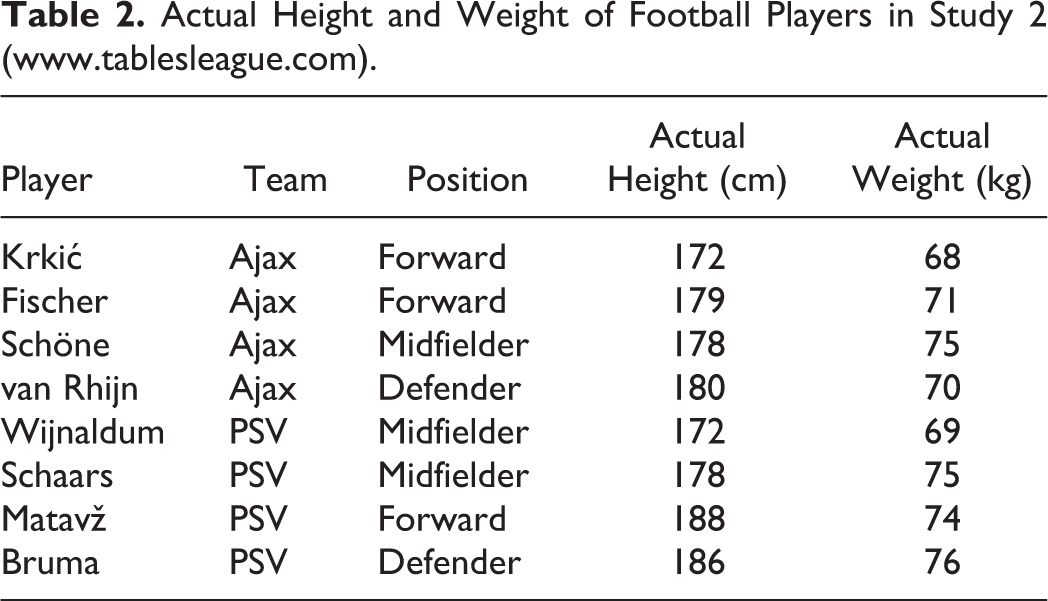
After completion of some sociodemographic questions, participants then indicated whether and which team they supported and answered questions on their favorite team. If they were neutral, participants were randomly assigned a team. Next, similarly to Study 1, participants were asked to estimate performance and body size (in sliders) of four prominent football players of one of the teams: Bojan Krkić, Viktor Fischer, Lasse Schöne, and Ricardo van Rhijn for Ajax, and Georginio Wijnaldum, Stijn Schaars, Tim Matavž, and Jeffrey Bruma for PSV (for heights and weights of the individual players; see Table 2). Participants were also asked how interested they were in the team’s performance, how much they supported the team, who they thought would win the match, and what the final score of the match would be.
Actual Height and Weight of Football Players in Study 2 (www.tablesleague.com).
After the match, participants who had indicated that they would like to participate in a second part of the study were emailed a link to an online survey. For the second part, 20 PSV fans (35.71%), 36 Ajax fans (28.12%), and 11 neutral participants (25.58%; 8 were randomly assigned to PSV and 3 to Ajax) responded. They were asked whether they had seen the match and if so, which team was the winning team. Next, they completed the same measures as in the first part. After this, they were asked how satisfied they were with their team’s performance in the last match and which of the four players they thought had performed the best. Upon completion of the survey, participants were thanked and entered into the raffle, if they wished so.
Analyses
Initial analyses showed that the height and weight slider measurements were moderately to strongly correlated, r(225) = .612, p < .001. As in Study 1, we ran separate analyses for the height and the weight measurements. The units of analysis were self-reported fandom and height, weight, and performance estimations made by the participants, and the four individual players for each team were added as groupings. We used similar linear mixed models analyses as in Study 1, and again tables for the analyses and the results of participant sex and participant body size are reported in the ESM 3.
Results Study 2
We expected that when players were perceived as performing well, they would also be perceived as larger in body size (“BBB”). Furthermore, we expected that winning the match would be positively associated with estimations of body size, while losing would be negatively associated with estimations of body size.
Continuous Height Estimations
The third model (random slopes for estimated performance and self-reported fandom and random intercept) was comparatively the best fitting model (AIC = 6,419.673, ΔAIC second best model = −2.916; BIC = 6,438.505, ΔBIC second best model = 6.500). In line with our expectations, estimated performance, t(135.296) = 3.860, p < .001, 95% CI [0.07, 0.20]; bootstrap: p = .001, 95% CI [0.07, 0.19], was significantly associated with continuous height estimation (ESM 3, Table 5). When players were estimated to perform better, they were also estimated to be taller. Fandom (p = .150) initially was not significantly associated with continuous height estimation. However, after bootstrapping, fandom was indeed significantly associated with height estimation: p = .006, 95% CI [0.01, 0.05]. Individuals who were more invested in the team also estimated the players to be taller.
Continuous Weight Estimations
Again, the third model (random slopes for estimated performance and self-reported fandom and random intercept) was comparatively the best fitting model (AIC = 6,380.039, ΔAIC second best model = 10.88; BIC = 6,398.871, ΔBIC second best model = 1.46). In line with our expectations, estimated performance, t(778,146) = −3.021, p = .003, 95% CI [0.04, 0.17]; bootstrap: p = .001, 95% CI [0.03, 0.18], was significantly associated with continuous weight estimation (ESM 3, Table 6). When players were estimated to perform better, they were also estimated to be heavier. Fandom (p = .423) was not significantly associated with continuous weight estimation. However, bootstrapping revealed that fandom (p = .050, 95% CI [−0.00, 0.04]) was indeed significantly associated with estimated weight. Individuals who were more invested in the team also estimated the players to be heavier.
Association of Performance and Body Size Over Time
Due to the correlational nature of Study 2, we were not able to study causal effects. In order to examine whether there was an effect of time for estimated performance on estimated formidability of the players, we conducted two analyses of covariance (ANCOVAs) with estimated performance at Time 1 (before the game) as the independent variable and estimated height at Time 2 (after the game) and estimated weight at Time 2 as the dependent variables. When player performance was more positively evaluated before the game, players were judged as being significantly taller, F(1, 110) = 12.754, p = .001,
Winner/Loser Effects
We expected that perception of body size in winners would be overestimated, while physical formidability in losers would be underestimated. PSV won the game decisively (4-0). This result is represented in the performance judgments of both teams, as the main effects of team, Ajax, PSV: F(1, 66.862) = 20.735, p < .001, and time, before match, after match: F(1, 66.315) = 10.703, p = .002, on judged performance were significant. The interaction between team and time, F(1, 66.315) = 19.409, p < .001, was also significant: Judged performance of PSV increased over time (Δ = 4.803), and judged performance of Ajax decreased over time (Δ = −32.513).
Continuous height estimations
We conducted two repeated measures mixed models with estimated height via sliders of four players of one of the teams as dependent variable, and participant sex, football team, estimated performance of the four players, self-reported fandom of the team, time (before match/after match), and the interaction between time and team as independent variables. The second model (autoregressive) was comparatively the best fitting model (AIC = 1,191.834, ΔAIC second model = −0.5; BIC = 1,197.341, ΔBIC second model = 2.3). Team (p = .597), estimated performance (p = .401), fandom (p = .250), time (p = .358), and the interaction between time and team (p = .545) all were not significantly associated with continuous height estimation.
Continuous weight estimations
Two similar repeated measures mixed models analyses were conducted with estimated weight via sliders of four players of one of the teams as dependent variable. Again, the second model (autoregressive) was comparatively the best fitting model (AIC = 1,190.323, ΔAIC second model = 1.684; BIC = 1,195.830, ΔBIC second model = 4.4). Team (p = .548), estimated performance (p = .535), fandom (p = .384), time (p = .778), and the interaction between time and team (p = .528) all were not significantly associated with continuous weight estimation.
Summary Study 2
Again, our predictions were partly supported. Hypothesis 1 was fully supported as estimated performance had a robustly significant relationship with continuous measurements of estimated height and weight. In line with our expectations, self-reported fandom was significantly associated with the height and weight estimations (fully supporting Hypothesis 3). However, we did not find any substantial support for Hypothesis 2 (winner/loser effects), which could be due to low statistical power, as we only had 67 participants for the second part of the study.
Studies 1 and 2 gave us the opportunity to examine real-life coalitional affiliation; however, this also means that real-life prior knowledge might influence results. Study 3 was set up to test causality of the performance effect on body size estimations using an experimental setup. In order to clarify the relationship between the slider and the centimeter/kilogram measures, we again used all the height and weight measures from Study 1. Furthermore, we aimed for a sample with a more even gender distribution in order to test whether men make larger formidability estimations than women do. Men have estimated politicians as taller than women did in previous research by Higham and Carment (1992), suggesting these differences were due to using one’s own height as an anchor. However, this argument was not supported by later research, where men did not make larger estimations of physical formidability than women did, and participant’s own height and weight did not affect estimations (Knapen et al., 2017). Given these mixed results, we will also conduct exploratory tests for participant sex effects in body size estimates.
Method Study 3
Participants
Participants were recruited via the crowdsourcing platform CrowdFlower. As the survey was in English, we aimed to recruit native speakers by making the study available for the United Kingdom and the United States only. We indicated a stopping rule at 200 participants based on a sample size analysis for (1 − β) = .80 and α = .05, resulting in 95 participants for a medium effect size, and 175 participants for a small effect size. Unfortunately, probably due to participants entering the payment code multiple times through different accounts, after shutting down the experiment at 200 participants, we only had a total of 142 participants who actually completed the experiment. We excluded 52 participants from analysis a priori because they did not complete the whole survey (n = 5) or gave extremely unrealistic answers for height or weight (n = 47). This left us with a total of 90 participants (42 males, one person chose not to disclose their sex) with a mean age of 37.8 years (SD = 10.41, range 18–69 years). The majority of the participants resided in the United Kingdom (95.6%) and indicated that they were White (91.1%). Women reported an average height of 162.84 cm (SD = 8.11, range 144.78–187.96 cm) and an average weight of 66.41 kg (SD = 15.28). Men reported an average height of 178.16 cm (SD = 8.97, range 152.68–193.04) and an average weight of 73.84 kg (SD = 19.70). Only six participants indicated that they were not familiar with football (soccer), excluding them did not change the results. Participants received a small payment (US$0.30) via their CrowdFlower account after completing the study.
Materials and Procedure
After completing some sociodemographic questions, participants were randomly assigned to either a high performance (HP) or low performance (LP) condition. Research using the “minimal group paradigm” (Tajfel, Billig, Bundy, & Flament, 1971) has shown that even minimal or arbitrary distinctions between groups can trigger in-group behavior. In order to create at least some degree of coalitional affiliation, we informed the participants that they would be assigned to one of the two teams: Home Team or Visiting Team. However, all participants were assigned to Home Team, as we expected this would create the most affiliative feelings.
All participants were shown a black and white picture of a morphed male rated as averagely attractive (used with permission from Braun, Gruendl, Marberger, & Scherber, 2001; Figure 1), announcing they had been assigned to “Home Team.” Next, they read a short text about the football player in the picture (complete text can be found in ESM 4). Participants in the HP condition then read the following text: “This player has been performing very well this season. Both his number of achieved goals and his assistance in goal making were above average. Expert raters gave him 8 of the 10 points,” while participants in the LP condition read this text: “This player has not been performing well this season. Both his number of achieved goals and his assistance in goal making were below average. Expert raters gave him 5 out of the 10 points.”

Picture of football player in Study 3 (from Braun et al., 2001).
After reading the text, participants rated the player on performance (0 = very bad to 100 = very good), height (0–100 slider and in feet/inches), and weight (0–100 slider and in pounds). All five ratings were presented in random order. To check whether participants felt coalitional affiliation with the hypothetical hometown team (HT), we asked them how positive their feelings were toward HT (M = 71.72; SD = 23.08), how involved they felt in HT (M = 65.49; SD = 25.81), whether they felt like a part of HT (M = 60.65; SD = 26.16), and whether they hoped HT would win the match (M = 79.35; SD = 22.91), all on 0–100 slider scales. Next, participants answered some manipulation checks and were given a code in order to receive payment.
Results Study 3
We expected that the high-status in-group member’s (football player of the HT) body size would be estimated larger in the high-performance condition compared to the low-performance condition. We exploratorily tested whether men would on average make larger overestimations than women would make. We asked for self-reported height and weight to examine whether individuals use their own height or weight as an anchor in estimating body size.
Preliminary Analyses
As a manipulation check, we also measured perceived performance of the player. Indeed, performance was rated significantly higher in the HP condition (M = 80.98, SD = 8.51) compared to the LP condition, M = 47.24, SD = 12.38; F(1, 88) = 231.578, p < .001,
Height Estimations in Centimeters
An ANCOVA with height estimations in centimeters as the dependent variable and condition, participant sex, and participant height as independent variables, F(3, 85) = 5.559, p = .002,
Continuous Height Estimations
An ANCOVA with height estimations via the slider as the dependent variable and condition, participant sex, and participant height as independent variables, F(3, 85) = 5.508, p = .002,
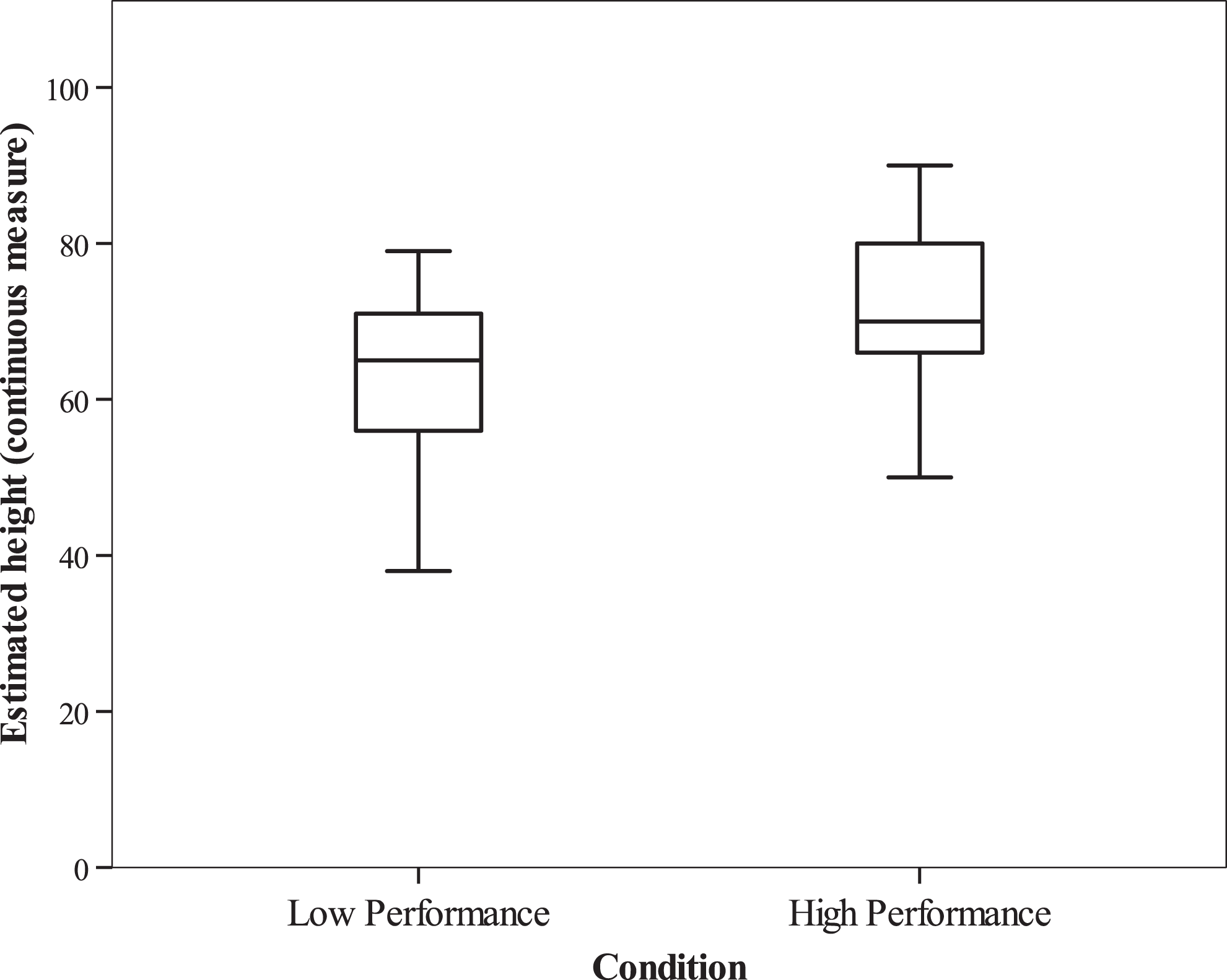
Estimated height in sliders by condition in Study 3.
Weight Estimations in Kilograms
An ANCOVA with weight estimations in kilograms as the dependent variable and condition, participant sex, and participant weight as independent variables, F(3, 85) = 2.008, p = .119,
Continuous Weight Estimations
An ANCOVA with weight estimations via the slider as the dependent variable and condition, participant sex, and participant weight as independent variables, F(3, 85) = .788, p = .504,
Summary Study 3
In line with Study 2, estimated performance had a significant positive effect on estimated height when continuous measurements were used. Furthermore, we also found a significant effect of estimated performance on height measurements in centimeters this time. In line with Study 1, we did not find an effect of performance on the estimations of weight in kilograms. However, contrary to Studies 1 and 2, we also did not find an effect of performance on the continuous estimations of weight. Previous findings that men overestimate height more than women do were not supported. The argument that men use their own (taller) height or (heavier) weight as an anchor was also not supported.
Discussion
Our most robust finding deals with the expected positive association of prestige with height estimations: In two of the three studies, we found evidence for estimated performance (our proxy measure for prestige) being positively associated with height estimations. The findings regarding the association between prestige and weight estimations were mixed. We did not find any association between prestige and the weight estimations in kilograms, but we did find a significant association between prestige and estimated continuous weight in the first two studies (however, not in Study 3). These results are in line with earlier studies suggesting a positive association between high-status in-group member’s behavioral evaluations (political skills, leadership) and their perceived physical formidability (Knapen et al., 2017; Lukaszewski et al., 2016). Our study demonstrates the BBB: The association between prestige-based status and body size is so strong that the heuristic is also used when it is not useful (i.e., when status and size are not correlated in that domain). Our results suggest that this bias is especially strong for the association between prestige-based status and estimated height. The different height and weight measurements were not significantly, or only weakly, correlated with each other in both Study 1 and Study 3. Furthermore, the estimations made in centimeters and kilograms in Study 1, and weight estimations in kilograms in Study 3, yielded null results, while most of the estimations made with sliders (except for height in Study 1 and weight in Study 3) did show the expected associations. This is in line with research by Knapen et al. (2017) who concluded that continuous measurements give more “opportunity” for perceptual distortions than centimeter or kilogram measures do. As participants were well aware of the actual heights in centimeters of the players, this could explain why there was no association between performance and these estimations in the first study. In Study 3, we used a hypothetical football player that the participants did not know, and here we did find the expected effect in the centimeter height measurements. However, this does not explain the null results for the kilogram estimations, as participants were not very aware of the actual weights of the players. As we did not find any effects of performance on weight estimations in Study 3, the BBB association may simply be stronger for height than for weight. Although this is in line with previous research not finding prestige effect on weight measures for politicians (Knapen et al., 2017), we did expect them here as weight is a more relevant proxy for muscle mass (i.e., strength) in professional football players than it is in politicians. Perhaps a direct measure of strength would have been better here; however, then we would not have had the possibility to test for overestimation.
In line with our expectations, individuals who reported to be bigger fans of the team also estimated the players to be taller and heavier. These results support our hypothesis that individuals who are more invested in the coalition make larger estimations of prestige-based high-status individuals’ body size within that coalition. In line with previous research (Knapen et al., 2017; Winegard & Deaner, 2010), this suggests that coalitional affiliation could be part of a motivated cognition for coalitional functioning. This would be an interesting hypothesis to explore further in future research dealing with body size perceptions in sports or other coalitional contexts. In the current study, we only examined perceptions within one’s own coalition, and we expect that in-group estimations would be larger than out-group estimations (of rival teams’ members; in line with Knapen et al., 2017).
In Study 3, we also conducted exploratory tests for participant sex effects on estimated body size, which we did not find any support for. Effects of participant sex on body size estimations have yielded mixed results in earlier research (Higham & Carment, 1992; Knapen et al., 2017), and our results are in line with Knapen et al. (2017) where the anchoring hypothesis has also not been supported. Further research should look more closely into these possible sex effects and examine whether differences are possibly due to other contributing factors than anchoring effects. Popularity of women’s football’s is growing rapidly, and it would also be interesting to examine sex effects within the targets: Does the BBB also apply to high-status female football players?
Limitations
Although we found an overall association of performance estimations with body size estimations, occasionally individual players stood out. These findings can possibly be explained by the deviations in height and weight that these individuals have (see also Sorokowski, 2010). Sneijder, for example, is very short for Dutch standards, and his height is often remarked or even made fun of in the (Dutch) media (e.g., www.vi.nl). When individuals are so fully aware of a player’s height, like in the case of Sneijder, it is unlikely that their perceptions of these more extreme builds will differ according to performance.
We did not find any winner/loser effects in Study 2. This could be due to lack of power because of the rather small sample of participants who participated in both parts of the study. However, previous research on body size perceptions of politicians has also documented mixed findings in these winner/loser effects (Higham & Carment, 1992; Knapen et al., 2017; Sorokowski, 2010). Winning could also be seen as another measure of performance and as such, these results would contrast our findings of performance leading to larger body size estimations. A possible explanation for this would be that although football is a team sport, people pay more attention to individual performances (as measured by asking for performance of individual players) and thus that the BBB does not generalize to team efforts (i.e., winning or losing a match).
Previous research suggests that physical formidability, especially height, can lead to a “halo effect” where the positive validation of an individual’s height is automatically associated with a positive evaluation of that individual’s competence (Blaker et al., 2013; Judge & Cable, 2004). In Study 3, we did not control for perceived competence when testing the association between performance and physical formidability. However, research has shown that the association between prestige and perceived body size maintains above and beyond possible confounding variables like intelligence, attractiveness, and liking (Knapen et al., 2017; Lukaszewski et al., 2016). Moreover, we expect that the experimental design of the study, incorporating the manipulation of performance while measuring perceptions of height and weight, obviates the possible “halo effect” as described above.
Conclusion
In sum, our results suggest that individuals associate prestige with body size, even when there is no actual association between the two, demonstrating the strength of a “better is bigger” heuristic. Messi’s height and weight would thus probably be overestimated due to his football skills, were it not that he is so famous that his fans probably know exactly how tall he really is. More research is needed to further explore the role of coalitional affiliation in this association, for example, by testing in-group versus out-group targets.
Supplemental Material
Supplemental Material, ESM_1 - When Better Seems Bigger: Perceived Performance of Adult Professional Football Players Is Positively Associated With Perceptions of Their Body Size
Supplemental Material, ESM_1 for When Better Seems Bigger: Perceived Performance of Adult Professional Football Players Is Positively Associated With Perceptions of Their Body Size by Jill E. P. Knapen, Thomas V. Pollet and Mark van Vugt in Evolutionary Psychology
Supplemental Material
Supplemental Material, ESM_2 - When Better Seems Bigger: Perceived Performance of Adult Professional Football Players Is Positively Associated With Perceptions of Their Body Size
Supplemental Material, ESM_2 for When Better Seems Bigger: Perceived Performance of Adult Professional Football Players Is Positively Associated With Perceptions of Their Body Size by Jill E. P. Knapen, Thomas V. Pollet and Mark van Vugt in Evolutionary Psychology
Supplemental Material
Supplemental Material, ESM_3 - When Better Seems Bigger: Perceived Performance of Adult Professional Football Players Is Positively Associated With Perceptions of Their Body Size
Supplemental Material, ESM_3 for When Better Seems Bigger: Perceived Performance of Adult Professional Football Players Is Positively Associated With Perceptions of Their Body Size by Jill E. P. Knapen, Thomas V. Pollet and Mark van Vugt in Evolutionary Psychology
Supplemental Material
Supplemental Material, ESM_4 - When Better Seems Bigger: Perceived Performance of Adult Professional Football Players Is Positively Associated With Perceptions of Their Body Size
Supplemental Material, ESM_4 for When Better Seems Bigger: Perceived Performance of Adult Professional Football Players Is Positively Associated With Perceptions of Their Body Size by Jill E. P. Knapen, Thomas V. Pollet and Mark van Vugt in Evolutionary Psychology
Footnotes
Declaration of Conflicting Interests
The author(s) declared no potential conflicts of interest with respect to the research, authorship, and/or publication of this article.
Funding
The author(s) disclosed receipt of the following financial support for the research and/or authorship of this article: This research was supported by a NWO (de Nederlandse Organisatie voor Wetenschappelijk Onderzoek; www.nwo.nl) Veni grant to TVP (451.10.032).

Supplemental Material
Supplemental material for this article is available online.
References
Supplementary Material
Please find the following supplemental material available below.
For Open Access articles published under a Creative Commons License, all supplemental material carries the same license as the article it is associated with.
For non-Open Access articles published, all supplemental material carries a non-exclusive license, and permission requests for re-use of supplemental material or any part of supplemental material shall be sent directly to the copyright owner as specified in the copyright notice associated with the article.
