




Abstract
The present research examined the influence of celebrity opinion upon individuals’ acceptance of the theory of evolution. Priming stimuli were developed purveying pro-evolution, anti-evolution, or neutral opinion (Study 1). When paired with a male celebrity or expert source (Study 2), the male celebrity, but not the male expert, influenced undergraduates’ acceptance of evolution. The influence of the male celebrity on acceptance of evolution was replicated in a community sample (Study 3). When paired with a female celebrity source, undergraduates’ acceptance of evolution was similarly influenced (Study 4). Together, these findings extend our understanding of the reach of credible celebrity endorsers beyond consumer behavior to core individual beliefs, such as those surrounding the acceptance of human evolution.
The vast majority of scientists believe that humans have evolved over time (98%; Pew Research Center, 2015). However, recent public opinion polls indicate much more variability in the views of the general public; only 65% of Americans (Pew Research Center, 2015), 61% of Canadians (Angus Reid Public Opinion Polls, 2012), and similar amounts of British and Australians share this view (Angus Reid Public Opinion Polls, 2012; Australian Academy of Science, 2013). Conflicting opinions about human evolution are also sometimes expressed publicly by potentially influential members of society, such as celebrities. Singer and actress Miley Cyrus was criticized by some on the social media platform Twitter for posting a Lawrence Krauss quote about the origin of life deriving from exploding stars, to the extent that she seemed compelled to respond “How can people take the love out of science and bring hate into religion so easily?” (March 6, 2012), a comment that was shared (i.e., retweeted) nearly 5,000 times.
Sometimes, publicized celebrity opinions constitute a lack of acceptance (or misunderstanding) of the basic facts underlying human evolution. Actor Kirk Cameron famously claimed on Fox News that there was a lack of transitional forms in the fossil record and that if such forms existed, we would have evidence of things like duck–crocodile hybrids. Actor Chuck Norris (2006) has written here’s what I really think about the theory of evolution: It’s not real. It is not the way we got here. In fact, the life you see on this planet is really just a list of creatures God has allowed to live. We are not creations of random chance. We are not accidents. There is a God, a Creator, who made you and me. We were made in His image, which separates us from all other creatures. Science makes a lot of sense. Then I start thinking—wait, the “big bang.” For a “big bang” to create all this is more wild to think about than thinking about there being a God. Imagine putting a bunch of gold into a box, shaking up the box, and out comes a Rolex. It’s so preposterous once people start saying it. (La Puma, 2015)
This raises the question: Are publicized celebrity opinions about human evolution merely inconsequential forms of entertainment, or do they have the potential to influence individuals’ acceptance of evolution? Across four experiments involving either undergraduates or community members, participants were randomly assigned to read one of three fictitious magazine articles (developed in Study 1) in which either an expert in biology (Study 2) or a popular celebrity (Studies 2–4) endorses a book that is (1) pro-evolution in title and content, (2) anti-evolution in title and content, or (3) neutral (control), and subsequently completed a well-validated measure of acceptance of the theory of evolution (MATE).
Acceptance of Evolution
Over the past century and a half, the body of evidence supporting and improving the scientific knowledge of evolution has increased drastically. Yet many individuals hold beliefs about evolution that are discordant with the base of knowledge surrounding it (e.g., Williams, 2009). Miller, Scott, and Okamoto (2006) asked adults to respond with “true,” “false,” or “unsure/do not know” to the statement: “Human beings, as we know them, developed from earlier species of animals.” Conducted between 1985 and 2005, the study revealed that adults’ beliefs in evolution dropped from 45% to 40% (Miller et al., 2006). In this time, the number of people who were skeptical or unsure of evolution increased from 7% to 21% (Miller et al., 2006).
Some researchers suggest that a possible reason for lack of acceptance of evolution is the misconceptions people hold, such as creationists’ views about the origin of species (Williams, 2009). Researchers have recently attempted to discern ways of reducing misconceptions about evolution, for instance, by distinguishing between the notions of belief and acceptance, with acceptance meaning the acknowledgment of something that is valid based upon an evaluation of evidence (Smith & Scharmann, 1999). Evolutionary misconceptions may have negative consequences for the individual and society because they can hinder further learning (Committee of Undergraduate Science Association, 1997). Moreover, acceptance of evolution (or lack thereof) among the public can influence systemic factors, such as the education system, which ultimately affects the scientific literacy (e.g., Aguillard, 1999). For example, the 1925 Tennessee Anti-Evolution Act, which prevented schools from teaching evolution (Waller, 1925), was strongly advocated for by individuals who did not accept Darwin’s theory of evolution (Larson, 2004). More recent law, such as the Louisiana Scientific Education Act passed in 2008, has been similarly criticized for preventing the effective teaching of evolutionary theory and passing creationism off as fact (Branch & Scott, 2009). Some parents who do not believe in evolution actively seek to have their children excused from learning about it (Scott & Branch, 2008) and may pressure educators to omit evolution from the curriculum (Branch, Scott, & Rosenau, 2010) see. Anti-evolution advocates have even made attempts to have the controversy between evolutionary theory and creationism taught in biology textbooks (Skoog, 2005; Wexler, 2003).
Accordingly, researchers have advocated for the importance of increasing individuals’ acceptance of evolution (Nadelson & Hardy, 2015). Recent research has focused on understanding factors that influence individuals’ acceptance of evolution, with most studies focusing on the beneficial effects of explicit education initiatives (Blackwell, Powell, & Dukes, 2003; Dagher & BouJaoude, 1997; Jensen & Finley, 1996). Conversely, to date, no research has explored the possibility that exposure to the opinions of influential others, such as celebrities, might affect acceptance of evolution.
Celebrity Influence
A celebrity is defined as a “person who is both credible and attractive” and “enjoys public recognition” (McCracken, 1989). Celebrities develop a “self” in the public eye, which then becomes both exemplary and inspirational for the public (McCracken, 1989), often through the portrayal of both social and physical ideals (Giles & Maltby, 2004). Today, celebrity role models and personas are extremely accessible through diverse forms of media (i.e., newspaper, TV, magazines, Internet, etc.; e.g., Perez-Pena, 2007). Through various media outlets, individuals form relationships with celebrities. Horton and Wohl (1956) developed a theory of interaction that occurs between celebrity and fan, which they termed, the para-social interaction: a nonreciprocal relationship in which one person cares deeply about another and the other is unaware. The relationship may seem to mature over time as the fan feels more intimate with the celebrity persona. The fan may begin to model the celebrity’s behavior in social situations (Horton & Wohl, 1956). Indeed, a relationship with a figure of admiration is often characterized by elements and degrees of imitation. Kelman (1961) noted that imitation can involve mimicking the statements, actions, and beliefs of others. Individuals may identify with a celebrity and in doing so mimic their attitudes (Brown & Basil, 1995) such as their viewpoint toward a contentious issue. The influence of a celebrity need not occur explicitly: Tanner and Maeng (2012) found that facial morphs incorporating celebrity faces were (although unrecognizable to participants) rated as being more trustworthy than morphs that did not include celebrity faces.
Celebrity endorsers have long been understood as effective tools in influencing consumer purchasing behavior. Today, one in four advertisements utilizes celebrity endorsement (Amos, Holmes, & Strutton, 2008). The reach of celebrity influence has extended from marketing of products to attempting to alter attitudes and behavior surrounding domains such as politics and health (Knoll & Matthes, 2017). For example, celebrity has recently been found to influence personal values such as agreement with both popular and unpopular political statements (Jackson & Darrow, 2005; see also Austin, Van de Vord, Pinkleton, & Epstein, 2008). Recent research has further considered the potential influence of celebrity on Federal lawmaking (Demaine, 2009), religion (Cusack, 2009), and public health initiatives (Choi & Berger, 2010; see Hoffman & Tan, 2013, for review). For example, in the months following Angelina Jolie’s well-publicized decision to have genetic testing for the BRCA1 gene and subsequent decision to undergo risk-reducing mastectomy, genetic testing rates among members of the public more than doubled (Evans et al., 2014).
However, not all celebrities are equally influential. Amos, Holmes, and Strutton (2008) conducted a meta-analysis examining effects of celebrity influence on consumer behavior and found support for a “source credibility” model, whereby celebrity trustworthiness, expertise, and physical attractiveness have the strongest effect on consumer behavior and attitudes, followed by credibility, familiarity, and likeability (see also Knoll & Matthes, 2017). Accordingly, we selected celebrities for the present study who have been demonstrated by past research (Studies 2 and 3) or recent popular press (Study 4) as exhibiting high source credibility.
The Present Research
In the present set of studies, we examined whether an influential celebrity conveying an opinion (in the form of a book recommendation) about evolution would influence individuals’ reported acceptance of evolution. In Study 1, we developed and validated priming stimuli in the form of short book recommendations that present and endorse a superficial pro-, anti-, or neutral opinion about Darwinian evolution (Appendix). In Study 2, these recommendations were integrated into fictitious magazine articles that were presented as being written by either an expert in biology or an influential male celebrity, and the potential effect upon a well-validated measure of acceptance of evolution was examined. In Study 3, the potential influence of the male celebrity opinion upon individuals’ acceptance of evolution was reexamined in a community sample. In Study 4, the role of an influential female celebrity in affecting acceptance of evolution was examined. In each study examining celebrity influence on acceptance of evolution, the potential covariates of age, sex, and religiosity were statistically controlled for.
Study 1: Stimuli Development
Study 1 involved the development of the pro-evolution, anti-evolution, and neutral content which would later constitute the opinion of an expert (Study 2) or a celebrity (Studies 2–4). Three fictitious book recommendations were developed (approximately 200 words each) comprising a brief positive recommendation of a book that details and supports a pro-evolution, anti-evolution, or neutral perspective (Appendix). In order for this content to be suitable for our research objectives, we first had to ensure that the content of the recommendations, in and of themselves, does not influence individuals’ acceptance of evolution. If the pro-evolution, anti-evolution, or neutral opinion content alone does not affect acceptance of evolution, then any subsequently observed effects when those opinions are paired with a celebrity or expert source would be due to the purveyor of the opinion rather than to the content of the opinion itself.
Method
Participants
Participants were recruited from classrooms in various programs (e.g., psychology, physical and health education, and sociology) at a small University in Northern Ontario, Canada. Sample size was selected for using power analysis using an α of .05, a power of .80, and a medium effect size (f = .25; Faul, Erdfelder, Buchner, & Lang, 2013). Thus, our stop decision for data collection occurred when we reached N = 158 or until the semester was complete—whichever came first. In this case, we stopped at N = 150 (111 women) between the ages of 18 and 50 (M = 20.89, SD = 4.07; 50/experimental condition) at the end of the 2015–2016 academic term. Participants were remunerated with partial course credit for their participation. Participants were randomly assigned to either a pro-evolution, anti-evolution, or neutral priming condition (N = 50 per condition).
Procedure
Participants were told they were taking part in a study on memory and social attitudes. Participants completed a brief demographics survey and were then asked to read and remember as best they could a randomly assigned book recommendation from a popular online book marketplace. Following this task, participants completed a survey involving questions about their recall of content from the book recommendation, demographic characteristics (age and sex), as well as measures of self-report memory and acceptance of evolution.
Pro-Evolution, Anti-Evolution, and Neutral Stimuli
Three book recommendations were developed, each of which included a short written passage and a color image of the book cover, together conveying a pro-evolution, anti-evolution, or neutral opinion. For each, the written recommendation described the book as wonderful, insightful, and witty and contained superficial content purported to describe the content of these reviews were not actually taken from the exemplar books. In the pro-evolution condition, the book being recommended was Jerry A. Coyne’s (2009) Why Evolution Is True. The content of the review gave superficial arguments in support of evolution (i.e., the strength of DNA sequencing and of the fossil record and modern examples of observable evolution such as among dog breeds). In the anti-evolution condition, the book being recommended was Benjamin Wiker’s (2009) The Darwin Myth: The Life and Lies of Charles Darwin. Superficial information in opposition of evolution (i.e., the low statistical odds that DNA could occur by chance alone, gaps, and hoaxes in the fossil record and that evolution cannot explain how life on earth actually began) was presented in the recommendation. In the neutral condition, the book being recommended was Anthony Doerr’s (2014) All the Light We Cannot See. The review provided a brief synopsis of the book content (a work of fiction) set during World War II. Each participant was randomly assigned to read one of the three book reviews.
Memory for Stimuli
Participants then responded to 2 items assessing their memory for the read content: (1) What was the title of the book being reviewed? and (2) Briefly, what was the book review about? These items were used to maintain the cover story of the research being interested in memory but also served to reinforce the content and to provide a check to ensure the participants’ attention to, and understanding of, the content. Participants also completed the Everyday Memory Questionnaire-Revised (Royle & Lincoln, 2008), which assesses self-perceived memory failure in everyday life circumstances, as a part of the deception (responses to these items were not scored).
Acceptance of Evolution
The MATE instrument was administered as the dependent variable in order to determine participants’ acceptance of evolution. The scale is comprised of 18 items; all items were measured on a 5-point Likert-type rating scale ranging from (5) strongly agree to (1) strongly disagree. Sample item: “Organisms existing today are the result of evolutionary processes that have occurred over millions of year” (Rutledge & Warden, 1999). In the present study, the MATE showed good internal consistency, α = .92.
Results and Discussion
A one-way between-subjects analysis of covariance (ANCOVA) was conducted with sex and age entered as covariates, acceptance of evolution as the dependent variable, and experimental condition as the independent variable. Levene’s test for homogeneity of variance indicated equality of variance across conditions, F(2, 147) = 1.26, p = .29. Results showed a main effect of the covariate sex, F(1, 145) = 6.24, p = .014,
Study 2
Friedman and Friedman (1979) indicated that celebrities are generally more effective than other types of endorsers, such as “the professional expert.” In order to determine whether this is also the case among endorsement of opinion surrounding acceptance of evolution, for which that of an expert should logically be more influential relative to a celebrity nonexpert, we exposed participants to pro-evolution, anti-evolution, or neutral book recommendations (described in Study 1) using either a celebrity (George Clooney) or a fictional professor of biology from a prestigious American University (Dr. George Rooney) as the purveyor of the opinion (i.e., the book review and recommendation).
Method
Participants
Participants were recruited from a small University in Northern Ontario, Canada, using a campus research participation system, in-class recruitment, and recruitment in common areas of the campus. Sample size was selected for using power analysis using an α of .05, a power of .95, and a medium effect size (f = .25; Faul et al., 2013), which yielded an ideal total sample of 251. We elected to extend this to N = 360 university and college students (240 women, 120 men) aged 16–45 (M = 21, SD = 3.10) in order to retain consistency with our related studies presented in this article at a minimum of 50 participants per condition. Participants were largely Caucasian (90%) with, 2% Asian, 2% South Asian, 1% Black, 3% Native American, and 2% Latin American. Participants were remunerated in one of two ways: Students drawn from the Online Research Participant Pool were granted a noncompulsory course credit of 0.5%. Other participants were entered in a draw for CAD$100.
Materials and Procedure
Demographics
Upon providing informed consent, participants completed a brief demographic questionnaire. Participants reported their age, sex, and ethnicity. Participants also completed a well-validated nondenominational measure of religious involvement: The Duke University Religion Index (DUREL; Koenig, Parkerson, & Meador, 1997). The measure consists of 5 items scored along a 5-point Likert-type scale from (1) definitely true of me to (5) definitely not true. The DUREL showed good internal consistency, α = .90.
Priming task
Participants were then asked to choose one of three envelopes containing a magazine article, which they were instructed to read thoroughly as a part of a memory test. In actuality, all three envelopes contained copies of the same fictitious article which was randomly assigned to the participant a priori to convey celebrity attitudes that were pro-evolution, anti-evolution, or neutral with respect to evolution. Participants were also randomly assigned to have this opinion purveyed by either a celebrity or an expert. In the celebrity condition, the fictitious magazine article (purportedly from a popular print magazine) involved a segment entitled “Celebrity Book Review” in which a celebrity recommends and describes a book of their choosing. In each article, George Clooney was used as the celebrity purveyor of the opinion. George Clooney was selected as the celebrity given previous research showing that he meets criteria for the source attractiveness model. Specifically, work by Lee and Thorson (2008) found him to rank high among other potentially influential celebrities on familiarity, physical attractiveness, salience, and overall impression and simultaneously low on recall of him making many prior endorsements. Conversely, in the expert condition, the purveyor of the opinion was a fictitious professor of biology from a prestigious American University named George Rooney, with the article title changed to Expert Book Review. In each condition, the content (book cover image and written recommendation) from the pro-evolution, anti-evolution, and neutral conditions detailed in Study 1, which previously had no effect on participants’ acceptance of evolution, were imposed into the magazine article along with an image of either George Clooney or professorial-looking male.
Manipulation check and acceptance of evolution
After reading the article, participants were asked to complete a memory task in which three questions were asked: (1) Who was the celebrity [expert] interviewed in the magazine article? (2) What was the title of the magazine that your article came from? and (3) Briefly, what was the article about? These questions were used to maintain the cover story of the research being interested in short-term memory, but also as reinforcement to the priming manipulation, and as a check to ensure the participants’ attention to, and understanding of, the article. Participants then completed the MATE (α = .93) and the Everyday Memory Questionnaire as described in Study 1.
Results and Discussion
A two-way between-subjects ANCOVA was conducted with sex, age, and religiosity entered as covariates; acceptance of evolution as the dependent variable; and opinion about evolution (pro-evolution, anti-evolution, or neutral) and purveyor of that opinion (celebrity or expert) as the independent variables. Levene’s test for homogeneity of variance indicated equality of variance across conditions, F(5, 353) = 0.58, ns. A main effect of religiosity was found, such that more religious participants expressed lower acceptance of evolution compared to less-religious participants, F(1, 350) = 58.17, p < .001,

Mean differences in acceptance of evolution scores across opinion (pro-evolution, anti-evolution, and control) and purveyor (celebrity, expert) conditions. † p < .01. *p < .05. **p < .01. ***p < .001.
Study 3
The purpose of Study 3 was to determine whether the primary finding from Study 2 that a male celebrity can influence individuals’ acceptance of evolution is replicable in a community sample.
Method
Participants
Participants were community members recruited from various public locations (e.g., shopping mall, big-box retail store, and public library) in a small city in Northern Ontario, Canada, during the 2016–2017 academic year. Sample size was selected for using power analysis using an α of .05, a power of .80, and a medium effect size (f = .25; Faul et al., 2013). Thus, our stop decision for data collection occurred when we reached N = 158. One participant failed to complete the manipulation check item assessing attention paid to the priming stimuli. Therefore, participants were 157 community members (81 women) ranging in age from 16 to 78 (M = 32, SD = 16.38). Participants were largely Caucasian (94%) with, 1% Asian, 1% South Asian, 3% Native Canadian, and 1% Latin American. Participants were remunerated with entry in a draw for CAD$100.
Materials and Procedure
Participants were randomly assigned to one of three celebrity opinion conditions in which a pro-evolution, anti-evolution, or neutral book recommendation was made by an influential male celebrity (George Clooney). All demographic and outcome measures and procedures were identical to those reported for Study 2 (DUREL: α = .89; MATE: α = .94).
Results and Discussion
A one-way between-subjects ANCOVA was conducted with age and religiosity (DUREL) entered as covariates, acceptance of evolution as the dependent variable, and celebrity opinion condition as the independent variable. Levene’s test for homogeneity of variance indicated equality of variance across conditions, F(2, 154) = 1.54, p = .22. Results showed a main effect of the covariate sex, F(1, 151) = 5.64, p = .019,

Mean differences in acceptance of evolution scores across opinion (pro-evolution, anti-evolution, and control) purveyed by a male celebrity among a community sample. † p < .01. *p < .05. **p < .01. ***p < .001.
Study 4
Men are generally more influential than women, partly because men are often seen as having more credibility than their female counterparts (Carli, 2001). Vandegrift and Czopp (2011) examined the influence of male versus female endorsements of Hillary Clinton among male and female college students. The results indicated that whereas men rated the male and female supporters as similarly competent, women rated the male supporter as more competent than the female supporter. Furthermore, science is stereotypically viewed as a male profession (Miller, Eagly, & Linn, 2015) and some research has shown that women are perceived as being less scientifically adept than men (Carli, Alawa, Lee, Zhao, & Kim, 2016). This could lead to females who are conveying scientific information being less influential than their male counterparts. For example, female science teachers have indicated that male students frequently questioned their knowledge and skills by deliberately seeking help from male teachers outside class (Robinson, 2000). Expertise is an important factor in the effectiveness of celebrity endorsement and, as Kessler, Ashenden, Connell, and Dowsett (1985) noted, in our culture “masculinity also comes to define valued experience” (p. 46). Therefore, it is unclear whether a popular female celebrity would also be capable of influencing individuals’ acceptance of evolution similar to results from Studies 2 and 3 which used a male celebrity. The purpose of Study 4 was to determine whether a female celebrity opinion can also influence individuals’ acceptance of evolution.
Method
Participants
Participants were recruited using the online research participation system and via recruitment stations in common areas on the campuses from a small University in Northern Ontario, Canada, during the 2016–2017 academic year. Sample size was selected for using power analysis using an α of .05, a power of .80, and a medium effect size (f = .25; Faul et al., 2013). Thus, our target sample was N = 158. In this case, we stopped at N = 168 to allow for potential participants who may not sufficiently complete the attention-check items following the priming stimuli. Two participants (both assigned to the neutral condition) were removed for having failed to indicate the content of the article assigned to them, bringing the final sample to 166 (121 women) with ages ranging from 16 to 49 (M = 22, SD = 5.16). Participants were largely Caucasian (87%), with 3% Asian, 3% South Asian, 5% Native American, 1% Black, and 1% Latin American. Participants were remunerated with partial course credit or entry in a draw for CAD$100.
Materials and Procedure
Participants were randomly assigned to one of the three celebrity opinion conditions, in which a pro-evolution, anti-evolution, or neutral book recommendation was made by an influential female celebrity (Emma Watson). Emma Watson was chosen as the female celebrity because she was included in Time Magazine’s 2015 list of the 100 most influential people. Additionally, AskMen.com (2015) placed her at the top of its list of the Top 99 Outstanding Women, in part because she is “rich, successful, famous, stylish, beautiful, intelligent, personable, and kind.” All demographic and outcome measures and procedures were identical to those reported for Studies 2 and 3 (DUREL: α = .89; MATE: α = .93).
Results and Discussion
A one-way between-subjects ANCOVA was conducted with sex, age, and religiosity (DUREL) entered as covariates, acceptance of evolution as the dependent variable, and celebrity opinion condition as the independent variable. Levene’s test for homogeneity of variance indicated equality of variance across conditions, F(2, 163) = 3.03, p = .051. Results showed a modest main effect of the covariate sex, F(1, 161) = 3.43, p = .066,
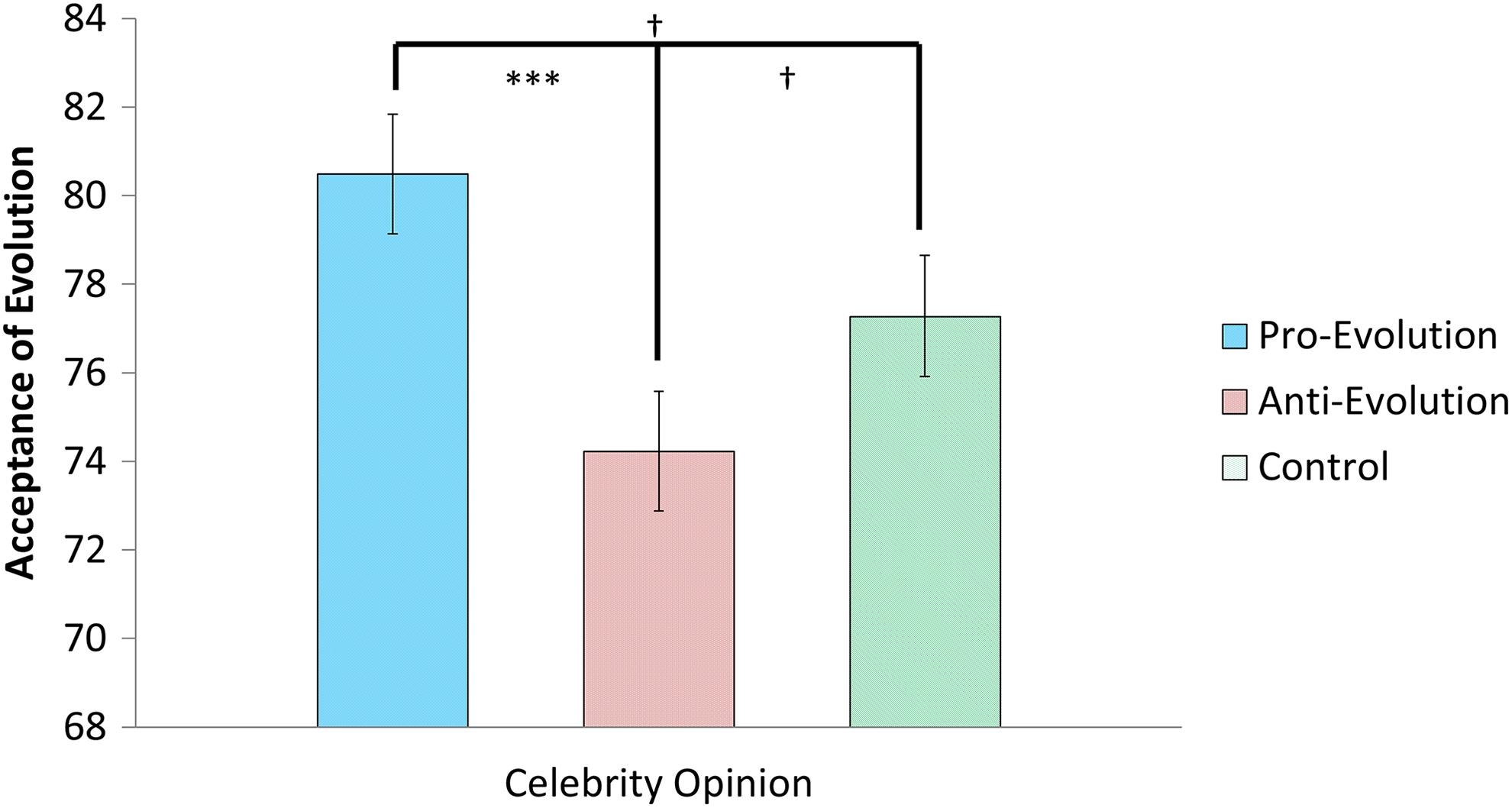
Mean differences in acceptance of evolution scores across opinion (pro-evolution, anti-evolution, and control) purveyed by a female celebrity. † p < .01. *p < .05. **p < .01. ***p < .001.
General Discussion
Despite the consensus among scientists that humans have evolved over time, human evolution still remains a contentious topic among much of the general public. Researchers have suggested many possible reasons that can contribute to individuals’ lack of acceptance of evolution, and yet no research has explored whether an individual’s acceptance of evolution can be susceptible to the opinions of influential others. We addressed this gap in the literature by examining whether male and female celebrities purveying an opinion about evolution can influence individuals’ acceptance of evolution. Taken together, the results of the present set of studies provide novel evidence that exposure to a celebrity’s opinion about evolution can indeed influence individuals’ acceptance of evolution.
First, the results from Study 2 showed that an opinion about evolution purveyed by a male celebrity influenced undergraduates’ acceptance of evolution, even after controlling for age and religiosity. This finding fits with the narrative that celebrities may influence core values and beliefs of individuals, surrounding other important issues such as political orientation and religious affiliation (Cusack, 2009). Furthermore, the male celebrity was significantly more effective at endorsing an opinion surrounding acceptance of evolution when compared to the male expert. This result was also in line with previous research, which has shown that celebrity endorsements are often more effective than endorsements from professional experts (Friedman & Friedman, 1979). Results from Study 3 were consistent with the main finding from Study 2, thus demonstrating that expression of an opinion about evolution by an influential male celebrity can influence individuals’ acceptance of evolution is replicable in a community sample.
Previous research has found that females are not as influential as males (Carli, 2001) and are sometimes viewed as having less credibility, expertise, and being less scientifically adept than males (Carli et al., 2016; Kessler, Ashenden, Connell, & Dowsett, 1985; Vandegrift & Czopp, 2011). Thus, it was unclear whether an opinion about evolution purveyed by an influential female celebrity would also have an effect on individuals’ acceptance on evolution. However, in Study 4, we found that the expression of a positive versus negative opinion about evolution by an influential female celebrity did indeed affect participants’ acceptance of evolution. The findings supporting celebrity influence held across all three studies after controlling for the main effect of religiosity, which was found across all three studies, such that more religious participants expressed lower acceptance of evolution compared to less-religious participants. This finding is in line with previous research that has shown religion to be a major predictor of belief in evolution (Mazur, 2004).
In light of the present findings, celebrities who publicly state opinions about evolution may have an impact on public acceptance of evolution. Evolution explains many processes that have provided important advancements in medicine, agriculture, and computer science (Bull & Wichman, 2001). Public statements made by celebrities that endorse an anti-evolution opinion could therefore contribute to public nonacceptance of evolution and consequently limit the public’s ability to make informed decisions about a wide range of phenomena—many of which have personal ramifications (Nadelson & Hardy, 2015). Furthermore, once celebrities make these statements regarding evolution, the consequences might be difficult to undue. Public claims made by celebrities that contain scientific misinformation continue to exert an influence on people’s opinions, even after the claims been retracted (Ecker, Swire, & Lewandowsky, 2014). Thus, a celebrity publicly voicing an opinion about evolution that contains misconceptions might not only negatively influence individuals’ acceptance of evolution, but the misconceptions about evolution that are endorsed by the celebrity may be difficult to correct.
Limitations and Future Directions
There are several limitations and future directions surrounding the present research. The first limitation was the use of undergraduate students in Study 4. When receivers and senders of messages share similarities, such as demographic and ideological similarities, the persuasiveness of the message increases (McGuire, 1985). The female celebrity chosen as the purveyor of opinion, Emma Watson, shared demographic similarity to participants of the study; like Emma Watson, the majority of participants were young adults and female. Therefore, it is possibly that an opinion about evolution shared by Emma Watson might not hold the same influence on individuals’ acceptance of evolution in a more demographically diverse sample. Accordingly, this should be a consideration for future research. Given what is known about factors affecting celebrity influence, it would be interesting for future research to better examine the differential influence of celebrities on public acceptance of evolution based on individual differences such as publicized reputation for social or charitable work, education, or perhaps even past television or film roles which might affect the perceived authoritative nature of the celebrity.
The current investigation relied on a young Western, educated, industrialized, rich, and democratic sample (Henrich, Heine, & Norenzayan, 2010). Susceptibility to the influence of celebrities and their ability to influence acceptance of evolution may be specific to Western cultures that place an emphasis on celebrity culture. Future research should consider the attempted replication of these findings in more diverse populations. Although we employed random assignment in our design, it would also be useful for future research to control for educational attainment (specifically science education) in analyses, given the potential influence of education on trait acceptance of evolution.
An additional direction for future research is to investigate whether female celebrities, who may be at a disadvantage in terms of influence and being viewed as less scientifically adept than males (Carli, 2001; Carli et al., 2016), could be more influential than a professional expert. It would also be beneficial to examine whether the findings from the current set of studies hold cross-culturally, since celebrity endorsement differs across different cultures (Choi, Lee, & Kim, 2005), as well as across a longer period of time. With the recent popularity of “celebrity scientists” in contemporary culture, it would also be interesting to examine their potential influence relative to more traditional celebrities upon acceptance of evolution.
Given the importance of attempting to educate individuals about evolution in order to increase acceptance of evolution and scientific literacy at large, future research might consider how use of celebrity opinion (video clips of celebrity interviews espousing opinions about evolution) might be used as discussion points or learning tools in the educational process.
Finally, the results demonstrate that for better or for worse effective celebrity endorsement extends to acceptance of evolution, a scientific theory. Celebrities have publicly voiced opinions about other polarized topics in science, including vaccines, climate change, and genetically modified foods. Since science is heavily politicized across a number of domains beyond acceptance of evolution, future research would do well to explore celebrity influence across other topics in an experimental manner.
Conclusion
The vast majority of scientists agree that humans have evolved over time, and yet human evolution still remains a hotly debated topic among much of the general public. This has led researchers to investigate the factors that contribute to public lack of acceptance of evolution. However, no research has explored whether an individual’s acceptance of evolution can be susceptible to the opinions of influential others. The present set of studies is the first to demonstrate that exposure to a celebrity’s opinion about evolution can influence individuals’ acceptance of evolution.
Footnotes
Appendix
Declaration of Conflicting Interests
The author(s) declared no potential conflicts of interest with respect to the research, authorship, and/or publication of this article.
Funding
The author(s) received no financial support for the research, authorship, and/or publication of this article.