




Abstract
During social interactions, individuals frequently experience interpersonal insecurity, including feelings of not being loved, protected, trusted, or cared for; these feelings cause numerous behavioral consequences. The present research explores the relationship between interpersonal insecurity and risk-taking propensity in multiple risk domains and around the globe based on risk-sensitivity theory and research on group identity. In Study 1, participants (N = 209) reported their interpersonal insecurity and risk-taking propensity across seven risk domains. The results show that risk-taking propensity generally increases with interpersonal insecurity. However, this relationship was negative in the cooperation domain and null in the financial domain. In Study 2 (N = 128,162), data from the World Values Survey from 77 countries reveal a positive correlation between risk-taking propensity and interpersonal insecurity with in-group members but a negative relationship between risk-taking propensity and interpersonal insecurity with out-group members.
Risk is ubiquitous. Therefore, research on risk-taking has not stopped over the past 100 years. Identified factors promoting risk-taking include male (vs. female; Byrnes, Miller, & Schafer, 1999), sensation seeking (Zuckerman & Kuhlman, 2010), anger (Lerner & Keltner, 2001), depression (Bonomo et al., 2001), and peer pressure (Curry, Mirman, Kallan, Winston, & Durbin, 2012). Notably, individuals are vulnerable during social interactions, wherein they are easily suspected, excluded, betrayed, or harmed by others. All these events evoke a sense of interpersonal insecurity, feelings of not being loved, protected, trusted, or cared for (Zhang, Chan, Teng, & Zhang, 2015). In this sense, many risky decisions are made under feelings of interpersonal insecurity.
Interpersonal insecurity leads to low self-regulation (DeWall, Baumeister, & Vohs, 2008), self-defeating behavior (Twenge, Catanese, & Baumeister, 2002), dehumanization (Zhang et al., 2015), and less prosocial behavior (Twenge, Baumeister, DeWall, Ciarocco, & Bartels, 2007). Although important, the relationship between interpersonal insecurity and risk-taking is rarely examined. In this research, we investigate how risk-taking propensity changes with interpersonal insecurity.
Interpersonal Insecurity
In some studies, interpersonal insecurity is defined as the extent to which people worry about interpersonal rejection and hurt (Lemay & Dudley, 2009, 2011; Schoebi, 2008), and it is measured by items such as “I worry my partner doesn’t accept me,” “sometimes I find it difficult to trust my partner completely,” and “when I am hurt by others, I stay that way for hours.” However, Zhang, Chan, Teng, and Zhang (2015) conceptualize interpersonal insecurity in a broader way that implies an unsafe connection to others. This unsafe connection is derived from not being loved, protected, trusted, supported, or cared for by others. In this research, we adopt the definition of Zhang et al. (2015) to assess interpersonal insecurity.
This definition distinguishes interpersonal insecurity in several seemingly related constructs. (1) Attachment anxiety—This concept refers to an anticipated rejection by an intimate other (Bartholomew & Horowitz, 1991). Attachment anxiety is related to interpersonal insecurity (Hart, 2014; Hazan & Shaver, 1987). However, the former emphasizes the emotional connection with an intimate other, whereas the latter captures feelings in interactions with a broad array of others, including intimate others, acquaintances, and even strangers (Zhang et al., 2015). (2) Social rejection, social exclusion, and ostracism—These constructs refer to instances in which an individual is ignored, rejected, or kept apart from others (Williams, 2007). However, interpersonal insecurity is not about rejection per se but about the feelings of being socially rejected or excluded. Furthermore, in light of our conceptualization of interpersonal insecurity, interpersonal insecurity is caused not only by ostracism (social exclusion or social rejection) but also by a lack of support, trust, or protection (Clark et al., 2011; Zhang et al., 2015). (3) Social status/esteem and competition—These concepts are less related to interpersonal insecurity as they reflect different needs. Interpersonal insecurity is a result of a failure to fulfill the affiliation need, whereas social status/esteem and competition reflect a need for status (Kenrick, Griskevicius, Neuberg, & Schaller, 2010). One similarity is that people feel bad when they experience interpersonal insecurity (Duclos, Wan, & Jiang, 2013), have low social status/esteem, and fail in competition. (4) Personal safety—This construct is about physical safety (Martin & Daffern, 2006), whereas interpersonal insecurity is about psychological security with others.
Although no research has investigated the relationship between interpersonal insecurity and risk-taking propensity, research on social exclusion and ostracism has suggested a possible association. For example, Buelow and Wirth (2017) found that ostracism impaired deliberative thinking and led to more risk-taking behavior in tasks requiring deliberative thinking. Duclos, Wan, and Jiang (2013) showed that people who were socially excluded sought a sense of control. Given that money provides a sense of control, social exclusion motivates people to make risky financial decisions. Maner, DeWall, Baumeister, and Schaller (2007) suggested that people who experienced ostracism engaged in risky activities to gain the recognition of their peers.
However, these studies carry a number of limitations that prevent a deep understanding of the relationship between interpersonal insecurity and risk-taking propensity. First, as stated above, ostracism and social exclusion are conceptually distinct from interpersonal insecurity. Second, researchers interpreted why ostracism and social exclusion promote risk-taking propensity from the perspective of deliberative thinking, obtaining a sense of control, or gaining recognition. Nevertheless, risk-taking propensity, which has an evolutionary basis, is shaped by recurrent risks in the environment over the course of human evolution (Wang, Kruger, & Wilke, 2009). Hence, we have good reason to examine interpersonal insecurity and risk-taking propensity within a framework of evolutionary psychology.
Third, prior research has mainly focused on risk-taking propensity in the financial domain. Given that risk-taking propensity differs in multiple risk domains (Weber, Blais, & Betz, 2002), it remains unclear whether the potential relationship between interpersonal insecurity and risk-taking propensity can be generalized to other risk domains. Fourth, in-group members are more essential for survival and reproduction than are out-group members in both human evolution and modern social life (Brewer & Caporael, 2006; Buss, 2009; Kenrick et al., 2010). However, few studies distinguish interpersonal insecurity with in-group members (e.g., hurt by family members) from that with out-group members (e.g., hurt by strangers). Finally, the observed relationship between ostracism and risk-taking propensity is largely based on small-sample data, which may not have sufficient statistical power.
This research extends the investigations in this area in several important ways. We examine the relationship between interpersonal insecurity and risk-taking propensity in different risk domains based on small- and large-sample surveys within a framework of evolutionary psychology. In addition, interpersonal insecurity is divided into interpersonal insecurity with in- and out-group members.
Need and Risk-Taking Propensity
Affiliation with others is a basic need, both in human evolution and in modern society (Baumeister & Leary, 1995). In ancient times, a close and supportive relationship with others enabled humans to obtain food and shelter from harms through collaboration. In other words, survival and reproduction, the two main tasks in evolution, relied heavily on social affiliation (Mikulincer, Florian, & Hirschberger, 2003). Even in the world today, a successful and healthy life also depends on such a warm and responsive relationship (Baumeister & Leary, 1995). Close social bonds provide feelings of interpersonal security because people experience love, trust, and care from social relationships (Zhang at al., 2015). Therefore, interpersonal security is a fundamental need.
However, not all types of interpersonal security matter to the same extent. The importance of interpersonal security depends on group identity, which distinguishes in-group members from out-group members. Interpersonal security with in-group members is more important than that with out-group members (Kenrick et al., 2010). In our evolutionary past, the mutual love and collaboration from in-group members were more crucial to survival and reproduction than were those from out-group members (Ruffle & Sosis, 2006). Furthermore, people show in-group bias (Hewstone, Rubin, & Willis, 2002), such that they favor in-group members over out-group members. Meanwhile, individuals expect reciprocal love and trust from their in-group members more than they do from out-group members. In addition, research has shown different emotional reactions to in- (e.g., kin) and out-group (e.g., strangers) members (Ackerman, Kenrick, & Schaller, 2007). Therefore, interpersonal security with in-group members is a more fundamental need than is interpersonal security with out-group members. Feeling interpersonally insecure with in-group members is perceived as a huge loss. People are faced with the possibility of failure to obtain essential resources (e.g., food and money) to achieve their life goals due to a lack of collaboration with others. However, because feeling insecure with out-group members is not perceived as a loss, people will not be faced with such threats.
Risk-sensitivity theory posits that risk-taking is a product of need (Ermer, Cosmides, & Tooby, 2008; Mishra, 2014). Risk is defined by outcome variance such that a high-variance option is riskier than a low-variance option. Need refers to the disparity between a status quo and a goal. Seeking high-variance options provides a chance to obtain a better outcome (up bound of variance), thus satisfying the need to obtain essential resources and contributing to a successful life.
This theory originated from observations of bird foraging behaviors. Compared to birds that had a low energy need, birds that had a high energy need favored a food patch offering high-variance calories (which had the possibility to meet their energy requirements) over a patch offering low-variance calories (Caraco, Martindale, & Whittam, 1980). Humans show similar patterns. For instance, people who had high monetary needs preferred a risky option (which had the potential to meet their need) over a safe option in a financial decision to a greater extent than did those who had low monetary needs (Mishra & Lalumière, 2010). People who experienced economic inequality tended to take more financial risks than did those who did not experience economic inequality (Payne, Brown-Iannuzzi, & Hannay, 2017). Even when needs and risks occur in different domains, human behaviors are in line with risk-sensitivity theory. For instance, those with lower performance than their peers on an intelligence test were more likely to take risks in financial contexts (Mishra, Barclay, & Lalumière, 2014).
Given that interpersonal security with in-group members (vs. out-group members) is more fundamental, a lack of interpersonal security with in-group members (vs. out-group members) will evoke a higher need to obtain more resources, which in turn will cause a stronger risk-taking propensity.
Notably, risk-taking behaviors are domain-specific. Both modern (e.g., financial, recreational, and ethical risks) and evolutionarily typical risk domains (e.g., between-group competition, within-group competition, mating, status/power, food selection, food acquisition, kinship, and cooperation risks) are identified (Kruger, Wang, & Wilke, 2007; Wang, Zheng, Xuan, Chen, & Li, 2016; Weber et al., 2002; Wilke et al., 2014). Research has shown that some life-history variables (e.g., age, number of siblings, birth order, and parental status) have domain-specific effects on risk-taking propensity, whereas others (e.g., sex) have domain-general effects (Wang et al., 2009; Wilke et al., 2014).
Although our basic hypothesis is that interpersonal insecurity will be positively associated with risk-taking propensity, we argue that this positive relationship may be specific to noninterpersonal domains. In domains related to interpersonal relationships, such as cooperation, people who experienced interpersonal insecurity will perceive the unreliability of others and thus will expect negative outcomes regarding cooperation with others. In other words, taking risks in the cooperation domain cannot help to acquire resources. Therefore, interpersonal insecurity will be negatively related to risk-taking propensity in these domains. In sum, our hypotheses are as follows.
Present Research
We performed two studies to investigate the relationship between interpersonal insecurity and risk-taking propensity. Study 1 investigated the association between interpersonal insecurity and risk-taking propensity in multiple domains, including both modern and evolutionarily typical risks. In Study 2, we relied on archival data, which provided a larger sample size around the globe, to test our hypotheses. These data enabled us to distinguish interpersonal insecurity with in- and out-group members. The research was approved by the Ethics Committee of East China Normal University (approval no. HR2015/03004).
Study 1: Risk-Taking Propensity Across Domains
We investigated the relationship between interpersonal insecurity and risk-taking propensity in different domains. We employed the Domain-Specific Risk-Taking Scale across Seven Domains (DOSPERT-7) by Wang, Zheng, Xuan, Chen, and Li (2016) to measure risk-taking propensity for two reasons. First, this scale captures not only modern risks but also evolutionarily typical risks by integrating multiple domain-specific risk-taking scales (e.g., Kruger et al., 2007; Weber et al., 2002). Second, samples in the present study and in Wang et al. (2016) were Chinese, eliminating potential cultural differences in understanding items.
Method
Participants
Altogether, 215 participants (105 men, 110 women; M age = 32.89, SD = 8.11; age range = 16−60 years) were recruited through Wenjuanxing (https://www.wjx.cn/)—a crowdsourcing website similar to Amazon Mechanical Turk. The amount of time that participants took from opening the questionnaire link to submission of their data was recorded. Six participants were excluded because they spent a much longer time than average finishing the survey (> M + 3SD). In total, 209 adults (101 men, 108 women; M age = 32.78 years, SD = 8.06; age range = 16−60 years) were included in the study. Informed consent was obtained from each participant.
Procedure and Materials
The study included two parts. In the first part, participants reported their feelings of interpersonal insecurity on 4 items (“I feel cared for by others in my life,” “I feel loved by others in my life,” “I feel protected by others in my life,” and “I feel safely connected to others in my life”; 1 = totally disagree, 7 = totally agree; α = .82; adapted from Zhang et al., 2015). These items were reverse-scored, and the average score reflected the level of interpersonal insecurity.
In the second part, we assessed risk-taking propensity in different domains. Participants completed the DOSPERT-7 Scale (α = .92), which had 4 items in each domain. The seven domains are natural/physical risk (e.g., climbing an unexplored and uninhabited plateau alone to take pictures of spectacular scenery; α = .80), moral risk (e.g., having an affair with a married man or woman; α = .78), financial risk (e.g., investing 10% of your annual income in a moderate growth mutual fund; α = .72), reproduction risk (e.g., getting sterilized so you cannot have children but have more leisure time and more financial flexibility; α = .74), cooperation (e.g., physically intervening between two friends who are aggressively pushing each other to prevent a fight; α = .55), safety (e.g., riding a motorcycle without a helmet; α = .69), and gambling (e.g., betting a day’s income at the horse races; α = .91). 1 Participants indicated their likelihood of engaging in each behavior from 1 (very unlikely) to 5 (very likely). The average score in each domain reflected risk-taking propensity in each domain. The overall average score among seven domains reflected overall risk-taking propensity. Information regarding gender (0 = male, 1 = female) and age was also collected. The questionnaire was presented in Chinese. Finally, participants were thanked, debriefed, and paid.
Results and Discussion
Table 1 shows the descriptive statistics and the correlational matrix among the variables. Consistent with Hypothesis 1, interpersonal insecurity was positively correlated with overall risk-taking propensity (r = .24, p < .001) and risk-taking propensity in natural/physical (r = .20, p = .003), moral (r = .36, p < .001), reproduction (r = .30, p < .001), safety (r = .31, p < .001), and gambling (r = .18, p = .011) domains. Moreover, interpersonal insecurity was negatively correlated with risk-taking propensity in the cooperation domain (r = −.26, p < .001), supporting Hypothesis 2.
Descriptive Statistics and Correlational Matrix Among Variables (Study 1).

*p < .05. **p < .01. ***p < .001.
Unexpectedly, interpersonal insecurity was not correlated with risk-taking propensity in the financial domain (r = .02, p = .814). This result may be due to the stake effect, in which risk-taking propensity is influenced by the magnitude of the stakes (Cameron, 1999). The magnitudes of the stakes in the financial domain described in the DOSPERT-7 Scale were quite large (e.g., 10% of annual income). Testing the relationship between interpersonal insecurity and risk-taking propensity in the financial domain for stakes of smaller magnitudes would be interesting in future research.
In addition, age was not correlated with interpersonal insecurity and risk-taking propensity in each domain (Table 1). Consistent with existing studies, males were more prone to risk-taking than females in all domains, ps < .036 (Table 2).
Gender Difference in Risk-Taking Propensity Across Domains (Study 1).

Due to gender differences in risk-taking propensity, we examined the association between interpersonal insecurity and risk-taking propensity after controlling for gender. Eight hierarchical linear regressions on risk-taking propensity were conducted; gender was entered in the first step, and interpersonal insecurity was entered in the second step. The results did not change after controlling for gender (Table 3). Although we made the most conservative correction for multiple analyses and set α as .00625 (i.e., .05/8), the results largely remained the same, except that the correlation between interpersonal insecurity and risk-taking propensity in the gambling domain became nonsignificant (p = .017 > .00625).
Interpersonal Insecurity and Risk-Taking Propensity Across Domains (Study 1).
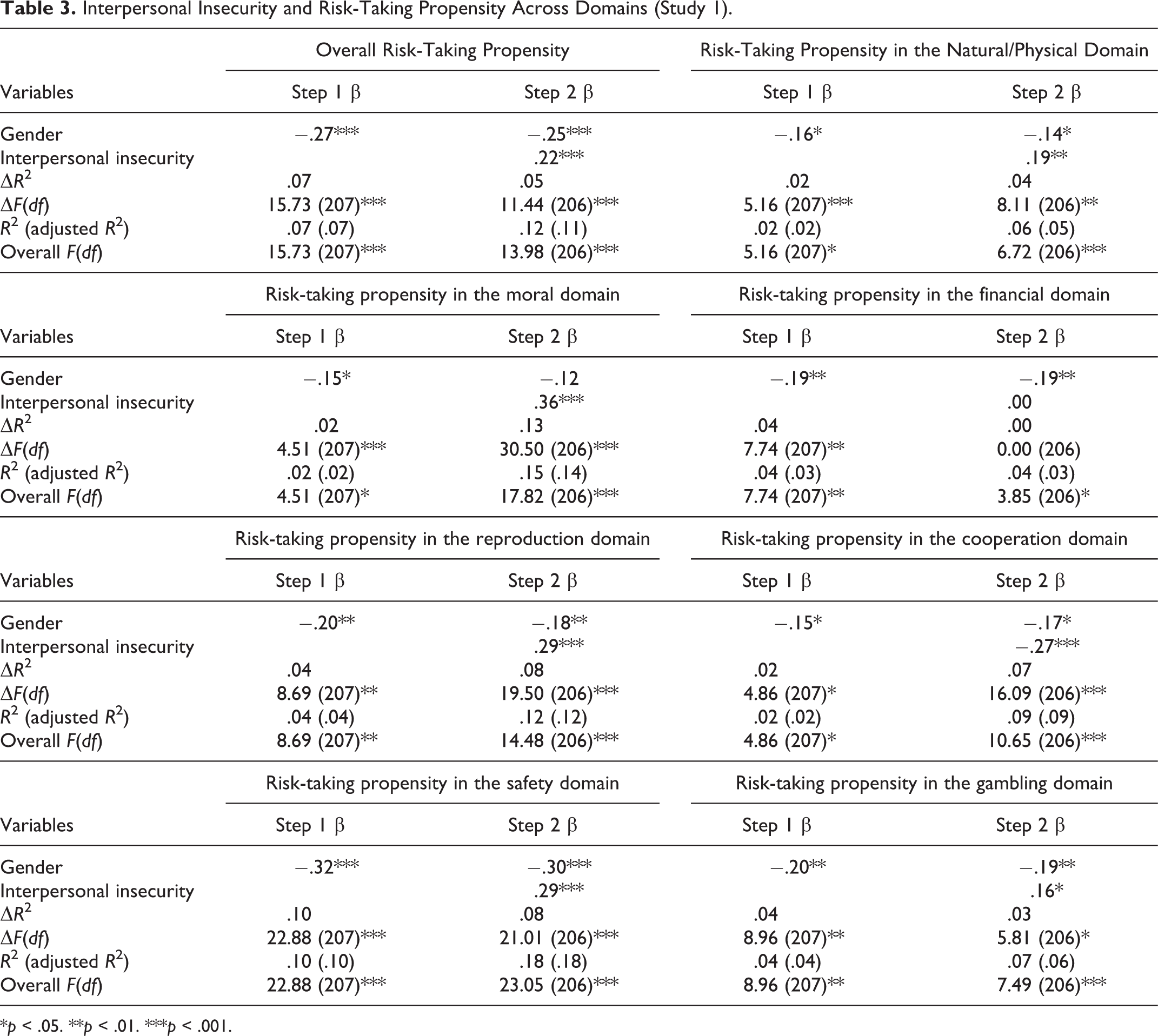
*p < .05. **p < .01. ***p < .001.
In sum, Study 1 showed a generally positive association between interpersonal insecurity and risk-taking propensity. However, this association had two exceptions. We found a negative relationship between interpersonal insecurity and risk-taking propensity in the cooperation domain and a nonsignificant relationship between interpersonal insecurity and risk-taking propensity in the financial domain.
Study 2: Risk-Taking Propensity Around the Globe
In this study, we relied on archival data to test the relationship between interpersonal insecurity and risk-taking propensity based on a larger sample size. We analyzed data from the World Values Survey from 77 countries around the world (http://www.worldvaluessurvey.org). The data set includes six waves of survey data collected in different years to investigate people’s values and beliefs (Wave 1, 1981−1984; Wave 2, 1990−1994; Wave 3, 1995−1998; Wave 4, 1999−2004; Wave 5, 2005−2009; Wave 6, 2010−2014). The last two waves of the survey include 1 item measuring propensity for risk-taking. We used this item to capture risk-taking propensity as Mata, Josef, and Hertwig (2016) did.
In addition, these two waves of the survey include 6 items measuring how much participants distrust their family, people they know personally, their neighbors, people of other religions, people of other nationalities, and people they meet for the first time. These items were used to reflect interpersonal insecurity because research has revealed that distrusting others is partially a result of interpersonal insecurity (Larzelere & Huston, 1980). For example, Lemay and Dudley (2009) showed that interpersonal insecurity reduced trust in others and increased suspicions of others’ authenticity. Bartz et al. (2011) found that insecure attachment was positively related to distrust in others.
Method
Participants
For Wave 5, our final sample comprised 54,515 individuals (27,172 men, 27,343 women; M age = 41.53 years, SD = 16.37; age range = 15−98 years) with valid answers on all analyzed variables. For Wave 6, our final sample comprised 73,647 individuals (35,707 men, 37,940 women; M age = 41.23 years, SD = 16.13; age range = 16−99 years) with valid answers on all analyzed variables.
Materials
Participants rated their similarity to a hypothetical person with the statement “adventure and taking risks are important to this person; to have an exciting life” on a 6-point scale (1 = very much like me, 6 = not at all like me). This item was reverse-scored, with a higher value indicating more risk-taking.
Participants also responded to 6 items assessing distrust (1 = trust completely, 4 = not trust at all; “how much do you trust your family,” “how much do you trust people you know personally,” “how much do you trust your neighborhood,” “how much do you trust people of another religion,” “how much do you trust people of another nationality,” and “how much do you trust people you meet for the first time”). A higher value indicates a higher level of interpersonal insecurity. On the basis of a pilot study, family, people known personally, and neighbors were considered in-group members, whereas people of other religions, people of other nationalities, and people met for the first time were considered out-group members. 2
We also considered a number of demographic variables that may influence risk-taking propensity, including gender (0 = male, 1 = female), age, marital status (0 = unmarried, 1 = married), education (0 = no or incomplete primary education, 1 = primary education or higher), employment (0 = unemployed, 1 = employed), and household income (1 = lowest group in their country, 10 = highest group in their country). Age and income were continuous variables, whereas others were dichotomized variables.
Results and Discussion
Table 4 shows the descriptive statistics and the correlational matrix among variables. Consistent with Hypothesis 3, interpersonal insecurity with in-group members was positively correlated with risk-taking propensity (r = .02, p < .001 for Wave 5; r = .01, p < .001 for Wave 6). Unexpectedly, interpersonal insecurity with out-group members was negatively correlated with risk-taking propensity (r = −.06, p < .001 for Wave 5; r = −.05, p < .001 for Wave 6).
Descriptive Statistics and Correlational Matrix Among Variables (Study 2).

***p < .001.
In addition, risk-taking propensity was negatively associated with age (r = −.23, p < .001 for Wave 5; r = −.23, p < .001 for Wave 6; Table 4) but positively associated with household income (r = .09, p < .001 for Wave 5; r = .11, p < .001 for Wave 6; Table 4). We also found significant effects of gender, marital status, education, and employment on risk-taking propensity, ps < .001 (Table 5).
Demographic Variables and Risk-Taking Propensity Around the Globe (Study 2).
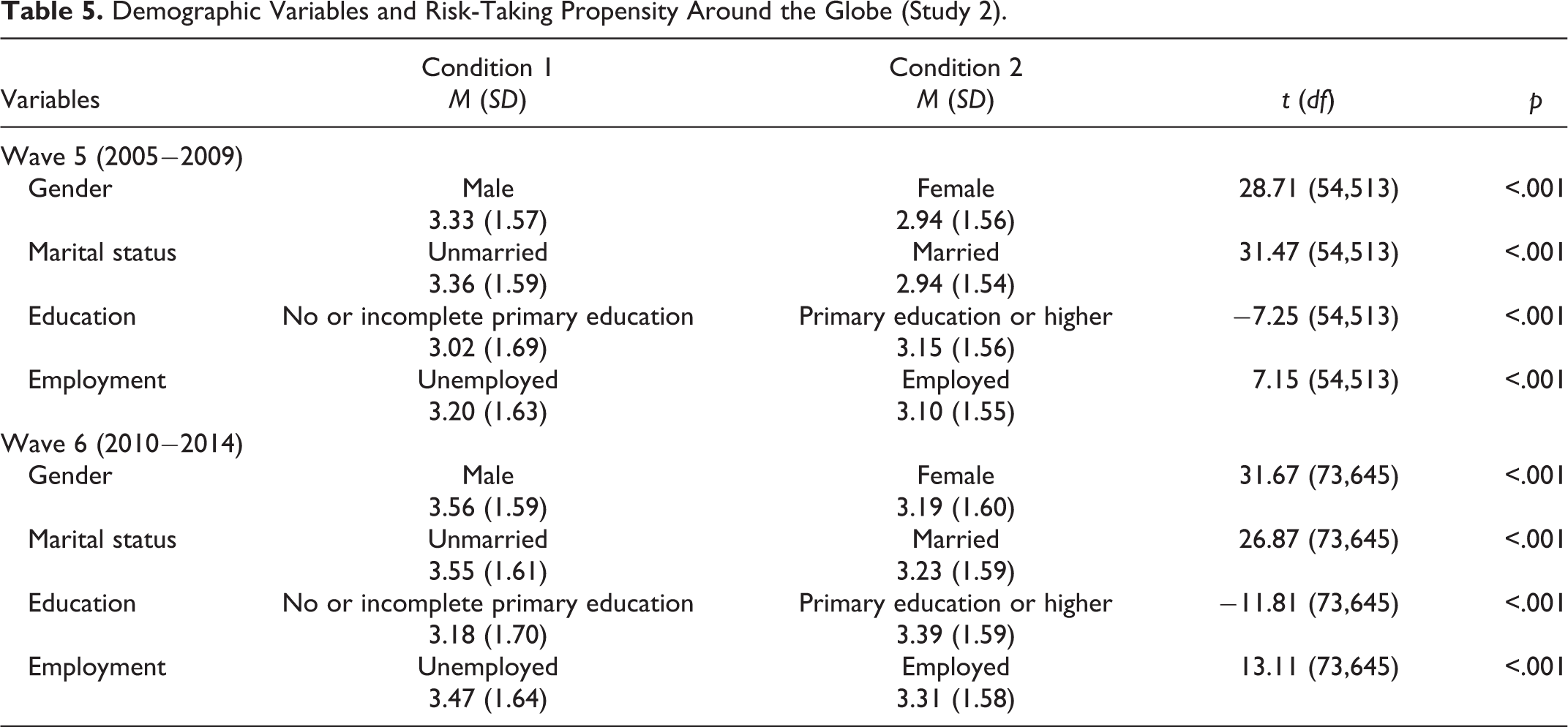
A hierarchical linear regression on risk-taking was run for the data from Waves 5 and 6 to control for the effects of gender, age, marital status, education, employment, and income. As Table 6 displays, the results remained unchanged such that risk-taking propensity was positively correlated with interpersonal insecurity with in-group members (β = .03, p < .001 for Wave 5; β = .02, p < .001 for Wave 6) but negatively correlated with interpersonal insecurity with out-group members (β = −.09, p < .001 for Wave 5; β = −.07, p < .001 for Wave 6).
Interpersonal Insecurity With In- and Out-Group Members and Risk-Taking Propensity Around the Globe (Study 2).

*p < .05. ***p < .001.
The negative relationship between interpersonal insecurity with out-group members and risk-taking propensity may be caused by negative emotions induced by interpersonal insecurity. In light of the affect infusion model, negative emotions tend to reduce risk-taking propensity (Forgas, 1995). Although interpersonal insecurity with in-group members causes negative emotions, the substantial threat to survival and reproduction brought by interpersonal insecurity with in-group members outperforms negative emotions and motivates individuals to seek risks to obtain essential resources. In addition, the effect of interpersonal insecurity on risk-taking propensity was relatively small. On the one hand, the small effect may be caused by a single item in assessing risk-taking propensity. On the other hand, the small effect suggests that risk-taking propensity is driven by various factors other than interpersonal insecurity.
To summarize, this study showed that risk-taking propensity increases with interpersonal insecurity with in-group members but decreases with interpersonal insecurity with out-group members.
General Discussion
The current research answers the question regarding whether people have a propensity to take risks when they are in an unfavorable social relationship. The results reveal a general tendency in which risk-taking propensity increases with interpersonal insecurity, based on both small- and large-sample surveys. However, this association has two boundary conditions: risk domain and group identity. Interpersonal insecurity is not associated with risk-taking propensity in the financial domain and is negatively associated with risk-taking propensity in the cooperation domain. Furthermore, risk-taking propensity increases with interpersonal insecurity with in-group members but decreases with interpersonal insecurity with out-group members.
We interpret our findings from an evolutionary perspective. Interpersonal security (especially with in-group members) is fundamental for survival and reproduction because collaboration with others is essential for obtaining resources. Experiencing interpersonal insecurity (especially with in-group members) evokes a high need to obtain more resources to ensure success in survival and reproductive tasks, hence causing a stronger propensity for risk-taking. This resource-acquiring notion is consistent with the idea of need-based risk-taking (Mishra, Barclay, & Sparks, 2017). However, we did not assess resource-acquiring needs in our research. Future studies should test this assumption directly.
Risk-taking can also be ability-based, whereby people take risks to demonstrate their ability because risk-takers have important qualities (e.g., strength, intellect, and social capital) to undertake the costs of risk-taking (Mishra et al., 2017). Nevertheless, this notion cannot explain the effect observed in our study. If people feeling interpersonally insecure are motivated to demonstrate their ability to bear the costs of risk-taking, they should then take risks in all domains, including in the cooperation domain in Study 1.
Furthermore, our research shows the necessity to tease apart different risk domains in investigating interpersonal insecurity and risk-taking propensity. People who feel interpersonally insecure tend to take risks only in domains that are unrelated to social relationships because risk-taking in these domains provides an opportunity to acquire resources. However, in social domains such as cooperation, people are aware of the low chance of acquiring resources by taking risks. Therefore, risk-taking propensity does not increase with interpersonal insecurity in these domains.
Our results also contribute to the work on affiliation motives. Love and belonging, which are fundamental needs for human beings (Maslow, 1943), are reflected not only in secure attachment with inmate others but also in a warm and safe bond with general others. However, not all types of social relationships are treated equally, according to our results. People weigh social relationships with in-group members more heavily than they weigh those with out-group members.
There are several limitations in the current research. Our research is cross-sectional and correlational in nature, making it difficult to infer a causal relationship between interpersonal insecurity and risk-taking propensity. Therefore, laboratory experiments that manipulate interpersonal insecurity and then measure risk-taking propensity are suggested for the future. Furthermore, distrust in others was used as a proxy for interpersonal insecurity in Study 2. Although interpersonal insecurity can be reflected by distrust in others, interpersonal insecurity is not the same as distrust. Third, we only measured risk-taking propensity. Given differences between propensity and actual behavior (Pedroni et al., 2017), further research would do well to focus on risk-taking behaviors.
Footnotes
Declaration of Conflicting Interests
The author(s) declared no potential conflicts of interest with respect to the research, authorship, and /or publication of this article
Funding
The author(s) disclosed receipt of the following financial support for the research, authorship, and/or publication of this article: This research was financially funded by Peak Discipline Construction Project of Education at East China Normal University and the programs of National Natural Science Foundation of China (71501073 and 71771088).
