




Abstract
Previous research with hunter-gatherers has found that women perceive men with voices manipulated to be lower in pitch to be better hunters, and men perceive women with lower pitch to be better gatherers. Here, we test if actual voice pitch is associated with hunting and gathering reputations in men and women, respectively. We find that voice pitch does relate to foraging reputation in men, but not in women, with better hunters having a lower voice pitch. In addition, we find that the previously documented relationship between voice pitch and reproductive success no longer holds when controlling for hunting reputation, but hunting reputation remains a significant predictor of reproductive success when controlling for voice pitch. This raises the possibility that voice pitch is being selected for in hunter-gatherers because of the relationship between voice pitch and hunting reputation.
Human voice pitch is sexually dimorphic, with males producing a voice pitch approximately 6 standard deviations below females (Puts, Doll, & Hill, 2014). This sex difference is due to males having larger vocal folds (Titze, 1994). Vocal folds begin to sexually differentiate during puberty, when increased testosterone levels in males (Tossi, Postan, & Bianculli, 1976) act upon androgen receptors in vocal folds (Newman, Butler, Hammond, & Gray, 2000; Saez & Sakai, 1976), resulting in larger folds and lower voice pitch. The sex difference in vocal folds is one of the largest anatomical sex differences observed in humans (Rendall, Kollias, Ney, & Lloyd, 2005), yet differences in voice pitch within sex are only weakly related to stature (Collins, 2000; Pisanski et al., 2014; Puts, Apicella, & Cárdenas, 2012). This suggests that sexual dimorphism in voice pitch is not simply the by-product of increased size in males, but rather that lower voice pitch in males was independently selected for, possibly because of its role in mating competition (Puts et al., 2014). Indeed, across a sample of anthropoid primates, increasing mating competition among males is associated with the evolution of greater sexual dimorphism in vocalization pitch (Puts et al., 2016). Also, in an extant population of hunter-gatherers, the Hadza, lower voice pitch is associated with greater reproductive success in men, but no association between voice pitch and fertility outcomes has been found for women (Apicella, Feinberg, & Marlowe, 2007). Together, these findings suggest that dimorphism in voice pitch is the result of selection for lower pitched vocalizations in males.
Sexual Selection and Voice Pitch
One hypothesis is that female mate choice, or intersexual selection, which favors ornaments and showy displays, may have led to sexual dimorphism in voice pitch. Indeed, several lines of research suggest that women are more attracted to men with lower voice pitch (e.g., Collins, 2000; Feinberg, Jones, Little, Burt, & Perrett, 2005; Saxton, Caryl, & Roberts, 2006) and that this preference is more pronounced when women are close to ovulation (Feinberg et al., 2006; Puts, 2005). These results are consistent with the hypothesis that women have evolved conditional strategies for short- and long-term mating, such that during periods of high fecundity women should be more motivated to find partners of high genetic quality because finding a mate who can provide indirect benefits (e.g., good genes) becomes relatively more important than finding a mate who can provide direct benefits (e.g., resources and physical protection). Direct benefits are thought to be important when evaluating prospective mates for long-term partnerships (Buss & Schmitt, 1993). Interestingly, prior work with the Hadza suggests that women do not prefer high or low pitch in men’s voices when selecting for marriage partners; however, this may be due to the high percentage of the sample that was pregnant or lactating (Apicella & Feinberg, 2009). Indeed, Hadza women who were breast-feeding preferred men with voices raised in pitch, though this was an exploratory analysis based on a small sample. Although women were found to prefer lower male voice pitch in the context of short-term versus long-term mating in a Western sample (Puts, 2005), no studies have examined women’s preferences for short-term mates in the Hadza.
One debated explanation for why women prefer men with lower voice pitch is that lower pitch signals heritable immune system efficiency (Feinberg et al., 2006; Puts, 2005, 2006). Androgens, including testosterone, are thought to be immunosuppressant (Bouman, Heineman, & Faas, 2005, but see Roberts, Buchanan, & Evans, 2004, for a critical review), and compromising immune functioning via greater androgen production may be possible only for healthy individuals. Conversely, immune system activation may depress testosterone production (Boonekamp, Ros, & Verhulst, 2008), so that healthy individuals tend to more consistently produce higher testosterone and hence more masculinized traits. The relationship between testosterone and immune function is not entirely clear, as many of the studies conducted are observational (Roberts et al., 2004), and so it is possible that other omitted variables, such as energetic shortages could contribute to a decreased immune system and lower testosterone levels via independent pathways (Ellison, 2011; see also Prall & Muehlenblein, 2014, for review). Nevertheless, it is commonly held that traits associated with greater androgen exposure should influence attractiveness to females because these traits signal genes that confer disease resistance to offspring (Folstad & Karter, 1992).
Cortisol, a glucocorticoid known for its role in metabolic and energy mobilization processes needed during fight and flight responses, also has adverse effects on metabolic and immune processes (Coutinho & Chapman, 2011). Recent evidence indicates that the relationship between the expression of male traits and immune function may be mediated by both testosterone and cortisol, such that men with both high testosterone and low cortisol tend to possess better functioning immune systems (Rantala et al., 2012). Consistent with this, men with lower voice pitch tend to have higher testosterone levels (Dabbs & Mallinger, 1999; Evans, Neave, & Wakelin, 2006; Puts et al., 2012), and this relationship is stronger in men with lower cortisol (Puts et al., 2016). Finally, women with low self-rated health were found to prefer men with lower voice pitch as short-term mates, when the genetic benefit of disease resistance in offspring is higher relative to other components of mate quality, such as investment (Feinberg et al., 2012).
Another hypothesis is that intrasexual selection may have led to increased dimorphism in voice pitch. In many nonhuman animal species, male vocalizations may be used as honest advertisements of competitive ability, particularly in intrasexual aggression (e.g., Clutton-Brock & Albon, 1979; Hauser, 1993). Human males too may have evolved lower voice pitch to advertise competitive ability (Puts et al., 2012). Several studies have found that experimentally lowering voice pitch increases perceived dominance in men (Feinberg et al., 2005; Puts, Gaulin, & Verdolini, 2006; Puts, Hodges, Cárdenas, & Gaulin, 2007; Saxton, Mackey, McCarty, & Neave, 2016; Wolff & Puts, 2010), which is consistent with data suggesting that men with lower voice pitch have more upper body strength and thus, may be more formidable (Puts et al., 2012). Indeed, a cross-cultural study found that individuals could accurately assess upper body strength from men’s voices, even when the voices spoken were from an unfamiliar language (Sell et al., 2009).
Of course, intersexual and intrasexual selection are not mutually exclusive possibilities. Whatever the evolutionary cause of sexual dimorphism in voice pitch, data on Hadza hunter-gatherers suggest that voice pitch is under directional selection in men, but not in women (Apicella et al., 2007). Hadza men with lower voice pitch have greater reproductive success, due largely to having more children born to them rather than their children experiencing less mortality. It is possible that a low pitch elevates Hadza men’s status among men and/or attractiveness to women and thus increases their access to more or higher quality mates. If so, then these findings are consistent with sexual selection accounts for why men have, on average, lower voice pitch.
Hunting reputation in men is another trait that is associated with reproductive success in the Hadza (Apicella, 2014; Marlowe, 2001), and previous research has examined perceptions of foraging reputation in Hadza males and females with manipulated voices (Apicella & Feinberg, 2009). Hadza females perceive males with experimentally manipulated lower voice pitch as better hunters, even when judging the voices of non-Hadza speaking an unfamiliar language. Similarly, Hadza males perceive females with experimentally manipulated lower voice pitch as better gatherers. It is currently unknown to what extent natural variation in voice pitch is correlated with actual hunting and gathering reputations in men and women.
Sexual Selection, Hunting, and Voice Pitch
Hunting has featured heavily in evolutionary accounts of human origins. For example, human’s increased encephalization, lengthened juvenile period, and long life span have all been attributed to the act of hunting (Gurven, Kaplan, & Gutierrez, 2006; Kaplan, Hill, Lancaster, & Hurtado, 2000; Washburn & Lancaster, 1968). Hunting continues to be under selection in extant hunter-gatherers. Hunting success in men is associated with increased reproductive success in several forager populations including the Aché (Hill & Hurtado, 1996), !Kung (Wiessner, 2002), Lamalera (Alvard & Gillespie, 2004), Meriam (Bliege Bird, Smith, & Bird, 2001), and the Hadza (Apicella, 2014; Marlowe, 2001). Successful hunters obtain many reproductive benefits including younger wives and more children (for review, Gurven & von Rueden, 2006). Perhaps unsurprisingly, hunting ability is an important criterion for choosing husbands in the Hadza (Apicella & Crittenden, 2016; Marlowe, 2004). While the reproductive advantages for being a good hunter are clear, the question of what motivates men to hunt is debated. Gathering, on average, brings in more calories than hunting in the Hadza and in warm-climate foragers more generally—calories that can be directed exclusively toward kin (Marlowe, 2010). In contrast, hunted foods tend to be shared widely outside the nuclear family (Hawkes, O’Connell, & Blurton Jones, 2001) possibly because they are more difficult to procure and the packages tend to be larger (for review, see Kaplan, Gurven, Hill, & Hurtado, 2005). For these reasons, traditional explanations suggesting that men hunt to provision their families have been questioned.
Some anthropologists maintain that men are motivated to hunt primarily to advertise their quality to potential mates and allies (Hawkes, 1991; Hawkes & Bliege Bird, 2002). On the one hand, because hunting requires knowledge, strength, and stamina, being a successful hunter may be a reliable indicator of condition (Smith, Bliege Bird, & Bird, 2003). Thus, women may choose successful hunters as mates because hunting success signals underlying male condition including genetic quality. On the other hand, hunted foods may be attractive to women because of the benefits they provide to themselves and their children. Meat is rich in fat, digestible proteins, and essential amino acids, and consequently no plant source in the African Savannah rivals it (Dominguez-Rodrigo et al., 2014). Under this view, hunting may be considered a form of intrasexual competition by which men procure foods that are attractive to women (for overview of the debate, Gurven & von Rueden, 2006).
Interestingly, the best physical predictor of hunting reputation in Hadza men is upper body strength—a physical trait that the Hadza also recognize as important for hunting success (Apicella, 2014). Upper body strength, and in particular strength in the forearm and muscles surrounding the shoulder girdle, is necessary for pulling back on bows (Ertran, Kentel, Tümer, & Korkusuz, 2003; Mann & Littke, 1989) and may increase the distance at which men can successfully strike a target. Since hunting ability is under selection in current hunter-gatherers, sex differences in upper body strength in humans may be due to selection acting on hunting ability and not just fighting ability (Apicella, 2014).
Here we explore the relationships between hunting and gathering reputations, natural voice pitch, and reproductive success in Hadza hunter-gatherers using a data set previously reported in other papers (Apicella, 2014; Apicella et al., 2007; Puts et al., 2012). It is important to examine voice pitch and hunting ability together since lowered voice pitch may have been selected independently or jointly with hunting ability in men. For instance, voice pitch may signal good genes independently of hunting ability and/or through its association with hunting ability. That is, both hunting ability and voice pitch may serve as signals to male quality, and these signals may reflect similar or different aspects of quality. As an example, voice pitch may provide women a means to assess immunocompetence and/or other androgen-related qualities while hunting ability, may, in addition, signal other qualities, such as intelligence. Alternatively, voice pitch dimorphism in humans may have resulted from intrasexual competition—due to its association with men’s ability to acquire resources (i.e., hunt), fight, or both. Here we ask to what extent voice pitch is associated with hunting/foraging reputations in men and women, respectively, and whether the relationship between voice pitch and reproductive success in men persists after controlling for hunting reputation.
Method
Study Population
The Hadza are a traditional population of about 1,000 who subsist on hunted and gathered foods. They occupy a savannah-woodland habitat in Northern Tanzania and live in mobile camps that number approximately 25–30 people. Camps shift location every 6–8 weeks as resources in an area become depleted. Membership in camps is flexible as individuals come and go freely and are welcome in any Hadza camp they choose to live.
The Hadza practice central place foraging where acquired foods are brought back to camp and shared with family and other campmates. They use traditional tools to acquire resources. Men hunt birds and mammals using bow and arrow technology. While bows and arrows are constructed from wood, arrowheads are made with either wooden or metal tips. Metal tips are typically used for larger animals and are often dipped in poison from the panjube plant that acts to hasten the death of the animal (Bartram, 1997).
Women collect water, firewood, fruit, and dig for tubers using sharpened wooden sticks. Women forage for an average of 4.2 hr a day. It too is strenuous and demanding, and women’s ability to acquire resources is also an important factor in mate choice for men (Marlowe, 2005). Compared to men, Hadza women tend to contribute more food to their households, unless they currently have a nursing infant. During this “critical period of nursing,” women’s productivity decreases and their husband’s increases (Marlowe, 2003).
While Hadza men are dominant to women, women have a large degree of autonomy, are free to select their marriage partners, and participate in camp-level decision-making (Marlowe, 2010). Still, Hadza men are, on average, more competitive and more risk-taking than women, as evinced from performance in incentivized economic games (Apicella & Dreber, 2015; Apicella, Crittenden, & Tobolsky, 2017). Other sex differences in economic (e.g., preference for owned items) and social preferences (e.g., cooperation) have not been found (Apicella, 2017; Apicella, Azevedo, Christakis, & Fowler, 2014; Apicella, Marlowe, Fowler, & Christakis, 2012).
Finally, because the Hadza remain relatively isolated from Western culture, do not use birth control, and practice a way of life that more closely approximates the lives of our ancestors compared to agriculturalists, pastoralists, and farmers, they provide a valuable resource for testing evolutionary hypotheses (Apicella & Barrett, 2016). Some have questioned whether the Hadza are atypical because they still practice hunting and gathering when all other surrounding groups have adopted newer modes of subsistence. However, the Hadza are not unusual relative to the full spectrum of contemporary foragers for whom data exist. 1 Nevertheless, evolutionary arguments for evolved traits necessitate some consideration of the challenges faced by our ancestors, and it is difficult to know with certainty the ways in which modern foragers depart from ancestral foragers. To the extent that the problems faced by the Hadza differ from the problems faced by our ancestors, using the Hadza as a model for understanding human evolution may be limited (for a full discussion of this issue, see Apicella & Crittenden, 2016). However, we believe that the traits considered here (e.g., hunting and gathering, mate choice, and reproduction) to still be useful referents for the past. Nevertheless, we urge that prudence be exercised when using single populations to make claims about the past and that each trait’s relevance be considered on a case by case basis.
Procedure
Data were collected over a period of approximately 6 months in 2006 from a sample of Hadza Bushmen in Tanzania. Nine camps were visited for data collection by one of the researchers, and all adults in each camp were invited to participate. The sample included 53 men between the ages of 19 and 59 (M = 37.4, SD = 11.3) and 49 women between the ages of 18 and 53 (M = 31.0, SD = 7.7).
Measures
Voice pitch
To collect voice pitch data, participants were instructed to speak into a microphone the word “hujambo,” which loosely translates from Swahili to “how are you?” in English. Recordings were made in private with only a female experimenter present. The voices were directly encoded in mono onto a computer hard drive using Sonic Foundry’s Sound Forge at 44.1 kHz sampling rate and 16-bit quantization and saved as uncompressed “wav” files. F 0, the acoustic correlate of voice pitch, was analyzed using Praat software (Version 4.5) and measured using Pratt’s (Boersma & Weenink, 2007) autocorrelation algorithm using techniques described elsewhere (Feinberg et al., 2005). Voice pitch ranged from 83.64 Hz to 174.28 Hz in men, and from 135.80 Hz to 272.46 Hz in women. Table 1 presents the mean values for voice pitch and other variables for each sex.
Descriptive Statistics by Sex.

Note. Values are mean statistics with standard deviations are in parentheses.
Upper body strength
Upper body strength was calculated from upper arm muscle mass and grip strength. Upper arm muscle mass was calculated from a standard formula that estimates the area of the muscle of the upper arm minus the bone from measurements of midupper arm circumference and triceps skinfold measurements (Heymsfield, McManus, Smith, Stevens, & Nixon, 1982). Arm circumference of the left arm was measured using a flexible tape measure. Triceps skinfold measurements were measured in triplicate (Cronbach’s α = .88) using skinfold calipers. Handgrip strength for each hand was measured using a dynamometer. Each measurement was standardized within sex then averaged together. A higher score indicates greater upper body strength.
Foraging reputation
To collect data on hunting and gathering reputation, women were asked to evaluate the hunting ability of men, and men were asked to evaluate the gathering ability of women. To do this, facial photographs were taken of each of the adult men and women in each camp and were displayed simultaneously in a random order to each participant on a computer screen. Men and women were interviewed privately, questioned in their nonnative language, Swahili, and asked: “Which of these men is the best hunter?” or “which of these women is the best gatherer?” After an individual was chosen, his or her picture was removed from the screen. This process was repeated until all men and women were assigned a ranking. Confidentiality was assured during all interviews. This ordinal ranking was used to facilitate data collection because the Hadza lack experience in assigning numerical values. For each individual, the mean rank was calculated from each rater’s ranking and then standardized within camps. A lower value indicates a better reputation.
For each of the nine camps, a different number of men and women participated in ranking hunting and gathering reputation. The number of male participants in each camp ranged from 3 to 7 (M = 5.9, SD = 1.3), and the number of female participants in each camp ranged from 3 to 12 (M = 5.9, SD = 2.9). For women rating men’s hunting ability, Cronbach’s α ranged from .5 to .98 (M = .82, SE = .15). For men rating women’s gathering ability, raters were in less agreement. In two camps—both with three women each—there was a negative correlation between raters. Excluding these camps from the analyses does not change the results. The Cronbach’s α for the other seven camps ranged from .23 to .92 (M = .70, SD = .24). The lower interrater reliability may be due to lower variability between women in gathering returns (Berbesque, Wood, Crittenden, Mabulla, & Marlowe, 2016), making meaningful assessment of ability more difficult, or perhaps men are less motivated to attend to women’s ability to gather resources.
Reproductive success, fertility, and offspring mortality
To collect data on reproductive success, participants were interviewed about the number of children born to them, the number of those children that have died, and the number of children still living. Because Hadza have difficulty counting to large numbers, participants were asked to provide the names of each child born to them sequentially. After the child was named, the participant was then asked if the child was still living. Reproductive success was defined as the number of living children, fertility was defined as the number of children born to the participant, and offspring mortality was defined as the proportion of children born to the participant that died (participants with no children born to them were coded as n/a). Obviously, men do not have the same level of accuracy in assessing their parental status as women. While there are no data available on the rate of misattributed paternity in the Hadza, we have no reason to suspect that it is unusually high compared to other monogamous populations where rates generally hover around 1%. 2
Results
Camp Effects
We tested for differences between camps in voice pitch, upper body strength, age, reproductive success, fertility, and mortality rate using one factor analysis of variances (ANOVAs) for each sex separately. Table 2 presents the output of those analyses. For males, there were significant differences between camps for age, reproductive success, and fertility. For females, there were no significant differences between camps. Because of the significant effects, we control for camps effects in analyses involving age, reproductive success, and fertility.
Camp Effects on Variables by Sex.

Note. Output for analysis of variance models testing for camp differences for each variable by sex.
*p < .05. **p < .01.
Voice Pitch and Foraging Reputation
Table 3 presents zero-order correlations between each variable for males. Voice pitch significantly correlated with foraging reputation; males with lower voices were ranked as better hunters (see Figure 1). 3 Voice pitch also correlated with reproductive success; males with lower voices had more living children. Similarly, foraging reputation also correlated with reproductive success; males who were ranked as better hunters had more living children. Table 4 presents zero-order correlations between each variable for females. Voice pitch did not significantly correlate with any other variables including foraging reputation (see Figure 1). Foraging reputation significantly correlated with age; older females were ranked as better gatherers.
Zero-Order Correlations for Males.
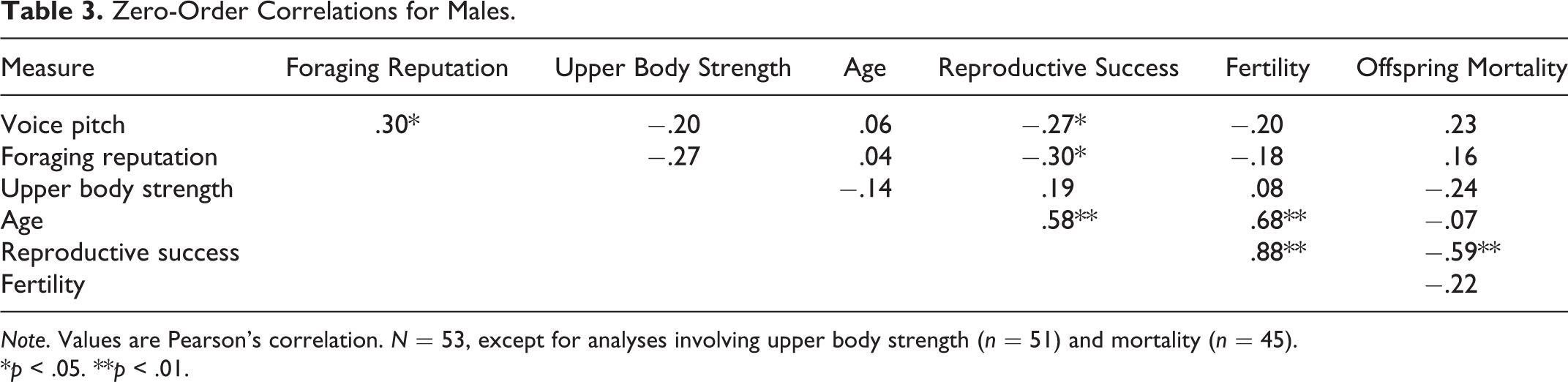
Note. Values are Pearson’s correlation. N = 53, except for analyses involving upper body strength (n = 51) and mortality (n = 45).
*p < .05. **p < .01.
Zero-Order Correlations for Females.

Note. Values are Pearson’s correlations. N = 49, except for analyses involving reproductive success, fertility (both n = 48), and mortality (n = 45).
*p < .05. **p < .01.

Scatterplot with ordinary least squares regression line of voice pitch and foraging reputation in males and females. Lower reputation scores mean that individuals were ranked as a better hunter/gatherer. Shaded region is 95% confidence interval.
Table 5 presents a series of regression models predicting foraging reputation from voice pitch controlling for camp-fixed effects, separated by sex. For males, voice pitch remained a significant predictor after controlling for camp membership (Model 1) and age (Model 2). For females, voice pitch was still nonsignificant after controlling for camp membership and age. Models 3 and 4 test the hypothesis that voice pitch predicts foraging reputation in males because upper body strength predicts voice pitch (Puts et al., 2012) and hunting reputation (Apicella, 2014). If true, then after controlling for upper body strength, voice pitch should no longer be a significant predictor of hunting reputation. However, contrary to our prediction, for males, voice pitch remained significant when controlling for upper body strength. For females, though upper body strength is a significant predictor of foraging reputation, voice pitch was still a nonsignificant predictor of foraging reputation.
OLS Regression Models Predicting Foraging Reputation.
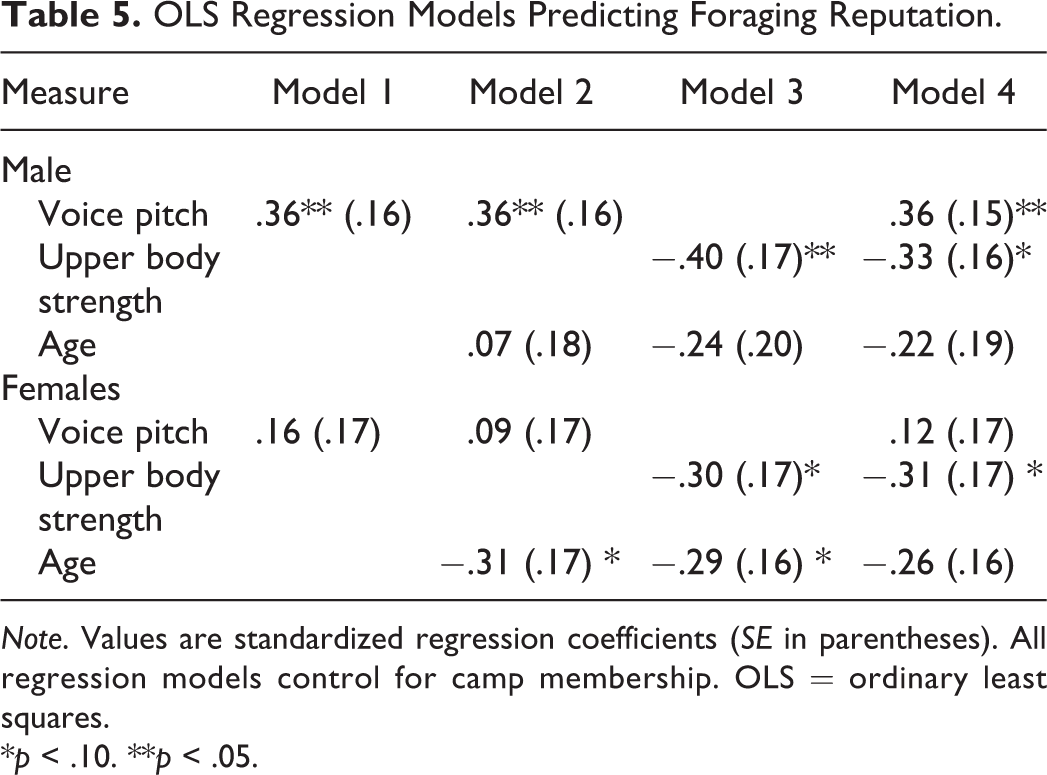
Note. Values are standardized regression coefficients (SE in parentheses). All regression models control for camp membership. OLS = ordinary least squares.
*p < .10. **p < .05.
Voice Pitch, Foraging Reputation, and Reproductive Success
Both voice pitch and hunting reputation predict reproductive success in males (Apicella, 2014; Apicella et al., 2007; see Table 6), but not in females (see Table 4). We tested if the relationship in males between voice pitch and reproductive success is due, in part, to the relationship between voice pitch and hunting reputation in series of ordinary least squares regression models presented in Table 6. When voice pitch and hunting reputation are entered simultaneously in the model predicting reproductive success, voice pitch is no longer significant, whereas hunting reputation remains significant. Moreover, an ANOVA reveals that adding hunting reputation to the model with just voice pitch significantly improves the variance explained, F(1, 41) = 6.58, p = .014, ΔR 2 = .02, whereas adding voice pitch to the model with just hunting reputation does not significantly improve the model, F(1, 41) = 2.48, p = .123, ΔR 2 = .01. This suggests that the relationship between voice pitch and reproductive success is indirect and mediated by hunting reputation. To better understand how these variables contribute to reproductive success, we analyzed fertility and offspring mortality separately. We obtain similar results with fertility, with voice pitch and hunting reputation independently predicting fertility, and evidence that the voice pitch’s effect on fertility is mediated by hunting reputation. However, we find that voice pitch and hunting reputation do not predict offspring mortality. Thus, Hadza males with lower voices have better hunting reputations, which lead to having more offspring, but these offspring are no more likely to survive than offspring of fathers with worse hunting reputations. This is consistent with other findings in the literature that status markers increase reproductive success through their effects on fertility rather than offspring mortality (von Rueden & Jaeggi, 2016).
OLS Regression Models Predicting Reproductive Outcomes for Males.

Note. Values are standardized regression coefficients (SE in parentheses) predicting reproductive success, fertility, and offspring mortality for males. All regression models control for camp membership and age. OLS = ordinary least squares.
*p < .10. **p < .05.
Discussion
Hadza men with lower voice pitch have better hunting reputations. This accords with previous research reporting that Hadza women perceived samples of male voices manipulated to be lower in pitch as better hunters (Apicella & Feinberg, 2009). In contrast, we did not find that Hadza women with lower voice pitch have better gathering reputations. This finding conflicts with prior results showing that men rate women’s voices manipulated to be lower in pitch as better gatherers. In addition, though men’s reproductive success is predicted by voice pitch (Apicella et al., 2007) and hunting reputation (Apicella, 2014) separately, when entered in the same regression model only hunting reputation remains a significant predictor of reproductive success, suggesting that voice pitch is related to reproductive success because of its relationship with hunting reputation or another correlate of hunting reputation.
Why do Hadza men with lower voice pitch have better hunting reputations? One possibility is that such men are not in fact better hunters but are merely perceived as such. Studies across several cultures find that people can infer physical formidability from the voice (Puts et al., 2012; Sell et al., 2009). Voice pitch reliably predicts physical size and upper body strength (Bruckert, Liénard, Lacroix, Kreutzer, & Leboucher, 2006; Evans et al., 2006; Hodges-Simeon, Gurven, Puts, & Gaulin, 2014; Puts et al., 2012), current testosterone levels (Bruckert et al., 2006; Dabbs & Mallinger, 1999; Evans et al., 2006; Puts et al., 2012), and pubertal androgen exposure (Harries, Hawkins, Hacking, & Hughes, 1997). Because of its associations with physical formidability, low voice pitch may erroneously suggest hunting ability to perceivers.
Alternatively, men with lower voice pitch may in fact be better hunters. Pubertal testosterone influences both muscle mass (Griggs et al., 1989) and voice pitch (Pedersen, Møller, Krabbe, & Bennett, 1986). Archery involves the use of several major arm muscles including muscles in the forearm and around the shoulder girdle (Ertran et al., 2003; Mann & Littke, 1989); in fact, the best physical predictor of hunting reputation is upper body strength in men (Apicella, 2014). To the extent that voice pitch predicts strength, voice pitch could serve as a cue to at least this component of hunting ability. Though this explanation is plausible, our data do not support it. We find that voice pitch and upper body strength independently predict hunting reputation. However, given our small sample size, it is important that this is tested in other, larger samples before ruling this explanation out.
Finally, it could be that hunting success affects men’s voice pitch through its role in affecting their status and confidence. While there are no clear dominance hierarchies in the Hadza (Marlowe, 2010), men may demonstrate their threat potential (Bliege Bird et al., 2001), as well as gain prestige through nonagonistic sources such as possessing superior aptitude and competency in a valued activity (Henrich & Gil-White, 2001). Certainly, hunting ability is one route by which men in hunter-gatherer societies may gain status (Gurven & von Rueden, 2006) and specifically respect, though other routes exist (von Rueden, Gurven, & Kaplan, 2008). Given the role of voice pitch in status signaling, it would not be surprising if better hunters adopt lower pitch voices and/or worse hunters adopt higher pitch voices. Indeed, much work has suggested that individuals will modulate their voice pitch depending on social context as well as their intentions to signal rank (Cheng, Tracy, Ho, & Henrich, 2016). For instance, individuals have been found to accommodate their voice pitch more if their conversation partner was of higher status (Gregory & Webster, 1996). Similarly, competitors who interact with one another will adjust their voice pitch to match their self-perceived dominance relative to the perceived dominance of their opponent (Puts et al., 2006). That is, men who perceive themselves as less dominant than their competitor will increase their voice pitch and vice versa. Future study may benefit by tracking both changes in hunting success and voice pitch over time to help establish the causal link between voice pitch and hunting reputation. Other work has shown that hunting success increases testosterone in men (Trumble, Smith, O’Connor, Kaplan, & Gurven, 2014).
If voice pitch is related to hunting reputation in men in part because of the influence of pubertal testosterone on both voice pitch and muscle mass, then this could explain why women with lower voices do not have better foraging reputations. Gathering consists mostly of digging up tubers often over a meter underground (Marlowe, 2005) and can thus be arduous labor requiring upper body strength and endurance. Indeed, variation in women’s hormonal profiles across societies may reflect the level of difficulty women face in acquiring resources, such that the more stressful their environment, the more adrenal androgens they produce (Cashdan, 2008). However, while increased testosterone levels cause lower voice pitch in pubescent males (Newman et al., 2000; Tossi et al., 1976), between-women variability in voice pitch may not reflect adult (Puts et al., 2016) or pubertal androgen levels. Thus, gathering reputation in women may relate to upper body strength and/or endurance, but not to voice pitch. Alternatively, women with higher voice pitch are perceived as more attractive in Western (Feinberg, DeBruine, Jones, & Perrett, 2008; Puts, Barndt, Welling, Dawood, & Burriss, 2011) and Hadza (Apicella & Feinberg, 2009) samples, possibly because it is a cue to reproductive potential (Wheatley et al., 2014). If this is the case, then lower voice pitch may not predict better gathering reputation because of competing selection for indicators of fertility. Finally, we may have found no relationship between voice pitch and gathering reputation in women because assessments of reputation were noisy, making it difficult to find a relationship in a small sample.
The fact that there is less agreement on women’s gathering reputation is itself interesting. It is possible that men do not pay as much attention to women’s gathering ability because it is less important to them. When ranking qualities most important in a spouse, Hadza men rank foraging ability only after character and physical attractiveness. This contrasts with Hadza women who rank hunting ability higher (Marlowe, 2004). It may be relatively more difficult to make judgments of women’s gathering ability because there is less disparity between women in their ability to gather. Indeed, gathering returns are markedly less variable than hunting returns (Berbesque et al., 2016). Alternatively, gathering returns may be less conspicuous because they are not widely shared, whereas hunting returns are.
Given that humans are characterized by optical primacy whereby traits are quickly and effortlessly assessed in others based on visual cues (Willis & Todorov, 2006), one might question the usefulness of the voice in providing any new information. However, multiple signaling is relatively common in multisensory, highly social animals like humans. It is thought that multiple signals are beneficial in animal communication because they reduce the risk of errors (e.g., Moller and Pomiankowski, 1993). So even when signals are redundant—providing the same information—they buffer against disruptions in the message due to environmental perturbations (for review, see Partan & Marler, 1999). Redundant signals can thus evoke the same response in a receiver when transmitted independently (i.e., equivalent responses) and sometimes, when transmitted together, they can result in enhanced responses (i.e., multiplicative responses; Partan & Marler, 1999). And finally, when signals are nonredundant, they provide more information per unit of time (Partan & Marler, 1999). For these reasons, we do not think it is unreasonable that voice pitch would be sexually selected even when other signals to mate quality or fighting ability exist. That said, the extent to which vocal and visual cues underlie the same aspects in men is poorly understood and debated. Feinberg (2008) suggests that men’s faces and voices reflect a common trait (i.e., hormone levels) which are cues to dominance and health. While some studies have documented a link between perceived attractiveness of the face and voice (e.g., Saxton, DeBruine, Jones, Little, & Roberts, 2009) and have shown that people make similar judgments independently from faces and voices about masculinity and health (e.g., Smith, Dunn, Baguley, & Stacey, 2016), other studies have not documented such associations (e.g., Lander, 2008; Valentova, Varella, Havlíček, & Kleisner, 2017). Yet other studies have shown that perceptions (Doll et al., 2014; Wheatley et al., 2014) and objective measurements (Hill et al., 2013) of faces and voices provide partly nonredundant information about mate quality and formidability.
The current study has some important limitations. The first is the small sample size and use of a single population. Small samples provide inaccurate estimates of effect size (Fritz, Scherndl, & Kühberger, 2013). Moreover, nonsignificant results, particularly voice pitch failing to predict reproductive success when controlling for hunting reputation, may be significant with a larger sample size. Also, the Hadza represent one of many hunter-gatherer populations and ideally, the findings should be replicated in other societies. Such work is important in moving from “proof-of-concept” demonstrations to generalizable knowledge (Apicella & Barrett, 2016). The second limitation is the use of foraging reputation as a proxy of foraging ability. Hunting returns are highly variable and difficult to measure over a short period (Hawkes, O’Connell, Blurton Jones, Oftedal, & Blumenschine, 1991), making the use of reputation necessary. It could be that reputation assessments are influenced by recent returns (Hill & Kintigh, 2009); however, there is no reason to suspect that error in estimating hunting ability systematically relates to voice pitch. Still, future study would benefit from examining actual caloric returns by both men and women. Finally, it could be the case that hunting reputation assessments are partly conflated with assessments of physical ability, as discussed above. Direct assessments of physical formidability would help pull apart these possibilities.
Voice pitch is one of the most sexually dimorphic features in humans, a result most likely due to sexual selection. Two main explanations for lower voice pitch in males are intrasexual competition—lower voice pitch signals competitive ability to other males—and intersexual selection—lower voice pitch signals mate quality to females, although of course these are not mutually exclusive possibilities. The association of voice pitch with hunting reputation does not distinguish between the two, as hunting success is linked to both competitive ability (Apicella, 2014; Hawkes & Bliege Bird, 2002) and mate choice (Marlowe, 2004, 2005). That is, the practice of hunting has been viewed as subject to intra- and intersexual selection. Given that previous work in this population has found that women do not prefer a more masculine voice pitch, and indeed may prefer a more feminine pitch (Apicella & Feinberg, 2009), it seems unlikely that low pitch is favored directly via female choice. Rather, low pitch may represent a by-product of traits related to hunting proficiency or it may be favored through its influence on perceptions of men’s hunting ability, formidability, and the like, which themselves attract women and/or induce deference from other men. The latter is consonant with many previous findings, for example, that low pitch increases perceptions of hunting ability in this population (Apicella & Feinberg, 2009) and fighting ability and dominance elsewhere (Puts et al., 2007; Saxton et al., 2016), as well as evidence that male anthropoid primates tend to evolve relatively low pitch when they compete more intensely for mates (Puts et al., 2016). Again, we stress that we are using a small sample, from a single population and more work is needed before firm conclusions are drawn.
Footnotes
Declaration of Conflicting Interests
The author(s) declared no potential conflicts of interest with respect to the research, authorship, and/or publication of this article.
Funding
The author(s) disclosed receipt of the following financial support for the research, authorship, and/or publication of this article: This research was made possible through an NSF REG research grant (C.L.A.) and support from the Department of Anthropology at Harvard University (C.L.A.).