




Abstract
People use relatively low-cost signals to maintain close relationships, in which they engage in costlier exchanges of tangible support. Paying attention to a partner allows an individual to communicate his or her interest in the relationship with the partner. Previous studies have revealed that when Person A pays attention to Person B, B’s feeling of intimacy toward A increases. If social attention strengthens the bond between A and B, it is predicted that A’s attention will also increase B’s generous behavior toward A. This study tested this prediction. Participants first engaged in a collaborative task using computers. In the task, the putative partner (a computer program) either paid or did not pay attention to participants (high attention condition vs. low attention condition). In the control condition, the partner could not choose when to pay attention to participants. They then played three rounds of the dictator game with the partner. Confirming the previous finding, perceived intimacy was highest in the high attention condition, in the middle in the control condition, and lowest in the low attention condition. More importantly, participants in the high attention condition decided to give more resources to their partner than those in the low attention condition (but the difference between the high attention condition and the control condition was not significant). In addition, self-reported intimacy was positively correlated with the resource allocated to the partner. The results of this study demonstrated that social attention fosters a partner’s generosity.
The lives of primates are crucially embedded in their social relationships, and the quality of these social relationships is associated with fitness consequences (Silk, 2007). Humans are no exception. Close relationships not only serve as a source of subjective well-being (Argyle, 1987; Myers & Diener, 1995) but also buffer various life stresses (Cohen & Wills, 1985). Consequently, a lack of close relationships is estimated to increase the risk of mortality as much as heavy smoking (i.e., smoking 15 or more cigarettes per day) does (Holt-Lunstad, Smith, & Layton, 2010). Therefore, humans have a strong desire to affiliate with others (Baumeister & Leary, 1995). Despite the importance of close relationships, people need to be cautious in developing such relationships, as they might be exploited by fair-weather friends, who only take relational benefits and never incur costs for providing help (Tooby & Cosmides, 1996). The same argument holds for human mating because, regardless of their sex, those pursuing a long-term mating strategy might be exploited by those pursuing a short-term mating strategy (Buss & Duntley, 2008). In other words, in the biological markets of friends or mates, people are not exclusively interested in a potential partners’ quality but are also deeply concerned about their intention or lack of exploitative intention (Barclay, 2016).
Yet one’s intention is no more visible than one’s quality. Therefore, as we rely on costly signals to assess others’ quality, such as resourcefulness and fecundity (Zahavi & Zahavi, 1997), we rely on commitment signals to determine a potential partner’s intention to develop a mutually dependable relationship (e.g., Yamaguchi, Smith, & Ohtsubo, 2015, in press). For example, in a courtship context, a man may give an expensive gift to his partner to communicate his intention to commit in a long-term relationship (Miller, 2000). The expensive gift serves as a commitment signal because this man’s partner knows that he cannot afford to give expensive gifts to every potential mate, and thus his commitment is to this relationship (Camerer, 1988; Sozou & Seymour, 2005). The same logic applies to a commitment to friendship (Hruschka, 2010). Previous studies have shown that there are substantial similarities between courtship and friendship commitment signals. In line with analyses of the signaling game (e.g., Camerer, 1988; Sozou & Seymour, 2005), in both types of relationships, costly prorelationship acts (e.g., giving an expensive birthday present) more effectively communicate the actor’s commitment than noncostly prorelationship acts (e.g., sending a birthday wish) do (Yamaguchi et al., 2015). For example, self-sacrifices for the partner are taken as a commitment signal in both contexts. Accordingly, the willingness to sacrifice predicts various positive relationship outcomes (Van Lange et al., 1997). Showing tolerance for stress imposed by a partner is also considered a sign of commitment (Kelley, 1983; Zahavi, 1977). Therefore, people around the world are more forgiving of a close partner than a nonclose partner (Karremans et al., 2011).
Despite the effectiveness of costly prorelationship behaviors, apparently noncostly prorelationship acts (e.g., just conveying a birthday wish) are practiced in both courtship and friendship contexts and are often effective at strengthening a bond (Yamaguchi et al., 2015, in press). Indeed, people seem to utilize whether a partner pays attention to them as a sign of the partner’s commitment (Ohtsubo et al., 2014; Ohtsubo & Tamada, 2016). A partner’s constant attention is not physically costly. Therefore, this might first appear to contradict the signaling theory, which posits that when the signal sender’s and receiver’s interests are in conflict (i.e., when the signal sender could benefit from misleading the signal receiver), the honesty of the signals is secured by the cost associated with producing the signal (Grafen, 1990; Maynard Smith & Harper, 2003; Zahavi & Zahavi, 1997). For example, if one can easily convince his or her potential partner of his or her commitment to the relationship by simply saying “I love you,” noncommitted short-term maters could abuse this cheap signal. However, if a commitment signal is sufficiently costly to produce, short-term maters may not benefit from faking it because he or she has to pay the cost multiple times. Therefore, it is expected that commitment signals need to be costly. It is true that paying attention to a certain partner may not reduce one’s fitness as much as other prorelationship behaviors do, such as giving expensive gifts on the partner’s birthday, taking care of the partner when he or she is sick, or taking the side of the partner in interpersonal conflicts. Nevertheless, one cannot pay attention to every potential partner, because attention is a limited resource. In other words, one must be selective in allocating one’s attention. Accordingly, social attention can serve as a credible signal of one’s interest in a particular relationship (see Roberts & Dunbar, 2011; Sutcliffe, Dunbar, Binder, & Arrow, 2012, for the parallel argument in the context of time allocation). Accordingly, a partner’s constant attention serves as a barometer of his or her valuation of the relationship as compared with his or her valuation of other potential partners.
Previous research revealed that when Person A pays attention to Person B, B feels greater intimacy with A (Ohtsubo et al., 2014; Ohtsubo & Tamada, 2016). In the literature on close relationships, intimacy is regarded as a process whereby “partners feel mutually responsive to each other’s important goals, needs, dispositions, and values” (Reis, Clark, & Holmes, 2004, p. 203). Therefore, the increased intimacy due to A’s attention is expected to increase B’s responsiveness to A’s needs. In other words, it is expected that B will behave more generously toward A, who has paid attention to B. The present study tested this prediction. Note that the extension from intimacy (subjective feeling) to generosity (behavior) is central to the evolutionary hypothesis because merely elevated intimacy would have no fitness consequences unless it facilitates cooperative interactions (see Neuberg, Kenrick, & Schaller, 2010, for the relevance of behavioral measures to evolutionary psychological research). However, this behavioral prediction has yet to be empirically tested. In the present study, we investigated whether participants who received attention from an anonymous partner would behave more generously toward the partner in the dictator game than those who did not receive attention.
Method
Overview
This study combined Ohtsubo et al.’s (2014) attention manipulation (i.e., a collaborative quiz task) and the dictator game. Each participant was paired with a partner, who was actually a preprogrammed computer. The pairs engaged in the collaborative quiz task via computer. The partner’s attention during the task was experimentally manipulated by a red or blue signal placed on the display of each participant’s computer. In particular, it was explained that the red signal would turn blue when the partner was monitoring the participant via computer. Using this procedure, this experiment included high attention, low attention, and control conditions as a between-participants factor. In the high attention condition, the signal turned blue 80% of the time, while in the low attention condition, the signal never turned blue. In the control condition, it was explained that the partner could not choose when to monitor participants, and thus the blue signal did not imply the partner’s voluntary attention. After completing the collaborative quiz task, the putative pairs played three rounds of the dictator game. Each of the three dictator games had a different payoff structure. Participants were assigned to the dictator role and had to decide how much of the endowed resource they would give to their partner. The primary hypothesis was that those in the high attention condition would be more generous in allocating the resource than those in the low attention condition.
Participants
Participants were 129 undergraduate students at a large university in Japan (85 females and 44 males; M age = 18.50 years old, standard deviation [SD] = 0.71). They voluntarily responded to an e-mail advertisement posted in a university-wide psychology participant pool. The advertisement explained that participants would each earn 500 Japanese yen (500 JPY ≈ US$5.00) and a possible bonus depending on their result in an experimental game. Participants were randomly assigned to one of the three conditions (i.e., high attention, low attention, and control conditions).
Of the 129 participants, 14 were omitted from the data analyses due to procedural failures or their misunderstanding of the instructions. In addition, 12 participants were excluded because they spontaneously expressed suspicion about the absence of the partner during the debriefing session. Toward the end of the debriefing session, the experimenter directly asked, “Did you have even a slight doubt about the presence of the partner?” An additional 13 participants responded positively to this question (most of their responses were accompanied by adverbs like “slightly”). To avoid omitting too many participants, these 13 slightly suspicious participants were retained in the data set. Accordingly, 103 participants (68 females and 35 males) were included in the subsequent analyses. However, we report the results excluding these 13 slightly suspicious participants and the results including the 12 overtly suspicious participants along with the main results based on the 103 participants.
Procedure
Quiz task
Upon arrival, participants were individually ushered to separate cubicles. The most frequent procedural failures occurred at this stage (i.e., two or more participants met each other at the meeting place before the experimenter attended to them). After participants signed the informed consent form, the experimenter explained the first experimental task (i.e., the collaborative quiz task), which was adapted from Ohtsubo et al.’s (2014) Study 2. Participants were given the following instructions, except for the contents inside parentheses: Each participant will be paired with another participant and independently solve a set of 20 difficult trivia quizzes using a laptop computer. Every trivia quiz will be in multiple choice format with four alternatives (e.g., “How many petals does each Chinese citron flower have?”). The dyad members will be assigned as either Player 1 or Player 2. The order of the 20 quizzes will be randomized for each player. During the task, Player 1 can monitor on which quiz Player 2 is currently working. When Player 1 finds that Player 2 is working on the same quiz as he or she is, he or she can help Player 2 by eliminating two wrong alternatives from Player 2’s four alternatives. However, Player 1 cannot see which alternatives have been eliminated (therefore, this is a form of altruistic behavior, as Player 1 has to use his or her attention for Player 2). When Player 1 is monitoring Player 2’s task, a red signal on the left side of Player 2’s display (see Figure 1) will turn blue to notify Player 2 that Player 1 is currently monitoring him or her.

A screen shot from the quiz game.
After giving the above instructions, participants were assigned to the role of Player 2 in an apparently random manner. They were further instructed that they had been assigned to the no help condition, in which Player 1 could not eliminate wrong alternatives from Player 2’s quiz, even if they happened to be working on the same quiz. Nevertheless, Player 1 was able to monitor Player 2. This extra instruction was included to eliminate the confounding of the altruistic intention with attention manipulation. Forty-one participants were assigned to the high attention condition, in which the signal on participants’ display turned blue with a probability of .80 for each quiz. Forty-four participants were assigned to the low attention condition, in which the signal never turned blue. Forty-four participants were assigned to the control condition, in which they were told that Player 1 would not be allowed to monitor them according to his or her own will. Thus, the monitoring decisions would be made by the computer, and Player 1 would be forced to see Player 2’s current quiz at predetermined timings. In the control condition, the signal turned blue with a probability of .80.
After understanding the instructions and correctly answering the instruction comprehension questions, participants completed a filler questionnaire containing the Self-Esteem Scale (Rosenberg, 1965; the Japanese version was developed by Yamamoto, Matsui, & Yamanari, 1982). After completing the self-esteem questionnaire, participants undertook the quiz task. They performed the quizzes slightly above the chance level of .25 (average accuracy = .37, SD = .10), t(128) = 12.91, p < .001. After completing the quiz task, participants filled out the postexperiment questionnaire, consisting of the second-time Self-Esteem Scale and 4 items designed to assess participants’ feeling of intimacy with the partner, which were accompanied by some filler items. The Self-Esteem Scale was administered twice (i.e., before and after the quiz task) to obscure the real purpose of the experiment. Participants might have considered that the experimenter was interested in the change in their self-esteem scores. Intimacy was operationally defined as a composite of understanding, validation, and caring (Reis & Shaver, 1988). Based on this operational definition, intimacy was measured by the following 4 items: If you became friends with the partner, how well do you think this person would understand you? (understanding); If you became friends with the partner, how much do you think this person would accept you? (validation); How much did the partner care for you? (caring); How much do you agree that this partner had little concern for you? (reverse-coded caring). These 4 items were rated on a 7-point scale (1 = not at all to 7 = very much).
Dictator game
After the posttask questionnaire, each participant played three rounds of the dictator game with his or her partner, allowing us to measure generosity toward the partner. The standard dictator game involves two players: the dictator and the receiver (Forsythe, Horowitz, Savin, & Sefton, 1994). The dictator decides how to divide a certain amount of money between the receiver and himself or herself. A repeated measures design was used to enhance the reliability of the measurement of generosity. However, given the simplicity of the dictator game, we included two modified versions of the dictator game (the first two games) along with the standard dictator game (the third game) in order to prevent participants from simply repeating the same allocation 3 times. As we explain shortly, the two modified dictator games differed in terms of their payoff structures.
It was explained that participants would play three rounds of a “resource allocation game” with their partner. All participants were assigned to the dictator role in an apparently random manner, and they received the following instructions (a Japanese equivalence of “allocator” was used for the dictator in the instructions): They will play three rounds of the dictator game in the role of the dictator. The dictator decides how much to give to the partner from his or her endowment (500 JPY). The dictator can choose whatever amount he or she likes in the range of 0–500 JPY (in increments of 20 JPY). After having made the three decisions, the result of one of the games will be randomly chosen to determine their final reward.
In the first game, participants were told that the partner would receive half the amount that they spent on him or her (i.e., if a participant decided to spend x JPY, his or her partner would receive x/2 JPY, while the participant himself or herself would receive (500 − x) JPY). In the second game, participants were told that the partner would receive twice as much as the amount they spent (i.e., the partner and the participant would receive 2x and (500 − x) JPY, respectively). In the third game, participants were told that the partner would receive the same amount that they spent on him or her (i.e., the partner and the participant would receive x and (500 − x) JPY, respectively).
Debriefing and ethics
At the end of the experiment, we had a funnel debriefing session (Aronson, Wilson, & Brewer, 1998), in which we first asked if participants had any questions during the experiment. Those who spontaneously mentioned their suspicion about the absence of the partner (i.e., the 12 overtly suspicious participants) were excluded from the data analyses. Toward the end of the debriefing session, we explicitly asked if they had even a slight suspicion about the absence of the partner. Those who responded positively to this question (i.e., 13 slightly suspicious participants) were retained in the data analyses. However, we also report the results excluding these participants. After this, we fully explained the purpose and procedures of the experiment. Because the deception was involved in the procedure, we paid all participants 1,000 JPY regardless of their decisions in the dictator game. This study was approved by the institutional review board of the authors’ institute.
Results
During the quiz task, participants completed the Self-Esteem Scale twice (i.e., before and after the quiz game). After confirming the reliability of the Self-Esteem Scale (Cronbach’s α coefficient was .85 and .87 for the pre- and postquiz phases, respectively), we examined whether the level of self-esteem differed across the three attention conditions. The effect of attention was not significant, F(2, 99) < 1.20, in either the pre- or postquiz phase. These nonsignificant results indicate that the random assignment was successful.
In the subsequent analyses, gender was excluded as an independent variable for the sake of brevity. When gender was included in the analyses, the effects involving gender were consistently nonsignificant. The nonsignificant gender differences were consistent with Ohtsubo et al.’s (2014) and Ohtsubo and Tamada’s (2016) results. Interested readers can analyze the data set that is available as the Online Supplementary Material of this article.
Partner Attention and Intimacy
We first tested the replicability of Ohtsubo et al.’s (2014) finding that a partner’s attention fostered intimacy. The 4 intimacy items (understanding, validation, caring, and reverse-coded caring) were aggregated (Cronbach’s α coefficient = .65) and submitted to a one-way analysis of variance (ANOVA). Replicating Ohtsubo et al.’s (2014) result, the main effect of attention was significant, F(2, 100) = 41.94, p < .001, η2 = .84 (see Figure 2). A post hoc test (Tukey’s honestly significant difference [HSD] test) indicated that the intimacy score was significantly higher in the high attention condition (M ± SD = 4.50 ± 0.67, n = 31) than in the other two conditions, while the intimacy score was higher in the control condition (3.68 ± 0.80, n = 36) than in the low attention condition (2.83 ± 0.74, n = 36). In this series of post hoc tests, all p values were smaller than .001.

Mean intimacy as a function of partner attention. Error bars indicate the standard error of the mean (***p < .001).
The same results were observed when the 13 slightly suspicious participants were discarded from the data set (Data set S) and when the 12 overtly suspicious participants were included in the data set (Data set L). The omnibus ANOVA indicated the significant main effect of attention: F(2, 87) = 40.59, p < .001, η2 = .93, and F(2, 112) = 45.23, p < .001, η2 = .81, for Data sets S and L, respectively. Tukey’s HSD test indicated that the intimacy score was higher in the high attention condition (4.60 ± 0.59, n = 28 and 4.51 ± 0.65, n = 33 for Data sets S and L, respectively) than in the other two conditions, and it was higher in the control condition (3.71 ± 0.84, n = 30 and 3.73 ± 0.80, n = 40) than in the low attention condition (2.86 ± 0.77, n = 32 and 2.88 ± 0.74, n = 42). Again, all p values in these post hoc tests were smaller than .001.
Partner Attention and Generosity
The three allocation decisions in the dictator game were highly correlated with each other (Cronbach’s α = .74, see also Table 1); thus, they were aggregated as a single index of generosity to the partner. Since the distributions of the allocated amounts differed across the three games, the allocated amounts were transformed to z-scores within each game, and then the three z-scores were averaged within each participant. This aggregated generosity score was significantly correlated with intimacy, r = .29, df = 101, p = .003.
Mean Allocation Amount in Each of the Three Rounds of the Dictator Game as a Function of the Attention Condition and Correlation Coefficients Among the Three Allocated Amounts.
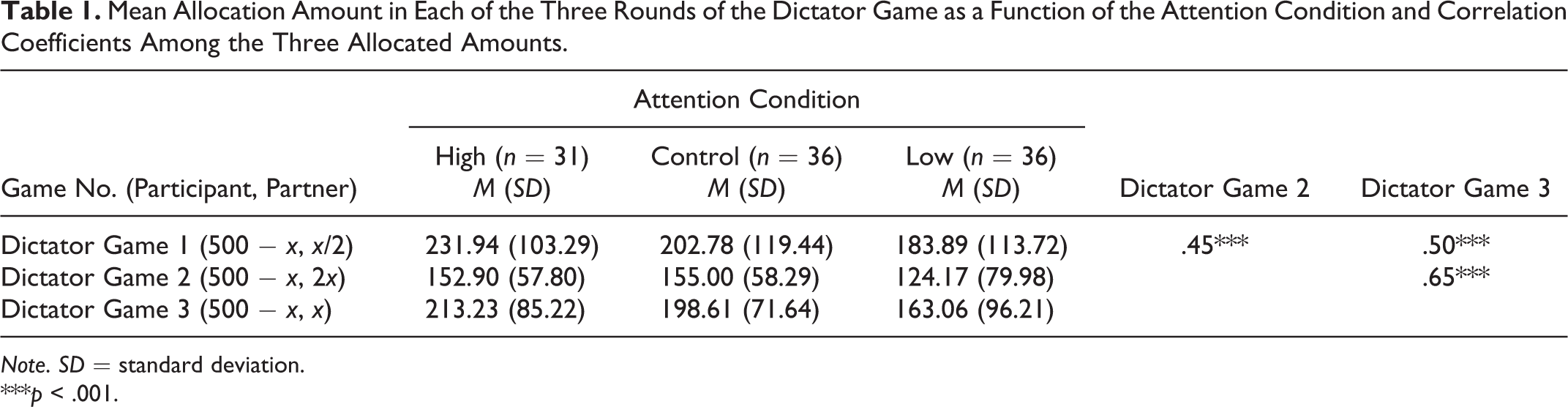
Note. SD = standard deviation.
***p < .001.
A one-way ANOVA revealed a significant effect of attention on generosity, F(2, 100) = 3.12, p = .048, η2 = .06 (see Figure 3). Tukey’s HSD test indicated that participants in the high attention condition allocated more of the resource to their partner (0.21 ± 0.67) than those in the low attention condition did (−0.26 ± 1.00), p = .049. However, the mean generosity in the control condition (0.08 ± 0.72) was not significantly different from the mean generosity in the high attention condition or low attention condition.

Mean generosity as a function of partner attention (*p < .05). The allocated amounts of the three dictator games were transformed to z-scores within each game. The three z-scores were aggregated within each participant to obtain a single generosity score.
The same pattern emerged when the 13 slightly suspicious participants were discarded. Generosity was significantly correlated with intimacy, r = .32, df = 88, p = .002. The omnibus ANOVA indicated the significant effect of attention, F(2, 87) = 3.37, p = .039, η2 = .08. Tukey’s HSD test indicated that the difference between the high attention (0.23 ± 0.67) and low attention (−0.30 ± 1.00) conditions was significant (p = .039), while the differences between the control condition (0.09 ± 0.76) and the other two conditions were not significant. When the 12 overtly suspicious participants were included, the effect of attention did not reach the conventional significance level, F(2, 112) = 2.23, p = .112. Nevertheless, the correlation between intimacy and generosity was still significant, r = .25, df = 113, p = .007, and the differences in the three conditions were still in the predicted direction (0.17 ± 0.71, 0.08 ± 0.75, and −0.21 ± 0.94 in the high attention, control, and low attention conditions. respectively).
Discussion
Previous research revealed that people feel more intimate with a partner who pays attention to them (Ohtsubo et al., 2014; Ohtsubo & Tamada, 2016). Based on this finding, it was speculated that attention would foster responsive exchanges between the attention payer and the attention recipient. Accordingly, we tested whether people became more generous in resource allocation toward someone who paid attention to them. The present study partially confirmed this prediction. Participants in the high attention condition allocated more of the resource to their partner than those in the low attention condition did. However, generosity in the high attention condition did not significantly exceed generosity in the control condition.
The lack of a significant difference in generosity between the high attention and control conditions might have been due to low reliability as compared to self-reported intimacy. Generous allocation in the dictator game is not solely determined by the dictator’s sense of intimacy with the partner; it is also affected by the dictator’s personal traits, such as agreeableness and (low) psychopathic tendency (e.g., Yamagishi, Takagishi, Matsumoto, & Kiyonari, 2014; Zhao, Ferguson, & Smillie, 2016). These individual differences, which are conceivable as a source of measurement errors for the present purpose, might have led to low reliability, and consequently attenuated the effect size of this study. Accordingly, we might have needed a much larger sample size, as our samples comprised 31 and 36 participants in the high attention and control conditions, respectively. In fact, the power analysis given the observed means and SDs indicated that we would need 450 participants in each condition to obtain a statistical power of 80%. However, this would be an unreasonably large sample size for a laboratory experiment. Therefore, it would behoove us to consider how to increase the effect size, before considering increasing the statistical power.
Two possible procedural changes would appear to increase the effect size. First, it is noteworthy that including the slightly suspicious participants attenuated the effect size (.06 with suspicious participants vs. .08 without them). This pattern held for the discarded 12 overtly suspicious participants. Including those overtly suspicious participants made the effect of attention on generosity nonsignificant (cf. the effect of attention on intimacy remained significant after including these 12 overtly suspicious participants). Therefore, we would have to convince participants of the presence of the partner. This could be accomplished by, for example, having a confederate in the next cubicle in the laboratory and giving participants a glimpse of the putative partner’s back. The other possibility would be increasing the probability of the partner’s attention. In this study, high attention was operationalized as 80% of monitoring in the quiz task. As Ohtsubo et al. (2014) showed that intimacy monotonically increased as the probability of attention increased (20%, 50%, and 80%), 100% attention might increase generosity as well as the sense of intimacy. In future studies, these improvements will be needed in the experimental procedures to detect the effect of attention on the behavioral manifestation of intimacy.
Despite the above limitation, it is worth emphasizing that we observed a difference in generosity between the high attention and low attention conditions. This is important because participants did not receive any tangible benefits from the partner’s attention. Nevertheless, participants in the high attention condition behaved generously toward the partner by incurring some cost. Initially, this might appear perplexing, because participants in the high attention condition sacrificed a fitness-relevant resource (i.e., a small amount of money) in return for a fitness-irrelevant resource (i.e., social attention). However, there is an evolutionary explanation for such an apparently nonadaptive exchange. The long-term exchanges of responsive behaviors within a fixed relationship can be understood as a form of reciprocity (Trivers, 1971), and its adaptive value is well-documented (see Kurzban, Burton-Chellew, & West, 2015, for a review). However, its implementation in real relationships might be more complicated than typical game theoretic models of the iterated prisoner’s dilemma game assume (e.g., Axelrod & Hamilton, 1981): Both players decide whether to cooperate with the partner simultaneously. In a real-life setting, however, partners are unlikely to help each other simultaneously because people become needy in an unpredictable manner (Aktipis et al., 2016; Hruschka, 2010). For example, suppose that Person A is needy today due to illness, but will not be needy for a substantially long period of time. Conversely, Person B may become needy more than twice within a relatively short period of time. B helps A today and will be helped more than twice by A. Thus, A’s short-term cost may exceed the benefit of being helped today. On the one hand, if people tried to keep track of the cost–benefit balance and tried to make the short-term balance as even as possible, they could not maintain a long-term responsive relationship in unpredictable environments. On the other hand, if they did not at all worry about the balance, they might be exploited by fair-weather friends (Tooby & Cosmides, 1996). This problem can be solved by more frequent and less costly exchanges of social signals (Hruschka, 2010). In other words, the primary function of regular low-cost signals is to maintain valuable long-term relationships, in which more substantial exchanges of tangible resources occur sporadically. Therefore, the cost of social signals must be smaller than the costs/benefits of the tangible exchanges.
Interestingly, the recent evidence shows that people use their mobile phone to be in frequent contact with, and emotionally close to, others (Jo, Saramäki, Dunbar, & Kaski, 2014). Being in frequent contact via mobile phone is not particularly costly, but because of the time allocation problem, it communicates the caller’s commitment to the relationship. Therefore, this result can be interpreted as evidence of the aforementioned thesis that people use relatively low-cost social signals to prevent close social relations from decaying (Roberts & Dunbar, 2011). In future studies, attention allocation along with time allocation in such real-life situations must be more closely investigated. Such ecologically valid studies, as compared with studies relying on economic games such as the dictator game, might provide a better window to the behavioral consequences of receiving social attention. Moreover, ecologically valid studies should provide a better understanding of the fitness consequences of the exchange of low-cost signals.
Supplemental Material
Supplemental material for People Are More Generous to a Partner Who Pays Attention to Them
Supplemental material, for People Are More Generous to a Partner Who Pays Attention to Them by Yohsuke Ohtsubo and Chiaki Yamaguchi in Evolutionary Psychology
Footnotes
Acknowledgments
We thank Naoki Konishi, Chiaki Nakanishi, Rei Oizumi, Shunta Sasaki, Yui Tanaka, Mayuko Tomita, Mai Tsuchida, and Yi Xia for their assistance with the data collection.
Declaration of Conflicting Interests
The author(s) declared no potential conflicts of interest with respect to the research, authorship, and/or publication of this article.
Funding
The author(s) disclosed receipt of the following financial support for the research, authorship, and/or publication of this article: This work was supported by the Japan Society for the Promotion of Science [JSPS KAKENHI 26590132].

References
Supplementary Material
Please find the following supplemental material available below.
For Open Access articles published under a Creative Commons License, all supplemental material carries the same license as the article it is associated with.
For non-Open Access articles published, all supplemental material carries a non-exclusive license, and permission requests for re-use of supplemental material or any part of supplemental material shall be sent directly to the copyright owner as specified in the copyright notice associated with the article.
