



Abstract
Previous research found that men conspicuously consume luxury products to attract a mate and to signal their mate value. However, these studies have yet neglected to investigate the function of male conspicuous consumption in same-sex competition. Given that intersexual selection and intrasexual selection are closely related processes, it stands to reason that a further function of male conspicuous consumption could be to impress and deter same-sex rivals. An 2 (intrasexual competition context vs. control) × 2 (conspicuous luxury vs. inconspicuous nonluxury) between-subjects experimental study conducted with an Amazon Mechanical Turk sample (N = 160) revealed that men reported both higher liking of and an intent to purchase a conspicuous luxury car compared to an inconspicuous nonluxury car due to increased feelings of social status. This effect was stronger in the intrasexual competition than in the control context. An additional perception study using a single-factor between-subjects design (conspicuous luxury vs. inconspicuous nonluxury car) among German men (N = 405) indicated that male participants rated a man who displayed a conspicuous luxury car more as a rival and mate poacher and less as a friend. They further perceived him to be superior on various mate value characteristics (i.e., attractiveness, intelligence, ambition, and status) and rated him as more oriented toward short-term mating. In sum, our findings add to previous research in the field of evolutionary consumer psychology by suggesting that male conspicuous consumption of luxuries may also serve a function in male–male competition.
Keywords
Relative to women, men are more likely to purchase and register conspicuous sports cars in the United States and cars of well-known luxury brands (Bowling, 2013; Macesich, 2014). Previous research has demonstrated that men may use these luxury cars to impress women, given that they may function as a signal of mate value (Griskevicius et al., 2007). And indeed, a man who was seated in a luxury car was perceived as more attractive by women compared to the same man seated in a nonluxury car (Dunn & Searle, 2010). Hence, men appear to use showy spending to attract women in intersexual competition contexts. Sundie et al. (2011) further revealed that men’s flaunting of luxury goods signals their desirability as a short-term (rather than long-term) mate. In addition, the study of Saad and Vongas (2009) indicated that men who drove a luxury sports car yielded higher testosterone levels compared to when they drove a nonluxury car. Moreover, Saad and Vongas found that male testosterone levels also rose when confronted with other men who displayed luxury (vs. nonluxury goods) in the presence of a female confederate. These latter results suggest that intrasexual competition processes may also incite men’s luxury spending. However, no increase in testosterone levels was found when the confederate was a male.
The current research builds on these findings and aims to further unravel whether men’s conspicuous displays of luxury goods can function as a signal to other men (and not only to women) in intrasexual competition contexts. Intersexual selection and intrasexual selection are highly related processes (Berglund, Bisazza, & Pilastro, 1996). Specific male characteristics, referred to as “armaments,” have evolved in male–male competition but have also taken over the function of an “ornament” indicating desirable underlying mate qualities (e.g., good genes). Therefore, these characteristics are of great importance in mate choice as well (Chen & Chang, 2015). Given these relations, male conspicuous consumption of luxury products could not only serve a function in mate attraction but also in male–male competition aiming to impress and deter potential same-sex competitors. The goal of the current research is hence to investigate male conspicuous consumption of luxury cars in an intrasexual competition context and to provide first empirical evidence of its dual function (i.e., beneficial in intersexual as well as intrasexual selection). Moreover, assuming an intrasexual signaling function of men’s conspicuous car spending behavior, we further investigated male perceptions of a same-sex rival who displays a luxury car.
Male–Male Competition
Sexual selection (Darwin, 1871) creates adaptations that are the result of successful mating. Within sexual selection, there are two primary distinct processes. Intersexual selection concerns the actual mate choice, whereas intrasexual selection refers to the competition between members of the same sex to gain access to members of the opposite sex. Although female intrasexual competitions also occur, male intrasexual competition appears to be particularly intense in humans (Puts, 2010, 2016). This is the result of a higher male than female reproductive variance, which, in turn, is caused by sex-different obligatory costs in reproduction (Bateman, 1948; Brown, Laland, & Mulder, 2009; Trivers, 1972).
One way for men to succeed in intrasexual competition is to show off their underlying mate qualities by means of easily observable signals that are hard to fake (Zahavi, 1975). Among these costly signals are facial hair (Dixson & Brooks, 2013; Neave & Shields, 2008), voice pitch (Puts, Hodges, Cárdenas, & Gaulin, 2007), and body shape (Coy, Green, & Price, 2014). Specific male behaviors such as intrasexual aggression (Archer, 2009; Daly & Wilson, 2001; Wilson & Daly, 1985) but also specific consumption practices (Saad, 2007) appear to be costly signals shaped by sexual selection, too. In the following, we develop an argument for the conspicuous display of luxuries as costly signals within same-sex competitions.
Luxury Car Spending as a Costly Signal Within Same-Sex Competition
Previous studies have shown that luxury spending may function as a costly signal for both men and women. Given that not all individuals can equally afford to purchase high-priced luxury goods, the conspicuous consumption of luxuries can be considered a hard to fake behavior that may signal underlying desirable traits (Miller, 2009). In this respect, flaunting luxury brands provides individuals with benefits in social interactions because they signal high social status to others and accordingly increase the desirability to affiliate with them (Nelissen & Meijers, 2011). Women appear to specifically benefit from displaying conspicuous luxury brands in within-sex competitions. For women in relationships, luxury brands can signal the devotion of their partner and thus deter potential rivals from mate poaching (Wang & Griskevicius, 2014). In addition, luxury brands can signal a woman’s readiness as a partner and her sexual willingness to rivals, thus providing her advantages in competitions for high-quality mates (Hudders, De Backer, Fisher, & Vyncke, 2014).
On the other hand, men benefit from displaying conspicuous luxury brands in intersexual competitions because it signals social status to women. Studies indicate that women perceive a man who displays conspicuous consumption of a luxury sports car as a more desirable short-term mate (Sundie et al., 2011) and that fertile women are more likely to notice conspicuous status products (Lens, Driesmans, Pandelaere, & Janssens, 2012). Moreover, men actually show a higher preference for luxury items when exposed to a romantic context. In particular, men report a higher desire for money (Roney, 2003), tend to discount the future (e.g., Wilson & Daly, 2004), and have a better recall memory for conspicuous status products in the presence of mating cues (Janssens et al., 2011). A recent study suggests that men are even willing to engage in financial risk-taking to compensate for a lack of physical attractiveness in order to increase their desirability as a mate (Chan, 2015). A study of Sundie et al. (2011) further revealed that a short-term mating context elicited conspicuous consumption of luxury products only in males who indicated an inclination toward short-term mating. In line with this, financial consumption appears to be positively connected with men’s mating intentions as well as their actual number of past mates (Kruger, 2008).
We expect the same to occur in male–male competitions. In particular, men might show a higher preference for showy luxury items in an intrasexual competition context. Some preliminary evidence that supports this hypothesis can be found in research conducted by Lycett and Dunbar (2000). They observed men in bars and found that these men were more likely to conspicuously display their mobile phones with an increasing male-to-female ratio. The authors interpreted the men’s conspicuous display of their mobile phones as a signal of financial wealth and social status which may be used to impress potential rivals and to distinguish from them. Similar results were obtained in a study by Saad and Vongas (2009) who found that men’s testosterone levels rose when they were exposed to other men who flaunted luxury items (e.g., pen and watch) and when being in the presence of a female confederate. These results suggest that male luxury spending could have evolved in intrasexual competition processes, too.
In line with these findings, we expect that men’s conspicuous display of a luxury car can be used to deter rivals. Despite the fact that Saad and Vongas (2009) did not find an increase in testosterone levels resulting from men who flaunted luxury items when being in the presence of a male confederate, we nevertheless expect that intrasexual competition in other contexts than mate competition can trigger men’s luxury spending, such as a work competition. In line with Veblen (1899, 1979), luxury brands are often flaunted to impress other individuals and show off one’s social status. This social status refers to one’s position in society relative to others (Nelissen & Meijers, 2011). Luxury cars may therefore be a suitable tool to signal one’s social status to others, given that its consumption occurs conspicuously. Thus, by displaying luxury cars, one can show off his economic success, prestige, and financial wealth to others. All these are traits that are strongly linked to one’s social status (Frank, 1999). This higher social status can increase the social value of men and outmarch rivals.
Following this reasoning, we hypothesize that men will show higher preferences (Hypothesis 1) and purchase intentions (Hypothesis 2) for a conspicuous luxury than for an inconspicuous nonluxury car in an intrasexual competition context because men expect to be attributed a higher social status when driving this luxury car than when driving the nonluxury car. This is also in line with previous research, suggesting that status motives triggered by competition increase seeking for luxury products (for a review, see Griskevicius & Kenrick, 2013). In a noncompetitive context, we expect men’s preferences for a luxury to a nonluxury car to be less strong, since social status is less relevant in this case (see Figure 1 for the conceptual model).
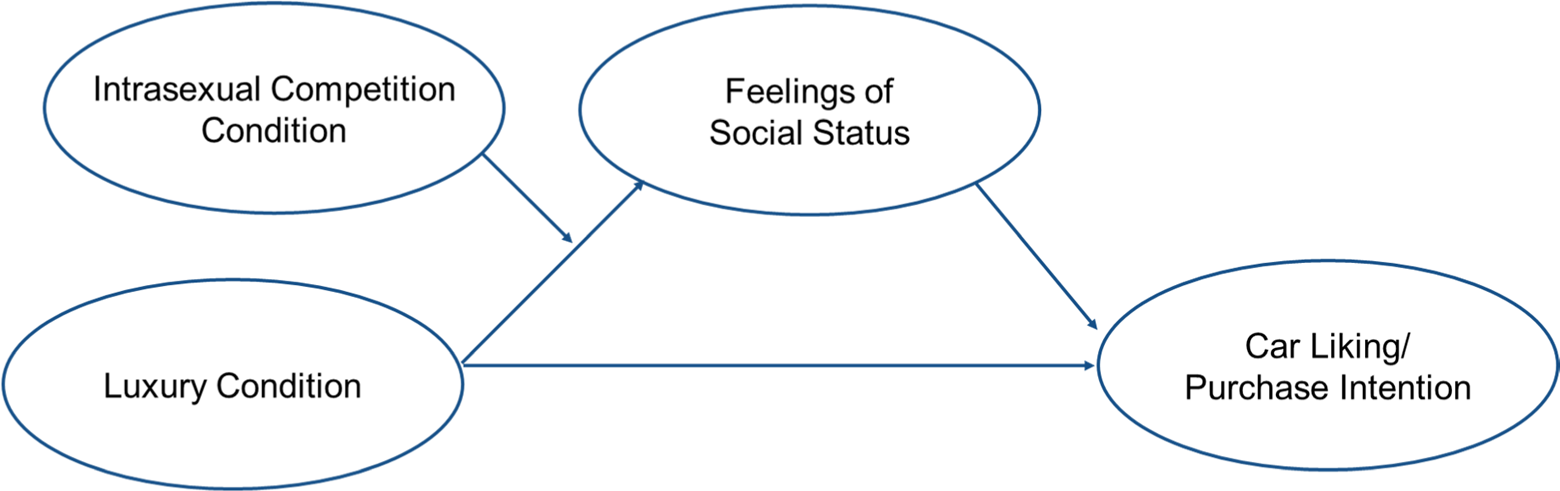
Conceptual model of Study 1.
Male Perceptions of a Same-Sex Rival
Proposing that a luxury car can honestly signal desirable mate value traits in male–male competition, we expect that a luxury car will influence male perceptions of a potential same-sex rival. Hudders, De Backer, Fisher, and Vyncke (2014) found that a woman who displayed luxuries was perceived as a stronger rival by other women, given that her luxury consumption appears to signal her sexual availability as a short-term mate. In a similar vein, we hypothesize that a man who displays conspicuous consumption of a luxury car will be perceived more as a rival (Hypothesis 3), more as a mate poacher (Hypothesis 4), and, consequently, less as a friend (Hypothesis 5) by other men relative to that same man who displays consumption of a nonluxury car. In line with Sundie et al. (2011), we further assume that flaunting luxury brands will increase a man’s value as a short-term mate and that this will be recognized by other men. We therefore expect that a man who displays conspicuous consumption of a luxury car will be rated higher on mate value attributes associated with short-term mating (e.g., infidelity, flirting behavior, sexiness, attractiveness, immaturity, and financial resources; Hypothesis 6) and that he will be more likely to be considered as searching for short-term relationships (Hypothesis 7).
Study 1: Luxury Car Spending Elicited by a Same-Sex Competition Context
Method
Design and Procedure
An experiment was conducted online to test whether men would show higher interest in luxury cars when exposed to a competitive compared to noncompetitive condition. The experiment followed a 2 (intrasexual competition vs. control) × 2 (conspicuous luxury car vs. inconspicuous nonluxury car) between-subjects design. Participants were randomly assigned to one of the conditions. Participants in this research received a small financial compensation. The conduct of this study followed the ethical rules of the American Psychological Association (2010) and was approved by the ethical committee of the university.
To reduce demand effects and to conceal the purpose of our study, participants were told that they would participate in two separate studies of which the first one investigated storytelling, while the second researched product design. At the beginning of the questionnaire, participants provided demographic information. Next, they were instructed to carefully read one short story (intrasexual competition or control condition) and to put themselves in the shoes of the first-person narrator. Subsequently, participants were asked to indicate on a number of items how they felt after reading the scenario. Then, they were presented a picture of a car model (either luxury or nonluxury) and asked to evaluate the car on several attributes (e.g., design, status, and perceived price). Participants were further asked to which extent they liked the car and to which extent they would consider purchasing the car (dependent variables [DVs]). Finally, they were asked about their status feelings when driving this car (mediating variable). At the end, participants were thanked for their participation.
Participants
Participants were recruited via Amazon Mechanical Turk sample. One hundred sixty-five male U.S. participants completed the questionnaire. Participants indicating a homosexual orientation (n = 5) were excluded because research suggests that the mate preferences and mating psychology of heterosexuals differ from homosexuals (Gobrogge et al., 2007; Kenrick, Keefe, Bryan, Barr, & Brown, 1995). Thus, the final sample comprised 160 English-speaking male participants (M age = 34.5 years, SD = 10.3, age range = 19–63 years, 96.9% heterosexual, 3.1% bisexual). The majority of the participants were highly educated holding a bachelor’s degree, a master’s degree (61.9%), or a PhD (1.3%), while 36.6% had completed high or secondary school. Roughly, three of the four (73.8%) were full-time employed. The others were students (8.8%), part-time employed (10%), unemployed (6.3%), or retired (1.3%). About half of the respondents were in a relationship (51.9%). Of the participants, 19.4% indicated a net monthly income of less than US$1,500, 23.8% reported to earn net monthly incomes between US$1,500 and US$3,000, and 50.0% reported net monthly incomes of more than US$3,000. Eleven participants (6.9%) did not provide information.
Materials
To elicit intrasexual competitiveness, we used a priming procedure. This method is commonly applied and well established in evolutionary informed research on conspicuous consumption (e.g., Griskevicius et al., 2007; Hudders et al., 2014; Janssens et al., 2011; Sundie et al., 2011; Wang & Griskevicius, 2014). The scenarios were adopted from the study by Griskevicius et al. (2009). In the intrasexual competition condition, participants read a short story written in first person and were asked to imagine that they were looking for a new job (see Appendix 1). After a harsh selection process, they are offered a job at a large, prestigious company. At their first day, they encounter two other new male colleagues who start at this company. The boss then comes and says that after 6 months one of them will receive a promotion and move to another office, and that one of them will be fired. The short story has an open ending, suggesting a very strong sense of competition between the respondent and his new colleagues. It ends with the sentence: “You are confident that you will outperform them and make it to the top. You’re ready to accept the challenge.” In contrast, the control scenario described a situation in which the respondent has lost his keys and wallet after a shopping trip and starts looking for them in the streets (see Appendix 2). To facilitate the participants’ imagination, short stories were accompanied with pictures that matched their contents. The intrasexual competition scenario was presented with photographs that depict potential male rivals, while the control scenario was provided with a photograph that shows a shopping street. In case the male rivals depicted on the photographs did not match the participants’ idea of a rival, the instruction encouraged participants to envision any other male rival while reading the short story. The luxury condition was manipulated by selecting two different car brands. As conspicuous luxury car, a Porsche Boxster was selected, while a Ford Fiesta was chosen as inconspicuous nonluxury car. In line with previous studies, cars were considered as appropriate products to investigate male conspicuous consumption (e.g., Dunn & Searle, 2010; Janssens et al., 2011; Saad & Vongas, 2009; Sundie et al., 2011). Car models were picked based on sales reports and popularity statistics (Autobild.de, 2015) and prerated on conspicuous consumption (“I consider the purchase of the Porsche Boxster/Ford Fiesta as conspicuous consumption”), status (“I attach status to the Porsche Boxster/Ford Fiesta”), and perceived price (“I consider the Porsche Boxster/Ford Fiesta to be…”). Participants further prerated to which extent the car models could be used to signal dominance (“Men also purchase the [car model] to demonstrate their dominance over other men”). The prerating included 26 male participants (M age = 32.7 years, SD = 12.3, 46.2% employees, 23.1% university students). Conspicuous consumption, status, and dominance perceptions were assessed on 7-point Likert-type scales (1 = not at all to 7 = very much) and perceived price on a visual analogue scale (1 = very cheap to 100 = very expensive). Paired samples t-tests indicated that the purchase of the Porsche Boxster was considered much more as conspicuous consumption than the purchase of the Ford Fiesta (M Porsche = 6.42, SD = 0.70 vs. M Ford = 1.42, SD = 0.64), t(25) = 23.27, p < .001, d = 4.56. Moreover, the Porsche Boxster was much more associated with status (M Porsche = 6.19, SD = 1.50 vs. M Ford = 1.77, SD = 0.71), t(25) = 13.26, p < .001, d = 2.60; more often rated as signals of dominance (M Porsche = 5.19, SD = 1.72 vs. M Ford = 1.38, SD = 0.70), t(25) = 10.59, p < .001, d = 2.06; and perceived as more expensive (M Porsche = 86.19, SD = 13.67 vs. M Ford = 22.38, SD = 12.53), t(25) = 17.46, p < .001, d = 3.42, than the Ford Fiesta. Hence, the Porsche Boxster is referred to as the conspicuous luxury car and the Ford Fiesta as the inconspicuous nonluxury car.
Measures
Participants first indicated their gender, age, educational level, profession, income, sexual orientation, and relationship status.
As a manipulation check for the priming scenario, participants were asked to indicate their feelings after reading the scenario on a 5-point Likert-type scale (1 = not at all to 5 = very much). A selection of items from the Positive and Negative Affect Schedule (PANAS) scale was used (Watson, Clark, & Tellegen, 1988). In particular, the following feelings were measured: (to what extent do you feel…) self-confident, happy, powerful, competitive, romantic, nervous, angry, afraid, excited, determined.
As a manipulation check for the luxury condition, participants were asked to indicate how luxurious they rated the car on 7 items which included the following 5-point semantic differential scales: unappealing design–appealing design, cheap–expensive, nonluxurious–luxurious, low status–high status, inconspicuous–conspicuous, low quality–high quality, ugly–beautiful (Hudders & Pandelaere, 2015). These items were summed up to one scale measuring perceived luxuriousness (α = .95).
The DVs in this study were car liking and purchase intention. Car liking was measured with the item “How much do you like this car” which was answered on a 5-point Likert-type scale (1 = dislike extremely to 5 = like extremely). Similarly, purchase intention was measured with the item “If I could afford it, I would purchase this car,” to be answered on a 5-point Likert-type scale (1 = definitely will not to 5 = definitely will). Next, as a mediating variable, participants were asked to indicate whether they “would feel like having high social status when driving this car” on a 5-point Likert-type scale (1 = strongly disagree to 5 = strongly agree). In contrast to the item measuring perceived status of the car model in the manipulation check (see above), this variable explicitly referred to the anticipated feelings when driving the car.
Results
Manipulation Checks
First, independent samples t-tests were conducted to check whether the intrasexual competition scenario induced more competitive feelings than the control scenario. Compared to the control condition, respondents in the intrasexual competition condition felt significantly more self-confident, t(158) = 18.29, p < .001, d = 2.91; happy, t(156.27) = 14.16, p < .001, d = 2.25; powerful, t(154.90) = 12.46, p < .001, d = 1.98; competitive, t(158) = 15.50, p < .001, d = 2.47; excited, t(134.23) = 7.28, p < .001, d = 1.16; and determined, t(118.05) = 6.37, p < .001, d = 1.01. They further felt less nervous, t(158) = −3.66, p < .001, d = −0.58; less angry, t(158) = −9.32, p < .001, d = −1.48; and less afraid, t(137.38) = −6.50, p < .001, d = −1.03. There were no significant differences in experienced romantic feelings, t(158) = 1.17, p = .25, d = 0.19. The mean values can be found in Figure 2. In sum, the above-mentioned results indicate that the priming elicited the intended feelings, given that individuals in the intrasexual competition scenario felt more competitive, powerful, and determined than respondents in the control scenario, while there were no significant differences in experienced romantic feelings. This indicates that no intersexual selection processes were primed with this scenario.
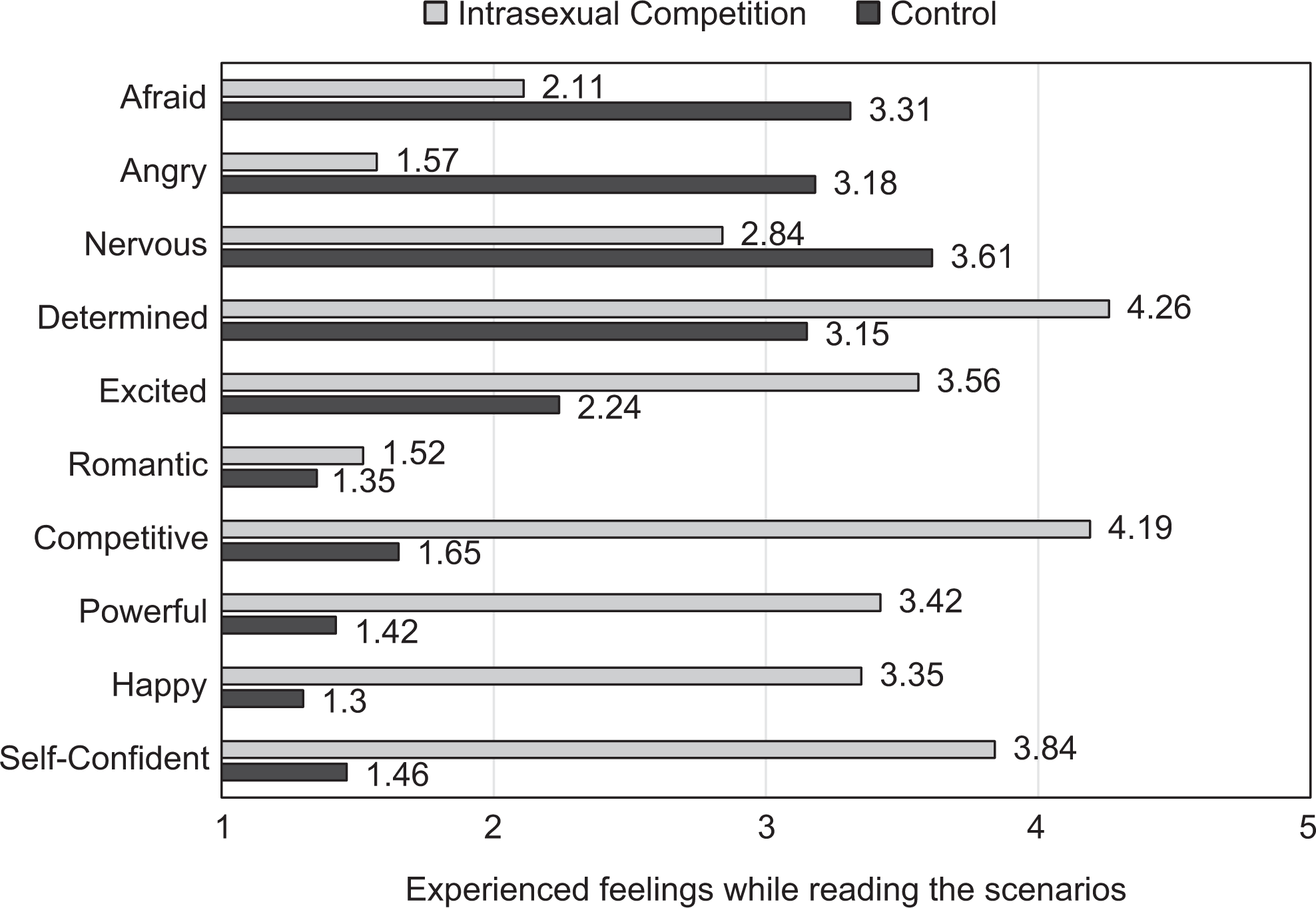
Manipulation check of the priming, Study 1.
Next, a two-way univariate analysis of variance (ANOVA) was used to test whether the luxury condition was rated higher on luxuriousness than the control condition. Results revealed that the conspicuous luxury car (M = 4.34, SE = 0.09) was rated higher on luxuriousness compared to the inconspicuous nonluxury car (M = 2.71, SE = 0.09), F(1, 156) = 166.37, p < .001,
Car Liking
A moderated mediation analysis using the PROCESS macro of Hayes (2013, model 7, 5,000 bootstrap samples) was performed to test Hypothesis 1. The independent variable was luxury condition, the moderating variable was intrasexual competition condition (for both variables, the control condition was coded as 0 and the experimental condition as 1), the mediating variable was anticipated feelings of social status (when driving this car), and the DV was car liking. As hypothesized, the results of this analysis revealed a significant moderated mediation (B = 0.43, SE = 0.15, 95% CI [0.1537, 0.7548], see Figure 3). In particular, the results showed that the respondents indicated a higher car liking for the luxury car than for the nonluxury through increased feelings of social status and that the effect was stronger in the intrasexual competition context (B = 1.03, SE = 0.15, 95% CI [0.7652, 1.3323]) than in the control condition (B = 0.60, SE = 0.17, 95% CI [0.3003, 0.9732]). Hence, Hypothesis 1 was supported. The netto direct effect of luxury condition on car liking was not significant (B = −0.12, SE = 0.16, p = .45). In addition, the results of this analysis revealed a positive main effect of luxury condition (B = 1.28, SE = 0.24, t = 5.37, p < .001) and a negative main effect of intrasexual competiton condition (B = −0.72, SE = 0.22, t = −3.23, p = .002) on anticipated status feelings. Further, the interaction effect of luxury and intrasexual competition condition on anticipated status feelings was significant (B = 0.93, SE = 0.32, t = 2.90, p = .004), indicating that the luxury car condition leads to higher anticipated feelings of status than the nonluxury car condition in the intrasexual competition condition compared to control. In conclusion, anticipated status feelings have a positive impact on car liking (B = 0.47, SE = 0.06, t = 7.84, p < .001).
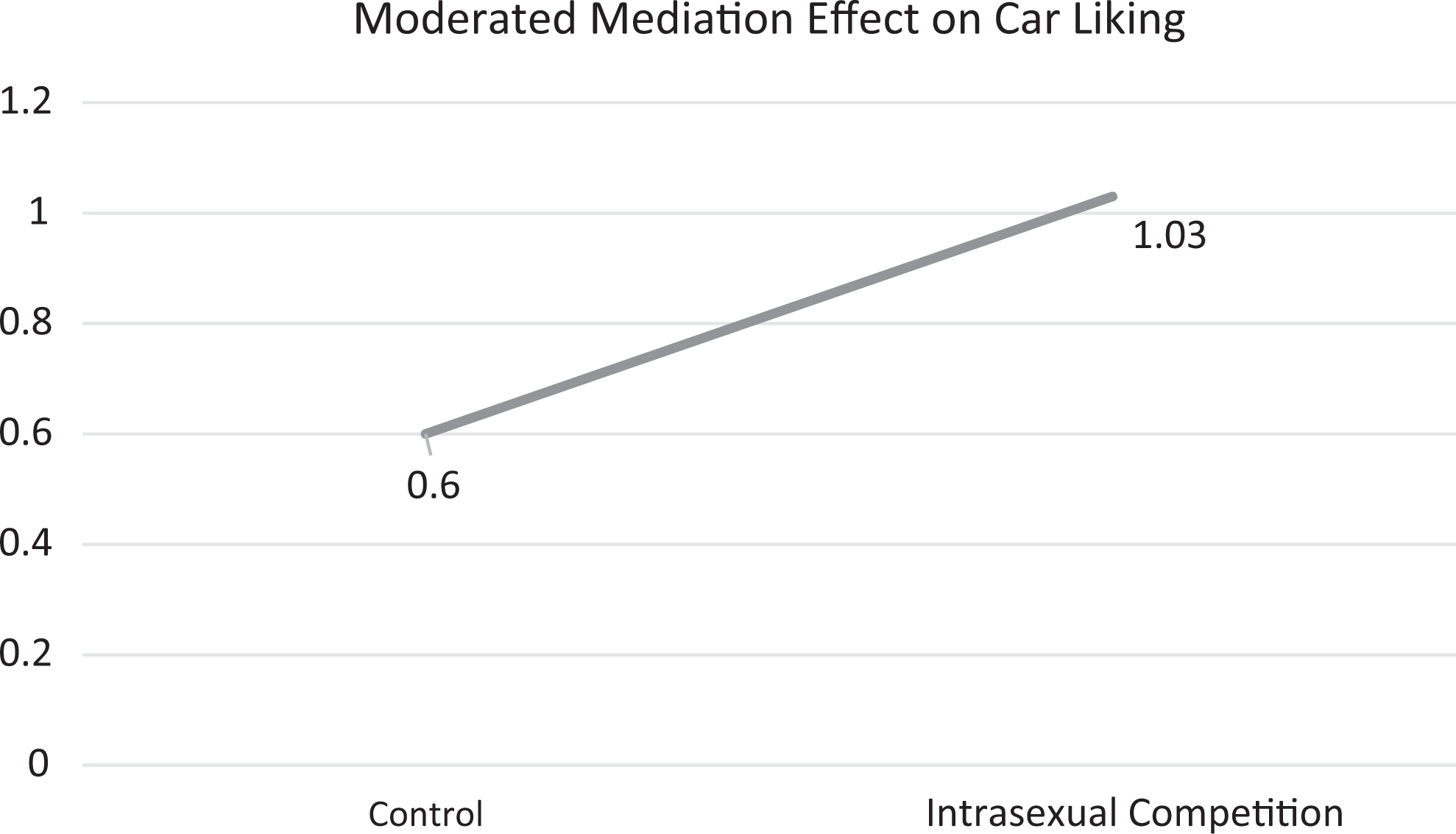
Moderating impact of intrasexual competition condition on the mediating role of status feelings in the effect of luxury condition on car liking, Study 1. y-Axis refers to the difference in car liking between nonluxury and luxury condition. When the effect is positive, luxury condition has a significantly higher car liking than nonluxury condition; when the effect is negative, the nonluxury condition has a significantly higher car liking than the luxury condition. When the effect is 0, there is no significant difference between conditions.
Purchase Intention
The same statistical analyses as reported above were performed with purchase intention as DV. Similar results were found as for car liking, that is, a conditional indirect effect of luxury condition on purchase intention through perceived feelings of status was observed (B = 0.53, SE = 0.20, 95% CI [0.1634, 0.9530], see Figure 4). In particular, the results suggested a stronger indirect effect in the intrasexual competition context (B = 1.26, SE = 0.19, 95% CI [0.9222, 1.6659]) than in the control condition (B = 0.73, SE = 0.21, 95% CI [0.3708, 1.1894]. Hence, Hypothesis 2 was supported. The netto direct effect of luxury condition on purchase intent was significant (B = −0.64, SE = 0.23, t = −2.83, p = .005), indicating that purchase intent for a luxury car is lower than for a nonluxury car, when controlling for the positive indirect path through anticipated status feelings. In conclusion, the main effect of anticipated status feelings on purchase intent is significant (B = 0.57, SE = 0.08, t = 6.87, p < .001).

Moderating impact of intrasexual competition condition on the mediating role of status feelings in the effect of luxury condition on purchase intent, Study 1. y-Axis refers to the difference in purchase intent between nonluxury and luxury condition. When the effect is positive, luxury condition has a significantly higher purchase intent than nonluxury condition; when the effect is negative, the nonluxury condition has a significantly higher purchase intent than the luxury condition. When the effect is 0, there is no significant difference between conditions.
Discussion
In line with our predictions, the results of the first study revealed that men liked a conspicuous luxury car more than an inconspicuous nonluxury car and reported higher purchase intention for it. Our findings suggest that this effect occurs because men expect to feel like having higher social status when driving the conspicuous luxury car. In addition, this effect appears to be intensified through the intrasexual competition condition compared to the control condition. These findings indicate that men might use conspicuous luxury products in male–male competition, because they think they would feel like having a higher social status. Accordingly, men might use luxury cars to deter potential rivals. This would be in line with the function of conspicuous displays that can be observed in male–male competition in the animal kingdom (Berglund et al., 1996). For instance, the elaborateness of peacock’s trains (e.g., train length) is correlated with the number of competitive male–male interactions (Loyau, Saint Jalme, & Sorci, 2005). That is, peacocks use their plumages not only in intersexual but also in intrasexual competition in order to intimidate their rivals. And the more successful they are in doing so, the more exaggerated their respective plumage is.
To further shed light on the signaling function of men’s conspicuous consumption of luxury products in same-sex competition, the second study investigated how men actually perceived a potential rival having purchased either the conspicuous luxury car or the inconspicuous nonluxury car.
Study 2: Male Perceptions of a Potential Rival Who Displays Conspicuous Consumption
Design and Procedure
The experiment followed a single-factor between-subjects design with the between-subjects factor of car type (conspicuous luxury vs. inconspicuous nonluxury). Participants were randomly assigned to one experimental condition. Participation in this research was voluntary and not paid. This online experiment was conducted in line with the ethical rules of the American Psychological Association (2010) and was approved by the ethical committee of the university.
After a short introduction, participants first gave demographic information. Afterward, they were shown the picture of a male target model and told that the depicted man had just purchased either a conspicuous luxury or an inconspicuous nonluxury car. Next, they were instructed to evaluate this man on a number of characteristics and completed some manipulation check measures. At the end of the questionnaire, participants were thanked for their participation.
Participants
Participants were recruited via university mailing lists, online advertisements, and social networking sites. A total of 425 German-speaking male participants (all living in Germany) completed the online questionnaire (instructions and questions were all presented in German). As in the first study, participants who reported a homosexual orientation (n = 13) and participants who declined to report their sexual orientation (n = 5) were dropped out from analyses. Moreover, two more cases were excluded (one participant was aged below 16 and one participant gave false information on his profession). The final sample included 405 men (M age = 27.8 years, SD = 8.27, age range = 16–67 years, 97.0% heterosexual, 3.0% bisexual). About half of them were in a committed long-term relationship (51.1%). Most of them (73.8%) were highly educated and held at least a university entrance certificate. Roughly, the half (49.9%) were university students enrolled in various subjects (e.g., computer science, information systems, teaching profession), followed by employees (31.4%) and trainees (5.4%). Of the participants, 68.8% reported net monthly incomes of less than 1,500 EUR, 26.2% reported net monthly incomes between 1,500 EUR and 3,000 EUR, and 5.2% reported net monthly incomes of more than 3,000 EUR.
Materials
Car type condition was manipulated by showing the participants a picture of a male target model and instructing them that the depicted man had just purchased either a conspicuous luxury or inconspicuous nonluxury car. The cars were the same as used in Study 1 (i.e., Porsche Boxster and Ford Fiesta). The male target model used in Study 2 was prerated by 33 heterosexual male participants (M age = 30.4 years, SD = 13.8, 48.5% university students, 15.2% employees) on attractiveness (M = 4.64, SD = 1.34), dominance (M = 2.76, SD = 1.17), perception as a potential friend (M = 3.67, SD = 1.53), rival (M = 3.67, SD = 1.57), and mate poacher (M = 3.79, SD = 1.87) using 7-point Likert-type scales (1 = not at all to 7 = very much). One-sample t-tests indicated that participants rated the male target model as significantly more attractive than the midpoint of the scale, t(32) = 2.72, p = .01, d = 0.47, and as significantly less dominant than the midpoint of the scale, t(32) = −6.08, p < .001, d = −1.06. For the other attributes, ratings did not significantly differ from the midpoint of the scale, ts(32) ≤ −1.25, ps ≥ .22. The pictures of the male target model and the car were presented next to each other.
Measures
Participants first indicated their gender, age, educational level, profession, net monthly income, relationship status, and sexual orientation.
Participants evaluated the male target model as a rival (“I can imagine the depicted man as a rival”) and mate poacher (“I can imagine introducing the depicted man to my girlfriend,” “I would let my girlfriend spend time with the depicted man”; for similar items, see Vaillancourt & Sharma, 2011) as well as a potential friend (“I can imagine the depicted man as a friend of mine”). Next, they rated the male target model on 13 traits that assess six dimensions of mate value (i.e., agreeableness, attractiveness, sexual willingness, intelligence, ambition, and status; see Buss, 1989). The items were adapted from Hudders et al. (2014) and included the following: agreeable, attractive, youthful, sexy, flirty, loyal, talented, smart, mature, ambitious, passionate, rich, and wealthy. All responses were given on 7-point Likert-type scales (1 = not at all to 7 = very much).
Afterward, participants evaluated the male target model’s mating strategy using the Revised Sociosexual Orientation Inventory (SOI-R, Penke & Asendorpf, 2008; for a similar method, see Sundie et al., 2011). The SOI-R is used to assess mating strategy on the facets behavior (e.g., “With how many different partners have you had sex within the past 12 months?”; 1= 0 to 5 = 8 or more), attitude (e.g., “Sex without love is ok”; 1= strongly disagree to 5 = strongly agree), and desire (e.g., “How often do you experience sexual arousal when you are in contact with someone you are not in a committed romantic relationship with?”; 1= never to 5 = nearly every day). The mean of the three facets was used as a measurement of how participants perceived the male target’s mating strategy. For the purpose of this research, the wording of the SOI-R items was rewritten from first to third person (e.g., “With how many different partners had this man sex within the past 12 months?”). Higher values indicate a higher orientation toward short-term mating. The SOI-R showed high internal consistency (α = .94).
As a manipulation check, participants rated the cars on conspicuous consumption and status using (7-point Likert-type scales, 1 = not at all to 7 = very much) and price (visual analogue scale, 1 = very cheap to 100 = very expensive).
Results
Manipulation Checks
The conspicuous luxury car was more associated with conspicuous consumption (M luxury car = 5.45, SD = 1.65 vs. M nonluxury car = 1.98, SD = 1.32), t(382.11) = 23.26, p < .001, d = 2.20, status (M luxury car = 4.98, SD = 1.80 vs. M nonluxury car = 2.25, SD = 1.24), t(354.31) = 17.79, p < .001, d = 1.78, and was perceived as more expensive (M luxury car = 73.11, SD = 21.49 vs. M nonluxury car = 27.85, SD = 19.61), t(403) = 22.15, p < .001, d = 2.20, than the inconspicuous nonluxury car. Hence, the manipulation was successful.
Perceptions as a Rival, Mate Poacher, and Friend
In line with our predictions, male participants perceived the male target model who had just purchased the conspicuous luxury car more as a rival (Hypothesis 3), more as a mate poacher (Hypothesis 4), and less as a friend (Hypothesis 5) compared to when he had just purchased the inconspicuous nonluxury car (see Table 1).
Male Perceptions of a Potential Rival Depending on the Type of Car He Has Just Purchased.

Note. Standard deviations appear in parentheses. p-Values are two-tailed.
Mate Value
A multivariate analysis of variance with the mate value traits as DVs and the condition (conspicuous luxury car vs. inconspicuous nonluxury car) as independent variable was performed. There was a significant main effect of car type, Pillai’s Trace F(13, 391) = 40.36, p < .001,
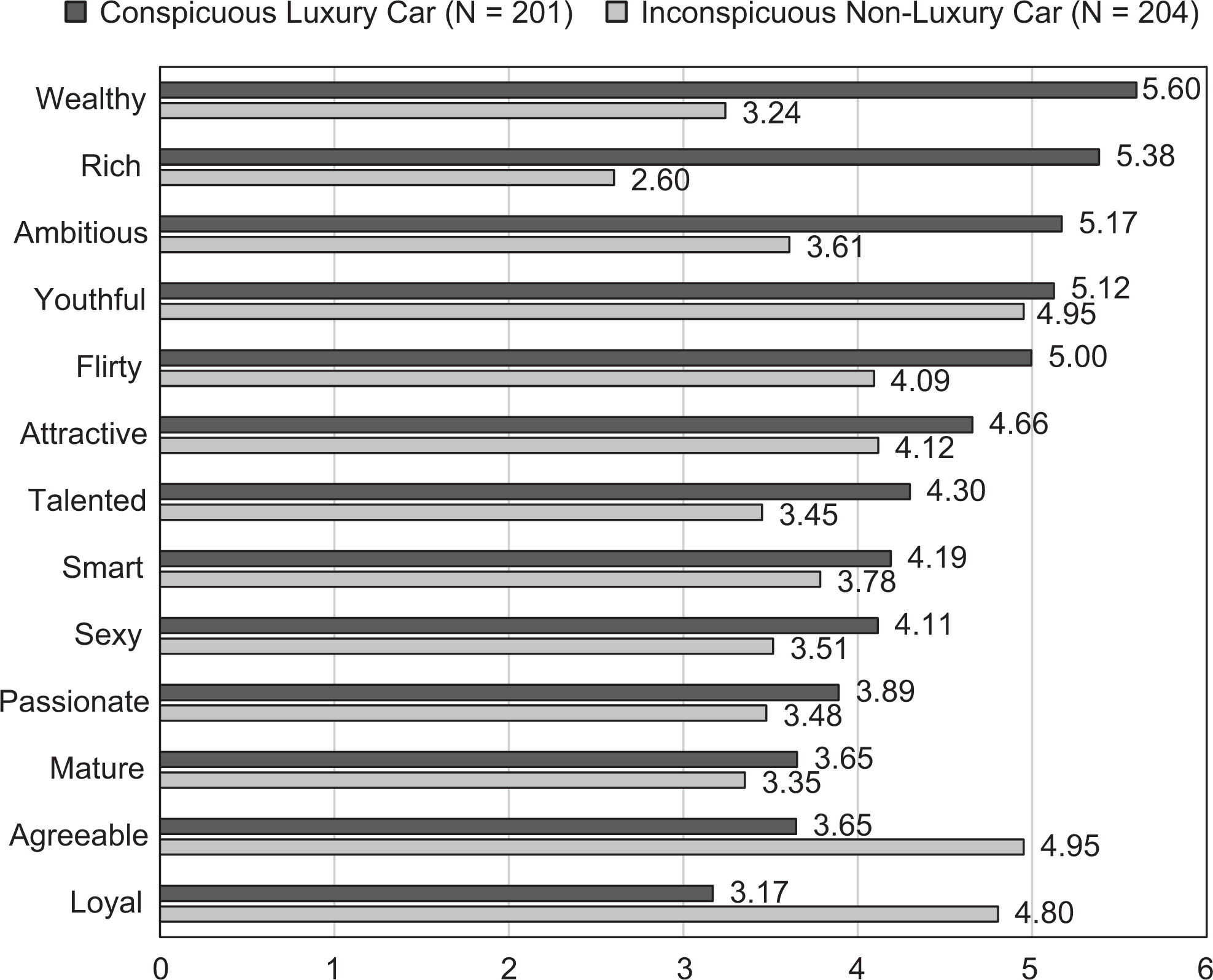
Effects of car type on male perceptions of another man’s mate value attributes, Study 2.
Perceived Mating Strategy
In the conspicuous luxury car condition, the male target model was perceived as much more oriented toward short-term mating (see Table 1). Hence, Hypothesis 7 was also supported.
Discussion
Study 2 aimed to shed light on the specific signaling function of male conspicuous consumption of luxury products. The results showed that male participants perceived a man who displayed conspicuous consumption of a luxury car more as a rival and mate poacher and less as a friend relative to a man who displayed a nonluxury car. Furthermore, in the conspicuous luxury car condition, male participants rated the male target model higher on all mate value attributes (i.e., attractiveness, sexual willingness, intelligence, ambition, and status). These findings suggest that men could (unconsciously) reveal a variety of desirable traits about themselves when displaying conspicuous consumption of luxuries in same-sex competition. These results corroborate the hypothesized signaling function of male conspicuous consumption and suggest that a man who displays conspicuous luxuries may have an advantage over other men, as he could therefore deter inferior rivals.
General Discussion
Drawing on sexual selection theory (Darwin, 1871) and costly signaling (Zahavi, 1975), the present research investigated the function of conspicuous luxury consumption by men in same-sex competition. Many secondary sexual characteristics have evolved during male–male competition. Based on these costly signals, females might then make their mate choice (Berglund et al., 1996). Given that conspicuous consumption of luxury products can be regarded as a sexually selected mating strategy in humans (Sundie et al., 2011), it stood to reason that male conspicuous luxury consumption would not only serve a function in mate attraction but also in male–male competition with the goal to impress and deter rivals.
The results of Study 1 corroborated this assumption and showed that men reported a higher liking and higher purchase intention of a conspicuous luxury car than an inconspicuous nonluxury car because they presumably believed that they would feel like having higher social status when driving this luxury car. This effect was stronger in an intrasexual competition context relative to a control context. In sum, the findings of Study 1 suggest that male conspicuous consumption of a luxury car may be elicited by a same-sex competition motive and that men may thus use conspicuous consumption in male–male competition.
The second study aimed to explore the signaling function of male conspicuous consumption in same-sex competition in more depth. It was found that male participants perceived a man who displayed conspicuous consumption of a luxury car more as a rival and mate poacher and less as a friend. They further evaluated him higher on five of the six important mate value domains, that is, they perceived him as more attractive, flirtier, more intelligent, more ambitious, and as having a higher status. In contrast, they perceived him as less loyal and less agreeable relative to when he displayed an inconspicuous nonluxury car. The mate value characteristics male participants assigned to a potential rival who engaged in conspicuous consumption are those women favor in a short-term mate (i.e., physical attractiveness, sexual willingness, and availability of resources) but also traits women seek in a long-term mate (i.e., agreeableness, kindness, intelligence, and status; Buss, 1989; Li & Kenrick, 2006). However, one might question whether it makes sense to strictly separate mate values between those sought in a short-term and long-term mate, given that there are a lot of overlaps (Stewart, Stinnett, & Rosenfeld, 2000). Moreover, women use short-term mating to find a new long-term mate or to switch mates (Greiling & Buss, 2000), and if possible, women also favor the traits of a long-term mate in a short-term mate (Li & Kenrick, 2006).
To summarize, our findings suggest that male conspicuous consumption of luxury products may provide an advantage in same-sex competition. Conspicuous spending could therefore indicate a man’s mate qualities in general—rather than to those specific of either a short-term or long-term mate. Nevertheless, male participants rated the male target model who displayed the luxury car to be much more oriented toward short-term mating. This perception is reasonable, given that the depicted man could “afford” pursuing a short-term mating strategy due to his high mate value and could thus have a higher reproductive success.
Practical Implications
Insights of this study can be used by marketers to develop marketing campaigns. In particular, our research shows that competitive contexts may more strongly induce a preference for luxury car brands. Marketers can integrate these findings in their marketing communication by portraying competitive contexts. In this context, it would be important to emphasize the high status one may obtain in the eyes of others. However, one should be careful about potential negative effects of emphasizing status because high-status products are especially vulnerable for processes such as Schadenfreude (Sundie, Ward, Beal, Chin, & Geiger-Oneto, 2009). This emotion refers to the joy one experiences when a (status) product fails (Sundie et al., 2009).
Similarly, conspicuously displaying luxury products could elicit feelings of envy. In line with this idea, research indicates that upward social comparison processes may evoke envy and scorn (Fiske, 2010). Due to feelings of envy, other men might thus be less willing to cooperate with the man who displays conspicuous consumption. Consequently, men’s desires to purchase a conspicuous luxury car could be decreased to a certain extent when they are reliant on cooperation with other men, as it would be the case in working context. Thus, marketers should also consider which specific competition scenarios to use in their campaigns.
Limitations and Future Research
As to the limitations, one might criticize that the “feelings of social status” item we used as a mediator was too close to the items used in the preratings and manipulation checks. Further research might hence use different items for a clearer distinction.
Furthermore, one could question the causality we assumed for our model of male–male competition. In particular, we proposed that feelings of social status when driving the car would mediate the relationship between luxury condition and car liking and purchase intentions of this car, respectively, which means that men report higher liking and purchase intentions for a luxury car in an intrasexual competition situation because they believe that driving this car would contribute to their status. We based this reasoning on research by Griskevicius and Kenrick (2013) who suggested that men’s purchase of luxury items is triggered by competitive situations because these men aim to increase their status by purchasing these items. In our view, this implies that these men have to somehow anticipate feelings of a higher status that follow the acquisition of the status item and that incite the men’s purchasing behavior. However, one could also argue that purchasing a status good may entail feelings of higher status and that these feelings are not the mediating variable but rather a result. Future research is needed to further clarify the causality.
The current research focused on intrasexual selection rather than on intersexual selection and could show that intrasexual competition is a field worth researching. Indeed, the focus on intersexual selection in evolutionary psychological research so far might be an overemphasis of the actual mate choice compared to other processes. As a matter of fact, before intersexual selection can be operative in the form of (female) mate choice, one must succeed in intrasexual selection first (Puts, 2010, 2016). So, very generally, future research might also want to further focus on the relevance of intrasexual selection for conspicuous consumption.
The present research elicited an intrasexual competition motive by means of priming a short story. For future research, it would be interesting to use a laboratory setting with a confederate who acts as a “real” rival. Studies investigating male conspicuous consumption in a mate attraction context have used a sexily dressed female experimenter who served as a mating prime (Janssens et al., 2011). In a similar vein, research investigating female–female competition has used an overly sexily dressed confederate (Vaillancourt & Sharma, 2011), and Saad and Vongas (2009) have used a male confederate who displayed expensive luxury products to investigate the influence of conspicuous consumption on male testosterone levels. Applying such an experimental setting could enhance the strength of the prime as well as the ecological validity of our findings by using an advanced manipulation of feelings of competition and status feelings.
Moreover, further research is needed on the underlying mechanism of feelings of status. For instance, it would be interesting to investigate the moderating impact of a person’s initial status. It is possible that in an intrasexual competition situation, a man with a high initial status would desire different luxury products compared to a man with a low initial status. For instance, the study of Han, Nunes, and Drèze (2010) indicated that wealthy consumers (i.e., those who have already a high social status) prefer inconspicuously branded luxury goods when they have a low need for status, so that only peers with the same social status will recognize the person’s status. In contrast, wealthy consumers who have a high need for status (as it is the case in an intrasexual competition situation) preferred conspicuously branded luxury goods to clearly demonstrate their higher status among individuals of lower status. Thus, which kind of status products men prefer in male–male competition could be further dependent on the men’s initial status as well as on the status of their rivals.
In a similar way, future studies could further investigate how male conspicuous consumption is affected by the degree of the man’s acquaintance with the competitor(s). It is possible that when a man knows the qualities of his competitor(s) well because these are in his close peer group, he would be less likely to choose conspicuous consumption to demonstrate his status and therewith mate value. Instead, he could demonstrate his status by other means, for instance, by engaging in socially dominant behavior (e.g., Cheng, Tracy, Foulsham, Kingstone, & Henrich, 2013). Thus, varying the degree of acquaintance of the rivals could provide interesting insights into the contexts that influence to which degree men engage in conspicuous consumption.
In addition, liking of luxury products and purchase intentions of these could be examined in a real purchase situation such as in a market place with an attractive male sales clerk. To further generalize the findings of this research, future studies should investigate other product categories than cars, such as brand clothing, sunglasses, electronics, watches, or exclusive services in male–male competition (Nelissen & Meijers, 2011; Saad & Vongas, 2009; Sundie et al., 2011).
To gain further insight of the signaling function of male conspicuous consumption in male–male competition, one could also assess the male participants’ mating strategy. It is possible that mating strategy acts as a moderator such that a man who displays conspicuous consumption could be perceived as a stronger rival by those men who are particularly interested in short-term mating rather than by those who predominantly seek for a long-term mate.
Finally, it would be of interest to investigate the interplay between the male proneness to the display of conspicuous consumption and male characteristics that indicate dominance, such as facial hair, voice pitch, and physiognomic features (Puts, 2010; Puts et al., 2007).
Footnotes
Appendix A
Appendix B
Acknowledgments
We would like to thank three anonymous reviewers and Frank Schwab for helpful comments on an earlier versions of this manuscript. We further wish to thank Helmut Outzen for his assistance with data collection.
Declaration of Conflicting Interests
The author(s) declared no potential conflicts of interest with respect to the research, authorship, and/or publication of this article.
Funding
The author(s) received no financial support for the research, authorship, and/or publication of this article.