




Abstract
Research from evolutionary psychology suggests that the mere presence of eye images can promote prosocial behavior. However, the “eye images effect” is a source of considerable debate, and findings across studies have yielded somewhat inconsistent support. We suggest that one critical factor may be whether the eyes really need to be watching to effectively enhance prosocial behavior. In three experiments, we investigated the impact of eye images on prosocial behavior, assessed in a laboratory setting. Participants were randomly assigned to view an image of watching eyes (eyes with direct gaze), an image of nonwatching eyes (i.e., eyes closed for Study 1 and averted eyes for Studies 2 and 3), or an image of flowers (control condition). Upon exposure to the stimuli, participants decided whether or not to help another participant by completing a dull cognitive task. Three independent studies produced somewhat mixed results. However, combined analysis of all three studies, with a total of 612 participants, showed that the watching component of the eyes is important for decision-making in this context. Images of watching eyes led to significantly greater inclination to offer help as compared to images of nonwatching eyes (i.e., eyes closed and averted eyes) or images of flowers. These findings suggest that eyes gazing at an individual, rather than any proxy to social presence (e.g., just the eyes), serve as a reminder of reputation. Taken together, we conclude that it is “eyes that pay attention” that can lift the veil of anonymity and potentially facilitate prosocial behavior.
Individuals care about making a good impression on others, and they tend to behave prosocially when they believe that they are being watched and evaluated by others (Kurzban, 2001; Milinski, Semmann, & Krambeck, 2002; Van Bommel, Van Prooijen, Elffers, & Van Lange, 2012; Van Vugt & Hardy, 2010). In public situations, people commonly behave prosocially in expectation of building a positive reputation which will give them access to valuable social benefits, such as resources or alliance partners (Kurzban, Burton-Chellew, & West, 2015; Nowak & Sigmund, 1998; Panchanathan & Boyd, 2003; Sylwester & Roberts, 2010; Wedekind & Milinski, 2000). Furthermore, in the absence of anonymity, people often treat others prosocially to avoid social penalties that can result from failure to cooperate, such as social ostracism (Boyd, Gintis, & Bowles, 2010; Fehr & Fischbacher, 2004). Indeed, research suggests that reputational mechanisms driving prosocial behavior can be elicited not only by the presence of real observers (e.g., Bereczkei, Birkas, & Kerekes, 2007) but also by minimal cues of being watched, such as images of eyes or artificial eyelike shapes (for reviews, see Nettle et al., 2013; Sparks & Barclay, 2013).
A series of laboratory and online experiments has demonstrated that the mere display of eye images can enhance various cooperative acts, including (a) generosity (Baillon, Selim, & Van Dolder, 2013; Fathi, Bateson, & Nettle, 2014; Haley & Fessler, 2005; Keller & Pfattheicher, 2011; Oda, Niwa, Honma, & Hiraishi, 2011; Pfattheicher & Keller, 2015; Rigdon, Ishii, Watabe, & Kitayama, 2009), (b) contribution to public goods (Burnham & Hare, 2007), (c) conformity to social norms or condemnation of moral transgressions (Bourrat, Baumard, & Mckay, 2011; Oda, Kato, & Hiraishi, 2015), and (d) conservation of endangered species (Manesi, Van Lange, & Pollet, 2015). For example, in Haley and Fessler’s (2005) seminal study, a pair of stylized eyes displayed on participants’ computer screen was sufficient to increase the likelihood of donating in the dictator game. Field research has extended the “eye images effect” to various socially desirable acts in the real world, including (a) litter cleanup and proecological acts (Bateson, Callow, Holmes, Roche, & Nettle, 2013; Ernest-Jones, Nettle, & Bateson, 2011; Francey & Bergmüller, 2012), (b) charitable giving (Ekström, 2012; Powell, Roberts, & Nettle, 2012), (c) voting in elections (Panagopoulos, 2014), (d) abidance by honesty systems (Bateson, Nettle, & Roberts, 2006), and (e) compliance with the law (Nettle, Nott, & Bateson, 2012).
Although images of eyes are obviously a false cue to surveillance (as no one is actually watching or evaluating the behavior of the individual), in most studies conducted so far, they appear effective in lifting the veil of anonymity and calibrating social behavior (but see Cai, Huang, Wu, & Kou, 2015; Carbon & Hesslinger, 2011; Fehr & Schneider, 2010; Raihani & Bshary, 2012; Tane & Takezawa, 2011; Vogt, Efferson, Berger, & Fehr, 2015). In fact, a recent work by Pfattheicher and Keller (2015) demonstrates that images of eyes can indeed elicit a sense of being watched. This suggests that the feeling of being watched should matter, as it serves as a reminder of reputation and a tool to enhance prosociality.
However, despite the increased attention to those minimal cues to social surveillance, it is unclear whether humans modify their behavior only when the eyes are “monitoring them,” that is, when the eyes show direct gaze. It is possible that individuals feel the urge to manage their reputation and act prosocially even when they are not the focus of eyes’ attention (e.g., when the eyes are closed or show averted gaze). Eyes that are not watching may still be a reminder of social presence or even convey social evaluations. For example, being subjected to an averted gaze may elicit fears of negative social evaluation because looking away can be a sign of rejection and social ostracism (see, e.g., Williams, Shore, & Grahe, 1998). We argue that in order to better understand potential psychological mechanisms behind the phenomenon, it is important to clarify whether the “watching” component of the eyes underlies the eye images effect. We propose two alternative hypotheses. If being the focus of eyes’ attention is a necessary precondition for experiencing reputational concerns, then people should modulate their behavior only in the presence of eyes that are watching (i.e., eyes with direct gaze). An opposing hypothesis suggests that any eyes, be it watching or nonwatching, can elicit prosocial behavior because they can be cues of potential social sanctions. Shedding light on this issue could help clarify the circumstances under which eyes are a valid signal that reputation is at stake.
When do eyes matter?
There are several reasons for expecting watching eyes to be a stronger elicitor of prosocial behavior than nonwatching eyes. For instance, relative to an averted gaze, a direct gaze appears to exert greater influence on humans. As compared to averted gaze faces, exposure to staring faces is a more powerful elicitor of attention, physiological arousal, and neural activation, as measured by greater galvanic skin responses (Conty, Russo, et al., 2010; Nichols & Champness, 1971), enhanced activity of the amygdala (a brain region involved in emotional processing and social evaluations, among other functions; Kawashima, 1999), and the fusiform gyrus (a brain region involved in face perception; George, Driver, & Dolan, 2001). This is because, when humans become the target of another’s gaze, they tend to be highly alert to those watching cues and attentive to the gazer (Conty, Gimmig, Belletier, George, & Huguet, 2010; Conty, Russo, et al., 2010).
The profound effects of a direct gaze are not surprising given that eye contact serves as a precursor to social interaction, conveying the gazer’s state of mind and intentions toward the other (e.g., threat, interest, sexual attraction, see Kampe, Frith, & Frith, 2003; Wicker, Perrett, Baron-Cohen, & Decety, 2003), and playing a key role in social cognition. For instance, as compared to closed eyes or averted eye gaze, seeing another’s direct gaze enables the perceiver to make faster social judgments, including attribution of intentionality (i.e., attribution of animacy and agency in the environment, see Senju & Johnson, 2009), memory of faces and recognition of individual identity (Hood, Macrae, Cole-Davies, & Dias, 2003), person construal and category activation (e.g., gender categorization, see Macrae, Hood, Milne, Rowe, & Mason, 2002), and decoding of others’ mental states, goals, and intentions (i.e., mentalizing, see Kampe et al., 2003; Wicker et al., 2003).
Given the psychological significance of eye contact and humans’ striking sensitivity to direct eye gaze, one would expect that the “watching component” of the eyes is a prerequisite for triggering a feeling of being monitored. Hence, concerns for one’s own reputation and motivation to acquire social approval by acting in a prosocial, cooperative fashion should be higher in the presence of watching eyes rather than nonwatching eyes (e.g., eyes in a closed state or eyes staring away from the individual).
However, it is still possible that reputational concerns are somewhat activated even when the individual is not the target of eyes’ attention. Nonwatching eyes may also be a cue to reputation because they are socially salient stimuli that attract attention and activate brain regions involved in sociality (see, e.g., Emery, 2000). For example, as compared to other face parts or inanimate objects (e.g., lips, scrambled faces, or flowers), nonwatching eyes (i.e., eyes with averted gaze and eyes closed) can elicit larger N170 amplitudes (i.e., a brain response to faces, see Taylor, George, & Ducorps, 2001; Taylor, Itier, Allison, & Edmonds, 2001). This suggests that people pay special attention to eyes (even if those eyes are not watching) when detecting faces and social presence. Furthermore, mere exposure to an averted gaze is shown to elicit activity in regions involved in social cognition, like the superior temporal sulcus (a brain region involved in the detection of agency, biological motion, and social attention, see Calder et al., 2002; Hoffman & Haxby, 2000) and the medial prefrontal cortex (a brain region involved in mentalizing, see Calder et al., 2002).
Apart from activating the social brain network, nonwatching eyes can have important psychological and emotional consequences. Previous research suggests that mere exposure to nonwatching eyes can elicit concerns about belongingness and personal status (Schmitz, Scheel, Rigon, Gross, & Blechert, 2012; Wirth, Sacco, Hugenberg, & Williams, 2010). For example, Wirth et al. (2010) showed that displaying an image of a face with averted gaze (as compared to a face with direct gaze) caused participants to experience greater feelings of social exclusion, greater negative affect, and lower self-esteem. This suggests that apart from signaling social presence, nonwatching eyes may also have an evaluative function conveying negative social evaluation and threatening one’s need to belong. This seems logical because in contrast to eye contact (which signals social engagement and attention), averting the gaze (by looking away or closing the eyes) can signal a lack of interest or social involvement. An averted gaze, for example, can convey the sender’s motivational tendencies of avoidance (Adams & Kleck, 2005; Sander, Grandjean, Kaiser, Wehrle, & Scherer, 2007). If eyes that do not pay attention can elicit fears of negative social evaluation and rejection, one could argue that they also have the potential to enhance reputation-based decision-making. Thus, it is possible that individuals are inclined to engage in conspicuous displays of prosocial behavior in order to “be seen,” feel included, and build a positive social reputation. Given the above lines of reasoning, we aimed to explore if eyes need to be watching to enhance prosocial behavior.
Measuring prosociality and hypotheses
To test the role of the watching component in the eye images effect, we used a simple measure of prosocial behavior, namely, the decision to help another individual at a cost to oneself. Specifically, we examined the extent to which participants would show other-regarding preferences by carrying out a dull cognitive task in the laboratory in order to minimize the effort of another individual into the same task. Deciding to leave the task unfinished would provide more self-benefit (i.e., energy and time for oneself), whereas deciding to complete the task would provide more other-benefit (i.e., energy and time for the other). Thus, this cognitive task was used to create a so-called mixed motive situation in which self-benefit and other-benefit conflict (Van Lange, Joireman, Parks, & Van Dijk, 2013).
In the three studies reported below, we tested whether an image of eyes can increase the likelihood of a prosocial allocation of workload. Aiming to examine the boundary conditions of the phenomenon, we compared watching eyes against nonwatching eyes and flowers. Specifically, Study 1 tested whether or not participants will show greater prosocial allocation of workload when exposed to a pair of watching eyes (i.e., eyes open with direct gaze) as compared to eyes in a closed state or control images of flowers. Studies 2 and 3 tested whether the superiority of watching eyes over nonwatching stimuli extends to comparisons with averted gaze. In Studies 2 and 3, we tested whether prosocial allocation of workload would be greater when exposed to watching eyes as compared to eyes with averted gaze or control images of flowers.
Study 1
Materials and Methods
Participants and design
The initial sample consisted of 268 Dutch undergraduate students from a university-wide subject pool. Four psychology students, who expressed suspicion about the eyes manipulation because they were already familiar with the eye images effect, were dropped from the analyses. Also, because the main measure of prosociality was a completion of a behavioral task that involved touch-typing, data from 15 participants with dyslexic-type difficulties were eliminated from analyses. Data removal was based on self-report items assessing dyslexia. This resulted in a final sample of 249 people (76.3% female; M age = 20.35 years, SD = 2.36 years). Because we used images of real stimuli, we did not limit our attention to a single sex category, and we used images of both male and female eyes. In a between-participants design, participants were randomly assigned to one of five experimental conditions: (a) male watching eyes condition (n = 48), (b) male eyes closed condition (n = 50), (c) female watching eyes condition (n = 50), (d) female eyes closed condition (n = 51), and (e) flowers condition (n = 50). In this five-condition design, our main interest was to test whether the two conditions of watching eyes will differ significantly from the two conditions of eyes closed and the control condition of flowers. The ethics committee of the university has approved the present research, and all participants gave informed consent before participating in the experiment.
Typing task and procedure
The entire experiment was computerized: Instructions and task were administered via Qualtrics survey software (Qualtrics, Provo, UT), and participants were seated in individual cubicles to ensure privacy and anonymity. The experiment consisted of a simple cognitive task, called the “typing task,” which involved typing strings of characters with the use of the keyboard (see Appendix A). On each trial of the task, a string of 20 random letters was displayed in the center of the computer screen, and the participants were asked to type these characters without errors.
Participants were informed that in this task, they would be randomly paired with a task partner, who would participate in the experiment at a later time. According to the cover story, participants were assigned to the role of Partner A, whereas their partner was assigned to the role of Partner B in the task. The participants read that the ultimate goal was to complete the task, which consisted of 15 typing trials, in total. According to the instructions, Partner A was to carry out any number of task trials he or she wished. However, the number of trials carried out by Partner A would affect the workload of Partner B. If Partner A would leave the task unfinished, then Partner B would be required to complete any remaining task trials in his or her turn to participate in the experiment. Thus, for example, if Partner A decided to carry out 10 trials, then Partner B would be obliged to carry out the remaining five trials in order to complete the whole task.
Hence, the typing task created a decision context, which involved outcome dependence: The participant was assigned to the role of the decision-maker influencing the workload (outcome) of himself or herself and the task partner, whereas the task partner had no power over the workload (outcome) of the participant or the workload (outcome) of himself or herself. As such, the task created a mixed motive situation resembling the dictator game, in which one could determine the outcome for the other (but not vice versa). Prosocial behavior was measured by (a) the inclination of participants to complete the task (yes/no) and thus leave no workload for the partner and (b) the inclination to leave lower workload for the partner (in the case that participants did not complete the task).
After the typing task, participants provided some demographic information, were probed for suspicion, and answered few comprehension questions about task-specific instructions. They were then debriefed about the aims of the study, thanked, and given course credit or a show-up fee of €2.50 for participating in the study. In this experiment, a relatively minor form of deception was used: Partner B, with whom participants were told that they were paired, was in fact a fictitious individual.
Eyes manipulation
On each trial of the typing task, a pair of eyes or flowers appeared above the letter string (see Appendix B). If assigned to the watching eyes conditions, participants viewed pairs of eyes in an open state and direct gaze. If assigned to the eyes closed conditions, participants viewed pairs of eyes in a closed state. Eye stimuli (240 × 90 mm in size) were cropped from four standardized facial photographs of two Caucasian adult men and two Caucasian adult women with neutral emotional expression. Images were transformed from color to gray scale, and all stimuli were obtained from a website with a standardized set of facial images (see www.flickr.com; user profile: Michael Wagenhäuser). Based on evidence from Sparks and Barclay (2013) suggesting that humans become habituated to the eye images effect, stimuli in the current research were displayed on the screen just before the participant decides whether or not to complete each task trial. The image remained visible until the participant completed the task trial or pressed the “stop” button (and, thus, quit the task). To further prevent habituation, on each task trial, stimuli alternated between different images of the same set (i.e., set of watching eyes, set of eyes closed, or set of flowers).
Statistical Analyses
We analyzed the data using the following models: zero-inflated Poisson (ZIP) models, zero-inflated negative binomial (ZINB) models, zero-altered Poisson (ZAP) models, and zero-altered negative binomial regression (ZANB) models (Lambert, 1992; Martin et al., 2005; Mullahy, 1986; Welsh, Cunningham, Donnelly, & Lindenmayer, 1996; Zuur, Ieno, Walker, Saveliev, & Smith, 2009). The zero-altered modeling approach allows combining two separate analyses, one for the yes/no decision (complete or not complete the task) and one for the counts (trials left behind), into a single model. Zero-inflated and zero-altered models do not differ in fit indices; we therefore report the parameter estimates (with watching eyes as reference category), standard errors, and significance tests for the zero-altered models, though the corresponding zero-inflated models showed the same effects.
The analyses were implemented using R Version 3.1.3 (R Development Core Team, 2008) and use the “pscl” package (Jackman, 2008) for modeling ZIP, ZINB, ZAP, and ZANB. The data and R code are provided as Electronic Supplementary Material (see ESM 3). We also ran a combined analysis where we combined the data from the three experiments. For combined analysis, we also modeled a fixed effect for study and the interaction between study and the condition variable. In addition, we explored the possibility of random effect models via the “glmmadmb” package (Supplementary Table 1; ESM 2; see Skaug, Fournier, Nielsen, Magnusson, & Bolker, 2011). Detailed information about the selection of the statistical models and the nature of the data is provided as ESM (see ESM 1). We rescored the data such that higher scores indicated more task trials left to be carried out by the partner and zeros indicated zero trials left behind (i.e., the participant completed the entire task). Finally, we ran extra analyses with flowers as the reference group and provided descriptive statistics for each of the three studies (Supplementary Tables 2-4; ESM 2).
Results and Discussion
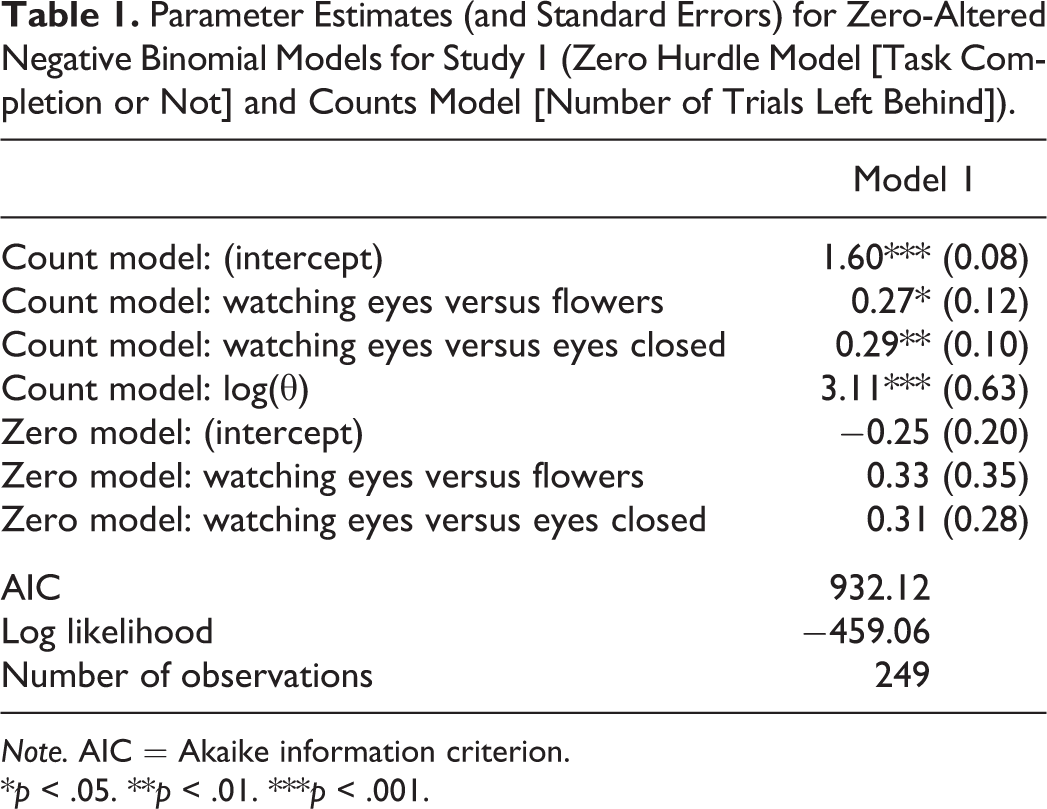
Our data provided partial support for the primary hypotheses. As shown in Table 1, both the eyes closed and flowers conditions differed significantly from the watching eyes condition in terms of the expected count distribution (Figure 1A). Participants who did not complete the task left significantly fewer trials behind when exposed to images of watching eyes (M = 5.02, SD = 2.23, Mdn = 5), as opposed to images of eyes closed (M = 6.65, SD = 3.12, Mdn = 6) or flowers (M = 6.50, SD = 2.93, Mdn = 6).
Parameter Estimates (and Standard Errors) for Zero-Altered Negative Binomial Models for Study 1 (Zero Hurdle Model [Task Completion or Not] and Counts Model [Number of Trials Left Behind]).
Note. AIC = Akaike information criterion.
*p < .05. **p < .01. ***p < .001.

(A–C). Histograms depicting the number of task trials that the participants did not perform. Higher scores indicate higher number of task trials that the participants did not perform.
Results showed no significant differences between watching eyes and eyes closed or flowers in terms of task completion (yes/no; see Figure 3A). Yet, it can be noted that the percentage of participants completing the task in the watching eyes condition was 56.1%, whereas in the closed eyes and flowers conditions, it was 48.5% and 48%, respectively. The contrasts between eyes closed and flowers were also not significant (count model: p = .825; zero hurdle model: p = .952). If we combine the eyes closed and flowers conditions and compare them to the watching eyes condition, we obtain a similar result (count model estimate: −0.282 ± 0.092, p = .002; zero hurdle estimate: −0.312 ± 0.261, p = .231).

Histograms depicting the number of task trials that the participants did not perform in all three studies combined. Higher scores indicate higher number of task trials that the participants did not perform.

(A–C). Bar graphs depicting the percentage of participants completing the task in each of the three studies. In Study 3, p value for significant difference between watching eyes and flowers was p < .05 (see Table 3). Remaining p values reveal no significant differences between other groups (at p < .05).
Thus, in line with our hypothesis, participants who did not complete the task and were exposed to images of watching eyes left significantly fewer trials behind than those in the other conditions. However, images of watching eyes did not seem to increase the likelihood of completing the task, in comparison with images of eyes closed or flowers. Furthermore, results showed no effect of the sex of eyes.
Study 2
The first study provided some initial support for the hypothesis that it is specifically the gaze of the eyes that elicits prosocial behavior. However, it is unclear whether prosocial behavior is affected only by eyes staring at the individual or just by the mere presence of any gaze. To test this alternative interpretation of our results, we conducted a replication of Study 1, but we included a condition of eyes with averted gaze instead of the condition of eyes closed. Do eyes that pay attention elicit greater levels of prosocial behavior than eyes that look away?
Materials and Methods
Participants and design
Following deletions for dyslexic tendencies (n = 10), the final sample consisted of 190 people (65.3% female; M age = 22.17 years, SD = 7.21 years). In a between-participants design, individuals were randomly assigned to one of five experimental conditions: (a) male watching eyes condition (n = 36), (b) male averted eyes condition (n = 41), (c) female watching eyes condition (n = 37), (d) female averted eyes condition (n = 36), (e) flowers condition (n = 40). In this five-condition design, our main interest was to test whether the two conditions of watching eyes will differ significantly from the two conditions of averted eyes and the control condition of flowers.
Typing task, eyes manipulation, and procedure
The experimental task and procedure were identical to those of Study 1 with one exception: The maximum number of trials of the typing task was raised to 18. Because many participants completed all task trials in Study 1, this may have led to a ceiling effect potentially masking the effect of gaze on overall task performance. Therefore, we increased the required effort for task completion by increasing the maximum number of trials from 15 to 18. Similar to Study 1, on each trial of the typing task, a pair of eyes or flowers suddenly appeared above the letter string (see Appendix B). Participants assigned to the watching eyes conditions viewed pairs of eyes with direct gaze, whereas participants assigned to the averted eyes conditions viewed pairs of eyes with averted gazes. Stimuli were obtained from the Radboud Faces Database (RaFD; Langner et al., 2010). Eye stimuli (240 × 90 mm in size) were cropped from the facial photographs of 18 Caucasian adult men and women, with neutral emotional expression (gray scale). As in Study 1, to prevent habituation, stimuli alternated between different images of the same set and were displayed on the screen during task trials.
Results and Discussion
Figure 1B displays the distributions, and these resemble the pattern found in Study 1. However, data from the second study provided no support to our hypotheses. There were no significant differences between either the averted eyes or the flowers condition and the watching eyes condition, either in the expected count distribution or in the distribution of zeros (all p >.13; Table 2; Figures 1B and 3B).
Parameter Estimates (and Standard Errors) for Zero-Altered Negative Binomial Models for Study 2 (Zero Hurdle Model [Task Completion or Not] and Counts Model [Number of Trials Left Behind]).

Note. AIC = Akaike information criterion.
*p < .05. **p < .01. ***p < .001.
Although more participants tended to complete the task when exposed to watching eyes (54.8%) as compared to averted eyes (49.4%) or flowers (45%), differences between groups were nonsignificant. Furthermore, although participants left fewer task trials behind when exposed to watching eyes (M = 8.76, SD = 4.22, Mdn = 8) as compared to the averted eyes (M = 10.31, SD = 4.62, Mdn = 11) or flowers (M = 9.64, SD = 3.54, Mdn = 10), differences between groups were nonsignificant. The contrast between averted eyes and flowers was also not significant (count model: p = .578; zero hurdle model: p = .655). Pooling the averted eyes and flowers condition and contrasting these with the watching eyes condition do not alter this conclusion (count model: p = .164; zero hurdle model: p = .353).
Thus, results from Study 2 provided no support for our hypothesis. In contrast to results from Study 1, watching eyes as compared to averted eyes or flowers did not lead to a significant increase in prosocial behavior, in terms of amount of trials left to be completed by the partner or likelihood of task completion. As in Study 1, there was no effect of the sex of eyes.
Study 3
The first two studies produced somewhat inconsistent results regarding the role of watching eyes in promoting prosocial behavior. In Study 3, we used images depicting averted eyes paired with a deviated head orientation. Averting both head and gaze (compared to averting only the gaze) may be a better signal that an individual is not paying attention and, therefore, is not watching (Langton, 2000).
Materials and Methods
Participants and design
Following deletions for dyslexic tendencies (n = 10) and suspicion (n = 5), the final sample consisted of 173 Dutch undergraduate students (76.3% female; M age = 20.73 years, SD = 3.61 years). In a between-participants design, individuals were randomly assigned to one of three experimental conditions: (a) watching eyes condition (n = 56), (b) averted eyes condition (n = 57), and (c) flowers condition (n = 60).
Typing task, eyes manipulation, and procedure
The task and procedure were identical to those of Study 2. Eye stimuli were cropped from the facial photographs of 18 Caucasian adult men and women (RaFD; Langner et al., 2010), with neutral emotional expression, averted gazes, and deviated head orientation (gray scale, see Appendix B). Given that in Studies 1 and 2, the sex of the eyes did not affect results, in this study, the sex of the eyes was not manipulated between participants, so that participants assigned to the watching eyes or the averted eyes conditions viewed pairs of both male and female eyes (in a random order).
Results and Discussion
Data provided partial support for the primary hypothesis. There was a significant difference between watching eyes and flowers in the expected task completion (yes/no): Participants in the watching eyes condition were more likely to complete the entire task than those in the flowers condition (Table 3; Figure 3C). Specifically, the percentage of participants completing the task was 60.7% in the watching eyes condition, whereas it was 41.7% in the flowers condition.
However, the conditions of watching eyes (M = 8.18, SD = 3.14, Mdn = 8) and flowers (M = 7.77, SD = 2.99, Mdn = 8) did not differ significantly in the number of trials left behind (Table 3, Figure 1C). Furthermore, the differences between watching eyes and averted eyes (M = 8.34, SD = 3.13, Mdn = 8) were not significant (Table 3), neither for the count nor for the yes/no distribution (count model: p = .420; zero hurdle model: p = .419). Although greater percentage (60.7%) of participants tended to complete the task when exposed to watching eyes as compared to averted eyes (49.1%), differences between groups were not significant. When we pool the averted eyes and flowers condition and compare these to watching eyes, we find a statistical trend for completion (zero hurdle estimate: 0.624 ± 0.331, p = .059) but not for the number of trials completed (count model estimate: −0.019 ± 0.087, p = .83).
Parameter Estimates (and Standard Errors) for Zero-Altered Poisson Models for Study 3 (Zero-Hurdle Model [Task Completion or Not] and Counts Model [Number of Trials Left Behind]).

Note. AIC = Akaike information criterion.
*p < .05. **p < .01. ***p < .001.
Thus, results from Study 3 showed that exposure to images of watching eyes (as compared to images of flowers) led to significantly greater prosocial behavior, in terms of likelihood of task completion. However, there were no significant differences in prosocial behavior between participants exposed to images of watching eyes and those exposed to images of averted eyes.
All Studies Combined
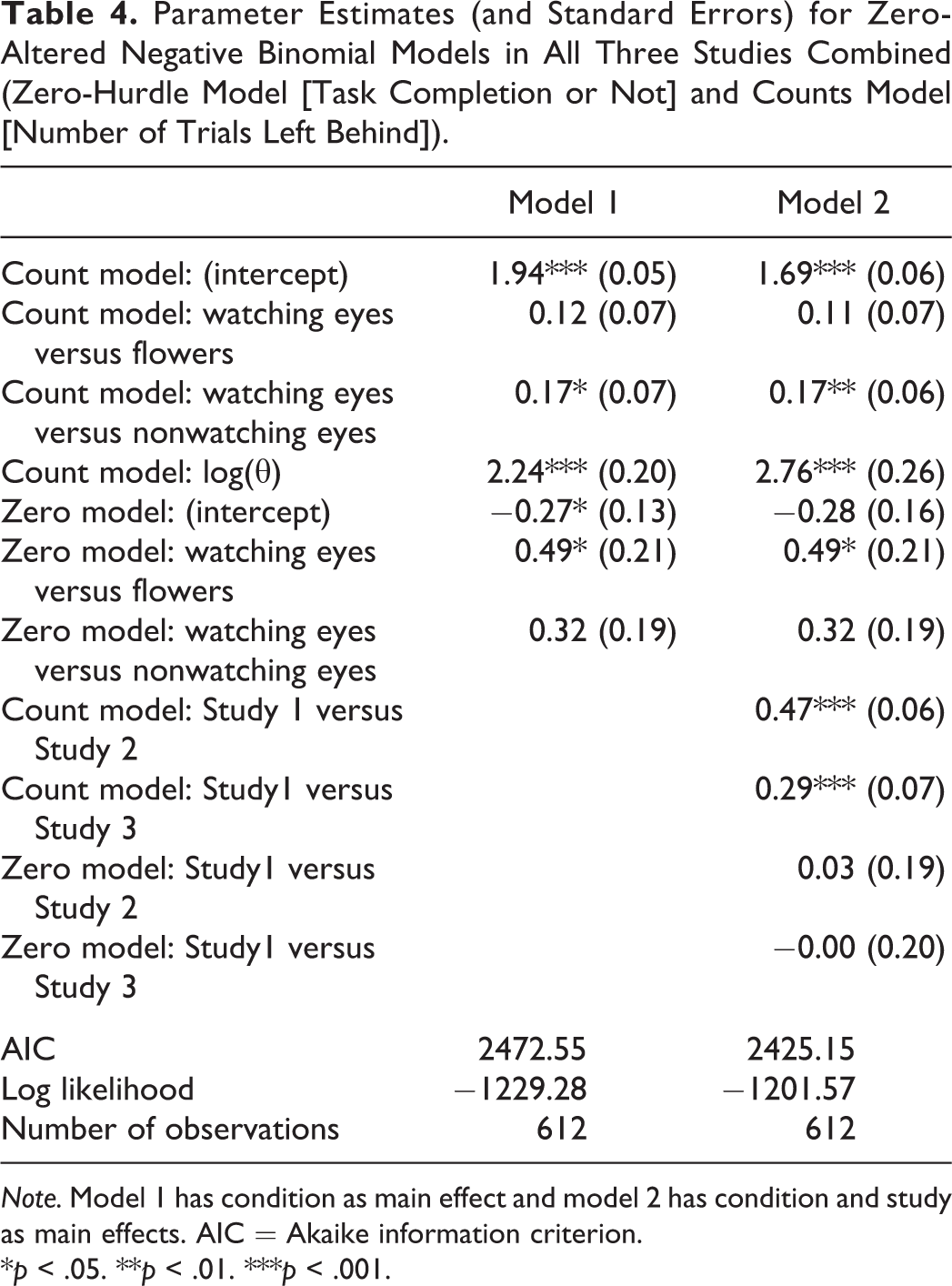
Given the somewhat inconsistent findings and our similar designs, we decided to combine the data of all three studies. The best fitting model contains two main effects, condition and study, but no interaction between them (Table 4). This suggests that the overall result is not driven by a particular condition from a single study. The analyses yielded four major findings.
Parameter Estimates (and Standard Errors) for Zero-Altered Negative Binomial Models in All Three Studies Combined (Zero-Hurdle Model [Task Completion or Not] and Counts Model [Number of Trials Left Behind]).
Note. Model 1 has condition as main effect and model 2 has condition and study as main effects. AIC = Akaike information criterion.
*p < .05. **p < .01. ***p < .001.
First, as compared to all other stimuli, images of watching eyes led to significantly greater levels of prosocial behavior in the typing task. Specifically, when we pool the flowers and nonwatching eyes conditions and contrast these with the watching eyes condition, we find that these contrasts are significantly different for both the count and the yes/no distribution (count model estimate: 0.149 ± 0.061, p = .015; zero hurdle estimate: 0.384 ± 0.169; p = .023). The task was completed by 56.8% of participants exposed to watching eyes as opposed to 47.3% of participants exposed to the other stimuli. Furthermore, if participants left some workload to the other individual, the amount of trials left behind was lower for the watching eyes condition (M = 6.99, SD = 3.64, Mdn = 6) as compared to all other conditions (M = 8.09, SD = 3.71, Mdn = 8).
Second, the contrast between nonwatching eyes and flowers was not significant for expected counts or completion (count model: p = .486; zero hurdle model: p = .413). Thus, the nonwatching eyes condition did not significantly differ from the flowers condition with regard to the number of trials left behind (M = 8.25, SD = 3.97, Mdn = 8; and M = 7.87, SD = 3.31, Mdn = 7, respectively) or the likelihood of completing the task (48.9% and 44.7%, respectively). This further suggests that it is the watching component of the eyes that matters for showing prosocial behavior in the typing task.
Third, focused comparisons between watching eyes and each of the other conditions yielded the following results. The watching eyes condition was significantly different from the flowers condition with respect to completion (Table 4; Figure 4) but not with respect to expected counts (Figure 2). Participants were thus significantly more likely to complete the task when exposed to images of watching eyes (56.8%) compared to images of flowers (44.7%). Furthermore, the watching eyes condition differed from the nonwatching eyes condition (i.e., averted eyes and eyes closed) in terms of counts but not in terms of task completion (Table 4; Figure 2). Participants left significantly fewer trials behind when eyes were watching (M = 6.99, SD = 3.64, Mdn = 6), as opposed to when eyes were not watching them (M = 8.25, SD = 3.97, Mdn = 8).

Bar graph depicting the percentage of participants completing the task in all three studies combined. The p value for significant difference between watching eyes and flowers was p < .05 (see Table 4). Remaining p values reveal no significant differences between other groups (at p < .05).
The overall picture is thus that watching eyes lead to both a higher completion rate of the task and leaving fewer trials behind (for those who do not complete it) than the other conditions combined. Specific comparisons show that watching eyes lead to significantly greater prosocial behavior in terms of task completion though dependent on the specific contrast (watching eyes vs. flowers: significantly greater completion/watching eyes vs. nonwatching eyes: significantly less trials left behind, when not completed).
General Discussion
The present research aimed to shed light on the circumstances under which images of eyes can promote prosocial behavior. In particular, we sought to explore whether eyes need to be watching in order to elicit prosocial behavior. We tested this hypothesis in three laboratory studies with a total combined sample of 612 participants.
Results from each individual study were not always completely consistent with one another, even though the pattern was very similar across the three studies. Focusing on the differences, we saw that Studies 1 and 3 showed that the tendency to reduce another’s workload was greater, when presented with eyes showing direct gaze as compared to control images of flowers. Furthermore, Study 1 provided support to the idea that the watching component of the eyes is important: The tendency to reduce another’s workload was greater, when faced with a direct gaze, as compared to eyes closed. And finally, Study 2 revealed no effect of eye images, and Study 3 showed no significant changes in prosocial behavior when exposed to a direct gaze as opposed to an averted eye gaze.
Given the mixed results and the prominent similarity with regard to study design and procedure of all three studies, we considered it the best approach for now to conduct a combined analysis to give insight into the bigger picture across the three studies. Combined analysis of all three studies provided evidence that watching eyes exerted a significant effect, although with small or modest effect size.
First, as compared to all nonwatching stimuli (i.e., eyes closed, averted gaze, and flowers), watching eyes led to significantly greater inclination to help another individual. The proportion of participants completing the task was significantly higher in the presence of a direct gaze (56.8%) as compared to all other stimuli (47.3%). Furthermore, participants who left some workload to the other individual tended to assign significantly lower amount of task trials when they were exposed to a direct gaze as compared to all other stimuli.
Second, specific comparisons further clarified the specific nature of the differences. As compared to control images of flowers, eyes showing direct gaze significantly increased the likelihood of completing the task to help another individual. The proportion of participants completing the task was significantly higher in the presence of a direct gaze (56.8%) as opposed to flowers (44.7%). Although there was no significant difference between direct gaze and nonwatching eyes (i.e., eyes closed and averted eyes) in terms of task completion, there was a significant difference in terms of trials left behind: Participants who left some workload to the other individual tended to assign significantly lower amount of task trials when they were exposed to direct gaze as compared to eyes closed and averted gaze.
Thus, the three studies together converge on the tentative conclusion that eyes are a meaningful cue to reputation when they are watching. By contrasting direct gaze with averted gaze and eyes closed, we demonstrated that attempts to build a reputation as prosocial person are more likely to take place when prosocial acts can be observed and therefore evaluated by others. In contrast to eyes directed at an individual, eyes in a closed state and eyes with averted gaze are unlikely to identify the individual and thus to remove anonymity. As participants’ behavior does not fall within “the spotlight of attention” anymore, nonwatching eyes are unlikely to jeopardize one’s reputation or to activate reputation management concerns. Our findings extend and complement existing knowledge on the eye images effect (e.g., Bateson et al., 2006; Ernest-Jones et al., 2011; Haley & Fessler, 2005) by showing that the watching component of the eyes moderates the effect of eye images on prosociality. Confirming earlier speculations (e.g., Burnham & Hare, 2007), the current research provides empirical evidence for the potential relevance of gaze detection mechanisms that examine whether the honest indicator of monitoring (i.e., watching eyes) is there and thus whether reputation is at stake.
The current findings are also in accordance with the broader literature on the role of reputation concerns in increasing prosociality (i.e., data on image scoring and gossip, Nowak & Sigmund, 1998; Piazza & Bering, 2008). These data, also, complement prior work by Tane and Takezawa (2011), who found that people do not show increased prosocial behavior in the presence of eyes that cannot recognize the identity of a person, like eye images presented in darkness. As with the experience of darkness, a pair of closed or averted eyes may have elicited a sense of concealment, leading participants to experience comparably low levels of reputational concerns.
It is worth noting that exposure to images of nonwatching eyes did not make people act significantly more prosocially than exposure to images of flowers. Although eyes that are not paying attention may serve as reminders of social environment, they appear to be as weak as control stimuli in making people signal prosocial dispositions. Despite evidence that nonwatching eyes activate the social brain and have important psychological implications (Emery, 2000; Hoffman & Haxby, 2000; Wirth et al., 2010), the present research suggests that they might not be as powerful as watching eyes in triggering reputational concerns and in promoting prosocial behavior. For reputational concerns to be activated, the eyes need to be watching you and not being closed or looking away.
It is also useful to discuss the present findings from methodological perspectives. First, the findings underline the need for rigorous statistical approaches that analyze data on the eye images effect from multiple perspectives (i.e., both binary and count or continuous data) without compromising statistical power. As in the case of the typing task, other measures of prosocial behavior often yield zero-inflated data with the majority of participants acting prosocially (or not). In the dictator game, for instance, most of the participants donate a certain amount rather than no amount (Engel, 2011). We posit that in such cases, statistical approaches modeling two steps, decision (yes/no) and/or the amount to contribute, are perhaps more suitable. In line with recent discussion on suitable statistics for testing the eye images effect (Nettle et al., 2013), our data highlight the importance of more informative models than the traditional approaches.
Second, it is perhaps not completely surprising that the eye images effect was somewhat inconsistently observed in each individual study. After all, various individual studies have disputed the role of eyes in modulating behavior (see, e.g., Fehr & Schneider, 2010; Raihani & Bshary, 2012; Vogt et al., 2015). This, in turn, has given rise to a lively debate in the literature encouraging multiexperiment papers and meta-analytical reviews in an attempt to shed light on the circumstances under which eyes do or do not matter (e.g., Cai et al., 2015; Nettle et al., 2013; Sparks & Barclay, 2013). Therefore, our data also point to the importance of drawing conclusions regarding the eye images effect based on multiple studies, rather than on single studies. Considering that the present research was the first attempt to explore the moderating role of eye gaze (to our knowledge), future research using different behavioral paradigms is needed to further explore the phenomenon. Also, it is important to note that our three studies yielded very similar findings for the contrast between nonwatching eyes and the flower conditions.
In general, the present research advances the state of knowledge on the eye images effect in various ways: (a) showing that eye gaze conveys a signal that is fundamental in enhancing prosociality, (b) using a noneconomic approach to the effect of eye images on prosocial behavior in the laboratory, and (c) underlying the importance of considering alternative statistical analyses for a better understanding of data on the eye images effect.
One limitation of the present research is the use of grayscale resolution stimuli, which may be less realistic (as compared to full color stimuli) and may therefore dampen the eye images effect. The reason behind the use of grayscale images was to eliminate the possibility that color differences may affect perception of stimuli or participants’ mood and behavior (Elliot & Maier, 2007; Fink, Grammer, & Matts, 2006; Kleisner, Kočnar, Rubešová, & Flegr, 2010). Future studies could consider exploring whether more (vs. less) realistically looking stimuli can modulate the effect of watching eyes. A second limitation concerns the use of flower images as control stimuli. Although various studies on the eye images effect and other phenomena have used images of flowers as “neutral” control stimuli (see e.g., Bateson et al., 2006; Dasgupta & Asgari, 2004; Ernest-Jones et al., 2011; Francey & Bergmüller, 2012; Öhman & Mineka, 2003), the neutrality of those stimuli may be debated. Future research could offer insights into the boundary conditions of the eye images effect by juxtaposing the effect of eyes against that of various other controls and perhaps also different cues to social presence (e.g., images of other face parts, voice cues).
A third limitation is that the present research is restricted solely to samples of university students, and thus results cannot yet be generalized broadly (see also Henrich, Heine, & Norenzayan, 2010). Despite the homogeneity of the participant pool, convenience samples of undergraduate students are likely to have higher scores of intelligence (including emotional intelligence) as compared to the general population. Given that the eye images effect has been debated in the literature (see, e.g., Fehr & Schneider, 2010; Raihani & Bshary, 2012; Vogt et al., 2015), the present findings need replication ideally via more diverse samples. Furthermore, future studies could consider exploring the role of potential moderators of the effect of watching eyes. Prior research has underlined the influence of individual differences (e.g., in regulatory focus or public self-awareness, see Keller & Pfattheicher, 2011; Pfattheicher & Keller, 2015) in the phenomenon. Considering that our research revealed small to modest effects, testing the role of individual differences in the eye images effect could be a promising avenue for future research.
Conclusions
The extant literature suggests that reminders of reputation, in the form of human eyes, promote human cooperation and prosociality. We extend this general argument by arguing that it is not merely the eyes as such that promote prosociality: It is the eyes that pay attention. In particular, we suggest that it is eyes that pay attention and seem to play a key role as a reminder of reputation, serving as a key mechanism promoting prosocial behavior. As such, we see two broad contributions of our article. Empirically, it contributes to getting a grip on the inconsistency in findings of the eyes-images effect. Theoretically, we suggest that the reminder of reputation is in the eye gaze. This seems logical because reward and punishment often start with signals conveying approval or disapproval. Such signals clearly have functional value in that they are effective and efficient tools for regulating individual members within a social group. Indeed, “looking away” does not convey this signal and may even signal the complete absence of approval or disapproval. Thus, we close with the tentative conclusion that it is the signal rather than the eyes as such that serve as a reminder of reputation—and it is those social signals that help individuals to enact prosocially oriented behaviors.
Footnotes
Appendix A
Example trial of the typing task with a picture of watching eyes (Studies 2 and 3, RaFD; Langner et al., 2010).
Appendix B
Example pictures of watching eyes, averted eyes, and flowers used in Studies 2 and 3 (RaFD; Langner et al., 2010).
(a) Watching eyes trial in Studies 2 and 3.
(b) Averted eyes trial in Study 2.
(c) Averted eyes trial in Study 3.
(d) Flowers trial in Studies 2 and 3.
Acknowledgments
The authors wish to thank two anonymous reviewers for their constructive suggestions and Prof. Dr. Daniel Nettle for the fruitful discussion of a previous version of this article.
Declaration of Conflicting Interests
The author(s) declared no potential conflicts of interest with respect to the research, authorship, and/or publication of this article.
Funding
The author(s) disclosed receipt of the following financial support for the research, authorship, and/or publication of this article: This project was made possible through the support of a grant from the John Templeton Foundation (Grant ID: 43919). The opinions expressed in this publication are those of the authors and do not necessarily reflect the views of the John Templeton Foundation.
