



Abstract
A man whose romantic partner is sexually unfaithful is at risk of sperm competition and cuckoldry—unwitting investment in offspring to whom he is genetically unrelated. Men, therefore, may have evolved mechanisms to solve the adaptive problems of sperm competition and cuckoldry. The current research investigates another potential anti-cuckoldry tactic: reducing in-pair copulation (IPC) duration, thereby more quickly placing his sperm into competition. We hypothesize that IPC duration will be negatively correlated with female infidelity (Hypothesis 1). We further hypothesize that IPC duration will be negatively correlated with sexual coercion (Hypothesis 2). Results of Study 1 (men’s reports, n = 410) indicate that both men’s perceptions of female infidelity and men’s sexual coercion predict shorter IPC duration. Results of Study 2 (women’s reports, n = 455) did not provide statistical support for the study hypotheses. The current research provides an initial investigation of men’s adjustment of copulatory duration and suggests that men reduce IPC duration and ejaculate more quickly at the couple’s most recent copulation, in response to greater risk of sperm competition and in the context of sexual coercion.
Sperm competition occurs when the sperm of two or more males simultaneously occupy a female’s reproductive tract and compete to fertilize the ova (Parker, 1970). Sperm competition has been demonstrated or inferred to exist in many species, including humans (Baker & Bellis, 1993a, 1993b; Birkhead & Moller, 1992). A recurrent context for sperm competition in humans is female infidelity or extra-pair copulation (Baker & Bellis, 1993b; Gallup et al., 2003; Shackelford et al., 2002; Smith, 1984). A man whose long-term partner pursues extra-pair copulations is at risk of sperm competition and subsequent cuckoldry—unwitting investment in offspring to whom he is genetically unrelated. Cuckoldry has likely been a recurrent adaptive problem for humans (Baker & Bellis, 1995; Buss & Shackelford, 1997; Voracek, Haubner, & Fisher, 2008). Because human males often invest in their putative offspring (Chrastil, Getz, Euler, & Starks, 2006; Trivers, 1972), the costs of cuckoldry can be substantial (Leivers & Simmons, 2014).
Men, therefore, may have evolved anti-cuckoldry tactics to prevent or to participate in sperm competition to guard their paternity (Platek & Shackelford, 2006; Shackelford et al., 2002 , 2005). Anti-cuckoldry tactics include mate guarding behaviors (Buss, 1988; Buss & Shackelford, 1997), frequent in-pair copulations (IPCs; Pham, Shackelford, Holden, Zeigler-Hill, Hummel, & Memering, 2014; Shackelford, Goetz, Guta, & Schmitt, 2006), sexually coercing IPCs (Goetz & Shackelford, 2006; reviewed in Goetz, Shackelford, & Camilleri, 2008), semen-displacing copulatory behaviors (Gallup et al., 2003; Goetz et al., 2005), ejaculate adjustments (Baker & Bellis, 1993a, 1995), partner-abuse during pregnancy (Burch & Gallup, 2004), and adjustments in parental investment (Platek, Burch, Panyavin, Wesserman, & Gallup, 2002).
The current research investigates another potential anti-cuckoldry tactic: reducing IPC duration. Men who perceive greater sperm competition risk report increased urgency to copulate with their in-pair partner, which, in part, reflects an urgency to submit sperm into competition (Shackelford et al., 2002; Shackelford, Goetz, McKibbin, & Starratt, 2007; see also Spiess, Geer, & O’Donohue, 1984). Because sexual behavior is caused proximately by sexual arousal, reducing ejaculatory latency and, therefore, copulatory duration, affords quicker entry into sperm competition. We hypothesize that, in humans, IPC duration will be negatively correlated with female infidelity (Hypothesis 1).
Women attempt to delay IPC following copulation with another man (Gallup, Burch, & Mitchell, 2006), suggesting that women may manipulate sperm competition in favor of an extra-pair partner. In contrast, men report greater sexual interest in their partner and greater urgency to copulate with their partner following suspicions of her infidelity (Pham & Shackelford, 2013; Shackelford et al., 2002). As a consequence of this sexual conflict, men may attempt to counter women’s resistance to IPC by deploying tactics of sexual coercion to gain sexual access to their partner and quickly enter into sperm competition.
Men at greater risk of sperm competition report more frequent use of sexual coercion (McKibbin, Starratt, Shackelford, & Goetz, 2011), and women who self-report infidelity also report that their partner is more sexually coercive (Goetz & Shackelford, 2006, 2009). Men at greater sperm competition risk, including men who perceive greater risk of partner infidelity, report greater upset in response to a partner’s resistance to IPC (Pham & Shackelford, 2013; Shackelford et al., 2002, 2007), and this upset is positively associated with men’s self-reports and women’s partner reports of sexual coercion (Shackelford & Goetz, 2004). Research in other animals corroborates the hypothesis that sexual coercion may function as an anti-cuckoldry tactic (Barash, 1997; McKinney, Cheng, & Bruggers, 1984). In many socially monogamous birds, for example, forced IPC reliably occurs immediately following female extra-pair copulation (Bailey, Seymour, & Stewart, 1978; Barash, 1997; Birkhead, Hunter, & Pellatt, 1989).
Research with other animals also indicates that forced copulations are shorter in duration than nonforced copulations. For example, males of several species of waterfowl (family Anatidae) often perform precopulatory displays prior to nonforced IPCs (McKinney, Derrickson, & Mineau, 1983). During forced IPCs, however, males do not perform precopulatory displays (McKinney et al., 1983). This suggests that males may be attempting to inseminate the female quickly by eliminating precopulatory displays, affording males the opportunity to more quickly enter their sperm into competition. Similarly, sneak copulations in guppies (Poecilia reticulata) are shorter in duration than courtship copulations (Pilastro, Mandelli, Gasparini, Dadda, & Bisazza, 2007), and males who specialize in sneak copulations experience greater sperm competition—as indexed by their larger relative testes size (Taborsky, 1998). In other species, reduced copulatory duration may also function to minimize detection by another male. However, men in intimate relationships already have regular access to their partner and reduced copulatory duration is less likely to be an attempt to reduce detection from a rival male and more likely to be implemented as an anti-cuckoldry tactic.
On the basis of this comparative research, we anticipate that sexually coercive men may also reduce IPC duration. Therefore, we hypothesize that IPC duration will be negatively correlated with sexual coercion (Hypothesis 2). However, sexual coercion in human intimate relationships can take more subtle forms than physically forced copulation (Goetz & Shackelford, 2006; Shackelford & Goetz, 2004). Men who use physical force to obtain sexual access to their partner risk incurring severe costs, including their partner’s defection from the relationship (Goetz & Shackelford, 2006). Men, therefore, use more subtle forms of sexual coercion before resorting to physical force. Shackelford and Goetz (2004) identified three components of sexual coercion that men use in intimate relationships: (1) Commitment Manipulation (e.g., “I told my partner that if she loved me she would have sex with me”), (2) Defection Threat (e.g., “I threatened to have sex with another woman if my partner did not have sex with me”), and (3) Resource Manipulation/Violence (e.g., “I withheld benefits that my partner depends on to get her to have sex with me”; “I threatened to physically force my partner to have sex with me”).
In summary, we propose that, in response to suspicions of female infidelity, men deploy anti-cuckoldry tactics to enter their sperm into competition to guard their paternity. Specifically, following perceptions of female infidelity, men may use sexual coercion to counter women’s resistance to IPC and quickly inseminate their partner to increase their chances of success in sperm competition. We conducted two independent studies to test two hypotheses derived from sperm competition theory. In Study 1, we secured men’s reports on the target variables, and in Study 2, we secured women’s reports on these same variables.
Study 1: Men’s Reports
Study 1 secured men’s reports to test the hypothesized relationships between perceptions of female infidelity, sexual coercion, and IPC duration. Following Goetz and Shackelford (2006), we operationalized sperm competition risk as men’s perceptions of their partner’s past infidelity and likelihood of future infidelity.
Method
Participants
Participants were 410 men in a committed, heterosexual, sexual relationship for at least 1 month. The mean age of participants was 24.6 years (SD = 8.0), the mean age of the men’s partners was 23.3 years (SD = 7.4), and the mean relationship length was 39.0 months (SD = 61.3). Approximately half of the participants were university students, and the other half of participants were from communities surrounding the university where the research was conducted.
Materials
Participants completed an anonymous survey that requested demographic information, including the participant’s age, their partner’s age, and the length of their relationship. Participants then answered questions about their partner’s infidelities, their own use of sexually coercive tactics, and their most recent IPC.
Partner’s infidelity
Men were asked four questions about their partner’s infidelity: “As far as you know, has your current partner had sexual intercourse [fallen in love] with someone other than you since you have been involved in a relationship together?”; How likely do you think it is that your current partner will in the future have sexual intercourse [fall in love] with someone other than you, while in a relationship with you?” Men responded to each question on a 10-point Likert-type scale ranging from 0 (definitely no/not at all likely) to 9 (definitely yes/extremely likely). We calculated the mean of the responses to the four questions to create a composite variable female infidelity (α = .71) for each participant as an indicator of sperm competition risk.
IPC duration
Men reported on the relative duration of their last copulation with their partner in which the man ejaculated as a result of penetrative, penile-vaginal sex, by responding to the question “In comparison to what is typical, how long did sexual intercourse with your partner last?” on a 10-point Likert-type scale ranging from 0 (much less time than is typical) to 9 (much more time than is typical). We asked participants to indicate the relative length of time that copulation lasted, rather than absolute length of time (e.g., in minutes) that copulation lasted. On average, IPC duration in humans is approximately five to six minutes; however, IPC duration can, in rare instances, last upward of 45 minutes (Waldinger et al., 2005). By assessing relative copulation duration, we are able to control for individual differences in participant’s average length of IPC that, for example, may be influenced by motivations to sexually please a romantic partner.
Sexual coercion
The Sexual Coercion in Intimate Relationships Scale (SCIRS; Shackelford & Goetz, 2004) was used to assess men’s use of sexually coercive acts in their current relationship. The SCIRS asks how often men performed 34 sexually coercive acts in the past one month. Participants respond to each item on a 6-point scale (0 = act never occurred; 1 = act occurred 1 time; 2 = act occurred 2 times; 3 = act occurred 3–5 times; 4 = act occurred 6–10 times; 5 = act occurred 11 or more times). Responses to each statement were recoded as the midpoint of the response category the participant reported. For example, if the participant reported an act occurring “3–5 times in the past month,” the response was recoded as occurring 4 times in the past month. Responses indicating “act occurred 11 or more times” were recoded as occurring 15 times in the past month. The SCIRS assesses three components: Commitment Manipulation, Defection Threat, and Resource Manipulation/Violence (see above for sample items). Following Shackelford and Goetz (2004), composite scores were calculated by summing the recoded response category midpoints for the appropriate items, yielding a composite score for each participant for overall sexual coercion and each sexual coercion component.
Procedure
The current research was approved by the institutional review board at the university at which the research was conducted. Participants who met the following criteria were eligible for the current study: (1) male, (2) at least 18 years old, and (3) currently in a committed, heterosexual, sexual relationship for at least 1 month. Prospective participants arrived at a specified location and read a consent form. Participants who met the criteria and agreed to participate completed a survey and returned the completed survey to the researcher in an unmarked, sealed envelope.
Results
Zero-order correlations and descriptive statistics for the target variables are reported in Table 1. Relationship length was not correlated with the predictor variables (i.e., female infidelity and sexual coercion) and is therefore not included as a confounding variable in subsequent analyses. We calculated a zero-order correlation between perceived female infidelity and IPC duration to test whether female infidelity—as a measure of sperm competition risk—is associated with shorter IPC duration. The result supports Hypothesis 1 in that greater perceived sperm competition risk is correlated with shorter IPC duration (see Table 1).
Study 1: Men’s Reports. Zero-Order Correlations and Descriptive Statistics.
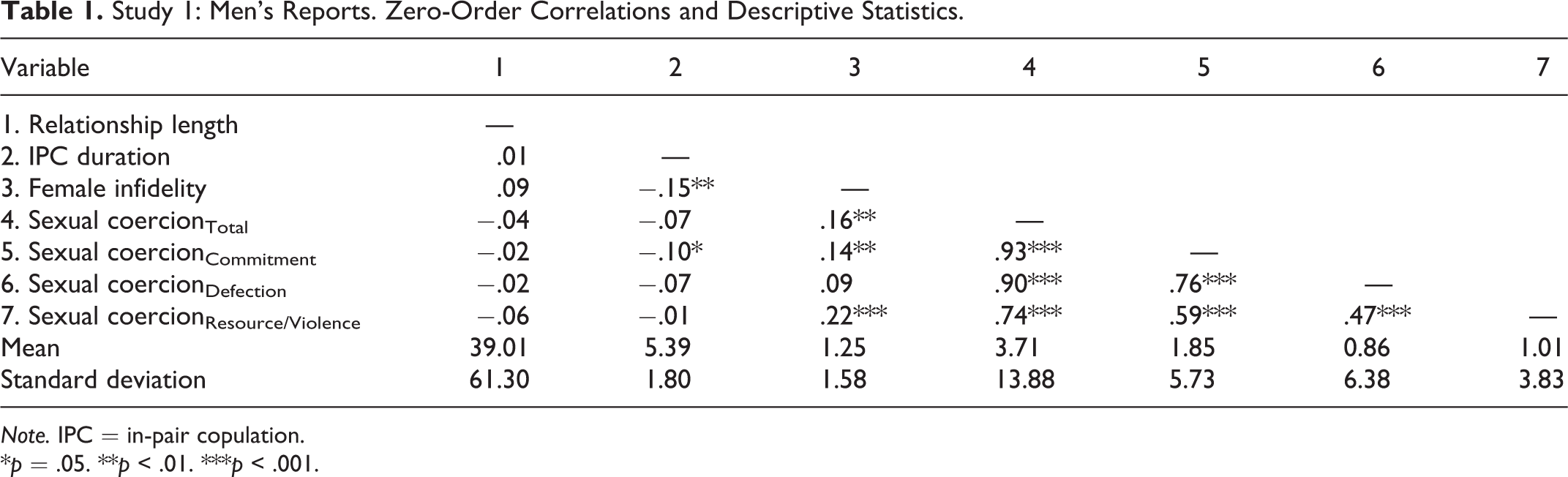
Note. IPC = in-pair copulation.
*p = .05. **p < .01. ***p < .001.
We calculated a zero-order correlation to test whether sexual coercion is associated with shorter IPC duration. The result provides support for Hypothesis 2 in that that men who report more frequent use of sexually coercive Commitment Manipulation acts also report shorter IPC duration (see Table 1). A multiple linear regression was conducted as a more stringent test of Hypothesis 2. The three sexual coercion components (Commitment Manipulation, Defection Threat, and Resource Manipulation/Violence) were simultaneously entered into the regression analysis, with IPC duration as the dependent variable (see Table 2). Men’s use of sexually coercive Commitment Manipulation acts remained the best predictor of IPC duration, approaching statistical significance (p = .07).
Study 1: Men’s Reports. Multiple Regression Analysis With IPC Duration as the Dependent Variable.

Note. IPC = in-pair copulation.
Study 2: Women’s Reports
Men’s reports of their partner’s infidelities and their use of sexual coercion may be inaccurate (Dobash, Dobash, Cavanagh, & Lewis, 1998; Edleson & Brygger, 1986). Study 2 secured reports from an independent sample of women to examine the hypothesized relationships between female infidelity, men’s use of sexual coercion, and IPC duration.
Method
Participants
Participants were 455 women in a committed, heterosexual, sexual relationship for at least 1 month. Women in this study were not necessarily partnered to the men in Study 1. The mean age of the participant was 22.1 years (SD = 5.7), the mean age of the women’s partner was 24.4 years (SD = 6.9), and the mean relationship length was 31.4 months (SD = 41.8 months). Approximately half of the participants were university students, and the other half of participants were from communities surrounding the university where the research was conducted.
Materials
The survey used in Study 2 was parallel to the survey used in Study 1, with appropriate replacement of gender-relevant terms.
Self-reported infidelity
Women were asked four questions to assess their past infidelities and the likelihood of committing future infidelities. Women responded “yes” or “no” to the question: “Have you had sexual intercourse with someone other than your current partner since you have been involved in a relationship with your current partner?” Dichotomous responses to the past sexual infidelity question were recoded such that a “no” response was recoded “0,” and a “yes” response was recoded “9.” Women also responded to the questions: “Have you fallen in love with someone other than your current partner since you have been involved in a relationship with your current partner?” and “How likely do you think it is that you will in the future have sexual intercourse [fall in love] with someone other than your current partner, while in a relationship with your current partner?” Women responded to these questions on a 10-point Likert-type scale ranging from 0 (definitely no/not at all likely) to 9 (definitely yes/extremely likely). We then averaged responses to the four questions to create a composite variable female infidelity (α = .60) for each participant as an indicator of sperm competition risk.
IPC duration
In parallel with Study 1, women reported on the relative duration of their last copulation with their partner in which their partner ejaculated as a result of penetrative, penile-vaginal sex, by responding to the question “In comparison to what is typical, how long did sexual intercourse with your partner last?” on a 10-point Likert-type scale ranging from 0 (much less time than is typical) to 9 (much more time than is typical).
Partner’s use of sexual coercion
In parallel with Study 1, women completed the SCIRS (Shackelford & Goetz, 2004) to report their partner’s use of sexual coercion. Following Shackelford and Goetz (2004), we calculated participant’s composite scores for overall sexual coercion and each sexual coercion component (i.e., Commitment Manipulation, Defection Threat, and Resource Manipulation/Violence).
Procedure
The current research was approved by the institutional review board at the university at which the research was conducted. Participants who met the following criteria were eligible for the current study: (1) female, (2), at least 18 years old, and (3) currently in a committed, heterosexual, sexual relationship for at least 1 month. Prospective participants arrived at a specified location and read a consent form. Participants who met the criteria and agreed to participate completed a survey and returned the completed survey to the researcher in an unmarked, sealed envelope.
Results
Zero-order correlations and descriptive statistics for the target variables are reported in Table 3. Relationship length was not correlated with the predictor variables (i.e., female infidelity and sexual coercion) and is therefore not included as a confounding variable in subsequent analyses. We calculated a zero-order correlation between self-reported infidelity and IPC duration to investigate whether female infidelity is associated with shorter IPC duration. The correlation between women’s reports of their infidelity and IPC duration was not statistically significant (see Table 3).
Study 2: Women’s Reports. Zero-Order Correlations and Descriptive Statistics.

Note. IPC = in-pair copulation.
*p < .05. **p < .01. ***p < .001.
We calculated a zero-order correlation to investigate whether women’s reports of their partner’s sexual coercion is correlated with shorter IPC duration. The correlations between the three sexual coercion components and IPC duration were not statistically significant (see Table 3). A multiple linear regression was conducted as a more stringent test of Hypothesis 2. The three sexual coercion components (Commitment Manipulation, Defection Threat, and Resource Manipulation/Violence) were simultaneously entered into the regression analysis, with IPC duration as the dependent variable (see Table 4). Women’s reports of their partner’s use of sexually coercive Defection Threat acts were the best predictor of IPC duration, approaching statistical significance (p = .07).
Study 2: Women’s Reports. Multiple Regression Analysis with IPC Duration as the Dependent Variable.

Note. IPC = in-pair copulation.
General Discussion
The results of Study 1 (men’s reports) support Hypothesis 1 in that perceptions of female infidelity are correlated with shorter relative IPC duration. The results of Study 1 also support Hypothesis 2 in that men’s use of sexually coercive Commitment Manipulation is correlated with shorter relative IPC duration. The results of Study 2 (women’s reports), however, do not provide statistical support for Hypotheses 1 and 2: The correlation between women’s self-reported infidelities and IPC duration, and between women’s reports of their partner’s use of sexually coercive acts and IPC duration, is not statistically significant.
Tests of Hypothesis 1 investigated whether IPC duration is shorter in response to sperm competition risk—operationalized as female infidelity. Men’s reports indicate that as perception of sperm competition risk increases, the duration of IPC decreases. We suggest that circumstances indicative of sperm competition—specifically, a man’s partner’s extra-pair copulation—motivate men to enter their sperm into competition as quickly as possible, resulting in relatively shorter IPC duration. Women’s reports do not replicate this relationship, although women’s reports of their partner’s use of sexually coercive Defection Threat acts approached statistical significance.
Men may face a trade-off in copulatory strategies following female infidelity: Quickly enter sperm into competition or perform semen-displacement behaviors to extract rival sperm from the vagina. Consequently, IPC duration may be relatively shorter or longer, respectively, depending on the copulatory strategy a man pursues. Men’s copulatory strategy might be determined by whether they are attempting to prevent or correct female infidelity (Shackelford, 2003). We operationalized sperm competition risk in Study 1 as men’s perception of female infidelity. The results indicate that men engage in shorter IPC when they perceive greater risk or likelihood of female infidelity, which we suggest is a corrective sperm competition strategy. Goetz and colleagues (2005) suggested that men might pursue longer duration of IPC as a corrective strategy in response to sperm competition risk—operationalized in their research as female partner attractiveness. However, a partner’s attractiveness can also motivate men to prevent infidelity because her attractiveness portends that she is more likely to have extra-pair suitors. Thus, the relationship between female attractiveness and longer IPC duration might also be indicative of men’s attempts to prevent partner infidelity (see Buss, 1988; Buss & Shackelford, 1997).
The IPC duration and, consequently, the copulatory strategy men deploy, might be affected by a variable not measured in the current research or in Goetz et al.’s (2005) research: the time since a woman’s suspected or known extra-pair copulation. The time since a women’s extra-pair copulation might affect men’s copulatory strategy at the next IPC. For example, longer copulation duration—which includes more semen-displacing behaviors—might be a more effective sperm competition strategy in circumstances in which the time between a woman’s copulation with an extra-pair partner and an in-pair partner is brief. Under these circumstances, a rival man’s sperm and spermicidal substances have not yet been ejected from the vagina (e.g., less than 1 hour; Baker & Bellis, 1993b, 1995), and reduced ejaculatory latency may adversely affect semen displacement (Gallup & Burch, 2004). Shorter copulation duration—quickly entering sperm into competition—might be more likely in circumstances in which the time between a woman’s extra-pair copulation and IPC is longer (e.g., more than 1 hour; Baker & Bellis, 1993b), and it is unlikely that rival sperm are still present in the vagina. After sperm are ejected from the vagina, adjusting IPC duration to be shorter—ejaculating quickly—may be a more successful sperm competition strategy (but see, Gallup & Burch, 2004). This hypothesis is contingent on two factors: (1) the duration of how long sperm remain in the vagina (i.e., the “corrective window”; Baker & Bellis, 1995; Johnson & Everitt, 1995; Morris, 1977; Smith, 1984), and (2) a woman’s behavior after sexual intercourse (Gallup & Burch, 2006; but see, Baker & Bellis, 1995). Our understanding of men’s strategies to correct or prevent female infidelity (Shackelford, 2003), such as extending IPC duration to facilitate semen displacement, would be informed by assessing the time between a woman’s perceived or actual extra-pair copulation and the next IPC.
Men’s reports indicate a relationship between sexually coercive Commitment Manipulation and shorter IPC, supporting Hypothesis 2. This suggests that the duration of coercive sex is shorter than consensual sex, consistent with the results of research on nonhumans (e.g., waterfowl; McKinney et al., 1983). The current research is the first to investigate copulatory behavior—in particular, copulation duration—associated with reports of sexual coercion in humans. Men who employ sexual coercion to secure IPCs may be pursuing a copulatory strategy that affords quick entry into sperm competition, rather than a strategy to displace rival sperm that may be present.
The nonsignificant relationship between women’s reports of their infidelity and shorter IPC duration may be a result of a perceptual bias unique to the context of sexually coercive copulations. Because sexual coercion is often psychologically traumatizing for women (Campbell, 1989; Thornhill & Thornhill, 1990, 1991), women’s reports of copulation duration and/or the frequency of sexual coercion may differ from men’s reports. Recent research (Bélanger, Mathieu, Dugal, & Courchesne, 2015) conducted with romantic couples indicates that, compared to their male partner, women significantly underreport instances of sexually coercive behavior (measured by the Conflict Tactics Scale; Straus, Hamby, Boney-McCoy, & Sugarman, 1996). Discrepancies between male and female reports may account for the sex differences observed in the current research. Nevertheless, men’s reports suggest that future research might profitably investigate sexually coercive copulatory behaviors and strategies. Future research could secure data from both romantic partners to obtain more accurate corroborating reports of sexual behavior in intimate relationships.
The results of the current research are not conclusive regarding the relationships between sperm competition risk, sexual coercion, and copulation duration. Men’s reports (Study 1) provide support for the study hypotheses, but women’s reports (Study 2) do not corroborate these findings. The current research offers an initial investigation into adjustments of copulatory duration in humans—a domain that has not yet been explored. Future research that addresses the limitations of the current studies (see below) could continue to profitably investigate copulation duration in humans.
Limitations and Future Directions
The current research secured data from independent samples of men and women. Although securing men’s reports and women’s reports of the same behaviors might afford triangulating on reliable assessments of the relevant phenomena, the current data are limited in that we secured data from men and women who were not partnered to one another. Future research might secure daily reports from both members of couples to afford more reliable assessments of sexual coercion and related copulatory behaviors in intimate relationships.
Another limitation is that we assessed the duration of the most recent IPC. In contrast, we assessed the frequency with which men performed sexually coercive acts during the previous one month. Because of the difference in assessment time frame for the two variables, we cannot be certain that sexual coercion was used to secure the copulation about which participants reported. Future research addressing sexual coercion in intimate relationships and copulatory behaviors could secure reports about sexually coercive acts used to achieve a specific IPC. Additionally, research could investigate the average time of IPCs or average time in the previous one month (e.g., in minutes) to afford congruence between measures of sexual coercion and copulatory duration. This would afford stronger claims about whether and how the use of sexual coercion is related to copulation duration in response to female infidelity.
Moreover, we secured a relative measure of copulatory duration (how long copulation lasted compared to “what is normal for you”), rather than an absolute measure of copulation duration (how long copulation lasted, in minutes). Although our measure of copulation duration afforded control of individual differences in copulation duration, we suggest that future research investigates absolute length of copulation duration. Because the upper limits of copulation duration in humans (e.g., 45 min; Waldinger et al., 2005) may indicate an increased motivation to sexually please one’s partner, the absolute duration of copulation could provide useful information regarding whether—under circumstances of increased sperm competition risk—men are less inclined to sexually please their partner for the benefit of entering their sperm into competition more quickly.
Finally, the results of the current research are correlational, and thus strong statements of causality are not defensible. Based on the available literature, however, we argue that men’s copulatory behaviors and use of sexual coercion are motivated by increased sperm competition risk—in particular, by perceived or actual female infidelity. It is possible, however, that men’s sexual coercion motivates women to pursue extra-pair copulations or eventually to terminate the relationship.
Conclusion
Female infidelity is a primary context in which sperm competition might have occurred over human evolutionary history and may have occasionally resulted in cuckoldry. Because cuckoldry can inflict substantial costs on paternally investing males, men may have evolved strategies to solve this class of adaptive problems. We tested the hypotheses that female infidelity and men’s use of sexual coercion are associated with shorter IPC duration. Men’s reports indicate that perceptions of their partner’s infidelity are correlated with shorter IPC duration, which we argue reflects a copulatory strategy to quickly enter sperm into competition. Men’s reports also indicate that sexually coercive men reduce IPC duration. These findings contribute to our understanding of men’s use of sexual coercion in intimate relationships and, more generally, to our understanding of human male adaptations to sperm competition.
Footnotes
Declaration of Conflicting Interests
The author(s) declared no potential conflicts of interest with respect to the research, authorship, and/or publication of this article.
Funding
The author(s) received no financial support for the research, authorship, and/or publication of this article.