




Abstract
While smiling enhances women’s facial attractiveness, the findings are inconclusive for men. The present study investigated the effect of smiling on male facial attractiveness for short- and long-term prospective partners using East Asian and European samples. In Experiment 1 (N = 218), where female participants rated male facial attractiveness, the facilitative effect of smiling was present when judging long-term partners but absent for short-term partners. This pattern was observed for East Asians as well as for Europeans. Experiment 2 (N = 71) demonstrated that smiling male faces engendered an impression suitable for long-term partnership (e.g., high ratings of trustworthiness) while neutral faces produced an impression suitable for short-term partnership (e.g., high ratings of masculinity). We discuss these results in terms of opposing evolutionary strategies in mate choice: heritable benefit versus paternal investment.
Introduction
Faces may be one of the most important determinants of perceived attractiveness (e.g., more than bodies shape; Currie & Little, 2009). Not only the structural features (e.g., averageness, symmetry, sexual dimorphism, see Rhodes, 2006) but also temporary changes in shape like those provoked by facial expressions have been the scope of investigation on facial attractiveness (e.g., Lau, 1982; Mehu, Little, & Dunbar, 2008; Tracy & Beall, 2011). This research suggests that “smiling” may be one of the most influential determinants of facial attractiveness because (a) it is a universal emotional display and (b) it conveys a powerful nonverbal cue that is important in social interactions (Krumhuber et al., 2007). Because smiling faces generally create more favorable impressions than neutral ones (Lau, 1982; Mehu et al., 2008; Otta, Abrosio, & Hoshino, 1996), one might argue that smiling generally has a positive effect on facial attractiveness. This argument is partially supported: while smiling generally increases female facial attractiveness, the results are inconclusive for male facial attractiveness. Some studies have demonstrated that smiling enhances both male and female facial attractiveness (Lau, 1982; Reis et al., 1990; Otta, Abrosio, et al., 1996; Otta, Lira, Delevati, Cesar, & Pires, 1994), whereas others have demonstrated that smiling exclusively enhances female facial attractiveness (Mehu et al., 2008; Penton-Voak & Chang, 2008; Raines, Hechetman, & Rosenthal, 1990; Rhodes, Sumich, & Byatt, 1999). Tracy and Beall (2011) even found that male smiling faces were rated as least attractive among faces with other emotions (pride, shame, and neutral). The null effect of smiling on male facial attractiveness has often been found in female raters (e.g., Mehu et al., 2008). Such conflicting evidence could be resolved by postulating the presence of a modulating factor that, according to context, may lead to adopt different (and sometimes opposite) strategies. We propose here that the “mating context” plays an important role in determining whether a smiling male will look more or less attractive to the opposite sex.
Fletcher, Simpson, Thomas, and Giles (1999) proposed three fundamental sets of criteria in mate selection: warmth/trustworthiness, attractiveness/vitality, and status/resource. Among these criteria, a smile has a direct relationship with perceived trustworthiness. Todorov and his colleagues have found that smiling positively predicted the perception of facial trustworthiness (e.g., Todorov, Baron, & Oosterhof, 2008; Todorov & Duchaine, 2008). Miles (2009) demonstrated that smiling individuals were more approachable than individuals posing a neutral expression. Owren and Bachorowski (2001) claimed that smiling is a means to establish and maintain effective interpersonal interactions by signaling trustworthiness and cooperative intent.
Fletcher, Tither, O’Loughlin, Friesen, and Overall (2004) found that the relationship context (i.e., short term vs. long term) modulated the relative importance of trustworthiness in mate selection. In their study, both men and women placed more importance on trustworthiness for long-term partners than for short-term partners while the reverse was true on attractiveness. Moreover, there were sex differences in the effect of relationship context: women, relative to men, evaluated trustworthiness as more important for the long-term partners (see Fletcher, Tither, O’Loughlin, Friesen, & Overall, 2004, table 2). Li and Kenrick (2006) used a budged allocation method and found that both men and women prioritized physical attractiveness for short-term mates, while, in the long-term context, women tended to less evaluate physical attractiveness than men did (see Li & Kenrick, 2006, study 2).
The sex differences found in the effect of relationship context can be explained in terms of opposing evolutionary strategies in mate choice: heritable benefit versus paternal investment (e.g., Little, Connely, Feinberg, Jones, & Roberts, 2011; Thornhill & Gangestad, 2006). Men’s facial masculinity is positively related to competitiveness (Carré & McCormick, 2008), strength (Fink, Neave, & Seydel, 2007; Windhager, Schaefer, & Fink, 2011), and arguably to health as well (Grammer & Thornhilll, 1994; Rhodes, 2006; Thornhill & Gangestad, 2006; but see also Scott, Clark, Boothroyd, & Penton-Voak, 2012 for criticisms and discussions), and, thus, it may act as a cue to heritable benefits for potential offspring. From an evolutionary point of view, both men and women place importance on the heritable benefit (i.e., good genes) to offspring. On the other hand, women invest more in child pregnancy and parenting than do men and try to minimize the risk of losing commitment from their partner (Buss, 1989; Trivers, 1972). Therefore, women should put more emphasis on social factors such as trustworthiness for the long-term relationship, where paternal investment is expected.
In the present study, we examined the effect of relationship context on the male attractiveness of smiling and neutral faces. Considering that smiling positively predicts facial trustworthiness (Todorov et al., 2008; Todorov & Duchaine, 2008), we hypothesized that smiling would specifically enhance male attractiveness for long-term relationships, which place importance on trustworthiness because long-term cooperation is necessary for parenting. In contrast, for short-term relationships, in which trustworthiness is less important than in long-term relationship, we predicted no such effect, or at least that it would be reduced. Most previous studies, which examined the effect of smiling on male facial attractiveness, did not delve into the relationship context: participants were simply asked to rate face attractiveness (Morrison, Morris, & Bard, 2013; Penton-Voak & Chang, 2008) or rate the set of traits including attractiveness with no specific relationship context (Mehu et al., 2008; Lau, 1982; Reis et al., 1990; Rhodes et al., 1999; Otta, Abrosio, et al., 1996; Otta, Lira, et al., 1994). An unspecified context might be responsible for the mixed results of the previous studies. For example, Tracy and Beall (2011) asked participants to rate sexual attractiveness, which is more important in the short-term than in the long-term context and found the negative effect of smiling on male facial attractiveness. Although the results of Tracy and Beall (2011) are consistent to our hypothesis, their study did not directly manipulate the relationship context. Thus, the direct manipulation of the context is needed to critically test our hypothesis.
In the present study, we conducted two experiments manipulating relationship contexts and facial expressions and measuring attractiveness. In addition, we tested the possible presence of differential cultural influences on the attractiveness of smiling males by recruiting participants from different cultures (East Asian and European), since it is not unlikely that cultural and environmental factors can affect the relevance of mating strategies (see Pisanski & Feinberg, 2013 for a review). On one hand, smiling is known to engender different impressions across cultures (Matsumoto & Kudoh, 1993); on the other hand, there is good agreement in attractiveness across cultures and ethnicities (Langlois et al., 2000). In Experiment 1, we employed female East Asians and Europeans as participants. They were asked to rate male attractiveness of faces of prospective partners for either a short- or a long-term relationship. On the basis of our hypothesis, we predicted that smiling would enhance male attractiveness for long-term relationships but not for short-term relationships. In Experiment 2, we asked female participants to rate masculinity, maturity, and trustworthiness of male face photographs. Masculinity can be related to a higher heritable benefit while trustworthiness can be linked to a larger paternal investment (Perrett et al., 1998). Therefore, the smiling faces should be rated as less masculine and more trustworthy than the neutral faces.
Experiment 1
In Experiment 1, female participants rated facial attractiveness for a prospective short-term relationship (e.g., as a boyfriend going out on a date) or for a prospective long-term relationship (e.g., as a possible marriage partner). In addition, we examined cultural influences by comparing participants from East Asia and Europe. As Little, Connely, Feinberg, Jones, and Roberts (2011) have pointed out, short-term relationships reduce the need to value paternal investment. Instead, social and cooperative characteristics should be primarily important for long-term partners. Therefore, we expect women to place more importance on social factors such as trustworthiness for long-term partners than for short-term partners. Considering the facilitative role of smiling in the perception of trustworthiness, we predicted that smiling would enhance male attractiveness for long-term relationships but not for short-term relationships.
Method
Participants
A total of 218 female graduate and undergraduate students took part in the experiment: 54 participants were East Asians (Japanese, M age = 18.92 years, SD = 0.40) while 164 participants were Europeans (Norwegians and Italians, Mage = 25.67, SD = 6.70). East Asian participants were recruited at Meijigakin University, Tokyo (Japan), while European participants were recruited at the University of Oslo (Norway) and the University of Chieti (Italy). Since our hypothesis involved male facial attractiveness in romantic relationships, all the participants were female and none of them were self-reported homosexual: nine participants were self-reported bisexuals while all the other participants were self-reported heterosexuals. We did not exclude self-reported bisexual participants because they could also evaluate potential male partners either for short-term or for long-term romantic relationship. We randomly assigned participants either to the short-term or long-term relationship groups. East Asian participants were evenly assigned to two relationship groups. On the other hand, 83 European participants were assigned to the short-term group, while 81 were assigned to the long-term relationship group. The study was approved by Senshu University’s Human Research Ethics Committee, and raters gave written informed consent prior to the experiment.
Stimulus Materials
East Asian and European participants observed face photographs of their own ethnicity. To create the face stimuli for East Asian participants, we recruited 48 male models from Senshu University (Kanagawa). Because the models’ university was geographically distant from that of the participants in the rating task, we assumed the models to be unknown to the participants who rated them. A digital camera (Nikon Coolpix S 500) was used to take the face photographs. During a photo session, we asked the models to sit facing straight toward the camera in a well-lit room. The models posed two facial expressions (smiling and neutral). For the smile expression, we encouraged models to smile as expressively as possible. For the neutral expression, we asked them to maintain a neutral pose. We used a total of 96 color photographs for East Asian participants. These same pictures were used in a previous study (Okubo, Kobayashi, & Ishikawa, 2012) where we found that when participants rated the pictures on a 7-point scale (1 = not at all expressive to 7 = extremely expressive), the smiling faces (M = 4.62, SE = 0.12) were rated to be significantly more expressive than the neutral faces (M = 2.52, SE = 0.10), t(66) = 13.24, p < .001, d = 3.21. In addition, five independent observers, who did not participate in the rating experiment, correctly classified the face photographs as smiling or as neutral (M = 93.96%, SD = 2.32).
For European participants 29 young male Caucasian faces were selected from FACES database (Ebner, Riediger, & Lindenberger, 2010). The mean age of the models was 24.62 (SD = 6.30) and similar to that of the participants of the rating task (see above). We used a total of 58 photographs in the experiment, consisting of 29 models with two emotional expressions (smiling and neutral). According to Ebner, Riediger, and Lindenberger (2010), young female raters correctly identified the emotional expressions of the photographs both for smiling (M = 99%, SD = 2) and for neutral faces (M = 96%, SD = 6; see Ebner et al., 2010, appendix A).
Procedure
Each participant sat in front of the computer monitor and observed a face photograph presented at the center of the display. On each trial, we asked participants to rate the attractiveness of a face photograph on a 7-point scale (from 1 or not at all attractive to 7 or extremely attractive). The short-term group was instructed to rate the attractiveness of the face photographs in terms of a boyfriend going out on a date; whereas the long-term group was instructed to rate face attractiveness in terms of a marriage partner. Each photograph subtended approximately 50 mm on the LCD monitor and appeared at the center of the monitor screen. The face photograph remained on the screen until the response was made. We randomized stimulus presentation across the experimental session. At the end of the testing session, we asked participants (1) whether or not they had seen the pictures used in the experiment before, (2) whether or not they had a steady partner, and (3) their sexual orientation. None of participants had prior contact with the models in the photographs. We collected information about relationship status since this may affect attractiveness ratings from a “moral” point of view (e.g., a participant who has a steady partner may rate the attractiveness of male face photographs as low as possible to be loyal to her partner). For East Asian participants, the experiment was conducted in a group of 10 to 20 students in the computer-equipped classroom, while it was conducted online for European participants (i.e., some of them were tested at their university and others were tested at home).
Results
For each participant, we computed the mean ratings of attractiveness for the two facial expression conditions. Because the preliminary analysis revealed that their current relationship status (e.g., being in a steady relationship) did not produce any significant effect and interactions, ps > .44, the data were collapsed across the current relationship status. The rating scores were subjected to three-way mixed-factor analysis of variance (ANOVA) with facial expression (smile vs. neutral) as a within-participant factor and relationship (short- vs. long-term relationship) and ethnicity (East Asian vs. European) as between-participant factors. There was a significant interaction of facial expression and relationship, F(1, 214) = 6.42, p = .012, η2 = .003, indicating that the advantage of smile faces was selectively observed in the long-term context. This pattern was observed both for East Asians (Figure 1a) and for Europeans (Figure 1b). In addition, a main effect of relationship was significant, F(1, 214) = 4.03, p = .046, η2 = .017, with higher ratings for the long-term relationship than for the short-term relationship. No other main effect and interaction was significant, ps > .08, η2s < .0016.
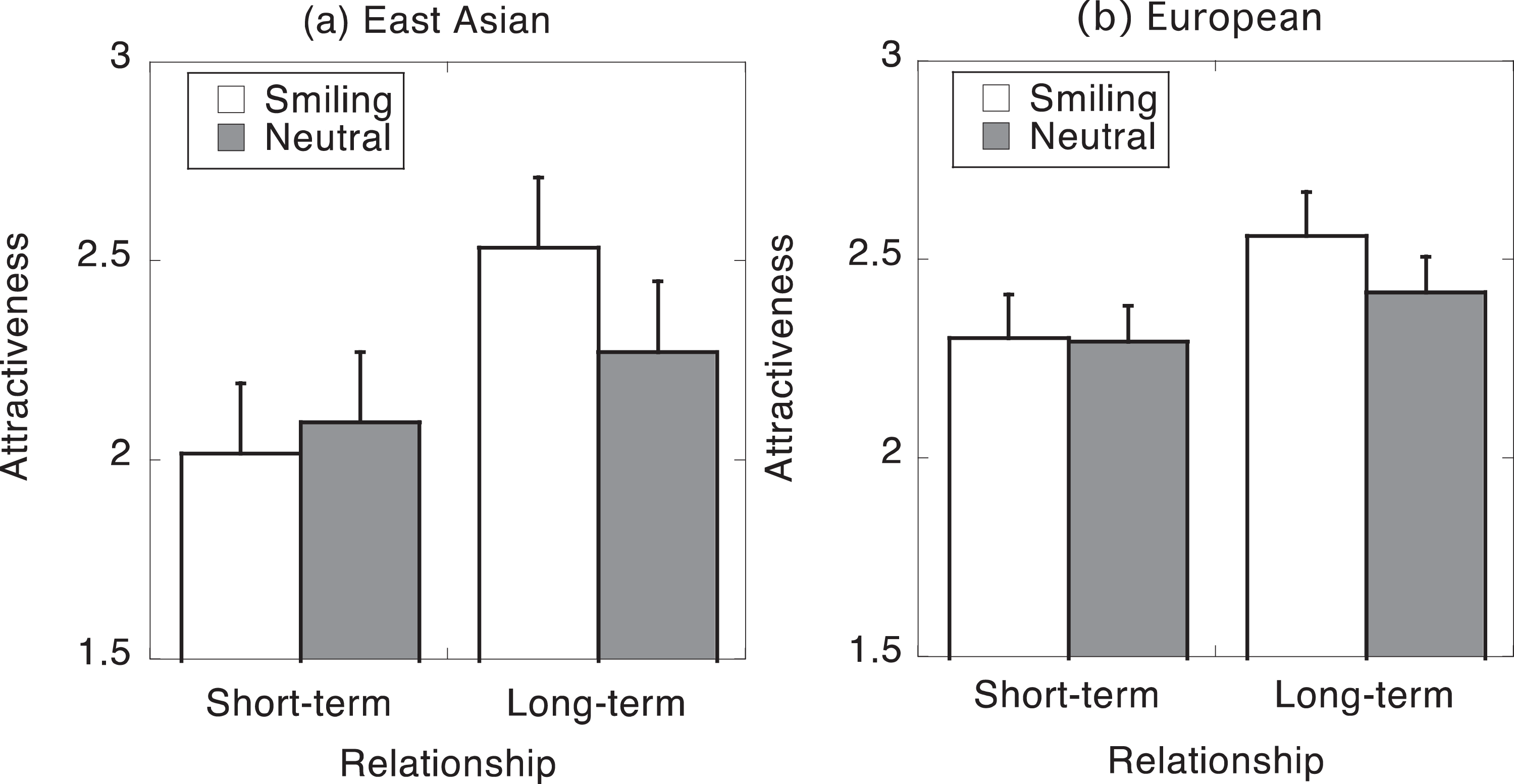
Means of attractiveness ratings by (a) East Asian and (b) European participants for male face photographs as a function of facial expression and relationship context in Experiment 1.
To clarify the interaction of facial expression and relationship, we performed a two-way ANOVA for each relationship condition. For the long-term relationship, smiling faces were rated as more attractive than neutral ones, F(1, 106) = 10.09, p = .002, η2 = .009. On the other hand, smiling did not improve attractiveness for the short-term relationship F < 1.00, η2 = .0007.
Although ethnicity did not produce a significant main effect and interactions, we conducted 2-way ANOVAs with expressions and relationship separately for each European country (i.e., Norway and Italy) to examine the possible cultural difference. The interaction of facial expression and relationship was significant for Norwegian participants, F(1, 81) = 4.01, p = .04, η2 = .006, but not for Italian participants, p = .778, η2 < .0001.
In addition, we conducted correlational analyses to examine the relationship between the ratings for short- and long-term partners. As the relationship conditions were manipulated between participants, we conducted item analyses to calculate the correlations for each facial expression and ethnicity (i.e., the mean scores were computed for each model and then were subjected to the correlational analysis). Correlations between the short- and long-term relationship conditions were positive and relatively high across facial expressions and ethnicity (rs > .65, ps < .001). Error bars show standard errors. East Asian and European participants rated only faces of their own ethnicity.
Discussion
Our predictions were confirmed: smiling enhanced the male facial attractiveness for long-term relationships but not for short-term relationships. As Figure 1 shows, the results of East Asians and Europeans were very similar. The similarity between the cultures supports our hypothesis based on the idea of opposite strategies for parenting and suggests that the finding is not limited to a specific culture. In addition to the interaction between facial expression and relationship, the main effect of relationship was significant; the rating scores were higher for long-term relationships than for short-term relationships. Participants might have employed more strict criteria of physical attractiveness for short-term partners than for long-term partners because women are likely to put more value on the heritable benefit for short- as compared to long-term partners (Little et al., 2011).
Although Europeans as a whole showed such a pattern, the interaction of facial expression and relationship was significant for Norwegian participants but not for Italian participants. The reason for the difference is not clear, but the lack of smiling advantage in Italian participants may be attributed to low familiarity with the ethnicity of the models used in the experiment. For European participants, we used the FACES database (Ebner et al., 2010), which was developed in Germany and, thus, consisted primarily of models with Germanic appearance (e.g., pale skin). As the effect of facial expressions on attractiveness is relatively small (Morrison et al., 2013), careful selection of stimuli would be needed in future research. However, the results from the East Asian and the European groups as a whole support our hypothesis based on the idea of opposite strategies for parenting and suggest that the finding is not limited to a specific culture.
The positive correlations between the ratings for the short- and long-term partners indicated that models who were rated to be attractive for short-term partners tended to be rated as such for long-term partners. Models’ identity, which has a strong effect on facial attractiveness (Morrison et al., 2013), may be responsible for the positive correlations. These results are not surprising because each data point (i.e., each model) share a number of variables affecting attractiveness, such as averageness, symmetry, and masculinity (for a review, Rhodes, 2006). We will discuss the effect of models’ identity more fully in general discussion.
Experiment 2
Several male facial expressions can lead viewers to infer the presence of certain traits such as masculinity, maturity, sociability, and warmth; in turn, these traits can influence a viewer’s judgments of the overall attractiveness of a male face (see, Cunningham, Barbee, & Pike, 1990; Rhodes, 2006, for reviews). In Experiment 2, we manipulated facial expression to examine the role of such traits in judgments of male facial attractiveness for smiling and neutral faces. In particular, female participants were asked to rate masculinity, maturity, and trustworthiness of face photographs. Masculinity can be related to a higher heritable benefit, while trustworthiness can be related to a larger paternal investment (Perrett et al., 1998). Therefore, smiling faces should be rated as less masculine and more trustworthy than neutral faces.
Method
The methodology was identical to that of Experiment 1 unless otherwise noted. Both raters and models were East Asians in this experiment. Seventy-one female university students (M age = 18.86, SD = 0.58) from Meijigakuin University, Tokyo, took part in the experiment as raters to fulfill a course requirement. None of them participated in Experiment 1. We asked participants to rate the masculinity, maturity, and trustworthiness of each facial photograph.
Results
We computed the mean rating scores for each participant. We then subjected the means to a repeated-measure ANOVA with facial expression (smiling vs. neutral) and rating type (masculinity, maturity, or trustworthiness) as within-participant factors. The Greenhouse-Geisser’s correction was applied when the assumption of sphericity was violated. There was a significant interaction between facial expression and rating type, F(1.38, 96.53) = 73.89, p < .001, η2 = .025. To clarify this two-way interaction, we conducted a paired t-test on each rating type. As Figure 2 shows, smiling faces, relative to neutral ones, were rated as less masculine, t(70) = 7.14, p < .001, d = 0.85, and as less mature, t(70) = 6.13, p < .001, d = 0.73. On the other hand, the smiling faces were rated as more trustworthy than the neutral ones, t(70) = 6.38, p < .001, d = 0.77.

Means of ratings for masculinity, maturity, and trustworthiness as a function of facial expression (smiling vs. neutral) in Experiment 2.
Discussion
Smiling and neutral faces produced different impressions: the smiling face advantage for the perceived trustworthiness replicated our previous study (Okubo et al., 2012), while the neutral face advantage for masculinity and maturity appears consistent with previous studies (Dabbs, 1997 for masculinity and Ozono et al., 2010 for maturity). Perrett et al. (1998) reported that personality characteristics unsuitable for parenting (e.g., untrustworthy, cold, aggressive) were typically ascribed to masculinized faces, whereas personality traits suitable for parenting (e.g., trustworthy, warm, cooperative) were typically ascribed to feminized faces. If the opposite strategies for parenting are taken into consideration, the results of Experiment 2 suggest that the neutral faces, relative to the smiling ones, produce more preferable impressions for short-term partners; while the smiling faces, relative to the neutral ones, produce more preferable impressions for long-term partners. These differences in impressions between smiling and neutral faces endorse the validity of the experimental procedure used in Experiment 1, where we compared overall attractiveness of smiling and neutral faces involving certain traits. Error bars show standard errors.
General Discussion
Smiling enhanced the male attractiveness for long-term relationships but not for short-term relationships. The facilitative effect of smiling on the long-term partners was observed for East Asian as well as for European participants. In addition, smiling faces were rated to be less masculine and more trustworthy and mature than neutral faces. These results are in agreement with the idea that social and cooperative characteristics would be primarily important for long-term partners but not very much for short-term partners because long-term cooperation is necessary for parenting in the former but not in the latter (Little et al., 2011). Women put more emphasis on social factors such as trustworthiness for the long-term relationship, where paternal investment is expected, in order to minimize the risk of losing commitment from their partner during pregnancy and parenting (Buss, 1989; Trivers, 1972). The smiling advantage for long-term partners supports our hypothesis based on the idea of evolutionary strategies in mate choice for parenting.
Some previous studies indicated that smiling enhances facial attractiveness irrespective of the models’ sex (Lau, 1982; Reis et al., 1990; Otta, Abrosio, et al., 1996; Otta, Lira, et al., 1994), while others demonstrated that smiling exclusively enhances female facial attractiveness (Mehu et al., 2008; Penton-Voak & Chang, 2008; Raines et al., 1990; Rhodes et al., 1999). None of these studies did specify the relationship or mating context in which the choices should take place. Without specified contexts some participants might have rated the attractiveness in terms of short-term relationships, while others might have rated in terms of long-term relationships or the same participant may have used a mixture of strategies. An inconsistency for context interpretations could be a plausible ground for the mixed results. For example, it is interesting that Tracy and Beall (2011) had stressed the sexual aspects of attractiveness in their study, which should make a short-term strategy more relevant than a long-term one, and they found no facilitative effects of smiling. Thus, opposing strategies for mate choice could at least partially explain the inconsistency of the smiling effect in the literature.
We also note that we used a within-participant design to examine the effect of facial expressions (i.e., all participants observed both smiling and neutral faces of the same models), whereas some previous studies used a between-participant design (e.g., participants observed either smiling or neutral faces; Lau, 1982; Mehu et al., 2008; Otta, Abrosio, et al., 1996; Otta, Lira, et al., 1994; Reis et al., 1990). A within-participant design has advantages for controlling individual differences in various facial traits of the models. As facial expressions have a relatively small effect on attractiveness judgments (Morrison et al., 2013), it is crucial to control such individual difference. In addition, participants usually observed only one type of expressions when the between-participant design was used (Lau, 1982; Mehu et al., 2008; Otta, Abrosio, et al., 1996; Otta, Lira, et al., 1994; Reis et al., 1990). Morrison, Morris, and Bard (2013) argued that, if participants observed a series of faces with the same expression, the attractiveness rating would not be affected much by the expression but rather by face identities. Moreover, a between-participant design has the merit of controlling for carryover effects: if participants rated both smiling and neutral faces with the same identity, the first ratings may affect the following presentations of the same identity. The strong effect of identity was observed as well in our study: Models who were rated to be attractive for short-term partners tended to be rated as such for long-term partners in Experiment 1. However, the carryover effect cannot explain the present findings: smiling and neutral faces with the same identity were presented both in the short- and long-term relationship conditions. Nevertheless, the facilitative effect of smiling was found selectively in the long-term relationship condition.
Related to this issue, Morrison et al. (2013) compared the attractiveness of faces displaying the six basic emotions (anger, disgust, fear, happiness, sadness, and surprise). Faces with a happy expression were rated to be more attractive than faces with the other emotions, but they were rated as attractive as neutral ones. In addition, the effect size of expression was smaller than that of identity. These patterns were observed for both male and female faces. To avoid the carry-over effect, Morrison et al. (2013) presented each model only once to each participants. Considering the relatively large effect of identity, the effect of expression may have been overshadowed and thus undetected in their study. In addition, they presented a variety of facial expressions including negative ones; hence, faces with a neutral expression should have looked more attractive than those with negative emotions and as attractive as those with a happy expression. As Morrison et al. (2013) mentioned, attractiveness judgments are relative decisions, rather than absolute ones, and depend heavily on the set of stimuli presented in the session.
The attractiveness ratings were lower for the short-term relationship than for the long-term relationship contexts in Experiment 1, suggesting that participants might have adopted stricter criteria for short-term partners than for long-term partners. One might argue that these strict criteria might have led the rating score for the short-term relationships to fall to the floor level, resulting in the null effect of smiling on the attractiveness for short-term partners. It should be noted, however, that the mean rating scores were far above the floor (i.e., 1; see Figure 1). In addition, the low score was observed even when we used standardized face stimuli (i.e., FACES; Ebner et al., 2010). Thus, it is plausible that the low ratings are attributable to strict criteria adopted by participants.
Although European as a whole demonstrated the smiling advantage for long-term relationship, Italian participants did not show such a pattern. We speculated that the low familiarity with the stimuli might be responsible for the lack of the effect of smiling (see Experiment 1). This speculation should be assessed with a similar participant group using Southern European models. In addition, not only cultural but also individual differences may also be influential for male facial attractiveness. All the participants in this study were young female college students and, thus, were similar in age and occupation. However, as we did not obtain further demographic information, such as income, religion, and socioeconomic status, a systematic difference in such demographic variables might have led to the lack of smiling effect in the Italian sample. Therefore, further research is needed to examine the cultural as well as individual differences in the effect of smiling on male facial attractiveness.
Evolutionarily informative cues for mate selection, such as masculinity and femininity, often have biological basis and tend to be stable (Grammer & Thornhilll, 1994). Little et al. (2011) found women’s preferences toward masculinity was consistent across domains, such as faces, bodies, voices, and smell, when selecting short-term partners whereas their preferences for femininity was consistent across domains when selecting long-term partners. Differently from masculinity/femininity, facial emotions are transient and not only have biological but also have social bases. The results of the present study suggest that women utilize such transient social cues and select an adaptive mate according to the context.
Footnotes
Declaration of Conflicting Interests
The author(s) declared no potential conflicts of interest with respect to the research, authorship, and/or publication of this article.
Funding
The author(s) disclosed receipt of the following financial support for the research, authorship, and/or publication of this article: This study was supported in part by KAKENHI (#24530923) and by the grant of Strategic Research Foundation Grant-aided Project for Private Universities from MEXT, Japan, 2011–2015 (S1101013).