



Abstract
Humans have engaged in unique cooperative breeding insofar as multiple in-group members help mothers. Two psychological-proximate factors maintain such a breeding system—various individuals' interest in infants and mothers' positive reactions toward individuals approaching their infants—which we investigated in the present study. In Study 1, we conducted field observations to examine the first factor: what types of passersby in Japan reacted to the mother and infant. This replicated studies conducted in Western countries more than 30 years ago, allowing for the examination of the influence of culture and time. The results confirmed the differences among age groups in frequency of looking at mother and infant, and predicted its universality, especially the rise in older adults. The sex difference was not significant. In Study 2, we gathered data via questionnaires and interviews using hypothetical scenarios to investigate the second factor: how mothers felt when their infants were approached by strangers. The results revealed that mothers received strangers' approaches positively. The present study showed that humans engaged in unique cooperative breeding in the Environment of Evolutionary Adaptedness (EEA), where mothers in modern society see strangers as potential helpers as part of the EEA.
Introduction
Human infants are born helpless, with large brains and a slow growth rate. Unlike other animals, infants need care long after they have been weaned. Nevertheless, mothers often raise multiple children due to their short birth interval. Such a high breeding rate is supported by help from others (Hrdy, 2009). That is, humans have evolved a breeding system in which group members other than the genetic parents (i.e., alloparents) frequently help the parents rear their offspring (Hrdy, 2005). One unique point in humans is that multiple individuals contribute to childcare—male and female kin and non-kin ranging from juveniles to older adults (Kramer, 2010)—because human society consists of many unrelated group members (Hill et al., 2011). As a result, child rearing still naturally causes social interaction in modern society. In fact, Wood, Giles-Corti, Zubrick, and Bulsara (2013) revealed that child rearing influenced broad social interactions, community participation, and social capital in neighborhoods.
Such a cooperative breeding system is maintained by two psychological-proximate factors. The first is the interest in infants presented by non-parent individuals. Generally, primates are attracted to infants (Hrdy, 2009). However, in non-cooperative breeding species, such as Japanese macaques (Macaca fuscata) or chimpanzees (Pan troglodytes), the individuals showing the highest interest in infants are restricted in young nulliparous females (Hiraiwa, 1981; Nishida, 1983). This tendency is also seen in species showing alloparenting, such as Hanuman langurs (Semnopithecus entellus) (Hrdy, 1976) or Vervet monkeys (Cevcopithecus aethiops) (Lancaster, 1971). On the other hand, in common marmosets (Callithrix jacchus) and cotton-top tamarins (Saguinus oedipus), which breed cooperatively, motivation toward parenting is not limited to young nulliparous females but is shown by other group members as well (Saito, Izumi, and Nakamura, 2011; Zahed, Kurian, and Snowdon, 2010).
With regard to studies on humans, Maestripieri and Pelka (2002) examined sex differences regarding interest in infants across the lifespan and showed that preferences for infant silhouettes over those of adults decreased steadily with age in women. The authors explained their findings from an evolutionary perspective: Young girls show interest in infants to learn caretaking skills, as has been shown in other primates. Contrasting results were yielded by observational studies. One version of such studies was the waiting room experiment. In these studies, responsiveness to a live infant in the waiting room was examined (Feldman and Nash, 1978, 1979a, 1979b; Feldman, Nash, and Cutrona, 1977; Nash and Feldman, 1980). In another version, passersby looking, smiling at, and talking to an adult and an infant (Schleidt, Schiefenhővel, Stanjek, and Krell, 1980) or simply looking at them (Robinson, Lockard, and Adams, 1979) were analyzed in the field. These studies revealed that minors and older adults reacted more to the infant than middle-aged people did, and a sex difference was observed as women showed more frequent reactions.
Although methodological differences may explain the variation between the preference experiment and these observation studies, it is of primary importance to an investigation of responses to infant stimuli that we consider the human society and cooperative breeding system mentioned above. Differing from other primates, many unrelated people compose a community, and multiple in-group members, including non-kin individuals, take part in child rearing. Furthermore, some biases concerning responsiveness toward infants might be predicted as follows from the viewpoint of the Environment of Evolutionary Adaptedness (EEA). The EEA is conceptualized as the conditions encountered by ancestors that could impact their fitness, dictating the development of their psychological mechanisms (Tooby and Cosmides, 1990). Hunter-gatherer societies today are often referred to as examples, suggesting the sexual division of labor: men's major role in hunting and women's in gathering and childcare (Lancaster and Kaplan, 2009). It is possible that women are more responsive in the area of childcare because they were more likely to be with the infants of their community than men. Although, as Maestripieri and Pelka (2002) indicated, young girls should be motivated to learn caretaking skills, people in the post-reproductive stage—especially women who are skilled—could afford to mind other infants. In fact, Ivey (2000) revealed that, in Efé foragers, people without dependent offspring were more likely to engage in alloparenting. These aspects may explain people's reactions to infants in observational studies.
The second psychological-proximate factor promoting a cooperative breeding system in humans is mothers' positive reactions toward individuals approaching their infants. In non-cooperative breeding primates, mothers restrict other individuals' access to their infants to avoid abuse or kidnapping (Hrdy, 1976; Nicolson, 1987; Onishi and Nakamichi, 2011). In contrast, mothers in species such as langurs, who have been seen alloparenting, are tolerant of others' eagerness to approach their infants; however, “others” may be defined as kin individuals to whom mothers could commit their infants (Hrdy, 2005, 2009). Mothers of marmosets also let other family members carry their infants (Box, 1977; Mills, Windle, Baker, and Ridley, 2004). Differing from other apes, human mothers do permit others to approach or hold their infants (Hrdy, 2009). Since humans are engaged in cooperative breeding among various in-group members, it is expected that mothers will receive interest from others positively, regardless of whether they are kin or non-kin. Therefore, we should explore the phenomenon of infants as attention catchers from the view point of mothers. In relation to this, no previous studies have addressed how mothers feel when people approach them and their infants, instead focusing solely on people's reactions toward their infants.
Modern society is far different from the EEA. However, the human mind today should show signs of traits adapted to the EEA, because their brains could not catch up with the extremely changed environment. In the EEA, people would have lived mostly in small face-to-face communities (Cosmides and Tooby, 2013). On the other hand, in modern society, people have the chance to see many unfamiliar people every day. Traditionally, in-group members are perceived positively (Brewer, 1979), whereas strangers are perceived as out-group members who humans innately fear. This is the case for strange males, who threatened children and adults in the evolutionary past (Hahn-Holbrook, Holbrook, and Bering, 2010). If modern mothers are receptive to strangers who show positive response toward the mother and infants, it is unlikely that they perceive strangers according to the EEA. Instead, it is possible that they see these strangers' approaches as a sign of potential help from in-group members, as a result of a disparity between the EEA and modern society.
In order to investigate these two psychological factors reflected in people today, in the present study we examine what kinds of people are attracted by infants in the field and how mothers feel about these approaches by strangers toward them and their infants. In this study, we defined strangers' reactions as follows: their looking as attention, and their smiling and talking as approaches. Baby schema (Kindchenschema), or infantile features suggested by Lorenz (1943), attracts attention (Brosch, Sander, and Scherer, 2007; Brosch, Sander, Pourtois, and Scherer, 2008) and leads to the perception of cuteness and motivation toward caretaking (Glocker et al., 2009), according to visual stimulus-based experiments. Therefore, looking (representing attention), smiling (that occurs after looking, as a reaction to infants) (Hildebrandt and Fitzgerald, 1978; Schleidt et al., 1980), and talking (indicating actual interaction), are indicators of caretaking behavior.
In Study 1, we conducted field experiments to observe the reactions of passersby to a mother and an infant. Although similar studies have been conducted in the U.S. (Robinson et al., 1979), and in Germany and Italy (Schleidt et al., 1980)—which reported the presence of sex and age differences as women, minors, and older adults showed more frequent reactions—no study seems to have examined this phenomenon in a non-Western culture. Japanese pedestrians were found to react less to a stranger with smiles, nods, and greetings than Americans do (Patterson et al., 2007). Hence, this examination was needed to reveal whether the findings of Robinson et al. (1979) or Schleidt et al. (1980) were culturally universal or specific; in particular, smiling at or talking to a mother and an infant, as seen in the study of Schleidt et al. (1980).
Robinson et al. (1979), who conducted observations with both mother-infant and father-infant pairs, stated that a replication of their study 20 years later might yield different results due to changes of opinion on traditional sex roles. However, no replication has yet been conducted in the more than 30 years since their study, with the exception of Schleidt et al.'s (1980) Hrdy, 2009). Potential helpers in humans of in-group members include non-kin individuals (Kramer, 2010). In hunter-gatherer societies, mothers let anyone come near or hold their baby (Hrdy, 2009). If mothers show their tolerance to certain individuals, this would indicate that mothers recognize them as potential helpers. Emotions adjust physiological, psychological, and behavioral responses (Nesse, 1990); subsequently, mothers' feelings predict whether permissive behavior can follow.
Study 1: Observation
Study 1 was conducted to observe and examine the characteristics of those passersby who reacted to the mother and infant in the field experiment. We expected that our results would ascertain the kinds of people who are likely to take part in cooperative breeding, replicating the results of prior studies (Robinson et al., 1979; Schleidt et al., 1980). Therefore, the first hypothesis was that female passersby would react more than male passersby to the mother and infant. The second hypothesis was that minors and older adults would react more than middle-aged people would.
Materials and Methods
Confederates
Eleven pairs of mothers (28–35 years old) and their infants (4 boys and 7 girls; 5–25 months old) served as confederates. We recruited the confederates through acquaintances. Each mother confederate was instructed in advance on how to behave during the experiment (See Procedure).
This study was approved by the psychological research ethics committees at the College of Contemporary Psychology of Rikkyo University. We obtained prior consent and parental consent from all confederates.
Setting
The experiments were conducted at five 4–7 meter-wide sidewalk locations in Tokyo and Saitama prefectures. These locations were selected based on confederates' residences. Observations were carried out during the day on sunny or cloudy days between July and November 2012. The temperature ranged from 8–30 °C during the observations.
Participants
Individuals passing the sidewalk observation points were regarded as participants. Participants were restricted to those walking in the direction with heavier traffic at the beginning of each experiment. When many individuals passed the observation point simultaneously, the nearest pedestrian to the confederates was designated as the participant. People who were running, wearing sunglasses, a mask, or a sun visor were excluded as participants, as were infants being held or pushed in strollers. Individuals who talked to a confederate were added as participants unless they were existing participants' companions.
Procedure
Each pair of confederates spent 30 minutes in the experiment. Additionally, mother confederates spent 30 minutes alone for the baseline measurement. The two conditions were conducted in randomized order. Details of the experiments are illustrated in Figure 1.

Illustration of Study 1 procedure
Confederates remained at the observation point beside the sidewalk. If the infant left the observation point, observation was suspended, and the mother confederate reclaimed the infant without force. In the event that the infant left and remained at other locations near the sidewalk, the observation was resumed at that location. The mother confederates were instructed to behave naturally in both conditions and to maintain a free physical posture, such as sitting on a bench or standing by the sidewalk. If the infant could not yet walk unassisted, the confederate could choose to hold the infant in her arms or place him or her in a stroller. When both the mother and the infant sat on the bench, the mother sat behind the infant so that it could be seen from the direction from which the observation was being conducted. The confederates were allowed to read books, eat, drink, use mobile phones except to make a call, and play with toys that were unlikely to attract attention. They were instructed to behave as usual when a participant talked to them and not to talk until they were spoken to.
Traffic dropped remarkably during the mother-and-infant condition for one pair of confederates shortly after the experiment began. Observation was suspended 15 minutes after the start time and resumed at another location, where the remainder of the mother and infant period and the full baseline observation were carried out.
The observer was 1.5–4 m in front of the confederates in the direction of participants passing through. She began to observe the participant from the time he or she reached 2 m before the confederates and stopped when the participant passed the confederates, then recorded the content of the observation on a data sheet within 5 s.
The data recorded included the participants' characteristics and observed reactions to the confederates. Participant characteristics recorded were sex and age group. We estimated the age group in the following five groups from the perspective of life history, referring to a 2012 children and childcare white paper (Cabinet office, Government of Japan, 2012): under 12, 13–18, 19–29, 30–49, and over 50. Participants' observed reactions were recorded according to three categories—looking, smiling, and talking—which were used by the replicated study (Schleidt et al., 1980). “Looking” was defined as looking at the confederates for at least 2 s, referring to the study of Robinson et al. (1979), although looking was treated as gazing for even less than 2 s in the study of Schleidt et al. (1980), who used a video camera to record. “Smiling” was defined as looking and smiling.
In order to verify inter-rater reliability, Cohen's kappa coefficients (Cohen, 1960) were calculated for three sets of observations conducted by two independent observers. Prior to the experiments, the observers practiced with and without a confederate (female undergraduate student), in particular for the accurate estimation of age group and presence of looking by passersby. Kappa coefficients of the three set of observations were .77 for age group, .62 for looking, and .82 for smiling at the confederates. Values of .61 or more are significant Kappa coefficient (Landis and Koch, 1977). Therefore, the estimations were regarded as reliable, despite the use of constructed age groups, as opposed to real ones.
Mother confederates were given a checklist and asked that when they were talked to during the experiment, to check off items on the list to record what they talked about. The list items were as follows: (a) about the infant confederate, (b) about the mother confederate, (c) about the participant's child or grandchild, (d) greetings, and (e) other topics. The mother confederates were directed to classify statements, such as “He is cute” or “How old is he?” as talk about the infant confederates; a topic like childcare would pertain to the mother confederates. The checklist included space for each item to record whether the mother or the infant confederate was addressed. The mother confederates were also asked to record the sex of the participant who talked to them in order to identify the participant recorded by the observer.
Results
The number of participants in each trial ranged from 14 to 99. In our analysis, all 11 sets of data were integrated into the data for either the mother-and-infant condition or the baseline. Although 951 people were observed across trials, 14 were excluded from the analysis because of operational errors. The final total number of participants was 937 (490 in the mother-and-infant condition and 447 in the baseline). Details of the participants and their observed reactions are shown in Table 1. Almost all the participants were judged as Japanese; approximately 2% appeared to be non-Japanese, but these did not exhibit any observed reaction.
Details of the number of participants and their observed reactions

The software R 3.0.2 (R Core Team, 2013) was used for the statistical analysis. Independent variables were the sex and age group of the participant; dependent variables were the percentages of observed reactions. We applied the statistical analysis only to the mother-and-infant condition.
Using the “Anova” function of the R-package “car” (Fox and Weisberg, 2011), we applied a likelihood ratio test. The interaction of sex and age groups had no significant effect on looking, χ2(4) = 8.28, p = .08. In the model excluding interaction, sex did not have a significant effect, χ2(1) = 0.03, p = .86, but age groups did, χ2(4) = 24.38, p < .001. The percentages of each category classified by sex and age group are illustrated in Figure 2.

The percentages of passersby looking at confederates for at least 2 s in the mother-and-infant condition (n = 490)
For smiling, we examined the data of participants who looked at the confederates (n = 81). The data showed that 17 participants smiled at confederates. The interaction of sex and age group had no significant effect, χ2(3) = 5.39, p = .15. In the model excluding interaction, sex had a significant effect, χ2(1) = 4.47, p < .05, indicating that women smiled more often than men. However, age groups did not have a significant effect, χ2(4) = 1.97, p = .74.
Talking was observed in only six cases in the mother-and-infant condition. This category was not examined with a statistical test because of the small number of observations. Table 2 shows participants' characteristics and the type of talk recorded by the mother confederates. The participant in case 1 was accompanied by an infant. In case 5, the participant was accompanied by three men who appeared to be in the same age group as the participant (19–29). Two of the three companions (companion A and companion B) also talked to the confederates. Companion A greeted the infant and talked to the mother confederate about the infant and the confederate herself. Companion B talked to the mother confederate about the infant and greeted the infant.
The characteristic of participants who talked to confederates and the type of the talk recorded by mother confederates

Study 2: Questionnaire and Interview
In Study 2-1, we administered a questionnaire to mothers based on a hypothetical scenario, asking their feelings about being smiled at or talked to by a stranger. The feelings were rated on a scale ranging from pleasant to unpleasant. The scenarios of Study 2-1 were composed of three conditions—Alone, With-Another-Adult, and With-Own-Infant—so that we could compare mothers' feelings according to the conditions and examine the influence of the infant's presence. In Study 2-2, a semi-structured interview was conducted with participants independent of the questionnaire. In the interview, we asked participants about their feelings in the above situations and related items and classified the answers.
Study 2-1: Questionnaire
Materials and Methods
Participants
We distributed the questionnaire to 40 mothers living in Tokyo who had children 0–5 years old; responses were obtained from 28 (response rate: 70%; mean age: 37.7, range: 29–45 years, SD: 4.27). The participants were those of an unrelated study in the area of developmental psychology. Participants expressed their interest in response to notices on bulletin boards at places frequented by children or families in Tokyo.
This study was approved by the psychological research ethics committees at the College of Contemporary Psychology of Rikkyo University.
Procedure
There were six questions for the hypothetical scenario: 3 (condition: Alone, With-Another-Adult, With-Own-Infant) × 2 (type of reaction by strangers: Smiled-At, Talked-To). For example, “How do you feel about being smiled at by a stranger when you are out alone?” The full form of the questionnaire is shown in Appendix 1.
The participant was asked to choose an answer for each question from 1 (unpleasant) to 5 (pleasant).
Results
An analysis of variance (ANOVA, using SPSS version 20) showed a significant main effect of condition. F(1.52, 40.98) = 34.95, p < .001 (see Figure 3), and multiple comparisons indicated that the With-Own-Infant condition scored higher than the Alone or With-Another-Adult conditions at the 0.1% level; no significant difference was found between the Alone and With-Another-Adult conditions. There was a significant main effect of the type of reaction: The Talked-To reaction scored lower than the Smiled-At reaction, F(1, 27) = 5.99, p < .05. An interaction of condition and type of reaction was not significant, F(2, 54) = 2.84, n.s..

The results of the ANOVA for the hypothetical scenario
Study 2-2: Interview
Materials and Methods
Participants
Study 2-2 consisted of 11 mothers with infants 0–2 years old, 8 of whom had been confederates in Study 1. An additional three mothers were recruited specifically for Study 2-2 through acquaintances. Their ages ranged from 28 to 40, and they lived in Tokyo, Kanagawa, and Saitama prefectures.
This study was approved by the psychological research ethics committees at the College of Contemporary Psychology at Rikkyo University. Prior consent was obtained from the participants.
Procedure
The interview was conducted in a semi-structured form in which participants talked freely about each question. The interview was recorded by a SD card recorder (ZOOM H2 Handy Recorder) and transcribed. Interviews for the eight mothers who participated in Study 2-2 were conducted after Study 1.
The interview questions were as follows:
How do you feel about being smiled at/talked to by a stranger when you are out alone, with another adult, or with your infant, and why do you feel that way?
Do you recognize changes in such feelings compared to the days before childbirth?
For the mothers who participated in Study 1 and were talked to during the experiment: How did you feel at that time, and why did you feel that way?
Analysis
Answers to questions (1) and (3) were classified as Negative, Neutral, or Positive, and answers to question (2) were classified as Change into Negative, Neutral, or Positive. These classifications were performed by the first author and another independently with a Kappa coefficient of .77; the first author's data were used.
Results
Table 3 shows the classifications of feelings about approaches from strangers, recognized changes since childbirth, and feelings about being talked to during the experiments as answered by the five mother confederates who were talked to in Study 1. The numbers in parentheses on the table represent the number of answers by confederates of Study 1. Examples of words and sentences from the interviews are shown in Appendix 2.
The classifications of answers in the interviews
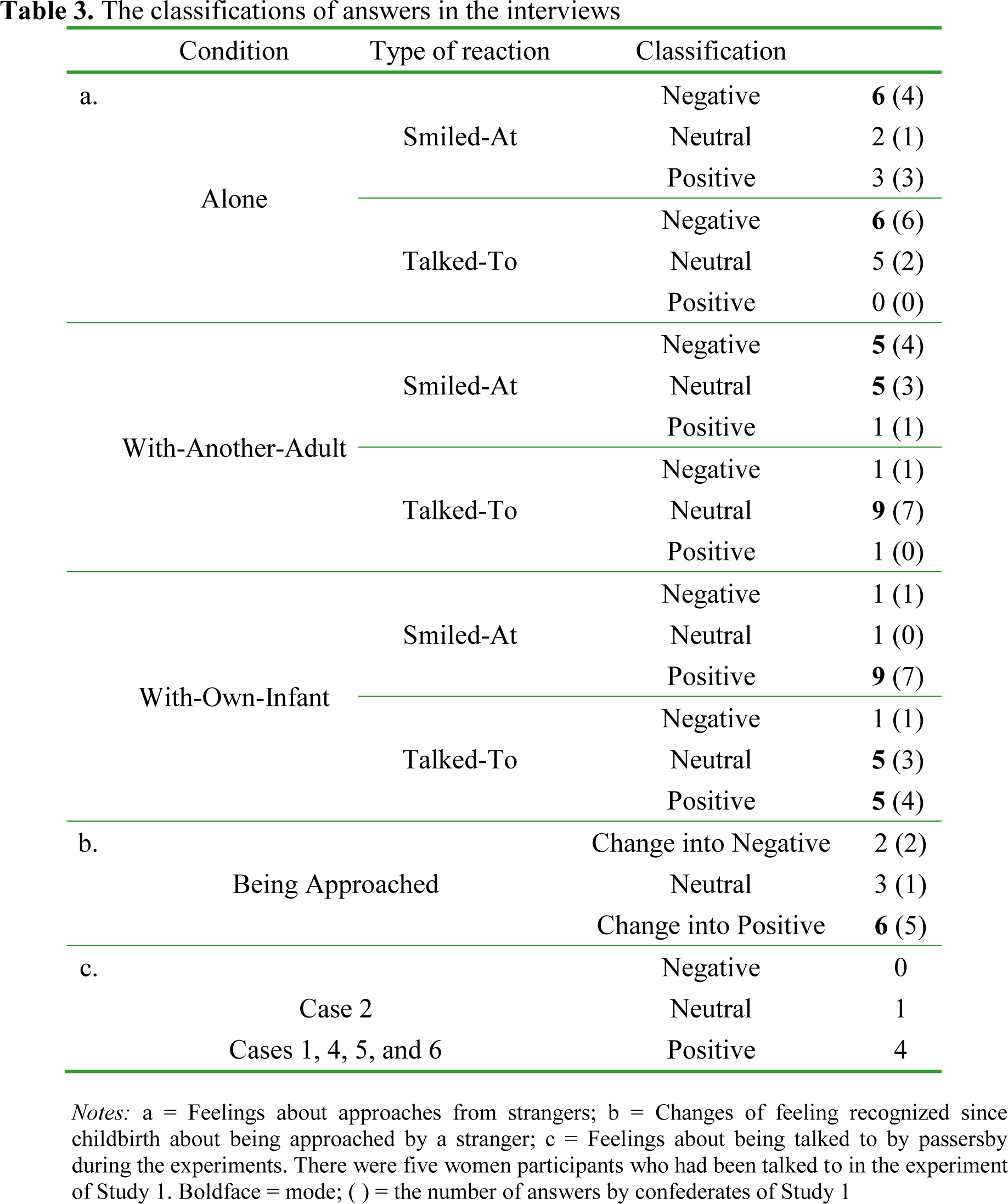
Notes: a = Feelings about approaches from strangers; b = Changes of feeling recognized since childbirth about being approached by a stranger; c = Feelings about being talked to by passersby during the experiments. There were five women participants who had been talked to in the experiment of Study 1. Boldface = mode; () = the number of answers by confederates of Study 1
With the Smiled-At reaction, many answers for the Alone and With-Another-Adult conditions were classified as Negative or Neutral. Positive was the most frequent answer only in the With-Own-Infant condition. Regarding the Talked-To reaction, again Positive was the most frequent answer only in the With-Own-Infant condition, although this condition showed fewer Positive answers compared to the Smiled-At reaction.
Regarding changes in feelings recognized since childbirth, many answers were in Change into Positive, but there were a few answers in Change into Negative, which mentioned wariness about harm to her infant.
Most answers concerning feelings about having been talked to during the experiments were classified as Positive; no answer was Negative.
Discussion
The present study was conducted on the two psychological factors which would maintain a human cooperative breeding system; we examined what kinds of people reacted to an infant (Study 1) and how mothers felt about approaches by strangers toward themselves and their infants (Study 2). For Study 1, from the perspective of the EEA and based on prior studies, we predicted that women would react more than men to the mother and infant and that minors and older adults would react more than middle-aged people. The results of Study 1 confirmed the differences in frequency of looking at the mother and infant among age groups as hypothesized and, therefore, predicted the universal distribution of attention toward an infant according to age regardless of culture and time. However, there was no indication of difference according to sex. The results for smiling were reversed: The difference was found by sex but not by age. From Study 2, which used a hypothetical scenario, we found that mothers are receptive to strangers' interest in their infants. This could mean that they see interest as an indication of potential helpers in that of in-group members.
The results of Study 1 showed that, with respect to sex difference, there was no significant effect on looking, but there was an effect on smiling. Therefore, in this study, the sex difference could occur in how to behave after attention is attracted; women tend to smile more when they perceive an infant. This result is consistent with the result of facial muscle activity after presentation of infant face photographs (Hildebrandt and Fitzgerald, 1978). For talking, three of six cases were initiated by adult men. In particular, case 5 occurred with a group composed entirely of young adult men. Although the sample size was too small to be discussed, a man's approach toward an infant is worth considering.
In substantial contrast to caretaking behavior, Hiraiwa-Hasegawa (2005) reported that the homicide rate in Japan has decreased drastically; in particular, a huge decrease has been seen in the rate of homicides committed by young men. The homicide rate in Japan is currently the lowest level in the world (UNODC, 2013). This tendency may be associated with Japanese men showing more positive reactions to infants than men in other countries, and may be explained by a proximate factor of testosterone, since testosterone level is related to patterns of crime (Dabbs, Carr, Frady, and Riad, 1995; Dabbs, Riad, and Chance, 2001) and parental care (Gettler, McDade, Feranil, and Kuzawa, 2011; Gray, Kahlenberg, Barrett, Lipson, and Ellison, 2002).
Regarding the change in values over time, gender roles in Japan seem to be unclear, where childcare provided by men has become socially acceptable. Globalization and Westernization have encouraged egalitarian views in childrearing, leading many Japanese men to value family life (Shwalb and Shwalb, 2014). Although no similar study has been conducted, notions around gender roles in Japan have certainly changed in the 30 years since Robinson et al. (1979) and Schleidt et al. (1980) carried out their research. These factors that are derived from culture and time influence the attitudes of men in present-day Japan.
The hypothesis of differences among age groups was supported in looking: Participants under 12 and over 50 years old looked more often than other age groups. Practically, the ages of most observed participants in the under-12 age group were estimated to be around the age of infant confederates or a little older. Therefore, a high frequency of looking in this age group would not be associated with caretaking behavior but rather with friendship.
The essential point of Study 1 should be increased looking in the over-50 age group, parallel to previous studies and, therefore, a robust indication of the tendency. Robinson et al. (1979) interpreted the phenomenon from the perspective of kin selection: Interest in an infant could increase in aged people associated with their grandchildren. This phenomenon seems to be consistent with the results of Feldman and Nash's (1979b) observation that grandparents exhibited more interest in an infant than did people who did not yet have grandchildren, and that grandmothers reacted to an infant more often than grandfathers did. The grandmother hypothesis (Hawkes et al., 1998) may also lie with their interpretation. However, the explanation by kin selection for these phenomena cannot answer why older people's attention is attracted to an unfamiliar and, thus, presumed non-kin infant.
It would be effective to consider the features of humans' life history, society, and cooperative breeding to comprehend the results of Study 1. Humans have a long life span, which includes a long post-reproductive stage in women (Hawkes, O'Connell, Jones, Alvarez, and Charnov, 1998). Their society includes many unrelated members, so some cognitive features cannot be explained by ancestral environments based on kinship (Hill et al., 2011). Multiple individuals contribute to childcare (Kramer, 2010). When considering the likelihood of alloparenting, people in stages other than reproductive could afford to pay attention to infants who were not their own. Moreover, people who would usually be with infants of their community could likely be responsive to infants; these tendencies might be applicable to women, as we predicted. There is a question regarding the increased looking of older adult men in the present study. Studies of traditional societies suggest that older adult men do not necessarily contribute to alloparenting, even of their grandchildren (Hrdy, 2009; Scelza, 2009), much less to unrelated infants (Ivey, 2000). At a minimum, this phenomenon should be further examined in both men and women.
Age groups did not have a significant effect on smiling in this study. As a limitation of the present study, the sample size was small compared to previous studies, and the number of participants in each age group varied widely. Smiling was analyzed in participants whose looking was observed, so the sample size was further reduced (to only 17). These factors could influence the results. The present study is comparable to previous studies that use the observation of passersby, where the characteristics of the sample can be seen as largely equivalent, excluding differences in culture and time. The present study showed different results from that of Schleidt et al. (1980) with respect to the absence of a significant effect of smiling by age group. Although this discrepancy could be the result of differences across culture and time, small sample size also could also be an issue.
The experiments were conducted in Tokyo and surrounding areas because of the residential location of confederates. This is a limitation to the representativeness of results, where results may be biased toward certain characteristics of participants and may not be generalized to the rest of Japan. Despite this, it can be said that we observed typical people who live in an urban area in Japan, though we were unable to observe people who live in rural areas.
Study 2-1 indicated that the With-Own-Infant condition scored significantly higher on the pleasantness scale for a stranger's approach than the Alone or With-Another-Adult conditions. Regarding the type of reaction by strangers, the Talked-To reaction scored significantly lower on the pleasantness scale than the Smiled-At one. A similar result was obtained from Study 2-2; the positive feeling was the mode only in the With-Own-Infant condition both for the Smiled-At and the Talked-To reactions, although in the Talked-To reaction, positive answers were fewer than in the Smiled-At one. These findings of Studies 2-1 and 2-2 were intended to be parallel, so we will discuss the results of the questionnaire and interviews based on the words and sentences used in the interviews as follows (See Appendix 2).
Originally, humans innately feared strangers, especially males, who threatened children and adults in the evolutionary past. As a result, modern adults continue to show negative emotions toward them, despite the evidence that strangers are no longer dangerous (Hahn-Holbrook et al., 2010). Fessler, Holbrook, Pollack, and Hahn-Holbrook (2014) showed contrary findings to the present study. Parents estimated a stranger to be more formidable than non-parents, perhaps because parental injury reduces their fitness, subsequently risking the fitness of their children. The results of the present study showed a little support for the concern of mothers toward strangers. Some words implying caution were used during interviews when the participants were discussing the With-Own-Infant condition. Increased wariness was also mentioned in answers to questions about changes since childbirth.
Although it is natural that mothers pay attention to the safety of their infants, Hrdy (2009) described human mothers as hyper-vigilant but not hyper-possessive. Study 2 indicated many mothers perceive strangers' approaches positively. In Study 2-2, even the participant who was the confederate in Study 1 and had been talked to by young men (case 5) answered positively. The results of Study 2 need particular explanation, as they ignore previous findings that strangers are perceived as out-group members (Hahn-Holbrook et al., 2010) and, usually, in-group members are perceived positively (Brewer, 1979). Many mothers in the present study received a stranger's approach favorably when they imagined they were accompanied by their infant. One of the explanations for this phenomenon could be that they perceive strangers, who show positive reactions toward them and their infants, as a sign of potential in-group members who can help them.
Although our hypothetical scenario included the situation of being talked to by a stranger, the results of Study 1 showed talking to confederates rarely occurred in realistic situations (similar to the study of Schleidt et al., 1980). We conducted Study 1 to replicate previous studies, using a similar study design. This study focused on just one chance of individuals passing through. However, there are a range of situations that can occur in real life where contact with strangers is possible, such as being in a supermarket, an elevator, or a waiting room of a clinic. The likelihood of talking to mothers and their infants could be different in such cases. The hypothetical scenarios of Study 2 were made quite vague (“when you are out”), which were not the same as the situation of Study 1. In this case, mothers could imagine situations where they would be likely to be talked to by strangers.
This ambiguity in the hypothetical scenarios, of course, also acts as a limitation of Study 2. The type of stranger, according to sex, age and so on, could influence mothers' acceptance of their approaches. As mentioned above, male strangers were likely to be dangerous in an evolutionary context (Hahn-Holbrook et al., 2010). Additionally, participants in the present study were living in Tokyo (an urban area). Therefore, for a resident area of the participants there could be some biases. Different results could be yielded in rural areas, where the meaning of a stranger would be more similar to that in the EEA due to the face-to-face nature of the community.
In conclusion, Study 1 suggests a human universal and unique distribution of attention toward infants with the rise in older adults. Study 2 showed that mothers received strangers' approaches positively. The results of Study 1 reflect the environment where humans have evolved to attend to and care for their infants. The results of Study 2, however, suggest that mothers are receptive to strangers' approaches, which would be unlikely to occur in the EEA. This can be explained by the tendency of modern mothers to perceive strangers as potential helpers. This is seen as a feature of cooperative breeding, where humans rear children with various in-group members.
Footnotes
Acknowledgements:
This work was supported by JSPS KAKENHI Grant Number 23700307 (to AS). We thank Mariko Hiraiwa-Hasegawa and Kunihiro Yokota for their helpful comments and Minami Fukuoka for her assistance.
Appendix 1. The questionnaire used in Study 2-1
Appendix 2. Classifications of answers and examples of words and sentences from the interviews in Study 2–2
Notes: a = Feelings about approaches from strangers; b = Changes of feeling recognized since childbirth about being approached by a stranger; c = Feelings about being talked to by passersby during the experiments; Boldface = mode. There were five women participants who had been talked to in the experiment of Study 1.
Condition
Type of Reaction
Classification
Examples of Words and Sentences from the Interviews
a.
Alone
Smiled-At
Negative
Surprising. / Strange. / Cautious. / The person seems to be abnormal.
Neutral
2
The feelings depend on the situation. / The feelings depend on the person.
Positive
3
The person seems to be friendly. / I have a favorable impression.
Talked-To
Negative
Tense. / Afraid that they might be trying to sell something. / Surprising and suspicious. / Uneasy being alone.
Neutral
5
I feel nothing. / It is not my custom. / The feelings depend on what is talked about.
Positive
0
With-Anot her-Adult
Smiled-At
Negative
Unusual in Japan. / I feel if we are odd.
Neutral
I do not feel bad but use a little caution. / I do not have particular feelings as I am with a companion.
Positive
1
I have a favorable impression, though I may not care when I am with someone.
Talked-To
Negative
1
Suspicious.
Neutral
I am less tense than when I am alone. / I feel secure for being with someone. / I feel it is strange but not bad.
Positive
1
I think the person might be in trouble, so I would like to help him because he would talk to just us.
With-Own-Infant
Smiled-At
Negative
1
Cautious. / Suspicious character.
Neutral
1
I do not care because such situation often occurs.
Positive
Happy. / I do not use caution. / The person may think my baby is cute. / If they are older adults, I am easy to talk, feeling close to them because their age is around that of my parents or grandparents.
Talked-To
Negative
1
Dangerous.
Neutral
The feelings depend on what is talked about. / The feelings depend on the person. / It is not unpleasant, but I am anxious about a pervert.
Positive
Appreciate. / Glad to talk about my child. / Glad for my child being seen. / Talking with other people broadens my world.
b.
Being Approached
Change into Negative
2
After childbirth: Sense of crisis / I have more wariness, fearing harm for my infant.
Neutral
3
Though being talked to has increased after childbirth, I do not have changes in my feelings.
Change into Positive
Before childbirth: I did not have interaction with strangers at all. / I did not have intention to talk frankly. / It was unusual to talk with strangers.
After childbirth: I do not feel bad / It is delightful to be talked to. / Various people came to talk to us, so it became as usual.
c.
Case 2
Negative
0
Neutral
1
It was not unpleasant at all.
Positive
4
Appreciate. / Having a child increases opportunities of interaction with people. / I feel ties to people. / Glad to care and be interested in my child. / I was glad as if they had good feelings for a part of me. / I like people and talking with them, and my child likes people too.