



Abstract
Drinking games are a risk factor for behavioral and health problems among university students. Previous cross-sectional research by Hone, Carter, and McCullough (2013) replicated well-established sex differences in drinking game behaviors (i.e., that men are more active drinking game participants than are women) and university drinking problems more generally. Hone et al. (2013) also found that these male-specific behavioral patterns are attributable in part to the fact that men's generally unrestricted sexual strategies, plus their social competitiveness, motivate them to participate in drinking games to display their fortitude and compete with same-sex rivals. Here, the authors conducted a study to evaluate with greater causal rigor whether sex differences in sexual restrictedness and social competitiveness—and sex differences in motivations for participating in drinking games in particular—are partially responsible for the sex differences in university students' drinking game behaviors and drinking problems. Sex differences in changes in frequency of drinking game participation were partially mediated by competitive motivations for participating in drinking games and by the effects of social competitiveness on competitive drinking game motivation. These findings lend additional support to the proposition that participation in drinking games is motivated in part by their suitability as a venue for sexual competition in university students' day-to-day lives.
Introduction
Forty percent of full-time university students report heavy episodic (“binge”) drinking—that is, consuming five (four for women) drinks or more in a single 2–hour episode (O'Malley and Johnston, 2002; Substance Abuse and Mental Health Services Administration, 2007; U.S. Department of Health and Human Services [DHHS], 2004, 2007). Drinking games are one of the most popular venues in which heavy episodic drinking takes place for university students, and drinking game participation is one of the best predictors of students' heavy episodic drinking and blood alcohol levels while drinking (Clapp et al., 2003; Clapp, Won Min, Shillington, Reed, and Ketchie Croff, 2008; Douglas, 1987; Engs and Hanson, 1993; Green and Grider, 1990; Nagoshi, Wood, Cote, and Abbit, 1994; Newman, Crawford, and Nellis, 1991; Pedersen, 1990).
Furthermore, participation in drinking games is responsible for many of the negative consequences associated with heavy episodic drinking in general (Cameron et al., 2010; Johnson and Stahl, 2004; Perkins, 2002; Polizzotto, Saw, Tjhung, Chua, and Stockwell, 2007). Nevertheless, up to 77% of university students report having participated in drinking games, even though they are generally well aware of the attendant risks (Borsari, 2004; Cameron et al., 2010; Leigh, 1987; Polizzotto et al., 2007; Simons, Lantz, Klichine, and Ascolese, 2005). Explaining why people do things that they know are bad for them is not only a psychological puzzle, but a biological one as well, so theories that can account for young people's motivations to participate in drinking games (along with other risk behaviors) have the potential to advance theory about the evolutionary foundations of human social behavior. Here we test a functional model of university students' drinking game involvement—based on sexual selection theory—that incorporates well-established sex differences in drinking game behaviors and drinking problems as well as sexual restrictedness, social competitiveness, and motivations for participating in drinking games in particular (Bateman, 1948; Buss and Schmitt, 1993; Darwin, 1871; Geary, 2003, 2006; Trivers, 1972).
We previously conducted a cross-sectional study in which we modeled sex differences in students' drinking game behaviors and drinking problems so that we could estimate the extent to which these sex differences could be explained as a function of (1) sex differences in sexual restrictedness (Simpson and Gangestad, 1991) and social competitiveness (Simmons, Wehner, Tucker, and King, 1988) as well as (2) sex differences in fortitude-display, sexual, and competitive motivations for participating in drinking games in particular (Hone et al., 2013). We found that men's low levels of sexual restrictedness and high levels of social competitiveness were positively related to their competitive motivation to participate in drinking games, which in turn was positively related to their frequency of participation in drinking games (Hone et al., 2013). We also found that men's low levels of sexual restrictedness were positively correlated with their motivation to display their fortitude via drinking games, which in turn appeared to correlate with the frequency with which they encountered drinking problems.
In the present study, we sought to establish whether the associations that we found in our previous cross-sectional study also obtained in a two-wave study. To do so, we followed up with participants from the original, cross-sectional study and assessed drinking game behaviors and drinking problems at a time point about 12 weeks after the initial data collection. Our rationale for these studies stems from sexual selection theory. Sexual selection theory posits that due to asymmetries in parental investment (Trivers, 1972), the fitness of females (or, when they are the higher-investing sex, males) is constrained by the quality of mates, whereas the fitness of males (or, when they are the lesser investing sex, females) is constrained by access to mates (Bateman, 1948; Buss and Schmitt, 1993; Darwin, 1871; Geary, 2003, 2006; Trivers, 1972). It follows that adaptive psychological mechanisms plausibly evolved in response to these selection pressures and gave rise to intra- and intersexual competition (Buss and Schmitt, 1993). For example, females from many different species appear to possess preferences for high-investing mates with good genes, whereas males appear to possess motivations to compete for mates and to signal their mate quality (Buss and Schmitt, 1993).
From this theoretical vantage point, we hypothesized (as have other researchers) that humans seek out venues for intrasexual and intersexual competition—for example, through conspicuous consumption (Saad, 2007; Saad and Vongas, 2009; Sundie et al., 2011), male-male aggression (Daly and Wilson, 1988), displays of generosity (Iredale, Van Vugt, and Dunbar, 2008), and athletic competition (Miller, Maner, and McNulty, 2012). We think the fit of this hypothesis to drinking games is, at the outset, quite tight: Students' explicit motivations for participating in drinking games are often both competitive (i.e., students cite, “because I want to win” as a reason to participate) and sexual (i.e., students report participating, “in order to have sex with someone;” Borsari, 2004; Johnson, 2002; Johnson, Hamilton, and Sheets, 1999; Johnson and Sheets, 2004). Moreover, drinking games enable male players to compete with other men in the presence of female players, who also participate and take an interest in the games' outcomes (Borsari, 2004; Borsari, Bergen-Cico, and Carey, 2003; Polizzotto et al., 2007; Rhoads, 1995). Thus, we posit that university students find drinking games appealing because they, too, provide a venue for male intrasexual competition and female intersexual choice.
We expect that students should seek out drinking games as venues for sexual competition, but also that they should increase in their frequencies of doing so upon entering college when this venue is newly available to them (e.g., their parents are no longer capable of closely monitoring their behavior) and when other venues for excessive drinking (e.g., bars and venues only available to those of the legal drinking age) remain unavailable to them. In line with this rationale, data suggest that increases in frequency of alcohol use and binge drinking are correlated with leaving home and going to college, and that students high in sensation-seeking exhibit the greatest increases (White et al., 2006). Furthermore, moving away from home is associated with an increase in heavy episodic drinking, with those who are also enrolled in college (where drinking games are played) experiencing the sharpest increases (White et al., 2006). Thus, we think there is good reason to expect meaningful individual differences in how students' drinking-related behaviors change during their first few semesters of college.
Predictions
Based on previous cross-sectional findings that men participate in drinking games more frequently and experience more drinking problems than do women, and that these sex differences are mediated by men's low levels of sexual restrictedness, high levels of social competitiveness, and motivations for participating in drinking games (Hone et al., 2013), we made the following predictions. We predicted that men would increase in drinking game behaviors and drinking problems between Phase 1 and Phase 2, relative to women, over a 12-week period. Additionally, we predicted that these sex differences in increases would be mediated by sex differences in sexual restrictedness and social competitiveness (Ahlgren and Johnson, 1979; Simpson and Gangestad, 1991). We furthermore predicted that the mediation of sex differences in drinking game behaviors and drinking problems via sex differences in sexual restrictedness and social competitiveness would themselves be mediated by sex differences in people's espousal of fortitude-display, sexual, and competitive motivations for participating in drinking games specifically.
To test these predictions, we used structural equation models in Mplus (Version 6; Muthén and Muthén, 2010) that enabled us to evaluate whether the direct effects of sex on increases in drinking game behaviors and drinking problems were mediated by sexual restrictedness and social competitiveness, as well as fortitude-display, sexual, and competitive motivations for participating in drinking games. We also set out to test whether these indirect effects of sex on increases in drinking game behaviors and drinking problems via individual differences in sexual restrictedness and social competitiveness themselves were due to their intermediate effects on fortitude-display, sexual, and competitive motivations for participating in drinking games.
Materials and Methods
Participants
Participants were 263 students from the University of Miami who were enrolled in Introductory Psychology in the fall of 2010 and the spring of 2011, who reported drinking and participating in drinking games at least occasionally (that is, participants who indicated “I do not play drinking games” were excluded from analyses), and who provided data on both measurement occasions. The sample comprised 133 women aged 17 to 23 (M ± SD = 18.64 ± 1.19) and 128 men aged 17 to 24 (M ± SD = 18.80 ± 1.22). Two participants did not report their sex. Students aged 18 and older provided written documentation of informed consent. We obtained parental consent for students under 18 years of age. Participants obtained course credit for participating. The study was approved by the University of Miami's Institutional Review Board.
Procedure
Data were collected at two time points (Phase 1 and Phase 2, respectively). During the first few weeks of both semesters, we administered a battery of questionnaires to participants. Approximately 12 weeks later, during the last week of both semesters, we provided students with a link to an online survey that contained the same questionnaires, which they completed a second time.
Measures
Sexual restrictedness and social competitiveness. We measured sexual restrictedness via the Sociosexual Orientation Inventory at Phase 1 (SOI; Simpson and Gangestad, 1991). The SOI score comprises seven weighted and aggregated items that measure individual differences in sexual restrictedness. In this sample, reliability of the SOI was acceptable (α = 0.86). We measured social competitiveness at Phase 1 with three items, endorsed on a 5-point Likert-type scale (1 = strongly disagree, 5 = strongly agree) from the Cooperative/Competitive Strategy Scale (Simmons et al., 1988). These items represent the use of competition to both motivate and achieve success as opposed to the use of cooperation to motivate and achieve success, or the avoidance of achieving success through competition. Reliability of the social competitiveness subscale was acceptable (α = .76).
Motivations for participating in drinking games. We measured students' fortitude-display, sexual, and competitive motivations for participating in drinking games via nine Likert-type self-report items (Hone et al., 2013). Items were rated on a 5-point scale (1 = strongly disagree, 5 = strongly agree), including an option to select the statement, “I do not play drinking games.” The fortitude-display motivation comprised the items, “I like to play drinking games that show who can go the longest without passing out,” “… that show who can last the longest without throwing up,” and “… in which sometimes people need to be put to bed.” The sexual motivation factor comprised the items, “I like to play drinking games that give me an opportunity to have fun with people I'd like to have sex with,” “… that loosen people up for fooling around or having sex later,” and “that give me an opportunity to hit on people I'm interested in.” Finally, the competitive motivation factor comprised the items, “I like to play drinking games in which people are really serious about winning,” “… that have clear winners and losers,” and “… in which people get teased or respected depending on how they played.” Reliability of these factors was acceptable (Fortitude-display motivation: α = 0.81; sexual motivation: α = 0.90; competitive motivation: α = 0.75).
Drinking game behaviors and drinking problems. At Phase 1 and Phase 2, we used two Likert-type self-report items to measure frequency of drinking game participation and quantity of alcohol consumed during drinking game participation. The item “How often do you play drinking games?” was endorsed on an 8-point scale (0 = never, 7 = daily or almost daily) and the item, “How much alcohol do you tend to consume when you play drinking games (“drink” = 1 beer or 1 shot)?” was endorsed on a 6-point scale (0 = none, 5 = seven or more drinks). We also used six items from the Alcohol Use Disorders Identification Test to measure students' drinking problems at Phase 1 and Phase 2 (Babor, Higgins-Biddle, Saunders, and Monteiro, 2001). Reliability of the six-item version of the AUDIT was acceptable (Phase 1: α = 0.78; Phase 2: α = 0.83). We specified causal paths from these three scores at Phase 1 to their corresponding scores at Phase 2 so that the remaining variance in the respective Phase 2 scores could be conceptualized as measures of residualized change over the 12-week period (Cronbach and Furby, 1970). This is analogous to regressing Phase 2 scores on Phase 1 scores and then assessing the relationship between the predictor variables and these residuals. We conducted independent samples t-tests (corrected for multiple comparisons; see Table 1) to assess sex differences in these key outcome variables for the study.
Sex differences in residualized change scores of drinking game behaviors and drinking problems

Note. DG = drinking game. All tests were two-tailed.
p < .01.
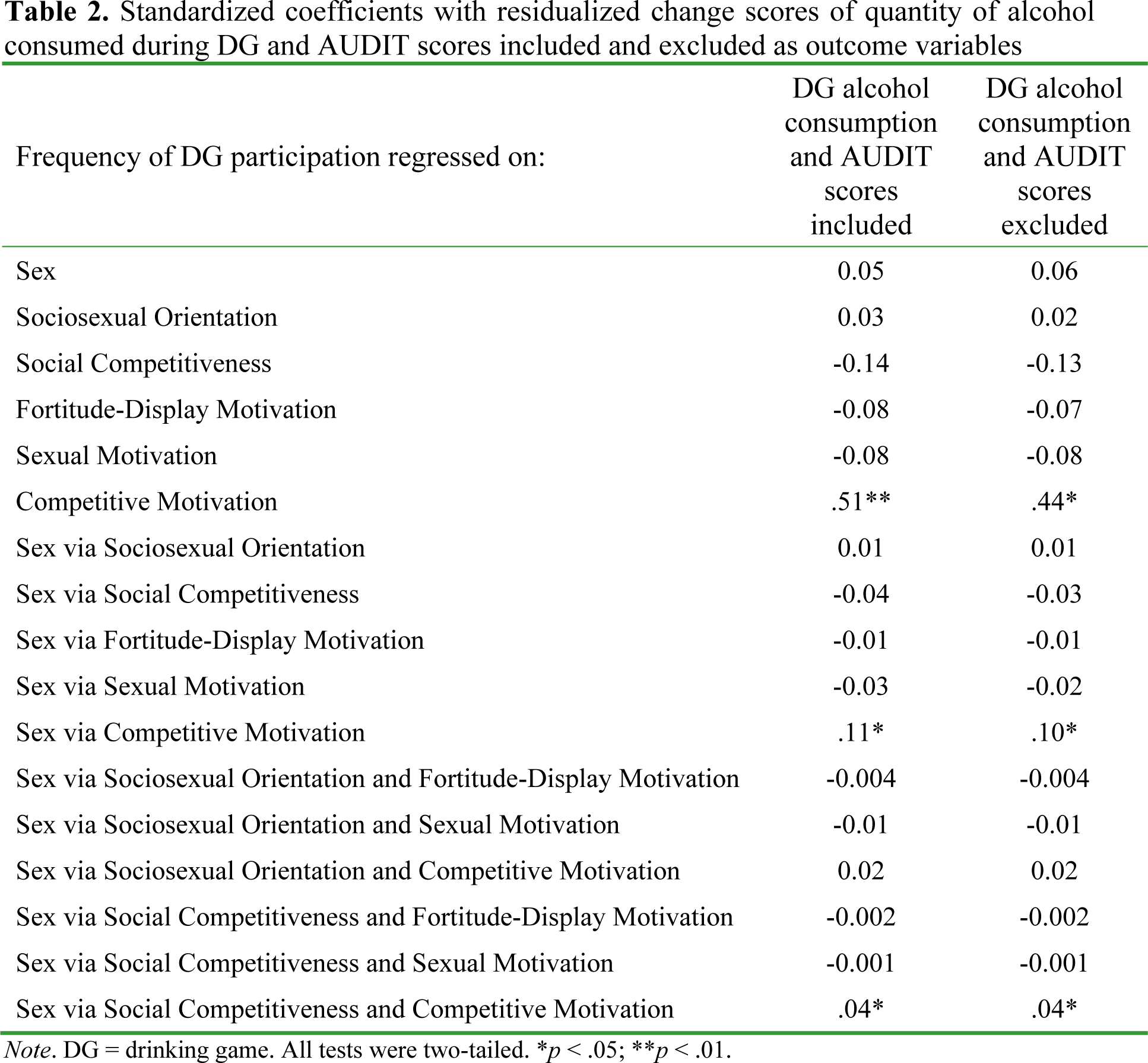
Men scored higher on the residualized change score measure of frequency of drinking game participation, but not on the residualized change score measures of quantities of alcohol consumed during drinking game participation or drinking problems. Consequently, we dropped these latter two outcome variables from further consideration and evaluated only the sex differences in residualized changes in frequency of drinking game participation. Excluding these two variables as outcomes did not influence the direct or indirect path coefficients from sex to the residualized change score measure of frequency of drinking game participation that we report here (see Table 2).
Standardized coefficients with residualized change scores of quantity of alcohol consumed during DG and AUDIT scores included and excluded as outcome variables
Note. DG = drinking game. All tests were two-tailed.
p < .05;
p < .01.
Results
Model fit
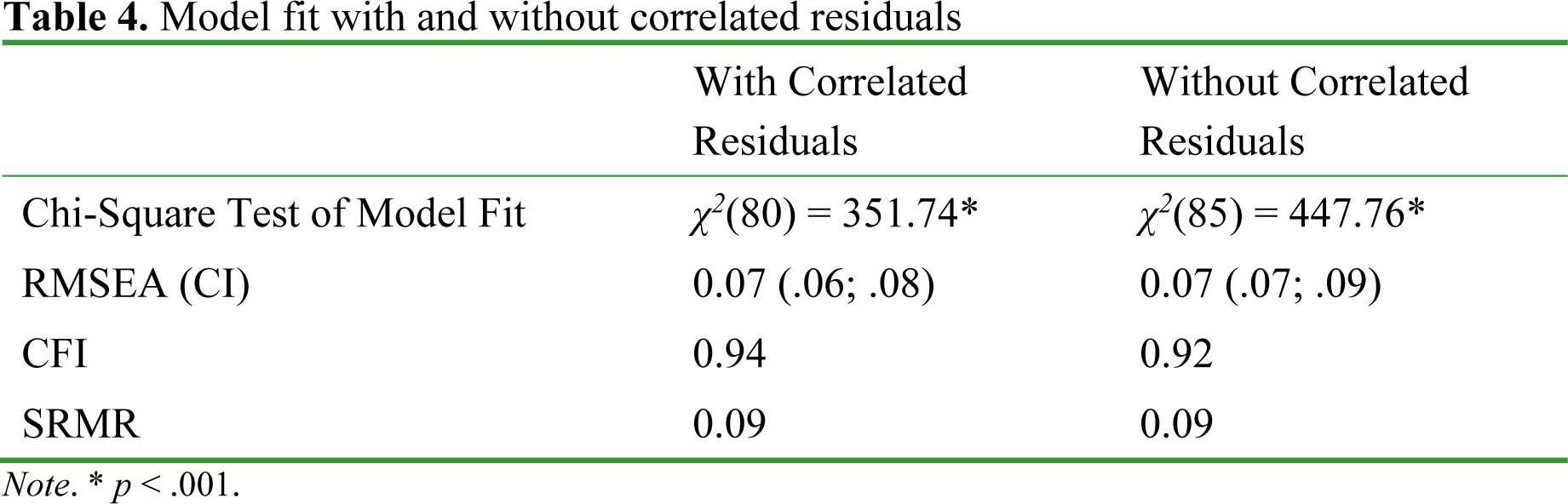
In a structural equation model, we specified a path from frequency of drinking game participation at Phase 1 to frequency of drinking game participation at Phase 2. We then specified paths from sex, to sexual restrictedness and social competitiveness, to fortitude-display, sexual, and competitive motivations, and to frequency of drinking game participation at Phase 2, controlling for participation at Phase 1 (paths from independent variables to frequency at Phase 1 were not specified; see Figure 1). According to the modification indices, some residual variances of drinking game items that comprise the drinking game motivations were specified to correlate with each other (see Table 3), which improved model fit (see Table 4).
Correlated residuals

Model fit with and without correlated residuals
Note. * p < .001.

Structural equation model
Data were assumed to be missing at random and full information maximum likelihood estimation was used. The chi square test of model fit to these data was significant, χ2(80) = 351.75, p < .001, which indicated poor fit (Kline, 2011). However, analysts typically complement this fit statistic with a variety of other indices for assessing model fit. A Comparative Fit Index of 0.94 indicated that the proposed model provided a better fit than a baseline model (Hu and Bentler, 1999; Schreiber, Stage, King, Nora, and Barlow, 2006). In contrast, the Root Mean Square Error of Approximation statistic was 0.07, with a lower bound confidence interval value of 0.06 and an upper bound confidence interval value of 0.08, suggesting that a close-fit hypothesis could not be retained, although the poor-fit hypothesis could be rejected (Browne and Cudeck, 1993). Finally, a Standardized Root Mean Residual of 0.09 was obtained, indicating that the average residual of the difference between the observed and proposed variance/covariance matrix was acceptable and, thus, that the model provided decent explanatory power (Hu and Bentler, 1999; Schreiber et al., 2006).
Together, the six predictors in the model (sex, sexual restrictedness, social competitiveness, and the three drinking game motivations) accounted for 45% of the variance in residualized change score in frequency of drinking game participation. Eight percent of the variation in residualized change score in frequency of drinking game participation was accounted for uniquely by sexual restrictedness, social competitiveness, and the three drinking game motivations at Phase 1.
Mediation of sex differences in changes in frequency of drinking game participation
We found evidence that competitive motivation for participating in drinking games partially mediated the sex difference in the residualized change score measure of frequency of drinking game participation (see Figure 2). This two-step mediational path suggests that competitive motivation for participating in drinking games helps account for why men had higher residualized change scores in drinking game participation over the 12-week period than did women.
We also found a significant indirect effect of sex on residualized change scores in frequency of drinking game participation via social competitiveness that was itself mediated by the indirect effect of social competitiveness on competitive motivation to participate in drinking games (see Figure 3). This three-step mediational path suggests that sex differences in social competitiveness appeared to cause increases in competitive motivation for participating in drinking games specifically, which in turn increased men's participation in drinking games, relative to women, over the 12-week period.
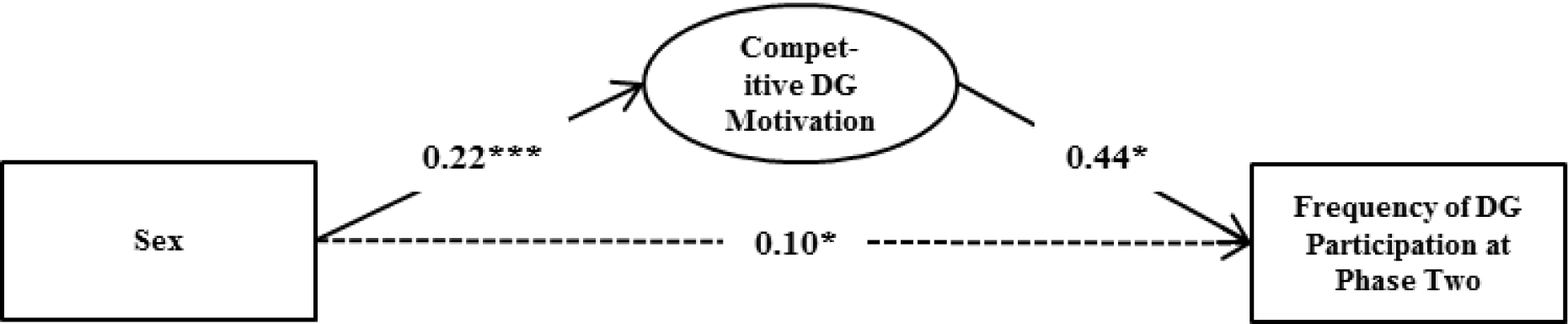
Partial mediation of the sex difference in the residualized change score measure of frequency of drinking game participation by competitive motivation for playing drinking games

The indirect effect of sex on residualized change scores in frequency of drinking game participation mediated by the indirect effect of social competitiveness on competitive motivation to participate in drinking games
In a reduced model in which we predicted residualized changes in frequency of drinking game participation with (1) sex, (2) social competitiveness, and (3) competitive motivation for participating in drinking games in particular, the sex difference in the residualized change score measure of drinking game participation was reduced to a very small and non-significant association (β = .06, p = .29, 95% CI [−0.05, 0.16]), which suggests that sex differences in competitive motivation explained virtually all of the meaningful sex differences in drinking game participation.
Discussion
Because females likely possess evolved systems that generate motivation to seek high-quality mates and males likely possess evolved systems that motivate them to compete and signal their quality to females (Bateman, 1948; Buss and Schmitt, 1993; Darwin, 1871; Geary, 2003; 2006; Trivers, 1972)—and because drinking games are often sexual and competitive in nature (Johnson, 2002; Johnson and Sheets, 2004)—we hypothesized that university students use drinking games as a venue for sexual competition (Hone et. al, 2013). In the two-wave study presented here, we found that men increased their frequency of drinking game participation, relative to women, in part because they were more motivated than women were to participate in such games for competitive reasons, and because they were more socially competitive in general than were women. Specifically, we found that the sex difference in changes in frequency of drinking game participation was reduced to nearly zero when social competitiveness and competitive drinking game motivations were taken into account. To our knowledge, this study is the first to test an evolutionary-functional explanation for sex differences in drinking game behavior—indeed, in any risk behavior—using two-wave data, which enables better tests of causal hypotheses than cross-sectional data can provide (Finkel, 1995).
Implications
In addition to the present study's value for shedding light on the possible functional bases of risk-taking behavior during adolescence and early adulthood, our results might have public health implications: Because men's competitiveness is related to increases in how frequently they participate in drinking games, there might be value in university policies that identify and target particularly competitive individuals (e.g., student athletes) or venues and occasions on which competitive motivation is likely to be high (around major sporting events or competitive events within or between fraternities) for interventions that take into consideration the competitive aspects of drinking games (Grossbard, Geisner, Neighbors, Kilmer, and Larimer, 2007). Previous interventions that stress the negative consequences associated with risky behavior and drinking games are largely unsuccessful and may inadvertently increase participation among competitive men because drinking games (and risk behaviors) are attractive to some men as a venue for competition (Hone et al., 2013). Consequently, interventions should seek to frame the risks and consequences associated with drinking games in a way that discourages participation, rather than inadvertently encourages it. It cannot be taken for granted that warning young people of the dangers will not have unintended negative consequences for drinking game participation.
Limitations
The two-wave nature of our data set enabled a more rigorous examination of causation than what is possible in cross-sectional studies, but a study with even more frequent within-subject sampling would have allowed for better analysis of cause and effect relationships. Evaluating changes in students' drinking game behaviors and drinking problems over three or more time points would enable the use of latent growth curve models and better estimation of missing data. In addition, collecting data at three or more time points within even shorter time frames would enable researchers to examine the social precipitants of short-term changes in drinking game behavior (Larson and Csikszentmihalyi, 1983). Furthermore, future studies examining not only the between-sex differences we studied here but within-sex differences as well (e.g., differences within females; Zamboanga, Bean, Pietras, and Pabón, 2005) could help to explain why some men and women participate in drinking games more so than do their same-sex peers. In the same vein, because drinking game involvement poses more hazards for women than for men, examining women's unique motivations for participating in drinking games (even though they participate considerably less frequently than do men) in future studies would also be useful (Pedersen and LaBrie, 2006; Zamboanga, Leitkowski, Rodríguez, and Cascio, 2006).
The addition of objective measures of social competitiveness and sexual restrictedness might also improve future studies assessing drinking game behaviors (e.g., via a laboratory situation in which men compete with a confederate to win a lunch date with an attractive woman; Gangestad, Simpson, Cousins, Garver-Apgar, and Christensen, 2004). Despite these limitations, we believe the findings we report here support conclusions drawn from cross-sectional data and provide another step toward elucidating the functional bases of risk-taking behavior (Daly and Wilson, 2005; Hill and Chow, 2002; Kruger and Nesse, 2006).
Conclusion
Drinking games are associated with many negative consequences, yet a majority of university students report participating in drinking games—especially for sexual and competitive reasons (Borsari, 2004; Cameron et al., 2010; Johnson, 2002; Johnson et al., 1999; Johnson and Sheets, 2004; Johnson and Stahl, 2004; Polizzotto et al., 2007; Simons et al., 2005). Students are aware of the negative consequences of drinking, so why do they take part? Our results suggest that this puzzle can be solved, at least in part, by taking into account the sexually selected differences in men's and women's appetites for competition (Bateman, 1948; Buss and Schmitt, 1993; Darwin, 1871; Geary, 2003; 2006; Trivers, 1972). Drinking games might productively be conceptualized as a culturally sanctioned venue in which young people can enact their sexually selected motivations to compete with each other. Understanding the causes of drinking game behavior and drinking problems is also a puzzle for public health (Carman, Fitzgerald, and Holmgren, 1983; DHHS, 2007), so we are cautiously optimistic that research such as ours, which points to a possible functional basis for young people's attraction to such activities, might find some use in applied work as well.