



Abstract
One individual's actions may affect the evolutionary fitness of another individual. Sexually antagonistic coevolution occurs when one partner's behavior decreases the fitness of the other partner (Rice, 1996). This conflict pressures the other partner to counter these disadvantageous actions. Mate guarding is a mate retention tactic aimed at keeping a partner from cheating. Mate guarding may reduce mate choice, especially for extra pair mates. Therefore, some individuals may resist their partner's mate guarding tactics. We developed a scale to measure resistance to mate guarding and tested it in women (N = 1069). Using exploratory factor analysis (EFA), six theoretically sound factors emerged and explained 69% of the variance. Confirmatory Factor Analysis showed strong support for the six original subscales as well as for the overall scale. The subscales had high reliability. The validity of the Resistance to Mate Guarding Scale was also excellent. Women who stated they used more resistance to mate guarding strategies also indicated that they had partners who mate guarded more, were less invested in their relationships, felt their partners were more controlling, had a more avoidant attachment style, and had a more unrestricted sociosexual orientation.
Keywords
Introduction
Romantic relationships are rife with potential genetic conflicts of interest. One individual's actions may affect the evolutionary fitness of another individual. Sexually antagonistic coevolution occurs when one partner's behavior decreases the fitness of the other partner (Rice, 1996). This conflict pressures the other partner to counter these disadvantageous actions. Within romantic relationships, mate guarding is one potential area in which sexually antagonistic coevolution may drive men's and women's behavior. Mate guarding is a mate retention tactic aimed at keeping a partner from cheating and may reduce mate choice, especially for extra pair mates. Therefore, some individuals may resist their partner's mate guarding tactics. We sought to develop a resistance to mate guarding scale and assess the reliability and validity of the scale.
Mate guarding
According to Buss (2002), mate guarding entails three main strategies: maintaining access to one's mate, eliminating potential competitors, and preventing a mate from exiting the relationship. One way to think about mate guarding is that it is the behavioral manifestation of sexual jealousy; it includes behaviors aimed at controlling a partner's behavior, such as monopolizing a partner's time, intimidating a partner and potential sexual competitors, and being vigilant about a partner's whereabouts. Mate guarding includes directly guarding a partner from rivals along with threats or aggression towards these rivals. Because only males face paternity uncertainty, most studies of mate guarding (including those in other species) assume males mate guard their female mates and not vice versa (e.g., Birkhead, Johnson, and Nettleship, 1985; but for an exception, see Wilson and Swaddle, 2013).
Although there is evidence to suggest that male mate guarding does, in fact, occur in humans (Buss and Shackelford, 1997; Flinn, 1988; Haselton and Gangestad, 2006) and that men respond to the fitness payoffs by mate guarding some women all the time and other women mostly at high fertility (Haselton and Gangestad, 2006), there is little evidence pertaining to whether women resist their partner's mate guarding attempts, but there is evidence that female crustaceans do, in fact, resist mate guarding (Cothran, 2008). Given the potential evolutionary implications of reduced mate choice, one could argue that at least some women should resist mate guarding by their male partners.
Very little research exists linking men's mate guarding to women's resistance to mate guarding. However, one study showed that resistance to mate guarding was highest for women who cheated on their partner. Interestingly, for women who cheated, resistance was highest when their partners had higher digit ratios, a marker of reduced prenatal masculinization (Cousins, Fugère, and Franklin, 2009). Since prenatal testosterone exposure appears to be related to being threatening and physically aggressive toward a mate (Cousins et al., 2009), women face costs to resisting their partner's mate guarding and, therefore, they may resist mate guarding only when the risk of retaliation by their partner is low.
Controlling partners and resistance to mate guarding
Research indicates that individuals who are more controlling are more violent toward their romantic partners (Graham-Kevan and Archer, 2005). Other research shows that proprietary behavior, which is similar to mate guarding, is linked with physical aggression toward a romantic partner, but for men only (Cousins and Gangestad, 2007). Since there appears to be a link between mate guarding and resistance to mate guarding, we expect that women with controlling partners may resist their partner's mate guarding attempts more than women with less controlling partners. In addition, women themselves may be controlling in their relationships, and these women may show more resistance to mate guarding than women with lower levels of controlling behaviors.
Relationship investment and resistance to mate guarding
Recent research on dyadic interactions of romantic partners showed that with increased investment, couples were more committed (Macher, 2013). Since women's resistance to mate guarding appears to be at least partly explained by whether they cheated on their mate (Cousins et al., 2009), one might expect that resistance to mate guarding will be higher when women are less invested in their relationships.
Intimacy and resistance to mate guarding
Intimacy in romantic relationships is associated with relationship satisfaction. In research assessing intimacy and conflict across a 10-day time span, researchers found that intimacy was related to positive affect and that changes in intimacy were a better predictor of positive affect than just the level of intimacy (Laurenceau, Troy, and Carver, 2005). These researchers also found that conflict, in particular a change to higher levels of conflict, is related to more relationship anxiety. Since mate guarding—and women's resistance to mate guarding—may cause relationship conflict, one might expect that when there is less intimacy, there will be more resistance to mate guarding.
Attachment style and resistance to mate guarding
Those who have an avoidant attachment style fear intimacy and, therefore, frequently avoid closeness in relationships (Hazan and Shaver, 1987). Avoidantly attached individuals are more likely to cheat on a mate and to be less committed to their relationship (DeWall et al., 2011). Avoidant individuals may be particularly likely to resist the mate guarding efforts of their mate.
Individuals who have anxious attachment styles fear losing their romantic partners. This fear may cause them to become very jealous in relationships (Hazan and Shaver, 1987) and to potentially act in ways that are very controlling and, ultimately, destructive to their relationship (Downey and Feldman, 1996). Although it may seem counter to keeping their relationship intact, anxiously attached individuals may engage in activities that are detrimental to their relationship (Downey and Feldman, 1996); one such tactic may be to mate guard their partner. However, it is unclear whether anxiously attached individuals should resist mate guarding or actually seek it out (as it may indicate a partner is paying attention). Therefore, analyses between women's resistance to mate guarding and anxious attachment are exploratory in nature.
Sociosexual orientation and resistance to mate guarding
Sociosexual Orientation (SOI) is the extent to which an individual is comfortable having uncommitted sex (Simpson and Gangestad, 1991). Individuals who are unrestricted feel more comfortable having sex outside of a committed relationship. According to one study, women's self-reported SOI predicted increased use of some mate retention tactics by their male partners, including inducing jealousy in a mate, being verbally possessive, threatening rivals, and being physically aggressive toward rivals (Kardum, Hudek-Knežević, and Gračanin, 2006). These behaviors are all related to mate guarding. Unrestricted individuals are also more likely to report cheating in a relationship (Feldman and Cauffman, 1999). Therefore, we expect that unrestricted SOI will be related to higher levels of resistance to mate guarding.
Hypotheses related to the validity of the resistance to mate guarding scale
In recent years, evolutionary psychologists have begun studying the genetic conflicts of interest that occur in dyadic interactions. Conflicts of interest occur when the best strategy for one partner does not match the best strategy for the other partner (Trivers, 1972). In order to move forward in understanding the benefits and drawbacks of men's mate guarding, as well as women's strategies toward a partner who uses mate guarding, it is important to have a measure of women's resistance to mate guarding. No instruments currently exist to measure resistance to mate guarding. The goal of the current study was to assess the reliability and validity of a newly developed Resistance to Mate Guarding Scale. The following hypotheses were tested:
Women with partners who mate guard more often will resist the mate guarding attempts of their partners more.
Women who say their partners are more controlling will show more resistance to mate guarding.
Women who self-report that they are more controlling will show more resistance to mate guarding than women with lower levels of controlling behaviors.
Individuals who show higher levels of resistance to mate guarding will show less investment in their relationships.
Individuals with higher levels of resistance to mate guarding will report less intimacy in their romantic relationships.
Resistance to mate guarding will be positively correlated with avoidant attachment styles. Analyses with anxious attachment are exploratory.
Individuals who show higher levels of resistance to mate guarding will have a more unrestricted sociosexual orientation.
Materials and Methods
Participants
Heterosexual women were recruited both online (n = 976) and through a small, public liberal arts university (n = 93) for a study about conflict in romantic relationships (N = 1069). Some of the students from our university participated in the online version, but most of the participants from the online sample were recruited from outside of the university. Participants had a mean age of 21.88 years (SD = 6.37). Sixty-seven percent were Caucasian, 11.5% were African American, 8.6% were Hispanic, 8.8% were from other racial or ethnic backgrounds, and 3.9% did not respond. Of the women in the sample, 34% were single, 50.3% were dating someone, 4.2% were engaged, 8% were married, and 3.5% did not answer the question. For those in a current romantic relationship, the average length of their relationship was more than two years (M = 27.57 months, SD = 41.42). The median relationship length was 16 months, indicating that most of the participants were currently in relatively long term, stable relationships.
Measures
Participants were asked to think about their current relationship or their last relationship (if they were not currently involved) while they completed a variety of questionnaires. The following measures were used:
Mate guarding. The Mate Guarding Scale consists of 48 items that assess how frequently women's partners have used a variety of mate guarding tactics (Cousins, 2003). Some items were drawn from the Mate Retention Tactics Scale (Buss, 1988), but we also generated original items (see Cousins, 2003 for more details about the development of the Mate Guarding Scale). For example, we included the items Buss (1988) categorized as “direct guarding” (p. 298). Direct guarding consisted of vigilance, mate concealment, and time monopolization. We also considered the tactics of punishing a mate's threat of infidelity, intrasexual threats, and intrasexual violence to be part of the repertoire of mate guarding tactics. We did not include some other aspects from the Mate Retention Tactics Scale in our measure of mate guarding—for instance, changing appearance to keep a mate (Buss, 1988).
Participants were asked to rate how often their partner “used social networks to show other people that they were in a relationship” and how frequently their partner confronted someone making a pass at them. The scale ranges from 0 (never) to 4 (very often) where higher scores indicate more mate guarding. The participants also completed the same questionnaire with regard to their own mate guarding behaviors. Cronbach's alphas were extremely reliable at .95 for women's self-ratings and .96 for their rating of their partner's mate guarding.
Resistance to Mate Guarding Scale. To determine whether women resist mate guarding by their partner, we developed a measure to assess resistance to mate guarding. Further details regarding scale development are described below. Women reported how frequently they used a variety of tactics to resist mate guarding attempts by their partner. The measure consists of 34 items rated on a 5-point scale (0 = “never,” 4 = “very often”) where higher scores indicate more resistance to mate guarding. Sample items include: “I avoided situations where I knew my partner might be able to check up on me” and “I stopped talking to other men because it caused too much conflict in our relationship.”
Relationship investment. Relationship investment was measured using the Partner Specific Investment Inventory (Ellis, 1998). It includes 52 items such as “I make and discuss plans for our future” and “I desert my partner at parties.” Higher scores indicate higher levels of investment in the relationship and questions tap into various types of investment, including being nurturing, oriented toward the future, spending time together, and being socially attentive. We calculated a mean Relationship Investment score for all 52 items. Cronbach's alpha for the overall Partner Specific Investment Inventory was .97 (see Ellis [1998] for a more detailed discussion of reliability and validity for this scale).
Controlling Behavior Scale. This scale measures five different types of control, including economic control (“I controlled my partner's money”), threatening control (“I threatened to harm my partner”), intimidating control (“I tried to make my partner do things my partner didn't want to”), emotional control (“I told my partner he was going mad”), and isolating control (“I checked up on my partner's movements”) (Graham-Kevan and Archer, 2005). Twenty-four items were rated from 0 (never) to 4 (always). Participants completed both self-reports of controlling behavior as well as reporting on the degree of controlling behaviors by their partner. A mean score was calculated for all the items in the scale. Cronbach's alphas were highly reliable at .94 for self-report and .96 for partner-report.
Intimacy Scale. The Intimacy Scale measures intimacy within close relationships and includes various aspects of intimacy such as emotional closeness, respect, and solidarity (Walker and Thompson, 1983). This is a 17-item measure with a 7-point Likert scale (0 = “never,” 6 = “always”) where higher scores indicate great levels of intimacy. Sample items include: “I feel like we are a unit” and “We respect each other.” We calculated a mean score for intimacy. Cronbach's alpha was .97.
The Experiences in Close Relationships-Revised Questionnaire. This scale measures how comfortable individuals are getting close to others (attachment avoidance) and how secure they are in relationships (attachment anxiety) (Fraley, Waller, and Brennan, 2000). Each subscale had 18 items measured on a 1 (strongly disagree) to 7 (strongly agree) Likert scale, with higher scores indicating a greater degree of avoidance and anxiety in relationships. Cronbach's alphas were excellent at .94 for both the anxiety and avoidance subscales.
Sociosexual Orientation Inventory. To assess how comfortable women were engaging in uncommitted sex, we used the Sociosexual Orientation Inventory (SOI; Simpson and Gangestad, 1991). This scale consists of seven items, including questions asking participants how many partners they had sexual intercourse with in the past year, how frequently they fantasized about someone other than their primary partner, how many partners they had sexual intercourse with on only one occasion, and their attitudes toward uncommitted sex. SOI scores were calculated as described in Simpson and Gangestad (1991). Higher scores indicate a more unrestricted sociosexual orientation (i.e., they were more comfortable having uncommitted sex). Cronbach's alpha was .83 (Simpson and Gangestad, 1991).
Procedure
We used the Mate Guarding Scale (Cousins, 2003) to generate ideas about how men mate guard women. We then generated various strategies women might use to resist their partner's mate guarding attempts. For instance, one item from the Mate Guarding Scale was, “My partner confronted someone he thought was hitting on me.” One of the Resistance to Mate Guarding items that we created matched this mate guarding item: “I was sneaky about flirting with other men so my partner wouldn't find out.” In addition to the authors creating items for theoretical reasons, a small group of research assistants thought of ways in which women might resist the mate guarding attempts of their partner. Most of the additional items included the use of technology to resist mate guarding. For instance, the following item was suggested by a research assistant: “I ignore text messages/phone calls I receive from my partner throughout the day.” Unlike some scale development (e.g., Buss, 1988), we did not have participants generate items. Instead, we generated items based on a theoretical approach using known mate guarding tactics to generate ideas about how women might resist mate guarding.
After developing the items for the Resistance to Mate Guarding Scale, we received approval from the Committee for the Use of Human Subjects and then we recruited women from our university as well as from an online research website. All but 93 of the women completed the questionnaire online after consenting to participate in the study. The other 93 women completed a copy of the questionnaire in person. Upon completion, participants were debriefed.
Results
Differences between the online and on-ground participants
We conducted independent sample t-tests to investigate potential differences between the samples recruited online versus on-ground. Online participants were significantly older (M = 22.04, SD = 6.54) than on-ground participants (M = 20.23, SD = 3.96), t(1007) = −2.61, p = .01. However, the difference in the lengths of their current romantic relationships was only marginally significant, t(1020) = −1.83, p = .07. Importantly, women recruited online versus on-ground did not significantly differ in their responses to any of the subscales of the Resistance to Mate Guarding Scale, nor did they differ in the amount of mate guarding they reported by their partners. Therefore, we combined these groups for the subsequent factor analyses.
Factor analysis of the resistance to mate guarding scale
We randomly split the sample and conducted an exploratory factor analysis on half of the data (n = 539) and a confirmatory factor analysis on half of the data (n = 569).
Exploratory factor analysis. We conducted an exploratory factor analysis on the Resistance to Mate Guarding Scale using principal axis factoring with oblique rotation. Six factors emerged, which explained 69.43% of the variance. As shown in Table 1, the six rotated factors had very balanced loadings.
Rotated factor loadings for the six Resistance to Mate Guarding Scale factors

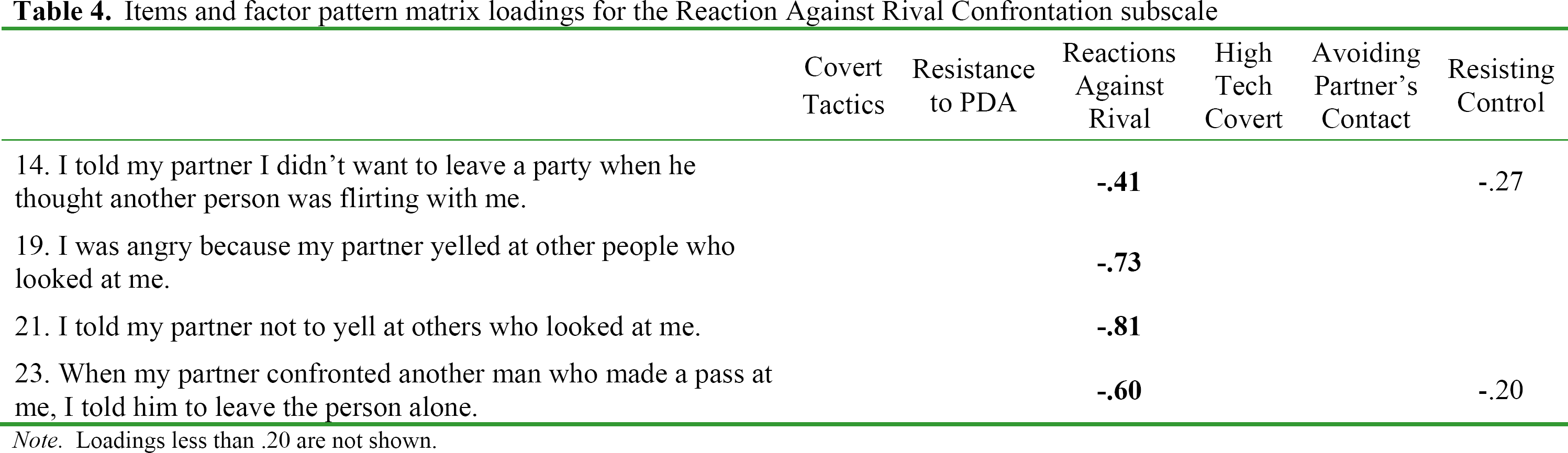
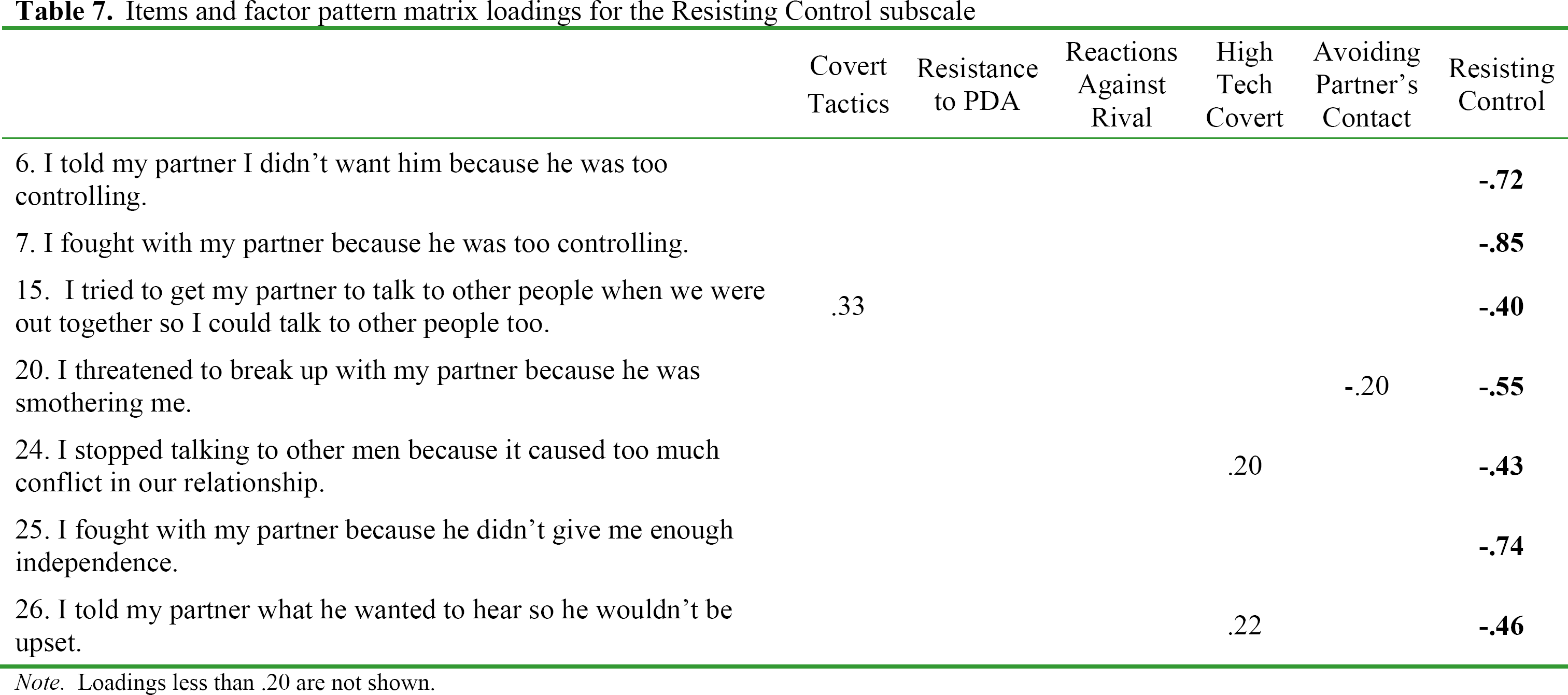
All of the items on the Resistance to Mate Guarding Scale, along with the factor loadings from the rotated pattern matrix, are shown in Tables 2 to 7. Factor loadings for an item indicate how well each item correlates with the factor (Tabachnick and Fidell, 1996). Factor loadings below .20 are not shown in the Tables. The scree plot indicated six factors, and after assessing the individual items, we concluded that extracting six factors was appropriate and theoretically sound. The six factors on the Resistance to Mate Guarding Scale were: Covert Tactics (see Table 2), Resisting a Partner's Public Displays of Affection (PDA; see Table 3), Reactions against Rival Confrontation by a partner (see Table 4), use of High Tech Covert Strategies (see Table 5), Avoiding Contact with a Partner (see Table 6), and Resisting a Partner's Attempts at Control (see Table 7).
Items and factor pattern matrix loadings for the Covert Tactics subscale

Note. Loadings less than .20 are not shown;
This item was removed due to it loading nearly equally on two factors.
Items and factor pattern matrix loadings for the Resistance to PDA subscale

Note. Loadings less than .20 are not shown.
Items and factor pattern matrix loadings for the Reaction Against Rival Confrontation subscale
Note. Loadings less than .20 are not shown.
Items and factor pattern matrix loadings for the High Tech Covert Strategy subscale

Note. Loadings less than .20 are not shown.
Items and factor pattern matrix loadings for the Avoiding Partner's Contact subscale

Note. Loadings less than .20 are not shown;
These items were removed due to loading nearly equally on two factors
Items and factor pattern matrix loadings for the Resisting Control subscale
Note. Loadings less than .20 are not shown.
Confirmatory factor analysis of the Resistance to Mate Guarding Scale
Based upon the results of the exploratory factor analysis, there appeared to be some potentially problematic cross-loadings for six items (meeting the definition based upon a difference between maximum loadings of < .10). Three items (item 13 of the Covert scale and Items 12 and 22 of the Avoiding Partner Contact scale) had nearly identical pattern matrix factor loadings (within .03 on two subscales). These three items were removed prior to the confirmatory factor analysis.
A second-order confirmatory factor analysis with maximum likelihood estimation was conducted using EQS 6 to test the hypothesized 6-factor model for the Resistance to Mate Guarding Scale. The six proposed latent constructs (i.e., first order factors) included Covert Tactics, Resistance to PDA, Resisting Control, Reactions against Rival, High Tech Covert Strategies, and Avoiding Partner's Contact. The model also included a seventh, second-order factor to represent overall resistance to mate guarding. The assumption of multivariate normality was violated; therefore, we used robust maximum likelihood estimation. The Satorra-Bentler Scaled χ2 and robust estimates of the Comparative Fit Index (CFI), Root Mean-Square Error of Approximation (RMSEA), and normed chi-square test (i.e., χ2 divided by degrees of freedom) were used to interpret model fit. A CFI value greater than or equal to .90, RMSEA value less than .05, and normed χ2 value close to or less than 2 indicate a model of favorable fit (Hatcher, 2004; Kline, 2005).
All fit indices revealed that the hypothesized model is a good fit for the data (Satorra-Bentler χ2[423] = 647.51; CFI = .90; RMSEA = .04; normed χ2 = 1.53). Based on the Lagrange Multiplier Test, five error covariances were allowed to relax the model. The Wald Test indicated that none of the measurement parameters needed to be dropped. All tested path coefficients were statistically significant. Moreover, all path coefficients from the second- to the first-order factors were large (ranging from .59 to .90), and none of the first-order factor-to-item coefficients fell below .55. This indicates that it is appropriate to use the Resistance to Mate Guarding Scale with either six subscales or as one overall measure of resistance to mate guarding. The proposed CFA model with standardized pathway coefficients is shown in Figure 1.

Proposed CFA model with standardized pathway coefficients
Cronbach's alphas and correlation of subscales
We calculated Cronbach's alphas for each subscale using the entire data set. The reliabilities ranged from .86 to .93. The reliability for the subscale Covert Tactics was .90. Covert Tactics consisted of nine items that encompassed the ways women may try to resist mate guarding which they do not want their partner to discover. For example, “I hid stuff from my partner, so he wouldn't find it.” Resistance to PDA had a reliability of .93 and consisted of three items. These items included behaviors aimed at trying to hinder a partner's attempt at being demonstrative in public. For example, “I wouldn't let my partner put his arm around me in public.” Resisting Control was the third subscale, with a reliability of .89. This subscale consisted of seven items that tapped into the things women did to stop a partner's controlling behavior. For instance, “I fought with my partner because he didn't give me enough independence.” The Reactions against Rival Confrontation by a Partner had a Cronbach's alpha of .86 and included four items. This scale tapped into the ways women resisted their partner's attempt to confront possible mate poachers. For instance, “I was angry because my partner yelled at other people who looked at me.” High Tech Covert Strategies had an alpha of .87 and included five items that assessed using technology to avoid a partner's mate guarding attempts. For example, “I have erased messages/comments other people have made to me via computer (i.e. Facebook, Myspace, AOL instant messenger, e-mail) so my partner does not find them.” The final subscale was Avoiding Partner's Contact; this scale had a reliability of .87 and consisted of five items. These items reflected the ways in which women escape being in contact with their partner. For instance, “I pretend that I do not receive all text messages/phone calls from my partner to avoid fighting with him/her.”
Finally, we conducted correlations using the full sample to determine if the subscales were related. Not surprisingly, they were all significantly, positively correlated with each other. Correlations ranged from .36 to .70 (see Table 8).
Correlations between the subscales of the Resistance to Mate Guarding Scale

Note. * p < .001; Ns = 712–740
Testing the validity of the Resistance to Mate Guarding Scale
Once we established that the structure of the Resistance to Mate Guarding Scale was sound, we began testing the validity of the scale using the entire sample. We used a more stringent alpha (p ≤ .01) to decrease the probability of a Type I error that may occur due to the number of analyses we performed.
Mate guarding and women's resistance to mate guarding. We predicted that women who indicated that their partners used more mate guarding tactics would have higher levels of resistance to mate guarding. Each subscale of the Resistance to Mate Guarding Scale significantly and positively correlated with women's self-reports of their partner's mate guarding. The highest correlation indicated that women with partners who used more mate guarding tactics were more likely to resist their partner's attempts to control them (see Table 9).
Convergent validity: Correlations between the Resistance to Mate Guarding subscales and other published measures

Note. All r values above .10 were significant at p = .001.
Controlling partners and women's resistance to mate guarding. We predicted that women who rated their partners as more controlling (as measured by the Controlling Behavior Scale) would show more resistance to their partner's mate guarding attempts. Each subscale of the Resistance to Mate Guarding Scale significantly and positively correlated with women's ratings of their partner's controlling behaviors. Not surprisingly, the highest correlation showed that women who rated their partners as more controlling used more covert resistance behaviors (see Table 9).
Women's use of control and their resistance to mate guarding. We predicted that women who self-reported high levels of control of their partner would also be more likely to resist their partner's mate guarding, primarily because these women clearly preferred to be in control and be independent of their partners. Each subscale of the Resistance to Mate Guarding Scale significantly and positively correlated with women's ratings of their own controlling behavior. Interestingly, women's use of controlling behaviors had the highest correlations with covert resistance to mate guarding strategies (see Table 9).
Women's relationship investment and resistance to mate guarding. We predicted that each subscale of the Resistance to Mate Guarding Scale would be related to less relationship investment as measured by the Partner Specific Investment Inventory. Once again, each subscale of the Resistance to Mate Guarding Scale significantly and negatively predicted women's self-reported investment in their romantic relationship. The strongest correlation indicated that the less invested women were in their relationship, the more they avoided their partner's contact (see Table 9).
Intimacy and resistance to mate guarding. We predicted that resistance to mate guarding would be higher in women who rated their relationships as less intimate. Each subscale of the Resistance to Mate Guarding Scale significantly and negatively correlated with women's ratings of intimacy. The two strongest correlations indicated that women who resisted their partner's control and avoided their partner's contact felt their relationships were less intimate (see Table 9).
Women's attachment style and resistance to mate guarding. We predicted that attachment style would be correlated with the Resistance to Mate Guarding Scale. In particular, we predicted that women with avoidant attachment would show more resistance to mate guarding. Once again, each subscale was significantly correlated with both anxious and avoidant attachment. However, the correlation between Resistance to a Partner's Public Displays of Affection and anxious attachment was so small that it is unlikely to be meaningful (r = .10). Women with anxious attachment styles were likely to resist their partner's mate guarding tactics using covert methods. Avoidant attachment was most strongly correlated with three resistance strategies: use of covert tactics, avoiding public displays of affection, and resisting a partner's control (see Table 9).
SOI and resistance to mate guarding. We predicted that women with a more unrestricted sociosexual orientation would have higher levels of resistance to mate guarding. As expected, all of the resistance to mate guarding subscales significantly and positively correlated with sociosexual orientation. However, these correlations were fairly low, ranging from .13 to .24. The highest correlation indicated that more unrestricted women used more covert resistance to mate guarding strategies (see Table 9).
Discussion
Based on theoretical and empirical support, we determined that the Resistance to Mate Guarding Scale has six factors, including resistance to mate guarding via Covert Tactics, resisting a partner's Public Displays of Affection, resisting a partner's attempts at Control, Reaction Against Rival Confrontation by a partner, use of High Tech Covert Strategies, and Avoiding Contact with a partner. These factors account for over 60% of the variance. Each of these subscales had high reliability and, not surprisingly, all of the subscales were significantly correlated with one another. Analyses also supported the use of an overall measure of resistance to mate guarding. Thus, researchers may choose to use an overall measure of resistance to mate guarding or the six subscales.
In addition to analyzing the structure and reliability of the Resistance to Mate Guarding Scale, we conducted further analyses to assess the validity of the questionnaire. As expected, compared to the other instruments we used to assess the validity of the Resistance to Mate Guarding Scale, mate guarding and resistance to mate guarding showed the largest correlations. This suggests that resistance to mate guarding occurs when women perceive that their partners are mate guarding and being controlling. Even when mate guarding occurs, resistance is most likely under specific circumstances, such as when women know their partners will not discover their resistance or when the stakes are low, such as with a partner who will not retaliate through the use of violence. Research assessing men's use of mate guarding and women's resistance to mate guarding indicates that women are more likely to resist mate guarding when their partner has a higher digit ratio, which is an indication of reduced prenatal exposure to testosterone. Since men with lower digit ratios are more likely to espouse the use of threats and physical violence toward a partner, women may not be willing to risk resisting the mate guarding attempts of these partners (Cousins et al., 2009).
In further support of the validity of the Resistance to Mate Guarding Scale, women's self-reported controlling behaviors positively predicted resistance to mate guarding, as did their report of their partner's controlling behaviors. Previous research indicates that control and intimate partner violence are related (Graham-Kevan and Archer, 2005), at least in men (Cousins and Gangestad, 2007). Our research extends these findings: When male partners are controlling, their female mates are more resistant to mate guarding. Presumably, this is because more controlling men are more likely to mate guard their partners, which women then resist. In addition, our research indicates that when women see themselves as particularly controlling, they are more likely to resist their partner's mate guarding attempts. There are a few possible explanations for this finding. These women may be more interested in independence within their relationship. Alternatively, these women may be in highly antagonistic relationships where both partners try to induce jealousy and react to the jealousy of their partners. Future research should investigate these possibilities.
Relationship investment and intimacy were negatively correlated with resistance to mate guarding. When women are less invested in their relationships, they may focus more on seeking an alternative mate. These women should be particularly likely to be mate guarded by their partners and to be motivated to resist those mate guarding attempts. When intimacy is low, women may be resistant to the mate guarding tactics of their partner because they are dissatisfied with their relationships.
Those with anxious and avoidant attachment also used more resistance to mate guarding tactics, although anxious attachment had a very low correlation with resistance to a partner's PDA (r = .10). We predicted that those with avoidant attachment would be more likely to resist mate guarding because women with an avoidant attachment style tend to be less committed to their relationships (DeWall et al., 2011). It is not clear how to interpret the finding that women with more anxious attachment styles more strongly resisted mate guarding. This correlation is very low and may represent a spurious relationship.
Finally, there were small but statistically significant correlations between sociosexual orientation and resistance to mate guarding such that more unrestricted women used more resistance strategies. This may be due to the fact that unrestricted women are more likely to cheat on a partner (Feldman and Cauffman, 1999); prior research shows that women who are interested in men other than their partners are more likely to resist mate guarding (Cousins et al., 2009). In sum, our results support both the convergent validity of the Resistance to Mate Guarding Scale.
Limitations and future directions
One of the limitations of this research is that only women were assessed. Evolutionary theory clearly predicts that men mate guard their partners, but its predictions for women's mate guarding are less straightforward. Buss (2002) argued that it makes sense for women to mate guard a partner because loss of resources to a competitor would have had detrimental fitness effects for a woman whose partner cheated on her. As with women's use of aggression, we suspect that even when women mate guard their partners, they are using some of the tactics that have a lower risk of physical injury (i.e., they avoid physical fights) (Campbell, 2005). The fitness payoffs to women are lower for tactics that could result in physical injury because women were more important in the survival of their offspring (Campbell, 2005). Research bears this out: In married couples, husbands, compared to their wives, report greater use of tactics that may risk injury such as threatening competitors (Buss and Shackelford, 1997). Many of the behaviors we consider to be mate guarding may have led to injury (Campbell, 2005). For instance, confronting a rival may lead to a physical assault and, therefore, women may be less likely to employ this method of mate guarding.
If women also use mate guarding to control their partners, this scale may not capture men's resistance strategies as well as it does women's resistance strategies. As with mate retention tactics, we expect that men may resist their partner's mate guarding in ways that are more confrontational, especially regarding physical confrontations. Many of the items on the current scale reflect the covert nature of the tactics used by women to resist their partner's mate guarding attempts (e.g., “I always erase text messages/voicemails from other people so my partner does not find out who I have been conversing with that day”). In fact, in previous research we divided this scale into the behaviors men would be aware of and those for which men would not be aware of (Cousins, 2003). Future research should include an analysis of whether resistance to mate guarding occurs in men and whether they use the same tactics as women.
It is possible that our resistance scale is tapping into a more general strategy in women who dislike behavioral restriction. That is, some women may score higher on the resistance to mate guarding scale simply because they dislike any sort of behavioral restriction. However, previous research using an earlier, unpublished version of this scale indicates that women are more likely to resist mate guarding when they are fertile, particularly for women who are attracted to men other than their primary partners (Gangestad, Garver-Apgar, Cousins, and Thornhill, 2014). The fact that women's scores vary across the menstrual cycle strongly suggests that the Resistance to Mate Guarding Scale does not measure a general form of behavioral restriction, but taps directly into women's behavioral response to their partner's attempts to keep them from cheating. Although we believe this is strong evidence that the Resistance to Mate Guarding Scale is not measuring psychological reactance, future research should address this issue more directly. The current research strongly supports the convergent validity of the Resistance to Mate Guarding Scale. However, future research should assess the discriminant validity of the measure.
Conclusions
Our research extends Buss' (1988) research on mate retention by assessing the dynamics that occur between partners when mate guarding is present in the relationship. By assessing dynamics within romantic relationships, especially regarding conflict over mate retention strategies, a better understanding of the interaction between partners will emerge. This will add to the growing body of research seeking to understand the coevolution of strategies when partners are in conflict.
The Resistance to Mate Guarding Scale may elucidate individual differences in reactions to a partner's mate guarding. We expect that scores on this scale will be predicted by a variety of factors, including interest in extra-pair partners and cheating. The resistance to Mate Guarding Scale adds to a growing body of research assessing sexually antagonistic coevolution in humans. In the past few years, research on sexually antagonistic coevolution has grown in importance. Recent work by McKibbin, Shackelford, Miner, Bates, and Liddle (2011) highlights the importance of research concerning sexually antagonistic coevolution. To our knowledge, this study is the first to develop a scale measuring strategies to reduce mate guarding.
Footnotes
Acknowledgements:
We would like to acknowledge the help of our undergraduate research assistants Vikki Klimas and Blair Pugliese for help with data collection and feedback.
Resistance to Mate Guarding Scale
Directions: Please think of your current romantic relationship. If you are not currently in a relationship, please think of your last relationship. Please use the following scale to make the ratings:
Researchers can calculate one overall measure of resistance to mate guarding by taking the mean of all the items from the scale. Alternatively, researchers can calculate the following resistance subscales by taking a mean of the items in the subscale:
*
Since we deleted three items from the original scale because they loaded on more than one factor, the numbering for the final scale changed. The number in parentheses after items reflects the original numbering; this is the number reflected in the tables in the rest of the paper.