



Abstract
We investigated the effect of the childhood context variables number of siblings (study 1 and 2) and parental SES (study 2) on implicit parenting motivation across six cultural samples, including Africa (2xCameroon), Asia (PR China), Europe (2xGermany), and Latin America (Costa Rica). Implicit parenting motivation was assessed using an instrument measuring implicit motives (OMT, Operant Multimotive Test; Kuhl and Scheffer, 2001). Replicating and extending results from previous studies, regression analyses and structural equation models show that the number of siblings and parental SES explain a large amount of cultural variance, ranging from 64% to 82% of the cultural variance observed in implicit parenting motivation. Results are discussed within the framework of evolutionary developmental psychology.
Keywords
Introduction
From an evolutionary developmental perspective, adult behavior can be seen as the result of epigenetic developmental pathways. The epigenetic view of development is bidirectional: If a gene is switched on, its genetic activity is a cause for the development of an organism, but the expression of the involved genes during ontogenesis is also influenced by ontogenetic experiences (i.e., maturational processes and behavior; see Bjorklund and Blasi, 2012; Bjorklund and Pellegrini, 2002; Chasiotis, 2010, 2011; Gottlieb, 1991). From this perspective, the phenotype is the result of epigenetic processes during development; genes interact epigenetically with the environment to produce the behavior we study in psychology. One of the most obvious manifestations of this epigenetic interplay is the evolution of life spans. This view implies that different developmental stages are not transitory phases toward adulthood but evolutionary end-products per se, because many features of childhood can be considered preparations for adulthood (Alexander, 1987; Bjorklund, 1997): If environmental change is slow compared to an individual lifespan, the optimal mode of adaptation is to establish sensitive learning situations (or sensitive periods) early in life as preparations for adulthood that guide later development (Chasiotis, 2011; Draper and Harpending, 1988). This evolutionary perspective fits with empirical evidence in the psychological literature and in mainstream developmental psychology, in which the first 6 years of childhood are considered as psychologically the most important (“functional”) for individual development (Lamb and Sutton-Smith, 1982).
In a previous study (Chasiotis, Hofer, and Campos, 2006), we were able to demonstrate that number of siblings, as an operationalization of an individual's childhood context, explained cultural variance in implicit parenting motivation in adulthood across three cultural samples from Cameroon, Costa Rica, and Germany (see also Bender and Chasiotis, 2011). In this paper, we expand this research design and set out to investigate whether the childhood context variables number of siblings and parental SES can explain cultural variance in implicit parenting motivation with two studies using six samples from Africa (2xCameroon), Asia (PR China), Europe (2xGermany), and Latin America (Costa Rica). In the following, after introducing the concept of implicit parenting motivation and the relevance of childhood context for its' development, we present the research design of the two studies we conducted to investigate the impact of the childhood context variables number of siblings (Study 1 and 2) and parental SES (Study 2) on implicit parenting motivation.
Implicit motives and parenting motivation
One of the most important implications of the distinction between psychological (proximate) and evolutionary (ultimate) causation is that explicit psychological measures might not be sufficient to explain human reproductive behavior, simply because many of its features are not necessarily represented on a conscious level and are thus not accessible through self-inspection or self-reports (Daly and Wilson, 1999). From an evolutionary life history perspective, prelinguistic affective experiences, which are decisive for the development of implicit motives, are an important aspect of the childhood context of an individual (Chisholm, 1999; McClelland and Pilon, 1983). McClelland, Koestner, and Weinberger (1989) distinguished between two motivational systems: On the one hand there is a motivational system operating on the conscious level (explicit or self-attributed), and on the other hand a motivational system that functions at the preconscious level (implicit). Because of their preverbal origins and unconscious nature, implicit motives are measured through projective, fantasy-based methods such as the Thematic Apperception Test [TAT] (Murray, 1943) and its more recent modifications like the Picture Story Exercise [PSE] or the Operant Multimotive Test [OMT] (Hofer and Chasiotis, 2011; Schultheiss and Brunstein, 2010). Such implicit motive tests are therefore qualified for assessing contents of preverbal developmental phases and manifestations of unconscious affective dispositions.
Implicit parenting motivation. Parenthood constitutes an investment in genetic offspring as a part of reproductive effort while at the same time setting the stage on which cultural values and practices are transmitted between generations. Researchers have reported a large degree of contextual and cultural variation in parenting behavior (Bornstein and Lansford, 2010). To explain this variation, explicitly represented parental socialization goals and ethnotheories are considered influential variables in creating and transmitting culture-dependent developmental pathways (Berry, Poortinga, Breugelmans, Chasiotis, and Sam, 2011; Keller, 2007), leaving implicit motivational roots of parenting behavior largely unknown (see Hofer, Schröder, and Keller, 2012 for the only exception so far). An evolutionary perspective on parenting motivation advocates teasing apart the implicit motivational underpinnings (shaped by individual experiences during early, preverbal childhood) from the verbalized, explicit representations emerging and establishing themselves during adolescence and early adulthood. The rewarding feelings of nurturance, generally described as expressions of the activated parental motivational system during the transition to parenthood from pregnancy to postpartum (Fleming, Steiner, and Corter, 1997; Storey, Walsh, Quinton, and Wynne-Edwards, 2000), could depend on previous experiences of being a sibling caretaker during childhood. The conscious desire to have children of one's own might be evolutionarily new, since it requires representation of the future and the consequences of sexuality. The unreflective responsiveness exhibited by adult mammals toward children through the “releasing” effect of certain morphological features of newborn mammals (“Kindchenschema”; see Lorenz, 1943), causing them to show a set of parental caretaking affects and behavior, may be a part of our evolved mammalian heritage. Even more, the motivation to care for children who are genetically related but not one's own (e.g., nieces, nephews, younger siblings), arguably a part of nepotistic altruism that ultimately increases our indirect fitness (Hamilton, 1964), is also independent of the desire to have sex or offspring (see also the literature on the evolution of human, especially female, longevity, e.g. Hrdy, 2011; Voland, Chasiotis, and Schiefenhövel, 2005). Thus, taking implicit parenting motivation into consideration might add to our knowledge of the evolutionary importance of childhood contextual experiences.
Childhood context effects on psychological outcomes in adulthood
Parental SES. Every child is reared in a unique environment characterized by contextual variables like number of siblings, specific birth order position, and socioeconomic conditions. Evidence for the importance of socioeconomic factors for developmental conditions comes from extensive value surveys in sociology (Inglehart, 1997) and cross-cultural psychology (Allen et al., 2007): The financial situation during childhood has been found to be a better predictor of the endorsement of values in adulthood than the current economic situation of the adult respondent. Such effects are typically summarized under the notion of “economic determinism” to refer to the impact of the economic situation on psychological outcomes. From an evolutionary perspective, the higher predictive value of parental SES compared to current SES can be regarded as an indicator for the notion of prepubertal childhood as a sensitive period for the preparation for adulthood (Bjorklund and Pellegrini, 2002; Chasiotis, 2011).
On the ontogenetic importance of siblings. Interactional experiences with siblings constitute another main type of childhood context. The (non-)existence of (younger and/or older) siblings and the ordinal position explains a huge array of phenomena, ranging from scientific discoveries and political revolutions to differences in personality traits (Sulloway, 1996). Also, it is uncontroversial that caretaking behaviors of siblings can be evoked in response to the presence of younger siblings (see Edwards, 1992; Harris, 2005). Studies have also shown that children as young as 4 years of age perform “motherese” in the presence of younger children (Papoušek and Papoušek, 1987) and show behavioral patterns of cultural teaching (Maynard, 2002) or of the culture-independent intuitive parenting program (Papoušek and Papoušek, 1987; see also Keller, Chasiotis, and Runde, 1992). Based on these considerations, Chasiotis, Hofer, and Campos (2006) proposed that interactive experiences with younger siblings should be considered an important factor for the emergence of parenting motivation. Taking a cross-cultural, developmental perspective, they suggested that the presence of younger siblings triggers prosocial, nurturing motivations and caregiving behavior. In turn, this implicit parenting motivation results in positive, loving feelings towards children on a conscious level, which finally leads to parenthood. Using structural equation modeling, they demonstrated that this developmental pathway is present in both male and female participants, and in all three cultural samples from Germany, Costa Rica, and Cameroon. Since implicit parenting motivation was associated with the existence of younger siblings and showed cultural variation, while the existence of younger siblings also varied across cultures, a further exploration of their relationship was warranted. To investigate the impact of this childhood context variable on cultural differences, implicit parenting motivation was first regressed on the variable “younger siblings.” In the next step, the unstandardized residual of implicit parenting motivation of that regression analysis was re-entered into an ANOVA with culture as a predictor. The ANOVA with the residual of implicit parenting motivation as a dependent variable and culture as a predictor showed a remarkable decrease in effect size of culture; up to 62 % of the original effect size of culture on implicit parenting motivation could be traced back to sibling effects.
We now present two studies investigating the importance of the childhood context variables number of siblings (Study 1 and 2) and parental SES (Study 2) for implicit parenting motivation. The basic criterion for selecting the cultural samples was to tap into cultural variability in sociocultural orientation and SES.
Selection of Cultural Samples
Selection of our cultural samples for both studies was based upon the considerations of Kağitçibaşi (1996; see also Markus and Kitayama, 1991) to differentiate the dimensions of interpersonal distance (separateness – relatedness) and agency (autonomy – heteronomy). The relevant combinations of these dimensions for both our studies are independence, interdependence, and autonomous-relatedness. Independence is defined as comprising autonomy and separateness, an adaptive pattern in Western, urban, educated middle-class contexts. A prototypical independent context can be found in affluent, educated, middle-class, nuclear families (Kağitçibaşi, 1996), where economic dependence on offspring is often not considered necessary or even desirable. Children – often just one – are therefore raised to be independent and self-sufficient, fostering a sense of separateness and uniqueness (Kağitçibaşi, 2005). Therefore, we selected German middle-class samples described as expressing prototypical independence (Keller, 2007). The prototypical interdependent socio-cultural orientation – defined as comprising heteronomy and relatedness – is adaptive in rural populations with lower socioeconomic and educational status. For the purpose of our paper, we selected samples of rural Cameroonian Nso, one of the largest ethnic groups in the North-West province of Cameroon (anglophone part of Cameroon). In rural agrarian societies with low levels of affluence, children often contribute to the family's economy and provide a security net for their aging parents (Kağitçibaşi, 2005). Having many children is valued, intergenerational interdependence (i.e., feeling close and connected; see Markus and Kitayama, 1991) is necessary for the family's livelihood, and a strong sense of tradition and obedience is dominant in parenting. Independence in this context is not functional (and thus not valued), because an independent child may leave the family and look after her/his own self-interest when she/he is grown. Such a context has been characterized as prototypically interdependent (Kağitçibaşi, 2005). Finally, to account for the autonomous-related context, as taking up a middle position between the prototypically independent and interdependent context, we decided to draw samples from a suburban context in PR China (study 1) and from the capital city of Costa Rica, San José (study 2).
General Procedure for Data Analysis
In cross-cultural research, equivalence of measures is crucial, in particular because many constructs are derived from Western psychological theories and their application can result in biased interpretations (Poortinga, 1989). Special attention was therefore paid to the procedures and methods devised to test and ensure the comparability of the concepts and measures used in this study in order to avoid construct, method, and item bias (Van de Vijver and Leung, 1997). Questionnaires were translated adhering to the suggested translation-backtranslation procedure by bilinguals of the target language (i.e., for the Chinese [Study 1], English [Study 1 and 2], and Spanish version [Study 2]; Van de Vijver and Leung, 1997). Deviations were minimal, and were solved in close collaboration with local experts. To ensure construct equivalence, instructions of the OMT were discussed with local experts and collaborators. Method bias can only partly be tested with statistical procedures (Van de Vijver and Leung, 1997), so we ensured a standardized administration, provided detailed instructions, and used fixed scoring rules (e.g., Veroff, 1992). Furthermore, test-relevant background characteristics (individual and context variables: e.g., gender, age) were assessed to rule out alternative interpretations for cross-cultural and intra-cultural differences in test-scores (van de Vijver, 2000). The comparability of measurements across cultural samples was evaluated through confirmatory factor analyses (CFA) using AMOS (Arbuckle, 2009). Because results from judgmental and statistical approaches do not necessarily overlap (Engelhard, Hansche, and Rutledge, 1990), results of the analyses were further discussed with local experts (for a general discussion of this approach, see also Van de Vijver and Chasiotis, 2010). Before examining our hypotheses, the descriptive statistics of each group were compiled. Our main hypotheses were tested using hierarchical regression analyses and multi-group comparisons of path analyses (AMOS; Arbuckle, 2009). Three global fit indices were adopted to interpret the results of the path analyses in relation to the overall model fit: the χ2 test, the root mean square error of approximation (RMSEA) and the comparative fit index (CFI). A RMSEA ≤ 0.08 and a CFI ≥ 0.90 were considered cut-off values for acceptable fit to the data (Browne and Cudeck, 1993; Marsh, Hau, and Grayson, 2005).
Study 1: Germany, Cameroon, and PR China
In the first study, we tested the impact of the childhood context variable number of siblings on implicit parenting motivation in three cultural samples from Germany, Cameroon, and China. These samples were selected with regard to their prototypicality for these cultural contexts: a German middle-class sample from Osnabrück as a prototypical independent context, and a sample of Cameroonian Nso (the largest ethnic groups in the North-West province of Cameroon) as an interdependent context. Typically, researchers have claimed that Chinese participants in general represent a prototypically interdependent context. However, a Chinese sample from a suburban context is likely to represent a special case, since the institution of the one-child policy affected traditional family constellations and, thus, socialization practices. For this reason, the Chinese sample may best be described as coming from an autonomous-related context (see also Bender and Chasiotis, 2011).
Measures
Operant Multimotive Test. The Operant Multi-Motive-Test (OMT; Kuhl and Scheffer, 2001) was administered to assess the implicit motivational disposition of the participants. The OMT represents a Picture Story Exercise (PSE) that is based on the Thematic Apperception Test (TAT; Murray, 1943; see also Schultheiss and Brunstein, 2010). In such a test, participants are presented with ambiguous picture stimuli and instructed to imagine a story in response to each of the pictures. In the OMT, participants do not have to write down the complete story (like in other PSEs), but instead have to answer three short questions: (1) “What is important for the person in this situation and what is he/she doing?” (2) “How does the person feel?” and (3) “Why does the person feel this way?” These responses are then content-coded for the presence of the three basic implicit motives (achievement, power, affiliation) as in most PSE coding procedures (Winter, 1991). Research on motivation has traditionally distinguished three basic motives referring to affiliation, power, and achievement (McClelland, 1987). The affiliation motive reflects a concern for close and warm interpersonal relationships (Weinberger, Cotler, and Fishman, 2010). The power motive reflects a desire to influence behavior or emotions of other people, and the achievement motive represents a need to surpass standards of excellence (Smith, 1992). In addition to identifying the presence of one motive per picture (only one code is given), the particular modes of motive realization, that is, the cognitive and affective mechanisms guiding the motive pursuit, are identified as well. The OMT therefore allows for the differentiation of four approach components and one avoidance component for each motive. This is achieved by crossing two affective sources of motivation (positive vs. negative) with different degrees of self-determined vs. incentive-focused forms of motivation. In other words, a motive realization can either be positively or negatively affectively toned and either be grounded in the self or in external incentives (Kuhl, 2001; see also Deci and Ryan, 1985). This results in the following five combinations for the power motive: (1) a power motive characterized by negative affect and self-activation is commonly described as self-realization (e.g., asserting wishes against resistance); (2) If the story is lacking in self-activation, an inhibited mode of realization is apparent (e.g., fear of exerting power, insisting on roles); (3) If negative affect is combined with the absence of self-activation, the passive, avoidant component of the power motive is scored (e.g., feelings of powerlessness, guilt); When (4) striving for power is associated with positive affect based on external rewards, an implicit striving for status is scored (e.g., being the focus of attention, having prestige and authority); Finally, (5) a positively toned power motivation characterized by self-activation (i.e., being rooted in the self) is coded as the implicit desire to help others by providing prosocial guidance (e.g., passing on knowledge, conveying values, taking care of less stronger and younger ones). Since previous research (Chasiotis, Hofer, and Campos, 2006) has linked this motive realization with a culturally invariant path-model towards parenthood, this category is labeled as implicit parenting motivation throughout the text. Prototypical responses would read: What is important for the person in this situation and what is he/she doing? – “Instructing and leading the young.” – How does the person feel? – “Feels patient.” – Why does the person feel this way? – “As an elder or leader he needs to guide the young.”
In the last few years, extensive research has been carried out on the convergent validity of the OMT and the traditional TAT, also with regard to behavioral correlates (Baumann, Kaschel, and Kuhl, 2005; for an overview, see Baumann, Kazén, and Kuhl, 2010). The OMTs cross-cultural appropriateness has been demonstrated repeatedly, and the 12 pictures used in the present study have proved to be applicable for the measurement of implicit motivation and its specific modes of realization in PR China, Cameroon, Costa Rica, and Germany (Bender and Chasiotis, 2011; Busch, Hofer, Chasiotis, and Campos, 2013; Chasiotis, Bender, Kiessling, and Hofer, 2010; Hofer, Busch, Chasiotis, Kärtner, and Campos, 2008).
OMT coding. Participants' answers to the picture cards were scored for power motivation by five experienced coders who achieved percentage agreements of 85% or better in their responses to training material prescored by experts in OMT – workshops based on the manual by Kuhl and Scheffer (2001). Initially, the responses of 100 participants were scored by all raters to examine agreement of codings for power. As the reliability of raters was found to be sufficiently high (e.g., category agreement for implicit parenting motivation α > .85), the remaining data sets were scored separately. Coding difficulties were resolved by discussion in regular meetings.
Sociodemographic characteristics. After filling out the OMT, participants were instructed to report their gender, age, and to provide information about the number and age of their siblings (see Table 1).
Sample characteristics for Study 1

Study 1 Results
Cultural differences. A total of 77 Chinese, 68 Cameroonians, and 100 Germans aged 20 to 40 years with a mean age of 28 years (SD = 5.20) participated in the study (see Table 1). Analyses of variances did not reveal significant differences between the three cultures with respect to the distribution of gender, χ2(2, 245) = 3.85 and age of the participants, F(2, 242) = 2.74.
The three cultural samples differed with respect to the number of siblings participants reported, F(2, 242) = 13.43, p < .001. Post hoc tests indicated that Cameroonians had significantly more siblings (M = 4.60, SD = 2.15) than Chinese participants (M = 1.87, SD = 1.14; p < .001), who in turn had significantly more siblings than German participants (M = .88, SD = 1.12; p < .001; see Table 1). The cultural samples under investigation also differed significantly from each other in their average implicit parenting motivation, F(1, 245) = 7.91, p < .001. Post hoc analyses revealed that Cameroonian participants exhibited the most implicit parenting motivation (M = .75, SD = .89), more than both German (M = .37, SD = .58; p < .01) and Chinese (M = .35, SD = .60; p < .01) participants, who did not differ from each other (see Table 1). To summarize, there are significant culture sample differences in implicit parenting motivation and in number of siblings.
Analyses on the moderating effect of culture. An inspection of the correlations reveals that implicit parenting motivation is positively correlated with having many siblings, r(245) = .24, p < .001 (see Table 2). In the following, we examined whether this relationship between number of siblings and implicit parenting motivation holds true for all cultural groups. In cross-cultural applications of regression analysis, we are often interested in the question of whether a single regression equation can capture the relationship between the independent and dependent variable in each group, since it is possible that the strength and/or direction of relationship between two variables varies from one country to another. In other words, culture may act as a moderator (cf. Baron and Kenny, 1986). Moderated multiple regression analyses (Cohen and Cohen, 1975) were therefore conducted to see whether multiple regression analysis results obtained from the overall sample held true for all three cultural samples. This procedure was recommended particularly for cross-cultural research by van de Vijver and Leung (1997, pp. 116–117).
Zero-order correlations of measures across and within samples for Study 1 (total /Germany /PR China /Cameroon)

Note: *** p < .001
The first step in this technique is to obtain a pan-cultural regression equation of the dependent variable implicit parenting motivation on the predictor number of siblings, in which data from all cultures are included (see Table 3, Block 1). In the second step, culture is added as a dummy variable, and another regression analysis is carried out including the predictor and the dummy variable (Table 3, Block 2). In the third step, the interaction of the predictor and the dummy variable is added (Table 3, Block 3). The multiple correlations of the two equations are then tested for equality. To test the moderation effect of culture, two dummy variables were created for the three cultural samples (cf. Cohen and Cohen, 1975).
Hierarchical regression analyses (simultaneous entry method within blocks): Influence of number of siblings on implicit parenting motivation controlling for moderating effects of culture (Study 1; N = 245)

Notes: (*) p < . 10;
p < .05;
p < .01;
p < .001; for Culture 1, PR China = 1, Germany and Cameroon = 0; for Culture 2, Germany and Cameroon = 1 and PR China = 0
Significant differences between the blocks would indicate that a cross-cultural difference exists in the relation between the dependent variable and predictor, and thus, pancultural generalizations would not be appropriate (for other cross-cultural applications of this approach, see Chasiotis, Bender, Kiessling and Hofer, 2010; Chasiotis, Kiessling, Hofer and Campos, 2006).
In the first block of the linear regression model with number of siblings as the predictor and implicit parenting motivation as the dependent variable, the childhood context variable number of siblings accounted for a small but significant part of the variance (see Table 3). After entering the dummy variables for culture in the second block, the explained variance increased insignificantly, F(2, 244) = 1.82, p = .16. In the third step of the regression model, we entered the interaction terms of the culture dummy variables and the z-transformed scores of number of siblings together with the dummy variables for culture and the number of siblings variable as predictors. Only if the interaction terms do not increase the explained variance significantly can we be assured that the effect of number of siblings on prosocial power motivation is culture-independent. As Table 3 indicates, number of siblings remains significant (β = .27; p = .024), whereas the increase in explained variance after entering the interaction terms is insignificant, F(2, 244) = 1.22, p = .30. This result demonstrates the culturally invariant influence of number of siblings on implicit parenting motivation in these samples.
Additionally, analyses using an AMOS multi-group comparison with the 3 cultural samples also revealed an adequate fit of the relation of the number of siblings with implicit parenting motivation, thus indicating the validity of these effects across all three cultural samples, χ2 = 2.18, p = .34, df = 2, GFI = .99, RMSEA = 019.
Explaining cultural variance by number of siblings. After providing evidence for a culturally invariant influence of the childhood context variable number of siblings on implicit parenting motivation, in the next step we assessed its impact on the cultural variance of implicit parenting motivation. In order to investigate the magnitude of this effect, we conducted a set of ANOVAs and regressions (see Poortinga, van de Vijver, Joe, and van de Koppel, 1987; for applications of this approach, see Bender and Chasiotis, 2011; Chasiotis et al., 2006; van Hemert, 2003, 2011). First, we computed the effect size of culture on the dependent variable prosocial power motivation in an ANOVA, F(2, 244) = 7.91, p < .001, η2 = .061. After that, we extracted the effect of the number of siblings on the dependent variable implicit parenting motivation in a linear regression, and we computed the residual effect of culture on the particular dependent variable. Finally, the effect of culture on the purified residual without the effect of number of siblings was investigated in an ANOVA to obtain its adjusted effect size, F(2, 244) = 1.29, p = .28, η2 = .011. Computing the proportion of the two effect sizes revealed that 82% of the cultural variance in these three samples from Germany, Cameroon, and PR China is explained by the childhood context variable number of siblings.
Study 2: Germany, Cameroon, and Costa Rica
In study 2, we included parental SES as an additional childhood context variable, and selected a Latin American sample from the capital city of Costa Rica, San José, to represent an autonomous-related culture. Furthermore, we included a measure of current SES. This was done to compare the effects of current and parental SES on implicit parenting motivation (see Table 4). Concerning the direction of the effect of parental SES on implicit parenting motivation, we expect, in line with empirical evidence on the effects of social class on prosocial behavior (see Piff, Kraus, Cote, Cheng, and Keltner, 2010; Piff, Stancato, Cote, Mendoza-Denton, and Keltner, 2013), that individuals coming from a lower class family environment will show higher levels of implicit parenting motivation. It should be noted, however, that the common operationalization of social class in the literature reflects current, not parental, SES (see discussion).
Sample characteristics for Study 2

Measures
Operant Multimotive Test. We again employed the Operant Multi-Motive-Test (OMT; Kuhl and Scheffer, 2001) to assess the participants' levels of implicit parenting motivation. Cameroonian OMTs (in English) and German OMTs were coded by four bilingual research assistants in Germany. The Costa Rican OMTs were coded by five local assistants after attending a 5-day workshop on the Spanish version of the OMT coding manual (Kuhl and Scheffer, 2001). After reaching a satisfying inter-coder reliability with the training materials, 20% of the OMTs of a pretest were translated into English to establish inter-rater reliability between the German and the Costa Rican coders. All coders reached an overall inter-coder reliability of > 85% across all OMT categories (see Chasiotis and Hofer, 2003 for more details).
Sociodemographic characteristics. After filling out the OMT, participants were instructed to report their gender, age, the number and age of their siblings, and to provide information about their current and parental socioeconomic status. Parental SES was assessed by asking for the paternal profession during prepubertal childhood (a valid proxy for parental SES; see Chasiotis, 1999); current SES was assessed by asking for the participant's current occupation. Open-ended responses were then coded according to Kleining and Moore's (1968) coding scheme (1 = upper class, 2 = middle class, 3 = lower class; see Table 4).
Study 2 Results
Cultural differences. A total of 124 Germans, 126 Cameroonians, and 120 Costa Ricans aged 18 to 75 years with a mean age of 36 years (SD = 5.20) participated in the study. Samples did not differ in age and gender distribution. Cultural samples differed with respect to current SES, χ2(4, 370) = 35.48, p < .001, as well as parental SES, χ2(4, 370) = 57.78, p < .001, with Cameroonian participants showing a lower current and parental SES than German and Costa Rican participants, who did not differ from each other (see Table 4).
The three samples differed also with respect to the number of siblings participants indicated, F(2, 370) = 29.37, p < .001. Post hoc tests indicated that Germans had significantly fewer siblings (M = 2.00, SD = 1.88; p < .001) than Cameroonian (M = 4.9, SD = 3.86) and Costa Rican participants (M = 4.13, SD = 3.12) who did not differ from each other. Finally, the cultural samples under investigation also differed significantly from each other in their average implicit parenting motivation, F(2, 370) = 12.22, p < .001. Post hoc analyses revealed that German participants exhibited the lowest prosocial power motivation (M = .23, SD = .44; p < .001), lower than both Cameroonian (M = .70, SD = .93) and Costa Rican (M = .62, SD = .93) participants, who did not differ from each other (see Table 4). To summarize, there are significant culture sample differences in implicit parenting motivation and in the childhood context variables number of siblings and parental SES.
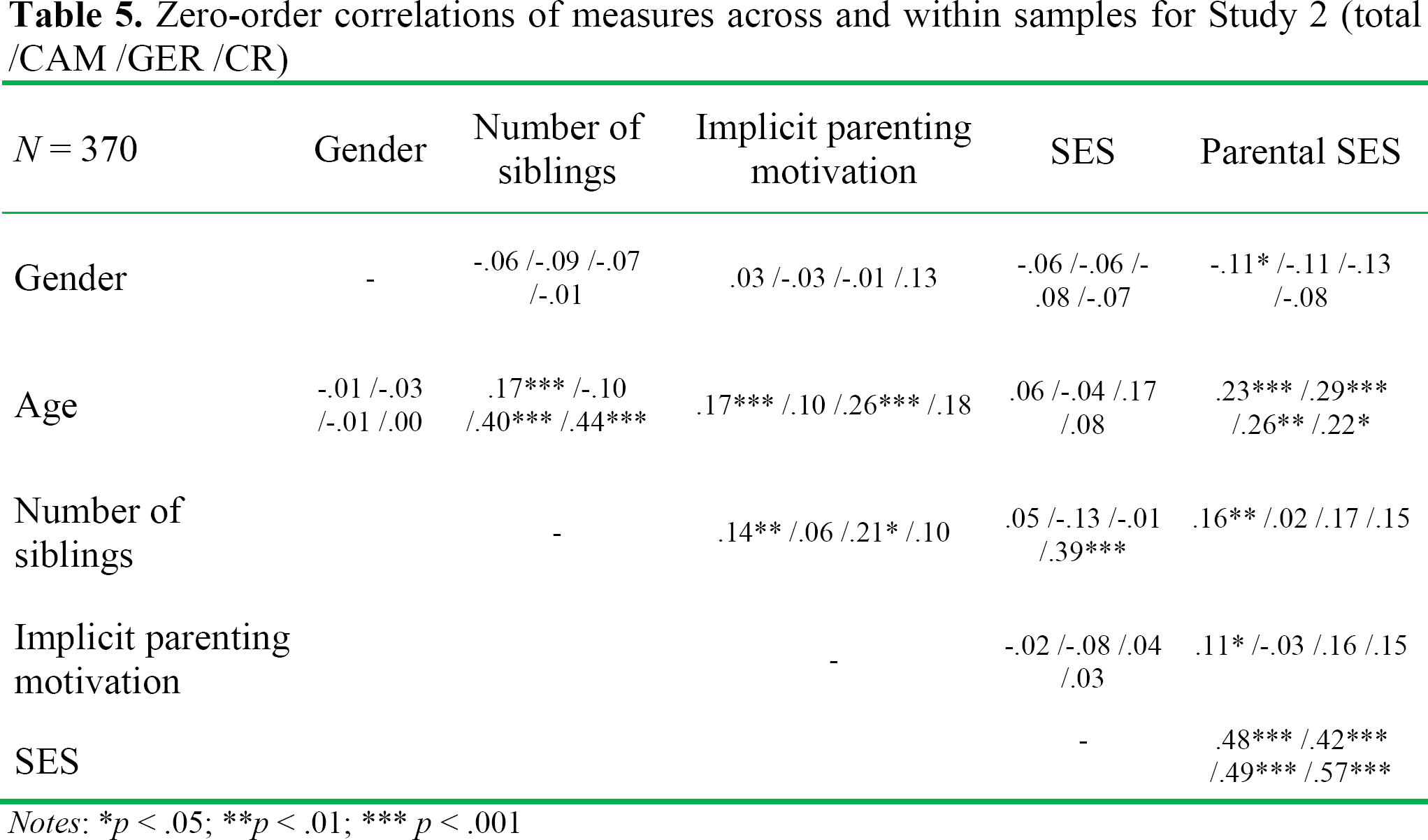
Analyses on the moderating effect of culture. An inspection of the correlations reveals that implicit parenting motivation correlates with parental SES, r(370) = .11, p < .05, but not with current SES, r(370) = −.02, p < .80 (see Table 5). Also, a regression model where both variables were entered simultaneously showed that only parental SES is predictive for implicit parenting motivation (β = .15; p < .05), whereas current SES remains insignificant, β = −.09; p < .20, adjusted R2 = .11, F(2, 370) = 2.76, p < .05. Additionally, implicit parenting motivation correlates significantly with having many siblings, r(370) = .14, p < .01. In short, individuals with many siblings and lower parental SES, but not lower current SES, show higher levels of implicit parenting motivation. To examine if the relationships between implicit parenting motivation and the two childhood context variables number of siblings and parental SES are culturally invariant, we conducted moderated regression analyses (see Table 6).
Zero-order correlations of measures across and within samples for Study 2 (total /CAM /GER /CR)
Notes: *p < .05;
p < .01;
p < .001
Hierarchical regression analyses (simultaneous entry method within blocks): Influence of number of siblings and parental SES on implicit parenting motivation controlling for moderating effects of culture (Study 2; N = 370)

Notes: (*) p < .10;
p < .05;
p < .01;
p < .001; for Culture 1, Cameroon and Costa Rica = 1 and Germany = 0; for Culture 2, Cameroon and Costa Rica = 0 and Germany = 1
In the first block of the linear regression model with number of siblings and parental SES as predictors and implicit parenting motivation as the dependent variable, the childhood context variables number of siblings and parental SES accounted for a small but significant part of the variance (see Table 6). After entering the dummy variables for culture in the second block, the explained variance increased significantly, F(2, 370) = 8.47, p = .001. In the third step of the regression model, we entered the interaction terms of the culture dummy variables and the z-transformed scores of number of siblings and parental SES together with the dummy variables for culture and the number of siblings variable and parental SES as predictors. As Table 6 shows, number of siblings (β = .09; p < .05) and parental SES (β = .17; p < .05) remain significant, whereas the increase in explained variance after entering the interaction terms is insignificant, F(2, 370) = 1.01, p = .30.
Additionally, analyses with an AMOS multi group comparison with three cultural samples also revealed an adequate fit of the relations of these two childhood context variables with implicit parenting motivation, thus indicating the validity of these effects across cultures, χ2 = 3.99, p = .41, df = 4, GFI = 1.00, RMSEA = .000 (see Figure 1). These results demonstrate the culturally invariant influence of number of siblings and parental SES on implicit parenting power motivation.
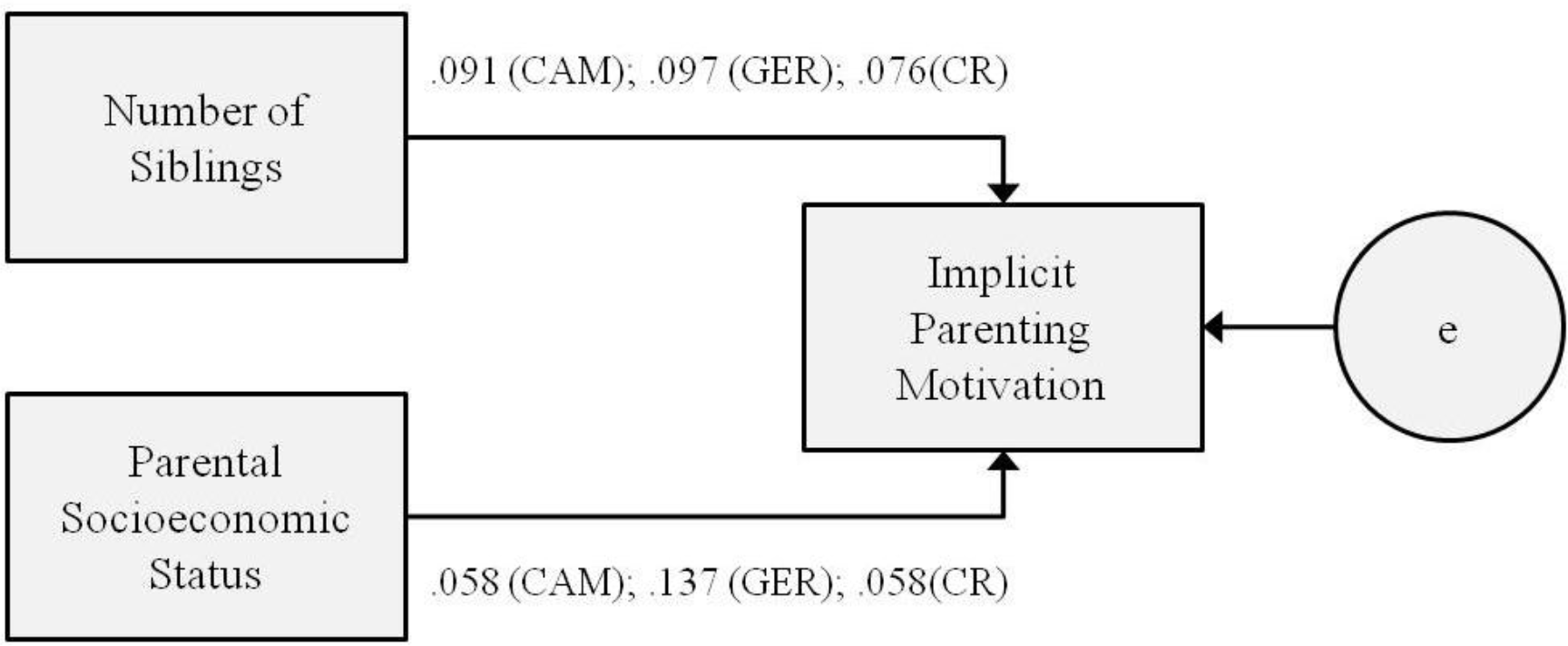
Multi-group comparison model (Study 2) for effects of childhood context variables number of siblings and parental SES on implicit parenting motivation with samples from Cameroon (CAM), Germany (GER), and Costa Rica (CR)
Explaining cultural variance by number of siblings and parental SES. In the next step we assessed the impact of the two childhood context variables on the cultural variance of implicit parenting motivation. After computing the effect size of culture on the dependent variable in an ANOVA (η2 = .063, F(4, 370) = 7.91, p < .001), we extracted the effect of the number of siblings on the dependent variable implicit parenting motivation and computed the residual effect of culture on the particular dependent variable. The effect of culture on the residual without the effect of number of siblings is η2 = .041, F(4, 370) = 7.64, p < .001. Computing the proportion of the two effect sizes shows that the decrease in cultural variance by number of siblings amounts to 35%. Additionally, extracting the effect of parental SES decreases the adjusted effect size even more, η2 = .029, F(4, 370) = 7.28, p > .001. Taken together, 64% of the cultural variance obtained in the samples from Cameroon, Costa Rica, and Germany can be explained by the childhood context variables number of siblings and parental SES.
General Discussion
In this paper, we set out to replicate and extend findings from a previous study with three samples from Cameroon, Costa Rica, and Germany on the effects of number of siblings on implicit parenting motivation (Chasiotis et al., 2006). Summing up, we now have a set of three studies with a total of nine samples – three samples from Africa, one sample from Asia, three samples from Europe, and two samples from Latin America –demonstrating the effect of number of siblings on this implicit measure across cultures. Moreover, in this paper we included parental SES as an additional childhood context variable explaining cultural variance on implicit parenting motivation over and above the effect of number of siblings alone. The fact that current SES does not have an impact on implicit parental motivation demonstrates that these childhood context effects are different from mere ecological or economic determinism, in which the current socioeconomic situation determines psychological outcomes (Allen et al., 2007).
Concerning our results on parental SES, it should be noted that there are not many studies comparing current and childhood SES. In fact, one reason why results are mixed on the predictability of prosocial behavior from SES might be that parental SES has not been taken into account. For example, there seems to be evidence that higher class individuals show lower levels of ethical behavior (Piff et al., 2010, 2013), which is in line with our findings on lower levels of implicit parenting motivation in individuals with an upper class family background. On the other hand, upper class members are also found more often to be volunteers (Wilson, 2000; Wilson and Musick, 1997). From an evolutionary developmental perspective, the closer relation of implicit parenting motivation to the socioeconomic situation during childhood could be explained by the notion of a sensitive period in preverbal childhood during which implicit motives are supposed to emerge (Chasiotis et al., 2010). Future studies should address the impact of implicit motivation and its relation to childhood context variables, like number of siblings and parental SES, in order to further shed light on these mixed findings (Aydinli, Bender, and Chasiotis, 2013).
We suggest that our results should at least have methodological consequences on research design and sample selection by clarifying the importance of controlling for childhood context effects like number of siblings and parental SES. From the perspective of evolutionary developmental psychology, our findings might even point at deferred, age-dependent influences of our childhood context variables, which can be seen as indicators for the notion of early and prepubertal childhood as a sensitive period of preparation for adulthood (Bjorklund and Pellegrini, 2002). Generalizing our results on implicit parenting motivation, the consideration of implicit motives in evolutionary developmental psychology might help to avoid response biases of self-report measures like social desirability (e.g., see Cronk, 1995) and to discover implicit panhuman universals under the surface of observed differences (see Chasiotis, 2011).
Although the present research yielded encouraging results, there are some conceptual and methodological limitations. The most important methodological shortcoming is that we were not able to consider birth order effects in a systematic way, because it was not a part of the research design of our studies, which were mainly based on reanalyzing data sets acquired for a different purpose, namely to establish culture-informed measures of implicit motives (Chasiotis and Hofer, 2003; Hofer, Chasiotis, Friedlmeier, Busch, and Campos, 2005). However, dichotomous comparisons of participants with siblings (first-, middle- and lastborns) and without siblings (only children) or with(out) older (only children and firstborns vs. middleborns and lastborns) or with(out) younger siblings (first- and middleborns vs. lastborns and only children) revealed that the number of siblings accounted for virtually all birth order effects in univariate analyses.
On a conceptual level, it is clear that we might have identified indicators for a sensitive period, but we still do not know much about the underlying mechanisms. If we define a sensitive period as a time during development “when a certain skill or ability can be most easily acquired” (Bjorklund and Blasi, 2012, p. 22), what we could show with our data is only that many siblings and a lower socioeconomic status during childhood is related to higher levels of implicit parenting motivation in adulthood, but not how these context variables are actually leading to a higher implicit motivation. Concerning number of siblings, there are some ideas and empirical hints about how the existence of siblings might lead to the development of implicit parenting motivation in the early years of life (see Bender and Chasiotis, 2011; Chasiotis et al., 2006), but strictly speaking, we can only be sure that this is really the case if we can trace the development of implicit motives (Chasiotis et al., 2010).
Our lack of knowledge of the underlying mechanisms is even bigger regarding the influence of socioeconomic status in childhood. One is inclined to relate that to evolutionary ideas about reproductive strategies mirrored in divergent developmental pathways (Belsky, Steinberg, and Draper, 1991) and their relation to psychological features (Figueredo et al., 2006). But this might not be as straightforward as it seems. If we assume, for example, that a lower level of resources and a higher number of siblings constitute features of a quantitative reproductive strategy, then we would have to assume that this quantitative reproductive strategy leads to higher implicit parenting motivation. On the other hand, high implicit parenting motivation could also be considered as a feature of a highly engaged parent following a qualitative reproductive strategy (features of instruments measuring self-reported inclination for qualitative investment, like the Mini-K for example, can be interpreted that way; see Figueredo et al., 2006).
Based on our findings, one could also speculate about a possible dissociation between explicit and implicit parenting motivation: In the data set of Study 2, we can use the Benevolence scale of the Schwartz Value Scale (SVS; see Schwartz, 1992) as such an explicit measure of prosocial motivation. Interestingly, this scale neither correlates significantly with number of siblings, r(370) = .07, p < .20, nor with parental SES, r(370) = −.01, p < .90. However, within the data set of Study 1, there were effects of number of siblings on the explicit value of conservation across cultures (used as a proxy for an interdependent self-construal, measured with the PVQ scale; see Bender and Chasiotis, 2011). Thus, at least for prosocial motivation, there seems to be a dissociation between explicit and implicit motivational measures and the childhood context variables number of siblings and parental SES, thereby strengthening our argument about the decisive role of the preverbal childhood period for the development of implicit motives. As a cautionary note, the dissociation of implicit and explicit motivation in childhood notwithstanding, explicit motivation can still moderate the relationship between implicit motivation and psychological (e.g. Hofer and Chasiotis, 2003; Chasiotis, Bender, and Hofer, 2013) or reproductive (e.g. Hofer et al., 2010) outcomes.
A straightforward implication of these findings to distinguish between developmental pathways towards a qualitative or a quantitative reproductive strategy could be that the qualitative reproductive strategy relies more on an explicit, reflected notion of parenting motivation, whereas the quantitative reproductive strategy is based on a more intuitive, implicit parenting motivation. But one would then have to speculate about a sort of superposition of the implicit parenting motivation by a more reflective notion on parenting to predict a qualitative reproductive strategy in individuals from higher SES families (e.g., via higher education). Another possibility could be that the association of implicit and reflective parenting motivation to a quantitative and a qualitative reproductive strategy, respectively, might be a matter of degree, since parenting can be a mixture of both: some, mainly spontaneous behaviors may be based on implicit motivation, whereas more planned behaviors might be based on explicit prosocial motivation (Aydinli et al., 2013). More research is badly needed to disentangle these relations (see also Tomasello, 2012).
Limitations notwithstanding, our results on childhood context effects on diverse psychological variables across cultures imply that examining the family context during childhood is a powerful approach for explaining cross-cultural differences in developmental outcomes from an evolutionary perspective rather than a culturalist perspective. Our results complement recent empirical evidence that behavioral variation between populations is driven by environmental differences in demography and ecology rather than cultural norms on behavior (Lamba and Mace, 2011). Thus, context variables like socioeconomic status during childhood and number of siblings can be expected to exert similar systematic influences on somatic, psychological, and reproductive developmental trajectories across different cultural contexts. On the basis of the explanatory power of these childhood context variables for cultural differences in such highly diverse areas as pubertal timing (Chasiotis, Keller, and Scheffer, 2003), social value orientations, autobiographical memory (Bender and Chasiotis, 2011), and implicit parenting motivation (Chasiotis et al., 2006; see Chasiotis, 2011 for discussion), we suggest that many psychological characteristics that are typically attributed to cultural differences may reflect systematic variations in childhood context variables across cultural contexts.
Footnotes
Acknowledgements:
This study was supported by two grants of the German Research Foundation to the first and third author. We would like to thank Domingo Campos, Bame Nsamenang, Vanessa Smith-Castro, and all our research assistants in Cameroon, Costa Rica, Germany, and PR China for their help in data acquisition.