



Abstract
To what extent are personality traits and sexual strategies linked? The literature does not provide a clear answer, as it is based on the Sociosexuality model, a one-dimensional model that fails to measure long-term mating (LTM). An improved two-dimensional model separately assesses long-term and short-term mating (STM; Jackson and Kirkpatrick, 2007). In this paper, we link this two-dimensional model to an array of personality traits (Big 5, Dark Triad, and Schizoid Personality). We collected data from different sources (targets and peers; Study 1), and from different nations (United States, Study 1; India, Study 2). We demonstrate for the first time that, above and beyond STM, LTM captures variation in personality.
Introduction
Jennifer is a peppy, outgoing, and alluring woman. She has been happily married for 10 years. Her husband enjoys spending time with her, as her warmth and lightheartedness evoke positive reactions from him. At the same time, she is frequently approached by other men who are interested in her romantically and sexually. Jennifer is impulsive too, and on occasion, she has had brief extramarital relationships. Actually, she suspects that one of her children was conceived when she was with another man. The case of Jennifer raises some plausible hypotheses about the links between sexual inclinations and personality; for example, this case suggests that extraverts may pursue (consciously or unconsciously) both short-term and long-term romantic relationships.
Discovering these types of links would have several important implications. First, such linkages would have practical consequences for romantic relationships. For example, Jennifer's husband selected a partner who, despite being a joy to spend time with, ended up being unfaithful. Thus, it would have been helpful if he had known how to use personality information to forecast this outcome (for the sake of his emotional health and reproductive success). A second implication is that these linkages would also be intertwined with sexual health. For example, Jennifer may be at an elevated risk for sexually transmitted diseases, and she may even transfer diseases to her unwitting spouse.
How should scientists describe people like Jennifer? It turns out that many words with sexual connotations (“sexy,” “attractive”) were dismissed from the trait literature early in the history of personality psychology, creating a fissure between the sexuality literature and the traditional trait literature (Allport and Odbert, 1936). Luckily, evolutionary psychology has re-captured such words, with a particular focus on those relevant to sexual strategies—the attitudes, behaviors, and desires that constitute the psychological and social aspects of sexuality (Buss and Schmitt, 1993; Gangestad and Simpson, 1990; Penke and Asendorpf, 2008; Snyder, Simpson, and Gangestad, 1986). One aim of this article is to argue that such sexual dimensions are relevant to personality description.
This sexual strategies literature has been through two phases. As Jackson and Kirkpatrick (2007) have pointed out, the first phase is that the modern literature relied heavily on the construct called Sociosexuality (Gangestad and Simpson, 1990; Kinsey, Pomeroy, and Marchin, 1948; Kinsey, Pomeroy, Martin, and Gebhard, 1953; Penke and Asendorpf, 2008; Simpson and Gangestad, 1991). Sociosexuality is a one-dimensional construct that was originally designed to capture restricted and committed sexual relationship orientation (long-term mating; LTM) versus unrestricted and non-committal sexual relationship orientation (short-term mating; STM); high scorers presumably exhibit more STM and less LTM (although recently, researchers have challenged the assumption that STM and LTM are opposites). Sociosexuality has provided a powerful way to characterize human sexual tendencies, and it constitutes a crucial operationalization of sexual inclinations in a literature that had previously been without one. However, we submit that reliance on the construct and the assumptions inherent in the simple model may be impeding an accurate estimate of the associations between personality (e.g., the Big 5) and sexual strategies. The second phase in the history of this literature, to which we turn subsequently, provides a promising model (Jackson and Kirkpatrick, 2007) to overcome the limitations of the primary model of the first phase.
Phase 1: Sociosexuality, A one-dimensional model of sexual strategies
The term Sociosexuality was coined in the middle of the 20th century. It was first discussed by Alfred Kinsey and colleagues (1948; 1953) who interviewed over 10,000 participants about their sexual inclinations. The construct lay dormant until Simpson and Gangestad (1991) described Sociosexuality as follows:
Individuals at one end of this dimension—those who possess a restricted sociosexual orientation—typically insist on commitment and closeness in a relationship prior to engaging in sex with a romantic partner. Restricted individuals claim, for instance, that they need closeness before feeling comfortable with sex, they have had few sexual relationships in the past year, and they rarely if ever have had sex with a partner on one and only one occasion. Conversely, persons at the other end of the dimension—those who exhibit an unrestricted sociosexual orientation—tend to feel relatively comfortable engaging in sex without commitment or closeness. (p. 870)
We have seen in the literature two interpretations of this definition. The first and perhaps most common interpretation is that this model treats people who use STM (unrestricted people) and people who use LTM (restricted people) as opposites, juxtaposing STM and LTM. The origins of the Sociosexuality model were based on the application of economists' Game Theory in biology (Maynard Smith, 1982), which emphasized the plausibility of alternative strategies for evolutionary outcomes—in this case, different mating strategies (Gangestad and Simpson, 1990). The model has been reformulated over the years (Gangestad and Simpson, 2000), yet the notion that STM and LTM are opposites appears to have remained central to the model. A second interpretation of the Sociosexuality model is that it did not explicitly address LTM; that is, Sociosexuality was simply designed to assess STM. Either interpretation of the Sociosexuality model—that STM and LTM are opposites or that LTM is simply not addressed—calls for a reconsideration of the model. The “juxtaposition” interpretation is a risky hypothesis that requires empirical evidence of a strong negative correlation between STM and LTM, whereas the second interpretation begs for a model that explicitly measures LTM.
Phase 2: A multi-dimensional model of sexual strategies
Jackson and Kirkpatrick (2007) demonstrated that STM and LTM are not polar opposites, as evidenced by only a small negative correlation between the dimensions. Moreover, they explicitly measured LTM as a separate dimension. Thus, their research facilitated the second major phase of the sexual strategies literature. In turn, recognition of the limitations of the juxtaposition assumption is spreading. Authors have begun making distinctions between STM and LTM (e.g., Penke and Asendorpf, 2008, Footnote 8). For example, Schmitt and Shackelford (2008) note that “some individuals seek short-term sexual relationships in addition to their long-term relationships” (p. 252). This quote suggests that STM and LTM cannot be opposites. The emerging view is that Sociosexuality primarily captures STM, and does not necessarily capture much of LTM. This pure emphasis on STM can be seen in the original SOI items (Simpson and Gangestad, 1991), such as the item “I can imagine myself being comfortable and enjoying ‘casual’ sex with different partners.” This item—which is solely about STM—may be strongly negatively related to LTM, but that is an empirical question. Accordingly, we follow the lead of other researchers on this matter (Penke and Asendorpf, 2008; Schmitt and Shackelford, 2008): LTM may be statistically distinguishable from Sociosexuality.
One reason that one-dimensional models need to be reconsidered and re-evaluated is that they cannot adequately describe all people; multi-dimensional models provide more descriptive coverage. For example, some people do not pursue either LTM or STM. In fact, Kinsey and colleagues (1948), the creators of the term “Sociosexuality”, discussed those who “are afraid of approaching other persons for sexual relations” (p. 211). These ideas are echoed by Eysenck (1976), who wrote about “sexually dissatisfied” and “low-libido” individuals who have “difficulties in meeting people of the opposite sex and [are] generally precluded from adequate sexual relations” (pp. 231–232). Other examples include celibacy and abstinence, both of which involve the concerted effort to avoid sexual relations. A variety of clinical conditions overlap with these descriptions as well (Beck, 1995; Brotto, 2010; Brotto, Bitzer, Laan, Leiblum, and Luria, 2010), and some of these conditions are emerging as focal points in reproductive health fields (e.g., sexual hypo-arousal).
A very different group of people pursue at least moderate levels of both LTM and STM, which further calls into question the one-dimensional model. Based on their monumental study of human sexual behaviors, Kinsey and colleagues found that 27% of men and 26% of women who were using a LTM strategy (marriage) had reported having sex with an extra-pair partner by age 40 (Kinsey et al., 1948, p. 284; Kinsey et al., 1953, p. 417). Thus, the creators of the Sociosexuality construct demonstrated that LTM and STM may commonly co-occur (see also: Schmitt, 2005). Some people exhibit STM and LTM strategies simultaneously (Broude, 2000). Even if the population correlation of STM and LTM is negative, a multidimensional approach to sexual strategies could reveal the personalities of dual-strategists, whereas a one-dimensional model is incapable of describing these people. If indeed STM and LTM are not opposites, as Jackson and Kirkpatrick (2007) have argued, then this opens up the possibility of assessing STM and LTM separately and then describing the separate dimensions in relation to personality.
The present research
Goals and hypotheses. One of our preliminary goals is to replicate the finding that LTM and Sociosexuality are at least somewhat statistically distinguishable (Jackson and Kirkpatrick, 2007), thereby demonstrating the multidimensional nature of sexual strategies. This is a prerequisite for demonstrating that the two-dimensional model can be useful for personality description. Provided that LTM contributes novel variance to the description of sexual strategies, it is important to determine whether LTM can capture personality variance above and beyond Sociosexuality. We predict that indeed it can.
We offer predictions about specific traits, depicted in the elliptical model in Figure 1. The model is intentionally drawn as elliptical, rather than circular, because we expect to see a negative correlation between STM and LTM—which we predict will be neither too close to 0.00 nor too close to −1.00. The axis extending from the bottom left to the top right is the LTM axis. The axis extending from the bottom right to the top left is the STM axis. The farther away the trait is from the center of the figure, the larger we expect the effects to be in absolute value. For example, we do not expect very large effects for openness, as this trait has not been highly associated with sexual strategies in previous research (Schmitt and Shackelford, 2008). We do, however, expect sizable effects for narcissism, for example (Holtzman and Strube, 2010).

Predicted associations of Long-Term Mating (LTM) and Short-Term Mating (STM) with personality traits
Which traits are related to LTM? Generally, the more likely that a trait facilitates ongoing romantic relationships, the more likely it is that the trait will be related to LTM (Miller, 2007). Miller theorizes that “attractive bodies may elicit short-term desire, but attractive moral traits can elicit long-term love” (p. 97). Thus, pro-social traits like agreeableness (which involves politeness and compassion; DeYoung, Quilty, and Peterson, 2007) should be captured by high LTM, above and beyond the extent to which such traits are captured by low STM (Schmitt and Shackelford, 2008). Conversely, socially aversive traits like psychopathy—which involves traits like impulsivity, shallow affect, deception, and a lack of empathy (Neumann and Hare, 2008)—should capture variance in low LTM, above and beyond the extent to which psychopathy is captured by high STM (Seto, Khattar, Lalumiere, and Quinsey, 1997).
This model also provides the unique opportunity to explore which traits are related positively to both STM and LTM, and which traits are related negatively to both STM and LTM. Indeed, the two-dimensional model is indispensable because the one-dimensional model by definition cannot capture such patterns of effects—instead, the one-dimensional model hides such patterns. The high-STM high-LTM traits would involve flexibly shifting between different types of sexual relationships, which may be feasible for reward-sensitive people who nevertheless create positive social externalities that encourage relationship maintenance. Extraversion may fit this description. It is already known that extraversion is positively associated with STM (Nettle, 2005; Schmitt and Shackelford, 2008; Wright and Reise, 1997). However, extraversion also predicts positive emotions (Larsen and Ketelaar, 1989, 1991; Rusting and Larsen, 1997), and is associated with higher levels of relationship satisfaction (Lopes, Salovey, and Straus, 2003) and marital quality (Donnellan, Conger, and Bryant, 2004)—suggesting that extraverts might be at least moderately skilled at LTM in addition to being skilled at STM.
In contrast, the low-LTM low-STM traits presumably involve indifference about sexual relationships of any type, such as is the case in schizoid personality (Mittal, Kalus, Bernstein, and Siever, 2007). This makes schizoid personality potentially a very interesting trait to explore in the context of LTM and STM—for it is the only trait being assessed that is expected to be negatively related to both LTM and STM. Thus, we explore schizoid personality as well. In sum, the two-dimensional model offers a potential opportunity to reveal unexplored combinations of LTM and STM strategies in relation to personality.
Two potential moderators of the effects: Data source and participant sex. Our findings may very well depend upon other variables. Thus, we explored two possible moderators. First, given the importance of peer reports in pointing out the inaccuracies in self-perceptions (Hofstee, 1994; Vazire and Carlson, 2011), we explored our effects across data sources (self, peers). Peer reports may be particularly useful in this type of study because they reduce the social desirability effects that often influence self-reports (e.g., reports about number of sex partners); researchers have explicitly identified the over-reliance of self-reports as a major problem in this particular literature (Holtzman, Vazire, and Mehl, 2010; Jonason, Webster, Schmitt, Li, and Crysel, 2012). We address that problem here. This approach could provide some important clues about whether some personalities provide inaccurate reports about their sexual strategies.
A second moderator we explored was participant sex; we did not expect to see much moderation by sex because of the unique nature of our analyses. Superficially, one might expect sex to moderate the relationships between personality and sexual strategies because sex differences are often highlighted in evolutionary and cultural psychology (Buss and Schmitt, 1993; Eagly and Wood, 1999). However, mean sex differences—which have been the subject of these lively debates on sex differences—should be sharply distinguished from the within-sex correlations of personality and sexual strategies that we investigate here. We did not necessarily expect to find pervasive sex differences in the correlations between sexual strategies and personality. There is evidence that men pursue STM more readily than women (Clark and Hatfield, 1989), which is a main effect of mean levels, but large studies have shown that the correlations between STM and personality traits are, for the most part, quite similar within men versus within women (Schmitt and Shackelford, 2008). For example, we expected that men and women high in psychopathy would both tend to use STM, even though men typically exhibit higher levels on both of these individual differences (Cale and Lilienfeld, 2002; Clark and Hatfield, 1989). We examined these effects in Study 1 and 2.
Two generalizability concerns. We also explore two possible generalizability issues. One concern is that the effects may not be generalizable to cultures outside of the United States because different social and environmental forces could impact behavior in unique ways, possibly leading to correlations that differ across cultures (Barkow, Cosmides, and Tooby, 1992; Boyd, Richerson, and Henrich, 2011; Gangestad, Haselton, and Buss, 2006; Henrich, Heine, and Norenzayan, 2010). The West—East distinction is one of the most common distinctions in cultural psychology (Nisbett, Peng, Choi, and Norenzayan, 2001). For example, it is already known that, in the Western hemisphere, narcissism is positively associated with STM (Holtzman and Strube, 2011), but perhaps this association is not evident in the Eastern hemisphere. Typically, personality psychologists emphasize the universality of personality structure (e.g., McCrae, Costa, del Pilar, Rolland, and Parker, 1998), but it is important to test this empirically. To explore these types of boundary conditions, we assess participants from one Western nation, the United States (Study 1), and one Eastern nation, India (Study 2).
A second generalizability concern involves the operationalization of the key constructs. Debates are currently taking place about which types of personality assessments should be used to assess major personality traits (Donnellan, Oswald, Baird, and Lucas, 2006; Gosling, Rentfrow, and Swann, 2003; Jonason and Webster, 2010; Yarkoni, 2010). If our model is robust, then it should produce reasonably consistent results regardless of construct operationalizations. We use three methods of assessing the Big 5 personality traits (two in Study 1; one in Study 2), and three methods of assessing the Dark Triad traits (again, two in Study 1; one in Study 2). Thus, we provide an indication of how well the effects replicate across these personality measures.
In sum, we explore data source, target sex, socio-cultural group, and construct operationalizations as variables that could possibly impact the two-dimensional model in relation to personality. This approach will help determine the extent to which our model is robust.
Study 1
In Study 1, we took a multi-method approach to explore the utility of LTM in relation to personality. We created an analogue to the long-term mating measure that Jackson and Kirkpatrick (2007) created. We assessed its reliability, inter-rater consistency (self with peers, as well as peers with peers), and convergence with the measure of Jackson and Kirkpatrick. Then, we assessed the incremental validity of LTM in capturing variance in personality above and beyond Sociosexuality.
Materials and Methods
Design
We used a “one-with many” design. The targets provided self-reports (the “one”) and asked as many as 10 peers (the “many”) to provide reports as well (Kenny, Kashy, and Cook, 2006). The overarching goal was to gather information from multiple sources regarding both sexual strategies and a broad range of personality traits, and thereby reduce the error inherent in any given source of data.
Participants
Data came from both targets and peers. Meta-analysts should note that this data was part of a larger study (Holtzman, 2011; Holtzman, Augustine, and Senne, 2011; Holtzman and Strube, 2013); in the other published studies, the sexual strategy data was not discussed and thus it is novel.
Targets. Two-hundred and nine undergraduate students (56% female; M age = 19.4, SD = 1.22) from a private Midwestern university in the United States participated for 2 hours for partial course credit. The racial composition of the sample was 66% White, 20% Asian, 9% African or African American, and 5% other.
Peers. Because self-reports may elicit biased responses about behavioral tendencies, it is important to gather information from peers as well in order to bolster validity (Hofstee, 1994). Ten specific types of peers were recruited: [1] same sex friend from college, [2] opposite sex friend from college, [3] same sex acquaintance from college, [4] opposite sex acquaintance from college, [5] same sex friend from hometown or high school, [6] opposite sex friend from hometown or high school, [7] same sex acquaintance from home town or high school, [8] opposite sex acquaintance from hometown or high school, [9] current intimate partner, and [10] ex intimate partner. Due to the sparse matrix of peer reports, and the homogeneity of the peers (e.g., in age; see demographics below), we treated the peers as indistinguishable, collapsing peer data per target into an average peer report. This creates a model of the “generalized other” who perceives the target.
A total of 588 peers provided at least some data, and a subset of these peers elected to skip parts of the survey; 405 peers completed the 15-minute survey. This procedure resulted in at least one peer report for 151 unique targets. The mean age of the peers was 20.05 (SD = 1.34), and 57% were female. On average, peers reported knowing their target 3.90 years (SD = 1.83). The mean rating of how well-acquainted the peers were with the targets was 7.28 (SD = 1.03) on a Likert scale from 1 (“not well at all”) to 9 (“very well”).
Personality traits
Table 1 and Table 2 contain information about the individual differences measures.
Descriptive Statistics for Self-Reports from Study 1

Descriptive Statistics for Peer Reports from Study 1
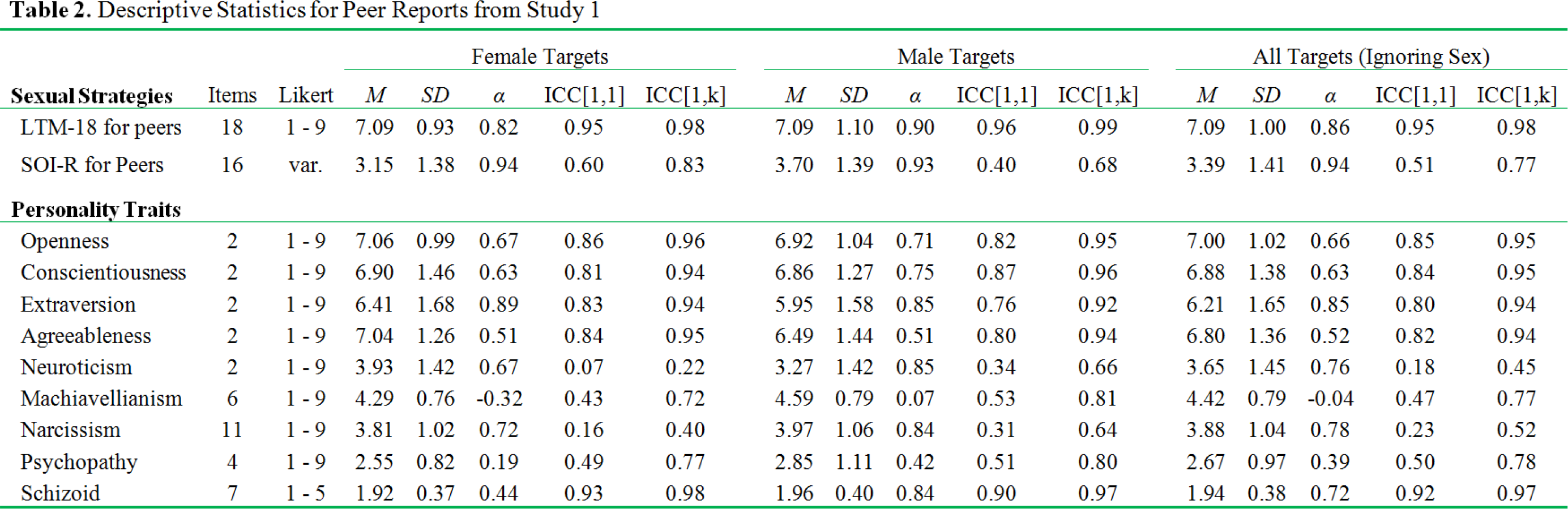
Big 5. Via self-report, we assessed the Big 5 using the Analogue for Multiple Broadband Inventories (AMBI; Yarkoni, 2010) and computed aggregates of the Big 5 across three different inventories for which the AMBI served as an analogue: the NEO Five Factor Inventory (Costa and McCrae, 1992), the Jackson Personality Inventory (Jackson, 1994), and the HEXACO model. These scales yielded good reliability, as shown in Table 1. The AMBI allows items to be used for more than one scale. For example, a particular neuroticism item could be used for the NEO, the Jackson Personality Inventory, and the HEXACO model. Therefore, to avoid alpha inflation, items that were used in multiple scales were entered only once when calculating the alpha coefficients. Peers completed reports about the targets on the Big 5 using the Ten Item Personality Inventory (Gosling et al., 2003).
Dark triad. Targets completed self-reports of the Dark Triad traits using the Mach-IV (Christie and Geis, 1970), the Narcissistic Personality Inventory—40 (Raskin and Terry, 1988), and the Self-Report Psychopathy scale (Paulhus, Neumann, and Hare, in press; Williams, Paulhus, and Hare, 2007). See Table 1 for more information. Because no standard Dark Triad peer report scales existed when these data were collected, we created custom measures of the Dark Triad. The custom measures were designed to use one item to measure each of the six facets of Machiavellianism (McHoskey, Worzel, and Szyarto, 1998; see Table 1), seven facets and four facets of narcissism (Emmons, 1984; Raskin and Terry, 1988), and four facets of psychopathy (Neumann and Hare, 2008). An example of a custom Machiavellianism item is “strategic, manipulative about people.” An example of a custom narcissism item is “has high vanity; is conceited.” An example of a custom psychopathy item is “hurts people, appears reckless.” Items for the custom scales can be obtained from the first author.
Schizoid personality disorder. Due to its theoretical linkage with sexual inclinations (Mittal et al., 2007), we also collected data on schizoid personality disorder, using self and peer versions of the Multi-source Assessment of Personality Pathology (MAPP; Oltmanns and Turkheimer, 2006).
Short-term mating. Among targets, our operationalization of short-term mating was the 9-item Sociosexuality Inventory Revised (SOI-R) self-report form, developed and validated by Penke and Asendorpf (2008). The SOI-R is a revised and expanded version of the Sociosexuality measure by Simpson and Gangestad (1991). A key strength of our study is that we also obtained short-term mating scores of the targets as reported by peers who used a 16-item analogue to the SOI-R, thus answering the call in this literature for multi-source data (Jonason et al., 2012). A sample item from that peer scale is, “would probably be comfortable having a one-night stand.”
Long-term mating. We assessed long-term mating in three ways. Targets completed the 7-item Long-Term Mating Orientation scale developed by Jackson and Kirkpatrick (2007). Targets also completed an 18-item measure developed for this study (in a largely unsuccessful attempt to create a measure of long-term mating that included multiple facets) called the Long-Term Mating 18-item scale (LTM-18). Sample item: “I have had a long-term relationship.” The full scale may be requested. Peers completed a modified version of the LTM-18. A sample peer item is, “is willing to have a long-term sexual relationship.”
Results
Descriptive statistics
Table 1 and Table 2 provide descriptive statistics for self-reports and peer-reports by participant sex, including Likert scale information, means, standard deviations, Cronbach's alphas, and ICCs. Overall, the self-reports exhibited good reliability (average α = .85). The reliabilities of the peer-reports were comparable to other studies that have used similarly brief measures (average α = .64; average ICC[1,1] = .64; average ICC[1,k]] = .82).
Self-peer consistency
The correlations between self-reports and peer-reports were computed by first averaging the peer-reports within targets and then calculating the correlations (n = 151). The correlations were as follows: STM (r = .73), LTM (r = .54; based on the LTM-18 for the self), openness (r = .32), conscientiousness (r = .52), extraversion (r = .58), agreeableness (r = .36), neuroticism (r = .39), Machiavellianism (r = .26), narcissism (r = .48), psychopathy (r = .33), and schizoid personality (r = .37). To obtain overall scores, the self-reports and average peer-reports were first standardized and then the z-scores from the two data sources were averaged to create a composite.
The LTM-18
The LTM-18 exhibited good internal consistency reliability in both the self-report form (α = .83) and peer-report form (α = .86). Inter-rater consistency was substantial for the LTM-18 (r = .54), which bodes well for its validity. The LTM-18 also showed evidence of convergent validity, as the self-report form of the LTM-18 correlated highly with self-reported Long-Term Mating Orientation (r = .73; corrected for unreliability: ρ = .84); this convergence helps to establish the LTM-18 as an alternative form of the Long-Term Mating Orientation scale. Consistent with the results of Jackson and Kirkpatrick (2007), the correlation between STM (self-reported SOI-R) and their measure of LTM (self-reported Long-Term Mating Orientation) was moderate and negative, r = −.24. Similarly, the correlation between STM (self-reported SOI-R) and our measure of LTM (self-reported LTM-18) was moderate and negative, r = −.23. Thus, the inter-correlations among the sexual strategies were largely consistent with our hypotheses and consistent with Jackson and Kirkpatrick's (2007) argument—casting doubt on the notion that STM and LTM are polar opposites.
Incremental validity of the LTM-18
In order to establish the utility of the LTM-18 for capturing personality, we conducted hierarchical multiple regression analyses. The use of this analytic approach should not be construed as indicating that sexual strategies cause personality—indeed the reverse may be true. Future research could explore the causal direction (e.g., with longitudinal methods). Here, we simply employ hierarchical regressions because they facilitate the comparison of the STM-only model to the model that separately assesses STM and LTM.
Table 3 reveals the extent to which the LTM-18 captures variance in personality above and beyond the standard measure of short-term mating, the SOI-R. Step 1 in each regression equation included the SOI-R (self and peer-average collapsed) as the sole predictor and the personality trait as the outcome. Step 2 included the LTM-18 (self and peer-average collapsed).
Hierarchical Multiple Regressions Linking Short-Term Mating and Long-Term Mating to Personality for Study 1

The SOI-R captured a significant amount of the variance in personality. It was especially positively correlated with the Dark Triad—Machiavellianism, narcissism, and psychopathy (rs ≥ .43). It was especially negatively correlated with agreeableness (r = −.48).
As predicted, long-term mating captured a significant amount of the variance in personality above and beyond short-term mating. By using the LTM-18, we obtained a significant improvement in the ability to capture personality variation in general. LTM was especially useful in accounting for variance in extraversion and schizoid personality.
The utility of LTM for describing specific traits
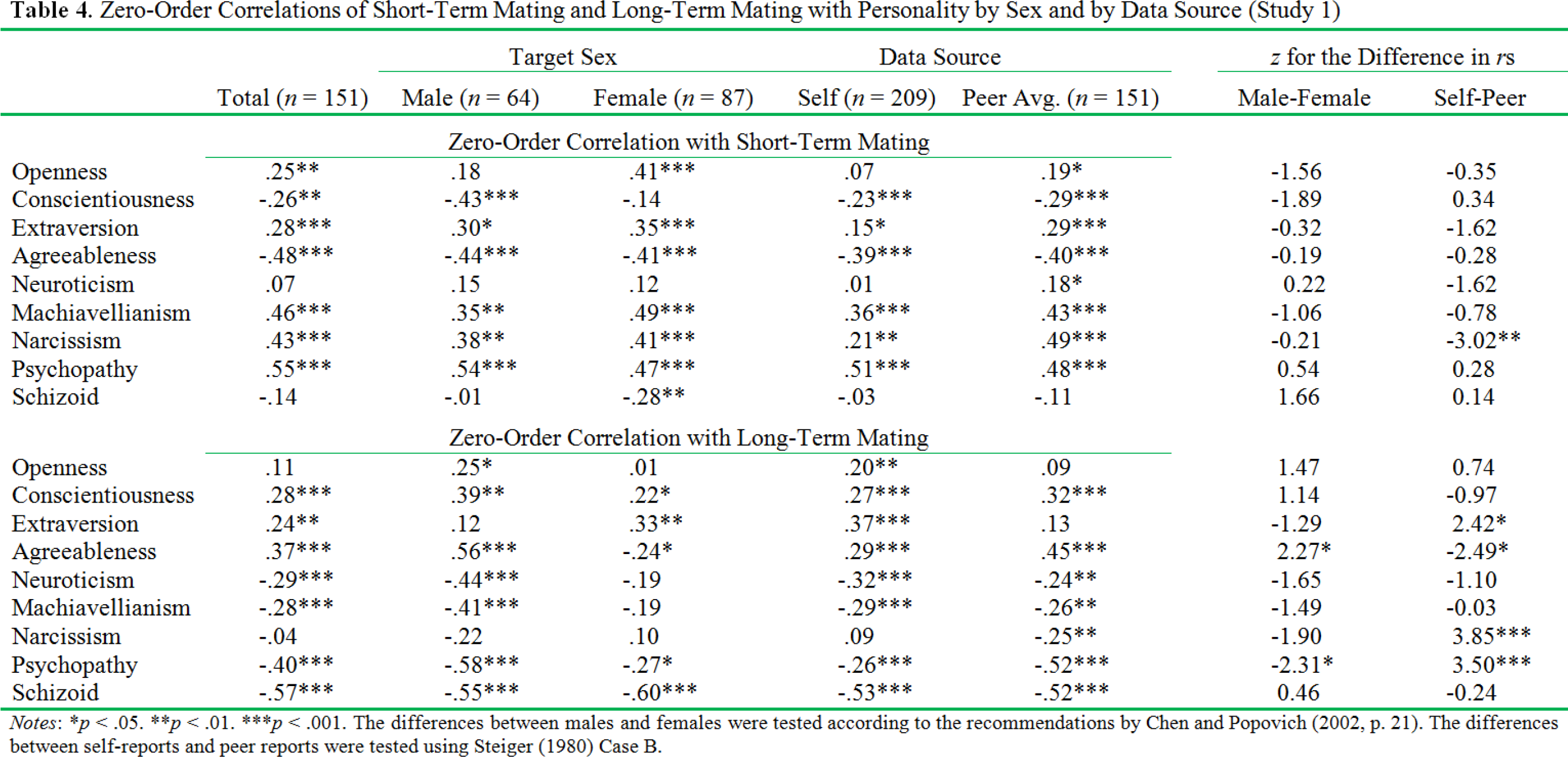
Using LTM in addition to Sociosexuality allowed us to more clearly distinguish some pairs of traits. For example, in the Sociosexuality-only model, psychopathy and extraversion were both positively associated with STM (r = .55, r = .28, respectively). However, in the two-dimensional model, psychopathy was clearly negatively related with LTM (r = −.40), whereas extraversion was positively related to LTM (r = .24). The difference between the zero-order effects was very large (.64). Thus, the two-dimensional model allows for a nice distinction of some traits that are otherwise similar in the one-dimensional model.
Moderators of the links between sexual strategies and personality
In order to explore moderators of the associations between sexual strategies and personality, we ran several tests of significant differences in the correlations. Table 4 depicts the zero-order correlations between sexual strategies and personality by participant sex and by data source. The top part of the table shows the correlations between short-term mating and the personality traits, whereas the bottom part of the table shows the correlations between long-term mating and the personality traits. At the right side of the table are the z-scores of the differences between the r-to-z transformed effect sizes, which capture the extent to which the effects are moderated by participant sex and by data source.
Zero-Order Correlations of Short-Term Mating and Long-Term Mating with Personality by Sex and by Data Source (Study 1)
Notes: *p < .05.
p < .01.
p < .001. The differences between males and females were tested according to the recommendations by Chen and Popovich (2002, p. 21). The differences between self-reports and peer reports were tested using Steiger (1900) Case B.
Moderation by participant sex. To more formally test the comparability of the patterns of effects across participant sex and across data source, we used an extension of correlation analysis that can account for more than one independent variable, bi-dimensional regression (Friedman and Kohler, 2003). This procedure offers a multidimensional variant of column—vector correlations. The correlations from Table 4 were r-to-z transformed, and then submitted to the bi-dimensional regression to determine whether the patterns of effects in the two-dimensional model were similar in men and women. Similarity in the two-dimensional model across sexes was revealed in bi-dimensional regression, r = .84, indicating little moderation overall. Sex-differences in each effect, one-by-one, were explored using Chen and Popovich's (2002) suggestions (see p. 21). Of the 18 effects, two were significant at p < .05, which is roughly consistent with what would be expected by chance alone.
Moderation by data source. Overall, the results were also very similar across sources of data, as revealed by another bi-dimensional regression model, r = .92. Of the 18 effects explored, five were significant, p < .05. Specific differences in correlations due to source of data were tested via Steiger's (1980) Case B (see Chen and Popovich, 2002, p. 24 for further details; Silver, Hittner, and May, 2004). Of these, two were significant at a stringent level, p < .001. Namely, compared to the perceptions provided by self-reporters, perceptions provided by peer reports revealed a more negative association of narcissism and psychopathy with long-term mating. One post-hoc explanation is that such dark personalities deceive themselves about their long-term potential, whereas peers realize that these targets will not thrive in long-term relationships. This finding raises the intriguing possibility that externalizing tendencies may involve intrapsychic phenomena—such as believing in the plausibility that one could be a good long-term partner—that facilitate the creation of a short-lived social persona that deceptively publicizes that the target would make a good long-term mate (Campbell, 2005; von Hippel and Trivers, 2011).
Study 2
In Study 2, we aimed to replicate the results of Study 1 in a culture outside of the Western hemisphere in order to offer a first test of the cross-cultural relevance of LTM to personality, and to further evaluate the elliptical model that connects personality to sexual strategies. India provides a suitable place to test our hypotheses because the culture is very different from the culture in the United States. In line with the classic East/West distinction, India is more collectivistic (Verma and Triandis, 1999). Compared to people in the United States, people in India have unique values (Schwartz et al., 2001) and tend to be Hindu, not Christian. These are just a few of the many differences. Thus, this study allowed us to test our hypothesis that, despite the fact that the Unites States and India are different culturally and despite the fact that the levels of the sexual inclinations and personality traits may differ across cultures, the correlations in the elliptical model are hypothesized to remain largely the same. Concretely, for example, we expected that a psychopathic disposition could be characterized by a positive correlation with STM and a negative correlation with LTM, regardless of whether one lives in the United States or in India. In addition, this study enabled us to explore the degree to which our findings generalize across different personality measures. In sum, Study 2 offered the opportunity to replicate and generalize our findings.
Materials and Methods
Design
This was an Amazon Mechanical Turk (M-Turk) study conducted with people from the nation of India via the internet. Recent evidence suggests that M-Turk can be an excellent source of psychological data (Buhrmester, Kwang, and Gosling, 2011).
Participants
A total of 738 people tried to participate; of these 738 individuals, 551 were ruled eligible according to the following prerequisites: They had to be English-speaking adults, living in India, of Indian race, and they had to transmit their data from a verifiable IP address in India. Of these 551 individuals, 223 provided data that were completely non-random (see definition in the data preparation section). Participants were mostly in their 20s (M = 25.45; SD = 3.39). Participants were compensated $0.60 to $0.75 USD. The study lasted approximately 40 minutes.
Data preparation
To ensure data quality, we created three items that had objectively wrong answers, and if participants responded incorrectly to any one of these items, then their data were discarded from all analyses. For example, one item read, “While responding here, please click the leftmost option.” The results presented below are based on the 223 participants who met this data quality criterion.
Personality traits
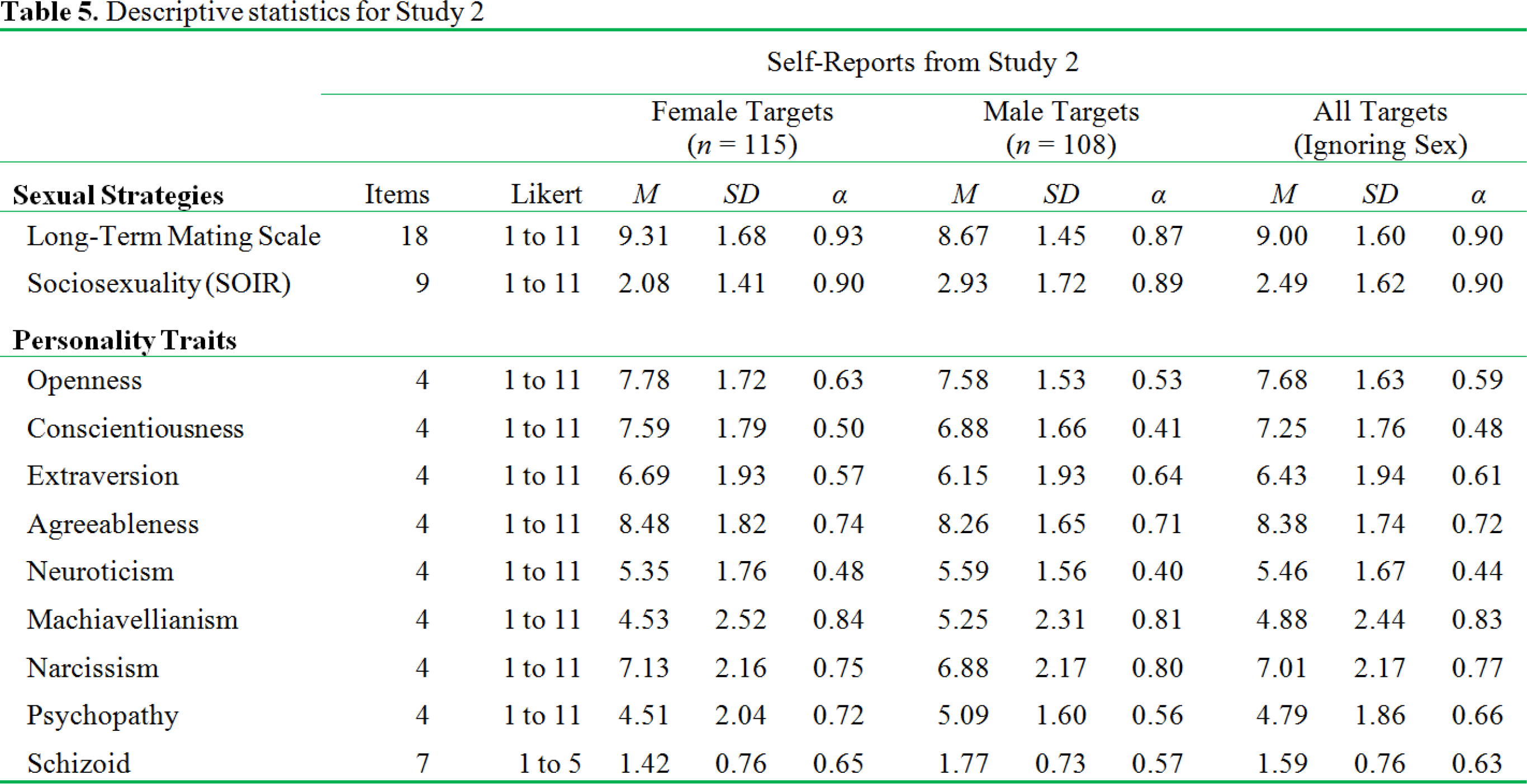
Table 5 contains scale characteristics for the measures used in Study 2. The Big 5 were assessed using the 20-item mini-IPIP scales (Donnellan et al., 2006). The Dark Triad were assessed using the Dirty Dozen scale (Jonason and Webster, 2010). As in Study 1, Schizoid tendencies were assessed using the 7-item scale from the MAPP (Oltmanns and Turkheimer, 2006).
Descriptive statistics for Study 2
Sexual strategies
Short-term mating was assessed using the 9-item self-report version of the SOI-R (Penke and Asendorpf, 2008), which was also used in Study 1. Long-term mating was assessed using a slightly reworded version of the LTM-18 (see Study 1); as an extension of Study 1, we employed this measure instead of Jackson and Kirkpatrick's (2007) LTMO because we were trying to create a multi-faceted measure of Long-Term Mating. However, the multi-faceted variant didn't have good psychometric qualities at the facet-level of analysis, and therefore we do not discuss it further; we recommend that researchers use the LTMO in the future (Jackson and Kirkpatrick, 2007). We did not include the LTMO in Study 2 because, at the outset (but not after further consideration), we felt that the 18-item measure was superior. Nevertheless, the total scores for the LTM-18 are very comparable to the LTMO (see Study 1). For more details on the mating scales, see Table 5.
Results
Descriptive statistics
Table 5 displays the descriptive statistics for the measures used in Study 2, including the means, standard deviations, and Cronbach's alphas. The measures of sexual strategies exhibited good reliability (average α = .90). We used very brief measures of personality traits and thus, unsurprisingly, the traits exhibited modest reliability (average α = .64).
Inter-correlations among the sexual strategies measures
The correlation between short-term mating (SOI-R) and long-term mating (LTM-18) was r = −.54, which is larger in absolute value than it was in Study 1. The multicollinearity in this dataset presents a challenge for our primary thesis because our ability to detect effects for LTM is hampered by its large negative correlation with STM. The key test is whether the LTM-18 provides incremental benefits above and beyond STM.
Incremental validity of long-term mating over short-term mating
Table 6 displays the results of the multiple regressions of STM and LTM, ignoring sex. Even though STM and LTM were highly negatively correlated in this study, LTM still captured significant and unique variance in personality. In step one, as in Study 1, STM captured substantial variance in personality. In step two, on average, LTM more than doubled the personality variance accounted for, above and beyond the variance in personality captured by STM. The LTM dimension accounted for a sizable proportion of the variance in four traits: openness, agreeableness, schizoid personality, and psychopathy.
Hierarchical Regressions Linking Short-Term Mating and Long-Term Mating to Personality based on Study 2 Data

The utility of LTM for differentiating traits
The LTM-18 was particularly useful in distinguishing some pairs of traits. For example (as in Study 1), in the STM-only model, psychopathy and extraversion were largely indistinguishable (r = .28 vs. r = .18, respectively). However, in the two-dimensional model, psychopathy was highly negatively related with LTM (r = −.45, p < .001), whereas extraversion had a near-typical level of LTM (r = −.08, p = n.s.). The difference between the effects for LTM was statistically significant according to Steiger's (1980) Case A (t[220] = 4.71, p < .001). Thus, as in Study 1, the two-dimensional model in Study 2 provided a degree of discriminability that the one-dimensional Sociosexuality model did not provide.
Participant sex as a moderator of the links between sexual strategies and personality
To determine whether the overall patterns of results were similar in men and women, we used the same bi-dimensional regression procedure employed in Study 1; it revealed a high association between the patterns of effects of men and women in Study 2, r = .84, indicating comparability across sex. Table 7 shows the zero-order correlations between sexual strategies and personality, by sex. Even though the analysis showed comparability across the sexes, at the level of single traits, a total of 6 of the 18 sex-differences in correlations were significant. However, none of the significant sex-differences were consistent with those found in Study 1, and therefore we do not elaborate on them here.
Zero-order correlations of short-term mating and long-term mating with personality, by sex, based on Study 2 data

Notes: *p < .05.
p < .01.
p < .001. The difference between males and females was tested according to the recommendations by Chen and Popovich (2002).
Discussion
Study 2 provided a picture of the generalizability of the two-dimensional model to a different culture using different operationalizations of personality constructs. We highlighted the gains to personality description that can be obtained by explicitly modeling LTM. Most of the sex-differences in the correlations between personality and sexual strategies were small; the ones that were not trivial were inconsistent with what we found in Study 1. Thus, the ellipse model appears to be more similar than different in the two sexes. Furthermore, this study replicated the finding from Study 1 that, although psychopathy and extraversion were each positively associated with STM, psychopathy but not extraversion was negatively associated with LTM—helping to differentiate these traits. In sum, these results illustrate how the elliptical model can help connect sexual strategies and personality traits—even in the Eastern hemisphere.
General Discussion
Sociosexuality has been interpreted as either (a) a model that treats short-term mating and long-term mating as polar opposites, or (b) a model of short-term mating by itself—a model that is agnostic about long-term mating. A major goal of our paper was to elucidate the power of long-term mating to complement the Sociosexuality model in its ability to capture personality traits. One prerequisite for attaining this goal, however, was to demonstrate that LTM is not simply the polar opposite of Sociosexuality. Indeed, we found that LTM and Sociosexuality are negatively correlated but not opposites, thus replicating Jackson and Kirkpatrick (2007). Sociosexuality appears to be tapping into STM, but it is not extensively capturing the negative pole of LTM (Schmitt and Shackelford, 2008). By using both STM and LTM, instead of using only STM, we were able to capture almost double the variance in personality. Thus, our model offers a more comprehensive description of the relationships between sexual inclinations and personality traits.
The robustness of these effects was shown across different sources of reports, different personality measures, and different data collection methods. Importantly, we demonstrated the comparability of the basic pattern of effects in different cultures, the United States and India. Thus, although in different nations there may be different levels of personality and different levels of sexual strategies, the correlations between personality and sexual strategies are very similar in the United States and India. Take, for example, the argument that people in the Western hemisphere are particularly narcissistic (this is debated elsewhere; see Donnellan, Trzesniewski, and Robins, 2009; Twenge and Campbell, 2009). Our model is intentionally silent about cross-cultural mean levels of personality traits and sexual strategies, but it explicitly predicts cross-cultural similarities in the correlations between personality and sexual strategies. Our model suggests that, compared to a non-narcissist, a narcissist is more likely to pursue STM, regardless of the culture. Indeed, we found that the correlations between personality and sexual strategies are quite similar across the two cultures we studied (the U.S.A. and India).
The personality traits that sociosexuality (STM) captures
STM did a good job of capturing some personality traits. In our studies, multiple regression models revealed that Sociosexuality captured low agreeableness, low conscientiousness, high extraversion, and high levels of the Dark Triad traits (Machiavellianism, narcissism, and psychopathy). Sociosexuality alone was needed to describe the sexual strategies associated with narcissism, as LTM was not significantly associated with narcissism. In sum, Sociosexuality significantly captures variance in some personality traits, consistent with a number of studies (Foster, Shrira, and Campbell, 2006; Gangestad, Garver-Apgar, Simpson, and Cousins, 2007; Gangestad and Simpson, 1990; Reise and Wright, 1996; Schmitt et al., 2007; Schmitt and Shackelford, 2008; Simpson, Wilson, and Winterheld, 2004).
The personality traits that long-term mating captures
One of our most important findings is that LTM uniquely captures personality above and beyond the extent to which personality was captured by STM (as measured by Sociosexuality). Multiple regression models revealed that, above and beyond the associations of personality with STM, LTM was associated with high agreeableness, high conscientiousness, high openness, low neuroticism, low Machiavellianism, and low psychopathy. Finally, schizoid personality and neuroticism mapped onto the negative pole of LTM but were not significantly associated with the Sociosexuality (STM) dimension. This final point is an important one because research that ignores the LTM dimension would erroneously suggest that traits like neuroticism and schizoid personality are unassociated with sexual strategies.
The personality traits that STM and LTM capture together
As we have discussed, in some cases, STM alone or LTM alone was sufficient to create the sexual strategy profile for a particular trait. For example, narcissism loads primarily onto the positive end of STM, whereas neuroticism loads primarily onto the negative end of LTM. However, some traits are better captured by a model that measures both STM and LTM. In Study 1 and Study 2, Machiavellianism and psychopathy were associated with high STM and low LTM. Also, in both studies, agreeableness and conscientiousness were associated with low STM and high LTM. It is important to emphasize that the Sociosexuality model, by itself, was not capable of capturing these traits as comprehensively as the multidimensional sexual strategies model.
A major strength of the two-dimensional model is that it also allows for identifying those individuals who use both STM and LTM. Extraversion was one of the best exemplars of this dual strategy, as extraverts clearly use STM strategies in addition to at least moderate levels of LTM strategies.
Our data suggest that dual strategy use may be particularly likely among extraverts like Jennifer, whom we described in the introduction. In the United States sample, extraversion correlated with both STM and LTM. In the India sample, extraversion was positively associated with STM and had a near-zero association with LTM. Across the two studies, extraversion was positively associated with both STM and LTM strategies.
The dual strategies of extraverts carry multiple implications and predictions, and it highlights the benefits of a two-dimensional model of sexual strategies. At least in some environments, extraversion may predispose a person to use both STM and LTM, which may lead to infidelity and cuckoldry. Further, having sex outside of one's ongoing LTM relationship may pose a risk to transferring STDs from a short-term partner to a long-term partner. Thus, our elliptical model provides predictions about how people who do not use STM can contract STDs; namely, they form long-term relationships with people (e.g., extraverts) who are more likely to use a plurality of mating strategies. Models that ignore LTM as a separate dimension will be unable to describe people who (a) commit infidelities in the context of an ongoing relationship, (b) cuckold their mates, and (c) transfer STDs to a long-term partner. More generally, models that ignore LTM will not be able to model dual strategy use.
Opposite the dual strategists are those people who tend to avoid sexual and romantic relations (i.e., low STM, low LTM). Schizoid tendencies most clearly fit this profile, consistent with the clinical descriptions of the disorder (Mittal et al., 2007). We speculate that many psychological traits associated with reproductive problems may lie in this section of the model (Keller, 2008; Keller and Miller, 2006), and it will be intriguing to watch as this section of the model is filled-out in the future.
Similarity to other models of personality
Several two-dimensional models of personality (DeYoung, 2006; Digman, 1997; Markon, Krueger, and Watson, 2005) share structural features with our elliptical model—although it is important to emphasize that ours is the only one that delineates the links between sexual strategies and personality. In particular, our model bears resemblance to the Interpersonal Circumplex (Kiesler, 1983; Leary, 1957; Markey and Markey, 2009; Wiggins, 1979). LTM roughly maps onto Communion, whereas STM roughly maps onto Agency (with slight rotation of the axes); we leave it to future research to determine the causal direction of these associations.
Schmitt and Buss (2000) identified a similar two-dimensional model of sexual descriptors, but ultimately these authors favored the “Sexy Seven” dimensions. Our data suggest that these researchers had been grappling with a higher-order two-dimensional structure that we have identified here. Just as in personality psychology (e.g., Markon et al., 2005), the literature on sexual description is likely to have a hierarchy of latent variables, and thus the present model is not a competitor of the Sexy Seven; rather, it probably represents a different level of abstraction.
Limitations and future research
One of the major limitations of this study is that we cannot establish causality; specifically, we cannot state conclusively whether traditional personality traits (operationally defined in our study as the Big 5, the Dark Triad, and Schizoid Personality Disorder) cause sexual strategies, or sexual strategies cause personality. Evolutionarily minded scholars are inclined to argue that reproductive success is of the utmost importance, and therefore reason that sexual individual differences underlie traditional personality individual differences; they argue that traditional traits operate in the service of (and are therefore subservient to) bringing about genetic proliferation. Thus, for example, STM and natural selection for STM cause narcissism. In contrast, developmental psychologists are inclined to point out that many of the traditional traits emerge before puberty when sexual strategies commence, and these trait levels may very well constrain and shape one's sexual strategies. Thus, for example, the narcissistic child eventually develops into someone who uses a STM strategy. One might easily combine these views and argue that traditional personality traits and sexual individual differences reciprocally cause one another. We find all of these perspectives compelling to a degree, and it is left to longitudinal designs to tease apart these fascinating causality questions.
Footnotes
Acknowledgements
We thank Angela Senne, Aaron Weidman, and Tal Yarkoni for their insightful comments on previous drafts.