




Abstract
We test between four separate hypotheses (social gossip, social contracts, mate advertising and factual information exchange) for the function(s) of language using a recall paradigm. Subjects recalled the social content of stories (irrespective of whether this concerned social behavior, defection or romantic events) significantly better than they did ecological information. Recall rates were no better on ecological stories if they involved flamboyant language, suggesting that, if true, Miller's “Scheherazade effect” may not be independent of content. One interpretation of these results might be that language evolved as an all-purpose social tool, and perhaps acquired specialist functions (sexual advertising, contract formation, information exchange) at a later date through conventional evolutionary windows of opportunity.
Introduction
Traditional explanations for the evolution of language have often assumed that the selective advantage of language derives from increased access to information about ecological problems such as the location of food sources, how to make tools, or how to use tools for extractive foraging. Similarly, language users might be able to give one another advance warning of the approach of predators, or plan and co-ordinate hunting strategies better than they could otherwise do without language. Such theories often explicitly assume that language is essentially cooperative and designed to facilitate cooperation (Owren and Rendall, 2001; Tomasello, 2008; Tomasello et al., 2012).
The simplicity of instrumental theories renders them intuitively appealing. However, there are several reasons to think this is a less than satisfactory explanation. First, most of the ecological problems that provide the benefits for language are common to at least some other species. Although many species communicate among themselves about the location of resources (e.g., bees: von Frisch, 1967) or the presence of predators (ground squirrels: Sherman, 1985; monkeys: Seyfarth, Cheney, and Marler, 1980), none has language in any formal sense and none seems any the worse for lacking it. It seems unlikely that humans alone should have needed to develop a form of communication of such sophistication, flexibility and complexity to solve a problem that others cope with quite adequately without the benefit of language.
The suggestion that language might have evolved to allow improved co-ordination for collaborative hunts or to share information about foraging techniques and tools also seems unlikely for the same reason: many species solve exactly this problem without the benefit of language (e.g., hyaena: Kruuk, 1972; chimpanzees: Stanford, Wallis, Mpongo, and Goodall, 1994; hamadryas baboons: Sigg and Stolba, 1981). In humans, studies of conversational content tend to suggest that, in everyday social contexts, most conversations are social rather than instrumental, both in post-industrial (Dunbar et al., 1997; Eggins and Slade, 1997) and traditional (Haviland, 1977) societies. In contrast, hunting is typically done in silence (or only using gestures), and in many cases individuals hunt alone (Smith, 1991).
Alternative hypotheses for the function of language focus on social functions that language might subserve. The “gossip” theory (Dunbar, 1993 1996) argues that language originally evolved to facilitate social communication, and thereby in some way enabled social bonding, in large human communities. Evidence that communicative complexity increases with the size of the social group in both birds (Freeberg, 2006) and primates (Dobson, 2009; McComb and Semple, 2005) offers some support for this claim. An alternative suggestion is that language evolved as a form of signaling in the context of mate choice and sexual selection (the “Scheherazade effect”: Miller, 1999). Miller suggested that language competence is a costly signal (Zahavi, 1975; Zahavi and Zahavi, 1997), and used sex differences in vocabulary size and language style to support the claim that language owed its origins to sexual selection and mate advertising. A third hypothesis (the “symbolic contract hypothesis”: Deacon, 1995) argues that language evolved to allow humans to create social contracts essential to the smooth running of society, including, for example, public contracts of marriage that reduce the risk of mate theft once large groups and the division of labor had evolved. Language allows individuals to label mates as ”spoken for” and thus beyond the pale for general interest. Humans use many conventional signals for exactly this purpose (e.g., wedding rings). More generally, however, explicit as well as implicit contracts are undoubtedly central to humans' ability to cooperate and trade.
Each of these hypotheses recognizes that language may sometimes be used to perform all of these functions, and perhaps more: in other words, they are not wholly mutually exclusive (Dunbar, 2009a). However, they do differ in the way they conceive the evolutionary history of language (i.e., in the sequence by which these various functions were acquired). An important distinction is drawn in evolutionary biology between the primary or original selection pressure for a trait and secondary (derived) selection pressures that may have come into force later and which may have since become important in the maintenance of the trait (for a recent discussion, see Dunbar, 2009b. Sexual selection is often an example, since it can lock onto and exaggerate a trait that evolved for some other purpose. In the context of language, Millikan (1984) referred to this distinction in terms of “direct” and “derived” functions (see also Origgi and Sperber, 2000). These are often difficult to tease apart when we cannot observe the actual evolutionary history of a trait, something that is especially problematic when the trait is of relatively recent origin (in the case of language, no more than ~500,000 years, give or take a bit [Dunbar, 2009a] – and, in the view of some archaeologists, considerably less: see Noble and Davidson, 1996) and no other living species shares the trait, thus making it impossible to undertake comparative analyses.
Our concern here, however, is less ambitious. Instead, we ask simply about the design properties of the cognition that underpins language. We take it for granted that language (and especially grammar) exist to enable us to transmit information efficiently (or, alternatively but equivalently, influence other people's minds: Origgi and Sperber, 2000), and ask whether there is a natural predisposition in our attentiveness to the content of speech that differentiates between the four hypotheses (one instrumental and three social) spelt out above. We use a recall paradigm (cf. Mesoudi, Whiten, and Dunbar, 2006) to do this, on the common assumption that when subjects recall one stimulus better than another, it reflects a combination of greater natural attentiveness and/or implicit interest. We leave open the question as to whether the function(s) identified by the data as most important are primary or secondary (i.e., derived) in an evolutionary sense.
Materials and Methods
The study used a memory-recall paradigm for five short paragraphs with varying content that reflected the hypotheses outlined above: (1) a story that revolved around social relationships (all the characters were of the same sex so that there would be no sexual implications) designed to reflect the social cohesion version of the gossip hypothesis (Social vignette); (2) a story about two friends (both female), one of whom behaved badly towards another to reflect the claim that language relates to social altruism and implicit social contracts (Betrayal vignette); (3) a story that revolved around a romantic relationship between two individuals (a negative version of the gossip hypothesis: Romantic vignette); (4) a story about how to extract honey from a beehive without getting stung to reflect instrumental theories of language function (Ecological vignette); and (5) the same honey story couched in more flamboyant language using longer, multisyllabic, more unusual words to reflect Miller's Scheherazade hypothesis (Flamboyant vignette). In the latter case, we explicitly avoided stories with any sexual or romantic connotations in order to test the claim that it is pure language flamboyance that is at issue, rather than the content itself.
The stories were matched for number of words, sentences, propositions, verbs, adjectives and overall complexity, since these are all known to affect subjects' capacity to remember content (Kintsch, 1974). The paragraphs themselves, and further information as to how the paragraphs were balanced, are given in the Appendix.
Procedure
All participants were given a booklet containing a short questionnaire and the written task. The questionnaire asked participants to provide information about their age, sex, nationality, occupation etc. Participants were then asked to read the story printed on the following page; having done so, they were asked to turn over and on the next page they were asked to write down as much of the story as they could remember, without turning back to see what they had just read. A researcher was always present to ensure that participants did not cheat. Since the study aims to uncover natural memory biases, participants were not informed that the task involved a memory test, but were debriefed afterwards.
The dependent variable was the amount of information remembered from each paragraph. Each paragraph contained 10 main points of information, along with 13 extra details, which added to but were not necessary for an overall understanding of the paragraph. Subjects scored 1 mark for each of the 10 main points they correctly remembered, and 1/2 mark for each extra detail listed, for a maximum score of 16.5 points per story.
Participants
201 participants (101 females and 100 males, mean age = 29.4 ± 11.1 years) were recruited to take part in the study from public places around Oxford. Of these, 137 described themselves as British, 53 as North American or of European descent, and 11 as Asian; 161 stated that they were native English speakers. 48 (48%) of the males were in a romantic relationship, as were 55 (54.5%) of the females.
Results
The results are shown in Figure 1. We first ran a simple GLM analysis comparing social versus factual (environmental) stories, with items recalled as the dependent variable, story type (social vs. environmental) as a fixed factor and sex of participant, whether or not in a romantic relationship and whether or not the participant was a native English speaker as random factors. The overall model was significant, and only story type had a significant effect (story type: F1,196 = 26.64, p < 0.001; sex: F1,196 = 1.75, p = 0.187; relationship status: F1,196 = 1.08, p = 0.301; native speaker: F1,196 = 3.49, p = 0.063). With three and two different stories per story type, this suggests that this is a robust effect since a variety of stories of each type yield the same effect.

Mean (±se) number of items recalled from five different stories representing different functions for language for (a) males and (b) females

(A) Speed of response (secs) and (B) coherence ratings for the five stories, based on a pilot sample of 15 subjects
To explore the differences between story sub-types, we then ran a mixed-design ANCOVA with items recalled as the dependent variable and the same set of independent variables, except that story now has five categories instead of two. There were significant effects of story, sex and relationship on recall, but there was no effect due to language and no sex* relationship status interaction (see Table 1). Examination of the distributions in Figure 1 suggest the broad pattern of response was similar between the two sexes, except that females seemed to differentiate more strongly between the stories than males did: the variance of recall rates across stories is much greater for females than for males (indexed as the magnitude of the F statistic: males, F4,95 = 2.62, p = 0.040; females, F4,96 = 5.59, p < 0.001). Figure 1 also suggests that being in a relationship made subjects of both sexes, but especially women, more sensitive to stories relating to defections, but not to stories about more general social interactions. Recall on both ecological stories was, by comparison, poor for both sexes, and relationship status had very little discernible effect in this case.
Analysis of variance for items recalled as dependent variable
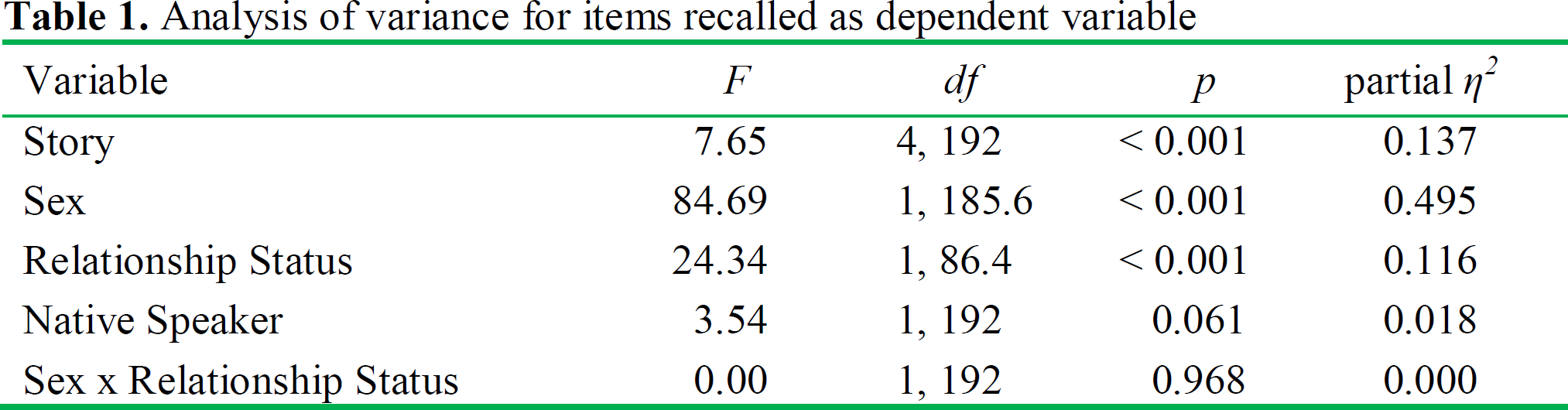
Scheffé post hoc tests comparing stories in a simple ANOVA indicate that, overall, stories 1 (social), 2 (defection) and 3 (romantic) do not differ significantly from each other in recall rates (p ≥ 0.05), but all three of these differ significantly from stories 4 (ecological) and 5 (flamboyant) (p ≤ 0.05), which in turn do not differ significantly from each other (p = 0.343). There was no evidence to suggest that either sex exhibited significant differences between the three social story types (males, F2,60 = 0.17, p = 0.842; females, F2,58 = 1.55, p = 0.222). Treating the stories and sexes separately, comparison of items recalled by those in and those not in a relationship suggests that the only difference that is significant is that for females on the deception story (p = 0.047).
Discussion
Memory for the contents of stories suggests that social contents are remembered better than factual, ecologically related content, mirroring the findings of Mesoudi et al. (2006) on a memory chain (Chinese whispers) task. The differences between the different types of social content were not significant, suggesting that no aspect of sociality is especially privileged in terms of readers' attention to content, although the data do suggest that women may be more sensitive to defection stories when they are in a romantic relationship. The two versions of the ecological story did not differ significantly, indicating that flamboyant language on its own is not an important factor (notwithstanding the possibility that flamboyant language might still be important in the context of explicitly social stories). It seems that ability to use a flamboyant vocabulary does not, of itself, attract enough attention to act as a cue for anything for either sex (although this might reflect the particular language style in the vignette used in this case).
In general, the broad pattern of responses was rather similar between the two sexes, in line with previous research suggesting that there are only limited sex differences in conversational engagement (Mehl, Vazire, Ramírez-Esparza, Slatcher, and Pennebaker, 2007) and conversation content (Dunbar, Marriot, and Duncan, 1997). However, women were more likely to remember details of a story with a betrayal (deception) content when they are in a relationship seems to suggest that women monitor social situations more closely than men do. This could, perhaps, be interpreted as support for the claim that women invest more heavily in relationships than men do (Dunbar, 2009c). However, our deception story explicitly involved only female characters, and it may be that women find other women's doings more interesting than men do for reasons of rivalry. A counterbalanced set of stories with all male and all female characters would be needed to test this properly, but such a design was too demanding for the present study whose focus was on a comparison of different language functions.
In sum, our results suggest that, at least in terms of attention and interest (as indexed by recall), the main function of language in everyday contexts is concerned broadly with the social world, as has been suggested by previous observational studies (Haviland, 1977, Dunbar et al., 1997, Eggins and Slade, 1997) and, more recently, studies of online microblog content (Mickes et al., 2013). This perhaps suggests that specialized functions such as sexual advertising or contract formation (and, indeed, instrumental uses of language) may be derivative, having arisen as a result of windows of opportunity provided by the fact that language exists and has a broadly social function, and that the grammatical structures that facilitate information transfer are neutral as to what kinds of information are transmitted. Finding ways to test this has proved, and may continue to prove, challenging but we clearly need to grapple more seriously with this issue than we have done hitherto. However, the suggestion that language evolved for social reasons and then acquired other functions remains the most parsimonious explanation pending better evidence.
Footnotes
Acknowledgements
RD's research is supported by an Advanced Research Grant from the European Research Council.
Appendix
The five stories each consist of 5 sentences and ~65 words. They each include 29 propositions, 8 verbs, 5 adjectives, 2 adverbs, 3 possessives, 6 circumstance indicators (place or time), 2 causal phrases, 1 negative, 1 concession indicator (“but,” “however”) and 1 conjunction.
To check the balance of the stories, we first ran a pilot (n = 15 subjects) in which we recorded the time needed to read each of the vignettes (since this is also known to influence memorability of text). Subjects in the pilot study were also asked to rate the vignettes for coherence and flow (on a 1-5 Likert scale), and to match them to the topics/hypotheses they were intended to represent. The results indicated that the content of the stories was appropriate (all the raters correctly matched the paragraphs to their putative topics). Although there are significant differences across stories on both response time (F4,74 = 6.77, p < 0.001) and coherence (F4,74 = 3.51, p = 0.011), in fact this is due entirely to the Flamboyant vignette: this differs significantly from all the other stories on response time (Scheffé tests: p < 0.02), and from the Romantic story, but no others, on coherence (Scheffé tests: p < 0.05). No other pairwise comparisons are significant. This may have been due to the fact, in retrospect, that wording in the Flamboyant vignette was somewhat more artificial that that for any of the other stories.