



Abstract
Background
Corcoran (2000, 2001) has suggested that theory of mind judgements can be arrived at using analogical reasoning skills and she has proposed that this is the route that people with schizophrenia take when they make inferences about others' mental states. Recent work has demonstrated a robust relationship between mental state inference and autobiographical memory, providing initial support for the model. This study examines the model further by exploring the assertion that in schizophrenia the ability to infer the mental states of others also depends upon effective social reasoning in conditional contexts.
Method
59 people with a DSM IV diagnosis of schizophrenia and 44 healthy subjects performed four versions of the thematic selection task. The versions varied according to the familiarity and social nature of the material they incorporated. The same subjects also completed the Hinting Task, a measure of theory of mind and tests of intellectual functioning and narrative recall.
Results
The schizophrenia and the normal control groups differed in their performance on all of the measures except that of intellectual functioning. Explorations within the schizophrenia group indicated that social reasoning was most markedly affected in the patients with negative signs and in those with paranoid delusions while for the hinting task, those with negative signs performed significantly worse than those in remission but this difference seemed to be due to these patients' poorer narrative memory. There was evidence in the schizophrenia data to support the hypothesis of a relationship between theory of mind and social conditional reasoning.
Conclusion
This work provided further support for the idea that in patients with schizophrenia at least, judgements about the mental states of others are achieved using analogical reasoning.
Introduction
I. The social reasoning of people with schizophrenia
Many of the characteristic symptoms of schizophrenia reflect alterations in how patients view themselves within their social spheres (Cutting and Murphy, 1990). Biases in reasoning have been reported in association with psychosis for many years (e.g., Von Damarus, 1944; Williams, 1964). More recently, authors have focussed on different types of social reasoning in schizophrenia. Kemp, Chua, McKenna and David. (1997) for example have examined emotive and neutral syllogistic reasoning. Bentall and colleagues have, for many years, examined attributional style in people with paranoid delusions (See Bentall, Corcoran, Kinderman, Blackwood and Howard, 2001 for a review of this work). Probabilistic reasoning has been the focus of Garety and colleagues (e.g., Garety, Hemsley and Wessely, 1991) while other authors have explored probabilistic reasoning biases in people with delusions using salient social material (Dudley, John, Young, Over, 1997; Young and Bentall).
Of particular relevance to the study reported here is the research that continues to accumulate on theory of mind problems in people with schizophrenia. Theory of mind (Premack and Woodruff, 1978) is a term that is now widely used to describe the understanding that our own and other's behaviour is determined by thoughts, beliefs and intentions. Typical empirical tests of this skill use vignettes and require participants to infer what is in the mind of one of the characters in the story. Commonly, an understanding of another's false belief and acts of deception are tested (see Frith and Corcoran, 1996 for example) but the ability to understand pragmatic language where intentions are hidden is an effective way to explore this skill in adult samples (see Corcoran, Mercer and Frith, 1995)
This work began with the publication of Frith's (1992) neuropsychological account of schizophrenia where he argued that difficulty understanding the mental states of other people was central to the formation and maintenance of paranoid delusions. An impairment of this skill was also proposed to underlie some negative and positive behavioural signs. In a series of four studies, Corcoran and Frith attempted to test this hypothesis (Corcoran, Mercer and Frith., 1995; Frith and Corcoran, 1996; Corcoran and Frith, 1996; Corcoran, Cahill and Frith 1997). The initial study in the series supported the hypothesis with the subsequent studies replicating the findings using different paradigms.
Since the original studies, several independent groups have explored theory of mind in schizophrenia and all of them have confirmed problems in this skill in some patients (e.g., Langdon et al. 1997; Sarfati et al., 1997; Doody et al., 1998; Pickup and Frith, 2001, Randell, Corcoran, Day and Bentall, 2003, Greig, Bryson and Bell, 2004).
Corcoran (2000, 2001) has attempted to ‘unpack’ the cognitive components of mental state inference in a way that makes sense of the differential performance seen in people with schizophrenia according to their clinical features. She has proposed that when people attempt to infer another's mental state, they refer initially to autobiographical memory to see if any remembered event can inform the ongoing problem-solving. Any relevant retrieved recollection will form a base from which the inference process will proceed. Reasoning processes will work upon this memory to render a solution suitable to the current situation by considering the relevant conditional or situational variables at play. In other words, this model of mental state inference proposes that people infer other's mental states by retrieving information from episodic memory and reasoning in a conditional manner about the similarities and differences between the memory and the current situation. The model, being an attempt to account for socio-cognitive difficulties in schizophrenia, presents an alternative way of ‘mentalizing’ that is quite different from the modular view of theory of mind dominant in the cognitive neuroscience literature (Leslie, 1994; Frith and Frith, 2003). It does however have some similarities to the simulation model of theory of mind proposed by Harris (1992) which proposes that the appreciation of another's mental state is achieved by imagining oneself in the other's situation.
In work that provides support for this ‘alternative’ model, Corcoran and Frith (2003) found robust correlations between the strength of autobiographical memory retrieval and theory of mind functioning in people with schizophrenia. This study assessed theory of mind using tests of pragmatic language (the hinting task) and stories incorporating false belief and deception. Furthermore, Corcoran (2003) demonstrated a substantial correlation between hinting task performance and an ambiguous sentence comprehension task that required inductive reasoning skills (Corcoran, 2003). Clearly, the performance of people with and without theory of mind difficulties upon a task that explores conditional reasoning within social and non-social contexts and within contexts that are either familiar or unfamiliar will challenge the model further. This challenge is the focus of the current study.
II. Reasoning in familiar or unfamiliar and social or non-social contexts - the thematic selection task
The Wason Selection Task (Wason, 1966) is a card selection task in which the ability of people to reason in a logical fashion is explored. In the original version of this classic deductive reasoning task, the subject is told that each card within a set has a letter on one side and a number on the other. Then the experimenter states that the rule: “If a card has a vowel on one side (p) then it has an even number on the other side (q)” should hold. The subject is then shown one side of 4 cards from the set. The exposed sides show a vowel (card p), a consonant (card not p), an even number (card q) and an odd number (card not q). The subject is then asked to decide which of the 4 cards it would be sufficient to turn over to see if the rule does indeed hold. When the rule is expressed as an ‘if…then…’ statement then the logical choice is always to turn over the card with the vowel on it (card p) and the card with the odd number on it (card not q). Using this original, abstract version of the test, Wason and Johnson-Laird (1972) reported that only 10% or fewer subjects could solve the problem. Most people selected the ‘p’ card correctly but then erroneously selected the ‘q’ card. This choice reflects the confirmation bias (i.e. the tendency to try to confirm a rule rather than disprove it). This is an extremely robust empirical finding in the normal population that has lead to the conclusion that people are extremely poor deductive reasoners.
However, empirical work conducted during the early 1970's seemed to demonstrate that people became more able to solve the selection task problem if it was couched in a familiar context (Wason and Shapiro, 1971; Johnson-Laird, Legrenzi and Legrenzi, 1972). While the task remained a deductive one (since no information other than that which was incorporated into the task was actually needed to solve the problem) the familiarity of the context meant that people could rely upon knowledge gleaned from other sources (i.e. inductive reasoning) to solve the problem. In other words, if subjects had any relevant prior knowledge they would use it, resulting in a performance that was more proficient. This explanation of this ‘content’ or ‘thematic’ effect came to be known as the ‘availability hypothesis’ (Tversky and Kahneman, 1973). It remained relatively unchallenged as an explanation of reasoning facilitation (though it was manipulated and extended by Cox and Griggs (1982) and Griggs (1983)) until the rise of the domain-specific reasoning theories of which one is social contract theory (Cosmides, 1985, 1989). The proponents of social contract theory suggest that ‘Darwinian algorithms’ have evolved enabling more efficient reasoning in situations involving social contracts. For example, the ‘cheater detector’ algorithm enables us to detect the behaviour of others aimed at increasing their own net benefit at the expense of our own. If a selection task content activates this, or another specialized algorithm, then deductive reasoning will be facilitated. The results offered in support of the domain-specific theories are compelling and argue against a straight-forward availability hypothesis. For example, Cosmides (1989) showed that, even when apparently unfamiliar contexts are used, reasoning is still facilitated providing the cheater detector algorithm is invoked. The idea that specialized modules or algorithms exist to help us reason within particular social situations is akin to the notion that a ‘theory of mind’ module has evolved in the human brain, a notion that has received support from imaging studies of this skill (Frith and Frith, 2003; Gallagher an Frith, 2003).
However, it can be argued that the extension or reformulation of the availability hypothesis offered by Griggs (1983) can adequately account for Cosmides's findings. According to Griggs's formulation, the facilitated reasoning for the so-called unfamiliar social contexts arises because we can bring to bear experience that, though not equivalent, is analogous to the context of the thematic selection task problem. In other words, analogical reasoning, or current problem-solving achieved using similar information derived from past experience (Sternberg, 1977), can account for the facilitation effects used to support domain-specific theories. This account of facilitation for social reasoning where specialized modules or algorithms are not evoked, is consistent with the model of theory of mind proposed by Corcoran (2000, 2001) (outlined above).
The aim of this study was to determine whether a relationship exists between theory of mind and social conditional reasoning in a sample of people with schizophrenia some of who will show poor theory of mind performance.
Method
Subjects
Fifty-nine people with a DSM IV diagnosis of schizophrenia were included in this study. The majority of these participants lived independently in the community or in staffed hostels. All but three, were taking antipsychotic medication. Typically these were depot or atypical neuroleptics. Most of the sample was male. Data was also obtained from forty four normal subjects gathered from various sources. These two samples were matched for sex ratio (Chi sq. = 0.87, 1df, ns), age (t(equal variances not assumed) = −1.84, 93.4df, ns) and estimated IQ.(t(equal variances not assumed) = 1.19, 93.4 df, ns) The demographic details of the samples can be seen in Table One.
Demographic Details of the two groups.

The current symptoms of the schizophrenic sample were assessed prior to testing using the Present State Examination (PSE version 9; Wing, Cooper and Sartorius, 1974). Ten participants had prominent negative signs including blunted affect, social withdrawal and poverty of speech. A further ten participants had formal thought disorder without negative signs. Sixteen had paranoid delusions including delusions of persecution, reference, misinterpretation and thoughts being read but no negative signs or thought disorder. Eight described passivity delusions including delusions of control, delusions of influence, thought insertion and thought withdrawal in the absence of paranoid delusions or behavioural signs and fifteen were in remission and reported being well for at least the preceding two weeks.
The Tasks
All subjects performed the 4 tasks described below.
The Thematic Selection Task
Four thematic selection task items were used in the study. The items, the word count and Flesch Reading Ease scores for the stories as well as the instructions given can be seen in the Appendix to this paper. Performance was not time-limited.
The non-social unfamiliar version (NSU) incorporated the conditional rule within a story where it was necessary to check that the correct type of trees had been felled.
The non-social familiar version (NSF). Here the conditional rule is embedded within a story where it was necessary to check that hot taps were fitted with red dots on them.
The social unfamiliar version (SF). In this case the conditional rule is embedded within a story where it is necessary to check whether young men are legitimately joining a tribal dance
The social familiar version (SU). Here the conditional rule is embedded within a story where it was necessary to check whether people are drinking under age.
Scores ranging from 0–2 were computed for social reasoning and non-social reasoning comprising for each the familiar and the unfamiliar form. The amount of facilitation afforded by social contexts for each participant was calculated by subtracting the number of non-social versions correct from the number of social versions correct (i.e., (SF+SU)-(NSF+NSU)). Similarly, the amount of facilitation afforded by familiarity for each participant was calculated by subtracting the number of unfamiliar versions correct from the number of familiar versions correct (i.e. (SF+NSF) − (SU+NSU)).
The Hinting Task
This task, devised by Corcoran et al. (1995), is a simple theory of mind test where the participant must infer the intention behind veiled speech acts. The hints constitute the final speech act of a main character in each of ten very short vignettes. After the stories are read out (stories are available for the participant to read through as many times as necessary), the subject is asked what the character really meant by what he/she said. If an inference is not made or, if an inappropriate conclusion is drawn, more is added to the story in the form of an even more obvious hint. The task has a maximum score of 20 and normal adults tend to score close to ceiling. An item taken from the hinting task is presented in the appendix to this paper.
The Quick Test (Ammons and Ammons, 1962)
This is a measure of word-to-picture matching designed to give an estimate of the level of general functioning expressed as an IQ and based upon the Wechsler Adult Intelligence Scale (Wechsler, 1955). The participant is asked to state for each given word which of four pictures the word goes best with. As such it is a measure that assesses word –knowledge as well as the more ‘fluid’ ability of contextual analysis. The test is an appropriate measure of the kinds of general skill that might be used when answering ToM tests. It is therefore a particularly well- suited measure of general functioning for this study.
Immediate Narrative Recall
The Story Recall subtest from the Adult Memory and Information Processing Battery (Coughlan and Hollows, 1985) was used to assess the ability to recall a short prose passage immediately after hearing it. It is important to assess the potential influence of this ability for two reasons. First, people with schizophrenia are reported to have poor episodic memories. Second, the conditional reasoning task used here loads significantly on narrative memory.
Results
1. Schizophrenia versus normal control comparisons
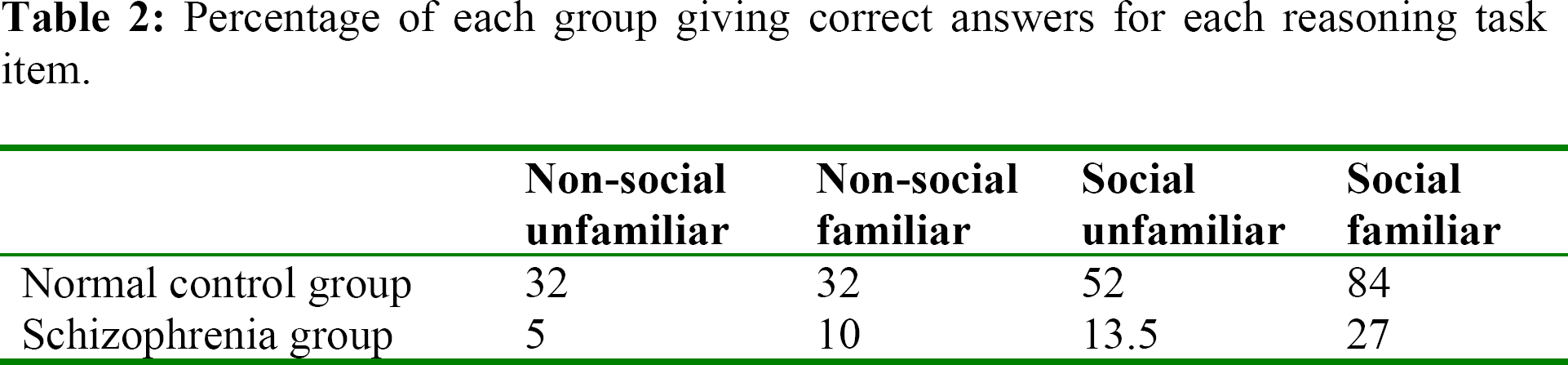
Table 2 provides information about the group performances on the single reasoning task items. Table 3 gives summary scores on background cognitive tasks, the hinting task, social reasoning, non-social reasoning and facilitation afforded by social and familiar contexts for the groups.
Percentage of each group giving correct answers for each reasoning task item.
Summary of Task Performance by the 2 groups – means and (sds) (CRT = conditional reasoning task).
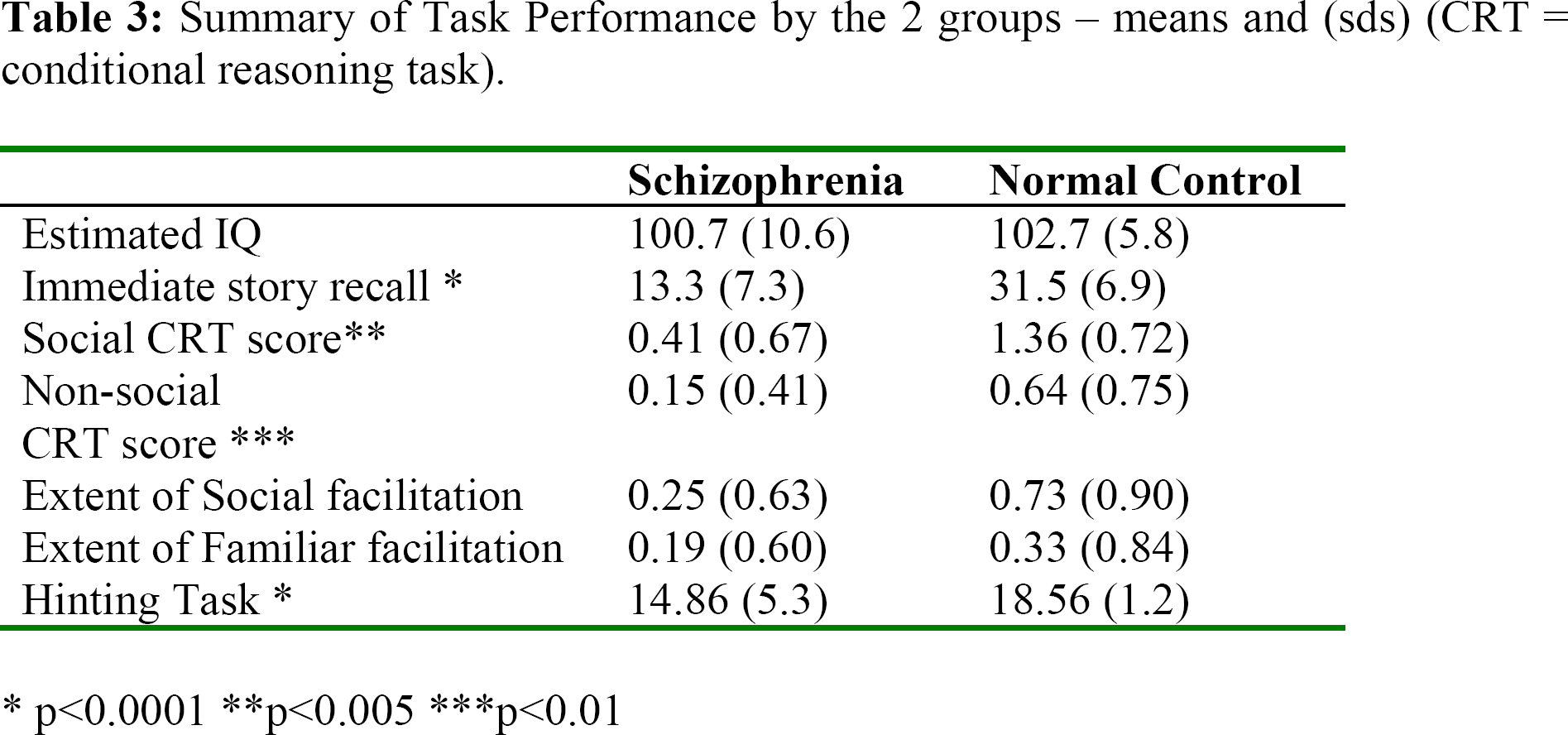
p<0.0001
p<0.005
p<0.01
The results of statistical tests indicated that differences existed on the performance of the experimental tasks between the sample of people with schizophrenia and the normal control sample. Highly significant group differences were found to exist on performance of the hinting task and the narrative recall task with the schizophrenia sample performing poorly compared to the normal controls. (Hinting: t = 5.15, 65.65 df, p<0.0001; story recall: t = 12.81, 101df, p<0.0001). It is clear from Table 2 that the normal control group and, to a lesser extent, the schizophrenia group as a whole perform better on the social versions of the reasoning task than on the non-social versions. Paired sample ‘t’ tests comparing the total score for the social and non-social items confirmed this impression for both groups (normal control t=5.37, 43 df, p<0.0001; schizophrenia t=3.09, 58 df, p<0.005).
To explore the effect of group membership on performance on the thematic selection task items while taking into account differing narrative memory ability, a multivariate analyses of covariance was conducted. This was significant (Wilks' Lambda F(4, 96) = 3.504, p, 0.05). Univariate tests indicated a significant effect of group on the number of the social items answered correctly (F(1,99) = 10.12, p<0.005) as well as the number of non-social items answered correctly (F(1,99) = 7.35, p<0.01). However, no significant effect of group was observed on the extent of facilitation afforded social reasoning (F(1,99) =0.69, ns) or familiar reasoning (F(1,99) = 0.636, ns). In none of these analyses was performance on immediate story recall found to be a significant covariate.
2. Exploring the effects of signs and symptoms in schizophrenia (See Table 4)
Performance on Tasks by the symptom subgroups – means and (sds).

p<0.0001
p<0.05
p<0.005
As outlined earlier, the literature on theory of mind in schizophrenia suggests that some patients have more problems with ToM than others and that this difference may be related to the nature of the signs and symptoms present. In particular, ToM difficulties have been associated with negative signs, thought disorder and paranoia. In order to determine whether symptom specific findings arose in this sample for theory of mind and for social conditional reasoning, the schizophrenia group was divided according to current prominence of signs and symptoms displayed and analyses of variance explored differential effects on the conditional reasoning task and the hinting task. With respect to the conditional reasoning task, one way ANOVAs indicated that symptom subgroup differences existed for social conditional reasoning performance (F(4,54)=3.16, p<0.05) but follow-up post hoc tests were not able to establish where the paired-group differences lay. However, the descriptive data indicated that the largest differences in performance existed between the paranoid group and the group with non-persecutory delusions and this difference approached significance (p=0.058, 2 tailed test). The group with prominent negative features also displayed more markedly poor functioning than those with non-persecutory delusions (p=0.084, 2 tailed test). By contrast no significant group difference was evident for non-social conditional reasoning performance (F(4,54) = 0.37, ns). These analyses were followed-up by a univariate ANCOVA to examine if the symptom subgroup differences in social reasoning survived correction for differences in non-social reasoning, immediate story recall and estimated IQ between the groups. This analysis demonstrated a significant effect of group (F = 2.89, 4df, p<0.05) with estimated IQ (F = 4.23, p<0.05) and performance on non-social reasoning (F = 11.18, p<0.005) significant covariates. Again, post-hoc pair-wise comparisons were not able to illustrate where the significant group differences existed. However, the difference between the estimated marginal means of the paranoid group and the group with non-persecutory delusions was the largest and approached significance (p = 0.08, 2 tailed test). The same approach was used to assess the symptom subgroup differences that existed for the Hinting Task. The one way analysis indicated a significant effect of subgroup on hinting task performance (F(4,54) = 4.43, p<0.005). Post hoc Dunnett's tests demonstrated that the significant difference arose between the group with prominent negative features and those in remission. However, when a univariate ANCOVA was conducted to take into account differences in immediate story recall and any impact of IQ, group differences on hinting task performance did not survive (F = 1.19, 4df, ns). Immediate narrative recall performance had a significant impact on hinting task performance (F = 13.11, p<0.005) but estimated IQ did not (F = 1.12, ns).
There were marked differences in the extent of facilitation afforded by social contexts within the schizophrenia groups as can be seen by the pie charts displayed in Figure 1 (overleaf). It is clear from these that the group of patients in remission as well as the small group with non-persecutory delusions perform most similarly to the normal control group.

Extent of social facilitation in each of the groups
3. Does facilitation for social contexts predict theory of mind performance in the schizophrenia sample? (See Figure 2, overleaf)

Hinting task score in those patients with some or no social facilitation.
According to the model of Corcoran (2000, 2001), there should be a significant positive relationship between facilitation of reasoning for social items and performance on the Hinting Task. To test this hypothesis directly the schizophrenia sample were divided according to whether or not reasoning performance was facilitated by social contexts to any extent. 44 people in this sample were not facilitated at all by social contexts while 15 people were facilitated to some extent (i.e. scored at least 1 point more on social reasoning than on non-social reasoning). Independent ‘t’ tests showed that there were no differences between these groups in terms of estimated IQ (t=−1.07, 57 df, ns) or immediate story recall (t=−1.23, 57df, ns). However, when a one-tailed independent ‘t’ test was carried out on hinting task performance it was found that those whose performance was facilitated by social contexts performed significantly better on the hinting task than those who were not facilitated by these contexts (t) = −1.78, 57 df, p<0.05, 1 tailed test). A series of Chi square tests in which the schizophrenia group was divided into high (15 or above) and low (14 or below) scorers on the hints supported the above finding. In these analyses the only significant association was between classification on the ToM task and the answer given to the social familiar item (Chi sq = 4.26, p<0.05) with the low scorers on the ToM task being more likely to answer this item incorrectly. Neither the social unfamiliar item nor the two non-social items discriminated the groups successfully as most of the patients answered these incorrectly.
Discussion
The main findings reported here have demonstrated three things. First, it is clear that some people with schizophrenia have difficulty inferring the intention behind indirect speech acts, thus replicating, the findings of Corcoran et al. (1995). This is an important replication since the sample of people with schizophrenia included in this study were, on the whole, less severely ill than those sampled by Corcoran et al. (1995). Second, the findings indicate that some people with schizophrenia are markedly dissimilar to normally-functioning adults in the extent to which their reasoning is facilitated by social contexts. Finally, the extent of facilitation afforded social reasoning and the performance on the Hinting Task in the schizophrenia sample appear to be related. This is demonstrated by the fact that difficulties with these skills arise in association with the same symptoms and it is also supported by statistical analyses.
There are two ways of interpreting the superiority for social reasoning that all normal adults demonstrate. The first, social contract theory, advocates the existent of a specialized brain module and is therefore consistent with the suggestion that ToM is also accomplished by a (possibly the same) specialized module. The second way to explain this superiority for social reasoning is to argue that in both social and non-social situations we attempt to reason inductively by drawing on analogous information to inform our reasoning. The difference is explained by the fact that for social situations we have plenty of relevant material to draw upon while for non-social settings our resource of analogous information is much more limited and therefore of much less use. This argument amounts to the notion that all normally-functioning adults are expert social reasoners but novice non-social reasoners simply because they have plentiful experience of the former (Evans, 1984). This proposal about social reasoning is consistent with the alternative model of theory of mind proposed by Corcoran (2000, 2001). Taken in isolation, the data collected for this study was not able to inform this debate. However, the earlier work by Corcoran and Frith (2003) showing a substantial correlation between strength of autobiographical retrieval and theory of mind performance strongly suggests that these skills draw upon the same information processes. Similarly, Corcoran (2003) demonstrated substantial correlations between performance on the hinting task and a test of inductive problem solving. Taken together, these recent findings provide evidence in support of the notion that theory of mind judgments in people with schizophrenia are accomplished using a form of inductive or analogical reasoning. Whether or not the same can be said about the manner in which normal adults make theory of mind judgments is a matter for clarification. However, this type of explanation works very well for people with an enduring condition that has a significant impact upon social functioning. When social functioning is restricted, then the store of analogous information will be small as a result. This explanation will therefore apply equally as well to people with autism or Asperger's syndrome as it does to people with chronic schizophrenia.
It is of course possible that theory of mind judgments are accomplished in a different ways by those with schizophrenia and by normally functioning adults. It may be that the development of and reliance upon a specialized module is the default system of the normally developing brain. Perhaps in schizophrenia (and also in autistic spectrum disorders) a course of anomalous central nervous system development prevented the development of the specialized module or, that this devoted system functions normally during periods of remission but malfunctions during acute states of illness. What is clear however, is that this interpretation of the data from people with schizophrenia is compatible with the idea that in the normal course of events, ‘theory of mind’ judgments are achieved by a specialized module. In some people with schizophrenia this module becomes defective, making it necessary to draw upon general cognitive skills such as memory and conditional reasoning to draw conclusions about others mental states.
There were two significant limitations of this study. The first is associated with the symptom subgroup analyses which would have been more compelling had larger numbers been collected in each group. The second is the fact that only two versions of social and non-social conditional reasoning were used. Had more versions been incorporated, the findings may have been stronger. Any attempts to replicate these findings should take these considerations into account and should focus on establishing the methods and quality of inductive reasoning in people with psychosis and in further establishing the relationship that this type of reasoning has with theory of mind ability in both clinical and non-clinical groups.
Footnotes
Acknowledgements
This work was supported by a grant awarded to the authors by the Wellcome Trust (ref046366/Z/95). Many mental health care teams in and around London and Liverpool enabled this work. We are grateful to everyone who helped with data collection. Finally, many thanks to those who participated in the study.
Appendix
The four versions of the thematic reasoning test and an example taken from the Hinting task.